

ISO/TS 19321:2024
(Main)Intelligent transport systems — Cooperative ITS — Dictionary of in-vehicle information (IVI) data structures
General Information
- Abstract
This document specifies the in-vehicle information (IVI) data structures that are required by different intelligent transport system (ITS) services for exchanging information between ITS stations (ITS-S). A general, extensible data structure is specified, which is split into structures called containers to accommodate current-day information. Transmitted information includes IVI such as contextual speed, road works warnings, vehicle restrictions, lane restrictions, road hazard warnings, location-based services and re-routing. The information in the containers is organized in sub-structures called data frames and data elements, which are described in terms of their content and syntax. The data structures are specified as communications-agnostic. This document does not provide the communication protocols. This document provides scenarios for usage of the data structure, e.g. in case of real time, short-range communications.
- Status
- Published
- Publication Date
- 04-Jul-2024
- Technical Committee
- ISO/TC 204 - Intelligent transport systems
- Drafting Committee
- ISO/TC 204 - Intelligent transport systems
- Current Stage
- 9092 - International Standard to be revised
- Start Date
- 06-Jun-2025
- Completion Date
- 29-Aug-2026

Overview
ISO/TS 19321:2024 - Intelligent transport systems - Cooperative ITS - Dictionary of in-vehicle information (IVI) data structures defines a general, extensible set of in-vehicle information (IVI) data structures for exchanging IVI between ITS stations (ITS‑S). The technical specification standardizes how contextual information (e.g., contextual speed, road works, vehicle and lane restrictions, hazards, location‑based services, re‑routing) is organized into containers, data frames and data elements. The data structures are specified as communications‑agnostic (the document does not define transport or protocol layers) and includes usage scenarios such as real‑time short‑range communications.
Key topics and technical requirements
- Structural model: a general model split into conceptual zones to accommodate current and extensible IVI content.
- Location referencing: supports both geographic and map‑based location referencing for precise IVI exchange.
- IVI Containers: predefined container types including Management, Location (Geographic/Map), and Application containers (General IVI, Road Configuration, Text, Layout, Automated Vehicle, Road Surface, Infrastructure Support, etc.).
- Data frames and elements: detailed descriptions of frames such as AbsolutePosition, Segment, LaneInformation, RoadSurfaceDynamicCharacteristics and numerous data elements that define content and syntax.
- Communications‑agnostic design: structures meant for use over multiple transport protocols - the specification does not mandate communication protocols.
- Usage scenarios: examples for real‑time, short‑range use cases and other ITS service contexts.
Applications
ISO/TS 19321:2024 is intended to harmonize IVI content exchange across ITS ecosystems to support interoperable Cooperative ITS services:
- Real‑time driver information and warnings (hazards, road works, speed context).
- Vehicle‑to‑infrastructure and vehicle‑to‑vehicle IVI exchange for lane/vehicle restrictions and re‑routing.
- Map providers and navigation services integrating standardized IVI content.
- Automated driving and platooning support where vehicle characteristics and rules are shared.
- Traffic management centers and road authorities distributing authoritative IVI.
Who will use this standard
- Automotive OEMs and Tier‑1 suppliers (IVI/ADAS systems)
- ITS system architects and integrators
- Map and location data providers
- Road operators and traffic management authorities
- App developers and service providers building cooperative ITS services
Related standards
The document references data elements and coding concepts that align with other ITS standards (e.g., ISO references such as ISO 14823 appear in the data frames). Because ISO/TS 19321 is communications‑agnostic, it is commonly used together with protocol and transport standards when implementing complete Cooperative ITS solutions.
Keywords: ISO/TS 19321:2024, Cooperative ITS, IVI data structures, in‑vehicle information, ITS services, location referencing, IVI containers, data frames, data elements, communications‑agnostic.
Relations
- Effective Date
- 12-Feb-2026
- Effective Date
- 06-Jun-2022
Get Certified
Connect with accredited certification bodies for this standard

BSI Group
BSI (British Standards Institution) is the business standards company that helps organizations make excellence a habit.

TÜV Rheinland
TÜV Rheinland is a leading international provider of technical services.

TÜV SÜD
TÜV SÜD is a trusted partner of choice for safety, security and sustainability solutions.
Sponsored listings
Frequently Asked Questions
ISO/TS 19321:2024 is a technical specification published by the International Organization for Standardization (ISO). Its full title is "Intelligent transport systems — Cooperative ITS — Dictionary of in-vehicle information (IVI) data structures". This standard covers: This document specifies the in-vehicle information (IVI) data structures that are required by different intelligent transport system (ITS) services for exchanging information between ITS stations (ITS-S). A general, extensible data structure is specified, which is split into structures called containers to accommodate current-day information. Transmitted information includes IVI such as contextual speed, road works warnings, vehicle restrictions, lane restrictions, road hazard warnings, location-based services and re-routing. The information in the containers is organized in sub-structures called data frames and data elements, which are described in terms of their content and syntax. The data structures are specified as communications-agnostic. This document does not provide the communication protocols. This document provides scenarios for usage of the data structure, e.g. in case of real time, short-range communications.
This document specifies the in-vehicle information (IVI) data structures that are required by different intelligent transport system (ITS) services for exchanging information between ITS stations (ITS-S). A general, extensible data structure is specified, which is split into structures called containers to accommodate current-day information. Transmitted information includes IVI such as contextual speed, road works warnings, vehicle restrictions, lane restrictions, road hazard warnings, location-based services and re-routing. The information in the containers is organized in sub-structures called data frames and data elements, which are described in terms of their content and syntax. The data structures are specified as communications-agnostic. This document does not provide the communication protocols. This document provides scenarios for usage of the data structure, e.g. in case of real time, short-range communications.
ISO/TS 19321:2024 is classified under the following ICS (International Classification for Standards) categories: 35.240.60 - IT applications in transport; 43.040.15 - Car informatics. On board computer systems. The ICS classification helps identify the subject area and facilitates finding related standards.
ISO/TS 19321:2024 has the following relationships with other standards: It is inter standard links to CEN ISO/TS 19321:2024, ISO/TS 19321:2020. Understanding these relationships helps ensure you are using the most current and applicable version of the standard.
ISO/TS 19321:2024 is available in PDF format for immediate download after purchase. The document can be added to your cart and obtained through the secure checkout process. Digital delivery ensures instant access to the complete standard document.
Standards Content (Sample)
Technical
Specification
ISO/TS 19321
Third edition
Intelligent transport systems —
2024-07
Cooperative ITS — Dictionary of
in-vehicle information (IVI) data
structures
Systèmes intelligents de transport — Coopérative STI —
Dictionnaire de structures de données d'informations dans les
véhicules (IVI)
Reference number
© ISO 2024
All rights reserved. Unless otherwise specified, or required in the context of its implementation, no part of this publication may
be reproduced or utilized otherwise in any form or by any means, electronic or mechanical, including photocopying, or posting on
the internet or an intranet, without prior written permission. Permission can be requested from either ISO at the address below
or ISO’s member body in the country of the requester.
ISO copyright office
CP 401 • Ch. de Blandonnet 8
CH-1214 Vernier, Geneva
Phone: +41 22 749 01 11
Email: copyright@iso.org
Website: www.iso.org
Published in Switzerland
ii
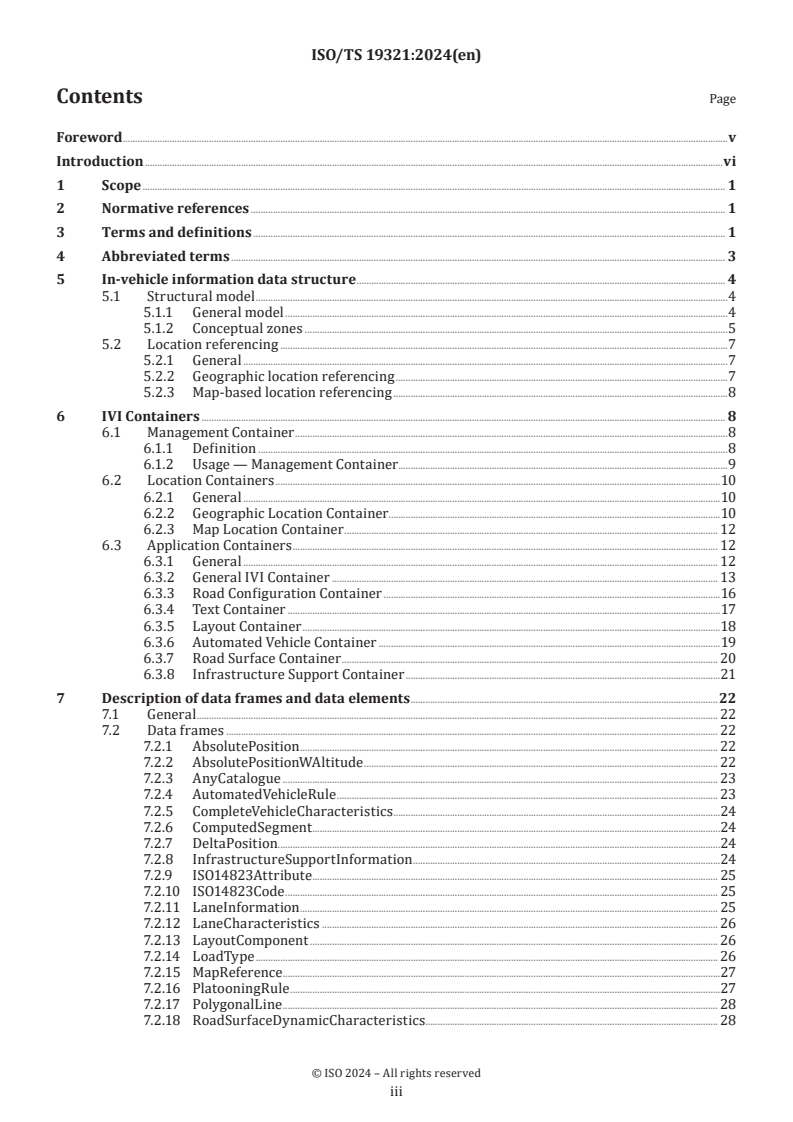
Contents Page
Foreword .v
Introduction .vi
1 Scope . 1
2 Normative references . 1
3 Terms and definitions . 1
4 Abbreviated terms . 3
5 In-vehicle information data structure . 4
5.1 Structural model .4
5.1.1 General model .4
5.1.2 Conceptual zones .5
5.2 Location referencing .7
5.2.1 General .7
5.2.2 Geographic location referencing .7
5.2.3 Map-based location referencing .8
6 IVI Containers . 8
6.1 Management Container .8
6.1.1 Definition .8
6.1.2 Usage — Management Container .9
6.2 Location Containers .10
6.2.1 General .10
6.2.2 Geographic Location Container.10
6.2.3 Map Location Container . 12
6.3 Application Containers . 12
6.3.1 General . 12
6.3.2 General IVI Container . 13
6.3.3 Road Configuration Container .16
6.3.4 Text Container .17
6.3.5 Layout Container .18
6.3.6 Automated Vehicle Container .19
6.3.7 Road Surface Container . 20
6.3.8 Infrastructure Support Container .21
7 Description of data frames and data elements .22
7.1 General . 22
7.2 Data frames . 22
7.2.1 AbsolutePosition . 22
7.2.2 AbsolutePositionWAltitude . 22
7.2.3 AnyCatalogue . 23
7.2.4 AutomatedVehicleRule . 23
7.2.5 CompleteVehicleCharacteristics .24
7.2.6 ComputedSegment .24
7.2.7 DeltaPosition . . .24
7.2.8 InfrastructureSupportInformation .24
7.2.9 ISO14823Attribute . . 25
7.2.10 ISO14823Code . 25
7.2.11 LaneInformation . 25
7.2.12 LaneCharacteristics . 26
7.2.13 LayoutComponent . 26
7.2.14 LoadType . 26
7.2.15 MapReference .27
7.2.16 PlatooningRule .27
7.2.17 PolygonalLine . 28
7.2.18 RoadSurfaceDynamicCharacteristics . 28
iii
7.2.19 RoadSurfaceStaticCharacteristics . 28
7.2.20 RSCode . . 29
7.2.21 Segment . 29
7.2.22 SegmentExtended . 29
7.2.23 SupportItem . 30
7.2.24 Text . 30
7.2.25 TractorCharacteristics . 30
7.2.26 TrailerCharacteristics. 30
7.2.27 TrainCharacteristics .31
7.2.28 VcCode.31
7.2.29 VehicleCharacteristicsFixValues .31
7.2.30 VehicleCharacteristicsRanges .32
7.2.31 Zone .32
7.2.32 Data frames which are lists .32
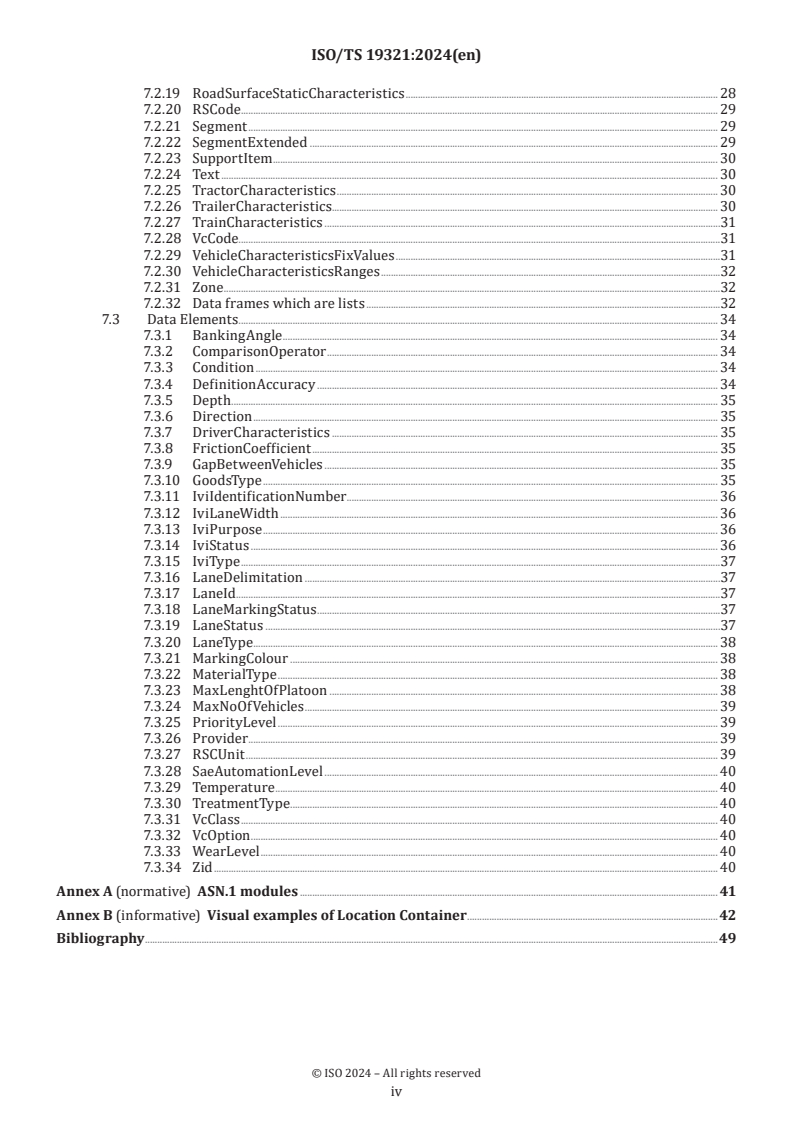
7.3 Data Elements . . 34
7.3.1 BankingAngle . 34
7.3.2 ComparisonOperator . 34
7.3.3 Condition . 34
7.3.4 DefinitionAccuracy . 34
7.3.5 Depth . . 35
7.3.6 Direction . 35
7.3.7 DriverCharacteristics . 35
7.3.8 FrictionCoefficient . 35
7.3.9 GapBetweenVehicles . 35
7.3.10 GoodsType . 35
7.3.11 IviIdentificationNumber . . 36
7.3.12 IviLaneWidth . 36
7.3.13 IviPurpose . 36
7.3.14 IviStatus . 36
7.3.15 IviType .37
7.3.16 LaneDelimitation .37
7.3.17 LaneId .37
7.3.18 LaneMarkingStatus .37
7.3.19 LaneStatus .37
7.3.20 LaneType . . . 38
7.3.21 MarkingColour . 38
7.3.22 MaterialType . 38
7.3.23 MaxLenghtOfPlatoon . 38
7.3.24 MaxNoOfVehicles . 39
7.3.25 PriorityLevel . 39
7.3.26 Provider . 39
7.3.27 RSCUnit . 39
7.3.28 SaeAutomationLevel . 40
7.3.29 Temperature . 40
7.3.30 TreatmentType . . . 40
7.3.31 VcClass . 40
7.3.32 VcOption . 40
7.3.33 WearLevel . 40
7.3.34 Zid . 40
Annex A (normative) ASN.1 modules . 41
Annex B (informative) Visual examples of Location Container .42
Bibliography .49
iv
Foreword
ISO (the International Organization for Standardization) is a worldwide federation of national standards
bodies (ISO member bodies). The work of preparing International Standards is normally carried out through
ISO technical committees. Each member body interested in a subject for which a technical committee
has been established has the right to be represented on that committee. International organizations,
governmental and non-governmental, in liaison with ISO, also take part in the work. ISO collaborates closely
with the International Electrotechnical Commission (IEC) on all matters of electrotechnical standardization.
The procedures used to develop this document and those intended for its further maintenance are described
in the ISO/IEC Directives, Part 1. In particular, the different approval criteria needed for the different types
of ISO document should be noted. This document was drafted in accordance with the editorial rules of the
ISO/IEC Directives, Part 2 (see www.iso.org/directives).
ISO draws attention to the possibility that the implementation of this document may involve the use of (a)
patent(s). ISO takes no position concerning the evidence, validity or applicability of any claimed patent
rights in respect thereof. As of the date of publication of this document, ISO had not received notice of (a)
patent(s) which may be required to implement this document. However, implementers are cautioned that
this may not represent the latest information, which may be obtained from the patent database available at
www.iso.org/patents. ISO shall not be held responsible for identifying any or all such patent rights.
Any trade name used in this document is information given for the convenience of users and does not
constitute an endorsement.
For an explanation of the voluntary nature of standards, the meaning of ISO specific terms and expressions
related to conformity assessment, as well as information about ISO's adherence to the World Trade
Organization (WTO) principles in the Technical Barriers to Trade (TBT), see www.iso.org/iso/foreword.html.
This document was prepared by Technical Committee ISO/TC 204, Intelligent transport systems, in
collaboration with the European Committee for Standardization (CEN) Technical Committee CEN/TC 278,
Intelligent transport systems, in accordance with the Agreement on technical cooperation between ISO and
CEN (Vienna Agreement).
This third edition cancels and replaces the second edition (ISO/TS 19321:2020), which has been technically
revised.
The main changes are as follows:
— additional explanations have been added in 5.2.2;
— the Infrastructure Support Container and related data frames and data elements have been added;
— the data frame SegmentExtended has been added.
Any feedback or questions on this document should be directed to the user’s national standards body. A
complete listing of these bodies can be found at www.iso.org/members.html.
v
Introduction
In a cooperative intelligent transport system (C-ITS), presenting information related to the traffic situation
or regulation of a road to the driver of a vehicle is an important component of road operations. The road
operators are responsible for road setup, operation, signage and maintenance for traffic management and
road safety, and in some countries, also for the enforcement of road laws. For road operators, efficient
transport of vehicles on roadways ensures a safe and predictable trip for all road users. Road operators,
together with equipment manufacturers, whether of vehicles or of roadside equipment, contribute to how
road information is properly presented to drivers.
So far, one defined C-ITS method for notifying road users of road and/or traffic situations and events is
by transmission of messages such as Cooperative Awareness Messages (CAM), Decentralized Environment
Notification Messages (DENM) or Basic Safety Messages (BSM).
This document supports mandatory and advisory road signage such as contextual speeds and road works
warnings. In-vehicle information can be sent by an ITS station (ITS-S) and either corresponds to physical
road signs such as static or variable road signs or does not correspond to physical road signs (a virtual sign),
or corresponds to road works. In-vehicle information (IVI) does not include identification of road events as
already provided by DENM.
This document provides a toolbox of information elements for IVI. It can be used for fulfilling the
requirements of the service provider considering the needs of the receiving ITS-S. The container concept
provides a way for an ITS-S to manage the relevant IVI information, determine where the IVI is relevant,
and to provide details for the application of the IVI. The description of data elements encompasses the data
syntax and semantics, i.e. a definition of data format and content, together with a description of how to use
those data elements.
This document is of an enabling nature. It does not specify which information is necessary for a certain
service, but it supports those IVI information elements that it can be necessary to transmit to a receiving
ITS-S to carry out a certain service. Usage of the IVI information elements depends on the specific context
and application of IVI for a specific service. Usage is established as mandatory or optional only for messaging
purposes, not for application purposes. In order to fulfil the requirements of a specific service, the IVI
structure can be appropriately profiled.
This document refers to ISO 14823-1 as one system of standardized codes for existing road signs codes.
NOTE ISO 14823-1 does not contain codes for specific national or regional signs that are not commonly used, and
it does not represent a catalogue of road sign pictograms for all applicable nations.
vi
Technical Specification ISO/TS 19321:2024(en)
Intelligent transport systems — Cooperative ITS — Dictionary
of in-vehicle information (IVI) data structures
1 Scope
This document specifies the in-vehicle information (IVI) data structures that are required by different
intelligent transport system (ITS) services for exchanging information between ITS stations (ITS-S).
A general, extensible data structure is specified, which is split into structures called containers to
accommodate current-day information. Transmitted information includes IVI such as contextual speed,
road works warnings, vehicle restrictions, lane restrictions, road hazard warnings, location-based services
and re-routing. The information in the containers is organized in sub-structures called data frames and data
elements, which are described in terms of their content and syntax.
The data structures are specified as communications-agnostic. This document does not provide the
communication protocols. This document provides scenarios for usage of the data structure, e.g. in case of
real time, short-range communications.
2 Normative references
The following documents are referred to in the text in such a way that some or all of their content constitutes
requirements of this document. For dated references, only the edition cited applies. For undated references,
the latest edition of the referenced document (including any amendments) applies.
ISO 639:2023, Code for individual languages and language groups
ISO 14823-1, Intelligent transport systems — Graphic data dictionary — Part 1: Specification
ISO 17573-3, Electronic fee collection — System architecture for vehicle-related tolling — Part 3: Data dictionary
ETSI/TS 102 894-2, Intelligent Transport Systems (ITS); Users and applications requirements; Part 2:
Applications and facilities layer common data dictionary; Release 2
SAE J2540/2, International Traveler Information Systems (ITIS) Phrase Lists
3 Terms and definitions
For the purposes of this document, the following terms and definitions apply.
ISO and IEC maintain terminology databases for use in standardization at the following addresses:
— ISO Online browsing platform: available at https:// www .iso .org/ obp
— IEC Electropedia: available at https:// www .electropedia .org/
3.1
application data unit
data unit exchanged between ITS station application instances
3.2
container
group of data frames (3.4) and data elements (3.3) semantically belonging together in one place in the in-
vehicle information (3.8) structure
3.3
data element
data type that contains one single datum
[SOURCE: ETSI/TS 102 894-2]
3.4
data frame
data type that contains more than one data element (3.3) in a predefined order
[SOURCE: ETSI/TS 102 894-2]
3.5
detection zone
part of the road network that is passed by a vehicle in approach of the relevance zone (3.16)
3.6
digital map database
structured set of digital and alphanumeric data portraying geographic locations and relationships of spatial
features
[SOURCE: ISO 17572-1:2022, 3.9, modified — Note 1 to entry has been removed.]
3.7
driver awareness zone
parts of the road network in which a message is presented to inform drivers about upcoming situations
3.8
in-vehicle information
information contained in the in-vehicle information data structure that is required by different intelligent
transport system services
3.9
in-vehicle signage
intelligent transport system service that provides static, as well as dynamic, road sign and message sign
information to drivers
3.10
intersection
crossing and/or connection of two or more roads (3.14)
[SOURCE: ISO 17572-1:2022, 3.16, modified — Notes to entry have been removed.]
3.11
link
direct topological connection between two nodes in a given digital map database (3.6), that has a unique link
ID (3.12)
[SOURCE: ISO 17572-1:2022, 3.19, modified — Admitted term “edge”, domain " and Note 1 to entry
have been removed. The phrase "that has a unique link ID" has been moved to the end of the definition.]
3.12
link ID
link identifier
[locally, globally] identifier that is uniquely assigned to a link (3.11)
[SOURCE: ISO 17572-1:2022, 3.20, modified — Preferred term and admitted term have been exchanged.
Note 1 to entry has been removed.]
3.13
minimum dissemination area
parts of the road network where the in-vehicle signage (3.9) message can be received by the potentially
targeted vehicles
3.14
road
part of the road network which is generally considered as a whole and which can be addressed by a single
identification like a road name or road number throughout
[SOURCE: ISO 17572-1:2022, 3.36, modified — Notes 1 and 2 to entry have been removed.]
3.15
road segment
part of a road (3.14), having its start and end along that road
[SOURCE: ISO 17572-1:2022, 3.40, modified — Note to entry has been removed.]
3.16
relevance zone
parts of the road network for which the information in an Application Container is valid
3.17
road works warning
alert for routing road users around road construction and/or road repair
3.18
variable message sign
electronic sign board presenting text, symbols, or a combination of both
4 Abbreviated terms
AVC Automated Vehicle Container
ASN.1 Abstract Syntax Notation One
BLOB data binary large object
C-ITS cooperative intelligent transport systems
DE data element
DENM decentralized environmental notification message
DF data frame
GIC General IVI Container
GLC Geographic Location Container
ID identification
ISC Infrastructure Support Container
ITS intelligent transport systems
ITS-S ITS station
IVI in-vehicle information
IVS in-vehicle signage
LAC Layout Container
MAP map data message
MLC Map Location Container
PDU protocol data unit
RCC Road Configuration Container
RSC Road Surface Container
RWW road works warning
TC Text Container
5 In-vehicle information data structure
5.1 Structural model
5.1.1 General model
The in-vehicle information (IVI) structure represents the application data unit to be transmitted and
received by an ITS station (ITS-S). The IVI structure shall conform to the syntax defined in Annex A as the
data type IviStructure. This means that it shall be composed of Containers defined in this document and it
shall follow the form depicted in Figure 1.
Figure 1 — IVI structure
The IVI structure is extensible and other Containers can be added in the future.
The IVI structure is intended to be encapsulated in a message with the appropriate ITS common header, for
example, the ItsPduHeader of ETSI/TS 102 894-2. The header structure and contents are out of the scope of
this document and are specified in ETSI/TS 103 301, for example.
The IVI structure shall contain a Management Container. The information in the Management Container is
applicable to the entire IVI structure. The presence of this Container is mandatory and it provides a receiving
ITS-S with enough information to handle the IVI structure and decide on its further processing.
The IVI structure can contain one or more Location Container(s). The Location Container describes the
essential information for applications in the receiving ITS-S. Applications can use the location information
to understand how to apply information provided by Application Containers. Location Containers can
carry information relevant for different Application Containers or carry the same content but expressed
in different forms (see 5.2). This enables a receiving ITS-S to choose the appropriate location referencing
system that the ITS-S supports.
The IVI Structure can contain one or more Application Container(s). The Application Container provides IVI
information for use by an application. Application information is self-contained and refers to the location
information for its spatial validity. Application information of the same type shall not refer to overlapping
relevance zones. Each Application Container refers to zones defined in the Location Container identified by
their identifications (IDs) for the following usage:
a) detection zone,
b) relevance zone, and
c) driver awareness zone.
An Application Container may optionally provide information about the minimum awareness time, that is,
the minimum time for which the IVI should be available before the vehicle enters the relevance zone. This
MinimumAwarenessTime information can be used by the receiving ITS-S to determine the appropriate driver
awareness zone.
5.1.2 Conceptual zones
When an ITS-S receives the IVI structure, the ITS-S can interpret the application information in the context
of the appropriate location information. Principally, there are four conceptual zones:
a) minimum dissemination area;
b) detection zone;
c) driver awareness zone;
d) relevance zone.
The Minimum Dissemination Area refers to the minimum area where the IVI structure is disseminated by
an ITS-S based on application requirements. The extension of the Minimum Dissemination Area is defined in
the relevant application standards or specification(s) and is therefore out of scope of this document.
In some situations, a vehicle ITS-S needs to be able to detect whether or not it is approaching a relevance zone
at a certain minimum time before it enters the relevance zone. This is, for example, to guarantee that the
relevance zone is detected immediately at its entry (e.g. in case of a very small relevance zone) or to guarantee
that the relevance zone is correctly detected (in case it is near to other road segments, e.g. parallel or on
different altitude level). Therefore, a detection zone occurs in the approach to a relevance zone. In this way, if
a receiving ITS-S moves through the detection zone, it can detect that it is approaching a relevance zone.
The IVI can be used to inform drivers about upcoming situations in a relevance zone. The driver awareness
zone can be determined by the receiving ITS-S because the driver awareness zone can be based on the
dynamic status of the receiving ITS-S and can depend on the presence of other higher priority information
to be presented. Alternatively, the driver awareness zone can be provided by the sending ITS-S for usage by
the receiving ITS-S.
The relevance zone covers the area where the information in the Application Container is applicable.
Examples of the detection and relevance zones for the spatial validity of the IVI Structure are illustrated in
Figure 2. In traffic direction East (right-hand traffic), i.e. under the green middle barrier, the figure shows
a detection zone and a relevance zone for a speed limit (80 km/h) under slippery road conditions, for the
entire carriageway. The driver awareness zone can be physically overlapping with the detection zone (but is
not necessarily equal in size). In traffic direction West, Figure 2 shows lane-specific detection and relevance
zones for speed limits (80 km/h and 100 km/h) and lane closure (red X).
Figure 2 — Spatial validity for IVI: Detection and relevance zones
The Location Container always contains a definition of one or more zones which can represent a detection
zone, a relevance zone, or both. In Figure 2 in traffic direction East, from left to right, the first zone represents
a detection zone and the second zone represents a relevance zone.
In Figure 3 in traffic direction East, from left to right, the first zone represents a detection zone. The second
zone then represents relevance zone 1, and this same zone also serves as a detection zone for relevance zone
2, and so on.
Figure 3 — Adjacent relevance zones
5.2 Location referencing
5.2.1 General
There are essentially two different ways of referencing road locations (see ISO 17572-1):
— geographic location referencing, when referencing a regular or irregular division of space which exists
independently of the representation of the road network;
— map-based location referencing, when referencing attributes of the road network itself.
5.2.2 Geographic location referencing
Geographic location referencing systems are coordinate systems in a specified dimension (D) that provide
means for expressing locations as D-tuples of individual coordinates.
An ITS-S sending an IVI Structure provides one or more common reference position(s) in the Geographic Location
Container. The coordinate system in which a particular reference position is defined is specified implicitly. This
reference position is the reference for the description of a static zone or a dynamic (moving) zone.
There are various options to describe a zone in the Geographic Location Container:
— a distance value indicating the extension of the zone from the reference position and the heading relative
to the reference position (this is the simplest option);
— an area that includes a set of roads, described by a closed polygonal chain;
— a road segment characterized by a longitudinal extension or along track extension and a lateral extension
or cross-track extension, described using one of the following options:
— an open polygonal chain appropriately placed on the road and an implicitly defined lateral extension
over all driveable lanes of the carriageway or of one driving direction. "Driveable lane" refers to
those lanes that are legally allowed for driving, including the regular driving lanes that are normally
open for driving and optionally the (inner or outer) hard shoulder if it is opened for driving;
— an open polygonal chain appropriately placed on the road and an explicitly described lateral extension
over a single lane. This allows the description of any physical lane, including regular driving lanes
and inner or outer hard shoulders;
— an open polygonal chain appropriately placed on the road and an explicitly described lateral extension
over a set of lanes. This allows the description of any set of parallel lanes, e.g. at a motorway junction
the set of lanes that are exiting or the set that of lanes that are going straight.
Further zones can be described by referencing the common reference position or by referencing to (one of)
the already described zone(s).
Determination of the relevance of IVI is carried out by referencing the location of a receiving ITS-S relative
to the zone(s). As a vehicle progresses, its motion creates a series of points. The series, when assembled as a
set, traces the path of the vehicle. The path enables a receiving ITS-S to locate itself with respect to the zone
and to detect the applicability of a relevance zone and the approach into a relevance zone.
5.2.3 Map-based location referencing
This document supports map-based location referencing, by reference to a link ID in a digital map database
(the “map”). The supported map is the Map Data Message (MAP) defined in ISO/TS 19091:2019. This can
also be a MAP Extended Message as defined in ETSI/TS 103 301.
An ITS-S sending an IVI structure provides one or more references to Map Data Messages in the Map Location
Container. The Map Data Message can represent an intersection: this is when the option intersections
is used. Alternatively, the Map Data Message can represent a road segment: this is when the option
roadSegments is used. The reference to the Map Data Message includes the type of option that is referred to.
A zone can be described with reference to one or more links defined in the Map Data Message. The link ID in
such a message is called LaneID.
Determining the relevance of IVI is carried out by referencing the location of a receiving ITS-S relative to the
links in the Map Data Message.
6 IVI Containers
6.1 Management Container
6.1.1 Definition
The Management Container contains information regarding the management of the IVI structure which
supports the receiving ITS-S to deal with the lifecycle of the IVI. It includes information which allows
receiving ITS stations to identify further processing. Table 1 describes the contents for inclusion
...