

ISO/TS 8231:2025
(Main)Road vehicles — Visibility — Requirements and recommendations for automotive interior display systems
General Information
- Abstract
This document specifies requirements and recommendations regarding performance criteria for display systems in vehicles as a guideline for suppliers and manufacturers under normal operating conditions. This document applies to in-vehicle display systems designed to provide vital information to the driver and passenger. This document applies to the system as a whole as well as its relevant components, such as cover lenses, coatings, and properties of the device itself. This document covers display systems in passenger vehicles (including sport utility vehicles and light trucks) and commercial vehicles (including heavy trucks and buses). NOTE Static and dynamic laboratory testing and dynamic field operational assessment to measure display and cover glass attributes are also included, where available, in the scope of this document. This document is not applicable for: — technology and type of display device (e.g. LED, LCD, OLED); — manufacturing and handling of components in production; — electrical setup and integration into the vehicle; — EMC requirements for electrical subassemblies; — head-up display (HUD) and e-mirror displays [e.g. camera monitoring system (CMS)]; — behaviour in accidents besides the regulatory head impact test (HIT).
- Status
- Published
- Publication Date
- 10-Sep-2025
- Technical Committee
- ISO/TC 22/SC 35 - Lighting and visibility
- Drafting Committee
- ISO/TC 22/SC 35 - Lighting and visibility
- Current Stage
- 6060 - International Standard published
- Start Date
- 11-Sep-2025
- Due Date
- 24-May-2025
- Completion Date
- 11-Sep-2025

Overview
ISO/TS 8231:2025 - Road vehicles - Visibility - Requirements and recommendations for automotive interior display systems provides guidance on performance, visibility and human-centred requirements for in-vehicle display systems. It applies to display systems used to present vital information to drivers and passengers in passenger vehicles (including SUVs and light trucks) and commercial vehicles (including heavy trucks and buses). The Technical Specification covers the system as a whole and relevant components (for example, cover lenses and coatings) and includes laboratory and dynamic field assessment methods where available. It explicitly excludes display device technology choices (LED, LCD, OLED), manufacturing processes, electrical integration and EMC, head‑up displays (HUDs) and e‑mirrors/CMS, and accident behaviour except for the head impact test (HIT).
Key topics and technical requirements
ISO/TS 8231:2025 addresses visibility, readability and durability aspects of automotive interior displays with emphasis on real‑world performance:
- Readability & visual comfort
- Screen luminance, auto‑adjustment and flicker behavior
- Viewing area and viewing angle requirements
- Considerations for 2D vs 3D displays and use with glasses/sunglasses
- Display optical performance
- Luminance, contrast and gamma considerations
- Colour attributes and measurement methods (see Annex A)
- Reflection, reflectance, haze and ghosting control
- Artefacts such as black mura, glare and sparkle
- Cover lenses and coatings
- Requirements for cover lens materials and coatings (anti‑glare, anti‑reflection, easy‑to‑clean, anti‑fingerprint)
- Test methods for coatings (see Annex B)
- Environmental, reliability and durability testing
- Vibration, mechanical shock, temperature cycling, humidity and damp‑heat
- UV/weathering, scratch and abrasion resistance, chemical resistance (cleaners, disinfectants)
- Breakability and frangibility tests, plus severe push/pull load resistance
- Safety
- Head impact test (HIT) requirements for behaviour in accidents
Applications and who uses it
ISO/TS 8231:2025 is intended for:
- Vehicle manufacturers (OEMs) specifying in‑vehicle display performance and visibility
- Tier‑1 suppliers and component manufacturers (displays, cover lenses, coatings)
- HMI designers and ergonomists optimizing driver information legibility and visual comfort
- Test laboratories and validation engineers conducting static, dynamic and field assessments
- Safety and compliance teams ensuring interieur display systems meet visibility and durability expectations
Using this standard helps improve driver information legibility, reduce distraction, increase user satisfaction and support consistent test methods for durability and optical performance.
Related standards
Developed by ISO/TC 22 (Road vehicles), this Technical Specification complements broader vehicle lighting, visibility and human‑machine interface guidance. Implementers should coordinate with relevant vehicle safety, lighting and EMC standards during system design and integration.
Get Certified
Connect with accredited certification bodies for this standard

TÜV Rheinland
TÜV Rheinland is a leading international provider of technical services.

TÜV SÜD
TÜV SÜD is a trusted partner of choice for safety, security and sustainability solutions.

DEKRA Certification Inc.
DEKRA US certification services.
Sponsored listings
Frequently Asked Questions
ISO/TS 8231:2025 is a technical specification published by the International Organization for Standardization (ISO). Its full title is "Road vehicles — Visibility — Requirements and recommendations for automotive interior display systems". This standard covers: This document specifies requirements and recommendations regarding performance criteria for display systems in vehicles as a guideline for suppliers and manufacturers under normal operating conditions. This document applies to in-vehicle display systems designed to provide vital information to the driver and passenger. This document applies to the system as a whole as well as its relevant components, such as cover lenses, coatings, and properties of the device itself. This document covers display systems in passenger vehicles (including sport utility vehicles and light trucks) and commercial vehicles (including heavy trucks and buses). NOTE Static and dynamic laboratory testing and dynamic field operational assessment to measure display and cover glass attributes are also included, where available, in the scope of this document. This document is not applicable for: — technology and type of display device (e.g. LED, LCD, OLED); — manufacturing and handling of components in production; — electrical setup and integration into the vehicle; — EMC requirements for electrical subassemblies; — head-up display (HUD) and e-mirror displays [e.g. camera monitoring system (CMS)]; — behaviour in accidents besides the regulatory head impact test (HIT).
This document specifies requirements and recommendations regarding performance criteria for display systems in vehicles as a guideline for suppliers and manufacturers under normal operating conditions. This document applies to in-vehicle display systems designed to provide vital information to the driver and passenger. This document applies to the system as a whole as well as its relevant components, such as cover lenses, coatings, and properties of the device itself. This document covers display systems in passenger vehicles (including sport utility vehicles and light trucks) and commercial vehicles (including heavy trucks and buses). NOTE Static and dynamic laboratory testing and dynamic field operational assessment to measure display and cover glass attributes are also included, where available, in the scope of this document. This document is not applicable for: — technology and type of display device (e.g. LED, LCD, OLED); — manufacturing and handling of components in production; — electrical setup and integration into the vehicle; — EMC requirements for electrical subassemblies; — head-up display (HUD) and e-mirror displays [e.g. camera monitoring system (CMS)]; — behaviour in accidents besides the regulatory head impact test (HIT).
ISO/TS 8231:2025 is classified under the following ICS (International Classification for Standards) categories: 43.040.15 - Car informatics. On board computer systems. The ICS classification helps identify the subject area and facilitates finding related standards.
ISO/TS 8231:2025 is available in PDF format for immediate download after purchase. The document can be added to your cart and obtained through the secure checkout process. Digital delivery ensures instant access to the complete standard document.
Standards Content (Sample)
Technical
Specification
ISO/TS 8231
First edition
Road vehicles — Visibility
2025-09
— Requirements and
recommendations for automotive
interior display systems
Véhicules routiers — Visibilité — Exigences et recommandations
relatives aux systèmes d'affichage intérieur des véhicules
automobiles
Reference number
© ISO 2025
All rights reserved. Unless otherwise specified, or required in the context of its implementation, no part of this publication may
be reproduced or utilized otherwise in any form or by any means, electronic or mechanical, including photocopying, or posting on
the internet or an intranet, without prior written permission. Permission can be requested from either ISO at the address below
or ISO’s member body in the country of the requester.
ISO copyright office
CP 401 • Ch. de Blandonnet 8
CH-1214 Vernier, Geneva
Phone: +41 22 749 01 11
Email: copyright@iso.org
Website: www.iso.org
Published in Switzerland
ii
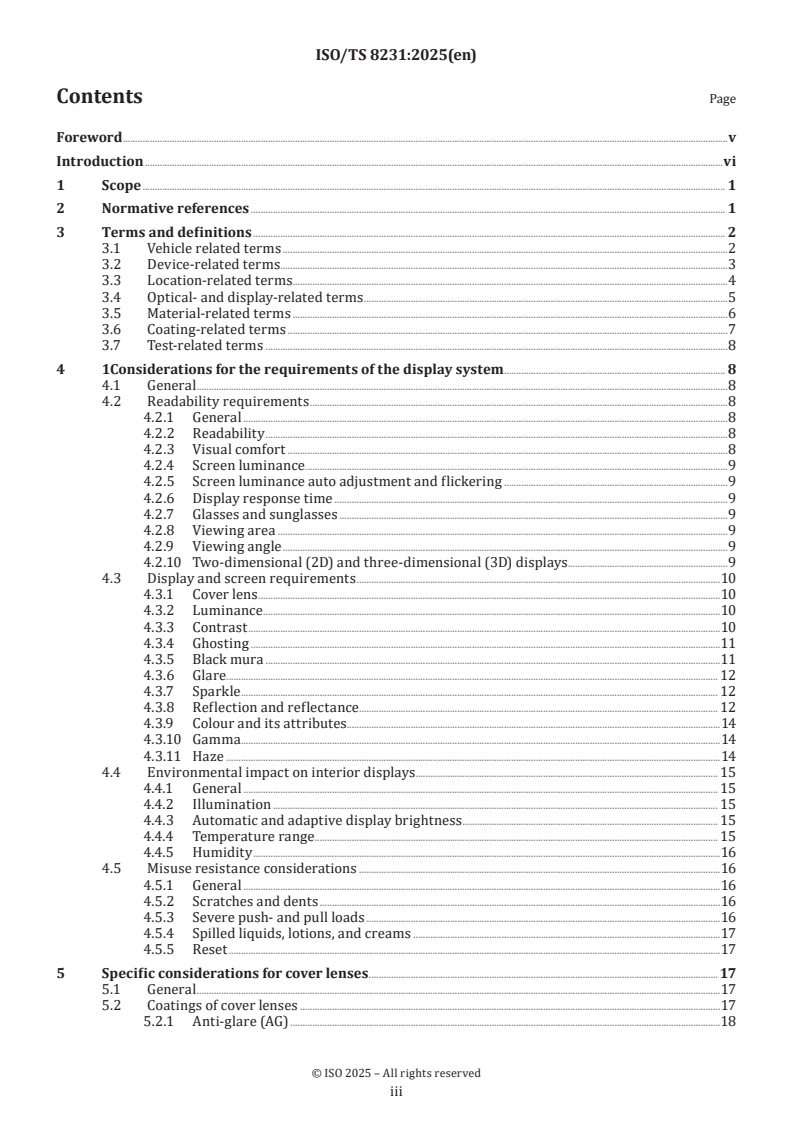
Contents Page
Foreword .v
Introduction .vi
1 Scope . 1
2 Normative references . 1
3 Terms and definitions . 2
3.1 Vehicle related terms .2
3.2 Device-related terms.3
3.3 Location-related terms.4
3.4 Optical- and display-related terms .5
3.5 Material-related terms .6
3.6 Coating-related terms .7
3.7 Test-related terms .8
4 1Considerations for the requirements of the display system . 8
4.1 General .8
4.2 Readability requirements .8
4.2.1 General .8
4.2.2 Readability .8
4.2.3 Visual comfort .8
4.2.4 Screen luminance.9
4.2.5 Screen luminance auto adjustment and flickering .9
4.2.6 Display response time .9
4.2.7 Glasses and sunglasses .9
4.2.8 Viewing area .9
4.2.9 Viewing angle .9
4.2.10 Two-dimensional (2D) and three-dimensional (3D) displays .9
4.3 Display and screen requirements .10
4.3.1 Cover lens .10
4.3.2 Luminance .10
4.3.3 Contrast .10
4.3.4 Ghosting .11
4.3.5 Black mura .11
4.3.6 Glare. 12
4.3.7 Sparkle . 12
4.3.8 Reflection and reflectance. 12
4.3.9 Colour and its attributes.14
4.3.10 Gamma .14
4.3.11 Haze .14
4.4 Environmental impact on interior displays . 15
4.4.1 General . 15
4.4.2 Illumination . 15
4.4.3 Automatic and adaptive display brightness . 15
4.4.4 Temperature range . 15
4.4.5 Humidity .16
4.5 Misuse resistance considerations .16
4.5.1 General .16
4.5.2 Scratches and dents .16
4.5.3 Severe push- and pull loads .16
4.5.4 Spilled liquids, lotions, and creams .17
4.5.5 Reset .17
5 Specific considerations for cover lenses . 17
5.1 General .17
5.2 Coatings of cover lenses .17
5.2.1 Anti-glare (AG) .18
iii
5.2.2 Anti-reflection (AR) .18
5.2.3 Easy-to-clean coating (ETCC) .18
5.2.4 Anti-fingerprint coating (AFC) .18
5.3 Breakage and frangibility .18
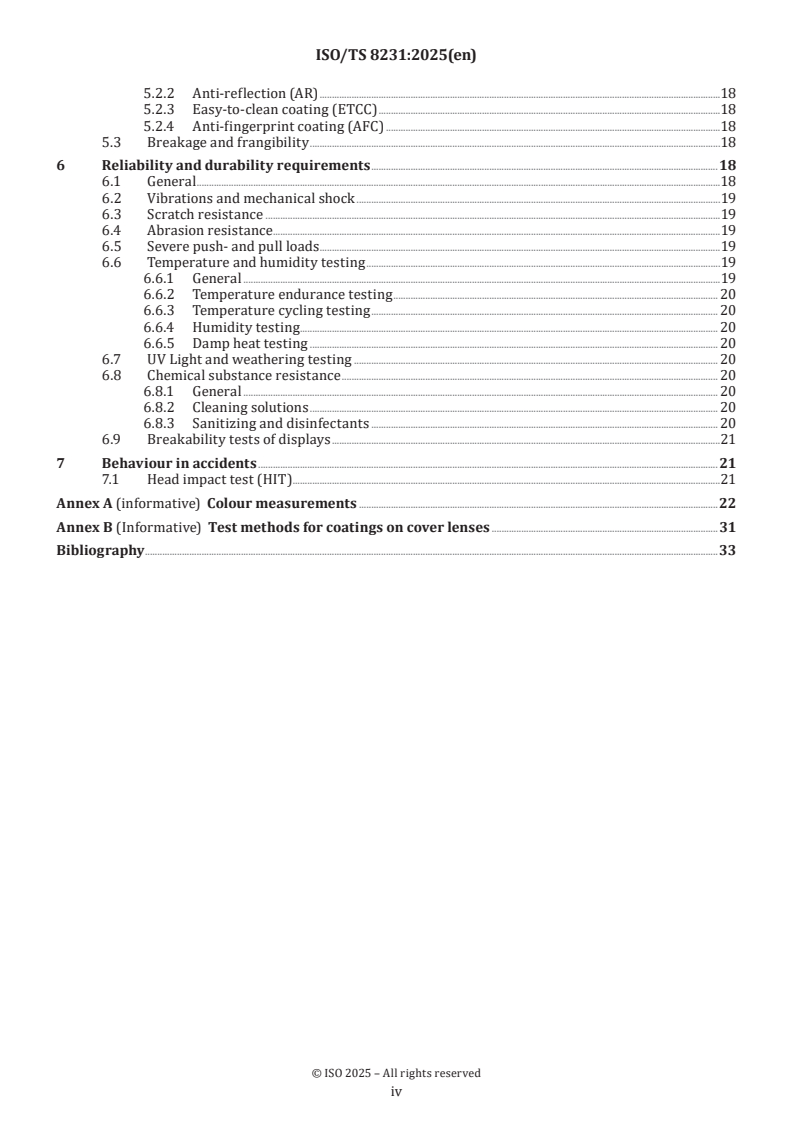
6 Reliability and durability requirements .18
6.1 General .18
6.2 Vibrations and mechanical shock .19
6.3 Scratch resistance .19
6.4 Abrasion resistance . .19
6.5 Severe push- and pull loads .19
6.6 Temperature and humidity testing .19
6.6.1 General .19
6.6.2 Temperature endurance testing . 20
6.6.3 Temperature cycling testing . 20
6.6.4 Humidity testing . . 20
6.6.5 Damp heat testing . 20
6.7 UV Light and weathering testing . 20
6.8 Chemical substance resistance . 20
6.8.1 General . 20
6.8.2 Cleaning solutions . 20
6.8.3 Sanitizing and disinfectants . 20
6.9 Breakability tests of displays .21
7 Behaviour in accidents .21
7.1 Head impact test (HIT).21
Annex A (informative) Colour measurements .22
Annex B (Informative) Test methods for coatings on cover lenses .31
Bibliography .33
iv
Foreword
ISO (the International Organization for Standardization) is a worldwide federation of national standards
bodies (ISO member bodies). The work of preparing International Standards is normally carried out through
ISO technical committees. Each member body interested in a subject for which a technical committee
has been established has the right to be represented on that committee. International organizations,
governmental and non-governmental, in liaison with ISO, also take part in the work. ISO collaborates closely
with the International Electrotechnical Commission (IEC) on all matters of electrotechnical standardization.
The procedures used to develop this document and those intended for its further maintenance are described
in the ISO/IEC Directives, Part 1. In particular, the different approval criteria needed for the different types
of ISO document should be noted. This document was drafted in accordance with the editorial rules of the
ISO/IEC Directives, Part 2 (see www.iso.org/directives).
ISO draws attention to the possibility that the implementation of this document may involve the use of (a)
patent(s). ISO takes no position concerning the evidence, validity or applicability of any claimed patent
rights in respect thereof. As of the date of publication of this document, ISO had not received notice of (a)
patent(s) which may be required to implement this document. However, implementers are cautioned that
this may not represent the latest information, which may be obtained from the patent database available at
www.iso.org/patents. ISO shall not be held responsible for identifying any or all such patent rights.
Any trade name used in this document is information given for the convenience of users and does not
constitute an endorsement.
For an explanation of the voluntary nature of standards, the meaning of ISO specific terms and expressions
related to conformity assessment, as well as information about ISO's adherence to the World Trade
Organization (WTO) principles in the Technical Barriers to Trade (TBT), see www.iso.org/iso/foreword.html.
This document was prepared by Technical Committee ISO/TC 22, Road vehicles, Subcommittee SC 35,
Lighting and visibility.
Any feedback or questions on this document should be directed to the user’s national standards body. A
complete listing of these bodies can be found at www.iso.org/members.html.
v
Introduction
Display systems are increasingly replacing traditional instrument clusters in vehicles. Transportation
information and vehicle control systems (TICS) are now being integrated with one or two digital display
systems to provide vital information to drivers and passengers.
This display system can be located anywhere in front of the driver as the instrument cluster display, in
the centre of the vehicle, in front of the passenger on front or rear seats, or throughout the dashboard, or
anywhere in the vehicle.
The display system is intended to provide vehicle data, navigation, infotainment and other information such
as comfort and warning systems.
In the past, display systems were designed for static applications in the home or workplace, such as TV
screens or computer monitors. There are many IEC standards on electronic display systems.
An in-vehicle display system is not only exposed to the elements, but also to constant shock and vibration.
A touch screen will assemble fingerprint marks. Therefore, it is important that it can withstand cleaning
solutions, beverage and food spills. In addition, the display is subjected to misuse like scratches and dents.
Large displays put a significant area of glass in front of the passenger. The glass must not cause any bodily
injury if it breaks for any reason. The in-vehicle display system must function in all the environmental
operating and storage conditions for which the vehicle is designed. The display must also remain readable
and operable even after years of use.
The IEC has published standards for display device systems for video, TV and IT, covering operational,
optical and safety requirements. IEEE has published reports and articles about in-vehicle display technology,
recognizing the special requirements for displays as information systems in vehicles. The German Display
Forum (DFF) has established a European Original Equipment Manufacturer (OEM) specification for in-
vehicle displays. Another source of information about optical measurements can be found in the Society for
Information Displays (SID) and its International Committee for Display Metrology (ICDM) standard.
vi
Technical Specification ISO/TS 8231:2025(en)
Road vehicles — Visibility — Requirements and
recommendations for automotive interior display systems
1 Scope
This document specifies requirements and recommendations regarding performance criteria for display
systems in vehicles as a guideline for suppliers and manufacturers under normal operating conditions.
This document applies to in-vehicle display systems designed to provide vital information to the driver and
passenger. This document applies to the system as a whole as well as its relevant components, such as cover
lenses, coatings, and properties of the device itself.
This document covers display systems in passenger vehicles (including sport utility vehicles and light
trucks) and commercial vehicles (including heavy trucks and buses).
NOTE Static and dynamic laboratory testing and dynamic field operational assessment to measure display and
cover glass attributes are also included, where available, in the scope of this document.
This document is not applicable for:
— technology and type of display device (e.g. LED, LCD, OLED);
— manufacturing and handling of components in production;
— electrical setup and integration into the vehicle;
— EMC requirements for electrical subassemblies;
— head-up display (HUD) and e-mirror displays [e.g. camera monitoring system (CMS)];
— behaviour in accidents besides the regulatory head impact test (HIT).
2 Normative references
The following documents are referred to in the text in such a way that some or all of their content constitutes
requirements of this document. For dated references, only the edition cited applies. For undated references,
the latest edition of the referenced document (including any amendments) applies.
ISO 15008, Road vehicles — Ergonomic aspects of transport information and control systems — Specifications
and test procedures for in-vehicle visual presentation
IEC 62977-2-1, Electronic displays - Part 2-1: Measurements of optical characteristics - Fundamental
measurements
IEC 62977-2-11, Electronic displays – Part 2-11: Measurement of optical characteristics - Local luminance and
uniformity
IEC 62977-3-9, Electronic displays - Part 3-9: Evaluation of optical performance - Display sparkle contrast
IEC 63211-2-21, Durability test methods for electronic displays – Part 2-21: Environmental tests – Test methods
for heat and humidity
IEC 63211-3-2, Durability test methods for electronic displays - Part 3-2: Mechanical tests - Static stress
IEC 63211-3-5, Durability test methods for electronic displays - Part 3-5: Mechanical tests - Surface durability
International Display Metrology Standard IDMS 1.03
3 Terms and definitions
For the purposes of this document, the terms and definitions given in ISO 15008 and the following apply.
ISO and IEC maintain terminological databases for use in standardization at the following addresses:
— ISO Online browsing platform: available at https:// www .iso .org/ obp
— IEC Electropedia: available at https:// www .electropedia .org/
3.1 Vehicle related terms
3.1.1
eyebox
simplified two-dimensional (2D) rectangular box model providing the representative distribution range of
the driver's eye reference point for evaluation, encapsulation and having its frame line tangential to the
eyellipse
[SOURCE: ISO/TS 21957:2023, 3.2.2, modified — Note 1 to entry was deleted.]
3.1.2
eyellipse
contraction of the words “eye” and “ellipse” used to describe the statistical distribution of eye locations in
three-dimensional (3D) space located relative to defined vehicle interior reference points
[SOURCE: ISO 4513:2022, 3.1, modified — Figure 1 was deleted.]
3.1.3
field of view
FOV
angular extent of what can be seen, either with the eye or with an optical instrument or camera
[SOURCE: SAE J264:2021, 3.1.4 and 3.1.7, modified — This is a compilation of two terminological entries:
direct field of view and indirect field of view.]
3.1.4
instrument cluster display
ICD
display located right in front of the driver providing information that is vital for driving
Note 1 to entry: This display delivers primary information available at a glance or is detectable without changing
gazing direction.
3.1.5
driver information display
DID
display providing information to the driver in a location directly in or close to the normal straightforward
gazing direction
Note 1 to entry: This display provides primary information that is vital for the driving task, e.g. the status of the
vehicle and messages for safe driving. Typical information is the speedometer, warning signals, fault messages and
fuel levels.
3.1.6
secondary information display
SID
display integrated in an adjacent location to the driver to show secondary information typically related to
navigation, parking aids and audio system positioned at the middle point.
3.1.7
co-driver display
CDD
relays information to the co-driver supporting the driver from the passenger seat
Note 1 to entry: The typical information given in a CDD is navigation or infotainment, like interfaces for communication
or audio systems' information to the co-driver on the passenger seat. The main purpose of the CDD or passenger
information display (PID) is infotainment.
3.1.8
passenger information display
PID
display providing information to passengers where they are seated.
Note 1 to entry: The information is specifically adapted to what is useful for passengers who are not directly involved
in the driving task.
3.1.9
rear seat entertainment display
RSED
display located behind the front seats with the specific purpose to provide information for rear seat
passengers
Note 1 to entry: Examples of typical information in an RSED are entertainment and control feedback for climate and
audio systems which are incorporated in the back of the front seats with the sole purpose of entertaining rear seat
passengers.
3.2 Device-related terms
3.2.1
display
electronic display device capable of visibly communicating information, including hardware and software
[SOURCE: ISO 9241-302:2008, 3.4.6, modified — "including hardware and software" added.]
3.2.2
cover lens
transparent layer in front of a display system with the purpose of physically protecting the display and of
adding additional properties, e.g. anti-glare
Note 1 to entry: The cover lens is generally made of a highly transparent material, e.g. glass or certain polymers, such
as polycarbonate (PC), polymethyl methacrylate (PMMA), or combinations.
Note 2 to entry: The term cover glass is often used as well, regardless of the material.
3.2.3
contrast ratio
CR
relationship or degree of tonal gradation between the lightest and darkest areas in an original or
reproduction
[SOURCE: ISO 12637-2:2008, 2.38]
3.2.3.1
luminance contrast ratio
quotient of the luminance of two active parts of a display surface having the same or different colours
Note 1 to entry: The luminance contrast ratio has unit one.
[SOURCE: IEC 60050-845:2020, 845-32-029]
3.2.3.2
ambient contrast ratio
ACR
ratio of the luminance of the white state to the luminance of the black state, under specified ambient lighting
conditions
Note 1 to entry: It is a measure of a display's performance in the presence of ambient light.
[SOURCE: IDMS 1.03, 3.6, modified —Second sentence moved to Note 1 to entry.]
3.2.3.3
static contrast ratio
ratio of the luminance of the brightest colour (white) to that of the darkest colour (black) that the system can
produce simultaneously on the screen at the same time
[SOURCE: IDMS 1.03, 3.6]
3.2.3.4
dynamic contrast ratio
DCR
ratio of the luminance of the brightest colour (white) to that of the darkest colour (black) that the system is
capable of producing over time, but not necessarily at the same time
[SOURCE: IDMS 1.03, 3.6]
3.2.4
display response time
time it takes the display to switch from one colour to another, expressed in milliseconds
Note 1 to entry: The definition of response time in general is the time from a sudden change of a control quantity until
the corresponding change of an output quantity has reached a specified fraction of its final value.
Note 2 to entry: The display response time is expressed in milliseconds.
3.2.5
gamma
γ
maximum slope of the straight line which gives the best approximation to the curve representing, on a
logarithmic scale, the luminance of a screen element as a function of the amplitude of the corresponding
video signal, over the useful range of the curve
[SOURCE: IEC 60050-723:1997, 723-06-36]
3.2.6
3D display
display device or system including a special functionality for enabling depth perception
Note 1 to entry: 3D can also be used to describe curved or angled cover lenses.
[SOURCE: ISO/TR 9241-331:2012, 2.1.1 modified — Note 1 to entry has been added.]
3.3 Location-related terms
3.3.1
display viewing area
limited area for seated occupants that allows good viewing conditions independent of the relative dimensions
of the projected information
Note 1 to entry: The occupant can be the driver or a passenger. The area corresponds to what is visible from the
occupant eye location without any obstructions by bezel or frames.
[SOURCE: ISO 11315-2:1997, 3.4]
3.4 Optical- and display-related terms
3.4.1
luminance
intensity of light emitted from a surface per unit area and per unit solid angle in a given direction
Note 1 to entry: The SI unit of luminance is candela per square meter (cd/m ); sometimes the term nit is used instead.
Nits are the light of candles per square meter: 1 nit = 1 cd/m , but this term has been deprecated.
[SOURCE: ISO 24550:2019, 3.6, modified — Note 1 to entry has been replaced.]
3.4.2
reflection
process by which radiation is returned by a surface or a medium, without change in the frequency of its
monochromatic components
Note 1 to entry: Reflection refers to visible light in this document.
[SOURCE: IEC 60050-845:2020, 845-24-047, modified — Note 1 to entry has been added.]
3.4.3
reflectance
ratio of the reflected luminous flux to the incident luminous flux
Note 1 to entry: Luminous reflectance depends on relative spectral power distribution of the light source.
Note 2 to entry: For automotive display, all contributing sources of a module should be considered, e.g. including the
internal contributions from an LCD or a touch sensor.
[SOURCE: ISO 3538:1997, 2.6, modified—Term changed from "luminous reflectance" to "reflectance" and
Note 2 to entry has been added.]
3.4.4
glare
condition of vision in which there is discomfort or a reduction in the ability to see details or objects, caused
by an unsuitable distribution or range of luminance or by extreme contrasts
[SOURCE: ISO 16505:2019, 3.8]
3.4.5
ghosting
either a reflected image that overlaps with actual image content or an image that fails to adjust in brightness
in time and produce ghosts of the previous image
3.4.6
sparkle
random brightness pattern (modulation) extending across the display area which changes with the viewing
direction
Note 1 to entry: Sparkle pattern are refraction based and can also be observed with incoherent light.
[SOURCE: IEC 62977-3-9:2023, modified — Note 1 to entry has been added.]
3.4.7
speckle
brightness pattern, e.g. generated by light incident on a rough surface
Note 1 to entry: In contrast to sparkle, speckle patterns are created by interference effects and therefore require
sufficiently coherent light to be observed.
3.4.8
colour
characteristic of visual perception that can be described by attributes of hue, brightness (or lightness) and
colourfulness (or saturation or chroma)
Note 1 to entry: Perceived colour depends on the spectral distribution of the colour stimulus, on the size, shape,
structure and surround of the stimulus area, on the state of adaptation of the observer's visual system, and on the
observer's experience of the prevailing and similar situations of observation.
[SOURCE: IEC 60050-845:2020, 845-22-040, modified — Notes 2 and 3 to entry have been deleted.]
3.4.8.1
hue
attribute of a visual perception according to which an area appears to be similar to one of the colours red,
yellow, green, and blue, or to a combination of adjacent pairs of these colours considered in a closed ring
3.4.8.2
colour difference
DE
difference between two colour stimuli, defined as a distance between the points representing them in a
specified colour space
Note 1 to entry: A colour distance metric defined by the International Commission on Illumination (CIE) is called
delta E (ΔE).
[SOURCE: ISO 18314-4:2024, 3.3 modified — Notes 1 to entry has been added.]
3.4.8.3
gamut
colour gamut
subset of colours which can be accurately displayed or measured within a given 2D or 3D colour space
Note 1 to entry: A 2D or 3D colour space includes, for example, CIE 1931 or CIELAB.
3.4.8.4
tristimulus
three primary colours for which the human eye has receptors
Note 1 to entry: Their ratio is defined in the CIE 1931 colour spaces. More specific definitions for colours can be found
in Annex A.
3.4.9
black mura
display mura
Japanese word meaning blemish that has been adopted in English to provide a name for imperfections of a
display pixel matrix surface that are visible when the display screen is driven to a constant grey level
Note 1 to entry: Mura defects appear as low contrast, non-uniform brightness regions, typically larger than single
pixels. They are caused by a variety of physical factors. For example, in LCD displays, the causes of mura defects
include non-uniformly distributed liquid crystal material and foreign particles within the liquid crystal. Mura-like
blemishes occur in CRT, FED, and other display devices.
[SOURCE: ISO/TR 9241-310:2010, 2.13, modified — Original term was “mura”.]
3.5 Material-related terms
3.5.1
toughened glass
glazing material consisting of a single layer of glass which has been subjected to special thermal treatment
to increase its mechanical strength and to condition its fragmentation after shatter
Note 1 to entry: Other terms such as “heat treated glass,” “tempered glass”, “case-hardened glass”, are used as well.
Note 2 to entry: Toughened and tempered glass is heat treated.
[SOURCE: ISO 3536:2016, 2.2, modified — Notes to entry have been added.]
3.5.2
chemically strengthened glass
glass that has been subjected to a chemical process, which allows toughness requirements to be met at
thinner thicknesses
Note 1 to entry: Sometimes also called chemically toughened glass or and chemically tempered glass.
[SOURCE: SAE J673:2021, 3.2.2, modified — Note 1 to entry has been added.]
3.5.3
plastic
material that contains, as an essential ingredient, one or more layers of organic polymeric substances
Note 1 to entry: The following two types are recognized:
— rigid plastic: organic polymeric material which maintains its structural stiffness over the intended use range;
— flexible plastic: organic polymeric material which remains conformable over the intended use range.
[SOURCE: ISO 3536:2016, 2.6 modified — Term changed from “plastic safety glazing material” to "plastic".]
3.5.4
coefficient of thermal expansion
CTE
fractional increase in length per unit rise in temperature
[SOURCE: ISO 8930:2021, 3.6.10.1]
3.6 Coating-related terms
3.6.1
anti-glare coating
scattering coating for the suppression of distinct (mirror) images of ambient light sources reflected by
smooth polished (display) surface
Note 1 to entry: This concept is also called anti-glare layer.
[SOURCE: IEC 62977-3-9:2023, 3.1.4, modified — Note 1 to entry has been added.]
3.6.2
anti-reflection coating
AR coating
ARC
coating on the surface of a lens intended to reduce light reflected from its surfaces
[SOURCE: ISO 13666:2019, 3.18.3, modified — Note 1 to entry has been deleted.]
3.6.3
anti-fingerprint-coating
AFC
grease absorbing coating that is supposed to actively hide any fingerprints by nano-technique
3.6.4
easy-to-clean coating
ETCC
coating designed to allow easy cleaning of fingerprints and smudge from its surface
Note 1 to entry: The term easy-to-clean coating is not to be confused with anti-fingerprint coating.
3.7 Test-related terms
3.7.1
device under test
DUT
single component or combination of multiple components that performs a function of the display as defined
to be tested
[SOURCE: ISO/TS 21957:2023, 3.3.25, modified — “head-up display” was replaced by “display”.].
4 1Considerations for the requirements of the display system
4.1 General
There are many factors that contribute to the performance of a display system. Flicker, response time,
resolution, touch sensitivity, etc. all play an important role in making a good display for automotive use.
Other quality indicators are how certain optical criteria meet expectations. In the end, it is a combination of
many criteria that result in a high-quality display.
Location and functionality also play a role in the definition of the requirements. All essential information
displays shall lie in the FOV of the driver or passenger. There are many names and terms in existence that
basically describe the same thing. The DID and the ICD are directly located in front of the driver to relay
vital information. Displays in the middle of the dashboard, called centre stack display or SID, provide
navigational information as well as services like vehicle settings and creature comfort. Then there is also
a co-driver display in front of the front passenger that provides information to the passenger to assist the
driver. Displays for the information and entertainment of the passengers in any seats are called PIDs.
The level of requirements will depend on the display’s functionality. If it is to provide vital information to
the driver, then more attention to the display properties is to be given; meanwhile, RSIDs do not have as
stringent requirements than the ones serving the driver.
4.2 Readability requirements
4.2.1 General
There are many factors that play into the readability and visibility of display systems. As long as the display
is intended to provide vital information to the driver and passenger, readability is not a commodity, but a
safety requirement. Therefore, all readability requirements laid out in ISO 15008 shall apply. In general, any
letters and symbols depicted on display systems shall remain legible in all illumination situations, ranging
from night to bright sunlight, even if the driver wears polarized sunglasses.
Readability shall be evaluated for the ICD, DID, and SID displays.
4.2.2 Readability
The readability requirements specified in ISO 15008 impose several demands on both the optical system as
a whole and the cover lens surface in particular. From the system's point of view, photopic reflection should
be minimized to the extent that the ACR is still sufficient according to ISO 15008, at least for safety-relevant
applications such as instrument clusters, but also for rear-view camera systems and possibly primary gear
shift indicators. Since ACR depends on display performance (luminance), system reflections from display,
surface, touch and other internal layers, as well as position in the dashboard, ACR shall be evaluated in an
application-like scenario. The impact of critical system contributors is discussed in later sections.
4.2.3 Visual comfort
Many considerations for using screens for work or leisure do apply to display in automotive, especially
in the light of the amount of information transported on displays in comparison to previous analogous
instruments, however, they do not apply to the full extent. The driver should be able to relax his eyes by
observing the road as he is supposed to do.
Measurements shall be done according to IEC 62977-2-1.
4.2.4 Screen luminance
Screen luminance should be set in relation to the ambient light in the vehicle because the contrast between
screen luminance and ambient light affects visual comfort.
Luminance shall be tested according to IEC 62977-2-11.
4.2.5 Screen luminance auto adjustment and flickering
Another aspect is screen flickering, which is caused by adjusting the luminance of the screen or pixels to the
ambient light.
There are two main methods of adjusting luminance, each with its own advantages and disadvantages.
Since flickering can be very irritating to the driver, the luminance should be controlled either by direct
current modulation or pulse width modulation with known safe frequencies in such a way that there is no
degradation or disturbance of the viewing experience.
4.2.6 Display response time
The response time of a monitor or screen is usually measured from black to white or from grey to grey.
Quality of image and motion depiction improves the fewer milliseconds the response time takes.
4.2.7 Glasses and sunglasses
The display shall remain clearly visible even viewed through sunglasses with polarizing effects.
4.2.8 Viewing area
The term viewing area typically refers to the visible area of the display surface. Depending on the human
machine interface concept, the viewing area can be slightly smaller or larger than the active area. If the
viewing area is smaller than the active area, the actual display content typically does not extend to the edges
of the viewing area to prevent pixels getting clipped due to alignment tolerances.
The viewing area must correlate with the eyebox and eyellipse determined by the vehicle manufacturer.
4.2.9 Viewing angle
While the instrument cluster display is primarily intended for the driver, the visibility of centrally located
displays should be given also from other seating positions, e.g., codriver or rear seat passengers. To achieve
this, the eyebox and eyellipse should be determined for each vehicle model for a variety of occupants'
positions and related to the optimal viewing angle and viewing area of the display.
The displayed image should not change significantly within the specified viewing angle range of the display.
Signifi
...