

ISO/TS 5283-1:2025
(Main)Road vehicles — Driver readiness and intervention management — Part 1: Partial automation (Level 2)
General Information
- Abstract
The purpose of this document is to provide background information on driver state monitoring (DSM) in the context of partial driving automation (SAE L2). It describes existing DSM implementations (including system interventions), the underlying design guidelines and provisions by relevant stakeholders in the field, as well as considerations on how to validate the effectiveness of driver state-related system interventions. Moreover, the document introduces a conceptual framework for “driver readiness and intervention management” for the purpose of providing a comprehensive view of relevant aspects of driver readiness and harmonizing terms and definitions in this field. It is believed that this framework can be helpful when comparing different approaches for driver state assessment. The document does not contain any specific technical requirements for current or future system implementations of driver state monitoring.
- Status
- Published
- Publication Date
- 22-Oct-2025
- Technical Committee
- ISO/TC 22/SC 39 - Ergonomics
- Drafting Committee
- ISO/TC 22/SC 39 - Ergonomics
- Current Stage
- 6060 - International Standard published
- Start Date
- 23-Oct-2025
- Due Date
- 04-May-2025
- Completion Date
- 23-Oct-2025


Overview
ISO/TS 5283-1:2025 - Road vehicles - Driver readiness and intervention management - Part 1: Partial automation (Level 2) is a Technical Specification from ISO that provides background, conceptual framing and high‑level guidance on driver state monitoring (DSM) and intervention strategies for SAE Level 2 (partial) driving automation. Published as a first edition in 2025, the document summarizes current DSM implementations (hands‑on and hands‑off L2 systems), human factors evidence on driver behaviour, and considerations for validating driver readiness and intervention effectiveness. Importantly, this TS does not set prescriptive technical requirements for DSM systems; it harmonizes terminology and offers a conceptual framework to compare approaches.
Key topics and (high‑level) requirements
- Conceptual framework for driver readiness
- Defines driver readiness and its subdimensions: driver availability, engagement in the dynamic driving task (DDT), and intention to intervene.
- Proposes layers and measurement constructs to harmonize assessments across implementations.
- Implementations and interventions
- Reviews existing L2 approaches: hands‑on vs hands‑off, typical DSM sensors/architectures, and system intervention strategies to restore driver readiness.
- Driver states and empirical findings
- Summarizes evidence on distraction, drowsiness, reduced engagement, trust and mental models stemming from partial automation use.
- Design considerations
- High‑level guidance on what and how to measure (multiple measures, fusion of indicators), challenges in intervention strategy design, and human‑machine interaction principles.
- Validation and safety assessment
- Outlines considerations for validating DSM effectiveness: unintended behaviours without DSM, mitigation effectiveness, corner‑case scenarios, and field safety effects.
- Terminology harmonization
- Aligns definitions with ISO/SAE PAS 22736 and other referenced normative documents.
Note: The TS compiles requirements and guidelines from regulators and standards bodies but does not prescribe technical thresholds or implementation recipes.
Applications and users
ISO/TS 5283-1:2025 is intended for:
- Automotive OEMs and Tier‑1 suppliers designing ADAS and DSM systems
- Human factors and safety engineers working on L2 vehicle features
- Regulators, conformity assessment bodies and test labs validating driver monitoring approaches
- Researchers, NCAP programs, insurers and policy makers evaluating real‑world safety impacts
Practical uses include creating specification briefs, aligning terminology across projects, informing DSM validation protocols, and comparing intervention strategies.
Related standards and references
Key referenced regulations and standards include:
- ISO/SAE PAS 22736 (SAE J3016 taxonomy)
- UN Regulations (e.g., R79, R157, R171)
- EU Regulation 2019/2144
- SAE J3114, ISO 21717
- Stakeholder programs (Euro NCAP, NHTSA studies)
Keywords: ISO/TS 5283-1:2025, driver readiness, driver state monitoring, DSM, partial automation, Level 2, L2, ADAS validation, intervention management.
Get Certified
Connect with accredited certification bodies for this standard

TÜV Rheinland
TÜV Rheinland is a leading international provider of technical services.

TÜV SÜD
TÜV SÜD is a trusted partner of choice for safety, security and sustainability solutions.

DEKRA Certification Inc.
DEKRA US certification services.
Sponsored listings
Frequently Asked Questions
ISO/TS 5283-1:2025 is a technical specification published by the International Organization for Standardization (ISO). Its full title is "Road vehicles — Driver readiness and intervention management — Part 1: Partial automation (Level 2)". This standard covers: The purpose of this document is to provide background information on driver state monitoring (DSM) in the context of partial driving automation (SAE L2). It describes existing DSM implementations (including system interventions), the underlying design guidelines and provisions by relevant stakeholders in the field, as well as considerations on how to validate the effectiveness of driver state-related system interventions. Moreover, the document introduces a conceptual framework for “driver readiness and intervention management” for the purpose of providing a comprehensive view of relevant aspects of driver readiness and harmonizing terms and definitions in this field. It is believed that this framework can be helpful when comparing different approaches for driver state assessment. The document does not contain any specific technical requirements for current or future system implementations of driver state monitoring.
The purpose of this document is to provide background information on driver state monitoring (DSM) in the context of partial driving automation (SAE L2). It describes existing DSM implementations (including system interventions), the underlying design guidelines and provisions by relevant stakeholders in the field, as well as considerations on how to validate the effectiveness of driver state-related system interventions. Moreover, the document introduces a conceptual framework for “driver readiness and intervention management” for the purpose of providing a comprehensive view of relevant aspects of driver readiness and harmonizing terms and definitions in this field. It is believed that this framework can be helpful when comparing different approaches for driver state assessment. The document does not contain any specific technical requirements for current or future system implementations of driver state monitoring.
ISO/TS 5283-1:2025 is classified under the following ICS (International Classification for Standards) categories: 43.040.15 - Car informatics. On board computer systems. The ICS classification helps identify the subject area and facilitates finding related standards.
ISO/TS 5283-1:2025 is available in PDF format for immediate download after purchase. The document can be added to your cart and obtained through the secure checkout process. Digital delivery ensures instant access to the complete standard document.
Standards Content (Sample)
Technical
Specification
ISO/TS 5283-1
First edition
Road vehicles — Driver readiness
2025-10
and intervention management —
Part 1:
Partial automation (Level 2)
Véhicules routiers — Gestion de la préparation et de
l'intervention du conducteur —
Partie 1: Automatisation partielle (niveau 2)
Reference number
© ISO 2025
All rights reserved. Unless otherwise specified, or required in the context of its implementation, no part of this publication may
be reproduced or utilized otherwise in any form or by any means, electronic or mechanical, including photocopying, or posting on
the internet or an intranet, without prior written permission. Permission can be requested from either ISO at the address below
or ISO’s member body in the country of the requester.
ISO copyright office
CP 401 • Ch. de Blandonnet 8
CH-1214 Vernier, Geneva
Phone: +41 22 749 01 11
Email: copyright@iso.org
Website: www.iso.org
Published in Switzerland
ii
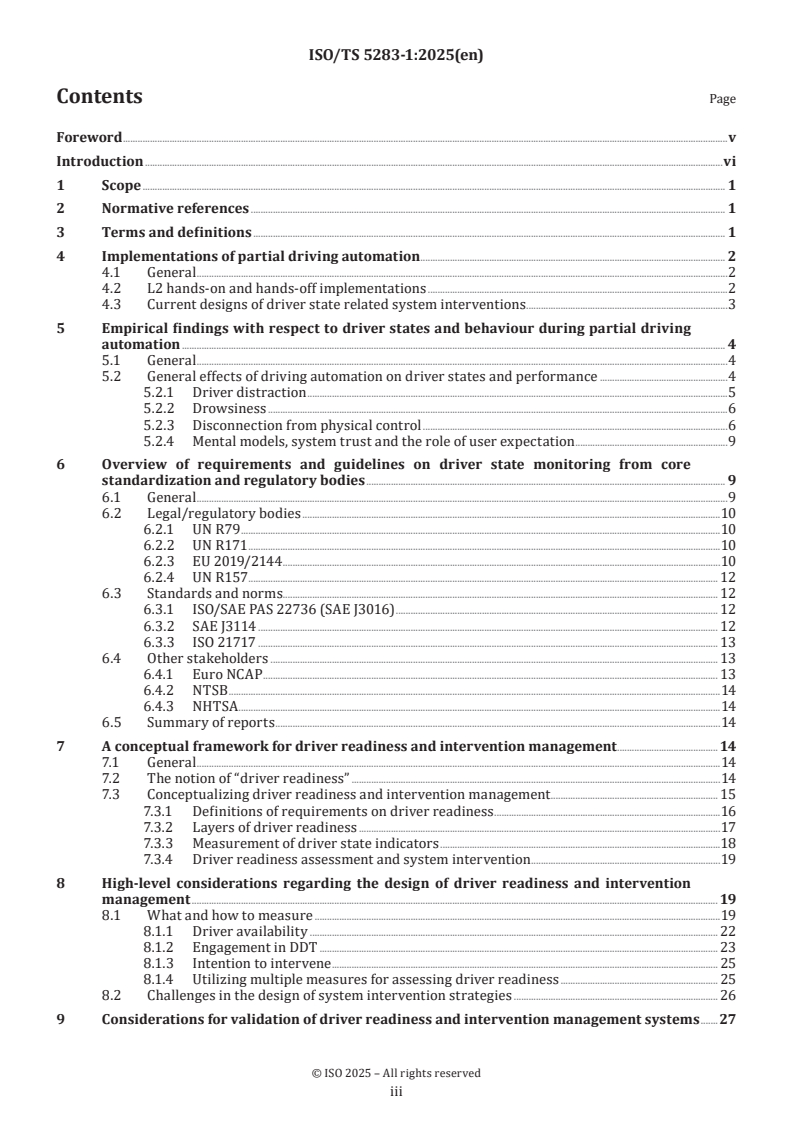
Contents Page
Foreword .v
Introduction .vi
1 Scope . 1
2 Normative references . 1
3 Terms and definitions . 1
4 Implementations of partial driving automation . 2
4.1 General .2
4.2 L2 hands-on and hands-off implementations .2
4.3 Current designs of driver state related system interventions .3
5 Empirical findings with respect to driver states and behaviour during partial driving
automation . 4
5.1 General .4
5.2 General effects of driving automation on driver states and performance .4
5.2.1 Driver distraction .5
5.2.2 Drowsiness .6
5.2.3 Disconnection from physical control .6
5.2.4 Mental models, system trust and the role of user expectation .9
6 Overview of requirements and guidelines on driver state monitoring from core
standardization and regulatory bodies . 9
6.1 General .9
6.2 Legal/regulatory bodies .10
6.2.1 UN R79 .10
6.2.2 UN R171 .10
6.2.3 EU 2019/2144 .10
6.2.4 UN R157 . . . 12
6.3 Standards and norms. 12
6.3.1 ISO/SAE PAS 22736 (SAE J3016) . 12
6.3.2 SAE J3114 . 12
6.3.3 ISO 21717 . 13
6.4 Other stakeholders . 13
6.4.1 Euro NCAP . 13
6.4.2 NTSB .14
6.4.3 NHTSA . .14
6.5 Summary of reports .14
7 A conceptual framework for driver readiness and intervention management . 14
7.1 General .14
7.2 The notion of “driver readiness” .14
7.3 Conceptualizing driver readiness and intervention management . 15
7.3.1 Definitions of requirements on driver readiness .16
7.3.2 Layers of driver readiness .17
7.3.3 Measurement of driver state indicators .18
7.3.4 Driver readiness assessment and system intervention .19
8 High-level considerations regarding the design of driver readiness and intervention
management . 19
8.1 What and how to measure .19
8.1.1 Driver availability . 22
8.1.2 Engagement in DDT . 23
8.1.3 Intention to intervene . 25
8.1.4 Utilizing multiple measures for assessing driver readiness . 25
8.2 Challenges in the design of system intervention strategies . 26
9 Considerations for validation of driver readiness and intervention management systems .27
iii
9.1 General .27
9.2 Unintended driver behaviour without a DMS and its associated risk.27
9.3 Effectiveness of the DMS in mitigating unintended behaviour .27
9.4 Impact of the driving automation system integrated with the DMS on safety related
measures in realistic corner-case scenario .27
9.5 Field safety effect . 28
Bibliography .29
iv
Foreword
ISO (the International Organization for Standardization) is a worldwide federation of national standards
bodies (ISO member bodies). The work of preparing International Standards is normally carried out through
ISO technical committees. Each member body interested in a subject for which a technical committee
has been established has the right to be represented on that committee. International organizations,
governmental and non-governmental, in liaison with ISO, also take part in the work. ISO collaborates closely
with the International Electrotechnical Commission (IEC) on all matters of electrotechnical standardization.
The procedures used to develop this document and those intended for its further maintenance are described
in the ISO/IEC Directives, Part 1. In particular, the different approval criteria needed for the different types
of ISO document should be noted. This document was drafted in accordance with the editorial rules of the
ISO/IEC Directives, Part 2 (see www.iso.org/directives).
ISO draws attention to the possibility that the implementation of this document may involve the use of (a)
patent(s). ISO takes no position concerning the evidence, validity or applicability of any claimed patent
rights in respect thereof. As of the date of publication of this document, ISO had not received notice of (a)
patent(s) which may be required to implement this document. However, implementers are cautioned that
this may not represent the latest information, which may be obtained from the patent database available at
www.iso.org/patents. ISO shall not be held responsible for identifying any or all such patent rights.
Any trade name used in this document is information given for the convenience of users and does not
constitute an endorsement.
For an explanation of the voluntary nature of standards, the meaning of ISO specific terms and expressions
related to conformity assessment, as well as information about ISO's adherence to the World Trade
Organization (WTO) principles in the Technical Barriers to Trade (TBT), see www.iso.org/iso/foreword.html.
This document was prepared by Technical Committee ISO/TC 22 Road vehicles, Subcommittee SC 39,
Ergonomics.
A list of all parts in the ISO 5283 series can be found on the ISO website.
Any feedback or questions on this document should be directed to the user’s national standards body. A
complete listing of these bodies can be found at www.iso.org/members.html.
v
Introduction
According to the Society for Automotive Engineers (SAE) guidelines, in Level 2 partial driving automation
(ISO/SAE PAS 22736), the driver is expected to be engaged in the dynamic driving task (DDT). Namely,
supervising the automated system while both longitudinal and lateral control of the vehicle are executed
by the system, and managing the object and event detection and response (OEDR), in case the system does
not respond properly. This may be because of system limitations, when particular objects or events are not
detectable by the system, operation condition is out of the vehicle’s operational design domain (ODD), or due
to a system malfunction. In each case, the driver is expected to immediately resume parts or all aspects of the
DDT, managing the situation to either continue safe driving in manual mode or stop the vehicle safely. There
are currently two types of Level 2 systems available in the market. Hands-on systems are features which
require the driver to keep their hands on the steering wheel, while hands-off systems do not. However, the
driver’s role in performing the OEDR task, supervising system performance, and resuming control, without
hesitation and when necessary, is the same for both hands-on and hands-off systems.
Overall, in Level 2 partial driving automation, the driver is always required to supervise system operation and
be ready to resume part or all of the DDT, when necessary, whether or not the system issues an alert signal.
Supervision of automated systems can entail multiple responsibilities and tasks. Among these are often one
[1][2]
or more vigilance-based tasks—with which humans are known to struggle. In the context of partial
driving automation behavioural effects include reduced attention to driving related tasks, and increased
[3][4] [5]
boredom, and distraction, although this depends on how the system is implemented. To mitigate these
driver states, dedicated in-vehicle systems are used to monitor relevant aspects of driver readiness, and help
bring drivers back into a desirable state, so that they are ready to intervene, when needed.
This document summarizes key findings on human interaction with L2 driving automation systems as
well as related standards and regulations. It also offers a conceptual framework for driver readiness and
intervention management, providing high-level considerations on the design of these systems, as well as a
synthesis of information required for their validation.
vi
Technical Specification ISO/TS 5283-1:2025(en)
Road vehicles — Driver readiness and intervention
management —
Part 1:
Partial automation (Level 2)
1 Scope
The purpose of this document is to provide background information on driver state monitoring (DSM) in
the context of partial driving automation (SAE L2). It describes existing DSM implementations (including
system interventions), the underlying design guidelines and provisions by relevant stakeholders in the field,
as well as considerations on how to validate the effectiveness of driver state-related system interventions.
Moreover, the document introduces a conceptual framework for “driver readiness and intervention
management” for the purpose of providing a comprehensive view of relevant aspects of driver readiness
and harmonizing terms and definitions in this field. It is believed that this framework can be helpful when
comparing different approaches for driver state assessment.
The document does not contain any specific technical requirements for current or future system
implementations of driver state monitoring.
2 Normative references
The following documents are referred to in the text in such a way that some or all of their content constitutes
requirements of this document. For dated references, only the edition cited applies. For undated references,
the latest edition of the referenced document (including any amendments) applies.
ISO/SAE PAS 22736, Taxonomy and definitions for terms related to driving automation systems for on-road
motor vehicles
3 Terms and definitions
For the purposes of this document, the terms and definitions given in ISO/SAE PAS 22736 and the following apply.
ISO and IEC maintain terminology databases for use in standardization at the following addresses:
— ISO Online browsing platform: available at https:// www .iso .org/ obp
— IEC Electropedia: available at https:// www .electropedia .org/
3.1
driver readiness
driver’s current ability to safely assume parts or all of the dynamic driving task while using driving
automation
Note 1 to entry: Driver readiness includes driver availability (3.2), engagement in DDT (3.3) and intention to intervene (3.4).
3.2
driver availability
subdimension of readiness, addressing fundamental prerequisites for successful user interventions such as
receptivity, alertness, and motoric state
3.3
engagement in DDT
engagement in dynamic driving task
subdimension of readiness, addressing all aspects of human behaviour, that is associated with the
performance of the remaining aspects of the dynamic driving task while using a driving automation feature
3.4
intention to intervene
subdimension of readiness, addressing the decision mechanisms to initiate user interventions during use of
driving automation
3.5
driver readiness and intervention management
method which aims to mitigate undesirable driver states and associated safety issues in the context of
driving automation by means of driver state detection and interventions
4 Implementations of partial driving automation
4.1 General
An SAE L2 driving automation feature is characterized by its execution of the lateral and longitudinal
vehicle motion control subtasks of the DDT, on a sustained and ODD-specific basis, with the expectation
that the driver completes the OEDR subtask and supervises the driving automation system (ISO/SAE PAS
22736). The widely adopted ISO/SAE taxonomy of automation levels classifies a wide range of potential
driving automation features (from no driving automation to full driving automation) and it is also linked
to the general roles and tasks of the user. However, ISO/SAE PAS 22736 does not provide details of how
to design specific system implementations for each level of automation. These details are specified by the
system manufacturer, considering any legal requirements (for example, regulations for type approval) and
documents from standards organizations (see Clause 6). In the context of L2 driving automation, two general
classes of L2 driving automation have emerged as implementations: "hands-on" and "hands-off" versions of
partial driving automation, which are further described in 4.2.
4.2 L2 hands-on and hands-off implementations
In UN ECE (United Nations Economic Commission for Europe) adopting countries (contracting parties to the
1958 Agreement), currently available L2 features are approved by referencing to UN R79 ACSF B1 (steering
[6]
assistance), the International Standards ISO 21717 [“Partially Automated In-Lane Driving Systems
[7] [8]
(PADS)”] and ISO 15622 (“Adaptive cruise control systems”). The derived L2 driving automation
features are of the hands-on type. The exact technology for hands-on detection is not regulated, but typically
requires detection of manual steering activity (e.g. by utilizing the steering torque measuring unit which is
a standard feature of the steering system), as well as detection of hand contact with the steering wheel (e.g.
by utilizing capacitive sensors in the steering wheel).
In recent years, system manufacturers have begun to develop hands-off implementations of partial driving
automation which allow drivers to release the steering wheel as long as certain conditions are met, which
are determined by the particular system. However, the driver still needs to continue the OEDR subtask and
intervene immediately, if necessary. Relevant products have been launched either in non-UN ECE adopting
countries (according to the 1958 agreement) or with special (national) permission. Currently, a dedicated
UN ECE task force on advanced driver assistance systems (ADAS) is developing a regulatory document to
[9]
determine system requirements for type approval of “Driver Control Assistance Systems” (DCAS) which
[10]
is expected to include L2 hands-off states. According to ISO/PAS 11585, hands-on and hands-off driving
automation can both be implemented within one system design, appearing as alternative system states
depending on their availability. For the hands-off system state, this document also requests a monitoring of
additional aspects of the driver state, such as monitoring their visual attentiveness.
Unless used directly or cited from another document, the use of the term "hands-free" is avoided in this
document although it is sometimes used interchangeably with "hands-off" in the context of L2 driving
automation. However, the interpretation of the term free may induce the incorrect suggestion that the driver
is free to do other tasks with their free hands, which is not valid for L2 partial driving automation. For both
hands-off and hands-on versions, driver monitoring systems are designed to intervene (e.g. issue warnings,
require hands-on) when certain thresholds have been exceeded. The primary purpose of the driver
monitoring systems, characterized in this document, is to motivate intended use of the automated system,
and prevent misuse by the driver. Subclause 4.3 provides an overview of the recommended interventions for
L2 systems.
4.3 Current designs of driver state related system interventions
In countries adopting the UN ECE regulation (contracting parties of the 1958 agreement) partial driving
[6]
automation was permitted under UN R79, with hands-on features. These features require the following
[6]
the minimum requirements (details are found in UN-R79, 5.6.2.2.5 ):
— if, after a period of no longer than 15 s the driver is not holding the steering control, an optical warning
signal shall be provided;
— if, after a period of no longer than 30 s the driver is not holding the steering control, at least the hands or
steering control in the pictorial information provided as optical warning signal shall be shown in red and
an acoustic warning signal shall be provided;
— the system shall be automatically deactivated at the latest 30 s after the acoustic warning signal has
started. After deactivation the system shall clearly inform the driver about the system status by an
acoustic emergency signal which is different from the previous acoustic warning signal, for at least 5 s or
until the driver holds the steering control again.
The regulation does not specifically mention the haptic/kinesthetic modality as a substitution for either the
visual or auditory component of the signals in the context of hands-off detection.
In addition to markets that adhere to UNECE regulations, other markets, such as the US, may have Level
2 driving automation features that allow for hands-free driving. These systems commonly escalate alerts
1)
to solicit a driver response when the driver is determined to be inattentive by the system. The alerting
scheme may begin with a simple visual or auditory alert and escalate to a pattern of alerts and/or penalties
(e.g. deactivation of the system and prevention of future activation) and emergency actions for non-response
(e.g. pull over on the side of the road) based on the timing strategy of the manufacturer.
An example description of a three-stage alert sequence is described below based on the products available
in the US market as of 2025. The descriptions are based on expert assessments of in-market products,
rather than official disclosure or customer education materials from the manufacturers. Additionally, the
descriptions may not reflect the latest implementations, as manufacturers continuously improve their
systems.
1)
— First stage alert: The driver monitoring system determines that the driver is not attentive to the road
and provides visual, audible or haptic alerts when this exceeds a time threshold. The alerts stop when
1)
the system determines that the driver has returned their attention to the road. During the first stage,
the Level 2 driving automation feature may continue to be engaged.
1)
— Second stage alert: The driver monitoring system determines that the driver has exceeded a time
threshold in the first stage without returning their attention to the road. The system communicates that
the driver must place their hands on the steering wheel and return their attention to the road through
1)
an escalation of visual, audible, or haptic alerts. The alerts stop when the system determines that the
driver has returned their attention to the road and has placed their hands on the steering wheel. The
system must be re-engaged to continue using the Level 2 driving automation feature.
1)
— Third stage alert: The driver monitoring system determines that the driver has exceeded a time
threshold in the second stage without returning their attention to the road. The system communicates
that the driver must immediately place their hands on the steering wheel and return their attention to
1) System implementations differ in how they determine driver attentiveness. For example, head and eye angle may
both be used to determine whether a driver’s gaze is toward the road. In addition, variety of angles may be used as criteria
for this determination based on a design strategy, vehicle dimensions, or other factors. The same is true of the alert
modality and alerting period.
the road through a further escalation of visual, audible, or haptic alerts. The alerts stop when the system
1)
determines that the driver has returned their attention to the road and has placed their hands on the
steering wheel. The system must be re-engaged to continue using the Level 2 driving automation feature.
If the driver does not immediately respond, the vehicle may slow in the lane of travel and brake to a stop
with its hazard lights on. The system is then disengaged and is not available until the next ignition cycle.
[9]
Other different system intervention designs may be found in the market, especially following UN R171.
Due to a lack of sufficient data and published material on user interaction with real L2 vehicles, Clause 5
provides a summary of relevant empirical studies investigating driver state and behaviour in partially
automated vehicles.
5 Empirical findings with respect to driver states and behaviour during partial
driving automation
5.1 General
This clause summarizes results from empirical studies investigating driver states and driving performance
in the context of partial driving automation. Moreover, the efficiency of driver state monitoring approaches
and the related interaction strategies to maintain appropriate driver state (including system interventions)
are described.
The collection of empirical findings comprises studies from a wide range of experimental settings, including
studies based on driving simulators and naturalistic studies. Many of these studies do not include driver
feedback management of any kind and the systems studied were designed to simply explore the driver
response to alerts. Additionally, the studies that do include driver feedback are not representative of some
production-intent systems, which may have specific nuances related to alert timing, escalation strategy, and
safety system integration. The exception to these is naturalistic studies that involve/include production
vehicles deployed in naturalistic settings (which may incorporate such feedback strategies by design). It
is important to note that these findings do not indicate any adverse field safety effect associated with the
current state of L2 automation features. There is currently no comparison of real-world crashes with and
without production L2 systems. In fact, studies utilizing crash records and insurance data of production
[11][12]
systems have not found any impact, positive or negative, of L2 usage on road safety. However,
continuous monitoring of real-world crashes is necessary to further evaluate the safety effect of production
L2 systems. With these caveats in mind, the findings discussed here are intended to raise awareness of
potential issues in the interaction between humans and driving automation systems.
5.2 General effects of driving automation on driver states and performance
This subclause provides an overview of the driver states that can frequently and consistently degrade when
using inappropriately designed L2 systems, in comparison to manual driving, and how these degraded
states reduce driver awareness and performance.
Historically, studies regarding the interaction between humans and automation have been conclusive in
suggesting that, without effective countermeasures, humans are not very good supervisors of automated
[13][14][15]
systems. For example, detecting an infrequent visual target during partial automation has been
[16]
found to decline in as little as 15 min.
The inability to act appropriately in case of system limitation is also found during driving automation.
Human factors studies suggest that drivers’ supervisory performance decreases when they are given
[17]
the opportunity to relinquish physical control of the driving task without effective countermeasures.
Drivers may seek to relieve boredom from supervising a system by engaging in other, non-driving related
activities (NDRAs), which further reduces situation awareness by removing drivers’ attention away from
[4]
their supervisory role. Relinquishing moment-to-moment steering control of the vehicle also leads to
[18]
poor visuo-motor coordination by the driver if they are asked to resume control either due to a system
limitation, or at the end of the vehicle’s operational design domain (ODD). Visual attention directed towards
the road scene and hands placed on the steering wheel may not always be sufficient for initiation of an
action by driver, to respond to a situation which cannot be handled by partial automation. For example, in a
[19]
test track study, 21 out of 76 participants crashed into an obstacle, despite having their eyes on the road
and their hands on the steering wheel. When asked about their unresponsiveness, participants stated that
they trusted the vehicle to avoid a collision. This explains their delayed response, which was either because
they expected the system to handle the situation, or because they could not avoid the collision by the time
they realized the system was not handling the situation. This “expectation mismatch” provides an example
of a misunderstanding of drivers’ expectations about vehicle capabilities. Such automation-induced changes
in driver performance, showing slower or poorer driver response to potential and impending hazards and
[20][21][22]
obstacles, when compared to manual driving, are commonly reported in empirical studies.
Overall, studies suggest that if drivers are not actively engaged in vehicle motion control and likely to be
[17]
out of the loop, they need some time to gather sufficient mental and physical resources for providing
[23][24]
the correct response, following a takeover request. Results from driving simulator studies and a
meta-analysis suggest that drivers’ response times to a takeover request varies from 1 s to 3 s, depending
on the traffic context, although this is based on the time it takes drivers to grab the steering wheel, or
apply the brake, and may not reflect the time needed for drivers to resume stable control of the vehicle, or
appropriately avoid a crash.
The findings above suggest that inadequately designed automation systems can lead to a decline in driver
states and performance, although additional field research with naturalistic L2 usage and longer exposure
is needed to better understand the long-term naturalistic effect of partial driving automation. In addition,
the frequency and severity of these effects can vary depending on various factors, such as the performance
of the system. For example, drivers’ vigilance may decline when using a system that reliably maintains the
lane, but it may stay high for a system that frequently requires driver intervention. The implementation of
safeguards such as driver monitoring systems (DMS) and suitably designed human-machine interfaces (HMI)
may also influence these results. The above literature underscores the significance of implementing suitable
safeguards for Level 2 automation systems. This may involve proactive measures to prevent degradation of
driver states and performance, as well as reactive detection and intervention, when necessary. It is important
to recognize that addressing different issues may require the use of diverse solutions and technologies.
The next subclauses provide several examples of this research, focusing on how automation-induced driver
distraction, drowsiness, lack of physical control of the vehicle, and incorrect mental models lead to impaired
performance after a request to intervene is provided.
5.2.1 Driver distraction
Without effective countermeasures, drivers are likely to increase engagement with secondary tasks or non-
driving-related activities (e.g. smartphone usage, looking down towards the vehicle centre stack, looking
around the driving scene) when using L2 systems. This is especially the case when drivers are not prevented
[4][25][26][27][28][29][30]
from looking away from the forward roadway by a reliable alert from DMS. Distractions
caused by engaging in such secondary activities lead to excessive and prolonged eyes-off-road glances that
[31]
could impact drivers’ ability to predict, detect or process road hazards. Both driving simulator and real-
world studies have illustrated the dispersion of driver gaze away from the forward roadway, and reduced
[29][30]
glances towards rear-view and side mirrors during L2 driving.
In addition, gaze is found to be more dispersed when a resumption of control is required, with drivers
looking towards the centre stack or dash area for information about automation status (on/off) perhaps in
an attempt to determine their responsibility (whether or not to resume control from the driving automation).
[31]
The dispersed eye movement may lead to less focus to the forward roadway and a degraded motor
[21][22] [20][32]
control coordination – leading to late braking, poor steering control, or both.
Although there is no direct evidence that increased driver distraction during L2 driving automation leads
to a higher crash risk, there is a well-established association between increased visual glances away from
[33][34][35][36][37]
the road and safety critical events during manual driving. Therefore, assessing the effect of
driver visual distraction on safety is an important aspect to consider, when designing L2 driving automation.
Prolonged periods of L2 driving automation can lead to cognitive distraction by drivers, even if their eyes are
[38][39]
on the forward roadway and surrounding areas (commonly termed mind wandering, MW), although
there is no direct evidence of reductions in safety due to this driver state. Nevertheless, studies in manual
driving have shown that MW is associated with degraded driving performance, such as longer responses
[40][41][42]
to sudden events, driving at a higher speed and maintaining a shorter headway. Driving simulator
experiments suggest that lower frequency of strategic glances outside the road centre (e.g. to check for traffic
in the mirrors, or glance to the dash area), are indicators of drivers’ lack of situation awareness and potential
[43][44]
cognitive distraction. In term of real-world risks, in Reference [45] mind wandering is reported as a
contributor by 17 % of the “at-fault” crashes for hospitalised patients, and 9 % of the “not-at-fault” patients.
An obvious weakness of this approach is that it is not clear whether MW is prevalent amongst the same
patients when they are not getting into crashes. Furthermore, as the self-report was not provided at the time
of the crash, the fallibility of memory may have diminished the accuracy of the reporting. Considering the
lack of compelling evidence for increased MW associated with L2 usage or elevated safety risks linked to
MW, additional research may be needed to better inform L2 system design.
5.2.2 Drowsiness
Automated driving may result in cognitive underload, which can cause drowsiness over longer periods of
[38]
active driving automation. Even in manual driving, long, monotonous driving on straight sections of road
[46]
is known to induce fatigue and drowsiness within 20 min– 30 min. For automated driving, high levels of
drowsiness after long periods of automated driving could lead to drivers falling asleep at the wheel if they do
not seek to resolve this state, e.g. by taking breaks or engaging in activities that keep them vigilant and alert.
[47]
Even at lower levels of drowsiness and fatigue, drivers’ response is known to be poorer and slower, with
drowsiness reducing availability of mental and physical resources required for good performance. This can
[48]
impair the quality and timeliness of a takeover. A drowsy driver may also fail to detect an object/event
that requires driver-initiated transition for a Level 2 system. Results regarding the effect of drowsiness on
takeover performance are rather mixed and depend on the nature of the study. For example, in Reference
[49] an increase in drowsiness was seen with conditional driving automation, but no significant effects
[50]
have been found by other researchers. This may be because most of these studies are conducted in the
laboratory, for short periods of driving, but see Reference [47] for further discussions on this point.
Many studies have found that drivers develop higher levels of drowsiness when using a driving automation
[39][51][52][53]
system in comparison to manual driving, during similar traffic/road conditions. Studies also
suggest that driving automation leads to a higher level of drowsiness when drivers are already sleep-deprived
[51]
(i.e. at night) but not when they were generally alert (i.e. during daytime hours). Moreover, drivers are
seen to engage driving automation when they feel drowsy, which in turn helps increase sleepiness, due to
[54]
the monotony associated with supervising driving automation. It should be noted that the partial driving
automation systems examined in most of these studies did not include a driving attention monitoring/
management system, except for one that issued alerts if drivers’ hands were away from the steering wheel
[51]
for too long – which is not a direct indicator of drowsiness.
5.2.3 Disconnection from physical control
As outlined above, disconnecting the perceptual-motor link between steering control and eye movements
could be problematic for safe resumption of control after L2 driving automation. There is currently some
debate in the literature regarding hands-on versus hands-off L2 driving, with regulatory guidelines also
different between regions. When using an L2 automated system, drivers’ hand position on the steering
wheel has been found to impact their ability to take over steering control, after an unexpected fault in
[55]
vehicle torque. Specifically, when drivers’ hands were removed from the steering wheel, results found
excessive/incorrect steering and an increase in lane crossing events. In contrast, drivers’ ability to control
the vehicle and recover was significantly improved when they were allowed to put one hand on the steering
wheel (see also Reference [56]). The following subclauses provide evidence from other studies, including
those that have considered the value of DMS.
5.2.3.1 Studies on driver states and performance for L2 hands-on
It has been argued that unless appropriate countermeasures are adopted, driver state decrements can
[17][28]
also occur for automation systems that require drivers to keep their hands on the steering wheel.
This is thought to be because the visuo-motor mapping required for good resumption of steering control
fades over time with driving automation engagement, since in these conditions drivers are simply keeping
their hands on the wheel or making contact, but not controlling the steering. Upon a request to intervene, a
(re)calibration must be accurately re-established within a short time, which is regularly the case for short
takeover requests of 10 s or less. In Reference [57], it was reported that drivers oversteered when asked
to take over from driving automation. However, since steering sensitivity was artificially increased during
driving automation in this study, this degradation may be attributed to the change of steering sensitivity,
rather than an effect of driving automation, per se.
In Reference [30] naturalistic data from 16 Tesla drivers was analysed, investigating the behavioural effects
of activating an L2 hands-on feature. Their results indicated that immediately after system engagement,
glances downwards and to the centre-stack increased by 18 %. There was also a 32 % increase in the
proportion of hands-off driving.
5.2.3.2 Studies on driver states and performance for L2 hands-off (without DMS)
Changes in driver state, and visual attention in particular, have been documente
...