

ISO/PAS 23735:2025
(Main)Road vehicles — Ergonomic design guidance for external visual communication from automated vehicles to other road users
General Information
- Abstract
The scope of this document encompasses design parameters of external visual communication used by single mode L4/L5 automated driving system-dedicated vehicles (ADS-DVs), as defined in SAE J3016. Guidance is given for passenger cars (including sport utility vehicles and light trucks) and commercial vehicles (including heavy trucks and buses), as well as derivatives of them that carry or do not carry compartments for occupants (i.e. driver or passengers). These vehicles can be operated in different domains, covering several alternative scenarios and use cases (e.g. open roads, motorways, urban environments, confined areas, geo-fenced areas with dedicated lanes, ports, terminals, pits). It is assumed that the design of ADS-DVs will be unique, thus making it readily apparent that the vehicle is an ADS-DV (see also Annex A for descriptions of use cases concerning the need for communication). The wide range of domains makes it important to consider users with different experiences and abilities, e.g. experienced and inexperienced drivers, elderly, people with disabilities and children.
- Status
- Published
- Publication Date
- 24-Mar-2025
- Technical Committee
- ISO/TC 22/SC 39 - Ergonomics
- Drafting Committee
- ISO/TC 22/SC 39/WG 8 - TICS on-board-MMI
- Current Stage
- 6060 - International Standard published
- Start Date
- 25-Mar-2025
- Due Date
- 01-Jul-2025
- Completion Date
- 25-Mar-2025

Overview
ISO/PAS 23735:2025 - "Road vehicles - Ergonomic design guidance for external visual communication from automated vehicles to other road users" provides human-factors guidance for designing external visual communication on single‑mode L4/L5 automated driving system‑dedicated vehicles (ADS‑DVs). The Publicly Available Specification covers passenger cars, SUVs, light trucks, heavy trucks and buses (and their derivatives) operating across multiple domains (open roads, motorways, urban environments, geo‑fenced lanes, ports, terminals and confined areas). The document emphasizes ergonomics, accessibility and the need to make ADS‑DVs recognizably automated while addressing diverse road users (pedestrians, cyclists, motorcyclists, drivers, elderly people, children and people with disabilities).
Key topics and technical focus
ISO/PAS 23735 does not set numeric mandates but gives structured design guidance across these technical areas:
- Framework for interaction between ADS‑DVs and other road users: encounters, interactions and conflict situations.
- Communication channels: explicit vs implicit signalling and how visual signals integrate with natural vehicle motion and other cues.
- Expectation management: how different road users perceive, comprehend and respond to external visual messages.
- Developing a communication language: message content, protocols, media allocation, learnability and addressability.
- Visual attributes and implementation: presentation style, message location on the vehicle, viewing angles, colour, brightness, and coordination with vehicle motion and existing vehicle signals.
- Integration and evaluation: choreography with existing systems, human‑factors testing and methods for evaluating effectiveness.
- Accessibility, demographic and cultural considerations: design for age differences, disabilities and regional expectations.
- Supporting materials: informative Annex A (use cases needing communication) and Annex B (multiple resource theory).
Practical applications
ISO/PAS 23735 is practical guidance for:
- Designing external light displays, pictograms and dynamic message surfaces on AVs.
- Defining human‑centred UX for AV fleet deployments in urban, motorway and confined domains.
- Creating test protocols and validation plans for vehicle–road‑user interactions.
- Informing procurement, deployment policies and signage integration for dedicated automated vehicle zones.
Who should use this standard
- Automotive OEMs and AV system integrators
- Human factors / ergonomics and UX designers
- Vehicle lighting and display engineers
- Regulators, transport planners and fleet operators
- Researchers and test houses evaluating AV road‑user communication
Related standards
- SAE J3016 (definition of L4/L5 ADS terminology) - referenced in the scope
- AVAS concepts and vehicle lighting/signal standards (for multimodal integration)
Keywords: ISO/PAS 23735, external visual communication, automated vehicles, ADS‑DV, L4, L5, ergonomic design, road users, visual signals, vehicle UX.
Get Certified
Connect with accredited certification bodies for this standard

TÜV Rheinland
TÜV Rheinland is a leading international provider of technical services.

TÜV SÜD
TÜV SÜD is a trusted partner of choice for safety, security and sustainability solutions.

DEKRA Certification Inc.
DEKRA US certification services.
Sponsored listings
Frequently Asked Questions
ISO/PAS 23735:2025 is a technical specification published by the International Organization for Standardization (ISO). Its full title is "Road vehicles — Ergonomic design guidance for external visual communication from automated vehicles to other road users". This standard covers: The scope of this document encompasses design parameters of external visual communication used by single mode L4/L5 automated driving system-dedicated vehicles (ADS-DVs), as defined in SAE J3016. Guidance is given for passenger cars (including sport utility vehicles and light trucks) and commercial vehicles (including heavy trucks and buses), as well as derivatives of them that carry or do not carry compartments for occupants (i.e. driver or passengers). These vehicles can be operated in different domains, covering several alternative scenarios and use cases (e.g. open roads, motorways, urban environments, confined areas, geo-fenced areas with dedicated lanes, ports, terminals, pits). It is assumed that the design of ADS-DVs will be unique, thus making it readily apparent that the vehicle is an ADS-DV (see also Annex A for descriptions of use cases concerning the need for communication). The wide range of domains makes it important to consider users with different experiences and abilities, e.g. experienced and inexperienced drivers, elderly, people with disabilities and children.
The scope of this document encompasses design parameters of external visual communication used by single mode L4/L5 automated driving system-dedicated vehicles (ADS-DVs), as defined in SAE J3016. Guidance is given for passenger cars (including sport utility vehicles and light trucks) and commercial vehicles (including heavy trucks and buses), as well as derivatives of them that carry or do not carry compartments for occupants (i.e. driver or passengers). These vehicles can be operated in different domains, covering several alternative scenarios and use cases (e.g. open roads, motorways, urban environments, confined areas, geo-fenced areas with dedicated lanes, ports, terminals, pits). It is assumed that the design of ADS-DVs will be unique, thus making it readily apparent that the vehicle is an ADS-DV (see also Annex A for descriptions of use cases concerning the need for communication). The wide range of domains makes it important to consider users with different experiences and abilities, e.g. experienced and inexperienced drivers, elderly, people with disabilities and children.
ISO/PAS 23735:2025 is classified under the following ICS (International Classification for Standards) categories: 13.180 - Ergonomics; 43.040.15 - Car informatics. On board computer systems. The ICS classification helps identify the subject area and facilitates finding related standards.
ISO/PAS 23735:2025 is available in PDF format for immediate download after purchase. The document can be added to your cart and obtained through the secure checkout process. Digital delivery ensures instant access to the complete standard document.
Standards Content (Sample)
Publicly
Available
Specification
ISO/PAS 23735
First edition
Road vehicles — Ergonomic design
2025-03
guidance for external visual
communication from automated
vehicles to other road users
Véhicules routiers — Lignes directrices de conception
ergonomique de la communication visuelle extérieure du véhicule
automatisé aux autres utilisateurs de la route
Reference number
© ISO 2025
All rights reserved. Unless otherwise specified, or required in the context of its implementation, no part of this publication may
be reproduced or utilized otherwise in any form or by any means, electronic or mechanical, including photocopying, or posting on
the internet or an intranet, without prior written permission. Permission can be requested from either ISO at the address below
or ISO’s member body in the country of the requester.
ISO copyright office
CP 401 • Ch. de Blandonnet 8
CH-1214 Vernier, Geneva
Phone: +41 22 749 01 11
Email: copyright@iso.org
Website: www.iso.org
Published in Switzerland
ii
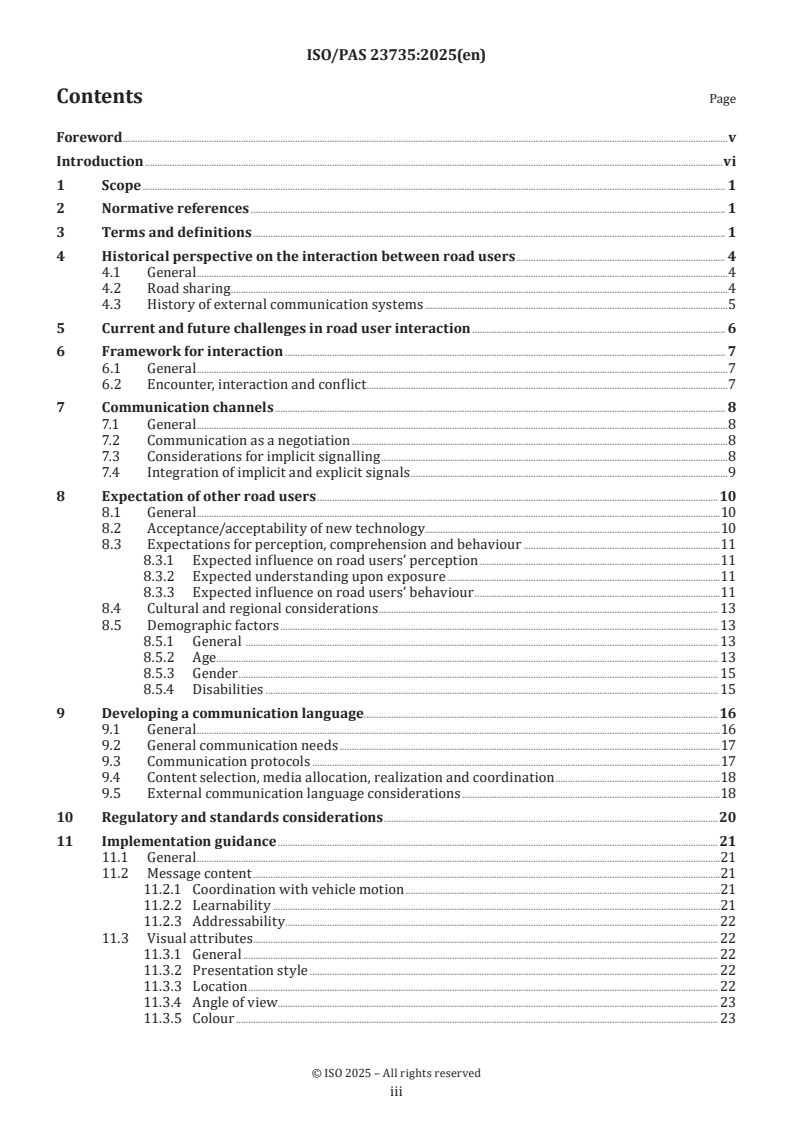
Contents Page
Foreword .v
Introduction .vi
1 Scope . 1
2 Normative references . 1
3 Terms and definitions . 1
4 Historical perspective on the interaction between road users . 4
4.1 General .4
4.2 Road sharing .4
4.3 History of external communication systems .5
5 Current and future challenges in road user interaction . 6
6 Framework for interaction . 7
6.1 General .7
6.2 Encounter, interaction and conflict . .7
7 Communication channels . 8
7.1 General .8
7.2 Communication as a negotiation .8
7.3 Considerations for implicit signalling .8
7.4 Integration of implicit and explicit signals .9
8 Expectation of other road users .10
8.1 General .10
8.2 Acceptance/acceptability of new technology .10
8.3 Expectations for perception, comprehension and behaviour .11
8.3.1 Expected influence on road users’ perception .11
8.3.2 Expected understanding upon exposure .11
8.3.3 Expected influence on road users’ behaviour .11
8.4 Cultural and regional considerations . 13
8.5 Demographic factors . 13
8.5.1 General . 13
8.5.2 Age . . . 13
8.5.3 Gender . 15
8.5.4 Disabilities . 15
9 Developing a communication language .16
9.1 General .16
9.2 General communication needs .17
9.3 Communication protocols .17
9.4 Content selection, media allocation, realization and coordination .18
9.5 External communication language considerations .18
10 Re gulatory and standards considerations .20
11 Implementation guidance .21
11.1 General .21
11.2 Message content .21
11.2.1 Coordination with vehicle motion .21
11.2.2 Learnability .21
11.2.3 Addressability . 22
11.3 Visual attributes . 22
11.3.1 General . 22
11.3.2 Presentation style . 22
11.3.3 Location . 22
11.3.4 Angle of view . . 23
11.3.5 Colour . 23
iii
11.3.6 Brightness .24
11.4 Integration with existing systems .24
11.4.1 Coordination and choreography with other signals .24
11.4.2 Discussion on integration with automated driving system .24
11.5 E valuation .24
Annex A (informative) Use cases in traffic situations with need of communication .25
Annex B (informative) Description of the multiple resource theory .48
Bibliography .50
iv
Foreword
ISO (the International Organization for Standardization) is a worldwide federation of national standards
bodies (ISO member bodies). The work of preparing International Standards is normally carried out through
ISO technical committees. Each member body interested in a subject for which a technical committee
has been established has the right to be represented on that committee. International organizations,
governmental and non-governmental, in liaison with ISO, also take part in the work. ISO collaborates closely
with the International Electrotechnical Commission (IEC) on all matters of electrotechnical standardization.
The procedures used to develop this document and those intended for its further maintenance are described
in the ISO/IEC Directives, Part 1. In particular, the different approval criteria needed for the various types
of ISO documents should be noted. This document was drafted in accordance with the editorial rules of the
ISO/IEC Directives, Part 2 (see www.iso.org/directives).
ISO draws attention to the possibility that the implementation of this document may involve the use of (a)
patent(s). ISO takes no position concerning the evidence, validity or applicability of any claimed patent
rights in respect thereof. As of the date of publication of this document, ISO had not received notice of (a)
patent(s) which may be required to implement this document. However, implementers are cautioned that
this may not represent the latest information, which may be obtained from the patent database available at
www.iso.org/patents. ISO shall not be held responsible for identifying any or all such patent rights.
Any trade name used in this document is information given for the convenience of users and does not
constitute an endorsement.
For an explanation of the voluntary nature of standards, the meaning of ISO specific terms and expressions
related to conformity assessment, as well as information about ISO's adherence to the World Trade
Organization (WTO) principles in the Technical Barriers to Trade (TBT), see www.iso.org/iso/foreword.html.
This document was prepared by Technical Committee ISO/TC 22, Road vehicles, Subcommittee SC 39,
Ergonomics.
Any feedback or questions on this document should be directed to the user’s national standards body. A
complete listing of these bodies can be found at www.iso.org/members.html.
v
Introduction
As the automotive industry develops automated driving systems (ADS), there continues to be discussion
of the need for them to communicate with other road users. Other road users include, but are not limited
to, pedestrians, bicyclists, motorcyclists and human drivers. Research suggests that visual communication
[1]
from external displays on automated vehicles will be helpful to other road users in certain circumstances. -
[4]
Common approaches to designing external communication systems should mitigate public confusion and
enhance public acceptance and trust of automated vehicles (AVs). This document outlines design guidance
on external visual communication to support future standardization.
vi
Publicly Available Specification ISO/PAS 23735:2025(en)
Road vehicles — Ergonomic design guidance for external visual
communication from automated vehicles to other road users
1 Scope
The scope of this document encompasses design parameters of external visual communication used by single
mode L4/L5 automated driving system-dedicated vehicles (ADS-DVs), as defined in SAE J3016. Guidance is
given for passenger cars (including sport utility vehicles and light trucks) and commercial vehicles (including
heavy trucks and buses), as well as derivatives of them that carry or do not carry compartments for
occupants (i.e. driver or passengers). These vehicles can be operated in different domains, covering several
alternative scenarios and use cases (e.g. open roads, motorways, urban environments, confined areas, geo-
fenced areas with dedicated lanes, ports, terminals, pits). It is assumed that the design of ADS-DVs will be
unique, thus making it readily apparent that the vehicle is an ADS-DV (see also Annex A for descriptions
of use cases concerning the need for communication). The wide range of domains makes it important to
consider users with different experiences and abilities, e.g. experienced and inexperienced drivers, elderly,
people with disabilities and children.
2 Normative references
There are no normative references in this document.
3 Terms and definitions
For the purposes of this document, the following terms and definitions apply.
ISO and IEC maintain terminology databases for use in standardization at the following addresses:
— ISO Online browsing platform: available at https:// www .iso .org/ obp
— IEC Electropedia: available at https:// www .electropedia .org/
3.1
acoustic vehicle alerting system
AVAS
system for hybrid-electric and pure-electric vehicles, which provides sound to signal the vehicle's presence
to pedestrians and other road users
3.2
acceptability
prospective judgment of a new concept
Note 1 to entry: A new concept means that the technology does not exist, or the subject has no experience with the
technology.
3.3
acceptance
evaluation of an existing concept
Note 1 to entry: An existing concept is when the technology is already introduced into the subject's environment.
3.4
adoption
active choice to take up, follow and interact with technology
Note 1 to entry: Adoption is the opposite of acceptance (3.3), which designates just the passive willingness to accept a
technology.
3.5
bearing angle
angular distance between the participant's trajectory and an oncoming object
Note 1 to entry: See Reference [47].
3.6
combination vehicle
any combination of truck, truck tractor, trailer, semi-trailer, pole trailer used upon the highways or streets in
the transportation of passengers or property
Note 1 to entry: A combination vehicle can also include passenger cars (3.20) with a trailer or caravan.
3.7
commercial vehicle
vehicle used for carrying goods or fare-paying passengers, including heavy trucks and buses
3.8
conflict
event that ensues when two or more agents compete to occupy the same space within which only one of
them can physically exist
3.9
daytime running light
daytime running lamp
automotive lighting device on the front of a road vehicle which is automatically switched on when the vehicle
is driven and emits white, yellow or amber light, whose function is to help other road users see the vehicle
3.10
encounter
event that occurs anytime two or more agents come into proximity of each other, move towards each other
and cross the paths of each other
3.11
explicit communication
behaviour that can be interpreted as serving the exclusive purpose of conveying information to another
road user
3.12
implicit communication
behaviour that can be interpreted as serving the purpose of conveying information to another road user but
also as serving some other purpose (e.g. locomotion)
3.13
interaction
traffic event with a collision course where interactive behaviour is a precondition to avoid an incident
3.14
jaywalker
person crossing a street where not permitted to cross
3.15
kinematic gesture
specific and typical way that a vehicle alters its speed (typically towards or starting from a standstill) so that
it can become possible for other road users to understand its intent specifically from the vehicle's motion
Note 1 to entry: Significant cues include the rate and variation of acceleration or deceleration.
3.16
legal zone
area that has its legal properties relating to speed restrictions, entry, occupancy, and withdrawal
requirements and priorities
[7]
Note 1 to entry: When two legal zones intersect, there is a potential for a space-sharing conflict (3.8), in the sense
[8]
that no two agents can occupy the same “tile” space at the same “time” .
3.18
looming
useful optical phenomenon where an object that comes into sight and gets closer results in a rapid
enlargement of the size experienced by the other road users
Note 1 to entry: This can work as a notification and warning.
3.19
mixed traffic environment
traffic containing various vehicles and vehicle types, either motorized or non-motorized, and sometimes
also pedestrians
3.20
partially supervised
conflict resolution scheme in which priority is fixed and not switched (as in “supervised”) and conditional
EXAMPLE Non-signallized pedestrian crossing or zebra crossing.
3.21
passenger car
road motor vehicle, other than a motorcycle, intended for the carriage of passengers and designed to seat no
more than nine persons (including the driver), including sport utility vehicles and light trucks
3.22
piggybacking
usage of space or gap that someone else has created to their advantage
EXAMPLE When manoeuvring through a traffic environment.
3.23
receptivity
willingness to interact with a technology
Note 1 to entry: Receptivity is different than acceptance (3.3), which designates the willingness to use a technology.
3.24
road space
physical space that includes roadways, sidewalks, intersections, crossing zones, etc., where vehicles and
vulnerable road users (VRUs) collectively operate
3.25
supervised control
supervised conflict resolution scheme (e.g. traffic lights and pedestrian lights) in which priority is given to
road agents coming from different legal zones via signal mechanisms that enforce access, occupancy and
withdrawal of the road user (i.e. a semaphore)
3.26
technology acceptance
subjective judgments that make the technological object attractive, usable and useful for users
3.27
unsupervised control with priority
conflict resolution scheme in which there is clear prioritization between the conflicting agents, but there is
no supervisory support for the vehicle
Note 1 to entry: The vehicle and driver are advised to do their best to resolve the conflict (3.8).
Note 2 to entry: The priority scheme is determined by law (e.g. jaywalker).
3.28
unsupervised control without priority
conflict resolution scheme in which there is no clear prioritization between the conflicting agents and no
supervisory support to the vehicle
Note 1 to entry: Further, no priority scheme is given to resolve a conflict (3.8) between vehicle and driver, e.g. double
lane merges.
3.29
visually guided eye movement
eye movement that is generated by the presence of visual cues in the field of view, also known as reflexive or
exogenously driven eye movement
Note 1 to entry: Visually guided eye movements are the simplest form of eye movements - or saccades - and require
only basic neural circuitry.
4 Historical perspective on the interaction between road users
4.1 General
Interaction among road users has been shaped over time by how road users conceptualize and share the
road space. Primary influences in this shaping have been changes in road infrastructure, the development
of new communication systems and vehicle technologies, and the adoption of new traffic regulations. In 4.2
and 4.3, it is described how road-sharing behaviour has changed over time and how the advent of external
communication systems has contributed to those changes.
4.2 Road sharing
Motor vehicles and motorized transport have been a reality for over a century. During this period, significant
developments have unfolded in how the road has been experienced as a shared space between different
road agents, including motor vehicles, pedestrians and cyclists. Images from the beginning of the 20th
century show pedestrians' predominant use of road space, with few instances of interaction with early light
vehicles and trams. Road lanes were generally undefined in this era, and traffic regulations were scarce.
Nevertheless, documents (mostly anecdotal, literary and photographic) indicate some level of seamless
interaction between motor vehicles and vulnerable road users (VRUs), made possible by the low number of
motor vehicles and the relatively lower velocities of these vehicles compared to modern ones. Communication
was directly conveyed through informal (i.e. verbal signals, gestures) one-on-one interactions.
The increasing complexity of urban road environments led to the emergence of road safety research in
[9]
the 1920s, aimed at dealing with the problem of increasing road traffic casualties. Early safety research
helped define road space, introduced the need for traffic regulation and defined the individual contributions
of road users in traffic incidents. Such efforts led to a stricter physical separation of road users in roadway
design and more structured interaction that became increasingly regulated during the following decades.
Formal methods of communication were created, including dedicated communication systems for both the
road infrastructure and road agents.
A century’s cumulative regulation of road users’ interaction and definition of separated road spaces has led
to the need for a less structured exchange. This is partly due to the likelihood of fewer vehicles on the road if
ADS-DVs yield their predicted benefit of a more efficient transportation ecosystem. With fewer vehicles on the
roads, more VRUs could safely use these spaces, particularly in urban centers, which would, in turn, influence
[10]
regulation, vehicle technology, and even urban planning. With more ADS-DVs on the roads, however, there
would be a paradigm shift in how road users communicate. Human interaction (verbal signals, gestures, etc.)
would likely play a minor role in the larger communication framework, especially as ADS-DVs become more
popular. In such a future, there would likely be a need to create systems dedicated to ADS-DV-VRU that are
distinct from those for ADS-DV-conventional vehicle communication domains. These new systems would
ideally accommodate the human road user by fostering clear and efficient communication, similar—if not
greater—in capability and versatility to the external communication systems described in 4.3.
4.3 History of external communication systems
According to Reference [11], “roadway interpersonal communication” consists of formal and informal
communication that can take both an intentional and unintentional form. Throughout the history of
automotive development, informal channels of communication (e.g. hand gestures, eye contact, head
movement, and vehicle movements) have been comparatively stable, while formal communication (e.g.
blinkers, headlights, passing lights and horns) have emerged due to technological innovations and successive
introduction of new HMI concepts. This subclause provides a brief history of such external communication
systems that have dynamically evolved around the needs of the most important agent—the human road user.
Formal methods of conveying information about vehicle presence have existed since the beginning of
automobile development, with the primary goal of making the vehicle visible to other road users. Early
attempts from the 1900s emulated aspects of pre-automobile vehicles regarding location and number of
lamps, with the first developments appearing in headlights and later in rear lights. Early automobile lamps
were the same as those used on horse-drawn carriages and were intended to make the vehicle visible at
night. These lamps often showed red to the rear but sometimes green to the left and white to the right. The
first compulsory rear lights were meant to illuminate the license plate, while presence signalling came as a
[12]
by-product. Electric lamps for signalling vehicle presence only became commonplace in both front and
rear locations in the 1920s, with the first conventions and specific photometric requirements being agreed
upon and adopted by the UNECE in 1958.
Attempts to systematize visual communication systems for signalling “intent” appeared as early as 1909
when a patent was submitted on a device “indicating the intended movements of vehicles” (US Patent
[13]
912.831). Despite its precocity, this first attempt was already concerned with road users’ comprehension,
hence the suggestion to use hand-shaped light signals that resembled the most common signal at the time –
hand gestures. The first commercial application of turn indicators appeared in the 1910s with the inclusion
of a winker (latter known as a trafficator), a mechanically operated arm or flag that extended from the
[14]
side of the vehicle. Early turn signal arrows were steadily burning until manually deactivated and were
coloured green, yellow, or red. Only in 1937 did SAE identify that flashing increased conspicuity, though
steady lamps were still allowed. In Europe, semaphore-type (when actuated, protruded from the body of
the vehicle) illuminated turn signals were still dominant in the 1950s. However, flashing lamps were used
[15]
almost universally in new cars by 1965. However, a 1952 study found that semaphore arms produced
shorter reaction times at night. They also identified that higher flash frequencies increased salience, though
[16]
mandated frequencies were not increased. In 2013, a study found that dynamic, directional turn signals
improved safety outcomes in the form of a shorter decision process and a higher probability of correct
interpretations.
Early stop lamps appeared as original equipment in the 1910s: one per vehicle on the left rear fender. Some
showed the letters STOP on the lens. Others were combined SLOW/STOP lamps, showing SLOW when either
the clutch or brake was depressed versus STOP when both were depressed. Other stop lamps changed colour
based on accelerator position: green when the accelerator was pressed and red when it was not. A significant
concern for early stop lamp lighting requirements was to avoid confusion with red railway signals. Yellow
stop lamps were still allowed in the US in the 1960s, though no manufacturers used them.
In conclusion, the history of external communication systems reveals a steady level of experimentation and
adaptation, which is expected to continue. External communication is a symbolic language that borrows
from contemporary communication functions. In Clause 5 new ways to incorporate more recent technology
acceptance/acceptability models into the design of these systems are explored.
5 Current and future challenges in road user interaction
Road users ideally need to have a similar interpretation of the situation to achieve a comfortable and pleasant
interaction. If this is not the case, and road users differ in their understanding or awareness of the situation,
[17]
breakdowns in the interaction and conflicts are likely to occur. Indeed, misinterpretation is among the
[18]
most common causation factors in pedestrian incidents and accidents. However, how pedestrians and
vehicles interact still needs to be fully understood.
Road users often use non-verbal communication to clarify their intentions in some traffic situations,
especially at low speeds when ambiguities and negotiation are needed. In Reference [19] it was found that
pedestrians’ decisions to cross are affected by various signals given by the driver, such as eye contact, hand
waving, posture and flashing lights. Of these signals, 84 % of pedestrians sought eye contact with drivers. In
Reference [20] it was found that pedestrians who want to cross the street look at the approaching driver to
get “acknowledgment,” i.e. if the driver returns the eye contact, pedestrians assume that they have been seen
and have achieved mutual understanding. The importance of visual search is also evident from Reference
[21] where it was reported that 75 % of pedestrians walked facing toward, rather than with, traffic. This
same behaviour correlated with lower fatality risk in historical data. Similar conclusions were drawn in
Reference [22], in which it was shown that the most prominent signal to transmit pedestrians’ crossing
intention is looking (90 %) or glancing (10 %) toward the oncoming traffic. In Reference [23] it was found
that when pedestrians interact with vehicles, they tend to rely on eye contact with the driver at low speeds,
while at higher speeds, they base their decisions more on the vehicle's behaviour.
Studies on the effects of non-verbal signals that pedestrians use to communicate with drivers further
explain the nature of road-user interactions. In Reference [24] it was found that pedestrian eye contact is
one factor that strongly influences driver behaviour. Without eye contact, about 55 % of the drivers did
not stop for the pedestrian, while about 68 % of the drivers stopped when the pedestrian was seeking eye
contact. A positive effect of pedestrians’ eye contact and other gestures (e.g. hand waving, leg movements
and smile) is also demonstrated in terms of increased time to collision and decreased severe braking by
[25] [25] [28]
drivers, as well as increased yielding behaviour. - In Reference [20] it was shown that participants
could not correctly evaluate pedestrians’ crossing intentions based only on their trajectories, suggesting
that parameters of body language are valuable cues.
This research indicates that some interactions might be challenging when introducing ADS-DVs in mixed-
traffic environments. One example of altered interaction derives from the absence of a human driver.
Without a human driver inside the vehicle, explicit signals such as hand gesturing and head movements are
precluded. Other road users may be left seeking signals that are no longer available. Because many road
users have been habitually trained—throughout a lifetime—to seek and use these signals to inform their
decision-making processes, the lack of such explicit signals may need to be supplemented with a new form
of communication.
Another impetus for change is that ADS-DVs may drive differently than human-driven vehicles. VRUs have,
through years of repeated exposure, developed internal frameworks to aid them in efficiently navigating
roads cohabited by human-operated vehicles. Implicit signalling through vehicle motion and other
environmental cues have thus far provided VRUs with a rich—and nuanced—set of cues. Still, automated
vehicles will not necessarily provide the same information in the same way. For example, deceleration and
stopping profiles may become standardized across automated systems. While such profiles may be very
effective in some geographical regions, they may not be as effective or even be prone to confusing others. See
the overview in Annex A on use cases (Tables A.1-A.8) regarding how these aspects of the vehicles' timing,
movement and positioning can be related to everyday traffic situations. Thus, to design effective external
communication systems for automated vehicles, it is first needed to understand how road users communicate
in the current context. Clause 6 provides a theoretical framework to define road user communication.
6 Framework for interaction
6.1 General
Several theoretical perspectives or frameworks could be used to conceptualize interactions between road
users in traffic and provide guidance on how future interactions might look. This clause provides key
interaction concepts, starting with a traffic conflict technique.
6.2 Encounter, interaction and conflict
The traffic process has several elementary events. These events differ in their degree of severity (regarding
safety) and frequency, ranging from safe and frequent everyday encounters and interactions between road
[29]-[31]
users to conflicts and accidents characterized by higher severity and lower frequency.
An encounter is an event that occurs any time two or more agents come into proximity and cross paths
with each other. These events, which are the most common type of multi-agent traffic interaction, do not
necessarily involve a conflict. Most encounter events occur without a conflict and, due to their prevalence,
are a significant focus of this document.
There are many different interpretations regarding the concept and theoretical framework surrounding
interaction. Reference [4] describes road user interactions as “situation[s] where the behavior of at least
two road users can be interpreted as being influenced by the possibility that they are both intending to
occupy the same region of space at the same time in the near future”. This is differentiated from a space-
sharing conflict, or “an observable situation from which it can be reasonably inferred that two or more road
users are intending to occupy the same region of space at the same time in the near future”. The addition
of this more general definition is necessary to capture situations where the conditions successfully reduce
[32]
interactions, improving the situation.
A conflict ensues when two or more agents compete to occupy the same space within which only one can
physically exist. There are four relevant types of conflict resolution schemes in relation to pedestrians:
— supervised control: priority is given to road agents coming from different areas via signal mechanisms
that enforce access, occupancy and withdrawal of the road user (e.g. a semaphore);
— partially supervised control: priority is fixed and conditional (e.g. non-signallized pedestrian crossing,
zebra crossing);
— unsupervised control with priority: priority is clearly delineated, but the vehicle does not receive
supervisory support. The vehicle and driver are advised to do their best to resolve the conflict. The
priority scheme is determined by law;
— unsupervised control without priority: no priority scheme is given (e.g. double lane merges).
A fully supervised scheme is preferable for all the conflicts, as mentioned above, as well as resolution schemes.
Since such control mechanisms cannot be implemented everywhere on the road, partially supervised control
schemes are most commonly used. Such schemes are more ambiguous and require negotiation. Consider,
for example, the situation in an unsignallized pedestrian crossing where the driver is unsure whether a
pedestrian will cross and the pedestrian is unsure whether the vehicle will stop. There are also situations
where the vehicle is too fast and too close to the pedestrian crossing, and the driver cannot stop in time
simply due to the situation's dynamics. Moreover, there are road situations where drivers must “nudge”
or “game” their way into heavy pedestrian traffic after being static longer than customary. Such conflicts
are managed today in an aggressive way, sometimes in an assertive way, and at times in a coordinated or
even accommodating way. Through communicative signals (e.g. indicator lights or flashing headlamps,
hand signals), drivers attempt to negotiate their way during the encounter and interaction phases discussed
above. See Annex A for examples of use cases that illustrate these processes in common traffic situations.
7 Communication channels
7.1 General
Human road users communicate with each other using various communication channels, from their
movement behaviour and placement to facial expression, eye gaze and contact, gestures, and possibly voice
and tone of speech. It is expected that communication channels will need to be established for AVs, although
it will be optional, to ensure that they are understood and perceived well by other road users. This clause
defines communication and describes its different dimensions.
7.2 Communication as a negotiation
Agents sometimes need to negotiate, communicating on the fly who gives priority to whom in unsignallized
conditions. According to Reference [34], one of the critical tasks within any human interaction is developing
and maintaining a shared definition of the situation, enabling participants to decode normative expectations
and adjust their behaviour accordingly. Strategic interactions occur when people are “in a well-structured
situation of mutual impingement where each party must make a move and where every possible move
[35]
carries fateful implications for all parties”. In these situations, knowing other participants are trying to
anticipate their actions influences each participant's decision. These interactions occur daily in the context
of traffic, where road users decide how they will move through the space.
Communication is a mixture of goal-related and facilitators' communication acts. Goal-related acts refer to
the movement of the agents. Such movement is defined here as an agent’s entry, occupancy and vacancy of
[36]
a given space. In addition, several means of communication are used to facilitate conflict resolution: (1)
formal vehicle signals (e.g. using the vehicle horn to avoid collisions and turn signal), (2) informal vehicle
signals (e.g. flashing the headlights to indicate giving way), (3) vehicle signals that stem from the pattern of
movement itself (e.g. looming effect and diminishing effect), and (4) bodily signals of humans (e.g. waving
hand, body posture).
Looking at the encounter process as a mixture of goal-related and facilitators' communication can help
analyse the turn-taking between pedestrians and vehicles as a formal discourse. In this respect, in Reference
[22] a data set of more than 650 samples of pedestrian behaviours when crossing (or attempting to cross)
the street under various conditions was analysed and their patterns of interaction were summarized. The
analysis shows that the crossing event unfolds over time. The most common pattern involves “standing,
looking and crossing”, whereas the second most common is “looking or glancing” while crossing.
These cues are being used to establish successful grounding between the two agents. Grounding relies on the
[37]
agents' “mutual knowledge, mutual beliefs, and mutual assumptions”. In the pedestrian crossing dialogue,
similarly to the conversation setting, grounding serves as “the mutual belief between conversational
[37]
partners that everyone involved has a clear enough understanding of the concept to move forward”.
See also the overview of use cases based on common traffic situations provided in Annex A. The categories
“communication messages,” “vehicle motions/behavior,” and “communication means” help to illustrate the
types of acts.
The following subclause provides a comprehensive review of road user interaction, including who those users
are, how they make decisions, and how explicit and implicit signals are used to communicate effectively.
7.3 Considerations for implicit signalling
This subclause provides principles and recommendations for implicit signalling through vehicle motion that
can be used for ADS-DVs. Two assumptions that guide the principles and recommendations in this subclause
are that safety is the most important aspect of vehicle-pedestrian encounters. The driver's or passengers'
comfort is an important consideration when choosing motion cues. Safety of vehicle motion cues may be
related to rear-end or imminent frontal collisions. For example, assertive deceleration used as a cue to other
road users may cause re
...