


ISO 23691
(Main)Microbiology of the food chain — Determination and use of cardinal values
Microbiology of the food chain — Determination and use of cardinal values
This document establishes basic principles and specifies requirements and methods to determine the cardinal values of bacteria and yeast strains and use them to predict microbial growth. The four main steps of the approach are: determination of the cardinal values in culture medium; determination of the correction factor in the target food; validation of the model; simulations. Four environmental factors are considered: temperature, pH, aw and inhibitors (e.g. organic acids). NOTE 1 Microbial competition is not considered as an inhibitor in this document and can be addressed by proper modelling approaches. The determination of cardinal values is performed in a two-step approach: the determination of maximum specific growth rates of the studied strain grown in broth under a defined range of values of the studied environmental factor(s); the use of recognized predictive microbiology secondary models to fit the obtained experimental data to obtain the cardinal values. The use of cardinal values in microbial growth simulation is based on predictive microbiology primary and secondary models. The cardinal values are combined with challenge test data to consider the matrix effect. Depending on the goal of the growth simulation, it is important to account for variation of cardinal values between strains within a bacterial or yeast species. Cardinal values are a good indicator of a strain growth ability for the studied environmental factors. They are therefore used as criteria to select strains, in addition to their origin and virulence, when performing growth challenge tests (see ISO 20976-1) or in methods validation (see ISO 16140 series). NOTE 2 This document focuses on the determination of cardinal values for one strain. The same methodology can be used to characterize multiple strains independently to cover biological strain variability and include these results in the predictions.
Microbiologie de la chaîne alimentaire — Détermination et utilisation des valeurs cardinales
Le présent document établit les principes élémentaires et spécifie les exigences et les méthodes pour déterminer les valeurs cardinales de souches de bactéries et de levures, et les utiliser afin de prédire la croissance microbienne. L’approche s’articule autour de quatre étapes principales: détermination des valeurs cardinales dans le milieu de culture; détermination du facteur de correction dans l’aliment cible; validation du modèle; simulations. Quatre facteurs environnementaux sont pris en compte: température, pH, aw et inhibiteurs (par exemple, acides organiques). NOTE 1 La compétition microbienne n’est pas assimilée à un inhibiteur dans le présent document et peut être traitée par des approches de modélisation convenables. La détermination de valeurs cardinales nécessite une approche en deux étapes: la détermination des taux de croissance spécifiques maximaux de la souche étudiée cultivée en bouillon pour une plage définie de valeurs du ou des facteurs environnementaux étudiés; et l’utilisation de modèles secondaires reconnus de microbiologie prévisionnelle pour ajuster les données expérimentales obtenues afin d’obtenir les valeurs cardinales. L’utilisation de valeurs cardinales pour la simulation de la croissance microbienne repose sur des modèles primaires et secondaires de microbiologie prévisionnelle. Les valeurs cardinales sont combinées aux données de test de croissance afin de prendre en considération l’effet de matrice. Selon l’objectif de la simulation de croissance, il est important de tenir compte de la variation des valeurs cardinales entre les souches d’une espèce de bactérie ou de levure. Les valeurs cardinales sont un bon indicateur de la capacité de croissance d’une souche pour les facteurs environnementaux étudiés. Elles sont donc utilisées comme critères de sélection des souches, en plus de leur origine et de leur virulence, dans le cadre de tests de croissance (voir l’ISO 20976-1) ou de validation d’une méthode (voir la série de l’ISO 16140). NOTE 2 Le présent document est axé sur la détermination de valeurs cardinales pour une seule souche. La même méthodologie peut être utilisée pour caractériser plusieurs souches indépendamment afin de couvrir la variabilité biologique des souches et inclure ces résultats dans les prévisions.
General Information
- Status
- Not Published
- Technical Committee
- ISO/TC 34/SC 9 - Microbiology
- Drafting Committee
- ISO/TC 34/SC 9/WG 19 - Guidelines for conducting challenge tests
- Current Stage
- 6000 - International Standard under publication
- Start Date
- 21-Oct-2025
- Completion Date
- 07-Feb-2026
Relations
- Effective Date
- 06-Jun-2022
Overview
ISO 23691:2025, titled Microbiology of the food chain - Determination and use of cardinal values, is an international standard published by ISO. This document establishes fundamental principles, requirements, and methods to determine cardinal values of bacteria and yeast strains. Cardinal values refer to critical growth parameters that describe microorganism behavior under various environmental factors such as temperature, pH, water activity (a_w), and inhibitory compounds. The standard provides a systematic approach to quantify these values and apply them in predictive microbiology to simulate microbial growth in food chains.
The methods outlined in ISO 23691 involve measuring maximum specific growth rates within defined ranges of intrinsic and extrinsic factors, utilizing secondary mathematical models to derive cardinal values. These values can subsequently be incorporated with challenge test data to simulate microbial growth accurately in different food matrices and processing scenarios.
This standard is essential for food microbiologists, quality assurance professionals, and regulatory bodies involved in microbial risk assessment and control within the food industry.
Key Topics
Determination of Cardinal Values
- Measurement of maximum specific growth rates of bacterial and yeast strains in broth culture under varied environmental conditions.
- Application of secondary predictive microbiology models (gamma functions) to fit growth data and extract cardinal values such as minimum, optimum, and maximum temperature or pH for growth.
Environmental Factors Considered
- Temperature
- pH
- Water activity (a_w)
- Concentrations of inhibitors (e.g., organic acids)
Correction Factor and Validation
- Determination of a food correction factor via challenge tests in actual food products.
- Validation protocols for ensuring the predictive models accurately represent microbial growth in target food matrices.
Predictive Microbiology Modeling
- Use of cardinal values combined with challenge test data to simulate microbial growth under static and dynamic food storage and processing conditions.
- Support for simulations considering multiple environmental factors simultaneously or changing over time (e.g., chill chain temperature variations).
Experimental Design and Data Collection
- Streamlined procedures for microbial culture preparation, growth monitoring (binary dilution and direct plating methods), and statistical treatment of data.
- Guidance on experimental design to capture sufficient growth data for reliable cardinal value estimation.
Applications
Food Safety and Quality Assurance
ISO 23691 supports food business operators in validating microbiological control measures within hazard analysis and critical control point (HACCP) systems. By accurately determining cardinal values, businesses can better predict microbial behavior and ensure compliance with food safety criteria.Microbial Risk Assessment (MRA)
Regulatory authorities and food producers can employ the standard’s methodology to estimate risks associated with pathogenic or spoilage microorganisms in different food products and processing environments.Product Development and Formulation
The cardinal values enable prediction of how changes in formulation-such as pH adjustments or addition of preservatives-influence microbial growth, supporting formulation optimization for shelf life and safety.Process Optimization
Predictive growth models based on cardinal values provide insights into the effects of time-temperature storage conditions, aiding in process control and shelf life prediction.Research and Standards Development
The standard offers a scientific framework and common methodology for microbiological studies related to food safety, enabling consistency and comparability of results across laboratories and jurisdictions.
Related Standards
- ISO 11290 series - Methods for detection and enumeration of Listeria monocytogenes and Listeria spp. in foods, complementary for microbial testing protocols.
- ISO/TS 19036 - Microbiology of food and animal feeding stuffs - Guidelines on performance criteria for methods for detection and enumeration of microorganisms.
- Codex Alimentarius General Principles of Food Hygiene - Provides the broader framework within which ISO 23691’s microbiological modeling supports food safety management.
By integrating ISO 23691 with these and other relevant standards, food industry professionals can establish robust microbiological safety protocols grounded in validated predictive microbiology. This ensures both regulatory compliance and consumer protection throughout the food chain.
Keywords: ISO 23691, cardinal values, predictive microbiology, microbial growth simulation, food safety, bacterial growth rate, yeast strains, environmental factors, HACCP, microbial risk assessment, food microbiology standards.

ISO/FDIS 23691 - Microbiology of the food chain — Determination and use of cardinal values Released:11. 08. 2025

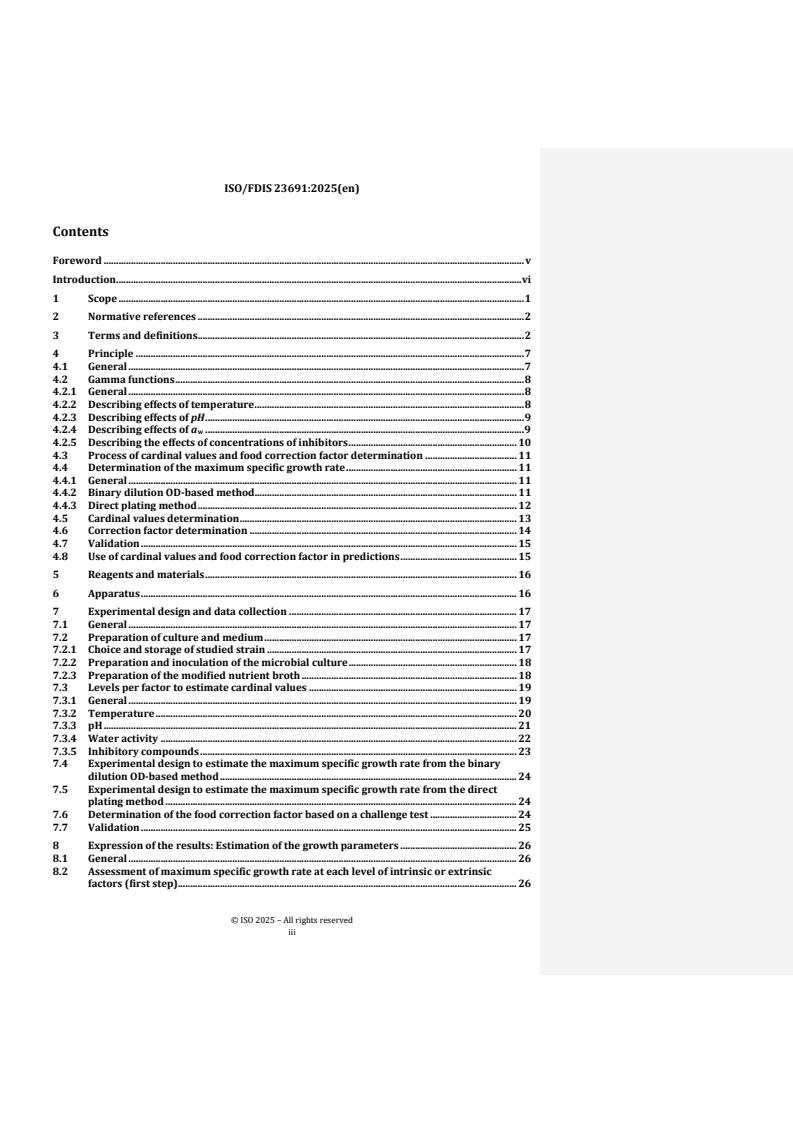
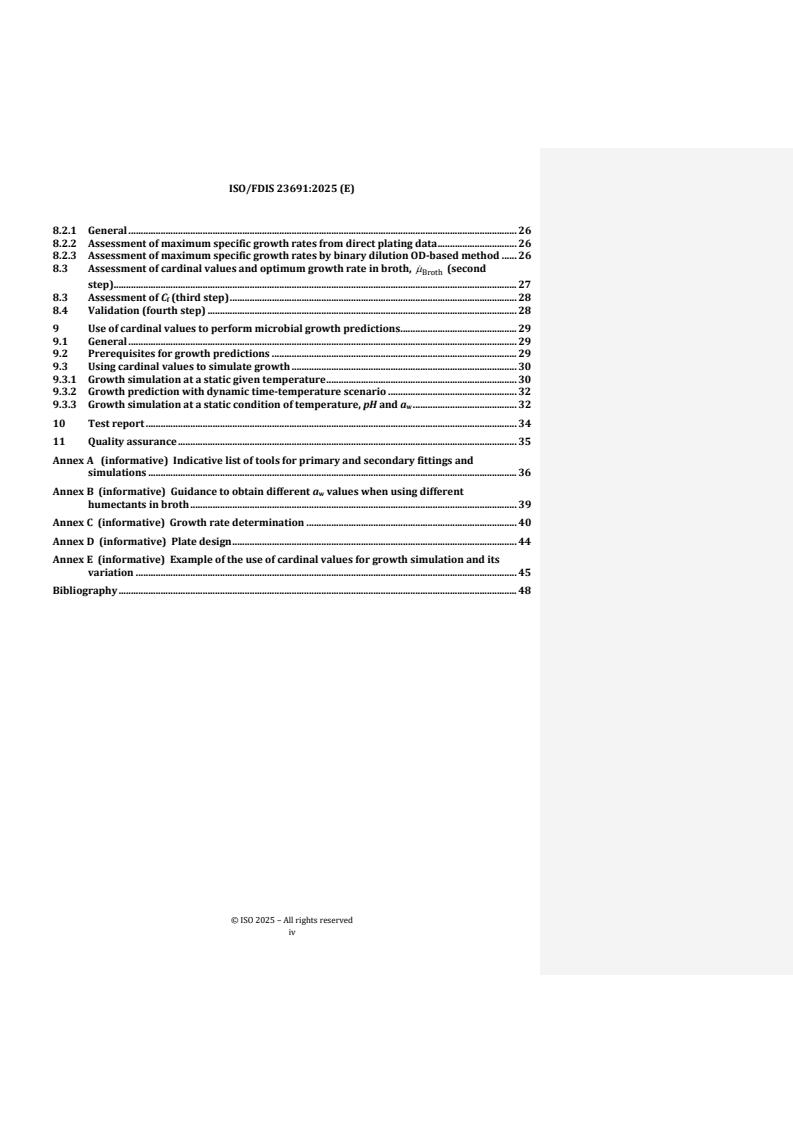
REDLINE ISO/FDIS 23691 - Microbiology of the food chain — Determination and use of cardinal values Released:11. 08. 2025


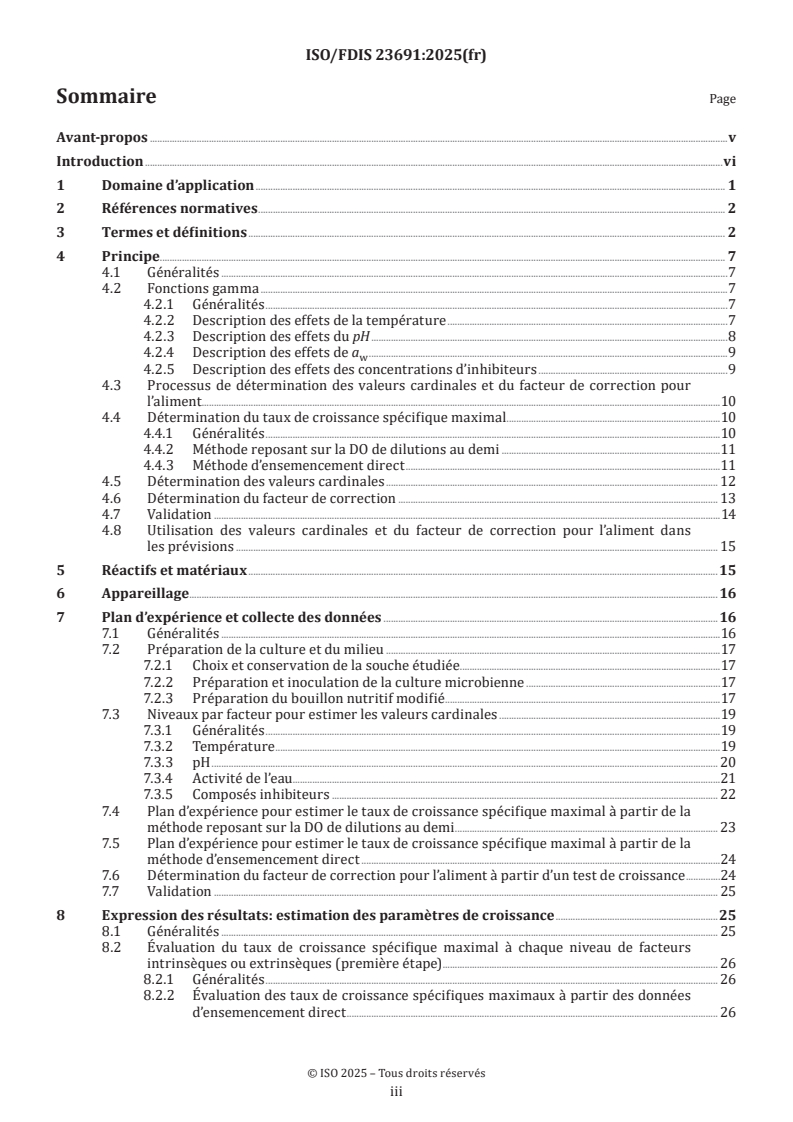
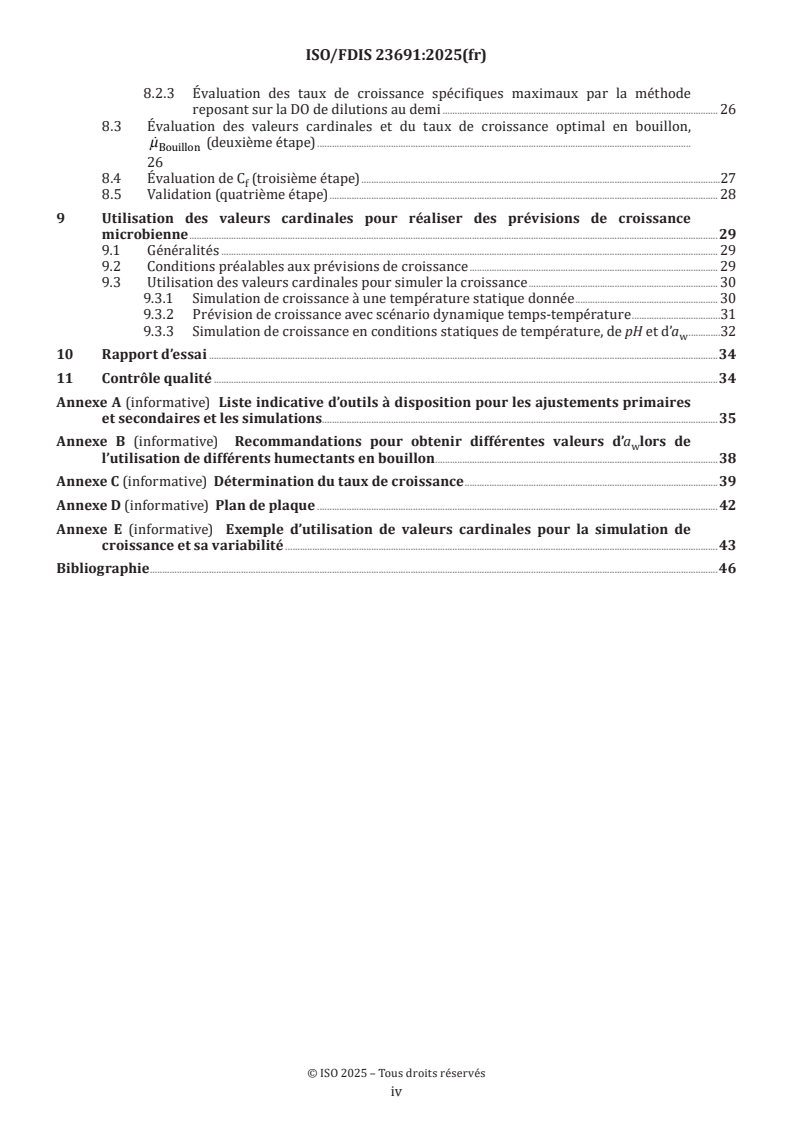
ISO/FDIS 23691 - Microbiologie de la chaîne alimentaire — Détermination et utilisation des valeurs cardinales Released:6. 09. 2025
Frequently Asked Questions
ISO 23691 is a draft published by the International Organization for Standardization (ISO). Its full title is "Microbiology of the food chain — Determination and use of cardinal values". This standard covers: This document establishes basic principles and specifies requirements and methods to determine the cardinal values of bacteria and yeast strains and use them to predict microbial growth. The four main steps of the approach are: determination of the cardinal values in culture medium; determination of the correction factor in the target food; validation of the model; simulations. Four environmental factors are considered: temperature, pH, aw and inhibitors (e.g. organic acids). NOTE 1 Microbial competition is not considered as an inhibitor in this document and can be addressed by proper modelling approaches. The determination of cardinal values is performed in a two-step approach: the determination of maximum specific growth rates of the studied strain grown in broth under a defined range of values of the studied environmental factor(s); the use of recognized predictive microbiology secondary models to fit the obtained experimental data to obtain the cardinal values. The use of cardinal values in microbial growth simulation is based on predictive microbiology primary and secondary models. The cardinal values are combined with challenge test data to consider the matrix effect. Depending on the goal of the growth simulation, it is important to account for variation of cardinal values between strains within a bacterial or yeast species. Cardinal values are a good indicator of a strain growth ability for the studied environmental factors. They are therefore used as criteria to select strains, in addition to their origin and virulence, when performing growth challenge tests (see ISO 20976-1) or in methods validation (see ISO 16140 series). NOTE 2 This document focuses on the determination of cardinal values for one strain. The same methodology can be used to characterize multiple strains independently to cover biological strain variability and include these results in the predictions.
This document establishes basic principles and specifies requirements and methods to determine the cardinal values of bacteria and yeast strains and use them to predict microbial growth. The four main steps of the approach are: determination of the cardinal values in culture medium; determination of the correction factor in the target food; validation of the model; simulations. Four environmental factors are considered: temperature, pH, aw and inhibitors (e.g. organic acids). NOTE 1 Microbial competition is not considered as an inhibitor in this document and can be addressed by proper modelling approaches. The determination of cardinal values is performed in a two-step approach: the determination of maximum specific growth rates of the studied strain grown in broth under a defined range of values of the studied environmental factor(s); the use of recognized predictive microbiology secondary models to fit the obtained experimental data to obtain the cardinal values. The use of cardinal values in microbial growth simulation is based on predictive microbiology primary and secondary models. The cardinal values are combined with challenge test data to consider the matrix effect. Depending on the goal of the growth simulation, it is important to account for variation of cardinal values between strains within a bacterial or yeast species. Cardinal values are a good indicator of a strain growth ability for the studied environmental factors. They are therefore used as criteria to select strains, in addition to their origin and virulence, when performing growth challenge tests (see ISO 20976-1) or in methods validation (see ISO 16140 series). NOTE 2 This document focuses on the determination of cardinal values for one strain. The same methodology can be used to characterize multiple strains independently to cover biological strain variability and include these results in the predictions.
ISO 23691 is classified under the following ICS (International Classification for Standards) categories: 07.100.30 - Food microbiology. The ICS classification helps identify the subject area and facilitates finding related standards.
ISO 23691 has the following relationships with other standards: It is inter standard links to ISO 10979:2019. Understanding these relationships helps ensure you are using the most current and applicable version of the standard.
ISO 23691 is available in PDF format for immediate download after purchase. The document can be added to your cart and obtained through the secure checkout process. Digital delivery ensures instant access to the complete standard document.
Standards Content (Sample)
FINAL DRAFT
International
Standard
ISO/FDIS 23691
ISO/TC 34/SC 9
Microbiology of the food chain —
Secretariat: AFNOR
Determination and use of cardinal
Voting begins on:
values
2025-08-25
Microbiologie de la chaîne alimentaire — Détermination et
Voting terminates on:
utilisation des valeurs cardinales
2025-10-20
RECIPIENTS OF THIS DRAFT ARE INVITED TO SUBMIT,
WITH THEIR COMMENTS, NOTIFICATION OF ANY
RELEVANT PATENT RIGHTS OF WHICH THEY ARE AWARE
AND TO PROVIDE SUPPOR TING DOCUMENTATION.
IN ADDITION TO THEIR EVALUATION AS
BEING ACCEPTABLE FOR INDUSTRIAL, TECHNO
ISO/CEN PARALLEL PROCESSING LOGICAL, COMMERCIAL AND USER PURPOSES, DRAFT
INTERNATIONAL STANDARDS MAY ON OCCASION HAVE
TO BE CONSIDERED IN THE LIGHT OF THEIR POTENTIAL
TO BECOME STAN DARDS TO WHICH REFERENCE MAY BE
MADE IN NATIONAL REGULATIONS.
Reference number
ISO/FDIS 23691:2025(en) © ISO 2025
FINAL DRAFT
ISO/FDIS 23691:2025(en)
International
Standard
ISO/FDIS 23691
ISO/TC 34/SC 9
Microbiology of the food chain —
Secretariat: AFNOR
Determination and use of
Voting begins on:
cardinal values
Microbiologie de la chaîne alimentaire — Détermination et
Voting terminates on:
utilisation des valeurs cardinales
RECIPIENTS OF THIS DRAFT ARE INVITED TO SUBMIT,
WITH THEIR COMMENTS, NOTIFICATION OF ANY
RELEVANT PATENT RIGHTS OF WHICH THEY ARE AWARE
AND TO PROVIDE SUPPOR TING DOCUMENTATION.
© ISO 2025
IN ADDITION TO THEIR EVALUATION AS
All rights reserved. Unless otherwise specified, or required in the context of its implementation, no part of this publication may
BEING ACCEPTABLE FOR INDUSTRIAL, TECHNO
ISO/CEN PARALLEL PROCESSING
LOGICAL, COMMERCIAL AND USER PURPOSES, DRAFT
be reproduced or utilized otherwise in any form or by any means, electronic or mechanical, including photocopying, or posting on
INTERNATIONAL STANDARDS MAY ON OCCASION HAVE
the internet or an intranet, without prior written permission. Permission can be requested from either ISO at the address below
TO BE CONSIDERED IN THE LIGHT OF THEIR POTENTIAL
or ISO’s member body in the country of the requester.
TO BECOME STAN DARDS TO WHICH REFERENCE MAY BE
MADE IN NATIONAL REGULATIONS.
ISO copyright office
CP 401 • Ch. de Blandonnet 8
CH-1214 Vernier, Geneva
Phone: +41 22 749 01 11
Email: copyright@iso.org
Website: www.iso.org
Published in Switzerland Reference number
ISO/FDIS 23691:2025(en) © ISO 2025
ii
ISO/FDIS 23691:2025(en)
Contents Page
Foreword .v
Introduction .vi
1 Scope . 1
2 Normative references . 2
3 Terms and definitions . 2
4 Principle . 6
4.1 General .6
4.2 Gamma functions .7
4.2.1 General .7
4.2.2 Describing effects of temperature .7
4.2.3 Describing effects of pH .8
4.2.4 Describing effects of a .9
w
4.2.5 Describing the effects of concentrations of inhibitors .10
4.3 Process of cardinal values and food correction factor determination .10
4.4 Determination of the maximum specific growth rate .11
4.4.1 General .11
4.4.2 Binary dilution OD-based method .11
4.4.3 Direct plating method . 12
4.5 Cardinal values determination . 13
4.6 Correction factor determination . 13
4.7 Validation .14
4.8 Use of cardinal values and food correction factor in predictions . 15
5 Reagents and materials .15
6 Apparatus . 16
7 Experimental design and data collection .16
7.1 General .16
7.2 Preparation of culture and medium .16
7.2.1 Choice and storage of studied strain .16
7.2.2 Preparation and inoculation of the microbial culture .17
7.2.3 Preparation of the modified nutrient broth .17
7.3 Levels per factor to estimate cardinal values .18
7.3.1 General .18
7.3.2 Temperature .19
7.3.3 pH . 20
7.3.4 Water activity.21
7.3.5 Inhibitory compounds . 22
7.4 Experimental design to estimate the maximum specific growth rate from the binary
dilution OD-based method . 22
7.5 Experimental design to estimate the maximum specific growth rate from the direct
plating method . 23
7.6 Determination of the food correction factor based on a challenge test . 23
7.7 Validation .24
8 Expression of the results: Estimation of the growth parameters .24
8.1 General .24
8.2 Assessment of maximum specific growth rate at each level of intrinsic or extrinsic
factors (first step) . 25
8.2.1 General . 25
8.2.2 Assessment of maximum specific growth rates from direct plating data . 25
8.2.3 Assessment of maximum specific growth rates by binary dilution OD-based
method . 25
iii
ISO/FDIS 23691:2025(en)
8.3 Assessment of cardinal values and optimum growth rate in broth, μ (second
Broth
step) .
8.3 Assessment of C (third step) . . 26
f
8.4 Validation (fourth step) .27
9 Use of cardinal values to perform microbial growth predictions .28
9.1 General . 28
9.2 Prerequisites for growth predictions . 28
9.3 Using cardinal values to simulate growth . 29
9.3.1 Growth simulation at a static given temperature . 29
9.3.2 Growth prediction with dynamic time-temperature scenario . 30
9.3.3 Growth simulation at a static condition of temperature, pH and a .31
w
10 Test report .33
11 Quality assurance .33
Annex A (informative) Indicative list of tools for primary and secondary fittings and
simulations.34
Annex B (informative) Guidance to obtain different a values when using different humectants
w
in broth .37
Annex C (informative) Growth rate determination .38
Annex D (informative) Plate design .42
Annex E (informative) Example of the use of cardinal values for growth simulation and its
variation .43
Bibliography .46
iv
ISO/FDIS 23691:2025(en)
Foreword
ISO (the International Organization for Standardization) is a worldwide federation of national standards
bodies (ISO member bodies). The work of preparing International Standards is normally carried out through
ISO technical committees. Each member body interested in a subject for which a technical committee
has been established has the right to be represented on that committee. International organizations,
governmental and non-governmental, in liaison with ISO, also take part in the work. ISO collaborates closely
with the International Electrotechnical Commission (IEC) on all matters of electrotechnical standardization.
The procedures used to develop this document and those intended for its further maintenance are described
in the ISO/IEC Directives, Part 1. In particular, the different approval criteria needed for the different types
of ISO document should be noted. This document was drafted in accordance with the editorial rules of the
ISO/IEC Directives, Part 2 (see www.iso.org/directives).
ISO draws attention to the possibility that the implementation of this document may involve the use of (a)
patent(s). ISO takes no position concerning the evidence, validity or applicability of any claimed patent
rights in respect thereof. As of the date of publication of this document, ISO had not received notice of (a)
patent(s) which may be required to implement this document. However, implementers are cautioned that
this may not represent the latest information, which may be obtained from the patent database available at
www.iso.org/patents. ISO shall not be held responsible for identifying any or all such patent rights.
Any trade name used in this document is information given for the convenience of users and does not
constitute an endorsement.
For an explanation of the voluntary nature of standards, the meaning of ISO specific terms and expressions
related to conformity assessment, as well as information about ISO’s adherence to the World Trade
Organization (WTO) principles in the Technical Barriers to Trade (TBT), see www.iso.org/iso/foreword.html.
This document was prepared by Technical Committee ISO/TC 34, Food products, Subcommittee SC 9,
Microbiology, in collaboration with the European Committee for Standardization (CEN) Technical Committee
CEN/TC 463, Microbiology of the food chain, in accordance with the Agreement on technical cooperation
between ISO and CEN (Vienna Agreement).
Any feedback or questions on this document should be directed to the user’s national standards body. A
complete listing of these bodies can be found at www.iso.org/members.html.
v
ISO/FDIS 23691:2025(en)
Introduction
Under the general principles of the Codex Alimentarius on food hygiene, it is the responsibility of the food
business operators (FBOs) to control microbiological hazards in foods and to manage microbial risks.
Therefore, it is the responsibility of the FBO to implement validated control measures, within the hazard
analysis and critical control point (HACCP) system, and conduct studies in order to investigate compliance
with the food safety criteria throughout the food chain.
In the framework of microbial risk assessment (MRA), several complementary approaches are developed
to estimate risks posed by pathogens or spoilage microorganisms in the food chain. MRA is adopted by
regulators under the auspices of the international agency for setting food standards. Predictive microbiology
is one of the recognized scientific approaches used to validate control measures within the HACCP system,
as well as to assess microbiological safety and quality of food, food production processes, food storage
conditions and food preparation recommendations dedicated to consumers.
Therefore, this document provides technical rules, procedures and calculations to estimate the cardinal
values of a microorganism of concern and use them in combination with challenge test results to simulate
and predict its growth in raw materials, intermediate products or end products under reasonably foreseeable
food processes, storage and use conditions.
To do so, this document includes the following sections:
— to identify the environmental factor(s) in scope (e.g. temperature, pH, a , organic acids);
w
— to define the appropriate experimental design;
— to estimate the cardinal values of a microorganism in broth medium;
— to perform a challenge test in the matrix of interest and derive the food correction factor and the
maximum microbial population density;
— to use the cardinal values and the food correction factor to predict the growth of the studied
microorganism in different conditions of interest (e.g. changes in time and temperature throughout the
chill chain, changes in formulation with addition of organic acids or preservatives).
Regulatory authorities can have specific recommendations, and these differences have been included as
much as possible in this document. It is, however, possible that additional requirements are needed to get a
regulatory approval of the study.
The use of this document involves expertise from the organizing laboratories in relevant fields such as
food microbiology, predictive microbiology and statistics. This expertise encompasses an understanding
of sampling theory and design of experiments, statistical analysis of microbiological data, and overview of
scientifically recognized and available mathematical concepts used in predictive microbiology.
vi
FINAL DRAFT International Standard ISO/FDIS 23691:2025(en)
Microbiology of the food chain — Determination and use of
cardinal values
WARNING — In order to safeguard the health of laboratory personnel, it is essential that tests for
detecting target microorganism(s) are only undertaken in properly equipped laboratories, under
the control of a skilled microbiologist, and that great care is taken in the disposal of all incubated
materials. Persons using this document should be familiar with normal laboratory practice. This
document does not purport to address all of the safety aspects, if any, associated with its use. It is the
responsibility of the user to establish appropriate safety and health practices.
1 Scope
This document establishes basic principles and specifies requirements and methods to determine the
cardinal values of bacteria and yeast strains and use them to predict microbial growth.
The four main steps of the approach are:
a) determination of the cardinal values in culture medium;
b) determination of the correction factor in the target food;
c) validation of the model;
d) simulations.
Four environmental factors are considered: temperature, pH, a and inhibitors (e.g. organic acids).
w
NOTE 1 Microbial competition is not considered as an inhibitor in this document and can be addressed by proper
modelling approaches.
The determination of cardinal values is performed in a two-step approach:
— the determination of maximum specific growth rates of the studied strain grown in broth under a defined
range of values of the studied environmental factor(s);
— the use of recognized predictive microbiology secondary models to fit the obtained experimental data to
obtain the cardinal values.
The use of cardinal values in microbial growth simulation is based on predictive microbiology primary and
secondary models. The cardinal values are combined with challenge test data to consider the matrix effect.
Depending on the goal of the growth simulation, it is important to account for variation of cardinal values
between strains within a bacterial or yeasts species.
Cardinal values are a good indicator of a strain growth ability for the studied environmental factors. They
are therefore used as criteria to select strains, in addition to their origin and virulence, when performing
growth challenge tests (see ISO 20976-1) or in methods validation (see ISO 16140 series).
NOTE 2 This document focuses on the determination of cardinal values for one strain. The same methodology can
be used to characterize multiple strains independently to cover biological strain variability and include these results
in the predictions.
ISO/FDIS 23691:2025(en)
2 Normative references
The following documents are referred to in the text in such a way that some or all of their content constitutes
requirements of this document. For dated references, only the edition cited applies. For undated references,
the latest edition of the referenced document (including any amendments) applies.
ISO 7218, Microbiology of the food chain — General requirements and guidance for microbiological examinations
ISO 11133, Microbiology of food, animal feed and water — Preparation, production, storage and performance
testing of culture media
ISO 18787, Foodstuffs — Determination of water activity
ISO 20976-1:2019, Microbiology of the food chain — Requirements and guidelines for conducting challenge tests
of food and feed products — Part 1: Challenge tests to study growth potential, lag time and maximum growth rate
3 Terms and definitions
For the purposes of this document, the following terms and definitions apply.
ISO and IEC maintain terminology databases for use in standardization at the following addresses:
— ISO Online browsing platform: available at https:// www .iso .org/ obp
— IEC Electropedia: available at https:// www .electropedia .org/
3.1
batch
group or set of identifiable food obtained through a given process under practically identical circumstances
and produced in a given place within one defined production period
Note 1 to entry: The batch is determined by parameters established beforehand by the organization and can be
described by other terms (e.g. lot).
[33]
[SOURCE: Commission Regulation (EC) No 2073/2005 , Article 2 (e), modified — “food obtained through”
replaced “products obtained from”. Note 1 to entry added.]
3.2
binary dilution optical-density-based method
binary dilution OD-based method
method used to stepwise dilute a microbial suspension with a constant dilution factor of two in each step
3.3
independent biological replicate
experiment performed using a newly prepared culture and a newly prepared medium
3.4
cardinal value
cardinal parameter
estimated minimum, optimum or maximum values of extrinsic factors (3.10) and intrinsic factors (3.15) (e.g.
temperature, pH, a , inhibitors) that characterize the growth of a given microbial strain
w
3.5
challenge test
study of the growth (or inactivation) of microorganism(s) artificially inoculated in food
3.6
coefficient of variation
C
V
ratio of the standard deviation to the mean
ISO/FDIS 23691:2025(en)
3.7
correction factor
C
f
dimensionless value used to link the broth and the food optimum growth rates (3.22)
Note 1 to entry: It is the ratio of the optimum growth rate estimated in the studied matrix (μ ) to the optimum
Food
growth rate value estimated in broth (μ ).
Broth
3.8
detection time
t
d
time at which the optical density (OD) reaches the pre-defined target during the exponential growth
3.9
exponential growth phase
phase during which the multiplication of the microbial population is the fastest and when the maximum
specific growth rate (3.18) is reached
3.10
extrinsic factor
factor in the surrounding environment of the food or the broth, such as temperature or packaging gaseous
composition, which affects the growth kinetics of the microorganism
3.11
gamma concept
γ
concept establishing that intrinsic factors (3.15) (e.g. pH, water activity (3.36), inhibitors) and extrinsic
factors (3.10) (e.g. temperature, packaging gaseous composition) affect the maximum specific growth rate
(3.18) independently
3.12
gamma function
γ (X)
nonlinear, dimensionless function, normalized between zero (no growth) and one (optimum condition for
growth) describing the relative effect of a studied factor (X) on the maximum specific growth rate (3.18) (e.g.
γ (T), γ (pH), γ (a ), γ (I))
w
Note 1 to entry: When combined, the effect of the factors is multiplicative.
3.13
growth curve
graphic representation of the increasing number of living cells of a microbial population in any given
intrinsic and extrinsic condition over a period of time
3.14
inoculum
microbial suspension used to contaminate the studied food or broth at a desired concentration
3.15
intrinsic factor
factor related to the food matrix itself or the broth, such as nutrients, water activity (3.36), organic acids or
pH, which affects the growth kinetics of the microorganism
3.16
lag phase
phase, directly after inoculation, during which the microbial population is adapting to the environment,
before it enters the exponential growth phase (3.9)
ISO/FDIS 23691:2025(en)
3.17
lag time
λ
kinetic parameter to characterize the duration of the lag phase (3.16)
Note 1 to entry: Lag time is expressed in time unit (h).
3.18
maximum specific growth rate
µ
max
kinetic parameter to characterize the exponential growth phase (3.9), represented by the slope of the curve
showing the evolution of the natural logarithm of the population as a function of time, under constant
growth conditions
Note 1 to entry: When the maximum specific growth rate is estimated in food, this is given as µ .
max,Food
−1
Note 2 to entry: Maximum specific growth rate is expressed in h .
3.19
minimal inhibitory concentration
MIC
estimated parameter representing the lowest concentration of an inhibitor that gives a value of maximum
specific growth rate (3.18) of zero
3.20
modified broth
culture medium with specific composition (e.g. increased salt content) or characteristic (e.g. pH) to study
intrinsic factors (3.15)
3.21
Monte Carlo simulation
iterative random sampling method that propagates variability (3.35) about model parameters to approximate
the distribution of input variables
Note 1 to entry: Monte Carlo simulations are extensively used in quantitative risk assessment and decision-making.
3.22
optimum growth rate
μ
highest value among the maximum specific growth rates (3.18), estimated at the optimum conditions for
growth of the microorganism in a studied food or broth
3.23
optimum growth rate in broth
μ
Broth
highest value among the maximum specific growth rates (3.18) in broth, estimated at the optimum conditions
for growth of the microorganism
3.24
optimum growth rate in food
μ
Food
highest value among the maximum specific growth rates (3.18) in food, estimated at the optimum conditions
for growth of the microorganism
Note 1 to entry: μ is a statistical parameter and is not measured in the food.
Food
Note 2 to entry: μ is a mathematical result obtained when all studied factors X are at their optimum values and
Food
the respective γ (X) terms are equal to 1.
ISO/FDIS 23691:2025(en)
3.25
organizing laboratory
laboratory with responsibility for determining the cardinal values (3.4) and performing the simulations
Note 1 to entry: Data collection and data analysis (including fitting and simulation) are performed in a single or in
multiple laboratories.
3.26
pH value
measure of acidity or alkalinity of a material in an aqueous solution
[SOURCE: ISO 5127:2017, 3.12.2.29, modified — Notes 1 and 2 to entry deleted.]
3.27
pKa
quantitative measure (negative base-10 logarithm) of the acid dissociation constant or Ka value, which
indicates the strength of an acid in solution (the lower the pKa value the stronger the acid)
3.28
primary model
mathematical model describing the changes of microbial concentration in log CFU/g or /ml as a function of
time under constant and known conditions of intrinsic factor(s) (3.15) and/or extrinsic factor(s) (3.10)
Note 1 to entry: In this document, log refers to the decimal base.
3.29
relative standard error
r
standard error (se) (3.31) divided by the parameter estimate
Note 1 to entry: It is expressed as a percentage.
3.30
secondary model
mathematical model describing the effects of the intrinsic factor(s) (3.15) and/or extrinsic factor(s) (3.10) (e.g.
temperature, pH, a ) on the parameters of the primary model (3.28) (e.g. maximum specific growth rate (3.18))
w
3.31
standard error
se
measure of the uncertainty (3.34) associated with the estimated parameter or the overall model fit
3.32
stationary phase
phase in which the microbial population no longer increases, having reached and remaining at its maximum
concentration
3.33
strong acid
acid characterized by its negative pKa (3.27)
Note 1 to entry: It ionizes completely in an aqueous solution by losing one proton. Hydrochloric and sulfuric acids are
examples of strong acids.
3.34
uncertainty
variation originating from lack of or incomplete knowledge of some characteristics of a system
Note 1 to entry: It originates from parameter uncertainty and model uncertainty.
Note 2 to entry: Sources of parameter uncertainty include lack of data, measurement errors, sampling errors and
systematic errors.
ISO/FDIS 23691:2025(en)
Note 3 to entry: Sources of model uncertainty include model structure, excluded variables, model resolution,
extrapolation. The standard error (3.31) represents the uncertainty associated with the parameter.
3.35
variability
variation inherent to a given system, typically as a result of true heterogeneity of the studied population and
is irreducible by additional measurement
Note 1 to entry: Three variation sources are distinguished: between strain variability (intraspecies variability),
within strain variability and analytical variability.
Note 2 to entry: The between strain variability is not included in this document as it is designed to study only one
strain at a time.
Note 3 to entry: The standard deviation represents the within strain biological variability associated with the
parameter.
3.36
water activity
a
w
ratio of the water-vapour pressure in the medium or foodstuff to the vapour pressure of pure water at the
same temperature
Note 1 to entry: It represents the water available for the microorganisms to use.
[SOURCE: ISO 18787:2017, 3.1, modified — “ratio of the water-vapour pressure in the medium or foodstuff to
the vapour pressure of” replaced “partial water-vapour pressure in equilibrium with the product analysed
to the water-vapour saturation pressure in equilibrium with”. Formula and Notes 1 and 2 to entry deleted.
New Note 1 to entry added.]
3.37
weak acid
acid characterized by its positive pKa (3.27) which does not dissociate completely in aqueous solution
Note 1 to entry: Acetic acid and citric acid are examples of weak acids.
4 Principle
4.1 General
The general formula used to describe the effect of different independent intrinsic and extrinsic factors on
the maximum specific growth rate of a microorganism is based on a modular approach called the “gamma
[23]
concept” and described in Formula (1):
µ = μ · γ (T) · γ (pH) · γ (a ) · γ (I) (1)
max w
where
−1
µ maximum specific growth rate (h ) of the studied strain in the matrix;
max
−1
μ
optimum growth rate (h ) of the studied strain in the matrix;
γ (T) dimensionless function describing the relative effect of the temperature on microbial growth;
γ (pH) dimensionless function describing the relative effect of the pH on microbial growth;
γ (a ) dimensionless function describing the relative effect of the a on microbial growth;
w w
γ (I) dimensionless functions describing the relative effect of different measurable inhibitors like
the undissociated form of the weak (organic) acids (HA) or CO .
ISO/FDIS 23691:2025(en)
The γ terms all vary between 0 and 1, γ = 0 when growth is fully inhibited by the studied factor, and γ = 1
when growth is not at all inhibited by the studied factor.
There are various secondary models available in the literature to describe the mathematical expression of
the gamma terms. In this document, the cardinal models are used and presented in 4.2.
For the adequate use of the models and interpretation of data, knowledge of and experience in using
predictive microbiology models is essential.
4.2 Gamma functions
4.2.1 General
Under the gamma concept, the different intrinsic and extrinsic factors (e.g. temperature, pH, water activity,
inhibitors) have separate and independent effects (gamma function) on the maximum specific growth
rate, which implies that the cardinal values associated with a factor are also estimated separately and
independently.
Various mathematical models have been developed in the literature.
4.2.2 Describing effects of temperature
For describing the effects of temperature, one of the two following models shall be used:
— the cardinal temperature model with inflection (CTMI, see Formula (2)) shall be used when optimal and
[20]
super-optimal temperatures are required;
[16]
— the restricted Ratkowsky (linear) model (see Formula (3)) shall be used when the temperature
ranges from the minimum supporting growth up to a reference temperature that is below the optimal
temperature:
0,if TT≤
C
min
TT− TT−
()
()C
max
min
γ (T) = , if TT<
C
max
min
TT− TT− TT− −−TT TT+−2T
() ()
()CC()() ()C
opt opt opttopt maxopt
min min min
0, if TT≥
max
(2)
where
T is the temperature (°C);
C
T is the estimated minimum temperature for growth for the cardinal gamma term;
min
T is the estimated optimum temperature for growth;
opt
T is the estimated maximum temperature for growth;
max
0, if TT<
R
min
γ ()T = (3)
TT−
R
min
, if TT>
R
min
TT−
R
ref
min
where
ISO/FDIS 23691:2025(en)
T is the temperature (°C);
R
T is the estimated minimum temperature for growth for the restricted Ratkowsky gamma
min
term;
T is the reference temperature.
ref
In cases where the restricted Ratkowsky model is used for the gamma term to describe the effects of the
temperature, it is important not to use the model outside the experimental range on which it was developed.
4.2.3 Describing effects of pH
For describing the effects of pH, one of the two following models shall be used:
[20]
— the cardinal model in cases where the regular delta shape is observed (see Formula (4));
[3]
— the Aryani model in cases where there is a plateau observed around the optimum, making it impossible
to estimate pH (see Formula (5)):
max
0, ifpH≤pH
min
()pH−pH pH−pH
()C
max
min
γ ()pH = , ifpH <
minmax
pH−pH pH−pH −−pH pH
(()
() ()
C max opt
min
0, ifpH≥pH
max
where
C
pH is the estimated minimum pH for growth for the cardinal gamma term;
min
pH is the estimated optimum pH for growth;
opt
pH is the estimated maximum pH for growth;
max
0, if pH ≤pH
A
min
pH−pH
()A
γ pH = (5)
()
min
pH −pH
()
A 12/
min
12−>, if pH pH
AA
min
where
A
pH is the estimated minimum pH for growth for the Aryani gamma term;
min
is the pH at which the maximum specific growth rate, μ , is half of the μ .
pH max
1/2
ISO/FDIS 23691:2025(en)
4.2.4 Describing effects of a
w
For describing the effects of the a , models based on a linear (see Formula (6)) or nonlinear relationship,
w
[21]
such as the cardinal a model shown in Formula (7), shall be used:
w
L
0, if aa≤
ww,min
L
γ ()a = (6)
aa−
w
ww,min
L
if aa>
ww,min
L
1− a
wm, in
where
a is the water activity;
w
L
a is the estimated minimum water activity for growth for the linear gamma term.
w,min
When a linear relationship is used to describe the effects of the a , it is important not to use the model
w
outside the experimental range on which it was developed (e.g. if experiments were performed up to 0,996 it
is not possible to extrapolate at 0,998).
γ ()a =
w
0, if aa≤
ww,min
n
C
()aa− aa−
()
ww,,maxw wmin
, if aa<< a
wm,,in ww max
n−1
C C C
aa− aa− aa− −−aa aa+ −n. a
() ()
( )) (() ())
wo,,pt wmin wo,,pt wmin ww,,optw optw,,maxw optw,mmin w
0, if aa≥
ww,max
(7)
where
a is the water activity;
w
n is a shape parameter;
C
a is the estimated minimum a for growth for the cardinal gamma term;
w,min w
a is the estimated optimum a for growth;
w,opt w
a is the estimated maximum a for growth.
w,max w
NOTE Generally, n = 1 and a is assumed to be 1,0.
w,max
ISO/FDIS 23691:2025(en)
4.2.5 Describing the effects of concentrations of inhibitors
For describing the effects of concentrations of inhibitors including undissociated organic acids, CO and
others, Formula (8) shall be used:
α
I
[]
1− , if[]I
γ ()I = (8)
MIC
0, if I ≥MIC
[]
where
[I] is the concentration of the inhibitor, e.g. undissociated organic acid (mM), CO (%);
MIC is the minimal inhibitory concentration;
α = is the shape parameter of the curve, with:
— α = 1 the shape is linear;
— α > 1 the shape is downward;
— α < 1 the shape is upward.
NOTE When several inhibitors act in combination, several gamma terms are used.
4.3 Process of cardinal values and food correction factor determination
The cardinal values are estimated parameters associated with the chosen gamma terms. For example, the
C
cardinal values for temperature are T , T , T and allow to calculate the relative effect of temperature
min opt max
through γ (T).
The cardinal values are assumed to be specific characteristics of the studied microbial strain, and are
independent of the environment in which growth takes place. They are, therefore, mostly studied in broth to
simplify and automate the experiments required to determine them. The effect of the medium appears
through the parameter μ (see Formula (1)). If the medium is a food product, then μ is identified as μ ,
Food
and if the medium is broth, μ is identified as μ . The food correction factor links these two parameters
Broth
(see 4.6).
The cardinal values and the food correction factor are referred to as “growth parameters”. Their
determination requires the following steps:
— the cardinal values determination is a two-step procedure, individually applied for each studied factor:
— first, the maximum specific growth rates of the microorganism are assessed in broth, for different
levels of the studied factor;
— then, a secondary model (see 4.2) is used to fit the observed maximum specific growth rates data
against the different levels of the studied factor to assess the cardinal values.
— the determination of the food correction factor.
Once determined and validated, the cardinal values and the food correction factor are used to predict the
behaviour of the studied microorganism in new conditions.
ISO/FDIS 23691:2025(en)
4.4 Determination of the maximum specific growth rate
4.4.1 General
The maximum specific growth rates used to assess cardinal values are obtained in broth. The choice of the
appropriate broth shall be justified based on literature or on preliminary studies, as it can have an impact
[11]
on the determination of the cardinal values.
The maximum specific growth rate is determined for different levels of each studied factor in broth adjusted
to the test conditions (modified broth), by using one of the following methods:
a) The binary dilution OD-based method completed by fitting a linear regression performed on the natural
logarithm of the dilution factor as function of t .
d
b) The direct plating method completed by fitting a recognized primary model to the growth kinetic data
of the studied strain in a given environmental condition.
Usually, automated OD measurements with high throughput equipment are preferred to accelerate data
acquisition. In cases where automated equipment is not available, the maximum specific growth rate shall
be calculated through the direct plating method.
When indirect methods cannot be used (e.g. for determination of maximum specific growth rates in extreme
conditions around the growth limits), direct plating shall be used.
4.4.2 Binary dilution OD-based method
−1
The maximum specific growth rate, µ (h ) is defined as shown by Formula (9):
max
1 dN
μ = · (9)
max
N dt
where N is the number
...
ISO/FDIS 23691:2025 (E(en)
ISO/TC 34/SC 9/WG 19
Secretariat: AFNOR
Date: 2025-05-2708-11
Microbiology of the food chain — Determination and use of
cardinal values
FDIS stage
ISO/FDIS 23691:2025 (E)
All rights reserved. Unless otherwise specified, or required in the context of its implementation, no part of
this publication may be reproduced or utilized otherwise in any form or by any means, electronic or
mechanical, including photocopying, or posting on the internet or an intranet, without prior written
permission. Permission can be requested from either ISO at the address below or ISO's member body in the
country of the requester.
ISO Copyright Office
CP 401 • CH-1214 Vernier, Geneva
Phone: + 41 22 749 01 11
Email: copyright@iso.org
Website: www.iso.org
Published in Switzerland.
ii
ISO/FDIS 23691:2025(en)
Contents
Foreword . v
Introduction. vi
1 Scope . 1
2 Normative references . 2
3 Terms and definitions . 2
4 Principle . 7
4.1 General . 7
4.2 Gamma functions . 8
4.2.1 General . 8
4.2.2 Describing effects of temperature . 8
4.2.3 Describing effects of pH . 9
4.2.4 Describing effects of aw . 9
4.2.5 Describing the effects of concentrations of inhibitors . 10
4.3 Process of cardinal values and food correction factor determination . 11
4.4 Determination of the maximum specific growth rate . 11
4.4.1 General . 11
4.4.2 Binary dilution OD-based method. 11
4.4.3 Direct plating method . 12
4.5 Cardinal values determination . 13
4.6 Correction factor determination . 14
4.7 Validation . 15
4.8 Use of cardinal values and food correction factor in predictions . 15
5 Reagents and materials . 16
6 Apparatus . 16
7 Experimental design and data collection . 17
7.1 General . 17
7.2 Preparation of culture and medium . 17
7.2.1 Choice and storage of studied strain . 17
7.2.2 Preparation and inoculation of the microbial culture . 18
7.2.3 Preparation of the modified nutrient broth . 18
7.3 Levels per factor to estimate cardinal values . 19
7.3.1 General . 19
7.3.2 Temperature . 20
7.3.3 pH . 21
7.3.4 Water activity . 22
7.3.5 Inhibitory compounds . 23
7.4 Experimental design to estimate the maximum specific growth rate from the binary
dilution OD-based method . 24
7.5 Experimental design to estimate the maximum specific growth rate from the direct
plating method . 24
7.6 Determination of the food correction factor based on a challenge test . 24
7.7 Validation . 25
8 Expression of the results: Estimation of the growth parameters . 26
8.1 General . 26
8.2 Assessment of maximum specific growth rate at each level of intrinsic or extrinsic
factors (first step) . 26
iii
ISO/FDIS 23691:2025 (E)
8.2.1 General . 26
8.2.2 Assessment of maximum specific growth rates from direct plating data . 26
8.2.3 Assessment of maximum specific growth rates by binary dilution OD-based method . 26
8.3 Assessment of cardinal values and optimum growth rate in broth, µ (second
Broth
step) . 27
8.3 Assessment of C (third step) . 28
f
8.4 Validation (fourth step) . 28
9 Use of cardinal values to perform microbial growth predictions . 29
9.1 General . 29
9.2 Prerequisites for growth predictions . 29
9.3 Using cardinal values to simulate growth . 30
9.3.1 Growth simulation at a static given temperature . 30
9.3.2 Growth prediction with dynamic time-temperature scenario . 32
9.3.3 Growth simulation at a static condition of temperature, pH and aw . 32
10 Test report . 34
11 Quality assurance . 35
Annex A (informative) Indicative list of tools for primary and secondary fittings and
simulations . 36
Annex B (informative) Guidance to obtain different a values when using different
w
humectants in broth . 39
Annex C (informative) Growth rate determination . 40
Annex D (informative) Plate design . 44
Annex E (informative) Example of the use of cardinal values for growth simulation and its
variation . 45
Bibliography . 48
iv
ISO/FDIS 23691:2025(en)
Foreword
ISO (the International Organization for Standardization) is a worldwide federation of national standards
bodies (ISO member bodies). The work of preparing International Standards is normally carried out
through ISO technical committees. Each member body interested in a subject for which a technical
committee has been established has the right to be represented on that committee. International
organizations, governmental and non-governmental, in liaison with ISO, also take part in the work. ISO
collaborates closely with the International Electrotechnical Commission (IEC) on all matters of
electrotechnical standardization.
The procedures used to develop this document and those intended for its further maintenance are
described in the ISO/IEC Directives, Part 1. In particular, the different approval criteria needed for the
different types of ISO document should be noted. This document was drafted in accordance with the
editorial rules of the ISO/IEC Directives, Part 2 (see www.iso.org/directives).
ISO draws attention to the possibility that the implementation of this document may involve the use of
(a) patent(s). ISO takes no position concerning the evidence, validity or applicability of any claimed
patent rights in respect thereof. As of the date of publication of this document, ISO had not received notice
of (a) patent(s) which may be required to implement this document. However, implementers are
cautioned that this may not represent the latest information, which may be obtained from the patent
database available at www.iso.org/patents. ISO shall not be held responsible for identifying any or all
such patent rights.
Any trade name used in this document is information given for the convenience of users and does not
constitute an endorsement.
For an explanation of the voluntary nature of standards, the meaning of ISO specific terms and
expressions related to conformity assessment, as well as information about ISO’s adherence to the World
Trade Organization (WTO) principles in the Technical Barriers to Trade (TBT), see
www.iso.org/iso/foreword.html.
This document was prepared by Technical Committee ISO/TC 34, Food products, Subcommittee SC 9,
Microbiology, in collaboration with the European Committee for Standardization (CEN) Technical
Committee CEN/TC 463, Microbiology of the food chain, in accordance with the Agreement on technical
cooperation between ISO and CEN (Vienna Agreement).
Any feedback or questions on this document should be directed to the user’s national standards body. A
complete listing of these bodies can be found at www.iso.org/members.html.
v
ISO/FDIS 23691:2025 (E)
Introduction
Under the general principles of the Codex Alimentarius on food hygiene, it is the responsibility of the food
business operators (FBOs) to control microbiological hazards in foods and to manage microbial risks.
Therefore, it is the responsibility of the FBO to implement validated control measures, within the hazard
analysis and critical control point (HACCP) system, and conduct studies in order to investigate
compliance with the food safety criteria throughout the food chain.
In the framework of microbial risk assessment (MRA), several complementary approaches are developed
to estimate risks posed by pathogens or spoilage microorganisms in the food chain. MRA is adopted by
regulators under the auspices of the international agency for setting food standards. Predictive
microbiology is one of the recognized scientific approaches used to validate control measures within the
HACCP system, as well as to assess microbiological safety and quality of food, food production processes,
food storage conditions and food preparation recommendations dedicated to consumers.
Therefore, this document provides technical rules, procedures and calculations to estimate the cardinal
values of a microorganism of concern and use them in combination with challenge test results to simulate
and predict its growth in raw materials, intermediate products or end products under reasonably
foreseeable food processes, storage and use conditions.
To do so, this document includes the following sections:
— to identify the environmental factor(s) in scope (e.g. temperature, pH, a , organic acids);
w
— to define the appropriate experimental design;
— to estimate the cardinal values of a microorganism in broth medium;
— to perform a challenge test in the matrix of interest and derive the food correction factor and the
maximum microbial population density;
— to use the cardinal values and the food correction factor to predict the growth of the studied
microorganism in different conditions of interest (e.g. changes in time and temperature throughout
the chill chain, changes in formulation with addition of organic acids or preservatives).
Regulatory authorities can have specific recommendations, and these differences have been included as
much as possible in this document. It is, however, possible that additional requirements are needed to
get a regulatory approval of the study.
The use of this document involves expertise from the organizing laboratories in relevant fields such as
food microbiology, predictive microbiology and statistics. This expertise encompasses an understanding
of sampling theory and design of experiments, statistical analysis of microbiological data, and overview
of scientifically recognized and available mathematical concepts used in predictive microbiology.
vi
FINAL DRAFT International Standard ISO/FDIS 23691:2025(en)
Microbiology of the food chain — Determination and use of
cardinal values
WARNING — In order to safeguard the health of laboratory personnel, it is essential that tests for
detecting target microorganism(s) are only undertaken in properly equipped laboratories, under the
control of a skilled microbiologist, and that great care is taken in the disposal of all incubated materials.
Persons using this document should be familiar with normal laboratory practice. This document does
not purport to address all of the safety aspects, if any, associated with its use. It is the responsibility of
the user to establish appropriate safety and health practices.
1 Scope
This document establishes basic principles and specifies requirements and methods to determine the
cardinal values of bacteria and yeast strains and use them to predict microbial growth.
The four main steps of the approach are: (1) Determination of the cardinal values in culture medium,
(2) Determination of the correction factor in the target food, (3) Validation of the model and (4)
Simulations.
a) determination of the cardinal values in culture medium;
b) determination of the correction factor in the target food;
c) validation of the model;
d) simulations.
Four environmental factors are considered: temperature, pH, a and inhibitors (e.g. organic acids).
w
NOTE 1 Microbial competition is not considered as an inhibitor in this document and can be addressed by proper
modelling approaches.
The determination of cardinal values is performed in a two-step approach:
— the determination of maximum specific growth rates of the studied strain grown in broth under a
defined range of values of the studied environmental factor(s);
— the use of recognized predictive microbiology secondary models to fit the obtained experimental
data to obtain the cardinal values.
The use of cardinal values in microbial growth simulation is based on predictive microbiology primary
and secondary models. The cardinal values are combined with challenge test data to consider the
matrix effect. Depending on the goal of the growth simulation, it is important to account for variation
of cardinal values between strains within a bacterial or yeasts species.
Cardinal values are a good indicator of a strain growth ability for the studied environmental factors.
They are therefore used as criteria to select strains, in addition to their origin and virulence, when
performing growth challenge tests (see ISO 20976-1) or in methods validation (see ISO 16140 series).
ISO/FDIS 23691:2025 (E)
NOTE 2 This document focuses on the determination of cardinal values for one strain. The same methodology
can be used to characterize multiple strains independently to cover biological strain variability and include these
results in the predictions.
2 Normative references
The following documents are referred to in the text in such a way that some or all of their content
constitutes requirements of this document. For dated references, only the edition cited applies. For
undated references, the latest edition of the referenced document (including any amendments) applies.
ISO 7218, Microbiology of the food chain — General requirements and guidance for microbiological
examinations
ISO 11133, Microbiology of food, animal feed and water — Preparation, production, storage and
performance testing of culture media
ISO 18787, Foodstuffs — Determination of water activity
ISO 20976-1:2019, Microbiology of the food chain — Requirements and guidelines for conducting
challenge tests of food and feed products — Part 1: Challenge tests to study growth potential, lag time and
maximum growth rate
ISO 18787, Foodstuffs — Determination of water activity
3 Terms and definitions
For the purposes of this document, the following terms and definitions apply.
ISO and IEC maintain terminology databases for use in standardization at the following addresses:
— ISO Online browsing platform: available at https://www.iso.org/obp
— IEC Electropedia: available at https://www.electropedia.org/
3.1
batch
group or set of identifiable food obtained through a given process under practically identical
circumstances and produced in a given place within one defined production period
Note 1 to entry: The batch is determined by parameters established beforehand by the organization and can be
described by other terms, (e.g. lot).
[33]
[SOURCE: Commission Regulation (EC) No 2073/2005] , Article 2 (e), modified — “food obtained
through” replaced “products obtained from”. Note 1 to entry added.]
3.2
binary dilution optical-density-based method
binary dilution OD-based method
method used to stepwise dilute a microbial suspension with a constant dilution factor of two in each
step
3.3
independent biological replicate
experiment performed using a newly prepared culture and a newly prepared medium
ISO/FDIS 23691:2025(en)
3.4
cardinal value
cardinal parameter
estimated minimum, optimum or maximum values of extrinsic factors (3.10) and intrinsic factors (3.15)
(e.g. temperature, pH, aw, inhibitors) that characterize the growth of a given microbial strain
3.5
challenge test
study of the growth (or inactivation) of microorganism(s) artificially inoculated in food
3.6
coefficient of variation
C
V
ratio of the standard deviation to the mean
3.7
correction factor
Cf
dimensionless value used to link the broth and the food optimum growth rates (3.22)
Note 1 to entry: It is the ratio of the optimum growth rate estimated in the studied matrix (µ ) to the optimum
Food
growth rate value estimated in broth (µ )).
Broth
3.8
detection time
t
d
time at which the optical density (OD) reaches the pre-defined target during the exponential growth
3.9
exponential growth phase
phase during which the multiplication of the microbial population is the fastest and when the maximum
specific growth rate (3.18) is reached
3.10
extrinsic factor
factor in the surrounding environment of the food or the broth, such as temperature or packaging
gaseous composition, which affects the growth kinetics of the microorganism
3.11
gamma concept
γ
concept establishing that intrinsic factors (3.15) (e.g. pH, water activity, (3.36), inhibitors) and extrinsic
factors (3.10) (e.g. temperature, packaging gaseous composition) affect the maximum specific growth
rate (3.18) independently
3.12
gamma function
γ (X)
nonlinear, dimensionless function, normalized between zero (no growth) and one (optimum condition
for growth) describing the relative effect of a studied factor (X) on the maximum specific growth rate
(3.18) (e.g. γ (T), γ (pH), γ (a ), γ (I))
w
Note 1 to entry: When combined, the effect of the factors is multiplicative.
ISO/FDIS 23691:2025 (E)
3.13
growth curve
graphic representation of the increasing number of living cells of a microbial population in any given
intrinsic and extrinsic condition over a period of time
3.14
inoculum
microbial suspension used to contaminate the studied food or broth at a desired concentration
3.15
intrinsic factor
factor related to the food matrix itself or the broth, such as nutrients, water activity, (3.36), organic
acids or pH, which affects the growth kinetics of the microorganism
3.16
lag phase
phase, directly after inoculation, during which the microbial population is adapting to the environment,
before it enters the exponential growth phase (3.9)
3.17
lag time
λ
kinetic parameter to characterize the duration of the lag phase (3.16)
Note 1 to entry: lagLag time is expressed in time unit (h).
3.18
maximum specific growth rate
µmax
kinetic parameter to characterize the exponential growth phase (3.9), represented by the slope of the
curve showing the evolution of the natural logarithm of the population as a function of time, under
constant growth conditions
Note 1 to entry: When the maximum specific growth rate is estimated in food, this is given as µ .
max,Food
−1
Note 2 to entry: maximumMaximum specific growth rate is expressed in h .
3.19
minimal inhibitory concentration
MIC
estimated parameter representing the lowest concentration of an inhibitor that gives a value of
maximum specific growth rate (3.18) of zero
3.20
modified broth
culture medium with specific composition (e.g. increased salt content) or characteristic (e.g. pH) to
study intrinsic factors (3.15)
3.21
Monte Carlo simulation
iterative random sampling method that propagates variability (3.35) about model parameters to
approximate the distribution of input variables
ISO/FDIS 23691:2025(en)
Note 1 to entry: Monte Carlo simulations are extensively used in quantitative risk assessment and decision-
making.
3.22
optimum growth rate
µ
highest value among the maximum specific growth rates, (3.18), estimated at the optimum conditions
for growth of the microorganism in a studied food or broth
3.23
optimum growth rate in broth
µ
Broth
highest value among the maximum specific growth rates (3.18) in broth, estimated at the optimum
conditions for growth of the microorganism
3.24
optimum growth rate in food
µ
Food
highest value among the maximum specific growth rates (3.18) in food, estimated at the optimum
conditions for growth of the microorganism
Note 1 to entry: is a statistical parameter and is not measured in the food.
µ
Food
Note 2 to entry: is a mathematical result obtained when all studied factors X are at their optimum values
µ
Food
and the respective γ (X) terms are equal to 1.
3.25
organizing laboratory
laboratory with responsibility for determining the cardinal values (3.4) and performing the simulations
Note 1 to entry: Data collection and data analysis (including fitting and simulation) are performed in a single or
in multiple laboratories.
3.26
pH value
measure of acidity or alkalinity of a material in an aqueous solution
[SOURCE: ISO 5127:2017, 3.12.2.29, modified — Notes 1 and 2 to entry deleted.]
3.27
pKa
quantitative measure (negative base-10 logarithm) of the acid dissociation constant or Ka value, which
indicates the strength of an acid in solution (the lower the pKa value the stronger the acid)
3.28
primary model
mathematical model describing the changes of microbial concentration in log10 CFU/g or /ml as a
function of time under constant and known conditions of intrinsic factor(s) (3.15) and/or extrinsic
factor(s) (3.10)
Note 1 to entry: inIn this standarddocument, log refers to the decimal base.
3.29
ISO/FDIS 23691:2025 (E)
relative standard error
r
standard error (se) (3.31) divided by the parameter estimate
Note 1 to entry: It is expressed as a percentage.
3.30
secondary model
mathematical model describing the effects of the intrinsic factor(s) (3.15) and/or extrinsic factor(s)
(3.10) (e.g. temperature, pH, a ) on the parameters of the primary model (3.28) (e.g. maximum specific
w
growth rate) (3.18))
3.31
standard error
se
measure of the uncertainty (3.34) associated with the estimated parameter or the overall model fit
3.32
stationary phase
phase in which the microbial population no longer increases, having reached and remaining at its
maximum concentration
3.33
strong acid
acid characterized by its negative pKa (3.27)
Note 1 to entry: It ionizes completely in an aqueous solution by losing one proton. Hydrochloric and sulfuric acids
are examples of strong acids.
3.34
uncertainty
variation originating from lack of or incomplete knowledge of some characteristics of a system
Note 1 to entry: It originates from parameter uncertainty and model uncertainty.
Note 2 to entry: Sources of parameter uncertainty include lack of data, measurement errors, sampling errors and
systematic errors.
Note 3 to entry: Sources of model uncertainty include model structure, excluded variables, model resolution,
extrapolation. The standard error (3.31) represents the uncertainty associated with the parameter.
3.35
variability
variation inherent to a given system, typically as a result of true heterogeneity of the studied population
and is irreducible by additional measurement
Note 1 to entry: Three variation sources are distinguished: between strain variability (intraspecies variability),
within strain variability and analytical variability.
Note 2 to entry: The between strain variability is not included in this document as it is designed to study only one
strain at a time.
Note 3 to entry: The standard deviation represents the within strain biological variability associated with the
parameter.
ISO/FDIS 23691:2025(en)
3.36
water activity
a
w
ratio of the water-vapour pressure in the medium or foodstuff to the vapour pressure of pure water at
the same temperature
Note 1 to entry: It represents the water available for the microorganisms to use.
[SOURCE: ISO 18787:2017, 3.1, modified — “ratio of the water-vapour pressure in the medium or
foodstuff to the vapour pressure of” replaced “partial water-vapour pressure in equilibrium with the
product analysed to the water-vapour saturation pressure in equilibrium with”. Formula and Notes 1
and 2 to entry deleted. New Note 1 to entry added.]
3.37
weak acid
acid characterized by its positive pKa (3.27) which does not dissociate completely in aqueous solution
Note 1 to entry: Acetic acid and citric acid are examples of weak acids.
4 Principle
4.1 General
The general formula used to describe the effect of different independent intrinsic and extrinsic factors
on the maximum specific growth rate of a microorganism is based on a modular approach called the
[23]
“gamma concept” and described in Formula (1):
µmax = µ = . · γ (T) . · γ (pH). ) · γ (aw) . · γ (I) (1)
where
−1
µ maximum specific growth rate (h ) of the studied strain in the matrix;
max
−1
µ optimum growth rate (h ) of the studied strain in the matrix;
γ (T) dimensionless function describing the relative effect of the temperature on microbial
growth;
γ (pH) dimensionless function describing the relative effect of the pH on microbial growth;
γ (a ) dimensionless function describing the relative effect of the a on microbial growth;
w w
γ (I) dimensionless functions describing the relative effect of different measurable inhibitors
like the undissociated form of the weak (organic) acids (HA) or CO .
The γ terms all vary between 0 and 1, γ = 0 when growth is fully inhibited by the studied factor,
and γ = 1 when growth is not at all inhibited by the studied factor.
There are various secondary models available in the literature to describe the mathematical expression
of the gamma terms. In this document, the cardinal models are used and presented in 4.2.
For the adequate use of the models and interpretation of data, knowledge of and experience in using
predictive microbiology models is essential.
ISO/FDIS 23691:2025 (E)
4.2 Gamma functions
4.2.1 General
Under the gamma concept, the different intrinsic and extrinsic factors (e.g. temperature, pH, water
activity, inhibitors) have separate and independent effects (gamma function) on the maximum specific
growth rate, which implies that the cardinal values associated with a factor are also estimated
separately and independently.
Various mathematical models have been developed in the literature.
4.2.2 Describing effects of temperature
For describing the effects of temperature, one of the two following models shall be used:
— the cardinal temperature model with inflection (CTMI, see Formula (2)) shall be used when
[20]
optimal and super-optimal temperatures are required;
[16]
— the restricted Ratkowsky (linear) model (see Formula (3)) shall be used when the temperature
ranges from the minimum supporting growth up to a reference temperature that is below the
optimal temperature.:
γ (T) =
0, if TT≤
C
min
T−−T T T
( )
( C)
max
min
, if T <
C
max
min
TT− TT− T−−−T TT T +T −2T
( ) ( )
( C)(( C) ( C ))
opt opt opt opt max opt
min min min
0, if TT≥
max
(2)
where
T is the temperature (°C);
Inserted Cells
C
T is the estimated minimum temperature for growth for the cardinal gamma term;
min
T is the estimated optimum temperature for growth;
opt
T is the estimated maximum temperature for growth.;
max
0, if TT<
R
min
γ(T)= (3)
T−T
R
min
, if TT>
R
min
T −T
ref R
min
where
T is the temperature (°C);
Inserted Cells
R
T is the estimated minimum temperature for growth for the restricted Ratkowsky gamma
min
term;
T is the reference temperature.
ref
ISO/FDIS 23691:2025(en)
In cases where the restricted Ratkowsky model is used for the gamma term to describe the effects of
the temperature, it is important not to use the model outside the experimental range on which it was
developed.
4.2.3 Describing effects of pH
For describing the effects of pH, one of the two following models shall be used:
[20]
— the cardinal model in cases where the regular delta shape is observed (see Formula (4));
[3]
— the Aryani model in cases where there is a plateau observed around the optimum, making it
impossible to estimate pH (see Formula (5)).)):
max
0, if pH≤ pH
min
pH−−pH pH pH
( )
max ( C)
min
γ(pH) , if pH<
min max
pH− pH (pH− pH )−−pH pH
( C) ( )
max opt
min
0, if pH≥ pH
max
where
C
pH is the estimated minimum pH for growth for the cardinal gamma term;
min Inserted Cells
pH is the estimated optimum pH for growth;
opt
pH is the estimated maximum pH for growth.
max
;
0, if pH≤ pH
A
min
pH−pH
( A)
γ(pH)= (5)
min
pH −pH
( A 1/2)
min
1−2 , if pH> pH
A
min
where
A
pH is the estimated minimum pH for growth for the Aryani gamma term;
min Inserted Cells
pH is the pH at which the maximum specific growth rate, μ , is half of the µ ;.
1/2 max
4.2.4 Describing effects of a
w
For describing the effects of the a , models based on a linear (see Formula (6)) or nonlinear
w
[21]
relationship, such as the cardinal aw model shown in Formula (7), shall be used:
L
0, if aa≤
w w ,min
L
γ a = (6)
( )
aa−
w
w w ,min
L
if aa>
w w ,min
L
1− a
w ,min
where
=
ISO/FDIS 23691:2025 (E)
a is the water activity;
w
L
a is the estimated minimum water activity for growth for the linear gamma term.
w,min
When a linear relationship is used to describe the effects of the a , it is important not to use the model
w
outside the experimental range on which it was developed (e.g. if experiments were performed up to
0,996 it is not possible to extrapolate at 0,998).
γ(a )=
w
0, if aa≤
w w ,min
n
C
aa−−a a
( )( )
w w ,max w w ,min
, if a <
w ,min w w ,max
n−1
CC C
a − a a − a a −−−a a a a + a − n. a
( ) ( )( ) ( )( )
w ,opt w ,min ( w ,opt w ,min w w ,opt w ,opt w ,max w ,opt w ,min w )
0, if aa≥
w w ,max
(7)
where
a is the water activity;
w
n is a shape parameter;
C
a is the estimated minimum a for growth for the cardinal gamma term;
w,min w
a is the estimated optimum a for growth;
w,opt w
a is the estimated maximum a for growth.
w,max w
NOTE Generally, n = 1 and aw,max is assumed to be 1,0.
4.2.5 Describing the effects of concentrations of inhibitors
For describing the effects of concentrations of inhibitors including undissociated organic acids, CO2 and
others, Formula (8) shall be used:
α
I
[]
1−<, if I MIC
[]
γ(I)= (8)
MIC
0, if I ≥ MIC
[]
where
[I] is the concentration of the inhibitor, e.g. undissociated organic acid (mM), CO2 (%);
MIC is the minimal inhibitory concentration;
α = is the shape parameter of the curve, with:
— α = 1 the shape is linear;
— α > 1 the shape is downward;
— α < 1 the shape is upward.
NOTE When several inhibitors act in combination, several gamma terms are used.
ISO/FDIS 23691:2025(en)
4.3 Process of cardinal values and food correction factor determination
The cardinal values are estimated parameters associated with the chosen gamma terms. For example,
C
the cardinal values for temperature are T , T , T and allow to calculate the relative effect of
min opt max
temperature through γ (T).
The cardinal values are assumed to be specific characteristics of the studied microbial strain, and are
independent of the environment in which growth takes place. They are, therefore, mostly studied in
broth to simplify and automate the experiments required to determine them. The effect of the medium
appears through the parameter µ (see Formula (1)). If the medium is a food product, then µ is
identified as µ , and if the medium is broth, µ is identified as µ . The food correction factor
Food Broth
links these two parameters (see 4.6).
The cardinal values and the food correction factor are referred to as “growth parameters”. Their
determination requires the following steps:
— the cardinal values determination is a two-step procedure, individually applied for each studied
factor:
— first, the maximum specific growth rates of the microorganism are assessed in broth, for
different levels of the studied factor;
— then, a secondary model (see 4.2) is used to fit the observed maximum specific growth rates
data against the different levels of the studied factor to assess the cardinal values.
— the determination of the food correction factor.
Once determined and validated, the cardinal values and the food correction factor are used to predict
the behaviour of the studied microorganism in new conditions.
4.4 Determination of the maximum specific growth rate
4.4.1 General
The maximum specific growth rates used to assess cardinal values are obtained in broth. The choice of
the appropriate broth shall be justified based on literature or on preliminary studies, as it can have an
[11]
impact on the determination of the cardinal values.
The maximum specific growth rate is determined for different levels of each studied factor in broth
adjusted to the test conditions (modified broth), by using one of the following methods:
a) The binary dilution OD-based method completed by fitting a linear regression performed on the
natural logarithm of the dilution factor as function of t .
d
b) The direct plating method completed by fitting a recognized primary model to the growth kinetic
data of the studied strain in a given environmental condition.
Usually, automated OD measurements with high throughput equipment are preferred to accelerate
data acquisition. In cases where automated equipment is not available, the maximum specific growth
rate shall be calculated through the direct plating method.
When indirect methods cannot be used (e.g. for determination of maximum specific growth rates in
extreme conditions around the growth limits), direct plating shall be used.
4.4.2 Binary dilution OD-based method
−1
The maximum specific growth rate, µ (h ) is defined as shown by Formula (9):
max
ISO/FDIS 23691:2025 (E)
1 dN
µ = ·
max
N dt
(9)
where N is the number of microorganisms at a given time, t (h).
During the exponential growth phase, µ is constant, and Formula (9) can be integrated as shown by
max
Formula (10):
N
t
ln µ ·(t−λ)
( ) max
N
(10)
where N0 is the number of microorganisms at t = 0 and λ (h) is the lag time.
Thus, for successive binary dilution kinetics, coming from the same culture and for which the lag time
can be considered as constant, Formula (10) can be modified as indicated in Formulae (11) and (12):
N
d
ln µ · t−λ
( )
( ) max d1
N
01
N
d
ln µ · t−λ
( )
( ) max dk
N
0k
(11)
N
ln µ · t−t
( )
( ) max dk d1
N
0k
(12)
where
N /N is the binary dilution ratio D є {1, 2, 4, 8…};
01 0k
t and t are the detection times for dilutions 1 and k.
d1 dk
If the growth is monitored by measuring the change in OD measurements over time, a threshold OD is
defined and the detection time, t , can be assessed for several binary dilutions of the same inoculum.
d
Thus, when plotting ln(D) versus the detection times, t , the maximum specific growth rate, µ ,
d max
corresponds to the slope and is obtained by linear regression using the method suggested by Cuppers
and Smelt (1993), Reference [7], further illustrated by Reference [9].
The relative standard error associated with the maximum specific growth rate shall be equal or lower
than 10 %.
When maximum specific growth rates are obtained for different replicates by the binary dilution OD-
based method, the coefficient of variation, C , shall be less than 15 %.
V
4.4.3 Direct plating method
The broth is adjusted to the test condition, inoculated with the studied microorganism and then
sampled at appropriate times to generate a complete growth curve. The maximum specific growth rate
is estimated on the full set of experimental datapoints of the growth curve (see Figure 1; at least eight
experimental data points, distributed along the three phases of the growth curve with at least five
[10]
points in the exponential phase) for the studied condition by fitting a recognized primary model.
An experimental growth curve can, but does not always, comprise a lag phase before the exponential
growth phase. Models that force a lag phase shall be avoided when the experimental curve does not
present a lag phase.
=
=
=
=
ISO/FDIS 23691:2025(en)
Key
X time (h)
Y ln (CFU/g or /ml)
Figure 1 — Microbial growth kinetic representing the plate counts results
in (ln CFU/g or /ml) versus time (h)
NOTE: the This figure 1 shows the three major phases: (1a) lag phase with the associated parameter λ, (2b)
exponential phase with the associated parameter maximum specific growth rate µmax, (3c) stationary phase.
,
Figure 1 — Microbial growth kinetic representing the plate counts results
in (ln CFU/g or /ml) versus time (h)
Adequate tools can be used to fit the plate count data (see Annex A) and obtain the maximum specific
growth rate. Its relative standard error, r, shall be equal or lower than 10 %. If the calculated standard
error is not satisfactory, a root cause analysis shall be performed, and if needed a new challenge test
shall be conducted.
When maximum specific growth rates are obtained for different replicates by the direct plating method,
the coefficient of variation, C , shall be less than 15 % for temperature experiments. Other factors are
V
harder t
...
PROJET FINAL
Norme
internationale
ISO/FDIS 23691
ISO/TC 34/SC 9
Microbiologie de la chaîne
Secrétariat: AFNOR
alimentaire — Détermination et
Début de vote:
utilisation des valeurs cardinales
2025-08-25
Microbiology of the food chain — Determination and use of
Vote clos le:
cardinal values
2025-10-20
LES DESTINATAIRES DU PRÉSENT PROJET SONT
INVITÉS À PRÉSENTER, AVEC LEURS OBSERVATIONS,
NOTIFICATION DES DROITS DE PROPRIÉTÉ DONT ILS
AURAIENT ÉVENTUELLEMENT CONNAISSANCE ET À
FOURNIR UNE DOCUMENTATION EXPLICATIVE.
OUTRE LE FAIT D’ÊTRE EXAMINÉS POUR
ÉTABLIR S’ILS SONT ACCEPTABLES À DES FINS
INDUSTRIELLES, TECHNOLOGIQUES ET COM-MERCIALES,
AINSI QUE DU POINT DE VUE DES UTILISATEURS, LES
PROJETS DE NORMES
TRAITEMENT PARALLÈLE ISO/CEN
INTERNATIONALES DOIVENT PARFOIS ÊTRE CONSIDÉRÉS
DU POINT DE VUE DE LEUR POSSI BILITÉ DE DEVENIR DES
NORMES POUVANT
SERVIR DE RÉFÉRENCE DANS LA RÉGLEMENTATION
NATIONALE.
Numéro de référence
ISO/FDIS 23691:2025(fr) © ISO 2025
PROJET FINAL
ISO/FDIS 23691:2025(fr)
Norme
internationale
ISO/FDIS 23691
ISO/TC 34/SC 9
Microbiologie de la chaîne
Secrétariat: AFNOR
alimentaire — Détermination et
Début de vote:
utilisation des valeurs cardinales
2025-08-25
Microbiology of the food chain — Determination and use of
Vote clos le:
cardinal values
2025-10-20
LES DESTINATAIRES DU PRÉSENT PROJET SONT
INVITÉS À PRÉSENTER, AVEC LEURS OBSERVATIONS,
NOTIFICATION DES DROITS DE PROPRIÉTÉ DONT ILS
AURAIENT ÉVENTUELLEMENT CONNAISSANCE ET À
FOURNIR UNE DOCUMENTATION EXPLICATIVE.
DOCUMENT PROTÉGÉ PAR COPYRIGHT
OUTRE LE FAIT D’ÊTRE EXAMINÉS POUR
ÉTABLIR S’ILS SONT ACCEPTABLES À DES FINS
© ISO 2025 INDUSTRIELLES, TECHNOLOGIQUES ET COM-MERCIALES,
AINSI QUE DU POINT DE VUE DES UTILISATEURS, LES
Tous droits réservés. Sauf prescription différente ou nécessité dans le contexte de sa mise en œuvre, aucune partie de cette
PROJETS DE NORMES
TRAITEMENT PARALLÈLE ISO/CEN
INTERNATIONALES DOIVENT PARFOIS ÊTRE CONSIDÉRÉS
publication ne peut être reproduite ni utilisée sous quelque forme que ce soit et par aucun procédé, électronique ou mécanique,
DU POINT DE VUE DE LEUR POSSI BILITÉ DE DEVENIR DES
y compris la photocopie, ou la diffusion sur l’internet ou sur un intranet, sans autorisation écrite préalable. Une autorisation peut
NORMES POUVANT
être demandée à l’ISO à l’adresse ci-après ou au comité membre de l’ISO dans le pays du demandeur.
SERVIR DE RÉFÉRENCE DANS LA RÉGLEMENTATION
NATIONALE.
ISO copyright office
Case postale 401 • Ch. de Blandonnet 8
CH-1214 Vernier, Genève
Tél.: +41 22 749 01 11
E-mail: copyright@iso.org
Web: www.iso.org
Publié en Suisse Numéro de référence
ISO/FDIS 23691:2025(fr) © ISO 2025
ii
ISO/FDIS 23691:2025(fr)
Sommaire Page
Avant-propos .v
Introduction .vi
1 Domaine d’application . 1
2 Références normatives . 2
3 Termes et définitions . 2
4 Principe. 7
4.1 Généralités .7
4.2 Fonctions gamma .7
4.2.1 Généralités .7
4.2.2 Description des effets de la température .7
4.2.3 Description des effets du pH .8
4.2.4 Description des effets de a .9
w
4.2.5 Description des effets des concentrations d’inhibiteurs .9
4.3 Processus de détermination des valeurs cardinales et du facteur de correction pour
l’aliment . . .10
4.4 Détermination du taux de croissance spécifique maximal .10
4.4.1 Généralités .10
4.4.2 Méthode reposant sur la DO de dilutions au demi .11
4.4.3 Méthode d’ensemencement direct .11
4.5 Détermination des valeurs cardinales . 12
4.6 Détermination du facteur de correction . 13
4.7 Validation .14
4.8 Utilisation des valeurs cardinales et du facteur de correction pour l’aliment dans
les prévisions . 15
5 Réactifs et matériaux .15
6 Appareillage . 16
7 Plan d’expérience et collecte des données .16
7.1 Généralités .16
7.2 Préparation de la culture et du milieu .17
7.2.1 Choix et conservation de la souche étudiée.17
7.2.2 Préparation et inoculation de la culture microbienne .17
7.2.3 Préparation du bouillon nutritif modifié .17
7.3 Niveaux par facteur pour estimer les valeurs cardinales .19
7.3.1 Généralités .19
7.3.2 Température .19
7.3.3 pH . 20
7.3.4 Activité de l’eau.21
7.3.5 Composés inhibiteurs . 22
7.4 Plan d’expérience pour estimer le taux de croissance spécifique maximal à partir de la
méthode reposant sur la DO de dilutions au demi . 23
7.5 Plan d’expérience pour estimer le taux de croissance spécifique maximal à partir de la
méthode d’ensemencement direct .24
7.6 Détermination du facteur de correction pour l’aliment à partir d’un test de croissance .24
7.7 Validation . 25
8 Expression des résultats: estimation des paramètres de croissance .25
8.1 Généralités . 25
8.2 Évaluation du taux de croissance spécifique maximal à chaque niveau de facteurs
intrinsèques ou extrinsèques (première étape) . 26
8.2.1 Généralités . 26
8.2.2 Évaluation des taux de croissance spécifiques maximaux à partir des données
d’ensemencement direct . 26
iii
ISO/FDIS 23691:2025(fr)
8.2.3 Évaluation des taux de croissance spécifiques maximaux par la méthode
reposant sur la DO de dilutions au demi . 26
8.3 Évaluation des valeurs cardinales et du taux de croissance optimal en bouillon,
μ (deuxième étape) .
Bouillon
8.4 Évaluation de C (troisième étape) .27
f
8.5 Validation (quatrième étape) . 28
9 Utilisation des valeurs cardinales pour réaliser des prévisions de croissance
microbienne .29
9.1 Généralités . 29
9.2 Conditions préalables aux prévisions de croissance . 29
9.3 Utilisation des valeurs cardinales pour simuler la croissance . 30
9.3.1 Simulation de croissance à une température statique donnée . 30
9.3.2 Prévision de croissance avec scénario dynamique temps-température .31
9.3.3 Simulation de croissance en conditions statiques de température, de pH et d’a .32
w
10 Rapport d’essai .34
11 Contrôle qualité .34
Annexe A (informative) Liste indicative d’outils à disposition pour les ajustements primaires
et secondaires et les simulations.35
Annexe B (informative) Recommandations pour obtenir différentes valeurs d’a lors de
w
l’utilisation de différents humectants en bouillon .38
Annexe C (informative) Détermination du taux de croissance .39
Annexe D (informative) Plan de plaque .42
Annexe E (informative) Exemple d’utilisation de valeurs cardinales pour la simulation de
croissance et sa variabilité .43
Bibliographie .46
iv
ISO/FDIS 23691:2025(fr)
Avant-propos
L’ISO (Organisation internationale de normalisation) est une fédération mondiale d’organismes nationaux
de normalisation (comités membres de l’ISO). L’élaboration des Normes internationales est en général
confiée aux comités techniques de l’ISO. Chaque comité membre intéressé par une étude a le droit de faire
partie du comité technique créé à cet effet. Les organisations internationales, gouvernementales et non
gouvernementales, en liaison avec l’ISO participent également aux travaux. L’ISO collabore étroitement avec
la Commission électrotechnique internationale (IEC) en ce qui concerne la normalisation électrotechnique.
Les procédures utilisées pour élaborer le présent document et celles destinées à sa mise à jour sont
décrites dans les Directives ISO/IEC, Partie 1. Il convient, en particulier, de prendre note des différents
critères d’approbation requis pour les différents types de documents ISO. Le présent document
a été rédigé conformément aux règles de rédaction données dans les Directives ISO/IEC, Partie 2
(voir www.iso.org/directives).
L’ISO attire l’attention sur le fait que la mise en application du présent document peut entraîner l’utilisation
d’un ou de plusieurs brevets. L’ISO ne prend pas position quant à la preuve, à la validité et à l’applicabilité
de tout droit de brevet revendiqué à cet égard. À la date de publication du présent document, l’ISO n’avait
pas reçu notification qu’un ou plusieurs brevets pouvaient être nécessaires à sa mise en application.
Toutefois, il y a lieu d’avertir les responsables de la mise en application du présent document que des
informations plus récentes sont susceptibles de figurer dans la base de données de brevets, disponible à
l’adresse www.iso.org/brevets. L’ISO ne saurait être tenue pour responsable de ne pas avoir identifié de tels
droits de brevets.
Les appellations commerciales éventuellement mentionnées dans le présent document sont données pour
information, par souci de commodité, à l’intention des utilisateurs et ne sauraient constituer un engagement.
Pour une explication de la nature volontaire des normes, la signification des termes et expressions
spécifiques de l’ISO liés à l’évaluation de la conformité, ou pour toute information au sujet de l’adhésion de
l’ISO aux principes de l’Organisation mondiale du commerce (OMC) concernant les obstacles techniques au
commerce (OTC), voir www.iso.org/avant-propos.
Le présent document a été élaboré par le comité technique ISO/TC 34, Produits alimentaires, sous-comité SC 9,
Microbiologie, en collaboration avec le comité technique CEN/TC 463, Microbiologie de la chaîne alimentaire,
du Comité européen de normalisation (CEN), conformément à l’Accord de coopération technique entre l’ISO
et le CEN (Accord de Vienne).
Il convient que l’utilisateur adresse tout retour d’information ou toute question concernant le présent
document à l’organisme national de normalisation de son pays. Une liste exhaustive desdits organismes
se trouve à l’adresse www.iso.org/fr/members.html.
v
ISO/FDIS 23691:2025(fr)
Introduction
Selon les principes généraux du Codex Alimentarius sur l’hygiène alimentaire, il est de la responsabilité
des exploitants du secteur alimentaire de maîtriser les dangers microbiologiques dans les aliments et de
gérer les risques microbiens. Par conséquent, il est de la responsabilité de l’exploitant du secteur alimentaire
de mettre en place des mesures de maîtrise validées, au sein du système HACCP (analyse des dangers et
points critiques pour leur maîtrise), et de conduire des études afin d’évaluer la conformité aux critères de
sécurité alimentaire tout au long de la chaîne alimentaire.
Dans le cadre de l’évaluation des risques microbiens, plusieurs approches complémentaires sont développées
afin d’estimer les risques posés par les micro-organismes pathogènes ou d’altération dans la chaîne
alimentaire. L’évaluation des risques microbiens est adoptée par les organismes de réglementation sous
les auspices de l’agence internationale chargée des normes alimentaires. La microbiologie prévisionnelle
fait partie des approches scientifiques reconnues utilisées pour valider les mesures de maîtrise au sein
du système HACCP, ainsi que pour évaluer la sécurité microbiologique et la qualité des aliments, les procédés
de production alimentaire, les conditions de stockage des aliments et les recommandations relatives
à la préparation des aliments destinées aux consommateurs.
Par conséquent, le présent document fournit les règles techniques, les modes opératoires et les calculs
pour estimer les valeurs cardinales d’un micro-organisme étudié et pour les utiliser conjointement avec
les résultats de tests de croissance afin de simuler et prédire sa croissance dans les matières premières,
les produits intermédiaires ou les produits finis dans des conditions de transformation, de conservation et
d’utilisation des aliments raisonnablement prévisibles.
Pour ce faire, le présent document comprend les sections suivantes:
— pour identifier le ou les facteurs environnementaux déterminants (par exemple, température, pH, a ,
w
acides organiques);
— pour définir le plan d’expérience adéquat;
— pour estimer les valeurs cardinales d’un micro-organisme dans un milieu de culture;
— pour effectuer un test de croissance dans la matrice étudiée et obtenir un facteur de correction pour
l’aliment et la densité de population microbienne maximale;
— pour utiliser les valeurs cardinales et le facteur de correction pour l’aliment afin de prédire la croissance
du micro-organisme étudié dans différentes conditions (par exemple, changements de durée et de
température tout au long de la chaîne du froid, changements de formulation par ajout d’acides organiques
ou de conservateurs).
Les autorités réglementaires peuvent avoir des recommandations spécifiques et ces différences ont été
incluses dans la mesure du possible dans le présent document. Il est toutefois possible que des exigences
supplémentaires s’avèrent nécessaires d’intégrer pour obtenir l’approbation réglementaire de l’étude.
L’utilisation du présent document nécessite, de la part des laboratoires organisateurs, une expertise
dans les domaines pertinents tels que la microbiologie des aliments, la microbiologie prévisionnelle et
les statistiques. Cette expertise englobe la compréhension de la théorie d’échantillonnage et des plans
d’expérience, l’analyse statistique des données microbiologiques et une vue d’ensemble des concepts
mathématiques scientifiquement reconnus et disponibles employés en microbiologie prévisionnelle.
vi
PROJET FINAL Norme internationale ISO/FDIS 23691:2025(fr)
Microbiologie de la chaîne alimentaire — Détermination et
utilisation des valeurs cardinales
AVERTISSEMENT — Afin de préserver la santé du personnel de laboratoire, il est essentiel que
les essais de recherche de micro-organismes cibles ne soient effectués que dans des laboratoires
correctement équipés, sous la surveillance d’un microbiologiste expérimenté, et qu’un grand soin
soit apporté à l’élimination de tous les matériaux incubés. Il convient que les utilisateurs du présent
document connaissent les pratiques normales de laboratoire. Le présent document ne prétend pas
traiter la totalité des aspects liés à la sécurité qui pourraient découler de son utilisation. Il incombe à
l’utilisateur de mettre en place des pratiques de santé et de sécurité appropriées.
1 Domaine d’application
Le présent document établit les principes élémentaires et spécifie les exigences et les méthodes pour
déterminer les valeurs cardinales de souches de bactéries et de levures, et les utiliser afin de prédire
la croissance microbienne.
L’approche s’articule autour de quatre étapes principales:
a) détermination des valeurs cardinales dans le milieu de culture;
b) détermination du facteur de correction dans l’aliment cible;
c) validation du modèle;
d) simulations.
Quatre facteurs environnementaux sont pris en compte: température, pH, a et inhibiteurs (par exemple,
w
acides organiques).
NOTE 1 La compétition microbienne n’est pas assimilée à un inhibiteur dans le présent document et peut être
traitée par des approches de modélisation convenables.
La détermination de valeurs cardinales nécessite une approche en deux étapes:
— la détermination des taux de croissance spécifiques maximaux de la souche étudiée cultivée en bouillon
pour une plage définie de valeurs du ou des facteurs environnementaux étudiés; et
— l’utilisation de modèles secondaires reconnus de microbiologie prévisionnelle pour ajuster les données
expérimentales obtenues afin d’obtenir les valeurs cardinales.
L’utilisation de valeurs cardinales pour la simulation de la croissance microbienne repose sur des modèles
primaires et secondaires de microbiologie prévisionnelle. Les valeurs cardinales sont combinées aux
données de test de croissance afin de prendre en considération l’effet de matrice. Selon l’objectif de la
simulation de croissance, il est important de tenir compte de la variation des valeurs cardinales entre les
souches d’une espèce de bactérie ou de levure.
Les valeurs cardinales sont un bon indicateur de la capacité de croissance d’une souche pour les facteurs
environnementaux étudiés. Elles sont donc utilisées comme critères de sélection des souches, en plus de leur
origine et de leur virulence, dans le cadre de tests de croissance (voir l’ISO 20976-1) ou de validation d’une
méthode (voir la série de l’ISO 16140).
NOTE 2 Le présent document est axé sur la détermination de valeurs cardinales pour une seule souche. La même
méthodologie peut être utilisée pour caractériser plusieurs souches indépendamment afin de couvrir la variabilité
biologique des souches et inclure ces résultats dans les prévisions.
ISO/FDIS 23691:2025(fr)
2 Références normatives
Les documents suivants sont cités dans le texte de sorte qu’ils constituent, pour tout ou partie de leur
contenu, des exigences du présent document. Pour les références datées, seule l’édition citée s’applique. Pour
les références non datées, la dernière édition du document de référence s’applique (y compris les éventuels
amendements).
ISO 7218, Microbiologie de la chaîne alimentaire — Exigences générales et recommandations pour les examens
microbiologiques
ISO 11133, Microbiologie des aliments, des aliments pour animaux et de l’eau — Préparation, production,
stockage et essais de performance des milieux de culture
ISO 18787, Produits agricoles et alimentaires — Détermination de l'activité de l'eau
ISO 20976-1:2019, Microbiologie de la chaîne alimentaire — Exigences et lignes directrices pour la réalisation
des tests d'épreuve microbiologique — Partie 1: Tests de croissance pour étudier le potentiel de croissance, le
temps de latence et le taux de croissance maximal
3 Termes et définitions
Pour les besoins du présent document, les termes et définitions suivants s’appliquent.
L’ISO et l’IEC tiennent à jour des bases de données terminologiques destinées à être utilisées en normalisation,
consultables aux adresses suivantes:
— ISO Online browsing platform: disponible à l’adresse https:// www .iso .org/ obp
— IEC Electropedia: disponible à l’adresse https:// www .electropedia .org/
3.1
lot
groupe ou série d’aliments identifiables obtenus par un procédé donné dans des conditions pratiquement
identiques et produits dans un endroit donné et au cours d’une période de production déterminée
Note 1 à l'article: Le lot est déterminé par des paramètres établis au préalable par l’organisation et il peut être décrit
par d’autres termes.
[33]
[SOURCE: Règlement (CE) N° 2073/2005 de la Commission, article 2 (e), modifié — remplacement
de «produits» par «aliments» et ajoute de la Note 1 à l’article]
3.2
méthode reposant sur la densité optique de dilutions au demi
méthode reposant sur la DO de dilutions au demi
méthode utilisée pour diluer en cascade une suspension microbienne avec un facteur de dilution constant de
deux à chaque étape
3.3
réplicat biologique indépendant
expérience réalisée en utilisant une nouvelle culture et un nouveau milieu
3.4
valeur cardinale
paramètre cardinal
valeurs minimale, optimale ou maximale estimées de facteurs extrinsèques (3.10) et de facteurs intrinsèques (3.15)
(par exemple, température, pH, a , inhibiteurs) caractérisant la croissance d’une souche microbienne donnée
w
3.5
test de croissance
étude de la croissance (ou de l’inactivation) d’un ou plusieurs micro-organismes inoculés artificiellement
dans un aliment
ISO/FDIS 23691:2025(fr)
3.6
coefficient de variation
C
V
rapport de l’écart-type sur la moyenne
3.7
facteur de correction
C
f
valeur sans dimension utilisée pour relier les taux de croissance optimaux (3.22) dans le bouillon et
dans l’aliment
Note 1 à l'article: Il s’agit du rapport entre le taux de croissance optimal estimé dans la matrice étudiée (μ ) et
Aliment
le taux de croissance optimal estimé dans le bouillon (μ ).
Bouillon
3.8
temps de détection
t
d
temps auquel la densité optique (DO) atteint la cible prédéfinie durant la croissance exponentielle
3.9
phase de croissance exponentielle
phase durant laquelle la multiplication de la population microbienne est la plus rapide lorsque le taux de
croissance spécifique maximal (3.18) est atteint
3.10
facteur extrinsèque
facteur de l’environnement ambiant de l’aliment ou du bouillon, tel que la température ou la composition
gazeuse de conditionnement, qui a une incidence sur la cinétique de croissance du micro-organisme
3.11
concept gamma
γ
concept établissant que le taux de croissance spécifique maximal(3.18) dépend de facteurs intrinsèques
(3.15) (par exemple, pH, activité de l’eau (3.36), inhibiteurs) et de facteurs extrinsèques (3.10) (par exemple,
température, composition gazeuse de conditionnement) indépendants
3.12
fonction gamma
γ (X)
fonction non linéaire sans dimension, normalisée entre zéro (aucune croissance) et un (condition optimale
de croissance) décrivant l’effet relatif d’un facteur étudié (X) sur le taux de croissance spécifique maximal
(3.18) (par exemple, γ (T), γ (pH), γ (a ), γ (I))
w
Note 1 à l'article: Lorsque les facteurs sont combinés, l’effet des différents facteurs est multiplicatif.
3.13
courbe de croissance
représentation graphique du nombre croissant de cellules vivantes d’une population microbienne dans toute
condition intrinsèque et extrinsèque donnée sur un laps de temps
3.14
inoculum
suspension microbienne utilisée pour contaminer l’aliment ou le bouillon étudié à une concentration
souhaitée
3.15
facteur intrinsèque
facteur associé à la matrice alimentaire elle-même ou au bouillon, tel que les nutriments, l’activité de
l’eau (3.36), les acides organiques ou le pH, et qui a une incidence sur la cinétique de croissance du micro-
organisme
ISO/FDIS 23691:2025(fr)
3.16
phase de latence
phase, directement après l’inoculation, durant laquelle la population microbienne s’adapte à l’environnement,
avant d’entrer en phase de croissance exponentielle (3.9)
3.17
temps de latence
λ
paramètre cinétique qui caractérise la durée de la phase de latence (3.16)
Note 1 à l'article: Le temps de latence est exprimé en unité de temps (h).
3.18
taux de croissance spécifique maximal
µ
max
paramètre cinétique caractérisant la phase de croissance exponentielle (3.9), représenté par la pente de
la courbe présentant l’évolution du logarithme naturel de la population en fonction du temps, dans des
conditions de croissance constantes
Note 1 à l'article: Lorsque le taux de croissance spécifique maximal est estimé dans l’aliment, il est noté µ .
max.aliment
−1
Note 2 à l'article: Le taux de croissance spécifique maximal est exprimé en h .
3.19
concentration minimale inhibitrice
CMI
paramètre estimé représentant la plus faible concentration d’un inhibiteur qui donne une valeur de taux de
croissance spécifique maximal (3.18) de zéro
3.20
bouillon modifié
milieu de culture ayant une composition spécifique (par exemple, plus forte teneur en sel) ou une
caractéristique spécifique (par exemple, pH) afin d’étudier des facteurs intrinsèques (3.15)
3.21
simulation de Monte Carlo
méthode d’échantillonnage aléatoire itératif qui propage la variabilité (3.35) des paramètres de modèle pour
estimer la distribution de variables d’entrée
Note 1 à l'article: Les simulations de Monte Carlo sont largement utilisées pour l’évaluation quantitative des risques et
la prise de décision.
3.22
taux de croissance optimal
μ
plus haute valeur parmi les taux de croissance spécifiques maximaux (3.18), estimés aux conditions optimales
de croissance du micro-organisme dans un aliment ou un bouillon étudié
3.23
taux de croissance optimal dans le bouillon
μ
Bouillon
plus haute valeur parmi les taux de croissance spécifiques maximaux (3.18) dans le bouillon, estimés aux
conditions optimales de croissance du micro-organisme
3.24
taux de croissance optimal dans l’aliment
μ
Aliment
ISO/FDIS 23691:2025(fr)
plus haute valeur parmi les taux de croissance spécifiques maximaux (3.18) dans l’aliment, estimés aux
conditions optimales de croissance du micro-organisme
Note 1 à l'article: μ est un paramètre statistique et n’est pas mesuré dans l’aliment.
Aliment
Note 2 à l'article: μ est un résultat mathématique obtenu lorsque tous les facteurs X étudiés sont à leurs valeurs
Aliment
optimales et que les termes ɣ (X) respectifs sont égaux à 1.
3.25
laboratoire organisateur
laboratoire chargé de déterminer les valeurs cardinales (3.4) et de réaliser les simulations
Note 1 à l'article: Le recueil des données et l’analyse des données (notamment ajustement et simulation) sont réalisés
par un seul ou par plusieurs laboratoires.
3.26
valeur de pH
mesure de la concentration d’acidité ou de basicité d’un matériau en solution aqueuse
[SOURCE: ISO 5127:2017, 3.12.2.29, modifié — suppression des Notes 1 et 2 à l’article]
3.27
pKa
mesure quantitative (logarithme décimal négatif) de la constante de dissociation acide ou valeur Ka,
qui indique la force d’un acide en solution (plus la valeur du pKa est faible, plus l’acide est fort)
3.28
modèle primaire
modèle mathématique décrivant les variations de concentration microbienne log UFC/g ou /ml en fonction
du temps dans des conditions connues et constantes d’un ou plusieurs facteurs intrinsèques (3.15) et/ou
facteurs extrinsèques (3.10)
Note 1 à l'article: Dans le présent document, «log» se réfère au logarithme en base décimale.
3.29
erreur-type relative
r
erreur-type (se) (3.31) divisée par l’estimation du paramètre
Note 1 à l'article: Elle est exprimée en pourcentage.
3.30
modèle secondaire
modèle mathématique décrivant les effets d’un ou plusieurs facteurs intrinsèques (3.15) et/ou
facteurs extrinsèques (3.10) (par exemple, température, pH, a ) sur les paramètres du modèle primaire (3.28)
w
(par exemple, taux de croissance spécifique maximal (3.18))
3.31
erreur-type
se
mesure de l’incertitude (3.34) associée au paramètre estimé ou à l’ajustement du modèle global
3.32
phase stationnaire
phase au cours de laquelle la population microbienne ne se multiplie plus, car elle a atteint sa concentration
maximale et y demeure
ISO/FDIS 23691:2025(fr)
3.33
acide fort
acide caractérisé par son pKa (3.27) négatif
Note 1 à l'article: Il s’ionise complètement dans une solution aqueuse en perdant un proton. Les acides chlorhydrique
et sulfurique sont des exemples d’acide fort.
3.34
incertitude
variation due à la méconnaissance ou à une connaissance insuffisante de certaines caractéristiques
d’un système
Note 1 à l'article: Elle découle de l’incertitude relative aux paramètres et de l’incertitude relative au modèle.
Note 2 à l'article: Les sources d’incertitude relative aux paramètres sont notamment un manque de données,
des erreurs de mesure, des erreurs d’échantillonnage et des erreurs systématiques.
Note 3 à l'article: Les sources d’incertitude relative au modèle sont notamment la structure du modèle, des variables
exclues, la résolution du modèle, l’extrapolation. L’erreur-type (3.31) représente l’incertitude associée au paramètre.
3.35
variabilité
variation inhérente à un système donné, généralement due à l’hétérogénéité réelle de la population étudiée
et ne pouvant être réduite par un mesurage supplémentaire
Note 1 à l'article: Il existe trois sources de variation différentes: variabilité inter-souches (variabilité intra-espèce),
variabilité intra-souche et variabilité analytique.
Note 2 à l'article: Le présent document ne couvre pas la variabilité inter-souches dans la mesure où elle porte sur
l’étude d’une seule souche à la fois.
Note 3 à l'article: L’écart-type représente la variabilité biologique intra-souche associée au paramètre.
3.36
activité de l’eau
a
w
rapport de la pression de vapeur d’eau dans le milieu ou la denrée alimentaire sur la pression de vapeur
de l’eau pure à la même température
Note 1 à l'article: Elle représente l’eau disponible pour les micro-organismes.
[SOURCE: ISO 18787:2017, 3.1, modifié — remplacement de «pression partielle de vapeur d’eau en équilibre
avec le produit analysé sur la pression saturante de vapeur d’eau en équilibre avec» par «rapport de
la pression de vapeur d’eau dans le milieu ou la denrée alimentaire sur la pression de vapeur de», suppression
de la formule et des Notes 1 et 2 à l’article et ajout d’une nouvelle Note 1 à l’article]
3.37
acide faible
acide caractérisé par son pKa (3.27) positif et qui ne se dissocie pas complètement en solution aqueuse
Note 1 à l'article: L’acide acétique et l’acide citrique sont des exemples d’acides faibles.
ISO/FDIS 23691:2025(fr)
4 Principe
4.1 Généralités
La formule générale utilisée pour décrire l’effet de différents facteurs intrinsèques et extrinsèques
indépendants sur le taux de croissance spécifique maximal d’un micro-organisme repose sur une approche
[23]
modulaire appelée «concept gamma » et est décrite dans la Formule (1):
µ = μ · γ (T) · γ (pH) · γ (a ) · γ (I) (1)
max w
où
−1
µ taux de croissance spécifique maximal (h ) de la souche étudiée dans la matrice;
max
−1
μ taux de croissance optimal (h ) de la souche étudiée dans la matrice;
γ (T) fonction sans dimension décrivant l’effet relatif de la température sur la croissance microbienne;
γ (pH) fonction sans dimension décrivant l’effet relatif du pH sur la croissance microbienne;
γ (a ) fonction sans dimension décrivant l’effet relatif de a sur la croissance microbienne;
w w
γ (I) fonctions sans dimension décrivant l’effet relatif de différents inhibiteurs mesurables comme
la forme non dissociée des acides (organiques) faibles (HA) ou le CO .
Les termes ɣ varient tous entre 0 et 1, ɣ = 0 lorsque la croissance est totalement inhibée par le facteur étudié,
et ɣ = 1 lorsque la croissance n’est pas du tout inhibée par le facteur étudié.
Divers modèles secondaires sont disponibles dans la littérature pour décrire l’expression mathématique des
termes gamma. Dans le présent document, les modèles cardinaux sont utilisés et présentés en 4.2.
Il est essentiel de disposer de connaissances et d’une certaine expertise en ce qui concerne les modèles
de microbiologie prévisionnelle pour les utiliser et interpréter les données convenablement.
4.2 Fonctions gamma
4.2.1 Généralités
Selon le concept gamma, les différents facteurs intrinsèques et extrinsèques (par exemple, température, pH,
activité de l’eau, inhibiteurs) ont des effets distincts et indépendants sur le taux de croissance spécifique
maximal, c’est pourquoi les valeurs cardinales associées à un facteur sont également estimées séparément
et indépendamment.
Divers modèles mathématiques ont été développés dans la littérature.
4.2.2 Description des effets de la température
Pour décrire les effets de la température, l’un des deux modèles suivants doit être utilisé:
— le modèle de température cardinale avec inflexion (CTMI, voir Formule (2)) doit être utilisé lorsque
[20]
des températures optimales et super-optimales sont requises ;
[16]
— le modèle de Ratkowsky (linéaire) restreint (voir Formule (3)) doit être utilisé lorsque la température
varie de la croissance minimale de support à une température de référence inférieure à la température
optimale:
ISO/FDIS 23691:2025(fr)
γ T =
()
0,if TT≤
C
min
()TT− TT−
(2)
()C
max
min
, siTT<
C max
min
TT− TT− TTT− −−TT TT+−2T
()()()() ()()
opt CCopt optopt maxopt C
min min min
0, if T ≥≥ T
max
où
T est la température (°C);
C
T est la température minimale de croissance estimée pour le terme gamma du modèle cardinal;
min
T est la température optimale de croissance estimée;
opt
T est la température maximale de croissance estimée;
max
0, siTT<
R
min
γ ()T = (3)
TT−
R
min
, siTT>
R
min
TT−
réf R
min
où
T est la température (°C);
R
T est la température minimale de croissance estimée pour le terme gamma du modèle
min
de Ratkowsky restreint;
T est la température de référence.
réf
Dans les cas où le modèle de Ratkowsky restreint est utilisé pour le terme gamma décrivant les effets de
la température, il est important de ne pas utiliser le modèle en dehors de la plage expérimentale sur laquelle
il a été développé.
4.2.3 Description des effets du pH
Pour décrire les effets du pH, l’un des deux modèles suivants doit être utilisé:
[20]
— le modèle cardinal dans les cas où une parabole asymétrique est observée (voir Formule (4));
[3]
— le modèle d’Aryani dans les cas où il existe un plateau observé autour de l’optimum, rendant impossible
l’estimation du pH (voir Formule (5)):
max
0, ifpH≤pH
min
()pH−pH pH−pH
()C
max
min
γ pH = , sipH <
()
minmax
pH−pH pH−pH −−pH pH
(()
()C ()
max opt
min
0, ifpH≥pH
max
où
C
pH est le pH minimal de croissance estimé pour le terme gamma du modèle cardinal;
min
pH est le pH optimal de croissance estimé;
opt
pH est le pH maximal de croissance estimé;
max
ISO/FDIS 23691:2025(fr)
0, sipH ≤pH
A
min
pH−pH
()
A
γ ()pH = (5)
min
pH −pH
()A 12/
min
12−>, sipH pH
AA
min
où
A
pH est le pH minimal de croissance estimé pour le terme gamma du modèle d’Aryani;
min
pH est le pH auquel le taux de croissance spécifique maximal μ est égal à la moitié de μ .
1/2 max
4.2.4 Description des effets de a
w
Pour décrire les effets de l’activité de l’eau a , des modèles fondés sur une relation linéaire (voir Formule (6))
w
[21]
ou non linéaire, comme le modèle cardinal d’a présenté dans la Formule (7), doivent être utilisés:
w
L
0, si aa≤
ww,min
L
γ a = (6)
()
aa−
w
ww,min
L
si aa>
ww,min
L
1− a
wm, in
où
a est l’activité de l’eau;
w
L
a est l’activité de l’eau minimale de croissance estimée pour le terme gamma du modèle linéaire.
w,min
Lorsqu’une relation linéaire est utilisée pour décrire les effets d’a , il est important de ne pas utiliser
w
le modèle en dehors de la plage expérimentale sur laquelle il a été développé (par exemple, si des expériences
ont été réalisées jusqu’à 0,996, il n’est pas possible d’extrapoler à 0,998).
γ a =
()
w
0, si aa≤
ww,min
n
C
aa− aa−
()()
ww,,maxw wmin
, si aa<< a
wm,,in ww max
n−1
C C C
aa− aa− aa− −−aa aa+ −n. a
() ()
( )) (() ())
wo,,pt wmin wo,,pt wmin ww,,optw optw,,maxw optw,mmin w
0, si aa≥
ww,max
(7)
où
a est l’activité de l’eau;
w
n est le paramètre de forme;
C
a est l’activité a minimale de croissance estimée pour le terme gamma du modèle cardinal;
w,min w
a est l’activité ea optimale de croissance estimée;
w,opt w
a est l’activité a maximale de croissance estimée.
w,max w
NOTE En général, n = 1 et l’activité a est présumée égale à 1,0.
w,max
4.2.5 Description des effets des concentrations d’inhibiteurs
Pour décrire les effets des concentrations d’inhibiteurs, incluant les acides or
...
Questions, Comments and Discussion
Ask us and Technical Secretary will try to provide an answer. You can facilitate discussion about the standard in here.
Loading comments...