


ISO 28219
(Main)Packaging — Labelling and direct product marking with linear bar code and two-dimensional symbols
Packaging — Labelling and direct product marking with linear bar code and two-dimensional symbols
ISO 28219:2017 - defines minimum requirements for identifying items, - provides guidelines for item marking with machine-readable symbols, - covers both labels and direct marking of items, - includes testing procedures for label adhesive characteristics and mark durability, - provides guidance for the formatting on the label of data presented in linear bar code, two-dimensional symbol or human-readable form, - is intended for applications which include, but are not limited to, support of systems that automate the control of items during the processes of: - production, - inventory, - distribution, - field service, - point of sale, - point of care, - repair, and - is intended to include, but it is not limited to, multiple industries including: - automotive, - aerospace, - chemical, - consumer items, - electronics, - health care, - marine, - rail, - telecommunications. The location and application method of the marking are not defined (these will be reviewed and agreed upon by suppliers and manufacturers and their trading partners before implementing ISO 28219:2017). ISO 28219:2017 does not supersede or replace any applicable safety or regulatory marking or labelling requirements. ISO 28219:2017 is meant to satisfy the minimum item marking requirements of numerous applications and industry groups and as such its applicability is to a wide range of industries, each of which may have specific implementation guidelines for it. ISO 28219:2017 is to be applied in addition to any other mandated labelling direct-marking requirements. The labelling and direct marking requirement of ISO 28219:2017 and other standards can be combined into one label or marking area or appear as separate labels or marking areas. ISO 28219:2017 uses the terms "part marking" and "item marking" interchangeably. Unless otherwise stated, ISO 28219:2017 will use the term "item marking" to describe both the labelling and direct part marking (DPM) of an item, where DPM includes, but is not limited to, altering (e.g. dot peen, laser etch, chemical etch), as well as additive type processes (e.g. ink jet, vacuum deposition). The purpose of ISO 28219:2017 is to establish the machine-readable (linear, two-dimensional, and composite symbols) and human-readable content for direct marking and labelling of items, parts, and components. ISO 28219:2017 provides a means for items, parts and components to be marked, and read in either fixtured or hand-held scanning environments at any manufacturer's facility and then read by customers purchasing items for subsequent manufacturing operations or for final end use. Intended applications include, but are not limited to, supply chain applications, e.g. inventory, distribution, manufacturing, quality control, acquisition, transportation, supply, repair, and disposal. The figures are illustrative and not necessarily to scale or to the quality requirements specified in ISO 28219:2017.
Emballages — Étiquetage et marquage direct sur le produit avec un code à barres linéaire et des symboles bidimensionnels
General Information
- Status
- Not Published
- Technical Committee
- ISO/TC 122 - Packaging
- Drafting Committee
- ISO/TC 122/WG 12 - Supply chain applications of logistics technology
- Current Stage
- 6000 - International Standard under publication
- Start Date
- 11-Apr-2026
- Completion Date
- 18-Apr-2026
Relations
- Effective Date
- 16-Sep-2023
Overview
ISO 28219 defines the international requirements for packaging, labeling, and direct product marking using linear barcodes and two-dimensional symbols. Developed by the International Organization for Standardization (ISO), this standard provides clear guidelines for item marking with machine-readable symbols, covering both adhesive labels and direct part marking processes. It ensures proper identification and traceability of items, parts, and components across various supply chain stages and industries. ISO 28219 also specifies test procedures for label adhesive characteristics and mark durability, supporting consistent quality and performance.
Key Topics
- Item Identification: The standard establishes minimum data requirements for uniquely identifying items at the level of individual items (serialization), batches, or higher-level assemblies.
- Labeling & Direct Part Marking (DPM): ISO 28219 covers both external labels and permanent direct marking methods such as dot peen, laser etch, and inkjet processes.
- Data Formats: Guidance is provided for proper formatting of information, whether presented in linear barcodes, two-dimensional symbols, or human-readable text.
- Mandatory Data Fields: Details what data must be encoded for different use cases, such as enterprise and item identification, batch or lot details, serialization, and traceability.
- Testing Procedures: Includes recommendations for evaluating label adhesives and the durability of direct marks to ensure performance under operational conditions.
- Industry Applicability: Designed for multi-sector use, including automotive, aerospace, chemical, electronics, healthcare, marine, rail, telecommunications, and consumer goods.
- Integration & Compliance: Recommends how to implement ISO 28219 alongside other regulatory, safety, or industry-specific labeling requirements.
Applications
ISO 28219 is intended for use in a wide range of supply chain and operational processes, supporting both automation and manual inventory control. It is particularly valuable for:
- Production and Manufacturing: Automating identification and tracking of components and finished products during assembly and quality control.
- Inventory and Distribution: Streamlining warehousing, stock movements, and shipping through standardized, machine-readable labeling.
- Field Service and Repair: Facilitating accurate part identification and tracking for maintenance, repairs, and returns.
- Point of Sale and Point of Care: Enhancing efficiency in retail environments and healthcare settings by integrating with automated data capture systems.
- Regulatory Compliance: Augmenting mandated safety or compliance marks with standardized machine-readable codes for global traceability.
Specific marking locations and methods are agreed upon between suppliers, manufacturers, and trading partners, ensuring flexibility for diverse operational environments. ISO 28219 can be combined with other labeling standards, allowing for a unified approach to product identification and regulatory marking.
Related Standards
ISO 28219 references and is compatible with several other key international standards, including:
- ISO/IEC 15415, 15416, 29158: Standards for barcode and symbol quality and print testing.
- ISO/IEC 15418, 15434, 15459: Guidelines for data identifiers, syntax for high-capacity media, and unique identification registration.
- ISO/IEC 16022, 18004: Specifications for Data Matrix and QR code symbologies.
- ISO/IEC 18975, IEC 61406: Standards for encoding and resolving identifiers via HTTP and for identification link requirements.
- GS1 Standards: General specifications for GS1 application identifiers and data structures widely used in retail and logistics.
- ANSI MH10.8.2: Data identifier standard used for encoding and interpreting barcode and symbol data.
Implementing ISO 28219 ensures compatibility across global supply chains, supports system interoperability, and provides a consistent approach to item marking and identification for organizations seeking to optimize automation, traceability, and data integrity.
Buy Documents
ISO/PRF 28219 - Packaging — Labelling and direct product marking with linear bar code and two-dimensional symbols/17/2025
ISO/PRF 28219 - Packaging — Labelling and direct product marking with linear bar code and two-dimensional symbols
REDLINE ISO/PRF 28219 - Packaging — Labelling and direct product marking with linear bar code and two-dimensional symbols
Get Certified
Connect with accredited certification bodies for this standard

BSI Group
BSI (British Standards Institution) is the business standards company that helps organizations make excellence a habit.

BRCGS (Brand Reputation Compliance Global Standards)
Global food safety and quality standards owner.

NYCE
Mexican standards and certification body.
Sponsored listings
Frequently Asked Questions
ISO 28219 is a draft published by the International Organization for Standardization (ISO). Its full title is "Packaging — Labelling and direct product marking with linear bar code and two-dimensional symbols". This standard covers: ISO 28219:2017 - defines minimum requirements for identifying items, - provides guidelines for item marking with machine-readable symbols, - covers both labels and direct marking of items, - includes testing procedures for label adhesive characteristics and mark durability, - provides guidance for the formatting on the label of data presented in linear bar code, two-dimensional symbol or human-readable form, - is intended for applications which include, but are not limited to, support of systems that automate the control of items during the processes of: - production, - inventory, - distribution, - field service, - point of sale, - point of care, - repair, and - is intended to include, but it is not limited to, multiple industries including: - automotive, - aerospace, - chemical, - consumer items, - electronics, - health care, - marine, - rail, - telecommunications. The location and application method of the marking are not defined (these will be reviewed and agreed upon by suppliers and manufacturers and their trading partners before implementing ISO 28219:2017). ISO 28219:2017 does not supersede or replace any applicable safety or regulatory marking or labelling requirements. ISO 28219:2017 is meant to satisfy the minimum item marking requirements of numerous applications and industry groups and as such its applicability is to a wide range of industries, each of which may have specific implementation guidelines for it. ISO 28219:2017 is to be applied in addition to any other mandated labelling direct-marking requirements. The labelling and direct marking requirement of ISO 28219:2017 and other standards can be combined into one label or marking area or appear as separate labels or marking areas. ISO 28219:2017 uses the terms "part marking" and "item marking" interchangeably. Unless otherwise stated, ISO 28219:2017 will use the term "item marking" to describe both the labelling and direct part marking (DPM) of an item, where DPM includes, but is not limited to, altering (e.g. dot peen, laser etch, chemical etch), as well as additive type processes (e.g. ink jet, vacuum deposition). The purpose of ISO 28219:2017 is to establish the machine-readable (linear, two-dimensional, and composite symbols) and human-readable content for direct marking and labelling of items, parts, and components. ISO 28219:2017 provides a means for items, parts and components to be marked, and read in either fixtured or hand-held scanning environments at any manufacturer's facility and then read by customers purchasing items for subsequent manufacturing operations or for final end use. Intended applications include, but are not limited to, supply chain applications, e.g. inventory, distribution, manufacturing, quality control, acquisition, transportation, supply, repair, and disposal. The figures are illustrative and not necessarily to scale or to the quality requirements specified in ISO 28219:2017.
ISO 28219:2017 - defines minimum requirements for identifying items, - provides guidelines for item marking with machine-readable symbols, - covers both labels and direct marking of items, - includes testing procedures for label adhesive characteristics and mark durability, - provides guidance for the formatting on the label of data presented in linear bar code, two-dimensional symbol or human-readable form, - is intended for applications which include, but are not limited to, support of systems that automate the control of items during the processes of: - production, - inventory, - distribution, - field service, - point of sale, - point of care, - repair, and - is intended to include, but it is not limited to, multiple industries including: - automotive, - aerospace, - chemical, - consumer items, - electronics, - health care, - marine, - rail, - telecommunications. The location and application method of the marking are not defined (these will be reviewed and agreed upon by suppliers and manufacturers and their trading partners before implementing ISO 28219:2017). ISO 28219:2017 does not supersede or replace any applicable safety or regulatory marking or labelling requirements. ISO 28219:2017 is meant to satisfy the minimum item marking requirements of numerous applications and industry groups and as such its applicability is to a wide range of industries, each of which may have specific implementation guidelines for it. ISO 28219:2017 is to be applied in addition to any other mandated labelling direct-marking requirements. The labelling and direct marking requirement of ISO 28219:2017 and other standards can be combined into one label or marking area or appear as separate labels or marking areas. ISO 28219:2017 uses the terms "part marking" and "item marking" interchangeably. Unless otherwise stated, ISO 28219:2017 will use the term "item marking" to describe both the labelling and direct part marking (DPM) of an item, where DPM includes, but is not limited to, altering (e.g. dot peen, laser etch, chemical etch), as well as additive type processes (e.g. ink jet, vacuum deposition). The purpose of ISO 28219:2017 is to establish the machine-readable (linear, two-dimensional, and composite symbols) and human-readable content for direct marking and labelling of items, parts, and components. ISO 28219:2017 provides a means for items, parts and components to be marked, and read in either fixtured or hand-held scanning environments at any manufacturer's facility and then read by customers purchasing items for subsequent manufacturing operations or for final end use. Intended applications include, but are not limited to, supply chain applications, e.g. inventory, distribution, manufacturing, quality control, acquisition, transportation, supply, repair, and disposal. The figures are illustrative and not necessarily to scale or to the quality requirements specified in ISO 28219:2017.
ISO 28219 is classified under the following ICS (International Classification for Standards) categories: 35.040.50 - Automatic identification and data capture techniques; 55.020 - Packaging and distribution of goods in general. The ICS classification helps identify the subject area and facilitates finding related standards.
ISO 28219 has the following relationships with other standards: It is inter standard links to ISO 28219:2017. Understanding these relationships helps ensure you are using the most current and applicable version of the standard.
ISO 28219 is available in PDF format for immediate download after purchase. The document can be added to your cart and obtained through the secure checkout process. Digital delivery ensures instant access to the complete standard document.
Standards Content (Sample)
DRAFT
International
Standard
ISO/DIS 28219
ISO/TC 122
Packaging — Labelling and direct
Secretariat: JISC
product marking with linear bar
Voting begins on:
code and two-dimensional symbols
2025-09-11
Emballage — Étiquetage et marquage direct sur le produit avec
Voting terminates on:
un code à barres et des symboles bidimensionnels
2025-12-04
ICS: 35.040.50; 55.020
THIS DOCUMENT IS A DRAFT CIRCULATED
FOR COMMENTS AND APPROVAL. IT
IS THEREFORE SUBJECT TO CHANGE
AND MAY NOT BE REFERRED TO AS AN
INTERNATIONAL STANDARD UNTIL
PUBLISHED AS SUCH.
IN ADDITION TO THEIR EVALUATION AS
BEING ACCEPTABLE FOR INDUSTRIAL,
TECHNOLOGICAL, COMMERCIAL AND
USER PURPOSES, DRAFT INTERNATIONAL
STANDARDS MAY ON OCCASION HAVE TO
This document has not been edited by the ISO Central Secretariat.
BE CONSIDERED IN THE LIGHT OF THEIR
POTENTIAL TO BECOME STANDARDS TO
WHICH REFERENCE MAY BE MADE IN
NATIONAL REGULATIONS.
RECIPIENTS OF THIS DRAFT ARE INVITED
TO SUBMIT, WITH THEIR COMMENTS,
NOTIFICATION OF ANY RELEVANT PATENT
RIGHTS OF WHICH THEY ARE AWARE AND TO
PROVIDE SUPPORTING DOCUMENTATION.
Reference number
ISO/DIS 28219:2025(en)
DRAFT
ISO/DIS 28219:2025(en)
International
Standard
ISO/DIS 28219
ISO/TC 122
Packaging — Labelling and direct
Secretariat: JISC
product marking with linear bar
Voting begins on:
code and two-dimensional symbols
Emballage — Étiquetage et marquage direct sur le produit avec
Voting terminates on:
un code à barres et des symboles bidimensionnels
ICS: 35.040.50; 55.020
THIS DOCUMENT IS A DRAFT CIRCULATED
FOR COMMENTS AND APPROVAL. IT
IS THEREFORE SUBJECT TO CHANGE
AND MAY NOT BE REFERRED TO AS AN
INTERNATIONAL STANDARD UNTIL
PUBLISHED AS SUCH.
IN ADDITION TO THEIR EVALUATION AS
BEING ACCEPTABLE FOR INDUSTRIAL,
© ISO 2025
TECHNOLOGICAL, COMMERCIAL AND
USER PURPOSES, DRAFT INTERNATIONAL
All rights reserved. Unless otherwise specified, or required in the context of its implementation, no part of this publication may
STANDARDS MAY ON OCCASION HAVE TO
be reproduced or utilized otherwise in any form or by any means, electronic or mechanical, including photocopying, or posting on
This document has not been edited by the ISO Central Secretariat. BE CONSIDERED IN THE LIGHT OF THEIR
the internet or an intranet, without prior written permission. Permission can be requested from either ISO at the address below
POTENTIAL TO BECOME STANDARDS TO
WHICH REFERENCE MAY BE MADE IN
or ISO’s member body in the country of the requester.
NATIONAL REGULATIONS.
ISO copyright office
RECIPIENTS OF THIS DRAFT ARE INVITED
CP 401 • Ch. de Blandonnet 8
TO SUBMIT, WITH THEIR COMMENTS,
CH-1214 Vernier, Geneva
NOTIFICATION OF ANY RELEVANT PATENT
Phone: +41 22 749 01 11
RIGHTS OF WHICH THEY ARE AWARE AND TO
PROVIDE SUPPORTING DOCUMENTATION.
Email: copyright@iso.org
Website: www.iso.org
Published in Switzerland Reference number
ISO/DIS 28219:2025(en)
ii
ISO/DIS 28219:2025(en)
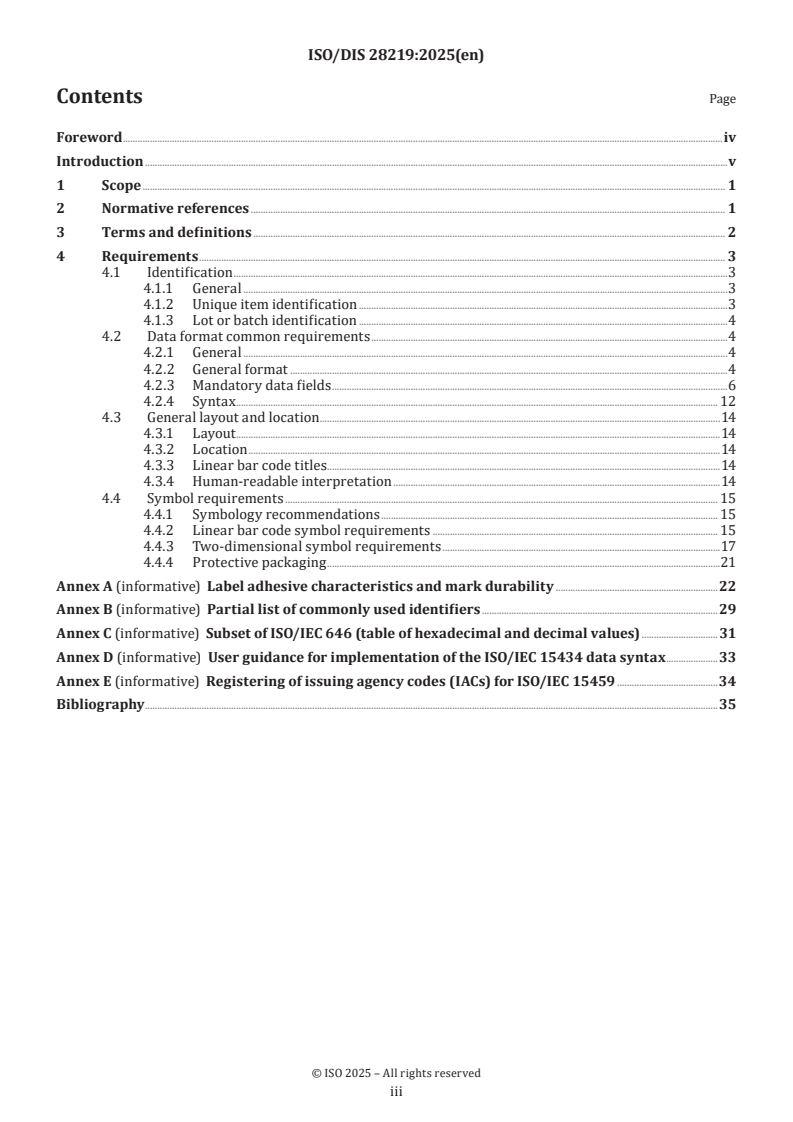
Contents Page
Foreword .iv
Introduction .v
1 Scope . 1
2 Normative references . 1
3 Terms and definitions . 2
4 Requirements . 3
4.1 Identification .3
4.1.1 General .3
4.1.2 Unique item identification .3
4.1.3 Lot or batch identification .4
4.2 Data format common requirements .4
4.2.1 General .4
4.2.2 General format .4
4.2.3 Mandatory data fields .6
4.2.4 Syntax . . 12
4.3 General layout and location . .14
4.3.1 Layout .14
4.3.2 Location .14
4.3.3 Linear bar code titles .14
4.3.4 Human-readable interpretation .14
4.4 Symbol requirements . 15
4.4.1 Symbology recommendations . 15
4.4.2 Linear bar code symbol requirements . 15
4.4.3 Two-dimensional symbol requirements .17
4.4.4 Protective packaging .21
Annex A (informative) Label adhesive characteristics and mark durability .22
Annex B (informative) Partial list of commonly used identifiers .29
Annex C (informative) Subset of ISO/IEC 646 (table of hexadecimal and decimal values) .31
Annex D (informative) User guidance for implementation of the ISO/IEC 15434 data syntax .33
Annex E (informative) Registering of issuing agency codes (IACs) for ISO/IEC 15459 .34
Bibliography .35
iii
ISO/DIS 28219:2025(en)
Foreword
ISO (the International Organization for Standardization) is a worldwide federation of national standards
bodies (ISO member bodies). The work of preparing International Standards is normally carried out through
ISO technical committees. Each member body interested in a subject for which a technical committee
has been established has the right to be represented on that committee. International organizations,
governmental and non-governmental, in liaison with ISO, also take part in the work. ISO collaborates closely
with the International Electrotechnical Commission (IEC) on all matters of electrotechnical standardization.
The procedures used to develop this document and those intended for its further maintenance are described
in the ISO/IEC Directives, Part 1. In particular, the different approval criteria needed for the different types
of ISO documents should be noted. This document was drafted in accordance with the editorial rules of the
ISO/IEC Directives, Part 2 (see www.iso.org/directives).
ISO draws attention to the possibility that the implementation of this document may involve the use of (a)
patent(s). ISO takes no position concerning the evidence, validity or applicability of any claimed patent
rights in respect thereof. As of the date of publication of this document, ISO [had/had not] received notice of
(a) patent(s) which may be required to implement this document. However, implementers are cautioned that
this may not represent the latest information, which may be obtained from the patent database available at
www.iso.org/patents. ISO shall not be held responsible for identifying any or all such patent rights.
Any trade name used in this document is information given for the convenience of users and does not
constitute an endorsement.
For an explanation of the voluntary nature of standards, the meaning of ISO specific terms and expressions
related to conformity assessment, as well as information about ISO's adherence to the World Trade
Organization (WTO) principles in the Technical Barriers to Trade (TBT), see www.iso.org/iso/foreword.html.
This document was prepared by Technical Committee ISO/TC 122, Packaging.
This third edition cancels and replaces the second edition (ISO 28219:2017), which has been technically
revised.
The main changes are as follows:
— added URL formats (ISO/IEC 18975, IEC 61406-x);
— preference on formats with concatenated fields;
— preference on 2D symbologies, stacked symbologies removed.
Any feedback or questions on this document should be directed to the user’s national standards body. A
complete listing of these bodies can be found at www.iso.org/members.html.
iv
ISO/DIS 28219:2025(en)
Introduction
Today, global industries widely use machine-readable markings on products for inventory control, quality
control, and product life cycle management. Common technologies, data structures, conformance, and
applications standards are necessary to enable all trading partners to use such markings internally and
throughout the supply chain.
A number of different product labelling and marking standards exist, each designed to meet the requirements
of the specific industry sector. For effective and economic use within and between industry sectors, one
common multi-industry standard is a necessity.
A standard linear bar code or two-dimensional symbol marked on a product or part will facilitate the
automation of inventory control, quality control, and product life cycle management. The linear bar code or
two-dimensional symbol information on the product can be used as a key to access the appropriate database
that contains detailed information about the product, including information transmitted via EDI. In addition,
a product mark can contain other information as agreed between the trading partners.
This document does not supersede or replace any applicable safety or regulatory marking or labelling
requirements. This document is meant to satisfy the minimum product marking requirements of numerous
applications and industry groups. As such, its applicability is to a wide range of industries, each of which
can have specific implementation guidelines for this document. This document is intended to be applied in
addition to any other mandated labelling requirements.
v
DRAFT International Standard ISO/DIS 28219:2025(en)
Packaging — Labelling and direct product marking with
linear bar code and two-dimensional symbols
1 Scope
The purpose of this document is to establish the machine-readable (linear, two-dimensional, and composite
symbols) and human-readable content for direct marking and labelling of items, parts, and components.
This document provides a means for items, parts and components to be marked, and read in either fixtured
or hand-held scanning environments at any manufacturer’s facility and then read by customers purchasing
items for subsequent manufacturing operations or for final end use. Intended applications include, but
are not limited to, supply chain applications, e.g. inventory, distribution, manufacturing, quality control,
acquisition, transportation, supply, repair, and disposal.
2 Normative references
The following documents are referred to in the text in such a way that some or all of their content constitutes
requirements of this document. For dated references, only the edition cited applies. For undated references,
the latest edition of the referenced document (including any amendments) applies.
ISO 21067, Packaging — Vocabulary
ISO/IEC 646, Information technology — ISO 7-bit coded character set for information interchange
ISO 3166-1, Codes for the representation of names of countries and their subdivisions — Part 1: Country code
ISO/IEC 15415, Automatic identification and data capture techniques — Bar code symbol print quality test
specification — Two-dimensional symbols
ISO/IEC 15416, Automatic identification and data capture techniques — Bar code print quality test specification
— Linear symbols
ISO/IEC 29158, Automatic identification and data capture techniques — Bar code symbol quality test
specification — Direct part mark (DPM)
ISO/IEC 15417, Information technology — Automatic identification and data capture techniques — Code
128 bar code symbology specification
ISO/IEC 15420, Information technology — Automatic identification and data capture techniques — EAN/UPC
bar code symbology specification
ISO/IEC 15434, Information technology — Automatic identification and data capture techniques — Syntax for
high-capacity ADC media
ISO/IEC 15459-2, Information technology — Automatic identification and data capture techniques — Unique
identification — Part 2: Registration procedures
ISO/IEC 16022, Information technology — Automatic identification and data capture techniques — Data Matrix
bar code symbology specification
ISO/IEC 16388, Information technology — Automatic identification and data capture techniques — Code 39 bar
code symbology specification
ISO/IEC 18004, Information technology — Automatic identification and data capture techniques — QR code
bar code symbology specification
ISO/DIS 28219:2025(en)
ISO/IEC 18975, Information technology — Automatic identification and data capture techniques — Encoding
and resolving identifiers over HTTP
ISO/IEC 19762, Information technology — Automatic identification and data capture (AIDC) techniques —
Vocabulary
IEC 61406-1, Identification Link - Part 1: General requirements
IEC 61406-2, Identification link Part 2: Types/models, lots/batches, items and characteristics
ISO/IEC 15418, Information technology — Automatic identification and data capture techniques — GS1
Application Identifiers and ASC MH10 Data Identifiers and maintenance
ANSI MH10.8.2, Data Application Identifier Standard
GS1, GS1 General Specifications Standard
DIN 16598, Syntax keyboard and Web compatible encoding of data elements in machine readable symbols
applied with ASC Data Identifiers
3 Terms and definitions
For the purposes of this document, the following terms and definitions apply.
ISO and IEC maintain terminology databases for use in standardization at the following addresses:
— ISO Online browsing platform: available at https:// www .iso .org/ obp
— IEC Electropedia: available at https:// www .electropedia .org/
3.1
cell
single element of a two-dimensional matrix symbol
3.2
part marking
item marking
applying a mark to an item
Note 1 to entry: This document uses the terms “part marking” and “item marking” interchangeably. Unless otherwise
stated, this document will use the term “item marking” to describe both the labelling and direct part marking (DPM) of
an item, where DPM includes, but is not limited to, altering (e.g. dot peen, laser etch, chemical etch), as well as additive
type processes (e.g. ink jet, vacuum deposition).
3.3
components
parts (bare printed circuit board, integrated circuits, capacitor, diodes, switch, valve, spring, bearing,
bracket, bolt, etc.) of a first level/modular assembly (3.6)
3.4
data element separator
specified character used to delimit discrete fields of data
3.5
1)
DUNS® Number
nine-digit number, issued by D&B, assigned to each business location in the D&B database, having a unique,
separate, and distinct operation for the purpose of identifying them
1) DUNS® Number is an example of a suitable product available commercially. This information is given for the
convenience of users of this document and does not constitute an endorsement by ISO of this product.
ISO/DIS 28219:2025(en)
3.7
Global Trade Item Number
2)
GTIN
GS1 identification key used to identify trade items
Note 1 to entry: The key comprises a GS1 Company Prefix, an item reference and a check digit.
3.8
item
product
first level or higher assembly that is sold in a complete end-usable configuration
3.9
label
media capable of being marked with information in machine-readable and/or human-readable form attached
to an item
3.10
manufacturer
actual producer or fabricator of an item (3.8), not necessarily the supplier (3.11) in a transaction
3.11
supplier
party that produces, provides, or furnishes an item (3.8) or service
3.12
traceability identification
string of characters assigned to identify or trace an entity or a unique group of entities (e.g. lot, batch, item
(3.8), production date, revision/version or serial number)
3.13
Global Location Number
GLN
The GS1 identification key used to identify locations or parties. The key comprises a GS1 Company Prefix,
location reference and check digit.
4 Requirements
4.1 Identification
4.1.1 General
Enterprises may choose to assign uniqueness to items at the individual, group, or product level. Individual
uniqueness requires serialization or one-of-a-kind production, see 4.1.2 and 4.2.3.3. A lot or batch number
captures group uniqueness, see 4.1.3 and 4.2.3.3. A product code is an example of item uniqueness, see
4.2.3.4.
4.1.2 Unique item identification
Items may be assigned a unique item identification code to each instance of the item, i.e. serialization. Serial
numbers shall be unique either within an enterprise ID or within enterprise ID + part number. When using
unique identification, the encoded symbol shall contain only one enterprise identifier, serial number and/or
original part number to avoid confusion and ensure uniqueness.
2) GTIN is an example of a suitable product available commercially. This information is given for the convenience of
users of this document and does not constitute an endorsement by ISO of this product
ISO/DIS 28219:2025(en)
4.1.3 Lot or batch identification
Items can have group uniqueness applied by an enterprise. Some items are assigned group identification,
e.g. lot or batch number.
4.2 Data format common requirements
4.2.1 General
Those implementing this document should refer to the guidelines for their particular industries. For a partial
list of industry guidelines, see the Bibliography.
4.2.2 General format
4.2.2.1 Overview
Labels will accommodate both mandatory and optional data fields. The maximum length of each discrete
data field shall be 25 data characters unless otherwise specified in the following chapters. This character
count is exclusive of overhead characters.
See [14] for information on serialization of some electronic products.
All data elements encoded in a machine-readable medium shall be preceded by the appropriate qualifier
following ISO/IEC15418, in particular an appropriate Data Identifier (DI) as defined in ANSI MH10.8.2
Data Identifier, or the appropriate Application Identifier (AI) as defined in the GS1 General Specifications
Standard. The exceptions to this rule are the UPC-A, UPC-E, EAN-8, and EAN-13 symbologies.
The choice between DIs and GS1 AIs, for any user, will normally be determined in the applicable industry
convention being followed.
Other industries developing item identification conventions should consider business practices, information
requirements and systems capabilities of the trading partners in choosing between DIs and GS1 AIs. See
Annex B for a list of commonly used DIs and the equivalent AIs.
The character set shall be in compliance to ANSI MH10.8.2 for Data Identifier or to the GS1 General
Specifications Standard for Application Identifier. Alphanumerical fields assigned to data identifiers (DI's)
shall use all upper case alphabetic characters (A to Z), numeric digits (0 to 9), and the four characters [dash
(–), period (.) and solidus (/)]. Alphanumeric fields assigned to Application Identifiers shall comply to GS1 AI
encodable character set 82, which contains most of the printable ASCII characters excluding the space and a
few other characters.
NOTE The “+” character is defined to be used as separator within a data field and shall be used for that purpose
only in case it appears in a data field to avoid misinterpretations.
For field separators, record separators, segment terminators and compliance indicator contained in
ISO/IEC 15434 shall be used in their function as separator but never in any data field. A table of these
characters and their hexadecimal and decimal equivalent is given in Annex C. The actual character set
employed conforming to this document shall be the character set permitted by the data field and not
the symbology. It is recommended that the resultant data stream from scanning a 2D symbol follow the
syntax described in ISO/IEC 15434, ISO/IEC 18975 and IEC 61406-1/2. See Annex D for guidance on the
implementation of the ISO/IEC 15434 data syntax.
The format of values is described by a sequence of character set and character count range. The character
set is described as follows:
— a: alphabet;
— n:digit;
— an: alphanumeric.
ISO/DIS 28219:2025(en)
The character count may be defined by
— number: field of given fix length
— number.number: character count is between the given count. If one number is omitted, the minimum/
maximum applies, e.g. ".5" describes 0 to 5 characters, "3." describes minimum 3 characters.
Multiple encoded fields are represented by a plus sign („+“). The plus sign is not encoded in the data.
NOTE Data fields for e.g. DI 20V use the "+" character in the data field to concatenate two or more data parts in
one field. This use of the "+" character is not meant by the definition of the format in this chapter (see table 2).
EXAMPLE "an3+n.3" describes 3 alphanumeric characters directly followed by up to 3 digits. A data string in
compliance with this example is "A3B45". "A3B" is the 3 character alphanumeric string. "45" are two digits, which is in
conformance to the specification of up to 3 digits.
Other data structures with a scope on a limited application field are not covered by this document. One
[4]
example is the Halth Industry Business Code (HIBC) for medical devices .
See Annex A for label adhesive characteristics.
4.2.2.2 Data identifiers (DIs)
The descriptions in the DI list are general in nature and are used in industrial and international applications.
Specific application guidelines provide the detailed definition used among trading partners.
The full list of registered DIs and the full specification for their use are found in the American National
Standard ANSI MH10.8.2.
DIs may be used with any alphanumeric data carrier and are designed to ensure cross-industry commonality
of Data Identifiers used in automatic identification technologies.
DIs have a format of one alphabetic character alone or one alphabetic character prefixed by one, two or three
numeric characters.
4.2.2.3 GS1 Application Identifiers (AIs)
The definitions of the GS1 AIs are supported by application guidelines. The GS1 AIs, and associated
guidelines, have been designed for international and multi-sector trading purposes.
The GS1 identification system and related encoding standard are complemented by the GS1 maintained
AIs. This document comprises two principal elements, which are the key to any encoding system: the data
content and the data carrier.
The use of GS1 AIs is subject to the rules established by GS1.
GS1 AIs identify generic and simple data fields for use in cross-sector and international supply chain
applications. The GS1 General Specifications Standard provides rules for the definition, format and structure
of the data fields.
Each GS1 AI consists of two, three or four numerical characters.
4.2.2.4 Organization inclusion in coding
To create item identification incorporating the organization providing the identification the pure item
identification is preceded by an issuing agency code (IAC) and a company identification number (CIN)
assigned by the issuing agency. IAC’s shall be assigned to organisations according to the rules defined by
ISO/IEC 15459-2.
GS1 is one Issuing Agency (IA). GS1 defines then numbers for local GS1 organisation and these provide the
CIN to their customers which includes the IAC and the number of the local GS1 organisation. The company
ISO/DIS 28219:2025(en)
identified by the CIN adds then the pure item number. The complete data is then the Global Trade Item
Number (GTIN)
Other IA’s like DUN&Bradstreet are identified by one, two or three capital alphabet characters. Most of them
use DI’s. The item identification builds then up by the sequence of IAC, CIN and the pure item identification. In
[1]
case of DUN&Bradstreet the IAC is “UN” The general rules for this system are defined by ISO/IEC 15459-3 .
See Annex E for information about the register of issuing agency codes (IACs) for ISO/IEC 15459.
4.2.3 Mandatory data fields
4.2.3.1 General
Mandatory data fields are given in Table 1.
Table 1 — Item identification code type
Item identification type Mandatory fields
1. Commodity Item identification code (example nails)
2. Non-traceable Enterprise identification code
Item identification code
3. Group traceability Enterprise identification code
Item identification code
Product version number, Lot number or production date
or
Enterprise identification code
Unambiguous lot number
4. Unique serialization within item identification code Enterprise identification code
Item identification code
Unique individual item identification code
5. Unique serialization within enterprise Enterprise identification code
Unique item traceability code within enterprise
identification code
The enterprise identification code and item identification code may be combined in a single data field, see
4.2.3.4.
4.2.3.2 Enterprise identification code
The enterprise identification code shall use formats contained in Table 2. The use of more than one enterprise
identification code preceded by DI 20V is permitted on an item. The choice of enterprise identification code(s)
should be mutually agreed upon between trading partners. The appropriate DI shall precede the enterprise
identification when separate data fields are used to identify the supplier and the item identification.
Within the GS1 system, an enterprise is identified by a GLN. The GLN is used as a part of a data element for
uniqueness but not encoded as a separate field.
ISO/DIS 28219:2025(en)
Table 2 — Data Identifiers used for enterprise identification
Data characteristics
Type followed by the number of
Data Identifier Data field Description
characters
(e.g. a#, n#, an#)
18V Combined IAC/CIN an3+an1.3+an3.13 Combined IAC/CIN
12V DUNS® Number Iden- an3+n9 Entity (manufacturer) identification as-
tifying Manufacturer signed by Dun and Bradstreet
17V US Department of an3+an5 Company identification assigned by the US
[8]
Defence (DoD) CAGE Department of Defence
Code/NAMSA NCAGE
20V Company an3+an1.3+an3.13+“+”+an3 Combined IAC/CIN and Party Qualifier Code
(EDIFACT DE 3035)
identification
21V Supplier an3+an.25 Combined IAC/CIN followed by an internally
assigned entity identification
identification
25V (N)CAGE of Manufac- an3 + an5 Manufacturer identification assigned by the
turer US Department of Defence or NATO
4.2.3.3 Group and item traceability identification
The traceability identification is assigned by the manufacturer or supplier. The DIs or AIs given in Table 3
and Table 4 represent a partial list of the ANSI MH10 Data Identifiers and GS1 Application Identifiers that
may be applicable to traceability identification.
The maximum length of a single traceability identification data field should not exceed 35 characters, which
excludes the associated DI or AI. The traceability identification data field shall not exceed 50 characters.
Asset identifiers shall not be used for any other purpose and shall remain unique for a period well beyond the
lifetime of relevant records. If a company assigns asset identifiers to trade items supplied to its customers,
the company shall ensure that the asset identifiers are never reused.
Table 3 — Data Identifiers used for traceability identification
Data characteristics
Type followed by the number of
Data Identifier Data field Description
characters
(e.g. a#, n#, an#)
S Serial number an1+an.20 Serial number or code assigned by the sup-
plier to an entity for its lifetime
18S Serial number within an3+an5+an.20 Serial number or code assigned by the CAGE
CAGE Code Code that is unique within CAGE Code
20S Customer assigned an3+an.20 Serial number or code assigned by the cus-
a
serial number tomer to an entity for its lifetime
22S Cellular Mobile Tele- an3+an.25 Electronic Serial Number (ESN) for Cellular
phone (CMT) Elec- Mobile Telephones or the Mobile Equipment
[10]
tronic Serial Number Identifier (MEID) or the International
Mobile Station Equipment Identity (IMEI)
[11]
25S Serial number an3+.50 Combined IAC/CIN and the serial number
(including IAC/CIN) assigned by the supplier
a
20S may be used by industries that are serializing items that were not serialized by the manufacturer at time of
manufacturing.
NOTE 1 The variable lengths for the IAC/CIN combined lengths are defined by ISO 15459.
NOTE 2 See ESN Assignment Guidelines and Procedures and MOBILE EQUIPMENT IDENTIFIER (MEID) GHA (Global Hexadecimal
Administrator) Assignment Guidelines and Procedures for additional information on ESN and MEID.
ISO/DIS 28219:2025(en)
TTabablele 3 3 ((ccoonnttiinnueuedd))
Data characteristics
Type followed by the number of
Data Identifier Data field Description
characters
(e.g. a#, n#, an#)
1T Lot/batch number an2+an.20 Lot/Batch Number defined by the manufac-
turer
25T Lot/batch number an3+an.50 Combined IAC/CIN and enterprise identifi-
(including IAC/CIN) cation and lot or batch number assigned by
the supplier
37S Unique item identifier an3+an.50 Combined IAC/CIN, part number, literal plus
("+") and serial number
URL Unique item identifi- Restricted URL format An URL following IEC61406-1 defines a
cation unique item. See chapter 4.2.4.3.
URL Unique batch identifi- Restricted URL format An URL following IEC61406-2 defines a
cation unique batch of items. See chapter 4.2.4.3.
a
20S may be used by industries that are serializing items that were not serialized by the manufacturer at time of
manufacturing.
NOTE 1 The variable lengths for the IAC/CIN combined lengths are defined by ISO 15459.
NOTE 2 See ESN Assignment Guidelines and Procedures and MOBILE EQUIPMENT IDENTIFIER (MEID) GHA (Global Hexadecimal
Administrator) Assignment Guidelines and Procedures for additional information on ESN and MEID.
Table 4 — Application Identifiers used for traceability identification
Data characteristics
Application Type followed by the number of
Data field Description
Identifier characters
(e.g. a#, n#, an#)
10 Batch/lot number n2+an.20 Traceability identification defined by the
manufacturer
a
11 Production date n2+n6 Production date (YYMMDD)
21 Serial number n2+an.20 Serial number or code assigned by the sup-
plier to an trade item for its lifetime
414 Global location num- n3+n13 Global location number (GLN) to be pro-
ber cessed according to the particular applica-
tion requirements
8003 Global returnable n4+n14+n.16 Global returnable asset identifier (GRAI)
asset identifier
8004 Global individual n4+n10.30 Global individual asset identifier (GIAI)
asset identifier
a
Production date code construction using GS1 Application Identifiers use a two-digit designation for year.
4.2.3.4 Item identification
The identity for individual products and product packages shall not contain more than 50 characters. For
efficient use within various AIDC data carrier systems, it is recommended that the number of characters to
be coded by one line linear bar code should not exceed 20 characters and number of characters should be
kept as short as possible regardless of the permissible maximum of 50 characters. This maximum excludes
the associated DI or AI. Item identification codes may be concatenated with the enterprise identification to
produce a unique item identification. See Tables 2 to 4 for IAC/CIN.
The item identification code (e.g. supplier or customer part number) shall be designated as mutually agreed
upon between the supplier or manufacturer and customer. The supplier’s part number is the recommended
item identification code.
ISO/DIS 28219:2025(en)
An item identification code may be concatenated with the company prefix to produce a unique item
identification code. GTIN-12 and GTIN-13 formats are fixed length numeric examples of company prefix
codes concatenated with item identification codes to provide worldwide item identification uniqueness. See
Table 6.
Likewise, variable length examples of fixed length enterprise identification codes concatenated with
variable length alphanumeric item identification codes to provide worldwide item identification uniqueness
may be provided with DIs such as “9P” and “17P”. See Table 5.
Table 5 — Data Identifiers used for item identifier
Data characteristics
Type followed by the number of
Data Identifier Data field Description
characters
(e.g. a#, n#, an#)
P Part number an1+an.20 Customer assigned part number
1P Part number an2+an.20 Supplier assigned part number
8P Part number an2+n14 GS1 GTIN-14
9P Part number an2+n9+an.16 Combined DUNS-9 supplier identification
[7]
and item code assigned by the supplier
17P Part number an3+an8.27 Combined GS1 company prefix and item
code assigned by the supplier
25P Product number an3+an1.20 (IAC+CIN+PN) Combined IAC/CIN and Party Qualifier Code
(EDIFACT DE 3035)
51P Versioned product an3+an.50 The value is the concatenation of the follow-
number ing fields: IAC/CIN, literal plus ("+"), Prod-
uct code, literal plus ("+"), product version
53P EU Marine Equipment an3+a1+n4+an5.20 The value is the concatenation of the follow-
ing fields: conformity assessment module,
notified body, certificate
54P UDI-DI an3+an1.35 Product code following the IMDRF guideline
for medical devices.
9N IFA Pharmacy Prod- an2+an2+an15.26+n2 Pharmacy product number maintained by
uct Number IFA. The value is comprised of the following
fields: two characters product registration
code (PRAC), product reference (PR), two
PPN check digits
ISO/DIS 28219:2025(en)
Table 6 — Application Identifiers used for item identifier
Data characteristics
Application Type followed by the number of
Data field Description
Identifier characters
(e.g. a#, n#, an#)
Not applicable Part number (suppli- n12 GTIN (12) incorporates combination of
er/item) (GTIN-12) supplier and item identification) (encoded in
bar code symbol type UPC-A)
Not applicable Part number (suppli- n13 GTIN (13) incorporates combination of
er/item) (GTIN-13) supplier and item identification) (encoded in
bar code symbol type UPC-E)
01 Part number (suppli- n2+n14 Global Trade Item Number (comprises a
er/item and quantity) GS1 Company Prefix, an item reference and
GTIN-14 check digit)
22 Consumer product n2+an…20 Code Assigned to Specify the Revision Level
variant for an Item (e.g., engineering change level,
edition, or revision)
03 Identification of a n2+n14 Part number of a made to order item.
Made-to-Order (MtO)
trade item (GTIN)
241 Part number n3+an.30 Customer assigned part number
8001 Roll products n4+n14 Roll products - width, length, core diameter,
direction and splices
8006 Identification of the n4+n14+n2+n2 GS1 Identification of a fixed measure trade
components of a item (GTIN) packed in separate parcels.
trade item
8018 Global service rela- n4+n18 GS1 identification number of a service re-
tion number (GSRN) lation (GSRN) to be assigned by the service
provider
NOTE While GS1 permits AI “241” to be a maximum of 30 characters, the customer assigned part number should be limited to no
more than 25 characters.
4.2.3.5 Optional data fields
Specific applications and trading partner agreements may require additional data fields. See Table 7 and
Table 8 for examples.
When using DIs or AIs to encode country of origin, it shall be in one of the formats shown in Table 7 or
Table 8.
ISO/DIS 28219:2025(en)
Table 7 — Data Identifiers used for optional data
Data characteristics
Type followed by the number of
Data Identifier Data field Description
characters
(e.g. a#, n#, an#)
4L Country of origin an2+an2 The two-character country code as defined
by ISO 3166-1. The country of origin is de-
fined as the manufacturing country wherein
the product obtained its present identity as
a part, subassembly, or finished product.
6D Defined date an2+n8+an3 ISO format YYYYMMDD immediately
followed by an ANSI X12.3 Data Element
Number 374 Qualifier providing a code
specifying type of date (e.g. ship date, man-
ufacture date)
11D Week an3+n6 Format YYYYWW
12D Date an3+n8 Format YYYYMMDD
14D Expiration date an3+n8 Expiration date (YYYYMMDD)
a
16D Production date an3+n8 Production date (YYYYMMDD)
30P First level additional an3+an.20 First level (supplier assigned) item identifi-
item identification cation (item ID), which is different than or
in addition to Item ID provided by “1P”
a
May also be used for group traceability
Table 8 — Application Identifiers used for optional data
Data characteristics
Application Type followed by the number of
Data field Description
Identifier characters
(e.g. a#, n#, an#)
422 Country of origin n3+n3 The three-digit country code as defined by
ISO 3166-1. The country of origin is defined
as the manufacturing country wherein the
product obtained its present identity as a
part, subassembly, or finished product.
423 Country of initial n3+n.15 ISO country codes stating the countries of
processing (with ISO initial processing of a trade item. The n.15
country code) code may be 3, 6, 9, 12, 15 characters long
depending on number of processing coun-
tries.
424 Country of processing n3+n3 ISO country code stating the country of
(with ISO country processing of a trade item
code)
425 Country of disassem- n3+n.15 ISO country code stating the country of
bly (with ISO country disassembly of a trade item
code)
426 Country covering full n3+n3 ISO country code stating the (single) coun-
process chain (with try of full processing of a trade item
ISO country code)
17 Expiration date n2+n6
a
11 Production date n2+n6
a
May also be used for group traceability
ISO/DIS 28219:2025(en)
4.2.3.6 Optional link to the internet
Specific application may require a link to the internet for obtaining detailled product information. One
solution is to add a AI/DI for such a link as shown in Table 9.
The other solution is embedding the product ID in an URL (see chapter 4.2.5.5 URL syntax and embedding
product data for Web compatibility). Using AIs/DIs for adding URLs.
[12]
NOTE Prior to the ISO/IEC 18975 and the GS1 Digital Link URI standard, GS1 had a direct mode approach that
was utilizing GS1 element string (AI-based) syntax method that used AI (01) and AI (8200) to produce a product URL.
For new applications, GS1 follows the structured path approach of ISO/IEC 18975 (GS1 Digital Link URI syntax) to
encode QR Code or Data Matrix barcodes to link to the internet.
Table 9 — Data Identifiers used to link to the internet
Data characteristics
Type followed by the number of
Data Identifier Data field Description
characters
(e.g. a#, n#, an#)
a [14]
33L Uniform Resource an3+an. URL for product information .
Locator (URL)
a
34L Pointer to Process an3+an. Pointer to Process URL (P2P URL) for
URL initiating a URL to carry all other data
[14] b
elements encoded in an AIDC media .
a
Chararter set and length in conformance to RFC1738
b
Field decodation rule: Scan the code and initiate the URL starting with the P2P URL string, omitting DI 34L and ISO/IEC 15434
envelope syntax (prefix and postfix) and append all other data elements that have been scanned in same sequence as encoded in
the media, including DIs and data element separators. Convert special characters in the appended data into RFC 1738 format (e.g.,
Group Separator “GS” translated into RFC 1738 sequence %1D). Note that this does not apply to the P2P URL itself.
Example: Encoded data string (using ISO/IEC 15434)
R G G G
[)> 06 25SUN123456789PA12345 4LUSGS16D20131108 34LHTTP://WWW .SECUREUID .COM/ ITEMDATA/ ?SCAN = RS05
S S S S
R E
GS13131108 O
S T
results in the following URL with the transmitted data:
http:// WWW .SECUREUID .COM/ ITEMDATA/ ?SCAN = 2 5SUN123456 789PA12345 %1D4LUS %1D16D20131108
Data from the “05” format envelope was not incorporated in the URL since the 34L was encoded in the “06” format envelope
4.2.4 Syntax
4.2.4.1 Linear bar code symbol data field syntax
Data encoded in the EAN/UPC symbology inclu
...
International
Standard
Third edition
Packaging — Labelling and direct
product marking with linear bar
code and two-dimensional symbols
Emballage — Étiquetage et marquage direct sur le produit avec
un code à barres et des symboles bidimensionnels
PROOF/ÉPREUVE
Reference number
© ISO 2026
All rights reserved. Unless otherwise specified, or required in the context of its implementation, no part of this publication may
be reproduced or utilized otherwise in any form or by any means, electronic or mechanical, including photocopying, or posting on
the internet or an intranet, without prior written permission. Permission can be requested from either ISO at the address below
or ISO’s member body in the country of the requester.
ISO copyright office
CP 401 • Ch. de Blandonnet 8
CH-1214 Vernier, Geneva
Phone: +41 22 749 01 11
Email: copyright@iso.org
Website: www.iso.org
Published in Switzerland
PROOF/ÉPREUVE
ii
Contents Page
Foreword .iv
Introduction .v
1 Scope . 1
2 Normative references . 1
3 Terms and definitions . 2
4 Requirements . 3
4.1 Identification .3
4.1.1 General .3
4.1.2 Unique item identification .4
4.1.3 Lot or batch identification .4
4.2 Data format common requirements .4
4.2.1 General .4
4.2.2 General format .4
4.2.3 Mandatory data fields .6
4.2.4 Syntax . . 12
4.3 General layout and location . . 13
4.3.1 Layout . 13
4.3.2 Location .14
4.3.3 Linear bar code titles .14
4.3.4 Human-readable interpretation .14
4.4 Symbol requirements .14
4.4.1 Symbology recommendations .14
4.4.2 Linear bar code symbol requirements . 15
4.4.3 Two-dimensional symbol requirements .16
4.4.4 Protective packaging . 20
Annex A (informative) Label adhesive characteristics and mark durability .21
Annex B (informative) Partial list of commonly used identifiers .28
Annex C (informative) Subset of ISO/IEC 646 IRV (table of hexadecimal and decimal values) .30
Annex D (informative) User guidance for implementation of the ISO/IEC 15434 data syntax .34
Annex E (informative) Registering of issuing agency codes (IACs) for ISO/IEC 15459 .35
Bibliography .36
PROOF/ÉPREUVE
iii
Foreword
ISO (the International Organization for Standardization) is a worldwide federation of national standards
bodies (ISO member bodies). The work of preparing International Standards is normally carried out through
ISO technical committees. Each member body interested in a subject for which a technical committee
has been established has the right to be represented on that committee. International organizations,
governmental and non-governmental, in liaison with ISO, also take part in the work. ISO collaborates closely
with the International Electrotechnical Commission (IEC) on all matters of electrotechnical standardization.
The procedures used to develop this document and those intended for its further maintenance are described
in the ISO/IEC Directives, Part 1. In particular, the different approval criteria needed for the different types
of ISO document should be noted. This document was drafted in accordance with the editorial rules of the
ISO/IEC Directives, Part 2 (see www.iso.org/directives).
ISO draws attention to the possibility that the implementation of this document may involve the use of (a)
patent(s). ISO takes no position concerning the evidence, validity or applicability of any claimed patent
rights in respect thereof. As of the date of publication of this document, ISO had not received notice of (a)
patent(s) which may be required to implement this document. However, implementers are cautioned that
this may not represent the latest information, which may be obtained from the patent database available at
www.iso.org/patents. ISO shall not be held responsible for identifying any or all such patent rights.
Any trade name used in this document is information given for the convenience of users and does not
constitute an endorsement.
For an explanation of the voluntary nature of standards, the meaning of ISO specific terms and expressions
related to conformity assessment, as well as information about ISO's adherence to the World Trade
Organization (WTO) principles in the Technical Barriers to Trade (TBT), see www.iso.org/iso/foreword.html.
This document was prepared by Technical Committee ISO/TC 122, Packaging.
This third edition cancels and replaces the second edition (ISO 28219:2017), which has been technically
revised.
The main changes are as follows:
— added URL formats (ISO/IEC 18975, IEC 61406-x);
— preference on formats with concatenated fields;
— preference on 2D symbologies, stacked symbologies removed.
Any feedback or questions on this document should be directed to the user’s national standards body. A
complete listing of these bodies can be found at www.iso.org/members.html.
PROOF/ÉPREUVE
iv
Introduction
Today, global industries widely use machine-readable markings on products for inventory control, quality
control, and product life cycle management. Common technologies, data structures, conformance, and
applications standards are necessary to enable all trading partners to use such markings internally and
throughout the supply chain.
A number of different product labelling and marking standards exist, each designed to meet the requirements
of the specific industry sector. For effective and economic use within and between industry sectors, one
common multi-industry standard is a necessity.
A standard linear bar code or two-dimensional symbol marked on a product or part will facilitate the
automation of inventory control, quality control, and product life cycle management. The linear bar code or
two-dimensional symbol information on the product can be used as a key to access the appropriate database
that contains detailed information about the product, including information transmitted via electronic data
interchange (EDI). In addition, a product mark can contain other information as agreed between the trading
partners.
This document does not supersede or replace any applicable safety or regulatory marking or labelling
requirements. This document is meant to satisfy the minimum product marking requirements of numerous
applications and industry groups. As such, its applicability is to a wide range of industries, each of which
can have specific implementation guidelines for this document. This document is intended to be applied in
addition to any other mandated labelling requirements.
PROOF/ÉPREUVE
v
International Standard ISO 28219:2026(en)
Packaging — Labelling and direct product marking with
linear bar code and two-dimensional symbols
1 Scope
The purpose of this document is to establish the machine-readable (linear, two-dimensional, and composite
symbols) and human-readable content for direct marking and labelling of items, parts, and components.
This document provides a means for items, parts and components to be marked, and read in either fixtured
or hand-held scanning environments at any manufacturer’s facility and then read by customers purchasing
items for subsequent manufacturing operations or for final end use. Intended applications include, but
are not limited to, supply chain applications, e.g. inventory, distribution, manufacturing, quality control,
acquisition, transportation, supply, repair and disposal.
2 Normative references
The following documents are referred to in the text in such a way that some or all of their content constitutes
requirements of this document. For dated references, only the edition cited applies. For undated references,
the latest edition of the referenced document (including any amendments) applies.
ISO/IEC 646, Information technology — ISO 7-bit coded character set for information interchange
ISO 3166-1, Codes for the representation of names of countries and their subdivisions — Part 1: Country code
ISO/IEC 15415, Automatic identification and data capture techniques — Bar code symbol print quality test
specification — Two-dimensional symbols
ISO/IEC 15416, Automatic identification and data capture techniques — Bar code print quality test specification
— Linear symbols
ISO/IEC 29158, Automatic identification and data capture techniques — Bar code symbol quality test
specification — Direct part mark (DPM)
ISO/IEC 15417, Information technology — Automatic identification and data capture techniques — Code
128 bar code symbology specification
ISO/IEC 15420, Information technology — Automatic identification and data capture techniques — EAN/UPC
bar code symbology specification
ISO/IEC 15434, Information technology — Automatic identification and data capture techniques — Syntax for
high-capacity ADC media
ISO/IEC 15459-2, Information technology — Automatic identification and data capture techniques — Unique
identification — Part 2: Registration procedures
ISO/IEC 16022, Information technology — Automatic identification and data capture techniques — Data Matrix
bar code symbology specification
ISO/IEC 16388, Information technology — Automatic identification and data capture techniques — Code 39 bar
code symbology specification
ISO/IEC 18004, Information technology — Automatic identification and data capture techniques — QR code
bar code symbology specification
PROOF/ÉPREUVE
ISO/IEC 18975, Information technology — Automatic identification and data capture techniques — Encoding
and resolving identifiers over HTTP
ISO/IEC 19762, Information technology — Automatic identification and data capture (AIDC) techniques —
Vocabulary
IEC 61406-1, Identification Link - Part 1: General requirements
IEC 61406-2, Identification link Part 2: Types/models, lots/batches, items and characteristics
ISO/IEC 15418, Information technology — Automatic identification and data capture techniques — GS1
Application Identifiers and ASC MH10 Data Identifiers and maintenance
ANSI MH10.8.2, Data Application Identifier Standard
GS1, GS1 General Specifications Standard
DIN 16598, Syntax keyboard and Web compatible encoding of data elements in machine readable symbols
applied with ASC Data Identifiers
3 Terms and definitions
For the purposes of this document, the terms and definitions given in ISO/IEC 19762 and the following terms
and definitions apply.
ISO and IEC maintain terminology databases for use in standardization at the following addresses:
— ISO Online browsing platform: available at https:// www .iso .org/ obp
— IEC Electropedia: available at https:// www .electropedia .org/
3.1
cell
single element of a two-dimensional matrix symbol
3.2
part marking
item marking
applying a mark to an item
Note 1 to entry: This document uses the terms “part marking” and “item marking” interchangeably. Unless otherwise
stated, this document uses the term “item marking” to describe both the labelling and direct part marking (DPM) of
an item (3.7), where DPM includes, but is not limited to, altering (e.g. dot peen, laser etch, chemical etch), as well as
additive type processes (e.g. ink jet, vacuum deposition).
3.3
components
parts (bare printed circuit board, integrated circuits, capacitor, diodes, switch, valve, spring, bearing,
bracket, bolt, etc.) of a first level/modular assembly
3.4
data element separator
specified character used to delimit discrete fields of data
3.5
1)
DUNS® Number
nine-digit number, issued by Dun & Bradstreet (D&B), assigned to each business location in the D&B
database, having a unique, separate, and distinct operation for the purpose of identifying them
1) DUNS® Number is an example of a suitable product available commercially. This information is given for the
convenience of users of this document and does not constitute an endorsement by ISO of this product.
PROOF/ÉPREUVE
3.6
Global Trade Item Number
2)
GTIN
GS1 identification key used to identify trade items
Note 1 to entry: The key comprises a GS1 Company Prefix, an item reference and a check digit.
Note 2 to entry: GS1 identification key is issued under GS1 identification licensee and comprises a GS1 Company
Prefix (GCP), an item reference and check digit. GCP is a unique string of four to twelve digits issued by GS1 Member
Organisations and used to issue GS1 identification keys under GS1 identification licensee.
3.7
item
product
first level or higher assembly that is sold in a complete end-usable configuration
3.8
label
media capable of being marked with information in machine-readable and human-readable form attached to
an item (3.7)
3.9
manufacturer
actual producer or fabricator of an item (3.7), not necessarily the supplier (3.10) in a transaction
3.10
supplier
party that produces, provides, or furnishes an item (3.7) or service
3.11
traceability identification
string of characters assigned to identify or trace an entity or a unique group of entities (e.g. lot, batch, item
(3.7), production date or serial number)
3.12
Global Location Number
GLN
GS1 identification key identifying locations or parties
Note 1 to entry: The key comprises a GS1 Company Prefix, location reference and check digit.
3.13
labelling
set of methods for the application of a mark onto the label or directly on the item (3.7)
4 Requirements
4.1 Identification
4.1.1 General
Enterprises can choose to assign uniqueness to items at the individual, group, or product level. Individual
uniqueness requires serialization or one-of-a-kind production, see 4.1.2 and 4.2.3.3. A lot or batch number
captures group uniqueness, see 4.1.3 and 4.2.3.3. A product code is an example of item uniqueness, see
4.2.3.4.
2) GTIN is an example of a suitable product available commercially. This information is given for the convenience of
users of this document and does not constitute an endorsement by ISO of this product.
PROOF/ÉPREUVE
4.1.2 Unique item identification
Items can be assigned a unique item identification code to each instance of the item, i.e. serialization. Serial
numbers shall be unique either within an enterprise ID or within enterprise ID + part number. When using
unique identification, the encoded symbol shall contain only one enterprise identifier, serial number, original
part number, or both of the last, to avoid confusion and ensure uniqueness.
4.1.3 Lot or batch identification
Items can have group uniqueness applied by an enterprise. Some items are assigned group identification,
e.g. lot or batch number.
4.2 Data format common requirements
4.2.1 General
Those implementing this document should refer to the guidelines for their particular industries. For a partial
list of industry guidelines, see the Bibliography.
4.2.2 General format
4.2.2.1 Overview
Labels accommodate both mandatory and optional data fields. The maximum length of each discrete data
field shall be 25 data characters unless otherwise specified in the following clauses. This character count is
exclusive of overhead characters.
See Reference [14] for information on serialization of some electronic products.
All data elements encoded in a machine-readable medium shall be preceded by the appropriate qualifier
following ISO/IEC 15418, in particular an appropriate Data Identifier (DI) as defined in ANSI MH10.8.2 DI,
or the appropriate Application Identifier (AI) as defined in the GS1 General Specifications Standard. The
exceptions to this rule are the UPC-A, UPC-E, EAN-8, and EAN-13 symbologies.
The choice between DIs and GS1 AIs, for any user, is determined in the applicable industry convention being
followed.
Other industries developing item identification conventions should consider business practices, information
requirements and systems capabilities of the trading partners in choosing between DIs and GS1 AIs. See
Annex B for a list of commonly used DIs and the equivalent AIs.
The character set shall conform to ANSI MH10.8.2 for DI or to the GS1 General Specifications Standard for AI.
Alphanumerical fields assigned to DI's shall use all upper case alphabetic characters (A to Z), numeric digits
(0 to 9), and the four characters [dash (–), period (.) and solidus (/)]. Alphanumeric fields assigned to AI's
shall comply to GS1 AI encodable character set 82, which contains most of the printable ASCII characters
excluding the space and a few other characters.
The “+” character is defined to be used as separator within a data field and shall be used for that purpose
only in case it appears in a data field to avoid misinterpretations.
For field separators, record separators, segment terminators and compliance indicator contained in
ISO/IEC 15434 shall be used in their function as separator but never in any data field. A table of these
characters and their hexadecimal and decimal equivalent is given in Annex C. The actual character set
employed conforming to this document shall be the character set permitted by the data field and not the
symbology. The resultant data stream from scanning a 2D symbol shall follow the syntax described in
ISO/IEC 15434, ISO/IEC 18975, IEC 61406-1 or IEC 61406-2. See Annex D for guidance on the implementation
of the ISO/IEC 15434 data syntax.
PROOF/ÉPREUVE
The format of values is described by a sequence of character set and character count range. The character
set is described as follows:
— a: alphabet;
— n:digit;
— an: alphanumeric.
The character count may be defined by:
— number: field of given fix length;
— number.number: character count is between the given count. If one number is omitted, the minimum/
maximum applies, e.g. ".5" describes 0 to 5 characters, "3." describes minimum 3 characters.
Multiple encoded fields are represented by a plus sign („+“). The plus sign is not encoded in the data.
NOTE Data fields for e.g. DI 20V use the "+" character in the data field to concatenate two or more data parts in
one field. This use of the "+" character is not meant by the definition of the format in this clause (see Table 2).
EXAMPLE "an3+n.3" describes 3 alphanumeric characters directly followed by up to 3 digits. A data string in
conformance with this example is "A3B45". "A3B" is the three-character alphanumeric string. "45" are two digits,
which is in conformance to the specification of up to three digits.
Other data structures with a scope on a limited application field are not covered by this document. One
[4]
example is the Health Industry Business Code (HIBC) for medical devices .
See Annex A for label adhesive characteristics.
4.2.2.2 Data Identifiers (DIs)
The descriptions in the DI list are general in nature and are used in industrial and international applications.
Specific application guidelines provide the detailed definition used among trading partners.
The full list of registered DIs and the full specification for their use are found in the American national
standard ANSI MH10.8.2.
DIs may be used with any alphanumeric data carrier and are designed to ensure cross-industry commonality
of DIs used in automatic identification technologies.
DIs have a format of one alphabetic character alone or one alphabetic character prefixed by one, two or three
numeric characters.
4.2.2.3 GS1 Application Identifiers (AIs)
The definitions of the GS1 AIs are supported by application guidelines. The GS1 AIs, and associated
guidelines, have been designed for international and multi-sector trading purposes.
The GS1 identification system and related encoding standard are complemented by the GS1 maintained
AIs. This document comprises two principal elements, which are the key to any encoding system: the data
content and the data carrier.
The use of GS1 AIs is subject to the rules established by GS1.
GS1 AIs identify generic and simple data fields for use in cross-sector and international supply chain
applications. The GS1 General Specifications Standard provides rules for the definition, format and structure
of the data fields.
Each GS1 AI consists of two, three or four numerical characters.
PROOF/ÉPREUVE
4.2.2.4 Organization inclusion in coding
To create item identification incorporating the organization providing the identification the pure item
identification is preceded by an issuing agency code (IAC) and a company identification number (CIN)
assigned by the issuing agency. IAC’s shall be assigned to organisations according to the rules defined by
ISO/IEC 15459-2.
IA’s are registered by the registration authority AIM Global. AIM Global provides a list of all, more than 40,
IA’s and document describing of how to get an IA.
GS1 is one Issuing Agency (IA). GS1 defines the numbers for local GS1 organisation and these provide the
CIN to their customers which includes the IAC and the number of the local GS1 organisation. The company
identified by the CIN then adds the pure item number. The complete data is then the Global Trade Item
Number (GTIN).
Other IA’s like Dun & Bradstreet are identified by one, two or three capital alphabet characters. Most of them
use DI’s. The item identification then builds up by the sequence of IAC, CIN and the pure item identification. In
[1]
case of Dun & Bradstreet the IAC is “UN”. The general rules for this system are defined by ISO/IEC 15459-3 .
See Annex E for information about the register of issuing agency codes (IACs) for ISO/IEC 15459.
4.2.3 Mandatory data fields
4.2.3.1 General
Mandatory data fields are given in Table 1.
Table 1 — Item identification code type
Item identification type Mandatory fields
1. Commodity Item identification code (example nails)
2. Non-traceable Enterprise identification code
Item identification code
3. Group traceability Enterprise identification code
Item identification code
Product version number, Lot number or production date
or
Enterprise identification code
Unambiguous lot number
4. Unique serialization within item identification code Enterprise identification code
Item identification code
Unique individual item identification code
5. Unique serialization within enterprise Enterprise identification code
Unique item traceability code within enterprise
identification code
The enterprise identification code and item identification code may be combined in a single data field, see
4.2.3.4.
4.2.3.2 Enterprise identification code
The enterprise identification code shall use formats contained in Table 2. The use of more than one enterprise
identification code preceded by DI 20V is permitted on an item. The choice of enterprise identification code(s)
should be mutually agreed upon between trading partners. The appropriate DI shall precede the enterprise
identification when separate data fields are used to identify the supplier and the item identification.
Within the GS1 system, an enterprise is identified by a GLN. The GLN is used as a part of a data element for
uniqueness but not encoded as a separate field.
PROOF/ÉPREUVE
Table 2 — Data Identifiers used for enterprise identification
Data characteristics
Data Identi- Type followed by the number
Data field Description
fier of characters
(e.g. a#, n#, an#)
18V Combined IAC/CIN an3+an1.3+an3.13 Combined IAC/CIN
12V DUNS number Identi- an3+n9 Entity (manufacturer) identification as-
fying Manufacturer signed by Dun & Bradstreet
17V US department of an3+an5 Company identification assigned by the US
[8]
defence (DoD) CAGE department of defence
Code/NAMSA NCAGE
20V Company an3+an1.3+an3.13+“+”+an3 Combined IAC/CIN and party qualifier code
(EDIFACT DE 3035)
identification
21V Supplier an3+an.25 Combined IAC/CIN followed by an internally
assigned entity identification
identification
25V (N)CAGE of manufac- an3 + an5 Manufacturer identification assigned by the
turer US department of defence or NATO
4.2.3.3 Group and item traceability identification
The traceability identification is assigned by the manufacturer or supplier. The DIs or AIs given in Table 3
and Table 4 represent a partial list of the ANSI MH10.8.2 data identifiers and GS1 application identifiers that
may be applicable to traceability identification.
The maximum length of a single traceability identification data field should not exceed 35 characters, which
excludes the associated DI or AI. The traceability identification data field shall not exceed 50 characters.
Asset identifiers shall not be used for any other purpose and shall remain unique for a period well beyond the
lifetime of relevant records. If a company assigns asset identifiers to trade items supplied to its customers,
the company shall ensure that the asset identifiers are never reused.
Table 3 — Data Identifiers used for traceability identification
Data characteristics
Data Identi- Type followed by the number
Data field Description
fier of characters
(e.g. a#, n#, an#)
S Serial number an1+an.20 Serial number or code assigned by the sup-
plier to an entity for its lifetime
18S Serial number within an3+an5+an.20 Serial number or code assigned by the CAGE
CAGE Code Code that is unique within CAGE Code
20S Customer assigned an3+an.20 Serial number or code assigned by the cus-
a
serial number tomer to an entity for its lifetime
22S Cellular Mobile Tele- an3+an.25 Electronic Serial Number (ESN) for cellular
phone (CMT) Elec- mobile telephones or the mobile equipment
[10]
tronic Serial Number identifier (MEID) or the international
[11]
mobile station equipment identity (IMEI)
25S Serial number an3+.50 Combined IAC/CIN and the serial number
(including IAC/CIN) assigned by the supplier
1T Lot/batch number an2+an.20 Lot/Batch Number defined by the manufac-
turer
a
20S can be used by industries that are serializing items that were not serialized by the manufacturer at time of manufacturing.
NOTE 1 The variable lengths for the IAC/CIN combined lengths are defined by ISO/IEC 15459.
NOTE 2 See ESN Assignment Guidelines and Procedures and mobile equipment identifier (MEID) global hexadecimal
administrator (GHA) assignment guidelines and procedures for additional information on ESN and MEID.
PROOF/ÉPREUVE
TTabablele 3 3 ((ccoonnttiinnueuedd))
Data characteristics
Data Identi- Type followed by the number
Data field Description
fier of characters
(e.g. a#, n#, an#)
25T Lot/batch number an3+an.50 Combined IAC/CIN and enterprise identifi-
(including IAC/CIN) cation and lot or batch number assigned by
the supplier
37S Unique item identifier an3+an.50 Combined IAC/CIN, part number, literal plus
("+") and serial number
URL Unique item identifi- Restricted URL format An URL following IEC 61406-1 defines a
cation unique item. See 4.2.4.3.
URL Unique batch identifi- Restricted URL format An URL following IEC 61406-2 defines a
cation unique batch of items. See 4.2.4.3.
a
20S can be used by industries that are serializing items that were not serialized by the manufacturer at time of manufacturing.
NOTE 1 The variable lengths for the IAC/CIN combined lengths are defined by ISO/IEC 15459.
NOTE 2 See ESN Assignment Guidelines and Procedures and mobile equipment identifier (MEID) global hexadecimal
administrator (GHA) assignment guidelines and procedures for additional information on ESN and MEID.
Table 4 — Application Identifiers used for traceability identification
Data characteristics
Application Type followed by the number
Data field Description
Identifier of characters
(e.g. a#, n#, an#)
10 Batch/lot number n2+an.20 Traceability identification defined by the
manufacturer
a
11 Production date n2+n6 Production date (YYMMDD)
21 Serial number n2+an.20 Serial number or code assigned by the sup-
plier to a trade item for its lifetime
414 Global location num- n3+n13 Global location number (GLN) to be pro-
ber cessed according to the particular applica-
tion requirements
8003 Global returnable n4+n14+n.16 Global returnable asset identifier (GRAI)
asset identifier
8004 Global individual n4+n10.30 Global individual asset identifier (GIAI)
asset identifier
a
Production date code construction using GS1 Application Identifiers use a two-digit designation for year.
4.2.3.4 Item identification
The identity for individual products and product packages shall not contain more than 50 characters. For
efficient use within various AIDC data carrier systems, it is recommended that the number of characters to
be coded by one line linear bar code should not exceed 20 characters and number of characters should be
kept as short as possible regardless of the permissible maximum of 50 characters. This maximum excludes
the associated DI or AI. Item identification codes may be concatenated with the enterprise identification to
produce a unique item identification. See Tables 2 to 4 for IAC/CIN.
The item identification code (e.g. supplier or customer part number) shall be designated as mutually agreed
upon between the supplier or manufacturer and customer. The supplier’s part number is a recommended
item identification code.
An item identification code may be concatenated with the company prefix to produce a unique item
identification code. GTIN-12 and GTIN-13 formats are fixed length numeric examples of company prefix
codes concatenated with item identification codes to provide worldwide item identification uniqueness. See
Table 6.
PROOF/ÉPREUVE
Likewise, variable length examples of fixed length enterprise identification codes concatenated with
variable length alphanumeric item identification codes to provide worldwide item identification uniqueness
may be provided with DIs such as “9P” and “17P”. See Table 5.
Table 5 — Data Identifiers used for item identifier
Data characteristics
Data Identi- Type followed by the number
Data field Description
fier of characters
(e.g. a#, n#, an#)
P Part number an1+an.20 Customer assigned part number
1P Part number an2+an.20 Supplier assigned part number
8P Part number an2+n14 GS1 GTIN-14
9P Part number an2+n9+an.16 Combined DUNS-9 supplier identification
[7]
and item code assigned by the supplier
17P Part number an3+an8.27 Combined GS1 company prefix and item
code assigned by the supplier
25P Product number an3+an1.20 (IAC+CIN+PN) Combined IAC/CIN and Party Qualifier Code
(EDIFACT DE 3035)
51P Versioned product an3+an.50 The value is the concatenation of the follow-
number ing fields: IAC/CIN, literal plus ("+"), Prod-
uct code, literal plus ("+"), product version
53P EU Marine Equipment an3+a1+n4+an5.20 The value is the concatenation of the follow-
ing fields: conformity assessment module,
notified body, certificate
54P UDI-DI an3+an1.35 Product code following the IMDRF guideline
for medical devices.
9N IFA Pharmacy Prod- an2+an2+an15.26+n2 Pharmacy product number maintained by
uct Number IFA. The value is comprised of the following
fields: two characters product registration
code (PRAC), product reference (PR), two
PPN check digits
Table 6 — Application Identifiers used for item identifier
Data characteristics
Application Type followed by the number
Data field Description
Identifier of characters
(e.g. a#, n#, an#)
Not applicable Part number (suppli- n12 GTIN (12) incorporates combination of
er/item) (GTIN-12) supplier and item identification) (encoded in
bar code symbol type UPC-A)
Not applicable Part number (suppli- n13 GTIN (13) incorporates combination of
er/item) (GTIN-13) supplier and item identification) (encoded in
bar code symbol type UPC-E)
01 Part number (suppli- n2+n14 Global trade item number (comprises a
er/item and quantity) GS1 company prefix, an item reference and
GTIN-14 check digit)
22 Consumer product n2+an…20 Code assigned to specify the revision level
variant for an item (e.g., engineering change level,
edition, or revision)
03 Identification of a n2+n14 Part number of a made to order item.
Made-to-Order (MtO)
trade item (GTIN)
241 Part number n3+an.30 Customer assigned part number
PROOF/ÉPREUVE
TTabablele 6 6 ((ccoonnttiinnueuedd))
Data characteristics
Application Type followed by the number
Data field Description
Identifier of characters
(e.g. a#, n#, an#)
8001 Roll products n4+n14 Roll products - width, length, core diameter,
direction and splices
8006 Identification of the n4+n14+n2+n2 GS1 identification of a fixed measure trade
components of a item (GTIN) packed in separate parcels.
trade item
8018 Global service rela- n4+n18 GS1 identification number of a service re-
tion number (GSRN) lation (GSRN) to be assigned by the service
provider
4.2.3.5 Optional data fields
Specific applications and trading partner agreements may require additional data fields. See Table 7 and
Table 8 for examples.
When using DIs or AIs to encode country of origin, it shall be in one of the formats shown in Table 7 or
Table 8.
Table 7 — Data Identifiers used for optional data
Data characteristics
Data Identi- Type followed by the number
Data field Description
fier of characters
(e.g. a#, n#, an#)
4L Country of origin an2+an2 The two-character country code as defined
by ISO 3166-1. The country of origin is de-
fined as the manufacturing country wherein
the product obtained its present identity as
a part, subassembly, or finished product.
6D Defined date an2+n8+an3 ISO format YYYYMMDD immediately
followed by an ANSI X12.3 Data Element
Number 374 Qualifier providing a code
specifying type of date (e.g. ship date, man-
ufacture date)
11D Week an3+n6 Format YYYYWW
12D Date an3+n8 Format YYYYMMDD
14D Expiration date an3+n8 Expiration date (YYYYMMDD)
a
16D Production date an3+n8 Production date (YYYYMMDD)
30P First level additional an3+an.20 First level (supplier assigned) item identifi-
item identification cation (item ID), which is different than or
in addition to Item ID provided by “1P”
a
May also be used for group traceability
PROOF/ÉPREUVE
Table 8 — Application Identifiers used for optional data
Data characteristics
Application Type followed by the number
Data field Description
Identifier of characters
(e.g. a#, n#, an#)
422 Country of origin n3+n3 The three-digit country code as defined by
ISO 3166-1. The country of origin is defined
as the manufacturing country wherein the
product obtained its present identity as a
part, subassembly, or finished product.
423 Country of initial n3+n.15 ISO country codes stating the countries of
processing (with ISO initial processing of a trade item. The n.15
country code) code may be 3, 6, 9, 12, 15 characters long
depending on number of processing coun-
tries.
424 Country of processing n3+n3 ISO country code stating the country of
(with ISO country processing of a trade item
code)
425 Country of disassem- n3+n.15 ISO country code stating the country of
bly (with ISO country disassembly of a trade item
code)
426 Country covering full n3+n3 ISO country code stating the (single) coun-
process chain (with try of full processing of a trade item
ISO country code)
17 Expiration date n2+n6 Format YYMMDD
a
11 Production date n2+n6 Format YYMMDD
a
May also be used for group traceability
4.2.3.6 Optional link to the internet
Specific application may require a link to the internet for obtaining detailed product information. One
solution is to add a DI for such a link as shown in Table 9.
The other solution is embedding the product ID in an URL (see 4.2.4.3 URL syntax and embedding product
data for web compatibility). This allows using AIs or DIs within URLs.
[12]
NOTE Prior to the ISO/IEC 18975 and the GS1 Digital Link URI standard, GS1 had a direct mode approach that
was utilizing GS1 element string (AI-based) syntax method that used AI (01) and AI (8200) to produce a product URL.
For new applications, GS1 follows the structured path approach of ISO/IEC 18975 (GS1 Digital Link URI syntax) to
encode QR Code or Data Matrix barcodes to link to the internet.
PROOF/ÉPREUVE
Table 9 — Data Identifiers used to link to the internet
Data characteristics
Data Identi- Type followed by the number
Data field Description
fier of characters
(e.g. a#, n#, an#)
a [14]
33L Uniform resource an3+an. URL for product information .
locator (URL)
a
34L Pointer to process an3+an. Pointer to process URL (P2P URL) for initi-
URL ating a URL to carry all other data elements
[14] b
encoded in an AIDC media .
a
Character set and length in conformance to RFC1738
b
Field decoding rule: Scan the code and initiate the URL starting with the P2P URL string, omitting DI 34L and ISO/IEC 15434
envelope syntax (prefix and postfix) and append all other data elements that have been scanned in same sequence as encoded in
the media, including DIs and data element separators. Convert special characters in the appended data into RFC 1738 format (e.g.
Group Separator “GS” translated into RFC 1738 sequence %1D). Note that this does not apply to the P2P URL itself.
Example: Encoded data string (using ISO/IEC 15434)
R G G G
[)> 06 25SUN123456789PA12345 4LUSGS16D20131108 34LHTTP://WWW .SECUREUID .COM/ ITEMDATA/ ?SCAN = RS05
S S S S
R E
GS13131108 O
S T
results in the following URL with the transmitted data:
http:// WWW .SECUREUID .COM/ ITEMDATA/ ?SCAN = 2 5SUN123456 789PA12345 %1D4LUS %1D16D20131108
Data from the “05” format envelope was not incorporated in the URL since the 34L was encoded in the “06” format envelope.
4.2.4 Syntax
4.2.4.1 Linear bar code symbol data field syntax
Data encoded in the EAN/UPC symbology includes no AIs. A DI, as per ANSI MH10.8.2, shall precede
data encoded in the Code 39 symbology. Code 39 is specified by ISO/IEC 16388. Data encoded in GS1-
128 symbology shall be formatted as defined in GS1 General Specifications Standard preceded by an AI.
Data encoded in Code 128, as described in ISO/IEC 15417, not using GS1 AIs shall be preceded by a DI per
ANSI MH10.8.2. Data encoded in UPC-A symbology shall be in accordance with GS1 general specifications
standard.
4.2.4.2 Concatenation of multiple data fields
When concatenating data in a linear bar code symbol, the total length should be limited to 48 data characters,
including the associated DIs and AIs and concatenation characters but not including symbology overhead
characters. If the length exceeds the 48-character maximum message length, two-dimensional symbols
should be used.
a) When concatenating data in a linear bar code message, the appropriate data element separator shall be
used in accordance with the specific industry standard. The maximum length of the concatenated data
field is limited by the symbology, the reading technology, and the available space.
b) Specific data or AIs are assigned to accommodate concatenation of specific fixed length data fields.
c) When mul
...
ISO/DISPRF 28219:2025(en)
ISO/TC 122/WG 12
Secretariat: JISC
Date: 2025-11-252026-03-13
Packaging — Labelling and direct product marking with linear bar
code and two-dimensional symbols
Emballage — Étiquetage et marquage direct sur le produit avec un code à barres et des symboles
bidimensionnels
PROOF
ISO #####-#:####(X/PRF 28219:2026(en)
All rights reserved. Unless otherwise specified, or required in the context of its implementation, no part of this publication
may be reproduced or utilized otherwise in any form or by any means, electronic or mechanical, including photocopying,
or posting on the internet or an intranet, without prior written permission. Permission can be requested from either ISO
at the address below or ISO’s member body in the country of the requester.
ISO copyright office
CP 401 • Ch. de Blandonnet 8
CH-1214 Vernier, Geneva
Phone: + 41 22 749 01 11
EmailE-mail: copyright@iso.org
Website: www.iso.org
Published in Switzerland
© ISO #### 2026 – All rights reserved
ii
ISO/DISPRF 28219:20252026(en)
Contents
Foreword . iv
Introduction . v
1 Scope . 1
2 Normative references . 1
3 Terms and definitions . 2
4 Requirements . 4
4.1 Identification . 4
4.2 Data format common requirements . 4
4.3 General layout and location . 15
4.4 Symbol requirements . 16
Annex A (informative) Label adhesive characteristics and mark durability . 25
Annex B (informative) Partial list of commonly used identifiers . 35
Annex C (informative) Subset of ISO/IEC 646 IRV (table of hexadecimal and decimal values) . 37
Annex D (informative) User guidance for implementation of the ISO/IEC 15434 data syntax . 42
Annex E (informative) Registering of issuing agency codes (IACs) for ISO/IEC 15459 . 43
Bibliography . 44
iii
ISO #####-#:####(X/PRF 28219:2026(en)
Foreword
ISO (the International Organization for Standardization) is a worldwide federation of national standards
bodies (ISO member bodies). The work of preparing International Standards is normally carried out through
ISO technical committees. Each member body interested in a subject for which a technical committee has been
established has the right to be represented on that committee. International organizations, governmental and
non-governmental, in liaison with ISO, also take part in the work. ISO collaborates closely with the
International Electrotechnical Commission (IEC) on all matters of electrotechnical standardization.
The procedures used to develop this document and those intended for its further maintenance are described
in the ISO/IEC Directives, Part 1. In particular, the different approval criteria needed for the different types of
ISO document should be noted. This document was drafted in accordance with the editorial rules of the
ISO/IEC Directives, Part 2 (see www.iso.org/directives).
ISO draws attention to the possibility that the implementation of this document may involve the use of (a)
patent(s). ISO takes no position concerning the evidence, validity or applicability of any claimed patent rights
in respect thereof. As of the date of publication of this document, ISO [had/had not] received notice of (a)
patent(s) which may be required to implement this document. However, implementers are cautioned that this
may not represent the latest information, which may be obtained from the patent database available at
www.iso.org/patents. ISO shall not be held responsible for identifying any or all such patent rights.
Any trade name used in this document is information given for the convenience of users and does not
constitute an endorsement.
For an explanation of the voluntary nature of standards, the meaning of ISO specific terms and expressions
related to conformity assessment, as well as information about ISO's adherence to the World Trade
Organization (WTO) principles in the Technical Barriers to Trade (TBT), see www.iso.org/iso/foreword.html.
This document was prepared by Technical Committee ISO/TC 122, Packaging.
This third edition cancels and replaces the second edition (ISO 28219:2017), which has been technically
revised.
The main changes are as follows:
— — added URL formats (ISO/IEC 18975, IEC 61406-x);
— — preference on formats with concatenated fields;
— — preference on 2D symbologies, stacked symbologies removed.
Any feedback or questions on this document should be directed to the user’s national standards body. A
complete listing of these bodies can be found at www.iso.org/members.html.
© ISO #### 2026 – All rights reserved
iv
ISO/DISPRF 28219:20252026(en)
Introduction
Today, global industries widely use machine-readable markings on products for inventory control, quality
control, and product life cycle management. Common technologies, data structures, conformance, and
applications standards are necessary to enable all trading partners to use such markings internally and
throughout the supply chain.
A number of different product labelling and marking standards exist, each designed to meet the requirements
of the specific industry sector. For effective and economic use within and between industry sectors, one
common multi-industry standard is a necessity.
A standard linear bar code or two-dimensional symbol marked on a product or part will facilitate the
automation of inventory control, quality control, and product life cycle management. The linear bar code or
two-dimensional symbol information on the product can be used as a key to access the appropriate database
that contains detailed information about the product, including information transmitted via electronic data
interchange (EDI). In addition, a product mark can contain other information as agreed between the trading
partners.
This document does not supersede or replace any applicable safety or regulatory marking or labelling
requirements. This document is meant to satisfy the minimum product marking requirements of numerous
applications and industry groups. As such, its applicability is to a wide range of industries, each of which can
have specific implementation guidelines for this document. This document is intended to be applied in
addition to any other mandated labelling requirements.
v
DRAFT International Standard ISO/DIS 28219:2025(en)
Packaging — Labelling and direct product marking with linear bar
code and two-dimensional symbols
1 Scope
The purpose of this document is to establish the machine-readable (linear, two-dimensional, and composite
symbols) and human-readable content for direct marking and labelling of items, parts, and components.
This document provides a means for items, parts and components to be marked, and read in either fixtured or
hand-held scanning environments at any manufacturer’s facility and then read by customers purchasing items
for subsequent manufacturing operations or for final end use. Intended applications include, but are not
limited to, supply chain applications, e.g. inventory, distribution, manufacturing, quality control, acquisition,
transportation, supply, repair, and disposal.
2 Normative references
The following documents are referred to in the text in such a way that some or all of their content constitutes
requirements of this document. For dated references, only the edition cited applies. For undated references,
the latest edition of the referenced document (including any amendments) applies.
ISO 21067, Packaging — Vocabulary
ISO/IEC 646, Information technology — ISO 7-bit coded character set for information interchange
ISO 3166--1, Codes for the representation of names of countries and their subdivisions — Part 1: Country code
ISO/IEC 15415, Automatic identification and data capture techniques — Bar code symbol print quality test
specification — Two-dimensional symbols
ISO/IEC 15416, Automatic identification and data capture techniques — Bar code print quality test specification
— Linear symbols
ISO/IEC 29158, Automatic identification and data capture techniques — Bar code symbol quality test
specification — Direct part mark (DPM)
ISO/IEC 15417, Information technology — Automatic identification and data capture techniques — Code
128 bar code symbology specification
ISO/IEC 15420, Information technology — Automatic identification and data capture techniques — EAN/UPC
bar code symbology specification
ISO/IEC 15434, Information technology — Automatic identification and data capture techniques — Syntax for
high-capacity ADC media
ISO/IEC 15459--2, Information technology — Automatic identification and data capture techniques — Unique
identification — Part 2: Registration procedures
ISO/IEC 16022, Information technology — Automatic identification and data capture techniques — Data Matrix
bar code symbology specification
ISO/PRF 28219:2026(en)
ISO/IEC 16388, Information technology — Automatic identification and data capture techniques — Code 39 bar
code symbology specification
ISO/IEC 18004, Information technology — Automatic identification and data capture techniques — QR code bar
code symbology specification
ISO/IEC 18975, Information technology — Automatic identification and data capture techniques — Encoding
and resolving identifiers over HTTP
ISO/IEC 19762, Information technology — Automatic identification and data capture (AIDC) techniques —
Vocabulary
IEC 61406--1, Identification Link - Part 1: General requirements
IEC 61406--2, Identification link Part 2: Types/models, lots/batches, items and characteristics
ISO/IEC 15418, Information technology — Automatic identification and data capture techniques — GS1
Application Identifiers and ASC MH10 Data Identifiers and maintenance
ANSI MH10.8.2, Data Application Identifier Standard
GS1, GS1 General Specifications Standard
DIN 16598, Syntax keyboard and Web compatible encoding of data elements in machine readable symbols
applied with ASC Data Identifiers
3 Terms and definitions
For the purposes of this document, the terms and definitions given in ISO 21067, ISO/IEC 19762 and the
following terms and definitions apply.
ISO and IEC maintain terminology databases for use in standardization at the following addresses:
— — ISO Online browsing platform: available at https://www.iso.org/obp
— — IEC Electropedia: available at https://www.electropedia.org/
3.1 3.1
cell
single element of a two-dimensional matrix symbol
3.2 3.2
part marking
item marking
applying a mark to an item
Note 1 to entry: This document uses the terms “part marking” and “item marking” interchangeably. Unless otherwise
stated, this document uses the term “item marking” to describe both the labelling and direct part marking (DPM) of an
item (3.7(3.7),), where DPM includes, but is not limited to, altering (e.g. dot peen, laser etch, chemical etch), as well as
additive type processes (e.g. ink jet, vacuum deposition).
3.3 3.3
components
parts (bare printed circuit board, integrated circuits, capacitor, diodes, switch, valve, spring, bearing, bracket,
bolt, etc.) of a first level/modular assembly
© ISO #### 2026 – All rights reserved
ISO/DISPRF 28219:20252026(en)
3.4 3.4
data element separator
specified character used to delimit discrete fields of data
3.5 3.5
11)
DUNS® Number
nine-digit number, issued by Dun & Bradstreet (D&B), assigned to each business location in the D&B database,
having a unique, separate, and distinct operation for the purpose of identifying them
3.6 3.6
Global Trade Item Number
22)
GTIN
GS1 identification key used to identify trade items
Note 1 to entry: The key comprises a GS1 Company Prefix, an item reference and a check digit.
Note 2 to entry: GS1 identification key is issued under GS1 identification licensee and comprises a GS1 Company Prefix
(GCP), an item reference and check digit. GCP is a unique string of four to twelve digits issued by GS1 Member
Organisations and used to issue GS1 identification keys under GS1 identification licensee.
3.7 3.7
item
product
first level or higher assembly that is sold in a complete end-usable configuration
3.8 3.8
label
media capable of being marked with information in machine-readable and human-readable form attached to
an item (3.7(3.7))
3.9 3.9
manufacturer
actual producer or fabricator of an item (3.7(3.7),), not necessarily the supplier (3.10(3.10)) in a transaction
3.10 3.10
supplier
party that produces, provides, or furnishes an item (3.7(3.7)) or service
3.11 3.11
traceability identification
string of characters assigned to identify or trace an entity or a unique group of entities (e.g. lot, batch, item
(3.7(3.7),), production date or serial number)
DUNS® Number is an example of a suitable product available commercially. This information is given for the
convenience of users of this document and does not constitute an endorsement by ISO of this product.
1)
DUNS® Number is an example of a suitable product available commercially. This information is given for the
convenience of users of this document and does not constitute an endorsement by ISO of this product.
GTIN is an example of a suitable product available commercially. This information is given for the convenience of users
of this document and does not constitute an endorsement by ISO of this product
2)
GTIN is an example of a suitable product available commercially. This information is given for the convenience of users
of this document and does not constitute an endorsement by ISO of this product.
ISO/PRF 28219:2026(en)
3.12 3.12
Global Location Number
GLN
GS1 identification key identifying locations or parties
Note 1 to entry: The key comprises a GS1 Company Prefix, location reference and check digit.
3.13 3.13
labelling
set of methods for the application of a mark onto the label or directly on the item (3.7(3.7))
4 Requirements
4.1 Identification
4.1.1 General
Enterprises can choose to assign uniqueness to items at the individual, group, or product level. Individual
uniqueness requires serialization or one-of-a-kind production, see 4.1.24.1.2 and 4.2.3.34.2.3.3. A lot or batch
number captures group uniqueness, see 4.1.34.1.3 and 4.2.3.34.2.3.3. A product code is an example of item
uniqueness, see 4.2.3.44.2.3.4.
4.1.2 Unique item identification
Items can be assigned a unique item identification code to each instance of the item, i.e. serialization. Serial
numbers shall be unique either within an enterprise ID or within enterprise ID + part number. When using
unique identification, the encoded symbol shall contain only one enterprise identifier, serial number, original
part number, or both of the last, to avoid confusion and ensure uniqueness.
4.1.3 Lot or batch identification
Items can have group uniqueness applied by an enterprise. Some items are assigned group identification, e.g.
lot or batch number.
4.2 Data format common requirements
4.2.1 General
Those implementing this document should refer to the guidelines for their particular industries. For a partial
list of industry guidelines, see the Bibliography.
4.2.2 General format
4.2.2.1 Overview
Labels accommodate both mandatory and optional data fields. The maximum length of each discrete data field
shall be 25 data characters unless otherwise specified in the following clauses. This character count is
exclusive of overhead characters.
See reference [14] Reference [14]for information on serialization of some electronic products.
All data elements encoded in a machine-readable medium shall be preceded by the appropriate qualifier
following ISO/IEC 15418, in particular an appropriate Data Identifier (DI) as defined in ANSI MH10.8.2 DI, or
the appropriate Application Identifier (AI) as defined in the GS1 General Specifications Standard. The
exceptions to this rule are the UPC-A, UPC-E, EAN-8, and EAN-13 symbologies.
© ISO #### 2026 – All rights reserved
ISO/DISPRF 28219:20252026(en)
The choice between DIs and GS1 AIs, for any user, is determined in the applicable industry convention being
followed.
Other industries developing item identification conventions should consider business practices, information
requirements and systems capabilities of the trading partners in choosing between DIs and GS1 AIs. See
Annex BAnnex B for a list of commonly used DIs and the equivalent AIs.
The character set shall conform to ANSI MH10.8.2 for DI or to the GS1 General Specifications Standard for AI.
Alphanumerical fields assigned to DI's shall use all upper case alphabetic characters (A to Z), numeric digits
(0 to 9), and the four characters [dash (–), period (.) and solidus (/)]. Alphanumeric fields assigned to AI's shall
comply to GS1 AI encodable character set 82, which contains most of the printable ASCII characters excluding
the space and a few other characters.
NOTE The “+” character is defined to be used as separator within a data field and shall be used for
that purpose only in case it appears in a data field to avoid misinterpretations.
For field separators, record separators, segment terminators and compliance indicator contained in ISO/IEC
15434 shall be used in their function as separator but never in any data field. A table of these characters and
their hexadecimal and decimal equivalent is given in Annex CAnnex C. The actual character set employed
conforming to this document shall be the character set permitted by the data field and not the symbology. The
resultant data stream from scanning a 2D symbol shall follow the syntax described in ISO/IEC 15434, ISO/IEC
18975, IEC 61406-1 or IEC 61406-1/2. See Annex DAnnex D for guidance on the implementation of the
ISO/IEC 15434 data syntax.
The format of values is described by a sequence of character set and character count range. The character set
is described as follows:
— — a: alphabet;
— — n:digit;
— — an: alphanumeric.
The character count may be defined by:
— — number: field of given fix length;
— — number.number: character count is between the given count. If one number is omitted, the
minimum/maximum applies, e.g. ".5" describes 0 to 5 characters, "3." describes minimum 3 characters.
Multiple encoded fields are represented by a plus sign („+“). The plus sign is not encoded in the data.
NOTE Data fields for e.g. DI 20V use the "+" character in the data field to concatenate two or more data parts in one
field. This use of the "+" character is not meant by the definition of the format in this chapterclause (see Table 2Table 2).).
EXAMPLE "an3+n.3" describes 3 alphanumeric characters directly followed by up to 3 digits. A data string in
conformance with this example is "A3B45". "A3B" is the 3 three-character alphanumeric string. "45" are two digits, which
is in conformance to the specification of up to 3three digits.
Other data structures with a scope on a limited application field are not covered by this document. One
[4][4]
example is the Health Industry Business Code (HIBC) for medical devices .
See Annex AAnnex A for label adhesive characteristics.
ISO/PRF 28219:2026(en)
4.2.2.2 Data identifiersIdentifiers (DIs)
The descriptions in the DI list are general in nature and are used in industrial and international applications.
Specific application guidelines provide the detailed definition used among trading partners.
The full list of registered DIs and the full specification for their use are found in the American national standard
ANSI MH10.8.2.
DIs may be used with any alphanumeric data carrier and are designed to ensure cross-industry commonality
of DIs used in automatic identification technologies.
DIs have a format of one alphabetic character alone or one alphabetic character prefixed by one, two or three
numeric characters.
4.2.2.3 GS1 Application Identifiers (AIs)
The definitions of the GS1 AIs are supported by application guidelines. The GS1 AIs, and associated guidelines,
have been designed for international and multi-sector trading purposes.
The GS1 identification system and related encoding standard are complemented by the GS1 maintained AIs.
This document comprises two principal elements, which are the key to any encoding system: the data content
and the data carrier.
The use of GS1 AIs is subject to the rules established by GS1.
GS1 AIs identify generic and simple data fields for use in cross-sector and international supply chain
applications. The GS1 General Specifications Standard provides rules for the definition, format and structure
of the data fields.
Each GS1 AI consists of two, three or four numerical characters.
4.2.2.4 Organization inclusion in coding
To create item identification incorporating the organization providing the identification the pure item
identification is preceded by an issuing agency code (IAC) and a company identification number (CIN)
assigned by the issuing agency. IAC’s shall be assigned to organisations according to the rules defined by
ISO/IEC 15459-2.
IA’s are registered by the registration authority AIM Global. AIM Global provides a list of all, more than 40, IA’s
and document describing of how to get an IA.
GS1 is one Issuing Agency (IA). GS1 defines the numbers for local GS1 organisation and these provide the CIN
to their customers which includes the IAC and the number of the local GS1 organisation. The company
identified by the CIN then adds the pure item number. The complete data is then the Global Trade Item Number
(GTIN).
Other IA’s like Dun & Bradstreet are identified by one, two or three capital alphabet characters. Most of them
use DI’s. The item identification then builds up by the sequence of IAC, CIN and the pure item identification. In
case of Dun & Bradstreet the IAC is “UN”. The general rules for this system are defined by ISO/IEC 15459-
[1][1]
3 .
See Annex EAnnex E for information about the register of issuing agency codes (IACs) for ISO/IEC 15459.
© ISO #### 2026 – All rights reserved
ISO/DISPRF 28219:20252026(en)
4.2.3 Mandatory data fields
4.2.3.1 General
Mandatory data fields are given in Table 1Table 1.
Table 1— Item identification code type
Item identification type Mandatory fields
1. Commodity Item identification code (example nails)
2. Non-traceable Enterprise identification code
Item identification code
3. Group traceability Enterprise identification code
Item identification code
Product version number, Lot number or production date
or
Enterprise identification code
Unambiguous lot number
4. Unique serialization within item identification code Enterprise identification code
Item identification code
Unique individual item identification code
5. Unique serialization within enterprise Enterprise identification code
Unique item traceability code within enterprise
identification code
The enterprise identification code and item identification code may be combined in a single data field, see
4.2.3.44.2.3.4.
4.2.3.2 Enterprise identification code
The enterprise identification code shall use formats contained in Table 2Table 2. The use of more than one
enterprise identification code preceded by DI 20V is permitted on an item. The choice of enterprise
identification code(s) should be mutually agreed upon between trading partners. The appropriate DI shall
precede the enterprise identification when separate data fields are used to identify the supplier and the item
identification.
Within the GS1 system, an enterprise is identified by a GLN. The GLN is used as a part of a data element for
uniqueness but not encoded as a separate field.
Table 2— Data Identifiers used for enterprise identification
Data characteristics
Data Type followed by the
Data field Description
Identifier number of characters
(e.g. a#, n#, an#)
18V Combined IAC/CIN an3+an1.3+an3.13 Combined IAC/CIN
12V DUNS number an3+n9 Entity (manufacturer) identification
Identifying assigned by Dun & Bradstreet
Manufacturer
ISO/PRF 28219:2026(en)
Data characteristics
Data Type followed by the
Data field Description
Identifier number of characters
(e.g. a#, n#, an#)
17V US department of an3+an5 Company identification assigned by the US
[8][8]
defence (DoD) CAGE department of defence
Code/NAMSA
NCAGE
20V Company an3+an1.3+an3.13+“+”+an3 Combined IAC/CIN and party qualifier code
(EDIFACT DE 3035)
identification
21V Supplier an3+an.25 Combined IAC/CIN followed by an
internally assigned entity identification
identification
25V (N)CAGE of an3 + an5 Manufacturer identification assigned by
manufacturer the US department of defence or NATO
4.2.3.3 Group and item traceability identification
The traceability identification is assigned by the manufacturer or supplier. The DIs or AIs given in
Table 3Table 3 and Table 4Table 4 represent a partial list of the ANSI MH10.8.2 data identifiers and GS1
application identifiers that may be applicable to traceability identification.
The maximum length of a single traceability identification data field should not exceed 35 characters, which
excludes the associated DI or AI. The traceability identification data field shall not exceed 50 characters.
Asset identifiers shall not be used for any other purpose and shall remain unique for a period well beyond the
lifetime of relevant records. If a company assigns asset identifiers to trade items supplied to its customers, the
company shall ensure that the asset identifiers are never reused.
Table 3— Data Identifiers used for traceability identification
Data characteristics
Data Type followed by the
Data field Description
Identifier number of characters
(e.g. a#, n#, an#)
S Serial number an1+an.20 Serial number or code assigned by the
supplier to an entity for its lifetime
18S Serial number an3+an5+an.20 Serial number or code assigned by the
within CAGE Code CAGE Code that is unique within CAGE
Code
20S Customer assigned an3+an.20 Serial number or code assigned by the
a
serial number customer to an entity for its lifetime
22S Cellular Mobile an3+an.25 Electronic Serial Number (ESN) for cellular
Telephone (CMT) mobile telephones or the mobile
[10] [10]
Electronic Serial equipment identifier (MEID) ) or the
Number international mobile station equipment
[11] [11]
identity (IMEI) )
25S Serial number an3+.50 Combined IAC/CIN and the serial number
(including IAC/CIN) assigned by the supplier
1T Lot/batch number an2+an.20 Lot/Batch Number defined by the
manufacturer
© ISO #### 2026 – All rights reserved
ISO/DISPRF 28219:20252026(en)
Data characteristics
Data Type followed by the
Data field Description
Identifier number of characters
(e.g. a#, n#, an#)
25T Lot/batch number an3+an.50 Combined IAC/CIN and enterprise
(including IAC/CIN) identification and lot or batch number
assigned by the supplier
37S Unique item an3+an.50 Combined IAC/CIN, part number, literal
identifier plus ("+") and serial number
URL Unique item Restricted URL format An URL following IEC61406IEC 61406-1
identification defines a unique item. See
4.2.4.3chapter 4.2.4.3.
URL Unique batch Restricted URL format An URL following IEC61406IEC 61406-2
identification defines a unique batch of items. See
4.2.4.3chapter 4.2.4.3.
a 20S maycan be used by industries that are serializing items that were not serialized by the manufacturer at time of manufacturing.
NOTE 1 The variable lengths for the IAC/CIN combined lengths are defined by ISO/IEC 15459.
NOTE 2 See ESN Assignment Guidelines and Procedures and mobile equipment identifier (MEID) global hexadecimal administrator
(GHA) assignment guidelines and procedures for additional information on ESN and MEID.
Table 4— Application Identifiers used for traceability identification
Data characteristics
Application Type followed by the
Data field Description
Identifier number of characters
(e.g. a#, n#, an#)
10 Batch/lot number n2+an.20 Traceability identification defined by the
manufacturer
a
11 Production date n2+n6 Production date (YYMMDD)
21 Serial number n2+an.20 Serial number or code assigned by the
supplier to a trade item for its lifetime
414 Global location n3+n13 Global location number (GLN) to be
number processed according to the particular
application requirements
8003 Global returnable n4+n14+n.16 Global returnable asset identifier (GRAI)
asset identifier
8004 Global individual n4+n10.30 Global individual asset identifier (GIAI)
asset identifier
a Production date code construction using GS1 Application Identifiers use a two-digit designation for year.
4.2.3.4 Item identification
The identity for individual products and product packages shall not contain more than 50 characters. For
efficient use within various AIDC data carrier systems, it is recommended that the number of characters to be
coded by one line linear bar code should not exceed 20 characters and number of characters should be kept
as short as possible regardless of the permissible maximum of 50 characters. This maximum excludes the
associated DI or AI. Item identification codes may be concatenated with the enterprise identification to
produce a unique item identification. See Tables 2Tables 2 to 44 for IAC/CIN.
ISO/PRF 28219:2026(en)
The item identification code (e.g. supplier or customer part number) shall be designated as mutually agreed
upon between the supplier or manufacturer and customer. The supplier’s part number is a recommended item
identification code.
An item identification code may be concatenated with the company prefix to produce a unique item
identification code. GTIN-12 and GTIN-13 formats are fixed length numeric examples of company prefix codes
concatenated with item identification codes to provide worldwide item identification uniqueness. See
Table 6Table 6.
Likewise, variable length examples of fixed length enterprise identification codes concatenated with variable
length alphanumeric item identification codes to provide worldwide item identification uniqueness may be
provided with DIs such as “9P” and “17P”. See Table 5Table 5.
Table 5— Data Identifiers used for item identifier
Data characteristics
Data Type followed by the
Data field Description
Identifier number of characters
(e.g. a#, n#, an#)
P Part number an1+an.20 Customer assigned part number
1P Part number an2+an.20 Supplier assigned part number
8P Part number an2+n14 GS1 GTIN-14
9P Part number an2+n9+an.16 Combined DUNS-9 supplier identification
[7][7]
and item code assigned by the supplier
17P Part number an3+an8.27 Combined GS1 company prefix and item
code assigned by the supplier
25P Product number an3+an1.20 (IAC+CIN+PN) Combined IAC/CIN and Party Qualifier
Code (EDIFACT DE 3035)
51P Versioned product an3+an.50 The value is the concatenation of the
number following fields: IAC/CIN, literal plus ("+"),
Product code, literal plus ("+"), product
version
53P EU Marine an3+a1+n4+an5.20 The value is the concatenation of the
Equipment following fields: conformity assessment
module, notified body, certificate
54P UDI-DI an3+an1.35 Product code following the IMDRF
guideline for medical devices.
9N IFA Pharmacy an2+an2+an15.26+n2 Pharmacy product number maintained by
Product Number IFA. The value is comprised of the
following fields: two characters product
registration code (PRAC), product
reference (PR), two PPN check digits
© ISO #### 2026 – All rights reserved
ISO/DISPRF 28219:20252026(en)
Table 6— Application Identifiers used for item identifier
Data characteristics
Application Type followed by the
Data field Description
Identifier number of characters
(e.g. a#, n#, an#)
Not Part number n12 GTIN (12) incorporates combination of
applicable (supplier/item) supplier and item identification) (encoded
(GTIN-12) in bar code symbol type UPC-A)
Not Part number n13 GTIN (13) incorporates combination of
applicable (supplier/item) supplier and item identification) (encoded
(GTIN-13) in bar code symbol type UPC-E)
01 Part number n2+n14 Global trade item number (comprises a
(supplier/item and GS1 company prefix, an item reference and
quantity) GTIN-14 check digit)
22 Consumer product n2+an…20 Code assigned to specify the revision level
variant for an item (e.g., engineering change level,
edition, or revision)
03 Identification of a n2+n14 Part number of a made to order item.
Made-to-Order
(MtO) trade item
(GTIN)
241 Part number n3+an.30 Customer assigned part number
8001 Roll products n4+n14 Roll products - width, length, core
diameter, direction and splices
8006 Identification of the n4+n14+n2+n2 GS1 identification of a fixed measure trade
components of a item (GTIN) packed in separate parcels.
trade item
8018 Global service n4+n18 GS1 identification number of a service
relation number relation (GSRN) to be assigned by the
(GSRN) service provider
4.2.3.5 Optional data fields
Specific applications and trading partner agreements may require additional data fields. See Table 7Table 7
and Table 8Table 8 for examples.
When using DIs or AIs to encode country of origin, it shall be in one of the formats shown in Table 7Table 7 or
Table 8Table 8.
Table 7— Data Identifiers used for optional data
Data characteristics
Data Type followed by the
Data field Description
Identifier number of characters
(e.g. a#, n#, an#)
4L Country of origin an2+an2 The two-character country code as defined
by ISO 3166-1. The country of origin is
defined as the manufacturing country
wherein the product obtained its present
identity as a part, subassembly, or finished
product.
ISO/PRF 28219:2026(en)
Data characteristics
Data Type followed by the
Data field Description
Identifier number of characters
(e.g. a#, n#, an#)
6D Defined date an2+n8+an3 ISO format YYYYMMDD immediately
followed by an ANSI X12.3 Data Element
Number 374 Qualifier providing a code
specifying type of date (e.g. ship date,
manufacture date)
11D Week an3+n6 Format YYYYWW
12D Date an3+n8 Format YYYYMMDD
14D Expiration date an3+n8 Expiration date (YYYYMMDD)
a
16D Production date an3+n8 Production date (YYYYMMDD)
30P First level additional an3+an.20 First level (supplier assigned) item
item identification identification (item ID), which is different
than or in addition to Item ID provided by
“1P”
a May also be used for group traceability
Table 8— Application Identifiers used for optional data
Data characteristics
Application Type followed by the
Data field Description
Identifier number of characters
(e.g. a#, n#, an#)
422 Country of origin n3+n3 The three-digit country code as defined by
ISO 3166-1. The country of origin is
defined as the manufacturing country
wherein the product obtained its present
identity as a part, subassembly, or finished
product.
423 Country of initial n3+n.15 ISO country codes stating the countries of
processing (with ISO initial processing of a trade item. The n.15
country code) code may be 3, 6, 9, 12, 15 characters long
depending on number of processing
countries.
424 Country of n3+n3 ISO country code stating the country of
processing (with ISO processing of a trade item
country code)
425 Country of n3+n.15 ISO country code stating the country of
disassembly (with disassembly of a trade item
ISO country code)
426 Country covering n3+n3 ISO country code stating the (single)
full process chain country of full processing of a trade item
(with ISO country
code)
17 Expiration date n2+n6 Format YYMMDD
a
11 Production date n2+n6 Format YYMMDD
a May also be used for group traceability
© ISO #### 2026 – All rights reserved
ISO/DISPRF 28219:20252026(en)
4.2.3.6 Optional link to the internet
Specific application may require a link to the internet for obtaining detailed product information. One solution
is to add a DI for such a link as shown in Table 9Table 9.
The other solution is embedding the product ID in an URL (see 4.2.4.34.2.5.5 URL syntax and embedding
product data for web compatibility). This allows using AIs or DIs within URLs.
[12] 12
NOTE Prior to the ISO/IEC 18975 and the GS1 Digital Link URI standard, , GS1 had a direct mode approach that
was utilizing GS1 element string (AI-based) syntax method that used AI (01) and AI (8200) to produce a product URL.
For new applications, GS1 follows the structured path approach of ISO/IEC 18975 (GS1 Digital Link URI syntax) to encode
QR Code or Data Matrix barcodes to link to the internet.
Table 9— Data Identifiers used to link to the internet
Data characteristics
Data Type followed by the
Data field Description
Identifier number of characters
(e.g. a#, n#, an#)
a [14][14]
33L Uniform resource an3+an. URL for product information .
locator (URL)
a
34L Pointer to process an3+an. Pointer to process URL (P2P URL) for
URL initiating a URL to carry all other data
[14][14] b
elements encoded in an AIDC media .
a Character set and length in conformance to RFC1738
b Field decoding rule: Scan the code and initiate the URL starting with the P2P URL string, omitting DI 34L and ISO/IEC 15434
envelope syntax (prefix and postfix) and append all other data elements that have been scanned in same sequence as encoded in
the media, including DIs and data element separators. Convert special characters in the appended data into RFC 1738 format (e.g.,.
Group Separator “GS” translated into RFC 1738 sequence %1D). Note that this does not apply to the P2P URL itself.
Example: Encoded data string (using ISO/IEC 15434)
R G G G
[)> S06 S25SUN123456789PA12345 S4LUSGS16D20131108 S34LHTTP://WWW.SECUREUID.COM/ITEMDATA/?SCAN= RS05
R E R E
GS13131108 O O
S T S T
results in the following URL with the transmitted data:
http://WWW.SECUREUID.COM/ITEMDATA/?SCAN=25SUN123456789PA12345%1D4LUS%1D16D20131108
Data from the “05” format envelope was not incorporated in the URL since the 34L was encoded in the “06” format envelope.
4.2.4 Syntax
4.2.4.1 Linear bar code symbol data field syntax
Data encoded in the EAN/UPC symbology includes no AIs. A DI, as per ANSI MH10.8.2, shall precede data
encoded in the Code 39 symbology. Code 39 is specified by ISO/IEC 16388. Data encoded in GS1-128
symbology shall be formatted as defined in GS1 General Specifications Standard preceded by an AI. Data
encoded in Code 128, as described in ISO/IEC 15417, not using GS1 AIs shall be preceded by a DI per ANSI
MH10.8.2. Data encoded in UPC-A symbology shall be in accordance with GS1 general specifications standard.
4.2.4.2 Concatenation of multiple data fields
When concatenating data in a linear bar code symbol, the total length should be limited to 48 data characters,
including the associated DIs and AIs and concatenation characters but not including symbology overhead
characters. If the length exceeds the 48-character maximum message length, two-dimensional symbols should
be used.
ISO/PRF 28219:2026(en)
a) a) When concatenating data in a linear bar code message, the appropriate data element separator
shall be used in accordance with the specific industry standard. The maximum length of the concatenated
data field is limited by the symbology, the reading technology, and the available space.
b) b) Specific data or AIs are assigned to accommodate concatenation of specific fixed length data
fields.
c) c) When multiple variable length data fields need to be concatenated using the GS1-128
G
symbology, the function one “FNC1” character (transmitted as “ ” ASCII Decimal 29) is used to delineate
S
between data fields.
d) d) DIs may also be introduced by the flag character "." (ASCII decimal 46). Multiple fields are
separated by the hat character "^" (ASCII decimal 94).
A former version of this standard used the plus character ("+") to concatenate multiple DI qualified data fields.
This was removed due to ambiguity, that the plus character may also be used as a separator within the data of
a data identifier. Examples are:
EXAMPLE 1 Plus in data of a data identifier: 37SUN0123456789ART+SER
EXAMPLE 2 Plus to concatenate data identifier qualified data: 25PUN0123456789ART+SSER
EXAMPLE 3 Dot structure is used for unambiguity data string: .25PUN0123456789ART^SSER
4.2.4.3 Two-dimensional symbology data field syntax
One of the following 4four solutions shall be used if an URL format is required:
— — ISO/IEC 15434 mode 05 or 06;
— — GS1 element string;
— — dot-format following DIN 16598;
— — URL following ISO/IEC 18975;
— — IEC 61406-1/ and IEC 61406-2.
R G
Within the syntax identified in ISO/IEC 15434, the header (first 7seven characters “[)> 06 ”) and trailer
S S
R E R E
(the last 2two characters “ S OT S OT ”) are fixed for this application, in accordance with ISO/IEC 15434,
R G
when DIs are used within the message. The header (first 7seven characters “[)> 05 ”) and trailer (the last
S S
R E R E
2two characters “ O O ”) are fixed for this application, in accordance with ISO/IEC 15434, when AIs are
S T S T
R E
used within the data encoding. The “ ” character is ISO/IEC 646 Decimal 30. The “ O ” character is ISO/IEC
S T
646 Decimal 04. All characters supported by this document are shown in Annex CAnnex C. Certain
symbologies support the use of a single codeword to encode the header and trailer character strings. Refer to
applicable symbology standards. The use of structures combining different formats shall be as defined in
ISO/IEC 15434.
G
When combining data fields within a two-dimensional symbol, the “ ” (ASCII/ISO/IEC 646 Decimal 29)
S
character shall be used with the appropriate DI or AI to identify each of the combined fields. The exception to
this requirement may be GS1 data carriers (e.g. composite symbology) that do not encode data in accordance
with ISO/IEC 15434. It is incumbent upon the reader to transmit the data to the application in an ISO/IEC
15434 syntax.
The GS1-128 element string used a specia
...
Questions, Comments and Discussion
Ask us and Technical Secretary will try to provide an answer. You can facilitate discussion about the standard in here.
Loading comments...