

ISO 13317-1:2024
(Main)Determination of particle size distribution by gravitational liquid sedimentation methods — Part 1: General principles, requirements and guidance
General Information
- Abstract
This document specifies the principles of particle size analysis by gravitational sedimentation, the principal types of measurement techniques as well as the general rules for conducting measurements, method validation, determination of the uncertainty budget and representation of results. This document covers neither particle migration by centrifugal, electric or magnetic forces nor sedimentation at high particle concentrations (e.g. zone sedimentation). Moreover, this document does not deal with the determination of properties other than sedimentation velocity and particle size (i.e. neither particle concentration, particle shape, particle density, zeta-potential nor apparent viscosity). NOTE This document can involve hazardous materials, operations and equipment. This document does not purport to address all the safety problems associated with its use. Explosion proof analysers are required when examining volatile liquids with a low flash point.
- Status
- Published
- Publication Date
- 08-Apr-2024
- Technical Committee
- ISO/TC 24/SC 4 - Particle characterization
- Drafting Committee
- ISO/TC 24/SC 4/WG 2 - Sedimentation, classification
- Current Stage
- 6060 - International Standard published
- Start Date
- 09-Apr-2024
- Due Date
- 03-Jul-2023
- Completion Date
- 09-Apr-2024

Overview
ISO 13317-1:2024 - Determination of particle size distribution by gravitational liquid sedimentation methods (Part 1) defines the general principles, requirements and guidance for particle size analysis based on gravitational sedimentation in liquids. The standard establishes how to measure and report sedimentation velocity distributions and convert them into particle size distributions (Stokes diameter) using sedimentation theory. It updates the 2001 edition and adds guidance on measurands, method validation and the determination of measurement uncertainty.
Key points:
- Primary measurand: sedimentation velocity, converted to particle size via Stokes’ law where applicable.
- Typical measurable size range (aqueous samples): roughly 200 nm to 100 µm; velocity range ~0.6 µm/s to 10 mm/s.
- Intended for low particle concentrations (volume fractions well below 1%).
- Safety note: hazardous liquids may require explosion-proof analysers.
Key Topics and Requirements
- Measurement principle and techniques: description of gravitational sedimentation-based instruments and technical realisations for monitoring phase separation (deposition or depletion).
- Data evaluation: defining sedimentation velocity distributions, Stokes-based analysis, and rules for quantifying size fractions.
- Limits and deviations: guidance on where Stokes’ law fails (porous, non‑spherical particles, agglomerates), and limits for upper/lower particle size, velocity and concentration.
- Sampling and sample preparation: requirements for primary dispersion, secondary conditioning, and representative sampling.
- Instrument preparation and measurement procedure: operational guidance for reproducible analyses.
- Method validation and quality control: system qualification, use of reference materials and performance checks.
- Uncertainty budget: stepwise approach to determine combined and expanded uncertainty for velocity and derived Stokes diameter.
- Informative annexes on technique lists, particle density considerations, and sedimentation beyond Stokes’ law.
Applications and Who Uses It
ISO 13317-1:2024 is relevant to laboratories and organizations performing particle characterization using gravitational sedimentation, including:
- Analytical and quality-control laboratories in pharmaceuticals, coatings, ceramics, chemicals, food and environmental sectors.
- Instrument manufacturers and method developers for sedimentation-based analyzers.
- R&D teams evaluating particle size distributions where high resolution in size fractions is required.
- Regulatory and conformity assessment bodies that require standardized reporting and uncertainty estimation.
Practical benefits: consistent, traceable particle size and velocity measurements; improved method validation; clear reporting formats for comparability across labs.
Related standards
- ISO 13317 series (other parts covering specific techniques)
- ISO 9276-1 (Representation of results of particle size analysis - graphical representation)
Keywords: ISO 13317-1:2024, gravitational liquid sedimentation, particle size distribution, sedimentation velocity, Stokes diameter, measurement uncertainty, method validation, particle characterization.
Relations
- Effective Date
- 09-Feb-2026
- Effective Date
- 23-Apr-2020
Get Certified
Connect with accredited certification bodies for this standard

IMP NDT d.o.o.
Non-destructive testing services. Radiography, ultrasonic, magnetic particle, penetrant, visual inspection.
Inštitut za kovinske materiale in tehnologije
Institute of Metals and Technology. Materials testing, metallurgical analysis, NDT.
Q Techna d.o.o.
NDT and quality assurance specialist. 30+ years experience. NDT personnel certification per ISO 9712, nuclear and thermal power plant inspections, QA/
Sponsored listings
Frequently Asked Questions
ISO 13317-1:2024 is a standard published by the International Organization for Standardization (ISO). Its full title is "Determination of particle size distribution by gravitational liquid sedimentation methods — Part 1: General principles, requirements and guidance". This standard covers: This document specifies the principles of particle size analysis by gravitational sedimentation, the principal types of measurement techniques as well as the general rules for conducting measurements, method validation, determination of the uncertainty budget and representation of results. This document covers neither particle migration by centrifugal, electric or magnetic forces nor sedimentation at high particle concentrations (e.g. zone sedimentation). Moreover, this document does not deal with the determination of properties other than sedimentation velocity and particle size (i.e. neither particle concentration, particle shape, particle density, zeta-potential nor apparent viscosity). NOTE This document can involve hazardous materials, operations and equipment. This document does not purport to address all the safety problems associated with its use. Explosion proof analysers are required when examining volatile liquids with a low flash point.
This document specifies the principles of particle size analysis by gravitational sedimentation, the principal types of measurement techniques as well as the general rules for conducting measurements, method validation, determination of the uncertainty budget and representation of results. This document covers neither particle migration by centrifugal, electric or magnetic forces nor sedimentation at high particle concentrations (e.g. zone sedimentation). Moreover, this document does not deal with the determination of properties other than sedimentation velocity and particle size (i.e. neither particle concentration, particle shape, particle density, zeta-potential nor apparent viscosity). NOTE This document can involve hazardous materials, operations and equipment. This document does not purport to address all the safety problems associated with its use. Explosion proof analysers are required when examining volatile liquids with a low flash point.
ISO 13317-1:2024 is classified under the following ICS (International Classification for Standards) categories: 19.120 - Particle size analysis. Sieving. The ICS classification helps identify the subject area and facilitates finding related standards.
ISO 13317-1:2024 has the following relationships with other standards: It is inter standard links to EN ISO 20427:2024, ISO 13317-1:2001. Understanding these relationships helps ensure you are using the most current and applicable version of the standard.
ISO 13317-1:2024 is available in PDF format for immediate download after purchase. The document can be added to your cart and obtained through the secure checkout process. Digital delivery ensures instant access to the complete standard document.
Standards Content (Sample)
International
Standard
ISO 13317-1
Second edition
Determination of particle size
2024-04
distribution by gravitational liquid
sedimentation methods —
Part 1:
General principles, requirements
and guidance
Détermination de la distribution granulométrique par les
méthodes de sédimentation par gravité dans un liquide —
Partie 1: Principes généraux et orientation
Reference number
© ISO 2024
All rights reserved. Unless otherwise specified, or required in the context of its implementation, no part of this publication may
be reproduced or utilized otherwise in any form or by any means, electronic or mechanical, including photocopying, or posting on
the internet or an intranet, without prior written permission. Permission can be requested from either ISO at the address below
or ISO’s member body in the country of the requester.
ISO copyright office
CP 401 • Ch. de Blandonnet 8
CH-1214 Vernier, Geneva
Phone: +41 22 749 01 11
Email: copyright@iso.org
Website: www.iso.org
Published in Switzerland
ii
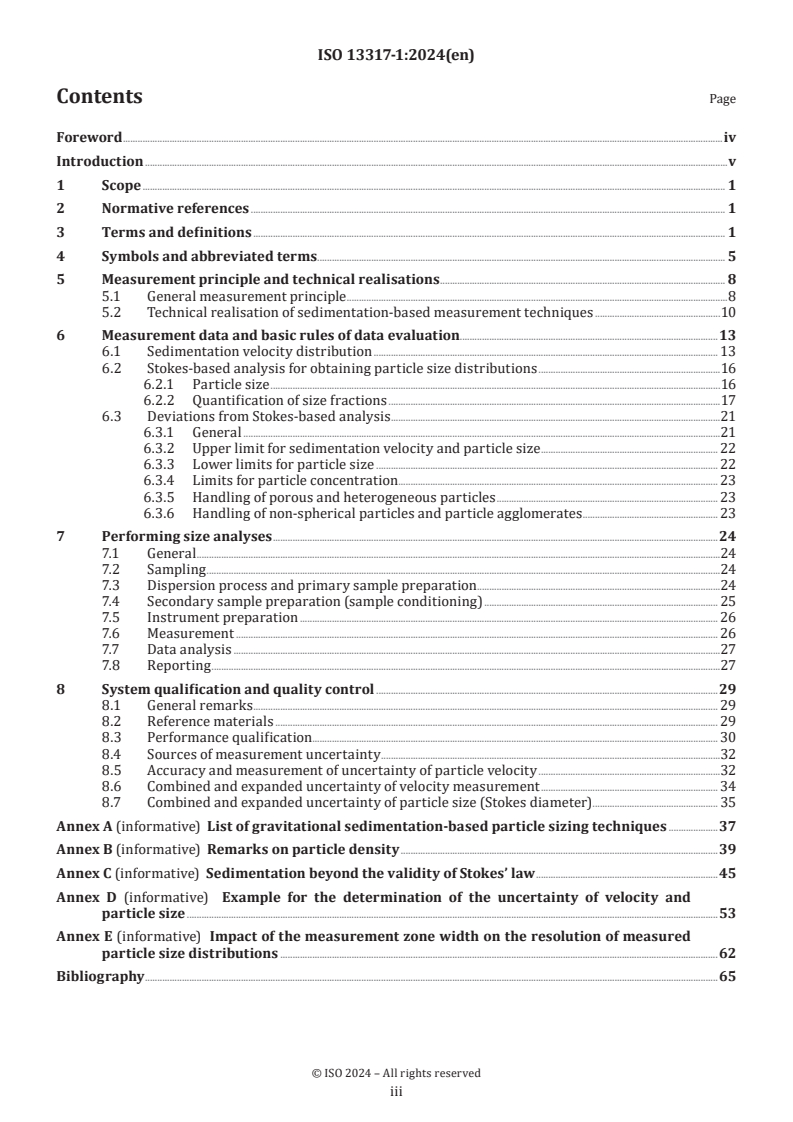
Contents Page
Foreword .iv
Introduction .v
1 Scope . 1
2 Normative references . 1
3 Terms and definitions . 1
4 Symbols and abbreviated terms. 5
5 Measurement principle and technical realisations . 8
5.1 General measurement principle .8
5.2 Technical realisation of sedimentation-based measurement techniques .10
6 Measurement data and basic rules of data evaluation.13
6.1 Sedimentation velocity distribution . 13
6.2 Stokes-based analysis for obtaining particle size distributions .16
6.2.1 Particle size .16
6.2.2 Quantification of size fractions .17
6.3 Deviations from Stokes-based analysis .21
6.3.1 General .21
6.3.2 Upper limit for sedimentation velocity and particle size . 22
6.3.3 Lower limits for particle size . 22
6.3.4 Limits for particle concentration . 23
6.3.5 Handling of porous and heterogeneous particles . 23
6.3.6 Handling of non-spherical particles and particle agglomerates . 23
7 Performing size analyses .24
7.1 General .24
7.2 Sampling .24
7.3 Dispersion process and primary sample preparation.24
7.4 Secondary sample preparation (sample conditioning) . 25
7.5 Instrument preparation . 26
7.6 Measurement . 26
7.7 Data analysis .27
7.8 Reporting .27
8 System qualification and quality control .29
8.1 General remarks . 29
8.2 Reference materials . 29
8.3 Performance qualification. 30
8.4 Sources of measurement uncertainty .32
8.5 Accuracy and measurement of uncertainty of particle velocity .32
8.6 Combined and expanded uncertainty of velocity measurement . 34
8.7 Combined and expanded uncertainty of particle size (Stokes diameter) . 35
Annex A (informative) List of gravitational sedimentation-based particle sizing techniques .37
Annex B (informative) Remarks on particle density .39
Annex C (informative) Sedimentation beyond the validity of Stokes’ law .45
Annex D (informative) Example for the determination of the uncertainty of velocity and
particle size .53
Annex E (informative) Impact of the measurement zone width on the resolution of measured
particle size distributions .62
Bibliography .65
iii
Foreword
ISO (the International Organization for Standardization) is a worldwide federation of national standards
bodies (ISO member bodies). The work of preparing International Standards is normally carried out through
ISO technical committees. Each member body interested in a subject for which a technical committee
has been established has the right to be represented on that committee. International organizations,
governmental and non-governmental, in liaison with ISO, also take part in the work. ISO collaborates closely
with the International Electrotechnical Commission (IEC) on all matters of electrotechnical standardization.
The procedures used to develop this document and those intended for its further maintenance are described
in the ISO/IEC Directives, Part 1. In particular, the different approval criteria needed for the different types
of ISO document should be noted. This document was drafted in accordance with the editorial rules of the
ISO/IEC Directives, Part 2 (see www.iso.org/directives).
ISO draws attention to the possibility that the implementation of this document may involve the use of (a)
patent(s). ISO takes no position concerning the evidence, validity or applicability of any claimed patent
rights in respect thereof. As of the date of publication of this document, ISO had not received notice of (a)
patent(s) which may be required to implement this document. However, implementers are cautioned that
this may not represent the latest information, which may be obtained from the patent database available at
www.iso.org/patents. ISO shall not be held responsible for identifying any or all such patent rights.
Any trade name used in this document is information given for the convenience of users and does not
constitute an endorsement.
For an explanation of the voluntary nature of standards, the meaning of ISO specific terms and expressions
related to conformity assessment, as well as information about ISO's adherence to the World Trade
Organization (WTO) principles in the Technical Barriers to Trade (TBT), see www.iso.org/iso/foreword.html.
This document was prepared by Technical Committee ISO/TC 24, Particle characterization including sieving,
Subcommittee SC 4, Particle characterization.
This second edition cancels and replaces the first edition (ISO 13317-1:2001), which has been technically
revised.
The main changes are as follows:
— core terms and definitions have been revised;
— the explanation of measurement principle and techniques has been revised and expanded;
— sedimentation velocity as measurand has been included;
— a guide for the determination of measurement uncertainty has been included.
A list of all parts in the ISO 13317 series can be found on the ISO website.
Any feedback or questions on this document should be directed to the user’s national standards body. A
complete listing of these bodies can be found at www.iso.org/members.html.
iv
Introduction
Gravitational sedimentation has been an established principle of particle size analysis for several decades.
It is employed in various academic and industrial fields of application. Numerous national and international
standards address gravitational sedimentation techniques and analytical methods.
Although manifold new particle sizing techniques have emerged during the last two decades, sedimentation
techniques have been recently rediscovered. This is due to substantial technical advancements and the fact
that they are based on a first-principle measurement of the particles’ directed motion (migration) under
gravity.
The measurands of gravitational sedimentation techniques are the distributions of sedimentation velocity
and corresponding particle size. They are derived from observations of phase separation – either by
monitoring the deposition of particles or the depletion of dispersion. The physical principles employed to
determine the quantity of particles differ widely, whereas sedimentation velocity is in each case computed
from the vertically migrated distance and measurement time. This computation does not demand essential
preconditions and theoretical assumptions. Yet, the transformation of velocity into particle size relies on
the applicability of Stokes’ law. As fractionating technique, sedimentation analysis can distinguish between
particle fractions of close sedimentation velocity. Accordingly, particle size distributions can be very finely
resolved, which is an advantage compared to spectroscopic ensemble techniques.
The ISO 13317 series covers the methods to determine the distributions of sedimentation velocities and
particle size of particulate materials by gravitation-induced particle migration in liquids. The direction of
this motion depends on the density difference (density contrast) between dispersed and continuous phase.
During the measurement, particles should not undergo any physical or chemical change in the continuous
phase (liquid).
The primary measurand is the particle velocity distribution, which is converted into size distribution
based on established sedimentation theory. The measurement techniques described in the ISO 13317 series
are applicable to liquid dispersions, like suspensions and emulsions. The measurable particle size range
depends on material properties and typically reaches from 200 nm to 100 μm for aqueous samples, whereas
sedimentation velocity can be quantified in the range from 0,6 µm/s to 10 mm/s. Sedimentation analysis is
conducted for low particle concentrations. The maximum permissible value depends on the measurement
technique and the analysis theory. In general, the volume fraction of particles is well below 1 %.
It is the responsibility of the user of this document to establish appropriate safety and health practices and
to determine the applicability of the regulatory limitations prior to its use.
v
International Standard ISO 13317-1:2024(en)
Determination of particle size distribution by gravitational
liquid sedimentation methods —
Part 1:
General principles, requirements and guidance
1 Scope
This document specifies the principles of particle size analysis by gravitational sedimentation, the principal
types of measurement techniques as well as the general rules for conducting measurements, method
validation, determination of the uncertainty budget and representation of results.
This document covers neither particle migration by centrifugal, electric or magnetic forces nor
sedimentation at high particle concentrations (e.g. zone sedimentation). Moreover, this document does not
deal with the determination of properties other than sedimentation velocity and particle size (i.e. neither
particle concentration, particle shape, particle density, zeta-potential nor apparent viscosity).
NOTE This document can involve hazardous materials, operations and equipment. This document does not
purport to address all the safety problems associated with its use. Explosion proof analysers are required when
examining volatile liquids with a low flash point.
2 Normative references
The following documents are referred to in the text in such a way that some or all of their content constitutes
requirements of this document. For dated references, only the edition cited applies. For undated references,
the latest edition of the referenced document (including any amendments) applies.
ISO 9276-1, Representation of results of particle size analysis — Part 1: Graphical representation
3 Terms and definitions
For the purposes of this document, the following terms and definitions apply.
ISO and IEC maintain terminology databases for use in standardization at the following addresses:
— ISO Online browsing platform: available at https:// www .iso .org/ obp
— IEC Electropedia: available at https:// www .electropedia .org/
3.1
sedimentation
directional motion of particles (3.7) in a viscous liquid under the action of gravity or centrifugal fields
Note 1 to entry: For a positive density contrast (3.17), sedimentation occurs in the direction of gravitational
acceleration; it is counter directed to this acceleration for a negative density contrast.
Note 2 to entry: A downward motion under gravity is also called "settling" or "falling".
Note 3 to entry: An upward motion under gravity is also called "creaming" (e.g. droplets) or more generally, "rising" or
"floating".
3.2
migration
directional motion of particles (3.7) in a viscous liquid under the action of a force field
Note 1 to entry: Migration in gravitational or centrifugal fields is called sedimentation (3.1).
3.3
terminal sedimentation velocity
sedimentation (3.1) velocity in the case that gravity or centrifugal force is completely balanced by buoyancy
and drag force
3.4
Stokes diameter
equivalent diameter of a sphere that has the same buoyant density (3.16) and terminal sedimentation velocity
(3.3) as the real particle (3.7) in the same liquid under creeping flow (3.19) conditions
Note 1 to entry: The general rule that the buoyant density is used for calculating the Stokes diameter applies also to
coated particles or multiconstituent particles (such as droplets in multiple emulsions). The buoyant density can be
approximated with the skeleton density (3.14) for monoconstituent particles.
Note 2 to entry: For porous particles, it is common use to compute particle size based on the apparent particle density
(3.15). This approach considers the stagnant liquid in the open pores (3.9) as intrinsic constituent of the dispersed
phase. Thus, the obtained size values are hydrodynamic equivalent diameters.
Note 3 to entry: For close-packed agglomerates (3.8) or aggregates, the buoyant density can be replaced by the
apparent particle density – with particle referring to the agglomerate or aggregate – in order to get the hydrodynamic
equivalent diameter.
3.5
shape correction factor
ratio of the sedimentation (3.1) velocity of a non-spherical particle (3.7) to the one of a spherical particle of
the same volume and apparent particle density (3.15)
3.6
hindrance function
ratio of the terminal sedimentation velocity (3.3) of a particle (3.7) placed in a well-mixed dispersion divided
by its sedimentation velocity in an infinite vessel for the absence of other particles
3.7
particle
minute piece of matter with defined physical boundaries
[SOURCE: ISO 26824:2022, 3.1.1, modified — Notes 1, 2 and 3 to entry have been deleted.]
3.8
agglomerate
cluster of particles (3.7) held together by weak or medium strong forces with an external surface area, which
is similar to the sum of the surface areas of the individual particles
Note 1 to entry: The forces acting between the constituent particles of an agglomerate are relatively weak. They result,
for example, from van der Waals attraction or simple physical entanglement.
Note 2 to entry: Agglomerates are also termed secondary particles and the original source particles are termed
primary particles.
3.9
open pore
pore not totally enclosed by its walls and open to the surface either directly or by interconnecting with
other pores and therefore accessible to liquid
[SOURCE: ISO 15901-1:2016, 3.11, modified — "fluid" has been replaced with "liquid" in the definition.]
3.10
closed pore
pore totally enclosed by its walls and hence not interconnecting with other pores and not accessible to liquids
[SOURCE: ISO 15901-1:2016, 3.10, modified — "fluids" has been replaced with "liquids" in the definition.]
3.11
dynamic viscosity
measure of flow resistance for Newtonian liquids calculated as the ratio of the shear stress to the rate of
shear for laminar flow exposed to a pre-set shear stress or strain
3.12
apparent viscosity
measure of flow resistance for non-Newtonian liquids at a defined shear stress or strain calculated as the
ratio of the shear stress to the shear rate
3.13
true density of the dispersed phase
ratio of mass to volume for a body solely consisting of the dispersed phase without pores, voids, inclusions
or surface fissures
3.14
skeleton density
ratio of the sample mass and the volume of the sample including the volume of closed pores (if present) but
excluding the volume of open pores (3.9)
Note 1 to entry: The skeleton density refers to solid particles (3.7) and is determined for samples of dry powder.
[SOURCE: ISO 12154:2014, 3.3, modified — "as well as that of void spaces between particles within the bulk
sample" has been deleted from the definition and Note 1 to entry has been added.]
3.15
apparent particle density
effective particle density
ratio of mass to volume for a particle (3.7) including particulate inclusions, entrapped stagnant liquid and
gas in pores, voids and surface fissures as well as surfaces layers and coatings
Note 1 to entry: The apparent particle density is the density of a migrating entity and is calculated as the weighted
average of its constituents.
Note 2 to entry: The apparent particle density depends on the wettability of open pores (3.9) and the kinetics of wetting
or replacement of pore liquid. Therefore, it is affected by sample preparation.
Note 3 to entry: The apparent particle density is not identical with the buoyant density (3.16). They deviate from each
other for porous particles and particle agglomerates (3.8) in particular.
3.16
buoyant density
ratio of mass to volume for a particle (3.7) including particulate inclusions, liquid and gas in closed pores and
voids as well as surface layers and coatings, but excluding the liquid continuous phase that penetrates open
pores (3.9)
Note 1 to entry: The buoyant density equals the (hypothetical) density of the continuous phase for which the
gravitational force acting on the immersed particle is counterbalanced by buoyancy.
Note 2 to entry: The buoyant density of a particle can be experimentally determined (see ISO 18747-1 and ISO 18747-2
for more information).
Note 3 to entry: The buoyant density of monoconstituent particles can be approximated with their skeleton density (3.14).
Note 4 to entry: The buoyant density of multiconstituent particles (e.g. coated pigments and droplets of multiple
emulsions) can be approximated with the averaged densities of the single constituents.
Note 5 to entry: The buoyant density is affected by the adsorption of dissolved species at the particle surface and
therefore depends on the solvent and its composition.
Note 6 to entry: The buoyant density is not identical with the apparent particle density (3.15), particularly for porous
particles and particle agglomerates (3.8).
3.17
density contrast
difference between the particle (3.7) density and the density of the continuous phase
Note 1 to entry: For quantifying the density contrast, the buoyant (particle) density (3.16) is used, but for porous
particles, the apparent particle density (3.15) is more appropriate.
3.18
particle Reynolds number
dimensionless parameter expressing the ratio of inertial to viscous forces within a fluid flowing past a
particle (3.7)
Note 1 to entry: The particle Reynolds number is based on the volume equivalent diameter.
Note 2 to entry: In other contexts, the definition of the particle Reynolds number can refer to different equivalent
diameters or to the equivalent radii.
Note 3 to entry: The particle Reynolds number is a characteristic of the flow field and mobility of the particle.
3.19
creeping flow
type of flow solely governed by viscous forces and not affected by inertial effects
Note 1 to entry: For moving particles (3.7) or for the flow past a particle, the creeping flow condition applies if the
particle Reynolds number (3.18) is well below 0,25.
3.20
Brownian motion
random motion of particles (3.7) caused by collisions with the molecules or atoms of the surrounding
continuous phase
Note 1 to entry: The trajectory of Brownian motion is not differentiable.
Note 2 to entry: Brownian motion results on a macroscopic level in mass transport of the dispersed phase, e.g. in case
of diffusion, thermophoresis or photophoresis.
3.21
lower size limit
size of the smallest particles that are detectable and with a diffusional particle flux that is negligible
compared to the sedimentational particle flux
Note 1 to entry: The ratio of sedimentational flux to diffusional flux (also called Péclet number, Pe) should be >1.
3.22
upper size limit
size of the largest particle (3.7) that satisfies the condition of creeping flow (3.19) and of which the terminal
sedimentation velocity (3.3) is detectable
3.23
type of quantity
specification of the physical property employed to quantify the individual particle (3.7) fractions
Note 1 to entry: The type of quantity is a cumulable property of single particles or disperse systems, such as number,
mass, intensity of scattered light (within the single scattering limit), light extinction (within the Lambert-Beer limit),
refractive index increment or X-ray attenuation.
Note 2 to entry: The type of quantity is indicated by a numerical or character subscript when symbolising the density
and cumulative function of a size distribution. Moreover, the subscript also specifies distribution parameters, such as
median, mean and modal values or any quantiles.
Note 3 to entry: The following conventions apply for the subscript of geometric or gravimetric properties:
— number: subscript r = 0
— length: subscript r = 1
— area: subscript r = 2
— volume or mass: subscript r = 3
Note 4 to entry: The following conventions apply for the subscript of physical properties:
— light extinction: subscript toq = “ext”
— light intensity: subscript toq = “int”
3.24
sensitivity
change of instrument response with respect to changes in concentration or absolute quantity of particles
(3.7) in a specified size class
Note 1 to entry: A concentration or quantity can be given in relative or absolute values depending on the detection aim.
Note 2 to entry: Sensitivity depends on the type of quantity (3.23).
Note 3 to entry: Sensitivity is a function of size.
3.25
limit of quantity detection
smallest quantity of specified particle (3.7) size class, for which the instrument response can be distinguished
from the background
Note 1 to entry: The limit of quantity detection depends on factors such as size range, precision, noise level and
smoothing algorithms.
Note 2 to entry: The limit of quantity detection affects the lower size limit (3.21) and upper size limit (3.22).
3.26
measurement uncertainty
uncertainty of measurement
parameter associated with the result of a measurement that characterises the dispersion of the values that
can reasonably be attributed to the measurand
[SOURCE: ISO/IEC Guide 98-3:2008, 2.2.3, modified — the term "measurement uncertainty" has been added.]
4 Symbols and abbreviated terms
For the purposes of this document, the following symbols apply.
a edge length m
Ar Archimedes number dimensionless
b systematic deviation of measured value from true value varying
0,5 0,5
C transformation coefficient, see Formula (34) m · s
C drag coefficient dimensionless
D
c(x) concentration density varying
c concentration with respect to extensive property M varying
M
d diameter m
2 −1
D particle diffusion coefficient m · s
p
F drag force (also: hydrodynamic resistance) N
D
−2
g gravitational acceleration m · s
h sedimentation distance m
sed
k coverage factor dimensionless
−1
k Boltzmann constant J · K
B
L length m
Lj Ljaščenko number dimensionless
M extensive property indicating the amount of dispersed phase varying
m number of bias determinations dimensionless
N number of replicate analyses dimensionless
P resolution ratio dimensionless
Pe Péclet number dimensionless
Q cumulative function of a distributed quantity, for a type of quantity, in which the dimensionless
toq
fractions are weighted
q density function of a distributed quantity, for a type of quantity, in which the varying
toq
fractions are weighted
Re particle Reynolds number dimensionless
P
S saturation of open pores with continuous phase dimensionless
s standard deviation varying
T absolute temperature K
t sedimentation time s
sed
U expanded uncertainty varying
u uncertainty varying
−1
v terminal sedimentation velocity m · s
sed
x particle size (equivalent diameter) m
x Stokes diameter m
Stokes
x volume equivalent diameter m
V
z Cartesian coordinate in vertical direction, vertical position m
−3
Δρ density contrast kg · m
−1
γ
shear rate s
δ layer thickness m
layer
δ relative error of the calculated particle size dimensionless
x
ε porosity dimensionless
η viscosity of the continuous phase Pa · s
c
−3
ρ particle density kg · m
p
−3
ρ density of the continuous phase kg · m
c
−3
ρ true density of the dispersed phase kg · m
d
φ volume fraction dimensionless
V
For the purposes of this document, the following subscripts apply.
aggl agglomerate, also aggregate
app apparent
bouy buoyant
c combined
incl inclusion
lab laboratory
max maximum
occl occluded voids
open open pores
ref reference
rel relative
rep repeatability
Rw reproducibility
sk skeleton
sus suspension
toq type of quantity
tot total
For the purposes of this document, the following abbreviated terms apply.
ALS angular light scattering
DLS dynamic light scattering
CRM certified reference material
FBRM focussed beam reflectance method
HSM homogeneous-start method
LSM line-start method
OV occluded void
PTA particle tracking analysis
QCM quality control material
RM reference material
SOP standard operating procedure
5 Measurement principle and technical realisations
5.1 General measurement principle
Gravitational liquid sedimentation techniques are established tools for the characterisation of suspensions
and emulsions. They quantify the separation of particles (the dispersed phase) from the continuous phase
(also called: dispersion medium or dispersion liquid) under the presence of gravity. This phase separation
relies on the directional, migratory motion of each particle, called sedimentation. Its rate, the sedimentation
velocity, depends on the particle size and thus offers a chance for the granulometric characterisation of
particle systems.
NOTE 1 Gravitational liquid sedimentation techniques are generally called “sedimentation techniques” in this
document.
Sedimentation occurs for any particle dispersed in a quiescent viscous liquid, as long as a density contrast
exists. It is driven by gravity, which acts on the particle (weight) and the displaced liquid (buoyancy). The
resulting net force (excess force) causes a migratory particle motion, which is retarded by a frictional
force (also called the drag force), which increases linearly with the sedimentation velocity and eventually
leads to a steady-state of zero net force, at which particles move with a terminal sedimentation velocity
(see Reference [43], chapter 6.4). Theoretically, terminal velocity is never reached. Sedimentation time to
reach 99 % of the terminal velocity is generally very fast and depends on the ratio of particle density and
liquid viscosity and the particle size squared for particle systems and operational conditions considered
within this document (i.e. for creeping flow). It amounts to 0,2 µs and 49 ms for spherical gold particles
(r = 19 300 kg/m ) of 0,3 µm and 100 µm, respectively, settling in water. If the excess force is positive (i.e.
p
weight is greater than buoyancy), the particle motion is called falling or settling. In the opposite case, it is
called rising, creaming or floating.
Sedimentation results in a depletion of the dispersed phase and the formation of a (fixed) layer of separated
particles – either at the bottom (sediment) or at the air-liquid interface (cream, foam).
a) Homogeneous dispersion and corresponding b) Formation of four zones and corresponding
concentration profile at t = 0 concentration profile at t
sed
Key
X concentration
Y position
1 zone 1 = particle-free supernatant
2 zone 2 = depleted dispersion (due to loss of coarse particles)
3 zone 3 = original dispersion
4 zone 4 = sediment
5 sedimentation cell
6 measurement zone
h sedimentation distance
sed
t sedimentation time
sed
Figure 1 — Schematic illustration of phase separation due to sedimentation for a bidisperse sample
with positive density contrast and its monitoring by an incremental sensing technique
Particles settle at different velocities in the dilute regime based on their difference in size. As a result, four
particle concentration zones are progressing (see Figure 1). The top layer, the supernatant (zone 1), has
already become free of particles (c = 0). The next layer (zone 2) is depleted of the large particles and the
dispersed phase consists only of the fine particle fraction (c = c ). Simultaneously, a sediment (zone 4)
fine
develops at the bottom. In the early stages of phase separation, it is predominantly built up by fast settling,
coarse particles. In the layer just above the sediment (zone 3), the concentration does not change at all with
time (c = c = c + c ) in the case of gravity sedimentation until the coarse fraction has completely
initial fine coarse
entered the sediment (zone 4). The sedimentation process is finished when all particles have settled down
and the formation of the sediment is completed. In the case of a negative excess force, the opposite picture is
observed, i.e. particle concentration decreases at the bottom and increases at the top.
In general, sedimentation techniques quantify either the changes of local particle concentration in the
measurement zone (detection level) or the growth of the layer of separated particles (e.g. at the bottom
of a detection tray for the balance method, see ISO 13317-4). The vertical position of measurement zone
(see Figure 1) and the time elapsed since starting the separation define the sedimentation velocity
(first measurement principle). Further preconditions or assumptions are not needed for attributing the
sedimentation velocity to a point of the measurement data (e.g. be it the temporal evolution of local particle
concentration, the local variation of particle concentration at a given time, the time function of sediment
weight). The sedimentation velocity itself constitutes an essential characteristic for several applications,
which goes far beyond a granulometric characterisation (e.g. analysis of suspension stability, segregation
phenomena, flocculation processes and phase separation of highly concentrated slurries).
The sedimentation velocity depends on the properties of the continuous phase (density, rheological
behaviour) and on characteristics of the particles (i.e. size, density and shape). This allows its conversion
into particle size based on the Stokes' law and corresponding presumptions (see 6.2.1). This (indirect)
quantification yields an equivalent diameter with respect to sedimentation velocity, called Stokes diameter,
x . It reflects the weight or volume of the particles as well as their mobility or drag coefficient. It is
Stokes
[44]
typically one of the smallest equivalent diameters of a given particle. According to Leschonski , Formula (1)
applies:
x < x < x = x < x (1)
Stokes V S proj,m proj,st
where
x is the projected area equivalent diameter for mean orientation;
proj,m
x is the projected area equivalent diameter for stable orientation;
proj,st
x is the surface equivalent diameter;
S
x is the volume equivalent diameter.
V
The difference between these equivalent diameters is particularly pronounced for particle aggregates and
[45]
agglomerates, where Formula (2) applies :
x << x < x < x (2)
Stokes hd gyr Feret,max
where
x is the maximum Feret diameter;
Feret,max
x is the diameter of gyration;
gyr
x is the hydrodynamic equivalent diameter.
hd
NOTE 2 The Stokes diameter is not identical to the hydrodynamic or mobility equivalent diameter, which solely
refers to the particles drag coefficient. Colloid scientists often use the radius of gyration (i.e. 0,5 · x ).
gyr
An essential feature of each sedimentation technique is the way of quantifying the particles and thus particle
size fractions. It occurs separately from the physical process of particle classification via sedimentation
and can employ very different measurands (e.g. local mass concentration, local X-ray attenuation or light
obscuration, sediment weight, sediment height). The primary measurement results of sedimentation
techniques are typically time-curves of these measurands and sometimes they can also be the distribution
of these measurands along the vertical coordinate (i.e. profiles). The positions at which time-curves
are measured or the instants at which a profile is acquired can be adjusted by operators or are fixed by
instrumentation. The time axis or the vertical measurement positions can be easily transformed into an
axis of sedimentation velocity on which the measured quantity is projected. Hence, the above-mentioned
measurands define the intrinsic type of quantity, by which the individual size fractions are weighted (see
5.2 and Annex A). The conversion of these quantities to fundamental ones (i.e. volume or number) can rely
on an unbiased or biased linear scaling or can involve parametric models (e.g. for light obscuration).
5.2 Technical realisation of sedimentation-based measurement techniques
There is a considerable variety of analytical techniques, which characterise particle systems based on the
sedimentation velocity (or equivalently the Stokes diameter). In general, they monitor the sedimentation
induced separation of the disperse sample via the depletion of the dispersion or the growth of deposited
particle layer (sediment or cream). Yet, they differ in several aspects.
At first, fundamental difference is the driving force. This document only covers sedimentation under gravity,
while the techniques based on sedimentation in centrifugal fields are described within the ISO 13318
series. A further distinction refers to the type of the primary measurand: some techniques probe integral
properties of the segregated particles (e.g. sediment mass or volume), others address an integral (cumulated)
quantity of dispersed particles (e.g. via hydrostatic pressure) and a third group measures the local particle
concentration within the dispersion (e.g. via X-ray attenuation or light extinction). With regard to data
analysis, the two former types of measurement techniques are called integral (or cumulative) techniques,
whereas the latter types are called incremental techniques (see Figure 2).
Integral sedimentation techniques comprise all techniques that monitor the growth of the sediment,
such as sedimentation balances techniques (see ISO 13317-4) or sedimentations tubes (see ISO 6344-3
and ISO 8486-2). These techniques apply to all disperse systems of solid particles with a positive density
contrast to the liquid phase. They measure mass, volume or height of the sediment as a function of time.
Another group of integral techniques probe the total amount of (solid) particles, which is still suspended in
the continuous phase, for which purpose they, for example, measure the hydrostatic pressure (manometric
[46] [47],[48]
sedimentation techniques ) or the weight force of a diving body (diving balance techniques ).
Incremental sedimentation techniques measure the local particle concentration. One way to accomplish this
consists of periodic sampling with a pipette and subsequent quantification of dispersed material (pipette
techniques, see ISO 13317-2). Alternatively, these techniques probe local, macroscopic properties of the
sample, for example, dispersion density (with micro-diving bodies, i.e. small hydrometers, see ISO 17892-4,
ISO 11277 and ASTM D7928-17), X-ray attenuation (X-ray sedimentometer, see ISO 13317-3), light extinction
[49]
or scattering (photosedimentometer, see GB/T 6524, ANSI B74.20) or refractive index . Pipette-based and
hydrometric sedimentation techniques were rather popular in the past, whereas modern sedimentometers
typically employ radiation-based sensing technologies, especially for fine particles 100 µm.
Figure 2 illustrates the differences between integral and incremental sedimentation techniques through
examples of monitoring the growth of sediment (integral) and the continuous observation of local particle
concentration (incremental). Time curves of the corresponding measurement signals are shown for two
modes of operation:
a) HSM (also suspension mode, situation A), and
b) LSM (situation B).
The former, which is preferably used in gravitational sedimentation analysis, starts with thoroughly
mixed, homogeneous samples, whereas in case of the latter, the initial state is characterised by a thin layer
of dispersion sample on top of a particle-free liquid. Although, the line-start method is prone to adverse
hydrodynamic instabilities (e.g. density convections), it is still used for specific applications (e.g. ISO 6344-3)
because it offers a few advantages such as the determination of the coarsest grain size. The two different
operational modes coincide with different shapes of time-curves (see Figure 2) and require different
procedures in data analysis (see 6.2.2).
a) Sedimentation for HSM used for incremental techniques and integral techniques
b) Sedimentation for LSM used for incremental techniques and integral techniques
Key
t time elapsed since starting the sedimentation experiment
sed
Y observed quantity (e.g. sediment mass or X-ray attenuation)
1 sediment layer [an example of measured object for integral (cumulative) techniques]
2 measurement zone for incremental (differential) techniques
3 time curve for sediment quantity (e.g. mass or volume)
4 time curve for local particle conce
...