

ISO 21501-1:2025
(Main)Determination of particle size distribution — Single particle light interaction methods — Part 1: Light scattering aerosol spectrometer
General Information
- Abstract
This document specifies characteristics of a light scattering aerosol spectrometer (LSAS) which is used for measuring the size, number concentration and number-based size distribution of particles suspended in a gas. This document provide the calibration procedure and the validation method for aerosol spectrometers. This document applies to: — characterization of metered dose inhalers (MDI), dry powder inhalers (DPI) and nebulizers in pharmacy; — production control of active agents; — cut-off determination: impactors, cyclones and impingers; — atmospheric aerosols: bio-aerosols, stables or composting facilities, nebulized droplets, measurements in street tunnels; — fractional separation efficiency determination of filters.
- Status
- Published
- Publication Date
- 09-Dec-2025
- Technical Committee
- ISO/TC 24/SC 4 - Particle characterization
- Drafting Committee
- ISO/TC 24/SC 4 - Particle characterization
- Current Stage
- 6060 - International Standard published
- Start Date
- 10-Dec-2025
- Due Date
- 28-Sep-2025
- Completion Date
- 10-Dec-2025

Overview
ISO 21501-1:2025 - Determination of particle size distribution - Single particle light interaction methods - Part 1: Light scattering aerosol spectrometer (LSAS) defines the characteristics, calibration procedures and validation methods for light scattering aerosol spectrometers. The standard targets instruments used to measure particle size, number concentration and number-based size distributions of particles suspended in a gas using single-particle light scattering techniques. It updates the first edition (2009) and aligns requirements with related parts of the ISO 21501 series.
Key topics and technical requirements
- Instrument scope and principle: Describes the LSAS measurement principle (single-particle light scattering) and the optical particle size concept (light scattering equivalent particle diameter). (Annex A)
- Size range: Defines the applicable measurement range (approximately 0.06 μm to 45 μm) and related metrological concepts.
- Counting efficiency: Specifies how to determine counting efficiency η(x) as a function of particle size, and gives acceptance ranges:
- Near the lower size limit: counting efficiency between 0.30 and 0.70 (50 ± 20 %).
- From twice the lower size limit up to 10 μm (or instrument plateau): counting efficiency between 0.90 and 1.10 (100 ± 10 %).
- Lower/upper size limits and size range: Defines lower size limit (counting efficiency 0.5 ± 0.15), upper size limit (0.5 ± 0.2), and the size-of-quantification range.
- Sizing accuracy and size resolution: Requirements for the instrument’s ability to resolve neighboring size classes and to report sizing accuracy.
- Flow and concentration parameters: Calibration and tests for sampling flow rate, effective flow through the sensing volume, maximum particle number concentration and coincidence error handling.
- Test methods and calibration procedures: Detailed test methods (size calibration, counting-efficiency tests via parallel comparison and generator methods, effective flow rate measurement). (Annexes B–F provide standards, effects, sampling guidance and examples.)
Practical applications and users
ISO 21501-1:2025 is applicable to:
- Pharmaceutical testing and QA: MDIs, DPIs, nebulizers, and production control of active agents.
- Aerosol and environmental monitoring: atmospheric aerosols, bio‑aerosols, nebulized droplets, tunnels, stables/composting facilities.
- Industrial quality control: cut-off determination for impactors, cyclones and impingers, and fractional separation efficiency of filters.
- Sectors and users: instrument manufacturers, calibration and metrology laboratories, pharmaceutical R&D and QC teams, environmental monitoring organizations, filter producers, and aerosol researchers.
Related standards
- ISO 21501 series (other parts on single-particle light interaction methods and complementary techniques).
- Refer to Annex B for particle size standards and Annex E for an example calibration with PSL particles.
Keywords: ISO 21501-1:2025, light scattering aerosol spectrometer, LSAS, particle size distribution, aerosol spectrometer calibration, counting efficiency, sizing accuracy, size resolution, pharmaceutical aerosols, environmental aerosol measurement.
Relations
- Effective Date
- 06-Jun-2022
Get Certified
Connect with accredited certification bodies for this standard

IMP NDT d.o.o.
Non-destructive testing services. Radiography, ultrasonic, magnetic particle, penetrant, visual inspection.
Inštitut za kovinske materiale in tehnologije
Institute of Metals and Technology. Materials testing, metallurgical analysis, NDT.
Q Techna d.o.o.
NDT and quality assurance specialist. 30+ years experience. NDT personnel certification per ISO 9712, nuclear and thermal power plant inspections, QA/
Sponsored listings
Frequently Asked Questions
ISO 21501-1:2025 is a standard published by the International Organization for Standardization (ISO). Its full title is "Determination of particle size distribution — Single particle light interaction methods — Part 1: Light scattering aerosol spectrometer". This standard covers: This document specifies characteristics of a light scattering aerosol spectrometer (LSAS) which is used for measuring the size, number concentration and number-based size distribution of particles suspended in a gas. This document provide the calibration procedure and the validation method for aerosol spectrometers. This document applies to: — characterization of metered dose inhalers (MDI), dry powder inhalers (DPI) and nebulizers in pharmacy; — production control of active agents; — cut-off determination: impactors, cyclones and impingers; — atmospheric aerosols: bio-aerosols, stables or composting facilities, nebulized droplets, measurements in street tunnels; — fractional separation efficiency determination of filters.
This document specifies characteristics of a light scattering aerosol spectrometer (LSAS) which is used for measuring the size, number concentration and number-based size distribution of particles suspended in a gas. This document provide the calibration procedure and the validation method for aerosol spectrometers. This document applies to: — characterization of metered dose inhalers (MDI), dry powder inhalers (DPI) and nebulizers in pharmacy; — production control of active agents; — cut-off determination: impactors, cyclones and impingers; — atmospheric aerosols: bio-aerosols, stables or composting facilities, nebulized droplets, measurements in street tunnels; — fractional separation efficiency determination of filters.
ISO 21501-1:2025 is classified under the following ICS (International Classification for Standards) categories: 19.120 - Particle size analysis. Sieving. The ICS classification helps identify the subject area and facilitates finding related standards.
ISO 21501-1:2025 has the following relationships with other standards: It is inter standard links to ISO 21501-1:2009. Understanding these relationships helps ensure you are using the most current and applicable version of the standard.
ISO 21501-1:2025 is available in PDF format for immediate download after purchase. The document can be added to your cart and obtained through the secure checkout process. Digital delivery ensures instant access to the complete standard document.
Standards Content (Sample)
International
Standard
ISO 21501-1
Second edition
Determination of particle size
2025-12
distribution — Single particle light
interaction methods —
Part 1:
Light scattering aerosol
spectrometer
Détermination de la distribution granulométrique — Méthodes
d'interaction lumineuse de particules uniques —
Partie 1: Spectromètre d'aérosol en lumière dispersée
Reference number
© ISO 2025
All rights reserved. Unless otherwise specified, or required in the context of its implementation, no part of this publication may
be reproduced or utilized otherwise in any form or by any means, electronic or mechanical, including photocopying, or posting on
the internet or an intranet, without prior written permission. Permission can be requested from either ISO at the address below
or ISO’s member body in the country of the requester.
ISO copyright office
CP 401 • Ch. de Blandonnet 8
CH-1214 Vernier, Geneva
Phone: +41 22 749 01 11
Email: copyright@iso.org
Website: www.iso.org
Published in Switzerland
ii
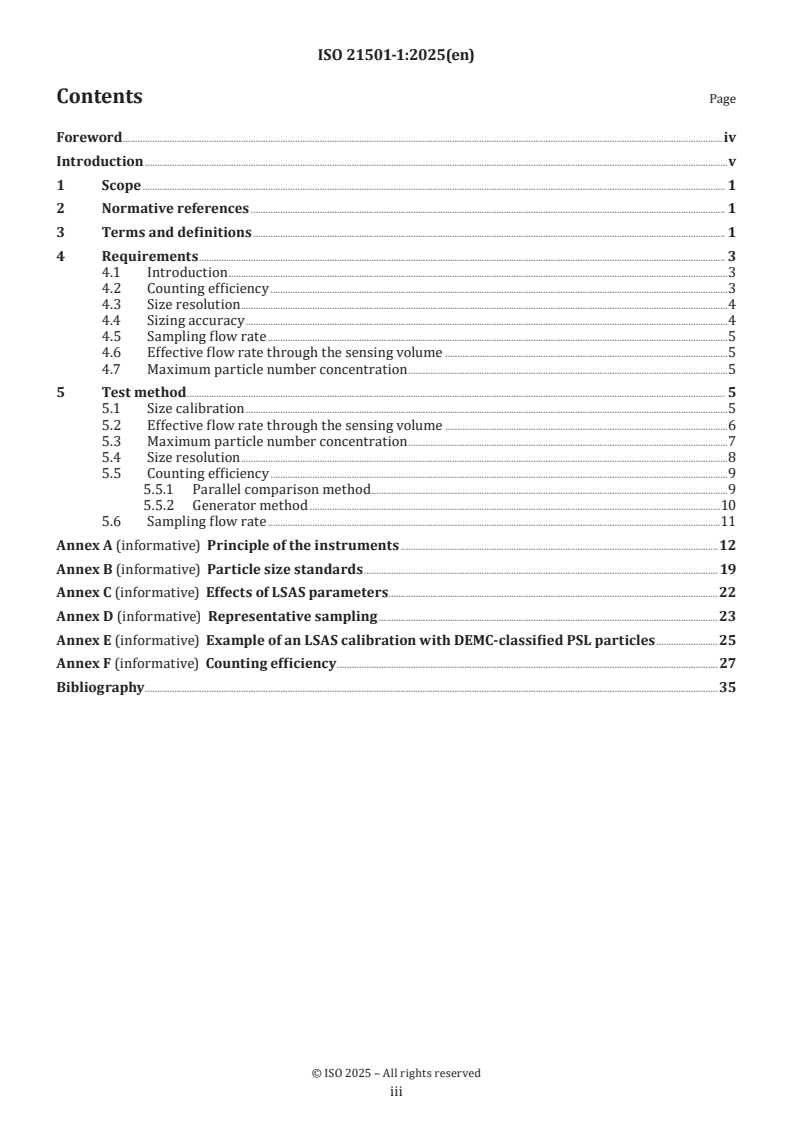
Contents Page
Foreword .iv
Introduction .v
1 Scope . 1
2 Normative references . 1
3 Terms and definitions . 1
4 Requirements . 3
4.1 Introduction .3
4.2 Counting efficiency .3
4.3 Size resolution .4
4.4 Sizing accuracy .4
4.5 Sampling flow rate .5
4.6 Effective flow rate through the sensing volume .5
4.7 Maximum particle number concentration .5
5 Test method . 5
5.1 Size calibration .5
5.2 Effective flow rate through the sensing volume .6
5.3 Maximum particle number concentration .7
5.4 Size resolution .8
5.5 Counting efficiency .9
5.5.1 Parallel comparison method .9
5.5.2 Generator method .10
5.6 Sampling flow rate .11
Annex A (informative) Principle of the instruments .12
Annex B (informative) Particle size standards . 19
Annex C (informative) Effects of LSAS parameters .22
Annex D (informative) Representative sampling .23
Annex E (informative) Example of an LSAS calibration with DEMC-classified PSL particles .25
Annex F (informative) Counting efficiency .27
Bibliography .35
iii
Foreword
ISO (the International Organization for Standardization) is a worldwide federation of national standards
bodies (ISO member bodies). The work of preparing International Standards is normally carried out through
ISO technical committees. Each member body interested in a subject for which a technical committee
has been established has the right to be represented on that committee. International organizations,
governmental and non-governmental, in liaison with ISO, also take part in the work. ISO collaborates closely
with the International Electrotechnical Commission (IEC) on all matters of electrotechnical standardization.
The procedures used to develop this document and those intended for its further maintenance are described
in the ISO/IEC Directives, Part 1. In particular, the different approval criteria needed for the different types
of ISO document should be noted. This document was drafted in accordance with the editorial rules of the
ISO/IEC Directives, Part 2 (see www.iso.org/directives).
ISO draws attention to the possibility that the implementation of this document may involve the use of (a)
patent(s). ISO takes no position concerning the evidence, validity or applicability of any claimed patent
rights in respect thereof. As of the date of publication of this document, ISO had not received notice of (a)
patent(s) which may be required to implement this document. However, implementers are cautioned that
this may not represent the latest information, which may be obtained from the patent database available at
www.iso.org/patents. ISO shall not be held responsible for identifying any or all such patent rights.
Any trade name used in this document is information given for the convenience of users and does not
constitute an endorsement.
For an explanation of the voluntary nature of standards, the meaning of ISO specific terms and expressions
related to conformity assessment, as well as information about ISO's adherence to the World Trade
Organization (WTO) principles in the Technical Barriers to Trade (TBT), see www.iso.org/iso/foreword.html.
This document was prepared by Technical Committee ISO/TC 24, Particle characterization including sieving,
Subcommittee SC 4, Particle characterization.
This second edition cancels and replaces the first edition (ISO 21501-1:2009), which has been technically
revised.
The main changes are as follows:
— alignment with ISO 21501-4;
— addition of Annex F addressing counting efficiency.
A list of all parts in the ISO 21501 series can be found on the ISO website.
Any feedback or questions on this document should be directed to the user’s national standards body. A
complete listing of these bodies can be found at www.iso.org/members.html.
iv
Introduction
Particle size distributions and particle number concentrations must be monitored in various fields, e.g. in
filter manufacturing, in the electronic industry, in the pharmaceutical industry, in the chemical industry,
in the manufacture of precision machines and in medical operations. The aerosol spectrometer is a useful
instrument for the determination of the size distribution and number concentration of particles suspended
in a gas.
The purpose of this document is to provide the calibration procedure and the validation method for aerosol
spectrometers, so as to improve the accuracy of the measurement result by aerosol spectrometers in general,
and to minimize the difference in the results measured by different instruments.
The light scattering technique described in this document is based upon single particle measurements. The
size range of particles measured by this method is between approximately 0,06 µm to 45 µm in diameter.
Instruments that conform to this document are used for the determination of the particle size distribution
11 3
and particle number concentration at relatively high concentrations of up to 10 particles/m .
v
International Standard ISO 21501-1:2025(en)
Determination of particle size distribution — Single particle
light interaction methods —
Part 1:
Light scattering aerosol spectrometer
1 Scope
This document specifies characteristics of a light scattering aerosol spectrometer (LSAS) which is used for
measuring the size, number concentration and number-based size distribution of particles suspended in a
gas. This document provide the calibration procedure and the validation method for aerosol spectrometers.
This document applies to:
— characterization of metered dose inhalers (MDI), dry powder inhalers (DPI) and nebulizers in pharmacy;
— production control of active agents;
— cut-off determination: impactors, cyclones and impingers;
— atmospheric aerosols: bio-aerosols, stables or composting facilities, nebulized droplets, measurements
in street tunnels;
— fractional separation efficiency determination of filters.
2 Normative references
There are no normative references in this document.
3 Terms and definitions
For the purposes of this document, the following terms and definitions apply.
ISO and IEC maintain terminology databases for use in standardization at the following addresses:
— ISO Online browsing platform: available at https:// www .iso .org/ obp
— IEC Electropedia: available at https:// www .electropedia .org/
3.1
particle
discrete element of the material regardless of its size
[SOURCE: ISO 2395:1990, 3.1.1]
3.2
aerosol
airborne particles and the gas (and vapour) mixture in which they are suspended
Note 1 to entry: In general, one divides the atmospheric aerosol into three size categories: the ultrafine range
x < 0,1 µm, the sub-micrometre range 0,1 µm < x < 1 µm and the super-micrometre range x > 1 µm, where x is the
particle diameter.
[SOURCE: ISO 4225:2020, 3.1.3.1, modified — Note 1 to entry added.]
3.3
particle size
diameter of a spherical particle determined by a specified measurement method and under specified
measurement conditions
Note 1 to entry: See also 3.4.
Note 2 to entry: There is no single definition of particle size. Different methods of analysis are based on the
measurement of different physical properties. The physical property to which the equivalent particle diameter refers
shall be indicated using a suitable subscript or reference to the documentary measurement standard according to
which the particle size was measured.
Note 3 to entry: In the whole series of ISO 9276, the symbol x is used to denote the particle size or the diameter of a
sphere. However, it is recognized there that the symbol d is also widely used to designate these values. Therefore, the
symbol x may be replaced by d where it appears.
3.4
equivalent particle diameter
diameter of the sphere with defined characteristics which behaves under defined conditions in exactly the
same way as the particle being described
3.5
light scattering equivalent particle diameter
x
sca
diameter of a homogeneous sphere of a reference substance (e.g. latex) which scatters defined incident light
with the same radiation efficiency into a defined solid angle element
3.6
particle concentration
indication of, e.g. particle numbers, particle mass, particle surface related to the unit volume of the carrier gas
Note 1 to entry: For the exact concentration indication, information on the gaseous condition (temperature and
pressure) or the reference to a standard volume indication is required.
3.7
coincidence error
probability of the presence of more than one particle inside the sensing volume simultaneously
Note 1 to entry: Coincidence error is related to particle number concentration and size of sensing volume.
3.8
counting efficiency
relation of the concentration determined from the counting rate of the measuring instrument and the real
concentration of the aerosol at the inlet of the instrument, or ratio of the particle number measured by an
LSAS to that introduced to the LSAS for a given sampling time
3.9
border zone error
particle sizing error that occurs when particles pass through the optical border of the sensing volume
3.10
light scattering aerosol spectrometer
LSAS
instrument that measures airborne particle numbers by counting the pulses as the particles pass through
the sensing volume, and also particle size by scattered light intensity
Note 1 to entry: The optical particle size measured by the LSAS is the light scattering equivalent particle size and not
a geometrical size.
Note 2 to entry: The principle of the instrument is described in Annex A.
3.11
lower size limit
smallest particle diameter with which the counting efficiency is 0,5 ± 0,15
3.12
upper size limit
largest diameter with which the counting efficiency is 0,5 ± 0,2
3.13
size range
distance between lower and upper size limit of quantification
3.14
reference instrument
reference particle counter is a counter that exhibits no particle losses or, if losses occur, these are small (e.g.
below 5 %), well characterized and taken into account during data evaluation
4 Requirements
4.1 Introduction
Aerosol spectrometers should determine the particle size distribution and particle number concentration
as accurately as necessary. For this purpose, they should have appropriate size resolution, sizing accuracy,
counting efficiency and flowrate accuracy. These aerosol spectrometers are not suitable for the classification
of clean rooms.
The effects of LSAS parameters are described in Annex C. The representative samplings are described in
Annex D.
4.2 Counting efficiency
The counting efficiency is the relation of the particle number concentration C — determined from
N,measured
the counting rate of a device and corrected for possible coincidence errors — to the real particle number
concentration C of the aerosol at the inlet of the device. The counting efficiency [η x ] is a function
()
N,actual
of the particle size and is expressed as the ratio shown in Formula (1).
Cx
()
N,measured
η()x = (1)
Cx
()
N,actual
The counting efficiency is also a function of signal processing, the homogeneous illumination of the sensing
volume and the extent to which the particles enter the sensing volume and flow rate.
Figure 1 shows a graphical representation of counting efficiency. In an ideal case, the counting efficiency
in the middle of the measuring range (as represented in Figure 1) has the value one. If an experimental
examination results in a value deviating from one, then this is to be accounted for as a correction to the
measurement result. For a proper evaluation of a measuring instrument, it is useful to determine the
complete counting efficiency curve, or to indicate the particle diameters corresponding to values of the
counting efficiency (e.g. at 0,1 and 0,9) besides those corresponding to a counting efficiency value of 0,5 at
lower size limit.
The counting efficiency shall be within 0,30 to 0,70 [corresponding to (50 ± 20) %] for calibration particles
with a diameter close to the lower size limit. It shall also be within 0,90 to 1,10 [(100 ± 10) %] for calibration
particles with diameter ranging from twice the lower size limit up to 10 μm or up to the maximum diameter
of the plateau region stated for the instrument if this is smaller. The counting efficiency can be determined
according to 4.5.
Key
X particle size
Y counting efficiency η (x)
1 lower size limit
2 upper size limit
3 size range
[5]
NOTE Figure 1 shows a graphical representation of the counting efficiency.
Figure 1 — Counting efficiency
4.3 Size resolution
The size resolution indicates which neighbouring particle sizes a particle measuring instrument can still
differentiate between and record separately. Aerosol spectrometers should determine the particle size
distribution and the particle number concentration as accurately as possible with high size resolution and
good sizing accuracy. The size resolution depends on particle size.
Almost all measuring instruments determine the particle number concentration in a limited number of
size classes which are firmly specified by the instrument design (e.g. instrument geometry, evaluation
electronics, evaluation software). In practical operation, the size resolution of an LSAS cannot be better than
the width of its size classes.
The size resolution shall be less than or equal to 0,15 (corresponding to 15 % of the specified particle size),
when it is evaluated using calibration particles of a certified average size specified by the manufacturer. The
size resolution can be determined according to 4.4.
4.4 Sizing accuracy
The sizing accuracy depends on the particle size. Therefore, the sizing accuracy can be evaluated for any
particle size as shown in Formula (2).
xx−
sr
ε()x = ×100 (2)
x
r
where
ε(x) is the ratio of particle size difference, in %;
x is the particle size of the size certified traceable particles, in µm;
r
x is the particle size indicated by the LSAS, in µm.
s
The sizing accuracy of an LSAS describes the difference between the actual calibration particle size and the
particle size indicated by the instrument. The correlation between the particle size and size class stated by
the manufacturer (channel number) is normally based upon a calibration of the instrument with a known
test aerosol [mostly polystyrene latex (PSL) particles]. Refer to Annex E.
4.5 Sampling flow rate
The sampling flow rate is the volumetric flow rate entering the LSAS and the error in the sampling flow rate
shall be within 5 %. Typical sampling flow rate is about 0,5 l/min to 5 l/min.
4.6 Effective flow rate through the sensing volume
The effective flow rate through the sensing volume is the volumetric flow rate through either the optically
or aerodynamically, or both, limited sensing volume. For particle number concentration measurements,
the effective flow rate through the sensing volume shall be evaluated. If the geometrical dimensions of the
sensing volume are exactly known, the effective flow rate through the sensing volume can be determined by
measuring the transit time of the particles through the sensing volume. Otherwise, the effective flow rate
through the sensing volume shall be determined by a calibration experiment according to 4.2.
4.7 Maximum particle number concentration
5 3
The LSAS must be able to measure in high particle number concentrations up to 10 particles/cm and
the maximum particle number concentration shall be specified by the manufacturer. According to 4.3, the
coincidence loss at the maximum particle number concentration of an LSAS shall be equal to or less than 10 %.
5 Test method
5.1 Size calibration
The light scattered by the individual particles is detected and transformed into a voltage pulse. These
pulses are classified according to their height in a multi-channel analyser (MCA). The result is a count
rate histogram. This histogram is transferred into a particle size distribution by applying the calibration
curve. This calibration curve, which is instrument specific, shall be determined either experimentally or
theoretically. Normally, aerosol spectrometers are calibrated with monodisperse test aerosols of known
(traceable) size and refractive index. Figure 2 shows a theoretical calibration curve.
For the production of monodisperse test aerosols, several generation principles can be used. The size
distribution of test aerosols with small variances are obtained if aqueous suspensions of PSL particles are
nebulized, dried and drawn through the instrument. Dry powder monodisperse PSL particles are also useful
for calibration.
Key
X particle size, in µm
Y relative scattered light intensity
[14]
NOTE Vertical bars are monodisperse particle experimental data.
Figure 2 — Theoretical calibration curve
Other techniques of providing narrow distributed aerosols are the vibrating-orifice generator, the Sinclair
and La Mer aerosol generator (SLG) or passing a polydisperse aerosol through a differential electrical
mobility classifier (DEMC) or aerodynamic aerosol classifier (AAC), which extracts particles within a narrow
size range according to their electrical mobility or aerodynamic relaxation time, respectively.
5.2 Effective flow rate through the sensing volume
The flow rate through the sensing volume is obtained by relating the instrument particle count rate to a
reference particle number concentration measurement using an instrument with a higher particle number
concentration range than the instrument to be calibrated and that is traceable to internationally accepted
standards. Figure 3 shows an effective flow rate and counting efficiency test set up.
Figure 3 — Effective flow rate and counting efficiency test set-up
The effective flow rate through the sensing volume is as shown in Formula (3).
N
q = (3)
E
C
N,ref
where
q is the effective flow rate through the sensing volume, in volume per time;
E
N is the measured particle count rate by LSAS, in number per time;
C is the measured particle number concentration by reference instruments, in number per volume.
N,ref
Effective flow rate through the sensing volume calibration is necessary for counting efficiency evaluation.
If the effective flow rate is unknown, the effective flow rate through the sensing volume calibration shall
be performed with particle sizes much smaller than the dimensions of the optical sensing volume, because
larger particles effectively increase the resulting sensing volume. However, the particle size shall be such
that both the LSAS under test and the reference device have a counting efficiency close to 100 %.
5.3 Maximum particle number concentration
The maximum particle number concentration of an LSAS is determined by the coincidence loss, which is
normally limited to 10 %. The coincidence loss is determined by the sampling flow rate, the time required
for particles to pass through the sensing volume and the electrical signal processing time. These values are
determined by the design of the LSAS. Calculation of coincidence loss is as shown in Formula (4).
Lq=−1 exp −×tC× ×100 (4)
()
Ep Nm, ax
where
L is the coincidence loss, in %;
q is the effective flow rate through the sensing volume, in m /s;
E
t is the time of passing through the effective sensing region plus electrical signal processing
p
time, in s;
C is the maximum particle number concentration, in particles per m .
N,max
There are several practical ways to ensure sufficiently low coincidence loss.
— A defined and reproducible concentration change of the same aerosol can be performed. If the number
concentration measured by the LSAS shows an equivalent change according to the defined conditions,
both concentrations are below the maximum particle number concentration.
— A reference instrument may be used to measure the reference concentration C . In this case, the particle
N,ref
size must be chosen such that the counting efficiency of both the LSAS and the reference instrument is
close to 100 %. The number concentration range of the reference instrument must be greater than the
maximum particle number concentration of the LSAS. As long as C /C is greater than 0,9, the
N, LSAS N, ref
number concentration is below the maximum particle number concentration of the LSAS.
In both cases, increasing the particle number concentration until a coincidence loss of 10 % is found will
determine the maximum particle number concentration C of the LSAS. Figure 4 shows a concentration
N,max
comparison measurement.
Key
X particle number concentration from defined concentration changes or C
N,ref
Y LSAS particle number concentration
Figure 4 — Concentration comparison measurement: coincidence loss and the maximum particle
number concentration (C , )
N max
5.4 Size resolution
The size resolution depends on the particle size. It can be determined by using monodisperse test aerosols
with known standard deviation (σ ) and high-resolution MCA. Figure 5 is an idealised representation of
P
the output of a high-resolution MCA. Determine the median MCA channel (b in Figure 5). The lower channel
(a) and upper channel (c) are selected so that the relative counts are 61 % ± 10 % of the median channel.
Using the calibration curve, determine the particle sizes corresponding to a and c. Calculate the absolute
value of the differences in particle sizes between the particle size of the size certified traceable particles and
the particle sizes corresponding to a and c. The larger difference in particle size is the observed standard
deviation σ. Calculate the percentage of size resolution of the LSAS using Formula (5). For further
information, refer to Annex E.
σσ−
P
R= ×100 (5)
x
where
R is the size resolution, in %;
σ is the observed standard deviation of the LSAS, in µm;
σ is the standard deviation of the particle size of the size certified traceable particles, in µm;
P
x is the particle size of the size certified traceable particles, in µm.
Key
X MCA channel
Y relative count
1 count rate distribution
2 lower side resolution
3 upper side resolution
a channel 1
b channel 2
c channel 3
Figure 5 — Size resolution
5.5 Counting efficiency
5.5.1 Parallel comparison method
Counting efficiency can be experimentally determined by using the measuring set-up shown in 4.2, along
with the guidance on particle generation in Annex B and the method described in Annex F.2.
For the test of the counting efficiency according to 3.1, it is assumed that C = C .
N,actual N,ref
It shall be verified that:
a) the LSAS under test and the reference counting device are below the 10 % coincidence limit;
b) the effective flow rate through the sensing volume of the LSAS is correct;
c) the LSAS under test and the reference counter are calibrated correctly concerning particle size, the
optics is not polluted and the electronics is adjusted correctly.
If Y > 1 in Figure 1, then C < C or conditions a), b) and c) have not been met.
N,ref N, actual
If Y = 1 in Figure 1, then the LSAS under test has 100 % counting efficiency.
If Y < 1 in Figure 1, then the sensitivity of the sensor is less than 100 % (point 1 in Figure 1; see also point B
in Figure 6) or there are transport losses (point 2 of Figure 1).
If Y decreases with increasing C , then there are coincidence losses (see point A in Figure 6).
N,ref
Key
X reference particle number concentration C , in particles/cm
N,ref
Y counting efficiency C /C
N,LSAS N,ref
0,156 µm PSL particles
0,234 µm PSL particles
0,312 µm PSL particles
Figure 6 — Counting efficiency: coincidence A, incorrect flow rate (5.2)
and decreasing sensitivity B
5.5.2 Generator method
Clause F.3 describes the generator method for evaluating the counting efficiency of LSAS. Generator method
uses monodisperse particles whose sizes are defined as the volume equivalent diameter. The method uses
an inkjet aerosol generator (IAG) as a monodisperse particle number standard. In this method, the counting
efficiency, η, is evaluated according to Formulae (6) and (7).
N
η= (6)
N
Nt=⋅L (7)
where
N is the number of particles measured by an LSAS under test;
N is the number of particles introduced to the LSAS;
t is the sampling time set to the LSAS;
L is the particle generation rate of the IAG.
The counting efficiencies of Formula (1) is equivalent to Formula (6) when N is evaluated by Formula (8).
NV=⋅C (8)
where
V is the volume of test aerosol sampled by the LSAS;
C is the number of particles introduced to the LSAS.
5.6 Sampling flow rate
The sampling flow rate should be measured using either a soap bubble film flow meter, a wet gas meter,
or some other type of flow meter that has a low pressure drop. The flow meter used shall have a valid
calibration certificate. The flow rate to be measured is the volumetric flow rate. Calculate the error in the
sampling flow rate, ε , by Formula (9).
q
qq−
ms
ε = (9)
q
q
s
where
ε is the sampling flow rate error;
q
q is the sampling flow rate specified by the manufacturer;
s
q is the measured sampling flow rate.
m
When using a mass flow meter, the flow rate should be converted to a volumetric flow rate at actual
conditions, taking the temperature and air pressure into account.
Annex A
(informative)
Principle of the instruments
A.1 Light scattering
A.1.1 General
The measuring method of an LSAS is based on light scattering. The particle diameter is determined for
individual particles which are assumed to be spherical, and the number of measured particles is registered
at the same time.
When light with the wavelength λ meets a particle with a diameter d and a refractive index n, the light
is scattered in different directions (see Figure A.1). The scattering of light at the particle is caused by
diffraction, refraction and reflection. The polarization plane of the incident light wave is also affected.
The intensity Ι of the light scattered from the single particles depends on the incident light intensity Ι , the
polarization angle Φ, the detection angle of the scattered light Θ, the refractive index n, the light wavelength
λ and the particle diameter d, as shown in Formula (A.1):
II=× fnΦΘ,, ,,λ d (A.1)
()
By means of the scattering parameter α, introduced by Mie, as shown in Formula (A.2):
π×d
α = (A.2)
λ
The relation between the sphere circumference π × d to the wavelength λ is used in Formula (A.1), as shown
in Formula (A.3):
II=× fnΦΘ,, ,α (A.3)
()
With regard to the particle-size-depending scattering power, three ranges can be distinguished in terms of
the scattering parameter α (see Figure A.2).
a) Rayleigh range: α << 1; here the scattering power rises with the sixth power of the particle diameter, see
6 4
References [6] and [17]. The scattered light will be proportional to d /λ . This means if in the Rayleigh
range one wants to be able to measure a particle half as large as before (lower size limit), then doubling
the supplied quantity of light is not enough. The required quantity of light must be possibly 64-times
stronger than for a particle twice as large.
b) Mie range: 0,1 ≤ α ≤ 10; here the relation between the scattered light intensity and the particle size is not
monotonic for certain optical configurations (Figure A.2).
c) Fraunhofer range: α >> 1; here a quadratic relation between the scattering power and particle diameter
is valid.
Key
1 incident light
2 scattering area
α scattering parameter
λ wavelength of light
Θ scattering angle
n refractive index
r radius
Φ polarization angle
Figure A.1 — Principle of the scattering incident light by particle
A.1.2 Theoretical response function
Although it is advisable to calibrate an optical instrument experimentally by means of test aerosols of known
size and refractive index, theoretical response functions give a general indication of the characteristics of
an optical system. By means of electromagnetic theory, the response function of optical systems, which
describe the power of light scattered through the collecting aperture, can be calculated as a function of
the diameter of a spherical particle. The parameter of these functions is the refractive index of the particle
material. Commercial optical systems can be divided roughly into instruments using low-angle scattering,
those collecting scattered light in the forward direction (diffraction lobe) and those employing right-angle
scattering. With respect to the light source, one must distinguish between polychromatic incandescent light
and monochromatic laser light.
The influence of monochromatic and polychromatic light on the response function is demonstrated
in Figure A.2, where the partial scattering cross-section is plotted against the particle diameter for
monochromatic and white light and a mean scattering angle of Θ = 45°. For monochromatic light, the curves
show typical oscillations. These fluctuations can be smoothed by using either white light and a mean scattering
angle between 45° and 90°, or monochromatic light and a wide angle collecting aperture. In the diameter
range smaller than the wavelength, the response functions are monotonic even for monochromatic light.
a) Example using monochromatic illumination b) Example using polychromatic illumination
Key
X particle size, in µm
Y relative scattered light intensity
n refractive indexes of particles
a) n = 1,80 b) n = 1,8
a) n = 1,46 b) n = 1,4
a) n = 1,46 – 0,15i b) n = 2,0 - i
NOTE Adapted from Reference [6].
Figure A.2 — Theoretical response function of a 45° light scattering system
A.2 Operating principle
[5]
The operational principle of an LSAS is based on the particle passing individually through a light beam
(Figure A.3) or through an intensively lighted sensing volume (Figure A.6) and on collecting the light
scattered by the particles. At the same time, the intensity of the scattered light is interpreted as a measure
of the particle size. From the number of the counted scattered light impulses, one can conclude with known
sample volume flow and defined measuring period the particle number concentration. Figure A.3 shows the
set-up in principle. Laser diodes, He-Ne lasers or intensive white sources of light (e.g. xenon high-pressure
lamps) are used. The scattered light is collected by optics under a certain solid angle (receiver aperture) and
focussed onto a detector (photo-multiplier or photodiode).
Key
1 aerosol supply
2 measuring chamber
3 light source
4 sensing volume
5 light trap
6 detector
7 amplifier
8 aerosol outlet
[5]
Figure A.3 — Example set-up of an LSAS
Figure A.4 contains an example of an amplified detector output signal U(t) as a function of time t. The
scattered light pulses are classified according to their height and summed as counting events in appropriate
classes.
Key
t time of the scattered light signals
U scattered light signals of single particles
1 class level 1
2 class level 2
3 class level 3
4 class level 4
[5]
Figure A.4 — Example of the output signal of an LSAS
For the application of the measuring principle, it is presupposed that there is always only one particle in
the sensing volume and that the signal processing for this particle is finished before the next scattered light
impulse appears at the detector output.
The height of the scattered light impulses depends not only on the particle size but also on the particle
[4]
material and the particle shape, so that finally one determines an equivalent scattered light diameter
defined by the calibration with spherical latex particles.
A.3 Definition of the sensing volume
Figures A.5 and A.6 illustrate how the sensing volume can be defined to determine where the scattered light
is collected by the photo-detector. Where the sensing volume is aerodynamically defined, the sample volume
flow rate is equal to the effective flow rate through the sensing volume, but where the sensing volume is
optically defined, then the effective flow rate through the sensing volume is smaller than the sample volume
flow rate.
Optically defined sensing volumes can be made very small and therefore are useful for the measurement
of particle size distributions at high particle number concentrations with as little coincidence error as
12 3
possible. A particle number concentration of 10 particles/m can be shown by a simple calculation to be
equivalent to a single particle in the volume enclosed by a cube with an edge length of 100 µm. Thus, if a
11 3
particle number concentration of 10 particles/m needs to be measured, the edge length of the sensing
volume must not be larger than 100 µm for measurements to be free from coincidence error. The indication
of the sensing volume size is very helpful for the user in order to estimate the maximum particle number
concentration that can be measured without coincidence errors.
In Figure A.6, the problem of the border zone error can be seen. A particle that is partially illuminated in the
border zone scatters only a fraction of the light of a particle of the same size that is situated in the sensing
volume centre. The border zone error becomes larger with increasing particle size.
Key
1 sample air
2 aerosol nozzle
3 clean air nozzle
4 aerosol flow
5 clean air curtain
6 light beam
7 sensing volume
8 suction nozzle
[5]
Figure A.5 — Example of an aerodynamic definition of the sensing volume
Key
1 aerosol channel
2 light beam
3 sensing volume
4 detection
5 detail of border zone error
Figure A.6 — Optical definition of the sensing volume for an LSAS
Annex B
(informative)
Particle size standards
B.1 Particle size reference materials
The unambiguous measurement of particle size in terms of the SI-unit length is possible only with microscopic
methods and for spherical particles. Nevertheless, laboratories using LSAS also have requirements for
metrological quality assurance, which can be met, for example, by reference materials. For the generation
of reference aerosols for the test and calibration of measuring instruments, two different approaches can in
principle be taken.
On the one hand, spherical, monodisperse reference particles are commercially available in defined sizes as
bulk or as aqueous suspensions. The size of the particles can be examined, for example, by light or electron
microscopically and is usually certified by the manufacturer. These particles can be regarded as certified
reference materials.
Alternatively, monodisperse reference particles can be generated directly in the aerosol phase. These test
aerosols are generated in situ for immediate use and the users must satisfy themselves as to the reliability
of the methods used.
Table B.1 — Monodisperse test aerosol generation methods
atomization and atomization heterogeneous atomization and atomization and droplet dis-
drying of particle via vibration condensation electrostatic aerodynamic pensing via
suspension orifice classifying classifying inkjet
reference - B.2 B.2, B.3 B.3 B.2, B.3 B.2, B.3 B.3
solutions,
suspensions liquids (oils), (pure liquids), pure liquids,
source sub- suspensions, aqueous solu-
- (polymer particles, liquifying solids solutions, solution
stances dissolved tions
glass beads) (steric acids) suspensions suspensions
liquids
particle sub-
- solid liquid or solid liquid or solid liquid or solid liquid or solid liquid or solid
stance
equivalent par- geometric geometric geometric electrical mobility aerodynamic volume equiv-
-
ticle diameter diameter diameter diameter diameter diameter alent diameter
size range µm 0,1 – 1,0 0,7 - 15 0,1 – 10,0 0,01 – 0,2 0,05 – 5,0 0,5 - 30
concentration < 10 0,1 – 10
3 2 7 5 6
1/cm < 10 < 10 < 10 < 10
range
neutral or uni- neutral
charge state - unipolar neutral unipolar
polar neutral or unipolar
adjustable size,
particle gen-
adjustable size, adjustable size, numerous sub-
adjustable size, eration rate
advantages - certificated sizes moderate con- numerous sub- stances,
high concentration is known and
centration stances super-micrometre
adjustable
particles
low concen-
discrete size, multiple charge
reference re- tration, limit-
disadvantages - drying residues, reference required phenomena,
quired ed to full-flow
low concentration ionising radiation
a
type LSAS
a
LSAS which flowrate of the sample air shown by Key 1 in Figure A.5 is equal to its sampling flowrate.
B.2 Certified reference materials for
...