

ISO 13099-2:2025
(Main)Colloidal systems — Methods for zeta-potential determination — Part 2: Optical methods
General Information
- Abstract
This document specifies two methods of measurement of the electrophoretic mobility of particles suspended in a liquid: video microscopy and electrophoretic light-scattering. NOTE Estimation of surface charge and determination of zeta-potential can be achieved from measured electrophoretic mobility using proper theoretical models, which are described in detail in ISO 13099-1.
- Status
- Published
- Publication Date
- 05-Aug-2025
- Technical Committee
- ISO/TC 24/SC 4 - Particle characterization
- Drafting Committee
- ISO/TC 24/SC 4 - Particle characterization
- Current Stage
- 6060 - International Standard published
- Start Date
- 06-Aug-2025
- Due Date
- 05-Apr-2026
- Completion Date
- 06-Aug-2025


Overview
ISO 13099-2:2025 - "Colloidal systems - Methods for zeta‑potential determination - Part 2: Optical methods" specifies optical techniques to measure the electrophoretic mobility of particles suspended in a liquid. The document covers two measurement methods: video microscopy and electrophoretic light‑scattering (ELS). Results from these optical measurements (electrophoretic mobility) can be converted to zeta‑potential using theoretical models provided in ISO 13099‑1.
This second edition (2025) updates the 2012 version with new terms and definitions, revised instrument configuration illustrations, removal of cross‑beam optics, an updated description of phase analysis light scattering (PALS), and added information on cell constant.
Key Topics and Requirements
- Measurement principles: electrophoresis and electroosmosis in a cell under an applied electric field; superposition of electrophoretic velocity and electroosmotic flow.
- Methods covered:
- Video microscopy: direct visual tracking of particle motion.
- Electrophoretic light‑scattering (ELS): optical Doppler methods (including PALS and modulated Brownian motion power spectrum methods).
- ELS technical elements:
- Cell design and cell constant determination.
- Optical arrangements (reference beam setups).
- Signal processing techniques: spectrum analysis, autocorrelation functions, phase analysis light scattering (PALS), and modulated Brownian motion approaches.
- Calculation: determination of electrophoretic mobility and translation to zeta‑potential (theoretical conversion methods are detailed in ISO 13099‑1).
- Operational procedures:
- Instrument siting, dispersion liquids, sample cell requirements, sample inspection/preparation, dilution and concentration guidance.
- Verification practices: use of reference materials, assessment of repeatability, intermediate precision, and trueness.
- Error sources: contamination, improper preparation, inappropriate medium, temperature instability, optical surface defects, excessive applied potential, air bubbles, electroosmosis effects, and calculation pitfalls.
- Informative annex on electroosmosis within capillary cells.
Applications and Who Uses This Standard
ISO 13099‑2:2025 is applicable to laboratories, instrument manufacturers, researchers, and quality professionals who need reliable optical measurement of particle electrokinetics. Typical use cases:
- Assessing colloidal stability and predicting suspension/emulsion behavior.
- Surface charge and adsorption studies for nanoparticles, colloids, and macromolecules.
- Method validation, instrument design, and standardized reporting in R&D, pharmaceuticals, cosmetics, materials science, and environmental monitoring.
Related Standards
- ISO 13099‑1 - theoretical models and overview for zeta‑potential determination (required companion document).
- ISO 13099 series and related particle characterization standards from ISO/TC 24.
Keywords: ISO 13099-2:2025, zeta‑potential, electrophoretic mobility, electrophoretic light‑scattering, ELS, PALS, video microscopy, colloidal systems, electroosmosis, cell constant.
Relations
- Effective Date
- 15-Apr-2023
Get Certified
Connect with accredited certification bodies for this standard

IMP NDT d.o.o.
Non-destructive testing services. Radiography, ultrasonic, magnetic particle, penetrant, visual inspection.
Inštitut za kovinske materiale in tehnologije
Institute of Metals and Technology. Materials testing, metallurgical analysis, NDT.
Q Techna d.o.o.
NDT and quality assurance specialist. 30+ years experience. NDT personnel certification per ISO 9712, nuclear and thermal power plant inspections, QA/
Sponsored listings
Frequently Asked Questions
ISO 13099-2:2025 is a standard published by the International Organization for Standardization (ISO). Its full title is "Colloidal systems — Methods for zeta-potential determination — Part 2: Optical methods". This standard covers: This document specifies two methods of measurement of the electrophoretic mobility of particles suspended in a liquid: video microscopy and electrophoretic light-scattering. NOTE Estimation of surface charge and determination of zeta-potential can be achieved from measured electrophoretic mobility using proper theoretical models, which are described in detail in ISO 13099-1.
This document specifies two methods of measurement of the electrophoretic mobility of particles suspended in a liquid: video microscopy and electrophoretic light-scattering. NOTE Estimation of surface charge and determination of zeta-potential can be achieved from measured electrophoretic mobility using proper theoretical models, which are described in detail in ISO 13099-1.
ISO 13099-2:2025 is classified under the following ICS (International Classification for Standards) categories: 19.120 - Particle size analysis. Sieving. The ICS classification helps identify the subject area and facilitates finding related standards.
ISO 13099-2:2025 has the following relationships with other standards: It is inter standard links to ISO 13099-2:2012. Understanding these relationships helps ensure you are using the most current and applicable version of the standard.
ISO 13099-2:2025 is available in PDF format for immediate download after purchase. The document can be added to your cart and obtained through the secure checkout process. Digital delivery ensures instant access to the complete standard document.
Standards Content (Sample)
International
Standard
ISO 13099-2
Second edition
Colloidal systems — Methods for
2025-08
zeta-potential determination —
Part 2:
Optical methods
Systèmes colloïdaux — Méthodes de détermination du
potentiel zêta —
Partie 2: Méthodes optiques
Reference number
© ISO 2025
All rights reserved. Unless otherwise specified, or required in the context of its implementation, no part of this publication may
be reproduced or utilized otherwise in any form or by any means, electronic or mechanical, including photocopying, or posting on
the internet or an intranet, without prior written permission. Permission can be requested from either ISO at the address below
or ISO’s member body in the country of the requester.
ISO copyright office
CP 401 • Ch. de Blandonnet 8
CH-1214 Vernier, Geneva
Phone: +41 22 749 01 11
Email: copyright@iso.org
Website: www.iso.org
Published in Switzerland
ii
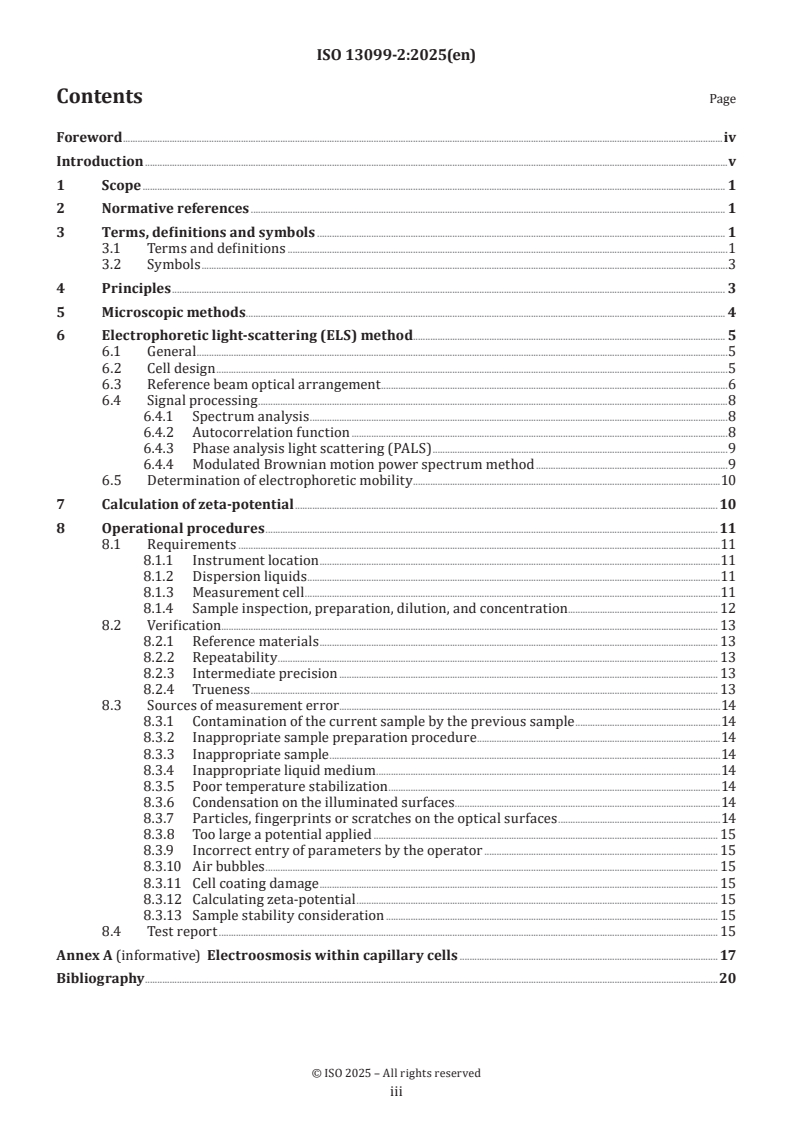
Contents Page
Foreword .iv
Introduction .v
1 Scope . 1
2 Normative references . 1
3 Terms, definitions and symbols . 1
3.1 Terms and definitions .1
3.2 Symbols .3
4 Principles . 3
5 Microscopic methods. 4
6 Electrophoretic light-scattering (ELS) method . 5
6.1 General .5
6.2 Cell design .5
6.3 Reference beam optical arrangement .6
6.4 Signal processing .8
6.4.1 Spectrum analysis .8
6.4.2 Autocorrelation function .8
6.4.3 Phase analysis light scattering (PALS) .9
6.4.4 Modulated Brownian motion power spectrum method .9
6.5 Determination of electrophoretic mobility .10
7 Calculation of zeta-potential . 10
8 Operational procedures .11
8.1 Requirements .11
8.1.1 Instrument location .11
8.1.2 Dispersion liquids .11
8.1.3 Measurement cell .11
8.1.4 Sample inspection, preparation, dilution, and concentration . 12
8.2 Verification . . 13
8.2.1 Reference materials . 13
8.2.2 Repeatability . 13
8.2.3 Intermediate precision . 13
8.2.4 Trueness . 13
8.3 Sources of measurement error . .14
8.3.1 Contamination of the current sample by the previous sample .14
8.3.2 Inappropriate sample preparation procedure .14
8.3.3 Inappropriate sample .14
8.3.4 Inappropriate liquid medium .14
8.3.5 Poor temperature stabilization .14
8.3.6 Condensation on the illuminated surfaces .14
8.3.7 Particles, fingerprints or scratches on the optical surfaces .14
8.3.8 Too large a potential applied . 15
8.3.9 Incorrect entry of parameters by the operator . 15
8.3.10 Air bubbles . 15
8.3.11 Cell coating damage . 15
8.3.12 Calculating zeta-potential . 15
8.3.13 Sample stability consideration . 15
8.4 Test report . 15
Annex A (informative) Electroosmosis within capillary cells . 17
Bibliography .20
iii
Foreword
ISO (the International Organization for Standardization) is a worldwide federation of national standards
bodies (ISO member bodies). The work of preparing International Standards is normally carried out through
ISO technical committees. Each member body interested in a subject for which a technical committee
has been established has the right to be represented on that committee. International organizations,
governmental and non-governmental, in liaison with ISO, also take part in the work. ISO collaborates closely
with the International Electrotechnical Commission (IEC) on all matters of electrotechnical standardization.
The procedures used to develop this document and those intended for its further maintenance are described
in the ISO/IEC Directives, Part 1. In particular, the different approval criteria needed for the different types
of ISO document should be noted. This document was drafted in accordance with the editorial rules of the
ISO/IEC Directives, Part 2 (see www.iso.org/directives).
ISO draws attention to the possibility that the implementation of this document may involve the use of (a)
patent(s). ISO takes no position concerning the evidence, validity or applicability of any claimed patent
rights in respect thereof. As of the date of publication of this document, ISO had notreceived notice of (a)
patent(s) which may be required to implement this document. However, implementers are cautioned that
this may not represent the latest information, which may be obtained from the patent database available at
www.iso.org/patents. ISO shall not be held responsible for identifying any or all such patent rights.
Any trade name used in this document is information given for the convenience of users and does not
constitute an endorsement.
For an explanation of the voluntary nature of standards, the meaning of ISO specific terms and expressions
related to conformity assessment, as well as information about ISO's adherence to the World Trade
Organization (WTO) principles in the Technical Barriers to Trade (TBT), see www.iso.org/iso/foreword.html.
This document was prepared by Technical Committee ISO/TC 24, Particle characterization including sieving,
Subcommittee SC 4, Particle characterization.
This second edition cancels and replaces the first edition (ISO 13099-2:2012), which has been technically
revised.
The main changes are as follows:
— addition of new terms and definitions;
— revision of Figure 3, illustrating instrument configuration;
— removal of section on cross-beam optics;
— revision of the description of phase analysis light scattering (PALS);
— addition of information on cell constant.
A list of all parts in the ISO 13099 series can be found on the ISO website.
Any feedback or questions on this document should be directed to the user’s national standards body. A
complete listing of these bodies can be found at www.iso.org/members.html.
iv
Introduction
Zeta-potential is a parameter that can be used to predict the long-term stability of suspensions and emulsions
and to study surface morphology and adsorption on particles and other surfaces in contact with a liquid.
Zeta-potential is not a directly measurable parameter. It can be determined using appropriate theoretical
models from experimentally determined parameters, such as electrophoretic mobility.
Optical methods, especially electrophoretic light scattering, have been widely used to determine
electrophoretic mobility of particles or macromolecules in suspension or in solution. The purpose of this
document is to provide methods for measuring electrophoretic mobility using optical means and for
calculating zeta-potential.
v
International Standard ISO 13099-2:2025(en)
Colloidal systems — Methods for zeta-potential
determination —
Part 2:
Optical methods
IMPORTANT — This document is to be read in conjunction with ISO 13099-1, which gives a
comprehensive overview of the theory.
1 Scope
This document specifies two methods of measurement of the electrophoretic mobility of particles suspended
in a liquid: video microscopy and electrophoretic light-scattering.
NOTE Estimation of surface charge and determination of zeta-potential can be achieved from measured
electrophoretic mobility using proper theoretical models, which are described in detail in ISO 13099-1.
2 Normative references
There are no normative references for this document,
3 Terms, definitions and symbols
3.1 Terms and definitions
For the purposes of this document, the following terms and definitions apply.
ISO and IEC maintain terminology databases for use in standardization at the following addresses:
— ISO Online browsing platform: available at https:// www .iso .org/ obp
— IEC Electropedia: available at https:// www .electropedia .org/
3.1.1
Brownian motion
random movement of particles suspended in a liquid caused by thermal movement of medium molecules
3.1.2
cell constant
proportional constant between the applied electric field, either in a constant voltage or a constant current,
and the electric field strength in the measurement zone of the sample cell, which is unique for each cell and
can be obtained by measuring a medium with known conductivity
3.1.3
Doppler shift
change in frequency and wavelength of a wave for an observer moving relative to the source of the wave
3.1.4
zeta-potential
electrokinetic potential
ζ-potential
ζ
difference in electric potential between that at the slipping plane and that of the bulk liquid
Note 1 to entry: Zeta-potential is expressed in volts.
3.1.5
electroosmosis
motion of liquid through or past a charged surface in response to an applied electric field, which is the result
of the force exerted by the applied field on the counter-charge ions in the liquid
Note 1 to entry: A charged surface can include an immobilized set of particles, a porous plug, a capillary or a membrane.
3.1.6
electroosmotic velocity
υ
eo
uniform velocity of the liquid far from the charged interface
Note 1 to entry: Electroosmotic velocity is expressed in metres per second.
3.1.7
electrophoretic mobility
μ
electrophoretic velocity per electric field strength
Note 1 to entry: Electrophoretic mobility is positive if the particles move toward lower potential (negative electrode)
and negative in the opposite case.
Note 2 to entry: Electrophoretic mobility is expressed in metres squared per volt second.
3.1.8
electrophoretic velocity
υ
e
particle velocity during electrophoresis
Note 1 to entry: Electrophoretic velocity is expressed in metres per second.
3.1.9
intermediate precision
measurement precision under set of intermediate precision conditions of measurement
[SOURCE: ISO/IEC Guide 99:2007, 2.23]
3.1.10
slipping plane
shear plane
abstract plane in the vicinity of the interface between liquid and solid where liquid starts to slide relative to
the surface under influence of a shear stress
3.1.11
trueness
closeness of agreement between the average of an infinite number of replicate measured quantity values
and a reference quantity value
[SOURCE: ISO/IEC Guide 99:2007, 3.17]
3.2 Symbols
a particle radius
D diffusion coefficient
E electric field strength
k Boltzmann constant
B
I light intensity
N Avogadro’s number
A
n medium refractive index
R capillary radius
cap
S(ω) frequency power spectrum of scattering
Γ characteristic Lorentzian half peak width
ε medium permittivity
ζ zeta-potential (electrokinetic potential)
η medium viscosity
θ angle between incident light and scattered light
κ reciprocal Debye length
λ wavelength
μ electrophoretic mobility
μ electroosmotic mobility of liquid
eo
ν frequency
ξ angle between scattered light and electric field direction
τ delay time in autocorrelation function
φ volume fraction
ω rotational frequency (= 2πν)
4 Principles
A suspension of particles having a given electrokinetic charge is placed in a cell which has a pair of electrodes
placed some distance apart (see Figure 1). This cell can be in the form of either a cylindrical or rectangular
capillary with electrodes at either end, or a pair of electrodes at a known fixed distance apart that are
dipped into a cuvette or other vessel. A potential is applied between the electrodes. Due to the process of
electrophoresis, particles carrying a net negative charge are drawn towards the electrode of opposite sign
and vice versa. In addition, if the capillary walls are charged, then an effect called electroosmosis causes the
liquid to stream along the capillary walls. The direction and velocity of this flow depends on the sign and
magnitude of the wall charge. The resulting velocity of the particle in the frame of references associated
with the cell is superposition of the electrophoretic velocity and the velocity of electroosmotic flow. The
time taken for the particle to reach the terminal electrophoretic velocity after the application of the electric
field is much shorter than the period of time needed to fully establish the electroosmosis flow throughout
the whole cell. This difference is exploited in some implementations. The velocity of the particles measured
at a specific position can be determined using either video microscope or electrophoretic light scattering
through a laser Doppler arrangement. Both the velocity and the direction of the moving particles in the frame
of references associated with the cell are determined. Provided that the distance between the electrodes is
known together with the applied electric potential, then the electrophoretic mobility can be established,
from which a zeta-potential can be calculated using established theories. Alternatively, calibration with
particles having a known zeta-potential can be used to eliminate the need to determine the unknown cell
constant of a particular cell.
There are two distinctively different approaches to monitor particle motion in the electric field. Historically,
the first deals with particle images observed through a microscope. It is referred to as the "microscopic
method", or alternatively as "microelectrophoresis". The second relies on measuring light scattered by
particles and extracting information on electrophoretic mobility from the Doppler frequency shift of the
scattered light. This method is called the "electrophoretic light scattering method". For optical techniques, a
cell constant for many types of cells must to be determined, through either calculation or measurement of a
solution of known conductivity.
Key
1 measurement zone
2 distance between electrodes
Figure 1 — Schematic diagram of electrophoresis measurement
5 Microscopic methods
The main principle of electrophoresis can be traced back over two centuries (see Reference [1]). In
microelectrophoresis, a light source illuminates particles migrating under the influence of a d.c. or a.c.
electric field. The illuminated particles can be observed due to scattering. This illumination can be arranged
either as a bright field or as a dark field or both (see Reference [2]). The contrast afforded by the bright
field illumination is inadequate to illuminate particles with sizes smaller than about 0,2 µm. Dark field
illumination is suitable for capturing images of moving nano-particles with sizes down to nanometre scale.
There are several approaches to the treatment of microscopic images of the moving particles. Depending on
the degree of operator involvement, it can be classified as manual, semi-automatic and automatic. Manual
methods track the movement of one or several individual particles by eye and a stopwatch and therefore are
typically time consuming, tedious to employ and inaccurate.
In the semi-automatic methods, particles are tracked through a microscope manually while the apparatus
either scans the illuminating light or moves a prism reflecting the illuminated image of particles. When the
light-scanning velocity or prism-moving velocity is semi-automatically adjusted so that the particle image as
viewed in the microscope is static, such a velocity is the electrophoretic velocity of particles (see References
[3] and [4]). These methods are only applicable to samples having a homogeneous electrophoretic mobility.
There are designs combining the manual microscopic observation with automatic electrophoretic light-
scattering signal analysis to measure samples of polydisperse electrophoretic mobility (see References [5]
and [6]).
The appearance of modern charge-coupled devices (CCD) and computers has made it possible to capture
images, transfer the images sequentially to a computer, and then using sophisticated image analysis to
reconstruct trajectories of particles moving under the influence of an electric field from the time-stamped
video frames. Only particles confined to video visibility can be measured. In order to record accurate
moving distances, from the time duration between frames and the distance each particle moved, the
velocity of each particle is calculated and combined with the applied field strength, and its electrophoretic
mobility is obtained. Dark field illumination extends this method to nano-particles. This method allows
application of electric field for very short periods of time, which resolves the problems of thermal convection
and electrochemical contamination. Concentration of particles shall be very low in order to track individual
particles.
A 90° laser scattering device is a typical optical arrangement of modern instruments. The laser serves as the
illumination of the microscope focal plane. Both laser beam and microscope axis are perpendicular to the
electric field. In Figure 2, the field direction is perpendicular to the plane of the drawing. Laser illumination
and microscope require alignment with the stationary layer to avoid electroosmosis, which is explained in
Annex A. This position shall be precisely located in order to accurately measure the electrophoretic motion
of particles. This method is also utilized in the particle tracking device which is primarily used for measuring
particle size and distribution based on tracking particles under Brownian motion from their scattering.
Under an applied electric field, the particle tracking device can perform similar measurement as that in
Figure 2 and track electrophoretic motion to obtain electrophoretic mobility of particles (see Reference [7]).
Key
1 laser
2 cell channel cross-section
3 microscopic objective
4 video camera
Figure 2 — A typical electrophoresis video microscope
6 Electrophoretic light-scattering (ELS) method
6.1 General
Electrophoretic light scattering (ELS) is an ensemble method for measuring electrophoretic mobility via
the Doppler shifts in scattered light. In an ELS experiment, coherent incident light illuminates dispersed
particles in a liquid that are subjected to an applied electric field. Charged particles move towards either
the anode or the cathode, depending on the sign of their net charge. Because of the motion, the frequency of
scattered light from particles is shifted due to the Doppler effect. From the frequency shift distribution, the
particle electrophoretic mobility distribution can be determined. ELS provides rapid, accurate, automatic,
and highly reproducible electrophoretograms of complex particulate samples suspended in either aqueous
or non-aqueous media without the need to use standard particles for calibration (see Reference [8]).
6.2 Cell design
Many designs of measurement cell have been employed. All cells have at least three functions:
— holding the sample containing the particles to be measured;
— supplying an electric field to the sample;
— providing an entrance and an exit for the incident light and scattered light, respectively.
Some cells are designed with liquid flow capability so that automatic titration can be performed with an
additional device. In some implementations, special cell designs have been implemented to facilitate
measurements of electrophoretic mobility at moderate concentrations, for example:
— utilizing a transparent electrode and multiple refraction for both incident and scattered light (see
Reference [9]); or
— using a shorter optical path length (see Reference [10]).
The electric field at the place of measurement shall be stable, homogenous, and parallel. To achieve that,
either the two electrodes must be placed very close to each other, in the case of cuvette cells, or the field
path must be confined, in the case of capillary cells. The voltage applied to the electrodes induces a current
in the liquid if ions are present. This current can be sufficiently high to cause Joule heating of the liquid and
lead to electrolysis at the electrodes. Therefore, choosing an appropriate type of cell and electrode material,
sufficiently prompt temperature control, and properly applied field duration and field strength are all
important factors to ensure correct and reproducible results.
To reduce polarization on the electrodes and maintain homogenous distribution of particles in the sample,
the applied field direction is regularly reversed with an intervening off-time to minimize heating effects. In
capillary cells, because of electroosmosis of liquid caused by charges on the walls, particles do not move in
a static liquid. The liquid moves in a parabolic form across the closed capillary. Historically, measurements
are therefore taken at the so-called stationary layer where there is no liquid movement or multiple
measurements are taken across the capillary to separate the liquid movement from the electrophoretic
motion of the particles. Since it takes a much longer time for liquid to reach the terminal velocity than that of
particles after the electric field is applied, if the electric field polarity changes rapidly, the liquid is static and
[11]
electroosmosis does not occur. The measurement can then be performed at any location in the cell. Some
implementations offer disposable cells.
6.3 Reference beam optical arrangement
A typical example for an electrophoretic light-scattering arrangement is shown in Figure 3. In Figure 3,
the reference beam can go outside the sample cell (2a-4a, dotted line) or go through the sample cell (2b-
4b, dashed line), and then merge with the scattered light at the surface of the detector. Instruments can
use either fibre optics or bulk optics in delivering the main beam and the reference beam or detecting the
scattered light. For simplicity, the refraction of light when entering and exiting the sample cell are not
depicted in Figure 3.
Key
1 laser
2 beam splitter
3 optical modulator
4 reference beam
5 main beam
6 lens
7 sample cell with electrodes
8 mirror
9 beam stop
10 semi-reflection mirror
11 photoelectric detector
12 device control and data processor
Figure 3 — Example configuration of the reference beam optics
A small angle scattering optical arrangement incorporating heterodyne detection is often employed. The
scattering angle, typically between 15° and 30°, exploits the advantage that the spectral broadening due to
Brownian motion is reduced. With non-spherical particles, rotational diffusion can increase the spectral
broadening. Means are provided in the measurement cell for the introduction of a pre-dispersed sample. The
cell may be temperature controlled; if it is not, the temperature shall be accurately known since viscosity,
permittivity, and refractive index of the liquid are all temperature dependent. A voltage is applied between
the electrodes of the cell, whose spacing is defined, to set up a potential gradient. In some implementations,
extra monitoring electrodes are employed at a defined spacing to provide a direct measure of the potential
gradient. Light from a coherent laser source of known wavelength is split into two beams, one called the
main beam and the other the reference beam. The main beam enters the cell directly or is refracted through
a cell window to illuminate particles in the sample. The reference beam, which possibly does or does not go
through the cell, as shown in Figure 3 in two routes, merges with the scattered light through conventional or
fibre optics at the surface of the photoelectric detector, which is either a photomultiplier tube or an avalanche
photodiode. One or both of the laser beams pass through a form of optical modulator to shift its frequency
by a few hundred hertz from the original laser frequency so that the two beams acquire a desired frequency
difference. This moves the origin of the Doppler shift caused by the velocity of the particles away from zero
and enables the particle moving direction to be recognized and low frequency environment interference to
be minimized. The detector aperture can be variable so as to control coherent detection and the scattering
volume. The detected signal is passed to a signal processing unit that can be a digital correlator, a spectrum
analyser or a phase analysis system. The voltage applied to the measuring cell can be reversed or pulsed and
reversed as determined by the processor which also synchronizes the data collection. The final control is
often by a desktop computer which calculates the zeta-potential.
6.4 Signal processing
6.4.1 Spectrum analysis
Consider a particle sample that is polydisperse both with respect to size and electrophoretic mobility. The
particles are undergoing Brownian motion together with electrophoretic motion under the influence of a
d.c. field of defined strength.
The spectrum, also called an electrophoretogram, for the reference beam optical arrangement can be
written as shown in Formula (1) (see Reference [8]):
d ΔΔν
max s,max
I Γ
s,ij i
SI()ωδ=22π ()ω + I (1)
LL ∑ ∑
id= j=Δν ωω +2πΔν +Γ
()
min s,min Ms,ij i
where
I is the reference beam intensity;
L
I is the scattered intensity from particles of ith size and jth mobility;
s,ij
Γ is the characteristic Lorentzian half peak width at half height from particles of the ith size,
i
which for spherical particles is related to particle diameter;
˥ is the angular frequency of light;
ω is the modulator frequency;
M
Δν is the frequency shift caused by the electrophoretic motion of particles with ith size and
s,ij
jth mobility.
The symbol in the denominator denotes that there are two peaks in the spectrum. One is located in the
negative frequency region that cannot be observed and the other in the visible positive frequency region. By
choosing a large modulator frequency, ω , so that the sum (ω + 2πΔν ) is always positive, a negative sign
M M s,ij
can be used instead.
According to Formula (1), the electrophoretic spectrum of any particulate sample has an intrinsic
broadening caused by Brownian motion of the particles in addition to any spectrum of electrophoretic
mobility velocities. The broadening due to Brownian motion becomes more pronounced as the particle size
reduces or when the scattering angle increases. One strategy of measuring the degree of broadening of the
frequency spectrum as a result of the Brownian motion is to conduct a measurement with the applied field
switched off. By subtraction of the Brownian motion only spectrum from the total spectrum, a distribution
of electrophoretic mobility can in certain circumstances be established (see Reference [12]).
6.4.2 Autocorrelation function
The autocorrelation function is a Fourier transform of the frequency power spectrum. Formula (2) shows
the intensity-intensity autocorrelation function in the reference beam optics as a function of delay time, τ:
d Δν
max s,max
()22
GI()ττ=+22II expc()−Γ os ων+ πΔ τ (2)
()
LL ∑ ∑ s,ij iiMs, j
id= j=Δν
min s,minn
Figure 4 shows a typical autocorrelation function together with an electrophoretic velocity spectrum. In
the autocorrelation function, the cosine wave is due to oriented electrophoretic motion and the decay is
due to random Brownian motion. In the spectrum, the peak location is related to optical modulator and
electrophoretic motion of the particles, and the peak shape is caused by Brownian motion of the particles,
the mobility velocity spectrum and any finite laser beam width restrictions.
Key
1 autocorrelation function G (τ) (τ = delay time)
2 spectrum S(ω) (ω = angular frequency)
Figure 4 — Typical autocorrelation function and spectrum from electrophoretic light scattering
6.4.3 Phase analysis light scattering (PALS)
The electrophoretic mobility of some particles in a non-polar solvent is very small, resulting in very small
differences between the modulator frequency and the Doppler frequency shifts from electrophoretic
motion. Such frequency differences can be less than 1 Hz. For particles suspended in a solution of high ion
concentration, due to Joule heating, only a very small field can be applied between the electrodes. Therefore,
again, Doppler frequency shifts from electrophoretic motion will be very small.
In these instances, intensity or spectrum analysis often cannot resolve small frequency shift of the
scattered light and phase analysis light scattering (PALS) becomes a better choice (see Reference [13]).
PALS obtains particle’s mobility from the rate of phase change. The rate of phase change is calculated by
comparing the interference signal between light scattered by the sample and the modulated reference beam
and a mathematically generated sine wave predetermined by the modulator frequency. PALS can resolve
frequency shifts as small as 0.002 Hz and provide mean electrophoretic mobility values immune to thermal
convection. PALS can only provide a mean electrophoretic mobility value.
In some implementations, a combination of PALS and spectrum analysis coupled with both fast and
slow applied voltage reversals is employed to both prevent cell electrode polarization and separate the
effects of electrophoresis and electroosmosis. By these means, both the mean value and the spectrum of
electrophoresis values are obtained (see Reference [14]).
6.4.4 Modulated Brownian motion power spectrum method
This method utilizes a frequency spectrum analysis of the scattered light from particles in suspension under
an alternating electric field to measure the average amplitude of particle electrophoretic mobility, while the
sign of mobility is determined by a separate d.c. measurement. A single point calibration with a traceable
mobility standard is needed.
6.5 Determination of electrophoretic mobility
The relation between the Doppler frequency shift of scattered light and particle electrophoretic mobility,
μ, depends on the optical arrangement of the instrumentation. Formula (3) applies for the reference beam
optics (see Reference [8]).
Δωλ
μ = (3)
42πnEsinsθθin 2 +ξ
() []()
where
Δω is the Doppler frequency shift;
λ is the laser wavelength in vacuum;
o
n is the refractive index of the medium;
E is the electric field strength;
θ is the angle between the incident light and the scattered light;
ξ is the angle between the scattered light and the orientation of the electric field.
7 Calculation of zeta-potential
For a detailed description of various theories applied for calculating zeta-potential, refer to ISO 13099-1.
For non-conducting spheres, Formula (5), an extension of the Henry equation between zeta-potential, ζ, and
electrophoretic mobility, μ, is widely used (see Reference [15]):
2ζε
μ = fa()κ (4)
3η
where
η is the viscosity of the medium;
κ is the reciprocal of Debye length;
ε is the dielectric permittivity of the medium;
a is the sphere radius;
f(κa) is a monotonic function varying from f(κa) = 1 to f(κa) = 3/2.
κa→0 κa→∞
Formula (4) assumes that:
a) the total electric field that a particle experiences is a superposition of the applied field and the field due
to the charge on the particle;
b) the distortion of the field induced by particle movement (i.e. the relaxation effect) can be ignored;
c) the inertial terms in the hydrodynamic equation are negligible;
d) the surface potential is much smaller than k T/e.
B
There are many refined or more rigorous models between ζ and μ without having to impose restrictions a)
to d). However, the calculation using these procedures requires tedious computation and prior knowledge of
some other parameters related to the sample, whose values are often unknown or difficult to obtain.
Relationships between electrophoretic mobility and zeta-potential for other types of particles in dilute
suspensions can be found in the literature and their applications in practice are fairly limited. Since most
samples are polydisperse in size and thus have different κa values, it is impractical to apply complex and
different conversions for each component in the distribution in order to obtain the complete zeta-potential
distribution.
When κa >> 1, typical for large particles in aqueous suspension, f(κa) takes the value of 3/2 in Formula (4),
leading to the Smoluchowski equation.
When κa << 1, typical for small particles in organic liquids, f(κa) takes the value of 1 in Formula (4). The
equation is then called the Hückel equation.
For a comprehensive overview of these theories, refer to ISO 13099-1.
8 Operational procedures
8.1 Requirements
8.1.1 Instrument location
The instrument should be located in a clean environment that is free from excessive electrical noise,
mechanical vibration and temperature fluctuations, and sheltered from direct sunlight and airflows.
NOTE Local health and safety requirements can apply regarding the operating area.
The instrument should contain a rigid internal optical bench with a vibration damp setup and be installed
on a rigid table or bench to avoid the necessity of realignment of the optical system at frequent intervals.
WARNING — The radiation within instruments equipped with a laser can cause permanent eye
damage. Never look into the direct path of the laser beam or its reflections. Avoid blocking the laser
beam with reflecting surfaces. Refer to relevant local laser radiation safety regulations.
8.1.2 Dispersion liquids
Ensure that the sample cell is compatible with the medium used. The electrophoretic mobility of the
particles is wholly dependent upon the chemical characteristics of the suspending liquid. Both the pH and
specific ion concentration of the dispersing liquid are vital characteristics to be controlled if concentrated
suspensions are to be diluted for measurement. The conditions the particles are currently experiencing
within a concentrated suspension shall be entirely matched by the diluents.
8.1.3 Measurement cell
Depending upon the apparatus available, there can be a choice of cell designs. Some cells are disposable.
To avoid the possibility of contamination, carefully rinse any cell previously used for tests. A measurement
conducted on a solution at low ion concentration can possibly be distorted if the previous measurement was
conducted at high ion concentration. It is challenging to adequately flush out all of the residual ions from the
earlier test. The condition of the electrode surface can become compromised by previous measurements,
leading to errors in the assessment of the potential gradient. If the cell walls remain contaminated, then it is
possible that the electroosmotic flow in a capillary cell is not as expected.
Careful temperature control of the cell is important, as the liquid viscosity is a function of temperature, e.g.
in the case of aqueous samples, the viscosity changes by about 2 %/°C. The terminal velocity the particles
obtain depends upon the liquid viscosity.
There are two operation modes in supplying the electric field, constant voltage mode and constant current
mode. At low sample conductivity, e.g. in non-polar media or media with very low ionic strength, the constant
voltage mode is employed and the field strength is the applied voltage divided by the distance between the
electrodes. In most aqueous dispersions, because of electrode polarization and Joule heating, the constant
current mode is a better choice to achieve stable and constant field strength. In the constant current mode,
the field strength is the product of the conductivity of the sample, the measured current and a cell geometry
factor. A cell constant, which is the proportionality between the current and the field strength, is needed.
The cell constant is obtained by measuring a medium with known conductivity.
The potential applied between the electrodes may be a d.c. voltage applied for a finite time before being
reversed in polarity. When highly conducting fluids are required, the d.c. voltage may only be applied for
a short period of the time before reversal. This method is employed to suppress Joule heating effects. This
method of operation can result in pulses that are so short that side-peak artefacts appear in the spectrum.
PALS processing is sometimes required under these conditions (see Reference [13]).
8.
...