

ISO/TS 5973:2024
(Main)Laser diffraction measurements — Good practice
General Information
- Abstract
This document gives guidance on the determination criteria for when laser diffraction is the most appropriate method for the analysis of samples, the appropriate preparation of samples, the verification of the correct functioning of instruments, the interpretation of data, and the assessment of data quality. This document focuses on the practical steps needed to obtain results of good quality, rather than on theoretical considerations, and covers not only the measurement of solid particles (in wet and dry measurement configurations), but also emulsions and bubbles. Result variation expectations of real samples are also considered in this document.
- Status
- Published
- Publication Date
- 24-Jul-2024
- Technical Committee
- ISO/TC 24/SC 4 - Particle characterization
- Drafting Committee
- ISO/TC 24/SC 4 - Particle characterization
- Current Stage
- 6060 - International Standard published
- Start Date
- 25-Jul-2024
- Due Date
- 05-Sep-2025
- Completion Date
- 25-Jul-2024


Overview
ISO/TS 5973:2024 - "Laser diffraction measurements - Good practice" is a technical specification from ISO that provides practical guidance for performing laser diffraction particle size analysis. Unlike theoretical standards, this document focuses on the day‑to‑day steps needed to obtain reliable particle size distributions (PSDs) and good quality data. It covers wet and dry measurement configurations and explicitly includes solids, emulsions and bubbles, plus real‑sample variation expectations.
Key topics and requirements
- Method applicability: Guidance on determining when laser diffraction is the most appropriate technique for a given sample or measurement objective.
- Sample information & preparation: Recommended information to collect before analysis and best practices for sampling powders, suspensions, emulsions, sprays, aerosols and bubbles to reduce bias and improve representativeness.
- Instrument verification and qualification: Practical checks to confirm correct instrument functioning and to support installation, operational and performance qualification (IQ/OQ/PQ).
- Data interpretation and quality assessment: How to interpret scattering patterns, assess background stability, detect multiple scattering, and evaluate non‑smooth scattering signatures that indicate measurement issues.
- Precision and reproducibility: Procedures and definitions for repeatability, intermediate precision and reproducibility, including which measurands to monitor and when tighter or wider control limits are appropriate.
- Optical properties guidance: Considerations for coloured, porous or mixed samples and appropriate use of refractive index (Mie vs Fraunhofer considerations).
- Troubleshooting trends: Practical explanations of common trends such as dispersion, dissolution, agglomeration and random variation in repeated measurements.
- Orthogonal techniques: Recommendations to combine laser diffraction with image analysis or dynamic light scattering to validate results and resolve ambiguities.
- Validation and method transfer: Advice on method validation, qualification and inter‑laboratory transfer to ensure consistent PSD results.
Applications
ISO/TS 5973:2024 is intended for laboratories and industries that routinely characterize particle size, including:
- Pharmaceuticals (powders, suspensions, emulsions)
- Chemical and materials R&D
- Food and cosmetics quality control
- Paints, coatings and aerosols
- Environmental and aerosol monitoring
It helps ensure robust particle size distribution (PSD) measurements using laser diffraction, improving comparability and traceability of results.
Who should use this standard
- Laboratory analysts and method developers
- Quality control and R&D teams
- Instrument manufacturers and service providers
- Regulatory and accreditation bodies
Related standards
- ISO 13320 (principles and instrument evaluation for laser diffraction) - ISO/TS 5973:2024 is intended to be used in conjunction with ISO 13320 for a complete approach to laser diffraction measurement practice.
Get Certified
Connect with accredited certification bodies for this standard

IMP NDT d.o.o.
Non-destructive testing services. Radiography, ultrasonic, magnetic particle, penetrant, visual inspection.
Inštitut za kovinske materiale in tehnologije
Institute of Metals and Technology. Materials testing, metallurgical analysis, NDT.
Q Techna d.o.o.
NDT and quality assurance specialist. 30+ years experience. NDT personnel certification per ISO 9712, nuclear and thermal power plant inspections, QA/
Sponsored listings
Frequently Asked Questions
ISO/TS 5973:2024 is a technical specification published by the International Organization for Standardization (ISO). Its full title is "Laser diffraction measurements — Good practice". This standard covers: This document gives guidance on the determination criteria for when laser diffraction is the most appropriate method for the analysis of samples, the appropriate preparation of samples, the verification of the correct functioning of instruments, the interpretation of data, and the assessment of data quality. This document focuses on the practical steps needed to obtain results of good quality, rather than on theoretical considerations, and covers not only the measurement of solid particles (in wet and dry measurement configurations), but also emulsions and bubbles. Result variation expectations of real samples are also considered in this document.
This document gives guidance on the determination criteria for when laser diffraction is the most appropriate method for the analysis of samples, the appropriate preparation of samples, the verification of the correct functioning of instruments, the interpretation of data, and the assessment of data quality. This document focuses on the practical steps needed to obtain results of good quality, rather than on theoretical considerations, and covers not only the measurement of solid particles (in wet and dry measurement configurations), but also emulsions and bubbles. Result variation expectations of real samples are also considered in this document.
ISO/TS 5973:2024 is classified under the following ICS (International Classification for Standards) categories: 19.120 - Particle size analysis. Sieving. The ICS classification helps identify the subject area and facilitates finding related standards.
ISO/TS 5973:2024 is available in PDF format for immediate download after purchase. The document can be added to your cart and obtained through the secure checkout process. Digital delivery ensures instant access to the complete standard document.
Standards Content (Sample)
Technical
Specification
ISO/TS 5973
First edition
Laser diffraction measurements —
2024-07
Good practice
Mesures par diffraction laser — Bonnes pratiques
Reference number
© ISO 2024
All rights reserved. Unless otherwise specified, or required in the context of its implementation, no part of this publication may
be reproduced or utilized otherwise in any form or by any means, electronic or mechanical, including photocopying, or posting on
the internet or an intranet, without prior written permission. Permission can be requested from either ISO at the address below
or ISO’s member body in the country of the requester.
ISO copyright office
CP 401 • Ch. de Blandonnet 8
CH-1214 Vernier, Geneva
Phone: +41 22 749 01 11
Email: copyright@iso.org
Website: www.iso.org
Published in Switzerland
ii
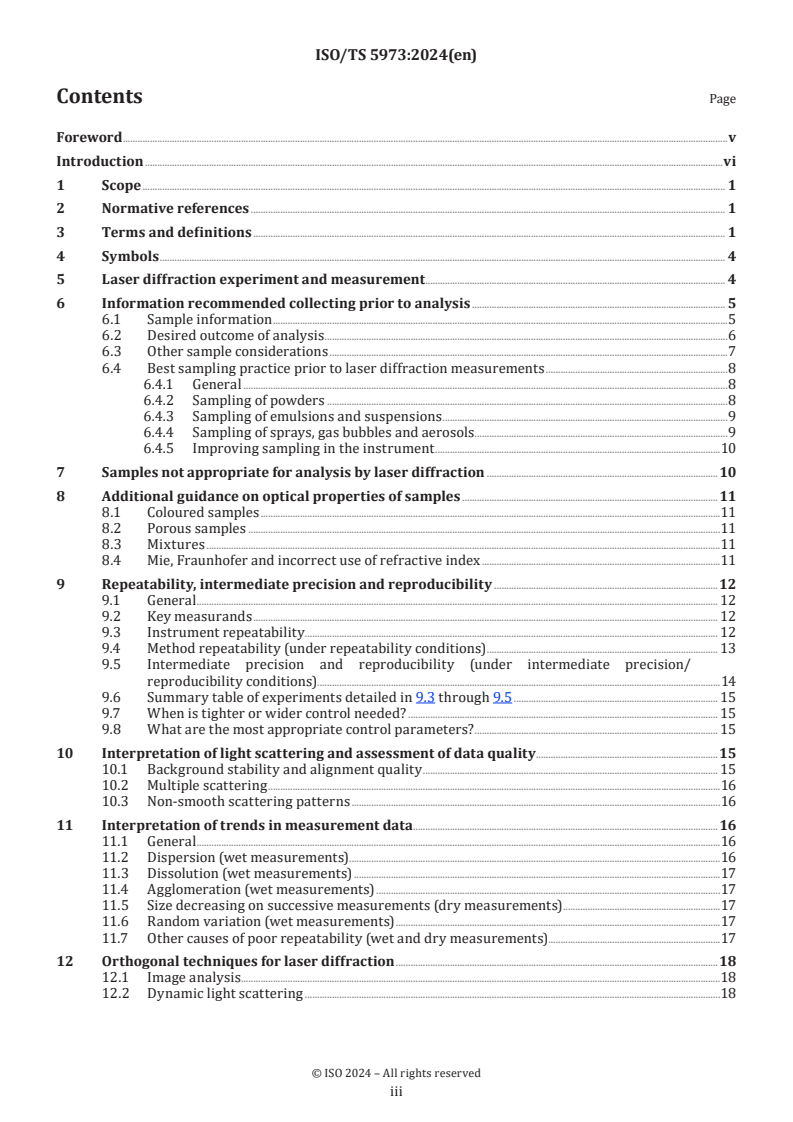
Contents Page
Foreword .v
Introduction .vi
1 Scope . 1
2 Normative references . 1
3 Terms and definitions . 1
4 Symbols . 4
5 Laser diffraction experiment and measurement . 4
6 Information recommended collecting prior to analysis . 5
6.1 Sample information .5
6.2 Desired outcome of analysis . .6
6.3 Other sample considerations .7
6.4 Best sampling practice prior to laser diffraction measurements .8
6.4.1 General .8
6.4.2 Sampling of powders .8
6.4.3 Sampling of emulsions and suspensions .9
6.4.4 Sampling of sprays, gas bubbles and aerosols .9
6.4.5 Improving sampling in the instrument .10
7 Samples not appropriate for analysis by laser diffraction .10
8 Additional guidance on optical properties of samples .11
8.1 Coloured samples .11
8.2 Porous samples .11
8.3 Mixtures .11
8.4 Mie, Fraunhofer and incorrect use of refractive index .11
9 Repeatability, intermediate precision and reproducibility .12
9.1 General . 12
9.2 Key measurands . 12
9.3 Instrument repeatability . 12
9.4 Method repeatability (under repeatability conditions) . 13
9.5 Intermediate precision and reproducibility (under intermediate precision/
reproducibility conditions).14
9.6 Summary table of experiments detailed in 9.3 through 9.5 . 15
9.7 When is tighter or wider control needed? . 15
9.8 What are the most appropriate control parameters? . 15
10 Interpretation of light scattering and assessment of data quality .15
10.1 Background stability and alignment quality . 15
10.2 Multiple scattering .16
10.3 Non-smooth scattering patterns .16
11 Interpretation of trends in measurement data .16
11.1 General .16
11.2 Dispersion (wet measurements) .16
11.3 Dissolution (wet measurements) .17
11.4 Agglomeration (wet measurements) .17
11.5 Size decreasing on successive measurements (dry measurements) .17
11.6 Random variation (wet measurements) .17
11.7 Other causes of poor repeatability (wet and dry measurements).17
12 Orthogonal techniques for laser diffraction .18
12.1 Image analysis.18
12.2 Dynamic light scattering .18
iii
13 Validation, installation qualification, operational qualification and performance
qualification . 19
Annex A (informative) Characterization data approach to laser diffraction measurements .20
Bibliography .23
iv
Foreword
ISO (the International Organization for Standardization) is a worldwide federation of national standards
bodies (ISO member bodies). The work of preparing International Standards is normally carried out through
ISO technical committees. Each member body interested in a subject for which a technical committee
has been established has the right to be represented on that committee. International organizations,
governmental and non-governmental, in liaison with ISO, also take part in the work. ISO collaborates closely
with the International Electrotechnical Commission (IEC) on all matters of electrotechnical standardization.
The procedures used to develop this document and those intended for its further maintenance are described
in the ISO/IEC Directives, Part 1. In particular, the different approval criteria needed for the different types
of ISO document should be noted. This document was drafted in accordance with the editorial rules of the
ISO/IEC Directives, Part 2 (see www.iso.org/directives).
ISO draws attention to the possibility that the implementation of this document may involve the use of (a)
patent(s). ISO takes no position concerning the evidence, validity or applicability of any claimed patent
rights in respect thereof. As of the date of publication of this document, ISO had not received notice of (a)
patent(s) which may be required to implement this document. However, implementers are cautioned that
this may not represent the latest information, which may be obtained from the patent database available at
www.iso.org/patents. ISO shall not be held responsible for identifying any or all such patent rights.
Any trade name used in this document is information given for the convenience of users and does not
constitute an endorsement.
For an explanation of the voluntary nature of standards, the meaning of ISO specific terms and expressions
related to conformity assessment, as well as information about ISO's adherence to the World Trade
Organization (WTO) principles in the Technical Barriers to Trade (TBT), see www.iso.org/iso/foreword.html.
This document was prepared by Technical Committee ISO/TC 24, Particle characterization including sieving,
Subcommittee SC 4, Particle characterization.
Any feedback or questions on this document should be directed to the user’s national standards body. A
complete listing of these bodies can be found at www.iso.org/members.html.
v
Introduction
The laser diffraction technique has evolved such that it is now a dominant method for determination of
particle size distributions (PSDs). The success of the technique is because it can be applied to a wide variety
of particulate systems. The technique is fast and can be automated, and a variety of commercial instruments
are available. Nevertheless, the proper use of the instrument and the interpretation of the results require
caution. ISO 13320 has had multiple revisions to date and covers the principles of the technology and
information on evaluating the accuracy of the instrument with a view to qualification. ISO 13320 does not,
however, cover the use of the technology on samples in great detail, and therefore, this document is intended
to be used in conjunction with ISO 13320, as this document provides practical advice for the measurement of
real samples, guidance on obtaining consistent results with good quality data and data interpretation.
vi
Technical Specification ISO/TS 5973:2024(en)
Laser diffraction measurements — Good practice
1 Scope
This document gives guidance on the determination criteria for when laser diffraction is the most
appropriate method for the analysis of samples, the appropriate preparation of samples, the verification of
the correct functioning of instruments, the interpretation of data, and the assessment of data quality. This
document focuses on the practical steps needed to obtain results of good quality, rather than on theoretical
considerations, and covers not only the measurement of solid particles (in wet and dry measurement
configurations), but also emulsions and bubbles. Result variation expectations of real samples are also
considered in this document.
2 Normative references
There are no normative references in this document.
3 Terms and definitions
For the purposes of this document, the following terms and definitions apply.
ISO and IEC maintain terminology databases for use in standardization at the following addresses:
— ISO Online browsing platform: available at https:// www .iso .org/ obp
— IEC Electropedia: available at https:// www .electropedia .org/
3.1
absorption
reduction of intensity of a light beam not due to scattering (3.14)
[SOURCE: ISO 13320:2020, 3.1.1]
3.2
accuracy
closeness of agreement between a test result or measurement result and the true value
Note 1 to entry: In practice, the accepted reference value is substituted for the true value.
Note 2 to entry: The term “accuracy”, when applied to a set of test or measurement results, involves a combination of
random components and a common systematic error or bias component.
Note 3 to entry: Accuracy refers to a combination of trueness and precision (3.8).
[SOURCE: ISO 3534-2:2006, 3.3.1]
3.3
intermediate precision
precision (3.8) under intermediate precision conditions/reproducibility conditions (3.4)
Note 1 to entry: Reproducibility is an alternative term for intermediate precision used in a specific case where a
comparison of different instruments in different locations is required.
[SOURCE: ISO 3534-2:2006, 3.3.15, modified — Note 1 to entry has been added.]
3.4
intermediate precision conditions
measurement conditions where independent test results or measurement results are
obtained on different laser diffraction instruments and in different test or measurement facilities, with
different operators using the same prescribed method
Note 1 to entry: There are four elements to the operating condition: time, calibration, operator and equipment. Tests
involving varying the first three are technically intermediate precision (3.8) tests, most notably when the operator is
changed, however when the equipment location is varied then it is a reproducibility test.
Note 2 to entry: Method transfer between sites is a test of reproducibility. The conditions described above would be
termed reproducibility conditions in this case.
[SOURCE: ISO 13320:2020, 3.1.11, modified — the conditions to different equipment and measurement
facilities have been expanded.]
3.5
multiple scattering
consecutive scattering (3.14) of light by more than one particle, causing a scattering pattern (3.15) that is no
longer the sum of the patterns from all individual particles
[SOURCE: ISO 13320:2020, 3.1.12]
3.6
transmission
fraction of incident light that remains un-attenuated by the particles
Note 1 to entry: Transmission can be expressed as a percentage.
Note 2 to entry: When expressed as fractions, obscuration (3.7) plus transmission equals unity.
[SOURCE: ISO 13320:2020, 3.1.29]
3.7
obscuration
fraction of incident light that is attenuated due to extinction [scattering (3.14) and/or absorption (3.1)] by
particles
Note 1 to entry: Obscuration can be expressed as a percentage.
Note 2 to entry: When expressed as fractions, obscuration plus transmission (3.6) equals unity.
[SOURCE: ISO 8130-13:2019, 3.1, modified — words “percentage” and “during a laser diffraction
measurement” have been removed from the definition and Notes 1 and 2 to entry have added.]
3.8
precision
closeness of agreement between independent test/measurement results obtained under stipulated
conditions
Note 1 to entry: Precision depends only on the distribution of random errors and does not relate to the true value or
the specified value.
Note 2 to entry: The measure of precision is usually expressed in terms of imprecision and computed as a standard
deviation of the test results. Less precision is reflected by a larger standard deviation.
Note 3 to entry: Quantitative measures of precision depend critically on the stipulated conditions. Repeatability
conditions (3.10) and reproducibility conditions are particular sets of extreme stipulated conditions.
[SOURCE: ISO 3534-2:2006, 3.3.4, modified —"measurement results" has been removed from Note 2 to entry.]
3.9
repeatability
precision (3.8) under repeatability conditions (3.10)
Note 1 to entry: Repeatability can be expressed quantitatively in terms of the stability characteristics of the
particulates in the dispersing medium (3.17).
[SOURCE: ISO 3534-2:2006, 3.3.5, modified — "dispersion characteristics of the results" has been replaced
with "particulates in the dispersing medium" in Note 1 to entry.]
3.10
repeatability conditions
observation conditions where independent test/measurement results are obtained with the same method
on identical test/measurement items in the same test or measuring facility by the same operator using the
same equipment within short intervals of time
Note 1 to entry: Repeatability conditions include:
— the same measurement procedure or test procedure;
— the same operator;
— the same measuring or test equipment used under the same conditions;
— the same location;
— repetition over a short period of time.
[SOURCE: ISO 3534-2:2006, 3.3.6]
3.11
instrument repeatability
closeness of agreement between multiple measurement results of a given property in the same aliquot of a
sample under repeatability conditions (3.10)
Note 1 to entry: The variability includes the variability from only the instrument itself.
3.12
method repeatability
closeness of agreement between multiple measurement results of a given property in different aliquots of a
sample, executed by the same operator using the same instrument under identical conditions within a short
period of time
Note 1 to entry: Various pharmaceutical monographs dictate the measurement of six separate preparations.
Note 2 to entry: The variability includes the variabilities of the sub sampling technique, the sampled material, the
sample handling when adding the sample to the instrument and the instrument itself.
Note 3 to entry: Method repeatability is usually determined as standard deviation of a number of measurement results
[SOURCE: ISO 13320:2020, 3.1.22, modified — "the sample handling when adding the sample to the
instrument" has been added to Note 2 to entry, and Notes 1 and 3 to entry have been added.]
3.13
optical properties
refractive index and absorption parameters used in the analysis of the sample
3.14
scattering
change in propagation of light at the interface of two media having different optical properties (3.13)
[SOURCE: ISO 13320:2020, 3.1.23]
3.15
scattering pattern
angular pattern of light intensity, I(θ), or spatial pattern of light intensity, I(r), originating from scattering
(3.14), or the related readings of energy values taking into account the sensitivity and the geometry of the
detector elements
[SOURCE: ISO 13320:2020, 3.1.25, modified with addition of “readings of”]
3.16
single scattering
scattering (3.14) whereby the contribution of a single member of a particle population to the total scattering
pattern (3.15) remains independent of the other members of the population
[SOURCE: ISO 13320:2020, 3.1.26]
3.17
dispersing medium
liquid or gas used to suspend particles during measurement that reduces their concentration for
measurement
Note 1 to entry: For measurements in liquid, the term "diluent" is often used as a synonym for dispersing medium.
4 Symbols
th
x particle diameter corresponding to the 10 percentile of the cumulative volume undersize distribution
10,3
(by volume)
th
x median particle diameter corresponding to the 50 percentile of the cumulative volume undersize
50,3
distribution (by volume)
th
x particle diameter corresponding to the 90 percentile of the cumulative volume undersize distribution
90,3
(by volume)
th th th
NOTE The term D is often used instead of the x where y is the 10 , 50 or 90 percentile as defined above.
y,3 y,3
5 Laser diffraction experiment and measurement
The schematic of the laser diffraction experiment assumed throughout this document is covered in
ISO 13320:2020, Figures 1 to 4.
Prior to any measurement, the optical system is normally aligned so that most of the light passes straight
through the system where its scatter can be measured on the obscuration monitor. The dispersing medium
(gas or liquid) is added via a sample dispersion unit which is often an additional apparatus (or ‘accessory’),
separate to the optical instrument itself. The particulate sample is not yet added to the sample dispersion
unit in that stage. The system is designed so that any scattered light signals are measured by the light
detectors.
Typically, the background scattering of the dispersing medium is then measured, whether gas or liquid, in
the absence of the particulate sample to be measured. The particulate sample is then added to the sample
dispersion unit and the scattering from both the sample and dispersing medium is measured. The previously
recorded dispersing medium background scattering signal is then subtracted in software to yield only the
scattering from the particulate fraction. Both single pass dry measurements, where the dispersing medium
is a gas, typically air, and recirculating or single pass wet measurements, where the dispersing medium
is a liquid, often water, iso-propyl alcohol, hexane or paraffinic oils for example, are in common use. Many
measurements are taken and a final average light scattering pattern is then obtained. This is then converted
into a volume size distribution using a light scattering theory (normally Mie or Fraunhofer theories). For
a more comprehensive outline of the measurement process, see ISO 13320:2020, Clause 4. A risk-based
approach to the whole laser diffraction measurement process was conducted as part of the Horizon 2020
project PAT4Nano and this has been summarized in Annex A below as it contains much useful information
regarding the laser diffraction measurement process.
6 Information recommended collecting prior to analysis
6.1 Sample information
The customer or submitter of a sample for laser diffraction analysis should provide, as available, all
information relevant to the measurement of their sample. Absence of information does not preclude analysis,
but availability of information can aid the analyst with respect to sample preparation, measurement design
and interpretation of results. In general, the more information known about a sample, the more likely the
analysis will be successful and the results meaningful for the customer. This information also reduces
uncertainty for the overall measurement process.
The following questions should be answered where possible, some are specific to measurements in a diluent,
termed wet measurement and some are specific to measurement in air, termed dry measurement (in order
of relative importance):
a) What is the principal mineral or chemical composition or polymorphic form of the sample?
1) If the particle size is large (over 50 µm) and/or the particles are opaque, optical parameters
(refractive index) of the sample are not needed necessarily.
2) If the particles are small and or transparent, the optical properties of the sample are more relevant.
If the refractive index is not known exactly, an estimation of the effective refractive index can be
used instead.
3) If the crystallographic phase is known, this should be noted, as it influences the appropriate
refractive index to be used (if Mie theory is employed).
4) The composition will determine the scattering properties and the refractive index, amongst other
properties.
5) What is the density of the sample? Has a Stokes’ Law calculation been carried out to show the
settling rate for particles of different sizes? Density is needed if specific surface area estimates need
to be calculated.
b) What is the diluent / dispersing medium?
1) (wet measurements) If the sample requires dilution, the dispersing medium should be compatible
with the sample, i.e. it should not react with or dissolve particles in the sample. If needed a technique
such as HPLC can be used to check that no dissolution has occurred. The dispersing medium should
ideally be compatible with the laser light source(s) used by the instrument i.e. should be non-
absorbing at the wavelength(s) used.
2) (wet measurements) The refractive index of the medium is necessary for analysis (if Mie theory
is employed), though what the medium consists of should be noted even if Fraunhofer theory is
employed so the measurement can be recreated later.
3) (wet measurements) Does the medium contain surfactants or additives that are necessary to wet
and/or disperse the particles and prevent agglomeration / coalescence over the time frame of the
measurement? If so, identify the surfactant or additive and its concentration and be prepared to
add this to the dispersing medium prior to measurement to prevent agglomeration / coalescence.
This instability can also occur if there was a substantive pH change upon addition to the dispersing
medium. This can point to the Zeta Potential of the sample being an issue. ISO/TR 19997 provides
advice on how to measure this parameter.
4) (dry measurements) Is the air supply fitted with moisture / oil / particle traps? Have these been
regularly serviced? If the powder is cohesive, is it statically charged, so can the dry feeder unit be
earthed?
5) (dry powder, measured wet) The mechanism of the addition of any surfactant is also important. In
many cases, it should be added to the dry powder, lightly stirred to make a paste and then added to
the system. A paste also serves as a method of taking a subsample from the paste with a spatula in
order to match a target obscuration.
c) (wet measurements) What is the mass concentration of the sample (e.g. 0,01 mg/ml)? This can
potentially point to the degree of dilution needed.
d) Is the sample coated? (e.g. is there a polymeric coating, ligand, surfactant, etc. that modifies the surface
functionality and stability). This can provide early pointers to the ease of wettability and help suggest
stabilizers / means of dilution, or potential difficulty of dry dispersion.
e) Is the sample polydisperse (e.g. does it contain multiple size populations or a very broad size range, is
it agglomerated)? The sample’s polydispersity will point to the need to obtain a representative sample
and the optical configuration that can need to be employed (if there is a choice).
1) Provide any available information about degree and nature of polydispersity.
2) Can details on how the sample supplied was taken from the bulk sample be provided?
f) What is the approximate or anticipated mean size of the sample particles, if known?
g) How was the sample prepared (e.g. milled, ultrasonically dispersed, synthesized in situ)?
h) Are special conditions necessary for sample storage and sample preparation before analysis (e.g.
refrigerated, in dark). Is there any potential deleterious storage effects such as agglomeration,
coalescence or Ostwald ripening that should be considered?
i) Are the principal particles highly asymmetric? (e.g. rod-like). If any images exist, attach them.
j) Is the sample material subject to dissolution? Is it friable? Knowing this information will guide the
choice of the dispersing medium and whether to use sonication (wet) and air pressure (dry).
k) Has the safety data sheet for the material been supplied and consulted for the safety information therein?
Does the sample have special handling conditions associated with it, such as toxicity or carcinogenicity?
Is personal protection equipment needed?
l) Are the particles expected to be homogenous? Proteinaceous samples, for example, are not homogeneous
whereas a simple polystyrene latex would be expected to be free from inclusions within each particle.
m) Is the sample material optically active, such as being bi-refringent or fluorescent? If so, then this can
mean that laser diffraction is not an appropriate technique, or that the optical properties used in the
analysis must be carefully chosen.
n) Is the material cohesive? Its cohesiveness impacts the difficulty of dispersal by dry means and also
points to the need to wet and to potentially sonicate the sample for wet analysis. Of course, if the primary
size is not of interest, the sample can be measured as is (see 6.2).
6.2 Desired outcome of analysis
In addition to providing the analyst with basic information about the sample, it is equally important for the
customer or submitter to indicate the purpose of the analysis. This information will determine the level of
effort expended and aids the analyst in experimental design. The following questions should be answered.
a) The results obtained for the sample vary depending on the needs of the analyst. If information related to
the state of agglomeration is desired, care should be taken to disperse the sample as gently as possible
to preserve the agglomerated state (enough pump and stir in the tank to suspend the material but not
to disperse it, or low air pressure for dry measurement). If the primary particle size is needed, then care
should be taken to disperse the material [but not dissolve or damage (fracturing by ultrasound, too high
an air pressure) in any way]: a titration over pump-stirrer or ultrasound settings looking for a stable
sample can be necessary, with final, selected settings that have an appropriate factor of safety over
and above values where setting-dependent effects are seen in the reported particle size distribution
of the sample. This avoids measuring the sample too close to a ‘performance edge’ and reduces overall
systematic and random uncertainty in the final particle size distribution.
b) Is this analysis related to quality control, research and development, or product characterization?
1) Quality control (QC) applications typically require less stringent analysis; relative changes
compared to a control, for instance, can require only a mean size determination. “Is this the same as
yesterday”.
2) Research and development (R&D) or product characterization can require higher levels of data
quality depending on the application need.
3) Analysis in a regulated environment (normally the pharmaceutical industry) strictly adheres to a
prescribed method, and any retesting is strictly controlled.
4) In all of these cases, care should be taken to ensure the sampling is consistent. Inconsistent
sampling can lead to poor conclusions about the process. The more polydisperse a sample is, the
more important that care is taken in obtaining a representative sample (see 6.4).
c) How many repeat measurements are needed? Will more than one sample be tested?
NOTE Many pharmaceutical regulations can require the measurements of up to six independent samples.
d) What type of dispersion is needed? If the sample is to be used dry or has been dry milled, then dry
analysis is likely to be most appropriate (especially true, if the state of agglomeration or the powder flow
properties of the sample are of interest). If the sample is to be used wet or has been wet milled, then wet
analysis is likely to be most appropriate (especially true if the primary particle size is of interest). Finer
samples, especially where the distribution is predominantly sub-micrometres, are often best measured
wet due to their cohesive nature of the product. For example, if the level of fines needs to be examined,
the x or the percentage below a size in the low micrometres area can be of interest. If tight control is
50,3
needed, specifications should be tighter than when a broad indicative value is needed.
6.3 Other sample considerations
There are many relevant properties of powders which affect the preparation of the sample for laser
diffraction analysis, such as powder flow properties and powder cohesion, particle segregation, particle
density, particle fragility, the electrostatic charge on the particle, particle surface wettability, swelling and
solubility in liquids.
Powders can be free-flowing or cohesive. Typically, dry powders containing near-spherical particles
greater than about 20 µm are reasonably free flowing or slightly cohesive. Powders with smaller sizes or
damp powders are cohesive. Particle shape also can have a significant influence on powder flow properties.
For example, highly acicular particles, like fibres or flakes, hamper flow properties. Free-flowing powder
properties lead in case of increasing PSD widths to greater possibilities for particle segregation, which in
turn leads to greater challenges for obtaining representative test samples. Cohesive powders do not show
a tendency for segregation, so that adequate blending can minimize any heterogeneity that is caused by
fluctuating PSDs coming from the production process. Thus, well-blended cohesive powders that can be split
and dispersed easily show optimum precision in tests of particle sizing instruments.
If the powder samples are toxic or highly reactive in air, then wet dispersion may be preferable on the
grounds of safety considerations. This is especially true if the sample is toxic and fine / potentially inhalable
(less than 10 μm).
Materials containing acicular particles (having small aspect ratios) can be more suited to image analysis
based sizing techniques than light scattering based techniques especially if there is any flow alignment
occurring.
For emulsions and suspensions, knowledge on stability, stabilizing agents and behaviour of particle
sedimentation and creaming is important. The samples are likely to require dilution for laser diffraction
measurement, and knowledge of this will influence the diluent. If the diluent has the same pH, ionic
strength, stabilizer concentration as the bulk liquid, dilution is more likely to proceed without aggregation.
The best diluent however is spun off or filtered bulk liquid that is particle free. Solid particles greater than
about 10 µm and having a high density settle fast in media having a low viscosity, like water, so the sample
presentation conditions (pump/stir) need to be carefully selected to avoid bias. Dispersions of small air
bubbles in water can be very stable, especially in the presence of surfactants.
6.4 Best sampling practice prior to laser diffraction measurements
6.4.1 General
Typically, small portions of powder are applied to characterize the quality of much larger material batches.
This requires that the test samples are representative for the batch of material within stated limits.
ISO 14488 sets the standards for and gives background and advice on the sampling procedures. Typically,
the sampling comprises different steps: the primary samples taken from large batches are usually too large
for measurement and, thus, must be split to form test samples. The primary sampling step from large batches
is often a major error source in the final PSD result, especially for segregated batches of material that have
a wide size distribution. The degree of segregation should be investigated through analysing test samples
coming from primary samples taken at different locations in the batch. Having established the degree of
segregation, test samples should be prepared from a gross sample composed from an appropriate number of
sample increments having about equal masses.
For statistical reasons, test samples should contain enough particles to reach a stated precision for the PSD.
Poisson statistics show that small particle numbers cause low precision for the PSD characteristics. This
may, for example, be the case at the upper end of broad volume-based PSDs, because particle volume relates
to the particle size cubed. It is especially true at large x /x ratios.
90,3 10,3
6.4.2 Sampling of powders
The ‘golden rules’ for sampling are as follows.
— The material should be sampled when it is well-mixed.
— The material should be sampled when it is in motion.
— Care should be given during sampling to avoid fluctuations that adversely influence the collection of a
representative particle size. Sample the whole cross-section of particulate flow; do not stop the flow.
— The sampling container should be designed large enough and without constraints.
— The sampling container should not be overfilled.
— A rotary sample splitter should be used for optimum precision, wherever possible.
— Validated procedures should be used for all sampling steps.
— Representative test samples should be used for material characterization.
— Sampling errors should be quantified through the analysis of multiple samples and then minimized
through the analysis of a test sample coming from a bulk sample.
— A specific and well-documented sampling protocol should be made for each product.
Produced materials are usually stored in e.g. heaps, silos or bags. Therefore, primary samples are often
collected from those stored batches, despite the recommendation of sampling material when it is in
motion. Large batches of material can be brought into motion in e.g. blender silos, followed by transport
belts or pipelines and then sampled. For fairly small batches, the best way is to apply spinning rifflers that
are available for different amounts of material, from about 1 g to 1 kg. Such rifflers cause – for reasonably
[10]
flowing materials – much smaller errors than other sampling means. Alternatively, small quantities of dry
powders may be divided following the addition of a few drops of surfactant solution, blending the resulting
paste by means of a spatula and then splitting it with the spatula.
Manual means of primary sampling in dry particulate batches – e.g. by means of the widely used sample
thief – often lead to significant errors, due to particle segregation and selective access to the sampler.
Scoop sampling from the top of a segregated batch is much worse. Sampler errors can be identified through
sampling and analysis of small material portions that have a known size distribution. The degree of
segregation in a batch can be identified and quantified through analysis of samples coming from different
regions of the batch with an appropriate technique. Since the uncertainty in the average result of analysis
of N separate sample measurements is reduced by a factor 1/√N in comparison to a single analysis, these
data also can lead to the number of primary samples that must be taken from the batch to reach a desired
maximum uncertainty for the measurement result. It is not necessary to analyse all these primary samples
separately all of the time. At a later stage, about equal quantities of them may be combined and then split in
the laboratory by means of a spinning riffler into test samples.
Spatulas having a flat surface usually cause large sampling errors in case of wide PSDs, since the largest
particles are likely to fall off the edges (large particles are more mobile) and a sampling error will result.
Cohesive powders can cause flow problems in rifflers, which in turn can lead to increased uncertainties. In
case of such problems, thief or scoop sampling (following homogenization) can give an alternative, provided
that the uncertainties are acceptable. Rounded scoop types are slightly better, but still much worse than
rifflers.
There are several methods of subdividing a sample. Methods such as coning and quartering the sample are
[10]
not as effective as using a rotary sample splitter for example. Selection of the most appropriate available
technique is important. If just scoop sampling is available, tumbling the sample prior to sample extraction
generally results in a more representative sample being taken than just simply taking a scoop of powder
from the top of the material. Gentling tumbling a material is not to be confused with vigorous shaking which
can cause breakage of friable material and can potentially increase sample segregation by eventually ending
up with large particles at the top of the sample and fine particles at the bottom.
6.4.3 Sampling of emulsions and suspensions
ISO 14488 also advises on the sampling procedures for liquid dispersions.
Emulsions are usually stabilized through the application of optimized complex mixtures of specific
dispersing media and stabilizers. They are often stable and fairly homogeneous, since the density of both
phases is almost equal. Thus, they can be easily sampled, following gentle mixing by manual methods, e.g. a
pipette. If the type of measurement instrument requires dilution of the test sample, this dilution should take
due care of the existing mixture of dispersing medium and stabilizers.
Suspensions are typically stabilized by less complex, electrostatic and/or steric aids, like low-foaming
surfa
...