


ISO/ASTM FDIS 52959
(Main)Additive manufacturing of metals — Test artefacts — Compression validation specimens for lattice designs
Additive manufacturing of metals — Test artefacts — Compression validation specimens for lattice designs
This document defines testing coupons and methods for the evaluation of the compression strength of AM lattice designs. The standardized test coupons will accommodate the application of a variety of lattice designs, while standardizing the evaluation method. This document is generally intended to be used in validation or verification activities for an additively manufactured component that incorporates a lattice or porous (non-solid) design. Details may include limits or requirements for minimum repeated elements and relative dimensions of the specimen. Note: Due to inherent variability across the manufacturing of AM components, evaluation methods are needed. Specifically, when an eventual component is intended to be subjected to compressive loads, a representative testing coupon is needed to represent the component to undergo destructive evaluation as a surrogate for the component itself.
Fabrication additive de métaux — Pièces types d’essai — Éprouvettes de validation de compression pour les conceptions de treillis
General Information
- Status
- Not Published
- Technical Committee
- ISO/TC 261 - Additive manufacturing
- Drafting Committee
- ISO/TC 261 - Additive manufacturing
- Current Stage
- 5020 - FDIS ballot initiated: 2 months. Proof sent to secretariat
- Start Date
- 26-Nov-2025
- Completion Date
- 26-Nov-2025
Relations
- Effective Date
- 01-Apr-2023
Overview
ISO/ASTM FDIS 52959:2025 is an international standard developed jointly by ISO Technical Committee 261 and ASTM Committee F42. It specifies test artefacts and procedures for evaluating the compression strength of metallic additive manufacturing (AM) lattice designs. This standard addresses the need for representative, standardized compression specimens to validate and verify AM components that incorporate complex, porous lattice structures. It ensures consistent quality assurance in compression testing by defining specimen geometry, manufacturing constraints, and testing methods tailored specifically for lattice architectures in metal additive manufacturing.
By standardizing test coupons and evaluation methods, ISO/ASTM FDIS 52959 facilitates reliable destructive testing on samples that accurately represent the mechanical behavior of AM lattice components under compressive loads. The standard is designed to accommodate a wide variety of lattice designs and materials, offering clear guidelines on specimen design, testing protocols, and reporting requirements.
Key Topics
- Scope and Application: Defines testing coupons for axial compression evaluation of AM metallic lattices and guidance on specimen preparation for validation of compressive strength.
- Specimen Design: Details requirements for specimen shapes (rectangular cuboid or cylindrical), minimum unit cell counts or mean void intercept length (MVIL) criteria to ensure representative lattice volume, and options for incorporating endplates to improve load distribution.
- Testing Procedure: Specifies cleaning, visual inspection, dimensional measurement, and identification protocols essential for reliable compression testing of AM lattice specimens. Emphasizes aligning build orientation with expected compressive load and controlling manufacturing variables.
- Loading and Measurement: Provides methodologies to estimate compressive lattice stress using either endplate area or projected lattice cross-section, including dynamic test data collection and deformation monitoring.
- Material Considerations: Addresses differences in testing requirements for ductile versus brittle materials, with distinct minimum unit cell configurations for each.
- Safety and Hazards: Advises on handling metallic powders and potential specimen fracture hazards during compression, recommending compliance with ISO/ASTM 52931 and use of personal protective equipment (PPE).
- Traceability and Reporting: Mandates comprehensive specimen identification including material, lattice configuration, specimen dimensions, build parameters, and any deviations from the standard to facilitate reproducibility and auditability.
Applications
ISO/ASTM FDIS 52959 is essential for industries employing additively manufactured metal parts with lattice or porous designs where compressive load performance is critical. Typical applications include:
- Aerospace and Automotive: Validation of lattice structures integrated into lightweight, load-bearing components to optimize weight-to-strength ratios.
- Medical Implants: Compression testing of porous metallic implants designed for bone ingrowth and load transfer.
- Industrial Tooling and Machinery: Verification of lattice-based metallic inserts or components subject to compressive stresses.
- Research and Development: Standardized specimen design aids evaluation of new lattice topologies, materials, and AM process parameters.
- Quality Assurance: Enables manufacturers to perform destructive testing reliably to ensure consistent mechanical properties across production batches of AM lattice components.
The standard helps users select and validate representative lattice configurations to best capture critical mechanical behaviors, even in complex or graded lattice structures.
Related Standards
ISO/ASTM FDIS 52959 complements and references several key international standards relevant to metal additive manufacturing and mechanical testing, including:
- ISO/ASTM 52900: Defines general principles, terminology, and fundamentals for additive manufacturing technologies.
- ISO/ASTM 52931: Covers environment, health, and safety protocols related to metallic AM powders.
- ASTM E9: Standard test methods for compression testing of metallic materials at room temperature.
- ISO 13314: Provides guidelines for compression testing of porous and cellular metals.
- ASTM F1854-15: Addresses dimensional metrology for cellular metals (used here for MVIL measurement).
By integrating with these standards, ISO/ASTM FDIS 52959 ensures a harmonized approach to AM lattice specimen testing, improving interoperability and comparability of test results across different laboratories and industries.
Keywords: ISO/ASTM FDIS 52959, additive manufacturing, metal lattice, compression testing, test specimens, lattice validation, AM components, mechanical strength, standardized test coupons, powder metallurgy, quality assurance, destructive testing, build orientation, lattice design, endplates, unit cells, mean void intercept length (MVIL).
ISO/ASTM FDIS 52959 - Additive manufacturing of metals — Test artefacts — Compression validation specimens for lattice designs Released:12. 11. 2025
REDLINE ISO/ASTM FDIS 52959 - Additive manufacturing of metals — Test artefacts — Compression validation specimens for lattice designs Released:12. 11. 2025
ISO/ASTM FDIS 52959 - Fabrication additive de métaux — Pièces types d’essai — Éprouvettes de validation de compression pour les conceptions de treillis Released:31. 12. 2025
Frequently Asked Questions
ISO/ASTM FDIS 52959 is a draft published by the International Organization for Standardization (ISO). Its full title is "Additive manufacturing of metals — Test artefacts — Compression validation specimens for lattice designs". This standard covers: This document defines testing coupons and methods for the evaluation of the compression strength of AM lattice designs. The standardized test coupons will accommodate the application of a variety of lattice designs, while standardizing the evaluation method. This document is generally intended to be used in validation or verification activities for an additively manufactured component that incorporates a lattice or porous (non-solid) design. Details may include limits or requirements for minimum repeated elements and relative dimensions of the specimen. Note: Due to inherent variability across the manufacturing of AM components, evaluation methods are needed. Specifically, when an eventual component is intended to be subjected to compressive loads, a representative testing coupon is needed to represent the component to undergo destructive evaluation as a surrogate for the component itself.
This document defines testing coupons and methods for the evaluation of the compression strength of AM lattice designs. The standardized test coupons will accommodate the application of a variety of lattice designs, while standardizing the evaluation method. This document is generally intended to be used in validation or verification activities for an additively manufactured component that incorporates a lattice or porous (non-solid) design. Details may include limits or requirements for minimum repeated elements and relative dimensions of the specimen. Note: Due to inherent variability across the manufacturing of AM components, evaluation methods are needed. Specifically, when an eventual component is intended to be subjected to compressive loads, a representative testing coupon is needed to represent the component to undergo destructive evaluation as a surrogate for the component itself.
ISO/ASTM FDIS 52959 is classified under the following ICS (International Classification for Standards) categories: 25.030 - Additive manufacturing. The ICS classification helps identify the subject area and facilitates finding related standards.
ISO/ASTM FDIS 52959 has the following relationships with other standards: It is inter standard links to ISO 24081:2021. Understanding these relationships helps ensure you are using the most current and applicable version of the standard.
ISO/ASTM FDIS 52959 is available in PDF format for immediate download after purchase. The document can be added to your cart and obtained through the secure checkout process. Digital delivery ensures instant access to the complete standard document.
Standards Content (Sample)
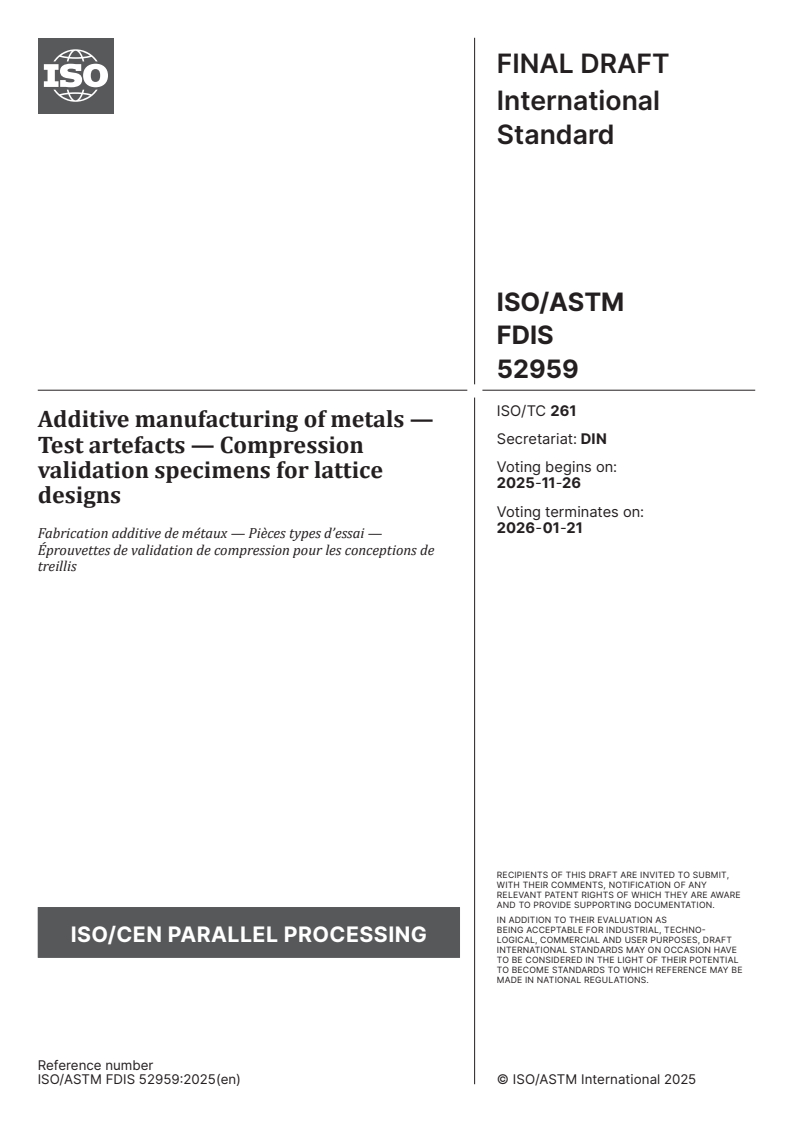
FINAL DRAFT
International
Standard
ISO/ASTM
FDIS
ISO/TC 261
Additive manufacturing of metals —
Secretariat: DIN
Test artefacts — Compression
Voting begins on:
validation specimens for lattice
2025-11-26
designs
Voting terminates on:
2026-01-21
Fabrication additive de métaux — Pièces types d’essai —
Éprouvettes de validation de compression pour les conceptions de
treillis
RECIPIENTS OF THIS DRAFT ARE INVITED TO SUBMIT,
WITH THEIR COMMENTS, NOTIFICATION OF ANY
RELEVANT PATENT RIGHTS OF WHICH THEY ARE AWARE
AND TO PROVIDE SUPPOR TING DOCUMENTATION.
IN ADDITION TO THEIR EVALUATION AS
BEING ACCEPTABLE FOR INDUSTRIAL, TECHNO
ISO/CEN PARALLEL PROCESSING LOGICAL, COMMERCIAL AND USER PURPOSES, DRAFT
INTERNATIONAL STANDARDS MAY ON OCCASION HAVE
TO BE CONSIDERED IN THE LIGHT OF THEIR POTENTIAL
TO BECOME STAN DARDS TO WHICH REFERENCE MAY BE
MADE IN NATIONAL REGULATIONS.
Reference number
FINAL DRAFT
International
Standard
ISO/ASTM
FDIS
ISO/TC 261
Additive manufacturing of
Secretariat: DIN
metals — Test artefacts —
Voting begins on:
Compression validation specimens
for lattice designs
Voting terminates on:
Fabrication additive de métaux — Pièces types d’essai —
Éprouvettes de validation de compression pour les conceptions de
treillis
RECIPIENTS OF THIS DRAFT ARE INVITED TO SUBMIT,
WITH THEIR COMMENTS, NOTIFICATION OF ANY
RELEVANT PATENT RIGHTS OF WHICH THEY ARE AWARE
© ISO/ASTM International 2025
AND TO PROVIDE SUPPOR TING DOCUMENTATION.
All rights reserved. Unless otherwise specified, or required in the context of its implementation, no part of this publication may
IN ADDITION TO THEIR EVALUATION AS
be reproduced or utilized otherwise in any form or by any means, electronic or mechanical, including photocopying, or posting on
BEING ACCEPTABLE FOR INDUSTRIAL, TECHNO
ISO/CEN PARALLEL PROCESSING
LOGICAL, COMMERCIAL AND USER PURPOSES, DRAFT
the internet or an intranet, without prior written permission. Permission can be requested from either ISO at the address below
INTERNATIONAL STANDARDS MAY ON OCCASION HAVE
or ISO’s member body in the country of the requester. In the United States, such requests should be sent to ASTM International.
TO BE CONSIDERED IN THE LIGHT OF THEIR POTENTIAL
ISO copyright office ASTM International TO BECOME STAN DARDS TO WHICH REFERENCE MAY BE
MADE IN NATIONAL REGULATIONS.
CP 401 • Ch. de Blandonnet 8 100 Barr Harbor Drive, PO Box C700
CH-1214 Vernier, Geneva West Conshohocken, PA 19428-2959, USA
Phone: +41 22 749 01 11 Phone: +610 832 9634
Fax: +610 832 9635
Email: copyright@iso.org Email: khooper@astm.org
Website: www.iso.org Website: www.astm.org
Published in Switzerland Reference number
© ISO/ASTM International 2025 – All rights reserved
ii
Contents Page
Foreword .iv
Introduction .v
1 Scope . 1
2 Normative references . 1
3 Terms and definitions . 1
4 Values . 1
5 Significance and use . 1
5.1 Significance . . .1
5.2 Use .2
6 Hazards . 2
7 Compression specimen design and manufacture . 2
8 Procedure . 3
8.1 Cleaning .3
8.2 Visual inspection .3
8.3 Specimen measurement .3
9 Specimen identification . 4
Bibliography . 5
© ISO/ASTM International 2025 – All rights reserved
iii
Foreword
ISO (the International Organization for Standardization) is a worldwide federation of national standards
bodies (ISO member bodies). The work of preparing International Standards is normally carried out through
ISO technical committees. Each member body interested in a subject for which a technical committee
has been established has the right to be represented on that committee. International organizations,
governmental and non-governmental, in liaison with ISO, also take part in the work. ISO collaborates closely
with the International Electrotechnical Commission (IEC) on all matters of electrotechnical standardization.
The procedures used to develop this document and those intended for its further maintenance are described
in the ISO/IEC Directives, Part 1. In particular, the different approval criteria needed for the different types
of ISO documents should be noted. This document was drafted in accordance with the editorial rules of the
ISO/IEC Directives, Part 2 (see www.iso.org/directives).
ISO draws attention to the possibility that the implementation of this document may involve the use of (a)
patent(s). ISO takes no position concerning the evidence, validity or applicability of any claimed patent
rights in respect thereof. As of the date of publication of this document, ISO had not received notice of (a)
patent(s) which may be required to implement this document. However, implementers are cautioned that
this may not represent the latest information, which may be obtained from the patent database available at
www.iso.org/patents. ISO shall not be held responsible for identifying any or all such patent rights.
Any trade name used in this document is information given for the convenience of users and does not
constitute an endorsement.
For an explanation of the voluntary nature of standards, the meaning of ISO specific terms and expressions
related to conformity assessment, as well as information about ISO's adherence to the World Trade
Organization (WTO) principles in the Technical Barriers to Trade (TBT), see www.iso.org/iso/foreword.html.
This document was prepared by Technical Committee ISO/TC 261, Additive manufacturing, in cooperation
with ASTM Committee F42, Additive Manufacturing Technologies, on the basis of a partnership agreement
between ISO and ASTM International with the aim to create a common set of ISO/ASTM standards on
Additive Manufacturing, in collaboration with the European Committee for Standardization (CEN) Technical
Committee CEN/TC 438, Additive manufacturing, in accordance with the Agreement on technical cooperation
between ISO and CEN (Vienna Agreement).
Any feedback or questions on this document should be directed to the user’s national standards body. A
complete listing of these bodies can be found at www.iso.org/members.html.
© ISO/ASTM International 2025 – All rights reserved
iv
Introduction
Validation and verification activities to support the manufacture of components are critical quality
requirements to ensure reliable production of consistent parts. Additive manufacturing (AM) offers the
opportunity to seamlessly incorporate computationally designed, high resolution, lattice structures into
components. On the other hand, AM systems can have different capabilities in terms of feature resolution,
therefore impacting physical properties of lattice structures. In order to ensure quality requirements, there
is a need to develop standardized lattice specimen geometries that can be used as surrogates in destructive
evaluations. Specifically, components incorporating lattice structures can be placed under compressive
loads. Since lattice designs, including, beam, gyroid or schwartz, can be unique to manufacturers, a
standardized approach is needed to ensure that the lattice design is adequately represented and can be
consistently assessed. This can allow for the evaluation of the compressive mechanical strength with
adequate representation of the manufacturing of the lattice design.
This document provides the lattice compression specimen and other AM specific considerations for using
the specimen per an existing compression test method like ASTM E9 or ISO 13314. Although ASTM E9 and
ISO 13314 provide standard methods of compression testing for metallic materials, in this document specific
considerations for lattice structures, such as the minimum number of unit cells, ductile and brittle material
considerations, the option for building specimens with en
...
ISO/TC 261 & ASTM F42
Secretariat: DIN
Date: 2025-10-24xx
Additive manufacturing of metals — Test artifactsartefacts —
Compression validation specimens for lattice designs
Fabrication additive de métaux — Pièces types d’essai — Éprouvettes de validation de compression pour les
conceptions de treillis
FDIS stage
© ISO/ASTM International 2025
All rights reserved. Unless otherwise specified, or required in the context of its implementation, no part of this publication
may be reproduced or utilized otherwise in any form or by any means, electronic or mechanical, including photocopying,
or posting on the internet or an intranet, without prior written permission. Permission can be requested from either ISO
at the address below or ISO’s member body in the country of the requester.
ISO copyright office
CP 401 • Ch. de Blandonnet 8
CH-1214 Vernier, Geneva
Phone: + 41 22 749 01 11
EmailE-mail: copyright@iso.org
Website: www.iso.org
Published in Switzerland
© ISO/ASTM 2025 – All rights reserved
ii
Contents
Foreword . iv
Introduction . v
1 Scope . 1
2 Normative references . 1
3 Terms and definitions . 1
4 Values . 1
5 Significance and use . 1
5.1 Significance . 1
5.2 Use . 2
6 Hazards . 2
7 Compression specimen design and manufacture . 2
8 Procedure . 3
8.1 Cleaning . 3
8.2 Visual inspection . 3
8.3 Specimen measurement . 3
9 Specimen identification . 4
Bibliography . 5
© ISO/ASTM 2025 – All rights reserved
iii
Foreword
ISO (the International Organization for Standardization) is a worldwide federation of national standards
bodies (ISO member bodies). The work of preparing International Standards is normally carried out through
ISO technical committees. Each member body interested in a subject for which a technical committee has been
established has the right to be represented on that committee. International organizations, governmental and
non-governmental, in liaison with ISO, also take part in the work. ISO collaborates closely with the
International Electrotechnical Commission (IEC) on all matters of electrotechnical standardization.
The procedures used to develop this document and those intended for its further maintenance are described
in the ISO/IEC Directives, Part 1. In particular, the different approval criteria needed for the different types of
ISO documents should be noted. This document was drafted in accordance with the editorial rules of the
ISO/IEC Directives, Part 2 (see www.iso.org/directives).
ISO draws attention to the possibility that the implementation of this document may involve the use of (a)
patent(s). ISO takes no position concerning the evidence, validity or applicability of any claimed patent rights
in respect thereof. As of the date of publication of this document, ISO had not received notice of (a) patent(s)
which may be required to implement this document. However, implementers are cautioned that this may not
represent the latest information, which may be obtained from the patent database available at
www.iso.org/patents. ISO shall not be held responsible for identifying any or all such patent rights.
Any trade name used in this document is information given for the convenience of users and does not
constitute an endorsement.
For an explanation of the voluntary nature of standards, the meaning of ISO specific terms and expressions
related to conformity assessment, as well as information about ISO's adherence to the World Trade
Organization (WTO) principles in the Technical Barriers to Trade (TBT), see www.iso.org/iso/foreword.html.
This document was prepared by Technical Committee ISO/TC 261, Additive manufacturing, in cooperation
with ASTM Committee F42, Additive Manufacturing Technologies, on the basis of a partnership agreement
between ISO and ASTM International with the aim to create a common set of ISO/ASTM standards on Additive
Manufacturing, in collaboration with the European Committee for Standardization (CEN) Technical
Committee CEN/TC 438, Additive manufacturing, in accordance with the Agreement on technical cooperation
between ISO and CEN (Vienna Agreement).
Any feedback or questions on this document should be directed to the user’s national standards body. A
complete listing of these bodies can be found at www.iso.org/members.html.
© ISO/ASTM 2025 – All rights reserved
iv
Introduction
Validation and verification activities to support the manufacture of components are critical quality
requirements to ensure reliable production of consistent parts. Additive manufacturing (AM) offers the
opportunity to seamlessly incorporate computationally designed, high resolution, lattice structures into
components. On the other hand, AM systems can have different capabilities in terms of feature resolution,
therefore impacting physical properties of lattice structures. In order to ensure quality requirements, there is
a need to develop standardized lattice specimen geometries that can be used as surrogates in destructive
evaluations. Specifically, components incorporating lattice structures can be placed under compressive loads.
Since lattice designs, including, beam, gyroid, or schwartz, can be unique to manufacturers, a standardized
approach is needed to ensure that the lattice design is adequately represented and can be consistently
assessed. This can allow for the evaluation of the compressive mechanical strength with adequate
representation of the manufacturing of the lattice design.
This document provides the lattice compression specimen and other AM specific considerations for using the
specimen per an existing compression test method like ASTM E9 or ISO 13314. Although ASTM E9 and ISO
13314 provide standard methods of compression testing for metallic materials, in this document specific
considerations for lattice structures, such as the minimum number of unit cells, ductile and brittle material
considerations, the option for building specimens with endplates, and differences between regular and non-
regular lattices are included along with reporting requirements of AM build parameters.
© ISO/ASTM 2025 – All rights reserved
v
Additive manufacturing of metals — Test artifactsartefacts —
Compression validation specimens for lattice designs
1 Scope
This document specifies requirements and provides guidance for the preparation for axial force compression
testing of additively manufactured (AM) metallic lattice specimens for validation purposes.
2 Normative references
The following documents are referred to in the text in such a way that some or all of their content constitutes
requirements of this document. For dated references, only the edition cited applies. For undated references,
the latest edition of the referenced document (including any amendments) applies.
ISO/ASTM 52900, Additive manufacturing — General principles — Fundamentals and vocabulary
ISO/ASTM 52931, Additive manufacturing of metals — Environment, health and safety — General principles for
use of metallic materials
ASTM E9, Standard Test Methods of Compression Testing of Metallic Materials at Room Temperature
3 Terms and definitions
For the purposes of this document, the terms and definitions given in ISO/ASTM 52900 apply.
ISO and IEC maintain terminology databases for use in standardiz
...
PROJET FINAL
Norme
internationale
ISO/ASTM
FDIS
ISO/TC 261
Fabrication additive de métaux —
Secrétariat: DIN
Pièces types d’essai — Éprouvettes
Début de vote:
de validation de compression pour
2025-11-26
les conceptions de treillis
Vote clos le:
2026-01-21
Additive manufacturing of metals — Test artefacts —
Compression validation specimens for lattice designs
LES DESTINATAIRES DU PRÉSENT PROJET SONT
INVITÉS À PRÉSENTER, AVEC LEURS OBSERVATIONS,
NOTIFICATION DES DROITS DE PROPRIÉTÉ DONT ILS
AURAIENT ÉVENTUELLEMENT CONNAISSANCE ET À
FOURNIR UNE DOCUMENTATION EXPLICATIVE.
OUTRE LE FAIT D’ÊTRE EXAMINÉS POUR
ÉTABLIR S’ILS SONT ACCEPTABLES À DES FINS
INDUSTRIELLES, TECHNOLOGIQUES ET COM-MERCIALES,
AINSI QUE DU POINT DE VUE DES UTILISATEURS, LES
PROJETS DE NORMES
TRAITEMENT PARALLÈLE ISO/CEN
INTERNATIONALES DOIVENT PARFOIS ÊTRE CONSIDÉRÉS
DU POINT DE VUE DE LEUR POSSI BILITÉ DE DEVENIR DES
NORMES POUVANT
SERVIR DE RÉFÉRENCE DANS LA RÉGLEMENTATION
NATIONALE.
Numéro de référence
PROJET FINAL
Norme
internationale
ISO/ASTM
FDIS
ISO/TC 261
Fabrication additive de métaux —
Secrétariat: DIN
Pièces types d’essai — Éprouvettes
Début de vote:
de validation de compression pour
2025-11-26
les conceptions de treillis
Vote clos le:
2026-01-21
Additive manufacturing of metals — Test artefacts —
Compression validation specimens for lattice designs
LES DESTINATAIRES DU PRÉSENT PROJET SONT
INVITÉS À PRÉSENTER, AVEC LEURS OBSERVATIONS,
NOTIFICATION DES DROITS DE PROPRIÉTÉ DONT ILS
DOCUMENT PROTÉGÉ PAR COPYRIGHT
AURAIENT ÉVENTUELLEMENT CONNAISSANCE ET À
FOURNIR UNE DOCUMENTATION EXPLICATIVE.
© ISO/ASTM International 2025
OUTRE LE FAIT D’ÊTRE EXAMINÉS POUR
ÉTABLIR S’ILS SONT ACCEPTABLES À DES FINS
Tous droits réservés. Sauf prescription différente ou nécessité dans le contexte de sa mise en œuvre, aucune partie de cette
INDUSTRIELLES, TECHNOLOGIQUES ET COM-MERCIALES,
publication ne peut être reproduite ni utilisée sous quelque forme que ce soit et par aucun procédé, électronique ou mécanique,
AINSI QUE DU POINT DE VUE DES UTILISATEURS, LES
y compris la photocopie, ou la diffusion sur l’internet ou un intranet, sans autorisation écrite soit de l’ISO à l’adresse ci-après,
PROJETS DE NORMES
TRAITEMENT PARALLÈLE ISO/CEN
INTERNATIONALES DOIVENT PARFOIS ÊTRE CONSIDÉRÉS
soit d’un organisme membre de l’ISO dans le pays du demandeur. Aux États-Unis, les demandes doivent être adressées à ASTM
DU POINT DE VUE DE LEUR POSSI BILITÉ DE DEVENIR DES
International.
NORMES POUVANT
ISO copyright office ASTM International SERVIR DE RÉFÉRENCE DANS LA RÉGLEMENTATION
NATIONALE.
Case postale 401 • Ch. de Blandonnet 8 100 Barr Harbor Drive, PO Box C700
CH-1214 Vernier, Genève West Conshohocken, PA 19428-2959, USA
Tél.: +41 22 749 01 11 Tél.: +610 832 9634
Fax: +610 832 9635
E-mail: copyright@iso.org E-mail: khooper@astm.org
Web: www.iso.org Web: www.astm.org
Publié en Suisse Numéro de référence
© ISO/ASTM International 2025 – Tous droits réservés
ii
Sommaire Page
Avant-propos .iv
Introduction .v
1 Domaine d’application . 1
2 Références normatives . 1
3 Termes et définitions . 1
4 Valeurs . 1
5 Importance et utilisation . 1
5.1 Importance . .1
5.2 Utilisation .2
6 Phénomènes dangereux . 2
7 Conception et fabrication d'éprouvettes de compression . 3
8 Mode opératoire . 3
8.1 Nettoyage .3
8.2 Inspection visuelle .4
8.3 Mesurage de l’éprouvette .4
9 Identification de l’éprouvette . 4
Bibliographie . 5
© ISO/ASTM International 2025 – Tous droits réservés
iii
Avant-propos
L'ISO (Organisation internationale de normalisation) est une fédération mondiale d'organismes nationaux
de normalisation (comités membres de l'ISO). L'élaboration des Normes internationales est en général
confiée aux comités techniques de l'ISO. Chaque comité membre intéressé par une étude a le droit de faire
partie du comité technique créé à cet effet. Les organisations internationales, gouvernementales et non
gouvernementales, en liaison avec l'ISO participent également aux travaux. L'ISO collabore étroitement avec
la Commission électrotechnique internationale (IEC) en ce qui concerne la normalisation électrotechnique.
Les procédures utilisées pour élaborer le présent document et celles destinées à sa mise à jour sont
décrites dans les Directives ISO/IEC, Partie 1. Il convient, en particulier, de prendre note des différents
critères d'approbation requis pour les différents types de documents ISO. Le présent document a
été rédigé conformément aux règles de rédaction données dans les Directives ISO/IEC, Partie 2 (voir
www.iso.org/directives).
L’ISO attire l’attention sur le fait que la mise en application du présent document peut entraîner l’utilisation
d’un ou de plusieurs brevets. L’ISO ne prend pas position quant à la preuve, à la validité et à l’applicabilité de
tout droit de propriété revendiqué à cet égard. À la date de publication du présent document, l’ISO n'avait pas
reçu notification qu’un ou plusieurs brevets pouvaient être nécessaires à sa mise en application. Toutefois,
il y a lieu d’avertir les responsables de la mise en application du présent document que des informations
plus récentes sont susceptibles de figurer dans la base de données de brevets, disponible à l'adresse
www.iso.org/brevets. L’ISO ne saurait être tenue pour responsable de ne pas avoir identifié tout ou partie de
tels droits de propriété.
Les appellations commerciales éventuellement mentionnées dans le présent document sont données pour
information, par souci de commodité, à l’intention des utilisateurs et ne sauraient constituer un engagement.
Pour une explication de la nature volontaire des normes, la signification des termes et expressions
spécifiques de l'ISO liés à l'évaluation de la conformité, ou pour toute information au sujet de l'adhésion de
l'ISO aux principes de l’Organisation mondiale du commerce (OMC) concernant les obstacles techniques au
commerce (OTC), voir www.iso.org/avant-propos.
Le présent document a été élaboré par le comité technique ISO/TC 261, Fabrication additive, en coopération
avec le Comité F42 de l’ASTM, Technologies de fabrication additive, dans le cadre d’un accord de partenariat
entre l’ISO et ASTM International dans le but de créer un ensemble commun de normes ISO/ASTM sur la
fabrication additive, en collaboration avec le comité technique CEN/TC 438 Fabrication additive, du Comité
européen de normalisation (CEN) conformément à l’Accord de coopération technique entre l’ISO et le CEN
(Accord de Vienne).
Il convient que l’utilisateur adresse tout retour d’information ou toute question concernant le présent
document à l’organisme national de normalisation de son pays. Une liste exhaustive desdits organismes se
trouve à l’adresse www.iso.org/fr/members.html.
© ISO/ASTM International 2025 – Tous droits réservés
iv
Introduction
Les activités de validation et de vérification à l’appui de la fabrication des composants sont des exigences
essentielles pour garantir la production de manière fiable des pièces cohérentes. La fabrication additive
(FA) offre la possibilité d'incorporer de manière transparente dans les composants des structures en treillis
à haute résolution conçues par ordinateur. D'autre part, les systèmes de FA peuvent avoir des capacités
différentes en termes de résolution des caractéristiques, ce qui a un impact sur les propriétés physiques des
structures en treillis. Afin de garantir les exigences de qualité, il est nécessaire de développer des géométries
normalisées d'éprouvettes de treillis qui peuvent être utilisées comme substituts dans les évaluations
destructives. Plus précisément, les composants incorporant des structures en treillis peuvent être soumis
à des charges de compression. Étant donné que les conceptions de treillis, de faisceau, de gyroïde ou de
schwartz peuvent être uniques aux fabricants, une approche normalisée est nécessaire pour garantir que la
conception de treillis est représentée de manière adéquate et peut être évaluée de manière cohérente. Cela
peut permettre d’évaluer la résistance mécanique à la compression avec une représentation adéquate de la
fabrication de la conception de treillis.
Le présent document fournit l'éprouvette de compression en treillis et d'autres considérations spécifiques
à la FA pour l'utilisation de l'éprouvette selon une méthode d'essai de compression existante telle que
l’ASTM E9 ou l’ISO 13314. Bien que l’ASTM E9 et l’ISO 13314 fournissent des méthodes normalisées d'essai
de compression pour les matériaux métalliques, le présent document tient compte de considérations
spécifiques aux structures en treillis, telles que le nombre minimum de cellules unitaires, les considérations
relatives aux matériaux ductiles et fragiles, la possibilité de construire des éprouvettes avec des plaques
d'extrémité et les différences entre les treillis réguliers et non réguliers, ainsi que des exigences en matière
de rapports sur les paramètres de fabrication de FA.
© ISO/ASTM International 2025 – Tous droits réservés
v
PROJET FINAL Norme internationale ISO/ASTM FDIS 52959:2025(fr)
Fabrication additive de métaux — Pièces types d’essai
— Éprouvettes de validation de compression pour les
conceptions de treillis
1 Domaine d’application
Le présent document spécifie les exigences et fournit des conseils pour la préparation des essais de
compression de force axiale d'éprouvette de treillis métalliques fabriqués de manière additive (FA) à des fins
de validation.
...
Questions, Comments and Discussion
Ask us and Technical Secretary will try to provide an answer. You can facilitate discussion about the standard in here.
Loading comments...