


ISO/DTS 32211
(Main)Sustainable finance - Products and services - Requirements and guidance
Sustainable finance - Products and services - Requirements and guidance
This document provides requirements and guidelines for development, implementation and presentation of sustainable finance products and services. This document enables sustainable finance practitioners to define the properties of self-developed sustainable finance products and services, integrate sustainability considerations into existing finance products and services, and evaluate external sustainable finance products and services. This document supports the implementation of sustainable finance products and services, the fair promotion and transparent reporting of sustainability performance.
Finance durable — Produits et services — Exigences et recommandations
General Information
- Status
- Not Published
- Technical Committee
- ISO/TC 322 - Sustainable finance
- Drafting Committee
- ISO/TC 322 - Sustainable finance
- Current Stage
- 5020 - FDIS ballot initiated: 2 months. Proof sent to secretariat
- Start Date
- 26-Nov-2025
- Completion Date
- 26-Nov-2025
Overview
ISO/DTS 32211:2025, developed by ISO Technical Committee ISO/TC 322 on Sustainable Finance, sets comprehensive requirements and guidance for sustainable finance products and services (SFPS). This standard serves as a global framework enabling the consistent development, implementation, communication, validation, and verification of finance products that integrate environmental, social, and governance (ESG) aspects. By applying these guidelines, financial institutions and practitioners can enhance transparency, reduce greenwashing risks, and improve the credibility of sustainability claims connected to their offerings.
The standard addresses a wide range of financial product categories including lending, asset management, insurance, accounts, and digital assets, with a focus on embedding sustainability considerations throughout the product life cycle. ISO/DTS 32211 supports sustainable economic growth that is environmentally responsible, socially inclusive, and ethically governed.
Key Topics
Principles for SFPS Development
Outlines essential principles for creating sustainable financial products that align with ESG criteria and stakeholder expectations.Life Cycle Perspective and Governance
Emphasizes a holistic view of SFPS, covering every phase from product design and embedding sustainability factors to transparent communication and external validation.Stakeholder Engagement
Highlights the need for active engagement with stakeholders to ensure products meet genuine sustainability goals and societal needs.General Requirements
Covers fundamental considerations applicable to all SFPS, including design, integration, promotion, reporting, and assurance processes.Sector-Specific Requirements
Provides tailored guidance for:- Sustainable lending
- Asset management focused on ESG integration
- Sustainable insurance products
- Payment and digital account services
- Digital assets such as cryptocurrencies and tokens, including classification, regulatory compliance, and impact assessment
Addressing Challenges like Greenwashing
Encourages clear disclosure and verification practices to mitigate misleading sustainability claims and ensure materiality in ESG reporting.Compensating Measures and Carbon Offsetting
Recommends actions to offset unavoidable environmental impacts and achieve net-zero ambitions through verified programs such as reforestation and renewable energy investments.
Applications
ISO/DTS 32211 is designed for use by a broad range of stakeholders within the sustainable finance ecosystem:
Financial Institutions and Service Providers
To design, implement, and communicate sustainable finance products that align with international ESG standards.Regulators and Policymakers
To benchmark and harmonize sustainability requirements across markets, enabling fair and consistent oversight.Investors and Asset Managers
For robust evaluation and selection of sustainable investment options based on standardized criteria.Insurance Providers
To embed sustainability considerations into underwriting and product development processes.Digital Finance and Cryptoasset Operators
To integrate ESG principles in digital asset offerings, improving transparency and stakeholder trust.Auditors and Verifiers
For conducting effective assurance activities on sustainability claims and performance reporting.
Using this standard helps organizations effectively market their sustainable finance products, increase investor confidence, demonstrate impact, and align with global sustainable development goals (SDGs).
Related Standards
ISO/DTS 32211 complements and integrates with several other international standards and frameworks, including:
- ISO 32210:2022 - Sustainability management systems guidance
- ISO 14100:2022 - Terminology on sustainability and financial materiality
- ISO 22739:2024 - Terminology for cryptoassets and cryptocurrencies
- ISO Guide 82:2019 - Guidance for sustainable development concepts
- International Financial Reporting Standards (IFRS) related to sustainability disclosures
- Principles for Responsible Investment (PRI) and other ESG-related voluntary initiatives
Together, these standards provide a cohesive ecosystem supporting best practices in sustainable finance, ensuring consistent definitions, transparent communication, and effective impact measurement across global markets.
By adopting ISO/DTS 32211, organizations gain a critical toolset for advancing sustainability in finance - facilitating ethical investment, reducing greenwashing risks, and contributing positively to long-term economic and environmental well-being.

ISO/DTS 32211 - Sustainable finance — Products and services — Requirements and guidance Released:12. 11. 2025


REDLINE ISO/DTS 32211 - Sustainable finance — Products and services — Requirements and guidance Released:12. 11. 2025
Frequently Asked Questions
ISO/DTS 32211 is a draft published by the International Organization for Standardization (ISO). Its full title is "Sustainable finance - Products and services - Requirements and guidance". This standard covers: This document provides requirements and guidelines for development, implementation and presentation of sustainable finance products and services. This document enables sustainable finance practitioners to define the properties of self-developed sustainable finance products and services, integrate sustainability considerations into existing finance products and services, and evaluate external sustainable finance products and services. This document supports the implementation of sustainable finance products and services, the fair promotion and transparent reporting of sustainability performance.
This document provides requirements and guidelines for development, implementation and presentation of sustainable finance products and services. This document enables sustainable finance practitioners to define the properties of self-developed sustainable finance products and services, integrate sustainability considerations into existing finance products and services, and evaluate external sustainable finance products and services. This document supports the implementation of sustainable finance products and services, the fair promotion and transparent reporting of sustainability performance.
ISO/DTS 32211 is classified under the following ICS (International Classification for Standards) categories: 03.060 - Finances. Banking. Monetary systems. Insurance; 13.020.20 - Environmental economics. Sustainability. The ICS classification helps identify the subject area and facilitates finding related standards.
ISO/DTS 32211 is available in PDF format for immediate download after purchase. The document can be added to your cart and obtained through the secure checkout process. Digital delivery ensures instant access to the complete standard document.
Standards Content (Sample)
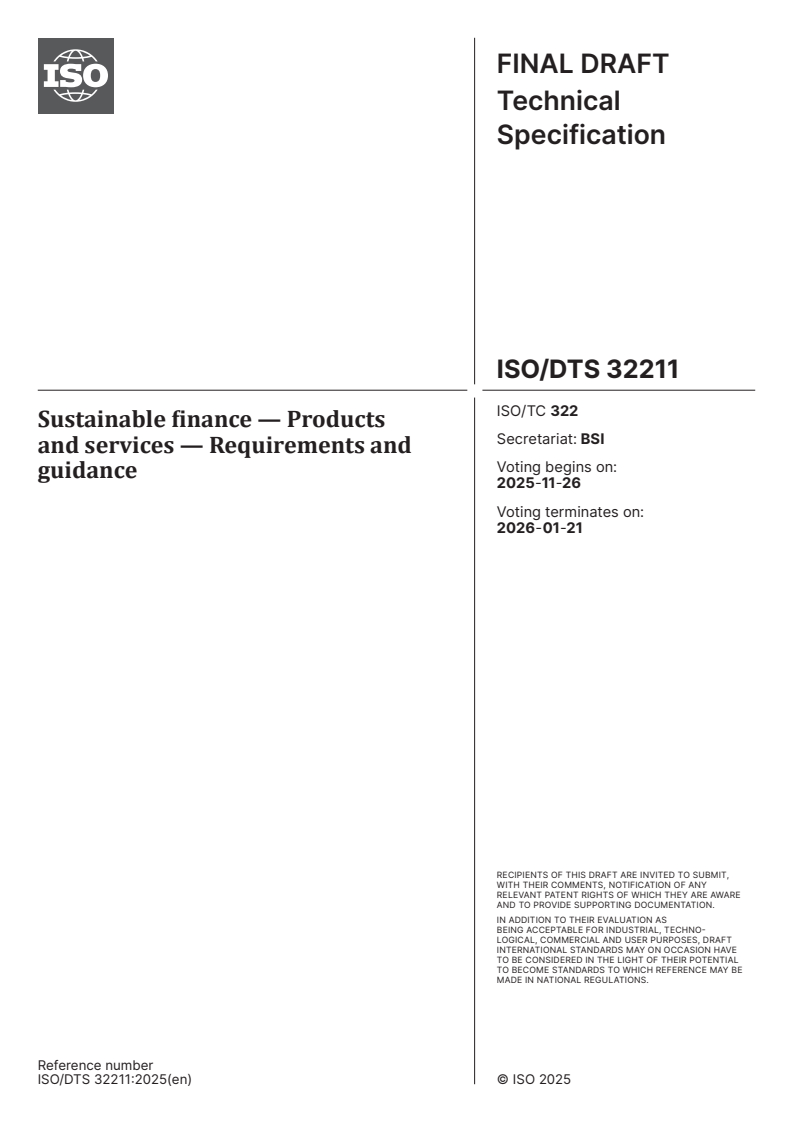
FINAL DRAFT
Technical
Specification
ISO/TC 322
Sustainable finance — Products
Secretariat: BSI
and services — Requirements and
Voting begins on:
guidance
2025-11-26
Voting terminates on:
2026-01-21
RECIPIENTS OF THIS DRAFT ARE INVITED TO SUBMIT,
WITH THEIR COMMENTS, NOTIFICATION OF ANY
RELEVANT PATENT RIGHTS OF WHICH THEY ARE AWARE
AND TO PROVIDE SUPPOR TING DOCUMENTATION.
IN ADDITION TO THEIR EVALUATION AS
BEING ACCEPTABLE FOR INDUSTRIAL, TECHNO
LOGICAL, COMMERCIAL AND USER PURPOSES, DRAFT
INTERNATIONAL STANDARDS MAY ON OCCASION HAVE
TO BE CONSIDERED IN THE LIGHT OF THEIR POTENTIAL
TO BECOME STAN DARDS TO WHICH REFERENCE MAY BE
MADE IN NATIONAL REGULATIONS.
Reference number
FINAL DRAFT
Technical
Specification
ISO/TC 322
Sustainable finance — Products
Secretariat: BSI
and services — Requirements and
Voting begins on:
guidance
Voting terminates on:
RECIPIENTS OF THIS DRAFT ARE INVITED TO SUBMIT,
WITH THEIR COMMENTS, NOTIFICATION OF ANY
RELEVANT PATENT RIGHTS OF WHICH THEY ARE AWARE
AND TO PROVIDE SUPPOR TING DOCUMENTATION.
© ISO 2025
IN ADDITION TO THEIR EVALUATION AS
All rights reserved. Unless otherwise specified, or required in the context of its implementation, no part of this publication may
BEING ACCEPTABLE FOR INDUSTRIAL, TECHNO
LOGICAL, COMMERCIAL AND USER PURPOSES, DRAFT
be reproduced or utilized otherwise in any form or by any means, electronic or mechanical, including photocopying, or posting on
INTERNATIONAL STANDARDS MAY ON OCCASION HAVE
the internet or an intranet, without prior written permission. Permission can be requested from either ISO at the address below
TO BE CONSIDERED IN THE LIGHT OF THEIR POTENTIAL
or ISO’s member body in the country of the requester.
TO BECOME STAN DARDS TO WHICH REFERENCE MAY BE
MADE IN NATIONAL REGULATIONS.
ISO copyright office
CP 401 • Ch. de Blandonnet 8
CH-1214 Vernier, Geneva
Phone: +41 22 749 01 11
Email: copyright@iso.org
Website: www.iso.org
Published in Switzerland Reference number
ii
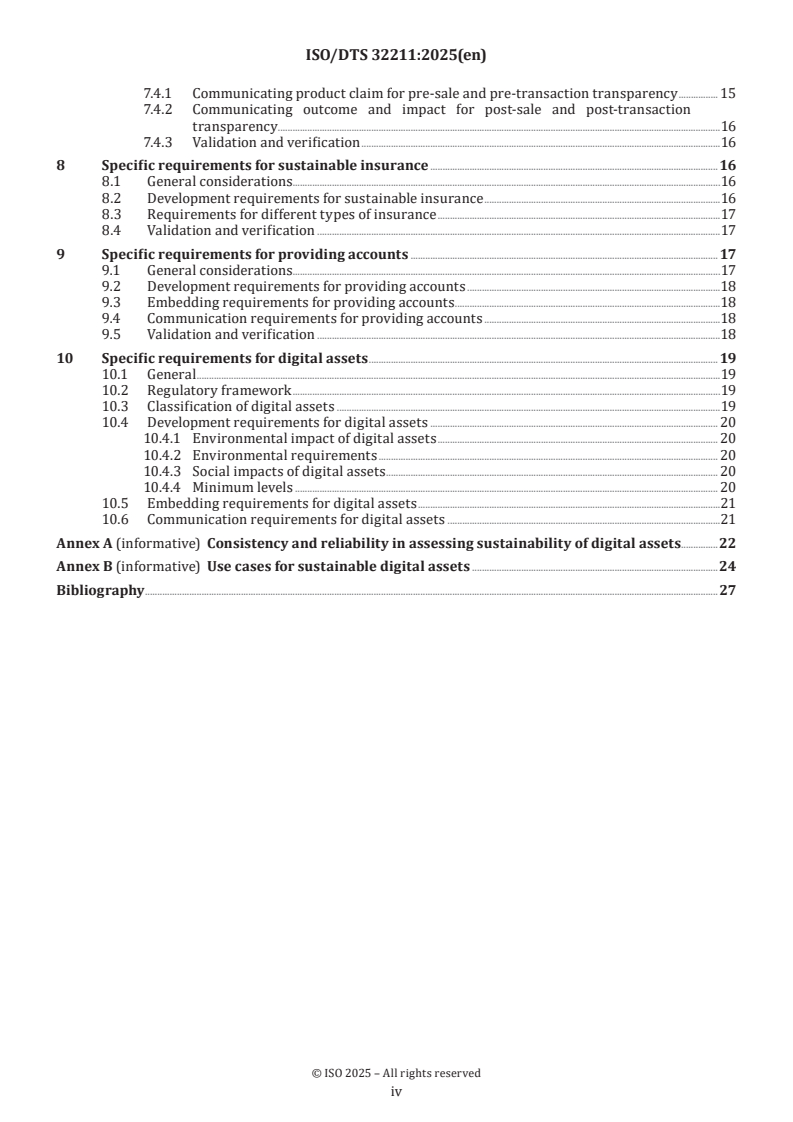
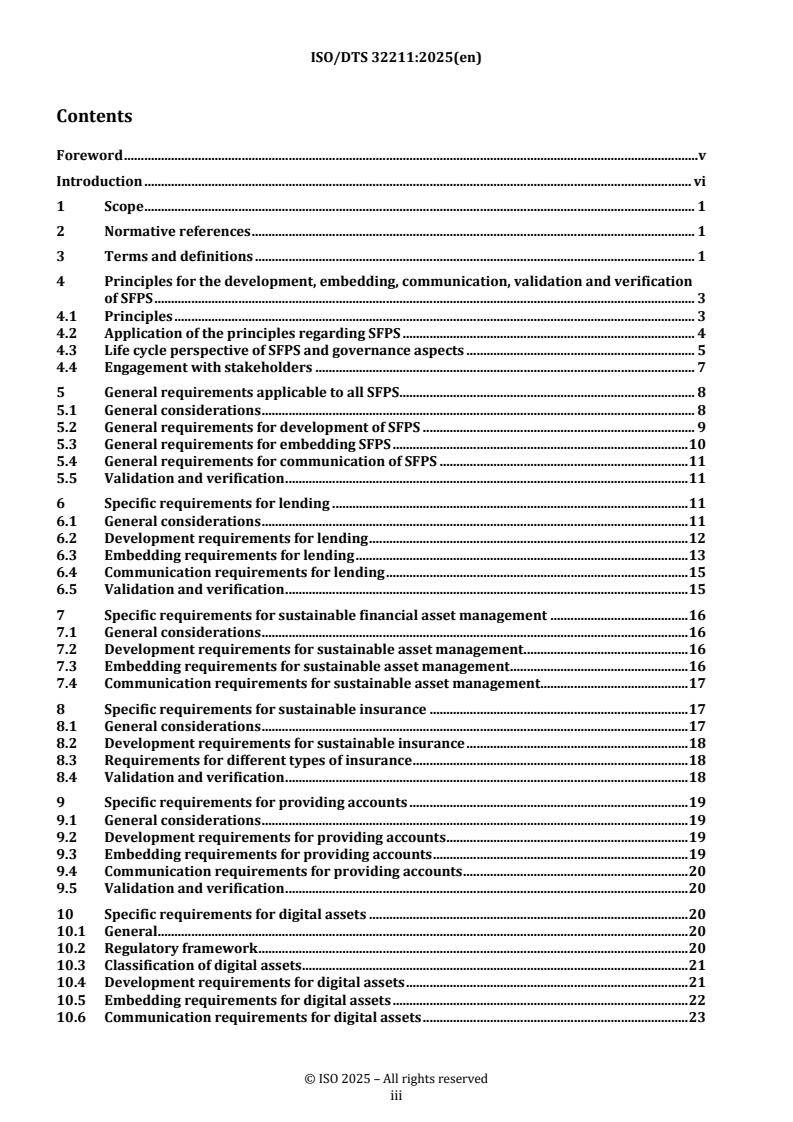
Contents Page
Foreword .v
Introduction .vi
1 Scope . 1
2 Normative references . 1
3 Terms and definitions . 1
4 Principles for the development, embedding, communication, validation and verification
of SFPS . 3
4.1 Principles .3
4.1.1 General .3
4.1.2 Transparency . . .3
4.1.3 Engagement.3
4.1.4 Accuracy .3
4.1.5 Completeness .3
4.1.6 Applicability .3
4.1.7 Robustness . .3
4.1.8 Accountability .4
4.1.9 Alignment .4
4.1.10 Benefit .4
4.2 Application of the principles regarding SFPS.4
4.3 Life cycle perspective of SFPS and governance aspects .5
4.3.1 Assessment of potential sustainability impacts and benefits .5
4.3.2 Governance .5
4.4 Engagement with stakeholders .7
4.4.1 Assessment of suppliers and counterparties .7
4.4.2 Know your customers .7
4.4.3 Monitoring, reporting, assessment, validation and verification .7
4.4.4 Market research .8
5 General requirements applicable to all SFPS . 8
5.1 General considerations.8
5.2 General requirements for development of SFPS .9
5.2.1 Rationale .9
5.2.2 Requirements .9
5.3 General requirements for embedding SFPS.9
5.4 General requirements for communication of SFPS .10
5.5 Validation and verification .10
6 Specific requirements for lending . .11
6.1 General considerations.11
6.2 Development requirements for lending .11
6.2.1 General .11
6.2.2 Environmental lending requirements .11
6.2.3 Social lending requirements . 12
6.3 Embedding requirements for lending . 12
6.4 Communication requirements for lending .14
6.4.1 General .14
6.4.2 Communicating product claim for pre-sale and pre-transaction transparency .14
6.4.3 Communicating impact claim for post-sale and post-transaction transparency .14
6.5 Validation and verification .14
7 Specific requirements for sustainable financial asset management . 14
7.1 General considerations.14
7.2 Development requirements for sustainable asset management . 15
7.3 Embedding requirements for sustainable asset management . 15
7.4 Communication requirements for sustainable asset management . 15
iii
7.4.1 Communicating product claim for pre-sale and pre-transaction transparency . 15
7.4.2 Communicating outcome and impact for post-sale and post-transaction
transparency . . .16
7.4.3 Validation and verification .16
8 Specific requirements for sustainable insurance .16
8.1 General considerations.16
8.2 Development requirements for sustainable insurance .16
8.3 Requirements for different types of insurance .17
8.4 Validation and verification .17
9 Specific requirements for providing accounts . 17
9.1 General considerations.17
9.2 Development requirements for providing accounts .18
9.3 Embedding requirements for providing accounts .18
9.4 Communication requirements for providing accounts .18
9.5 Validation and verification .18
10 Specific requirements for digital assets . 19
10.1 General .19
10.2 Regulatory framework .19
10.3 Classification of digital assets .19
10.4 Development requirements for digital assets . 20
10.4.1 Environmental impact of digital assets . 20
10.4.2 Environmental requirements . 20
10.4.3 Social impacts of digital assets . 20
10.4.4 Minimum levels . 20
10.5 Embedding requirements for digital assets .21
10.6 Communication requirements for digital assets .21
Annex A (informative) Consistency and reliability in assessing sustainability of digital assets .22
Annex B (informative) Use cases for sustainable digital assets .24
Bibliography .27
iv
Foreword
ISO (the International Organization for Standardization) is a worldwide federation of national standards
bodies (ISO member bodies). The work of preparing International Standards is normally carried out through
ISO technical committees. Each member body interested in a subject for which a technical committee
has been established has the right to be represented on that committee. International organizations,
governmental and non-governmental, in liaison with ISO, also take part in the work. ISO collaborates closely
with the International Electrotechnical Commission (IEC) on all matters of electrotechnical standardization.
The procedures used to develop this document and those intended for its further maintenance are described
in the ISO/IEC Directives, Part 1. In particular, the different approval criteria needed for the different types
of ISO document should be noted. This document was drafted in accordance with the editorial rules of the
ISO/IEC Directives, Part 2 (see www.iso.org/directives).
ISO draws attention to the possibility that the implementation of this document may involve the use of (a)
patent(s). ISO takes no position concerning the evidence, validity or applicability of any claimed patent
rights in respect thereof. As of the date of publication of this document, ISO had not received notice of (a)
patent(s) which may be required to implement this document. However, implementers are cautioned that
this may not represent the latest information, which may be obtained from the patent database available at
www.iso.org/patents. ISO shall not be held responsible for identifying any or all such patent rights.
Any trade name used in this document is information given for the convenience of users and does not
constitute an endorsement.
For an explanation of the voluntary nature of standards, the meaning of ISO specific terms and expressions
related to conformity assessment, as well as information about ISO’s adherence to the World Trade
Organization (WTO) principles in the Technical Barriers to Trade (TBT), see www.iso.org/iso/foreword.html.
This document was prepared by Technical Committee ISO/TC 322, Sustainable finance.
Any feedback or questions on this document should be directed to the user’s national standards body. A
complete listing of these bodies can be found at www.iso.org/members.html.
v
Introduction
In 2019, ISO/TC 322 undertook a stocktake to identify and analyse more than 150 international initiatives
addressing diverse aspects of sustainable finance. This revealed many examples of different approaches,
from setting voluntary standards to providing best practice and high-level explanation for the development
of products and services aimed at supporting sustainable development by financial markets.
The examples analysed give guidance for documenting the qualities or properties of such financial products
within a green or sustainable development finance context, whether to support labelling purposes or
to reduce deficits from being unspecific or ubiquitous, without proposing, for example, reference or
documentation. This bears the risk of what is called “standard shopping” for the lowest quality requirements
and allowing greenwashing when advertising, promoting and reporting sustainable finance products and
services (SFPS).
As addressed more and more by regulators and consumer organizations, there is a primary need for
a comprehensive and unifying standard, as market actors can be confronted with different initiatives
providing inconsistent or even contradictory information and advice on development, implementation and
communication of SFPS.
Another aspect to consider is that the approach of such guidance depends often on the history, purpose and
stakeholders of the organizations behind an initiative. Early initiatives were mainly looking at environmental
(“E”) and, over time, began to integrate social (“S”) and governance (“G”), often as an add-on factor to the
more mature environmental aspects. On the other hand, analysing the potential ESG gaps or overlays is not
only about a limited focus of initiatives as well as overall mission of some initiatives, but can also be a concern
for the potential conflicts: such as competing views on functionality, importance and significance, today
branded as materiality. And more recently, referring to the United Nations (UN) Sustainable Development
Goals (SDGs), further adds more complexity as well as another type of impact identification.
The diversity of initiatives and thus of actors provides ISO/TC 322 with the opportunity to develop a
standard by integrating the most holistic approaches by initiatives and other standard providers and best
practice of market participants, the providers of products and services. Standards are developed when
there is global consensus on their applicability and a recognized market need or opportunity. This process
is driven by open-minded collaboration and the pursuit of synergies through international normalization
efforts. The opportunity is to develop a common view of SFPS and identify the essential components of
quality and potential for contributing to sustainable development.
The document is based on and refers to good practices of finance products and services in international,
regional or national finance-sector-related initiatives. It also can be integrated with other economic and
cultural boundary conditions which already exist or are about to be developed in many regions of the world.
The requirements and guidance in this document are formulated to allow efficient and effective internal or
external assurance and verification to improve internal processes, economic effects and external credibility.
This document can also help an organization’s stakeholders to evaluate the general design and specifications
of SFPS in order to assess their ESG-related claims and communicated intended impacts.
vi
FINAL DRAFT Technical Specification ISO/DTS 32211:2025(en)
Sustainable finance — Products and services — Requirements
and guidance
1 Scope
This document specifies requirements for and gives guidance on the development, embedding,
communication, validation and verification of sustainable finance products and services (SFPS). It addresses
the product and service areas of lending, asset management, insurance, payment accounts and digital assets.
This document is applicable to any organization that intends to provide or is providing SFPS with an
integration of defined environmental, social and governance (ESG) aspects and proof of intended impacts. It
can be used for aligning existing SFPS or designing new ones.
This document enables organizations to define, embed, communicate, attribute and effectively evaluate
SFPS. It further enables successful marketing and documenting of SFPS objectives, properties and impacts,
as well as validation and verification.
2 Normative references
There are no normative references in this document.
3 Terms and definitions
For the purposes of this document, the following terms and definitions apply.
ISO and IEC maintain terminology databases for use in standardization at the following addresses:
— ISO Online browsing platform: available at https:// www .iso .org/ obp
— IEC Electropedia: available at https:// www .electropedia .org/
3.1
sustainable finance
process of integrating environmental, social and governance (ESG) considerations into financial sector
activities, including investment decisions, lending, insurance and financial services (including accounts and
digital assets) to promote long-term economic growth that is environmentally responsible, socially inclusive
and governed ethically, and direct capital towards sustainable economic activities and projects
3.2
sustainable development
development that meets the environmental, social and economic needs of the present without compromising
the ability of future generations to meet their own needs
[SOURCE: ISO Guide 82:2019, 3.2, modified — Note 1 to entry deleted.]
3.3
materiality
information essential for decision-making, which can be applied to identify issues that reflect an
organization’s environmental and social impacts, as well as information that supports interested party and
strategic decision-making
[SOURCE: ISO 14100:2022, 3.1.12]
3.4
compensating measure
action taken to offset or neutralize the environmental, social and governance (ESG) impacts of sustainable
finance (3.1) products and services (SFPS), particularly in cases where sustainability thresholds are not
fully met
Note 1 to entry: Compensating measures include initiatives such as carbon offset programmes (e.g. reforestation,
renewable energy investments, carbon capture) to achieve net-zero emissions for the asset.
3.5
carbon offsetting
practice used by issuers to counterbalance the carbon emissions generated from sustainable finance (3.1)
products and services (SFPS) operations by investing in environmental projects that reduce or remove an
equivalent amount of carbon from the atmosphere
Note 1 to entry: Carbon offset projects may include reforestation, renewable energy projects, and carbon capture and
storage (CCS) initiatives.
3.6
greenwashing
false or misleading information, either intentionally or inadvertently, regarding the environmental or
sustainability attributes of a product, asset and activity, which can have consequences on the assessment of
financial and non-financial materiality (3.3) affecting stakeholder decision-making
[SOURCE: ISO 14100:2022, 3.1.15, modified — “affecting stakeholder decision-making” added.]
3.7
baseline
agreed reference value or set of values which can be derived from past experience, often used for comparing
with ongoing performance data, values or outcomes
[SOURCE: ISO 32210:2022, 3.33]
3.8
cryptoasset
digital asset implemented using cryptographic techniques
Note 1 to entry: Distributed ledger technology (DLT) systems can be used to manage or transfer cryptoassets.
[SOURCE: ISO 22739:2024, 3.14, modified — Admitted term “crypto-asset” deleted.]
3.9
cryptocurrency
cryptoasset (3.8) designed to work as a medium of payment or value exchange
Note 1 to entry: Cryptocurrency involves the use of decentralized control and cryptography to secure transactions,
control the creation of additional assets, and verify the transfer of assets in a distributed ledger technology (DLT) system.
[SOURCE: ISO 22739:2024, 3.15]
3.10
token
asset that represents a collection of entitlements
[SOURCE: ISO 22739:2024, 3.92]
3.11
utility token
token (3.10) that can be used by its owner to receive access to goods or services
Note 1 to entry: Utility tokens are usually only accepted by the issuer of the token.
[SOURCE: ISO 22739:2024, 3.96]
3.12
security token
token (3.10) with specific characteristics that meets the definition of financial instrument or other
investment instrument under applicable legislation in the relevant jurisdiction
[SOURCE: ISO 22739:2024, 3.84]
4 Principles for the development, embedding, communication, validation and
verification of SFPS
4.1 Principles
4.1.1 General
In order to fully develop, embed, communicate, validate and verify SFPS, the organization shall apply the
principles given in 4.1.2 to 4.1.10.
4.1.2 Transparency
Reporting and communication on sustainability aspects shall be presented in a way that is open,
comprehensive, traceable and understandable. This ensures that stakeholders (ranging from investors and
customers to employees and communities) can clearly understand an organization’s sustainability goals,
performance, and short-, medium- and long-term impacts.
The SFPS shall include fair interests and requirements for customers (e.g. transparency on pricing and about
the sustainability impact of the products and services).
4.1.3 Engagement
Organizations shall involve stakeholders in a timely manner to consider important positions, expectations
and recommendations.
4.1.4 Accuracy
Organizations shall avoid bias and uncertainties regarding sustainability outcomes.
4.1.5 Completeness
All relevant and material sustainable finance information should be included while developing, embedding,
and communicating SFPS. Sustainable finance information and data should be selected according to the
needs of the intended user of SFPS.
4.1.6 Applicability
Organizations shall be aware of regulation on sustainable development aspects with mandatory or
voluntary requirements and recommendations, as well as guidance and standards provided by ISO and
other initiatives.
4.1.7 Robustness
Organizations shall use appropriate methodological approaches and information sources grounded in the
latest peer-reviewed science to support their decision-making and environmental actions. Acknowledgement
of uncertainties shall be recognized as a particularly valuable contribution to decision-making. Organizations
shall provide satisfactory sustainability expertise regarding the relevant sustainable finance aspects, either
internally or by in-sourcing of subject-matter experts.
4.1.8 Accountability
Organizations shall acknowledge and take full responsibility for their positive and negative sustainable
finance aspects and related assessment processes. They shall accept appropriate scrutiny and also accept a
duty to respond to this scrutiny.
4.1.9 Alignment
The SFPS shall be aligned with internationally agreed goals, such as UN SDGs, and/or nationally or regionally
defined sustainability priorities.
4.1.10 Benefit
The SFPS shall provide significant benefit to and improvement of ESG outcomes. At a minimum, the products
and services shall not conflict with the attainment of ESG outcomes.
4.2 Application of the principles regarding SFPS
Organizations should consider:
a) identification of the relevant regulatory landscape;
b) alignment with local, national, regional and international sustainability goals;
c) alignment with the organization’s interim, medium and long-term sustainability strategies and goals;
d) understanding the needs and challenges of all parties in the value chain and value stream, if relevant;
e) identification of sustainability expertise required in the organization and drawing on external and
internal sources, as well as applying upskilling to ensure adequate sustainability skills and expertise
are available;
f) training of staff and partners involved in SFPS development and management to ensure a consistent
understanding of sustainability principles;
g) assessment of SFPS’s risks and opportunities to both the organization and the environment, and the
related costs;
h) assessment of potential sustainable impacts and benefits, and attribution methodologies;
i) assessment of compensating measures to offset environmental impacts when sustainability thresholds
are not met;
j) time frame of intended outcomes and fiduciary duty obligations for long-term outcomes of specific
products and services;
k) application of innovative technologies (e.g. blockchain and distributed ledger technology (DLT), internet
of things (IoT), artificial intelligence (AI), remote sensing and geospatial technologies facilitating
assurance or parametric cover triggers, digitization to extend finance coverage, facilitating payment);
l) assurance of verifiable, traceable and provable product claims to avoid greenwashing and provide
credible product claims;
m) alignment of product-related compensation and remuneration packages with short- to medium- to long-
term sustainability outcomes/goals where possible;
n) institution of measures, including time frames, to ensure product claims are verifiable;
o) maintenance of thorough records of the SFPS life cycle and integration of learnings into future product
development for continuous improvement.
Remuneration shall be linked to measured sustainability benefits realized by the product.
4.3 Life cycle perspective of SFPS and governance aspects
4.3.1 Assessment of potential sustainability impacts and benefits
The organization shall assess the potential sustainability impacts, risks and benefits of SFPS, using the
following criteria:
a) support for sustainable economic activities;
[13]
EXAMPLE Taxonomies explained in ISO 14030-3, European Union taxonomy for sustainable activities ,
[14]
China’s Green Bond Catalogue or those organizations transitioning to sustainability.
b) defining conditions for financing activities based on identified/expected negative E, S and G outcomes;
c) engagement activities to achieve common sustainability goals;
d) measures taken to enhance the intended positive ESG impacts;
e) comprehensive information for customers;
f) establishing a baseline (what would happen without the SFPS) and using benchmarks to measure the
relative effectiveness of the intervention.
Taxonomies may be employed to support decision-making on what constitutes sustainable activities (and
what activities can be excluded from support), including considerations of transition to sustainability.
With the aim of enhancing positive impact in a credible manner, organizations should ensure that
progress towards a specific sustainability target does not come at the expense of adverse impacts in other
sustainability spheres.
4.3.2 Governance
4.3.2.1 General
In order to adhere to the principles set out in this document, the provider of the SFPS shall follow the
organizational requirements set out in 4.3.2.2 and 4.3.2.3.
NOTE 1 ISO 37000 provides further guidance on how to apply the foundational and enabling principles. The
guidance provided in ISO 32210 can also apply.
All SFPS shall be governed in a manner to ensure that they fulfil their stated intentions and do not cause
significant harm.
NOTE 2 ISO 37000 offers an appropriate set of foundational and enabling principles that are of fundamental
importance to SFPS. Likewise, the intended outcomes of governance as presented in ISO 37000 of ethical behaviour,
responsible stewardship and effective performance are of fundamental importance to SFPS.
For all general and specific requirements, the lender should be able to provide data and information which are:
a) specified: nature of contribution over a time period;
b) substantiated: context and measured outcome;
c) documented: methods applied, proof, self-assessment.
4.3.2.2 Generally applicable requirements
The way the primary and foundational principles for governance are applied to all SFPS provides a framework
within which the specific attributes of different types of financial services can be found. Accordingly, the
providers of SFPS shall:
a) Have a purpose that clearly defines their reason for existence, the product or service’s intentions
towards the natural environment, society and its stakeholders, and articulates the expectations
of its stakeholders. Specific to SFPS, such intentions shall be presented in terms of their intended
positive contribution to sustainable development as articulated (e.g. in one or several of the UN SDGs).
Performance shall be measured against the fulfilment of this stated purpose.
b) Define the value generation objectives (e.g. intended impact) that will enable the fulfilment of the
stated purpose in a manner that is consistent with a stated set of values and demonstrates a clear
understanding of the context within which the product or service exists.
c) Present a strategy on how these value generation objectives will be delivered and accordingly on how the
purpose will be fulfilled. This should consider both the internal and external context, and establish clear
policies that define expectations, responsibilities, authorities, oversight and constraints. Mechanisms
should be established to ensure that the strategy is being applied and is effectively delivering on the
value generation objectives and can be sustained over time.
d) Establish clear oversight mechanisms to ensure that the product or service is meeting its expectations,
adhering to ethical principles and meeting its compliance obligations, including a gap analysis between
SFPS and non-SFPS.
e) Be accountable for the delivery of its purpose through meaningful, accurate, timely and verified
disclosure on how intentions have been fulfilled. In doing so, the disclosure should show that the product
or service is viable, and performs over time, without compromising the ability of current and future
generations to meet their needs.
4.3.2.3 Specifically applicable requirements
For all products, governance principles and checks shall be applied to abide by good corporate governance
objectives, including supply chain aspects:
a) prevention of bribery and corruption;
b) prevention of money laundering and illicit assets;
c) prevention of the violation of environmental regulations including and not limited to wildlife regulations
and deterioration of habitats, illegal shipment or dumping of waste, pollution regulations and illegal
trading in hazardous substances;
d) good corporate governance (responsibility, risk management, transparency, stakeholder engagement);
e) sourcing from conflict regions;
f) stakeholder engagement and management;
g) ethical governance;
h) applied auditable labels adapted to the project or the objective to be achieved;
i) independent verification;
j) monitoring and tracking;
k) evidence of social impact, with the identification of their localization;
l) evidence of financial inclusion and accessibility;
m) benchmarking and tracking changes that affect financial inclusion and accessibility to financing options.
4.4 Engagement with stakeholders
4.4.1 Assessment of suppliers and counterparties
The organization shall ensure that suppliers and counterparties involved in the design and delivery of the
sustainable finance product commit to operate consistently with standard requirements including shared
values, disclosure of information and allowing for independent auditing of compliance.
This can form part of the regular due diligence process applied to appointment/retention of counterparties
(including sales and marketing).
NOTE See ISO 32210 for further guidance to support this requirement.
The organization shall require suppliers and counterparties, including those offering sales and marketing
activities, to have adequate sustainability skills and expertise.
4.4.2 Know your customers
The organization shall identify the customer needs, circumstances and objectives by:
a) ensuring the customer understands the product scope, attributes, risks and promised outcomes;
b) ensuring the product is appropriate to the risk profile of the customer.
The organization should ensure at all levels that the customer understands the product and that it is
suitable for the customer’s stated objectives. It is important that the customer has sufficient understanding
of the product, including both its financial risk characteristics and sustainability attributes, and related
requirements. This should include, but not be limited to, the overall aims of the product and how both
financial and sustainability objectives are to be realized, including any limitations and exclusions being
applied. The process instituted by the finance organization to meet this requirement can involve completion
of a questionnaire, personal interview or any other effective means of communication. The requirement also
applies to intermediaries who are employed in sales and marketing activities.
4.4.3 Monitoring, reporting, assessment, validation and verification
The organization shall periodically report progress made through the product offering, including
sustainability benefits realized, consistent with routine financial reporting. This will also include
communication with the customer on progress. It shall also include wider sustainability risks and
opportunities.
The organization shall embed the processes, systems and technologies in place to:
a) ensure that impacts and outcomes are being achieved, measured, verified and monitored;
b) ensure continuous measurement, evaluation and understanding of current and development of impacts;
c) understand, assess, evaluate and monitor identified risks (including financial and sustainable finance
risks) and opportunities;
d) continuously re-assess the methods implemented to identify, monitor, evaluate, and report impacts
and risks;
e) ensure continuous engagement to understand customer needs and challenges.
In their assessment of sustainability risk and opportunities, organizations should take into account different
approaches in both the public and private sectors, also taking into consideration various technologies and
timelines as well as circumstances of different jurisdictions and the enterprises that operate within them.
4.4.4 Market research
The organization should conduct market research activity to understand market demand, supply,
opportunities, risks and other challenges supplemented by broader stakeholder engagement with the aim of
providing an informed basis for the organization’s decisions.
To understand the market needs and stakeholders’ expectations along the entire value chain and value
stream, the organization should identify:
a) the potential and target market which is the right fit for the product;
b) how are stakeholder views being considered and implemented along the value chain;
c) the actors of the financial ecosystem that influence the products and services;
d) what benefits, risks and opportunities, and impacts might be realized both for the organization and
their customers.
NOTE See ISO 26000 for further details.
5 General requirements applicable to all SFPS
5.1 General considerations
In a growing number of countries, regulations list mandatory requirements regarding reporting the impact
of financial products and services or protecting specific stakeholders’ interests. For the same purpose, a
growing number of initiatives focusing on the finance sector offer voluntary sustainability objectives and
targets mainly to normalize terms and definitions and for their efficient and transparent use in global
financial markets. These mandatory, regulatory and voluntary frameworks provide information which can
be used as requirements but are most often formulated as reporting content. In some regions, financial
product labelling is available with different aims and intentions with reference to local and regional norms.
The requirements defined in 5.2 to 5.4 are designed to provide minimum sustainability objectives and
intentions to use/apply as claims for an intention to contribute to sustainable development. The user may
use them or refer
...
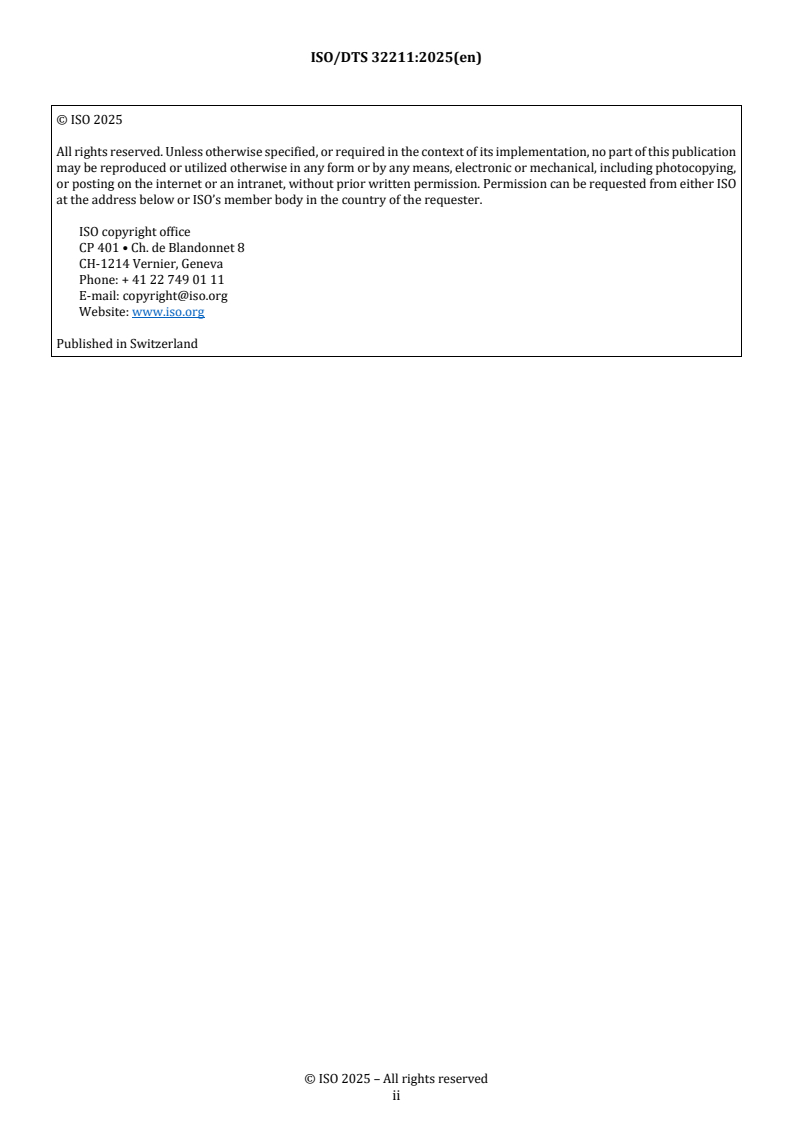
ISO/TC 322
Secretariat: BSI
Date: 2025-09-1511-11
Sustainable finance — Products and services — Requirements and
guidance
All rights reserved. Unless otherwise specified, or required in the context of its implementation, no part of this publication
may be reproduced or utilized otherwise in any form or by any means, electronic or mechanical, including photocopying,
or posting on the internet or an intranet, without prior written permission. Permission can be requested from either ISO
at the address below or ISO’s member body in the country of the requester.
ISO copyright office
CP 401 • Ch. de Blandonnet 8
CH-1214 Vernier, Geneva
Phone: + 41 22 749 01 11
E-mail: copyright@iso.org
Website: www.iso.org
Published in Switzerland
ii
Contents
Foreword . v
Introduction . vi
1 Scope . 1
2 Normative references . 1
3 Terms and definitions . 1
4 Principles for the development, embedding, communication, validation and verification
of SFPS . 3
4.1 Principles . 3
4.2 Application of the principles regarding SFPS . 4
4.3 Life cycle perspective of SFPS and governance aspects . 5
4.4 Engagement with stakeholders . 7
5 General requirements applicable to all SFPS. 8
5.1 General considerations . 8
5.2 General requirements for development of SFPS . 9
5.3 General requirements for embedding SFPS . 10
5.4 General requirements for communication of SFPS . 11
5.5 Validation and verification . 11
6 Specific requirements for lending . 11
6.1 General considerations . 11
6.2 Development requirements for lending . 12
6.3 Embedding requirements for lending . 13
6.4 Communication requirements for lending . 15
6.5 Validation and verification . 15
7 Specific requirements for sustainable financial asset management . 16
7.1 General considerations . 16
7.2 Development requirements for sustainable asset management. 16
7.3 Embedding requirements for sustainable asset management . 16
7.4 Communication requirements for sustainable asset management. 17
8 Specific requirements for sustainable insurance . 17
8.1 General considerations . 17
8.2 Development requirements for sustainable insurance . 18
8.3 Requirements for different types of insurance . 18
8.4 Validation and verification . 18
9 Specific requirements for providing accounts . 19
9.1 General considerations . 19
9.2 Development requirements for providing accounts . 19
9.3 Embedding requirements for providing accounts . 19
9.4 Communication requirements for providing accounts . 20
9.5 Validation and verification . 20
10 Specific requirements for digital assets . 20
10.1 General . 20
10.2 Regulatory framework . 20
10.3 Classification of digital assets . 21
10.4 Development requirements for digital assets . 21
10.5 Embedding requirements for digital assets . 22
10.6 Communication requirements for digital assets . 23
iii
Annex A (informative) Consistency and reliability in assessing sustainability of digital assets . 24
Annex B (informative) Use cases for sustainable digital assets . 26
Bibliography . 29
iv
Foreword
ISO (the International Organization for Standardization) is a worldwide federation of national standards
bodies (ISO member bodies). The work of preparing International Standards is normally carried out through
ISO technical committees. Each member body interested in a subject for which a technical committee has been
established has the right to be represented on that committee. International organizations, governmental and
non-governmental, in liaison with ISO, also take part in the work. ISO collaborates closely with the
International Electrotechnical Commission (IEC) on all matters of electrotechnical standardization.
The procedures used to develop this document and those intended for its further maintenance are described
in the ISO/IEC Directives, Part 1. In particular, the different approval criteria needed for the different types of
ISO documentsdocument should be noted. This document was drafted in accordance with the editorial rules
of the ISO/IEC Directives, Part 2 (see www.iso.org/directives).
ISO draws attention to the possibility that the implementation of this document may involve the use of (a)
patent(s). ISO takes no position concerning the evidence, validity or applicability of any claimed patent rights
in respect thereof. As of the date of publication of this document, ISO had not received notice of (a) patent(s)
which may be required to implement this document. However, implementers are cautioned that this may not
represent the latest information, which may be obtained from the patent database available at
www.iso.org/patents. ISO shall not be held responsible for identifying any or all such patent rights.
Any trade name used in this document is information given for the convenience of users and does not
constitute an endorsement.
For an explanation of the voluntary nature of standards, the meaning of ISO specific terms and expressions
related to conformity assessment, as well as information about ISO’s adherence to the World Trade
Organization (WTO) principles in the Technical Barriers to Trade (TBT), see www.iso.org/iso/foreword.html.
This document was prepared by Technical Committee ISO/TC 322, Sustainable Financefinance.
Any feedback or questions on this document should be directed to the user’s national standards body. A
complete listing of these bodies can be found at www.iso.org/members.html.
v
Introduction
In 2019, ISO/TC 322 undertook a stocktake to identify and analyse more than 150 international initiatives
addressing diverse aspects of sustainable finance. This revealed many examples of different approaches, from
setting voluntary standards to providing best practice and high-level explanation for the development of
products and services aimed at supporting sustainable development by financial markets.
The examples analysed give guidance for documenting the qualities or properties of such financial products
within a green or sustainable development finance context, whether to support labelling purposes or to reduce
deficits from being unspecific or ubiquitous, without proposing, for example, reference or documentation. This
bears the risk of what is called ‘“standard shopping’shopping” for the lowest quality requirements and
allowing greenwashing when advertising, promoting and reporting sustainable finance products and services.
(SFPS).
As addressed more and more by regulators and consumer organizations, there is a primary need for a
comprehensive and unifying standard, as market actors can be confronted with different initiatives providing
inconsistent or even contradictory information and advice on development, implementation and
communication of sustainable finance products and services. SFPS.
Another aspect to consider is that the approach of such guidance depends often on the history, purpose and
stakeholders of the organizations behind an initiative. Early initiatives were mainly looking at “environmental
(“E””) and, over time, began to integrate “social (“S””) and “governance (“G”,”), often as an add-on factor to the
more mature environmental aspects. On the other hand, analysing the potential ESG gaps or overlays is not
only about a limited focus of initiatives as well as overall mission of some initiatives, but can also be a concern
for the potential conflicts: such as competing views on functionality, importance and significance, today
branded as materiality. And more recently, referring to the United Nations (UN) Sustainable Development
Goals, popularly known as UN SDG’s, (SDGs), further adds more complexity as well as another type of impact
identification.
The diversity of initiatives and thus of actors provides ISO/TC 322 with the opportunity to develop a standard
by integrating the most holistic approaches by initiatives and other standard providers and best practice of
market participants, the providers of products and services. Standards are developed when there is global
consensus on globaltheir applicability and a recognized market need or opportunity for users through global
normalizationn. This process is driven by open mind for -minded collaboration and the pursuit of synergies
through international normalization efforts. The opportunity is to develop a common view of sustainable
finance products and servicesSFPS and identify the essential components of quality and potential for
contributing to sustainable development.
The document is based on and refers to good practices of finance products and services in international,
regional or national finance-sector-related initiatives. It also leaves the necessary space for specific legal and
regulatory requirements and allows to integratecan be integrated with other economic and cultural boundary
conditions which already exist or are about to be developed in many regions of the world.
The guidance and requirements and guidance in this document are formulated to allow efficient and effective
internal or external assurance and verification to improve internal processes, economic effects, and external
credibility. ItThis document can also be of help byan organization’s stakeholders to such an organization to
evaluate the general design and the specifications of sustainable finance product and servicesSFPS in order to
assess their ESG aspects -related claims and communicated intended impacts.
vi
Sustainable finance — Products and services — Requirements and
guidance
1 Scope
This document specifies requirements for and gives guidance on the development, embedding,
communication, validation and verification of sustainable finance products and services (SFPS). It addresses
the product and service areas of lending, asset management, insurance, payment accounts and digital assets.
This document is applicable to any organization that intends to provide or is providing SFPS with an
integration of defined environmental, social and governance (ESG) aspects and proof of intended impacts. It
can be used for aligning existing SFPS or designing new ones.
This document enables organizations to define, embed, communicate, attribute and effectively evaluate SFPS.
It further enables successful marketing and documenting of SFPS objectives, properties and impactimpacts,
as well as validation and verification.
2 Normative references
There are no normative references in this document.
3 Terms and definitions
For the purposes of this document, the following terms and definitions apply.
ISO and IEC maintain terminology databases for use in standardization at the following addresses:
— ISO Online browsing platform: available at https://www.iso.org/obp
— IEC Electropedia: available at https://www.electropedia.org/
3.1
sustainable finance
the process of integrating environmental, social and governance (ESG) considerations into financial sector
activities, including investment decisions, lending, insurance and financial services (including accounts and
digital assets) to promote long-term economic growth that is environmentally responsible, socially inclusive,
and governed ethically, and direct capital towards sustainable economic activities and projects
3.2
sustainable development
development that meets the environmental, social and economic needs of the present without compromising
the ability of future generations to meet their own needs
[SOURCE: ISO Guide 82:2019, 3.2, modified — Note 1 to entry has been deleted.]
3.3
materiality
information essential for decision-making, which can be applied to identify issues that reflect an organization’s
environmental and social impacts, as well as information that supports interested party and strategic decision-
making
[SOURCE: ISO 14100:2022, 3.1.1212]
3.4
compensating measures measure
actionsaction taken to offset or neutralize the environmental, social and governance impact(ESG) impacts of
sustainable finance (3.1) products and services (SFPS,), particularly in cases where sustainability thresholds
are not fully met
Note 1 to entry: Compensating measures include initiatives such as carbon offset programsprogrammes (e.g.
reforestation, renewable energy investments, carbon capture) to achieve net-zero emissions for the asset.
3.5
carbon offsetting
a practice used by issuers to counterbalance the carbon emissions generated from sustainable finance (3.1)
products and services (SFPS) operations by investing in environmental projects that reduce or remove an
equivalent amount of carbon from the atmosphere.
Note 1 to entry: Carbon offset projects may include reforestation, renewable energy projects, and carbon capture and
storage (CCS) initiatives.
3.6
greenwashing
false or misleading information, either intentionally or inadvertently, regarding the environmental or
sustainability attributes of a product, asset and activity, which can have consequences on the assessment of
financial and non-financial materiality (3.3) affecting stakeholder decision-making
[SOURCE: ISO 14100:2022, 3.1.15, modified] — “affecting stakeholder decision-making” added.]
3.7
baseline
agreed reference value or set of values which can be derived from past experience, often used for comparing
with ongoing performance data, values or outcomes
[SOURCE: ISO 32210:2022, 3.33.]
3.8
Cryptoassetcryptoasset
digital asset implemented using cryptographic techniques
Note 1 to entry: distributed Distributed ledger technology (DLT) systems can be used to manage or transfer cryptoassets.
[SOURCE: ISO 22739:2024, 3.14], modified — Admitted term “crypto-asset” deleted.]
3.9
cryptocurrency
cryptoasset (3.8) designed to work as a medium of payment or value exchange
Note 1 to entry: Cryptocurrency involves the use of decentralized control and cryptography to secure transactions,
control the creation of additional assets, and verify the transfer of assets in a distributed ledger technology (DLT) system.
[SOURCE: ISO 22739:2024, 3.15]
3.10
token
asset that represents a collection of entitlements
[SOURCE: ISO 22739:2024, 3.92]
3.11
utility token
token (3.10) that can be used by its owner to receive access to goods or services
Note 1 to entry: Utility tokens are usually only accepted by the issuer of the token.
[SOURCE: ISO 22739:2024, 3.96]
3.12
security token
token (3.10) with specific characteristics that meets the definition of financial instrument or other investment
instrument under applicable legislation in the relevant jurisdiction
[SOURCE: ISO 22739:2024, 3.84]
4 Principles and guidance for the development, embedding, communication,
validation and verification of SFPS
4.1 Principles
4.1.1 General
In order to fully develop, embed, communicate, validate and verify SFPS, the organization shall apply the
following principles given in 4.1.2 to 4.1.10.
4.1.2 Transparency
Reporting and communication on sustainability aspects shall be presented in a way that is open,
comprehensive, traceable and understandable. This ensures that stakeholders – (ranging from investors and
customers to employees and communities –) can clearly understand a company’san organization’s
sustainability goals, performance, and short term,-, medium term- and long-term impacts.
The SFPS shall include fair interests and requirements for customers, (e.g. transparency on pricing and about
the sustainability impact of the products and services.).
4.1.3 Engagement
Organizations shall involve stakeholders in a timely manner to consider important positions, expectations and
recommendations.
4.1.4 Accuracy
Organizations shall avoid bias and uncertainties regarding sustainability outcomes.
4.1.5 Completeness
All relevant and material sustainable finance information should be included while developing, embedding,
and communicating SFPS. Sustainable finance information and data should be selected according to the needs
of the intended user of SFPS.
4.1.6 Applicability
Organizations shall be aware of regulation on sustainable development aspects with mandatory or voluntary
requirements and recommendations, as well as guidance and standards provided by ISO and other initiatives.
4.1.7 Robustness
Organizations shall use appropriate methodological approaches and information sources grounded in the
latest peer-reviewed science to support their decision-making and environmental actions. Acknowledgement
of uncertainties shall be recognized as a particularly valuable contribution to decision-making. Organizations
shall provide satisfactory sustainability expertise regarding the relevant sustainable finance aspects, either
internally or by in-sourcing of subject-matter experts.
4.1.8 Accountability
Organizations shall acknowledge and take full responsibility for their positive and negative sustainable
finance aspects and related assessment processes. They shall accept appropriate scrutiny and also accept a
duty to respond to this scrutiny.
4.1.9 Alignment
The SFPS shall be aligned with internationally agreed goals, such as UN SDGs, and/or nationally or regionally
defined sustainability priorities.
4.1.10 Benefit
The SFPS shall provide significant benefit to and improvement of environmental, social and governance (ESG)
outcomes. At a minimum, the products and services shall not conflict with the attainment of ESG outcomes.
4.2 Guidance on the applicationApplication of the principles regarding SFPS
Organizations should consider:
a) identification of the relevant regulatory landscape;
b) alignment with local, national, regional and international sustainability goals;
c) alignment with the organization’s interim, medium and long-term sustainability strategies and goals;
d) understanding the needs and challenges of all parties in the value chain and value stream, if relevant;
e) identification of sustainability expertise required in the organization and drawdrawing on external and
internal sources, as well as applying upskilling to ensure adequate sustainability skills and expertise are
available;
f) traintraining of staff and partners involved in SFPS development and management to ensure a consistent
understanding of sustainability principles;
g) assessment of SFPS’s risks and opportunities to both the organization and the environment, and the
related costs;
h) assessment of potential sustainable impacts and benefits, and attribution methodologies;
i) assessment of compensating measures to offset environmental impacts when sustainability thresholds
are not met;
j) timeframetime frame of intended outcomes and fiduciary duty obligations for long-term outcomes of
specific products and services;
k) application of innovative technologies, (e.g. Blockchainblockchain and Distributed Ledger
Technologydistributed ledger technology (DLT), internet of things (IoT (Internet Of Things), artificial
intelligence (AI), remote sensing and geospatial technologies facilitating assurance or parametric cover
triggers, digitisationdigitization to extend finance coverage, facilitating payment, etc;);
l) ensureassurance of verifiable, traceable and provable product claims to avoid greenwashing and provide
credible product claims;
m) alignalignment of product-related compensation and remuneration packages with short- to medium- to
long-term sustainability outcomes/goals where possible;
n) instituteinstitution of measures, including timeframestime frames, to ensure product claims are
verifiable;
a) remuneration shall be linked to measured sustainability benefits realised by the product;
o) maintainmaintenance of thorough records of the SFPS lifecyclelife cycle and integrateintegration of
learnings into future product development for continuous improvement.
Remuneration shall be linked to measured sustainability benefits realized by the product.
4.3 Life cycle perspective of SFPS and governance aspects
4.3.1 Assessment of potential sustainability impacts and benefits
The organization shall assess the potential sustainability impacts, risks and benefits of SFPS, using the
following criteria:
a) support for sustainable economic activities;;
[ ]
EXAMPLE Taxonomies explained in ISO 14030-3, EUEuropean Union taxonomy for sustainable activities 13, ,
[14]
China’s Green Bond Catalogue (2021) or those organizations transitioning to sustainability.
b) defining conditions for financing activities based on identified/expected negative E, S and G outcomes;
c) engagement activities to achieve common sustainability goals;
d) measures taken to enhance the intended positive ESG impacts;
e) comprehensive information for customers;
f) establishestablishing a baseline (what would happen without the SFPS) and useusing benchmarks to
measure the relative effectiveness of the intervention.
Taxonomies may be employed to support decision-making on what constitutes sustainable activities (and
what activities mightcan be excluded from support)), including considerations of transition to sustainability.
With the aim of enhancing positive impact in a credible manner, organizations should ensure that progress
towards a specific sustainability target does not come at the expense of adverse impacts in other sustainability
spheres.
4.3.2 Governance
4.3.2.1 General
In order to adhere to the principles set out in this document, the provider of the SFPS shall follow the
organizational requirements set out in 4.3.2.2 and 4.3.2.3.
NOTE 1 ISO 37000 provides further guidance on how to apply the foundational and enabling principles should be
applied. The guidance provided in ISO 32210 maycan also apply.
All SFPS shall be governed in a manner to ensure that they fulfil their stated intentions and do not cause
significant harm.
NOTE 2 ISO 37000 offers an appropriate set of foundational and enabling principles that should beare of fundamental
importance to SFPS. Likewise, the intended outcomes of governance as presented in ISO 37000 of ethical behaviour,
responsible stewardship and effective performance are of fundamental importance to SFPS.
For all general and specific requirements, the lender should be able to provide data and information which
are:
a) specified: nature of contribution over a time period;
b) substantiated: context and measured outcome;
c) documented: methods applied, proof, self-assessment;.
4.3.2.2 Generally applicable requirements
The way the primary and foundational principles for governance are applied to all SFPS provides a framework
within which the specific attributes of different types of financial services can be found. Accordingly, the
providers of SFPS shall:
a) Have a purpose that clearly defines their reason for existence, the product or service’s intentions towards
the natural environment, society and its stakeholders, and articulates the expectations of its stakeholders.
Specific to SFPS, such intentions shall be presented in terms of their intended positive contribution to
sustainable development as articulated, (e.g. in one or several of the UN SDGs.). Performance shall be
measured against the fulfilment of this stated purpose.
b) Define the value generation objectives (e.g. intended impact,) that will enable the fulfilment of the stated
purpose in a manner that is consistent with a stated set of values and demonstrates a clear understanding
of the context within which the product or service exists.
c) Present a strategy on how these value generation objectives will be delivered and accordingly on how the
purpose will be fulfilled. This should consider both the internal and external context, and establish clear
policies that define expectations, responsibilities, authorities, oversight and constraints. Mechanisms
should be established to ensure that the strategy is being applied and is effectively delivering on the value
generation objectives and can be sustained over time.
d) Establish clear oversight mechanisms to ensure that the product or service is meeting its expectations,
adhering to ethical principles and meeting its compliance obligations, including a gap analysis between
SFPS and non-SFPS.
e) Be accountable for the delivery of its purpose through meaningful, accurate, timely and verified disclosure
on how intentions have been fulfilled. In doing so, the disclosure should show that the product or service
is viable, and performs over time, without compromising the ability of current and future generations to
meet their needs.
4.3.2.3 Specifically applicable requirements
For all products, governance principles and checks shall be applied to abide by good corporate governance
objectives, including supply chain aspects:
a) prevention of bribery and corruption;
b) prevention of money laundering and illicit assets;
c) prevention of the violation of environmental regulations including and not limited to wildlife regulations
and deterioration of habitats, illegal shipment or dumping of waste, pollution regulations and illegal
trading in hazardous substances;
d) good corporate governance (responsibility, risk management, transparency, stakeholder engagement);
e) sourcing from conflict regions;
f) stakeholder engagement and management;
g) ethical governance;
h) applied auditable labels adapted to the project or the objective to be achieved;
i) independent verification;
j) monitoring and tracking;
k) evidence of social impact, with the identification of their localization;
l) evidence of financial inclusion and accessibility;
m) benchmarking and tracking changes that affect financial inclusion and accessibility to financing options.
4.4 Engagement with stakeholders
4.4.1 Assessment of suppliers and counterparties
The organization shall ensure that suppliers and counterparties involved in the design and delivery of the
sustainable finance product commit to operate consistently with standard requirements including shared
values, disclosure of information and allowing for independent auditing of compliance.
This mightcan form part of the regular due diligence process applied to appointment/retention of
counterparties (including sales and marketing).
NOTE See ISO 32210 for further guidance to support this requirement.
The organization shall require suppliers and counterparties, including those offering sales and marketing
activities, to have adequate sustainability skills and expertise.
4.4.2 Know your customers
The organization shall identify the customer needs, circumstances and objectives by:
a) Ensuringensuring the customer understands the product scope, attributes, risks and promised outcomes;
b) Ensuringensuring the product is appropriate to the risk profile of the customer.
The organization should ensure at all levels that the customer understands the product and that it is suitable
for the customer’s stated objectives. It is important that the customer has sufficient understanding of the
product, including both its financial risk characteristics and sustainability attributes, and related
requirements. This should include, but not be limited to, the overall aims of the product and how both financial
and sustainability objectives are to be realisedrealized, including any limitations and exclusions being applied.
The process instituted by the finance organization to meet this requirement couldcan involve completion of a
questionnaire, personal interview or any other effective means of communication. The requirement would
also applyapplies to intermediaries who are employed in sales and marketing activities.
4.4.3 Monitoring, reporting, assessment, validation and verification
The organization shall periodically report progress made through the product offering, including
sustainability benefits realisedrealized, consistent with routine financial reporting. This will also include
communication with the customer on progress and. It shall also include wider sustainability risks and
opportunities.
The organization shall embed the processes, systems and technologies in place to:
a) Ensureensure that impacts and outcomes are being achieved, measured, , verified and monitored.;
b) Ensureensure continuous measurement, evaluation and understanding of current and development of
impacts.;
c) Understandunderstand, assess, evaluate and monitor identified risks (including financial and sustainable
finance risks) and opportunities.;
d) Continuouslycontinuously re-assess the methods implemented to identify, monitor, evaluate, and report
impacts and risks.;
e) Ensureensure continuous engagement to understand customer needs and challenges.
In their assessment of sustainability risk and opportunities, organizations should take into account different
approaches in both the public and private sectors, also taking into consideration various technologies and
timelines as well as circumstances of different jurisdictions and the enterprises that operate within them.
4.4.4 Market research
The organization should conduct market research activity to understand market demand, supply,
opportunities, risks and other challenges supplemented by broader stakeholder engagement with the aim of
providing an informed basis for the organization’s decisions.
To understand the market needs and stakeholders’ expectations along the entire value chain and value stream,
the organization should identify:
a) the potential and target market which is the right fit for the product;
b) how are stakeholder views being considered and implemented along the value chain;
c) the actors of the financial eco-systemecosystem that influence the products and services;
d) what benefits, risks and opportunities,, and impactsimpacts might be realisedrealized both for the
organization and their customers.
NOTE See ISO 26000 for further details.
5 General requirements applicable to all SFPS
5.1 General considerations
In a growing number of countries, regulations list mandatory requirements regarding reporting the impact of
financial products and services or protecting specific stakeholders’ interests. For the same purpose, a growing
number of initiatives focussingfocusing on the finance sector offer voluntary sustainability objectives and
targets mainly to normalize terms and definitions and for their efficient and transparent use in global financial
markets. These mandatory, regulatory and voluntary frameworks provide information which can be used as
requirements but are most often formulated as reporting content. In some regions, financial product labelling
is available with different aims and intentions with reference to local and regional norms.
The requirements defined in the following subclauses5.2 to 5.4 are designed to provide the floor or minimum
sustainability objectives and intentions to use/apply as claims for an intention to contribute to sustainable
development. The user may use them or refer to the use of a mandatory or voluntary initiative covering
explicitly the same minimum content. For the purposes of this document, sustainability aspects are structured
for ESG outcomes. In addition, the user can add any self-defined sustainability objectives and related
requirements.
Financial products and services developed in line with the currentthis document can be subject either to:
a) making a self-determination and self-declaration;
b) seeking confirmation of its conformance by parties having an interest in the organization, such as
customers;
c) seeking formal validation and verification by an external certification body;
The level of detail and complexity of the requirements listed in the following subclauses depends on:
— the sustainability impact intention or purpose of the respective product;
— the ability of the provider to obtain, manage and monitor the respective sustainability requirements.;
— the quality of the approach chosen to identify and verify sustainability impacts, either self-declared or
evaluated by third-party.
5.2 General requirements for development of SFPS
5.2.1 Rationale
The rationale for SFPS is given when developing it. It is during the development stage when all elements of
SFPS that are essential for a client – (as well as to fulfil legal requirements –), whether purely financial or
embracing sustainable development, are defined. The ESG outcomes of SFPS shall be described according to
5.2this subclause.
The development stage creates the opportunity to embrace all necessary elements from the beginning in order
to manage them at every later stage, i.e. embedding and communicating effectively. Some topics mayare not
bealways addressed in the same way throughout the life cycle of a SFPS, but they are all are a precondition for
enabling transparency wherever needed, expected or where such focus is intended.
To carefully consider sustainability aspects from the start is an opportunity. To miss it can create risks to the
provider of a product or service, (e.g. greenwashing) or losing opportunities, (e.g. customers and market
share.).
5.2.2 Requirements
The topics to be considered while developing the SFPS shall include:
a) scope of SFPS;
b) sustainability intention and purpose;
c) sustainability baseline;
d) sustainability performance targets (SPTs) with related timelines;
e) assumptions and limitations;
f) sustainability outcomes, impacts, risks and opportunities;
g) financial risks, opportunities and benefits;
h) regulatory obligations;
i) applied frameworks, (e.g. UN SDGs,), methodologies and valid sources of data;
j) applicable taxonomies;
k) management, monitoring and disclosure.
The product provider shall demonstrate a plan of identifying the assets including the source of information
for valuation and monitoring purposes and the intention of the customers. The customers should meet the
criteria of the product, demonstrate a plan, information and data required to qualify for the specific
sustainable financial product and service, including the process by which the progress is monitored to
evidence the sustainability criteria over the period of that product and service.
5.3 General requirements for embedding SFPS
The organization shall identify assess and evaluate skills and expertise required to develop so that it embeds
successfully the sustainable products and services.
This shall include:
a) identification of functional sustainable finance knowledge and expertise (knowhowknow-how) within the
organization;
b) identification of capabilities within the organization;
c) identification of the value chain and value stream activities to deliver sustainable financial products and
services;
d) identification of sustainable finance benefits by developing sustainable financial products and services;
e) identification of data and information components that are necessary for the realisationrealization of
these sustainable financial products and services;
f) identification of internal processes in place regarding relevant sustainability aspects;
g) stakeholder engagement:, including expertise in engaging customers, investors, and communities to build
trust and alignment;
h) identification of value network and stakeholders involved and related impacts;
i) mapping of capabilities, value stream, value chain, people, data, and processes to deliver sustainable
finance;
j) employees in charge of sustainable finance products and services must receiveSFPS receiving specific
education and training;
k) sustainability strategy development:, including expertise in aligning sustainability goals with the
organization's overall strategy;
l) research and innovation with emerging trends analysis:, including keeping abreast of trends in
sustainable materials, technologies, and practices relevant to the organization’s activities;
m) identifying the temporal and spatial scales of action required to achieve the expected results.
The requirements set out in b) and c) above can be fulfilled by third parties.
In addition, a process for assessing and evaluating skills and expertise should be in place in order to embed
sustainable products and services in the organization.
5.4 General requirements for communication of SFPS
When communicating SFPS to markets and clients, the sustainability purpose shall be specified and
documented.
It shall include a claim that specifies the purpose of the SFPS, which is intended to have a specific favourable
impact on a defined sustainable aspect.
In addition, the evaluation of overall impact intended or achieved shall be explained, including engagement
with relevant stakeholders.
5.5 Validation and verification
All SFPS shall receive validation of the purpose claim, and verification of the impact or outcome, i.e. proof of
that claim.
In order to ensure transparency and ease of verification, all the relevant requirements should be documented,
referenced (including date and author), and approved by the relevant governance body.
Systems and processes should integrate all relevant actions, activities, decisions and narratives so that there
is an auditable track of historic events.
Assumptions and limitations should be captured, so that they are able to be tested and understood.
6 Specific requirements for lending
6.1 General considerations
This clause is applicable to all types of lending products. This can include, but is not limited to, commercial
lending, project and infrastructure finance lending, lending with or without collateral (mortgages), bonds,
retail lending and consumer credits.
The level of detail and complexity of the requirements listed in the following subclauses6.2 to 6.4 depends on:
a) the sustainability impact intention or purpose of the respective lending product;
b) the ability of the lender to obtain collect, manage and monitor the respective sustainability requirements
including climate and nature considerations.
6.2 Development requirements for lending
6.2.1 General
During the development phase of lending products and services with sustainability claims, the environmental
and social requirements set out in this clause shall be fulfilled.
NOTE : General governance requirements are addressed in Clause 5.
6.2.2 En
...
Questions, Comments and Discussion
Ask us and Technical Secretary will try to provide an answer. You can facilitate discussion about the standard in here.
Loading comments...