

ISO 14097:2021
(Main)Greenhouse gas management and related activities — Framework including principles and requirements for assessing and reporting investments and financing activities related to climate change
General Information
- Abstract
This document specifies a general framework, including principles, requirements and guidance for assessing, measuring, monitoring and reporting on investments and financing activities in relation to climate change and the transition into a low-carbon economy. The assessment includes the following items: the alignment (or lack thereof) of investment and financing decisions taken by the financier with low-carbon transition pathways, adaptation pathways, and climate goals; the impact of actions through the financier’s investment and lending decisions towards the achievement of climate goals in the real economy, i.e. mitigation (greenhouse gas emissions) and adaptation (resilience); the risks to owners of financial assets (e.g. private equities, listed stocks, bonds, loans) arising from climate change. To support the financier’s assessment of the impact of investment and lending decisions, this document provides guidance for the financier on how to: set targets and determine metrics to be used for tracking progress related to the low-carbon transition pathways of investees; determine low-carbon transition and adaptation trajectories of investees; document the causality or linkage between its climate action and its outputs, outcomes and impacts. This document is applicable to financiers, i.e. investors and lenders. It guides their reporting activities to the following third parties: shareholders, clients, policymakers, financial supervisory authorities and non-governmental organizations.
- Status
- Published
- Publication Date
- 03-May-2021
- Technical Committee
- ISO/TC 207/SC 7 - Greenhouse gas management and related activities
- Drafting Committee
- ISO/TC 207/SC 7/WG 10 - Investments, financing and climate change
- Current Stage
- 9060 - Close of review
- Completion Date
- 02-Dec-2031
Buy Documents



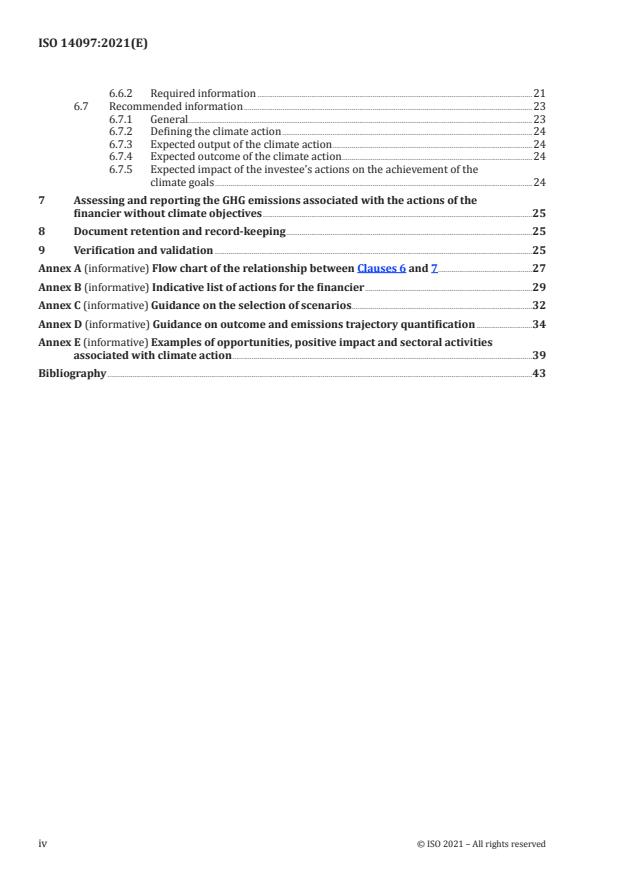
ISO 14097:2021 - Greenhouse gas management and related activities -- Framework including principles and requirements for assessing and reporting investments and financing activities related to climate change
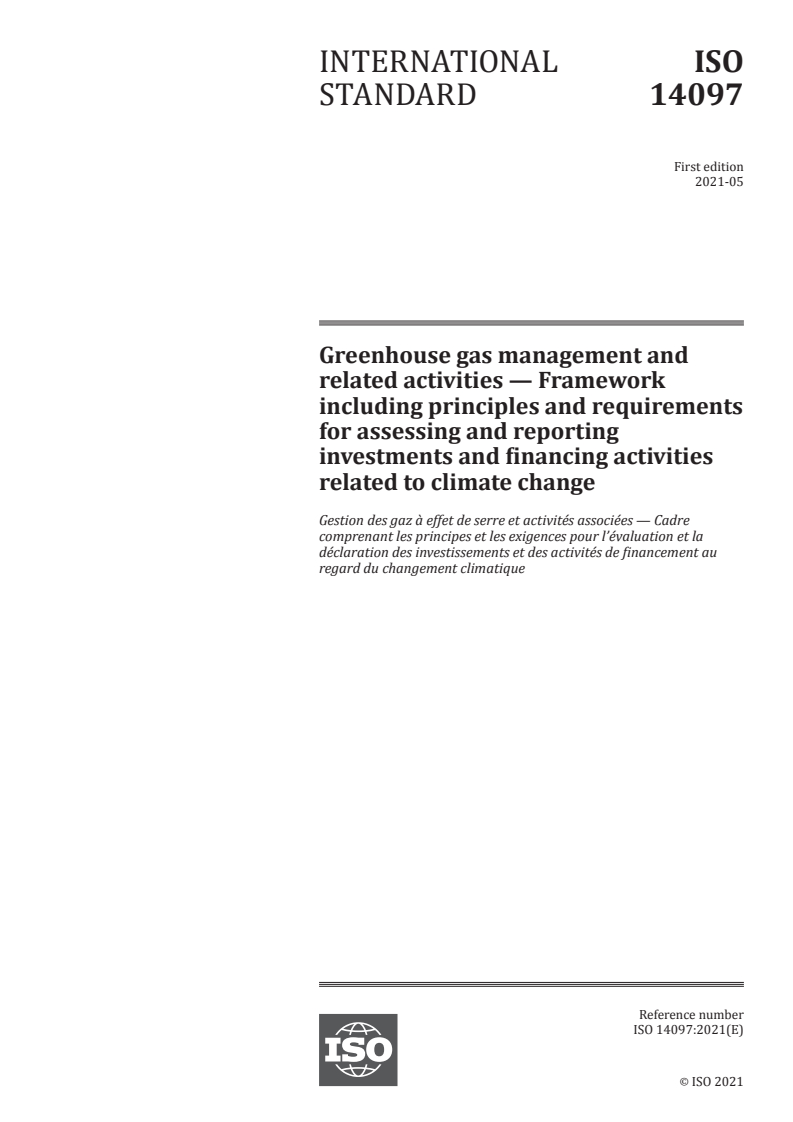

ISO 14097:2021 - Greenhouse gas management and related activities — Framework including principles and requirements for assessing and reporting investments and financing activities related to climate change/4/2021



ISO 14097:2021 - Gestion des gaz à effet de serre et activités associées -- Cadre comprenant les principes et les exigences pour l’évaluation et la déclaration des investissements et des activités de financement au regard du changement climatique

ISO 14097:2021 - Gestion des gaz à effet de serre et activités associées — Cadre comprenant les principes et les exigences pour l’évaluation et la déclaration des investissements et des activités de financement au regard du changement climatique/4/2021

ISO 14097:2021 - Greenhouse gas management and related activities — Framework including principles and requirements for assessing and reporting investments and financing activities related to climate change
Overview
ISO 14097:2021 provides a framework for assessing, measuring, monitoring and reporting investments and financing activities related to climate change. Targeted at financiers (investors and lenders), it defines principles, requirements and guidance to evaluate how financing decisions align with low‑carbon transition pathways, adaptation trajectories and climate goals (including the Paris Agreement). The standard covers both the impact of financiers’ actions on the real economy (mitigation and adaptation) and the climate‑related risks to financial assets (double materiality).
Key topics and technical requirements
- Scope and audience: Applicable to financiers - investors, lenders, asset managers - reporting to shareholders, clients, policymakers, financial supervisors and NGOs.
- Principles: Emphasizes relevance, consistency, completeness, conservativeness, long‑term orientation, transparency, verifiability, accuracy, coherence, and effectiveness among others.
- Risk and opportunity disclosure: Requires identification of short, medium and long‑term climate risks and opportunities and integration into business strategy and financial planning.
- Targets, metrics and methodologies: Guides financiers on setting targets, selecting metrics and tracking progress of investees against low‑carbon transition and adaptation trajectories.
- Impact assessment: Framework for documenting and quantifying outputs, outcomes and impacts attributable to a financier’s climate actions; includes guidance on causality/linkage between financing and real‑world climate effects.
- Monitoring and reporting: Specifies required and recommended information for transparent reporting, record‑keeping and retention.
- Verification: Addresses verification/validation of reported information to support credibility and comparability.
- Asset‑level considerations: Considers risks to a broad range of financial assets (private equity, listed equity, bonds, loans).
Practical applications and users
ISO 14097 is practical for:
- Financial institutions designing or refining climate finance strategies and disclosures.
- Risk teams incorporating climate‑related scenarios and transition risk into portfolios.
- Product teams creating green or transition finance products and conditional lending frameworks.
- ESG and sustainability reporting teams preparing disclosures for regulators, supervisors and investors.
- Asset managers and lenders documenting the impact of stewardship, lending conditions, preferential finance or policy advocacy on mitigation and adaptation.
Benefits include improved alignment with climate goals, clearer target setting, consistent metrics for tracking progress, and stronger evidence for stewardship and investment decisions.
Related standards and frameworks
ISO 14097 complements broader climate and financial disclosure frameworks - for example, the Paris Agreement goals and climate disclosure initiatives - and is intended to be used alongside other ISO guidance on greenhouse gas management and adaptation where appropriate.
Relations
- Effective Date
- 25-Aug-2026
- Effective Date
- 06-Jun-2022
Buy Documents
ISO 14097:2021 - Greenhouse gas management and related activities -- Framework including principles and requirements for assessing and reporting investments and financing activities related to climate change
ISO 14097:2021 - Greenhouse gas management and related activities — Framework including principles and requirements for assessing and reporting investments and financing activities related to climate change/4/2021
ISO 14097:2021 - Gestion des gaz à effet de serre et activités associées -- Cadre comprenant les principes et les exigences pour l’évaluation et la déclaration des investissements et des activités de financement au regard du changement climatique
ISO 14097:2021 - Gestion des gaz à effet de serre et activités associées — Cadre comprenant les principes et les exigences pour l’évaluation et la déclaration des investissements et des activités de financement au regard du changement climatique/4/2021
ISO 14097:2021 - Greenhouse gas management and related activities — Framework including principles and requirements for assessing and reporting investments and financing activities related to climate change
Get Certified
Connect with accredited certification bodies for this standard

BSI Group
BSI (British Standards Institution) is the business standards company that helps organizations make excellence a habit.

Bureau Veritas
Bureau Veritas is a world leader in laboratory testing, inspection and certification services.

DNV
DNV is an independent assurance and risk management provider.
Sponsored listings
Frequently Asked Questions
ISO 14097:2021 is a standard published by the International Organization for Standardization (ISO). Its full title is "Greenhouse gas management and related activities — Framework including principles and requirements for assessing and reporting investments and financing activities related to climate change". This standard covers: This document specifies a general framework, including principles, requirements and guidance for assessing, measuring, monitoring and reporting on investments and financing activities in relation to climate change and the transition into a low-carbon economy. The assessment includes the following items: the alignment (or lack thereof) of investment and financing decisions taken by the financier with low-carbon transition pathways, adaptation pathways, and climate goals; the impact of actions through the financier’s investment and lending decisions towards the achievement of climate goals in the real economy, i.e. mitigation (greenhouse gas emissions) and adaptation (resilience); the risks to owners of financial assets (e.g. private equities, listed stocks, bonds, loans) arising from climate change. To support the financier’s assessment of the impact of investment and lending decisions, this document provides guidance for the financier on how to: set targets and determine metrics to be used for tracking progress related to the low-carbon transition pathways of investees; determine low-carbon transition and adaptation trajectories of investees; document the causality or linkage between its climate action and its outputs, outcomes and impacts. This document is applicable to financiers, i.e. investors and lenders. It guides their reporting activities to the following third parties: shareholders, clients, policymakers, financial supervisory authorities and non-governmental organizations.
This document specifies a general framework, including principles, requirements and guidance for assessing, measuring, monitoring and reporting on investments and financing activities in relation to climate change and the transition into a low-carbon economy. The assessment includes the following items: the alignment (or lack thereof) of investment and financing decisions taken by the financier with low-carbon transition pathways, adaptation pathways, and climate goals; the impact of actions through the financier’s investment and lending decisions towards the achievement of climate goals in the real economy, i.e. mitigation (greenhouse gas emissions) and adaptation (resilience); the risks to owners of financial assets (e.g. private equities, listed stocks, bonds, loans) arising from climate change. To support the financier’s assessment of the impact of investment and lending decisions, this document provides guidance for the financier on how to: set targets and determine metrics to be used for tracking progress related to the low-carbon transition pathways of investees; determine low-carbon transition and adaptation trajectories of investees; document the causality or linkage between its climate action and its outputs, outcomes and impacts. This document is applicable to financiers, i.e. investors and lenders. It guides their reporting activities to the following third parties: shareholders, clients, policymakers, financial supervisory authorities and non-governmental organizations.
ISO 14097:2021 is classified under the following ICS (International Classification for Standards) categories: 03.060 - Finances. Banking. Monetary systems. Insurance; 13.020.20 - Environmental economics. Sustainability. The ICS classification helps identify the subject area and facilitates finding related standards.
ISO 14097:2021 has the following relationships with other standards: It is inter standard links to EN ISO 14065:2021, ISO 10297:2024. Understanding these relationships helps ensure you are using the most current and applicable version of the standard.
ISO 14097:2021 is available in PDF format for immediate download after purchase. The document can be added to your cart and obtained through the secure checkout process. Digital delivery ensures instant access to the complete standard document.
Standards Content (Sample)
INTERNATIONAL ISO
STANDARD 14097
First edition
2021-05
Greenhouse gas management and
related activities — Framework
including principles and requirements
for assessing and reporting
investments and financing activities
related to climate change
Gestion des gaz à effet de serre et activités associées — Cadre
comprenant les principes et les exigences pour l’évaluation et la
déclaration des investissements et des activités de financement au
regard du changement climatique
Reference number
©
ISO 2021
© ISO 2021
All rights reserved. Unless otherwise specified, or required in the context of its implementation, no part of this publication may
be reproduced or utilized otherwise in any form or by any means, electronic or mechanical, including photocopying, or posting
on the internet or an intranet, without prior written permission. Permission can be requested from either ISO at the address
below or ISO’s member body in the country of the requester.
ISO copyright office
CP 401 • Ch. de Blandonnet 8
CH-1214 Vernier, Geneva
Phone: +41 22 749 01 11
Email: copyright@iso.org
Website: www.iso.org
Published in Switzerland
ii © ISO 2021 – All rights reserved
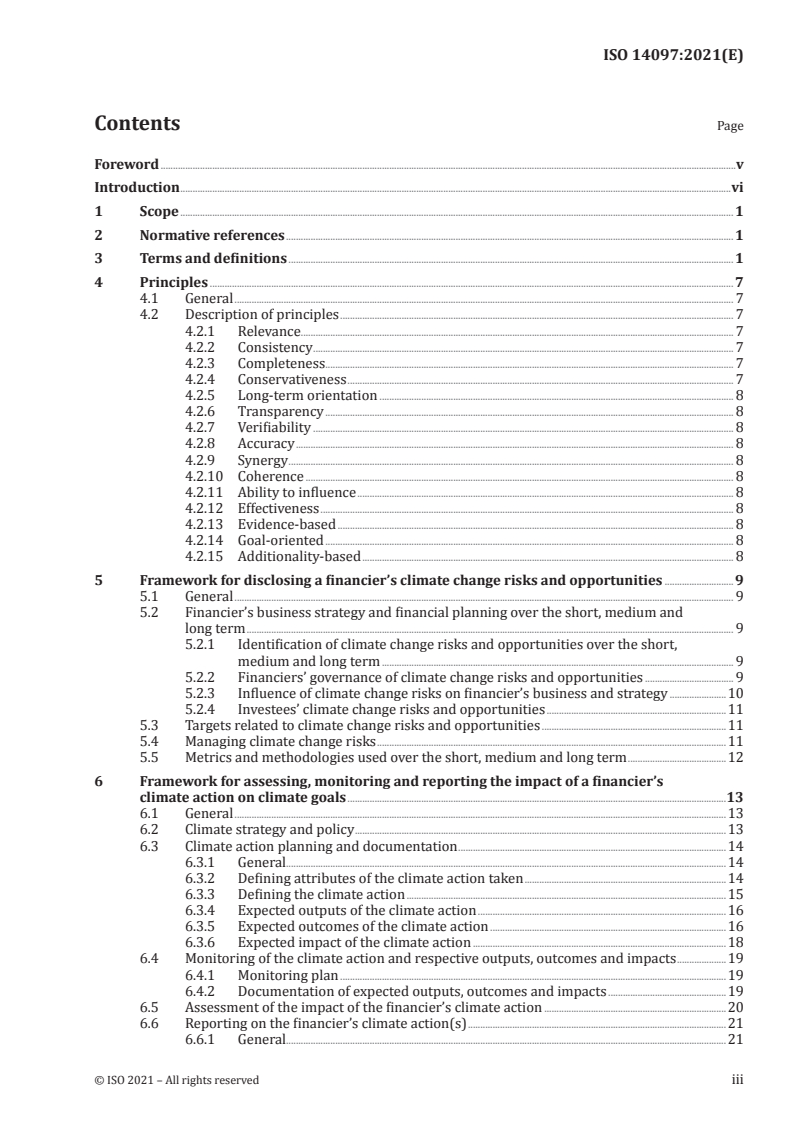
Contents Page
Foreword .v
Introduction .vi
1 Scope . 1
2 Normative references . 1
3 Terms and definitions . 1
4 Principles . 7
4.1 General . 7
4.2 Description of principles . 7
4.2.1 Relevance . . 7
4.2.2 Consistency . 7
4.2.3 Completeness . 7
4.2.4 Conservativeness . 7
4.2.5 Long-term orientation . 8
4.2.6 Transparency . 8
4.2.7 Verifiability . 8
4.2.8 Accuracy . 8
4.2.9 Synergy . 8
4.2.10 Coherence . 8
4.2.11 Ability to influence . 8
4.2.12 Effectiveness . 8
4.2.13 Evidence-based . 8
4.2.14 Goal-oriented . 8
4.2.15 Additionality-based . 8
5 Framework for disclosing a financier’s climate change risks and opportunities .9
5.1 General . 9
5.2 Financier’s business strategy and financial planning over the short, medium and
long term . 9
5.2.1 Identification of climate change risks and opportunities over the short,
medium and long term . 9
5.2.2 Financiers’ governance of climate change risks and opportunities . 9
5.2.3 Influence of climate change risks on financier’s business and strategy .10
5.2.4 Investees’ climate change risks and opportunities .11
5.3 Targets related to climate change risks and opportunities .11
5.4 Managing climate change risks .11
5.5 Metrics and methodologies used over the short, medium and long term .12
6 Framework for assessing, monitoring and reporting the impact of a financier’s
climate action on climate goals .13
6.1 General .13
6.2 Climate strategy and policy .13
6.3 Climate action planning and documentation .14
6.3.1 General.14
6.3.2 Defining attributes of the climate action taken .14
6.3.3 Defining the climate action .15
6.3.4 Expected outputs of the climate action .16
6.3.5 Expected outcomes of the climate action .16
6.3.6 Expected impact of the climate action .18
6.4 Monitoring of the climate action and respective outputs, outcomes and impacts .19
6.4.1 Monitoring plan .19
6.4.2 Documentation of expected outputs, outcomes and impacts .19
6.5 Assessment of the impact of the financier’s climate action .20
6.6 Reporting on the financier’s climate action(s) .21
6.6.1 General.21
6.6.2 Required information .21
6.7 Recommended information .23
6.7.1 General.23
6.7.2 Defining the climate action .24
6.7.3 Expected output of the climate action .24
6.7.4 Expected outcome of the climate action .24
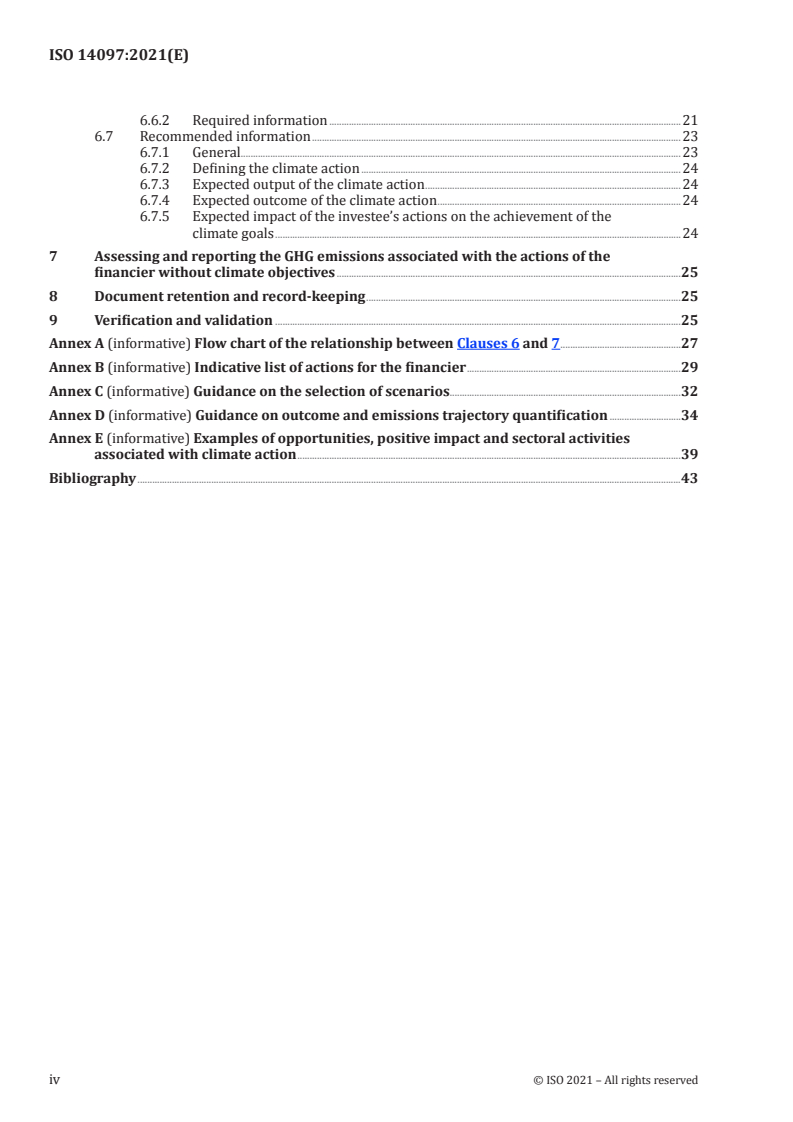
6.7.5 Expected impact of the investee’s actions on the achievement of the
climate goals .24
7 Assessing and reporting the GHG emissions associated with the actions of the
financier without climate objectives .25
8 Document retention and record-keeping .25
9 Verification and validation .25
Annex A (informative) Flow chart of the relationship between Clauses 6 and 7 .27
Annex B (informative) Indicative list of actions for the financier .29
Annex C (informative) Guidance on the selection of scenarios .32
Annex D (informative) Guidance on outcome and emissions trajectory quantification .34
Annex E (informative) Examples of opportunities, positive impact and sectoral activities
associated with climate action .39
Bibliography .43
iv © ISO 2021 – All rights reserved
Foreword
ISO (the International Organization for Standardization) is a worldwide federation of national standards
bodies (ISO member bodies). The work of preparing International Standards is normally carried out
through ISO technical committees. Each member body interested in a subject for which a technical
committee has been established has the right to be represented on that committee. International
organizations, governmental and non-governmental, in liaison with ISO, also take part in the work.
ISO collaborates closely with the International Electrotechnical Commission (IEC) on all matters of
electrotechnical standardization.
The procedures used to develop this document and those intended for its further maintenance are
described in the ISO/IEC Directives, Part 1. In particular, the different approval criteria needed for the
different types of ISO documents should be noted. This document was drafted in accordance with the
editorial rules of the ISO/IEC Directives, Part 2 (see www .iso .org/ directives).
Attention is drawn to the possibility that some of the elements of this document may be the subject of
patent rights. ISO shall not be held responsible for identifying any or all such patent rights. Details of
any patent rights identified during the development of the document will be in the Introduction and/or
on the ISO list of patent declarations received (see www .iso .org/ patents).
Any trade name used in this document is information given for the convenience of users and does not
constitute an endorsement.
For an explanation of the voluntary nature of standards, the meaning of ISO specific terms and
expressions related to conformity assessment, as well as information about ISO’s adherence to the
World Trade Organization (WTO) principles in the Technical Barriers to Trade (TBT), see www .iso .org/
iso/ foreword .html.
This document was prepared by Technical Committee ISO/TC 207, Environmental management,
Subcommittee SC 7, Greenhouse gas management and related activities.
Any feedback or questions on this document should be directed to the user’s national standards body. A
complete listing of these bodies can be found at www .iso .org/ members .html.
Introduction
0.1 The impact of financiers’ actions on the achievement of climate goals
Every financing or investment decision has an impact, whether positive or negative, on the climate and/
or can in turn be affected by climate change. This dual impact is considered as a “double materiality”,
i.e. how climate change affects the value of a company and how a company’s activities have an impact
on the climate by reducing greenhouse gas (GHG) emissions in the real economy, reducing vulnerability
to the impacts of climate change and increasing resilience.
[12]
To achieve the goals of the 2015 Paris Agreement and to maintain stability in the financial system,
the world needs to transition to a low-carbon and climate-resilient economy. To support this transition,
there is a need to undertake a vast reallocation of the investee capital from high-carbon to low-carbon
assets, assets with negative emissions and assets that are resilient in the short, medium and long term.
In addition to promoting financing for an already de-carbonized or low carbon activity (e.g. in the
area of renewable energy), it is important to promote financing for transition actions towards the de-
carbonization of GHG emitting industries and sectors as well, as a part of climate finance contributing
to the mitigation of climate change. Climate transition finance should be considered as financing
for businesses on a transition path towards achieving the ambition of the Paris Agreement and the
reduction target of each country based on the Paris Agreement. While green investments expand across
borders worldwide, transition pathways aligned with the Paris Agreement can differ from region to
region and from country to country, depending on the industrial structure, and/or the role played in the
overall global value chain. Therefore, “financing for a transition” should adopt an inclusive and flexible
approach that can be applied to various circumstances of countries and regions without excluding
specific sectors, industries or technologies from its scope, and further details should be considered by
each country or region based on its respective circumstances.
Financiers have a key role to play in this transformation because their day-to-day decisions can
influence the behaviour of “investees” (e.g. companies, clients, borrowers) in the real economy. Such an
influence can include capital and research and development expenditure plans, the decision to retire (or
not) high-carbon assets, or other aspects of corporate strategies. Similarly, financiers can influence the
investment decisions of their clients due to their potentially broad-ranging roles as creditors, financial
advisors or asset managers. The day-to-day decisions of financiers can have both positive and negative
consequences on the achievement of climate goals.
Most financiers manage their assets without an explicit objective or specific strategy related to climate
change. These financiers’ decisions and related actions can affect investees that have an impact on the
climate and can be exposed to climate-related risks. Any resulting effect, which can be thought of as
unintentional, can have positive or negative consequences both for the climate and for the assets of the
financiers. This document refers to these financiers as “financiers without climate objectives”.
In contrast, some financiers explicitly aim to support climate goals either by setting explicit objectives
or by creating specific strategies related to climate change. This document refers to these financiers as
“financiers with climate objectives”. These financiers influence investees through “climate actions” that
will lead to mitigation of climate change or enhancement of adaptation, including but not limited to:
— the use of voting rights associated with share ownership;
— the use of influencing power as creditors;
— setting conditionality associated with lending or security issuance;
— making preferential financing available for targeted activities that face a financing gap;
— conducting policy advocacy.
vi © ISO 2021 – All rights reserved
The finance sector’s active role in supporting the global concerted efforts to achieve international
[12]
climate goals has been acknowledged in Article 2.1c of the Paris Agreement and by the following
non-exhaustive list of organizations and initiatives:
— the United Nations (United Nations Environmental Programme Inquiry, Non-state Actors Zone for
Climate Action platform hosted by UN Climate Change);
— the Organization for Economic Cooperation and Development (OECD):
— the G20 (Green Finance Study Group);
[16]
— the European Commission through the Action Plan on Financing Sustainable Growth (2018) ;
[17]
the Guidelines on Reporting Climate-related Information (2019) , the Non-Financial Reporting
[18] [19]
Directive (2014) and the Non-Binding Guidelines on Non-Financial Reporting (2017) ;
— various financial supervisors and central banks across the world who joined forces in the Network
for Greening the Financial System (NGFS);
— the UN Principles for Responsible Banking;
— the UN-convened Net-Zero Asset Owner Alliance.
In this context, this document provides principles, requirements and guidance to define, monitor, assess
and report on financial institutions’ actions related to climate change and their respective contribution
to the achievement of the climate goals. The framework can be applied by financiers who undertake
deliberate climate actions, as well as by financiers without climate objectives or strategies.
For financiers with climate objectives, the framework is built around the theory of change (TOC)
approach, illustrated in Figure 1.
Figure 1 — Theory of change approach
The TOC process depends on defining all of the necessary and sufficient conditions required to bring
about a given long-term outcome and impact. The TOC explains the intended path the climate action
will take to achieve the (expected) impact. This is done by describing the causal linkages between
the objective established by the financier, the climate action the financier plans to take to achieve the
objective, the output(s) of the action and finally the outcome that will lead to the impact.
For financiers without climate objectives, the framework describes how to disclose on the GHG
emissions changes of investees in their financial portfolio and the decisions and actions taken that can
relate to the investees who are responsible for an increase or decrease in emissions.
0.2 The financial implications of climate change for the finance sector
For the finance sector, both the transition to a low-carbon emission and climate-resilient economy and
the negative impact arising from environmental upheavals and civil society preferences can influence
asset valuation and thus result in risks and opportunities for financiers.
In 2016, the G20’s Financial Stability Board (FSB) initiated a private sector-led group, the Task Force
on Climate-Related Financial Disclosures (TCFD), which explored these climate-related risks and
opportunities and developed a set of high-level recommendations regarding their disclosure of the
assessment and management of climate-related risks and opportunities.
These climate-related risks and opportunities for the finance sector have also been acknowledged
by many financial regulators and supervisory authorities across the world, including the European
Commission, the G20 and the NGFS.
[13]
Following the release of the TCFD recommendations in 2017 , a number of methodological, reporting
and disclosure frameworks have been and are in the process of being produced by various organizations
to facilitate stakeholders to measure and report on climate-related risks and opportunities.
[13]
In this context, this document contributes to the implementation of the TCFD recommendations ,
by providing guidance on the disclosure of the identification, assessment and management of climate-
related risks and opportunities and related climate actions.
This document can also be used to correlate climate performance and financial performance.
0.3 How to approach this document
As mentioned, a financier has financial and other objectives underpinning its business activities. In
relation to climate change, the financier can have different motivations for integrating climate-related
issues in its investment and lending processes. Objectives can include, but are not limited to:
a) understanding and managing climate change risks and leveraging opportunities;
b) contributing to the achievement of climate goals through the influence they have on investees.
This document provides the following requirements and related guidance for the processes
implemented to achieve these objectives. Depending on its objectives, the financier applies the clauses
indicated for the following purposes.
— Managing climate change risks and leveraging opportunities: Clause 5 provides requirements and
guidance on the identification, assessment and disclosure of climate change risks and opportunities.
— Understanding its contribution to the achievement of climate goals: Clause 6 provides a framework to
identify, monitor and assess the impact of climate action and estimate the GHG emissions associated
with investment, as well as for financing activities related to investees for which no climate action
is carried out.
NOTE See Annex A for a flow chart on the different clauses and subclauses of this document.
A financier’s business decisions can be driven only by financially related objectives (or at least no
climate objectives). However, these financier decisions can also have an impact on the climate and,
consequently, on the achievement of its climate goals, as well as exposing its business to climate-related
risks. In this instance, the financier shall follow Clause 7 to understand the GHG emissions changes and
trends associated with the investees in its portfolio and Clause 5 for disclosing climate-related risks.
Since the framework can be used for a variety of purposes, and also by financiers without climate
objectives or strategies, it is important to note that conformity does not equate to high ambition or
success with regard to climate actions. Users of the framework are encouraged to observe this caveat in
their reporting to third parties.
Clause 9 recommends verification and validation as the preferred approaches for conformity
assessment.
viii © ISO 2021 – All rights reserved
INTERNATIONAL STANDARD ISO 14097:2021(E)
Greenhouse gas management and related activities —
Framework including principles and requirements
for assessing and reporting investments and financing
activities related to climate change
1 Scope
This document specifies a general framework, including principles, requirements and guidance for
assessing, measuring, monitoring and reporting on investments and financing activities in relation
to climate change and the transition into a low-carbon economy. The assessment includes the
following items:
— the alignment (or lack thereof) of investment and financing decisions taken by the financier with
low-carbon transition pathways, adaptation pathways, and climate goals;
— the impact of actions through the financier’s investment and lending decisions towards the
achievement of climate goals in the real economy, i.e. mitigation (greenhouse gas emissions) and
adaptation (resilience);
— the risks to owners of financial assets (e.g. private equities, listed stocks, bonds, loans) arising from
climate change.
To support the financier’s assessment of the impact of investment and lending decisions, this document
provides guidance for the financier on how to:
— set targets and determine metrics to be used for tracking progress related to the low-carbon
transition pathways of investees;
— determine low-carbon transition and adaptation trajectories of investees;
— document the causality or linkage between its climate action and its outputs, outcomes and impacts.
This document is applicable to financiers, i.e. investors and lenders. It guides their reporting activities
to the following third parties: shareholders, clients, policymakers, financial supervisory authorities
and non-governmental organizations.
2 Normative references
There are no normative references in this document.
3 Terms and definitions
For the purposes of this document, the following terms and definitions apply.
ISO and IEC maintain terminological databases for use in standardization at the following addresses:
— ISO Online browsing platform: available at https:// www .iso .org/ obp
— IEC Electropedia: available at http:// www .electropedia .org/
3.1
climate goals
international long-term goals based on mitigation and adaptation priorities
Note 1 to entry: International climate goals are defined under the Paris Agreement.
Note 2 to entry: The Paris Agreement defines the following mitigation and adaptation goals: a) holding the
increase in the global average temperature to well below 2 °C above pre-industrial levels and pursuing efforts
to limit the temperature increase to 1,5 °C above pre-industrial levels, recognizing that this would significantly
reduce the risks and impacts of climate change (3.2); b) increasing the ability to adapt to the adverse impacts
of climate change and foster climate resilience (3.5) and low greenhouse gas emissions development, in a
manner which does not threaten food production; c) making finance flows aligned with a pathway towards low
greenhouse gas emissions and climate-resilient development.
[12]
[SOURCE: Paris Agreement , Article 2.1]
3.2
climate change
change in climate that persists for an extended period, typically decades or longer
[15]
[SOURCE: Intergovernmental Panel on Climate Change (IPCC) , modified]
3.3
climate change mitigation
human intervention to reduce the emission sources or enhance the sinks of greenhouse gases (GHGs)
[SOURCE: ISO 14080:2018, 3.1.2.1, modified — The word “emission” has been added to the definition.]
3.4
climate change adaptation
adaptation to climate change
process of adjustment to actual or expected climate and its effects
EXAMPLE Changes to human infrastructure and/or some natural systems to reduce the impacts of
increased/decreased rainfall, higher temperatures, scarce water or more frequent storms.
Note 1 to entry: In human systems, adaptation seeks to moderate or avoid harm to human livelihoods or exploit
beneficial economic opportunities (3.13).
Note 2 to entry: In some natural systems, human intervention can facilitate adjustment expected climate and its
effects.
[SOURCE: ISO 14090:2019, 3.1, modified — The term “climate change adaptation” has been made the
preferred term, the example has been added, and “to human livelihoods” and “economic” have been
added to Note 1 to entry.]
3.5
resilience
adaptive capacity (3.6) of an organization in a complex and changing environment
[15]
Note 1 to entry: Intergovernmental Panel on Climate Change (IPCC) defines resilience as “capacity of social,
economic, and environmental systems to cope with a hazardous event or trend or disturbance, responding or
reorganizing in ways that maintain their essential function, identity and structure, while also maintaining the
capacity for adaptation, learning and transformation”.
[SOURCE: ISO Guide 73:2009, 3.8.1.7, modified — Note 1 to entry has been added.]
3.6
adaptive capacity
ability of systems, institutions, humans and other organisms to adjust to potential damage, to take
advantage of opportunities (3.13) or to respond to consequences
[15]
[SOURCE: Intergovernmental Panel on Climate Change (IPCC) ]
2 © ISO 2021 – All rights reserved
3.7
financier
investor (3.8) and lender (3.10)
3.8
investor
individual or organization holding equity or debt categorized as financial assets, including but not
limited to asset owners (e.g. pension funds, insurance companies), asset managers and banks
EXAMPLE A fund holding an equity share is one of the investors of the company that issued the share.
3.9
investment
allocation of resources to achieve defined objectives and other benefits
Note 1 to entry: Investments relate to three different types: a) real assets (e.g. factory, mine, building); b) financial
assets (e.g. any form of debt, equity or other financing); c) intangible assets (e.g. assets related to research and
development).
3.10
lender
individual or organization that loans money to a borrower to finance consumption or investment
(3.9), on the expectation of repayment on contractual terms, usually within a stated period and with
interest payment
3.11
investee
organization other than financiers (3.7) that implements its activities using equity or debt investments
(3.9), the latter categorized as liabilities
EXAMPLE A company issuing a bond is the investee of the bond investor (3.8).
3.12
client
professional or non-professional stakeholder of a financier (3.7) that subscribes to its financial products
(e.g. investment (3.9)/insurance products, savings accounts) or institutional investor (3.8) that uses the
financier’s services
3.13
opportunity
situation from which an organization can derive benefit
Note 1 to entry: In this document, the focus is on opportunities that arise from climate change (3.2), i.e. the
positive impacts related to climate change (e.g. new markets, new or improved supply chains, research and
development and technology development)
Note 2 to entry: Opportunities for an organization can be a result of taking action to adapt to the physical impacts
of climate change and to mitigate climate change (e.g. efforts to improve resource efficiency and cost savings, the
adoption and utilization of low-emission energy sources, the development of new products and services, building
resilience (3.5) along the supply chain).
Note 3 to entry: Opportunities for an organization can arise from the implementation of climate policy
Note 4 to entry: Opportunities for an organization can arise from expanding, evolving or emerging markets and
from contributions (3.16) to the organization’s sustainability. Opportunities can include: new products, services,
customers and markets; reputational benefits; supply chain security; improved resilience; improved processes;
and innovation. Opportunities can be identified across value chains and their respective enabling environments.
Note 5 to entry: Climate-related opportunities will vary depending on the region, market and industry in which
an organization operates.
3.14
share in total financing
quantitative indicator measuring the weight of a financier (3.7) or category of financiers in the total
amount of financing received by an investee (3.11)
Note 1 to entry: Share in total financing can relate to the share in the total debt or total liabilities accounted on
the balance sheet of the investee or the share in the flow of financing received during any defined period of time.
EXAMPLE Bank A holds 80 % of the outstanding debt of a company. Bank B holds 30 % of the debt raised by
the company in the past six months. The shares in total financing related to “outstanding debt of a company” and
“debt raised by the company in the past six months” are respectively 80 % and 30 %.
3.15
climate action
initiative of a financier (3.7) to achieve climate goals (3.1) based on mitigation and adaptation priorities
Note 1 to entry: Climate action intends to a) reduce or prevent emissions of greenhouse gases or enhance
removals, and b) reduce vulnerability, maintain and increase the resilience (3.5) from, and increase the adaptive
capacity (3.6) of, human and ecological systems to adverse climate change (3.2) impacts.
Note 2 to entry: The initiative refers to a decision made by the financier or a group of financiers to exercise
its influence in a way that aims at achieving climate goals. It can be a specific investment/lending decision, a
permanent change in the investment/lending strategy, policy and processes of the financier(s), or actions that
aim at mobilizing other financiers to weigh in and use their influence.
Note 3 to entry: The achievement is characterized by changes in the real economy that are aligned with
climate goals.
EXAMPLE Use of shareholder voting rights to support a climate-related resolution, changes in the climate-
related conditions associated with the provision of a loan (see Annex B for more examples).
Note 4 to entry: Climate action(s) can be collective or individual.
Note 5 to entry: A climate action can consist of multiple activities (e.g. providing finance, sending letters to
investees (3.11), having bilateral meetings, exercising shareholder rights) substantiating a general action (e.g.
shareholder engagement).
[SOURCE: ISO 14080:2018, 3.1.1.1, modified — The definition has replaced “initiative to achieve climate
change measures or goals based on mitigation and/or adaptation priorities under climate change
policies”, “of greenhouse gases” has been added to Note 1 to entry, and Notes 2 to 5 to entry and the
example have been added.]
3.16
contribution
overall effect of a financier’s (3.7) actions on the achievement of climate goals (3.1)
Note 1 to entry: Climate contribution accounts for the effect caused by both a) climate passive decisions and b)
deliberate climate actions (3.15) driven by an objective that supports the achievement of climate goals.
Note 2 to entry: For climate change mitigation (3.3), it is usually expressed in GHG emission units. For climate
change adaptation (3.4), it may be expressed in terms of financial metrics, e.g. the reduction of the costs incurred
by climate-related natural disasters.
Note 3 to entry: Contribution can be positive or negative.
3.17
output of the climate action
change(s) arising from a financier’s (3.7) climate action (3.15) that influences the investee (3.11)
decision making
Note 1 to entry: The output can be quantitative or qualitative.
4 © ISO 2021 – All rights reserved
EXAMPLE The available equity for an emerging clean technology is dramatically increased; a shareholder
resolution on climate-related issues is passed at the annual general meeting; a legal process on climate-related
issues has been started.
3.18
outcome of the climate action
actual measurable change(s) observed in the activities of an investee (3.11), as a result of the output of
the climate action (3.17)
Note 1 to entry: The outcome is measured as an effect of the financier’s (3.7) influence in the activities of the
investee.
3.19
impact of the climate action
consequence of an outcome, which measures the extent to which the climate action (3.15) contributes to
the climate goals (3.1)
Note 1 to entry: For mitigation, the impact of the climate action is usually measured in physical units such as tons
of GHG emission reductions.
Note 2 to entry: The impact of the climate action can lead to a decrease in the financier’s (3.7) exposure to climate-
related financial risks and opportunities (3.13).
3.20
target
measurable outcome and impact a financier (3.7) intends to achieve with its climate
action(s) (3.15) with the ultimate goal being to maximize the financier’s impact given available market
opportunities (3.13)
Note 1 to entry: A mitigation target for a financier is considered science-based when it aims for a change in the
investee’s (3.11) behaviour, contributing to reducing GHG emissions in the real economy at a scale and pace that is
commensurate with climate goals (3.1).
Note 2 to entry: To achieve the target, the financier can carry out one or several climate actions.
Note 3 to entry: A target can be set at the portfolio level and cascaded into individual climate actions. It can be set
for an individual climate action or a series of climate actions.
3.21
investee target
measurable outcome and impact of investee (3.11) activities
3.22
external factor
factor affecting outputs, outcomes and impacts, but that is beyond the scope of influence of the climate
actions (3.15) and/or activities of a financier (3.7)
EXAMPLE 1 The removal of a coal-based power plant from the investment (3.9) plan of the investee (3.11) as a
consequence of a new public policy prohibiting operation of coal-based power plants.
EXAMPLE 2 Non-governmental organization pressure; changes in technology prices; subsidies; natural
disasters; locked out strikes.
3.23
science-based mitigation target
target (3.20) adopted by investees (3.11) to reduce GHG emissions in line with the scientifically defined
level of decarbonization required by climate change mitigation (3.3) goals
3.24
trajectory
expected future outcome and GHG emissions pathway of an investee (3.11) against which changes in
emissions or outcomes are measured
Note 1 to entry: There are different types of trajectories: a) the business as usual trajectory, which is the
expected future outcome and related GHG trajectory of the investee before climate action (3.15) takes place; b)
the targeted trajectory, which is the expected outcome and related GHG trajectory resulting from climate action;
and c) the science-based trajectory, which is an expected future outcome and related GHG trajectory in line with
the scientifically defined level of decarbonization required by climate change mitigation (3.3) goals.
Note 2 to entry: The business as usual trajectory can be considered as the baseline trajectory for comparison and
monitoring purposes.
3.25
transition risk
risk related to the transition to a lower-carbon economy
Note 1 to entry: The transition risk is related to policy/political initiatives, legal and regulatory obligations,
contractual obligations, technology and market changes to address mitigation and adaptation requirements
related to climate change (3.2).
Note 2 to entry: Transition risk results in varying levels of impact on the financial performance and reputation of
the financier (3.7).
Note 3 to entry: Transition risks are related to current and anticipated policy constraints and incentives in
relevant jurisdictions, technology changes and availability, and market changes.
[13]
[SOURCE: Task Force on Climate-Related Financial Disclosures (TCFD) ]
3.26
physical risk
risk resulting from event-driven (acute) or longer-term shifts (chronic) in climate patterns associated
with climate change (3.2)
Note 1 to entry: Physical risks can have financial implications for organizations, such as direct impact to assets
and indirect impacts on supply chains owing to changes in water availability, sourcing and quality, food security,
and for organizations’ premises and operations, supply chain, transport needs and employee safety owing to
extreme temperature changes.
Note 2 to entry: Acute physical risks refer to those risks that are event-driven, including increased severity of
extreme weather events, such as cyclones, hurricanes or floods.
Note 3 to entry: Chronic physical risks refer to longer-term shifts in climate patterns (e.g. sustained higher
temperatures) that can cause sea-level rise or chronic heat waves.
3.27
climate change risk
risk related to climate change (3.2) that includes, but is not limited to, transition risk (3.25) and physical
risk (3.26)
3.28
validation
process for evaluating the reasonableness of the assumptions, limitations and methods that support a
statement about the outcome of future activities
[SOURCE: ISO 14064-3:2019, 3.6.3]
6 © ISO 2021 – All rights reserved
3.29
verification
process for evaluating a statement of historical data and information to determine if the statement is
materially correct and conforms to criteria
[SOURCE: ISO 14064-3:2019, 3.6.2]
3.30
material
information capable of influencing the decisions of intended users
[SOURCE: ISO 14064-3:2019, 3.6.8]
3.31
disclose
reveal data to those not routinely authorized to have it
Note 1 to entry: Disclosure is the act or an instance of disclosing.
[SOURCE: ISO/TS 14265:2011, 2.13, modified — Note 1 to entry has been added.]
4 Principles
4.1 General
The principles are the basis for, and will guide the application of, the requirements and guidance in this
document.
4.2 Description of principles
4.2.1 Relevance
Activities, data, information, scenarios and methodologies used are appropriate for assessing and
disclosing the im
...
INTERNATIONAL ISO
STANDARD 14097
First edition
2021-05
Greenhouse gas management and
related activities — Framework
including principles and requirements
for assessing and reporting
investments and financing activities
related to climate change
Gestion des gaz à effet de serre et activités associées — Cadre
comprenant les principes et les exigences pour l’évaluation et la
déclaration des investissements et des activités de financement au
regard du changement climatique
Reference number
©
ISO 2021
© ISO 2021
All rights reserved. Unless otherwise specified, or required in the context of its implementation, no part of this publication may
be reproduced or utilized otherwise in any form or by any means, electronic or mechanical, including photocopying, or posting
on the internet or an intranet, without prior written permission. Permission can be requested from either ISO at the address
below or ISO’s member body in the country of the requester.
ISO copyright office
CP 401 • Ch. de Blandonnet 8
CH-1214 Vernier, Geneva
Phone: +41 22 749 01 11
Email: copyright@iso.org
Website: www.iso.org
Published in Switzerland
ii © ISO 2021 – All rights reserved
Contents Page
Foreword .v
Introduction .vi
1 Scope . 1
2 Normative references . 1
3 Terms and definitions . 1
4 Principles . 7
4.1 General . 7
4.2 Description of principles . 7
4.2.1 Relevance . . 7
4.2.2 Consistency . 7
4.2.3 Completeness . 7
4.2.4 Conservativeness . 7
4.2.5 Long-term orientation . 8
4.2.6 Transparency . 8
4.2.7 Verifiability . 8
4.2.8 Accuracy . 8
4.2.9 Synergy . 8
4.2.10 Coherence . 8
4.2.11 Ability to influence . 8
4.2.12 Effectiveness . 8
4.2.13 Evidence-based . 8
4.2.14 Goal-oriented . 8
4.2.15 Additionality-based . 8
5 Framework for disclosing a financier’s climate change risks and opportunities .9
5.1 General . 9
5.2 Financier’s business strategy and financial planning over the short, medium and
long term . 9
5.2.1 Identification of climate change risks and opportunities over the short,
medium and long term . 9
5.2.2 Financiers’ governance of climate change risks and opportunities . 9
5.2.3 Influence of climate change risks on financier’s business and strategy .10
5.2.4 Investees’ climate change risks and opportunities .11
5.3 Targets related to climate change risks and opportunities .11
5.4 Managing climate change risks .11
5.5 Metrics and methodologies used over the short, medium and long term .12
6 Framework for assessing, monitoring and reporting the impact of a financier’s
climate action on climate goals .13
6.1 General .13
6.2 Climate strategy and policy .13
6.3 Climate action planning and documentation .14
6.3.1 General.14
6.3.2 Defining attributes of the climate action taken .14
6.3.3 Defining the climate action .15
6.3.4 Expected outputs of the climate action .16
6.3.5 Expected outcomes of the climate action .16
6.3.6 Expected impact of the climate action .18
6.4 Monitoring of the climate action and respective outputs, outcomes and impacts .19
6.4.1 Monitoring plan .19
6.4.2 Documentation of expected outputs, outcomes and impacts .19
6.5 Assessment of the impact of the financier’s climate action .20
6.6 Reporting on the financier’s climate action(s) .21
6.6.1 General.21
6.6.2 Required information .21
6.7 Recommended information .23
6.7.1 General.23
6.7.2 Defining the climate action .24
6.7.3 Expected output of the climate action .24
6.7.4 Expected outcome of the climate action .24
6.7.5 Expected impact of the investee’s actions on the achievement of the
climate goals .24
7 Assessing and reporting the GHG emissions associated with the actions of the
financier without climate objectives .25
8 Document retention and record-keeping .25
9 Verification and validation .25
Annex A (informative) Flow chart of the relationship between Clauses 6 and 7 .27
Annex B (informative) Indicative list of actions for the financier .29
Annex C (informative) Guidance on the selection of scenarios .32
Annex D (informative) Guidance on outcome and emissions trajectory quantification .34
Annex E (informative) Examples of opportunities, positive impact and sectoral activities
associated with climate action .39
Bibliography .43
iv © ISO 2021 – All rights reserved
Foreword
ISO (the International Organization for Standardization) is a worldwide federation of national standards
bodies (ISO member bodies). The work of preparing International Standards is normally carried out
through ISO technical committees. Each member body interested in a subject for which a technical
committee has been established has the right to be represented on that committee. International
organizations, governmental and non-governmental, in liaison with ISO, also take part in the work.
ISO collaborates closely with the International Electrotechnical Commission (IEC) on all matters of
electrotechnical standardization.
The procedures used to develop this document and those intended for its further maintenance are
described in the ISO/IEC Directives, Part 1. In particular, the different approval criteria needed for the
different types of ISO documents should be noted. This document was drafted in accordance with the
editorial rules of the ISO/IEC Directives, Part 2 (see www .iso .org/ directives).
Attention is drawn to the possibility that some of the elements of this document may be the subject of
patent rights. ISO shall not be held responsible for identifying any or all such patent rights. Details of
any patent rights identified during the development of the document will be in the Introduction and/or
on the ISO list of patent declarations received (see www .iso .org/ patents).
Any trade name used in this document is information given for the convenience of users and does not
constitute an endorsement.
For an explanation of the voluntary nature of standards, the meaning of ISO specific terms and
expressions related to conformity assessment, as well as information about ISO’s adherence to the
World Trade Organization (WTO) principles in the Technical Barriers to Trade (TBT), see www .iso .org/
iso/ foreword .html.
This document was prepared by Technical Committee ISO/TC 207, Environmental management,
Subcommittee SC 7, Greenhouse gas management and related activities.
Any feedback or questions on this document should be directed to the user’s national standards body. A
complete listing of these bodies can be found at www .iso .org/ members .html.
Introduction
0.1 The impact of financiers’ actions on the achievement of climate goals
Every financing or investment decision has an impact, whether positive or negative, on the climate and/
or can in turn be affected by climate change. This dual impact is considered as a “double materiality”,
i.e. how climate change affects the value of a company and how a company’s activities have an impact
on the climate by reducing greenhouse gas (GHG) emissions in the real economy, reducing vulnerability
to the impacts of climate change and increasing resilience.
[12]
To achieve the goals of the 2015 Paris Agreement and to maintain stability in the financial system,
the world needs to transition to a low-carbon and climate-resilient economy. To support this transition,
there is a need to undertake a vast reallocation of the investee capital from high-carbon to low-carbon
assets, assets with negative emissions and assets that are resilient in the short, medium and long term.
In addition to promoting financing for an already de-carbonized or low carbon activity (e.g. in the
area of renewable energy), it is important to promote financing for transition actions towards the de-
carbonization of GHG emitting industries and sectors as well, as a part of climate finance contributing
to the mitigation of climate change. Climate transition finance should be considered as financing
for businesses on a transition path towards achieving the ambition of the Paris Agreement and the
reduction target of each country based on the Paris Agreement. While green investments expand across
borders worldwide, transition pathways aligned with the Paris Agreement can differ from region to
region and from country to country, depending on the industrial structure, and/or the role played in the
overall global value chain. Therefore, “financing for a transition” should adopt an inclusive and flexible
approach that can be applied to various circumstances of countries and regions without excluding
specific sectors, industries or technologies from its scope, and further details should be considered by
each country or region based on its respective circumstances.
Financiers have a key role to play in this transformation because their day-to-day decisions can
influence the behaviour of “investees” (e.g. companies, clients, borrowers) in the real economy. Such an
influence can include capital and research and development expenditure plans, the decision to retire (or
not) high-carbon assets, or other aspects of corporate strategies. Similarly, financiers can influence the
investment decisions of their clients due to their potentially broad-ranging roles as creditors, financial
advisors or asset managers. The day-to-day decisions of financiers can have both positive and negative
consequences on the achievement of climate goals.
Most financiers manage their assets without an explicit objective or specific strategy related to climate
change. These financiers’ decisions and related actions can affect investees that have an impact on the
climate and can be exposed to climate-related risks. Any resulting effect, which can be thought of as
unintentional, can have positive or negative consequences both for the climate and for the assets of the
financiers. This document refers to these financiers as “financiers without climate objectives”.
In contrast, some financiers explicitly aim to support climate goals either by setting explicit objectives
or by creating specific strategies related to climate change. This document refers to these financiers as
“financiers with climate objectives”. These financiers influence investees through “climate actions” that
will lead to mitigation of climate change or enhancement of adaptation, including but not limited to:
— the use of voting rights associated with share ownership;
— the use of influencing power as creditors;
— setting conditionality associated with lending or security issuance;
— making preferential financing available for targeted activities that face a financing gap;
— conducting policy advocacy.
vi © ISO 2021 – All rights reserved
The finance sector’s active role in supporting the global concerted efforts to achieve international
[12]
climate goals has been acknowledged in Article 2.1c of the Paris Agreement and by the following
non-exhaustive list of organizations and initiatives:
— the United Nations (United Nations Environmental Programme Inquiry, Non-state Actors Zone for
Climate Action platform hosted by UN Climate Change);
— the Organization for Economic Cooperation and Development (OECD):
— the G20 (Green Finance Study Group);
[16]
— the European Commission through the Action Plan on Financing Sustainable Growth (2018) ;
[17]
the Guidelines on Reporting Climate-related Information (2019) , the Non-Financial Reporting
[18] [19]
Directive (2014) and the Non-Binding Guidelines on Non-Financial Reporting (2017) ;
— various financial supervisors and central banks across the world who joined forces in the Network
for Greening the Financial System (NGFS);
— the UN Principles for Responsible Banking;
— the UN-convened Net-Zero Asset Owner Alliance.
In this context, this document provides principles, requirements and guidance to define, monitor, assess
and report on financial institutions’ actions related to climate change and their respective contribution
to the achievement of the climate goals. The framework can be applied by financiers who undertake
deliberate climate actions, as well as by financiers without climate objectives or strategies.
For financiers with climate objectives, the framework is built around the theory of change (TOC)
approach, illustrated in Figure 1.
Figure 1 — Theory of change approach
The TOC process depends on defining all of the necessary and sufficient conditions required to bring
about a given long-term outcome and impact. The TOC explains the intended path the climate action
will take to achieve the (expected) impact. This is done by describing the causal linkages between
the objective established by the financier, the climate action the financier plans to take to achieve the
objective, the output(s) of the action and finally the outcome that will lead to the impact.
For financiers without climate objectives, the framework describes how to disclose on the GHG
emissions changes of investees in their financial portfolio and the decisions and actions taken that can
relate to the investees who are responsible for an increase or decrease in emissions.
0.2 The financial implications of climate change for the finance sector
For the finance sector, both the transition to a low-carbon emission and climate-resilient economy and
the negative impact arising from environmental upheavals and civil society preferences can influence
asset valuation and thus result in risks and opportunities for financiers.
In 2016, the G20’s Financial Stability Board (FSB) initiated a private sector-led group, the Task Force
on Climate-Related Financial Disclosures (TCFD), which explored these climate-related risks and
opportunities and developed a set of high-level recommendations regarding their disclosure of the
assessment and management of climate-related risks and opportunities.
These climate-related risks and opportunities for the finance sector have also been acknowledged
by many financial regulators and supervisory authorities across the world, including the European
Commission, the G20 and the NGFS.
[13]
Following the release of the TCFD recommendations in 2017 , a number of methodological, reporting
and disclosure frameworks have been and are in the process of being produced by various organizations
to facilitate stakeholders to measure and report on climate-related risks and opportunities.
[13]
In this context, this document contributes to the implementation of the TCFD recommendations ,
by providing guidance on the disclosure of the identification, assessment and management of climate-
related risks and opportunities and related climate actions.
This document can also be used to correlate climate performance and financial performance.
0.3 How to approach this document
As mentioned, a financier has financial and other objectives underpinning its business activities. In
relation to climate change, the financier can have different motivations for integrating climate-related
issues in its investment and lending processes. Objectives can include, but are not limited to:
a) understanding and managing climate change risks and leveraging opportunities;
b) contributing to the achievement of climate goals through the influence they have on investees.
This document provides the following requirements and related guidance for the processes
implemented to achieve these objectives. Depending on its objectives, the financier applies the clauses
indicated for the following purposes.
— Managing climate change risks and leveraging opportunities: Clause 5 provides requirements and
guidance on the identification, assessment and disclosure of climate change risks and opportunities.
— Understanding its contribution to the achievement of climate goals: Clause 6 provides a framework to
identify, monitor and assess the impact of climate action and estimate the GHG emissions associated
with investment, as well as for financing activities related to investees for which no climate action
is carried out.
NOTE See Annex A for a flow chart on the different clauses and subclauses of this document.
A financier’s business decisions can be driven only by financially related objectives (or at least no
climate objectives). However, these financier decisions can also have an impact on the climate and,
consequently, on the achievement of its climate goals, as well as exposing its business to climate-related
risks. In this instance, the financier shall follow Clause 7 to understand the GHG emissions changes and
trends associated with the investees in its portfolio and Clause 5 for disclosing climate-related risks.
Since the framework can be used for a variety of purposes, and also by financiers without climate
objectives or strategies, it is important to note that conformity does not equate to high ambition or
success with regard to climate actions. Users of the framework are encouraged to observe this caveat in
their reporting to third parties.
Clause 9 recommends verification and validation as the preferred approaches for conformity
assessment.
viii © ISO 2021 – All rights reserved
INTERNATIONAL STANDARD ISO 14097:2021(E)
Greenhouse gas management and related activities —
Framework including principles and requirements
for assessing and reporting investments and financing
activities related to climate change
1 Scope
This document specifies a general framework, including principles, requirements and guidance for
assessing, measuring, monitoring and reporting on investments and financing activities in relation
to climate change and the transition into a low-carbon economy. The assessment includes the
following items:
— the alignment (or lack thereof) of investment and financing decisions taken by the financier with
low-carbon transition pathways, adaptation pathways, and climate goals;
— the impact of actions through the financier’s investment and lending decisions towards the
achievement of climate goals in the real economy, i.e. mitigation (greenhouse gas emissions) and
adaptation (resilience);
— the risks to owners of financial assets (e.g. private equities, listed stocks, bonds, loans) arising from
climate change.
To support the financier’s assessment of the impact of investment and lending decisions, this document
provides guidance for the financier on how to:
— set targets and determine metrics to be used for tracking progress related to the low-carbon
transition pathways of investees;
— determine low-carbon transition and adaptation trajectories of investees;
— document the causality or linkage between its climate action and its outputs, outcomes and impacts.
This document is applicable to financiers, i.e. investors and lenders. It guides their reporting activities
to the following third parties: shareholders, clients, policymakers, financial supervisory authorities
and non-governmental organizations.
2 Normative references
There are no normative references in this document.
3 Terms and definitions
For the purposes of this document, the following terms and definitions apply.
ISO and IEC maintain terminological databases for use in standardization at the following addresses:
— ISO Online browsing platform: available at https:// www .iso .org/ obp
— IEC Electropedia: available at http:// www .electropedia .org/
3.1
climate goals
international long-term goals based on mitigation and adaptation priorities
Note 1 to entry: International climate goals are defined under the Paris Agreement.
Note 2 to entry: The Paris Agreement defines the following mitigation and adaptation goals: a) holding the
increase in the global average temperature to well below 2 °C above pre-industrial levels and pursuing efforts
to limit the temperature increase to 1,5 °C above pre-industrial levels, recognizing that this would significantly
reduce the risks and impacts of climate change (3.2); b) increasing the ability to adapt to the adverse impacts
of climate change and foster climate resilience (3.5) and low greenhouse gas emissions development, in a
manner which does not threaten food production; c) making finance flows aligned with a pathway towards low
greenhouse gas emissions and climate-resilient development.
[12]
[SOURCE: Paris Agreement , Article 2.1]
3.2
climate change
change in climate that persists for an extended period, typically decades or longer
[15]
[SOURCE: Intergovernmental Panel on Climate Change (IPCC) , modified]
3.3
climate change mitigation
human intervention to reduce the emission sources or enhance the sinks of greenhouse gases (GHGs)
[SOURCE: ISO 14080:2018, 3.1.2.1, modified — The word “emission” has been added to the definition.]
3.4
climate change adaptation
adaptation to climate change
process of adjustment to actual or expected climate and its effects
EXAMPLE Changes to human infrastructure and/or some natural systems to reduce the impacts of
increased/decreased rainfall, higher temperatures, scarce water or more frequent storms.
Note 1 to entry: In human systems, adaptation seeks to moderate or avoid harm to human livelihoods or exploit
beneficial economic opportunities (3.13).
Note 2 to entry: In some natural systems, human intervention can facilitate adjustment expected climate and its
effects.
[SOURCE: ISO 14090:2019, 3.1, modified — The term “climate change adaptation” has been made the
preferred term, the example has been added, and “to human livelihoods” and “economic” have been
added to Note 1 to entry.]
3.5
resilience
adaptive capacity (3.6) of an organization in a complex and changing environment
[15]
Note 1 to entry: Intergovernmental Panel on Climate Change (IPCC) defines resilience as “capacity of social,
economic, and environmental systems to cope with a hazardous event or trend or disturbance, responding or
reorganizing in ways that maintain their essential function, identity and structure, while also maintaining the
capacity for adaptation, learning and transformation”.
[SOURCE: ISO Guide 73:2009, 3.8.1.7, modified — Note 1 to entry has been added.]
3.6
adaptive capacity
ability of systems, institutions, humans and other organisms to adjust to potential damage, to take
advantage of opportunities (3.13) or to respond to consequences
[15]
[SOURCE: Intergovernmental Panel on Climate Change (IPCC) ]
2 © ISO 2021 – All rights reserved
3.7
financier
investor (3.8) and lender (3.10)
3.8
investor
individual or organization holding equity or debt categorized as financial assets, including but not
limited to asset owners (e.g. pension funds, insurance companies), asset managers and banks
EXAMPLE A fund holding an equity share is one of the investors of the company that issued the share.
3.9
investment
allocation of resources to achieve defined objectives and other benefits
Note 1 to entry: Investments relate to three different types: a) real assets (e.g. factory, mine, building); b) financial
assets (e.g. any form of debt, equity or other financing); c) intangible assets (e.g. assets related to research and
development).
3.10
lender
individual or organization that loans money to a borrower to finance consumption or investment
(3.9), on the expectation of repayment on contractual terms, usually within a stated period and with
interest payment
3.11
investee
organization other than financiers (3.7) that implements its activities using equity or debt investments
(3.9), the latter categorized as liabilities
EXAMPLE A company issuing a bond is the investee of the bond investor (3.8).
3.12
client
professional or non-professional stakeholder of a financier (3.7) that subscribes to its financial products
(e.g. investment (3.9)/insurance products, savings accounts) or institutional investor (3.8) that uses the
financier’s services
3.13
opportunity
situation from which an organization can derive benefit
Note 1 to entry: In this document, the focus is on opportunities that arise from climate change (3.2), i.e. the
positive impacts related to climate change (e.g. new markets, new or improved supply chains, research and
development and technology development)
Note 2 to entry: Opportunities for an organization can be a result of taking action to adapt to the physical impacts
of climate change and to mitigate climate change (e.g. efforts to improve resource efficiency and cost savings, the
adoption and utilization of low-emission energy sources, the development of new products and services, building
resilience (3.5) along the supply chain).
Note 3 to entry: Opportunities for an organization can arise from the implementation of climate policy
Note 4 to entry: Opportunities for an organization can arise from expanding, evolving or emerging markets and
from contributions (3.16) to the organization’s sustainability. Opportunities can include: new products, services,
customers and markets; reputational benefits; supply chain security; improved resilience; improved processes;
and innovation. Opportunities can be identified across value chains and their respective enabling environments.
Note 5 to entry: Climate-related opportunities will vary depending on the region, market and industry in which
an organization operates.
3.14
share in total financing
quantitative indicator measuring the weight of a financier (3.7) or category of financiers in the total
amount of financing received by an investee (3.11)
Note 1 to entry: Share in total financing can relate to the share in the total debt or total liabilities accounted on
the balance sheet of the investee or the share in the flow of financing received during any defined period of time.
EXAMPLE Bank A holds 80 % of the outstanding debt of a company. Bank B holds 30 % of the debt raised by
the company in the past six months. The shares in total financing related to “outstanding debt of a company” and
“debt raised by the company in the past six months” are respectively 80 % and 30 %.
3.15
climate action
initiative of a financier (3.7) to achieve climate goals (3.1) based on mitigation and adaptation priorities
Note 1 to entry: Climate action intends to a) reduce or prevent emissions of greenhouse gases or enhance
removals, and b) reduce vulnerability, maintain and increase the resilience (3.5) from, and increase the adaptive
capacity (3.6) of, human and ecological systems to adverse climate change (3.2) impacts.
Note 2 to entry: The initiative refers to a decision made by the financier or a group of financiers to exercise
its influence in a way that aims at achieving climate goals. It can be a specific investment/lending decision, a
permanent change in the investment/lending strategy, policy and processes of the financier(s), or actions that
aim at mobilizing other financiers to weigh in and use their influence.
Note 3 to entry: The achievement is characterized by changes in the real economy that are aligned with
climate goals.
EXAMPLE Use of shareholder voting rights to support a climate-related resolution, changes in the climate-
related conditions associated with the provision of a loan (see Annex B for more examples).
Note 4 to entry: Climate action(s) can be collective or individual.
Note 5 to entry: A climate action can consist of multiple activities (e.g. providing finance, sending letters to
investees (3.11), having bilateral meetings, exercising shareholder rights) substantiating a general action (e.g.
shareholder engagement).
[SOURCE: ISO 14080:2018, 3.1.1.1, modified — The definition has replaced “initiative to achieve climate
change measures or goals based on mitigation and/or adaptation priorities under climate change
policies”, “of greenhouse gases” has been added to Note 1 to entry, and Notes 2 to 5 to entry and the
example have been added.]
3.16
contribution
overall effect of a financier’s (3.7) actions on the achievement of climate goals (3.1)
Note 1 to entry: Climate contribution accounts for the effect caused by both a) climate passive decisions and b)
deliberate climate actions (3.15) driven by an objective that supports the achievement of climate goals.
Note 2 to entry: For climate change mitigation (3.3), it is usually expressed in GHG emission units. For climate
change adaptation (3.4), it may be expressed in terms of financial metrics, e.g. the reduction of the costs incurred
by climate-related natural disasters.
Note 3 to entry: Contribution can be positive or negative.
3.17
output of the climate action
change(s) arising from a financier’s (3.7) climate action (3.15) that influences the investee (3.11)
decision making
Note 1 to entry: The output can be quantitative or qualitative.
4 © ISO 2021 – All rights reserved
EXAMPLE The available equity for an emerging clean technology is dramatically increased; a shareholder
resolution on climate-related issues is passed at the annual general meeting; a legal process on climate-related
issues has been started.
3.18
outcome of the climate action
actual measurable change(s) observed in the activities of an investee (3.11), as a result of the output of
the climate action (3.17)
Note 1 to entry: The outcome is measured as an effect of the financier’s (3.7) influence in the activities of the
investee.
3.19
impact of the climate action
consequence of an outcome, which measures the extent to which the climate action (3.15) contributes to
the climate goals (3.1)
Note 1 to entry: For mitigation, the impact of the climate action is usually measured in physical units such as tons
of GHG emission reductions.
Note 2 to entry: The impact of the climate action can lead to a decrease in the financier’s (3.7) exposure to climate-
related financial risks and opportunities (3.13).
3.20
target
measurable outcome and impact a financier (3.7) intends to achieve with its climate
action(s) (3.15) with the ultimate goal being to maximize the financier’s impact given available market
opportunities (3.13)
Note 1 to entry: A mitigation target for a financier is considered science-based when it aims for a change in the
investee’s (3.11) behaviour, contributing to reducing GHG emissions in the real economy at a scale and pace that is
commensurate with climate goals (3.1).
Note 2 to entry: To achieve the target, the financier can carry out one or several climate actions.
Note 3 to entry: A target can be set at the portfolio level and cascaded into individual climate actions. It can be set
for an individual climate action or a series of climate actions.
3.21
investee target
measurable outcome and impact of investee (3.11) activities
3.22
external factor
factor affecting outputs, outcomes and impacts, but that is beyond the scope of influence of the climate
actions (3.15) and/or activities of a financier (3.7)
EXAMPLE 1 The removal of a coal-based power plant from the investment (3.9) plan of the investee (3.11) as a
consequence of a new public policy prohibiting operation of coal-based power plants.
EXAMPLE 2 Non-governmental organization pressure; changes in technology prices; subsidies; natural
disasters; locked out strikes.
3.23
science-based mitigation target
target (3.20) adopted by investees (3.11) to reduce GHG emissions in line with the scientifically defined
level of decarbonization required by climate change mitigation (3.3) goals
3.24
trajectory
expected future outcome and GHG emissions pathway of an investee (3.11) against which changes in
emissions or outcomes are measured
Note 1 to entry: There are different types of trajectories: a) the business as usual trajectory, which is the
expected future outcome and related GHG trajectory of the investee before climate action (3.15) takes place; b)
the targeted trajectory, which is the expected outcome and related GHG trajectory resulting from climate action;
and c) the science-based trajectory, which is an expected future outcome and related GHG trajectory in line with
the scientifically defined level of decarbonization required by climate change mitigation (3.3) goals.
Note 2 to entry: The business as usual trajectory can be considered as the baseline trajectory for comparison and
monitoring purposes.
3.25
transition risk
risk related to the transition to a lower-carbon economy
Note 1 to entry: The transition risk is related to policy/political initiatives, legal and regulatory obligations,
contractual obligations, technology and market changes to address mitigation and adaptation requirements
related to climate change (3.2).
Note 2 to entry: Transition risk results in varying levels of impact on the financial performance and reputation of
the financier (3.7).
Note 3 to entry: Transition risks are related to current and anticipated policy constraints and incentives in
relevant jurisdictions, technology changes and availability, and market changes.
[13]
[SOURCE: Task Force on Climate-Related Financial Disclosures (TCFD) ]
3.26
physical risk
risk resulting from event-driven (acute) or longer-term shifts (chronic) in climate patterns associated
with climate change (3.2)
Note 1 to entry: Physical risks can have financial implications for organizations, such as direct impact to assets
and indirect impacts on supply chains owing to changes in water availability, sourcing and quality, food security,
and for organizations’ premises and operations, supply chain, transport needs and employee safety owing to
extreme temperature changes.
Note 2 to entry: Acute physical risks refer to those risks that are event-driven, including increased severity of
extreme weather events, such as cyclones, hurricanes or floods.
Note 3 to entry: Chronic physical risks refer to longer-term shifts in climate patterns (e.g. sustained higher
temperatures) that can cause sea-level rise or chronic heat waves.
3.27
climate change risk
risk related to climate change (3.2) that includes, but is not limited to, transition risk (3.25) and physical
risk (3.26)
3.28
validation
process for evaluating the reasonableness of the assumptions, limitations and methods that support a
statement about the outcome of future activities
[SOURCE: ISO 14064-3:2019, 3.6.3]
6 © ISO 2021 – All rights reserved
3.29
verification
process for evaluating a statement of historical data and information to determine if the statement is
materially correct and conforms to criteria
[SOURCE: ISO 14064-3:2019, 3.6.2]
3.30
material
information capable of influencing the decisions of intended users
[SOURCE: ISO 14064-3:2019, 3.6.8]
3.31
disclose
reveal data to those not routinely authorized to have it
Note 1 to entry: Disclosure is the act or an instance of disclosing.
[SOURCE: ISO/TS 14265:2011, 2.13, modified — Note 1 to entry has been added.]
4 Principles
4.1 General
The principles are the basis for, and will guide the application of, the requirements and guidance in this
document.
4.2 Description of principles
4.2.1 Relevance
Activities, data, information, scenarios and methodologies used are appropriate for assessing and
disclosing the im
...
NORME ISO
INTERNATIONALE 14097
Première édition
2021-05
Gestion des gaz à effet de serre
et activités associées — Cadre
comprenant les principes et les
exigences pour l’évaluation et la
déclaration des investissements et des
activités de financement au regard du
changement climatique
Greenhouse gas management and related activities — Framework
including principles and requirements for assessing and reporting
investments and financing activities related to climate change
Numéro de référence
©
ISO 2021
DOCUMENT PROTÉGÉ PAR COPYRIGHT
© ISO 2021
Tous droits réservés. Sauf prescription différente ou nécessité dans le contexte de sa mise en œuvre, aucune partie de cette
publication ne peut être reproduite ni utilisée sous quelque forme que ce soit et par aucun procédé, électronique ou mécanique,
y compris la photocopie, ou la diffusion sur l’internet ou sur un intranet, sans autorisation écrite préalable. Une autorisation peut
être demandée à l’ISO à l’adresse ci-après ou au comité membre de l’ISO dans le pays du demandeur.
ISO copyright office
Case postale 401 • Ch. de Blandonnet 8
CH-1214 Vernier, Genève
Tél.: +41 22 749 01 11
E-mail: copyright@iso.org
Web: www.iso.org
Publié en Suisse
ii © ISO 2021 – Tous droits réservés
Sommaire Page
Avant-propos .v
Introduction .vi
1 Domaine d’application . 1
2 Références normatives . 1
3 Termes et définitions . 1
4 Principes . 7
4.1 Généralités . 7
4.2 Description des principes . 7
4.2.1 Pertinence . 7
4.2.2 Harmonisation . 7
4.2.3 Complétude . 8
4.2.4 Principe de prudence . 8
4.2.5 Orientation à long terme . 8
4.2.6 Transparence . 8
4.2.7 Vérifiabilité. 8
4.2.8 Exactitude . 8
4.2.9 Synergie . 8
4.2.10 Cohérence . 8
4.2.11 Capacité d’influence . 8
4.2.12 Efficacité . 8
4.2.13 Approche basée sur des preuves . 9
4.2.14 Approche centrée sur les objectifs . 9
4.2.15 Approche basée sur l’additionnalité . 9
5 Cadre pour la communication sur les risques et opportunités liés au changement
climatique d’une institution financière . 9
5.1 Généralités . 9
5.2 Stratégie commerciale et planification financière de l’institution financière à court,
moyen et long terme . 9
5.2.1 Identification des risques et opportunités liés au changement climatique
à court, moyen et long terme. 9
5.2.2 Gouvernance des risques et opportunités liés au changement climatique
par les institutions financières .10
5.2.3 Influence des risques liés au changement climatique sur les activités et la
stratégie de l’institution financière .11
5.2.4 Risques et opportunités liés au changement climatique des bénéficiaires .11
5.3 Objectifs relatifs aux risques et opportunités liés au changement climatique .12
5.4 Gestion des risques liés au changement climatique .12
5.5 Paramètres et méthodologies utilisés à court, moyen et long terme .13
6 Cadre d’évaluation, de surveillance et de déclaration de l’impact d’une action
climatique d’une institution financière sur les objectifs climatiques .14
6.1 Généralités .14
6.2 Stratégie et politique climatiques .14
6.3 Planification et documentation des actions climatiques .15
6.3.1 Généralités .15
6.3.2 Définition des caractéristiques de l’action climatique menée .15
6.3.3 Définition de l’action climatique .16
6.3.4 Éléments de sortie attendus de l’action climatique .17
6.3.5 Résultats attendus de l’action climatique .17
6.3.6 Impact attendu de l’action climatique .19
6.4 Surveillance de l’action climatique et des éléments de sortie, résultats et impacts
respectifs .20
6.4.1 Plan de surveillance .20
6.4.2 Documentation des éléments de sortie, résultats et impacts attendus .20
6.5 Évaluation de l’impact de l’action climatique de l’institution financière .21
6.6 Rapports sur la ou les actions climatiques de l’institution financière .22
6.6.1 Généralités .22
6.6.2 Informations exigées .22
6.7 Informations recommandées .25
6.7.1 Généralités .25
6.7.2 Définition de l’action climatique .25
6.7.3 Élément de sortie attendu de l’action climatique .26
6.7.4 Résultat attendu de l’action climatique . .26
6.7.5 Impact attendu des actions menées par le bénéficiaire sur l’atteinte des
objectifs climatiques .26
7 Évaluation et déclaration des émissions de GES associées aux actions de
l’institution financière sans objectifs climatiques .27
8 Conservation des documents et tenue d’archives .27
9 Vérification et validation .27
Annexe A (informative) Organigramme de la relation entre les Articles 6 et 7.29
Annexe B (informative) Liste indicative d’actions pour l’institution financière .32
Annexe C (informative) Recommandations relatives à la sélection des scénarios .35
Annexe D (informative) Recommandations relatives à la quantification du résultat et de la
trajectoire des émissions .37
Annexe E (informative) Exemples d’opportunités, d’impacts positifs et d’activités
sectorielles associés aux actions climatiques .42
Bibliographiegraphc'est-à-dire .46
iv © ISO 2021 – Tous droits réservés
Avant-propos
L'ISO (Organisation internationale de normalisation) est une fédération mondiale d'organismes
nationaux de normalisation (comités membres de l'ISO). L'élaboration des Normes internationales est
en général confiée aux comités techniques de l'ISO. Chaque comité membre intéressé par une étude
a le droit de faire partie du comité technique créé à cet effet. Les organisations internationales,
gouvernementales et non gouvernementales, en liaison avec l'ISO participent également aux travaux.
L'ISO collabore étroitement avec la Commission électrotechnique internationale (IEC) en ce qui
concerne la normalisation électrotechnique.
Les procédures utilisées pour élaborer le présent document et celles destinées à sa mise à jour sont
décrites dans les Directives ISO/IEC, Partie 1. Il convient, en particulier, de prendre note des différents
critères d'approbation requis pour les différents types de documents ISO. Le présent document a été
rédigé conformément aux règles de rédaction données dans les Directives ISO/IEC, Partie 2 (voir www
.iso .org/ directives).
L'attention est attirée sur le fait que certains des éléments du présent document peuvent faire l'objet de
droits de propriété intellectuelle ou de droits analogues. L'ISO ne saurait être tenue pour responsable
de ne pas avoir identifié de tels droits de propriété et averti de leur existence. Les détails concernant
les références aux droits de propriété intellectuelle ou autres droits analogues identifiés lors de
l'élaboration du document sont indiqués dans l'Introduction et/ou dans la liste des déclarations de
brevets reçues par l'ISO (voir www .iso .org/ brevets).
Les appellations commerciales éventuellement mentionnées dans le présent document sont données
pour information, par souci de commodité, à l’intention des utilisateurs et ne sauraient constituer un
engagement.
Pour une explication de la nature volontaire des normes, la signification des termes et expressions
spécifiques de l'ISO liés à l'évaluation de la conformité, ou pour toute information au sujet de l'adhésion
de l'ISO aux principes de l’Organisation mondiale du commerce (OMC) concernant les obstacles
techniques au commerce (OTC), voir www .iso .org/ avant -propos.
Le présent document a été élaboré par le comité technique ISO/TC 207, Management environnemental,
sous-comité SC 7, Gestion des gaz à effet de serre et activités associées.
Il convient que l’utilisateur adresse tout retour d’information ou toute question concernant le présent
document à l’organisme national de normalisation de son pays. Une liste exhaustive desdits organismes
se trouve à l’adresse www .iso .org/ fr/ members .html.
Introduction
0.1 Impact des actions menées par les institutions financières sur l’atteinte des objectifs
climatiques
Chaque décision de financement ou d’investissement a un impact sur le climat, qu’il soit positif ou
négatif, et/ou peut être influencée par le changement climatique. Cette dualité est considérée comme
une « double matérialité », c’est-à-dire la manière dont le changement climatique influe sur la valeur
d’une entreprise et celle dont les activités d’une entreprise ont un impact sur le climat en réduisant les
émissions de gaz à effet de serre (GES) dans l’économie réelle, en réduisant la vulnérabilité aux impacts
du changement climatique et en augmentant la résilience.
[12]
Pour atteindre les objectifs de l’Accord de Paris de 2015 et pour maintenir la stabilité du système
financier, le monde a besoin d’initier sa transition vers une économie bas-carbone et résiliente au
changement climatique. Pour soutenir cette transition, il est nécessaire d’entreprendre une vaste
réaffectation du capital depuis les actifs carbo-intensifs vers ceux avec de faibles émissions de carbone
ou des émissions évitées, ainsi que vers les actifs résilients à court, moyen et long terme.
Outre la promotion du financement d’une activité déjà décarbonée ou bas-carbone (par exemple dans
le domaine des énergies renouvelables), il est important de promouvoir également le financement des
actions de transition vers la décarbonation des industries et des secteurs émetteurs de GES, dans le cadre
du financement de la lutte contre le changement climatique qui contribue à l’atténuation de ce dernier. Il
convient de considérer le financement de la transition en matière de climat comme un financement pour
les entreprises en transition pour atteindre l’ambition de l’Accord de Paris et l’objectif de réduction de
chaque pays basé sur l’Accord de Paris. Alors que les investissements verts se développent par-delà
les frontières dans le monde entier, les scénarios de transition alignés sur l’Accord de Paris peuvent
différer d’une région à l’autre et d’un pays à l’autre, en fonction de la structure industrielle et/ou du
rôle joué dans la chaîne de valeur mondiale dans son ensemble. Par conséquent, il convient pour le
« financement d’une transition » d’adopter une approche inclusive et flexible pouvant être appliquée
aux différentes situations des pays et des régions sans exclure de son champ d’application des secteurs,
des industries ou des technologies spécifiques, et il convient que chaque pays ou région considère les
données supplémentaires en fonction de sa propre situation.
Les institutions financières ont un rôle clé à jouer dans cette transformation, car leurs décisions
quotidiennes peuvent influencer le comportement de leurs « bénéficiaires » (par exemple entreprises,
clients, emprunteurs) au sein de l’économie réelle. Cette influence peut se manifester à travers des
plans d’investissement en capital et en recherche et développement, la décision de désinvestir (ou non)
des actifs carbo-intensifs ou via d’autres aspects de stratégie d’entreprise. De même, les institutions
financières peuvent influencer les décisions d’investissement de leurs clients en raison de leurs
rôles potentiellement élargis de créanciers, de conseillers financiers ou de gestionnaires d’actifs. Les
décisions quotidiennes des institutions financières peuvent avoir des conséquences à la fois positives et
négatives sur l’atteinte des objectifs climatiques.
La plupart des institutions financières gèrent leurs actifs sans objectif explicite ou stratégie spécifique
en matière de changement climatique. Les décisions prises par ces institutions financières, ainsi que
les actions qui en découlent, peuvent concerner des bénéficiaires ayant un impact sur le climat et
pouvant être exposés à des risques climatiques. Tout effet en résultant, qui peut être considéré comme
involontaire, peut avoir des conséquences positives ou négatives, tant pour le climat que pour les actifs
des institutions financières. Le présent document désigne ces institutions financières comme des
« institutions financières sans objectifs climatiques ».
En revanche, certaines institutions financières visent explicitement à contribuer à l’atteinte d’objectifs
climatiques, soit en définissant des objectifs précis, soit en créant des stratégies spécifiquement liées
au changement climatique. Le présent document désigne ces institutions financières comme des
« institutions financières ayant des objectifs climatiques ». Ces institutions financières exercent leur
influence sur leurs bénéficiaires à travers des « actions climatiques » qui conduiront à une atténuation
du changement climatique ou à un renforcement de l’adaptation. Ces actions comprennent, entre autres:
— l’utilisation des droits de vote associés à l’actionnariat;
vi © ISO 2021 – Tous droits réservés
— l’utilisation du pouvoir d’influence en tant que créanciers;
— la fixation de conditions pour l’émission de prêts ou de titres;
— le financement privilégié d’activités cibles confrontées à un déficit de financement;
— l’engagement actionnarial.
Le rôle actif du secteur financier dans le soutien des efforts concertés au niveau mondial pour atteindre
[12]
les objectifs climatiques internationaux a été reconnu à l’Article 2.1c de l’Accord de Paris et par la
liste suivante non exhaustive d’organisations et d’initiatives:
— les Nations Unies (Enquête du Programme des Nations Unies pour l’environnement, plate-forme de
la Zone des acteurs non étatiques pour l’action climatique hébergée par le portail de l’ONU sur les
changements climatiques);
— l’Organisation de coopération et de développement économiques (OCDE);
— le G20 (groupe d’études sur la finance verte);
[16]
— la Commission européenne à travers le plan d’action pour financer la croissance durable (2018) ;
[17]
les lignes directrices pour la communication des informations en rapport avec le climat (2019) ,
[18]
la directive sur l’information non financière (2014) et les lignes directrices non contraignantes
[19]
sur l’information non financière (2017) ;
— diverses autorités de surveillance financière et les banques centrales du monde entier qui ont uni
leurs forces au sein du Réseau pour le verdissement du système financier (NGFS);
— les principes de l’ONU pour une banque responsable;
— l’alliance « UN-convened Net-Zero Asset Owner Alliance ».
Dans ce contexte, le présent document fournit des principes, des exigences et des recommandations
pour définir, surveiller, évaluer et rendre compte des actions menées par les institutions financières au
regard du changement climatique et de leur contribution respective à l’atteinte des objectifs climatiques.
Le cadre peut être appliqué par les institutions financières qui mènent des actions climatiques
délibérées, ainsi que par les institutions financières sans objectifs ou stratégies climatiques.
Pour les institutions financières ayant des objectifs climatiques, le cadre est construit autour de
l’approche de la théorie du changement (TOC), illustrée à la Figure 1.
Figure 1 — Approche de la théorie du changement
Le processus de la théorie du changement dépend de la définition de toutes les conditions nécessaires
et suffisantes requises pour obtenir un résultat et un impact donnés à long terme. La théorie du
changement explique la direction à donner aux actions climatiques pour obtenir l’impact (escompté).
Cela se fait en décrivant les liens de causalité entre l’objectif établi par l’institution financière, les
actions climatiques que l’institution financière prévoit de mener pour atteindre cet objectif, le ou les
éléments de sortie des actions et enfin le résultat qui conduira à l’impact.
Pour les institutions financières sans objectifs climatiques, le cadre décrit la manière de communiquer
sur l’évolution des émissions de GES des bénéficiaires dans leur portefeuille financier ainsi que les
décisions et actions menées qui peuvent être en rapport avec les bénéficiaires et qui sont responsables
d’une augmentation ou d’une baisse des émissions.
0.2 Implications financières du changement climatique pour le secteur financier
Pour le secteur financier, la transition vers une économie bas-carbone et résiliente au changement
climatique, ainsi que l’impact négatif des bouleversements environnementaux et des préférences de
la société civile, peuvent avoir une influence sur la valorisation des actifs et donc se traduire par des
risques et des opportunités pour les institutions financières.
En 2016, le Conseil de stabilité financière (CSF) du G20 a créé un groupe dirigé par le secteur privé, le
Groupe de travail sur les informations financières liées au climat (TCFD, pour Task Force on Climate-
related Financial Disclosures), qui a étudié ces risques et opportunités liés au climat et a élaboré une
série de recommandations générales concernant la communication sur l’évaluation et la gestion des
risques et opportunités liés au climat.
Ces risques et opportunités liés au climat pour le secteur financier ont également été reconnus par de
nombreux régulateurs financiers et autorités de surveillance dans le monde, notamment la Commission
européenne, le G20 et le NGFS.
[13]
Suite à la publication des recommandations du TCFD en 2017 , un certain nombre de cadres
méthodologiques, de compte rendu et de communication ont été et sont en train d’être élaborés par
divers organismes afin d’aider les parties prenantes à mesurer les risques et opportunités liés au climat
et à en rendre compte.
[13]
Dans ce contexte, le présent document contribue à la mise en œuvre des recommandations du TCFD ,
en fournissant des recommandations relatives à la communication sur l’identification, l’évaluation et la
gestion des risques et opportunités liés au climat et des actions climatiques connexes.
Le présent document peut également être utilisé pour établir une corrélation entre les performances
climatiques et les performances financières.
0.3 Comment aborder le présent document
Comme mentionné, une institution financière a des objectifs financiers et autres qui sous-tendent ses
activités commerciales. En ce qui concerne le changement climatique, l’institution financière peut avoir
différentes motivations pour intégrer les questions liées au climat dans ses processus d’investissement
et de prêt. Les objectifs peuvent inclure, entre autres:
a) comprendre et gérer les risques liés au changement climatique et tirer parti des opportunités;
b) contribuer à l’atteinte des objectifs climatiques par l’influence qu’elle exerce sur les bénéficiaires.
Le présent document fournit les exigences suivantes et des recommandations connexes pour les
processus mis en œuvre afin d’atteindre ces objectifs. En fonction de ses objectifs, l’institution
financière applique les articles indiqués pour les finalités suivantes.
— Gérer les risques liés au changement climatique et tirer parti des opportunités: l’Article 5 fournit des
exigences et des recommandations relatives à l’identification, à l’évaluation et à la communication
des risques et opportunités liés au changement climatique.
— Comprendre sa contribution à l’atteinte des objectifs climatiques: l’Article 6 fournit un cadre
permettant d’identifier, de surveiller et d’évaluer l’impact de l’action climatique et d’estimer les
viii © ISO 2021 – Tous droits réservés
émissions de GES associées à l’investissement, ainsi que pour les activités de financement en relation
avec les bénéficiaires pour lesquels aucune action climatique n’est mise en œuvre.
NOTE Voir l’Annexe A pour un organigramme des différents articles et paragraphes du présent document.
Les décisions commerciales d’une institution financière peuvent être motivées uniquement par des
objectifs financiers (ou du moins par aucun objectif climatique). Toutefois, ces décisions peuvent
également avoir un impact sur le climat et, par conséquent, sur l’atteinte de ses objectifs climatiques,
ainsi qu’exposer ses activités à des risques climatiques. Dans ce cas, l’institution financière doit suivre
l’Article 7 pour comprendre les changements et les tendances en matière d’émissions de GES associés
aux bénéficiaires dans son portefeuille et l’Article 5 pour communiquer sur les risques climatiques.
Étant donné que le cadre peut être utilisé à des fins diverses, ainsi que par des institutions financières
sans objectifs ou stratégies climatiques, il est important de noter que la conformité n’équivaut pas à une
ambition élevée ou à un succès en ce qui concerne les actions climatiques. Les utilisateurs du cadre sont
encouragés à respecter cette réserve dans leurs rapports destinés à des tierces parties.
L’Article 9 du présent document recommande la vérification et la validation comme méthodes
privilégiées pour l’évaluation de la conformité.
NORME INTERNATIONALE ISO 14097:2021(F)
Gestion des gaz à effet de serre et activités associées —
Cadre comprenant les principes et les exigences pour
l’évaluation et la déclaration des investissements et
des activités de financement au regard du changement
climatique
1 Domaine d’application
Le présent document spécifie un cadre général comprenant les principes, les exigences et les
recommandations pour l’évaluation, la mesure, la surveillance et la déclaration des investissements et
des activités de financement au regard du changement climatique et de la transition vers une économie
bas-carbone. L’évaluation comprend les éléments suivants:
— l’alignement (ou l’absence d’alignement) des décisions d’investissement et de financement prises par
l’institution financière sur les voies de transition bas-carbone, les voies d’adaptation et les objectifs
climatiques;
— l’impact des actions menées par le biais des décisions d’investissement et de prêt de l’institution
financière en vue d’atteindre les objectifs climatiques dans l’économie réelle, c’est-à-dire l’atténuation
(émissions de gaz à effet de serre) et l’adaptation (résilience);
— les risques pour les propriétaires d’actifs financiers (par exemple, les placements privés, les actions
cotées en bourse, les obligations, les prêts) découlant du changement climatique.
Pour aider l’institution financière à évaluer l’impact de ses décisions d’investissement et de prêt, le
présent document fournit des recommandations sur la manière de:
— définir des objectifs et déterminer les paramètres à utiliser pour suivre les progrès liés aux voies de
transition bas-carbone des bénéficiaires;
— déterminer les trajectoires de transition et d’adaptation bas-carbone des bénéficiaires;
— documenter la causalité ou le lien entre ses actions climatiques et ses éléments de sortie, ses résultats
et ses impacts.
Le présent document est applicable aux institutions financières, c’est-à-dire aux investisseurs et aux
prêteurs. Il guide leurs activités de déclaration aux tiers suivants: les actionnaires, les clients, les
décideurs politiques, les autorités de surveillance financière et les organisations non gouvernementales.
2 Références normatives
Le présent document ne contient aucune référence normative.
3 Termes et définitions
Pour les besoins du présent document, les termes et définitions suivants s’appliquent.
L’ISO et l’IEC tiennent à jour des bases de données terminologiques destinées à être utilisées en
normalisation, consultables aux adresses suivantes:
— ISO Online browsing platform: disponible à l’adresse https:// www .iso .org/ obp
— IEC Electropedia: disponible à l’adresse http:// www .electropedia .org/
3.1
objectifs climatiques
objectifs internationaux à long terme fondés sur des priorités d’atténuation et d’adaptation
Note 1 à l'article: Les objectifs climatiques internationaux sont définis dans l’Accord de Paris.
Note 2 à l'article: L’Accord de Paris définit les objectifs d’atténuation et d’adaptation suivants: a) contenir l’élévation
de la température moyenne de la planète nettement en dessous de 2 °C par rapport aux niveaux préindustriels
et en poursuivant l’action menée pour limiter l’élévation de la température à 1,5 °C par rapport aux niveaux
préindustriels, étant entendu que cela réduirait sensiblement les risques et les effets des changements climatiques
(3.2); b) renforcer les capacités d’adaptation aux effets néfastes des changements climatiques et promouvoir la
résilience (3.5) à ces changements et un développement à faible émission de gaz à effet de serre, d’une manière
qui ne menace pas la production alimentaire; c) rendre les flux financiers compatibles avec un profil d’évolution
vers un développement à faible émission de gaz à effet de serre et résilient au changement climatique.
[12]
[SOURCE: Accord de Paris , Article 2.1]
3.2
changement climatique
variation de l’état du climat qui persiste pendant une longue période, généralement pendant des
décennies ou plus
[15]
[SOURCE: Groupe d’experts intergouvernemental sur l’évolution du climat (GIEC) , modifiée]
3.3
atténuation du changement climatique
intervention humaine visant à réduire les sources d’émission ou à renforcer les puits de gaz à effet de
serre (GES)
[SOURCE: ISO 14080:2018, 3.1.2.1, modifiée — Le mot « d’émission » a été ajouté à la définition.]
3.4
adaptation au changement climatique
adaptation au changement climatique
démarche d’ajustement au climat actuel ou attendu, ainsi qu’à ses conséquences
EXEMPLE Changements apportés aux infrastructures humaines et/ou à certains systèmes naturels pour
réduire les impacts de l’augmentation/diminution des précipitations, de l’élévation des températures, de la rareté
de l’eau ou de l’augmentation de la fréquence des tempêtes.
Note 1 à l'article: Dans les systèmes humains, il s’agit d’atténuer ou d’éviter les effets préjudiciables sur les
moyens de subsistance des populations et d’exploiter les effets économiques bénéfiques.
Note 2 à l'article: Dans certains systèmes naturels, l’intervention humaine peut faciliter l’adaptation au climat
attendu ainsi qu’à ses conséquences.
[SOURCE: ISO 14090:2019, 3.1, modifiée — Le terme « climate change adaptation » en anglais est devenu
le terme privilégié, l’exemple a été ajouté et les mots « sur les moyens de subsistance des populations »
et « économiques » ont été ajoutés dans la Note 1 à l’article.]
3.5
résilience
capacité d’adaptation (3.6) d’un organisme dans un environnement complexe et changeant
[15]
Note 1 à l'article: Le Groupe d’experts intergouvernemental sur l’évolution du climat (GIEC) définit la résilience
comme la « capacité des systèmes sociaux, économiques et environnementaux à faire face à un événement, une
tendance ou une perturbation dangereuse, en répondant ou en se réorganisant de manière à conserver leur
fonction essentielle, leur identité et leur structure, tout en maintenant la capacité d’adaptation, d’apprentissage,
et de transformation ».
[SOURCE: ISO Guide 73:2009, 3.8.1.7, modifiée — La Note 1 à l’article a été ajoutée.]
2 © ISO 2021 – Tous droits réservés
3.6
capacité d’adaptation
capacité d’ajustement des systèmes, des institutions, des êtres humains et des autres organismes, leur
permettant de se prémunir contre les risques de dégâts, de tirer parti des opportunités (3.13) ou de
réagir aux conséquences
[15]
[SOURCE: Groupe d’experts intergouvernemental sur l’évolution du climat (GIEC) ]
3.7
institution financière
investisseur (3.8) et prêteur (3.10)
3.8
investisseur
personne ou organisme détenant des capitaux propres ou des dettes classés comme actifs financiers,
y compris, sans toutefois s’y limiter, les propriétaires d’actifs (par exemple, les fonds de pension, les
compagnies d’assurance), les gestionnaires d’actifs ou les banques
EXEMPLE Un fonds détenant une action est l’un des investisseurs de l’entreprise qui a émis l’action.
3.9
investissement
allocation de ressources pour atteindre des objectifs définis et obtenir d’autres bénéfices
Note 1 à l'article: Les investissements concernent trois types différents: a) les actifs réels (par exemple, usine,
mine, bâtiment); b) les actifs financiers (par exemple, toute forme de titre de créance, de capitaux propres ou
d’autres financements); c) les actifs incorporels (par exemple, les actifs liés à la recherche et développement).
3.10
prêteur
personne ou organisme qui prête de l’argent à un emprunteur pour financer une consommation ou un
investissement (3.9), dans l’attente d’un remboursement aux conditions contractuelles, généralement
dans un délai déterminé et avec paiement d’intérêts
3.11
bénéficiaire
organisme autre qu’une institution financière (3.7) qui met en œuvre ses activités en utilisant des
investissements (3.9) sous forme de participation ou de titres de créance, ces derniers étant classés dans
les passifs
EXEMPLE Une entreprise qui émet une obligation est le bénéficiaire de l’investisseur (3.8) en obligations.
3.12
client
partie prenante professionnelle ou non professionnelle d’une institution financière (3.7) qui souscrit à
ses produits financiers (par exemple, produits d’investissement (3.9)/assurance, comptes d’épargne) ou
investisseur (3.8) institutionnel qui utilise les services de l’institution financière
3.13
opportunité
situation dont un organisme peut tirer profit
Note 1 à l'article: Dans le présent document, l’accent est mis sur les opportunités découlant du changement
climatique (3.2), c’est-à-dire les impacts positifs liés au changement climatique (par exemple, nouveaux marchés,
chaînes d’approvisionnement nouvelles ou améliorées, recherche et développement, et progrès technologique).
Note 2 à l'article: Les opportunités pour un organisme peuvent être le résultat d’actions menées pour s’adapter
aux impacts physiques du changement climatique et pour atténuer le changement climatique (par exemple, les
efforts pour améliorer l’efficacité des ressources et les économies de coûts, l’adoption et l’utilisation de sources
d’énergie à faibles émissions, le développement de nouveaux produits et services, le renforcement de la résilience
(3.5) tout au long de la chaîne d’approvisionnement).
Note 3 à l'article: Les opportunités pour un organisme peuvent découler de la mise en œuvre d’une politique
climatique.
Note 4 à l'article: Les opportunités pour un organisme peuvent découler de l’expansion, de l’évolution ou de
l’émergence de marchés et de contributions (3.16) à la durabilité de l’organisme. Les opportunités peuvent inclure:
de nouveaux produits, services, clients et marchés; des bénéfices en termes de réputation; la sécurité de la chaîne
d’approvisionnement; une plus grande résilience; des processus améliorés; et l’innovation. Les opportunités
peuvent être identifiées à travers les chaînes de valeur et leurs environnements propices respectifs.
Note 5 à l'article: Les opportunités liées au climat varient en fonction de la région, du marché et de l’industrie
dans lesquels un organisme exerce ses activités.
3.14
part du financement total
indicateur quantitatif mesurant le poids d’une institution financière (3.7) ou d’une catégorie
d’institutions financières dans le montant total des financements reçus par un bénéficiaire (3.11)
Note 1 à l'article: La part du financement total peut correspondre à la part de la dette totale ou du passif total
figurant au bilan du bénéficiaire ou à la part du flux de financement reçu pendant une période donnée.
EXEMPLE La banque A détient 80 % de l’encours de la dette d’une entreprise. La banque B détient 30 % de la
dette levée par l’entreprise au cours des six derniers mois. Les parts du financement total liées à « l’encours de la
dette d’une entreprise » et à « la dette levée par l’entreprise au cours des six derniers mois » sont respectivement
de 80 % et 30 %.
3.15
action climatique
initiative d’une institution financière (3.7) destinée à atteindre des objectifs climatiques (3.1) sur la base
de priorités d’atténuation et d’adaptation
Note 1 à l'article: Une action climatique vise à a) réduire ou prévenir les émissions de gaz à effet de serre ou
accroître les suppressions; et b) réduire la vulnérabilité, préserver et accroître la résilience (3.5), et augmenter la
capacité d’adaptation (3.6), des systèmes humains et écologiques par rapport aux impacts négatifs du changement
climatique (3.2).
Note 2 à l'article: L’initiative désigne une décision prise par l’institution financière ou un groupe d’institutions
financières d’exercer son influence de manière à atteindre les objectifs climatiques. Il peut s’agir d’une décision
d’investissement/de prêt spécifique, d’un changement permanent de la stratégie, de la politique et des processus
d’investissement/de prêt de l’institution ou des institutions financières, ou d’actions visant à mobiliser d’autres
institutions financières pour faire peser et utiliser leur influence.
Note 3 à l'article: L’atteinte des objectifs se caractérise par des changements dans l’économie réelle qui sont en
phase avec les objectifs climatiques.
EXEMPLE Utilisation du droit de vote des actionnaires pour soutenir une résolution relative au climat,
modification des conditions liées au climat associées à l’octroi d’un prêt (voir l’Annexe B pour d’autres exemples).
Note 4 à l'article: La ou les actions climatiques peuvent être collectives ou individuelles.
Note 5 à l'article: Une action climatique peut consister en de multiples activités (par exemple, fournir des
financements, envoyer des courriers aux bénéficiaires (3.11), organiser des réunions bilatérales, exercer les droits
des actionnaires) à l’appui d’une action générale (par exemple, l’engagement des actionnaires).
[SOURCE: ISO 14080:2018, 3.1.1.1, modifiée — La définition remplace « initiative destinée à réaliser des
mesures ou des objectifs en matière de changement climatique sur la base de priorités d’atténuation
et/ou d’adaptation dans le cadre de politiques relatives au changement climatique », les mots « de gaz à
effet de serre » ont été ajoutés dans la Note 1 à l’article, et les Notes 2 à 5 à l’article ainsi que l’exemple
ont été ajoutés.]
4 © ISO 2021 – Tous droits réservés
3.16
contribution
effet global des actions menées par une institution financière (3.7) sur l’atteinte des objectifs
climatiques (3.1)
Note 1 à l'article: La contribution au climat tient compte de l’effet induit à la fois par a) les décisions climatiques
passives et b) les actions climatiques (3.15) délibérées motivées par un objectif qui soutient l’atteinte des objectifs
climatiques.
Note 2 à l'article: Pour l’atténuation du changement climatique (3.3), elle est généralement exprimée en unités
d’émission de GES. Pour l’adaptation au changement climatique (3.4), elle peut être exprimée en termes de
paramètres financiers, par exemple la réduction des coûts engendrés par les catastrophes naturelles liées au
changement climatique.
Note 3 à l'article: La contribution peut être positive ou négative.
3.17
élément de sortie de l’action climatique
changement(s) résultant de l’action climatique (3.15) menée par une institution financière (3.7) qui
influencent la prise de décision du bénéficiaire (3.11)
Note 1 à l'article: L’élément de sortie peut être quantitatif ou qualitatif.
EXEMPLE L’augmentation considérable des capitaux propres disponibles pour une technologie propre
émergente; l’adoption d’une résolution des actionnaires sur les questions liées au climat lors de l’assemblée
générale annuelle; le lancement d’un processus juridique sur les questions liées au climat.
3.18
résultat de l’action climatique
changement(s) réel(s) mesurable(s) observé(s) dans les activités d’un bénéficiaire (3.11), résultant de
l’élément de sortie de l’action climatique (3.17)
Note 1 à l'article: Le résultat est mesuré comme un effet de l’in
...
NORME ISO
INTERNATIONALE 14097
Première édition
2021-05
Gestion des gaz à effet de serre
et activités associées — Cadre
comprenant les principes et les
exigences pour l’évaluation et la
déclaration des investissements et des
activités de financement au regard du
changement climatique
Greenhouse gas management and related activities — Framework
including principles and requirements for assessing and reporting
investments and financing activities related to climate change
Numéro de référence
©
ISO 2021
DOCUMENT PROTÉGÉ PAR COPYRIGHT
© ISO 2021
Tous droits réservés. Sauf prescription différente ou nécessité dans le contexte de sa mise en œuvre, aucune partie de cette
publication ne peut être reproduite ni utilisée sous quelque forme que ce soit et par aucun procédé, électronique ou mécanique,
y compris la photocopie, ou la diffusion sur l’internet ou sur un intranet, sans autorisation écrite préalable. Une autorisation peut
être demandée à l’ISO à l’adresse ci-après ou au comité membre de l’ISO dans le pays du demandeur.
ISO copyright office
Case postale 401 • Ch. de Blandonnet 8
CH-1214 Vernier, Genève
Tél.: +41 22 749 01 11
E-mail: copyright@iso.org
Web: www.iso.org
Publié en Suisse
ii © ISO 2021 – Tous droits réservés
Sommaire Page
Avant-propos .v
Introduction .vi
1 Domaine d’application . 1
2 Références normatives . 1
3 Termes et définitions . 1
4 Principes . 7
4.1 Généralités . 7
4.2 Description des principes . 7
4.2.1 Pertinence . 7
4.2.2 Harmonisation . 7
4.2.3 Complétude . 8
4.2.4 Principe de prudence . 8
4.2.5 Orientation à long terme . 8
4.2.6 Transparence . 8
4.2.7 Vérifiabilité. 8
4.2.8 Exactitude . 8
4.2.9 Synergie . 8
4.2.10 Cohérence . 8
4.2.11 Capacité d’influence . 8
4.2.12 Efficacité . 8
4.2.13 Approche basée sur des preuves . 9
4.2.14 Approche centrée sur les objectifs . 9
4.2.15 Approche basée sur l’additionnalité . 9
5 Cadre pour la communication sur les risques et opportunités liés au changement
climatique d’une institution financière . 9
5.1 Généralités . 9
5.2 Stratégie commerciale et planification financière de l’institution financière à court,
moyen et long terme . 9
5.2.1 Identification des risques et opportunités liés au changement climatique
à court, moyen et long terme. 9
5.2.2 Gouvernance des risques et opportunités liés au changement climatique
par les institutions financières .10
5.2.3 Influence des risques liés au changement climatique sur les activités et la
stratégie de l’institution financière .11
5.2.4 Risques et opportunités liés au changement climatique des bénéficiaires .11
5.3 Objectifs relatifs aux risques et opportunités liés au changement climatique .12
5.4 Gestion des risques liés au changement climatique .12
5.5 Paramètres et méthodologies utilisés à court, moyen et long terme .13
6 Cadre d’évaluation, de surveillance et de déclaration de l’impact d’une action
climatique d’une institution financière sur les objectifs climatiques .14
6.1 Généralités .14
6.2 Stratégie et politique climatiques .14
6.3 Planification et documentation des actions climatiques .15
6.3.1 Généralités .15
6.3.2 Définition des caractéristiques de l’action climatique menée .15
6.3.3 Définition de l’action climatique .16
6.3.4 Éléments de sortie attendus de l’action climatique .17
6.3.5 Résultats attendus de l’action climatique .17
6.3.6 Impact attendu de l’action climatique .19
6.4 Surveillance de l’action climatique et des éléments de sortie, résultats et impacts
respectifs .20
6.4.1 Plan de surveillance .20
6.4.2 Documentation des éléments de sortie, résultats et impacts attendus .20
6.5 Évaluation de l’impact de l’action climatique de l’institution financière .21
6.6 Rapports sur la ou les actions climatiques de l’institution financière .22
6.6.1 Généralités .22
6.6.2 Informations exigées .22
6.7 Informations recommandées .25
6.7.1 Généralités .25
6.7.2 Définition de l’action climatique .25
6.7.3 Élément de sortie attendu de l’action climatique .26
6.7.4 Résultat attendu de l’action climatique . .26
6.7.5 Impact attendu des actions menées par le bénéficiaire sur l’atteinte des
objectifs climatiques .26
7 Évaluation et déclaration des émissions de GES associées aux actions de
l’institution financière sans objectifs climatiques .27
8 Conservation des documents et tenue d’archives .27
9 Vérification et validation .27
Annexe A (informative) Organigramme de la relation entre les Articles 6 et 7.29
Annexe B (informative) Liste indicative d’actions pour l’institution financière .32
Annexe C (informative) Recommandations relatives à la sélection des scénarios .35
Annexe D (informative) Recommandations relatives à la quantification du résultat et de la
trajectoire des émissions .37
Annexe E (informative) Exemples d’opportunités, d’impacts positifs et d’activités
sectorielles associés aux actions climatiques .42
Bibliographiegraphc'est-à-dire .46
iv © ISO 2021 – Tous droits réservés
Avant-propos
L'ISO (Organisation internationale de normalisation) est une fédération mondiale d'organismes
nationaux de normalisation (comités membres de l'ISO). L'élaboration des Normes internationales est
en général confiée aux comités techniques de l'ISO. Chaque comité membre intéressé par une étude
a le droit de faire partie du comité technique créé à cet effet. Les organisations internationales,
gouvernementales et non gouvernementales, en liaison avec l'ISO participent également aux travaux.
L'ISO collabore étroitement avec la Commission électrotechnique internationale (IEC) en ce qui
concerne la normalisation électrotechnique.
Les procédures utilisées pour élaborer le présent document et celles destinées à sa mise à jour sont
décrites dans les Directives ISO/IEC, Partie 1. Il convient, en particulier, de prendre note des différents
critères d'approbation requis pour les différents types de documents ISO. Le présent document a été
rédigé conformément aux règles de rédaction données dans les Directives ISO/IEC, Partie 2 (voir www
.iso .org/ directives).
L'attention est attirée sur le fait que certains des éléments du présent document peuvent faire l'objet de
droits de propriété intellectuelle ou de droits analogues. L'ISO ne saurait être tenue pour responsable
de ne pas avoir identifié de tels droits de propriété et averti de leur existence. Les détails concernant
les références aux droits de propriété intellectuelle ou autres droits analogues identifiés lors de
l'élaboration du document sont indiqués dans l'Introduction et/ou dans la liste des déclarations de
brevets reçues par l'ISO (voir www .iso .org/ brevets).
Les appellations commerciales éventuellement mentionnées dans le présent document sont données
pour information, par souci de commodité, à l’intention des utilisateurs et ne sauraient constituer un
engagement.
Pour une explication de la nature volontaire des normes, la signification des termes et expressions
spécifiques de l'ISO liés à l'évaluation de la conformité, ou pour toute information au sujet de l'adhésion
de l'ISO aux principes de l’Organisation mondiale du commerce (OMC) concernant les obstacles
techniques au commerce (OTC), voir www .iso .org/ avant -propos.
Le présent document a été élaboré par le comité technique ISO/TC 207, Management environnemental,
sous-comité SC 7, Gestion des gaz à effet de serre et activités associées.
Il convient que l’utilisateur adresse tout retour d’information ou toute question concernant le présent
document à l’organisme national de normalisation de son pays. Une liste exhaustive desdits organismes
se trouve à l’adresse www .iso .org/ fr/ members .html.
Introduction
0.1 Impact des actions menées par les institutions financières sur l’atteinte des objectifs
climatiques
Chaque décision de financement ou d’investissement a un impact sur le climat, qu’il soit positif ou
négatif, et/ou peut être influencée par le changement climatique. Cette dualité est considérée comme
une « double matérialité », c’est-à-dire la manière dont le changement climatique influe sur la valeur
d’une entreprise et celle dont les activités d’une entreprise ont un impact sur le climat en réduisant les
émissions de gaz à effet de serre (GES) dans l’économie réelle, en réduisant la vulnérabilité aux impacts
du changement climatique et en augmentant la résilience.
[12]
Pour atteindre les objectifs de l’Accord de Paris de 2015 et pour maintenir la stabilité du système
financier, le monde a besoin d’initier sa transition vers une économie bas-carbone et résiliente au
changement climatique. Pour soutenir cette transition, il est nécessaire d’entreprendre une vaste
réaffectation du capital depuis les actifs carbo-intensifs vers ceux avec de faibles émissions de carbone
ou des émissions évitées, ainsi que vers les actifs résilients à court, moyen et long terme.
Outre la promotion du financement d’une activité déjà décarbonée ou bas-carbone (par exemple dans
le domaine des énergies renouvelables), il est important de promouvoir également le financement des
actions de transition vers la décarbonation des industries et des secteurs émetteurs de GES, dans le cadre
du financement de la lutte contre le changement climatique qui contribue à l’atténuation de ce dernier. Il
convient de considérer le financement de la transition en matière de climat comme un financement pour
les entreprises en transition pour atteindre l’ambition de l’Accord de Paris et l’objectif de réduction de
chaque pays basé sur l’Accord de Paris. Alors que les investissements verts se développent par-delà
les frontières dans le monde entier, les scénarios de transition alignés sur l’Accord de Paris peuvent
différer d’une région à l’autre et d’un pays à l’autre, en fonction de la structure industrielle et/ou du
rôle joué dans la chaîne de valeur mondiale dans son ensemble. Par conséquent, il convient pour le
« financement d’une transition » d’adopter une approche inclusive et flexible pouvant être appliquée
aux différentes situations des pays et des régions sans exclure de son champ d’application des secteurs,
des industries ou des technologies spécifiques, et il convient que chaque pays ou région considère les
données supplémentaires en fonction de sa propre situation.
Les institutions financières ont un rôle clé à jouer dans cette transformation, car leurs décisions
quotidiennes peuvent influencer le comportement de leurs « bénéficiaires » (par exemple entreprises,
clients, emprunteurs) au sein de l’économie réelle. Cette influence peut se manifester à travers des
plans d’investissement en capital et en recherche et développement, la décision de désinvestir (ou non)
des actifs carbo-intensifs ou via d’autres aspects de stratégie d’entreprise. De même, les institutions
financières peuvent influencer les décisions d’investissement de leurs clients en raison de leurs
rôles potentiellement élargis de créanciers, de conseillers financiers ou de gestionnaires d’actifs. Les
décisions quotidiennes des institutions financières peuvent avoir des conséquences à la fois positives et
négatives sur l’atteinte des objectifs climatiques.
La plupart des institutions financières gèrent leurs actifs sans objectif explicite ou stratégie spécifique
en matière de changement climatique. Les décisions prises par ces institutions financières, ainsi que
les actions qui en découlent, peuvent concerner des bénéficiaires ayant un impact sur le climat et
pouvant être exposés à des risques climatiques. Tout effet en résultant, qui peut être considéré comme
involontaire, peut avoir des conséquences positives ou négatives, tant pour le climat que pour les actifs
des institutions financières. Le présent document désigne ces institutions financières comme des
« institutions financières sans objectifs climatiques ».
En revanche, certaines institutions financières visent explicitement à contribuer à l’atteinte d’objectifs
climatiques, soit en définissant des objectifs précis, soit en créant des stratégies spécifiquement liées
au changement climatique. Le présent document désigne ces institutions financières comme des
« institutions financières ayant des objectifs climatiques ». Ces institutions financières exercent leur
influence sur leurs bénéficiaires à travers des « actions climatiques » qui conduiront à une atténuation
du changement climatique ou à un renforcement de l’adaptation. Ces actions comprennent, entre autres:
— l’utilisation des droits de vote associés à l’actionnariat;
vi © ISO 2021 – Tous droits réservés
— l’utilisation du pouvoir d’influence en tant que créanciers;
— la fixation de conditions pour l’émission de prêts ou de titres;
— le financement privilégié d’activités cibles confrontées à un déficit de financement;
— l’engagement actionnarial.
Le rôle actif du secteur financier dans le soutien des efforts concertés au niveau mondial pour atteindre
[12]
les objectifs climatiques internationaux a été reconnu à l’Article 2.1c de l’Accord de Paris et par la
liste suivante non exhaustive d’organisations et d’initiatives:
— les Nations Unies (Enquête du Programme des Nations Unies pour l’environnement, plate-forme de
la Zone des acteurs non étatiques pour l’action climatique hébergée par le portail de l’ONU sur les
changements climatiques);
— l’Organisation de coopération et de développement économiques (OCDE);
— le G20 (groupe d’études sur la finance verte);
[16]
— la Commission européenne à travers le plan d’action pour financer la croissance durable (2018) ;
[17]
les lignes directrices pour la communication des informations en rapport avec le climat (2019) ,
[18]
la directive sur l’information non financière (2014) et les lignes directrices non contraignantes
[19]
sur l’information non financière (2017) ;
— diverses autorités de surveillance financière et les banques centrales du monde entier qui ont uni
leurs forces au sein du Réseau pour le verdissement du système financier (NGFS);
— les principes de l’ONU pour une banque responsable;
— l’alliance « UN-convened Net-Zero Asset Owner Alliance ».
Dans ce contexte, le présent document fournit des principes, des exigences et des recommandations
pour définir, surveiller, évaluer et rendre compte des actions menées par les institutions financières au
regard du changement climatique et de leur contribution respective à l’atteinte des objectifs climatiques.
Le cadre peut être appliqué par les institutions financières qui mènent des actions climatiques
délibérées, ainsi que par les institutions financières sans objectifs ou stratégies climatiques.
Pour les institutions financières ayant des objectifs climatiques, le cadre est construit autour de
l’approche de la théorie du changement (TOC), illustrée à la Figure 1.
Figure 1 — Approche de la théorie du changement
Le processus de la théorie du changement dépend de la définition de toutes les conditions nécessaires
et suffisantes requises pour obtenir un résultat et un impact donnés à long terme. La théorie du
changement explique la direction à donner aux actions climatiques pour obtenir l’impact (escompté).
Cela se fait en décrivant les liens de causalité entre l’objectif établi par l’institution financière, les
actions climatiques que l’institution financière prévoit de mener pour atteindre cet objectif, le ou les
éléments de sortie des actions et enfin le résultat qui conduira à l’impact.
Pour les institutions financières sans objectifs climatiques, le cadre décrit la manière de communiquer
sur l’évolution des émissions de GES des bénéficiaires dans leur portefeuille financier ainsi que les
décisions et actions menées qui peuvent être en rapport avec les bénéficiaires et qui sont responsables
d’une augmentation ou d’une baisse des émissions.
0.2 Implications financières du changement climatique pour le secteur financier
Pour le secteur financier, la transition vers une économie bas-carbone et résiliente au changement
climatique, ainsi que l’impact négatif des bouleversements environnementaux et des préférences de
la société civile, peuvent avoir une influence sur la valorisation des actifs et donc se traduire par des
risques et des opportunités pour les institutions financières.
En 2016, le Conseil de stabilité financière (CSF) du G20 a créé un groupe dirigé par le secteur privé, le
Groupe de travail sur les informations financières liées au climat (TCFD, pour Task Force on Climate-
related Financial Disclosures), qui a étudié ces risques et opportunités liés au climat et a élaboré une
série de recommandations générales concernant la communication sur l’évaluation et la gestion des
risques et opportunités liés au climat.
Ces risques et opportunités liés au climat pour le secteur financier ont également été reconnus par de
nombreux régulateurs financiers et autorités de surveillance dans le monde, notamment la Commission
européenne, le G20 et le NGFS.
[13]
Suite à la publication des recommandations du TCFD en 2017 , un certain nombre de cadres
méthodologiques, de compte rendu et de communication ont été et sont en train d’être élaborés par
divers organismes afin d’aider les parties prenantes à mesurer les risques et opportunités liés au climat
et à en rendre compte.
[13]
Dans ce contexte, le présent document contribue à la mise en œuvre des recommandations du TCFD ,
en fournissant des recommandations relatives à la communication sur l’identification, l’évaluation et la
gestion des risques et opportunités liés au climat et des actions climatiques connexes.
Le présent document peut également être utilisé pour établir une corrélation entre les performances
climatiques et les performances financières.
0.3 Comment aborder le présent document
Comme mentionné, une institution financière a des objectifs financiers et autres qui sous-tendent ses
activités commerciales. En ce qui concerne le changement climatique, l’institution financière peut avoir
différentes motivations pour intégrer les questions liées au climat dans ses processus d’investissement
et de prêt. Les objectifs peuvent inclure, entre autres:
a) comprendre et gérer les risques liés au changement climatique et tirer parti des opportunités;
b) contribuer à l’atteinte des objectifs climatiques par l’influence qu’elle exerce sur les bénéficiaires.
Le présent document fournit les exigences suivantes et des recommandations connexes pour les
processus mis en œuvre afin d’atteindre ces objectifs. En fonction de ses objectifs, l’institution
financière applique les articles indiqués pour les finalités suivantes.
— Gérer les risques liés au changement climatique et tirer parti des opportunités: l’Article 5 fournit des
exigences et des recommandations relatives à l’identification, à l’évaluation et à la communication
des risques et opportunités liés au changement climatique.
— Comprendre sa contribution à l’atteinte des objectifs climatiques: l’Article 6 fournit un cadre
permettant d’identifier, de surveiller et d’évaluer l’impact de l’action climatique et d’estimer les
viii © ISO 2021 – Tous droits réservés
émissions de GES associées à l’investissement, ainsi que pour les activités de financement en relation
avec les bénéficiaires pour lesquels aucune action climatique n’est mise en œuvre.
NOTE Voir l’Annexe A pour un organigramme des différents articles et paragraphes du présent document.
Les décisions commerciales d’une institution financière peuvent être motivées uniquement par des
objectifs financiers (ou du moins par aucun objectif climatique). Toutefois, ces décisions peuvent
également avoir un impact sur le climat et, par conséquent, sur l’atteinte de ses objectifs climatiques,
ainsi qu’exposer ses activités à des risques climatiques. Dans ce cas, l’institution financière doit suivre
l’Article 7 pour comprendre les changements et les tendances en matière d’émissions de GES associés
aux bénéficiaires dans son portefeuille et l’Article 5 pour communiquer sur les risques climatiques.
Étant donné que le cadre peut être utilisé à des fins diverses, ainsi que par des institutions financières
sans objectifs ou stratégies climatiques, il est important de noter que la conformité n’équivaut pas à une
ambition élevée ou à un succès en ce qui concerne les actions climatiques. Les utilisateurs du cadre sont
encouragés à respecter cette réserve dans leurs rapports destinés à des tierces parties.
L’Article 9 du présent document recommande la vérification et la validation comme méthodes
privilégiées pour l’évaluation de la conformité.
NORME INTERNATIONALE ISO 14097:2021(F)
Gestion des gaz à effet de serre et activités associées —
Cadre comprenant les principes et les exigences pour
l’évaluation et la déclaration des investissements et
des activités de financement au regard du changement
climatique
1 Domaine d’application
Le présent document spécifie un cadre général comprenant les principes, les exigences et les
recommandations pour l’évaluation, la mesure, la surveillance et la déclaration des investissements et
des activités de financement au regard du changement climatique et de la transition vers une économie
bas-carbone. L’évaluation comprend les éléments suivants:
— l’alignement (ou l’absence d’alignement) des décisions d’investissement et de financement prises par
l’institution financière sur les voies de transition bas-carbone, les voies d’adaptation et les objectifs
climatiques;
— l’impact des actions menées par le biais des décisions d’investissement et de prêt de l’institution
financière en vue d’atteindre les objectifs climatiques dans l’économie réelle, c’est-à-dire l’atténuation
(émissions de gaz à effet de serre) et l’adaptation (résilience);
— les risques pour les propriétaires d’actifs financiers (par exemple, les placements privés, les actions
cotées en bourse, les obligations, les prêts) découlant du changement climatique.
Pour aider l’institution financière à évaluer l’impact de ses décisions d’investissement et de prêt, le
présent document fournit des recommandations sur la manière de:
— définir des objectifs et déterminer les paramètres à utiliser pour suivre les progrès liés aux voies de
transition bas-carbone des bénéficiaires;
— déterminer les trajectoires de transition et d’adaptation bas-carbone des bénéficiaires;
— documenter la causalité ou le lien entre ses actions climatiques et ses éléments de sortie, ses résultats
et ses impacts.
Le présent document est applicable aux institutions financières, c’est-à-dire aux investisseurs et aux
prêteurs. Il guide leurs activités de déclaration aux tiers suivants: les actionnaires, les clients, les
décideurs politiques, les autorités de surveillance financière et les organisations non gouvernementales.
2 Références normatives
Le présent document ne contient aucune référence normative.
3 Termes et définitions
Pour les besoins du présent document, les termes et définitions suivants s’appliquent.
L’ISO et l’IEC tiennent à jour des bases de données terminologiques destinées à être utilisées en
normalisation, consultables aux adresses suivantes:
— ISO Online browsing platform: disponible à l’adresse https:// www .iso .org/ obp
— IEC Electropedia: disponible à l’adresse http:// www .electropedia .org/
3.1
objectifs climatiques
objectifs internationaux à long terme fondés sur des priorités d’atténuation et d’adaptation
Note 1 à l'article: Les objectifs climatiques internationaux sont définis dans l’Accord de Paris.
Note 2 à l'article: L’Accord de Paris définit les objectifs d’atténuation et d’adaptation suivants: a) contenir l’élévation
de la température moyenne de la planète nettement en dessous de 2 °C par rapport aux niveaux préindustriels
et en poursuivant l’action menée pour limiter l’élévation de la température à 1,5 °C par rapport aux niveaux
préindustriels, étant entendu que cela réduirait sensiblement les risques et les effets des changements climatiques
(3.2); b) renforcer les capacités d’adaptation aux effets néfastes des changements climatiques et promouvoir la
résilience (3.5) à ces changements et un développement à faible émission de gaz à effet de serre, d’une manière
qui ne menace pas la production alimentaire; c) rendre les flux financiers compatibles avec un profil d’évolution
vers un développement à faible émission de gaz à effet de serre et résilient au changement climatique.
[12]
[SOURCE: Accord de Paris , Article 2.1]
3.2
changement climatique
variation de l’état du climat qui persiste pendant une longue période, généralement pendant des
décennies ou plus
[15]
[SOURCE: Groupe d’experts intergouvernemental sur l’évolution du climat (GIEC) , modifiée]
3.3
atténuation du changement climatique
intervention humaine visant à réduire les sources d’émission ou à renforcer les puits de gaz à effet de
serre (GES)
[SOURCE: ISO 14080:2018, 3.1.2.1, modifiée — Le mot « d’émission » a été ajouté à la définition.]
3.4
adaptation au changement climatique
adaptation au changement climatique
démarche d’ajustement au climat actuel ou attendu, ainsi qu’à ses conséquences
EXEMPLE Changements apportés aux infrastructures humaines et/ou à certains systèmes naturels pour
réduire les impacts de l’augmentation/diminution des précipitations, de l’élévation des températures, de la rareté
de l’eau ou de l’augmentation de la fréquence des tempêtes.
Note 1 à l'article: Dans les systèmes humains, il s’agit d’atténuer ou d’éviter les effets préjudiciables sur les
moyens de subsistance des populations et d’exploiter les effets économiques bénéfiques.
Note 2 à l'article: Dans certains systèmes naturels, l’intervention humaine peut faciliter l’adaptation au climat
attendu ainsi qu’à ses conséquences.
[SOURCE: ISO 14090:2019, 3.1, modifiée — Le terme « climate change adaptation » en anglais est devenu
le terme privilégié, l’exemple a été ajouté et les mots « sur les moyens de subsistance des populations »
et « économiques » ont été ajoutés dans la Note 1 à l’article.]
3.5
résilience
capacité d’adaptation (3.6) d’un organisme dans un environnement complexe et changeant
[15]
Note 1 à l'article: Le Groupe d’experts intergouvernemental sur l’évolution du climat (GIEC) définit la résilience
comme la « capacité des systèmes sociaux, économiques et environnementaux à faire face à un événement, une
tendance ou une perturbation dangereuse, en répondant ou en se réorganisant de manière à conserver leur
fonction essentielle, leur identité et leur structure, tout en maintenant la capacité d’adaptation, d’apprentissage,
et de transformation ».
[SOURCE: ISO Guide 73:2009, 3.8.1.7, modifiée — La Note 1 à l’article a été ajoutée.]
2 © ISO 2021 – Tous droits réservés
3.6
capacité d’adaptation
capacité d’ajustement des systèmes, des institutions, des êtres humains et des autres organismes, leur
permettant de se prémunir contre les risques de dégâts, de tirer parti des opportunités (3.13) ou de
réagir aux conséquences
[15]
[SOURCE: Groupe d’experts intergouvernemental sur l’évolution du climat (GIEC) ]
3.7
institution financière
investisseur (3.8) et prêteur (3.10)
3.8
investisseur
personne ou organisme détenant des capitaux propres ou des dettes classés comme actifs financiers,
y compris, sans toutefois s’y limiter, les propriétaires d’actifs (par exemple, les fonds de pension, les
compagnies d’assurance), les gestionnaires d’actifs ou les banques
EXEMPLE Un fonds détenant une action est l’un des investisseurs de l’entreprise qui a émis l’action.
3.9
investissement
allocation de ressources pour atteindre des objectifs définis et obtenir d’autres bénéfices
Note 1 à l'article: Les investissements concernent trois types différents: a) les actifs réels (par exemple, usine,
mine, bâtiment); b) les actifs financiers (par exemple, toute forme de titre de créance, de capitaux propres ou
d’autres financements); c) les actifs incorporels (par exemple, les actifs liés à la recherche et développement).
3.10
prêteur
personne ou organisme qui prête de l’argent à un emprunteur pour financer une consommation ou un
investissement (3.9), dans l’attente d’un remboursement aux conditions contractuelles, généralement
dans un délai déterminé et avec paiement d’intérêts
3.11
bénéficiaire
organisme autre qu’une institution financière (3.7) qui met en œuvre ses activités en utilisant des
investissements (3.9) sous forme de participation ou de titres de créance, ces derniers étant classés dans
les passifs
EXEMPLE Une entreprise qui émet une obligation est le bénéficiaire de l’investisseur (3.8) en obligations.
3.12
client
partie prenante professionnelle ou non professionnelle d’une institution financière (3.7) qui souscrit à
ses produits financiers (par exemple, produits d’investissement (3.9)/assurance, comptes d’épargne) ou
investisseur (3.8) institutionnel qui utilise les services de l’institution financière
3.13
opportunité
situation dont un organisme peut tirer profit
Note 1 à l'article: Dans le présent document, l’accent est mis sur les opportunités découlant du changement
climatique (3.2), c’est-à-dire les impacts positifs liés au changement climatique (par exemple, nouveaux marchés,
chaînes d’approvisionnement nouvelles ou améliorées, recherche et développement, et progrès technologique).
Note 2 à l'article: Les opportunités pour un organisme peuvent être le résultat d’actions menées pour s’adapter
aux impacts physiques du changement climatique et pour atténuer le changement climatique (par exemple, les
efforts pour améliorer l’efficacité des ressources et les économies de coûts, l’adoption et l’utilisation de sources
d’énergie à faibles émissions, le développement de nouveaux produits et services, le renforcement de la résilience
(3.5) tout au long de la chaîne d’approvisionnement).
Note 3 à l'article: Les opportunités pour un organisme peuvent découler de la mise en œuvre d’une politique
climatique.
Note 4 à l'article: Les opportunités pour un organisme peuvent découler de l’expansion, de l’évolution ou de
l’émergence de marchés et de contributions (3.16) à la durabilité de l’organisme. Les opportunités peuvent inclure:
de nouveaux produits, services, clients et marchés; des bénéfices en termes de réputation; la sécurité de la chaîne
d’approvisionnement; une plus grande résilience; des processus améliorés; et l’innovation. Les opportunités
peuvent être identifiées à travers les chaînes de valeur et leurs environnements propices respectifs.
Note 5 à l'article: Les opportunités liées au climat varient en fonction de la région, du marché et de l’industrie
dans lesquels un organisme exerce ses activités.
3.14
part du financement total
indicateur quantitatif mesurant le poids d’une institution financière (3.7) ou d’une catégorie
d’institutions financières dans le montant total des financements reçus par un bénéficiaire (3.11)
Note 1 à l'article: La part du financement total peut correspondre à la part de la dette totale ou du passif total
figurant au bilan du bénéficiaire ou à la part du flux de financement reçu pendant une période donnée.
EXEMPLE La banque A détient 80 % de l’encours de la dette d’une entreprise. La banque B détient 30 % de la
dette levée par l’entreprise au cours des six derniers mois. Les parts du financement total liées à « l’encours de la
dette d’une entreprise » et à « la dette levée par l’entreprise au cours des six derniers mois » sont respectivement
de 80 % et 30 %.
3.15
action climatique
initiative d’une institution financière (3.7) destinée à atteindre des objectifs climatiques (3.1) sur la base
de priorités d’atténuation et d’adaptation
Note 1 à l'article: Une action climatique vise à a) réduire ou prévenir les émissions de gaz à effet de serre ou
accroître les suppressions; et b) réduire la vulnérabilité, préserver et accroître la résilience (3.5), et augmenter la
capacité d’adaptation (3.6), des systèmes humains et écologiques par rapport aux impacts négatifs du changement
climatique (3.2).
Note 2 à l'article: L’initiative désigne une décision prise par l’institution financière ou un groupe d’institutions
financières d’exercer son influence de manière à atteindre les objectifs climatiques. Il peut s’agir d’une décision
d’investissement/de prêt spécifique, d’un changement permanent de la stratégie, de la politique et des processus
d’investissement/de prêt de l’institution ou des institutions financières, ou d’actions visant à mobiliser d’autres
institutions financières pour faire peser et utiliser leur influence.
Note 3 à l'article: L’atteinte des objectifs se caractérise par des changements dans l’économie réelle qui sont en
phase avec les objectifs climatiques.
EXEMPLE Utilisation du droit de vote des actionnaires pour soutenir une résolution relative au climat,
modification des conditions liées au climat associées à l’octroi d’un prêt (voir l’Annexe B pour d’autres exemples).
Note 4 à l'article: La ou les actions climatiques peuvent être collectives ou individuelles.
Note 5 à l'article: Une action climatique peut consister en de multiples activités (par exemple, fournir des
financements, envoyer des courriers aux bénéficiaires (3.11), organiser des réunions bilatérales, exercer les droits
des actionnaires) à l’appui d’une action générale (par exemple, l’engagement des actionnaires).
[SOURCE: ISO 14080:2018, 3.1.1.1, modifiée — La définition remplace « initiative destinée à réaliser des
mesures ou des objectifs en matière de changement climatique sur la base de priorités d’atténuation
et/ou d’adaptation dans le cadre de politiques relatives au changement climatique », les mots « de gaz à
effet de serre » ont été ajoutés dans la Note 1 à l’article, et les Notes 2 à 5 à l’article ainsi que l’exemple
ont été ajoutés.]
4 © ISO 2021 – Tous droits réservés
3.16
contribution
effet global des actions menées par une institution financière (3.7) sur l’atteinte des objectifs
climatiques (3.1)
Note 1 à l'article: La contribution au climat tient compte de l’effet induit à la fois par a) les décisions climatiques
passives et b) les actions climatiques (3.15) délibérées motivées par un objectif qui soutient l’atteinte des objectifs
climatiques.
Note 2 à l'article: Pour l’atténuation du changement climatique (3.3), elle est généralement exprimée en unités
d’émission de GES. Pour l’adaptation au changement climatique (3.4), elle peut être exprimée en termes de
paramètres financiers, par exemple la réduction des coûts engendrés par les catastrophes naturelles liées au
changement climatique.
Note 3 à l'article: La contribution peut être positive ou négative.
3.17
élément de sortie de l’action climatique
changement(s) résultant de l’action climatique (3.15) menée par une institution financière (3.7) qui
influencent la prise de décision du bénéficiaire (3.11)
Note 1 à l'article: L’élément de sortie peut être quantitatif ou qualitatif.
EXEMPLE L’augmentation considérable des capitaux propres disponibles pour une technologie propre
émergente; l’adoption d’une résolution des actionnaires sur les questions liées au climat lors de l’assemblée
générale annuelle; le lancement d’un processus juridique sur les questions liées au climat.
3.18
résultat de l’action climatique
changement(s) réel(s) mesurable(s) observé(s) dans les activités d’un bénéficiaire (3.11), résultant de
l’élément de sortie de l’action climatique (3.17)
Note 1 à l'article: Le résultat est mesuré comme un effet de l’in
...
Norma Internacional
ISO 14097
Primera edición
Gestión de gases de efecto
2021-05
invernadero y actividades
relacionadas — Marco de referencia
que incluye principios y requisitos
para la evaluación y presentación
de informes de las inversiones
y actividades de financiamiento
relacionadas con el cambio
climático
Greenhouse gas management and related activities —
Framework including principles and requirements for assessing
and reporting investments and financing activities related to
climate change
Publicado por la Secretaría Central de ISO en Ginebra, Suiza,
como traducción oficial en español avalada por el Translation
Management Group, que ha certificado la conformidad en
relación con las versiones inglesa y francesa.
Número de referencia
DOCUMENTO PROTEGIDO POR COPYRIGHT
© ISO 2021
Todos los derechos reservados. Salvo que se especifique de otra manera o se requiera en el contexto de su implementación, no
puede reproducirse ni utilizarse ninguna parte de esta publicación bajo ninguna forma y por ningún medio, electrónico o mecánico,
incluidos el fotocopiado, o la publicación en Internet o una Intranet, sin la autorización previa por escrito. La autorización puede
solicitarse a ISO en la siguiente dirección o al organismo miembro de ISO en el país del solicitante.
ISO copyright office
CP 401 • Ch. de Blandonnet 8
CH-1214 Vernier, Geneva
Phone: +41 22 749 01 11
Email: copyright@iso.org
Website: www.iso.org
Publicado en Suiza
Versión en español publicada en 2026
Traducción oficial
ii
Índice Página
Prólogo .v
Prólogo de la versión en español.vi
Introducción .vii
1 Objeto y campo de aplicación . 1
2 Referencias normativas . 1
3 Términos y definiciones . 1
4 Principios . 7
4.1 Generalidades .7
4.2 Descripción de los principios .7
4.2.1 Pertinencia .7
4.2.2 Consistencia .7
4.2.3 Integridad .7
4.2.4 Actitud conservadora .7
4.2.5 Orientación a largo plazo .8
4.2.6 Transparencia .8
4.2.7 Verificabilidad .8
4.2.8 Exactitud .8
4.2.9 Sinergia .8
4.2.10 Coherencia .8
4.2.11 Capacidad para influir .8
4.2.12 Eficacia .8
4.2.13 Con base en evidencia .8
4.2.14 Orientado a objetivos .8
4.2.15 Con base en adicionalidad .9
5 Marco de referencia para divulgar los riesgos y oportunidades del cambio climático
para un financista . 9
5.1 Generalidades .9
5.2 Estrategia de negocios y planificación financiera del financista a corto, mediano y
largo plazo .9
5.2.1 Identificación de los riesgos y oportunidades del cambio climático a corto,
mediano y largo plazo .9
5.2.2 Gobernanza de los riesgos y oportunidades del cambio climático de los
financistas .9
5.2.3 Influencia de los riesgos del cambio climático en el negocio y estrategia del
financista.10
5.2.4 Los riesgos y oportunidades del cambio climático de los receptores de la
inversión .11
5.3 Metas relacionadas con los riesgos y oportunidades del cambio climático .11
5.4 Gestión de los riesgos del cambio climático . 12
5.5 Métricas y metodologías utilizadas a corto, mediano y largo plazo . 13
6 Marco de referencia para la evaluación, el seguimiento y la presentación de informes
del impacto de la acción climática de un financista en los objetivos climáticos .13
6.1 Generalidades . 13
6.2 Política y estrategia climática . 13
6.3 Planificación y documentación de la acción climática .14
6.3.1 Generalidades .14
6.3.2 Definir los atributos de la acción climática tomada .14
6.3.3 Definir la acción climática . 15
6.3.4 Salidas esperadas de la acción climática .16
6.3.5 Resultados esperados de la acción climática .17
6.3.6 Impacto esperado de la acción climática .18
6.4 Seguimiento de la acción climática y las salidas, resultados e impactos respectivos .19
Traducción oficial
iii
6.4.1 Plan de seguimiento .19
6.4.2 Documentación de las salidas, resultados e impactos esperados .19
6.5 Evaluación del impacto de la acción climática del financista . 20
6.6 Presentación del informe de las acciones climáticas del financista .21
6.6.1 Generalidades .21
6.6.2 Información solicitada.21
6.7 Información recomendada .24
6.7.1 Generalidades .24
6.7.2 Definición de la acción climática .24
6.7.3 Salida esperada de la acción climática .24
6.7.4 Resultado esperado de la acción climática . 25
6.7.5 Impacto esperado de las acciones del receptor de la inversión en el logro de los
objetivos climáticos . 25
7 Evaluación y presentación de informes de las emisiones de GEI asociadas con
las acciones del financista sin objetivos climáticos .25
8 Conservación de documentos y mantenimiento de registros .26
9 Verificación y validación .26
Anexo A (informativo) Diagrama de flujo de la relación entre los Capítulos 6 y 7 .27
Anexo B (informativo) Lista indicativa de acciones para el financista .30
Anexo C (informativo) Orientación en la selección de escenarios .33
Anexo D (informativo) Orientación sobre la cuantificación del resultado y la trayectoria
de las emisiones .35
Anexo E (informativo) Ejemplos de oportunidades, impacto positivo y actividades sectoriales
asociadas con la acción climática .40
Bibliografía.44
Traducción oficial
iv
Prólogo
ISO (Organización Internacional de Normalización) es una federación mundial de organismos nacionales
de normalización (organismos miembros de ISO). El trabajo de elaboración de las Normas Internacionales
se lleva a cabo normalmente a través de los comités técnicos de ISO. Cada organismo miembro interesado
en una materia para la cual se haya establecido un comité técnico, tiene el derecho de estar representado
en dicho comité. Las organizaciones internacionales, gubernamentales y no gubernamentales, vinculadas
con ISO, también participan en el trabajo. ISO colabora estrechamente con la Comisión Electrotécnica
Internacional (IEC) en todos los temas de normalización electrotécnica.
En la Parte 1 de las Directivas ISO/IEC se describen los procedimientos utilizados para desarrollar este
documento y aquellos previstos para su mantenimiento posterior. En particular debería tomarse nota de los
diferentes criterios de aprobación necesarios para los distintos tipos de documentos ISO. Este documento
ha sido redactado de acuerdo con las reglas editoriales de la Parte 2 de las Directivas ISO/IEC (véase
www.iso.org/directives).
Se llama la atención sobre la posibilidad de que algunos de los elementos de este documento puedan estar
sujetos a derechos de patente. ISO no asume la responsabilidad por la identificación de alguno o todos los
derechos de patente. Los detalles sobre cualquier derecho de patente identificado durante el desarrollo de
este documento se indicarán en la Introducción y/o en la lista ISO de declaraciones de patente recibidas
(véase www.iso.org/patents).
Cualquier nombre comercial utilizado en este documento es información que se proporciona para comodidad
del usuario y no constituye una recomendación.
Para una explicación de la naturaleza voluntaria de las normas, el significado de los términos específicos de
ISO y las expresiones relacionadas con la evaluación de la conformidad, así como la información acerca de la
adhesión de ISO a los principios de la Organización Mundial del Comercio (OMC) respecto a los Obstáculos
Técnicos al Comercio (OTC), véase www.iso.org/iso/foreword.html.
Este documento ha sido elaborado por el Comité Técnico ISO/TC 207, Gestión ambiental, Subcomité SC 7,
Gestión de gases de efecto invernadero y actividades relacionadas.
Cualquier comentario o pregunta sobre este documento deberían dirigirse al organismo nacional de
normalización del usuario. En www.iso.org/members.html se puede encontrar un listado completo de estos
organismos.
Traducción oficial
v
Prólogo de la versión en español
Este documento ha sido traducido por el Grupo de Trabajo Spanish Translation Task Force (STTF) del Comité
Técnico ISO/TC 207, Gestión ambiental, en el que participan representantes de los organismos nacionales de
normalización y otras partes interesadas, para lograr la unificación de la terminología en lengua española
en el ámbito de la gestión ambiental.
Este documento ha sido validado por el ISO/TMBG/Spanish Translation Management Group (STMG)
conformado por los siguientes países: Argentina, Bolivia, Chile, Colombia, Costa Rica, Cuba, Ecuador, El
Salvador, España, Guatemala, Honduras, República Dominicana, México, Panamá, Paraguay, Perú y Uruguay.
Traducción oficial
vi
Introducción
0.1 El impacto de las acciones financieras sobre el logro de los objetivos climáticos
Cada decisión de financiamiento o inversión tiene un impacto, sea positivo o negativo, en el clima y/o puede a
su vez ser afectado por el cambio climático. Este doble impacto se considera como una “doble materialidad”,
es decir, como afecta el cambio climático al valor de una compañía y como las actividades de una compañía
tienen un impacto en el clima por la reducción de las emisiones de gases de efecto invernadero (GEI) en
la economía real, reduciendo la vulnerabilidad de los impactos del cambio climático y el incremento de la
resiliencia.
[12]
Para lograr los objetivos del Acuerdo de París de 2015 y para mantener la estabilidad en el sistema
financiero, el mundo necesita realizar la transición a una economía con bajas emisiones de carbono y clima
resiliente. Para apoyar esta transición, existe una necesidad de emprender una vasta reubicación del capital
invertido desde activos altos en carbono hacia activos bajos en carbono, activos con emisiones negativas y
activos que son resilientes en el corto, mediano y largo plazo.
Además, para promocionar el financiamiento para una actividad ya descarbonizada o con bajas emisiones de
carbono (por ejemplo, en el área de energía renovable), es importante promocionar el financiamiento para
las acciones de transición hacia la descarbonización de las industrias que emiten GEI y también los sectores,
como una parte de la contribución del financiamiento climático a la mitigación del cambio climático. El
financiamiento de la transición climática se debería considerar como financiamiento para negocios en un
camino de transición hacia el logro de la aspiración del Acuerdo de París y la meta de reducción de cada país
basada en el Acuerdo de París. Mientras las inversiones verdes se expanden a través de las fronteras en todo
el mundo, las vías de transición alineadas con el Acuerdo de París pueden diferir de región en región y de
país en país, dependiendo de la estructura industrial y/o del papel que desempeñen en la cadena de valor
global en general. Por eso, “el financiamiento para una transición” debería adoptar un enfoque inclusivo y
flexible que se pueda aplicar para varias circunstancias de países y regiones sin excluir sectores específicos,
industrias o tecnologías de este alcance, y además se deberían considerar los detalles para cada país o región
con base en sus respectivas circunstancias.
Los financistas tienen que desempeñar un papel clave en esta transformación debido a que sus decisiones
diarias pueden influenciar el comportamiento de los “receptores de la inversión” (por ejemplo, compañías,
clientes, prestatarios) en la economía real. Tal influencia puede incluir capital e investigación y planes
de inversión en desarrollo, la decisión de retirar (o no) activos altos en carbono, u otros aspectos de las
estrategias corporativas. De manera similar, los financistas pueden influenciar las decisiones de inversiones
de sus clientes debido a sus roles potenciales de amplio alcance como acreedores, consejeros financieros o
directores de activos. Las decisiones diarias de los financistas pueden tener consecuencias tanto positivas
como negativas en el logro de los objetivos climáticos.
La mayoría de los financistas gestionan sus activos sin un objetivo explícito o una estrategia específica
relacionada con el cambio climático. Las decisiones de estos financistas y las acciones relacionadas pueden
afectar los receptores de la inversión que tengan un impacto en el clima y puedan estar expuestos a riesgos
relacionados con el clima. Cualquier efecto resultante, que puede considerarse como involuntario, puede
tener consecuencias positivas o negativas tanto para el clima como para los activos de los financistas. Este
documento se refiere a estos financistas como “financistas sin objetivos climáticos”.
A diferencia de algunos financistas que explícitamente se dirigen a apoyar las metas climáticas ya sea
estableciendo objetivos explícitos o bien creando estrategias específicas relacionadas con el cambio
climático. Este documento se refiere a estos financistas como “financistas con objetivos climáticos”. Estos
financistas influyen en los receptores de la inversión a través de las “acciones climáticas” que conducirán a la
mitigación del cambio climático o a la mejora de la adaptación, incluidas, entre otras:
— el uso de derechos de voto asociados con la propiedad de acciones;
— el uso del poder de influencia como acreedores;
— el establecimiento de la condicionalidad asociada con los préstamos o la emisión de valores;
Traducción oficial
vii
— el ofrecimiento del financiamiento preferencial para actividades específicas que afronten un déficit de
financiamiento;
— la realización de la promoción de políticas.
El papel activo del sector financiero en apoyar los esfuerzos globales coordinados para lograr los objetivos
[12]
climáticos internacionales se ha reconocido en el Artículo 2.1c del Acuerdo de París de 2015 y por la
siguiente lista de organizaciones e iniciativas no exhaustiva:
— la Organización de Naciones Unidas (United Nations Environmental Programme Inquiry, Non-state Actors
Zone for Climate Action platform hosted by UN Climate Change);
— la Organización para la Cooperación y el Desarrollo Económicos (OCDE);
— el G20 (Green Finance Study Group);
[16]
— la Comisión Europea a través del Plan de acción para financiar el desarrollo sostenible (2018) ; las
[17]
Directrices sobre la presentación de informes de información relacionada con el clima (2019) , la Directiva
[18]
relativa a la divulgación de información no financiera (2014) y las Directrices no vinculantes sobre la
[19]
presentación de informes no financieros (2017) ;
— varios supervisores financieros y bancos centrales alrededor del mundo quienes unieron fuerzas en el
Network for Greening the Financial System (NGFS);
— el UN Principles for Responsible Banking;
— el UN-convened Net-Zero Asset Owner Alliance.
En este contexto, este documento proporciona los principios, requisitos y orientación para definir, hacer
seguimiento, evaluar y presentar informes sobre las acciones relacionadas con el cambio climático de las
instituciones financieras y su respectiva contribución al logro de los objetivos climáticos. El marco de
referencia puede aplicarse por financistas quienes emprenden acciones climáticas deliberadas, así como, por
financistas sin objetivos o estrategias climáticas.
Para los financistas con objetivos climáticos, el marco de referencia se construye alrededor del enfoque de la
teoría del cambio (TOC, por sus siglas en inglés), ilustrada en la Figura 1.
Figura 1 — Enfoque de la teoría del cambio
El proceso TOC depende de definir todas las condiciones necesarias y suficientes para producir un resultado
e impacto a largo plazo. El TOC explica el camino previsto que la acción climática seguirá para lograr el
impacto (esperado). Esto se realiza mediante la descripción de los enlaces casuales entre el objetivo
Traducción oficial
viii
establecido por el financista, los planes de acción climática del financista para llegar a lograr el objetivo, las
salidas de la acción y finalmente el resultado que guiará al impacto.
Para los financistas sin objetivos climáticos, el marco de referencia describe cómo divulgar los cambios
de las emisiones de GEI de los receptores de la inversión de su portafolio financiero y las decisiones y
acciones tomadas que puedan referirse a los receptores de la inversión responsables de un incremento o una
disminución de las emisiones.
0.2 Las implicaciones financieras del cambio climático para el sector financiero
Para el sector financiero, tanto la transición a una economía con bajas emisiones de carbono y resiliente al
clima como el impacto negativo que surge de los trastornos ambientales y las preferencias de la sociedad
civil pueden influir en la valoración de los activos y, por lo tanto, generar riesgos y oportunidades para los
financistas.
En 2016, el Consejo de Estabilidad Financiera (FSB, por sus siglas en inglés) del G20 inició un grupo liderado
por el sector privado, el Task Force on Climate Related Finalcial Disclosures (TCFD), que exploró estos riesgos y
oportunidades relacionados con el clima y desarrolló un conjunto de recomendaciones de alto nivel relativas
a su divulgación de la evaluación y la gestión de los riesgos y oportunidades relacionados con el clima.
Estos riesgos y oportunidades relacionados con el clima para el sector financiero también se han reconocido
por muchos reguladores financieros y autoridades supervisoras alrededor del mundo, incluyendo la
Comisión Europea, el G20 y el NGFS.
[13]
Tras la publicación de las recomendaciones del TCFD en 2017 , varias organizaciones han elaborado
y están elaborando una serie de marcos de referencia metodológicos, de presentación de informes y de
divulgación para facilitar que las partes interesadas midan e informen sobre los riesgos y oportunidades
relacionados con el clima.
[13]
En este contexto, este documento contribuye a la implementación de las recomendaciones del TCFD,
proporcionando orientación sobre la divulgación de la identificación, evaluación y gestión de los riesgos
relacionados con el clima y las oportunidades relacionadas con las acciones climáticas.
Este documento también se puede utilizar para correlacionar el desempeño climático y el desempeño
financiero.
0.3 Cómo abordar este documento
Como se mencionó, un financista tiene objetivos financieros y de otro tipo que sustentan sus actividades
comerciales. Con relación al cambio climático, el financista puede tener distintas motivaciones para integrar
cuestiones relacionadas con el clima en sus procesos de inversión y préstamo. Los objetivos pueden incluir,
entre otros:
a) entender y gestionar los riesgos del cambio climático y aprovechar oportunidades;
b) contribuir con el logro de los objetivos climáticos a través de la influencia que tienen sobre los receptores
de la inversión.
Este documento proporciona los siguientes requisitos y orientación relacionada para la implementación de
los procesos para lograr estos objetivos. Dependiendo de estos objetivos el financista aplica los capítulos
indicados para los siguientes propósitos.
— Gestionar los riesgos del cambio climático y aprovechar las oportunidades: el Capítulo 5 proporciona
los requisitos y la orientación sobre la identificación, evaluación y divulgación de los riesgos y las
oportunidades del cambio climático.
— Comprender su contribución para lograr los objetivos climáticos: el Capítulo 6 proporciona un marco
de referencia para identificar, monitorear y evaluar el impacto de la acción climática y estimar las
emisiones de GEI asociadas con la inversión, así como para las actividades financieras relacionadas con
los receptores de la inversión para las que no se realiza ninguna acción climática.
NOTA Véase el Anexo A para un diagrama de flujo sobre los diferentes capítulos y apartados de este documento.
Traducción oficial
ix
Las decisiones de negocios de un financista pueden estar dirigidos solamente por los objetivos relacionados
con lo financiero (o al menos no con los objetivos climáticos). Sin embargo, estas decisiones financieras
también pueden tener un impacto en el clima y, consecuentemente, en el logro de sus objetivos climáticos,
así como exponer sus negocios a riesgos relacionados con el clima. En este caso, el financista debe seguir lo
indicado en el Capítulo 7 para comprender los cambios y tendencias de las emisiones de GEI asociados a los
beneficiarios de la inversión de su portafolio y el Capítulo 5 para divulgar los riesgos relacionados con el
clima.
Dado que el marco de referencia se puede utilizar para diversos propósitos, y también por parte de
financistas sin objetivos ni estrategias climáticos, es importante señalar que la conformidad no equivale a
una gran ambición o éxito en lo que respecta a las acciones climáticas. Se alienta a los usuarios del marco de
referencia a respetar esta advertencia en sus informes a terceros.
El Capítulo 9 recomienda la verificación y validación como los enfoques preferidos para la evaluación de la
conformidad.
Traducción oficial
x
Norma Internacional ISO 14097:2021(es)
Gestión de gases de efecto invernadero y actividades
relacionadas — Marco de referencia que incluye principios y
requisitos para la evaluación y presentación de informes de
las inversiones y actividades de financiamiento relacionadas
con el cambio climático
1 Objeto y campo de aplicación
Este documento especifica un marco de referencia general, incluyendo principios, requisitos y orientación
para la evaluación, medición, seguimiento y presentación de informes sobre inversiones y actividades de
financiamiento con relación al cambio climático y la transición hacia una economía con bajas emisiones de
carbono. La evaluación incluye los siguientes puntos:
— la alineación (o la falta de ella) de la inversión y las decisiones de financiamiento tomadas por el financista
con vías de transición a bajas emisiones de carbono, vías de adaptación y objetivos climáticos;
— el impacto de las acciones a través de las inversiones y decisiones de préstamos del financista en dirección
al logro de los objetivos climáticos en la economía real, es decir, mitigación (emisiones de gases efecto
invernadero) y adaptación (resiliencia);
— los riesgos derivados del cambio climático para los dueños de los activos financieros (por ejemplo,
capitales privados, acciones registradas, bonos, créditos).
Para apoyar la evaluación del financista del impacto de la inversión y las decisiones de préstamo, este
documento proporciona la orientación para el financista sobre cómo:
— establecer metas y determinar métricas para que se utilicen para realizar el seguimiento del proceso
relacionado con las vías de transición a bajas emisiones de carbono de los receptores de la inversión;
— determinar las trayectorias de transición y adaptación a bajas emisiones de carbono de los receptores de
la inversión;
— documentar la causalidad o enlace entre su acción climática y sus salidas, resultados e impactos.
Este documento es aplicable a los financistas, es decir, inversionistas y prestamistas. Esto orienta sus
actividades de presentación de informes a las siguientes terceras partes: accionistas, clientes, responsables
de la política, autoridades de la supervisión financiera y organizaciones no gubernamentales.
2 Referencias normativas
No hay referencias normativas en este documento.
3 Términos y definiciones
Para los fines de este documento, se aplican los siguientes términos y definiciones.
ISO e IEC mantienen bases de datos terminológicas para su utilización en normalización en las siguientes
direcciones:
— Plataforma de búsqueda en línea de ISO: disponible en https:// www .iso .org/ obp
— Electropedia de IEC: disponible en https:// www .electropedia .org/
Traducción oficial
3.1
objetivos climáticos
objetivos internacionales a largo plazo basados en las prioridades de mitigación y adaptación
Nota 1 a la entrada: Los objetivos climáticos internacionales se definen bajo el Acuerdo de París.
Nota 2 a la entrada: El Acuerdo de París define los siguientes objetivos de mitigación y adaptación: a) mantener
el aumento de la temperatura media mundial muy por debajo de 2 °C con respecto a los niveles preindustriales y
continuar con los esfuerzos para limitar el aumento de temperatura a 1,5 °C con respecto a los niveles preindustriales,
reconociendo que esto reduciría significativamente los riesgos e impactos del cambio climático (3.2); b) incrementar
la habilidad para adaptarse a los impactos adversos del cambio climático y fomentar la resiliencia (3.5) climática y
disminuir el crecimiento de las emisiones de gases de efecto invernadero, de una manera que no amenace la producción
de los alimentos; c) realizar el flujo financiero alineado con una vía hacia la disminución de las emisiones de gases de
efecto invernadero y el crecimiento de la resiliencia climática.
[12]
[FUENTE: Acuerdo de París , Artículo 2.1]
3.2
cambio climático
cambio en el clima que persiste durante un período prolongado, generalmente décadas o más
[15]
[FUENTE: Panel Intergubernamental sobre Cambio Climático (IPCC) , modificado]
3.3
mitigación del cambio climático
intervención humana para reducir las fuentes de emisión de GEI o mejorar los sumideros de gases de efecto
invernadero (GEI)
[FUENTE: ISO 14080:2018 3.1.2.1, modificado — Se ha añadido a la definición la palabra “emisión”.]
3.4
adaptación al cambio climático
proceso de ajuste al clima real o esperado y sus efectos
EJEMPLO Cambios a la infraestructura humana y/o algún sistema natural para reducir los impactos del
incremento/disminución de la lluvia, altas temperaturas, sequía o mayor frecuencia de tormentas.
Nota 1 a la entrada: En los sistemas humanos, la adaptación busca moderar o evitar daños a los medios de vida
humanos o explotar oportunidades (3.13) económicas beneficiosas.
Nota 2 a la entrada: En algunos sistemas naturales, la intervención humana puede facilitar el ajuste al clima esperado
y sus efectos.
[FUENTE: ISO 14090:2019 3.1, modificado — El término “adaptación al cambio climático” se ha convertido
en el término preferido, se ha añadido el ejemplo, y “a los medios de vida humanos” y “económicas” se han
añadido a la Nota 1 a la entrada.]
3.5
resiliencia
capacidad de adaptación (3.6) de una organización en un medioambiente complejo y cambiante
[15]
Nota 1 a la entrada: Intergovernmental Panel on Climate Change (IPCC) , define resiliencia como “capacidad de
los sistemas sociales, económicos y ambientales para hacer frente a un evento, tendencia o alteración peligrosos,
respondiendo o reorganizándose de manera que se mantengan su función, identidad y estructura esenciales y al
mismo tiempo su capacidad de adaptación, aprendizaje y transformación”.
[FUENTE: ISO Guide 73:2009, 3.8.1.7, modificado — Se ha añadido la Nota 1 a la entrada.]
3.6
capacidad de adaptación
capacidad de los sistemas, instituciones, seres humanos y otros organismos para adaptarse a daños
potenciales, aprovechar las oportunidades (3.13) o afrontar las consecuencias
[15]
[FUENTE: Intergovernmental Panel on Climate Change (IPCC) , modificado]
Traducción oficial
3.7
financista
financiador
inversionista (3.8) y prestamista (3.10)
3.8
inversionista
individuo u organización que posee capital o deuda categorizados como activos financieros, incluidos,
entre otros, a los propietarios de activos (por ejemplo, fondos de pensiones, compañías de seguros),
administradores de activos y bancos
EJEMPLO Un fondo que posee una acción es uno de los inversionistas de la compañía que emitió la acción.
3.9
inversión
asignación de recursos para lograr objetivos definidos y otros beneficios
Nota 1 a la entrada: Las inversiones se relacionan a tres tipos diferentes: a) bienes inmuebles (por ejemplo, fábrica,
mina, edificio); b) activos financieros (por ejemplo, cualquier forma de deuda, capital u otro financiamiento); c) activos
intangibles (por ejemplo, activos relacionados con investigación y desarrollo).
3.10
prestamista
individuo u organización que presta dinero a un prestatario para consumo financiero o inversión (3.9), con la
expectativa de la devolución en términos contractuales, normalmente dentro de un periodo indicado y con
el pago de intereses
3.11
receptor de la inversión
organización distinta a los financistas (3.7) que implementan sus actividades utilizando capital o inversiones
(3.9) de deuda, estas últimas categorizadas como pasivos
EJEMPLO Una compañía que emite un bono es el receptor de la inversión del inversionista (3.8) en bonos.
3.12
cliente
parte interesada profesional o no de un financista (3.7) que suscribe a sus productos financieros (por
ejemplo, inversión (3.9)/productos de seguros, cuentas de ahorro) o inversionista (3.8) institucional que
utiliza los servicios financieros
3.13
oportunidad
situación de la que una organización puede obtener beneficio
Nota 1 a la entrada: En este documento, la atención se centra en las oportunidades que surgen del cambio climático
(3.2), es decir, los impactos positivos relacionados con el cambio climático (por ejemplo, nuevos mercados, cadenas de
suministro nuevas o mejoradas, investigación y desarrollo y desarrollo tecnológico).
Nota 2 a la entrada: Las oportunidades para una organización pueden resultar de tomar acción para adaptarse a los
impactos físicos del cambio climático y para mitigar el cambio climático (por ejemplo, los esfuerzos para mejorar la
eficiencia de recursos y el ahorro de costos, la adopción y utilización de las fuentes de energía de baja emisión, el
desarrollo de nuevos productos y servicios, construyendo resiliencia (3.5) a lo largo de la cadena de suministro).
Nota 3 a la entrada: Las oportunidades para una organización pueden surgir de la implementación de la política
climática.
Nota 4 a la entrada: Las oportunidades para una organización pueden surgir de mercados en expansión, en evolución
o emergentes y de contribuciones (3.16) para la sostenibilidad de la organización. Las oportunidades pueden incluir:
nuevos productos, servicios, consumidores y mercados; beneficios reputacionales; seguridad de la cadena de
suministro; resiliencia mejorada; procesos mejorados; e innovación. Se pueden identificar oportunidades en todas las
cadenas de valor y sus respectivos entornos propicios.
Traducción oficial
Nota 5 a la entrada: Las oportunidades relacionadas con el clima variarán dependiendo de la región, mercado e
industria en la que opera la organización.
3.14
participación en el financiamiento total
indicador cuantitativo que mide el peso de un financista (3.7) o la categoría de los financistas en la cantidad
total del financiamiento recibido por un receptor de la inversión (3.11)
Nota 1 a la entrada: La participación en el financiamiento total se puede relacionar con la participación en la deuda
total o pasivos totales contabilizados en la hoja de balance receptor de la inversión o la participación en el flujo del
financiamiento recibido durante cualquier período de tiempo definido.
EJEMPLO El banco A mantiene el 80 % de la deuda pendiente de una compañía. El banco B mantiene el 30 % de
la deuda contraída por la compañía en los últimos seis meses. La participación en el financiamiento total relacionado
con “la deuda pendiente de una compañía” y “la deuda contraída por la compañía en los últimos seis meses” son
respectivamente el 80 % y el 30 %.
3.15
acción climática
iniciativa de un financista (3.7) para lograr objetivos climáticos (3.1) con base en prioridades de mitigación y
adaptación
Nota 1 a la entrada: Una acción climática pretende a) reducir o prevenir emisiones de gases de efecto invernadero
o incrementar las remociones y b) reducir la vulnerabilidad, mantener e incrementar la resiliencia (3.5) y aumentar
la capacidad de adaptación (3.6) de sistemas humanos y ecológicos con respecto a los impactos adversos del cambio
climático (3.2).
Nota 2 a la entrada: La iniciativa se refiere a una decisión tomada por el financista o un grupo de financistas para ejercer
su influencia de una forma que apunte a lograr los objetivos climáticos. Esta puede ser una decisión de inversión/
préstamo, un cambio permanente en la estrategia de la inversión/préstamo, política y procesos de los financistas, o las
acciones que apunten a movilizar a otros financistas para que intervengan y utilicen su influencia.
Nota 3 a la entrada: El logro se caracteriza por cambios en la economía real que están alineados con los objetivos
climáticos.
EJEMPLO Uso de los derechos de voto de los accionistas para apoyar una resolución relacionada con el clima,
cambios en las condiciones relacionadas con el clima asociadas con la concesión de un préstamo (véase el Anexo B para
más ejemplos).
Nota 4 a la entrada: Las acciones climáticas pueden ser colectivas o individuales.
Nota 5 a la entrada: Una acción climática puede consistir en múltiples actividades (por ejemplo, proporcionar
financiamiento, enviar cartas a los receptores de la inversión (3.11), mantener reuniones bilaterales, ejercer los
derechos de los accionistas), sustanciando una acción general (por ejemplo, el compromiso de los accionistas).
[FUENTE: ISO 14080:2018, 3.1.1.1, modificado — En la definición se ha reemplazado “iniciativa para lograr
objetivos o medidas sobre cambio climático o los objetivos con base en prioridades de mitigación y/o
adaptación de acuerdo con políticas de cambio climático”, “de gases efecto invernadero” se ha añadido a la
Nota 1 a la entrada, y se han añadido las Notas 2 a 5 a la entrada y el ejemplo.]
3.16
contribución
efecto global de las acciones de un financista (3.7) para lograr objetivos climáticos (3.1)
Nota 1 a la entrada: Las cuentas de contribución climática para el efecto causado tanto por a) decisiones climáticas
pasivas y b) acciones climáticas (3.15) deliberadas, conducidas por un objetivo que apoye el l
...