


ISO/FDIS 32212
(Main)Sustainable finance — Net zero transition planning for financial institutions
Sustainable finance — Net zero transition planning for financial institutions
This document specifies requirements and recommendations and related guidance for strategic transition planning by financial institutions, designed to protect and enhance value by supporting institutions’ response and contribution to a global net zero and climate resilient economy. The requirements and recommendations are designed to enable financial institutions to develop and maintain transition planning objectives and targets that advance the temperature and resilience goals of the Paris Agreement[23], and establish robust policies and processes to integrate these into their financial activities. This document is applicable to any financial institution, regardless of size, type and geographic location, with a particular focus on banking, insurance and investment institutions. Its provisions are to be applied in the context of the institution’s particular business model. Some considerations specific to particular institution types are included in guidance notes. Additional guidance on product attributes specific to different types of financial institution may be found in the Annex. This document is applicable to all financial activities – including lending, insurance, asset owner investing, asset manager investing and capital market activities – that the institution determines it can either control or influence, using a life cycle perspective – e.g., those described in 8.2.2. It may also be applicable to relevant financial activities within real economy institutions and emerging financial institution types, many of which leverage digital technologies and can be subject to different or bespoke regulatory frameworks (e.g. decentralized finance (DeFi) platforms). Claims of conformity to this document are not acceptable unless all its requirements are incorporated into an institution’s transition planning processes and fulfilled without exclusion. NOTE 1 This document is intended for global application, recognising that some financial institutions, including those in some Emerging Market and Developing Economies (EMDEs), can face constraints in the local enabling regulatory environment and data availability. It therefore seeks to ensure flexibility and proportionality in application, as appropriate. NOTE 2 Documents on asset management developed by ISO/TC 521, including ISO 55000[18], ISO 55001[19] and detailed guidance in ISO 55002[20], can be useful for financial institution asset management activity, particularly as it relates to alignment of asset management with business objectives, for example those related to transition planning.
Finance durable — Planification de la transition vers le zéro émission nette pour les institutions financières
General Information
- Status
- Not Published
- Technical Committee
- ISO/TC 322 - Sustainable finance
- Drafting Committee
- ISO/TC 322 - Sustainable finance
- Current Stage
- 5020 - FDIS ballot initiated: 2 months. Proof sent to secretariat
- Start Date
- 16-Feb-2026
- Completion Date
- 16-Feb-2026
Overview
ISO/FDIS 32212: Sustainable finance - Net zero transition planning for financial institutions is an international standard developed by ISO Technical Committee 322. This standard sets out requirements, recommendations, and guidance for strategic transition planning by financial institutions to support their response to climate change and facilitate a net zero, climate-resilient global economy. ISO/FDIS 32212 aims to help financial institutions develop and maintain transition planning objectives and targets that contribute to achieving the temperature and resilience goals established by the Paris Agreement. The standard applies to all types and sizes of financial institutions globally, including banks, insurance companies, and investment firms, and is adaptable to various business models and regulatory environments.
Key Topics
Transition Planning Objectives and Targets
- Guidance on setting credible net zero and climate resilience objectives aligned with the Paris Agreement.
- Recommendations for robust policies, processes, and governance to ensure objectives are actionable and integrated across financial activities.
Integration into Financial Activities
- Framework for incorporating transition planning into lending, insurance, asset management, and capital market activities.
- Emphasis on a life cycle perspective to reflect the influence and reach of financial institutions over their activities.
Climate Risk and Opportunity Assessment
- Methods for identifying and evaluating climate-related impacts, risks, and opportunities.
- Encouragement to use climate scenario analysis and consider both mitigation and adaptation strategies.
Performance Review and Continuous Improvement
- Requirements for performance monitoring, internal auditing, corrective actions, and management review.
- Focus on data quality and transparency, as well as internal and external communication of progress and outcomes.
Governance and Documentation
- Recommendations for leadership commitment, building necessary skills and culture, and documenting transition planning processes to enable traceability and accountability.
Flexibility and Proportionality
- Recognizes the need for adaptation to local regulatory environments and data constraints, especially for institutions in emerging markets and developing economies.
Applications
ISO/FDIS 32212 is practical for all financial institutions committed to sustainable finance and climate action, including:
- Banks and Lending Institutions: Integrate net zero pathways in loan portfolios, engage with clients on transition strategies, and support sectoral decarbonization.
- Insurance Providers: Assess and address climate risks in underwriting, develop climate-resilient insurance products, and support clients in transition and adaptation efforts.
- Investment Firms and Asset Managers: Align investment strategies with climate objectives, implement engagement policies, and disclose progress toward net zero targets.
- Emerging Financial Entities: Applies to innovative players such as fintech and decentralized finance (DeFi) platforms, adapting requirements to digital-first business models.
- Cross-sectoral Use: Also relevant to larger real economy organizations that control or influence financial activities.
Financial institutions can leverage ISO/FDIS 32212 to:
- Demonstrate leadership in sustainable finance and climate risk management.
- Strengthen alignment with regulatory requirements and international frameworks.
- Enhance resilience against physical and transition climate risks.
- Mobilize and attract sustainable capital.
Related Standards
ISO/FDIS 32212 is designed for compatibility and complementarity with other international sustainability standards and frameworks, including:
- ISO 14060 (Net Zero Standard): Under preparation, focusing on verifying net zero commitments.
- ISO 32210 & ISO/TS 32211: Standards on sustainable finance and related guidance.
- ISO 55000 / ISO 55001 / ISO 55002: Asset management standards, useful for aligning asset management with transition objectives.
- ISO 14001, ISO 14064-1, ISO 14068-1, ISO 14097, and the ISO 14019 series: Environmental management and GHG reporting standards.
- International Initiatives / Frameworks:
- Science-Based Targets initiative (SBTi)
- Glasgow Financial Alliance for Net Zero (GFANZ)
- International Sustainability Standards Board (ISSB)
- Task Force on Climate-related Financial Disclosures (TCFD) and Transition Plan Taskforce (TPT)
ISO/FDIS 32212 provides a comprehensive framework to help financial institutions worldwide advance sustainable finance, drive the transition to net zero, and contribute meaningfully to climate-resilient economies. For those engaged in green finance, climate risk management, and sustainable investing, adopting this standard enhances both organizational value and societal impact.
Buy Documents


ISO/FDIS 32212 - Sustainable finance — Net zero transition planning for financial institutions Released:2. 02. 2026
REDLINE ISO/FDIS 32212 - Sustainable finance — Net zero transition planning for financial institutions Released:2. 02. 2026
Get Certified
Connect with accredited certification bodies for this standard

BSI Group
BSI (British Standards Institution) is the business standards company that helps organizations make excellence a habit.

Bureau Veritas
Bureau Veritas is a world leader in laboratory testing, inspection and certification services.

DNV
DNV is an independent assurance and risk management provider.
Sponsored listings
Frequently Asked Questions
ISO/FDIS 32212 is a draft published by the International Organization for Standardization (ISO). Its full title is "Sustainable finance — Net zero transition planning for financial institutions". This standard covers: This document specifies requirements and recommendations and related guidance for strategic transition planning by financial institutions, designed to protect and enhance value by supporting institutions’ response and contribution to a global net zero and climate resilient economy. The requirements and recommendations are designed to enable financial institutions to develop and maintain transition planning objectives and targets that advance the temperature and resilience goals of the Paris Agreement[23], and establish robust policies and processes to integrate these into their financial activities. This document is applicable to any financial institution, regardless of size, type and geographic location, with a particular focus on banking, insurance and investment institutions. Its provisions are to be applied in the context of the institution’s particular business model. Some considerations specific to particular institution types are included in guidance notes. Additional guidance on product attributes specific to different types of financial institution may be found in the Annex. This document is applicable to all financial activities – including lending, insurance, asset owner investing, asset manager investing and capital market activities – that the institution determines it can either control or influence, using a life cycle perspective – e.g., those described in 8.2.2. It may also be applicable to relevant financial activities within real economy institutions and emerging financial institution types, many of which leverage digital technologies and can be subject to different or bespoke regulatory frameworks (e.g. decentralized finance (DeFi) platforms). Claims of conformity to this document are not acceptable unless all its requirements are incorporated into an institution’s transition planning processes and fulfilled without exclusion. NOTE 1 This document is intended for global application, recognising that some financial institutions, including those in some Emerging Market and Developing Economies (EMDEs), can face constraints in the local enabling regulatory environment and data availability. It therefore seeks to ensure flexibility and proportionality in application, as appropriate. NOTE 2 Documents on asset management developed by ISO/TC 521, including ISO 55000[18], ISO 55001[19] and detailed guidance in ISO 55002[20], can be useful for financial institution asset management activity, particularly as it relates to alignment of asset management with business objectives, for example those related to transition planning.
This document specifies requirements and recommendations and related guidance for strategic transition planning by financial institutions, designed to protect and enhance value by supporting institutions’ response and contribution to a global net zero and climate resilient economy. The requirements and recommendations are designed to enable financial institutions to develop and maintain transition planning objectives and targets that advance the temperature and resilience goals of the Paris Agreement[23], and establish robust policies and processes to integrate these into their financial activities. This document is applicable to any financial institution, regardless of size, type and geographic location, with a particular focus on banking, insurance and investment institutions. Its provisions are to be applied in the context of the institution’s particular business model. Some considerations specific to particular institution types are included in guidance notes. Additional guidance on product attributes specific to different types of financial institution may be found in the Annex. This document is applicable to all financial activities – including lending, insurance, asset owner investing, asset manager investing and capital market activities – that the institution determines it can either control or influence, using a life cycle perspective – e.g., those described in 8.2.2. It may also be applicable to relevant financial activities within real economy institutions and emerging financial institution types, many of which leverage digital technologies and can be subject to different or bespoke regulatory frameworks (e.g. decentralized finance (DeFi) platforms). Claims of conformity to this document are not acceptable unless all its requirements are incorporated into an institution’s transition planning processes and fulfilled without exclusion. NOTE 1 This document is intended for global application, recognising that some financial institutions, including those in some Emerging Market and Developing Economies (EMDEs), can face constraints in the local enabling regulatory environment and data availability. It therefore seeks to ensure flexibility and proportionality in application, as appropriate. NOTE 2 Documents on asset management developed by ISO/TC 521, including ISO 55000[18], ISO 55001[19] and detailed guidance in ISO 55002[20], can be useful for financial institution asset management activity, particularly as it relates to alignment of asset management with business objectives, for example those related to transition planning.
ISO/FDIS 32212 is classified under the following ICS (International Classification for Standards) categories: 03.060 - Finances. Banking. Monetary systems. Insurance; 13.020.20 - Environmental economics. Sustainability. The ICS classification helps identify the subject area and facilitates finding related standards.
ISO/FDIS 32212 is available in PDF format for immediate download after purchase. The document can be added to your cart and obtained through the secure checkout process. Digital delivery ensures instant access to the complete standard document.
Standards Content (Sample)
FINAL DRAFT
International
Standard
ISO/TC 322
Sustainable finance — Net zero
Secretariat: BSI
transition planning for financial
Voting begins on:
institutions
2026-02-16
Finance durable — Planification de la transition vers le zéro
Voting terminates on:
émission nette pour les institutions financières
2026-04-13
RECIPIENTS OF THIS DRAFT ARE INVITED TO SUBMIT,
WITH THEIR COMMENTS, NOTIFICATION OF ANY
RELEVANT PATENT RIGHTS OF WHICH THEY ARE AWARE
AND TO PROVIDE SUPPOR TING DOCUMENTATION.
IN ADDITION TO THEIR EVALUATION AS
BEING ACCEPTABLE FOR INDUSTRIAL, TECHNO
LOGICAL, COMMERCIAL AND USER PURPOSES, DRAFT
INTERNATIONAL STANDARDS MAY ON OCCASION HAVE
TO BE CONSIDERED IN THE LIGHT OF THEIR POTENTIAL
TO BECOME STAN DARDS TO WHICH REFERENCE MAY BE
MADE IN NATIONAL REGULATIONS.
Reference number
FINAL DRAFT
International
Standard
ISO/TC 322
Sustainable finance — Net zero
Secretariat: BSI
transition planning for financial
Voting begins on:
institutions
Finance durable — Planification de la transition vers le zéro
Voting terminates on:
émission nette pour les institutions financières
RECIPIENTS OF THIS DRAFT ARE INVITED TO SUBMIT,
WITH THEIR COMMENTS, NOTIFICATION OF ANY
RELEVANT PATENT RIGHTS OF WHICH THEY ARE AWARE
AND TO PROVIDE SUPPOR TING DOCUMENTATION.
© ISO 2026
IN ADDITION TO THEIR EVALUATION AS
All rights reserved. Unless otherwise specified, or required in the context of its implementation, no part of this publication may
BEING ACCEPTABLE FOR INDUSTRIAL, TECHNO
LOGICAL, COMMERCIAL AND USER PURPOSES, DRAFT
be reproduced or utilized otherwise in any form or by any means, electronic or mechanical, including photocopying, or posting on
INTERNATIONAL STANDARDS MAY ON OCCASION HAVE
the internet or an intranet, without prior written permission. Permission can be requested from either ISO at the address below
TO BE CONSIDERED IN THE LIGHT OF THEIR POTENTIAL
or ISO’s member body in the country of the requester.
TO BECOME STAN DARDS TO WHICH REFERENCE MAY BE
MADE IN NATIONAL REGULATIONS.
ISO copyright office
CP 401 • Ch. de Blandonnet 8
CH-1214 Vernier, Geneva
Phone: +41 22 749 01 11
Email: copyright@iso.org
Website: www.iso.org
Published in Switzerland Reference number
ii
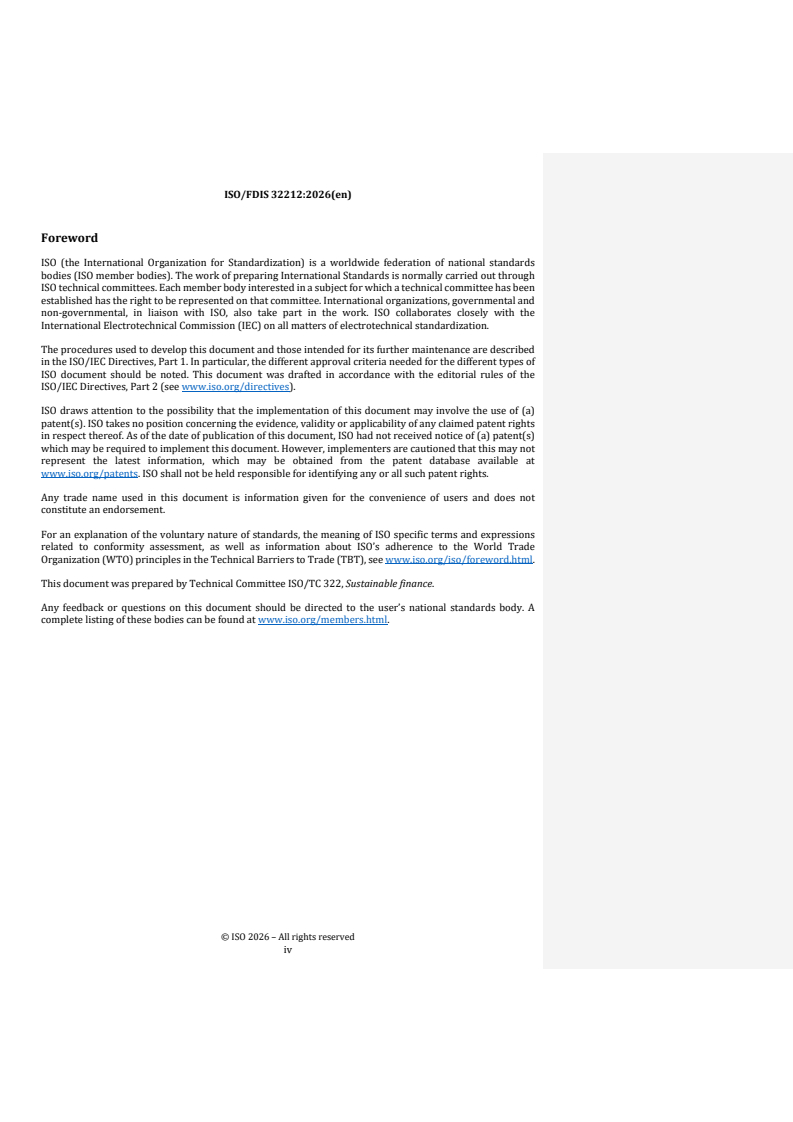
Contents Page
Foreword .v
Introduction .vi
1 Scope . 1
2 Normative references . 1
3 Terms and definitions . 1
3.1 Terms related to transition .2
3.2 Terms related to systems .7
4 Key activities for financial institutions . 9
5 Identify and assess the current position .10
5.1 General .10
5.2 Institution’s current position .11
5.2.1 General .11
5.2.2 Current strategy and profile of financial activities .11
5.2.3 Emissions inventory .11
5.3 Climate-related impacts, dependencies, risks and opportunities . 12
5.3.1 General . 12
5.3.2 Use of scenario analysis . 13
5.3.3 Approach to scenario analysis .14
6 Develop and maintain transition planning objectives and targets .15
6.1 General . 15
6.2 Transition levers and pathways . 15
6.2.1 General . 15
6.2.2 Transition levers .16
6.2.3 Use of benchmark pathways or other guidance .17
6.3 Transition planning objectives and targets .17
6.3.1 General .17
6.3.2 Transition planning objectives for financial activities .18
6.3.3 Transition planning targets for financial activities .19
6.3.4 Considerations for transition plan targets . 20
6.3.5 Combined contribution of transition planning objectives and targets .21
6.3.6 Use of carbon credits .21
7 Integrate transition planning objectives and targets into financing decisions.23
7.1 General . 23
7.2 Implementation strategy . 23
7.2.1 General . 23
7.2.2 Integration into financing decisions . 23
7.2.3 Integration into products and services design . 25
7.3 Engagement strategy . 26
7.3.1 General . 26
7.3.2 Engagement with industry actors, policymakers and other public interest
stakeholders . 26
7.3.3 Engagement with clients and investees .27
8 Communicate transition planning outcomes .27
8.1 General .27
8.2 Internal communication . 28
8.3 External communication . 28
9 Review performance and update plans .29
9.1 General . 29
9.2 Internal audit programme . 29
9.3 Nonconformity and corrective action . 30
9.4 Management review . 30
iii
9.5 Data collection and quality .31
10 Governance .31
10.1 General .31
10.2 Leadership and commitment .32
10.3 Skills and culture.32
11 Documentation .33
11.1 Documentation requirements . 33
11.2 Creating and updating documentation . 33
11.3 Control of documentation . 33
Annex A (informative) Further guidance .34
Bibliography .38
iv
Foreword
ISO (the International Organization for Standardization) is a worldwide federation of national standards
bodies (ISO member bodies). The work of preparing International Standards is normally carried out through
ISO technical committees. Each member body interested in a subject for which a technical committee
has been established has the right to be represented on that committee. International organizations,
governmental and non-governmental, in liaison with ISO, also take part in the work. ISO collaborates closely
with the International Electrotechnical Commission (IEC) on all matters of electrotechnical standardization.
The procedures used to develop this document and those intended for its further maintenance are described
in the ISO/IEC Directives, Part 1. In particular, the different approval criteria needed for the different types
of ISO document should be noted. This document was drafted in accordance with the editorial rules of the
ISO/IEC Directives, Part 2 (see www.iso.org/directives).
ISO draws attention to the possibility that the implementation of this document may involve the use of (a)
patent(s). ISO takes no position concerning the evidence, validity or applicability of any claimed patent
rights in respect thereof. As of the date of publication of this document, ISO had not received notice of (a)
patent(s) which may be required to implement this document. However, implementers are cautioned that
this may not represent the latest information, which may be obtained from the patent database available at
www.iso.org/patents. ISO shall not be held responsible for identifying any or all such patent rights.
Any trade name used in this document is information given for the convenience of users and does not
constitute an endorsement.
For an explanation of the voluntary nature of standards, the meaning of ISO specific terms and expressions
related to conformity assessment, as well as information about ISO’s adherence to the World Trade
Organization (WTO) principles in the Technical Barriers to Trade (TBT), see www.iso.org/iso/foreword.html.
This document was prepared by Technical Committee ISO/TC 322, Sustainable finance.
Any feedback or questions on this document should be directed to the user’s national standards body. A
complete listing of these bodies can be found at www.iso.org/members.html.
v
Introduction
0.1 General
[23]
Article 2.1(a) of the Paris Agreement sets the ambition of holding the increase in the global average
temperature to well below 2 °C above pre-industrial levels and pursuing efforts to limit the temperature
increase to 1,5 °C, recognizing that this would significantly reduce the risks and impacts of climate change.
Article 2.1(b) sets this ambition alongside the objective to increase the ability to adapt to the adverse effects
of climate change and foster climate resilience and low greenhouse gas (GHG) emissions development.
[23]
The Paris Agreement states it will be implemented in accordance with the principles of equity, common
but differentiated responsibilities, and respective capabilities in different parts of the world (see Article
2.2), and in the context of sustainable development and the goal of eradicating poverty. To deliver on
[23]
the objectives of the Paris Agreement , each Party undertakes to prepare, communicate and maintain
nationally determined contributions (NDCs) (see Article 4) and to engage in adaptation planning processes
(see Article 7).
[23]
Specifically related to finance, Article 2.1(c) of the Paris Agreement states that finance flows must
be consistent with a pathway towards low GHG emissions and climate-resilient development. Article 9
[107]
elaborates on the role of climate finance. The Glasgow Climate Pact reaffirmed the goals of the Paris
[23]
Agreement . It highlighted that every increment of global warming beyond 1,5 °C intensifies the risks and
impacts associated with climate change. It also emphasized that limiting global warming to 1,5 °C requires
reducing global carbon dioxide (CO ) emissions by 45 % by 2030 relative to the 2010 level and to net zero
around mid-century, as well as deep reductions in other GHGs. In addition, it underlined the critical role of
scaling up private finance in achieving global climate goals.
0.2 Objective of this document
This document specifies requirements and recommendations for strategic net zero transition planning
by financial institutions, designed to protect and enhance value by supporting institutions’ response and
contribution to the transition to a global net zero and climate-resilient economy. The requirements and
recommendations are designed to enable financial institutions to develop and maintain transition planning
[23]
objectives and targets that advance the goals of the Paris Agreement , and establish robust policies
and processes to integrate these into their financial activities. The document builds on existing guidance,
including materials developed by international organizations, jurisdictional authorities, industry initiatives
and others.
This document aims to support financial institutions in responding to and contributing towards the
transition to a global net zero and climate-resilient economy in a systematic and iterative manner, pursuing
continual improvement in their transition planning. This includes mobilizing and reallocating capital to
enable both decarbonization and climate adaptation activities in the real economy. It also aims to support
economic growth and competitiveness and a resilient financial system by enabling financial institutions to
capture opportunities for themselves (and their shareholders) and for their clients and beneficiaries in the
real economy, while minimizing current and future risks.
This document recognizes that there are limits to the influence financial institutions can have over the real
economy climate mitigation and adaptation outcomes resulting from the implementation of their transition
plans. Outcomes can be impacted by a range of external dependencies, including dependencies related to
public policy, regulation, scientific and climatic developments, and the actions of clients and investees.
0.3 Interaction with other standards
This document does not consider financial institutions’ operational emissions, nor does it provide detailed
1)
[6]
guidance on the credibility of net zero commitments. In this regard it is designed to complement ISO 14060 ,
as well as other relevant third-party resources (e.g. the Financial Institutions Net Zero Standard developed
[111]
by the Science Based Targets Initiative (SBTi) ). ISO 14060 will provide a comprehensive framework
for organizations to achieve, and demonstrate the credibility of commitments to achieve, net zero GHG
emissions, in their own operations and their value chains. A financial institution that aims to achieve net
1) Under preparation. Stage at the time of publication: ISO/CD 14060:2025.
vi
zero GHG emissions in both its operations and its financial activities may therefore choose to apply the
requirements and recommendations in this document alongside those in ISO 14060.
This document utilizes a hybrid approach to identifying GHG categories, drawing on both existing ISO and
Greenhouse Gas Protocol GHG Protocol (GHG Protocol) standards, reflecting the more accurate alignment of
[160]
the GHG Protocol with the scope of this document and the ISO and GHG Protocol partnership, which will
combine their respective GHG standards into harmonized co-branded international standards.
0.4 Foundations of this document
0.4.1 Role of net zero transition planning by financial institutions and the theory of change
With connections to actors in all sectors of the real economy, financial institutions have an important role
[23]
to play in advancing the goals of the Paris Agreement . By engaging in transition planning, developing
and maintaining transition planning objectives and targets, and establishing robust policies and processes
to integrate these into their financial activities, financial institutions can play a critical enabling role in
supporting their clients and investees to manage risk and capture opportunities associated with the global
[23]
transition to a net zero and climate-resilient economy.
Informed by forward-looking assessment of climate-related risks and opportunities, a financial institution
can integrate transition planning objectives and targets into its strategy. It can set policies for its lending,
investment or insurance activities, as well as its engagement activities with clients and investees, informed
by analysis of their climate mitigation and climate adaptation strategies.
NOTE 1 In its report on the need for scaling climate finance, the UN-convened Independent Expert Group on Climate
[26]
Finance states that “Every financial decision should take climate risk into account”.
This document is therefore grounded in a theory of change which recognizes that robust, credible processes
for net zero transition planning, undertaken as a strategic exercise as part of wider business planning, can
help an institution protect and enhance its own long-term value and that of its clients and beneficiaries,
[23]
while scaling the provision of finance to advance the goals of the Paris Agreement . This can include
providing finance to help developing countries both mitigate and adapt to climate change (see Article 9.1). At
the same time, an institution’s financing strategy can minimize adverse impacts and capture opportunities
for stakeholders, society, communities, the economy and the natural environment.
In developing a strategic approach to net zero transition planning, it is important to recognize the need for
financial institutions to consider not only the reduction of financed, facilitated and insurance associated
emissions, but also their contribution to the decarbonization and adaptation efforts of their clients and
investees in the real economy (e.g. by financing the abatement of emissions in high-emitting sectors or by
financing climate mitigation and adaptation solutions). This document’s focus on forward-looking strategies,
policies and processes that support real economy transition pathways is aligned with the United Nations
[24]
Environment Programme (UNEP) Theory of Change for Climate Mitigation .
[100]
NOTE 2 The Net Zero Investment Framework (NZIF) identifies the importance within net zero strategies
of maximizing efforts to “finance reduced emissions” rather than focusing solely on efforts to “reduce financed
emissions”.
NOTE 3 Other guidance and disclosure frameworks for transition planning and transition plans recognize the role
of the private sector in both responding to, and contributing towards, the transition to a net zero and climate-resilient
[30] [41]
economy (GFANZ (2022) and TPT (2023) .
This document recognizes that climate-related risks can be viewed as both exogenous and endogenous to
the financial system. That is, financial institutions are exposed to proximate climate-related financial risks,
which are already influencing asset values today and will continue to crystallize within traditional time
horizons, and also contribute to future system-wide risks, such as those that could arise from a disorderly
transition or extreme warming scenarios that exacerbate physical climate risks, the precise timing and
magnitude of which can be uncertain. Effective transition planning within financial institutions can
therefore be expected to support greater resilience at both institution and system levels, while also capturing
commercial opportunities associated with mobilising the USD 8,6 billion in capital needed annually until
[23]
2050 to advance the goals of the Paris Agreement (based on estimates by the Climate Policy Initiative,
[112]
CPI ).
vii
Of course, it is also important to acknowledge that the finance sector has an enabling, as opposed to
controlling, role in the transition. The principal decarbonization and adaptation efforts will take place
under the control of real economy actors, subject to supportive policy environments. Identification of the
interconnections and external dependencies that can impact the effectiveness of a financial institution’s
transition plan represents an important ongoing element of the transition planning process.
NOTE 4 Supervisory statements recognize the distinctive characteristics of climate risk, the need for a strategic
[113]
approach and the role of financial institutions in stewarding the transition (Financial Stability Board ).
NOTE 5 The results of climate stress testing exercises, undertaken within the central banking community, have
[114]
evidenced the benefits of an early and orderly transition (European Central Bank (ECB) ).
0.4.2 Accommodating national circumstances
[23]
The Paris Agreement explicitly acknowledges the need to accommodate national circumstances in
the pursuit of its goals. Article 2.2 states that its implementation must reflect equity and the principle of
common but differentiated responsibilities and respective capabilities in the light of different national
circumstances. Article 13.2 explicitly allows for flexibility for developing countries, complementing
Article 9.1 which highlights the need for finance flows from developed to developing countries in supporting
a global transition.
NDCs and national adaptation plans reflect this approach, describing climate plans that outline a country’s
mitigation, adaptation, finance and technology needs, and impacts from response measures, thereby acting
[23]
as the foundation for implementing the Paris Agreement . NDCs, national adaptation plans, national
transition plans, industrial policies or strategies, and national sector and/or technology plans and pathways
can accordingly provide locally relevant reference points for financial institutions in their transition
planning activities.
[99]
The Enhanced Transparency Framework (ETF) builds on existing reporting and review processes
[23]
established in the Paris Agreement , specifically addressing ongoing concerns around credibility and
flexibility in a way that is respectful of national sovereignty.
The G20 also acknowledges the challenge for organizational transition planning in balancing credibility
and consistency with the need to remain flexible as organizations align their own planning with
[90]
jurisdiction-specific circumstances. Such proportionality is essential for global applicability. Where
jurisdiction emissions reduction pathways do not exist or are incomplete, financial institutions can apply
international sector guidance, global standards or targets. These can incorporate exemptions, flexibilities
[94]
or proportionality approaches. This can mean, for example, differing transition priorities with a greater
[47]
focus on adaptation activity and operational emissions in some jurisdictions.
0.4.3 Looking beyond decarbonization
[23]
The Paris Agreement considers issues beyond decarbonization. For example, it recognizes that
adaptation is a key component of, and makes a contribution to, the long-term global response to climate
change to protect people, livelihoods and ecosystems including country specific flexibility (see Article 7).
The preamble acknowledges both the need for a just transition taking into account “…the workforce and the
creation of decent work and quality jobs in accordance with nationally defined development priorities” as
well as nature-related implications, noting “the importance of ensuring the integrity of all ecosystems,
including oceans, and the protection of biodiversity.”.
This document therefore addresses the need to look beyond decarbonization, taking into account adaptation
activity as well as potential co-benefits and trade-offs with societal and nature-related impacts and
[23]
dependencies. For example, Article 5 of the Paris Agreement emphasizes the need to conserve and
enhance forests as carbon sinks, encouraging action to reduce deforestation. This document accordingly
provides a strategic framework for supporting the financial sector to respond to and contribute towards the
[27]
global transition, while considering nature, adaptation and a just transition.
Also, recognizing the interconnected nature of climate, nature and human systems, it is important to identify
and mitigate unintended impacts of potential decarbonization actions (e.g. the potential trade-offs between
[28]
climate action, energy access and affordability, and economic development). This aligns with the Paris
viii
[23]
Agreement requirement (see Article 4.1) that climate action is undertaken “on the basis of equity, and in
the context of sustainable development and efforts to eradicate poverty”.
[115]
NOTE 1 The OECD Guidelines for Multinational Enterprises on Responsible Business Conduct set
recommendations to “enhance the business contribution to sustainable development and address adverse impacts
associated with business activities on people, planet, and society.”
NOTE 2 Network for Greening the Financial System (NGFS) in its guidance on integrating adaptation and resilience
[116]
into transition plans indicated that “[w]hile mitigation remains indispensable to limit future damages, integrating
adaptation into climate transition plans is also crucial, given their interconnectedness. Adaptation efforts help reduce
vulnerability, strengthen resilience, and unlock economic opportunities”.
[121]
NOTE 3 A CFRF report describes an approach to adaptation-related decision-making for financial institutions
utilizing a range of future warming scenarios (ABC Framework).
[122]
NOTE 4 TNFD identifies integrated transition planning activities as providing a “coherent structure” for
managing both nature-related dependencies, impacts, risks and opportunities, and climate mitigation and adaptation
efforts, thereby contributing to the transition envisaged by both the Kunming-Montreal Global Biodiversity
[23]
Framework and the Paris Agreement .
NOTE 5 Artificial intelligence (AI) and other technology can help identify and quantify the interconnected nature
of climate, nature and human systems.
NOTE 6 Decarbonization in the context of this document extends beyond consideration of carbon dioxide to
consider all GHGs.
0.4.4 Building on existing guidance and expectations
The requirements for credible transition planning as described in this document are designed to be
compatible with, and build on, existing guidance and expectations relevant to transition planning by
financial institutions. This includes:
— the iterative development and practical experience reflected in international finance sector initiatives,
such as the Glasgow Financial Alliance for Net Zero (GFANZ) and the Institutional Investors Group on
Climate Change (IIGCC);
— jurisdictional and international work on public disclosure of transition plans, such as the International
Sustainability Standards Board (ISSB) guidance on disclosing information about an entity’s transition
[123]
plan;
— non-governmental organization (NGO) initiatives on matters such as target setting, emissions
measurement and transition plan assessment, including SBTi, the Partnership for Carbon Accounting
Financials (PCAF) and The TPI Global Climate Transition Centre (TPI Centre);
— finance sector supervisory expectations around transition planning and the management of climate-
related financial risk, including the work of the NGFS.
[22]
The document also draws on (and references where appropriate) ISO documents including IWA 42 ,
[15] [16]
ISO 32210 and ISO/TS 32211 . A number of documents on environmental management developed by
[1] [2] [3] [11]
ISO/TC 207 are also relevant, including ISO 14001 , the ISO 14019 series , ISO 14030-1 , ISO 14100 ,
[5] [7] [8] [10] [19]
ISO 14054 , ISO 14064-1 , ISO 14068-1 and ISO 14097 . ISO 55001 on asset management and
[17] [2]
ISO 37000 on governance are also relevant. The ISO 14019 series provides guidance on the validation
and verification of sustainability information. Furthermore, this document is designed to complement
ISO 14060, as described in 0.3.
ix
FINAL DRAFT International Standard ISO/FDIS 32212:2026(en)
Sustainable finance — Net zero transition planning for
financial institutions
1 Scope
This document specifies requirements and recommendations for strategic transition planning by financial
institutions, designed to protect and enhance value by supporting institutions’ response and contribution
to a global net zero and climate-resilient economy. The requirements and recommendations are designed
to enable financial institutions to develop and maintain transition planning objectives and targets that
[23]
advance the goals of the Paris Agreement , and establish robust policies and processes to integrate these
into their financial activities.
This document is applicable to any financial institution, regardless of size, type and geographic location,
with a particular focus on banking, insurance and investment institutions. Its provisions are applied in the
context of the institution’s particular business model.
NOTE 1 Some considerations specific to particular institution types are included in guidance notes. Additional
guidance on product attributes specific to different types of financial institution can be found in Annex A.
This document is applicable to all financial activities (including lending, insurance, asset owner investing,
asset manager investing and capital market activities) that the institution determines it can either control
or influence, using a life cycle perspective (e.g. those described in 7.2.2). It can also be applicable to relevant
financial activities within real economy institutions and emerging financial institution types, many of
which leverage digital technologies and can be subject to different or bespoke regulatory frameworks (e.g.
decentralized finance (DeFi) platforms).
NOTE 2 This document is intended for global application, recognizing that some financial institutions, including
those in some emerging market and developing economies (EMDEs), can face constraints in the local enabling
regulatory environment and data availability. It therefore seeks to ensure flexibility and proportionality in application,
as appropriate.
[18] [19]
NOTE 3 Documents on asset management developed by ISO/TC 251, including ISO 55000 , ISO 55001 and
[20]
detailed guidance in ISO 55002 , can be useful for financial institution asset management activity, particularly as it
relates to alignment of asset management with business objectives (e.g. those related to transition planning).
2 Normative references
There are no normative references in this document.
3 Terms and definitions
For the purposes of this document, the following terms and definitions apply.
ISO and IEC maintain terminology databases for use in standardization at the following addresses:
— ISO Online browsing platform: available at https:// www .iso .org/ obp
— IEC Electropedia: available at https:// www .electropedia .org/
3.1 Terms related to transition
3.1.1
transition plan
output of transition planning (3.1.2), often a published disclosure, which details how the entity plans to
achieve its stated goals
Note 1 to entry: Established frameworks for disclosing transition plans include formalized pillars such as metrics and
targets, engagement strategy, and governance processes.
[124]
[SOURCE: PRI (2025) ]
3.1.2
transition planning
dynamic, iterative process through which an entity develops an organization-wide approach to the broader
economic transition to net zero (3.1.9), including by defining how they will adapt or transform operations,
strategies, and business models to align with their stated goals, and integrating these goals across the
organization
Note 1 to entry: NGFS (2024) state that transition planning (and transition plans) capture climate mitigation and
[125]
adaptation.
Note 2 to entry: As noted in the Introduction and set out in the Scope (see Clause 1), the focus of this document is
the application of transition planning in the context of financial institutions’ (3.2.8)financial activities (3.2.9). This
focus acknowledges that the overwhelming majority of financial institutions’ greenhouse gas emissions (3.1.15) are
associated with their financial activities, and recognizes the critical enabling role that financial institutions can
play in supporting their clients and investees to manage risk and capture opportunities associated with the global
transition to a net zero and climate-resilient economy. A financial institution that aims to achieve net zero greenhouse
gas emissions in both its operations and its financial activities may therefore choose to apply the requirements and
recommendations in this document alongside those in ISO 14060.
[124]
[SOURCE: PRI (2025) , modified — Notes 1 and 2 to entry added.]
3.1.3
transition finance
lending, financing, investment, insurance, and related products and services that are critical to delivering
real economy (3.1.5) emissions reduction to support an orderly, real economy transition to net zero (3.1.9)
Note 1 to entry: GFANZ identifies four key transition financing strategies, each of which aims to generate positive real
economy impacts:
a) climate solutions (3.1.7): entities and activities that develop and scale climate solutions;
b) aligned: entities that are already aligned to a 1,5 °C pathway;
c) aligning: entities committed to transitioning in line with 1,5 °C-aligned pathways;
d) managed phaseout: the accelerated managed phaseout of high-emitting physical assets.
Note 2 to entry: For the purposes of this document, a broad definition of transition finance has been adopted.
[30]
[SOURCE: GFANZ, 2022 , modified]
3.1.4
adaptation finance
lending, financing, investment, insurance and related products and services that are critical to delivering
real economy (3.1.5) adjustments in ecological, social or economic systems in response to actual or expected
climate change and its effects
[126]
[SOURCE: UNFCCC , modified]
3.1.5
real economy
economic activity that concerns the production, purchase and flow of goods and services outside of the
financial sector
Note 1 to entry: Financial institutions (3.2.8) are significant intermediaries that support activity in the real economy
(production and consumption by households, businesses and government) through their lending, investing,
underwriting, and advising activities.
[30]
[SOURCE: GFANZ, 2022 , modified]
3.1.6
climate change adaptation
process of adjustment to the actual or expected climate change and its effects
Note 1 to entry: In human systems, adaptation seeks to moderate or avoid harm or exploit beneficial opportunities.
Note 2 to entry: In some natural systems, human intervention can facilitate adjustment to expected climate and its
effects.
[21]2)
[SOURCE: ISO Guide 84:— , 3.1.3, modified — “climate change” replaced “climate” in the definition.]
3.1.7
climate solution
technologies, services, tools, or social and behavioural changes that directly eliminate, remove, or reduce
real economy (3.1.5)greenhouse gas emissions (3.1.15) or that directly support adaptation to the impacts of
climate change
Note 1 to entry: Climate solutions have two attributes:
— they represent a significant contribution to real economy emissions reduction and removal or climate resilience;
— the solution’s own emissions are reasonably expected to progress toward net-zero over time.
Note 2 to entry: Nature-based solutions are a category of climate solution. Such solutions represent actions to protect,
sustainably manage, and restore natural and modified ecosystems in ways that address societal challenges effectively
and adaptively, to provide both human well-being and biodiversity benefits.
[108]
[SOURCE: GFANZ, 2023 , modified]
3.1.8
climate enabler
technologies, services, tools, or social and behavioural changes that indirectly contribute to, but are critical
for, real economy (3.1.5) greenhouse gas emission (3.1.15) reductions by facilitating the deployment and
scaling of climate solutions (3.1.7)
[108]
[SOURCE: GFANZ, 2023 , modified]
3.1.9
net zero
net zero greenhouse gases
condition in which human-caused residual emissions (3.1.20) are balanced by human-led removals over a
specified period and within specified boundaries
Note 1 to entry: Human-led removals include ecosystem restoration, direct air carbon capture and storage,
reforestation and afforestation, biochar and other effective methods.
Note 2 to entry: The words “human-caused” and “human-led” are intended to be understood as synonymous with the
word “anthropogenic” in IPCC definitions.
[22]
[SOURCE: IWA 42:2022 , 3.1.1]
2) Under preparation. Stage at this time: ISO/DGuide 84.2:2025.
3.1.10
carbon credit
tradeable intangible instrument issued by a GHG/carbon-crediting programme, representing a greenhouse
gas emission (3.1.15) reduction to, or removal from, the atmosphere equivalent to one metric tonne of carbon
dioxide equivalent
Note 1 to entry: Carbon credits can be retired without being used
...
ISO/TC 322
Secretariat: BSI
Date: 2026-01-0602-02
Sustainable finance — Net zero transition planning for financial
institutions
Finance durable — Planification de la transition vers le zéro émission nette pour les institutions financières
FDIS stage
All rights reserved. Unless otherwise specified, or required in the context of its implementation, no part of this publication
may be reproduced or utilized otherwise in any form or by any means, electronic or mechanical, including photocopying,
or posting on the internet or an intranet, without prior written permission. Permission can be requested from either ISO
at the address below or ISO’s member body in the country of the requester.
ISO copyright office
CP 401 • Ch. de Blandonnet 8
CH-1214 Vernier, Geneva
Phone: + 41 22 749 01 11
E-mail: copyright@iso.org
Website: www.iso.org
Published in Switzerland
ii
Contents
Foreword . iv
Introduction . v
1 Scope . 1
2 Normative references . 1
3 Terms and definitions . 1
3.1 Terms related to transition . 2
3.2 Terms related to systems . 7
4 Key activities for financial institutions . 10
5 Identify and assess the current position . 12
5.1 General . 12
5.2 Institution’s current position . 12
5.3 Climate-related impacts, dependencies, risks and opportunities . 14
6 Develop and maintain transition planning objectives and targets . 17
6.1 General . 17
6.2 Transition levers and pathways . 17
6.3 Transition planning objectives and targets . 19
7 Integrate transition planning objectives and targets into financing decisions . 25
7.1 General . 25
7.2 Implementation strategy . 26
7.3 Engagement strategy . 28
8 Communicate transition planning outcomes . 30
8.1 General . 30
8.2 Internal communication . 31
8.3 External communication . 31
9 Review performance and update plans . 32
9.1 General . 32
9.2 Internal audit programme . 32
9.3 Nonconformity and corrective action . 32
9.4 Management review . 33
9.5 Data collection and quality . 34
10 Governance . 35
10.1 General . 35
10.2 Leadership and commitment . 35
10.3 Skills and culture . 36
11 Documentation . 36
11.1 Documentation requirements . 36
11.2 Creating and updating documentation . 36
11.3 Control of documentation . 36
Annex A (informative) Further guidance . 38
Bibliography . 43
iii
Foreword
ISO (the International Organization for Standardization) is a worldwide federation of national standards
bodies (ISO member bodies). The work of preparing International Standards is normally carried out through
ISO technical committees. Each member body interested in a subject for which a technical committee has been
established has the right to be represented on that committee. International organizations, governmental and
non-governmental, in liaison with ISO, also take part in the work. ISO collaborates closely with the
International Electrotechnical Commission (IEC) on all matters of electrotechnical standardization.
The procedures used to develop this document and those intended for its further maintenance are described
in the ISO/IEC Directives, Part 1. In particular, the different approval criteria needed for the different types of
ISO document should be noted. This document was drafted in accordance with the editorial rules of the
ISO/IEC Directives, Part 2 (see www.iso.org/directives).
ISO draws attention to the possibility that the implementation of this document may involve the use of (a)
patent(s). ISO takes no position concerning the evidence, validity or applicability of any claimed patent rights
in respect thereof. As of the date of publication of this document, ISO had not received notice of (a) patent(s)
which may be required to implement this document. However, implementers are cautioned that this may not
represent the latest information, which may be obtained from the patent database available at
www.iso.org/patents. ISO shall not be held responsible for identifying any or all such patent rights.
Any trade name used in this document is information given for the convenience of users and does not
constitute an endorsement.
For an explanation of the voluntary nature of standards, the meaning of ISO specific terms and expressions
related to conformity assessment, as well as information about ISO’s adherence to the World Trade
Organization (WTO) principles in the Technical Barriers to Trade (TBT), see www.iso.org/iso/foreword.html.
This document was prepared by Technical Committee ISO/TC 322, Sustainable finance.
Any feedback or questions on this document should be directed to the user’s national standards body. A
complete listing of these bodies can be found at www.iso.org/members.html.
iv
Introduction
0.1 General
[23]
Article 2.1(a) of the Paris Agreement sets the ambition of holding the increase in the global average
temperature to well below 2 °C above pre-industrial levels and pursuing efforts to limit the temperature
increase to 1.,5 °C recognising, recognizing that this would significantly reduce the risks and impacts of climate
change. Article 2.1(b) sets this ambition alongside the objective to increase the ability to adapt to the adverse
effects of climate change and foster climate resilience and low greenhouse gas (GHG) emissions development.
[23 ]
The Paris Agreement is to states it will be implemented in accordance with the principles of equity, common
but differentiated responsibilities, and respective capabilities in different parts of the world (see Article 2.2),
and in the context of sustainable development and the goal of eradicating poverty. To deliver on the objectives
[23]
of the Paris Agreement , each Party undertakes to prepare, communicate and maintain Nationally
Determined Contributionsnationally determined contributions (NDCs) (see Article 4) and to engage in
adaptation planning processes (see Article 7).
[23]
Specifically related to finance, Article 2.1(c) of the Paris Agreement states that finance flows must be
consistent with a pathway towards low greenhouse gas (GHG) emissions and climate-resilient development.
[107]
Article 9 elaborates on the role of climate finance. The Glasgow Climate Pact reaffirmed the goals of the
[23 ]
Paris Agreement , highlighting. It highlighted that every increment of global warming beyond 1.,5 °C
intensifies the risks and impacts associated with climate change and emphasizing. It also emphasized that
limiting global warming to 1.,5 °C requires reducing global carbon dioxide (CO ) emissions by 45 per cent %
by 2030 relative to the 2010 level and to net zero around mid-century, as well as deep reductions in other
greenhouse gasesGHGs. In addition, it underlined the critical role of scaling up private finance in achieving
global climate goals.
0.2 The objectiveObjective of this document
This document specifies requirements and recommendations for strategic net zero transition planning by
financial institutions, designed to protect and enhance value by supporting institutions’ response and
contribution to the transition to a global net zero and climate-resilient economy. The requirements and
recommendations are designed to enable financial institutions to develop and maintain transition planning
[23]
objectives and targets that advance the temperature and resilience goals of the Paris Agreement , and
establish robust policies and processes to integrate these into their financial activities. The document builds
on existing guidance, including materials developed by international organizations, jurisdictional authorities,
industry initiatives and others.
This document aims to support financial institutions in responding to and contributing towards the transition
to a global net zero and climate-resilient economy in a systematic and iterative manner, pursuing continual
improvement in their transition planning. This includes mobilizing and reallocating capital to enable both
decarbonization and climate adaptation activities in the real economy. It also aims to support economic
growth and competitiveness and a resilient financial system by enabling financial institutions to capture
opportunities for themselves (and their shareholders) and for their clients and beneficiaries in the real
economy, while minimizing current and future risks.
This document recognizes that there are limits to the influence financial institutions can have over the real
economy climate mitigation and adaptation outcomes resulting from the implementation of their transition
plans. Outcomes maycan be impacted by a range of external dependencies, including dependencies related to
public policy, regulation, scientific and climatic developments, and the actions of clients and investees.
0.3 Interaction with other standards
This document does not consider financial institutions’ operational emissions, nor does it provide detailed
guidance on the credibility of net zero commitments. In this regard it is designed to complement ISO’s Net
v
[6]1)
Zero Standard, ISO 14060 , which is currently in development, as well as other relevant third-party
resources (e.g. the Financial Institutions Net Zero Standard developed by the Science Based Targets Initiative
[111]
(SBTi) ). ISO 14060 will provide a comprehensive framework for organizations to achieve –, and
demonstrate the credibility of commitments to achieve –, net zero greenhouse gasGHG emissions, in their own
operations and their value chains. A financial institution that aims to achieve net zero greenhouse gasGHG
emissions in both its operations and its financial activities may therefore choose to apply the requirements
and recommendations in this document alongside those in ISO 14060.
This document utilisesutilizes a hybrid approach to identifying GHG categories, drawing on both existing ISO
and Greenhouse Gas Protocol GHG Protocol (GHG Protocol) standards, reflecting the more accurate alignment
[160 ]
of the GHG Protocol with the scope of this document and the ISO and GHG Protocol partnership, (see )
which will combine their respective greenhouse gas (GHG) standards into harmonized co-branded
international standards.
0.4 0.5 Foundations of this document
0.4.1 0.5.1 The roleRole of net zero transition planning by financial institutions and the theory of
change
With connections to actors in all sectors of the real economy, financial institutions have an important role to
[23[23] ]
play in advancing the goals of the Paris Agreement . . By engaging in transition planning, developing and
maintaining transition planning objectives and targets, and establishing robust policies and processes to
integrate these into their financial activities, financial institutions can play a critical enabling role in
supporting their clients and investees to manage risk and capture opportunities associated with the global
[23]
transition to a net zero, and climate-resilient economy.
Informed by forward-looking assessment of climate-related risks and opportunities, a financial institution can
integrate transition planning objectives and targets into its strategy. It can set policies for its lending,
investment or insurance activities, as well as its engagement activities with clients and investees, informed by
analysis of their climate mitigation and climate adaptation strategies.
NOTE 1 In its report on the need for scaling climate finance, the UN-convened Independent Expert Group on Climate
[26]
Finance states that “Every financial decision should take climate risk into account”.
This document is therefore grounded in a theory of change which recognizes that robust, credible processes
for net zero transition planning, undertaken as a strategic exercise as part of wider business planning, can
help an institution protect and enhance its own long-term value and that of its clients and beneficiaries, while
[23]
scaling the provision of finance to advance the goals of the Paris Agreement . This couldcan include
providing finance to help developing countries both mitigate and adapt to climate change (see Article 9.1). At
the same time, an institution’s financing strategy can minimize adverse impacts and capture opportunities for
stakeholders, society, communities, the economy and the natural environment.
In developing a strategic approach to net zero transition planning, it is important to recognize the need for
financial institutions to consider, not only the reduction of financed, facilitated and insurance associated
emissions, but also their contribution to the decarbonization and adaptation efforts of their clients and
investees in the real economy – (e.g. by financing the abatement of emissions in high-emitting sectors, or by
financing climate mitigation and adaptation solutions.). This document’s focus on forward-looking strategies,
policies and processes that support real economy transition pathways is aligned with the United Nations
[24]
Environment Programme (UNEP) Theory of Change for Climate Mitigation .
1)
Under preparation. Stage at the time of publication: ISO/CD 14060:2025.
vi
[100]
NOTE 1 2 The Net Zero Investment Framework (NZIF) identifies the importance within net zero strategies of
maximizing efforts to ‘“finance reduced emissions’emissions” rather than focussingfocusing solely on efforts to ‘“reduce
financed emissions’.emissions”.
NOTE 2 3 Other guidance and disclosure frameworks for transition planning and transition plans recognize the role of
the private sector in both responding to, and contributing towards, the transition to a net zero, and climate-resilient
[30] [41]
economy (GFANZ (2022) and TPT (2023) .
This document recognizes that climate-related risks can be viewed as both exogenous and endogenous to the
financial system. That is, financial institutions are: exposed to proximate climate-related financial risks, which
are already influencing asset values today and will continue to crystallize within traditional time horizons;,
and also contribute to future system-wide risks –, such as those that could arise from a disorderly transition
or extreme warming scenarios that exacerbate physical climate risks, the precise timing and magnitude of
which maycan be uncertain. Effective transition planning within financial institutions can therefore be
expected to support greater resilience at both institution and system levels, while also capturing commercial
opportunities associated with mobilising the $USD 8.,6 billion in capital needed annually until 2050 to
[23] [112]
advance the goals of the Paris Agreement (based on estimates by the Climate Policy Initiative, CPI ).
Of course, it is also important to acknowledge that the finance sector has an enabling, as opposed to
controlling, role in the transition. The principal decarbonization and adaptation efforts will take place under
the control of real economy actors, subject to supportive policy environments. Identification of the
interconnections and external dependencies that maycan impact the effectiveness of a financial institution’s
transition plan represents an important ongoing element of the transition planning process.
NOTE 1 4 Supervisory statements recognize the distinctive characteristics of climate risk, the need for a strategic
[113]
approach and the role of financial institutions in stewarding the transition (Financial Stability Board ).
NOTE 2 5 The results of climate stress testing exercises, undertaken within the central banking community, have
[114]
evidenced the benefits of an early and orderly transition (European Central Bank (ECB) ).
0.4.2 0.5.2 Accommodating national circumstances
[23]
The Paris Agreement explicitly acknowledges the need to accommodate national circumstances in the
pursuit of its goals. Article 2.2 states that its implementation must reflect equity and the principle of common
but differentiated responsibilities and respective capabilities in the light of different national circumstances.
Article 13.2 explicitly allows for flexibility for developing countries, complementing Article 9.1 which
highlights the need for finance flows from developed to developing countries in supporting a global transition.
NDCs and national adaptation plans reflect this approach, describing climate plans that outline a country’s
mitigation, adaptation, finance and technology needs, and impacts from response measures, thereby acting as
[23]
the foundation for implementing the Paris Agreement . NDCs, national adaptation plans, national transition
plans, industrial policies or strategies, and national sector and/or technology plans and pathways can
accordingly provide locally relevant reference points for financial institutions in their transition planning
activities.
[99]
The Enhanced Transparency Framework (ETF) builds on existing reporting and review processes
[23]
established in the Paris Agreement , specifically addressing ongoing concerns around credibility and
flexibility in a way that is respectful of national sovereignty.
The G20 also acknowledges the challenge for organizational transition planning in balancing credibility and
consistency with the need to remain flexible as organizations align their own planning with jurisdiction-
[90]
specific circumstances. Such proportionality is essential for global applicability. Where jurisdiction
emissions reduction pathways do not exist or are incomplete, financial institutions can apply international
sector guidance, global standards or targets. These can incorporate exemptions, flexibilities or proportionality
[94]
approaches. This can mean, for example, differing transition priorities with a greater focus on adaptation
[47]
activity and operational emissions in some jurisdictions.
vii
0.4.3 0.5.3 Looking beyond decarbonization
[23]
The Paris Agreement considers issues beyond decarbonization. For example, it recognizes that adaptation
is a key component of, and makes a contribution to, the long-term global response to climate change to protect
people, livelihoods and ecosystems including country specific flexibility (see Article 7). The preamble
acknowledges both the need for a just transition taking into account “…the workforce and the creation of
decent work and quality jobs in accordance with nationally defined development priorities” as well as nature-
related implications, noting “the importance of ensuring the integrity of all ecosystems, including oceans, and
the protection of biodiversity.”.
This document therefore addresses the need to look beyond decarbonization, taking into account adaptation
activity as well as potential co-benefits and trade-offs with societal and nature-related impacts and
[23]
dependencies. For example, Article 5 of the Paris Agreement emphasizes the need to conserve and enhance
forests as carbon sinks, encouraging action to reduce deforestation. This document accordingly provides a
strategic framework for supporting the financial sector to respond to and contribute towards the global
[27]
transition, while considering nature, adaptation and a just transition.
Also, recognizing the interconnected nature of climate, nature and human systems, it is important to identify
and mitigate unintended impacts of potential decarbonization actions (e.g. the potential trade-offs between
[28]
climate action, energy access and affordability, and economic development). This aligns with the Paris
[23]
Agreement requirement (see Article 4.1) that climate action is undertaken “on the basis of equity, and in
the context of sustainable development and efforts to eradicate poverty”.
[115]
NOTE 1 The OECD Guidelines for Multinational Enterprises on Responsible Business Conduct set
recommendations to “enhance the business contribution to sustainable development and address adverse impacts
associated with business activities on people, planet, and society.”
NOTE 2 Network for Greening the Financial System (NGFS) in its guidance on integrating adaptation and resilience
[116]
into transition plans indicated that “[w]hile mitigation remains indispensable to limit future damages, integrating
adaptation into climate transition plans is also crucial, given their interconnectedness. Adaptation efforts help reduce
vulnerability, strengthen resilience, and unlock economic opportunities.””.
[121]
NOTE 3 A CFRF report describes an approach to adaptation-related decision-making for financial institutions
utilisingutilizing a range of future warming scenarios (ABC Framework).
[122]
NOTE 4 TNFD identifies integrated transition planning activities as providing a ‘“coherent structure’structure” for
managing both nature-related dependencies, impacts, risks and opportunities, and climate mitigation and adaptation
efforts, thereby contributing to the transition envisaged by both the Kunming-Montreal Global Biodiversity Framework
[23]
and the Paris Agreement .
NOTE 5 Artificial Intelligenceintelligence (AI) and other technology can help identify and quantify the interconnected
nature of climate, nature and human systems.
NOTE 6 Decarbonization in the context of this document extends beyond consideration of carbon dioxide to consider
all GHGs.
0.4.4 0.5.4 Building on existing guidance and expectations
The requirements for credible transition planning as described in this document are designed to be
compatible with, and build on, existing guidance and expectations relevant to transition planning by financial
institutions. This includes:
— the iterative development and practical experience reflected in international finance sector initiatives,
such as the Glasgow Financial Alliance for Net Zero (GFANZ) and the Institutional Investors Group on
Climate Change (IIGCC);
viii
— jurisdictional and international work on public disclosure of transition plans, such as the International
Sustainability Standards Board (ISSB) guidance on disclosing information about an entity’s transition
[123]
plan;
— non-governmental organization (NGO) initiatives on matters such as target setting, emissions
measurement and transition plan assessment, including SBTi, the Partnership for Carbon Accounting
Financials (PCAF) and The TPI Global Climate Transition Centre (TPI Centre); and
— finance sector supervisory expectations around transition planning and the management of climate-
related financial risk, including the work of the NGFS.
Please see Bibliography for a list of guidance materials referenced in this document.
The document also draws on (and references where appropriate) existing and planned ISO documents
[22] [15] [16]
including IWA 42 , ISO 32210 and ISO/TS 32211 . A number of documents on environmental
[1] [2]
management developed by ISO/TC 207 are also relevant, including ISO 14001 , the ISO 14019 series , ISO
[3] [11[5] ] [5] [7] [8] [10] [19]
14030-1 , ISO 14100 , , ISO 14054 , ISO 14064-1 , ISO 14068-1 and ISO 14097 . ISO 55001 on
[17] [2]
asset management and ISO 37000 on governance are also relevant. The ISO 14019 series provides
guidance on the validation and verification of sustainability information. Furthermore, this document is
designed to complement ISO Net Zero Standard, ISO 14060, as described in 0.3, which is currently in
development. ISO 14060 is intended to provide a comprehensive framework for organizations to achieve –
and demonstrate the credibility of commitments to achieve – net zero greenhouse gas emissions, in their own
operations and their value chains.
ix
Sustainable finance — Net zero transition planning for financial
institutions
1 Scope
This document specifies requirements and recommendations and related guidance for strategic transition
planning by financial institutions, designed to protect and enhance value by supporting institutions’ response
and contribution to a global net zero and climate-resilient economy. The requirements and recommendations
are designed to enable financial institutions to develop and maintain transition planning objectives and
[23]
targets that advance the temperature and resilience goals of the Paris Agreement , and establish robust
policies and processes to integrate these into their financial activities.
This document is applicable to any financial institution, regardless of size, type and geographic location, with
a particular focus on banking, insurance and investment institutions. Its provisions are to be applied in the
context of the institution’s particular business model.
NOTE 1 Some considerations specific to particular institution types are included in guidance notes. Additional
guidance on product attributes specific to different types of financial institution maycan be found in the Annex A.
This document is applicable to all financial activities – (including lending, insurance, asset owner investing,
asset manager investing and capital market activities –) that the institution determines it can either control
or influence, using a life cycle perspective – (e.g. those described in 7.2.2). It maycan also be applicable to
relevant financial activities within real economy institutions and emerging financial institution types, many of
which leverage digital technologies and can be subject to different or bespoke regulatory frameworks (e.g.
decentralized finance (DeFi) platforms).
NOTE 2 This document is intended for global application, recognisingrecognizing that some financial institutions,
including those in some Emerging Marketemerging market and Developing Economiesdeveloping economies (EMDEs),
can face constraints in the local enabling regulatory environment and data availability. It therefore seeks to ensure
flexibility and proportionality in application, as appropriate.
[18] [19]
NOTE 3 Documents on asset management developed by ISO/TC 251, including ISO 55000 , ISO 55001 and
[20]
detailed guidance in ISO 55002 , can be useful for financial institution asset management activity, particularly as it
relates to alignment of asset management with business objectives, for example (e.g. those related to transition
planning.).
2 Normative references
There are no normative references in this document.
3 Terms and definitions
For the purposes of this document, the following terms and definitions apply.
ISO and IEC maintain terminology databases for use in standardization at the following addresses:
— ISO Online browsing platform: available at https://www.iso.org/obp
— IEC Electropedia: available at https://www.electropedia.org/
3.1 Terms related to transition
3.1.1
transition plan
output of transition planning (3.1.2 –), often a published disclosure –, which details how the entity plans to
achieve its stated goals
Note 1 to entry: Established frameworks for disclosing transition plans include formalisedformalized pillars such as
metrics and targets, engagement strategy, and governance processes.
[124]
[SOURCE: PRI (2025) ]
3.1.2
transition planning
dynamic, iterative process through which an entity develops an organization-wide approach to the broader
economic transition to net zero (3.1.9), including by defining how they will adapt or transform operations,
strategies, and business models to align with their stated goals, and integrating these goals across the
organization
Note 1 to entry: NGFS (2024) state that transition planning (and transition plans) capture climate mitigation and
[125]
adaptation.
Note 2 to entry: As noted in the Introduction and set out in the Scope (see Clause 1), the focus of this document is the
application of transition planning in the context of financial institutions’ (3.2.8)financial activities (3.2.9.). This focus
acknowledges that the overwhelming majority of financial institutions’ GHGgreenhouse gas emissions (3.1.15) are
associated with their financial activities, and recognizes the critical enabling role that financial institutions can play in
supporting their clients and investees to manage risk and capture opportunities associated with the global transition to
a net zero, and climate-resilient economy. A financial institution that aims to achieve net zero greenhouse gas emissions
in both its operations and its financial activities may therefore choose to apply the requirements and recommendations
in this document alongside those in ISO 14060.
[124]
[SOURCE: PRI (2025) , modified –— Notes 1 and 2 to entry added].]
3.1.3
transition finance
lending, financing, investment, insurance, and related products and services that are critical to delivering real
economy (3.1.5) emissions reduction to support an orderly, real economy transition to net zero (3.1.9)
Note 1 to entry: GFANZ identifies four key transition financing strategies, each of which aims to generate positive real
economy impacts:
a) Climateclimate solutions (3.1.7) –): entities and activities that develop and scale climate solutions;
b) Aligned -aligned: entities that are already aligned to a 1.,5 °C pathway;
c) Aligning -aligning: entities committed to transitioning in line with 1.,5 °C-aligned pathways; and
d) Managedmanaged phaseout -: the accelerated managed phaseout of high-emitting physical assets.
Note 2 to entry: For the purposes of this document, a broad definition of transition finance has been adopted.
[30]
[SOURCE: GFANZ, 2022 , modified —]]
3.1.4
adaptation finance
lending, financing, investment, insurance and related products and services that are critical to delivering real
economy (3.1.5) adjustments in ecological, social or economic systems in response to actual or expected
climate change and its effects
[126] ]
[SOURCE: UNFCCC Modified.] , modified]
3.1.5
real economy
economic activity that concerns the production, purchase and flow of goods and services outside of the
financial sector
Note 1 to entry: Financial institutions (3.2.8) are significant intermediaries that support activity in the real economy –
(production and consumption by households, businesses, and government –) through their lending, investing,
underwriting, and advising activities.
[30]
[SOURCE: GFANZ, 2022 , modified —]]
3.1.6
climate change adaptation
process of adjustment to the actual or expected climate change and its effects
Note 1 to entry: In human systems, adaptation seeks to moderate or avoid harm or exploit beneficial opportunities.
Note 2 to entry: In some natural systems, human intervention can facilitate adjustment to expected climate and its effects.
[21 1[21] ]2)
[SOURCE: ISO Guide 84:— :—, —‘ , 3.1.3, modified — “climate change’change” replaced ‘climate’
as“climate” in the preferred termdefinition.]
3.1.7
climate solution
technologies, services, tools, or social and behavioural changes that directly eliminate, remove, or reduce real
economy (3.1.5) GHG)greenhouse gas emissions (3.1.15) or that directly support adaptation to the impacts of
climate change
Note 1 to entry: Climate solutions have two attributes:
— they represent a significant contribution to real economy emissions reduction and removal or climate resilience;
— the solution’s own emissions are reasonably expected to progress toward net-zero over time.
Note 2 to entry: Nature-based solutions are a category of climate solution. Such solutions represent actions to protect,
sustainably manage, and restore natural and modified ecosystems in ways that address societal challenges effectively
and adaptively, to provide both human well-being and biodiversity benefits.
[108]
[SOURCE: GFANZ, 2023 , modified —]]
3.1.8
climate enabler
technologies, services, tools, or social and behavioural changes that indirectly contribute to, but are critical
for, real economy (3.1.5) GHG) greenhouse gas emission (3.1.15) reductions by facilitating the deployment and
scaling of climate solutions (3.1.7)
[108]
[SOURCE: GFANZ, 2023 , modified —]]
3.1.9
net zero
net zero greenhouse gases
2)
Under preparation. Stage at this time: ISO/DGuide 84.2:2025.
condition in which human-caused residual emissions (3.1.20) are balanced by human-led removals over a
specified period and within specified boundaries
Note 1 to entry: Human-led removals include ecosystem restoration, direct air carbon capture and storage, reforestation
and afforestation, , biochar and other effective methods.
Note 2 to entry: The words “human-caused” and “human-led” are intended to be understood as synonymous with the
word “anthropogenic” in IPCC definitions.
[22]
[SOURCE: IWA 42:2022 , 3.1.1]
3.1.10
carbon credit
tradeable intangible instrument issued by a GHG/carbon-crediting programme, representing a
GHGgreenhouse gas emission (3.1.15) reduction to, or removal from, the atmosphere equivalent to one metric
tonne of carbon dioxide equivalent
Note 1 to entry: Carbon credits can be retired without being used for offsetting, as a contribution to global climate action
or global net zero (3.1.9). Credits and offsets are not interchangeable terms.
Note 2 to entry: Carbon credits can be of different types: avoidance/reduction credits or removal credits.
Note 3 to entry: Carbon credit projects are validated and their impacts verified by carbon-crediting programmes. Carbon
credits are uniquely serialized, issued, tracked and retired or administratively cancelled by means of an electronic
registry operated by an administrative body, such as a carbon-crediting programme.
[8]
3.1.11 [SOURCE: ISO 14068-1:2023, 3.3.2, modified — . Admitted term deleted. Definition replaced.
Formatted: Default Paragraph Font
Notes 1 and 2 to entry replaced.]
Formatted: Default Paragraph Font
carbon lock-in
estimates of future GHGgreenhouse gas emissions (3.1.15) that are likely to be caused by an undertaking’s key
assets or products sold within their operating lifetime
[38]
[SOURCE: EFRAG, 2022 , Table 2, modified — “carbon lock-in” replaced “locked-in GHG emissions” as the
term].]
3.1.12
facilitated emission
indirect GHGgreenhouse gas emission (3.1.15) arising as a consequence of capital market transactions, i.e. those
associated with services provided by financial institutions (3.2.8) to support the issuance of capital market
instruments
[51]
[SOURCE: PCAF, 2023 , modified —]]
3.1.13
financed emission
indirect GHGgreenhouse gas emission (3.1.15) arising as a consequence of the financing activities, such as
lending and investment, of financial institutions (3.2.8)
[50]
[SOURCE: PCAF, 2025 , modified —] ]
3.1.14
insurance associated emission
indirect GHGgreenhouse gas emission (3.1.15) arising as a consequence of the re/insurance underwriting
activities of financial institutions (3.2.8)
[127]
[SOURCE: PCAF, 2025 , modified —]]
3.1.15
greenhouse gas emission
GHG emission
release of a GHG into the atmosphere
[4]
[SOURCE: ISO 14050:2020 , 3.9.8]
3.1.16
direct greenhouse gas emission
direct GHG emission
Scope 1 emission
GHGgreenhouse gas emission (3.1.15) from a GHG source owned or controlled by an organization
Note 1 to entry: Direct GHG emissions do not include those occurring from natural ecosystems owned or controlled by
the organization.
[4]
[SOURCE: ISO 14050:2020 , 3.9.9, modified — Admitted term added. “source” changed to singular in the
definition. Note 1 to entry added.]
3.1.17
energy indirect greenhouse gas emission
energy indirect GHG emission
indirect GHG emission from imported energy
Scope 2 emission
GHGgreenhouse gas emission (3.1.15) from the generation of imported electricity, heat, cooling or steam
consumed by an organization
Note 1 to entry: This category includes only GHG emissions due to the fuel combustion associated with the production of
final energy and utilities, such as electricity, heat, steam, cooling and compressed air. It excludes all upstream emissions
(from cradle to power plant gate) associated with fuel, emissions due to “imported” the construction of the power plant,
and “facility” changed emissions allocated to “organization” transport and distribution losses.
[4]
[SOURCE: ISO 14050:2020 , 3.9.11, modified — Admitted terms added. “cooling” added in the definition. Note
1 to entry added.]
3.1.18
other indirect greenhouse gas emission
other indirect GHG emission
Scope 3 emission
GHGgreenhouse gas emission (3.1.15), other than energy indirect GHG emissions (3.1.17), that is a consequence
of an organization’s activities, but arises from GHG sources that are owned or controlled by other
organizations
Note 1 to entry: Other indirect GHG emissions include all attributable value chain GHG emissions not included in direct
GHG emissions or energy indirect GHG emissions. These emissions are referred to as categories 3 to 6 in ISO 14064-
[7]
1:2018, Annex B.
[4]
[SOURCE: ISO 14050:2020 , 3.9.12]3., modified — Admitted term added. Note 1.19 to entry added.]
3.1.19
avoided emission
GHGgreenhouse gas emission (3.1.15) reductions that occur outside the organizational boundaries of the
reporting organization as a direct consequence of changes in the organization’s activity
Note 1 to entry: Avoided emissions are typically forward looking and assessed against a baseline scenario (3.1.23).
[9]
[SOURCE: ISO/TR 14069:2013, 3.1.5, modified — “including but not necessarily limited to.” deleted in the
term. Note 1 to entry added.]
3.1.20
residual emission
residual greenhouse gas emission
residual GHG emission
anthropogenic GHGgreenhouse gas emission (3.1.15) remaining at the net zero (3.1.9) target date after
implementing all technically feasible activities to achieve GHG emission reductions across the value chain
Note 1 to entry: Estimation of residual emissions takes into account emission reductions associated with all mitigation
actions that are technically and economically feasible.
[22]
[SOURCE: IWA 42:2022, 3.2.9, modified — Definition replaced. Notes 1 and 2 to entry replaced by a new
Note 1 to entry.]
3.1.21
greenwashing
providing false or misleading information, either intentionally or inadvertently, regarding the environmental
or sustainability attributes of an entity, product, asset and activity
[11]
[SOURCE: ISO 14100:2022 , 3.1.15, modified — “providing” and “entity” added, and “which can have
consequences on the assessment of financial and non-financial materiality” deleted.]
3.1.22
high-emitting asset
real or physical assets in sectors of the economy that account for significant direct or indirect production of
emissions
[109]
[SOURCE: GFANZ, 2022 , Box A, modified — “that provide important functions” and “GHG” deleted.]
3.1.23
scenario
plausible de
...
Questions, Comments and Discussion
Ask us and Technical Secretary will try to provide an answer. You can facilitate discussion about the standard in here.
Loading comments...