


ISO/FDIS 9000
(Main)Quality management — Fundamentals and vocabulary
Quality management — Fundamentals and vocabulary
ISO 9000:2015 describes the fundamental concepts and principles of quality management which are universally applicable to the following: organizations seeking sustained success through the implementation of a quality management system; customers seeking confidence in an organization's ability to consistently provide products and services conforming to their requirements; organizations seeking confidence in their supply chain that their product and service requirements will be met; organizations and interested parties seeking to improve communication through a common understanding of the vocabulary used in quality management; organizations performing conformity assessments against the requirements of ISO 9001; providers of training, assessment or advice in quality management; developers of related standards. ISO 9000:2015 specifies the terms and definitions that apply to all quality management and quality management system standards developed by ISO/TC 176.
Management de la qualité — Principes essentiels et vocabulaire
L'ISO 9000:2015 décrit les concepts fondamentaux et les principes du management de la qualité qui sont applicables à toutes les entités suivantes: organismes recherchant des performances durables par la mise en ?uvre d'un système de management de la qualité; clients cherchant à s'assurer de l'aptitude d'un organisme à fournir régulièrement des produits et services conformes à leurs exigences; organismes cherchant à s'assurer que leur chaîne d'approvisionnement satisfera leurs exigences relatives aux produits et services; organismes et parties intéressées cherchant à améliorer la communication par une compréhension mutuelle du vocabulaire utilisé dans le domaine du management de la qualité; organismes chargés de l'évaluation de la conformité aux exigences de l'ISO 9001; prestataires assurant une formation, une évaluation ou fournissant des conseils dans le domaine du management de la qualité; personnes élaborant des normes apparentées. L'ISO 9000:2015 spécifie les termes et définitions s'appliquant à toutes les normes relatives au management de la qualité et aux systèmes de management de la qualité élaborées par l'ISO/TC 176.
General Information
- Status
- Not Published
- Technical Committee
- ISO/TC 176/SC 1 - Concepts and terminology
- Current Stage
- 5020 - FDIS ballot initiated: 2 months. Proof sent to secretariat
- Start Date
- 16-Feb-2026
- Completion Date
- 16-Feb-2026
Relations
- Effective Date
- 12-Feb-2026
- Consolidates
ISO 24603:2022 - Biotechnology — Biobanking — Requirements for human and mouse pluripotent stem cells - Effective Date
- 02-Dec-2023
- Effective Date
- 18-Nov-2023
Overview
ISO/FDIS 9000:2026, developed by the International Organization for Standardization (ISO), establishes the fundamental concepts, principles, and vocabulary of quality management. As a foundational document within the ISO 9000 family, this standard provides the unified language and conceptual framework essential for all organizations implementing quality management systems (QMS). ISO/FDIS 9000 is broadly applicable across all organizations, regardless of size, sector, or business model, and supports both sustained success and regulatory compliance.
Adherence to ISO/FDIS 9000 enables organizations to create a common understanding of quality management terminology and concepts. This improves communication internally, externally, and throughout the supply chain, ensuring clarity in quality-related discussions, decision making, and training.
Key Topics
ISO/FDIS 9000:2026 covers several key areas in quality management:
- Fundamental Quality Concepts: The standard defines essential terms such as process, requirement, conformity, and continual improvement, providing a basis for understanding and applying quality management at all organizational levels.
- Quality Management Principles: ISO/FDIS 9000 details seven core principles-such as customer focus and continual improvement-that form the foundation of all ISO quality management standards.
- Unified Vocabulary: A comprehensive set of terms and definitions related to organizations, management, processes, systems, requirements, actions, results, data, customers, and audits. This unified vocabulary clarifies communication and ensures consistency across all ISO 9000 family standards.
- Conceptual Relationships: The standard includes diagrams and frameworks illustrating the relationships between key quality management concepts and terms.
- Structured Approach to Quality Management: Guidance on utilizing these concepts and vocabulary to effectively develop, implement, and improve a QMS.
Applications
The practical value of ISO/FDIS 9000:2026 is significant for a wide range of stakeholders:
- Organizations (of any size or industry): Provides guidance for designing, developing, and maintaining an effective QMS that leads to sustainable success and continual improvement.
- Customers and Supply Chain Partners: Offers confidence that an organization can consistently deliver products and services that meet requirements and expectations.
- Quality Management Professionals and Auditors: Serves as the baseline for assessing conformity with ISO 9001 and related standards, streamlining audit activities by ensuring a common understanding of terms.
- Trainers and Consultants: Delivers precise definitions and concepts for delivering consistent and accurate quality management training, consulting, and advisory services.
- Developers of Quality Standards: Supplies standardized terminology ensuring that new or sector-specific quality management standards align with internationally recognized definitions.
Related Standards
ISO/FDIS 9000:2026 is central to the ISO 9000 family and supports implementation and conformity assessment for a variety of ISO standards, such as:
- ISO 9001 - Quality management systems - Requirements
The primary QMS requirement standard, widely used for certification and supplier assessments. - ISO 9004 - Managing for the sustained success of an organization
Focuses on long-term performance and continual improvement beyond basic compliance. - ISO 19011 - Guidelines for auditing management systems
Provides guidance on internal and external audit programs, including QMS audits. - ISO/TC 176 Standards
All standards developed by ISO Technical Committee 176 leverage the vocabulary and concepts defined in ISO/FDIS 9000.
Conclusion
Adopting ISO/FDIS 9000:2026 ensures a consistent, harmonized understanding of quality management principles and terminology. It promotes more effective implementation, continual improvement, and communication-critical factors for any organization seeking excellence in quality management and compliance with global standards.
Buy Documents
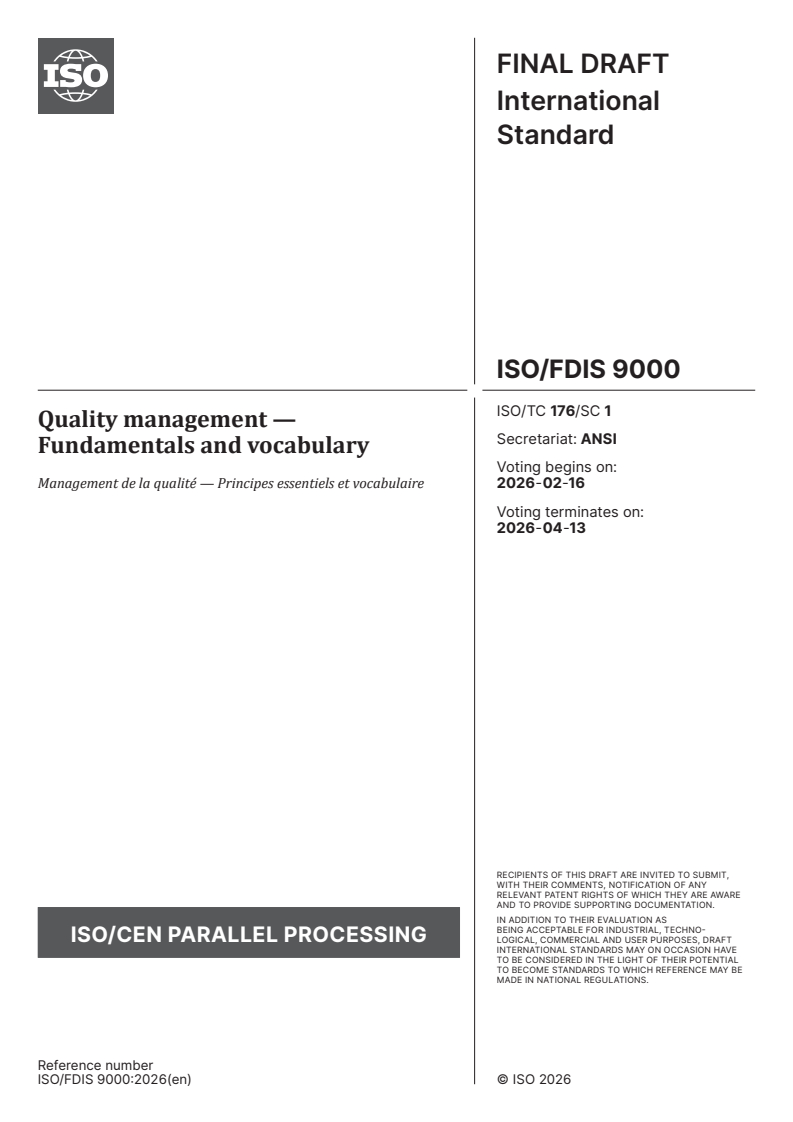


ISO/FDIS 9000 - Quality management — Fundamentals and vocabulary Released:2. 02. 2026
REDLINE ISO/FDIS 9000 - Quality management — Fundamentals and vocabulary Released:2. 02. 2026
Get Certified
Connect with accredited certification bodies for this standard

BSI Group
BSI (British Standards Institution) is the business standards company that helps organizations make excellence a habit.

Bureau Veritas
Bureau Veritas is a world leader in laboratory testing, inspection and certification services.

DNV
DNV is an independent assurance and risk management provider.
Sponsored listings
Frequently Asked Questions
ISO/FDIS 9000 is a draft published by the International Organization for Standardization (ISO). Its full title is "Quality management — Fundamentals and vocabulary". This standard covers: ISO 9000:2015 describes the fundamental concepts and principles of quality management which are universally applicable to the following: organizations seeking sustained success through the implementation of a quality management system; customers seeking confidence in an organization's ability to consistently provide products and services conforming to their requirements; organizations seeking confidence in their supply chain that their product and service requirements will be met; organizations and interested parties seeking to improve communication through a common understanding of the vocabulary used in quality management; organizations performing conformity assessments against the requirements of ISO 9001; providers of training, assessment or advice in quality management; developers of related standards. ISO 9000:2015 specifies the terms and definitions that apply to all quality management and quality management system standards developed by ISO/TC 176.
ISO 9000:2015 describes the fundamental concepts and principles of quality management which are universally applicable to the following: organizations seeking sustained success through the implementation of a quality management system; customers seeking confidence in an organization's ability to consistently provide products and services conforming to their requirements; organizations seeking confidence in their supply chain that their product and service requirements will be met; organizations and interested parties seeking to improve communication through a common understanding of the vocabulary used in quality management; organizations performing conformity assessments against the requirements of ISO 9001; providers of training, assessment or advice in quality management; developers of related standards. ISO 9000:2015 specifies the terms and definitions that apply to all quality management and quality management system standards developed by ISO/TC 176.
ISO/FDIS 9000 is classified under the following ICS (International Classification for Standards) categories: 01.040.03 - Services. Company organization, management and quality. Administration. Transport. Sociology. (Vocabularies); 03.100.70 - Management systems; 03.120.10 - Quality management and quality assurance. The ICS classification helps identify the subject area and facilitates finding related standards.
ISO/FDIS 9000 has the following relationships with other standards: It is inter standard links to FprEN ISO 9000, ISO 24603:2022, ISO 9000:2015. Understanding these relationships helps ensure you are using the most current and applicable version of the standard.
ISO/FDIS 9000 is available in PDF format for immediate download after purchase. The document can be added to your cart and obtained through the secure checkout process. Digital delivery ensures instant access to the complete standard document.
Standards Content (Sample)
FINAL DRAFT
International
Standard
ISO/TC 176/SC 1
Quality management —
Secretariat: ANSI
Fundamentals and vocabulary
Voting begins on:
Management de la qualité — Principes essentiels et vocabulaire 2026-02-16
Voting terminates on:
2026-04-13
RECIPIENTS OF THIS DRAFT ARE INVITED TO SUBMIT,
WITH THEIR COMMENTS, NOTIFICATION OF ANY
RELEVANT PATENT RIGHTS OF WHICH THEY ARE AWARE
AND TO PROVIDE SUPPOR TING DOCUMENTATION.
IN ADDITION TO THEIR EVALUATION AS
BEING ACCEPTABLE FOR INDUSTRIAL, TECHNO
ISO/CEN PARALLEL PROCESSING LOGICAL, COMMERCIAL AND USER PURPOSES, DRAFT
INTERNATIONAL STANDARDS MAY ON OCCASION HAVE
TO BE CONSIDERED IN THE LIGHT OF THEIR POTENTIAL
TO BECOME STAN DARDS TO WHICH REFERENCE MAY BE
MADE IN NATIONAL REGULATIONS.
Reference number
FINAL DRAFT
International
Standard
ISO/TC 176/SC 1
Quality management —
Secretariat: ANSI
Fundamentals and vocabulary
Voting begins on:
Management de la qualité — Principes essentiels et vocabulaire
Voting terminates on:
RECIPIENTS OF THIS DRAFT ARE INVITED TO SUBMIT,
WITH THEIR COMMENTS, NOTIFICATION OF ANY
RELEVANT PATENT RIGHTS OF WHICH THEY ARE AWARE
AND TO PROVIDE SUPPOR TING DOCUMENTATION.
© ISO 2026
IN ADDITION TO THEIR EVALUATION AS
All rights reserved. Unless otherwise specified, or required in the context of its implementation, no part of this publication may
BEING ACCEPTABLE FOR INDUSTRIAL, TECHNO
ISO/CEN PARALLEL PROCESSING
LOGICAL, COMMERCIAL AND USER PURPOSES, DRAFT
be reproduced or utilized otherwise in any form or by any means, electronic or mechanical, including photocopying, or posting on
INTERNATIONAL STANDARDS MAY ON OCCASION HAVE
the internet or an intranet, without prior written permission. Permission can be requested from either ISO at the address below
TO BE CONSIDERED IN THE LIGHT OF THEIR POTENTIAL
or ISO’s member body in the country of the requester.
TO BECOME STAN DARDS TO WHICH REFERENCE MAY BE
MADE IN NATIONAL REGULATIONS.
ISO copyright office
CP 401 • Ch. de Blandonnet 8
CH-1214 Vernier, Geneva
Phone: +41 22 749 01 11
Email: copyright@iso.org
Website: www.iso.org
Published in Switzerland Reference number
ii
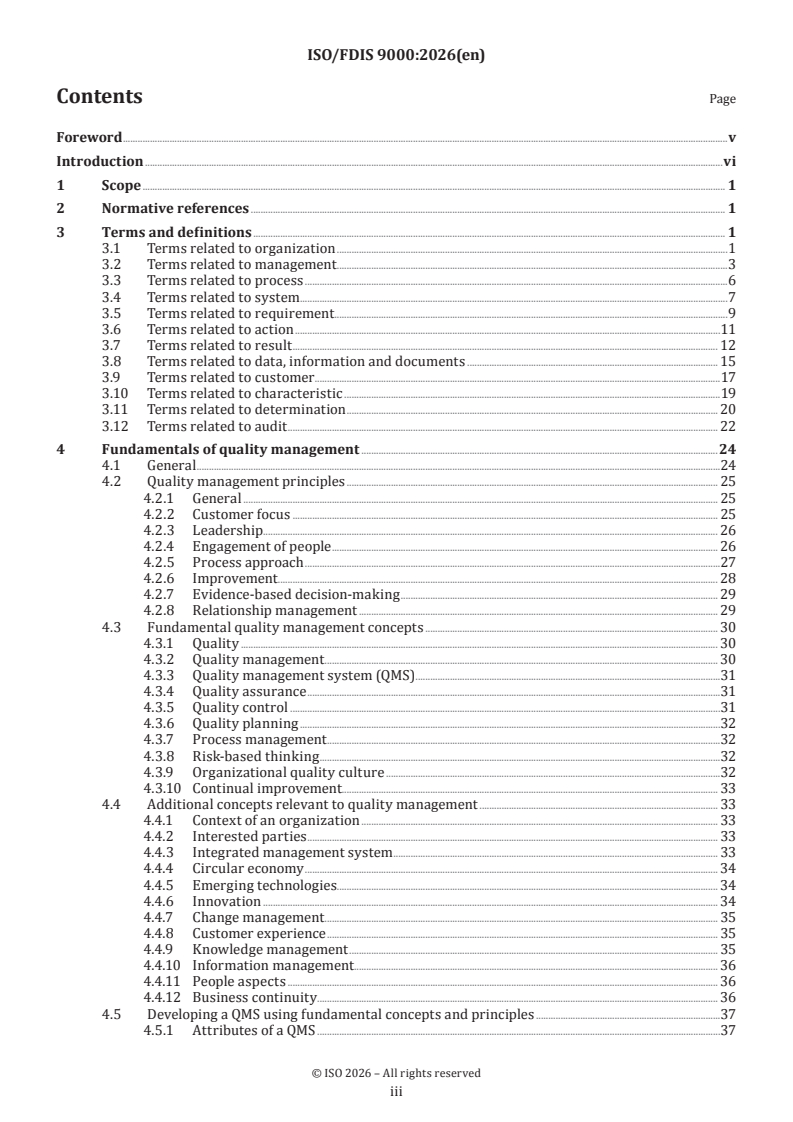
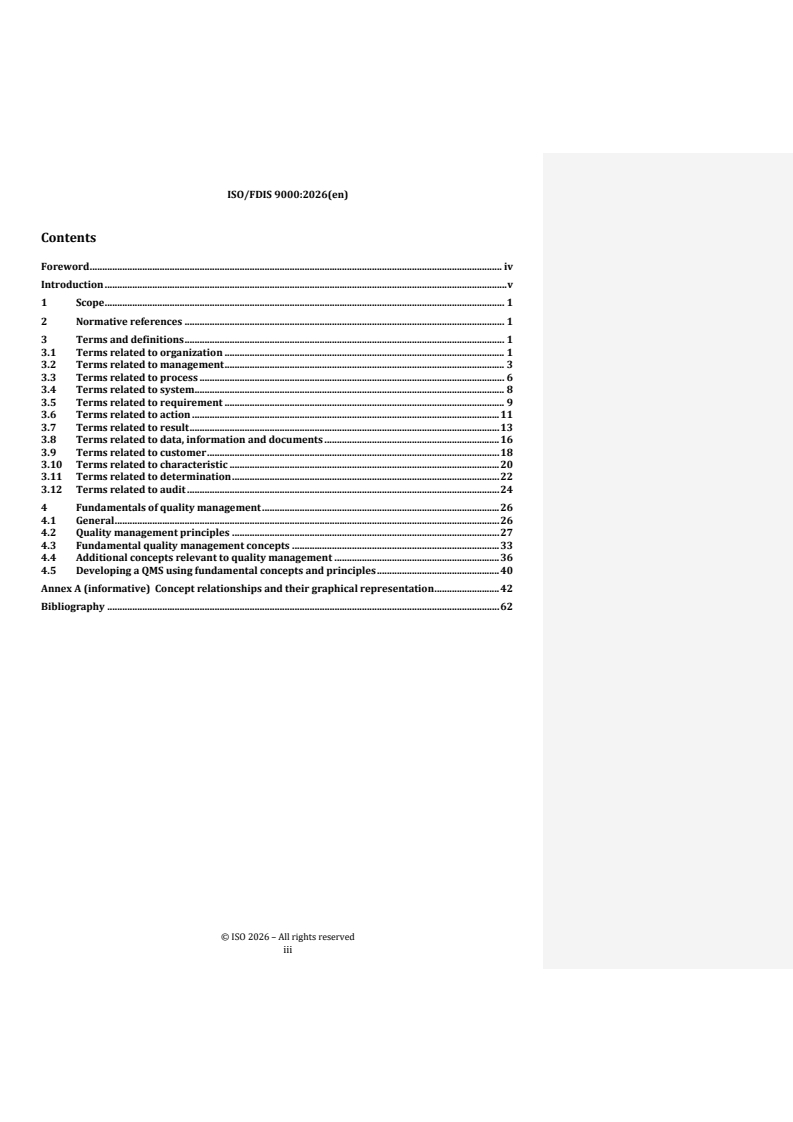
Contents Page
Foreword .v
Introduction .vi
1 Scope . 1
2 Normative references . 1
3 Terms and definitions . 1
3.1 Terms related to organization .1
3.2 Terms related to management .3
3.3 Terms related to process .6
3.4 Terms related to system . .7
3.5 Terms related to requirement . .9
3.6 Terms related to action .11
3.7 Terms related to result . 12
3.8 Terms related to data, information and documents . 15
3.9 Terms related to customer .17
3.10 Terms related to characteristic .19
3.11 Terms related to determination . 20
3.12 Terms related to audit . 22
4 Fundamentals of quality management .24
4.1 General .24
4.2 Quality management principles . 25
4.2.1 General . 25
4.2.2 Customer focus . 25
4.2.3 Leadership. 26
4.2.4 Engagement of people . 26
4.2.5 Process approach .27
4.2.6 Improvement. 28
4.2.7 Evidence-based decision-making . 29
4.2.8 Relationship management . 29
4.3 Fundamental quality management concepts . 30
4.3.1 Quality . 30
4.3.2 Quality management . 30
4.3.3 Quality management system (QMS) . .31
4.3.4 Quality assurance .31
4.3.5 Quality control .31
4.3.6 Quality planning .32
4.3.7 Process management .32
4.3.8 Risk-based thinking .32
4.3.9 Organizational quality culture .32
4.3.10 Continual improvement. 33
4.4 Additional concepts relevant to quality management . 33
4.4.1 Context of an organization . 33
4.4.2 Interested parties . 33
4.4.3 Integrated management system . 33
4.4.4 Circular economy . 34
4.4.5 Emerging technologies. 34
4.4.6 Innovation . 34
4.4.7 Change management . 35
4.4.8 Customer experience . 35
4.4.9 Knowledge management . 35
4.4.10 Information management. 36
4.4.11 People aspects . 36
4.4.12 Business continuity . 36
4.5 Developing a QMS using fundamental concepts and principles .37
4.5.1 Attributes of a QMS .37
iii
4.5.2 Development of a QMS .37
4.5.3 QMS standards, other management system standards and organizational
excellence models . 38
Annex A (informative) Concept relationships and their graphical representation .39
Bibliography .53
Index .54
iv
Foreword
ISO (the International Organization for Standardization) is a worldwide federation of national standards
bodies (ISO member bodies). The work of preparing International Standards is normally carried out through
ISO technical committees. Each member body interested in a subject for which a technical committee
has been established has the right to be represented on that committee. International organizations,
governmental and non-governmental, in liaison with ISO, also take part in the work. ISO collaborates closely
with the International Electrotechnical Commission (IEC) on all matters of electrotechnical standardization.
The procedures used to develop this document and those intended for its further maintenance are described
in the ISO/IEC Directives, Part 1. In particular, the different approval criteria needed for the different types
of ISO document should be noted. This document was drafted in accordance with the editorial rules of the
ISO/IEC Directives, Part 2 (see www.iso.org/directives).
ISO draws attention to the possibility that the implementation of this document may involve the use of (a)
patent(s). ISO takes no position concerning the evidence, validity or applicability of any claimed patent
rights in respect thereof. As of the date of publication of this document, ISO had not received notice of (a)
patent(s) which may be required to implement this document. However, implementers are cautioned that
this may not represent the latest information, which may be obtained from the patent database available at
www.iso.org/patents. ISO shall not be held responsible for identifying any or all such patent rights.
Any trade name used in this document is information given for the convenience of users and does not
constitute an endorsement.
For an explanation of the voluntary nature of standards, the meaning of ISO specific terms and expressions
related to conformity assessment, as well as information about ISO's adherence to the World Trade
Organization (WTO) principles in the Technical Barriers to Trade (TBT), see www.iso.org/iso/foreword.html.
This document was prepared by Technical Committee ISO/TC 176, Quality management and quality
assurance, Subcommittee SC 1, Concepts and terminology, in collaboration with the European Committee for
Standardization (CEN) Technical Committee, in accordance with the Agreement on technical cooperation
between ISO and CEN (Vienna Agreement).
This fifth edition cancels and replaces the fourth edition (ISO 9000:2015), which has been technically
revised.
The main changes are as follows:
— the title has been changed from “Quality management systems — Fundamentals and vocabulary” to
“Quality management — Fundamentals and vocabulary” to better represent the enhanced content;
— the document has been restructured by moving the fundamental concepts and quality management
principles from Clause 2 to Clause 4 to align with the structure in the ISO/IEC Directives, Part 2; Clause 2
is now Normative references;
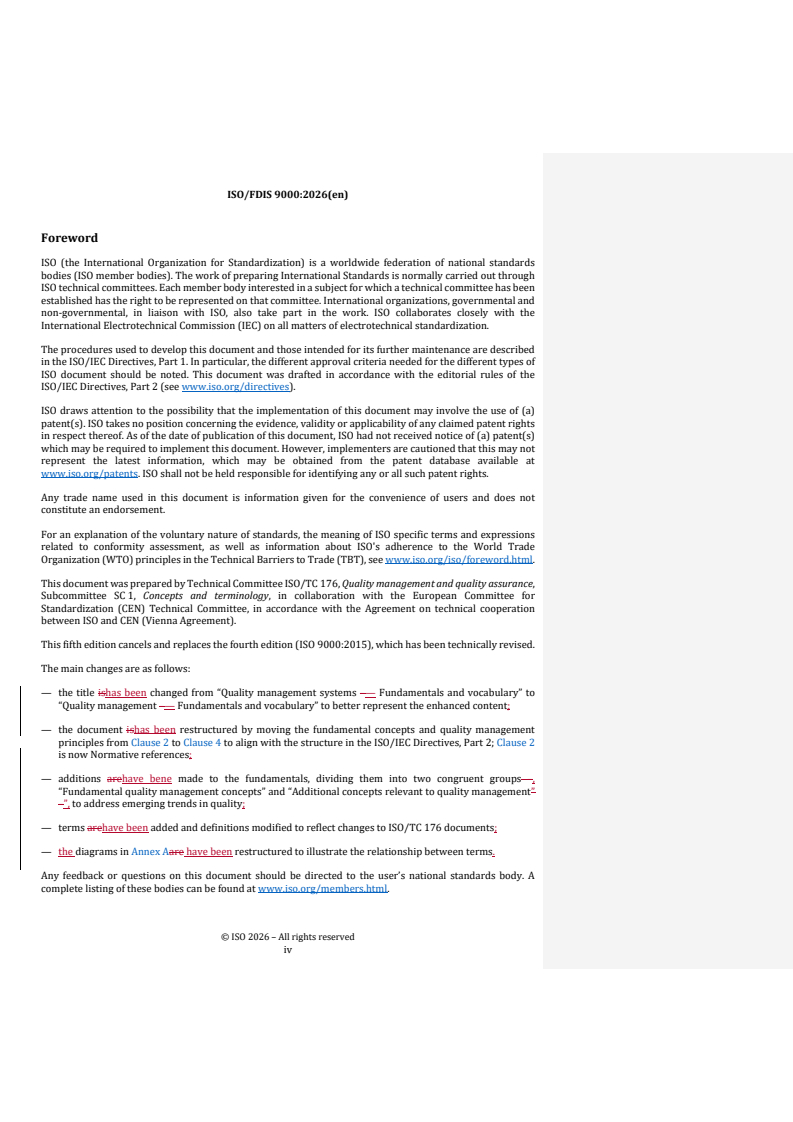
— additions have bene made to the fundamentals, dividing them into two congruent groups, “Fundamental
quality management concepts” and “Additional concepts relevant to quality management”, to address
emerging trends in quality;
— terms have been added and definitions modified to reflect changes to ISO/TC 176 documents;
— the diagrams in Annex A have been restructured to illustrate the relationship between terms.
Any feedback or questions on this document should be directed to the user’s national standards body. A
complete listing of these bodies can be found at www.iso.org/members.html.
v
Introduction
This document provides the fundamentals of quality management. It provides the foundation and the
vocabulary for quality management documents and quality management system (QMS) standards. This
document is intended to help the user understand the fundamental principles, concepts and vocabulary of
quality management, in order to be able to effectively and efficiently implement a QMS and realize value
from quality management documents and QMS standards. This document proposes a well-planned QMS,
based on a framework that integrates established principles and concepts relevant to quality management,
in order to help organizations realize their objectives. It aims to increase an organization’s awareness of its
duties and commitment in fulfilling the needs and expectations of its customers and interested parties, and
in achieving satisfaction with its products and services.
To gain most value for their organization’s QMS, the user should first seek to understand the quality
management principles and their rationale. The quality management principles form the basis of quality
management documents. This document contains seven quality management principles in 4.2. For each
quality management principle, there is a “Statement” describing the principle, a “Rationale” explaining
why the organization would address the principle, “Key benefits” attributed to the principle, and “Possible
actions” an organization can take in applying the principle.
The user should then understand the fundamental concepts in 4.3 and additional concepts relevant to
quality management in 4.4 to seek an insight into how they are used to develop QMS standards. Fundamental
concepts are those which are integral to the understanding of quality management in general. Additional
concepts are those relevant to the effective application of quality management within an organization.
The vocabulary in Clause 3 serves as a unified language for quality management documents, ensuring the
terms are clearly and accurately defined as used within the quality management documents developed
by ISO/TC 176. This document contains the terms and definitions that apply to all quality management
documents and QMS standards developed by ISO/TC 176, at the time of publication. This document does not
contain sector-specific terms and definitions for sector-specific QMS standards. The terms and definitions
are arranged in conceptual order, with an alphabetical index of the terminological entries provided in at
the end of this document. Annex A includes a set of concept diagrams on which the thematic grouping of the
terms and definitions in Clause 3 is based.
NOTE Guidance on some additional frequently used words in the QMS standards developed by ISO/TC 176, and
which have an identified dictionary meaning, is provided in Reference [19].
vi
FINAL DRAFT International Standard ISO/FDIS 9000:2026(en)
Quality management — Fundamentals and vocabulary
1 Scope
This document establishes the fundamental concepts and principles of quality management which are
universally applicable to the following:
— organizations seeking sustained success through the implementation of a quality management system
(QMS);
— customers seeking confidence in an organization’s ability to consistently provide products and services
conforming to their requirements;
— organizations seeking confidence in their supply chain that product and service requirements will be
met;
— organizations and interested parties seeking to improve communication through a common
understanding of the vocabulary used in quality management;
— organizations performing conformity assessments against the requirements of ISO 9001;
— providers of training, assessment or advice in quality management;
— developers of related standards.
This document defines terms that apply to all quality management documents and QMS standards developed
by ISO/TC 176.
This document is applicable to all organizations, regardless of size, complexity or business model.
2 Normative references
There are no normative references in this document.
3 Terms and definitions
ISO and IEC maintain terminology databases for use in standardization at the following addresses:
— ISO Online browsing platform: available at https:// www .iso .org/ obp
— IEC Electropedia: available at https:// www .electropedia .org/
3.1 Terms related to organization
3.1.1
organization
person or group of people that has its own functions with responsibilities, authorities and relationships to
achieve its objectives (3.7.11)
Note 1 to entry: The concept of organization includes, but is not limited to, sole-trader, company, corporation, firm,
enterprise, authority, partnership, charity or institution, or part or combination thereof, whether incorporated or not,
public or private.
Note 2 to entry: If the organization is part of a larger entity, the term “organization” refers only to the part of the larger
entity that is within the scope of the quality management system (3.4.9).
3.1.2
context of the organization
combination of internal and external issues that can have an effect on an organization’s (3.1.1) approach to
specifying and achieving its objectives (3.7.11)
Note 1 to entry: The organization’s objectives can be related to its products (3.7.9) and services (3.7.10), investments
and behaviour towards its interested parties (3.1.4).
Note 2 to entry: The concept of “context of the organization” is equally applicable to not-for-profit or public service
organizations as it is to those seeking profits.
Note 3 to entry: Understanding the infrastructure (3.4.3) can help to define the context of the organization.
3.1.3
top management
person or group of people who directs and controls an organization (3.1.1) at the highest level
Note 1 to entry: Top management has the power to delegate authority and provide resources within the organization.
Note 2 to entry: If the scope of the management system (3.4.2) covers only part of an organization, then top management
refers to those who direct and control that part of the organization.
3.1.4
interested party
stakeholder
person or organization (3.1.1) that can affect, be affected by, or perceive itself to be affected by a decision or
activity
EXAMPLE Customers (3.9.1), owners, people in an organization, providers (3.1.9), bankers, regulatory authorities,
unions, partners or society that can include competitors or opposing pressure groups.
3.1.5
involvement
taking part in an activity, event or situation
3.1.6
engagement
involvement (3.1.5) in, and contribution to, activities to achieve shared objectives (3.7.11)
3.1.7
innovation
new or changed object (3.5.3) realizing or redistributing value
Note 1 to entry: Activities resulting in innovation are generally managed.
Note 2 to entry: Innovation is generally significant in its effect.
3.1.8
association
organization (3.1.1) consisting of member organizations or persons
3.1.9
provider
supplier
organization (3.1.1) that provides a product (3.7.9) or a service (3.7.10)
EXAMPLE Producer, distributor, retailer or vendor of a product or a service.
Note 1 to entry: A provider can be internal or external to the organization.
Note 2 to entry: In a contractual situation, a provider is sometimes called “contractor”.
3.1.10
external provider
external supplier
provider (3.1.9) that is not part of the organization (3.1.1)
EXAMPLE Producer, distributor, retailer or vendor of a product (3.7.9) or a service (3.7.10).
3.1.11
DRP-provider
dispute resolution process provider
person or organization (3.1.1) that supplies and operates an external dispute (3.9.4) resolution process (3.3.1)
Note 1 to entry: Generally, a DRP-provider is a legal entity, separate from the organization or person as an individual
and the complainant (3.9.6). In this way, the attributes of independence and fairness are emphasized. In some
situations, a separate unit is established within the organization to handle unresolved complaints (3.9.3).
Note 2 to entry: The DRP-provider contracts with the parties to provide dispute resolution, and is accountable for
performance (3.7.3). The DRP-provider supplies dispute resolvers (3.9.5). The DRP-provider also utilizes support,
executive and other managerial staff to supply financial resources, clerical support, scheduling assistance, training,
meeting rooms, supervision and similar functions.
Note 3 to entry: DRP-providers can take many forms including not-for-profit, for-profit and public entities. An
association (3.1.8) can also be a DRP-provider.
3.1.12
continual improvement
recurring activity to enhance performance (3.7.3)
3.1.13
quality management system consultant
person who assists the organization (3.1.1) on quality management system realization (3.3.6), giving advice
or information (3.8.4)
Note 1 to entry: The consultant can also assist in realizing parts of a quality management system (3.4.9).
Note 2 to entry: ISO 10019 provides guidance on how to distinguish a competent quality management system
consultant from one who is not competent.
3.2 Terms related to management
3.2.1
management
coordinated activities to direct and control an organization (3.1.1)
Note 1 to entry: Management can include establishing policies (3.4.5) and objectives (3.7.11), and processes (3.3.1) to
achieve these objectives.
Note 2 to entry: The word “management” sometimes refers to people, i.e. a person or group of people with authority
and responsibility for the conduct and control of an organization. When “management” is used in this sense, it
should always be used with some form of qualifier to avoid confusion with the concept of “management” as a set of
activities defined above. For example, “management shall…” is deprecated whereas “top management (3.1.3) shall…” is
acceptable. Otherwise different words should be adopted to convey the concept when related to people (e.g. managerial
or managers).
3.2.2
quality management
management (3.2.1) with regard to quality (3.5.2)
Note 1 to entry: Quality management can include establishing quality policies (3.4.6) and quality objectives (3.7.12), and
processes (3.3.1) to achieve these quality objectives through quality planning (3.2.7), quality assurance (3.2.8), quality
control (3.2.9) and quality improvement (3.2.10).
3.2.3
improvement
activity to enhance performance (3.7.3)
Note 1 to entry: The activity can be recurring or singular.
3.2.4
good practice
method that has been proven to work well and produce good results (3.7.1), and is therefore recommended
to be adopted as a model
Note 1 to entry: A method described as a good practice has usually been tested over time and validated through
repeated trials before being accepted as worthy of broad adoption.
Note 2 to entry: In some circumstances “good practice” is referred to as “best practice”.
3.2.5
benchmarking
comparative evaluation or analysis of similar practices with the aim of improving performance (3.7.3)
Note 1 to entry: Benchmarking can be applied to policies (3.4.5), strategies (3.4.12) and objectives (3.7.11), processes
(3.3.1) and their operation, products (3.7.9), services (3.7.10) and the organization’s (3.1.1) structures.
3.2.6
process owner
person with assigned responsibility and authority for a process (3.3.1)
Note 1 to entry: The responsibilities of a process owner can include defining, developing and deploying the process,
communicating with interested parties (3.1.4), measuring and monitoring (3.11.3) the results (3.7.1) of the process and
continually improving the performance (3.7.3) of the process.
3.2.7
quality planning
part of quality management (3.2.2) focused on setting quality objectives (3.7.12) and specifying processes
(3.3.1) necessary for providing products (3.7.9) and services (3.7.10), and related resources to achieve the
quality objectives
Note 1 to entry: Establishing quality plans (3.8.10) can be part of quality planning.
3.2.8
quality assurance
part of quality management (3.2.2) focused on providing confidence that quality requirements (3.5.6) will be
fulfilled
3.2.9
quality control
part of quality management (3.2.2) focused on fulfilling quality requirements (3.5.6)
3.2.10
quality improvement
part of quality management (3.2.2) focused on increasing the ability to fulfil quality requirements (3.5.6)
Note 1 to entry: The quality requirements can be related to any aspect such as effectiveness (3.7.17), efficiency (3.7.16)
or traceability (3.5.11).
3.2.11
project management
planning, organizing, monitoring (3.11.3), controlling and reporting of all aspects of a project (3.2.12), and
the motivation of all those involved in it to achieve the project objectives
3.2.12
project
unique process (3.3.1) undertaken to achieve an objective (3.7.11)
Note 1 to entry: A project generally consists of a set of coordinated and controlled activities with start and finish
dates, conforming to specific requirements (3.5.1), including the constraints of time, cost and resources.
Note 2 to entry: An individual project can form part of a larger project structure and generally has a defined start and
finish date.
Note 3 to entry: In some projects, the objectives and scope are updated and the product or service characteristics
defined progressively as the project proceeds.
Note 4 to entry: The output (3.7.8) of a project can be one or several units of a product (3.7.9) or service (3.7.10).
Note 5 to entry: The project’s organization is normally temporary and established for the lifetime of the project.
Note 6 to entry: The complexity of the interactions among project activities is not necessarily related to the project
size.
3.2.13
activity
identified piece of work that is required to be undertaken to complete a project (3.2.12)
Note 1 to entry: The activity in a project can generally be recognized as the smallest identified entity.
3.2.14
project organization
temporary structure that includes project roles, responsibilities, and levels of authority and
boundaries that need to be defined and communicated to all interested parties (3.1.4) of a project (3.2.12)
3.2.15
project management plan
document (3.8.7) specifying what is necessary to meet the objective(s) (3.7.11) of a project (3.2.12)
Note 1 to entry: A project management plan should include or refer to the project’s quality plan (3.8.10).
Note 2 to entry: The project management plan also includes or references such other plans as those relating to
organizational structures, resources, schedule, budget, risk management, environmental management, health and
safety management and security management, as appropriate.
3.2.16
progress evaluation
assessment of progress made on achievement of project (3.2.12)objectives (3.7.11)
Note 1 to entry: This assessment should be carried out at appropriate points in the project life cycle (3.2.17) across
project processes (3.3.1), based on criteria for project processes and product (3.7.9) or service (3.7.10).
Note 2 to entry: The results (3.7.1) of progress evaluations can lead to revision of the project management plan (3.2.15).
3.2.17
project life cycle
defined set of phases from the start to the end of a project (3.2.12)
3.2.18
project phase
division of a project life cycle (3.2.17) into manageable sets of activities, such as conception,
development, realization and termination
3.3 Terms related to process
3.3.1
process
set of interrelated or interacting activities that uses or transforms inputs to deliver a result (3.7.1)
Note 1 to entry: Whether the result of a process is called an output (3.7.8), a product (3.7.9) or a service (3.7.10) depends
on the context of the reference.
Note 2 to entry: Inputs to a process are generally the outputs of other processes and outputs of a process are generally
the inputs to other processes.
Note 3 to entry: Two or more interrelated and interacting processes in series can also be referred to as a “process”.
Note 4 to entry: Processes in an organization (3.1.1) are generally planned and carried out under controlled conditions
to add value.
Note 5 to entry: A process where the conformity (3.5.9) of the resulting output cannot be readily or economically
validated is frequently referred to as a “special process”.
3.3.2
procedure
specified way to carry out an activity or a process (3.3.1)
Note 1 to entry: Procedures can be documented or not.
3.3.3
process owner
person (or team) responsible for defining and maintaining a process (3.3.1)
Note 1 to entry: At the organizational level, the process owner is the person (or team) responsible for the description
of a standard process; at the project level, the process owner is the person (or team) responsible for the description of
the defined process. A process can therefore have multiple owners at different levels of responsibility.
3.3.4
process approach
systematic approach to management (3.2.1) in which an organization
(3.1.1) identifies, monitors and manages its internal processes (3.3.1) and their interactions
3.3.5
workflow
series of activities necessary to complete a task
Note 1 to entry: A workflow that is partially carried out without manual interference can be referred to as a “semi-
automated workflow”. A workflow that is completely carried out without manual interference can be referred to as an
“automated workflow”.
Note 2 to entry: Workflows can be documented.
3.3.6
quality management system realization
process (3.3.1) of establishing, documenting, implementing, maintaining and continually improving a quality
management system (3.4.9)
3.3.7
change matrix
two-dimensional array showing the relationship between product
(3.7.9) or service (3.7.10) realization stages and organizational change stages
Note 1 to entry: The product or service realization stages are presented on the x-axis and organizational change stages
on the y-axis.
3.3.8
aggregation model
combined view of the current state of organizational change
Note 1 to entry: The combined view presents the positions of interested parties (3.1.4) on the change matrix (3.3.7).
3.3.9
intervention
process (3.3.1) through which the behaviour of an organization (3.1.1)
is changed
3.3.10
people development
encouragement of employees to acquire new or advanced competence (3.10.6) by creating
learning and training opportunities with circumstances to deploy the outcomes that have been acquired
3.3.11
design and development
set of processes (3.3.1) that transform requirements (3.5.1) for an object (3.5.3) into more detailed
requirements for that object
Note 1 to entry: The requirements forming input to design and development are often the result (3.7.1) of research
and can be expressed in a broader, more general sense than the requirements forming the output (3.7.8) of design and
development. The requirements are generally defined in terms of characteristics (3.10.1). In a project (3.2.12), there
can be several design and development stages.
Note 2 to entry: The words “design” and “development” and the term “design and development” are sometimes used
synonymously and sometimes used to define different stages of the overall design and development.
Note 3 to entry: A qualifier can be applied to indicate the nature of what is being designed and developed (e.g. product
(3.7.9) design and development, service (3.7.10) design and development, process design and development).
3.3.12
outsource, verb
make an arrangement where an external organization (3.1.1) performs part of an organization’s function or
process (3.3.1)
Note 1 to entry: An external organization is outside the scope of the management system (3.4.2), although the
outsourced function or process is within the scope.
3.3.13
contract
binding agreement
3.4 Terms related to system
3.4.1
system
set of interrelated or interacting elements
3.4.2
management system
set of interrelated or interacting elements of an organization (3.1.1) to establish policies (3.4.5) and objectives
(3.7.11), as well as processes (3.3.1) to achieve those objectives
Note 1 to entry: A management system can address a single discipline or several disciplines.
Note 2 to entry: The management system elements include the organization’s structure, roles and responsibilities,
planning and operation.
Note 3 to entry: The management system elements can include the organization’s policies, practices, rules and beliefs.
Note 4 to entry: An organization manages its interrelated elements in an orderly manner to achieve its objectives.
Note 5 to entry: The scope of a management system can include the whole of the organization, specific and identified
functions of the organization, specific and identified sections of the organization, or one or more functions across a
group of organizations.
3.4.3
infrastructure
system (3.4.1) of facilities, equipment and services (3.7.10) needed for the operation of an
organization (3.1.1)
3.4.4
work environment
set of conditions under which work is performed
Note 1 to entry: Conditions can include physical, social, psychological and environmental factors (such as temperature,
lighting, recognition schemes, occupational stress, ergonomics and atmospheric composition).
3.4.5
policy
intentions and direction of an organization (3.1.1) as formally expressed by its top
management (3.1.3)
3.4.6
quality policy
policy (3.4.5) related to quality (3.5.2)
Note 1 to entry: The quality policy:
— is generally consistent with the overall policy of the organization (3.1.1);
— can be aligned with the organization’s vision (3.4.10) and mission (3.4.11);
— provides a framework for the setting of quality objectives (3.7.12).
Note 2 to entry: The quality management principles presented in this document can form a basis for the establishment
of a quality policy.
3.4.7
culture
integrated shared values, beliefs, history, ethics, attitudes and observed behaviours
3.4.8
quality culture
culture (3.4.7) supporting the achievement of a quality policy (3.4.6) and objectives (3.7.12), and the delivery
of products (3.7.9) and services (3.7.10) that meet the needs and expectations of customers (3.9.1) and other
interested parties (3.1.4)
3.4.9
quality management system
QMS
part of the overall management system (3.4.2) of an organization (3.1.1) related to quality (3.5.2)
3.4.10
vision
aspiration of what an organization (3.1.1) would like to become as expressed by top management (3.1.3)
3.4.11
mission
organization’s (3.1.1) purpose for existing as expressed by top management (3.1.3)
3.4.12
strategy
plan to achieve a long-term or overall objective (3.7.11)
3.4.13
economic benefit
benefit attained through the effective implementation of management
system (3.4.2)processes (3.3.1) and resources to generate value and improve the health and overall worth of
an organization (3.1.1) and its relevant interested parties (3.1.4)
3.4.14
financial benefit
organizational improvement expressed in monetary form
Note 1 to entry: Financial benefits should be realized by implementing cost-effective management system processes.
3.5 Terms related to requirement
3.5.1
requirement
need or expectation that is stated, generally implied or obligatory
Note 1 to entry: “Generally implied” means that it is custom or common practice for the organization (3.1.1) and
interested parties (3.1.4) that the need or expectation under consideration is implied.
Note 2 to entry: A specified requirement is one that is stated, e.g. in documented information (3.8.14).
Note 3 to entry: A qualifier can be used to denote a specific type of requirement, e.g. product (3.7.9) requirement, service
(3.7.10) requirement, quality management (3.2.2) requirement, customer (3.9.1) requirement, quality requirement
(3.5.6).
Note 4 to entry: Requirements can be generated by different interested parties or by the organization itself.
Note 5 to entry: It can be necessary for achieving high customer satisfaction (3.9.13) to fulfil an expectation of a
customer even if it is neither stated nor generally implied or obligatory.
3.5.2
quality
degree to which a set of inherent characteristics (3.10.1) of an object (3.5.3) fulfils requirements (3.5.1)
Note 1 to entry: The term “quality” can be used with adjectives such as poor, good or excellent.
Note 2 to entry: “Inherent”, as opposed to “assigned”, means existing in the object.
3.5.3
object
anything perceivable or conceivable
EXAMPLE Product (3.7.9), service (3.7.10), process (3.3.1), person, organization (3.1.1), system (3.4.1), resource.
Note 1 to entry: Objects can be material (e.g. an “engine”, a “sheet of paper”, a “diamond”), immaterial (e.g. “conversion
ratio”, “project plan”) or imagined (e.g. “unicorn”, “scientific hypothesis”).
[SOURCE: ISO 1087:2019, 3.1.1, modified — Example added].
3.5.4
grade
category or rank given to different requirements (3.5.1) for an object (3.5.3) having the same functional use
EXAMPLE Class of airline ticket, category of hotel in a hotel brochure.
Note 1 to entry: When establishing a quality requirement (3.5.6), the grade is generally specified.
3.5.5
statutory requirement
obligatory requirement (3.5.1) specified by a legislative body
3.5.6
quality requirement
requirement (3.5.1) related to quality (3.5.2)
3.5.7
metrological requirement
set of requirements (3.5.1) for measurement processes (3.11.8) that include criteria and practices necessary
to ensure that measurements (3.11.4) are reliable and comply with applicable r
...
ISO/TC 176/SC 1
Secretariat: ANSI
Date: 2025-12-052026-01-30
Quality management — Fundamentals and vocabulary
Management de la qualité — Principes essentiels et vocabulaire
FDIS stage
TThhiiss drdraafftt i iss susubbmmiitttteed d ttoo aa ppaarraallellel l vvoottee i inn IISSOO,, CCEEN.N.
All rights reserved. Unless otherwise specified, or required in the context of its implementation, no part of this publication
may be reproduced or utilized otherwise in any form or by any means, electronic or mechanical, including photocopying,
or posting on the internet or an intranet, without prior written permission. Permission can be requested from either ISO
at the address below or ISO’s member body in the country of the requester.
ISO copyright office
CP 401 • Ch. de Blandonnet 8
CH-1214 Vernier, Geneva
Phone: + 41 22 749 01 11
E-mail: copyright@iso.org
Website: www.iso.org
Published in Switzerland
ii
Contents
Foreword . iv
Introduction . v
1 Scope . 1
2 Normative references . 1
3 Terms and definitions . 1
3.1 Terms related to organization . 1
3.2 Terms related to management . 3
3.3 Terms related to process . 6
3.4 Terms related to system . 8
3.5 Terms related to requirement . 9
3.6 Terms related to action . 11
3.7 Terms related to result . 13
3.8 Terms related to data, information and documents . 16
3.9 Terms related to customer . 18
3.10 Terms related to characteristic . 20
3.11 Terms related to determination . 22
3.12 Terms related to audit . 24
4 Fundamentals of quality management . 26
4.1 General . 26
4.2 Quality management principles . 27
4.3 Fundamental quality management concepts . 33
4.4 Additional concepts relevant to quality management . 36
4.5 Developing a QMS using fundamental concepts and principles . 40
Annex A (informative) Concept relationships and their graphical representation . 42
Bibliography . 62
iii
Foreword
ISO (the International Organization for Standardization) is a worldwide federation of national standards
bodies (ISO member bodies). The work of preparing International Standards is normally carried out through
ISO technical committees. Each member body interested in a subject for which a technical committee has been
established has the right to be represented on that committee. International organizations, governmental and
non-governmental, in liaison with ISO, also take part in the work. ISO collaborates closely with the
International Electrotechnical Commission (IEC) on all matters of electrotechnical standardization.
The procedures used to develop this document and those intended for its further maintenance are described
in the ISO/IEC Directives, Part 1. In particular, the different approval criteria needed for the different types of
ISO document should be noted. This document was drafted in accordance with the editorial rules of the
ISO/IEC Directives, Part 2 (see www.iso.org/directives).
ISO draws attention to the possibility that the implementation of this document may involve the use of (a)
patent(s). ISO takes no position concerning the evidence, validity or applicability of any claimed patent rights
in respect thereof. As of the date of publication of this document, ISO had not received notice of (a) patent(s)
which may be required to implement this document. However, implementers are cautioned that this may not
represent the latest information, which may be obtained from the patent database available at
www.iso.org/patents. ISO shall not be held responsible for identifying any or all such patent rights.
Any trade name used in this document is information given for the convenience of users and does not
constitute an endorsement.
For an explanation of the voluntary nature of standards, the meaning of ISO specific terms and expressions
related to conformity assessment, as well as information about ISO's adherence to the World Trade
Organization (WTO) principles in the Technical Barriers to Trade (TBT), see www.iso.org/iso/foreword.html.
This document was prepared by Technical Committee ISO/TC 176, Quality management and quality assurance,
Subcommittee SC 1, Concepts and terminology, in collaboration with the European Committee for
Standardization (CEN) Technical Committee, in accordance with the Agreement on technical cooperation
between ISO and CEN (Vienna Agreement).
This fifth edition cancels and replaces the fourth edition (ISO 9000:2015), which has been technically revised.
The main changes are as follows:
— the title ishas been changed from “Quality management systems –— Fundamentals and vocabulary” to
“Quality management –— Fundamentals and vocabulary” to better represent the enhanced content;
— the document ishas been restructured by moving the fundamental concepts and quality management
principles from Clause 2 to Clause 4 to align with the structure in the ISO/IEC Directives, Part 2; Clause 2
is now Normative references;
— additions arehave bene made to the fundamentals, dividing them into two congruent groups –,
“Fundamental quality management concepts” and “Additional concepts relevant to quality management”
–”, to address emerging trends in quality;
— terms arehave been added and definitions modified to reflect changes to ISO/TC 176 documents;
— the diagrams in Annex Aare have been restructured to illustrate the relationship between terms.
Any feedback or questions on this document should be directed to the user’s national standards body. A
complete listing of these bodies can be found at www.iso.org/members.html.
iv
Introduction
This document provides the fundamentals of quality management and the vocabulary used in ISO quality
management documents. It provides the foundation and the vocabulary for quality management documents
and quality management system (QMS) standards. This document is intended to help the user understand the
fundamental principles, concepts and vocabulary of quality management, in order to be able to effectively and
efficiently implement a QMS and realize value from quality management documents and QMS standards. This
document proposes a well-planned QMS, based on a framework that integrates established principles and
concepts relevant to quality management, in order to help organizations realize their objectives. It aims to
increase an organization’s awareness of its duties and commitment in fulfilling the needs and expectations of
its customers and interested parties, and in achieving satisfaction with its products and services.
To gain most value for their organization’s quality management systemQMS, the user should first seek to
understand the quality management principles and their rationale. The quality management principles form
the basis of ISO quality management standardsdocuments. This document contains seven quality management
principles in 4.2. For each quality management principle, there is a “Statement” describing the principle, a
“Rationale” explaining why the organization would address the principle, “Key benefits” attributed to the
principle, and “Possible actions” an organization can take in applying the principle.
The user should then understand the fundamental concepts in 4.3 and additional concepts relevant to quality
management in 4.4 to seek an insight into how they are used to develop ISO quality management systemQMS
standards. Fundamental concepts are those which are integral to the understanding of quality management
in general. Additional concepts are those relevant to the effective application of quality management within
an organization.
The vocabulary in Clause 3 serves as a unified language for ISO quality management standardsdocuments,
ensuring the terms are clearly and accurately defined as used within this family of standards.the quality
management documents developed by ISO/TC 176. This document contains the terms and definitions that
apply to all quality management documents and QMS standards developed by ISO/TC 176, at the time of
publication. This document does not contain sector-specific terms and definitions for sector-specific quality
management systemQMS standards. The terms and definitions are arranged in conceptual order, with an
alphabetical index of the terminological entries provided in at the end of this document. Annex A includes a
set of concept diagrams on which the thematic grouping of the terms and definitions in Clause 3 is based.
NOTE Guidance on some additional frequently used words in the QMS standards developed by ISO/TC 176, and
which have an identified dictionary meaning, is provided in Reference [19 [16]. ].
v
Quality management — Fundamentals and vocabulary
1 Scope
This document specifiesestablishes the fundamental concepts and principles of quality management which
are universally applicable to the following:
— organizations seeking sustained success through the implementation of a quality management system
(QMS);
— customers seeking confidence in an organization’s ability to consistently provide products and services
conforming to their requirements;
— organizations seeking confidence in their supply chain that product and service requirements will be met;
— organizations and interested parties seeking to improve communication through a common
understanding of the vocabulary used in quality management;
— organizations performing conformity assessments against the requirements of ISO 9001;
— providers of training, assessment or advice in quality management;
— developers of related standards.
This document specifies thedefines terms that apply to all quality management documents and QMS standards
developed by ISO/TC 176.
This document is applicable to all organizations, regardless of size, complexity or business model.
2 Normative references
There are no normative references in this document.
3 Terms and definitions
ISO and IEC maintain terminology databases for use in standardization at the following addresses:
— ISO Online browsing platform: available at https://www.iso.org/obp
— IEC Electropedia: available at https://www.electropedia.org/
3.1 Terms related to organization
3.1.1
organization
person or group of people that has its own functions with responsibilities, authorities and relationships to
achieve its objectives (3.7.11)
Note 1 to entry: The concept of organization includes, but is not limited to, sole-trader, company, corporation, firm,
enterprise, authority, partnership, charity or institution, or part or combination thereof, whether incorporated or not,
public or private.
Note 2 to entry: If the organization is part of a larger entity, the term “organization” refers only to the part of the larger
entity that is within the scope of the quality management system (3.4.9).
3.1.2
context of the organization
combination of internal and external issues that can have an effect on an organization’s (3.1.1) approach to
specifying and achieving its objectives (3.7.11)
Note 1 to entry: The organization’s objectives can be related to its products (3.7.9) and services (3.7.10), investments and
behaviour towards its interested parties (3.1.4).
Note 2 to entry: The concept of “context of the organization” is equally applicable to not-for-profit or public service
organizations as it is to those seeking profits.
Note 3 to entry: Understanding the infrastructure (3.4.3) can help to define the context of the organization.
3.1.3
top management
person or group of people who directs and controls an organization (3.1.1) at the highest level
Note 1 to entry: Top management has the power to delegate authority and provide resources within the organization.
Note 2 to entry: If the scope of the management system (3.4.2) covers only part of an organization, then top management
refers to those who direct and control that part of the organization.
3.1.4
interested party
stakeholder
person or organization (3.1.1) that can affect, be affected by, or perceive itself to be affected by a decision or
activity
EXAMPLE Customers (3.9.1), owners, people in an organization, providers (3.1.9), bankers, regulatory authorities,
unions, partners or society that can include competitors or opposing pressure groups.
3.1.5
involvement
taking part in an activity, event or situation
3.1.6
engagement
involvement (3.1.5) in, and contribution to, activities to achieve shared objectives (3.7.11)
3.1.7
innovation
new or changed object (3.5.3) realizing or redistributing value
Note 1 to entry: Activities resulting in innovation are generally managed.
Note 2 to entry: Innovation is generally significant in its effect.
3.1.8
association
organization (3.1.1) consisting of member organizations or persons
3.1.9
provider
supplier
organization (3.1.1) that provides a product (3.7.9) or a service (3.7.10)
EXAMPLE Producer, distributor, retailer or vendor of a product or a service.
Note 1 to entry: A provider can be internal or external to the organization.
Note 2 to entry: In a contractual situation, a provider is sometimes called “contractor”.
3.1.10
external provider
external supplier
provider (3.1.9) that is not part of the organization (3.1.1)
EXAMPLE Producer, distributor, retailer or vendor of a product (3.7.9) or a service (3.7.10).
3.1.11
DRP-provider
dispute resolution process provider
person or organization (3.1.1) that supplies and operates an external dispute (3.9.4) resolution process (3.3.1)
Note 1 to entry: Generally, a DRP-provider is a legal entity, separate from the organization or person as an individual and
the complainant (3.9.6). In this way, the attributes of independence and fairness are emphasized. In some situations, a
separate unit is established within the organization to handle unresolved complaints (3.9.3).
Note 2 to entry: The DRP-provider contracts with the parties to provide dispute resolution, and is accountable for
performance (3.7.3). The DRP-provider supplies dispute resolvers (3.9.5). The DRP-provider also utilizes support,
executive and other managerial staff to supply financial resources, clerical support, scheduling assistance, training,
meeting rooms, supervision and similar functions.
Note 3 to entry: DRP-providers can take many forms including not-for-profit, for-profit and public entities. An association
(3.1.8) can also be a DRP-provider.
3.1.12
continual improvement
recurring activity to enhance performance (3.7.3)
3.1.13
quality management system consultant
person who assists the organization (3.1.1) on quality management system realization (3.3.6), giving advice or
information (3.8.4(3.8.5))
Note 1 to entry: The consultant can also assist in realizing parts of a quality management system (3.4.9).
Note 2 to entry: ISO 10019 provides guidance on how to distinguish a competent quality management system consultant
from one who is not competent.
3.2 Terms related to management
3.2.1
management
coordinated activities to direct and control an organization (3.1.1)
Note 1 to entry: Management can include establishing policies (3.4.5(3.1.5)) and objectives (3.7.11(3.1.6),), and processes
(3.3.1(3.1.8)) to achieve these objectives.
Note 2 to entry: The word “management” sometimes refers to people, i.e. a person or group of people with authority and
responsibility for the conduct and control of an organization. When “management” is used in this sense, it should always
be used with some form of qualifier to avoid confusion with the concept of “management” as a set of activities defined
above. For example, “management shall…” is deprecated whereas “top management (3.1.3) shall…” is acceptable.
Otherwise different words should be adopted to convey the concept when related to people (e.g. managerial or
managers).
3.2.2
quality management
management (3.2.1) with regard to quality (3.5.2)
Note 1 to entry: Quality management can include establishing quality policies (3.4.6) and quality objectives (3.7.12), and
processes (3.3.1) to achieve these quality objectives through quality planning (3.2.7(3.2.6),), quality assurance
(3.2.8(3.2.7),), quality control (3.2.9(3.2.8)) and quality improvement (3.2.10(3.2.9).).
3.2.3
improvement
activity to enhance performance (3.7.3)
Note 1 to entry: The activity can be recurring or singular.
3.2.4
good practice
method that has been proven to work well and produce good results (3.7.1,), and is therefore recommended
to be adopted as a model
Note 1 to entry: A method described as a good practice has usually been tested over time and validated through repeated
trials before being accepted as worthy of broad adoption.
Note 2 to entry: In some circumstances “good practice” is referred to as “best practice”.
3.2.5
benchmarking
comparative evaluation or analysis of similar practices with the aim of improving performance (3.7.3)
Note 1 to entry: Benchmarking can be applied to policies (3.4.5), strategies (3.4.12) and objectives (3.7.11), processes
(3.3.1) and their operation, products (3.7.9), services (3.7.10) and the organization’s (3.1.1) structures.
3.2.6
process owner
person with assigned responsibility and authority for a process (3.3.1)
Note 1 to entry: The responsibilities of a process owner can include defining, developing and deploying the process,
communicating with interested parties (3.1.4(3.1.2),), measuring and monitoring (3.11.3) the results (3.7.1) of the process
and continually improving the performance (3.7.3(3.1.11)) of the process.
3.2.7
quality planning
part of quality management (3.2.2) focused on setting quality objectives (3.7.12) and specifying processes
(3.3.1) necessary for providing products (3.7.9) and services (3.7.10), and related resources to achieve the
quality objectives
Note 1 to entry: Establishing quality plans (3.8.10) can be part of quality planning.
3.2.8
quality assurance
part of quality management (3.2.2) focused on providing confidence that quality requirements (3.5.6) will be
fulfilled
3.2.9
quality control
part of quality management (3.2.2) focused on fulfilling quality requirements (3.5.6)
3.2.10
quality improvement
part of quality management (3.2.2) focused on increasing the ability to fulfil quality requirements (3.5.6)
Note 1 to entry: The quality requirements can be related to any aspect such as effectiveness (3.7.17), efficiency (3.7.16) or
traceability (3.5.11).
3.2.11
project management
planning, organizing, monitoring (3.11.3), controlling and reporting of all aspects of a project (3.2.12), and the
motivation of all those involved in it to achieve the project objectives
3.2.12
project
unique process (3.3.1) undertaken to achieve an objective (3.7.11)
Note 1 to entry: A project generally consists of a set of coordinated and controlled activities with start and finish dates,
conforming to specific requirements (3.5.1,), including the constraints of time, cost and resources.
Note 2 to entry: An individual project can form part of a larger project structure and generally has a defined start and
finish date.
Note 3 to entry: In some projects, the objectives and scope are updated and the product or service characteristics defined
progressively as the project proceeds.
Note 4 to entry: The output (3.7.8) of a project can be one or several units of a product (3.7.9) or service (3.7.10.).
Note 5 to entry: The project’s organization is normally temporary and established for the lifetime of the project.
Note 6 to entry: The complexity of the interactions among project activities is not necessarily related to the project size.
3.2.13
activity
identified piece of work that is required to be undertaken to complete a project (3.2.12(3.2.11))
Note 1 to entry: The activity in a project can generally be recognized as the smallest identified entity.
3.2.14
project organization
temporary structure that includes project roles, responsibilities, and levels of authority and
boundaries that need to be defined and communicated to all interested parties (3.1.4) of a project
(3.2.12(3.2.11))
3.2.15
project management plan
document (3.8.7) specifying what is necessary to meet the objective(s) (3.7.11) of a project (3.2.12(3.2.11))
Note 1 to entry: A project management plan should include or refer to the project’s quality plan (3.8.10).
Note 2 to entry: The project management plan also includes or references such other plans as those relating to
organizational structures, resources, schedule, budget, risk management, environmental management, health and safety
management and security management, as appropriate.
3.2.16
progress evaluation
assessment of progress made on achievement of project (3.2.12(3.2.11) )objectives (3.7.11)
Note 1 to entry: This assessment should be carried out at appropriate points in the project life cycle (3.2.17) across project
processes (3.3.1), based on criteria for project processes and product (3.7.9) or service (3.7.10).
Note 2 to entry: The results (3.7.1) of progress evaluations can lead to revision of the project management plan
(3.2.15(3.2.14).).
3.2.17
project life cycle
defined set of phases from the start to the end of a project (3.2.12(3.2.11))
3.2.18
project phase
division of a project life cycle (3.2.17(3.2.16)) into manageable sets of activities, such as conception,
development, realization and termination
3.3 Terms related to process
3.3.1
process
set of interrelated or interacting activities that uses or transforms inputs to deliver a result (3.7.1)
Note 1 to entry: Whether the result of a process is called an output (3.7.8), a product (3.7.9) or a service (3.7.10) depends
on the context of the reference.
Note 2 to entry: Inputs to a process are generally the outputs of other processes and outputs of a process are generally
the inputs to other processes.
Note 3 to entry: Two or more interrelated and interacting processes in series can also be referred to as a “process”.
Note 4 to entry: Processes in an organization (3.1.1) are generally planned and carried out under controlled conditions
to add value.
Note 5 to entry: A process where the conformity (3.5.9) of the resulting output cannot be readily or economically
validated is frequently referred to as a “special process”.
3.3.2
procedure
specified way to carry out an activity or a process (3.3.1)
Note 1 to entry: Procedures can be documented or not.
3.3.3
process owner
person (or team) responsible for defining and maintaining a process (3.3.1)
Note 1 to entry: At the organizational level, the process owner is the person (or team) responsible for the description of
a standard process; at the project level, the process owner is the person (or team) responsible for the description of the
defined process. A process can therefore have multiple owners at different levels of responsibility.
3.3.4
process approach
systematic approach to management (3.2.1) in which an organization
(3.1.1) identifies, monitors and manages its internal processes (3.3.1) and their interactions
3.3.5
workflow
series of activities necessary to complete a task
Note 1 to entry: A workflow that is partially carried out without manual interference can be referred to as a “semi-
automated workflow”. A workflow that is completely carried out without manual interference can be referred to as an
“automated workflow”.
Note 2 to entry: Workflows can be documented.
3.3.6
quality management system realization
process (3.3.1) of establishing, documenting, implementing, maintaining and continually improving a quality
management system (3.4.9)
3.3.7
change matrix
two-dimensional array showing the relationship between product
(3.7.9) or service (3.7.10) realization stages and organizational change stages
Note 1 to entry: The product or service realization stages are presented on the x-axis and organizational change stages
on the y-axis.
3.3.8
aggregation model
combined view of the current state of organizational change
Note 1 to entry: The combined view presents the positions of interested parties (3.1.4) on the change matrix (3.3.7).
3.3.9
intervention
process (3.3.1) through which the behaviour of an organization (3.1.1)
is changed
3.3.10
people development
encouragement of employees to acquire new or advanced competence (3.10.6) by creating learning
and training opportunities with circumstances to deploy the outcomes that have been acquired
3.3.11
design and development
set of processes (3.3.1) that transform requirements (3.5.1) for an object (3.5.3) into more detailed
requirements for that object
Note 1 to entry: The requirements forming input to design and development are often the result (3.7.1) of research and
can be expressed in a broader, more general sense than the requirements forming the output (3.7.8) of design and
development. The requirements are generally defined in terms of characteristics (3.10.1). In a project (3.2.12(3.2.11),),
there can be several design and development stages.
Note 2 to entry: The words “design” and “development” and the term “design and development” are sometimes used
synonymously and sometimes used to define different stages of the overall design and development.
Note 3 to entry: A qualifier can be applied to indicate the nature of what is being designed and developed (e.g. product
(3.7.9) design and development, service (3.7.10) design and development, process (3.3.1) design and development).
3.3.12
outsource, verb
make an arrangement where an external organization (3.1.1) performs part of an organization’s function or
process (3.3.1)
Note 1 to entry: An external organization is outside the scope of the management system (3.4.2), although the outsourced
function or process is within the scope.
3.3.13
contract
binding agreement
3.4 Terms related to system
3.4.1
system
set of interrelated or interacting elements
3.4.2
management system
set of interrelated or interacting elements of an organization (3.1.1) to establish policies (3.4.5) and objectives
(3.7.11), as well as processes (3.3.1) to achieve those objectives
Note 1 to entry: A management system can address a single discipline or several disciplines.
Note 2 to entry: The management system elements include the organization’s structure, roles and responsibilities,
planning and operation.
Note 3 to entry: The management system elements can include the organization’s policies, practices, rules and beliefs.
Note 4 to entry: An organization manages its interrelated elements in an orderly manner to achieve its objectives.
Note 5 to entry: The scope of a management system can include the whole of the organization, specific and identified
functions of the organization, specific and identified sections of the organization, or one or more functions across a group
of organizations.
3.4.3
infrastructure
system (3.4.1) of facilities, equipment and services (3.7.10) needed for the operation of an
organization (3.1.1)
3.4.4
work environment
set of conditions under which work is performed
Note 1 to entry: Conditions can include physical, social, psychological and environmental factors (such as temperature,
lighting, recognition schemes, occupational stress, ergonomics and atmospheric composition).
3.4.5
policy
intentions and direction of an organization (3.1.1) as formally expressed by its top
management (3.1.3)
3.4.6
quality policy
policy (3.4.5) related to quality (3.5.2)
Note 1 to entry: The quality policy:
— is generally consistent with the overall policy of the organization (3.1.1);
— can be aligned with the organization’s vision (3.4.10) and mission (3.4.11);
— provides a framework for the setting of quality objectives (3.7.12).
Note 2 to entry: The quality management principles presented in this document can form a basis for the establishment
of a quality policy.
3.4.7
culture
integrated shared values, beliefs, history, ethics, attitudes and observed behaviours
3.4.8
quality culture
culture (3.4.7) supporting the achievement of a quality policy (3.4.6) and objectives (3.7.12,), and the delivery
of products (3.7.9) and services (3.7.10) that meet the needs and expectations of customers (3.9.1) and other
interested parties (3.1.4)
3.4.9
quality management system
QMS
part of the overall management system (3.4.2) of an organization (3.1.1) related to quality (3.5.2)
3.4.10
vision
aspiration of what an organization (3.1.1) would like to become as expressed by top management (3.1.3)
3.4.11
mission
organization’s (3.1.1) purpose for existing as expressed by top management (3.1.3)
3.4.12
strategy
plan to achieve a long-term or overall objective (3.7.11)
3.4.13
economic benefit
benefit attained through the effective implementation of management
system (3.4.2)processes (3.3.1) and resources to generate value and improve the health and overall worth of
an organization (3.1.1) and its relevant interested parties (3.1.4)
3.4.14
financial benefit
organizational improvement expressed in monetary form
Note 1 to entry: Financial benefits should be realized by implementing cost-effective management system processes.
3.5 Terms related to requirement
3.5.1
requirement
need or expectation that is stated, generally implied or obligatory
Note 1 to entry: “Generally implied” means that it is custom or common practice for the organization (3.1.1) and
interested parties (3.1.4) that the need or expectation under consideration is implied.
Note 2 to entry: A specified requirement is one that is stated, e.g. in documented information (3.8.14).
Note 3 to entry: A qualifier can be used to denote a specific type of requirement, e.g. product (3.7.9) requirement, service
(3.7.10) requirement, quality management (3.2.2) requirement, customer (3.9.1) requirement, quality requirement
(3.5.6).
Note 4 to entry: Requirements can be generated by different interested parties or by the organization itself.
Note 5 to entry: It can be necessary for achieving high customer satisfaction (3.9.13) to fulfil an expectation of a customer
even if it is neither stated nor generally implied or obligatory.
3.5.2
quality
degree to which a set of inherent characteristics (3.10.1) of an object (3.5.3) fulfils requirements (3.5.1)
Note 1 to entry: The term “quality” can be used with adjectives such as poor, good or excellent.
Note 2 to entry: “Inherent”, as opposed to “assigned”, means existing in the object.
3.5.3
object
anything perceivable or conceivable
EXAMPLE Product (3.7.9), service (3.7.10), process (3.3.1), person, organization (3.1.1), system (3.4.1), resource.
Note 1 to entry: Objects can be material (e.g. an “engine”, a “sheet of paper”, a “diamond”), immaterial (e.g. “conversion
ratio”, “project plan”) or imagined (e.g. “unicorn”, “scientific hypothesis”).
[SOURCE: ISO 1087:2019, 3.1.1], modified — Example added].
3.5.4
grade
category or rank given to different requirements (3.5.1) for an object (3.5.3) having the same functional use
EXAMPLE Class of airline ticket, category of hotel in a hotel brochure.
Note 1 to entry: When establishing a quality requirement (3.5.6), the grade is generally specified.
3.5.5
statutory requirement
obligatory requirement (3.5.1) specified by a legislative body
3.5.6
quality requirement
requirement (3.5.1) related to quality (3.5.2)
3.5.7
metrological requirement
set of requirements (3.5.1) for measurement processes (3.11.8) that include criteria and practices necessary to
ensure that measurements (3.11.4) are reliable and comply with applicable requirements and regulations
Note 1: to entry: This may include, among other things, the accuracy and precision of the measurement process,
metrological traceability (3.5.11,), calibration frequency, personnel training levels, necessary maintenance operations.
Note 2: to entry: Metrological requirements for measurement processes are generally separate from product (3.7.9)
requirements and are not specified in the latter (usually given as an upper or lower specification limit or both).
3.5.8
regulatory requirement
obligatory requirement (3.5.1) specified by an authority mandated by a legislative body
3.5.9
conformity
DEPRECATED: conformance
fulfilment of a requirement (3.5.1)
3.5.10
capability
ability of an object (3.5.3) to realize an output (3.7.8) that will fulfil the requirements (3.5.1) for that output
Note 1 to entry: Process (3.3.1) capability terms in the field of statistics are defined in ISO 3534-2.
3.5.11
traceability
ability to trace the history, application or location of an object (3.5.3)
Note 1 to entry: When considering a product (3.7.9) or a service (3.7.10), traceability can relate to:
— the origin of materials and parts;
— the processing history;
— the distribution and location of the product or service after delivery.
Note 2 to entry: In the field of metrology, the definition in ISO/IEC Guide 99 is the accepted definition.
3.5.12
dependability
ability to perform as and when required
[SOURCE: IEC 60050-192, modified — Notes to entry deleted.]
3.5.13
nonconformity
non-fulfilment of a requirement (3.5.1)
3.5.14
defect
nonconformity (3.5.13) related to an intended or specified use
Note 1 to entry: The distinction between the concepts “defect” and “nonconformity” is important as it has legal
connotations, particularly those associated with product (3.7.9) and service (3.7.10) liability issues.
Note 2 to entry: The intended use as intended by the customer (3.9.1) can be affected by the nature of the information
(3.8.4), such as operating or maintenance instructions, provided by the provider (3.1.9).
3.6 Terms related to action
3.6.1
action
activity to achieve something
3.6.2
preventive action
action (3.6.1) to eliminate the cause of a potential nonconformity (3.5.13) or a potential undesirableundesired
situation
Note 1 to entry: There can be more than one cause for a potential nonconformity.
Note 2 to entry: Preventive action is taken to prevent occurrence whereas corrective action (3.6.4) is taken to prevent
recurrence.
3.6.3
correction
action (3.6.1) to eliminate a detected nonconformity (3.5.13)
Note 1 to entry: A correction can be made in advance of, in conjunction with or after a corrective action (3.6.4).
Note 2 to entry: A correction can be, for example, rework (3.6.8) or regrade (3.6.6).
3.6.4
corrective action
action (3.6.1) to eliminate the cause(s) of a nonconformity (3.5.13) and to prevent recurrence
Note 1 to entry: Corrective action is taken to prevent recurrence whereas preventive action (3.6.2) is taken to prevent
occurrence.
3.6.5
scrap
action (3.6.1) on a nonconforming (3.5.13)product (3.7.9) or service (3.7.10) to preclude its originally intended
use
EXAMPLE Recycling, destruction.
Note 1 to entry: In a nonconforming service situation, use is precluded by discontinuing the service.
3.6.6
regrade
alteration of the grade (3.5.4) of a nonconforming (3.5.13)product (3.7.9) or service (3.7.10) in order to make
it conform to requirements (3.5.1) differing from the initial requirements
3.6.7
repair
action (3.6.1) on a nonconforming (3.5.13)product (3.7.9) or service (3.7.10) to make it acceptable for the
intended use
Note 1 to entry: A successful repair of a nonconforming product or service does not necessarily make the product or
service conform to the requirements (3.5.1). It can be that in conjunction with a repair a concession (3.6.9) is required.
Note 2 to entry: Repair includes remedial action taken on a previously conforming product or service to restore it for use
(e.g. as part of maintenance).
Note 3 to entry: Repair can affect or change parts of the nonconforming product or service.
3.6.8
rework
action (3.6.1) on a nonconforming (3.5.13)product (3.7.9) or service (3.7.10) to make it conform to
requirements (3.5.1)
Note 1 to entry: Rework can affect or change parts of the nonconforming product or service.
3.6.9
concession
permission to use or release (3.6.11) a product (3.7.9) or service (3.7.10) that does not conform to specified
requirements (3.5.1)
Note 1 to entry: A concession is generally limited to the delivery of products and services that have nonconforming
(3.5.13)characteristics (3.10.1) within specified limits and is generally given for a limited quantity of products and
services or period of time, and for a specific use.
3.6.10
deviation permit
permission to depart from the originally specified requirements (3.5.1) of a product (3.7.9) or service (3.7.10)
prior to its realization
Note 1 to entry: A deviation permit is generally given for a limited quantity of products and services or period of time,
and for a specific use.
3.6.11
release
permission to proceed to the next stage of a process (3.3.1) or the next process
Note 1 to entry: In the context of software and documents (3.8.7), the word “release” is frequently used to refer to a
version of the software or the document itself.
3.7 Terms related to result
3.7.1
result
consequence of something
Note 1 to entry: A result can take the form of an output (3.7.8) or an outcome (i.e. consequence of the use or application
of an output or outputs).
3.7.2
risk
effect of uncertainty
Note 1 to entry: An effect is a deviation from the expected — positive or negative.
Note 2 to entry: Uncertainty is the state, even partial, of deficiency of information (3.8.4(3.8.5)) related to, understanding
or knowledge (3.10.4) of, an event, its consequence, or likelihood.
Note 3 to entry: Risk is often characterized by reference to potential events and consequences, or a combination of these.
Note 4 to entry: Risk is often expressed in terms of a combination of the consequences of an event (including changes in
circumstances) and the associated likelihood of occurrence.
Note 5 to entry: The word “risk” is sometimes used when there is the possibility of only negative consequences.
3.7.3
performance
measurable result (3.7.1)
Note 1 to entry: Performance can relate either to quantitative or qualitative findings.
Note 2 to entry: Performance can relate to managing activities (3.2.12), processes (3.3.1), products (3.7.9), services
(3.7.10), systems (3.4.1) or organizations (3.1.1).
3.7.4
lagging indicator
metric (3.7.6) that gives an indication of past performance (3.7.3)
3.7.5
leading indicator
metric (3.7.6) that gives an indication of expected performance (3.7.3)
3.7.6
metric
verifiable measurement (3.11.4) used for quantifying or evaluating a result
(3.7.1)
EXAMPLE Indicator, performance indicator, key performance indicator.
3.7.7
productivity
ability to generate, create, enhance or deliver products (3.7.9), services
(3.7.10) and knowledge (3.10.4)
3.7.8
output
result (3.7.1) of a process (3.3.1)
Note 1 to entry: Whether an output of the organization (3.1.1) is a product (3.7.9) or a service (3.7.10) depends on the
preponderance of the characteristics (3.10.1) involved (e.g. a painting for sale in a gallery is a product whereas the supply
of a commissioned painting is a service, a hamburger bought in a retail store is a product whereas receiving an order and
serving a hamburger ordered in a restaurant is part of a service).
3.7.9
product
output (3.7.8(3.7.1)) of an organization (3.1.1(3.1.1)) that can be produced without any transaction taking
place between the organization and the customer (3.9.1)
Note 1 to entry: Production of a pr
...
Questions, Comments and Discussion
Ask us and Technical Secretary will try to provide an answer. You can facilitate discussion about the standard in here.
Loading comments...