

ISO/IEC 7816-6:2023/Amd 1:2026
(Amendment)Identification cards — Integrated circuit cards — Part 6: Interindustry data elements for interchange — Amendment 1: Data elements for quantum safe cryptography
General Information
- Abstract
- Status
- Published
- Publication Date
- 12-Mar-2026
- Technical Committee
- ISO/IEC JTC 1/SC 17 - Cards and security devices for personal identification
- Current Stage
- 6060 - International Standard published
- Start Date
- 13-Mar-2026
- Due Date
- 03-Oct-2026
- Completion Date
- 13-Mar-2026
Buy Documents

ISO/IEC 7816-6:2023/Amd 1:2026 - Identification cards — Integrated circuit cards — Part 6: Interindustry data elements for interchange — Amendment 1: Data elements for quantum safe cryptography
Overview
ISO/IEC 7816-6:2023/Amd 1:2026 is an international amendment focused on identification cards, specifically integrated circuit cards (commonly known as smart cards). As Part 6 of the ISO/IEC 7816 series, this document extends the interindustry data elements for interchange by introducing new provisions for quantum safe cryptography (QSC). This amendment is jointly developed by ISO and IEC, ensuring alignment with global standards for information security and card interoperability in the context of emerging cryptographic threats.
Quantum safe cryptography addresses the vulnerabilities posed by quantum computers, which have the potential to compromise many current cryptographic systems. This amendment defines and incorporates essential data elements enabling integrated circuit cards to securely facilitate cryptographic operations in a post-quantum environment.
Key Topics
Quantum Safe Cryptography (QSC):
- Defines cryptographic systems resilient to attacks from both classical and quantum computers.
- Ensures long-term security and trust in personal identification and financial transactions.
Data Element Extensions:
- Introduces templates for encapsulating public/private keys, common parameters, hybrid signature configurations, and parameterized configurations necessary for Key Encapsulation Mechanisms (KEM).
- Defines new tags and templates to handle QSC data structures based on current and evolving standards.
Common Parameters:
- Specifies public values that control cryptographic algorithm operations, enhancing interoperability among diverse applications and systems.
Interindustry Interchange:
- Ensures that data element enhancements can be adopted widely across sectors and maintain compatibility between different card systems and devices.
Applications
This amendment has broad industry relevance wherever smart cards and secured identification are utilized. Key application areas include:
Banking and Financial Services:
- Enables future-proof card issuance against quantum-era attacks on encryption, helping banks and payment networks maintain the security of credit/debit cards and EMV payment systems.
Government and Identification Schemes:
- Supports national ID cards, passports, and digital identity credentials with encrypted data protected against next-generation cryptanalysis.
Healthcare Systems:
- Protects personal and medical information stored on health insurance cards and smart healthcare tokens by means of quantum safe cryptography elements.
Mobile and Telecommunication:
- Ensures that SIM cards and secure elements within mobile devices can support quantum resilient mechanisms for subscriber authentication and communication security.
Access and Transit Control:
- Improves the resilience of access badges, public transport cards, and other secure entry systems operating in sensitive environments.
Implementing this amendment allows organizations to transition to quantum safe cryptography, minimizing the risk of future vulnerabilities while maximizing compatibility with existing smart card infrastructure.
Related Standards
ISO/IEC 7816 Series: The foundational set for integrated circuit card standards, including:
- ISO/IEC 7816-4 (Organization, security, and commands for interchange)
- ISO/IEC 7816-8 (Commands for security operations)
- ISO/IEC 7816-11 (Personal verification through biometric methods)
ISO/IEC 2022 QSC Standards: Additional standards focusing on cryptography, such as ISO/IEC 18033 (Encryption algorithms) and ISO/IEC 14888 (Digital signatures).
EMVCo and Other Industry Initiatives: These build upon ISO/IEC 7816 to provide higher-level schemes for secure payment and identification services.
Adopting ISO/IEC 7816-6:2023/Amd 1:2026 helps organizations ensure their identification card solutions are aligned with the latest global requirements for robust, quantum-safe data protection and interoperability.
Relations
- Effective Date
- 28-Oct-2023
Buy Documents
ISO/IEC 7816-6:2023/Amd 1:2026 - Identification cards — Integrated circuit cards — Part 6: Interindustry data elements for interchange — Amendment 1: Data elements for quantum safe cryptography
Get Certified
Connect with accredited certification bodies for this standard

BSI Group
BSI (British Standards Institution) is the business standards company that helps organizations make excellence a habit.

NYCE
Mexican standards and certification body.
Sponsored listings
Frequently Asked Questions
ISO/IEC 7816-6:2023/Amd 1:2026 is a standard published by the International Organization for Standardization (ISO). Its full title is "Identification cards — Integrated circuit cards — Part 6: Interindustry data elements for interchange — Amendment 1: Data elements for quantum safe cryptography". This standard covers: Identification cards — Integrated circuit cards — Part 6: Interindustry data elements for interchange — Amendment 1: Data elements for quantum safe cryptography
Identification cards — Integrated circuit cards — Part 6: Interindustry data elements for interchange — Amendment 1: Data elements for quantum safe cryptography
ISO/IEC 7816-6:2023/Amd 1:2026 is classified under the following ICS (International Classification for Standards) categories: 35.240.15 - Identification cards. Chip cards. Biometrics. The ICS classification helps identify the subject area and facilitates finding related standards.
ISO/IEC 7816-6:2023/Amd 1:2026 has the following relationships with other standards: It is inter standard links to ISO/IEC 7816-6:2023. Understanding these relationships helps ensure you are using the most current and applicable version of the standard.
ISO/IEC 7816-6:2023/Amd 1:2026 is available in PDF format for immediate download after purchase. The document can be added to your cart and obtained through the secure checkout process. Digital delivery ensures instant access to the complete standard document.
Standards Content (Sample)
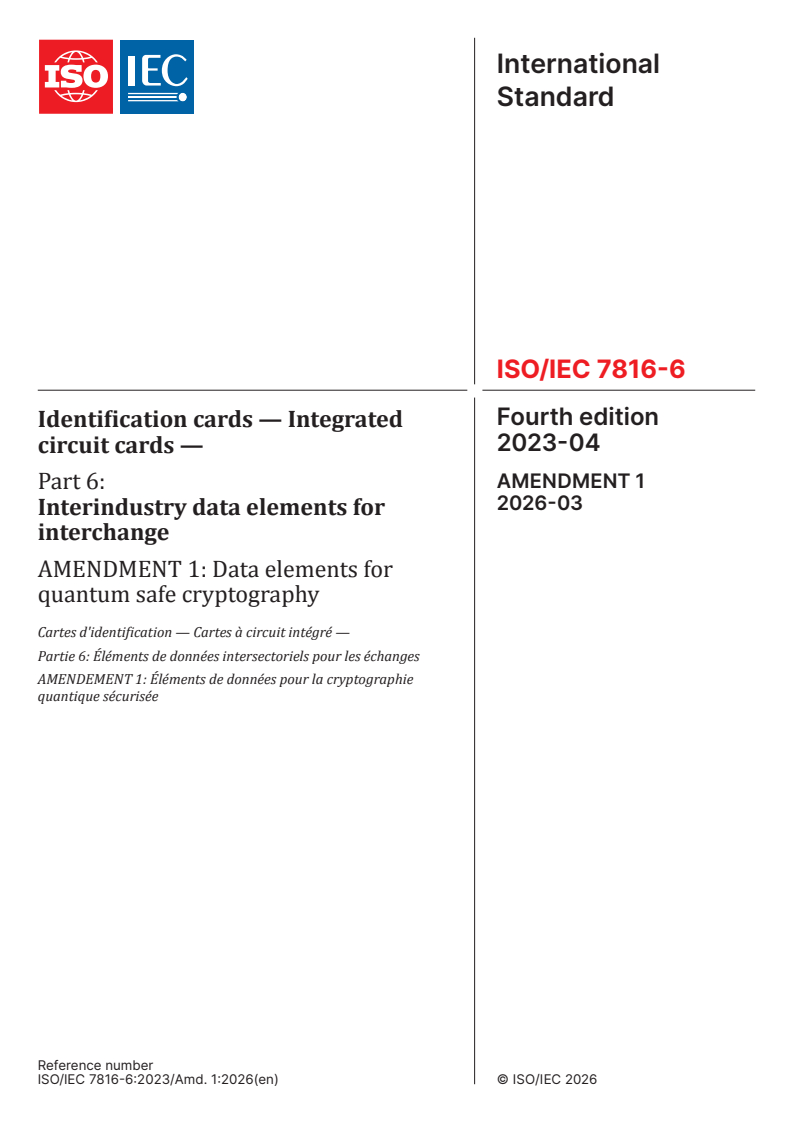
International
Standard
ISO/IEC 7816-6
Fourth edition
Identification cards — Integrated
2023-04
circuit cards —
AMENDMENT 1
Part 6:
2026-03
Interindustry data elements for
interchange
AMENDMENT 1: Data elements for
quantum safe cryptography
Cartes d'identification — Cartes à circuit intégré —
Partie 6: Éléments de données intersectoriels pour les échanges
AMENDEMENT 1: Éléments de données pour la cryptographie
quantique sécurisée
Reference number
ISO/IEC 7816-6:2023/Amd. 1:2026(en) © ISO/IEC 2026
ISO/IEC 7816-6:2023/Amd. 1:2026(en)
© ISO/IEC 2026
All rights reserved. Unless otherwise specified, or required in the context of its implementation, no part of this publication may
be reproduced or utilized otherwise in any form or by any means, electronic or mechanical, including photocopying, or posting on
the internet or an intranet, without prior written permission. Permission can be requested from either ISO at the address below
or ISO’s member body in the country of the requester.
ISO copyright office
CP 401 • Ch. de Blandonnet 8
CH-1214 Vernier, Geneva
Phone: +41 22 749 01 11
Email: copyright@iso.org
Website: www.iso.org
Published in Switzerland
© ISO/IEC 2026 – All rights reserved
ii
ISO/IEC 7816-6:2023/Amd. 1:2026(en)
Foreword
ISO (the International Organization for Standardization) and IEC (the International Electrotechnical
Commission) form the specialized system for worldwide standardization. National bodies that are
members of ISO or IEC participate in the development of International Standards through technical
committees established by the respective organization to deal with particular fields of technical activity.
ISO and IEC technical committees collaborate in fields of mutual interest. Other international organizations,
governmental and non-governmental, in liaison with ISO and IEC, also take part in the work.
The procedures used to develop this document and those intended for its further maintenance are described
in the ISO/IEC Directives, Part 1. In particular, the different approval criteria needed for the different types
of document should be noted. This document was drafted in accordance with the editorial rules of the ISO/
IEC Directives, Part 2 (see www.iso.org/directives or www.iec.ch/members_experts/refdocs).
ISO and IEC draw attention to the possibility that the implementation of this document may involve the
use of (a) patent(s). ISO and IEC take no position concerning the evidence, validity or applicability of any
claimed patent rights in respect thereof. As of the date of publication of this document, ISO and IEC had not
received notice of (a) patent(s) which may be required to implement this document. However, implementers
are cautioned that this may not represent the latest information, which may be obtained from the patent
database available at www.iso.org/patents and https://patents.iec.ch. ISO and IEC shall not be held
responsible for identifying any or all such patent rights.
Any trade name used in this document is information given for the convenience of users and does not
constitute an endorsement.
For an explanation of the voluntary nature of standards, the meaning of ISO specific terms and expressions
related to conformity assessment, as well as information about ISO's adherence to the World Trade
Organization (WTO) principles in the Technical Barriers to Trade (TBT) see www.iso.org/iso/foreword.html.
In the IEC, see www.iec.ch/understanding-standards.
This
...