


ISO/IEC TS 23220-4:2026
(Main)Cards and security devices for personal identification — Building blocks for identity management via mobile devices — Part 4: Protocols and services for operational phase
Cards and security devices for personal identification — Building blocks for identity management via mobile devices — Part 4: Protocols and services for operational phase
This document specifies building blocks for the implementation of the operational phase of mobile eID systems and any other mdoc for national bodies or document-specific standards to create profiles according to their needs. This document specifies the interface between the mdoc app and mdoc reader and the interface between the mdoc reader and the issuing authority infrastructure. More specifically, this document defines transport protocols for various RF solutions and for over the internet. It defines the application layers, such as the request-response protocols between an mdoc app and mdoc reader and between an mdoc reader and issuing authority. It further defines the security mechanism for issuer authentication, mdoc authentication and credential holder verification. This document also specifies mechanisms enabling parties other than the issuing authority to: use a machine to obtain the mdoc data; bind the mdoc to the mdoc holder; authenticate the origin of the mdoc data; verify the integrity of the mdoc data. The following items are out of scope for this document: provisioning of the mdoc data (this is covered by ISO/IEC TS 23220-3); how holder’s consent to share data is obtained; requirements on storage of mdoc data and mdoc private keys. Finally, it provides information to create a conformant profile.
Cartes et dispositifs de sécurité pour l’identification des personnes — Blocs fonctionnels pour la gestion des identités via les dispositifs mobiles — Partie 4: Protocoles et services pour la phase opérationnelle
General Information
- Status
- Published
- Publication Date
- 09-Apr-2026
- Technical Committee
- ISO/IEC JTC 1/SC 17 - Cards and security devices for personal identification
- Current Stage
- 6060 - International Standard published
- Start Date
- 10-Apr-2026
- Due Date
- 13-Apr-2026
- Completion Date
- 10-Apr-2026
Overview
ISO/IEC TS 23220-4:2026 - Protocols and Services for Operational Phase is part of a key international standard series for personal identification via mobile devices. Developed by ISO and IEC, this specification defines vital building blocks for the operational phase of mobile electronic identification (mobile eID) systems and other mobile documents (mdoc). It details critical interfaces, protocols, and security mechanisms for communication between mdoc applications, readers, and issuing authority infrastructures, enabling national bodies or document-specific standards to implement customized identity management profiles.
The focus of this part is to ensure secure, interoperable, and efficient operational procedures for mobile ID and credential verification, supporting both proximity and remote (internet) communications.
Key Topics
- Operational Phase Building Blocks
- Defines the structures, functions, and flows needed for mobile eID operation after initial set-up (provisioning is covered elsewhere).
- Interfaces and Protocols
- Specifies the interface between mdoc apps and mdoc readers, as well as between readers and issuing authorities.
- Details engagement and communication sub-phases, supporting both proximity (RF) and internet-based channels.
- Transport Protocols
- Supports various radio-frequency (RF) solutions, including NFC and BLE, for proximity exchanges.
- Specifies secure internet-based transport using established protocols.
- Request-Response Protocols
- Details application layer protocols for secure messaging and data exchange, ensuring reliable interactions between apps, readers, and authorities.
- Security Mechanisms
- Covers issuer authentication, mdoc authentication, and credential holder verification.
- Utilizes digital signatures and public key infrastructure (PKI) to confirm authenticity, integrity, and binding of credentials.
- Data Retrieval and Verification
- Enables authorized parties (beyond the issuer) to retrieve mdoc data, bind documents to holders, verify data origin, and check data integrity.
- Conformance and Profile Creation
- Provides guidance for creating standardized, conforming operational-phase profiles to ensure national and sectoral requirements are addressed.
Applications
ISO/IEC TS 23220-4:2026 supports a broad range of practical applications for mobile identity management, including:
- National eID Programs: Offers a framework for government-issued mobile IDs, driver's licenses, or residence permits that can be securely verified at borders, banks, or public services.
- Digital Credentials in Private Sector: Enables banks, healthcare providers, and other organizations to validate identity and access rights via secure mobile documents.
- Contactless Identity Validation: Supports proximity-based interactions, such as NFC or QR code scans for entry control, service access, or transactions.
- Remote Verification: Ensures safe online verification of identity through robust protocols and end-to-end encryption, suitable for remote onboarding or e-Government services.
- Custom Identity Profiles: Facilitates the definition of tailored identity solutions to meet sector-specific or document-specific legal, security, and functional requirements.
- Interoperability: Promotes cross-border, multi-platform compatibility for mobile device-based identification efforts.
Related Standards
To ensure broad compatibility and robust security, ISO/IEC TS 23220-4:2026 references and complements numerous related standards, including:
- ISO/IEC 23220-1: Foundations and architectures for mobile eID systems.
- ISO/IEC TS 23220-2: Data objects and encoding rules.
- ISO/IEC TS 23220-3: Processes for provisioning mdoc data (out of scope for Part 4).
- ISO/IEC 18013-5: Specifications for mdoc operations, including engagement and server retrieval.
- ISO/IEC 7816-4: Organization, security, and commands for identification cards.
- Security and Transport Protocols: References to CBOR, JSON, TLS, COSE, JWT, OID4VP, Elliptic Curve Cryptography, and others to guarantee secure data exchange and robust cryptographic verification.
Practical Value
Adopting ISO/IEC TS 23220-4:2026 enhances operational efficiency, security, and compliance for mobile identity solutions. By following these standardized protocols and services, organizations and national bodies can deliver mobile eID systems that are secure, interoperable, and user-friendly, reducing fraud while enabling seamless interactions across digital and physical environments. These standards also prepare identity management ecosystems for future technological advancements and regulatory requirements.
Buy Documents

ISO/IEC TS 23220-4:2026 - Cards and security devices for personal identification — Building blocks for identity management via mobile devices — Part 4: Protocols and services for operational phase
Get Certified
Connect with accredited certification bodies for this standard

BSI Group
BSI (British Standards Institution) is the business standards company that helps organizations make excellence a habit.

NYCE
Mexican standards and certification body.
Sponsored listings
Frequently Asked Questions
ISO/IEC TS 23220-4:2026 is a technical specification published by the International Organization for Standardization (ISO). Its full title is "Cards and security devices for personal identification — Building blocks for identity management via mobile devices — Part 4: Protocols and services for operational phase". This standard covers: This document specifies building blocks for the implementation of the operational phase of mobile eID systems and any other mdoc for national bodies or document-specific standards to create profiles according to their needs. This document specifies the interface between the mdoc app and mdoc reader and the interface between the mdoc reader and the issuing authority infrastructure. More specifically, this document defines transport protocols for various RF solutions and for over the internet. It defines the application layers, such as the request-response protocols between an mdoc app and mdoc reader and between an mdoc reader and issuing authority. It further defines the security mechanism for issuer authentication, mdoc authentication and credential holder verification. This document also specifies mechanisms enabling parties other than the issuing authority to: use a machine to obtain the mdoc data; bind the mdoc to the mdoc holder; authenticate the origin of the mdoc data; verify the integrity of the mdoc data. The following items are out of scope for this document: provisioning of the mdoc data (this is covered by ISO/IEC TS 23220-3); how holder’s consent to share data is obtained; requirements on storage of mdoc data and mdoc private keys. Finally, it provides information to create a conformant profile.
This document specifies building blocks for the implementation of the operational phase of mobile eID systems and any other mdoc for national bodies or document-specific standards to create profiles according to their needs. This document specifies the interface between the mdoc app and mdoc reader and the interface between the mdoc reader and the issuing authority infrastructure. More specifically, this document defines transport protocols for various RF solutions and for over the internet. It defines the application layers, such as the request-response protocols between an mdoc app and mdoc reader and between an mdoc reader and issuing authority. It further defines the security mechanism for issuer authentication, mdoc authentication and credential holder verification. This document also specifies mechanisms enabling parties other than the issuing authority to: use a machine to obtain the mdoc data; bind the mdoc to the mdoc holder; authenticate the origin of the mdoc data; verify the integrity of the mdoc data. The following items are out of scope for this document: provisioning of the mdoc data (this is covered by ISO/IEC TS 23220-3); how holder’s consent to share data is obtained; requirements on storage of mdoc data and mdoc private keys. Finally, it provides information to create a conformant profile.
ISO/IEC TS 23220-4:2026 is classified under the following ICS (International Classification for Standards) categories: 35.240.15 - Identification cards. Chip cards. Biometrics. The ICS classification helps identify the subject area and facilitates finding related standards.
ISO/IEC TS 23220-4:2026 is available in PDF format for immediate download after purchase. The document can be added to your cart and obtained through the secure checkout process. Digital delivery ensures instant access to the complete standard document.
Standards Content (Sample)
Technical
Specification
ISO/IEC TS 23220-4
First edition
Cards and security devices for
2026-04
personal identification — Building
blocks for identity management via
mobile devices —
Part 4:
Protocols and services for
operational phase
Cartes et dispositifs de sécurité pour l’identification des
personnes — Blocs fonctionnels pour la gestion des identités via
les dispositifs mobiles —
Partie 4: Protocoles et services pour la phase opérationnelle
Reference number
© ISO/IEC 2026
All rights reserved. Unless otherwise specified, or required in the context of its implementation, no part of this publication may
be reproduced or utilized otherwise in any form or by any means, electronic or mechanical, including photocopying, or posting on
the internet or an intranet, without prior written permission. Permission can be requested from either ISO at the address below
or ISO’s member body in the country of the requester.
ISO copyright office
CP 401 • Ch. de Blandonnet 8
CH-1214 Vernier, Geneva
Phone: +41 22 749 01 11
Email: copyright@iso.org
Website: www.iso.org
Published in Switzerland
© ISO/IEC 2026 – All rights reserved
ii
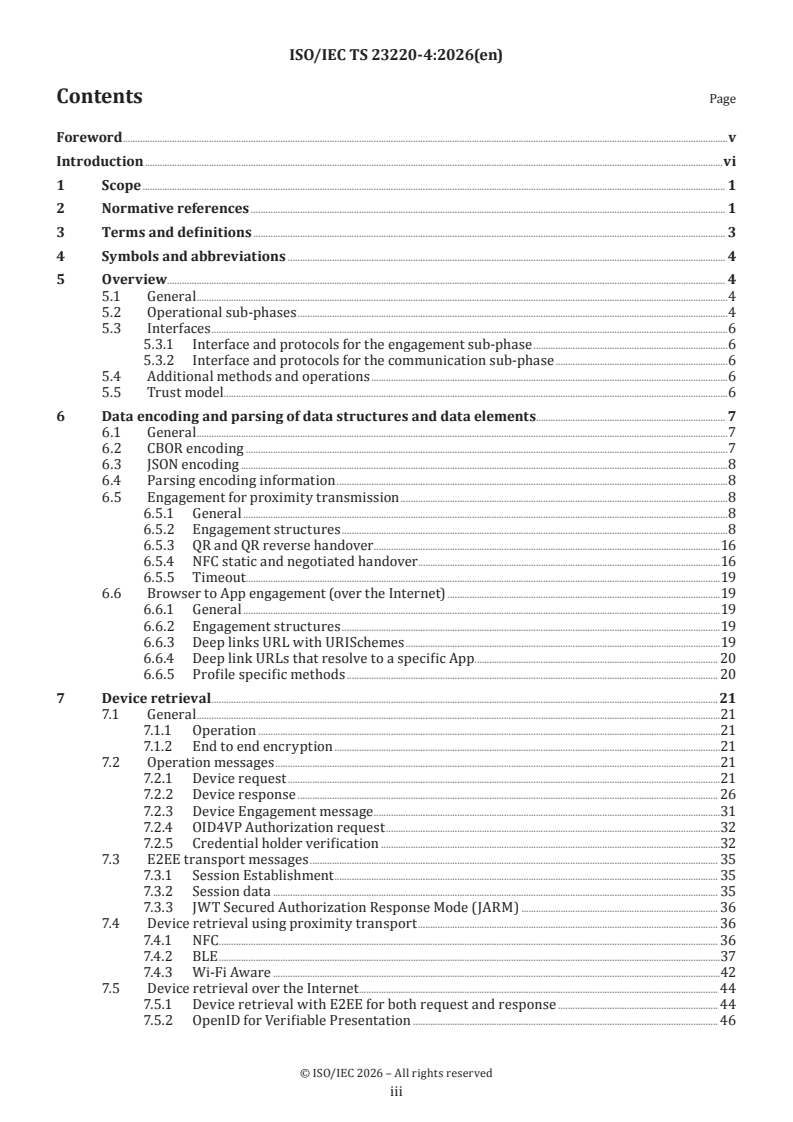
Contents Page
Foreword .v
Introduction .vi
1 Scope . 1
2 Normative references . 1
3 Terms and definitions . 3
4 Symbols and abbreviations . 4
5 Overview . 4
5.1 General .4
5.2 Operational sub-phases .4
5.3 Interfaces .6
5.3.1 Interface and protocols for the engagement sub-phase .6
5.3.2 Interface and protocols for the communication sub-phase .6
5.4 Additional methods and operations .6
5.5 Trust model .6
6 Data encoding and parsing of data structures and data elements. 7
6.1 General .7
6.2 CBOR encoding .7
6.3 JSON encoding .8
6.4 Parsing encoding information .8
6.5 Engagement for proximity transmission .8
6.5.1 General .8
6.5.2 Engagement structures .8
6.5.3 QR and QR reverse handover .16
6.5.4 NFC static and negotiated handover .16
6.5.5 Timeout . .19
6.6 Browser to App engagement (over the Internet) .19
6.6.1 General .19
6.6.2 Engagement structures .19
6.6.3 Deep links URL with URISchemes .19
6.6.4 Deep link URLs that resolve to a specific App . 20
6.6.5 Profile specific methods . 20
7 Device retrieval .21
7.1 General .21
7.1.1 Operation .21
7.1.2 End to end encryption .21
7.2 Operation messages .21
7.2.1 Device request .21
7.2.2 Device response . 26
7.2.3 Device Engagement message .31
7.2.4 OID4VP Authorization request .32
7.2.5 Credential holder verification .32
7.3 E2EE transport messages . 35
7.3.1 Session Establishment . 35
7.3.2 Session data . 35
7.3.3 JWT Secured Authorization Response Mode (JARM) . 36
7.4 Device retrieval using proximity transport . 36
7.4.1 NFC . 36
7.4.2 BLE .37
7.4.3 Wi-Fi Aware .42
7.5 Device retrieval over the Internet . 44
7.5.1 Device retrieval with E2EE for both request and response . 44
7.5.2 OpenID for Verifiable Presentation . 46
© ISO/IEC 2026 – All rights reserved
iii
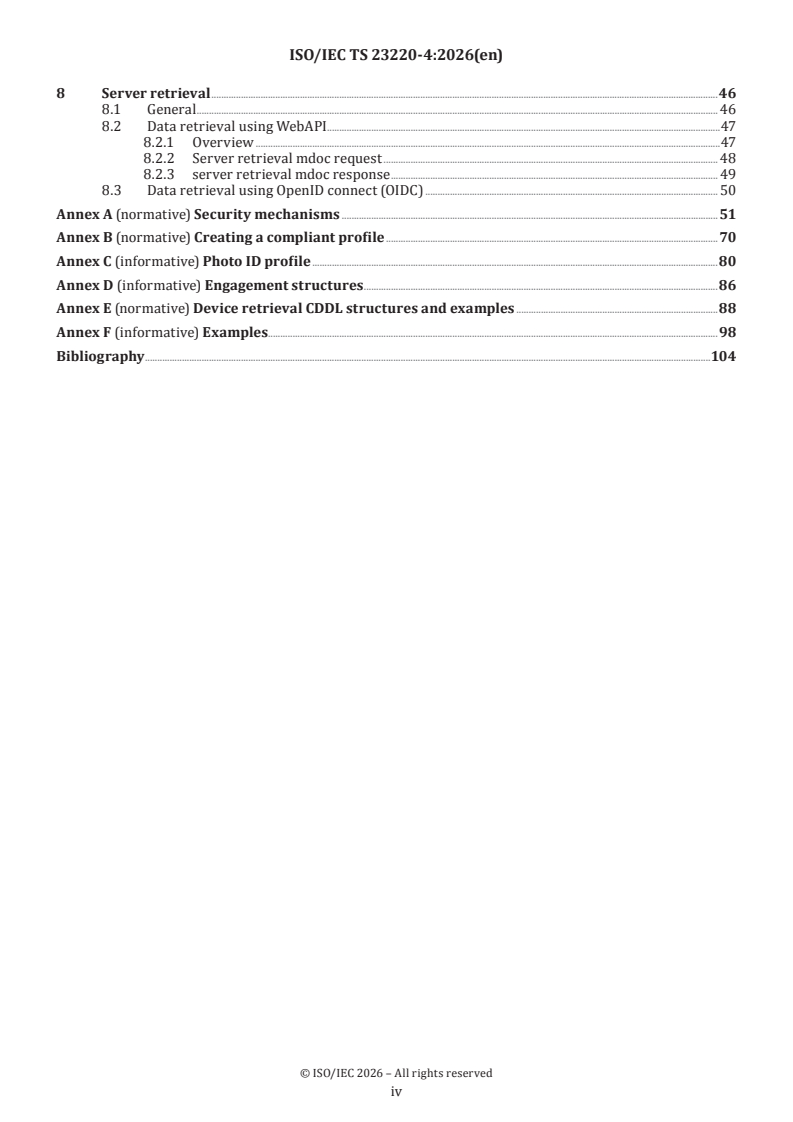
8 Server retrieval .46
8.1 General . 46
8.2 Data retrieval using WebAPI .47
8.2.1 Overview .47
8.2.2 Server retrieval mdoc request . 48
8.2.3 server retrieval mdoc response . 49
8.3 Data retrieval using OpenID connect (OIDC) . 50
Annex A (normative) Security mechanisms .51
Annex B (normative) Creating a compliant profile .70
Annex C (informative) Photo ID profile .80
Annex D (informative) Engagement structures .86
Annex E (normative) Device retrieval CDDL structures and examples .88
Annex F (informative) Examples .98
Bibliography .104
© ISO/IEC 2026 – All rights reserved
iv
Foreword
ISO (the International Organization for Standardization) and IEC (the International Electrotechnical
Commission) form the specialized system for worldwide standardization. National bodies that are
members of ISO or IEC participate in the development of International Standards through technical
committees established by the respective organization to deal with particular fields of technical activity.
ISO and IEC technical committees collaborate in fields of mutual interest. Other international organizations,
governmental and non-governmental, in liaison with ISO and IEC, also take part in the work.
The procedures used to develop this document and those intended for its further maintenance are described
in the ISO/IEC Directives, Part 1. In particular, the different approval criteria needed for the different types
of document should be noted. This document was drafted in accordance with the editorial rules of the ISO/
IEC Directives, Part 2 (see www.iso.org/directives or www.iec.ch/members_experts/refdocs).
ISO and IEC draw attention to the possibility that the implementation of this document may involve the
use of (a) patent(s). ISO and IEC take no position concerning the evidence, validity or applicability of any
claimed patent rights in respect thereof. As of the date of publication of this document, ISO and IEC had not
received notice of (a) patent(s) which may be required to implement this document. However, implementers
are cautioned that this may not represent the latest information, which may be obtained from the patent
database available at www.iso.org/patents and https://patents.iec.ch. ISO and IEC shall not be held
responsible for identifying any or all such patent rights.
Any trade name used in this document is information given for the convenience of users and does not
constitute an endorsement.
For an explanation of the voluntary nature of standards, the meaning of ISO specific terms and expressions
related to conformity assessment, as well as information about ISO's adherence to the World Trade
Organization (WTO) principles in the Technical Barriers to Trade (TBT) see www.iso.org/iso/foreword.html.
In the IEC, see www.iec.ch/understanding-standards.
This document was prepared by Joint Technical Committee ISO/IEC JTC 1, Information technology,
Subcommittee SC 17, Cards and security devices for personal identification.
A list of all parts in the ISO/IEC 23220 series can be found on the ISO and IEC websites.
Any feedback or questions on this document should be directed to the user’s national standards
body. A complete listing of these bodies can be found at www.iso.org/members.html and
www.iec.ch/national-committees.
© ISO/IEC 2026 – All rights reserved
v
Introduction
This document covers the operational phase introduced by ISO/IEC 23220-1. This document also expands
on ISO/IEC 18013-5, especially regarding reader engagement, over the internet device retrieval operation
and connections to other International Standards. It also expands operational data elements, such as for
credential holder authentication, operations involving data elements from identical or different types of
documents, and more.
Implementation conformant to ISO/IEC 18013-5 meets all requirements on selected building blocks specified
in this document.
© ISO/IEC 2026 – All rights reserved
vi
Technical Specification ISO/IEC TS 23220-4:2026(en)
Cards and security devices for personal identification —
Building blocks for identity management via mobile
devices —
Part 4:
Protocols and services for operational phase
1 Scope
This document specifies building blocks for the implementation of the operational phase of mobile eID
systems and any other mdoc for national bodies or document-specific standards to create profiles according
to their needs.
This document specifies the interface between the mdoc app and mdoc reader and the interface between the
mdoc reader and the issuing authority infrastructure.
More specifically, this document defines transport protocols for various RF solutions and for over the
internet. It defines the application layers, such as the request-response protocols between an mdoc app and
mdoc reader and between an mdoc reader and issuing authority.
It further defines the security mechanism for issuer authentication, mdoc authentication and credential
holder verification.
This document also specifies mechanisms enabling parties other than the issuing authority to:
— use a machine to obtain the mdoc data;
— bind the mdoc to the mdoc holder;
— authenticate the origin of the mdoc data;
— verify the integrity of the mdoc data.
The following items are out of scope for this document:
— provisioning of the mdoc data (this is covered by ISO/IEC TS 23220-3);
— how holder’s consent to share data is obtained;
— requirements on storage of mdoc data and mdoc private keys.
Finally, it provides information to create a conformant profile.
2 Normative references
The following documents are referred to in the text in such a way that some or all of their content constitutes
requirements of this document. For dated references, only the edition cited applies. For undated references,
the latest edition of the referenced document (including any amendments) applies.
ISO 7816-4:2020, Identification cards — Integrated circuit cards — Part 4: Organization, security and
commands for interchange
© ISO/IEC 2026 – All rights reserved
ISO/IEC 8859-1, Information technology — 8-bit single-byte coded graphic character sets — Part 1: Latin
alphabet No. 1
ISO/IEC 10118-3, IT Security techniques — Hash-functions — Part 3: Dedicated hash-functions
ISO/IEC 18004, Information technology — Automatic identification and data capture techniques — QR code
bar code symbology specification
ISO/IEC 23220-1:2023, Cards and security devices for personal identification — Building blocks for identity
management via mobile devices — Part 1: Generic system architectures of mobile eID systems
ISO/IEC TS 23220-2, Cards and security devices for personal identification — Building blocks for identity
management via mobile devices — Part 2: Data objects and encoding rules for generic eID systems
BSI TR-03111, Elliptic Curve Cryptography (ECC)
NIST SP 800-38D, Recommendation for Block Cipher Modes of Operation: Galois/Counter Mode (GCM) and GMAC
RFC 4122:2005, A Universally Unique IDentifier (UUID) URN Namespace
RFC 4395, Guidelines and Registration Procedures for New URI Schemes
RFC 4648, The Base16, Base32, and Base64 Data Encodings
RFC 5246, The Transport Layer Security (TLS) Protocol Version 1.2
RFC 5280:2008, Internet X.509 Public Key Infrastructure Certificate and Certificate Revocation List (CRL)
Profile
RFC 5869, HMAC-based Extract-and-Expand Key Derivation Function (HKDF)
RFC 6066:2011, Transport Layer Security (TLS) Extensions: Extension Definitions
RFC 7515:2015, JSON Web Signature (JWS)
RFC 7518, JSON Web Algorithms (JWA)
RFC 7519:2015, JSON Web Token (JWT)
RFC 8152, CBOR Object Signing and Encryption (COSE)
RFC 8259, JavaScript Object Notation (JSON)
RFC 8422:2018, Elliptic Curve Cryptography (ECC) Cipher Suites for Transport Layer Security (TLS) Versions 1.2
and Earlier
RFC 8446:2018, The Transport Layer Security (TLS) Protocol Version 1.3
RFC 8610:2019, Concise Data Definition Language (CDDL)
RFC 8949:2020, Concise Binary Object Representation (CBOR)
RFC 9052, CBOR Object Signing and Encryption (COSE): Structures and Process
RFC 9053:2022, CBOR Object Signing and Encryption (COSE): Initial Algorithms
RFC 9112:2022, HTTP/1.1
RFC 9360, CBOR Object Signing and Encryption (COSE)
Bluetooth SIG, Bluetooth Core Specification, Version 5.2, December 2019
NFC Forum, CH 1.5, Connection handover technical specification
Wi-Fi Alliance, Neighbour awareness networking specification, Version 3.1
© ISO/IEC 2026 – All rights reserved
3 Terms and definitions
For the purposes of this document, the terms and definitions given in ISO/IEC 23220-1 and the following
apply.
ISO and IEC maintain terminology databases for use in standardization at the following addresses:
— ISO Online browsing platform: available at https:// www .iso .org/ obp
— IEC Electropedia: available at https:// www .electropedia .org/
3.1
credential
set of data presented as evidence of a claimed or asserted identity and/or entitlements
Note 1 to entry: A user attribute signed by the issuer as proof of authenticity is a credential that can be verified by the
verifier by validating the electronic signature.
Note 2 to entry: According to ISO/IEC 29115, an assertion is considered a stronger statement than a claim.
Note 3 to entry: Where identity is a set of attributes characteristic or property of an entity (see ISO/IEC 24760-1)
[SOURCE: ISO/IEC 29115:2013, 3.8, modified — Example added, Note 1 to entry replaced, Note 2 to entry
added.]
3.2
device retrieval
process to retrieve user attribute(s) and credentials from the mdoc app
3.3
mdoc
mobile document (digital credential) issued by an issuing authority
3.4
PCD mode
mode in which a mobile device with NFC operates as a PCD
[SOURCE: ISO/IEC 14443-3:2018, 3.7, modified — The word “PXD” has been replaced with “mobile device
with NFC”.]
3.5
PICC mode
mode in which a mobile device with NFC operates as a PICC
[SOURCE: ISO/IEC 14443-3:2018, 3.8, modified — The word “PXD” has been replaced with “mobile device
with NFC”.]
3.6
server retrieval token
token identifying the mdoc holder and the mdoc app to the identity or attribute provider service
[SOURCE: ISO/IEC 18013-5:2021, 3.17, modified — App added after mdoc, "issuing authority" changed to the
identity or attribute provider service.]
© ISO/IEC 2026 – All rights reserved
4 Symbols and abbreviations
CBOR concise binary object representation
CDDL concise data definition language
CHV credential holder verification
DEM device engagement message
DH-OVR holder device handover
E2EE end to end encryption between the mdoc app and a verification application
IA issuing authority
GATT generic attribute profile
JARM JWT secure authorization response mode
JSON java script object notation
JWE JSON web encryption
JWT JSON web token
NDEF NFC data exchange format
NH-OVR negotiated handover
NFC near field communication
LoA level of assurance
OID4VP OpenID for verifiable presentation
RF radio frequency
RH-OVR reader handover
5 Overview
5.1 General
This document specifies building blocks for the implementation of the operational phase of mobile eID
systems and any other mdoc for national bodies or document specific standards to create profiles according
to their needs.
Annex B shall be used by national bodies or document specific standards for the specific rules to create a
profile according to their needs that conforms to this document.
An example of photo ID profile is provided in Annex C.
5.2 Operational sub-phases
For the operational phase, ISO/IEC 23220-1 defines three sub-phases: initialization, engagement and
communication.
Initialization is out of scope of this document. During this phase, the mdoc app and mdoc reader are activated
by the holder (e.g. using the mobile UI to access the app), triggered by some events such as NFC, BLE or an
© ISO/IEC 2026 – All rights reserved
API call facilitated by the mobile OS (e.g. deep linking), or scheduled and can require holder and verifier
authentication, respectively.
Engagement (see Clause 6): during this phase, the necessary information to proceed with the communication
phase is exchanged between the mdoc app and mdoc reader (see 6.5) or the mobile browser invokes the
mdoc app (see 6.6).
Communication: this phase starts when establishing a connection for device retrieval (see Clause 7) or
server retrieval (see Clause 8) and during which the transmission channel is used for user attribute requests
and user attribute retrievals.
The sub-phases are sequential and can take place over periods of time and in different locations.
A profile can define a maximum duration between sub-phases.
Figure 1 illustrates the transaction flows defined in this document for the operational phase.
Figure 1 — Operational transaction flow
© ISO/IEC 2026 – All rights reserved
5.3 Interfaces
5.3.1 Interface and protocols for the engagement sub-phase
The following proximity interfaces, illustrated as OP-1 by ISO/IEC 23220-1:2023, Figure 11, are specified in
this document in subclauses:
— 6.5.3 specifies the requirements when mdoc app uses a QR code to present the device engagement
structure;
— 6.5.3 specifies the requirements when mdoc reader uses a QR code to present the reader engagement
structure;
— 6.5.4 specifies the requirements when mdoc app uses Type 4 NDEF tag specified by NFC forum for static
handover mode to perform handover;
— 6.5.4 specifies the requirements when mdoc app uses Type 4 NDEF tag specified by NFC forum for
negotiated handover mode, and where mdoc reader further shares the reader engagement structure.
The following interfaces from Internet Browser to mdoc app, illustrated as interface ‘b’ by
ISO/IEC 23220-1:2023, Figure 13, are specified in this document in subclauses:
— 6.6.3 specifies how mdoc reader shall use W3C URISchemes specified by RFC 4395 to present the reader
engagement structure or OID4VP engagement data through the mobile Internet browser to the mdoc
app, both on the same device;
— 6.6.4 specifies how mdoc reader shall use deep links URL to present the reader engagement structure or
OID4VP engagement data through the mobile Internet browser to the mdoc app, both on the same device.
5.3.2 Interface and protocols for the communication sub-phase
The following interfaces for device retrieval are specified in Clause 7 of this document:
— Transmission of attribute(s) part of (a) credential(s) from or through an mdoc app to an mdoc reader
(illustrated respectively as OP-2 in Figure 11 from ISO/IEC 23220-1:2023 and as OP-4 in Figure 12 from
ISO/IEC 23220-1:2023);
— Transmission of attribute(s) part of (a) credential(s) from an mdoc app to an mdoc reader over the
Internet (illustrated as ‘OP-7’ or ‘b’ in Figure 13 from ISO/IEC 23220-1:2023).
The following interfaces for server retrieval are specified in Clause 8 of this document:
— Transmission of user attribute(s) part of (a) credential(s) between an mdoc reader and an identity or
attribute provider service (illustrated as OP-5 in Figure 12 from ISO/IEC 23220-1:2023).
5.4 Additional methods and operations
Additional methods and operations can be performed during device retrieval:
— 7.2.5 specifies: Framework for credential holder verification where the mdoc reader can request for CHV
and the mdoc app can respond accordingly with CHV status
NOTE This document defines only one additional operation.
5.5 Trust model
This document relies on the IA to be source of trust for verification of the mdoc:
— The IA digitally signs the mobile security object (A.1.2) of the mdoc for Authenticity. The authenticity
of the signature can be verified using PKI. The IA is the root of trust for signed information and device
binding.
© ISO/IEC 2026 – All rights reserved
— The mdoc is provisioned to an mdoc app that meets the Issuer privacy and security policies.
NOTE ISO/IEC TS 23220-3 can be used to determine the capabilities of the solution and the kind of secure area.
The authenticity of the mobile security object provides a means to the mdoc reader to verify if the returned
information is authorized (user attribute(s), authentication factors, validity information and more) and can
even permit to check the integrity of such data elements, and using the device key a mean to check if the
response is delivered by the expected device (anti cloning) and when such device key is on the holder device
to use such device as an authentication factor of something you have.
The issuer signature is verified using a public key infrastructure (PKI).
The issuing authority can define additional authentication factors that can be used for additional
confirmation to confirm that the mdoc is presented by the credential holder.
Once communication is established between an mdoc app and an mdoc reader, a signed request provides a
means to check for trust for the mdoc app to evaluate the risk prior to returning any information.
The mdoc app must acquire certificates from trusted sources to verify the authenticity of the signed request.
The mdoc reader must acquire certificates from trusted sources to verify the authenticity of the mdoc.
6 Data encoding and parsing of data structures and data elements
6.1 General
All structures in this document are either CBOR or JSON.
This document uses CDDL (Concise Data Definition Language) as specified in RFC 8610 to express CBOR
encoded data including in JSON structures.
6.2 CBOR encoding
CBOR structures shall be encoded according to RFC 8949.
RFC 8949:2020, section 4.2.1 describes the “core deterministic encoding requirements” for CBOR.
The requirements regarding preferred serialization and indefinite-length shall be implemented, the
requirements regarding sorting of map keys should be implemented.
Note that RFC 8949 does not allow a map with multiple entries with the same key.
Because deterministic map ordering is not required, all CBOR maps that are used in a cryptographic
operation are communicated in a tagged CBOR bytestring. For any cryptographic operation, an mdoc, mdoc
reader or issuing authority infrastructure shall use these bytestrings as they were sent or received, without
attempting to re-create them from the underlying maps.
EXAMPLE A data structure DataItem that is to be used in a cryptographic operation is communicated in a
structure DataItemBytes, specified as follows:
DataItemBytes = #6.24(bstr .cbor DataItem)
The CDDL in this example is defined in RFC 8610:2019, section 3.6 and expresses a tagged data item (major
type 6). As specified in RFC 8949:2020, section 3.4.5.1, tag value 24 indicates that the content of the CBOR
bstr following the tag is itself a CBOR data item. The .cbor control operator indicates that this data item is in
fact a DataItem.
When processing a data structure, an mdoc app, mdoc reader or issuing authority infrastructure shall ignore
any value that is specified as RFU in this document.
Whenever data structures in this document use a version element that is encoded as a string, their
contents follow the format of ‘major version number’.’minor version number’. A major version number
© ISO/IEC 2026 – All rights reserved
shall be incremented by 1 when any backwards incompatible changes are introduced in a future version
of this document. A minor version number shall be incremented by 1 when new, but backwards compatible
functionality is introduced. A minor version number shall be reset to 0 if the major version number is
incremented. An mdoc app, mdoc reader or issuing authority infrastructure shall not give an error and
continue a transaction if it receives a data structure having a known major version number but with an
unknown minor version number.
6.3 JSON encoding
JSON structures shall be encoded according to RFC 8259.
6.4 Parsing encoding information
RFC 761:1980, Section 2.10, states Postel’s robustness principle: be conservative in what they send, liberal
in what they accept. An mdoc app and mdoc reader should follow this principle for all non-security related
structures.
For any structure defined in this standard, unless explicitly stated otherwise, an mdoc app or mdoc reader
shall not give an error if a map (major type 5) contains an element that is not defined in the CDDL for that
structure.
EXAMPLE It applies when the CDDL definition of the data structure does not explicitly define that additional key-
value pairs can be present in the map, next to the specified ones.
6.5 Engagement for proximity transmission
6.5.1 General
All proximity transmissions share the same engagement structures and the same operation messages
for device request (7.2.1) and device response (7.2.2) and the same E2EE transport messages (session
establishment and session data, respectively 7.3.1 and 7.3.2).
6.5.2 Engagement structures
6.5.2.1 Engagement structures
The DeviceEngagement and ReaderEngagement structures shall be CBOR encoded. The full CDDL structure
can be found in D.1.1.
The DeviceEngagement and ReaderEngagement structures share identical items. Refer to Table 1 to see which
items are needed for each.
The detailed information for each item in the structure is provided in 6.5.2.2.
Testing examples are provided in D.1.2.
© ISO/IEC 2026 – All rights reserved
Table 1 — Engagement structures
Engagement structure CDDL DeviceEngagement ReaderEngagement Purpose Details
RH-ovr,
DH-ovr DEM NH-ovr
E2EE Web
Engagement = { Version of structure 6.5.2.2.1
M M M M
0: tstr
? 1: Security Needed data to estab- 6.5.2.2.2
M M M O
lish E2EE
? 2: DeviceRetrievalMethods Data to connect mdoc 6.5.2.2.3
C N/A C N/A
app and mdoc reader
? 3: ServerRetrievalMethods Token for server 6.5.2.2.4
O O N/A N/A
retrieval
? 4: ProtocolInfo Reserved for addition- 6.5.2.2.5
RFU RFU RFU RFU al protocol informa-
tion
? 5: OriginInfos Info about the source 6.5.2.2.6
O M C O of engagement struc-
ture
? 6: Capabilities Capabilities such as 6.5.2.2.7
C C N/A N/A
MacKeys
? *int => any Positive values are
Positive Positive Positive Positive
reserved for future
values are values values are values are
extensions. Negative
RFU are RFU RFU RFU
values can be used.
}
Key
M: Mandatory
C: Conditional – see details about condition criteria in related section in 6.5.2.2
O: Optional
N/A: Not applicable
RFU: reserved for future use
An application-specific extension shall use a negative integer for the key. An mdoc app or mdoc reader shall
ignore any key-value pairs with a negative key value that it is not able to interpret
6.5.2.2 Details
6.5.2.2.1 version
The tstr value for key 0 characterizes the content of the structure as follows:
— The value shall be 1.0 when both Key 5 (OriginInfos) and key 6 (Capabilities) are not present.
— The value shall be 1.1 when at least one of Key 5 (OriginInfos) and key 6 (Capabilities) is present.
The value of key 0 defines the version.
6.5.2.2.2 security
The security item specifies the cipher suite and the ephemeral public key to use to establish E2EE. See A.1.1
for session encryption.
The mdoc app shall use that structure to specify the cipher suite to use for the E2EE for the communication
phase and to deliver its ephemeral public key for the mdoc reader to use to derive E2EE keys.
© ISO/IEC 2026 – All rights reserved
This structure is optional for ReaderEngagement for "NFC negotiated handover". The mdoc reader should
use that structure to propose a cipher suite and curve to use for the E2EE for the communication phase and
accordingly deliver the ephemeral public key for the mdoc app to use to derive E2EE keys.
Security is an array of two mandatory elements as follows:
Security = {
int,
ESenderKeyBytes
}
The first element of the security structure is an int and its value shall reference the identifier of the cipher
suite to use. See A.1.7.
The ESenderKeyBytes shall be:
— EDeviceKeyBytes for DeviceEngagement
— EReaderKeyBytes for ReaderEngagement
See A.1.1.4.1 for the definitions of EDeviceKeyBytes and EReaderKeyBytes.
6.5.2.2.3 DeviceRetrievalMethods
DeviceRetrievalMethods is an array that shall contain one or more DeviceRetrievalMethod that delivers the
necessary information for the mdoc app and the mdoc reader to connect with each other.
The presence of DeviceRetrievalMethods shall be absent for NFC static, negotiated handover and E2EE web
and present otherwise.
DeviceRetrievalMethods is defined as follows:
DeviceRetrievalMethods = [
+ DeviceRetrievalMethod
]
DeviceRetrievalMethod = [
uint,
uint,
RetrievalOptions ;
]
DeviceRetrievalMethod is an array of 3 mandatory values:
— a first item which is a uint that identifies the type of supported handover connection.
— a second item which is a uint to identity the version
— RetrievalOptions that provides the connection details to establish communication.
Table 2 provides the RetrievalOptions details for each type of communication handover.
© ISO/IEC 2026 – All rights reserved
Table 2 — DeviceRetrievalMethod type and RetrievalOptions structures
Values for DeviceRetrievalMethod
Targeted Type Version RetrievalOptions
Connection
NFC 1 1 For handover to NFC, RetrievalOptions is an array of mandatory values defined as
follows:
RetrievalOptions = {
0: uint,
1: uint
}
The first element defines the maximum length of APDU command as specified in
7.4.1
The second element defines the maximum length of APDU response as specified in
7.4.1
Use this option for DeviceEngagement using QR handover (6.5.3) for communication
phase to use NFC (7.4.1)
BLE 2 1 For handover to BLE, RetrievalOptions is an array of up to 5 elements, two of them
mandatory as follows:
(
RetrievalOptions = {
0: bool,
1: bool,
? 10: bstr,
? 11: bstr,
? 20: bstr
? 21: uint. ; mdoc BLE L2CAP PSM for mdoc peripheral server mode
conditional to DeviceEngagement
}
7.4.2.1 defines mdoc peripheral server and mdoc central client modes.
Key 0 item indicates support for mdoc peripheral server mode. The value shall be
true or false.
Key 1 item indicates support for mdoc central client mode. The value shall be true
or false.
Key 10 item specifies the UUID to use for mdoc peripheral server mode and shall be
present when key 0 is set to true and not present otherwise.
Key 11 item specifies the UUID to use for mdoc client central mode
and specifies the UUID the mdoc App uses and the reader should scan for.
7.4.2.2 specifies which UUID the peripheral and client have to broadcast and scan
for.
The UUIDs shall be encoded using variant 1 (‘10x’b) as a 16 octets element with the
byte order as specified in RFC 4122:2005, section 4.1.2
Key 20 item specifies the BLE Device Address of the mdoc App. If Key 0 is present in
DeviceEngagement, key 20 may be present. Key 20 shall not be present otherwise or
for ReaderEngagement.
Key 21:
NOTE Any other values for Type are RFU.
© ISO/IEC 2026 – All rights reserved
TTabablele 2 2 ((ccoonnttiinnueuedd))
Values for DeviceRetrievalMethod
Targeted Type Version RetrievalOptions
Connection
— The L2CAP PSM field should be present in the DeviceEngagement if the
mdoc app supports the L2CAP transmission profile. The content shall be
the Protocol Service Multiplexer (PSM).
Use this option for QR handover and QR reverse handover (6.5.3) for communica-
tion phase using BLE (7.4.2).
Wi-Fi Aware 3 1 For handover to Wi-Fi aware, RetrievalOptions is an array of optional items as
follows:
RetrievalOptions = {
? 0: tstr,
? 1: uint,
? 2: uint,
3: bstr
}
0: tstr, ; Pass-phrase Info. When absent, pass phrase shall be calculated as defined
in 7.4.3.2
1: uint, ; Channel Info Operating Class
2: uint, ; Channel Info Channel Number
3: bstr , ; Band Info Supported Bands
This option for DeviceEngagement using QR handover (6.5.3) for communication
phase using Wi-Fi aware (7.4.3)
E2EE with 4 1 For communicating over the internet to an mdoc reader using E2EE with HTTPs
HTTPs server server, the RetrievalOptions is an array of one as follows:
RetrievalOptions = {
0: tstr ; URI of mdoc reader
}
The value of the tstr is the URI of the web server to connect to.
Use this option for ReaderEngagement to handover to communication phase using
E2EE for both request and response over the internet (7.5.1)
OID4VP 5 1 For communicating over the internet to an mdoc reader using OID4VP, the Retriev-
alOptions is an array of one as follows:
RetrievalOptions = {
0: tstr ; engagement payload for OID4VP
}
The value of the tstr is the OID4VP_engagement_data payload defined in D.2
Use this option for ReaderEngagement to handover to communication phase using
OID4VP (7.5.2)
NOTE Any other values for Type are RFU.
6.5.2.2.4 ServerRetrievalMethods
ServerRetrievalMethods is a map that contains information for the mdoc reader to establish communication
with the IA using an interface illustrated as OP-5 in ISO/IEC 23220-1.
The ServerRetrievalMethods shall be absent from ReaderEngagement.
The ServerRetrievalMethods is optional for DeviceEngagement.
© ISO/IEC 2026 – All rights reserved
ServerRetrievalMethods is CBOR encoded as follows:
ServerRetrievalMethods = {; list of supported protocols for retrieval from ID Provider
?"webApi" : ServerRetrievalOptions,
}
ServerRetrievalOptions = [
uint, ; Version
tstr, ; Issuer URL
tstr ; Server retrieval token
]
ServerRetrievalOptions contains:
— a uint to indicate its version
— a tstr for the URL of the identity provider service
— a tstr for the server retrieval token
If the ServerRetrievalMethods is prese
...
Questions, Comments and Discussion
Ask us and Technical Secretary will try to provide an answer. You can facilitate discussion about the standard in here.
Loading comments...