

ISO 6858:2017
(Main)Aircraft — Ground support electrical supplies — General requirements
General Information
- Abstract
ISO 6858:2017 specifies the electrical output characteristics and interface requirements between an aircraft and ground support electrical supplies. This includes all external electric power generation facilities, provided as part of a central source or in point-of-use application. Requirements for safety features are also included. Performance and safety issues under regional control are not addressed in this document. Requirements for ground traffic control purposes, such as towing points, identification and warning lights, etc. are also excluded. The electrical characteristics relate to nominal 28 V DC and either 115/200 V or 230/400 V three-phase, 400 Hz AC outputs measured at the aircraft attaching connector as indicated in Figure 1.
- Status
- Published
- Publication Date
- 05-Dec-2017
- Technical Committee
- ISO/TC 20/SC 1 - Aerospace electrical requirements
- Current Stage
- 9092 - International Standard to be revised
- Start Date
- 06-Mar-2024
- Completion Date
- 29-Aug-2026
Buy Documents
ISO 6858:2017 - Aircraft -- Ground support electrical supplies -- General requirements
ISO 6858:2017 - Aircraft — Ground support electrical supplies — General requirements/6/2017
Overview
ISO 6858:2017 - Aircraft - Ground support electrical supplies - General requirements defines the electrical output characteristics and interface requirements between an aircraft and ground support electrical supplies. It covers external electric power generation facilities whether provided from a central source or as point-of-use units, and includes required safety features. The standard addresses nominal 28 V DC and either 115/200 V or 230/400 V three‑phase, 400 Hz AC outputs measured at the aircraft attaching connector. Performance and safety matters under regional control and ground-traffic control features (towing points, identification/warning lights, etc.) are excluded.
Key technical topics and requirements
- Electrical output characteristics
- Steady‑state and transient behaviour for AC (three‑phase 400 Hz) and DC (28 V) supplies
- Voltage, frequency and ripple considerations measured at the aircraft connector
- Interface requirements
- Connector interface and electromagnetic interference (EMI) expectations for aircraft and utility sides
- Protection and fault handling
- AC and DC protection principles including over/under‑voltage, frequency deviation, overcurrent/short circuit, phase sequence, DC content, open conductor and earth/ground fault detection
- Control circuits and interlocks
- Aircraft interlock signals and maintenance-mode provisions for AC facilities
- Testing, safety and design
- Test requirements and normative test listings for AC and DC facilities (Annex A and B)
- Mechanical and electrical safety features: anti‑arcing, earthing, overload and personnel safeguards
- General design guidance: environmental, lifecycle, corrosion/moisture resistance, serviceability, labelling and documentation
Practical applications and users
ISO 6858:2017 is intended for organizations and professionals who design, manufacture, install, operate or regulate aircraft ground electrical power systems, including:
- Airport engineering and ground operations teams
- Ground power unit (GPU) and central plant manufacturers
- Aircraft manufacturers and maintenance organizations
- Safety and compliance officers, regulators and certification bodies
- System integrators responsible for interface compatibility between aircraft and ground supplies
Adopting this standard helps ensure safe, compatible and interoperable ground-to-air electrical connections, reduces risk of damage from incorrect supply characteristics, improves personnel safety, and supports consistent testing and labelling practices.
Related standards
- References to ISO/IEC Directives and collaboration with the IEC on electrotechnical standardization are noted in the Foreword. Implementers should consider complementary IEC electrical standards and applicable regional aviation regulations when using ISO 6858:2017.
Relations
- Effective Date
- 07-Sep-2013
Buy Documents
ISO 6858:2017 - Aircraft -- Ground support electrical supplies -- General requirements
ISO 6858:2017 - Aircraft — Ground support electrical supplies — General requirements/6/2017
Get Certified
Connect with accredited certification bodies for this standard

BUREAU VERITAS Certification Germany
Bureau Veritas certification in Germany.

Element Materials Technology
Materials testing and product certification.

AQMS Ltd.
AQMS provides ISO certification to SMEs across the UK.
Sponsored listings
Frequently Asked Questions
ISO 6858:2017 is a standard published by the International Organization for Standardization (ISO). Its full title is "Aircraft — Ground support electrical supplies — General requirements". This standard covers: ISO 6858:2017 specifies the electrical output characteristics and interface requirements between an aircraft and ground support electrical supplies. This includes all external electric power generation facilities, provided as part of a central source or in point-of-use application. Requirements for safety features are also included. Performance and safety issues under regional control are not addressed in this document. Requirements for ground traffic control purposes, such as towing points, identification and warning lights, etc. are also excluded. The electrical characteristics relate to nominal 28 V DC and either 115/200 V or 230/400 V three-phase, 400 Hz AC outputs measured at the aircraft attaching connector as indicated in Figure 1.
ISO 6858:2017 specifies the electrical output characteristics and interface requirements between an aircraft and ground support electrical supplies. This includes all external electric power generation facilities, provided as part of a central source or in point-of-use application. Requirements for safety features are also included. Performance and safety issues under regional control are not addressed in this document. Requirements for ground traffic control purposes, such as towing points, identification and warning lights, etc. are also excluded. The electrical characteristics relate to nominal 28 V DC and either 115/200 V or 230/400 V three-phase, 400 Hz AC outputs measured at the aircraft attaching connector as indicated in Figure 1.
ISO 6858:2017 is classified under the following ICS (International Classification for Standards) categories: 49.060 - Aerospace electric equipment and systems; 49.100 - Ground service and maintenance equipment. The ICS classification helps identify the subject area and facilitates finding related standards.
ISO 6858:2017 has the following relationships with other standards: It is inter standard links to ISO 6858:1982. Understanding these relationships helps ensure you are using the most current and applicable version of the standard.
ISO 6858:2017 is available in PDF format for immediate download after purchase. The document can be added to your cart and obtained through the secure checkout process. Digital delivery ensures instant access to the complete standard document.
Standards Content (Sample)
INTERNATIONAL ISO
STANDARD 6858
Second edition
2017-11
Aircraft — Ground support electrical
supplies — General requirements
Aéronefs — Alimentations électriques de service au sol des avions —
Conditions générales requises
Reference number
©
ISO 2017
© ISO 2017, Published in Switzerland
All rights reserved. Unless otherwise specified, no part of this publication may be reproduced or utilized otherwise in any form
or by any means, electronic or mechanical, including photocopying, or posting on the internet or an intranet, without prior
written permission. Permission can be requested from either ISO at the address below or ISO’s member body in the country of
the requester.
ISO copyright office
Ch. de Blandonnet 8 • CP 401
CH-1214 Vernier, Geneva, Switzerland
Tel. +41 22 749 01 11
Fax +41 22 749 09 47
copyright@iso.org
www.iso.org
ii © ISO 2017 – All rights reserved
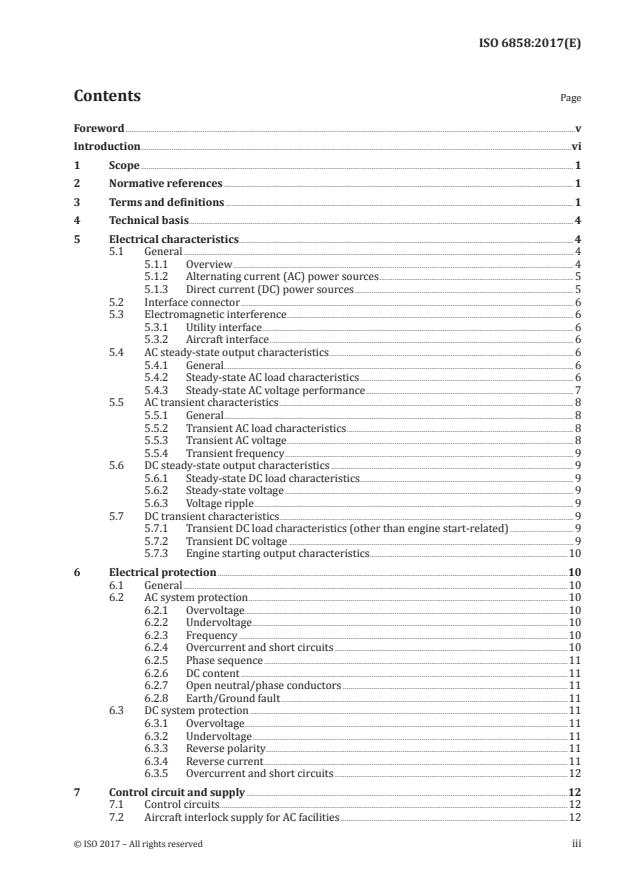
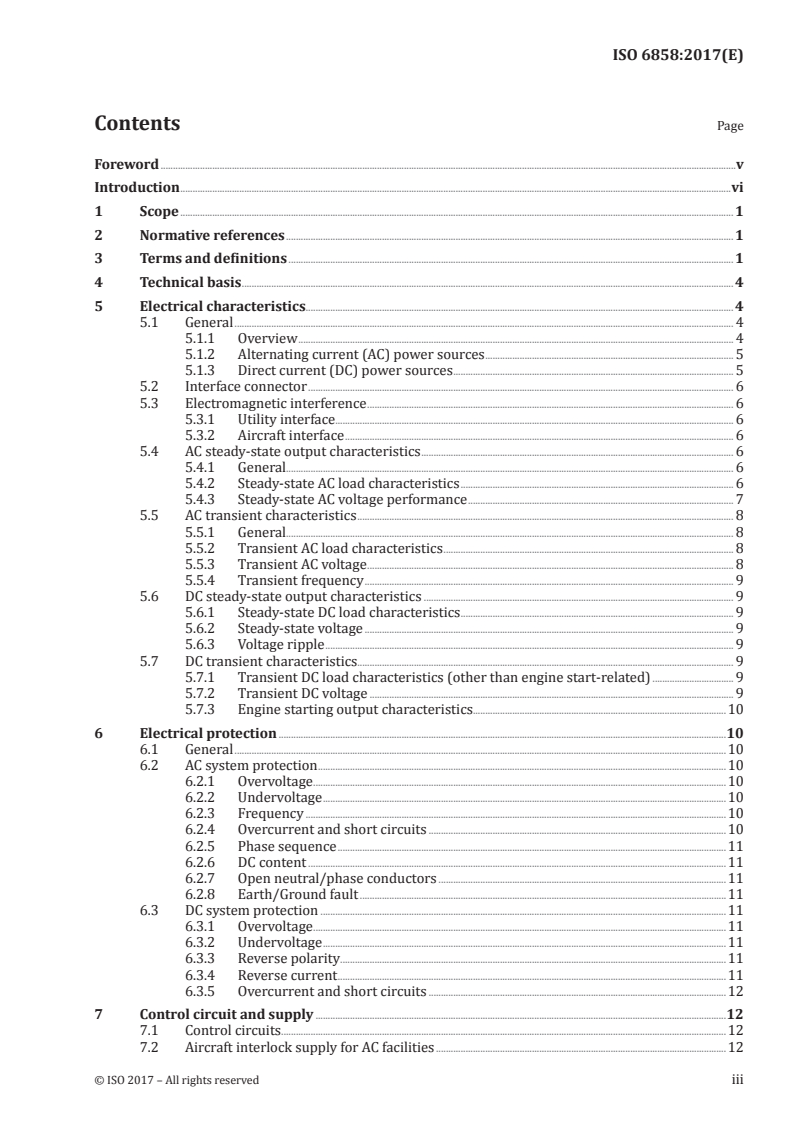
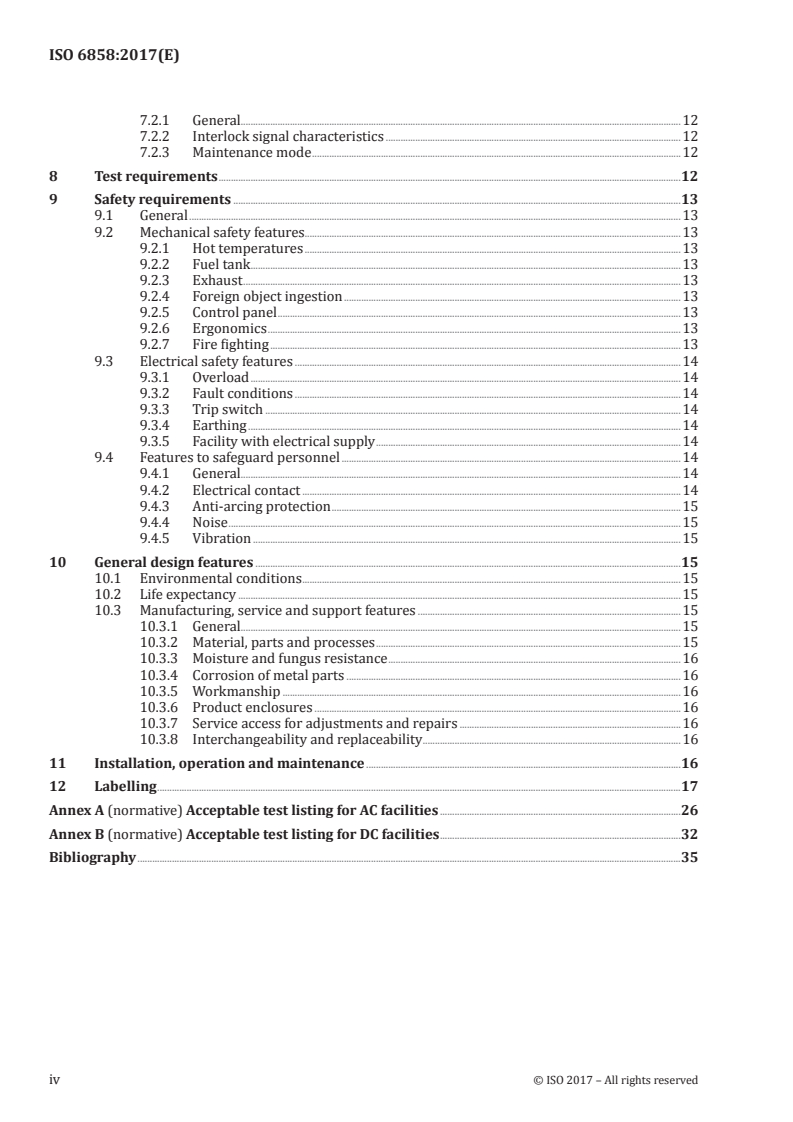
Contents Page
Foreword .v
Introduction .vi
1 Scope . 1
2 Normative references . 1
3 Terms and definitions . 1
4 Technical basis . 4
5 Electrical characteristics . 4
5.1 General . 4
5.1.1 Overview . 4
5.1.2 Alternating current (AC) power sources . 5
5.1.3 Direct current (DC) power sources . 5
5.2 Interface connector . 6
5.3 Electromagnetic interference . 6
5.3.1 Utility interface . . . 6
5.3.2 Aircraft interface . 6
5.4 AC steady-state output characteristics . 6
5.4.1 General. 6
5.4.2 Steady-state AC load characteristics . 6
5.4.3 Steady-state AC voltage performance . 7
5.5 AC transient characteristics . 8
5.5.1 General. 8
5.5.2 Transient AC load characteristics . 8
5.5.3 Transient AC voltage . 8
5.5.4 Transient frequency . 9
5.6 DC steady-state output characteristics . 9
5.6.1 Steady-state DC load characteristics . 9
5.6.2 Steady-state voltage . 9
5.6.3 Voltage ripple . 9
5.7 DC transient characteristics. 9
5.7.1 Transient DC load characteristics (other than engine start-related) . 9
5.7.2 Transient DC voltage . 9
5.7.3 Engine starting output characteristics.10
6 Electrical protection .10
6.1 General .10
6.2 AC system protection .10
6.2.1 Overvoltage . .10
6.2.2 Undervoltage .10
6.2.3 Frequency .10
6.2.4 Overcurrent and short circuits .10
6.2.5 Phase sequence .11
6.2.6 DC content .11
6.2.7 Open neutral/phase conductors .11
6.2.8 Earth/Ground fault .11
6.3 DC system protection .11
6.3.1 Overvoltage . .11
6.3.2 Undervoltage .11
6.3.3 Reverse polarity . . .11
6.3.4 Reverse current .11
6.3.5 Overcurrent and short circuits .12
7 Control circuit and supply .12
7.1 Control circuits.12
7.2 Aircraft interlock supply for AC facilities .12
7.2.1 General.12
7.2.2 Interlock signal characteristics .12
7.2.3 Maintenance mode .12
8 Test requirements .12
9 Safety requirements .13
9.1 General .13
9.2 Mechanical safety features.13
9.2.1 Hot temperatures .13
9.2.2 Fuel tank . .13
9.2.3 Exhaust .13
9.2.4 Foreign object ingestion .13
9.2.5 Control panel .13
9.2.6 Ergonomics .13
9.2.7 Fire fighting .13
9.3 Electrical safety features .14
9.3.1 Overload .14
9.3.2 Fault conditions .14
9.3.3 Trip switch .14
9.3.4 Earthing .14
9.3.5 Facility with electrical supply .14
9.4 Features to safeguard personnel .14
9.4.1 General.14
9.4.2 Electrical contact .14
9.4.3 Anti-arcing protection .15
9.4.4 Noise .15
9.4.5 Vibration .15
10 General design features .15
10.1 Environmental conditions .15
10.2 Life expectancy .15
10.3 Manufacturing, service and support features .15
10.3.1 General.15
10.3.2 Material, parts and processes .15
10.3.3 Moisture and fungus resistance .16
10.3.4 Corrosion of metal parts .16
10.3.5 Workmanship .16
10.3.6 Product enclosures .16
10.3.7 Service access for adjustments and repairs .16
10.3.8 Interchangeability and replaceability .16
11 Installation, operation and maintenance .16
12 Labelling .17
Annex A (normative) Acceptable test listing for AC facilities .26
Annex B (normative) Acceptable test listing for DC facilities .32
Bibliography .35
iv © ISO 2017 – All rights reserved
Foreword
ISO (the International Organization for Standardization) is a worldwide federation of national standards
bodies (ISO member bodies). The work of preparing International Standards is normally carried out
through ISO technical committees. Each member body interested in a subject for which a technical
committee has been established has the right to be represented on that committee. International
organizations, governmental and non-governmental, in liaison with ISO, also take part in the work.
ISO collaborates closely with the International Electrotechnical Commission (IEC) on all matters of
electrotechnical standardization.
The procedures used to develop this document and those intended for its further maintenance are
described in the ISO/IEC Directives, Part 1. In particular the different approval criteria needed for the
different types of ISO documents should be noted. This document was drafted in accordance with the
editorial rules of the ISO/IEC Directives, Part 2 (see www.iso.org/directives).
Attention is drawn to the possibility that some of the elements of this document may be the subject of
patent rights. ISO shall not be held responsible for identifying any or all such patent rights. Details of
any patent rights identified during the development of the document will be in the Introduction and/or
on the ISO list of patent declarations received (see www.iso.org/patents).
Any trade name used in this document is information given for the convenience of users and does not
constitute an endorsement.
For an explanation on the voluntary nature of standards, the meaning of ISO specific terms and
expressions related to conformity assessment, as well as information about ISO's adherence to the
World Trade Organization (WTO) principles in the Technical Barriers to Trade (TBT) see the following
URL: www.iso.org/iso/foreword.html.
This document was prepared by Technical Committee ISO/TC 20, Aircraft and space vehicles,
Subcommittee SC 1, Aerospace electrical requirements.
This second edition cancels and replaces the first edition (ISO 6858:1982), which has been technically
revised.
The main changes compared to the previous edition are:
— updated normative references, definitions and figures;
— new information regarding aircraft electrical load characteristics, facility capacity requirements
and ac power types;
— updated protection and safety requirements; and
— addition of new Annex A and B with acceptable test listings for ac and dc systems respectively.
Introduction
The purpose of this document is to foster compatibility between the providers, distributors and users
of aircraft ground support electrical power. This update takes into account several recent trends in
aircraft electrical systems, including increase in nonlinear load content on aircraft.
vi © ISO 2017 – All rights reserved
INTERNATIONAL STANDARD ISO 6858:2017(E)
Aircraft — Ground support electrical supplies — General
requirements
1 Scope
This document specifies the electrical output characteristics and interface requirements between an
aircraft and ground support electrical supplies. This includes all external electric power generation
facilities, provided as part of a central source or in point-of-use application. Requirements for safety
features are also included. Performance and safety issues under regional control are not addressed in
this document. Requirements for ground traffic control purposes, such as towing points, identification
and warning lights, etc. are also excluded.
The electrical characteristics relate to nominal 28 V DC and either 115/200 V or 230/400 V three-phase,
400 Hz AC outputs measured at the aircraft attaching connector as indicated in Figure 1.
2 Normative references
The following documents are referred to in the text in such a way that some or all of their content
constitutes requirements of this document. For dated references, only the edition cited applies. For
undated references, the latest edition of the referenced document (including any amendments) applies.
ISO 461-1, Aircraft — Connectors for ground electrical supplies — Part 1: Design, performance and test
requirements
ISO 461-2, Aircraft — Connectors for ground electrical supplies — Part 2: Dimensions
ISO 1540, Aerospace — Characteristics of aircraft electrical systems
ISO 7137, Aircraft — Environmental conditions and test procedures for airborne equipment
ISO 12100, Safety of machinery — General principles for design — Risk assessment and risk reduction
ISO 12384, Aerospace — Requirements for digital equipment for measurements of aircraft electrical power
characteristics
ISO 13850, Safety of machinery — Emergency stop function — Principles for design
IEC 60204-1, Safety of machinery — Electrical equipment of machines — Part1: General requirements
IEC 61140, Protection against electrical shock — Common aspects for installation and equipment
3 Terms and definitions
For the purpose of this document, the terms and definitions given in ISO 1540 and ISO 461 and the
following apply.
ISO and IEC maintain terminological databases for use in standardization at the following addresses:
— IEC Electropedia: available at http://www.electropedia.org/
— ISO Online browsing platform: available at http://www.iso.org/obp
3.1
alternator speed
nominal speed at which the alternator operates to produce 400 Hz
3.2
altitude
maximum height in feet above sea level at which the unit (3.24) needs to operate and maintain
characteristics within recommended limits
3.3
ambient temperature
temperature range in degrees Celsius in which the unit (3.24) needs to operate and maintain
characteristics within recommended limits
3.4
break transfer
mode of transferring the aircraft load from aircraft power source to ground power facility or vice versa
whereby power to the aircraft is momentarily interrupted
3.5
connector
supply cable interface with the aircraft
3.6
constant power load
AC utilization equipment which contains active elements that result in an inversely proportional draw
of current to that of the applied voltage
3.7
dead front
area of equipment which operators access that has no live voltage potential
3.8
dielectric test
test where high voltages is impressed between a component and the chassis of the unit (3.24) to check
the insulation characteristics
3.9
emergency stop
E-stop
manually activated switch that is placed in an easily accessible and highly visible position which when
depressed causes an immediate stop to the provision of electrical power from the nearby facility
(3.10) source
3.10
facility
equipment designed to supply electrical power to an aircraft on the ground, including means for power
generation, conversion and distribution
Note 1 to entry: Two types of AC facilities are defined by this document. Type 1 is intended for use with more
recent aircrafts that have a large electronic load content while Type 2 is intended for use with legacy aircrafts
that have a large content of inductive motor loads.
3.11
ground power unit
external power unit
GPU
rotating or static source (or combination thereof) supplied by the ground facility (3.10) to source
electrical power while the aircraft is on the ground
Note 1 to entry: It may be either a point-of-use or centrally located ground power electrical supply in land-based
facilities, or a shipboard power supply in marine applications.
2 © ISO 2017 – All rights reserved
3.12
highest phase voltage limiting
means of limiting the highest phase voltage of the unit (3.24) output during any unbalanced load
condition
3.13
line drop compensation
system of increasing the unit (3.24) output voltage in proportion to the current in the output cable(s)
such that the voltage is held constant at the aircraft receptacle
3.14
nominal voltage rating
root-mean-square, line-to-neutral and line-to-line voltage at which the unit (3.24) output is rated
Note 1 to entry: The unit is normally set such that output voltage is maintained at this value.
3.15
output terminals
terminals on the ground power unit side of the output-power feeders
3.16
overload rating
time-limited output capacity
Note 1 to entry: It is measured in kVA for an AC unit and in ampere for a DC unit.
3.17
prime mover
source of power for driving the alternator
Note 1 to entry: This generally refers to either a diesel engine (engine generator set) or a utility power-driven
motor (motor generator set) with respect to ground support equipment.
3.18
rated load
maximum continuous output in kVA for AC and maximum continuous current in ampere for DC
3.19
remote sensing
means of providing constant voltage at the aircraft receptacle(s) by sensing the voltage at the receptacle
with separate leads in the output cable
3.20
temperature rise
rise in degrees above ambient for components of the unit (3.24)
3.21
total life
hours of use from time of delivery of the equipment to the using activity until its identity is destroyed
by classifying it as salvage and/or subject to cannibalization
3.22
trip
actuation of electrical switchgear to inhibit or stop the flow of current through the device
3.23
type of mounting
means of mounting the unit (3.24) and controls
3.24
unit
complete power package
EXAMPLE Prime mover (3.17), alternator and all associated equipment and systems.
3.25
voltage transient recovery
time required for the output voltage to recover to and remain within the prescribed limits after load
application or removal
4 Technical basis
Limits defined in this document are based upon historical as well as near-term projected equipment
characteristics. They have been derived, following an analysis of ground power facilities, ground power
distribution systems, aircraft distribution systems and aircraft user equipment characteristics in an
effort to provide compatibility between ground power and the aircraft. These limits provide allowance
for typical power quality degradations as power moves downstream from the aircraft's ground power
connector (where this document applies) and arrives at the input terminals of user equipment (where
ISO 1540 applies).
5 Electrical characteristics
5.1 General
5.1.1 Overview
As illustrated in Figure 1, the combination of the facility, the interconnecting cable and the on-board
electrical network shall combine to provide electrical power at the aircraft user equipment input as
defined in ISO 1540. The characteristics viewed at the aircraft interfacing connector, when the facility
is supplying power to the aircraft, are those specifically defined in this document. These are generally
similar to those of ISO 1540 but account for items such as voltage drop in the aircraft network. Voltage
at the facility source terminals are not defined.
Because of the complex nature of the aircraft network, and often the power quality degrading effects of
aircraft user equipment, the characteristics defined by this document are likely to be inferior to those
which the facility source might provide when connected to a simple load simulation (e.g. a linear load
bank). Test conditions found in this document are therefore aimed at providing manufacturers with
reasonable ability to verify their equipment's performance prior to connection to an aircraft.
The AC voltage characteristics stated below apply to line-to-neutral quantities. Line-to-line
characteristics should be as a result of the specified line-to-neutral values. All AC voltages and currents
are rms values unless otherwise stated.
All DC values are mean values unless otherwise stated.
The stated capacity of the facility equipment shall be provided at the end of the aircraft interfacing
connector.
The facility equipment should be designed so that normal service maintenance will ensure the retention
of these specified characteristics throughout the full range of operational and environmental conditions
likely to be encountered in the location in which they are installed over its service life.
4 © ISO 2017 – All rights reserved
5.1.2 Alternating current (AC) power sources
5.1.2.1 General
The AC power system shall be three-phase, with a four-wire, wye-connected output, a nominal voltage
of either 115/200 V or 230/400 V, a nominal frequency of 400 Hz and a phase sequence of A-B-C. The
neutral point shall be connected in accordance with the circuits shown in Figure 2. If tied to the chassis
ground, the tie shall be capable of withstanding maximum ground fault current for a minimum of 5 s.
The output voltage shall be sufficiently adjustable to allow the checking of overvoltage and undervoltage
protective devices in an unloaded condition.
NOTE AC facility performance can be measurably affected by the formation of the three-phase cable bundle
between the facility source and the aircraft. In addition to basic ampacity considerations, cabling is preferred
which maintains equal distances between any two phases and between each phase and neutral conductors.
5.1.2.2 AC source rating
Two distinct AC source types, Type 1 and Type 2, are defined in this document. Type 1 AC sources are
defined to support all aircraft types and load suites. Type 2 AC sources are defined to support classical
aircraft with load conditions that are predominantly motor loads.
Each ground facility source shall indicate its continuous power capacity in kilo-volt-amperes (kVA).
Its short-term overload capacity shall be a function of its continuous capacity according to Table 1.
Continuous power capacity and source type (Type 1 or Type 2) shall be clearly marked for operator
inspection.
Power factor and overload capability as a function of the type classification shall be as follows.
Table 1 — Minimum capacity requirements for AC facility sources
Overload
AC facility capacities Continuous
(% of rated kVA)
Type Power factor range (% of rated kVA) 10 min 5 min 10 s 2 s
0,8 lagging to unity 100 % 110 % 125 % 140 % —
0,7 to 0,8 lagging — — — 140 % 200 %
0,8 lagging to unity 80 % — 100 % — —
0,7 to 0,8 lagging 100 % — — 120 % 150 %
NOTE 1 Power factor range is the average three-phase power factor. Individual phase power factors can be different.
NOTE 2 Type 1 or Type 2 facility requirement is per aircraft manufacturer direction.
NOTE 3 Aircraft with multiple facility connections can assume that all are independent 90 kVA sources.
5.1.3 Direct current (DC) power sources
5.1.3.1 General
The DC power system shall be a two wire system having a nominal voltage (at the aircraft plug) of 28 V,
the output of which shall be connected in accordance with the circuits shown in Figure 3.
5.1.3.2 DC source rating
The continuous and engine start rating of the DC ground power facility, in amperes shall be clearly
marked for operator inspection.
Engine start rating, which is also used for wash and purge cycles, is required for a minimum of 30 s to
accommodate both a short-term, peak current inrush and an overload value during engine motoring.
The facilities’ peak current capability shall be adjustable, as required to coordinate with different
aircrafts. Recommended values for engine start rating, related to the continuous rating, are as follows.
Continuous rating Recommended engine start rating
a) 300 A between 600 A and 1 200 A
b) 350 A between 700 A and 1 400 A
c) 400 A between 800 A and 1 600 A
d) 600 A between 1 200 A and 2 000 A
e) 800 A between 1 200 A and 2 500 A
Declaration of any additional overload current capability, and the associated time period the facility
may provide, shall also be clearly marked for operator inspection.
NOTE Current levels listed above exceed those defined by ISO 461-1.
5.2 Interface connector
The interconnecting cable shall be terminated with a ground supply connector complying with the
requirements of ISO 461-1 and ISO 461-2 for all continuous ratings supported.
NOTE 230 V AC equipment is not defined by ISO 461–1 and ISO 461–2. Suitable styles for 230/400 V ground
connection plugs and sockets would need to be defined in the International Standards to support the usage of
higher voltage systems.
5.3 Electromagnetic interference
5.3.1 Utility interface
If the facility requires a utility power input, it shall be tested in accordance with the requirements of
the relevant national standard.
5.3.2 Aircraft interface
The facility shall be tested for conducted emissions in accordance with the requirements of ISO 7137,
Category B limits.
5.4 AC steady-state output characteristics
5.4.1 General
AC voltage characteristics are to be guaranteed at the mating interface between the ground facility
plug and the aircraft connector, as indicated in Figure 1, throughout the extremes of electrical loading
and environmental conditions stated in this document.
5.4.2 Steady-state AC load characteristics
Table 2 lists the range of AC steady-state aircraft load characteristics expected to be provided through
the aircraft connector(s) during normal (no failure) conditions.
6 © ISO 2017 – All rights reserved
Table 2 — Aircraft steady-state loading characteristics
Parameter Minimum Maximum Units Comment
Current draw 0 100 % Rated amperes Continuous, as per Table 1
Power factor Each phase PF is independent of the
0,7 lagging Unity —
other two phases.
0 1/3 — Facilities of up to 40 kVA
Current imbalance
0 1/6 — Facilities of more than 40 kVA
Single-phase
Rectifier load may be on any or all
rectifier load 0 1/9 Phase kVA rating
phases.
content
Three-phase
(6-pulse) rectifier 0 1/6 Output kVA rating —
load content
Three-phase
transformer 0 1/3 Output kVA rating —
rectifier (12-pulse)
Three-phase
transformer
rectifier (12-pulse) Type 1 facilities of
0 1/3 Output kVA rating
with constant more than 60 kVA
power load
characteristic
NOTE 1 In all cases, additional load may be resistive.
NOTE 2 Conditions shown may appear simultaneously within the facilities capacity limitations.
5.4.3 Steady-state AC voltage performance
5.4.3.1 General
AC ground power facility steady-state electrical characteristics at the aircraft connector shall be within
the limits of Table 3 for all load conditions identified in Table 2. In cases where there is more than one
aircraft connection with the ground power facility, all outputs shall be maintained within these limits.
Phase relationship between the three phases is as shown in Figure 4.
5.4.3.2 Highest phase voltage limiting feature
Means shall be provided in any Type 1 ground power facility to limit the highest phase voltage to 124 V
(248 V for 230/400 V systems) at all aircraft connectors during unbalanced load conditions.
5.4.3.3 Line drop compensation feature
Means shall be provided in the ground power facility to compensate for the reduction in AC voltage
between the ground power facility and the aircraft connector (due to voltage drop in the interfacing
cable) such that the characteristics of Table 3 are maintained during all steady-state loading conditions.
Sources with multiple outputs shall coordinate these regulation features to accomplish the performance
required in Table 3 during conditions of unequal loading of the individual outputs.
5.4.3.4 Voltage regulation in presence of highly distorting loads
Means of voltage sensing for the regulation function shall maintain regulation during conditions of up
to 10 % voltage total distortion.
Table 3 — Steady-state limits for 115/200 V AC three-phase ground power systems
Limits at aircraft connector(s)
Steady state conditions (see 5.4.3)
0–rated load Rated load to overload
Phase voltages
3-phase average (Vrms) 112,0 to 120,5 110,0 to 120,5
Individual phase (Vrms) 109,5 to 122,0 106,0 to 122,0
Unbalance (Vrms) 4,0 —
Displacement (degrees) 117,5 to 122,5 —
Voltage modulation — —
Max peak-valley amplitude (Vpk) 3,5 —
Frequency components Figure 5 —
Voltage waveform
Crest factor 1,31 to 1,51 —
Distortion factor 5 % total —
Individual comp. of distortion 4 % max per Figure 6 —
DC Component (V DC) −0,1 to +0,1 —
Frequency
Frequency (Hz) 395 to 405 390 to 410
Frequency modulation Figure 7 —
NOTE 1 Limits for 230 V AC systems shall be 230/115 times as those shown above, except for values in
percentage.
NOTE 2 See Table 2 for loading conditions which apply to these performance limits.
5.5 AC transient characteristics
5.5.1 General
AC ground power facility transient performance shall be within the limits stated herein for the
identified AC load characteristics.
5.5.2 Transient AC load characteristics
The following are the transient AC load characteristics expected through the aircraft connector(s)
during normal (no failure) conditions:
a) balanced three-phase load application or removals within the capacity limits of Table 1;
b) motor start load transient — base load plus low power factor (0,4 PF to 0,6 PF lagging typical) motor
current inrush, as specified for individual applications, not to exceed the rated output capability;
c) momentary parallel with on-board aircraft power sources during a no-break power transfer (NBPT);
d) very short duration (one to three cycles) of high (approximately 300 %) peak inrush currents,
decaying to steady-state levels within 150 mS when first energizing aircraft buses.
5.5.3 Transient AC voltage
Transient AC voltage surges produced by the ground power facility at the aircraft connector shall
remain within the limits of Figure 8 as a result of the transient AC load conditions identified in 5.5.2
within the capacity limits of Table 1.
8 © ISO 2017 – All rights reserved
5.5.3.1 No-break power transfer limits
Type 1 facilities shall be able to operate in an uninterrupted fashion during NBPT and maintain voltage
and frequency within specified limits when out of synchronization with the on-board power source.
The ground and on-board power sources may be displaced by as much as ±30° in phase, ±2 Hz in
frequency and ±10 Vrms for a maximum time duration of 100 ms. If the NBPT conditions are more
severe, the unit's protection device(s) may be activated.
5.5.4 Transient frequency
Transient AC frequency surges produced by the ground power facility at the aircraft connector shall
remain within the limits of Figure 9 as a result of the identified transient AC load conditions.
5.6 DC steady-state output characteristics
5.6.1 Steady-state DC load characteristics
DC ground power facility steady-state electrical characteristics at the aircraft connector shall be within
the limits of Table 4 for all load conditions between 0 and rated continuous current draw.
5.6.2 Steady-state voltage
The voltage at the aircraft connector shall be between 24 V and 29,5 V for any steady-state load
condition up to rated load.
5.6.3 Voltage ripple
The ripple on the DC supply shall be such that the maximum departure from the average DC level is
less than 2 V. The rms value of individual spectral components of the ripple shall not exceed the values
shown in Figure 10. These spectral components shall not result in a distortion factor that exceeds 3,5 %.
Table 4 — Steady-state limits for 28 V DC ground power systems
Limits at aircraft
Steady state conditions (see 5.6) connector(s) (0–rated
load)
DC Voltage
DC voltage (V DC) 24 to 29,5
Voltage waveform
Voltage ripple (pk-Ave Volts) 2
Distortion factor 3,5 %
Individual comp. of distortion per Figure 10
5.7 DC transient characteristics
5.7.1 Transient DC load characteristics (other than engine start-related)
Transient requirements at the aircraft connector(s) during normal (no failure) conditions shall include
load application and removals up to rated continuous output current.
5.7.2 Transient DC voltage
Transient DC voltage surges produced by the ground power facility at the aircraft connector shall
remain within the limits of Figure 11 as a result of the identified transient DC load characteristics.
5.7.3 Engine starting output characteristics
Transient voltages during the engine start will be a function of starter impedance and the applied
current, resulting in transient voltages that may exceed Figure 11. Minimum voltage during a maximum
current engine start condition shall be identified in the unit's standard documentation.
6 Electrical protection
6.1 General
The minimum protection to be provided shall meet the requirements in ISO 12100, IEC 60204-1,
IEC 61140 and of 6.2 and 6.3. These functions are intended to both protect the personnel and the ground
power facility (including distribution elements) as well as to ensure coordination with the aircraft's
protective functions. Means shall be provided for periodic checking of these minimum protective
circuits. When a protective circuit has operated, the facility shall remain disconnected from the aircraft
until manually reset.
NOTE Electrical protection requirements herein are intended to provide an overall selective protection
scheme between the facility and the aircraft, with each protecting their equipment area, preferably with the
aircraft protection acting first.
6.2 AC system protection
6.2.1 Overvoltage
A protective system shall be provided whic
...
INTERNATIONAL ISO
STANDARD 6858
Second edition
2017-11
Aircraft — Ground support electrical
supplies — General requirements
Aéronefs — Alimentations électriques de service au sol des avions —
Conditions générales requises
Reference number
©
ISO 2017
© ISO 2017, Published in Switzerland
All rights reserved. Unless otherwise specified, no part of this publication may be reproduced or utilized otherwise in any form
or by any means, electronic or mechanical, including photocopying, or posting on the internet or an intranet, without prior
written permission. Permission can be requested from either ISO at the address below or ISO’s member body in the country of
the requester.
ISO copyright office
Ch. de Blandonnet 8 • CP 401
CH-1214 Vernier, Geneva, Switzerland
Tel. +41 22 749 01 11
Fax +41 22 749 09 47
copyright@iso.org
www.iso.org
ii © ISO 2017 – All rights reserved
Contents Page
Foreword .v
Introduction .vi
1 Scope . 1
2 Normative references . 1
3 Terms and definitions . 1
4 Technical basis . 4
5 Electrical characteristics . 4
5.1 General . 4
5.1.1 Overview . 4
5.1.2 Alternating current (AC) power sources . 5
5.1.3 Direct current (DC) power sources . 5
5.2 Interface connector . 6
5.3 Electromagnetic interference . 6
5.3.1 Utility interface . . . 6
5.3.2 Aircraft interface . 6
5.4 AC steady-state output characteristics . 6
5.4.1 General. 6
5.4.2 Steady-state AC load characteristics . 6
5.4.3 Steady-state AC voltage performance . 7
5.5 AC transient characteristics . 8
5.5.1 General. 8
5.5.2 Transient AC load characteristics . 8
5.5.3 Transient AC voltage . 8
5.5.4 Transient frequency . 9
5.6 DC steady-state output characteristics . 9
5.6.1 Steady-state DC load characteristics . 9
5.6.2 Steady-state voltage . 9
5.6.3 Voltage ripple . 9
5.7 DC transient characteristics. 9
5.7.1 Transient DC load characteristics (other than engine start-related) . 9
5.7.2 Transient DC voltage . 9
5.7.3 Engine starting output characteristics.10
6 Electrical protection .10
6.1 General .10
6.2 AC system protection .10
6.2.1 Overvoltage . .10
6.2.2 Undervoltage .10
6.2.3 Frequency .10
6.2.4 Overcurrent and short circuits .10
6.2.5 Phase sequence .11
6.2.6 DC content .11
6.2.7 Open neutral/phase conductors .11
6.2.8 Earth/Ground fault .11
6.3 DC system protection .11
6.3.1 Overvoltage . .11
6.3.2 Undervoltage .11
6.3.3 Reverse polarity . . .11
6.3.4 Reverse current .11
6.3.5 Overcurrent and short circuits .12
7 Control circuit and supply .12
7.1 Control circuits.12
7.2 Aircraft interlock supply for AC facilities .12
7.2.1 General.12
7.2.2 Interlock signal characteristics .12
7.2.3 Maintenance mode .12
8 Test requirements .12
9 Safety requirements .13
9.1 General .13
9.2 Mechanical safety features.13
9.2.1 Hot temperatures .13
9.2.2 Fuel tank . .13
9.2.3 Exhaust .13
9.2.4 Foreign object ingestion .13
9.2.5 Control panel .13
9.2.6 Ergonomics .13
9.2.7 Fire fighting .13
9.3 Electrical safety features .14
9.3.1 Overload .14
9.3.2 Fault conditions .14
9.3.3 Trip switch .14
9.3.4 Earthing .14
9.3.5 Facility with electrical supply .14
9.4 Features to safeguard personnel .14
9.4.1 General.14
9.4.2 Electrical contact .14
9.4.3 Anti-arcing protection .15
9.4.4 Noise .15
9.4.5 Vibration .15
10 General design features .15
10.1 Environmental conditions .15
10.2 Life expectancy .15
10.3 Manufacturing, service and support features .15
10.3.1 General.15
10.3.2 Material, parts and processes .15
10.3.3 Moisture and fungus resistance .16
10.3.4 Corrosion of metal parts .16
10.3.5 Workmanship .16
10.3.6 Product enclosures .16
10.3.7 Service access for adjustments and repairs .16
10.3.8 Interchangeability and replaceability .16
11 Installation, operation and maintenance .16
12 Labelling .17
Annex A (normative) Acceptable test listing for AC facilities .26
Annex B (normative) Acceptable test listing for DC facilities .32
Bibliography .35
iv © ISO 2017 – All rights reserved
Foreword
ISO (the International Organization for Standardization) is a worldwide federation of national standards
bodies (ISO member bodies). The work of preparing International Standards is normally carried out
through ISO technical committees. Each member body interested in a subject for which a technical
committee has been established has the right to be represented on that committee. International
organizations, governmental and non-governmental, in liaison with ISO, also take part in the work.
ISO collaborates closely with the International Electrotechnical Commission (IEC) on all matters of
electrotechnical standardization.
The procedures used to develop this document and those intended for its further maintenance are
described in the ISO/IEC Directives, Part 1. In particular the different approval criteria needed for the
different types of ISO documents should be noted. This document was drafted in accordance with the
editorial rules of the ISO/IEC Directives, Part 2 (see www.iso.org/directives).
Attention is drawn to the possibility that some of the elements of this document may be the subject of
patent rights. ISO shall not be held responsible for identifying any or all such patent rights. Details of
any patent rights identified during the development of the document will be in the Introduction and/or
on the ISO list of patent declarations received (see www.iso.org/patents).
Any trade name used in this document is information given for the convenience of users and does not
constitute an endorsement.
For an explanation on the voluntary nature of standards, the meaning of ISO specific terms and
expressions related to conformity assessment, as well as information about ISO's adherence to the
World Trade Organization (WTO) principles in the Technical Barriers to Trade (TBT) see the following
URL: www.iso.org/iso/foreword.html.
This document was prepared by Technical Committee ISO/TC 20, Aircraft and space vehicles,
Subcommittee SC 1, Aerospace electrical requirements.
This second edition cancels and replaces the first edition (ISO 6858:1982), which has been technically
revised.
The main changes compared to the previous edition are:
— updated normative references, definitions and figures;
— new information regarding aircraft electrical load characteristics, facility capacity requirements
and ac power types;
— updated protection and safety requirements; and
— addition of new Annex A and B with acceptable test listings for ac and dc systems respectively.
Introduction
The purpose of this document is to foster compatibility between the providers, distributors and users
of aircraft ground support electrical power. This update takes into account several recent trends in
aircraft electrical systems, including increase in nonlinear load content on aircraft.
vi © ISO 2017 – All rights reserved
INTERNATIONAL STANDARD ISO 6858:2017(E)
Aircraft — Ground support electrical supplies — General
requirements
1 Scope
This document specifies the electrical output characteristics and interface requirements between an
aircraft and ground support electrical supplies. This includes all external electric power generation
facilities, provided as part of a central source or in point-of-use application. Requirements for safety
features are also included. Performance and safety issues under regional control are not addressed in
this document. Requirements for ground traffic control purposes, such as towing points, identification
and warning lights, etc. are also excluded.
The electrical characteristics relate to nominal 28 V DC and either 115/200 V or 230/400 V three-phase,
400 Hz AC outputs measured at the aircraft attaching connector as indicated in Figure 1.
2 Normative references
The following documents are referred to in the text in such a way that some or all of their content
constitutes requirements of this document. For dated references, only the edition cited applies. For
undated references, the latest edition of the referenced document (including any amendments) applies.
ISO 461-1, Aircraft — Connectors for ground electrical supplies — Part 1: Design, performance and test
requirements
ISO 461-2, Aircraft — Connectors for ground electrical supplies — Part 2: Dimensions
ISO 1540, Aerospace — Characteristics of aircraft electrical systems
ISO 7137, Aircraft — Environmental conditions and test procedures for airborne equipment
ISO 12100, Safety of machinery — General principles for design — Risk assessment and risk reduction
ISO 12384, Aerospace — Requirements for digital equipment for measurements of aircraft electrical power
characteristics
ISO 13850, Safety of machinery — Emergency stop function — Principles for design
IEC 60204-1, Safety of machinery — Electrical equipment of machines — Part1: General requirements
IEC 61140, Protection against electrical shock — Common aspects for installation and equipment
3 Terms and definitions
For the purpose of this document, the terms and definitions given in ISO 1540 and ISO 461 and the
following apply.
ISO and IEC maintain terminological databases for use in standardization at the following addresses:
— IEC Electropedia: available at http://www.electropedia.org/
— ISO Online browsing platform: available at http://www.iso.org/obp
3.1
alternator speed
nominal speed at which the alternator operates to produce 400 Hz
3.2
altitude
maximum height in feet above sea level at which the unit (3.24) needs to operate and maintain
characteristics within recommended limits
3.3
ambient temperature
temperature range in degrees Celsius in which the unit (3.24) needs to operate and maintain
characteristics within recommended limits
3.4
break transfer
mode of transferring the aircraft load from aircraft power source to ground power facility or vice versa
whereby power to the aircraft is momentarily interrupted
3.5
connector
supply cable interface with the aircraft
3.6
constant power load
AC utilization equipment which contains active elements that result in an inversely proportional draw
of current to that of the applied voltage
3.7
dead front
area of equipment which operators access that has no live voltage potential
3.8
dielectric test
test where high voltages is impressed between a component and the chassis of the unit (3.24) to check
the insulation characteristics
3.9
emergency stop
E-stop
manually activated switch that is placed in an easily accessible and highly visible position which when
depressed causes an immediate stop to the provision of electrical power from the nearby facility
(3.10) source
3.10
facility
equipment designed to supply electrical power to an aircraft on the ground, including means for power
generation, conversion and distribution
Note 1 to entry: Two types of AC facilities are defined by this document. Type 1 is intended for use with more
recent aircrafts that have a large electronic load content while Type 2 is intended for use with legacy aircrafts
that have a large content of inductive motor loads.
3.11
ground power unit
external power unit
GPU
rotating or static source (or combination thereof) supplied by the ground facility (3.10) to source
electrical power while the aircraft is on the ground
Note 1 to entry: It may be either a point-of-use or centrally located ground power electrical supply in land-based
facilities, or a shipboard power supply in marine applications.
2 © ISO 2017 – All rights reserved
3.12
highest phase voltage limiting
means of limiting the highest phase voltage of the unit (3.24) output during any unbalanced load
condition
3.13
line drop compensation
system of increasing the unit (3.24) output voltage in proportion to the current in the output cable(s)
such that the voltage is held constant at the aircraft receptacle
3.14
nominal voltage rating
root-mean-square, line-to-neutral and line-to-line voltage at which the unit (3.24) output is rated
Note 1 to entry: The unit is normally set such that output voltage is maintained at this value.
3.15
output terminals
terminals on the ground power unit side of the output-power feeders
3.16
overload rating
time-limited output capacity
Note 1 to entry: It is measured in kVA for an AC unit and in ampere for a DC unit.
3.17
prime mover
source of power for driving the alternator
Note 1 to entry: This generally refers to either a diesel engine (engine generator set) or a utility power-driven
motor (motor generator set) with respect to ground support equipment.
3.18
rated load
maximum continuous output in kVA for AC and maximum continuous current in ampere for DC
3.19
remote sensing
means of providing constant voltage at the aircraft receptacle(s) by sensing the voltage at the receptacle
with separate leads in the output cable
3.20
temperature rise
rise in degrees above ambient for components of the unit (3.24)
3.21
total life
hours of use from time of delivery of the equipment to the using activity until its identity is destroyed
by classifying it as salvage and/or subject to cannibalization
3.22
trip
actuation of electrical switchgear to inhibit or stop the flow of current through the device
3.23
type of mounting
means of mounting the unit (3.24) and controls
3.24
unit
complete power package
EXAMPLE Prime mover (3.17), alternator and all associated equipment and systems.
3.25
voltage transient recovery
time required for the output voltage to recover to and remain within the prescribed limits after load
application or removal
4 Technical basis
Limits defined in this document are based upon historical as well as near-term projected equipment
characteristics. They have been derived, following an analysis of ground power facilities, ground power
distribution systems, aircraft distribution systems and aircraft user equipment characteristics in an
effort to provide compatibility between ground power and the aircraft. These limits provide allowance
for typical power quality degradations as power moves downstream from the aircraft's ground power
connector (where this document applies) and arrives at the input terminals of user equipment (where
ISO 1540 applies).
5 Electrical characteristics
5.1 General
5.1.1 Overview
As illustrated in Figure 1, the combination of the facility, the interconnecting cable and the on-board
electrical network shall combine to provide electrical power at the aircraft user equipment input as
defined in ISO 1540. The characteristics viewed at the aircraft interfacing connector, when the facility
is supplying power to the aircraft, are those specifically defined in this document. These are generally
similar to those of ISO 1540 but account for items such as voltage drop in the aircraft network. Voltage
at the facility source terminals are not defined.
Because of the complex nature of the aircraft network, and often the power quality degrading effects of
aircraft user equipment, the characteristics defined by this document are likely to be inferior to those
which the facility source might provide when connected to a simple load simulation (e.g. a linear load
bank). Test conditions found in this document are therefore aimed at providing manufacturers with
reasonable ability to verify their equipment's performance prior to connection to an aircraft.
The AC voltage characteristics stated below apply to line-to-neutral quantities. Line-to-line
characteristics should be as a result of the specified line-to-neutral values. All AC voltages and currents
are rms values unless otherwise stated.
All DC values are mean values unless otherwise stated.
The stated capacity of the facility equipment shall be provided at the end of the aircraft interfacing
connector.
The facility equipment should be designed so that normal service maintenance will ensure the retention
of these specified characteristics throughout the full range of operational and environmental conditions
likely to be encountered in the location in which they are installed over its service life.
4 © ISO 2017 – All rights reserved
5.1.2 Alternating current (AC) power sources
5.1.2.1 General
The AC power system shall be three-phase, with a four-wire, wye-connected output, a nominal voltage
of either 115/200 V or 230/400 V, a nominal frequency of 400 Hz and a phase sequence of A-B-C. The
neutral point shall be connected in accordance with the circuits shown in Figure 2. If tied to the chassis
ground, the tie shall be capable of withstanding maximum ground fault current for a minimum of 5 s.
The output voltage shall be sufficiently adjustable to allow the checking of overvoltage and undervoltage
protective devices in an unloaded condition.
NOTE AC facility performance can be measurably affected by the formation of the three-phase cable bundle
between the facility source and the aircraft. In addition to basic ampacity considerations, cabling is preferred
which maintains equal distances between any two phases and between each phase and neutral conductors.
5.1.2.2 AC source rating
Two distinct AC source types, Type 1 and Type 2, are defined in this document. Type 1 AC sources are
defined to support all aircraft types and load suites. Type 2 AC sources are defined to support classical
aircraft with load conditions that are predominantly motor loads.
Each ground facility source shall indicate its continuous power capacity in kilo-volt-amperes (kVA).
Its short-term overload capacity shall be a function of its continuous capacity according to Table 1.
Continuous power capacity and source type (Type 1 or Type 2) shall be clearly marked for operator
inspection.
Power factor and overload capability as a function of the type classification shall be as follows.
Table 1 — Minimum capacity requirements for AC facility sources
Overload
AC facility capacities Continuous
(% of rated kVA)
Type Power factor range (% of rated kVA) 10 min 5 min 10 s 2 s
0,8 lagging to unity 100 % 110 % 125 % 140 % —
0,7 to 0,8 lagging — — — 140 % 200 %
0,8 lagging to unity 80 % — 100 % — —
0,7 to 0,8 lagging 100 % — — 120 % 150 %
NOTE 1 Power factor range is the average three-phase power factor. Individual phase power factors can be different.
NOTE 2 Type 1 or Type 2 facility requirement is per aircraft manufacturer direction.
NOTE 3 Aircraft with multiple facility connections can assume that all are independent 90 kVA sources.
5.1.3 Direct current (DC) power sources
5.1.3.1 General
The DC power system shall be a two wire system having a nominal voltage (at the aircraft plug) of 28 V,
the output of which shall be connected in accordance with the circuits shown in Figure 3.
5.1.3.2 DC source rating
The continuous and engine start rating of the DC ground power facility, in amperes shall be clearly
marked for operator inspection.
Engine start rating, which is also used for wash and purge cycles, is required for a minimum of 30 s to
accommodate both a short-term, peak current inrush and an overload value during engine motoring.
The facilities’ peak current capability shall be adjustable, as required to coordinate with different
aircrafts. Recommended values for engine start rating, related to the continuous rating, are as follows.
Continuous rating Recommended engine start rating
a) 300 A between 600 A and 1 200 A
b) 350 A between 700 A and 1 400 A
c) 400 A between 800 A and 1 600 A
d) 600 A between 1 200 A and 2 000 A
e) 800 A between 1 200 A and 2 500 A
Declaration of any additional overload current capability, and the associated time period the facility
may provide, shall also be clearly marked for operator inspection.
NOTE Current levels listed above exceed those defined by ISO 461-1.
5.2 Interface connector
The interconnecting cable shall be terminated with a ground supply connector complying with the
requirements of ISO 461-1 and ISO 461-2 for all continuous ratings supported.
NOTE 230 V AC equipment is not defined by ISO 461–1 and ISO 461–2. Suitable styles for 230/400 V ground
connection plugs and sockets would need to be defined in the International Standards to support the usage of
higher voltage systems.
5.3 Electromagnetic interference
5.3.1 Utility interface
If the facility requires a utility power input, it shall be tested in accordance with the requirements of
the relevant national standard.
5.3.2 Aircraft interface
The facility shall be tested for conducted emissions in accordance with the requirements of ISO 7137,
Category B limits.
5.4 AC steady-state output characteristics
5.4.1 General
AC voltage characteristics are to be guaranteed at the mating interface between the ground facility
plug and the aircraft connector, as indicated in Figure 1, throughout the extremes of electrical loading
and environmental conditions stated in this document.
5.4.2 Steady-state AC load characteristics
Table 2 lists the range of AC steady-state aircraft load characteristics expected to be provided through
the aircraft connector(s) during normal (no failure) conditions.
6 © ISO 2017 – All rights reserved
Table 2 — Aircraft steady-state loading characteristics
Parameter Minimum Maximum Units Comment
Current draw 0 100 % Rated amperes Continuous, as per Table 1
Power factor Each phase PF is independent of the
0,7 lagging Unity —
other two phases.
0 1/3 — Facilities of up to 40 kVA
Current imbalance
0 1/6 — Facilities of more than 40 kVA
Single-phase
Rectifier load may be on any or all
rectifier load 0 1/9 Phase kVA rating
phases.
content
Three-phase
(6-pulse) rectifier 0 1/6 Output kVA rating —
load content
Three-phase
transformer 0 1/3 Output kVA rating —
rectifier (12-pulse)
Three-phase
transformer
rectifier (12-pulse) Type 1 facilities of
0 1/3 Output kVA rating
with constant more than 60 kVA
power load
characteristic
NOTE 1 In all cases, additional load may be resistive.
NOTE 2 Conditions shown may appear simultaneously within the facilities capacity limitations.
5.4.3 Steady-state AC voltage performance
5.4.3.1 General
AC ground power facility steady-state electrical characteristics at the aircraft connector shall be within
the limits of Table 3 for all load conditions identified in Table 2. In cases where there is more than one
aircraft connection with the ground power facility, all outputs shall be maintained within these limits.
Phase relationship between the three phases is as shown in Figure 4.
5.4.3.2 Highest phase voltage limiting feature
Means shall be provided in any Type 1 ground power facility to limit the highest phase voltage to 124 V
(248 V for 230/400 V systems) at all aircraft connectors during unbalanced load conditions.
5.4.3.3 Line drop compensation feature
Means shall be provided in the ground power facility to compensate for the reduction in AC voltage
between the ground power facility and the aircraft connector (due to voltage drop in the interfacing
cable) such that the characteristics of Table 3 are maintained during all steady-state loading conditions.
Sources with multiple outputs shall coordinate these regulation features to accomplish the performance
required in Table 3 during conditions of unequal loading of the individual outputs.
5.4.3.4 Voltage regulation in presence of highly distorting loads
Means of voltage sensing for the regulation function shall maintain regulation during conditions of up
to 10 % voltage total distortion.
Table 3 — Steady-state limits for 115/200 V AC three-phase ground power systems
Limits at aircraft connector(s)
Steady state conditions (see 5.4.3)
0–rated load Rated load to overload
Phase voltages
3-phase average (Vrms) 112,0 to 120,5 110,0 to 120,5
Individual phase (Vrms) 109,5 to 122,0 106,0 to 122,0
Unbalance (Vrms) 4,0 —
Displacement (degrees) 117,5 to 122,5 —
Voltage modulation — —
Max peak-valley amplitude (Vpk) 3,5 —
Frequency components Figure 5 —
Voltage waveform
Crest factor 1,31 to 1,51 —
Distortion factor 5 % total —
Individual comp. of distortion 4 % max per Figure 6 —
DC Component (V DC) −0,1 to +0,1 —
Frequency
Frequency (Hz) 395 to 405 390 to 410
Frequency modulation Figure 7 —
NOTE 1 Limits for 230 V AC systems shall be 230/115 times as those shown above, except for values in
percentage.
NOTE 2 See Table 2 for loading conditions which apply to these performance limits.
5.5 AC transient characteristics
5.5.1 General
AC ground power facility transient performance shall be within the limits stated herein for the
identified AC load characteristics.
5.5.2 Transient AC load characteristics
The following are the transient AC load characteristics expected through the aircraft connector(s)
during normal (no failure) conditions:
a) balanced three-phase load application or removals within the capacity limits of Table 1;
b) motor start load transient — base load plus low power factor (0,4 PF to 0,6 PF lagging typical) motor
current inrush, as specified for individual applications, not to exceed the rated output capability;
c) momentary parallel with on-board aircraft power sources during a no-break power transfer (NBPT);
d) very short duration (one to three cycles) of high (approximately 300 %) peak inrush currents,
decaying to steady-state levels within 150 mS when first energizing aircraft buses.
5.5.3 Transient AC voltage
Transient AC voltage surges produced by the ground power facility at the aircraft connector shall
remain within the limits of Figure 8 as a result of the transient AC load conditions identified in 5.5.2
within the capacity limits of Table 1.
8 © ISO 2017 – All rights reserved
5.5.3.1 No-break power transfer limits
Type 1 facilities shall be able to operate in an uninterrupted fashion during NBPT and maintain voltage
and frequency within specified limits when out of synchronization with the on-board power source.
The ground and on-board power sources may be displaced by as much as ±30° in phase, ±2 Hz in
frequency and ±10 Vrms for a maximum time duration of 100 ms. If the NBPT conditions are more
severe, the unit's protection device(s) may be activated.
5.5.4 Transient frequency
Transient AC frequency surges produced by the ground power facility at the aircraft connector shall
remain within the limits of Figure 9 as a result of the identified transient AC load conditions.
5.6 DC steady-state output characteristics
5.6.1 Steady-state DC load characteristics
DC ground power facility steady-state electrical characteristics at the aircraft connector shall be within
the limits of Table 4 for all load conditions between 0 and rated continuous current draw.
5.6.2 Steady-state voltage
The voltage at the aircraft connector shall be between 24 V and 29,5 V for any steady-state load
condition up to rated load.
5.6.3 Voltage ripple
The ripple on the DC supply shall be such that the maximum departure from the average DC level is
less than 2 V. The rms value of individual spectral components of the ripple shall not exceed the values
shown in Figure 10. These spectral components shall not result in a distortion factor that exceeds 3,5 %.
Table 4 — Steady-state limits for 28 V DC ground power systems
Limits at aircraft
Steady state conditions (see 5.6) connector(s) (0–rated
load)
DC Voltage
DC voltage (V DC) 24 to 29,5
Voltage waveform
Voltage ripple (pk-Ave Volts) 2
Distortion factor 3,5 %
Individual comp. of distortion per Figure 10
5.7 DC transient characteristics
5.7.1 Transient DC load characteristics (other than engine start-related)
Transient requirements at the aircraft connector(s) during normal (no failure) conditions shall include
load application and removals up to rated continuous output current.
5.7.2 Transient DC voltage
Transient DC voltage surges produced by the ground power facility at the aircraft connector shall
remain within the limits of Figure 11 as a result of the identified transient DC load characteristics.
5.7.3 Engine starting output characteristics
Transient voltages during the engine start will be a function of starter impedance and the applied
current, resulting in transient voltages that may exceed Figure 11. Minimum voltage during a maximum
current engine start condition shall be identified in the unit's standard documentation.
6 Electrical protection
6.1 General
The minimum protection to be provided shall meet the requirements in ISO 12100, IEC 60204-1,
IEC 61140 and of 6.2 and 6.3. These functions are intended to both protect the personnel and the ground
power facility (including distribution elements) as well as to ensure coordination with the aircraft's
protective functions. Means shall be provided for periodic checking of these minimum protective
circuits. When a protective circuit has operated, the facility shall remain disconnected from the aircraft
until manually reset.
NOTE Electrical protection requirements herein are intended to provide an overall selective protection
scheme between the facility and the aircraft, with each protecting their equipment area, preferably with the
aircraft protection acting first.
6.2 AC system protection
6.2.1 Overvoltage
A protective system shall be provided whic
...