


ISO 11105:2020
(Main)Small craft — Ventilation of petrol engine and/or petrol tank compartments
Small craft — Ventilation of petrol engine and/or petrol tank compartments
This document specifies requirements for the ventilation of petrol engine and petrol tank compartments in small craft having petrol engines for propulsion, electrical generation or mechanical power, to prevent the accumulation of explosive gases in these compartments. Personal watercraft are not covered in this document.
Petits navires — Ventilation des compartiments contenant des moteurs à essence et/ou des réservoirs à essence
Le présent document spécifie les exigences relatives à la ventilation des compartiments contenant des moteurs à essence et des réservoirs à essence sur les petits navires munis de moteurs à essence pour la propulsion, la génération électrique ou la puissance mécanique, afin de prévenir l'accumulation de gaz explosifs dans ces compartiments. Les motos aquatiques ne sont pas couvertes par ce document.
General Information
- Status
- Published
- Publication Date
- 10-Mar-2020
- Technical Committee
- ISO/TC 188 - Small craft
- Drafting Committee
- ISO/TC 188/WG 5 - Engine and propulsive systems
- Current Stage
- 9093 - International Standard confirmed
- Start Date
- 05-Jun-2025
- Completion Date
- 14-Feb-2026
Relations
- Effective Date
- 12-Feb-2026
- Effective Date
- 06-Aug-2016
Overview
ISO 11105:2020 - Small craft - Ventilation of petrol engine and/or petrol tank compartments - specifies ventilation requirements to prevent accumulation of explosive petrol vapours in small craft (≤ 24 m). It covers both natural ventilation for petrol tank compartments and combined natural + powered ventilation for petrol engine compartments. Personal watercraft are excluded.
Key topics and technical requirements
- Scope & definitions: Applies to permanently installed petrol engines, petrol tanks and portable fuel tank storage on small craft; net compartment volume is used for calculations.
- Compartment separation: Compartments containing petrol engines or tanks must be separated from habitable spaces with continuously sealed boundaries and sealed penetrations.
- Natural ventilation (Clause 5):
- Requires both an intake and an exhaust opening/duct to atmosphere unless the compartment is open to the atmosphere.
- Exhaust openings shall originate in the lower one‑third of the compartment and be above normal bilge water.
- Minimum combined internal cross‑sectional area A is calculated by: A = 3300 · ln(V / 0.14) (A in mm²; V = net compartment volume in m³).
- Intake and exhaust openings should be separated by at least 600 mm where compartment dimensions permit.
- Minimum duct cross‑sections: 1 134 mm² for petrol tank compartments and 3 161 mm² for petrol engine compartments.
- Powered ventilation (Clause 6):
- Each compartment with a permanently installed petrol engine requires an exhaust blower system.
- At least one powered blower per propulsion engine; multiple blowers must operate simultaneously.
- Minimum blower capacity q_r depends on compartment volume V:
- V < 1 m³: q = 1.5 m³/min
- 1 ≤ V ≤ 3 m³: q = 1.5 × V (m³/min)
- V > 3 m³: q = 0.5 × V + 3 (m³/min)
- Blower installation: intake in lower one‑third, self‑draining ducts, separated from natural ventilation ducts by ~600 mm where possible; intake/exhaust separation inside compartment ≥ 380 mm.
- Blowers must have dedicated overcurrent protection; visual power indicator at each blower switch; blower must not be auto‑activated by vapor detector.
- Blower rating test per Annex A: break‑in at 120% nominal voltage for 3 h, test at nominal voltage, correct airflow to standard density 1.2 kg/m³ and produce performance curve.
- Safety & marking:
- Only ignition‑protected equipment (ISO 8846) in petrol compartments.
- Label near the ignition switch: “Operate blower for 4 min before starting engine” (symbols per ISO 11192).
Applications and users
ISO 11105:2020 is essential for:
- Boat designers and naval architects specifying fuel and engine compartment ventilation.
- Boat builders and OEMs installing ventilation ducts, blowers and electrical protection.
- Marine safety inspectors and surveyors assessing compliance.
- Aftermarket installers, service technicians and owners following safe operation and maintenance guidance (owner’s manual requirements).
Related standards
- ISO 8846:1990 - Electrical devices - Protection against ignition of surrounding flammable gases
- ISO 10088:2013 - Permanently installed fuel systems (vent openings location)
- ISO 11192:2005 - Graphical symbols for nautical equipment
- ISO 8666:2016 - Principal data (length of hull)
Keywords: ISO 11105:2020, small craft ventilation, petrol engine compartments, petrol tank compartments, exhaust blower, natural ventilation, marine safety.
Buy Documents



ISO 11105:2020 - Small craft -- Ventilation of petrol engine and/or petrol tank compartments
ISO 11105:2020 - Small craft — Ventilation of petrol engine and/or petrol tank compartments Released:3/11/2020

ISO 11105:2020 - Petits navires -- Ventilation des compartiments contenant des moteurs a essence et/ou des réservoirs a essence
ISO 11105:2020 - Petits navires — Ventilation des compartiments contenant des moteurs à essence et/ou des réservoirs à essence Released:3/11/2020
Get Certified
Connect with accredited certification bodies for this standard

DNV
DNV is an independent assurance and risk management provider.

Lloyd's Register
Lloyd's Register is a global professional services organisation specialising in engineering and technology.

ABS Quality Evaluations Inc.
American Bureau of Shipping quality certification.
Sponsored listings
Frequently Asked Questions
ISO 11105:2020 is a standard published by the International Organization for Standardization (ISO). Its full title is "Small craft — Ventilation of petrol engine and/or petrol tank compartments". This standard covers: This document specifies requirements for the ventilation of petrol engine and petrol tank compartments in small craft having petrol engines for propulsion, electrical generation or mechanical power, to prevent the accumulation of explosive gases in these compartments. Personal watercraft are not covered in this document.
This document specifies requirements for the ventilation of petrol engine and petrol tank compartments in small craft having petrol engines for propulsion, electrical generation or mechanical power, to prevent the accumulation of explosive gases in these compartments. Personal watercraft are not covered in this document.
ISO 11105:2020 is classified under the following ICS (International Classification for Standards) categories: 47.080 - Small craft. The ICS classification helps identify the subject area and facilitates finding related standards.
ISO 11105:2020 has the following relationships with other standards: It is inter standard links to EN ISO 11105:2020, ISO 11105:1997. Understanding these relationships helps ensure you are using the most current and applicable version of the standard.
ISO 11105:2020 is available in PDF format for immediate download after purchase. The document can be added to your cart and obtained through the secure checkout process. Digital delivery ensures instant access to the complete standard document.
Standards Content (Sample)
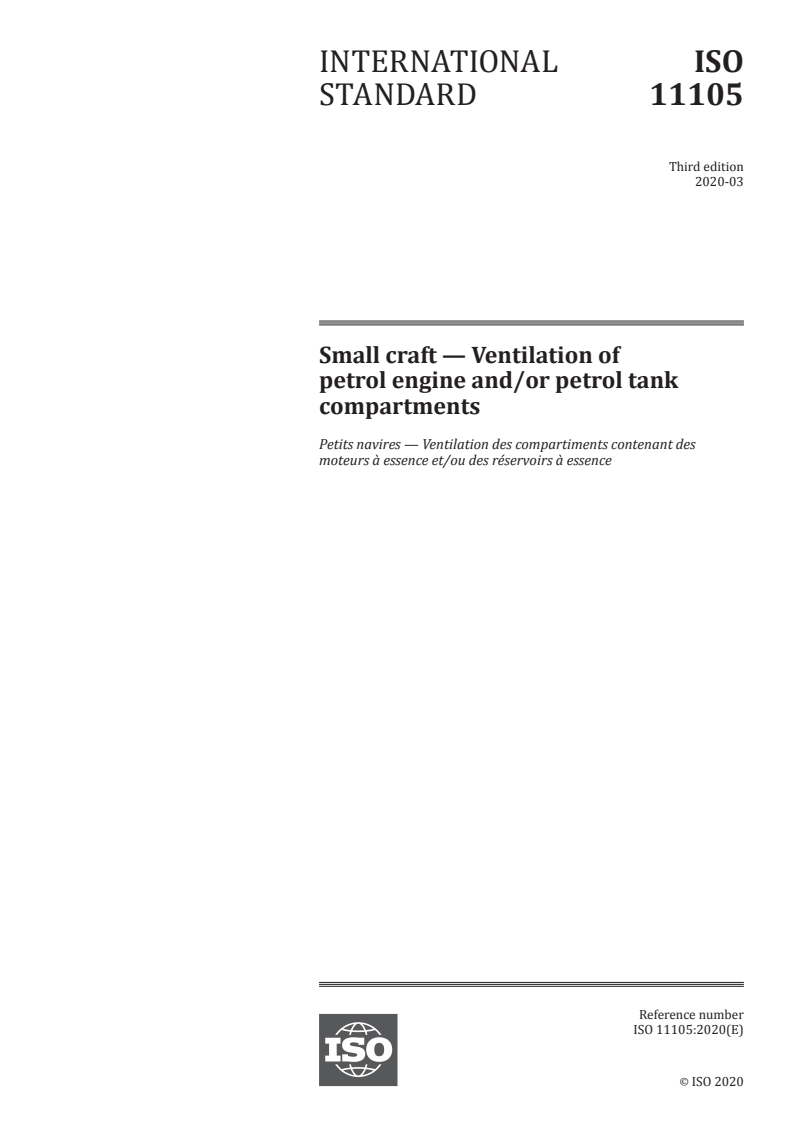
INTERNATIONAL ISO
STANDARD 11105
Third edition
2020-03
Small craft — Ventilation of
petrol engine and/or petrol tank
compartments
Petits navires — Ventilation des compartiments contenant des
moteurs à essence et/ou des réservoirs à essence
Reference number
©
ISO 2020
© ISO 2020
All rights reserved. Unless otherwise specified, or required in the context of its implementation, no part of this publication may
be reproduced or utilized otherwise in any form or by any means, electronic or mechanical, including photocopying, or posting
on the internet or an intranet, without prior written permission. Permission can be requested from either ISO at the address
below or ISO’s member body in the country of the requester.
ISO copyright office
CP 401 • Ch. de Blandonnet 8
CH-1214 Vernier, Geneva
Phone: +41 22 749 01 11
Fax: +41 22 749 09 47
Email: copyright@iso.org
Website: www.iso.org
Published in Switzerland
ii © ISO 2020 – All rights reserved
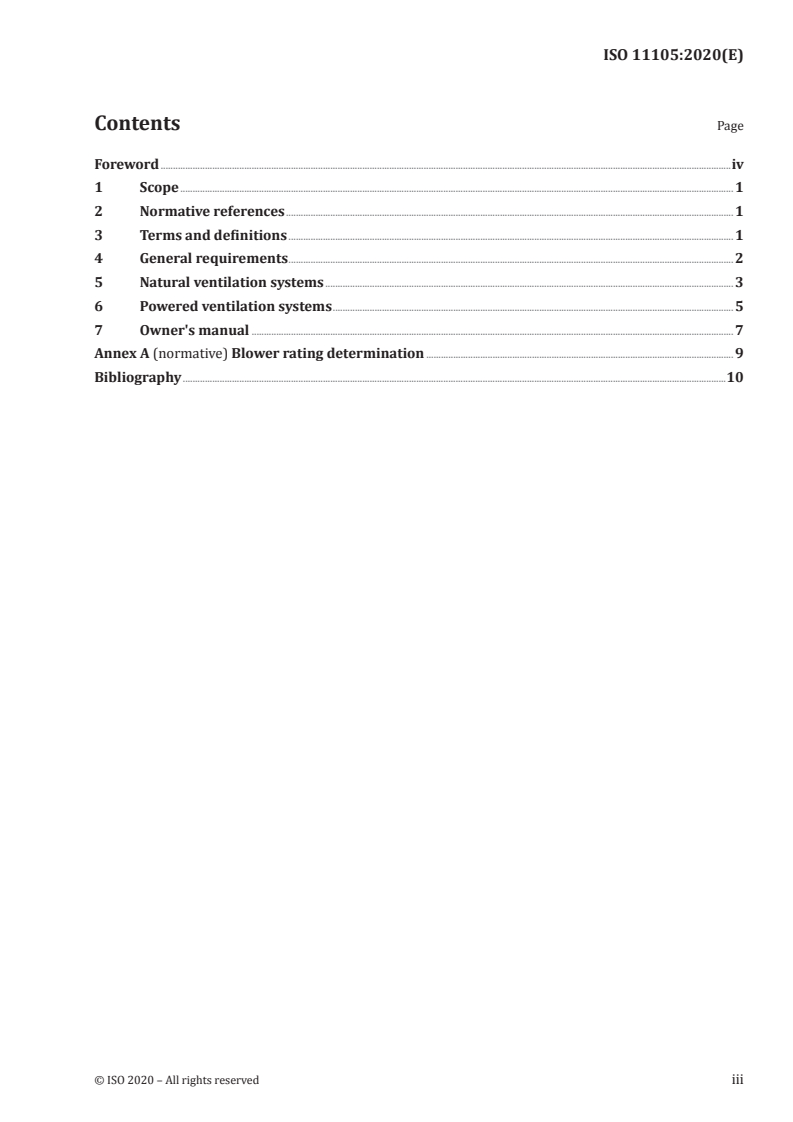
Contents Page
Foreword .iv
1 Scope . 1
2 Normative references . 1
3 Terms and definitions . 1
4 General requirements . 2
5 Natural ventilation systems . 3
6 Powered ventilation systems . 5
7 Owner's manual . 7
Annex A (normative) Blower rating determination . 9
Bibliography .10
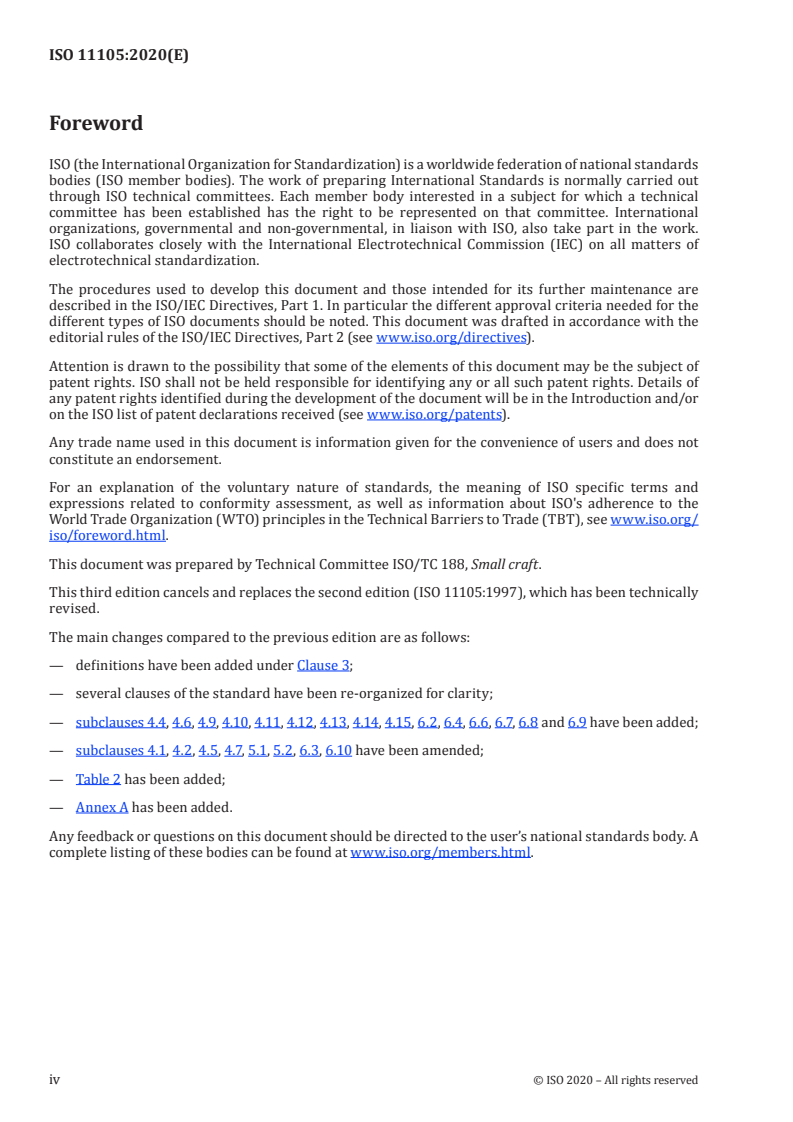
Foreword
ISO (the International Organization for Standardization) is a worldwide federation of national standards
bodies (ISO member bodies). The work of preparing International Standards is normally carried out
through ISO technical committees. Each member body interested in a subject for which a technical
committee has been established has the right to be represented on that committee. International
organizations, governmental and non-governmental, in liaison with ISO, also take part in the work.
ISO collaborates closely with the International Electrotechnical Commission (IEC) on all matters of
electrotechnical standardization.
The procedures used to develop this document and those intended for its further maintenance are
described in the ISO/IEC Directives, Part 1. In particular the different approval criteria needed for the
different types of ISO documents should be noted. This document was drafted in accordance with the
editorial rules of the ISO/IEC Directives, Part 2 (see www .iso .org/ directives).
Attention is drawn to the possibility that some of the elements of this document may be the subject of
patent rights. ISO shall not be held responsible for identifying any or all such patent rights. Details of
any patent rights identified during the development of the document will be in the Introduction and/or
on the ISO list of patent declarations received (see www .iso .org/ patents).
Any trade name used in this document is information given for the convenience of users and does not
constitute an endorsement.
For an explanation of the voluntary nature of standards, the meaning of ISO specific terms and
expressions related to conformity assessment, as well as information about ISO's adherence to the
World Trade Organization (WTO) principles in the Technical Barriers to Trade (TBT), see www .iso .org/
iso/ foreword .html.
This document was prepared by Technical Committee ISO/TC 188, Small craft.
This third edition cancels and replaces the second edition (ISO 11105:1997), which has been technically
revised.
The main changes compared to the previous edition are as follows:
— definitions have been added under Clause 3;
— several clauses of the standard have been re-organized for clarity;
— subclauses 4.4, 4.6, 4.9, 4.10, 4.11, 4.12, 4.13, 4.14, 4.15, 6.2, 6.4, 6.6, 6.7, 6.8 and 6.9 have been added;
— subclauses 4.1, 4.2, 4.5, 4.7, 5.1, 5.2, 6.3, 6.10 have been amended;
— Table 2 has been added;
— Annex A has been added.
Any feedback or questions on this document should be directed to the user’s national standards body. A
complete listing of these bodies can be found at www .iso .org/ members .html.
iv © ISO 2020 – All rights reserved
INTERNATIONAL STANDARD ISO 11105:2020(E)
Small craft — Ventilation of petrol engine and/or petrol
tank compartments
IMPORTANT — The colours represented in the electronic file of this document can be neither
viewed on screen nor printed as true representations. For the purposes of colour matching,
see ISO 3864-4 which provides colorimetric and photometric properties together with, as a
guideline, references from colour order systems.
1 Scope
This document specifies requirements for the ventilation of petrol engine and petrol tank compartments
in small craft having petrol engines for propulsion, electrical generation or mechanical power, to prevent
the accumulation of explosive gases in these compartments. Personal watercraft are not covered in this
document.
2 Normative references
The following documents are referred to in the text in such a way that some or all of their content
constitutes requirements of this document. For dated references, only the edition cited applies. For
undated references, the latest edition of the referenced document (including any amendments) applies.
ISO 8846:1990, Small craft — Electrical devices — Protection against ignition of surrounding
flammable gases
ISO 11192:2005, Small craft — Graphical symbols
ISO 10088:2013, Small craft — Permanently installed fuel systems
3 Terms and definitions
For the purposes of this document, the following terms and definitions apply.
ISO and IEC maintain terminological databases for use in standardization at the following addresses:
— ISO Online browsing platform: available at https:// www .iso .org/ obp
— IEC Electropedia: available at http:// www .electropedia .org/
3.1
habitable space
space surrounded by permanent structure in which there is provision for any of the following activities:
sleeping, cooking, eating, washing/toilet, navigation, steering
Note 1 to entry: Spaces intended exclusively for storage, open cockpits with or without canvas enclosures and
engine rooms are not included.
3.2
net compartment volume
volume that results from subtracting the volume of the permanently installed (3.4) items of equipment
and accessories from the total, or gross, compartment volume
3.3
open to the atmosphere
having at least 0,34 m of permanent open area directly exposed to the
atmosphere for each cubic meter of net compartment volume (3.2)
3.4
permanently installed
securely fastened so that tools, such as wrenches and screwdrivers, must be used for removal
3.5
craft
small craft
recreational boat, and other watercraft using similar equipment, of up to 24 m length of hull (L )
H
Note 1 to entry: The length of hull is defined in ISO 8666:2016.
3.6
ventilation
changing of air within a compartment by natural or powered means
Note 1 to entry: Ventilation can be affected by dilution of contaminated air, by local exhaust of contaminated air,
or by introduction of fresh air.
3.7
weather enclosure
removable covering intended to be used when the boat is occupied
4 General requirements
4.1 Natural ventilation shall be provided in petrol tank compartments, except when the remaining
volume is less than 3 l, in accordance with Clause 5.
4.2 Powered ventilation and natural ventilation shall be provided in petrol engine compartments in
accordance with Clauses 5 and 6.
4.3 The ventilation duct sizes and airflow requirements shall be calculated based on net compartment
volumes.
4.4 Ventilation ducts shall be self-draining.
4.5 Compartments or spaces containing fixed petrol engines and/or fixed petrol tanks shall
...
INTERNATIONAL ISO
STANDARD 11105
Third edition
2020-03
Small craft — Ventilation of
petrol engine and/or petrol tank
compartments
Petits navires — Ventilation des compartiments contenant des
moteurs à essence et/ou des réservoirs à essence
Reference number
©
ISO 2020
© ISO 2020
All rights reserved. Unless otherwise specified, or required in the context of its implementation, no part of this publication may
be reproduced or utilized otherwise in any form or by any means, electronic or mechanical, including photocopying, or posting
on the internet or an intranet, without prior written permission. Permission can be requested from either ISO at the address
below or ISO’s member body in the country of the requester.
ISO copyright office
CP 401 • Ch. de Blandonnet 8
CH-1214 Vernier, Geneva
Phone: +41 22 749 01 11
Fax: +41 22 749 09 47
Email: copyright@iso.org
Website: www.iso.org
Published in Switzerland
ii © ISO 2020 – All rights reserved
Contents Page
Foreword .iv
1 Scope . 1
2 Normative references . 1
3 Terms and definitions . 1
4 General requirements . 2
5 Natural ventilation systems . 3
6 Powered ventilation systems . 5
7 Owner's manual . 7
Annex A (normative) Blower rating determination . 9
Bibliography .10
Foreword
ISO (the International Organization for Standardization) is a worldwide federation of national standards
bodies (ISO member bodies). The work of preparing International Standards is normally carried out
through ISO technical committees. Each member body interested in a subject for which a technical
committee has been established has the right to be represented on that committee. International
organizations, governmental and non-governmental, in liaison with ISO, also take part in the work.
ISO collaborates closely with the International Electrotechnical Commission (IEC) on all matters of
electrotechnical standardization.
The procedures used to develop this document and those intended for its further maintenance are
described in the ISO/IEC Directives, Part 1. In particular the different approval criteria needed for the
different types of ISO documents should be noted. This document was drafted in accordance with the
editorial rules of the ISO/IEC Directives, Part 2 (see www .iso .org/ directives).
Attention is drawn to the possibility that some of the elements of this document may be the subject of
patent rights. ISO shall not be held responsible for identifying any or all such patent rights. Details of
any patent rights identified during the development of the document will be in the Introduction and/or
on the ISO list of patent declarations received (see www .iso .org/ patents).
Any trade name used in this document is information given for the convenience of users and does not
constitute an endorsement.
For an explanation of the voluntary nature of standards, the meaning of ISO specific terms and
expressions related to conformity assessment, as well as information about ISO's adherence to the
World Trade Organization (WTO) principles in the Technical Barriers to Trade (TBT), see www .iso .org/
iso/ foreword .html.
This document was prepared by Technical Committee ISO/TC 188, Small craft.
This third edition cancels and replaces the second edition (ISO 11105:1997), which has been technically
revised.
The main changes compared to the previous edition are as follows:
— definitions have been added under Clause 3;
— several clauses of the standard have been re-organized for clarity;
— subclauses 4.4, 4.6, 4.9, 4.10, 4.11, 4.12, 4.13, 4.14, 4.15, 6.2, 6.4, 6.6, 6.7, 6.8 and 6.9 have been added;
— subclauses 4.1, 4.2, 4.5, 4.7, 5.1, 5.2, 6.3, 6.10 have been amended;
— Table 2 has been added;
— Annex A has been added.
Any feedback or questions on this document should be directed to the user’s national standards body. A
complete listing of these bodies can be found at www .iso .org/ members .html.
iv © ISO 2020 – All rights reserved
INTERNATIONAL STANDARD ISO 11105:2020(E)
Small craft — Ventilation of petrol engine and/or petrol
tank compartments
IMPORTANT — The colours represented in the electronic file of this document can be neither
viewed on screen nor printed as true representations. For the purposes of colour matching,
see ISO 3864-4 which provides colorimetric and photometric properties together with, as a
guideline, references from colour order systems.
1 Scope
This document specifies requirements for the ventilation of petrol engine and petrol tank compartments
in small craft having petrol engines for propulsion, electrical generation or mechanical power, to prevent
the accumulation of explosive gases in these compartments. Personal watercraft are not covered in this
document.
2 Normative references
The following documents are referred to in the text in such a way that some or all of their content
constitutes requirements of this document. For dated references, only the edition cited applies. For
undated references, the latest edition of the referenced document (including any amendments) applies.
ISO 8846:1990, Small craft — Electrical devices — Protection against ignition of surrounding
flammable gases
ISO 11192:2005, Small craft — Graphical symbols
ISO 10088:2013, Small craft — Permanently installed fuel systems
3 Terms and definitions
For the purposes of this document, the following terms and definitions apply.
ISO and IEC maintain terminological databases for use in standardization at the following addresses:
— ISO Online browsing platform: available at https:// www .iso .org/ obp
— IEC Electropedia: available at http:// www .electropedia .org/
3.1
habitable space
space surrounded by permanent structure in which there is provision for any of the following activities:
sleeping, cooking, eating, washing/toilet, navigation, steering
Note 1 to entry: Spaces intended exclusively for storage, open cockpits with or without canvas enclosures and
engine rooms are not included.
3.2
net compartment volume
volume that results from subtracting the volume of the permanently installed (3.4) items of equipment
and accessories from the total, or gross, compartment volume
3.3
open to the atmosphere
having at least 0,34 m of permanent open area directly exposed to the
atmosphere for each cubic meter of net compartment volume (3.2)
3.4
permanently installed
securely fastened so that tools, such as wrenches and screwdrivers, must be used for removal
3.5
craft
small craft
recreational boat, and other watercraft using similar equipment, of up to 24 m length of hull (L )
H
Note 1 to entry: The length of hull is defined in ISO 8666:2016.
3.6
ventilation
changing of air within a compartment by natural or powered means
Note 1 to entry: Ventilation can be affected by dilution of contaminated air, by local exhaust of contaminated air,
or by introduction of fresh air.
3.7
weather enclosure
removable covering intended to be used when the boat is occupied
4 General requirements
4.1 Natural ventilation shall be provided in petrol tank compartments, except when the remaining
volume is less than 3 l, in accordance with Clause 5.
4.2 Powered ventilation and natural ventilation shall be provided in petrol engine compartments in
accordance with Clauses 5 and 6.
4.3 The ventilation duct sizes and airflow requirements shall be calculated based on net compartment
volumes.
4.4 Ventilation ducts shall be self-draining.
4.5 Compartments or spaces containing fixed petrol engines and/or fixed petrol tanks shall
...
NORME ISO
INTERNATIONALE 11105
Troisième édition
2020-03
Petits navires — Ventilation des
compartiments contenant des
moteurs à essence et/ou des
réservoirs à essence
Small craft — Ventilation of petrol engine and/or petrol tank
compartments
Numéro de référence
©
ISO 2020
DOCUMENT PROTÉGÉ PAR COPYRIGHT
© ISO 2020
Tous droits réservés. Sauf prescription différente ou nécessité dans le contexte de sa mise en œuvre, aucune partie de cette
publication ne peut être reproduite ni utilisée sous quelque forme que ce soit et par aucun procédé, électronique ou mécanique,
y compris la photocopie, ou la diffusion sur l’internet ou sur un intranet, sans autorisation écrite préalable. Une autorisation peut
être demandée à l’ISO à l’adresse ci-après ou au comité membre de l’ISO dans le pays du demandeur.
ISO copyright office
Case postale 401 • Ch. de Blandonnet 8
CH-1214 Vernier, Genève
Tél.: +41 22 749 01 11
Fax: +41 22 749 09 47
E-mail: copyright@iso.org
Web: www.iso.org
Publié en Suisse
ii © ISO 2020 – Tous droits réservés
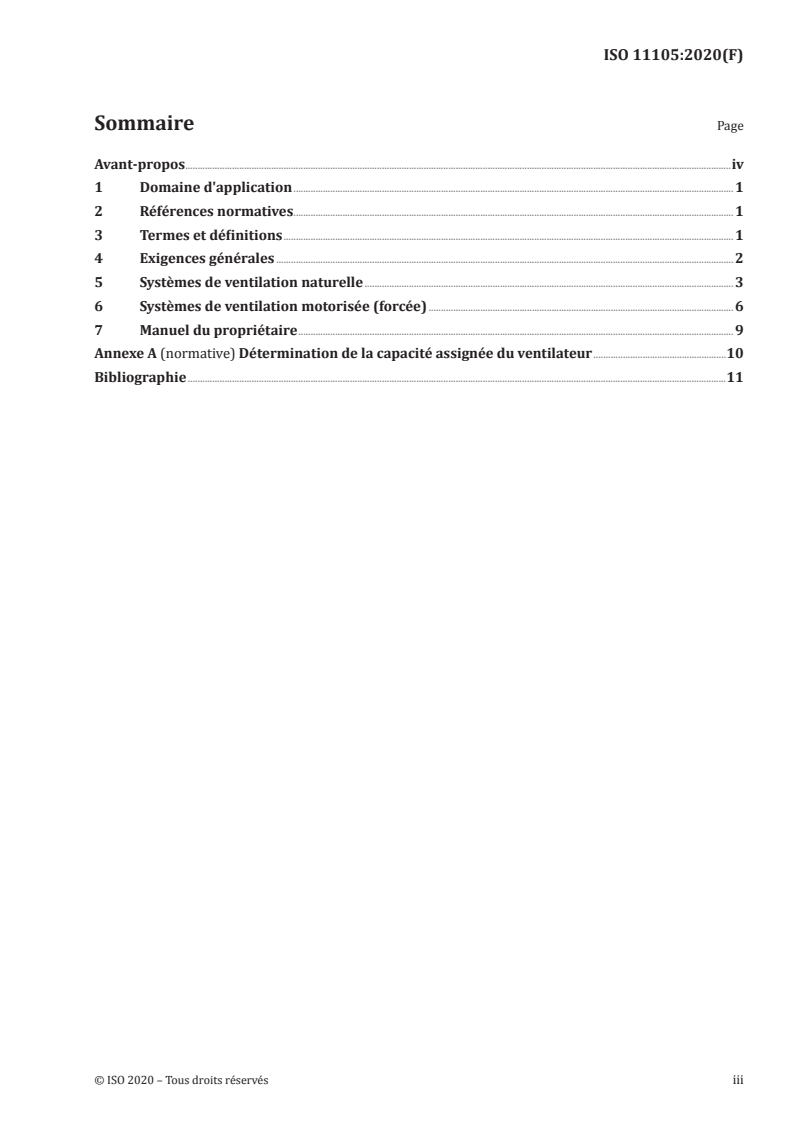
Sommaire Page
Avant-propos .iv
1 Domaine d'application . 1
2 Références normatives . 1
3 Termes et définitions . 1
4 Exigences générales . 2
5 Systèmes de ventilation naturelle . 3
6 Systèmes de ventilation motorisée (forcée) . 6
7 Manuel du propriétaire . 9
Annexe A (normative) Détermination de la capacité assignée du ventilateur .10
Bibliographie .11
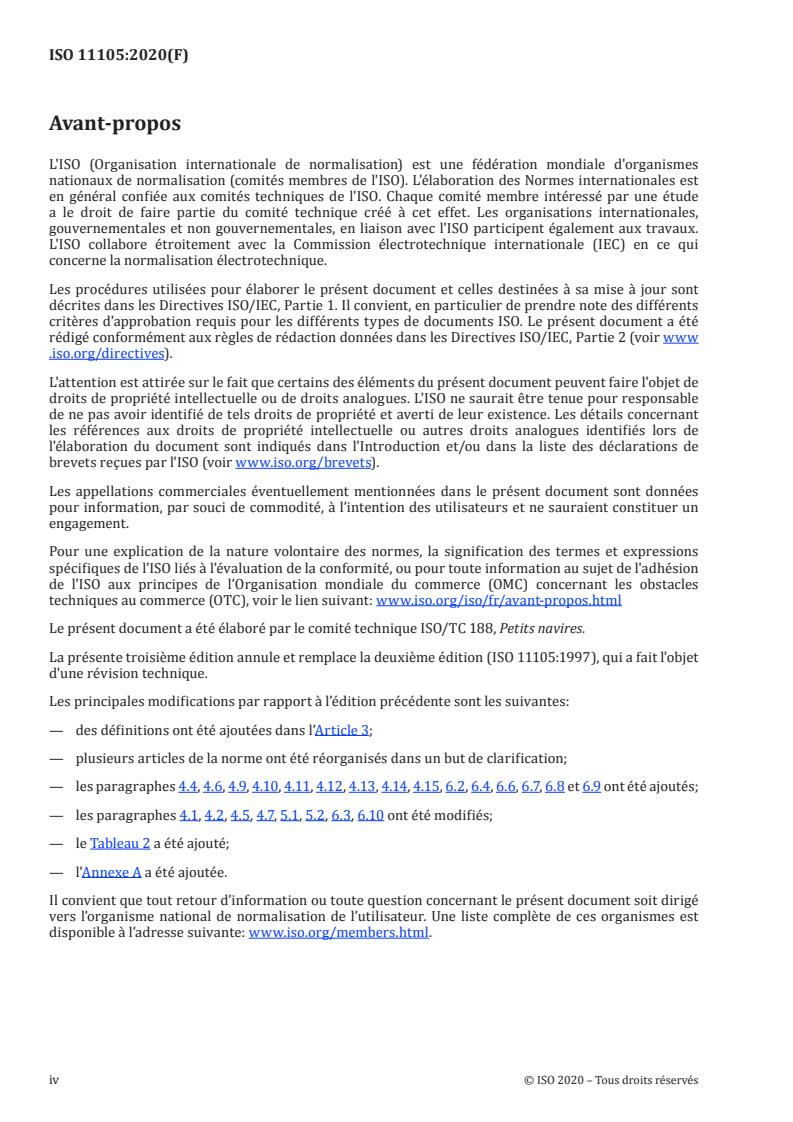
Avant-propos
L'ISO (Organisation internationale de normalisation) est une fédération mondiale d'organismes
nationaux de normalisation (comités membres de l'ISO). L'élaboration des Normes internationales est
en général confiée aux comités techniques de l'ISO. Chaque comité membre intéressé par une étude
a le droit de faire partie du comité technique créé à cet effet. Les organisations internationales,
gouvernementales et non gouvernementales, en liaison avec l'ISO participent également aux travaux.
L'ISO collabore étroitement avec la Commission électrotechnique internationale (IEC) en ce qui
concerne la normalisation électrotechnique.
Les procédures utilisées pour élaborer le présent document et celles destinées à sa mise à jour sont
décrites dans les Directives ISO/IEC, Partie 1. Il convient, en particulier de prendre note des différents
critères d'approbation requis pour les différents types de documents ISO. Le présent document a été
rédigé conformément aux règles de rédaction données dans les Directives ISO/IEC, Partie 2 (voir www
.iso .org/ directives).
L'attention est attirée sur le fait que certains des éléments du présent document peuvent faire l'objet de
droits de propriété intellectuelle ou de droits analogues. L'ISO ne saurait être tenue pour responsable
de ne pas avoir identifié de tels droits de propriété et averti de leur existence. Les détails concernant
les références aux droits de propriété intellectuelle ou autres droits analogues identifiés lors de
l'élaboration du document sont indiqués dans l'Introduction et/ou dans la liste des déclarations de
brevets reçues par l'ISO (voir www .iso .org/ brevets).
Les appellations commerciales éventuellement mentionnées dans le présent document sont données
pour information, par souci de commodité, à l’intention des utilisateurs et ne sauraient constituer un
engagement.
Pour une explication de la nature volontaire des normes, la signification des termes et expressions
spécifiques de l'ISO liés à l'évaluation de la conformité, ou pour toute information au sujet de l'adhésion
de l'ISO aux principes de l’Organisation mondiale du commerce (OMC) concernant les obstacles
techniques au commerce (OTC), voir le lien suivant: www .iso .org/ iso/ fr/ avant -propos .html
Le présent document a été élaboré par le comité technique ISO/TC 188, Petits navires.
La présente troisième édition annule et remplace la deuxième édition (ISO 11105:1997), qui a fait l'objet
d'une révision technique.
Les principales modifications par rapport à l’édition précédente sont les suivantes:
— des définitions ont été ajoutées dans l’Article 3;
— plusieurs articles de la norme ont été réorganisés dans un but de clarification;
— les paragraphes 4.4, 4.6, 4.9, 4.10, 4.11, 4.12, 4.13, 4.14, 4.15, 6.2, 6.4, 6.6, 6.7, 6.8 et 6.9 ont été ajoutés;
— les paragraphes 4.1, 4.2, 4.5, 4.7, 5.1, 5.2, 6.3, 6.10 ont été modifiés;
— le Tableau 2 a été ajouté;
— l'Annexe A a été ajoutée.
Il convient que tout retour d’information ou toute question concernant le présent document soit dirigé
vers l’organisme national de normalisation de l’utilisateur. Une liste complète de ces organismes est
disponible à l’adresse suivante: www .iso .org/ members .html.
iv © ISO 2020 – Tous droits réservés
NORME INTERNATIONALE ISO 11105:2020(F)
Petits navires — Ventilation des compartiments contenant
des moteurs à essence et/ou des réservoirs à essence
IMPORTANT — Les couleurs représentées dans le fichier électronique de ce document ne
peuvent être ni vues à l’écran ni imprimées comme de vraies représentations. Pour les besoins
de correspondance des couleurs, voir l'ISO 3864-4, qui fournit des propriétés colorimétriques
et photométriques ainsi que, à titre indicatif, des références issues de systèmes d'ordre de
couleurs.
1 Domaine d'application
Le présent document spécifie les exigences relatives à la ventilation des compartiments contenant des
moteurs à essence et des réservoirs à essence sur les petits navires munis de moteurs à essence pour la
propulsion, la génération électrique ou la puissance mécanique, afin de prévenir l’accumulation de gaz
explosifs dans ces compartiments. Les motos aquatiques ne sont pas couvertes par ce document.
2 Références normatives
Les documents suivants sont cités dans le texte de sorte qu’ils constituent, pour tout ou partie de leur
contenu, des exigences du présent document. Pour les références datées, seule l’édition citée s’applique.
Pour les références non datées, la dernière édition du document de référence s'applique (y compris les
éventuels amendements).
ISO 8846:1990, Navires de plaisance — Équipements électriques — Protection contre l'inflammation des
gaz inflammables environnants
ISO 11192:2005, Petits navires — Symboles graphiques
ISO 10088:2013, Petits navires — Systèmes à carburant installés à demeure
3 Termes et définitions
Pour les besoins du présent document, les termes et définitions suivants s'appliquent.
L'ISO et la CEI gèrent des bases de données terminologiques à utiliser pour la normalisation aux adresses
suivantes:
— Plateforme de navigation ISO en ligne: disponible sur https:// www .iso .org/ obp
— CEI Electropedia: disponible sur http:// www .electropedia .org/ .
3.1
espace habitable
espace entouré d’éléments de la structure du bateau installés à demeure dans lequel il est prévu de
pratiquer une quelconque des activités suivantes: dormir, faire la cuisine, manger, se laver/aller aux
toilettes, s’occuper de la navigation, barrer
Note 1 à l'article: Les espaces destinés uniquement au stockage, les cockpits ouverts, qu’ils soient entourés ou
non par des capotages en toile, et les compartiments moteurs ne sont pas compris
3.2
volume net du compartiment
volume résultant après avoir retiré le volume des éléments d’équipement et accessoires installés à
demeure (3.4) du volume total, ou brut, du compartiment
3.3
ouvert sur l’atmosphère
ayant au moins 0,34 m de surface ouverte en permanence et directement
exposée à l'atmosphère pour chaque mètre cube de volume net de compartiment (3.2)
3.4
installé à demeure
solidement fixé de sorte que des outils, tels que des clés et des tournevis, doivent être utilisés pour
leur retrait
3.5
bateau
petit navire
bateau de plaisance et autre embarcation utilisant un équipement similaire, d’une longueur de coque
(L ) inférieure ou égale à 24 m
H
Note 1 à l'article: La longueur de coque est définie dans l’ISO 8666:2016.
3.6
ventilation
changement d'air dans un compartiment par des moyens naturels ou mécaniques
Note 1 à l'article: La ventilation peut être effectuée par dilution de l'air contaminé, par l'évacuation locale de l'air
contaminé ou par l'introduction d'air frais.
3.7
capotage protégeant des intempéries
capotage amovible destiné à être utilisé lorsque le bateau est occupé
4 Exigences générales
4.1 Une ventilation naturelle doit être fournie dans les compartiments contenant des réservoirs à
essence, sauf lorsque le volume net de l'espace est inférieur à 3 litres, conformément à l’ Article 5.
4.2 Une ventilation forcée et une ventilation naturelle doivent être fournies dans les compartiments
contenant des moteurs à essence, conformément aux Articles 5 et 6.
4.3 Les dimensions des conduits de ventilation et les exigences de débit d'air doivent être calculées sur
la base des volumes nets du compartiment.
4.4 Les conduits de ventilation doivent être autovideurs.
4.5 Les compartiments ou espaces contenant des moteurs à essence et/ou des réservoirs à essence
fixes doivent être séparés des espaces habitables. Cette exigence est obtenue lorsque la structure remplit
les exigences suivantes:
a) les parois et limites sont rendues étanches de manière continue (par exemple soudées, brasées,
collées, stratifiées ou rendues étanches d’une autre manière).
b) les passages de câbles, tuyaux etc. sont rendus étanches à l'aide de raccords, joints et/ou de
matériaux d'étanchéité;
c) les ouvertures d'accès telles qu
...
NORME ISO
INTERNATIONALE 11105
Troisième édition
2020-03
Petits navires — Ventilation des
compartiments contenant des
moteurs à essence et/ou des
réservoirs à essence
Small craft — Ventilation of petrol engine and/or petrol tank
compartments
Numéro de référence
©
ISO 2020
DOCUMENT PROTÉGÉ PAR COPYRIGHT
© ISO 2020
Tous droits réservés. Sauf prescription différente ou nécessité dans le contexte de sa mise en œuvre, aucune partie de cette
publication ne peut être reproduite ni utilisée sous quelque forme que ce soit et par aucun procédé, électronique ou mécanique,
y compris la photocopie, ou la diffusion sur l’internet ou sur un intranet, sans autorisation écrite préalable. Une autorisation peut
être demandée à l’ISO à l’adresse ci-après ou au comité membre de l’ISO dans le pays du demandeur.
ISO copyright office
Case postale 401 • Ch. de Blandonnet 8
CH-1214 Vernier, Genève
Tél.: +41 22 749 01 11
Fax: +41 22 749 09 47
E-mail: copyright@iso.org
Web: www.iso.org
Publié en Suisse
ii © ISO 2020 – Tous droits réservés
Sommaire Page
Avant-propos .iv
1 Domaine d'application . 1
2 Références normatives . 1
3 Termes et définitions . 1
4 Exigences générales . 2
5 Systèmes de ventilation naturelle . 3
6 Systèmes de ventilation motorisée (forcée) . 6
7 Manuel du propriétaire . 9
Annexe A (normative) Détermination de la capacité assignée du ventilateur .10
Bibliographie .11
Avant-propos
L'ISO (Organisation internationale de normalisation) est une fédération mondiale d'organismes
nationaux de normalisation (comités membres de l'ISO). L'élaboration des Normes internationales est
en général confiée aux comités techniques de l'ISO. Chaque comité membre intéressé par une étude
a le droit de faire partie du comité technique créé à cet effet. Les organisations internationales,
gouvernementales et non gouvernementales, en liaison avec l'ISO participent également aux travaux.
L'ISO collabore étroitement avec la Commission électrotechnique internationale (IEC) en ce qui
concerne la normalisation électrotechnique.
Les procédures utilisées pour élaborer le présent document et celles destinées à sa mise à jour sont
décrites dans les Directives ISO/IEC, Partie 1. Il convient, en particulier de prendre note des différents
critères d'approbation requis pour les différents types de documents ISO. Le présent document a été
rédigé conformément aux règles de rédaction données dans les Directives ISO/IEC, Partie 2 (voir www
.iso .org/ directives).
L'attention est attirée sur le fait que certains des éléments du présent document peuvent faire l'objet de
droits de propriété intellectuelle ou de droits analogues. L'ISO ne saurait être tenue pour responsable
de ne pas avoir identifié de tels droits de propriété et averti de leur existence. Les détails concernant
les références aux droits de propriété intellectuelle ou autres droits analogues identifiés lors de
l'élaboration du document sont indiqués dans l'Introduction et/ou dans la liste des déclarations de
brevets reçues par l'ISO (voir www .iso .org/ brevets).
Les appellations commerciales éventuellement mentionnées dans le présent document sont données
pour information, par souci de commodité, à l’intention des utilisateurs et ne sauraient constituer un
engagement.
Pour une explication de la nature volontaire des normes, la signification des termes et expressions
spécifiques de l'ISO liés à l'évaluation de la conformité, ou pour toute information au sujet de l'adhésion
de l'ISO aux principes de l’Organisation mondiale du commerce (OMC) concernant les obstacles
techniques au commerce (OTC), voir le lien suivant: www .iso .org/ iso/ fr/ avant -propos .html
Le présent document a été élaboré par le comité technique ISO/TC 188, Petits navires.
La présente troisième édition annule et remplace la deuxième édition (ISO 11105:1997), qui a fait l'objet
d'une révision technique.
Les principales modifications par rapport à l’édition précédente sont les suivantes:
— des définitions ont été ajoutées dans l’Article 3;
— plusieurs articles de la norme ont été réorganisés dans un but de clarification;
— les paragraphes 4.4, 4.6, 4.9, 4.10, 4.11, 4.12, 4.13, 4.14, 4.15, 6.2, 6.4, 6.6, 6.7, 6.8 et 6.9 ont été ajoutés;
— les paragraphes 4.1, 4.2, 4.5, 4.7, 5.1, 5.2, 6.3, 6.10 ont été modifiés;
— le Tableau 2 a été ajouté;
— l'Annexe A a été ajoutée.
Il convient que tout retour d’information ou toute question concernant le présent document soit dirigé
vers l’organisme national de normalisation de l’utilisateur. Une liste complète de ces organismes est
disponible à l’adresse suivante: www .iso .org/ members .html.
iv © ISO 2020 – Tous droits réservés
NORME INTERNATIONALE ISO 11105:2020(F)
Petits navires — Ventilation des compartiments contenant
des moteurs à essence et/ou des réservoirs à essence
IMPORTANT — Les couleurs représentées dans le fichier électronique de ce document ne
peuvent être ni vues à l’écran ni imprimées comme de vraies représentations. Pour les besoins
de correspondance des couleurs, voir l'ISO 3864-4, qui fournit des propriétés colorimétriques
et photométriques ainsi que, à titre indicatif, des références issues de systèmes d'ordre de
couleurs.
1 Domaine d'application
Le présent document spécifie les exigences relatives à la ventilation des compartiments contenant des
moteurs à essence et des réservoirs à essence sur les petits navires munis de moteurs à essence pour la
propulsion, la génération électrique ou la puissance mécanique, afin de prévenir l’accumulation de gaz
explosifs dans ces compartiments. Les motos aquatiques ne sont pas couvertes par ce document.
2 Références normatives
Les documents suivants sont cités dans le texte de sorte qu’ils constituent, pour tout ou partie de leur
contenu, des exigences du présent document. Pour les références datées, seule l’édition citée s’applique.
Pour les références non datées, la dernière édition du document de référence s'applique (y compris les
éventuels amendements).
ISO 8846:1990, Navires de plaisance — Équipements électriques — Protection contre l'inflammation des
gaz inflammables environnants
ISO 11192:2005, Petits navires — Symboles graphiques
ISO 10088:2013, Petits navires — Systèmes à carburant installés à demeure
3 Termes et définitions
Pour les besoins du présent document, les termes et définitions suivants s'appliquent.
L'ISO et la CEI gèrent des bases de données terminologiques à utiliser pour la normalisation aux adresses
suivantes:
— Plateforme de navigation ISO en ligne: disponible sur https:// www .iso .org/ obp
— CEI Electropedia: disponible sur http:// www .electropedia .org/ .
3.1
espace habitable
espace entouré d’éléments de la structure du bateau installés à demeure dans lequel il est prévu de
pratiquer une quelconque des activités suivantes: dormir, faire la cuisine, manger, se laver/aller aux
toilettes, s’occuper de la navigation, barrer
Note 1 à l'article: Les espaces destinés uniquement au stockage, les cockpits ouverts, qu’ils soient entourés ou
non par des capotages en toile, et les compartiments moteurs ne sont pas compris
3.2
volume net du compartiment
volume résultant après avoir retiré le volume des éléments d’équipement et accessoires installés à
demeure (3.4) du volume total, ou brut, du compartiment
3.3
ouvert sur l’atmosphère
ayant au moins 0,34 m de surface ouverte en permanence et directement
exposée à l'atmosphère pour chaque mètre cube de volume net de compartiment (3.2)
3.4
installé à demeure
solidement fixé de sorte que des outils, tels que des clés et des tournevis, doivent être utilisés pour
leur retrait
3.5
bateau
petit navire
bateau de plaisance et autre embarcation utilisant un équipement similaire, d’une longueur de coque
(L ) inférieure ou égale à 24 m
H
Note 1 à l'article: La longueur de coque est définie dans l’ISO 8666:2016.
3.6
ventilation
changement d'air dans un compartiment par des moyens naturels ou mécaniques
Note 1 à l'article: La ventilation peut être effectuée par dilution de l'air contaminé, par l'évacuation locale de l'air
contaminé ou par l'introduction d'air frais.
3.7
capotage protégeant des intempéries
capotage amovible destiné à être utilisé lorsque le bateau est occupé
4 Exigences générales
4.1 Une ventilation naturelle doit être fournie dans les compartiments contenant des réservoirs à
essence, sauf lorsque le volume net de l'espace est inférieur à 3 litres, conformément à l’ Article 5.
4.2 Une ventilation forcée et une ventilation naturelle doivent être fournies dans les compartiments
contenant des moteurs à essence, conformément aux Articles 5 et 6.
4.3 Les dimensions des conduits de ventilation et les exigences de débit d'air doivent être calculées sur
la base des volumes nets du compartiment.
4.4 Les conduits de ventilation doivent être autovideurs.
4.5 Les compartiments ou espaces contenant des moteurs à essence et/ou des réservoirs à essence
fixes doivent être séparés des espaces habitables. Cette exigence est obtenue lorsque la structure remplit
les exigences suivantes:
a) les parois et limites sont rendues étanches de manière continue (par exemple soudées, brasées,
collées, stratifiées ou rendues étanches d’une autre manière).
b) les passages de câbles, tuyaux etc. sont rendus étanches à l'aide de raccords, joints et/ou de
matériaux d'étanchéité;
c) les ouvertures d'accès telles qu
...
Questions, Comments and Discussion
Ask us and Technical Secretary will try to provide an answer. You can facilitate discussion about the standard in here.
Loading comments...