


ISO 29281:2011
(Main)Intelligent transport systems — Communications access for land mobiles (CALM) — Non-IP networking
Intelligent transport systems — Communications access for land mobiles (CALM) — Non-IP networking
ISO 29281:2011 specifies FAST services, i.e. FAST networking & transport layer protocols for single-hop communications, N-hop broadcast communications, ITS-MUX, and ITS station-internal forwarding; FAST service for 15628 CI (DSRC CI) support; FAST service for 15628 application support; and the related support of the MN-SAP and MF-SAP.
Systèmes intelligents de transport — Accès aux communications des services mobiles terrestres (CALM) — Réseautique non-IP
General Information
- Status
- Withdrawn
- Publication Date
- 23-Mar-2011
- Withdrawal Date
- 23-Mar-2011
- Technical Committee
- ISO/TC 204 - Intelligent transport systems
- Drafting Committee
- ISO/TC 204/WG 16 - Communications
- Current Stage
- 9599 - Withdrawal of International Standard
- Start Date
- 11-Apr-2013
- Completion Date
- 14-Feb-2026
Relations
- Effective Date
- 23-Feb-2012
- Effective Date
- 23-Feb-2012

Get Certified
Connect with accredited certification bodies for this standard

BSI Group
BSI (British Standards Institution) is the business standards company that helps organizations make excellence a habit.

Great Wall Tianjin Quality Assurance Center
Established 1993, first batch to receive national accreditation with IAF recognition.
Hong Kong Quality Assurance Agency (HKQAA)
Hong Kong's leading certification body.
Sponsored listings
Frequently Asked Questions
ISO 29281:2011 is a standard published by the International Organization for Standardization (ISO). Its full title is "Intelligent transport systems — Communications access for land mobiles (CALM) — Non-IP networking". This standard covers: ISO 29281:2011 specifies FAST services, i.e. FAST networking & transport layer protocols for single-hop communications, N-hop broadcast communications, ITS-MUX, and ITS station-internal forwarding; FAST service for 15628 CI (DSRC CI) support; FAST service for 15628 application support; and the related support of the MN-SAP and MF-SAP.
ISO 29281:2011 specifies FAST services, i.e. FAST networking & transport layer protocols for single-hop communications, N-hop broadcast communications, ITS-MUX, and ITS station-internal forwarding; FAST service for 15628 CI (DSRC CI) support; FAST service for 15628 application support; and the related support of the MN-SAP and MF-SAP.
ISO 29281:2011 is classified under the following ICS (International Classification for Standards) categories: 03.220.01 - Transport in general; 35.240.60 - IT applications in transport. The ICS classification helps identify the subject area and facilitates finding related standards.
ISO 29281:2011 has the following relationships with other standards: It is inter standard links to ISO 29281-2:2013, ISO 29281-1:2013. Understanding these relationships helps ensure you are using the most current and applicable version of the standard.
ISO 29281:2011 is available in PDF format for immediate download after purchase. The document can be added to your cart and obtained through the secure checkout process. Digital delivery ensures instant access to the complete standard document.
Standards Content (Sample)
INTERNATIONAL ISO
STANDARD 29281
First edition
2011-04-01
Intelligent transport systems —
Communications access for land mobiles
(CALM) — Non-IP networking
Systèmes intelligents de transport — Accès aux communications des
services mobiles terrestres (CALM) — Réseautique non-IP
Reference number
©
ISO 2011
© ISO 2011
All rights reserved. Unless otherwise specified, no part of this publication may be reproduced or utilized in any form or by any means,
electronic or mechanical, including photocopying and microfilm, without permission in writing from either ISO at the address below or
ISO's member body in the country of the requester.
ISO copyright office
Case postale 56 • CH-1211 Geneva 20
Tel. + 41 22 749 01 11
Fax + 41 22 749 09 47
E-mail copyright@iso.org
Web www.iso.org
Published in Switzerland
ii © ISO 2011 – All rights reserved
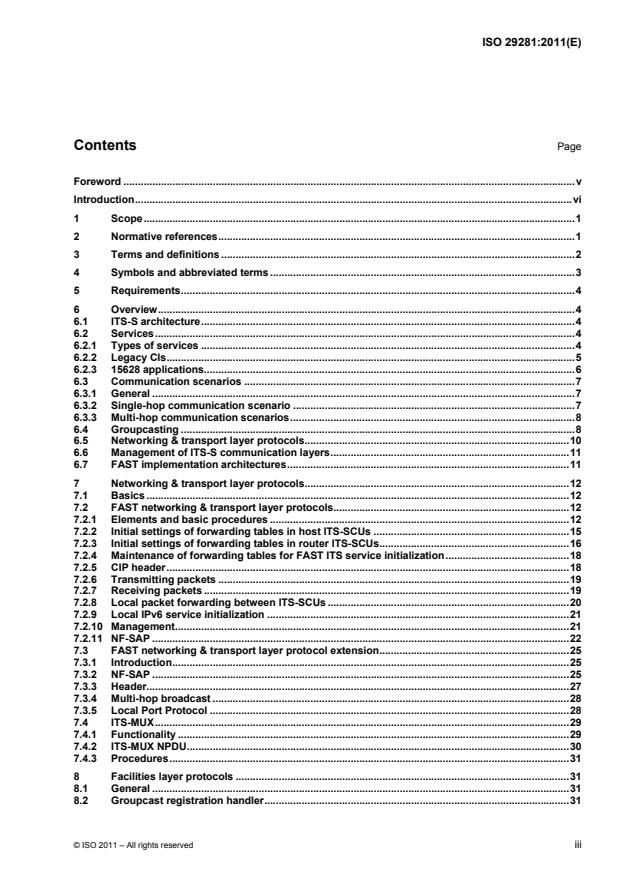
Contents Page
Foreword .v
Introduction.vi
1 Scope.1
2 Normative references.1
3 Terms and definitions .2
4 Symbols and abbreviated terms .3
5 Requirements.4
6 Overview.4
6.1 ITS-S architecture.4
6.2 Services.4
6.2.1 Types of services .4
6.2.2 Legacy CIs.5
6.2.3 15628 applications.6
6.3 Communication scenarios .7
6.3.1 General .7
6.3.2 Single-hop communication scenario .7
6.3.3 Multi-hop communication scenarios.8
6.4 Groupcasting .8
6.5 Networking & transport layer protocols.10
6.6 Management of ITS-S communication layers.11
6.7 FAST implementation architectures.11
7 Networking & transport layer protocols.12
7.1 Basics .12
7.2 FAST networking & transport layer protocols.12
7.2.1 Elements and basic procedures .12
7.2.2 Initial settings of forwarding tables in host ITS-SCUs .15
7.2.3 Initial settings of forwarding tables in router ITS-SCUs.16
7.2.4 Maintenance of forwarding tables for FAST ITS service initialization.18
7.2.5 CIP header.18
7.2.6 Transmitting packets .19
7.2.7 Receiving packets .19
7.2.8 Local packet forwarding between ITS-SCUs .20
7.2.9 Local IPv6 service initialization .21
7.2.10 Management.21
7.2.11 NF-SAP .22
7.3 FAST networking & transport layer protocol extension.25
7.3.1 Introduction.25
7.3.2 NF-SAP .25
7.3.3 Header.27
7.3.4 Multi-hop broadcast .28
7.3.5 Local Port Protocol .28
7.4 ITS-MUX.29
7.4.1 Functionality .29
7.4.2 ITS-MUX NPDU.30
7.4.3 Procedures.31
8 Facilities layer protocols .31
8.1 General .31
8.2 Groupcast registration handler.31
8.3 Repetitive packet transmission handler. 31
8.4 Legacy CI Port Manager. 31
8.5 15628 Kernel Emulator . 32
8.5.1 15628 legacy applications. 32
8.5.2 CI classes . 32
8.5.3 Registration of 15628 applications . 32
8.5.4 Operation phase. 33
8.6 Basic primitive application functions. 34
9 Common elements and procedures. 34
9.1 CIP management. 34
9.2 NF-SAP. 36
9.3 MN-SAP. 36
10 Conformance. 36
11 Test methods. 36
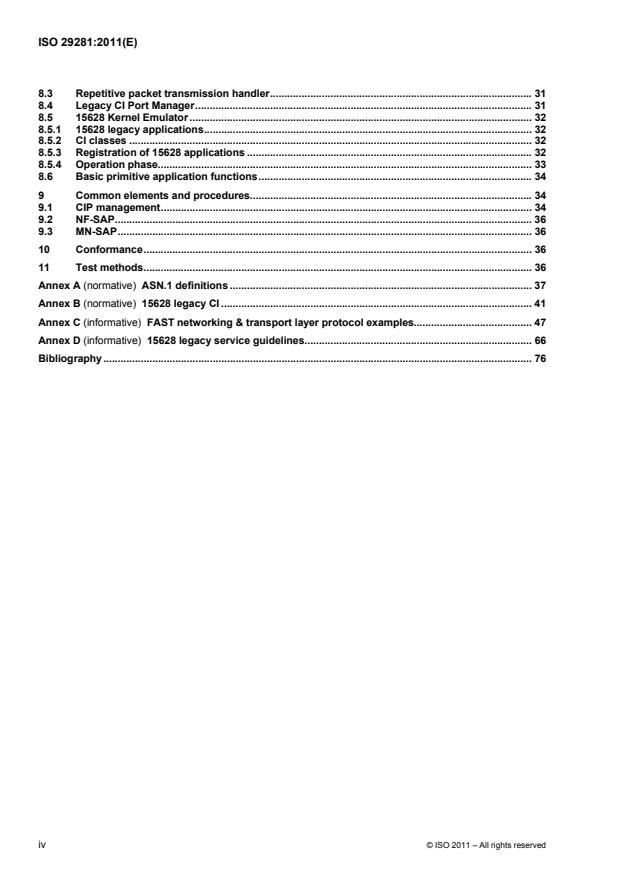
Annex A (normative) ASN.1 definitions . 37
Annex B (normative) 15628 legacy CI . 41
Annex C (informative) FAST networking & transport layer protocol examples. 47
Annex D (informative) 15628 legacy service guidelines. 66
Bibliography. 76
iv © ISO 2011 – All rights reserved
Foreword
ISO (the International Organization for Standardization) is a worldwide federation of national standards bodies
(ISO member bodies). The work of preparing International Standards is normally carried out through ISO
technical committees. Each member body interested in a subject for which a technical committee has been
established has the right to be represented on that committee. International organizations, governmental and
non-governmental, in liaison with ISO, also take part in the work. ISO collaborates closely with the
International Electrotechnical Commission (IEC) on all matters of electrotechnical standardization.
International Standards are drafted in accordance with the rules given in the ISO/IEC Directives, Part 2.
The main task of technical committees is to prepare International Standards. Draft International Standards
adopted by the technical committees are circulated to the member bodies for voting. Publication as an
International Standard requires approval by at least 75 % of the member bodies casting a vote.
Attention is drawn to the possibility that some of the elements of this document may be the subject of patent
rights. ISO shall not be held responsible for identifying any or all such patent rights.
ISO 29281 was prepared by Technical Committee ISO/TC 204, Intelligent transport systems.
Introduction
This International Standard is part of a family of International Standards based on the communications access
for land mobiles (CALM) concept. These International Standards specify a common architecture (see
ISO 21217), network protocols and communication interface definitions for wired and wireless
communications using various access technologies including cellular 2nd generation, cellular 3rd generation,
satellite, infra-red, 5 GHz microwave, 60 GHz millimetre-wave and mobile wireless broadband. These and
other access technologies that can be incorporated are designed to provide broadcast, unicast and multicast
communications between mobile stations, between mobile and fixed stations and between fixed stations in the
intelligent transport systems (ITS) sector.
A fundamental advantage of the CALM concept over traditional systems is that applications are abstracted
from the access technologies that provide the wireless connectivity and the networks that transport the
information from the source to the destination(s). This means that ITS stations are not limited to a single
access technology and networking protocol and can implement any of those supported, and the ITS station
management can make optimal use of all these resources. To exploit this flexibility, CALM-complaint systems
may support handover of different types including
⎯ those involving a change of communication interface without a change of access technology,
⎯ those involving a change of communication interface with a change of access technology,
⎯ those involving reconfiguration or change of the network employed to provide connectivity, and
⎯ those involving both a change in communication interface and network reconfiguration.
A detailed introduction to the CALM family of International Standards is provided in ISO 21217.
There are applications and services in the ITS sector that are not well suited to IPv6 networking. Due to the
rapidly changing topologies that can be encountered in ITS communications and the importance of physical
location in some circumstances, networking & transport layer protocols specifically designed for efficiency
(low-overhead, rapid initialization, etc.) and others based on geo-addressing and multi-hopping mechanisms
are necessary to enable a much larger class of applications and services than would be possible with only IP
networking. Examples of such applications include
⎯ time-critical vehicle and road safety,
⎯ road traffic efficiency,
⎯ road tolling,
⎯ access control, and
⎯ commercial services.
This International Standard focuses on non-IP operations and contains specifications for the ITS station
facilities layer and the non-IP networking & transport layer, which complements the IPv6 specifications given
in ISO 21210.
vi © ISO 2011 – All rights reserved
INTERNATIONAL STANDARD ISO 29281:2011(E)
Intelligent transport systems — Communications access for
land mobiles (CALM) — Non-IP networking
1 Scope
This International Standards specifies FAST services, i.e.
⎯ FAST networking & transport layer protocols for
⎯ single-hop communications,
⎯ N-hop broadcast communications,
⎯ ITS-MUX, and
⎯ ITS station-internal forwarding,
⎯ FAST service for 15628 CI (DSRC CI) support,
⎯ FAST service for 15628 application support,
and the related support of the MN-SAP and MF-SAP.
This International Standard references ISO 24102 for related specifications of
⎯
FAST ITS service announcement, and
⎯ groupcast management.
NOTE Formerly “FAST ITS service announcement” was referred to as “FAST service advertisement”. The name is
being changed in order to align with terminology specified in ISO 21217.
Wherever practicable, this International Standard has been developed by reference to suitable extant
standards, adopted by selection.
2 Normative references
The following referenced documents are indispensable for the application of this document. For dated
references, only the edition cited applies. For undated references, the latest edition of the referenced
document (including any amendments) applies.
ISO/IEC 8825-2, Information technology — ASN.1 encoding rules: Specification of Packed Encoding Rules
(PER)
ISO 15628:2007, Road transport and traffic telematics — Dedicated short range communication (DSRC) —
DSRC application layer
ISO 21210, Intelligent transport systems — Communications access for land mobiles (CALM) — IPv6
Networking
ISO 21215, Intelligent transport systems — Communications access for land mobiles (CALM) — M5
ISO 21217, Intelligent transport systems — Communications access for land mobiles (CALM) — Architecture
ISO 21218, Intelligent transport systems — Communications access for land mobiles (CALM) — Medium
service access points
ISO 24102, Intelligent transport systems — Communications access for land mobiles (CALM) — Management
ISO 24103, Intelligent transport systems — Communications access for land mobiles (CALM) — Media
adapted interface layer (MAIL)
ARIB STD-T88, DSRC application sub-layer
3 Terms and definitions
For the purposes of this document, the terms and definitions given in ISO 21217, ISO 21218, ISO 21210,
ISO 24102, ISO 24103 and the following apply.
3.1
ITS station information
information on the identity, location and movement of an ITS station together with a time stamp
3.2
forwarding data
information received in a network node, optionally evaluated, modified and amended, and finally retransmitted,
without involvement of an ITS-S application
3.3
ITS FAST service provider
entity using an ITS-S application (e.g. referred to as server application) in order to provide an ITS service to
an ITS FAST service user, initiating and controlling communications for the transmission/exchange of packets
with the FAST networking & transport layer protocol
3.4
ITS FAST service user
entity using an ITS-S applications (e.g. referred to as client application) in order to consume an ITS service
offered by an ITS FAST service provider entity, where the ITS-S applications of the ITS FAST service provider
and ITS FAST service user are complementary parts of the same ITS application
3.5
FAST ITS service
service offered by an ITS FAST service provider, by means of an ITS-S application (e.g. referred to as server
application) residing in one ITS station, to the ITS FAST service user applying the complementary ITS-S
application (e.g. referred to as client application) residing in another ITS station, which implies at least
transmission of a single message or an exchange of messages between these ITS-S applications applying the
FAST networking & transport layer protocol
3.6
GeoNetworking
networking functionality based on the geographic coordinates of the transmitter location and a geographic
description of the destination
3.7
NWref handler
functionality to handle assignment and usage of NWref numbers
2 © ISO 2011 – All rights reserved
3.8
Host ITS-SCU
ITS-SCU containing the functionality of an ITS-S host
3.9
Router ITS-SCU
ITS-SCU containing the functionality of an ITS-S router
3.10
FAST basic header
header of the FAST networking & transport layer protocol supporting its basic functionality
3.11
FAST extension header
additional header of the FAST networking & transport layer protocol appended to the FAST basic header,
supporting its extended functionality
3.12
FAST forwarding header
header of the FAST networking & transport layer protocol replacing the FAST basic header for ITS station-
internal forwarding of packets
3.13
FAST ITS service announcement
ITS service announcement using the FAST networking & transport layer protocol as specified in ISO 24102
4 Symbols and abbreviated terms
Symbols and abbreviated terms used in this International Standard are listed below. Reference should also be
made to ISO 21217, ISO 21210, ISO 21215, ISO 21218, ISO 24102 and ISO 24103.
CIP CI Parameters
CIP0 LSB of CIP reference
CIP1 Middle bit of CIP reference
CIP2 MSB of CIP reference
ELCP Extended Link Control Protocol
ETC Electronic Toll Collection
ITSSI ITS Station Information
LCP LAN Control Protocol
LPCP Local Port Control Protocol
LPP Local Port Protocol
NWref Network reference
OBE On-board equipment
SAF Service Advertisement Frame
SCF Service Context Frame
SID Service Identifier
STA Service Table for Advertisement
HMI Human−Machine Interface
5 Requirements
The principal requirements of this International Standard are specified in Clauses 6, 7, 8 and 9 as follows:
⎯ Clause 6 gives an overview of the functionalities specified in this International Standard;
⎯ Clause 7 specifies protocols of the networking & transport layer;
⎯ Clause 8 specifies protocols of the facilities layer;
⎯ Clause 9 specifies common elements and procedures.
Clauses 10 and 11 are related to conformance declaration and testing.
Annexes provide further normative and informative details related to the principal requirements.
6 Overview
6.1 ITS-S architecture
The specifications given in this International Standard shall comply with the ITS station architecture and with
the concept of an ITS station communication unit (ITS-SCU) as specified in ISO 21217 and ISO 24102.
NOTE The terminology from the series of International Standards on CALM was modified during the process of
harmonization of the standards. ITS-SCU (ITS-S communication unit) was formerly referred to as “CALM communication
kernel” (CCK).
6.2 Services
6.2.1 Types of services
This International Standard specifies ITS-S FAST services:
a) protocols in the networking & transport layer for
1) single-hop communications,
2) N-hop broadcast communications,
3) ITS-MUX, and
4) ITS station-internal forwarding;
b) 15628 CI (DSRC CI) support;
c) 15628 application support;
d) ITS service announcement (specification is done by reference to ISO 24102).
4 © ISO 2011 – All rights reserved
ITS-S FAST services located in the facilities layer are offered to ITS-S applications designed to use the FAST
protocols in the ITS-S networking & transport layer.
An example of an ITS-S FAST service is the “FAST ITS service announcement” specified in ISO 24102. It is a
protocol optimized for low latency and single-hop communications. It is based on groupcasting and the FAST
networking & transport protocol as specified in this International Standard. FAST ITS service announcement
also includes announcement of locally available IPv6-based services.
6.2.2 Legacy CIs
An existing access layer technology may be implemented in a ITS station as a “Legacy CI”, as presented in
Figure 1, such that it can communicate with peer stations that are not necessarily aware of any ITS-S context,
and where none of the networking protocols specified for ITS-S are used in the wireless link.
Types of CIs are specified in ISO 21218 in MI-parameter 22 “Medium”. The only legacy CI medium identified
so far in ISO 21218 is 128 “ISO 15628”. Further types may be added.
Applications
Legacy Service Entity
FA
Facilities
Legacy CI Port Manager
NF
Networking & transport
FAST
IN
Access
Extended CAL
Legacy CI
Figure 1 — Legacy CI
Inside the ITS station, the FAST networking & transport layer protocol shall be used for the forwarding of
packets between the access layer and the facilities layer.
This requires
⎯ implementing a CALM adaptation layer (CAL) as specified in ISO 21218, extended with the additional
functionality for FAST networking & transport layer support as specified in this International Standard,
which, optionally, may also include parts of the service processing functionality,
⎯ making use of the “Legacy CI Port Manager” as specified in this International Standard and in ISO 24102.
ITS station management
MI MN MF
Legacy CIs shall specify the medium specific parameters presented in Table 1 (see ISO 21218 for the
MI parameter 254 “MediumParameter”):
Table 1 — Legacy CI parameters
MediumParam.mediumPar.no MediumParam.detail Description
0 LegacyOption Optional classification of different options of the
same legacy CI
1 NWrefPM NWref of the “Legacy CI Port Manager”
connecting to the applicable “Legacy Service
Entity”
The “Legacy Service Entity” shall register at the “Legacy CI Port Manager” indicating the CI class and legacy
option of the required legacy CI.
Further details depend on the existing communication interface technology. Normative examples for legacy
systems compliant with ISO 15628:2007 are provided in Annex B.
6.2.3 15628 applications
Applications built on top of an OSI layer 7, as specified in ISO 15628:2007 may be operated over an ITS CI of
CI class CIC-wl1, specified in ISO 21218. The services shall interface with the FAST networking & transport
layer protocol via the “15628 Kernel Emulator” (see Figure 2).
NOTE In the given context, 15628 applications are also referred to as 15628 legacy applications.
CALM 15628 FAST ITS service user entity
Applications
15628 legacy application
FA
Facilities
15628 Kernel Emulator
NF
Networking & transport
FAST
IN
Access
CALM CI
of CI class CIC-wl1
Figure 2 — 15628 legacy service
6 © ISO 2011 – All rights reserved
ITS station management
MI MN MF
The 15628 initialization phase shall be implemented with the groupcast functionality specified in this
International Standard and in ISO 24102.
The “15628 Kernel Emulator” shall perform the following tasks:
⎯ register at server groupcast manager for periodic transmission of BST, if applicable;
⎯ register at client groupcast manager for transmission of VST, if applicable;
⎯ emulate the 15628 T-Kernel interface for usage by applications;
⎯ map the 15628 “FlowControl” on BC-VCI and UC-VCI.
The purpose of 15628 LID shall be served by CI-ID.
Detailed procedures are specified in Clause 8.
6.3 Communication scenarios
6.3.1 General
The protocols of the ITS-S networking & transport layer specified in this International Standard apply to two
basic communication scenarios:
⎯ single-hop communications between ITS stations, regardless of where the stations are installed;
⎯ multi-hop communications between ITS stations.
Subsequent hops may be managed either by services or by network/transport protocol extensions.
6.3.2 Single-hop communication scenario
Single-hop communications as specified in this International Standard involves communication between two
ITS stations as described in ISO 21217.
Examples of single-hop communication scenarios are illustrated in Figure 3.
Scenario A1
Scenario A2
Figure 3 — Examples of single-hop communications
Scenario A1 is a typical scenario for anouncement of ITS services provided by roadside service providers.
Further on, this is needed for traffic efficiency and road safety services.
Scenario A2 mainly is for road safety and traffic efficiency services.
6.3.3 Multi-hop communication scenarios
Multi-hop communications as specified in this International Standard involves communication between two
ITS stations using forwarding capabilities provided by one or more other ITS stations.
Multi-hop (N-hop) communications is supported, for example, by the GeoNetworking protocol currently being
developed at ETSI, which is based on the geo-address information of stations, and by the FAST networking &
transport layer protocol specified in this International Standard.
NOTE A new work item at ISO/TC204/WG16 is developing an International Standard on how to apply
GeoNetworking in an ITS station compliant with CALM. The development of GeoNetworking protocols at ETSI is based on
the results of the GeoNet project funded by the European Commission (see Reference [7]).
N-hop broadcast was presented in Reference [1] and named “Topologically Scoped Broadcast”. An example
of N-hop broadcast is illustrated in Figure 4. It provides data dissemination from a source node to all nodes
reachable with a limited number of subsequent hops. The number of subsequent hops shall be set by the
service. In Figure 4 the maximum number of hops is two.
Destination /
Forwarder
Destination / Destination
Destination
Forwarder
Source Destination
at most two hops
Figure 4 — N-hop broadcast (example with N=2)
6.4 Groupcasting
Groupcast communications includes broadcast communications and multicast communications. The definition
and maintenance of multicast groups and the related MAC multicast addresses is outside the scope of this
International Standard. Groupcasting is applicable to all kinds of networking protocols and to CIs of the CI
classes CIC-wl1, CIC-wl3 and CIC-wl5 specified in ISO 21218.
Three basically different types of groupcasting are given:
a) event-driven groupcasting;
b) repetitive event-driven groupcasting;
c) registered periodic groupcasting.
Groupcast transmissions may be requested by, for example,
⎯ a service for dissemination of
⎯ LDM data and other groupcast pool data,
8 © ISO 2011 – All rights reserved
⎯ ITS service announcement information,
⎯ “forwarding data”,
⎯ any networking protocol for dissemination of
⎯ “forwarding data”,
⎯ “ITS Station Information” (ITSSI),
⎯ other network-protocol-specific groupcast data,
⎯ an ITS-S management entity for dissemination of
⎯ CI management data,
⎯ ITS station management data,
⎯ ITSSI,
⎯ the MAC-sublayer of a CI for dissemination of
⎯ medium-specific MAC management data.
ITS-S management groupcasting shall be as specified in ISO 24102, if applicable.
MAC-sublayer groupcasting is medium-specific and shall be specified in the media standards, if applicable.
A communication medium, e.g. CALM M5, may accept control from the ITS station management entity with
respect to transmission and reception of management frames commanded via the MI-SAP. Such functionality
is expected to be specified in the related medium standard rather than in this International Standard.
All periodic groupcast communications except for those carried on MAC management frames, independent of
the basic networking protocol used, may be processed by the ITS-MUX virtual network service, as specified in
this International Standard.
NOTE 1 The main design goal of groupcasting via ITS-MUX is to minimize the load in the wireless communication
channels by mapping as many groupcast transmission requests as possible onto a single frame.
NOTE 2 In simple implementations with only one networking protocol, ITS-MUX forwards data packets between the
networking protocol and the IN-SAP.
The overall groupcasting architecture is presented in Figure 5. The building blocks are:
d) “Groupcasting Registration Handler” located in the “ITS Facilities Layer”;
e) “Groupcasting Manager” located in the “ITS station management entity” and specified in ISO 24102;
f) “Groupcasting Schedulers” located in the networking & transport layer;
g) CIs supporting MAC groupcast frames.
Figure 5 — Global groupcasting architecture with Geo-Routing as an example
NOTE 3 Required mechanisms for security related to groupcasting are outside the scope of this International Standard.
6.5 Networking & transport layer protocols
This International Standard specifies the following ITS networking & transport layer protocols:
⎯ FAST networking & transport layer protocol:
⎯ single-hop between ITS stations;
⎯ N-hop broadcast;
⎯ ITS station-internal forwarding;
⎯ ITS-MUX virtual networking & transport layer service.
10 © ISO 2011 – All rights reserved
MN MF
MI
6.6 Management of ITS-S communication layers
Details of the ITS-S management entity are specified in ISO 24102.
6.7 FAST implementation architectures
The FAST networking & transport layer protocol is primarily designed for single-hop communications,
i.e. without automatic forwarding of packets at nodes between the source node and the destination node.
However, FAST also supports local forwarding which is needed in installations, where ITS-S host functionality
and ITS-S router functionality are implemented in distinct physical units. The implementation architectures
presented in Figures 6, 7 and 8 are supported.
Figure 6 — FAST implementation architecture A
Figure 7 — FAST implementation architecture B
Figure 8 — FAST implementation architecture C
Informative Annex C provides networking protocol examples for the three implementation architectures.
7 Networking & transport layer protocols
7.1 Basics
The networking & transport layer protocols shall be identified in the IN-SAP with the appropriate SAP address
as specified in ISO 21218. The networking & transport layer protocols shall use the service DL-UNITDATA as
specified in ISO 21218.
A networking protocol may imply a dedicated transport layer protocol. The network/transport layer protocols
shall provide an NF-SAP to the facilities layer specified in ISO 21217.
Networking & transport layer protocols shall be managed via the MN-SAP specified in ISO 24102.
Networking & transport layer protocols may be secured via the SM interface specified in ISO 21217. Details
are outside the scope of this International Standard.
7.2 FAST networking & transport layer protocols
7.2.1 Elements and basic procedures
The FAST networking & transport layer protocol is a slim protocol designed primarily for single-hop
communications that uses a two-octet FAST basic header (networking header) as shown in Figure 9. A FAST
networking & transport layer protocol extension is included to support additional functionality:
⎯ “Local Port Protocol” (LPP);
⎯ multiple hops (N-hop broadcast) in the wireless link.
12 © ISO 2011 – All rights reserved
Figure 9 — FAST basic header
The sourceAddress and destinationAddress fields shall contain the NWref of source and destination,
respectively, i.e. indicating end points as specified in Table 2. Values used in the wireless link shall be
assigned by the router ITS-SCU under the responsibility of the NWref handler (see Figure 10).
NWref values used in the sourceAddress and destinationAddress fields of the FAST basic header shall be
mapped to NWref values as assigned to the service in the host ITS-SCU under the responsibility of the NWref
handler. A unique NWref numbering scheme in an ITS station is achieved by ServiceNWref. ServiceNWref
shall be the concatenation of NWref as assigned to the service in the host ITS-SCU and the ITS-SCU-ID of
the host ITS-SCU (see Figure 10).
NOTE 1 If a service resides in the router ITS-SCU, the NWref values used in the FAST network/transport header and
in the ServiceNWref might be the same.
Figure 10 — ServiceNWref
Every router ITS-SCU shall maintain a look-up table (see Figure 11) for ServiceNWref and NWref as assigned
by the local router ITS-SCU for usage in the FAST basic header.
Local router ServiceNWref (local host)
Link NWref Host NWref Host CCK-ID
Figure 11 — NWref look-up table
In receive mode, the destinationAddress NWref contained in the FAST basic header shall be used to search in
the column “Link NWref”. The related entry in the column “ServiceNWref” can then be used to check the
forwarding table.
In transmit mode, the “ServiceNWref” information shall be used to identify the proper value for NWref to be
used in the sourceAddress field of the FAST basic header.
NOTE 2 This look-up table can be favorably integrated in the forwarding tables (see Figure 12).
The NWref handler shall be responsible for the unique assignment of NWref values as specified in Table 2.
Table 2 — NWref values
NWref Description
0 Groupcast manager
1-251 General services including “15628 Port Manager” and “15628 Kernel Emulator”
252 FAST networking & transport layer protocol extension used.
This value is prohibited in the sourceAddress field of the FAST basic header. It shall
be used in the destinationAddress field of the FAST basic header in order to indicate
usage of the FAST networking & transport layer protocol extension.
If the FAST networking & transport layer protocol extension is used, the destination
address NWref shall be contained in the first element of the FAST extension header
as specified in Figure 25.
253 FAST networking & transport layer protocol-router ITS-SCU; only for local forwarding
between a host ITS-SCU and a router ITS-SCU in an ITS station.
254 FAST networking & transport layer protocol-host ITS-SCU; only for local forwarding
between a host ITS-SCU and a router ITS-SCU in an ITS station.
255 Unknown/don't care (logical NULL)
The network protocol shall maintain information as shown in the forwarding table according to Figure 12.
Remote service Local service Timeout
Link NWref CI-ID CI Status Link NWref ServiceNWref User Priority
Figure 12 — FAST networking & transport layer protocol forwarding table — Format
The elements below “Remote service” allow access to the ITS-S application in the peer (remote) ITS station.
⎯ The elements “Link NWref” shall carry the NWref values as used in the FAST basic header in the link. It is
unique only in combination with the element “CI-ID”.
⎯ The element “CI-ID” shall carry the CI-ID of the UC-VCI which connects to the peer station.
⎯ The element “CI Status” shall contain the CI status as specified in ISO 21218.
The elements below “Local service” allow access to the ITS-S application in the local ITS station.
⎯ The element “Link NWref” shall carry the NWref values as used in the FAST basic header in the link. It is
unique only at the local router ITS-SCU.
⎯ The element “ServiceNWref” shall be as specified in Figure 10.
⎯ The element “User Priority” shall contain the user priority as specified in ISO 21218. The value of “User
Priority” for an unknown priority shall be zero.
The element “Timeout” contains time information on the validity of this entry.
14 © ISO 2011 – All rights reserved
7.2.2 Initial settings of forwarding tables in host ITS-SCUs
7.2.2.1 Activation of a LAN VCI
Upon activation of a VCI to interconnect local ITS-SCUs, entries in the forwarding tables of the FAST
networking & transport layer protocol, as presented in Figure 13, shall be created in host ITS-SCU upon
request of the ITS station management entity via MN-SAP in order to enable FAST local forwarding.
NOTE These entries are not needed for implementations without local area network, i.e. where host and router
functionality is combined in a single ITS-SCU.
Remote service Local service Timeout
Link NWref CI-ID CI Status Link NWref ServiceNWref User Priority
253 UC-VCI, no “active” 254 (255, 2) 255 none
peer relation (see ISO 21218)
BC-VCI
Figure 13 — FAST networking & transport layer protocol forwarding table—
Creation of LAN VCI in a host ITS-SCU
7.2.2.2 Creation and deregistration of a socket
Upon creation of a socket, the FAST networking & transport layer protocol in the host ITS-SCU shall create an
entry in the forwarding table as presented in Figure 14.
Remote service Local service Timeout
Link NWref CI-ID CI Status Link NWref ServiceNWref User Priority
255 “don't know” 255 or 254 (of service, 0) of service none
Figure 14 — FAST networking & transport layer protocol forwarding table —
Creation of a socket in a host ITS-SCU
The Link NWref of the local service shall show the value 255. If the FAST networking & transport layer
protocol knows that local forwarding of packets to the router ITS-SCU is needed, the value 254 may also be
used alternately.
Upon deregistration of the socket, the entry shall be deleted.
7.2.2.3 FAST ITS service registration
Upon registration of a FAST ITS service at the groupcast manager in an ITS service provider host ITS-SCU,
the groupcast manager shall request the setting of an entry in the forwarding table for every requested CI as
presented in Figure 15, which is actually an update of the entry presented in Figure 14.
Remote service Local service Timeout
Link NWref CI-ID CI Status Link NWref ServiceNWref User Priority
255 CI requested for this service 255 or 254 (of service, 0) of service none
NOTE The CI might be in
another local ITS-SCU.
Figure 15 — FAST networking & transport layer protocol forwarding table —
Registration of FAST ITS service provider in a host ITS-SCU
The Link NWref of the local service shall show the value assigned to the service by the router ITS-SCU, if
ITS-S router and ITS-S host functionality are contained in the same ITS-SCU, or the value 254 to indicate host
ITS-SCU and the need for local forwarding, or the value 255 “unknown”.
Upon deregistration of the service, the entry shall be deleted.
7.2.3 Initial settings of forwarding tables in router ITS-SCUs
7.2.3.1 Activation of wireless VCI
Upon activation of a wireless VCI (see the CI state “active” in ISO 21218), which supports the FAST
networking & transport layer protocol (see parameter 23 “NWsupport” in ISO 21218), entries in the forwarding
table of the FAST networking & transport layer protocol in the router ITS-SCU, as presented in Figure 16, shall
be created, if applicable. Details of the creation of such entries shall be as specified in ISO 24102.
Remote service Local service Timeout
Link NWref CI-ID CI Status Link NWref ServiceNWref User Priority
255 UC-VCI, no “active” 255 (255, 0) “unknown” 0 none
peer relation (see ISO 21218)
BC-VCI
MC-VCI
Figure 16 — FAST networking & transport layer protocol forwarding table —
Creation of wireless VCIs
7.2.3.2 Reception of frame from peer station
Upon reception of a frame from a new peer station, identified by a new MAC address in the CI, the CI-ID field
of the related entry without peer relation in the forwarding table shall be assigned the relation to this new peer
station. Then a new entry for a UC-VCI with unknown peer relation shall be created in the forwarding table.
Whether creation of a new entry for a UC-VCI with unknown peer relation shall require a previous creation of a
new UC-VCI, or whether such a UC-VCI will be created only upon need, even directly by the CI on its own
receiving a DL-UNITDATA.request service primitive, depends on implementation.
16 © ISO 2011 – All rights reserved
7.2.3.3 Groupcast manager
In support of the groupcast manager, entries in the forwarding table of the FAST networking & transport layer
protocol in the router ITS-SCU, as presented in Figure 17, shall be created. Details of the creation of such
entries shall be as specified in ISO 24102.
Remote service Local service Timeout
Link NWref CI-ID CI Status Link NWref ServiceNWref User Priority
0 UC-VCI, no “active” 0 (0, 0) 255 none
peer relation (see ISO 21218)
Figure 17 — FAST networki
...
Questions, Comments and Discussion
Ask us and Technical Secretary will try to provide an answer. You can facilitate discussion about the standard in here.
Loading comments...