

ISO 4832:2006
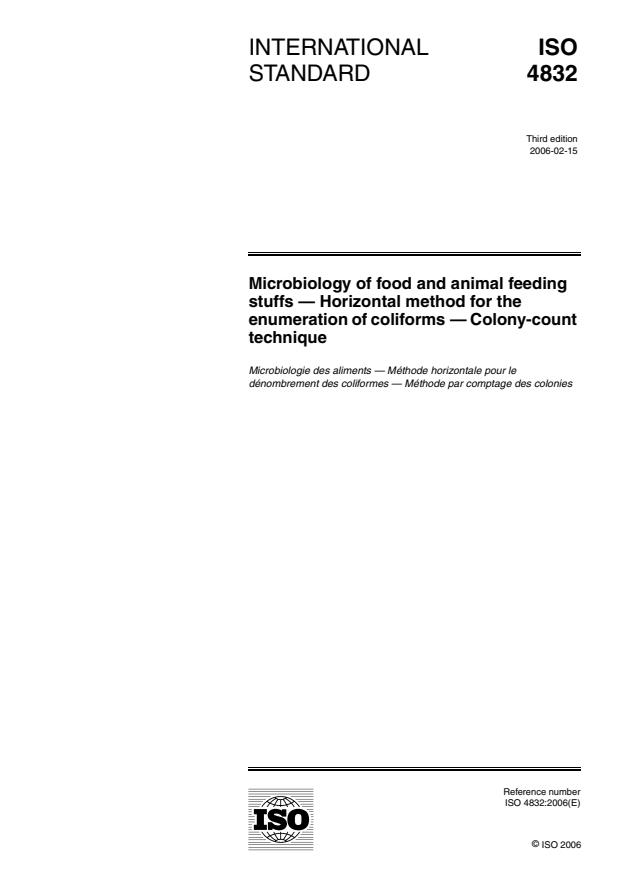
(Main)Microbiology of food and animal feeding stuffs — Horizontal method for the enumeration of coliforms — Colony-count technique
General Information
- Abstract
ISO 4832:2006 gives general guidelines for the enumeration of coliforms. It is applicable to products intended for human consumption and for the feeding of animals, and environmental samples in the area of food production and food handling, by means of the technique of counting colonies after incubation on a solid medium at 30 °C or at 37 °C. This technique is recommended when the number of colonies sought is expected to be more than 100 per millilitre or per gram of the test sample.
- Status
- Published
- Publication Date
- 15-Feb-2006
- Technical Committee
- ISO/TC 34/SC 9 - Microbiology
- Drafting Committee
- ISO/TC 34/SC 9 - Microbiology
- Current Stage
- 9093 - International Standard confirmed
- Start Date
- 03-Sep-2026
- Completion Date
- 12-Sep-2026
Buy Documents
ISO 4832:2006 - Microbiology of food and animal feeding stuffs — Horizontal method for the enumeration of coliforms — Colony-count technique Released:2/16/2006
ISO 4832:2006 - Microbiologie des aliments — Méthode horizontale pour le dénombrement des coliformes — Méthode par comptage des colonies Released:2/16/2006
Overview
ISO 4832:2006 is an international standard developed by the International Organization for Standardization (ISO) that specifies a horizontal method for enumerating coliform bacteria in food, animal feeding stuffs, and environmental samples associated with food production and handling. This method utilizes a colony-count technique after incubation on a solid selective medium at either 30 °C or 37 °C, depending on the agreement between involved parties.
Designed for samples where coliform colony counts exceed 100 per millilitre or gram, ISO 4832:2006 helps ensure reliable microbiological analysis critical for food safety, quality assurance, and regulatory compliance in food production and processing environments.
Key Topics
Scope and Application
Applicable to products consumed by humans and animals, including environmental samples in food production areas. It focuses on the colony-count technique for coliform enumeration.Coliform Definition
Coliforms are defined as bacteria forming characteristic colonies on crystal violet neutral red bile lactose agar and capable of lactose fermentation producing gas in confirmation tests with brilliant green lactose bile broth.Method Principle
The test involves:- Preparation of poured plates with VRBL agar and inoculation with test samples or their dilutions.
- Incubation at 30 °C or 37 °C for 24 hours.
- Counting typical coliform colonies, followed by confirmation of atypical colonies.
- Calculating coliform counts per unit of sample.
Culture Media
- Crystal violet neutral red bile lactose (VRBL) agar for selective colony growth.
- Brilliant green lactose bile broth for confirmatory fermentation testing.
Equipment Requirements
Standard microbiological apparatus including incubators, sterile pipettes, Petri dishes, water bath for media preparation, and colony counters.Precision and Reporting
Standard deviations for repeatability and reproducibility are provided, ensuring assessment of result reliability. Test reports must include sample identification, method references, operational details, and enumeration results.
Applications
Food Safety Testing
Used by laboratories to quantify coliforms as an indicator of hygienic conditions and potential contamination in food products such as dairy, meat, fruits, and vegetables.Animal Feed Quality Control
Assesses the microbial safety of animal feeds, helping to prevent transmission of pathogens through the food chain.Environmental Monitoring
Enables microbiological surveillance in food production and handling environments to maintain sanitary standards and prevent contamination.Regulatory Compliance
Supports compliance with international food safety regulations and standards by providing a validated quantitative method for coliform detection.Research and Development
Utilized in R&D for developing and evaluating new food products and processing techniques, ensuring microbiological quality.
Related Standards
- ISO 4831 – Horizontal method for detection and enumeration of coliforms by Most Probable Number (MPN) technique; complementary to the colony-count method.
- ISO 6887 – Preparation of test samples, initial suspension, and decimal dilutions for microbiological examination.
- ISO 7218 – General requirements and guidance for microbiological examinations of food and animal feed.
- ISO/TS 11133-1 & 11133-2 – Guidelines on preparation, production, and performance testing of culture media.
- ISO 8261 – General guidance on test sample preparation for milk and milk products.
Keywords: ISO 4832, coliform enumeration, colony-count technique, microbiology of food, food safety testing, animal feed microbiology, VRBL agar, lactose fermentation, microbiological standards, food production hygiene, environmental monitoring, microbiological culture media, ISO food standards.
Relations
- Effective Date
- 25-Aug-2026
- Effective Date
- 11-Mar-2017
- Effective Date
- 15-Apr-2008
- Effective Date
- 15-Apr-2008
Buy Documents
ISO 4832:2006 - Microbiology of food and animal feeding stuffs — Horizontal method for the enumeration of coliforms — Colony-count technique Released:2/16/2006
ISO 4832:2006 - Microbiologie des aliments — Méthode horizontale pour le dénombrement des coliformes — Méthode par comptage des colonies Released:2/16/2006
Frequently Asked Questions
ISO 4832:2006 is a standard published by the International Organization for Standardization (ISO). Its full title is "Microbiology of food and animal feeding stuffs — Horizontal method for the enumeration of coliforms — Colony-count technique". This standard covers: ISO 4832:2006 gives general guidelines for the enumeration of coliforms. It is applicable to products intended for human consumption and for the feeding of animals, and environmental samples in the area of food production and food handling, by means of the technique of counting colonies after incubation on a solid medium at 30 °C or at 37 °C. This technique is recommended when the number of colonies sought is expected to be more than 100 per millilitre or per gram of the test sample.
ISO 4832:2006 gives general guidelines for the enumeration of coliforms. It is applicable to products intended for human consumption and for the feeding of animals, and environmental samples in the area of food production and food handling, by means of the technique of counting colonies after incubation on a solid medium at 30 °C or at 37 °C. This technique is recommended when the number of colonies sought is expected to be more than 100 per millilitre or per gram of the test sample.
ISO 4832:2006 is classified under the following ICS (International Classification for Standards) categories: 07.100.30 - Food microbiology. The ICS classification helps identify the subject area and facilitates finding related standards.
ISO 4832:2006 has the following relationships with other standards: It is inter standard links to CEN ISO/TS 11133-2:2003, ISO 3811:1979, ISO 5541-1:1986, ISO 4832:1991. Understanding these relationships helps ensure you are using the most current and applicable version of the standard.
ISO 4832:2006 is available in PDF format for immediate download after purchase. The document can be added to your cart and obtained through the secure checkout process. Digital delivery ensures instant access to the complete standard document.
Standards Content (Sample)
INTERNATIONAL ISO
STANDARD 4832
Third edition
2006-02-15
Microbiology of food and animal feeding
stuffs — Horizontal method for the
enumeration of coliforms — Colony-count
technique
Microbiologie des aliments — Méthode horizontale pour le
dénombrement des coliformes — Méthode par comptage des colonies
Reference number
©
ISO 2006
PDF disclaimer
This PDF file may contain embedded typefaces. In accordance with Adobe's licensing policy, this file may be printed or viewed but shall
not be edited unless the typefaces which are embedded are licensed to and installed on the computer performing the editing. In
downloading this file, parties accept therein the responsibility of not infringing Adobe's licensing policy. The ISO Central Secretariat
accepts no liability in this area.
Adobe is a trademark of Adobe Systems Incorporated.
Details of the software products used to create this PDF file can be found in the General Info relative to the file; the PDF-creation
parameters were optimized for printing. Every care has been taken to ensure that the file is suitable for use by ISO member bodies. In the
unlikely event that a problem relating to it is found, please inform the Central Secretariat at the address given below.
All rights reserved. Unless otherwise specified, no part of this publication may be reproduced or utilized in any form or by any means,
electronic or mechanical, including photocopying and microfilm, without permission in writing from either ISO at the address below or
ISO's member body in the country of the requester.
ISO copyright office
Case postale 56 CH-1211 Geneva 20
Tel. + 41 22 749 01 11
Fax + 41 22 749 09 47
E-mail copyright@iso.org
Web www.iso.org
Published in Switzerland
©
ii ISO 2006 – All rights reserved
Foreword
ISO (the International Organization for Standardization) is a worldwide federation of national standards bodies
(ISO member bodies). The work of preparing International Standards is normally carried out through ISO
technical committees. Each member body interested in a subject for which a technical committee has been
established has the right to be represented on that committee. International organizations, governmental and
non-governmental, in liaison with ISO, also take part in the work. ISO collaborates closely with the International
Electrotechnical Commission (IEC) on all matters of electrotechnical standardization.
International Standards are drafted in accordance with the rules given in the ISO/IEC Directives, Part 2.
The main task of technical committees is to prepare International Standards. Draft International Standards
adopted by the technical committees are circulated to the member bodies for voting. Publication as an
International Standard requires approval by at least 75 % of the member bodies casting a vote.
Attention is drawn to the possibility that some of the elements of this document may be the subject of patent
rights. ISO shall not be held responsible for identifying any or all such patent rights.
ISO 4832 was prepared by Technical Committee ISO/TC 34, Food products, Subcommittee SC 9, Microbiology.
This third edition of ISO 4832 cancels and replaces ISO 4832:1991 and ISO 5541-1:1986. The main changes
are follows:
— the alternative procedure of incubation at 35 °C has been deleted (see 4.2);
— a confirmation test in brilliant green lactose bile broth has been introduced (see 5.4 and 9.4).
Considering the nature of the changes to the previous edition of this International Standard, it is considered that
the validation of alternative methods based on ISO 4832:1991 is not affected by this revision.
©
ISO 2006 – All rights reserved iii
Introduction
Because of the large variety of food and feed products, this horizontal method may not be appropriate in every
detail for certain products. In this case, different methods which are specific to these products may be used if
absolutely necessary for justified technical reasons. Nevertheless, every attempt should be made to apply this
horizontal method as far as possible.
When this International Standard is next reviewed, account will be taken of all information then available
regarding the extent to which this horizontal method has been followed and the reasons for deviations from this
method in the case of particular products.
The harmonization of test methods cannot be immediate, and for certain groups of products International
Standards and/or national standards may already exist that do not comply with this horizontal method. It is
hoped that when such standards are reviewed, they will be changed to comply with this International Standard
so that eventually the only remaining departures from this horizontal method will be those necessary for well-
established technical reasons.
[1]
The technique described in this International Standard is more precise than that described in ISO 4831 , but
does not allow a microbiological examination to be carried out on such a large test portion. It is therefore the
preferred method when large numbers of coliforms are present. Moreover, since the definition of “coliforms”
adopted in the two documents is different, the microorganisms enumerated are not necessarily the same. For
any particular product, the method to be chosen will be specified in the International Standard dealing with that
product.
For the purposes of a practicable test method, the definition of “coliforms” given in Clause 3 and used as the
basis for the procedure is not necessarily identical to corresponding definitions given in other published texts.
The method described in this International Standard will, on average, detect only about 90 % of strains of the
microorganisms referred to in other publications as “(presumptive) coliforms” (e.g. certain strains of Citrobacter,
Enterobacter, Klebsiella) (see Reference [2]).
©
iv ISO 2006 – All rights reserved
INTERNATIONAL STANDARD ISO 4832:2006(E)
Microbiology of food and animal feeding stuffs — Horizontal
method for the enumeration of coliforms — Colony-count
technique
1Scope
This International Standard gives general guidelines for the enumeration of coliforms. It is applicable to
— products intended for human consumption and for the feeding of animals, and
— environmental samples in the area of food production and food handling,
◦ ◦
by means of the technique of counting colonies after incubation on a solid medium at 30 C or at 37 C.
NOTE The temperature is subject to agreement between the parties concerned. In the case of milk and milk products, the
◦
temperature of incubation is 30 C.
This technique is recommended when the number of colonies sought is expected to be more than 100 per
millilitre or per gram of the test sample.
2 Normative references
The following referenced documents are indispensable for the application of this document. For dated
references, only the edition cited applies. For undated references, the latest edition of the referenced document
(including any amendments) applies.
ISO 6887 (all parts), Microbiology of food and animal feeding stuffs — Preparation of test samples, initial
suspension and decimal dilutions for microbiological examination
1)
ISO 7218:— , Microbiology of food and animal feeding stuffs — General requirements and guidance for
microbiological examinations
ISO 8261, Milk and milk products — General guidance for the preparation of test samples, initial suspensions
and decimal dilutions for microbiological examination
ISO/TS 11133-1, Microbiology of food and animal feeding stuffs — Guidelines on preparation and production of
culture media — Part 1: General guidelines on quality assurance for the preparation of culture media in the
laboratory
ISO/TS 11133-2:2003, Microbiology of food and animal feeding stuffs— Guidelines on preparation and
production of culture media — Part 2: Practical guidelines on performance testing of culture media
1) To be published.
©
ISO 2006 – All rights reserved 1
3 Terms and definitions
For the purposes of this document, the following terms and definitions apply.
3.1
coliforms
◦ ◦
bacteria which, at the specified temperature (i.e. 30 C or 37 C, as agreed) form characteristic colonies in
crystal violet neutral red bile lactose agar, and which in the confirmation test cause fermentation of lactose with
the production of gas under the test conditions specified in this International Standard
4Principle
4.1 Two poured plates are prepared using a solid selective culture medium, with a specified quantity of the test
sample if the initial product is liquid, or with a specified quantity of an initial suspension in the case of other
products.
Other pairs of poured plates are prepared under the same conditions, using decimal dilutions of the test sample
or of the initial suspension.
◦ ◦
4.2 The plates are incubated at 30 C or 37 C (as agreed) for 24 h.
4.3 T
...
NORME ISO
INTERNATIONALE 4832
Troisième édition
2006-02-15
Microbiologie des aliments — Méthode
horizontale pour le dénombrement des
coliformes — Méthode par comptage des
colonies
Microbiology of food and animal feeding stuffs — Horizontal method for
the enumeration of coliforms — Colony-count technique
Numéro de référence
©
ISO 2006
PDF — Exonération de responsabilité
Le présent fichier PDF peut contenir des polices de caractères intégrées. Conformément aux conditions de licence d'Adobe, ce fichier
peut être imprimé ou visualisé, mais ne doit pas être modifié à moins que l'ordinateur employé à cet effet ne bénéficie d'une licence
autorisant l'utilisation de ces polices et que celles-ci y soient installées. Lors du téléchargement de ce fichier, les parties concernées
acceptent de fait la responsabilité de ne pas enfreindre les conditions de licence d'Adobe. Le Secrétariat central de l'ISO décline toute
responsabilité en la matière.
Adobe est une marque déposée d'Adobe Systems Incorporated.
Les détails relatifs aux produits logiciels utilisés pour la création du présent fichier PDF sont disponibles dans la rubrique General Info du
fichier; les paramètres de création PDF ont été optimisés pour l'impression. Toutes les mesures ont été prises pour garantir l'exploitation
de ce fichier par les comités membres de l'ISO. Dans le cas peu probable où surviendrait un problème d'utilisation, veuillez en informer
le Secrétariat central à l'adresse donnée ci-dessous.
Droits de reproduction réservés. Sauf prescription différente, aucune partie de cette publication ne peut être reproduite ni utilisée sous
quelque forme que ce soit et par aucun procédé, électronique ou mécanique, y compris la photocopie et les microfilms, sans l'accord écrit
de l'ISO à l'adresse ci-après ou du comité membre de l'ISO dans le pays du demandeur.
ISO copyright office
Case postale 56 CH-1211 Geneva 20
Tel. + 41 22 749 01 11
Fax + 41 22 749 09 47
E-mail copyright@iso.org
Web www.iso.org
Publié en Suisse
©
ii ISO 2006 – Tous droits réservés
Avant-propos
L'ISO (Organisation internationale de normalisation) est une fédération mondiale d'organismes nationaux de
normalisation (comités membres de l'ISO). L'élaboration des Normes internationales est en général confiée
aux comités techniques de l'ISO. Chaque comité membre intéressé par une étude a le droit de faire partie du
comité technique créé à cet effet. Les organisations internationales, gouvernementales et non
gouvernementales, en liaison avec l'ISO participent également aux travaux. L'ISO collabore étroitement avec la
Commission électrotechnique internationale (CEI) en ce qui concerne la normalisation électrotechnique.
Les Normes internationales sont rédigées conformément aux règles données dans les Directives ISO/CEI,
Partie 2.
La tâche principale des comités techniques est d'élaborer les Normes internationales. Les projets de Normes
internationales adoptés par les comités techniques sont soumis aux comités membres pour vote. Leur
publication comme Normes internationales requiert l'approbation de 75 % au moins des comités membres
votants.
L'attention est appelée sur le fait que certains des éléments du présent document peuvent faire l'objet de droits
de propriété intellectuelle ou de droits analogues. L'ISO ne saurait être tenue pour responsable de ne pas avoir
identifié de tels droits de propriété et averti de leur existence.
L'ISO 4832 a été élaborée par le comité technique ISO/TC 34, Produits alimentaires, sous-comité SC 9,
Microbiologie.
Cette troisième édition de l’ISO4832 annule et remplace l’ISO4832:1991 et l’ISO5541-1:1986. Les
modifications sont les suivantes:
— la méthode alternative d’incubation à 35 °C a été supprimée (voir 4.2);
— un test de confirmation sur bouillon lactosé bilié au vert brillant a été introduit (voir 5.4 et 9.4).
Étant donné la nature des modifications à l’édition précédente de la présente Norme internationale, il est
considéré que cette révision n’a pas de conséquences sur la validation des méthodes alternatives basées sur
l’ISO 4832:1991.
©
ISO 2006 – Tous droits réservés iii
Introduction
En raison de la grande variété des produits alimentaires et des produits pour animaux, la méthode horizontale
peut ne pas être totalement appropriée pour certains produits. Dans ce cas, des méthodes différentes
spécifiques à ces produits peuvent être utilisées si cela est absolument nécessaire pour des raisons techniques
justifiées. Néanmoins, tous les efforts doivent être faits pour appliquer cette méthode horizontale autant que
faire se peut.
Lorsque la présente Norme internationale sera réexaminée, il sera tenu compte de tous les renseignements
disponibles à ce moment-là, à savoir dans quelle mesure cette méthode horizontale a été suivie et les raisons
pour lesquelles il aura été nécessaire d'y déroger dans le cas de produits particuliers.
L'harmonisation des méthodes d'essai ne peut pas être immédiate et, pour certains groupes de produits, des
Normes internationales et/ou des normes nationales qui ne sont pas en conformité avec cette méthode
horizontale peuvent exister. Il est souhaitable que, lorsqu'elles viendront en révision, elles soient alignées sur la
présente Norme internationale pour que, finalement, les seules divergences restantes soient celles qui sont
nécessaires pour des raisons techniques bien établies.
La technique décrite dans la présente Norme internationale est plus précise que celle décrite dans
[1]
l'ISO 4831 , mais elle ne permet pas d’effectuer un examen microbiologique sur une prise d’essai aussi
importante. C’est donc la méthode à utiliser de préférence lorsqu’un grand nombre de coliformes est présent.
D’autre part, la définition des «coliformes» adoptée dans les deux documents étant différente, on ne dénombre
pas nécessairement les mêmes microorganismes. Pour chaque produit particulier, le choix de la technique sera
précisé dans la Norme internationale concernant ce produit.
Pour les besoins d'une méthode d'essai efficace, la définition des «coliformes» donnée dans l'Article 3 et
servant de base à la technique n'est pas nécessairement identique aux définitions correspondantes données
dans d'autres textes publiés. La méthode décrite dans la présente Norme internationale ne détectera, en
moyenne, qu'environ 90 % des souches de micro-organismes désignés dans d'autres publications, sous le nom
de «coliformes (présumés)» (par exemple certaines souches de Citrobacter, d’Enterobacter et de Klebsiella).
(Voir Référence [2]).
©
iv ISO 2006 – Tous droits réservés
NORME INTERNATIONALE ISO 4832:2006(F)
Microbiologie des aliments — Méthode horizontale pour le
dénombrement des coliformes — Méthode par comptage des
colonies
1 Domaine d'application
La présente Norme internationale donne des directives générales pour le dénombrement des coliformes. La
présente Norme internationale s'applique à
— des produits destinés à la consommation humaine et à l'alimentation des animaux, et à
— des échantillons environnementaux au voisinage de la production et de la manipulation des aliments,
◦ ◦
par comptage des colonies après incubation à 30 C ou 37 C en milieu solide.
NOTE Cette température faisant l'objet d'un accord entre les parties concernées. Dans le cas du lait et des produits laitiers,
◦
la température d'incubation est 30 C.
Cette méthode est recommendée lorsque le nombre attendu est supposé être supérieur à 100 par millilitre ou
par gramme d'échantillon testé.
2 Références normatives
Les documents de référence suivants sont indispensables pour l'application du présent document. Pour les
références datées, seule l'édition citée s'applique. Pour les références non datées, la dernière édition du
document de référence s'applique (y compris les éventuels amendements).
ISO 6887 (toutes les parties), Microbiologie des aliments — Préparation des échantillons, de la suspension
mère et des dilutions décimales en vue de l'examen microbiologique
1)
ISO 7218:— , Microbiologie des aliments— Recommandations et règles générales pour les examens
microbiologiques
ISO 8261, Lait et produits laitiers — Lignes directrices générales pour la préparation des échantillons pour
essai, de la suspension mère et des dilutions décimales en vue de l'examen microbiologique
ISO/TS 11133-1, Microbiologie des aliments — Guide pour la préparation et la production des milieux de
culture — Partie 1: Guide général pour l'assurance de la qualité pour la préparation des milieux de culture en
laboratoire
ISO/TS 11133-2:2003, Microbiologie des aliments — Guide pour la préparation et la production des milieux de
culture — Partie 2: Guide général pour les essais de performance des milieux de culture
1) À publier.
©
ISO 2006 – Tous droits réservés 1
3 Termes et définitions
Pour les besoins du présent document, les termes et définitions suivants s'appliquent.
3.1
coliformes
◦ ◦
bactéries qui, à la température spécifiée (c'est-à-dire 30 C ou 37 C, selon accord), forment des colonies
caractéristiques en gélose lactosée biliée au cristal violet et au rouge neutre et qui, lors de l'essai de
confirmation, fermentent le lactose avec production de gaz, lorsque l'essai est effectué dans les conditions
spécifiées dans la présente Norme internationale
4Principe
4.1 Préparation de deux boîtes de Petri, en utilisant un milieu de culture sélectif solide et une quantité
spécifiée de l'échantillon pour essai si le produit initial est liquide ou une quantité spécifiée de suspension mère
dans le cas d'autres produits.
Préparation d'autres boîtes de Petri, dans les mêmes conditions, en utilisant des dilutions décimales de
l'échantillon
...