

ISO 17208-3:2025
(Main)Underwater acoustics — Quantities and procedures for description and measurement of underwater sound from ships — Part 3: Requirements for measurements in shallow water
General Information
- Abstract
ISO 17208 series describe procedures for the measurement of underwater sound radiated by the ship under test, and for calculating sound source quantities such as source level and radiated noise level from the measurement results. In ISO 17208-1 to ISO 17208-3 it is presumed that the ship under test cooperates in the measurements, sailing multiple runs over a specified track past the measurement system at a specified speed with pre-determined machinery configurations. Opportunistic measurements of the radiated sound of passing ships are outside the scope of these three standards. Part 1 of the ISO 17208 standards[ REF Reference_ref_4 \r \h 1 08D0C9EA79F9BACE118C8200AA004BA90B0200000008000000100000005200650066006500720065006E00630065005F007200650066005F0034000000 ] provides the procedure to quantify the underwater sound from the ship in terms of its radiated noise level, which is calculated from the sound pressure level (SPL) measured in the far field of the ship, in beam aspect, scaled by the distance to CPA and reported in decidecade bands. The intended use of radiated noise level is to show compliance with contract requirements or criteria, for comparison of one ship to another ship, to enable periodic signature assessments, and for research and development. ISO 17208-2[ REF Reference_ref_4 \r \h 1 08D0C9EA79F9BACE118C8200AA004BA90B0200000008000000100000005200650066006500720065006E00630065005F007200650066005F0034000000 ] specifies methods for calculating the source level of an equivalent monopole source at a specified nominal source depth from the radiated noise level values obtained according to ISO 17208-1. The intended use of source level, with associated nominal source depth, is to perform far field sound predictions such as needed for environmental impact studies or for creating underwater sound contour maps. ISO 17208-1 and ISO 17208-2[ REF Reference_ref_4 \r \h 1 08D0C9EA79F9BACE118C8200AA004BA90B0200000008000000100000005200650066006500720065006E00630065005F007200650066005F0034000000 ] are applicable for measurements in deep water, defined as water depth greater than the larger of 150 m and 1,5 times overall ship length. The allowable water depths and environmental conditions for part 3 measurements are described in REF Section_sec_4.5 \r \h 4.5 08D0C9EA79F9BACE118C8200AA004BA90B020000000800000010000000530065006300740069006F006E005F007300650063005F0034002E0035000000 . This document specifies procedures for the measurement of underwater sound radiated by the ship under test in shallow water. It also specifies procedures for the calculation of source level, with associated nominal source depth, from the sound pressure measurements, accounting for the relevant phenomena that govern the propagation of sound in shallow water. These calculations are described in REF Section_sec_7 \r \h Clause 7 08D0C9EA79F9BACE118C8200AA004BA90B02000000080000000E000000530065006300740069006F006E005F007300650063005F0037000000 . Once the source level has been calculated, other metrics may be calculated from the source level and the source depth. REF Section_sec_7.3 \r \h 7.3 08D0C9EA79F9BACE118C8200AA004BA90B020000000800000010000000530065006300740069006F006E005F007300650063005F0037002E0033000000 provides a procedure for calculating the radiated noise level that would have been measured in deep water according to ISO 17208-1 for the same ship with the same operating condition.
- Status
- Published
- Publication Date
- 01-Sep-2025
- Technical Committee
- ISO/TC 43/SC 3 - Underwater acoustics
- Drafting Committee
- ISO/TC 43/SC 3 - Underwater acoustics
- Current Stage
- 6060 - International Standard published
- Start Date
- 02-Sep-2025
- Due Date
- 15-Jun-2025
- Completion Date
- 02-Sep-2025
Overview
ISO 17208-3:2025 is the third part of the ISO 17208 series, developed by the International Organization for Standardization (ISO), focusing on underwater acoustics-specifically on the measurement and analysis of underwater sound radiated from ships in shallow water environments. This standard provides comprehensive requirements and procedures for reliably quantifying underwater sound levels from controlled ship trials, addressing the unique propagation characteristics and practical challenges present in shallow waters.
The ISO 17208-3 standard is designed for use where access to deep water is limited, enabling comparable, standardized measurements of radiated noise that are essential for regulatory compliance, environmental assessment, ship design, and performance benchmarking.
Key Topics
- Measurement Conditions: Defines the operational context for measurements, including requirements for ship cooperation, repeated test runs at specified speeds, and consistent machinery configurations.
- Shallow Water Definition: Clarifies shallow water as depths less than the greater of 150 meters or 1.5 times the ship’s overall length, highlighting the importance of depth on sound propagation.
- Test Site Selection: Specifies guidelines for selecting uniform, noise-limited, and environmentally suitable shallow water sites. Recommendations include preference for sandy seabeds and avoidance of sites with significant sediment layers or background noise.
- Measurement System Setup: Outlines specifications for acoustic measuring instrumentation such as hydrophone sensitivity, calibration, frequency range, directivity, and deployment methods (vessel-based or static deployments).
- Distance and Orientation Criteria: Sets parameters for hydrophone placement in relation to the ship’s track (closest point of approach, or CPA) to ensure accurate data collection.
- Data Processing and Analysis: Provides procedures to calculate sound pressure levels, background noise corrections, and the subsequent derivation of source level metrics that account for the specific propagation effects encountered in shallow water.
- Reporting Requirements: Details the data and documentation required to ensure traceability, including vessel information, environmental conditions, instrument calibration records, and final acoustic metrics.
Applications
ISO 17208-3:2025 is broadly applicable across the maritime industry and research sectors, providing value in several practical scenarios:
- Regulatory Compliance: Assists shipping lines and shipbuilders in demonstrating compliance with underwater noise criteria as specified by contracts or regulatory bodies.
- Ship Comparison and Design: Enables standardized benchmarking of underwater noise emissions across different vessels, informing both R&D and design improvements.
- Environmental Impact Assessment: Facilitates accurate predictions and mapping of underwater noise footprints for shallow water environments, supporting regulatory assessments and marine ecosystem protection.
- Periodic Vessel Signature Assessments: Supports continuous monitoring and signature management programs by providing uniform measurement methodologies in varied water depths.
- Academic and Industrial Research: Serves as a reference for research projects focused on underwater acoustics, ship noise propagation in shallow seas, and mitigation strategies.
Related Standards
The ISO 17208 series provides a harmonized framework for underwater noise measurement from ships, comprising:
- ISO 17208-1:2016: Requirements for precision measurements in deep water.
- ISO 17208-2: Methods for calculating source level from deep-water measurement data.
- ISO 18405: Terminology for underwater acoustics, ensuring consistency in definitions.
- IEC 60500: Detailed specifications for hydrophone properties and calibration.
- ISO 15016: Relevant for understanding the effects of shallow water on ship resistance and speed.
Adherence to ISO 17208-3:2025 ensures that shallow water noise measurements are performed with traceable, internationally recognized quality, supporting global efforts to assess and manage underwater radiated noise from ships.
Get Certified
Connect with accredited certification bodies for this standard

BSMI (Bureau of Standards, Metrology and Inspection)
Taiwan's standards and inspection authority.
Sponsored listings
Frequently Asked Questions
ISO 17208-3:2025 is a standard published by the International Organization for Standardization (ISO). Its full title is "Underwater acoustics — Quantities and procedures for description and measurement of underwater sound from ships — Part 3: Requirements for measurements in shallow water". This standard covers: ISO 17208 series describe procedures for the measurement of underwater sound radiated by the ship under test, and for calculating sound source quantities such as source level and radiated noise level from the measurement results. In ISO 17208-1 to ISO 17208-3 it is presumed that the ship under test cooperates in the measurements, sailing multiple runs over a specified track past the measurement system at a specified speed with pre-determined machinery configurations. Opportunistic measurements of the radiated sound of passing ships are outside the scope of these three standards. Part 1 of the ISO 17208 standards[ REF Reference_ref_4 \r \h 1 08D0C9EA79F9BACE118C8200AA004BA90B0200000008000000100000005200650066006500720065006E00630065005F007200650066005F0034000000 ] provides the procedure to quantify the underwater sound from the ship in terms of its radiated noise level, which is calculated from the sound pressure level (SPL) measured in the far field of the ship, in beam aspect, scaled by the distance to CPA and reported in decidecade bands. The intended use of radiated noise level is to show compliance with contract requirements or criteria, for comparison of one ship to another ship, to enable periodic signature assessments, and for research and development. ISO 17208-2[ REF Reference_ref_4 \r \h 1 08D0C9EA79F9BACE118C8200AA004BA90B0200000008000000100000005200650066006500720065006E00630065005F007200650066005F0034000000 ] specifies methods for calculating the source level of an equivalent monopole source at a specified nominal source depth from the radiated noise level values obtained according to ISO 17208-1. The intended use of source level, with associated nominal source depth, is to perform far field sound predictions such as needed for environmental impact studies or for creating underwater sound contour maps. ISO 17208-1 and ISO 17208-2[ REF Reference_ref_4 \r \h 1 08D0C9EA79F9BACE118C8200AA004BA90B0200000008000000100000005200650066006500720065006E00630065005F007200650066005F0034000000 ] are applicable for measurements in deep water, defined as water depth greater than the larger of 150 m and 1,5 times overall ship length. The allowable water depths and environmental conditions for part 3 measurements are described in REF Section_sec_4.5 \r \h 4.5 08D0C9EA79F9BACE118C8200AA004BA90B020000000800000010000000530065006300740069006F006E005F007300650063005F0034002E0035000000 . This document specifies procedures for the measurement of underwater sound radiated by the ship under test in shallow water. It also specifies procedures for the calculation of source level, with associated nominal source depth, from the sound pressure measurements, accounting for the relevant phenomena that govern the propagation of sound in shallow water. These calculations are described in REF Section_sec_7 \r \h Clause 7 08D0C9EA79F9BACE118C8200AA004BA90B02000000080000000E000000530065006300740069006F006E005F007300650063005F0037000000 . Once the source level has been calculated, other metrics may be calculated from the source level and the source depth. REF Section_sec_7.3 \r \h 7.3 08D0C9EA79F9BACE118C8200AA004BA90B020000000800000010000000530065006300740069006F006E005F007300650063005F0037002E0033000000 provides a procedure for calculating the radiated noise level that would have been measured in deep water according to ISO 17208-1 for the same ship with the same operating condition.
ISO 17208 series describe procedures for the measurement of underwater sound radiated by the ship under test, and for calculating sound source quantities such as source level and radiated noise level from the measurement results. In ISO 17208-1 to ISO 17208-3 it is presumed that the ship under test cooperates in the measurements, sailing multiple runs over a specified track past the measurement system at a specified speed with pre-determined machinery configurations. Opportunistic measurements of the radiated sound of passing ships are outside the scope of these three standards. Part 1 of the ISO 17208 standards[ REF Reference_ref_4 \r \h 1 08D0C9EA79F9BACE118C8200AA004BA90B0200000008000000100000005200650066006500720065006E00630065005F007200650066005F0034000000 ] provides the procedure to quantify the underwater sound from the ship in terms of its radiated noise level, which is calculated from the sound pressure level (SPL) measured in the far field of the ship, in beam aspect, scaled by the distance to CPA and reported in decidecade bands. The intended use of radiated noise level is to show compliance with contract requirements or criteria, for comparison of one ship to another ship, to enable periodic signature assessments, and for research and development. ISO 17208-2[ REF Reference_ref_4 \r \h 1 08D0C9EA79F9BACE118C8200AA004BA90B0200000008000000100000005200650066006500720065006E00630065005F007200650066005F0034000000 ] specifies methods for calculating the source level of an equivalent monopole source at a specified nominal source depth from the radiated noise level values obtained according to ISO 17208-1. The intended use of source level, with associated nominal source depth, is to perform far field sound predictions such as needed for environmental impact studies or for creating underwater sound contour maps. ISO 17208-1 and ISO 17208-2[ REF Reference_ref_4 \r \h 1 08D0C9EA79F9BACE118C8200AA004BA90B0200000008000000100000005200650066006500720065006E00630065005F007200650066005F0034000000 ] are applicable for measurements in deep water, defined as water depth greater than the larger of 150 m and 1,5 times overall ship length. The allowable water depths and environmental conditions for part 3 measurements are described in REF Section_sec_4.5 \r \h 4.5 08D0C9EA79F9BACE118C8200AA004BA90B020000000800000010000000530065006300740069006F006E005F007300650063005F0034002E0035000000 . This document specifies procedures for the measurement of underwater sound radiated by the ship under test in shallow water. It also specifies procedures for the calculation of source level, with associated nominal source depth, from the sound pressure measurements, accounting for the relevant phenomena that govern the propagation of sound in shallow water. These calculations are described in REF Section_sec_7 \r \h Clause 7 08D0C9EA79F9BACE118C8200AA004BA90B02000000080000000E000000530065006300740069006F006E005F007300650063005F0037000000 . Once the source level has been calculated, other metrics may be calculated from the source level and the source depth. REF Section_sec_7.3 \r \h 7.3 08D0C9EA79F9BACE118C8200AA004BA90B020000000800000010000000530065006300740069006F006E005F007300650063005F0037002E0033000000 provides a procedure for calculating the radiated noise level that would have been measured in deep water according to ISO 17208-1 for the same ship with the same operating condition.
ISO 17208-3:2025 is classified under the following ICS (International Classification for Standards) categories: 17.140.30 - Noise emitted by means of transport. The ICS classification helps identify the subject area and facilitates finding related standards.
ISO 17208-3:2025 is available in PDF format for immediate download after purchase. The document can be added to your cart and obtained through the secure checkout process. Digital delivery ensures instant access to the complete standard document.
Standards Content (Sample)
International
Standard
ISO 17208-3
First edition
Underwater acoustics — Quantities
2025-09
and procedures for description and
measurement of underwater sound
from ships —
Part 3:
Requirements for measurements in
shallow water
Grandeurs et modes de description et de mesurage de
l'acoustique sous-marine des navires —
Partie 3: Exigences pour les mesurages en eau peu profonde
Reference number
© ISO 2025
All rights reserved. Unless otherwise specified, or required in the context of its implementation, no part of this publication may
be reproduced or utilized otherwise in any form or by any means, electronic or mechanical, including photocopying, or posting on
the internet or an intranet, without prior written permission. Permission can be requested from either ISO at the address below
or ISO’s member body in the country of the requester.
ISO copyright office
CP 401 • Ch. de Blandonnet 8
CH-1214 Vernier, Geneva
Phone: +41 22 749 01 11
Email: copyright@iso.org
Website: www.iso.org
Published in Switzerland
ii
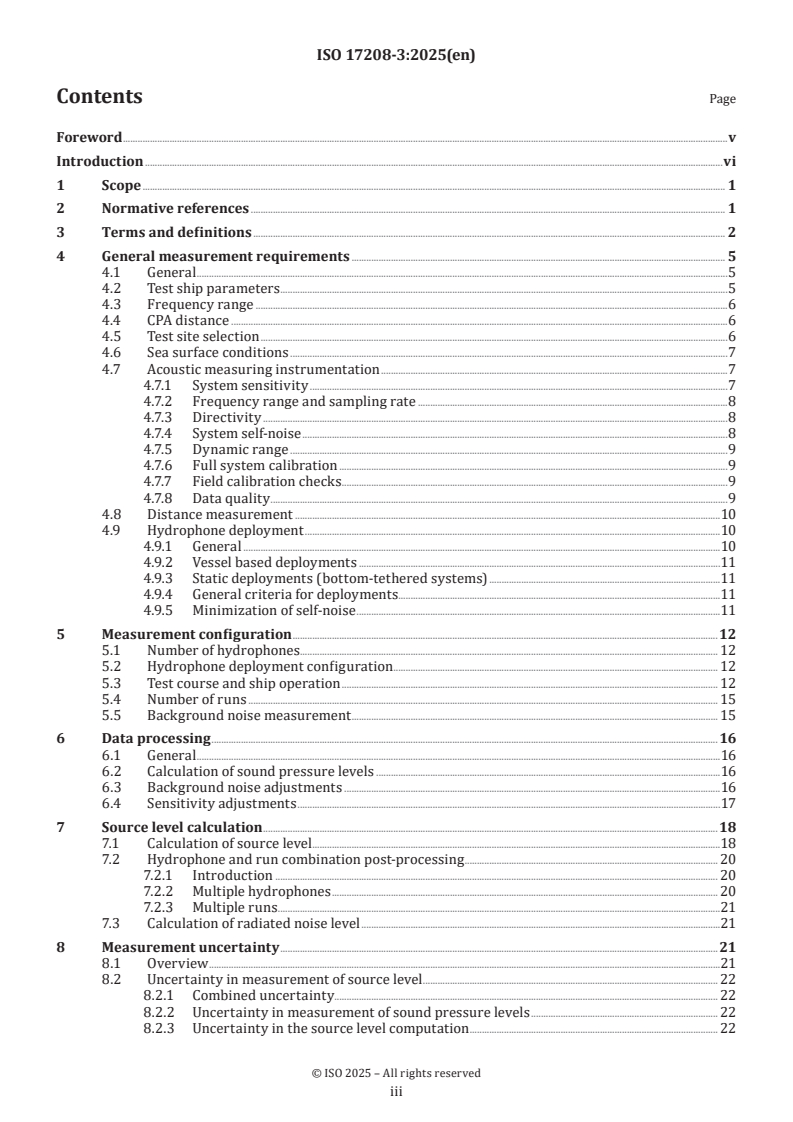
Contents Page
Foreword .v
Introduction .vi
1 Scope . 1
2 Normative references . 1
3 Terms and definitions . 2
4 General measurement requirements . 5
4.1 General .5
4.2 Test ship parameters . .5
4.3 Frequency range .6
4.4 CPA distance .6
4.5 Test site selection .6
4.6 Sea surface conditions .7
4.7 Acoustic measuring instrumentation .7
4.7.1 System sensitivity .7
4.7.2 Frequency range and sampling rate .8
4.7.3 Directivity .8
4.7.4 System self-noise .8
4.7.5 Dynamic range .9
4.7.6 Full system calibration .9
4.7.7 Field calibration checks . .9
4.7.8 Data quality .9
4.8 Distance measurement .10
4.9 Hydrophone deployment .10
4.9.1 General .10
4.9.2 Vessel based deployments .11
4.9.3 Static deployments (bottom-tethered systems) .11
4.9.4 General criteria for deployments.11
4.9.5 Minimization of self-noise .11
5 Measurement configuration .12
5.1 Number of hydrophones . . 12
5.2 Hydrophone deployment configuration . 12
5.3 Test course and ship operation . 12
5.4 Number of runs . 15
5.5 Background noise measurement . 15
6 Data processing . 16
6.1 General .16
6.2 Calculation of sound pressure levels .16
6.3 Background noise adjustments .16
6.4 Sensitivity adjustments .17
7 Source level calculation .18
7.1 Calculation of source level .18
7.2 Hydrophone and run combination post-processing . 20
7.2.1 Introduction . 20
7.2.2 Multiple hydrophones . 20
7.2.3 Multiple runs .21
7.3 Calculation of radiated noise level .21
8 Measurement uncertainty .21
8.1 Overview .21
8.2 Uncertainty in measurement of source level . 22
8.2.1 Combined uncertainty . 22
8.2.2 Uncertainty in measurement of sound pressure levels . 22
8.2.3 Uncertainty in the source level computation . 22
iii
8.2.4 Variability of the source . 23
9 Reporting of results .23
9.1 Records required from vessel under test . 23
9.2 Records required from fixed range or deploying vessel .24
9.3 Reporting results . 25
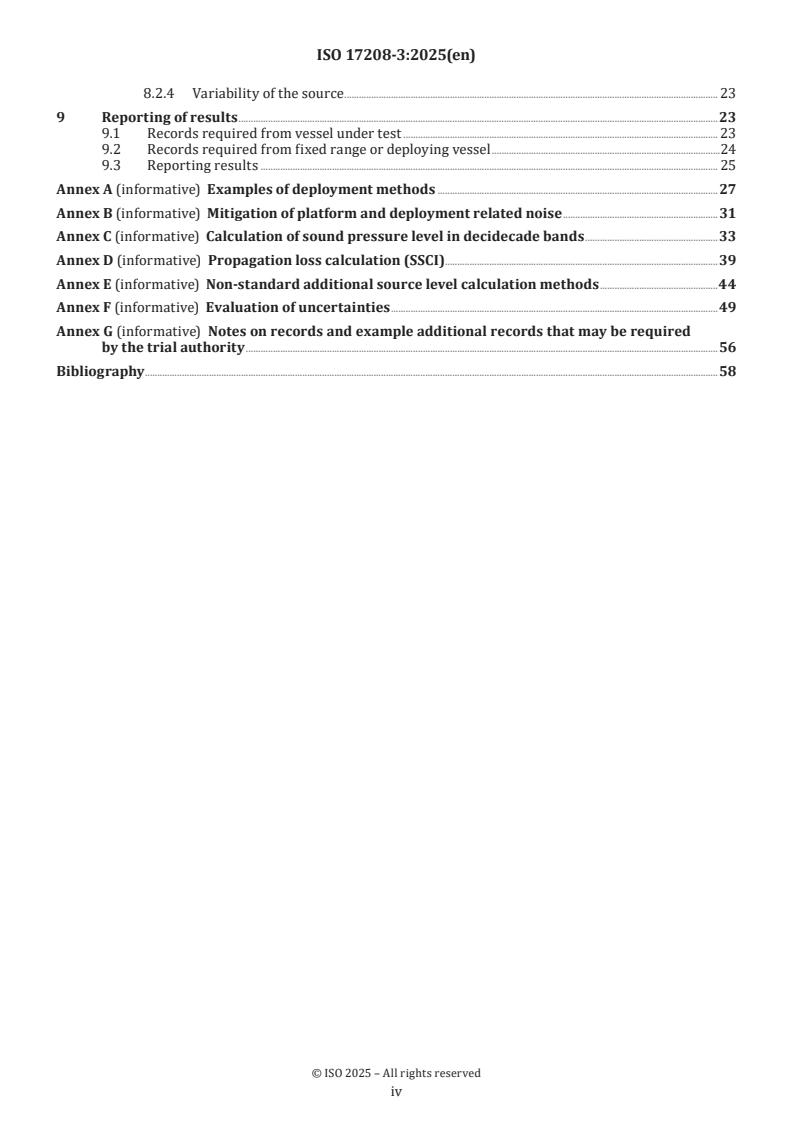
Annex A (informative) Examples of deployment methods .27
Annex B (informative) Mitigation of platform and deployment related noise .31
Annex C (informative) Calculation of sound pressure level in decidecade bands .33
Annex D (informative) Propagation loss calculation (SSCI).39
Annex E (informative) Non-standard additional source level calculation methods .44
Annex F (informative) Evaluation of uncertainties .49
Annex G (informative) Notes on records and example additional records that may be required
by the trial authority .56
Bibliography .58
iv
Foreword
ISO (the International Organization for Standardization) is a worldwide federation of national standards
bodies (ISO member bodies). The work of preparing International Standards is normally carried out through
ISO technical committees. Each member body interested in a subject for which a technical committee
has been established has the right to be represented on that committee. International organizations,
governmental and non-governmental, in liaison with ISO, also take part in the work. ISO collaborates closely
with the International Electrotechnical Commission (IEC) on all matters of electrotechnical standardization.
The procedures used to develop this document and those intended for its further maintenance are described
in the ISO/IEC Directives, Part 1. In particular, the different approval criteria needed for the different types
of ISO document should be noted. This document was drafted in accordance with the editorial rules of the
ISO/IEC Directives, Part 2 (see www.iso.org/directives).
ISO draws attention to the possibility that the implementation of this document may involve the use of (a)
patent(s). ISO takes no position concerning the evidence, validity or applicability of any claimed patent
rights in respect thereof. As of the date of publication of this document, ISO had not received notice of (a)
patent(s) which may be required to implement this document. However, implementers are cautioned that
this may not represent the latest information, which may be obtained from the patent database available at
www.iso.org/patents. ISO shall not be held responsible for identifying any or all such patent rights.
Any trade name used in this document is information given for the convenience of users and does not
constitute an endorsement.
For an explanation of the voluntary nature of standards, the meaning of ISO specific terms and expressions
related to conformity assessment, as well as information about ISO's adherence to the World Trade
Organization (WTO) principles in the Technical Barriers to Trade (TBT), see www.iso.org/iso/foreword.html.
This document was prepared by Technical Committee ISO/TC 43, Acoustics, Subcommittee SC 3, Underwater
acoustics.
A list of all parts in the ISO 17208 series can be found on the ISO website.
Any feedback or questions on this document should be directed to the user’s national standards body. A
complete listing of these bodies can be found at www.iso.org/members.html.
v
Introduction
The ISO 17208 series describe procedures for the measurement and analysis of underwater sound from
ships. The methodology and measurement configuration are sufficient to provide reliable acoustic data, but
also suitable for end-users to conduct the measurements without access to large, fixed sound measurement
facilities. ISO17208-1 covers measurements of radiated noise level in deep water, and ISO 17208-2 the
calculation of source level from the deep-water data. This document has been developed to address the need
to cover source level measurements in shallow water, one reason being that deep water maritime areas are
sometimes far away from the zone of operation of the ships considered.
The development of this document was supported by the EU-funded Horizon 2020 research programme
1) 2)
SATURN (Developing solutions to underwater radiated noise) and by the MMP2 project , sponsored by
Transport Canada’s Innovation Centre.
1) https://doi.org/10.3030/101006443
2) https://doi.org/10.1121/10.0017433
vi
International Standard ISO 17208-3:2025(en)
Underwater acoustics — Quantities and procedures for
description and measurement of underwater sound
from ships —
Part 3:
Requirements for measurements in shallow water
1 Scope
ISO 17208 series describe procedures for the measurement of underwater sound radiated by the ship under
test, and for calculating sound source quantities such as source level and radiated noise level from the
measurement results.
In ISO 17208-1 to ISO 17208-3 it is presumed that the ship under test cooperates in the measurements,
sailing multiple runs over a specified track past the measurement system at a specified speed with pre-
determined machinery configurations. Opportunistic measurements of the radiated sound of passing ships
are outside the scope of these three standards.
[1]
Part 1 of the ISO 17208 standards provides the procedure to quantify the underwater sound from the
ship in terms of its radiated noise level, which is calculated from the sound pressure level (SPL) measured
in the far field of the ship, in beam aspect, scaled by the distance to CPA and reported in decidecade bands.
The intended use of radiated noise level is to show compliance with contract requirements or criteria, for
comparison of one ship to another ship, to enable periodic signature assessments, and for research and
development.
[1]
ISO 17208-2 specifies methods for calculating the source level of an equivalent monopole source at a
specified nominal source depth from the radiated noise level values obtained according to ISO 17208-1. The
intended use of source level, with associated nominal source depth, is to perform far field sound predictions
such as needed for environmental impact studies or for creating underwater sound contour maps.
[1]
ISO 17208-1 and ISO 17208-2 are applicable for measurements in deep water, defined as water depth
greater than the larger of 150 m and 1,5 times overall ship length. The allowable water depths and
environmental conditions for part 3 measurements are described in 4.5.
This document specifies procedures for the measurement of underwater sound radiated by the ship under
test in shallow water. It also specifies procedures for the calculation of source level, with associated nominal
source depth, from the sound pressure measurements, accounting for the relevant phenomena that govern
the propagation of sound in shallow water. These calculations are described in Clause 7. Once the source
level has been calculated, other metrics may be calculated from the source level and the source depth. 7.3
provides a procedure for calculating the radiated noise level that would have been measured in deep water
according to ISO 17208-1 for the same ship with the same operating condition.
2 Normative references
The following documents are referred to in the text in such a way that some or all of their content constitutes
requirements of this document. For dated references, only the edition cited applies. For undated references,
the latest edition of the referenced document (including any amendments) applies.
ISO 18405, Underwater acoustics — Terminology
ISO 17208-1:2016, Underwater acoustics — Quantities and procedures for description and measurement
of underwater sound from ships — Part 1: Requirements for precision measurements in deep water used for
comparison purposes
IEC 60500, Underwater acoustics - Hydrophones - Properties of hydrophones in the frequency range 1 Hz to 500 kHz
3 Terms and definitions
For the purposes of this document, the terms and definitions given in ISO 18405, IEC 60500 and the
following apply.
ISO and IEC maintain terminology databases for use in standardization at the following addresses:
— ISO Online browsing platform: available at https:// www .iso .org/ obp
— IEC Electropedia: available at https:// www .electropedia .org/
NOTE From ISO 18405, this includes the following terms: sound pressure, sound pressure level (SPL), propagation
loss, source level, acoustic far field, decidecade. From IEC 60500, this includes the following terms: hydrophone, and
sensitivity level.
3.1
shallow water
water of depth less than the larger of 150 m and 1,5 times the overall ship length
3.2
deep water
water of depth greater than the larger of 150 m and 1,5 times the overall ship length
3.3
overall ship length
longitudinal distance between the forward-most and aft-most part of a ship
3.4
acoustic ship length
L
user defined length L over which the ship is assumed to radiate the dominant sound over the frequency
range of interest
Note 1 to entry: Dependent on the location of the dominant sound sources on the ship under test, this can be the
overall ship length or the length of the aft part of the ship, where the propellers and the main engines are located.
3.5
ship reference point
position of the equivalent sound source representing the ship
Note 1 to entry: For the purpose of this part of ISO 17208, the ship reference point is located longitudinally at the
centre of the acoustic ship length (3.4), transversely at the ship centre line and vertically at the nominal source depth.
Note 2 to entry: The position for the ship reference point applies for all frequencies.
3.6
nominal source depth
d
s
nominal depth below the sea surface of the monopole point source from which the sound is considered to
originate, and equal to 0,7 times the ship’s draught
Note 1 to entry: In formula form:
dD=07,
s
where D is the draught of the ship.
Note 2 to entry: The draught of the ship is considered to be the average of the stern and bow draughts.
Note 3 to entry: The choice of the nominal source depth is somewhat arbitrary, and the choice of 70 % of the mean
draught represents a compromise. The value of the nominal source depth is to be reported alongside the equivalent
monopole beam aspect source level value.
3.7
closest point of approach
CPA
point at which the horizontal distance (during a test run) from the ship reference point of the ship under test
to the hydrophone(s) reaches its minimum value
3.8
closest point of approach distance
CPA distance
d
CPA
horizontal distance (during a test run) from the ship reference point of the ship under test to the
hydrophone(s) at its closest point of approach
3.9
beam aspect
aspect normal to ship centre line from bow to stern
Note 1 to entry: Beam aspect refers to the location of the hydrophone (s) with respect to the ship under test in port or
starboard direction. For the purpose of ISO 17208, the beam aspect is measured over ±°30 data window angles.
3.10
data window angle
horizontal angle subtended at the hydrophone, between the start data location and the end data location
Note 1 to entry: The data window angle is expressed as a value in degrees as shown in Figure 1.
Note 2 to entry: The data window angle is ±30°.
3.11
data window length
DWL
l
DW
distance between the start data location and end data location
Note 1 to entry: The DWL is defined by the distance at closest point of approach and the data window angle of ±30° as
given in Figure 1. In formula form:
ld=°23tan 0
()
DW CPA
where d is the CPA distance in metres.
CPA
3.12
data window period
DWP
t
DW
time it takes the ship under test to travel the data window length at a certain speed
Note 1 to entry: In formula form:
l
DW
t =
DW
v
where l is the data window length in metres and v is the ship speed in metres per second .
DW
3.13
nominal hydrophone angle
angle between the horizontal axis and the line created between the point at the sea surface above the ship
reference point at CPA and the location of the hydrophone
Note 1 to entry: For the purpose of ISO 17208, for measurements at a CPA-distance smaller than the local water depth,
the nominal hydrophone angles are 15°, 30° and 45° below the horizontal plane.
3.14
hydrophone cable drift angle
angle between the vertical axis and the line created between the fixed support of the hydrophone cable and
the hydrophone
3.15
seabed critical angle
ψψ
c
grazing angle in water below which sound waves are totally reflected at the seabed
Note 1 to entry: If the seabed is modelled as a fluid with speed of sound c , the critical angle is given by
b
−1
ψ =cos/()cc , where c is the speed of sound in water.
cw b w
3.16
measurement system
data acquisition system consisting of, but not limited to, one or more hydrophone(s), conditioning
preamplifier(s), analogue-to-digital converter(s), computer and ancillary peripherals, or autonomous
recorder combining the above functionality in one instrument
3.17
system sensitivity
quotient of the root-mean-square open-circuit output signal at a specified point in the measurement system
(usually the electrical output terminals) to the incident root-mean-square sound pressure that would
be present at the position of the reference centre of the hydrophone in the undisturbed free field if the
hydrophone was removed for specified frequency and specified direction of plane wave sound
Note 1 to entry: The system sensitivity is defined here for an acoustic measurement system designed to measure sound
pressure signals in water. The measurement system will typically consist of hydrophone(s) connected to amplifier(s)
and filter(s) and will feed an output voltage into a digital acquisition and storage system. Note that the response of the
hydrophone(s), amplifier(s) and filter(s) will in general vary with frequency.
Note 2 to entry: For an analogue system, the output signals are electrical voltages, and the sensitivity is described in
terms of the electrical voltage developed per pascal of acoustic pressure, and is stated in units of V/Pa. The system
sensitivity level can be expressed in decibels with reference to 1 V/μPa.
Note 3 to entry: For digital systems, the output is a digital waveform (rather than an analogue voltage output). Here,
the calibration of the digitiser (analogue to digital converter) is incorporated into the overall sensitivity of the whole
system. This is termed the digital system sensitivity, which is the number of digital counts per unit change in sound
-1
pressure (unit Pa ).
Note 4 to entry: In general, the measuring system may introduce a phase delay into the measured signal. This may be
accounted for by representing the system sensitivity as a complex valued quantity, the modulus of which represents
the magnitude-only response, and the phase of which describes the phase delay. For calculation of acoustic metrics
which depend on the energy or power in the signal (e.g. SPL), the system phase response is of little significance.
Note 5 to entry: The system sensitivity is defined here as an acoustic free-field sensitivity using the free-field sensitivity
of the hydrophone. If the hydrophone is physically attached on to another body such as an acoustic recorder or float
(rather than deployed on an extension cable), diffraction and scattering of sound by the body may affect the free-field
sensitivity at kilohertz frequencies, causing enhanced directivity compared to the response of the free hydrophone.
3.18
calibration
method of using known inputs, possibly using physical stimuli (such as a known, calibrated and traceable
acoustic source) or electrical input (charge or voltage signal injection) at the input (or other stage) of a
measurement system
3.19
mean-square system-filtered sound pressure
p′
integral over a specified time interval of squared weighted sound pressure, divided by the duration of the
time interval, for a specified frequency range, when the linear filter is a specified underwater acoustic
measuring system (3.16)
Note 1 to entry: Mean-square system-filtered sound pressure is expressed in pascals (Pa).
Note 2 to entry: See ISO (18405:2017), entry 3.7.1.1 weighted sound pressure.
3.20
mean-square system-filtered sound pressure level
L
p′
ten times the logarithm to the base 10 of the ratio of the mean-square system-filtered sound pressure (3.19) to
the specified reference value, p , in decibels
Note 1 to entry: Mean-square sound pressure level is the level of the power quantity equal to the mean-square sound
2 2
pressure, denoted p . In formula form, Lp=10log/′ p dB.
′
p 10 ( 0 )
Note 2 to entry: Mean-square sound pressure level is expressed in decibels (dB).
Note 3 to entry: In underwater acoustics, the reference value of mean-square sound pressure, p , is 1 μPa . The
reference value shall be specified.
Note 4 to entry: The averaging time and frequency range shall be specified.
4 General measurement requirements
4.1 General
To perform a measurement of the sound radiated by a ship in shallow water, there are number of factors
which need to be addressed, including selection of an appropriate test site, suitable deployment of
3)
hydrophones, appropriate choice of instrumentation, and proper operation of the vessel under test. The
following steps are to be followed:
4.2 Test ship parameters
a) The user selects the ship of interest, with a specified overall length and draught.
b) The user selects the configuration (propulsion power and machinery settings, with tolerance) to achieve
the speed through the water for which the radiated sound is to be measured. Power and machinery
operation should be held constant throughout repeat runs (5.4).
NOTE Ship radiated sound, particularly propeller cavitation noise, will be impacted to a varying degree by
local wind and current effects, so speed over ground is not a suitable parameter.
c) The user defines the acoustic ship length L over which the ship is assumed to radiate the dominant
sound. Dependent on the location of the dominant sound sources on the ship under test, this can be the
3) In the context of this standard the terms ‘ship’ and ‘vessel’ are used as synonyms.
overall length of the ship (from bow to stern) or the length of the aft part of the ship, where the propellers
and the main engines are located.
d) The user defines ship reference point: transversely at the ship centre line, longitudinally at the centre of
the selected length L , and vertically at the nominal source depth, i.e. at 0,7 times the ship’s draught.
4.3 Frequency range
The user selects the frequency range of interest over which SL is required, following ISO 17208-1, which
specifies a minimum frequency range that covers the decidecade bands with nominal centre frequencies
from 10 Hz to 20 000 Hz (band indices -20 to 13, inclusive).
NOTE Decidecade bands span one tenth of a decade and are also known as one-third octave (base 10) bands
[ISO 18405].
4.4 CPA distance
Ship radiated sound measurements are to be made with hydrophone(s) located at a horizontal distance from
the ship track, to measure the beam (starboard / port) aspect of the ship under test. The user selects a
horizontal closest point of approach (CPA) distance between the ship track and the hydrophone location,
that fulfils the following requirements:
— The distance at CPA between the nearest hydrophone and the ship reference point shall be greater than
the acoustic ship length.
NOTE This ensures that the distance between the hydrophone(s) and all positions on the acoustic ship length
(see 4.2 c) do not deviate by more than 10 % from the distance between the hydrophone and the ship reference
point, so that the ship can be described as a point source.
— The minimum horizontal CPA distance shall be limited to achieve a minimum data window period of
10 s. The minimum CPA distance depends on ship speed v [m/s] and can be calculated from Formula (1):
tv×
DW,min
d = ≈()87, s ×v (1)
CPAm, in
23tan 0°
()
NOTE A data window period of 10 s results in an uncertainty of 0,7 dB in the calculation of the SPL in the
lowest (10 Hz) frequency band (see F.2).
— The maximum CPA distance shall be limited, to avoid signal-to-noise problems and to reduce uncertainty
associated with propagation loss estimation (see Clause 7). It is advised to limit the CPA distance to a
maximum of five times the local water depth.
— The hydrophone deployment shall not affect safe manoeuvring of the ship under tests.
4.5 Test site selection
The user selects a measurement site, that fulfils the following requirements:
— Ideally, the water depth is larger than the CPA-distance (see 4.4).
— The measurements can be performed in water with a depth smaller than the required minimum CPA
distance (see 4.4). It is advised to select a water depth greater than one fifth of the required minimum
CPA-distance.
— The water depth should be uniform over the area that covers the ship track length over which the ship
radiated sound is measured as well as the hydrophone locations, to within 10 %.
— The speed of sound in the seabed in the measurement area should be uniform to within 10 %. A sandy
seabed is preferred, to avoid immersion of bottom mounted hydrophones in soft sediment.
— Sediment layers, particularly where soft sediment overlays a hard substrate or where the seabed contains
gaseous layers, can have a substantial influence on sound propagation. Sites with such properties are to
be avoided where possible.
— The user should be aware that shallow water effects can affect ship resistance and hence have influence
[2]
on the ship radiated sound. ISO 15016 specifies that ship resistance measurements for a ship of width
B [m] and draught D [m] at speed v [m/s] is affected if the water depth H [m] is smaller than the larger
of the values obtained from the two formulas:
HB=3 D and Hv= 03,/sm ⋅
()
min min
— The background noise at the test site should be low enough to permit measurement of the underwater
sound of the ship under test over the frequency range of interest. That means that the background
noise in the area (including the sound from ships passing at distance from the measurements site) is
preferably at least 10 dB below the sound pressure level from the ship under test at the hydrophones, in
all decidecade bands in the frequency range of interest (4.3).
NOTE Performing background noise measurements at the intended test site prior to the ship measurements
is recommended. Where applicable, the expected sound pressure level of the ship at the hydrophones can be
estimated on the basis of statistical ship source level models, see e.g. Reference [3], in combination with an
estimation of propagation loss, see Clause 7.
4.6 Sea surface conditions
Sea surface conditions can negatively impact underwater noise measurements. Higher sea states increase
background noise and affect sound propagation which may degrade the trial results. Observation of the
[4]
sea surface conditions during the measurements should use WMO Code Table 3700 (Douglas Scale). The
maximum acceptable sea state during the trials is Code Figure 3 (Slight), referred to as “sea state 3”. This
corresponds with a maximum significant wave height of 1,25 m. The authority conducting the trial may
consider reducing this limit for vessels with an overall length of < 100 m, which may require more benign
surface conditions.
[4]
NOTE WMO Code Table 3700 uses the total state of agitation of the sea resulting from various factors such as
wind, swell, currents and angle between swell and wind.
4.7 Acoustic measuring instrumentation
The measuring system generally consists of the following instruments: hydrophone(s); amplifier(s) and
signal conditioning equipment; digitization and storage equipment.
The amplifier can be a separate element in the system with an adjustable gain or may be an integral part
of the hydrophone with no possibility for gain adjustment. Digitization is provided by an analogue to digital
converter (ADC) and the electronic storage is typically provided by a computer hard disk or solid state memory.
4.7.1 System sensitivity
The sensitivity of the measuring system should be chosen to be an appropriate value for the amplitude of
the sound being measured. The aim in the choice of the system sensitivity is to avoid a poor signal-to-noise
ratio for low amplitude signals as well as to avoid distortion and clipping for high amplitude signals, over the
desired frequency range.
NOTE 1 To build in some flexibility, it is preferable to have some selectable gain in the amplification stages, or in
the settings of the ADC. These can then be set to appropriate values once the sound levels are known after some initial
measurements. However, note that for autonomous recorders and hydrophones which have integral preamplifiers, the
gain cannot usually be modified after deployment.
NOTE 2 Ideally the same hydrophone and gain settings are used for the background noise measurements and the
measurement of the sound radiated from the vessel under test. A hydrophone with low-noise performance and high
sensitivity is generally preferred.
NOTE 3 If extra cable is added to a hydrophone which does not have an integral preamplifier, this will reduce the
overall sensitivity for the hydrophone due to the extra electrical loading caused by the capacitance of the extension
cable. Either the hydrophone is calibrated with the extension cable connected, or the effect of the electrical loading
[5]
is calculated (see IEC 60565-1 ). For hydrophones that have an integral preamplifier within the hydrophone body,
adding extension cable will not affect the sensitivity.
NOTE 4 Hydrophones with integral amplifiers have either differential or single ended outputs. It is important to
ensure that hydrophone, cable and receiver are configured consistently, and calibration is performed for the same
configuration.
4.7.2 Frequency range and sampling rate
The measuring system shall record sound pressures over the desired frequency range (as specified in 4.3).
This implies that all components in the signal chain, including hydrophone, amplifier, and filter, shall pass
signals within the desired frequency range.
NOTE 1 The requirement for unambiguous representation of the signals within the desired frequency range
requires the sampling rate, f , of the ADC within the recording system to be greater than 2,4 times the upper bound
s
frequency of the highest decidecade band of the desired frequency range. This also requires the use of an anti-alias
filter at the input to the ADC, to suppress signal frequencies above the Nyquist rate.
NOTE 2 It is desirable that the system sensitivity be invariant with frequency over the frequency range of interest
(i.e. that it possess a “flat response”), to within a tolerance of 2 dB. It is possible to correct for the variation in the
sensitivity with frequency with better accuracy than the above tolerance if the hydrophone and measuring system is
calibrated over the full frequency range of interest.
NOTE 3 For analysis in broad frequency bands (for example decidecade bands), the instrumentation must be
capable of covering the lower and upper limits of the lower and upper frequency bands respectively.
4.7.3 Directivity
The hydrophone (or hydrophone and recorder) used shall have an omnidirectional response such that its
sensitivity is invariant with the direction of the incoming sound wave to within a tolerance of 2 dB over the
frequency range of interest.
NOTE 1 This requirement is not difficult to satisfy at frequencies up to 20 kHz in the XY (horizontal) plane, and for
the majority of the XZ and YZ (vertical) planes of the hydrophone response [see IEC 60500], which defines the angular
range of significance for the hydrophone. For angles of incidence close to the body or cable of the hydrophone (or body
of the recorder), the directivity is likely to show greater variation due to shielding of the hydrophone element. When
deploying the hydrophone or recorder, care should be taken to orient the device to minimize this shielding effect.
One issue that can cause enhanced directionality is where the hydrophone is deployed close to another structure
that is capable of reflecting the sound waves. This effect can be evident at kilohertz frequencies if the hydrophone is
deployed close to a support structure such as a heavy mooring or support, or a recorder case that houses electronics
and batteries but is mostly air-filled. Similarly, if the hydrophone has a guard deployed around it, this can influence
the directivity at kilohertz frequencies. If necessary, the above effects can be quantified by directional response
measurements of the hydrophone together with the mounting, in a free-field environment.
4.7.4 System self-noise
The system self-noise (the noise generated by the system in the absence of any signal due to an external
acoustic stimulus), expressed as equivalent sound pressure level in decidecade bands, shall be at least 10 dB
below the sound pressure level from the ship under test at the hydrophones, in all decidecade bands in the
frequency range of interest (4.3), see also 4.5.
4.7.5 Dynamic range
The highest expected sound pressure at the measurement position, shall be measurable without distortion
or saturation caused by the hydrophone, amplifier, and ADC.
NOTE 1 High amplitude sounds that are beyond the maximum capability of the measuring system will cause
distortions in the measured data. For example, clipping can occur where the peaks of the signal are missing from the
data (the peaks being truncated at the full-scale value of the system ADC). The measuring system is required to be
linear up to the highest expected sound pressure.
NOTE 2 A method to mitigate problems with dynamic range is to have some flexibility in the sensitivity, often
achieved by use of adjustable gains for amplifier stages and scale settings on ADCs. However, where a system has been
deployed remotely (for example, an autonomous recording system), control over the system settings after deployment
might not be possible. In this case, some knowledge of the likely range of sound pressure levels is required to optimize
the available dynamic range (this knowledge can be obtained from for example prior recordings at the same location,
from reported levels in the scientific literatur
...