

ISO 16254:2024
(Main)Acoustics — Measurement of sound emitted by road vehicles of category M and N at standstill and low speed operation — Engineering method
General Information
- Abstract
This document is derived from ISO 362-1[2] and specifies an engineering method for measuring the sound emitted by M and N category road vehicles at standstill and low speed operating conditions. The specifications reproduce the level of sound which is generated by the principal vehicle sound sources consistent with stationary and low speed vehicle operating conditions relevant for pedestrian safety. The method is designed to meet the requirements of simplicity as far as they are consistent with reproducibility of results under the operating conditions of the vehicle. The test method requires an acoustic environment which is only obtained in an extensive open space. Such conditions usually exist during the following: — measurements of vehicles for regulatory certification; — measurements at the manufacturing stage; — measurements at official testing stations. The results obtained by this method give an objective measure of the sound emitted under the specified conditions of test. It is necessary to consider the fact that the subjective appraisal of the annoyance, perceptibility, and/or detectability of different motor vehicles or classes of motor vehicles due to their sound emission are not simply related to the indications of a sound measurement system. As annoyance, perceptibility and/or detectability are strongly related to personal human perception, physiological human condition, culture, and environmental conditions, there are large variations and therefore these terms are not useful as parameters to describe a specific vehicle condition. Spot checks of vehicles chosen at random rarely occur in an ideal acoustic environment. If measurements are carried out on the road in an acoustic environment which does not fulfil the requirements stated in this document, the results obtained might deviate appreciably from the results obtained using the specified conditions. In addition, this document provides an engineering method to measure the performance of external sound generation systems intended for the purpose of providing acoustic information to pedestrians on a vehicle’s operating condition. This information is reported as objective criteria related to the external sound generation system’s sound pressure level, frequency content, and changes in sound pressure level and frequency content as a function of vehicle speed. This document adds a metric related to the human perception of tonal loudness, the psychoacoustic tonality. The psychoacoustic tonality can be used to estimate audible frequency shifts of the sounds by identifying the most audible component in each auditory frequency band (critical band), as well as to determine if the band(s) so identified meet audibility criteria. Annex A and Annex C contains background information relevant in the development of this document.
- Status
- Published
- Publication Date
- 10-Dec-2024
- Technical Committee
- ISO/TC 43/SC 1 - Noise
- Current Stage
- 6060 - International Standard published
- Start Date
- 11-Dec-2024
- Due Date
- 03-Aug-2025
- Completion Date
- 11-Dec-2024

Overview
ISO 16254:2024 - Acoustics - Measurement of sound emitted by road vehicles of category M and N at standstill and low speed operation - Engineering method - defines an engineering test method to objectively measure the external sound emitted by road vehicles when stationary or operating at low speed. Derived from ISO 362-1, the standard reproduces the sound levels generated by principal vehicle sound sources relevant to pedestrian safety, and provides procedures for assessing both native vehicle noise and purpose-built external sound generation (ESG) systems.
Key technical topics and requirements
- Scope and purpose: Measurement of sound for category M and N vehicles at standstill and low speed to inform pedestrian detectability and regulatory certification.
- Test environments: Requires an extensive open space (outdoor) acoustic environment for full-vehicle tests; provisions for indoor hemi-anechoic/anechoic testing for components and ESG systems.
- Instrumentation: Specifications for acoustic instruments, speed measurement, and meteorological sensors; includes daily verification and conformity requirements.
- Microphone configuration: Multiple microphone positions and allowance for multiple microphones per location to reduce measurement variability.
- Signal processing and metrics:
- A-weighted sound pressure levels and one‑third octave band analysis.
- Frequency shift measurements and tonal identification using spectral analysis.
- Psychoacoustic tonality (tonal loudness) as an additional metric to quantify audibility and identify the most perceptible components across critical bands.
- Environmental controls: Meteorological condition limits and background noise criteria; flowcharts and procedures for background noise assessment.
- Test procedures and reporting: Detailed procedures for full-vehicle tests (standstill and slow-speed cruise), data compilation, uncertainty analysis, and required test report content.
- Annexes: Informative material on development, frequency identification methods, tonality, and frameworks for measurement uncertainty (referencing GUM).
Practical applications - who uses this standard
- Regulatory authorities for vehicle certification and compliance testing.
- Vehicle manufacturers (OEMs) and suppliers to design, validate and certify ESG systems and to benchmark low-speed/noise emission behavior.
- Vehicle testing stations and independent laboratories conducting production checks or type-approval testing.
- Acoustic consultants and safety engineers evaluating pedestrian detectability, mitigation measures, or product development.
- Accessibility and advocacy groups informing requirements for audible vehicle cues.
Related standards and references
- ISO 362-1 (source basis for methodology)
- ISO/IEC guidelines on measurement uncertainty (GUM) - referenced in Annex D
- Developed in cooperation with SAE vehicle-sound working groups
Keywords: ISO 16254:2024, vehicle sound measurement, acoustics, external sound generation, pedestrian safety, standstill, low speed, tonal loudness, psychoacoustic tonality, A-weighted sound pressure level, certification.
Relations
- Effective Date
- 07-Jan-2025
- Effective Date
- 23-Apr-2020
Get Certified
Connect with accredited certification bodies for this standard

BSMI (Bureau of Standards, Metrology and Inspection)
Taiwan's standards and inspection authority.
Sponsored listings
Frequently Asked Questions
ISO 16254:2024 is a standard published by the International Organization for Standardization (ISO). Its full title is "Acoustics — Measurement of sound emitted by road vehicles of category M and N at standstill and low speed operation — Engineering method". This standard covers: This document is derived from ISO 362-1[2] and specifies an engineering method for measuring the sound emitted by M and N category road vehicles at standstill and low speed operating conditions. The specifications reproduce the level of sound which is generated by the principal vehicle sound sources consistent with stationary and low speed vehicle operating conditions relevant for pedestrian safety. The method is designed to meet the requirements of simplicity as far as they are consistent with reproducibility of results under the operating conditions of the vehicle. The test method requires an acoustic environment which is only obtained in an extensive open space. Such conditions usually exist during the following: — measurements of vehicles for regulatory certification; — measurements at the manufacturing stage; — measurements at official testing stations. The results obtained by this method give an objective measure of the sound emitted under the specified conditions of test. It is necessary to consider the fact that the subjective appraisal of the annoyance, perceptibility, and/or detectability of different motor vehicles or classes of motor vehicles due to their sound emission are not simply related to the indications of a sound measurement system. As annoyance, perceptibility and/or detectability are strongly related to personal human perception, physiological human condition, culture, and environmental conditions, there are large variations and therefore these terms are not useful as parameters to describe a specific vehicle condition. Spot checks of vehicles chosen at random rarely occur in an ideal acoustic environment. If measurements are carried out on the road in an acoustic environment which does not fulfil the requirements stated in this document, the results obtained might deviate appreciably from the results obtained using the specified conditions. In addition, this document provides an engineering method to measure the performance of external sound generation systems intended for the purpose of providing acoustic information to pedestrians on a vehicle’s operating condition. This information is reported as objective criteria related to the external sound generation system’s sound pressure level, frequency content, and changes in sound pressure level and frequency content as a function of vehicle speed. This document adds a metric related to the human perception of tonal loudness, the psychoacoustic tonality. The psychoacoustic tonality can be used to estimate audible frequency shifts of the sounds by identifying the most audible component in each auditory frequency band (critical band), as well as to determine if the band(s) so identified meet audibility criteria. Annex A and Annex C contains background information relevant in the development of this document.
This document is derived from ISO 362-1[2] and specifies an engineering method for measuring the sound emitted by M and N category road vehicles at standstill and low speed operating conditions. The specifications reproduce the level of sound which is generated by the principal vehicle sound sources consistent with stationary and low speed vehicle operating conditions relevant for pedestrian safety. The method is designed to meet the requirements of simplicity as far as they are consistent with reproducibility of results under the operating conditions of the vehicle. The test method requires an acoustic environment which is only obtained in an extensive open space. Such conditions usually exist during the following: — measurements of vehicles for regulatory certification; — measurements at the manufacturing stage; — measurements at official testing stations. The results obtained by this method give an objective measure of the sound emitted under the specified conditions of test. It is necessary to consider the fact that the subjective appraisal of the annoyance, perceptibility, and/or detectability of different motor vehicles or classes of motor vehicles due to their sound emission are not simply related to the indications of a sound measurement system. As annoyance, perceptibility and/or detectability are strongly related to personal human perception, physiological human condition, culture, and environmental conditions, there are large variations and therefore these terms are not useful as parameters to describe a specific vehicle condition. Spot checks of vehicles chosen at random rarely occur in an ideal acoustic environment. If measurements are carried out on the road in an acoustic environment which does not fulfil the requirements stated in this document, the results obtained might deviate appreciably from the results obtained using the specified conditions. In addition, this document provides an engineering method to measure the performance of external sound generation systems intended for the purpose of providing acoustic information to pedestrians on a vehicle’s operating condition. This information is reported as objective criteria related to the external sound generation system’s sound pressure level, frequency content, and changes in sound pressure level and frequency content as a function of vehicle speed. This document adds a metric related to the human perception of tonal loudness, the psychoacoustic tonality. The psychoacoustic tonality can be used to estimate audible frequency shifts of the sounds by identifying the most audible component in each auditory frequency band (critical band), as well as to determine if the band(s) so identified meet audibility criteria. Annex A and Annex C contains background information relevant in the development of this document.
ISO 16254:2024 is classified under the following ICS (International Classification for Standards) categories: 17.140.30 - Noise emitted by means of transport. The ICS classification helps identify the subject area and facilitates finding related standards.
ISO 16254:2024 has the following relationships with other standards: It is inter standard links to ISO/TR 24315-2:2025, ISO 16254:2016. Understanding these relationships helps ensure you are using the most current and applicable version of the standard.
ISO 16254:2024 is available in PDF format for immediate download after purchase. The document can be added to your cart and obtained through the secure checkout process. Digital delivery ensures instant access to the complete standard document.
Standards Content (Sample)
International
Standard
ISO 16254
Second edition
Acoustics — Measurement of sound
2024-12
emitted by road vehicles of category
M and N at standstill and low speed
operation — Engineering method
Acoustique — Mesurage du bruit émis par les véhicules routiers
de catégories M et N à l'arrêt et en fonctionnement à basse vitesse
— Méthode d'expertise
Reference number
© ISO 2024
All rights reserved. Unless otherwise specified, or required in the context of its implementation, no part of this publication may
be reproduced or utilized otherwise in any form or by any means, electronic or mechanical, including photocopying, or posting on
the internet or an intranet, without prior written permission. Permission can be requested from either ISO at the address below
or ISO’s member body in the country of the requester.
ISO copyright office
CP 401 • Ch. de Blandonnet 8
CH-1214 Vernier, Geneva
Phone: +41 22 749 01 11
Email: copyright@iso.org
Website: www.iso.org
Published in Switzerland
ii
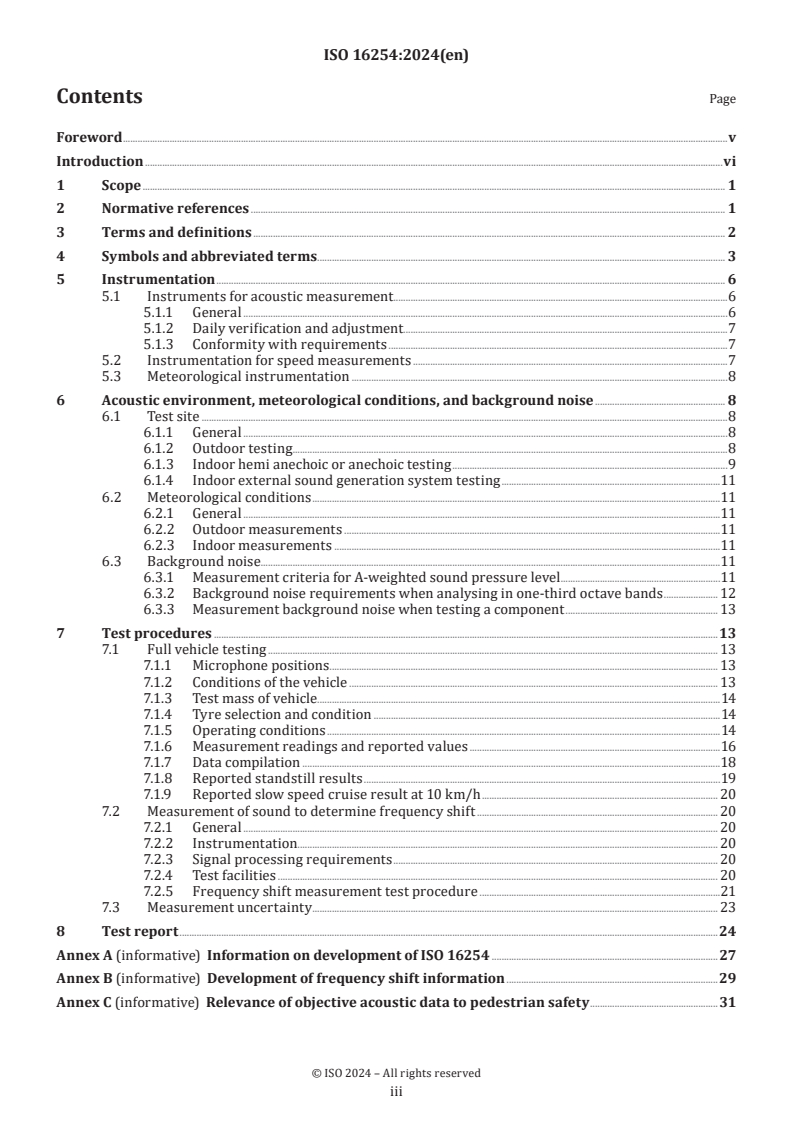
Contents Page
Foreword .v
Introduction .vi
1 Scope . 1
2 Normative references . 1
3 Terms and definitions . 2
4 Symbols and abbreviated terms. 3
5 Instrumentation . 6
5.1 Instruments for acoustic measurement .6
5.1.1 General .6
5.1.2 Daily verification and adjustment.7
5.1.3 Conformity with requirements .7
5.2 Instrumentation for speed measurements .7
5.3 Meteorological instrumentation .8
6 Acoustic environment, meteorological conditions, and background noise . 8
6.1 Test site .8
6.1.1 General .8
6.1.2 Outdoor testing .8
6.1.3 Indoor hemi anechoic or anechoic testing .9
6.1.4 Indoor external sound generation system testing .11
6.2 Meteorological conditions .11
6.2.1 General .11
6.2.2 Outdoor measurements .11
6.2.3 Indoor measurements .11
6.3 Background noise.11
6.3.1 Measurement criteria for A-weighted sound pressure level .11
6.3.2 Background noise requirements when analysing in one-third octave bands . 12
6.3.3 Measurement background noise when testing a component . 13
7 Test procedures .13
7.1 Full vehicle testing . 13
7.1.1 Microphone positions . . . 13
7.1.2 Conditions of the vehicle . 13
7.1.3 Test mass of vehicle.14
7.1.4 Tyre selection and condition .14
7.1.5 Operating conditions .14
7.1.6 Measurement readings and reported values .16
7.1.7 Data compilation .18
7.1.8 Reported standstill results .19
7.1.9 Reported slow speed cruise result at 10 km/h . 20
7.2 Measurement of sound to determine frequency shift . 20
7.2.1 General . 20
7.2.2 Instrumentation. 20
7.2.3 Signal processing requirements . 20
7.2.4 Test facilities . 20
7.2.5 Frequency shift measurement test procedure .21
7.3 Measurement uncertainty . . 23
8 Test report .24
Annex A (informative) Information on development of ISO 16254 .27
Annex B (informative) Development of frequency shift information .29
Annex C (informative) Relevance of objective acoustic data to pedestrian safety .31
iii
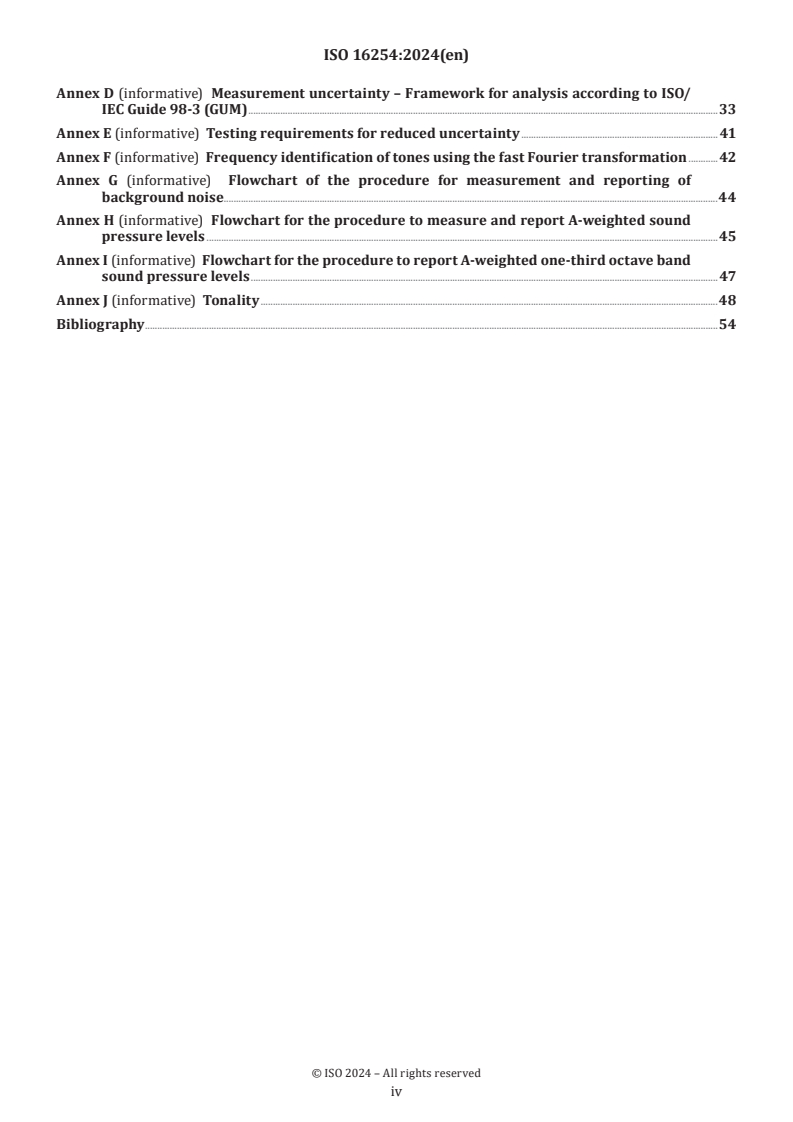
Annex D (informative) Measurement uncertainty – Framework for analysis according to ISO/
IEC Guide 98-3 (GUM) .33
Annex E (informative) Testing requirements for reduced uncertainty . 41
Annex F (informative) Frequency identification of tones using the fast Fourier transformation .42
Annex G (informative) Flowchart of the procedure for measurement and reporting of
background noise.44
Annex H (informative) Flowchart for the procedure to measure and report A-weighted sound
pressure levels .45
Annex I (informative) Flowchart for the procedure to report A-weighted one-third octave band
sound pressure levels . 47
Annex J (informative) Tonality .48
Bibliography .54
iv
Foreword
ISO (the International Organization for Standardization) is a worldwide federation of national standards
bodies (ISO member bodies). The work of preparing International Standards is normally carried out through
ISO technical committees. Each member body interested in a subject for which a technical committee
has been established has the right to be represented on that committee. International organizations,
governmental and non-governmental, in liaison with ISO, also take part in the work. ISO collaborates closely
with the International Electrotechnical Commission (IEC) on all matters of electrotechnical standardization.
The procedures used to develop this document and those intended for its further maintenance are described
in the ISO/IEC Directives, Part 1. In particular, the different approval criteria needed for the different types
of ISO document should be noted. This document was drafted in accordance with the editorial rules of the
ISO/IEC Directives, Part 2 (see www.iso.org/directives).
ISO draws attention to the possibility that the implementation of this document may involve the use of (a)
patent(s). ISO takes no position concerning the evidence, validity or applicability of any claimed patent
rights in respect thereof. As of the date of publication of this document, ISO had not received notice of (a)
patent(s) which may be required to implement this document. However, implementers are cautioned that
this may not represent the latest information, which may be obtained from the patent database available at
www.iso.org/patents. ISO shall not be held responsible for identifying any or all such patent rights.
Any trade name used in this document is information given for the convenience of users and does not
constitute an endorsement.
For an explanation of the voluntary nature of standards, the meaning of ISO specific terms and expressions
related to conformity assessment, as well as information about ISO's adherence to the World Trade
Organization (WTO) principles in the Technical Barriers to Trade (TBT), see www.iso.org/iso/foreword.html.
This document was prepared by Technical Committee ISO/TC 43, Acoustics, Subcommittee SC 1, Noise, in
collaboration with ISO/TC 22, Road vehicles.
This second edition cancels and replaces the first edition (ISO 16254:2016), which has been technically
revised.
The main changes are as follows:
— addition of multiple microphones at each measurement location;
— revised signal processing to improve correlation to human perception;
— further development of tonal loudness as an alternate method to identify frequencies and to assure
frequencies so identified are audible to pedestrians.
Any feedback or questions on this document should be directed to the user’s national standards body. A
complete listing of these bodies can be found at www.iso.org/members.html.
v
Introduction
The advent of road transport vehicles that rely, in whole or in part, on alternative drive trains (e.g.
electromotive propulsion) is serving to reduce both air and noise pollution and their adverse impacts on
citizens throughout the world. However, the environmental benefits achieved to date by these “hybrid or
pure electric” road vehicles have resulted in the unintended consequence of removing a source of audible
signal that is used by various groups of pedestrians (e.g. in particular, blind and low vision persons) to detect
the approach, presence and/or departure of road vehicles.
Therefore, this document has been developed to provide a method to measure the sound emission of road
vehicles at standstill and low speed operation, as well as to quantify the characteristics of any external
sound-generation system installed for the purpose of conveying acoustic information about the approach,
presence and/or departure of the vehicle to nearby pedestrians.
This document incorporates additional sensor locations and provisions to reduce the measurement variation
of reported results and to introduce a metric for determining the frequency of tonal components that does
not rely on prior knowledge of the sound signal. Tonal loudness calculates the audibility of the given signals
considering how the sounds are perceived by people, providing an optional metric to assess detection and to
identify frequency content.
This document was developed in cooperation with the Society of Automotive Engineers (SAE) Vehicle Sound
for Pedestrians Subcommittee and the SAE Advanced Driver Assistance Committee.
vi
International Standard ISO 16254:2024(en)
Acoustics — Measurement of sound emitted by road vehicles
of category M and N at standstill and low speed operation —
Engineering method
1 Scope
[2]
This document is derived from ISO 362-1 and specifies an engineering method for measuring the
sound emitted by M and N category road vehicles at standstill and low speed operating conditions. The
specifications reproduce the level of sound which is generated by the principal vehicle sound sources
consistent with stationary and low speed vehicle operating conditions relevant for pedestrian safety. The
method is designed to meet the requirements of simplicity as far as they are consistent with reproducibility
of results under the operating conditions of the vehicle.
The test method requires an acoustic environment which is only obtained in an extensive open space. Such
conditions usually exist during the following:
— measurements of vehicles for regulatory certification;
— measurements at the manufacturing stage;
— measurements at official testing stations.
The results obtained by this method give an objective measure of the sound emitted under the specified
conditions of test. It is necessary to consider the fact that the subjective appraisal of the annoyance,
perceptibility, and/or detectability of different motor vehicles or classes of motor vehicles due to their
sound emission are not simply related to the indications of a sound measurement system. As annoyance,
perceptibility and/or detectability are strongly related to personal human perception, physiological human
condition, culture, and environmental conditions, there are large variations and therefore these terms are
not useful as parameters to describe a specific vehicle condition.
Spot checks of vehicles chosen at random rarely occur in an ideal acoustic environment. If measurements
are carried out on the road in an acoustic environment which does not fulfil the requirements stated in
this document, the results obtained might deviate appreciably from the results obtained using the specified
conditions.
In addition, this document provides an engineering method to measure the performance of external
sound generation systems intended for the purpose of providing acoustic information to pedestrians on
a vehicle’s operating condition. This information is reported as objective criteria related to the external
sound generation system’s sound pressure level, frequency content, and changes in sound pressure level and
frequency content as a function of vehicle speed.
This document adds a metric related to the human perception of tonal loudness, the psychoacoustic tonality.
The psychoacoustic tonality can be used to estimate audible frequency shifts of the sounds by identifying
the most audible component in each auditory frequency band (critical band), as well as to determine if the
band(s) so identified meet audibility criteria.
Annex A and Annex C contains background information relevant in the development of this document.
2 Normative references
The following documents are referred to in the text in such a way that some or all of their content constitutes
requirements of this document. For dated references, only the edition cited applies. For undated references,
the latest edition of the referenced document (including any amendments) applies.
ISO 3745:2012, Acoustics — Determination of sound power levels and sound energy levels of noise sources using
sound pressure — Precision methods for anechoic rooms and hemi-anechoic rooms
ISO 10844, Acoustics — Specification of test tracks for measuring sound emitted by road vehicles and their tyres
ISO 26101-1, Acoustics — Test methods for the qualification of the acoustic environment — Part 1: Qualification
of free-field environments
IEC 60942, Electroacoustics — Sound calibrators
IEC 61260-1, Electroacoustics — Octave-band and fractional-octave-band filters — Part 1: Specifications
IEC 61672-1, Electroacoustics — Sound level meters — Part 1: Specifications
IEC 61672-3, Electroacoustics — Sound level meters — Part 3: Periodic tests
ISO/IEC Guide 98-3, Uncertainty of measurement — Part 3: Guide to the expression of uncertainty in
measurement (GUM:1995)
ECMA-418-2, Psychoacoustic metrics for ITT equipment: models based on human perception
3 Terms and definitions
For the purposes of this document, the following terms and definitions apply.
ISO and IEC maintain terminology databases for use in standardization at the following addresses:
— ISO Online browsing platform: available at https:// www .iso .org/ obp
— IEC Electropedia: available at https:// www .electropedia .org/
3.1
front reference plane
vertical plane tangent to the leading edge of the vehicle
3.2
rear reference plane
vertical plane tangent to the trailing edge of the vehicle
3.3
external sound generation system
system that provides an acoustic signal to the external environment of the vehicle for the purpose to provide
information to pedestrians
3.4
component
external sound generation system (3.3) intended to emit sound information which can be tested separately
from the vehicle
3.5
kerb mass
complete shipping mass of a vehicle fitted with all equipment necessary for normal operation plus the mass
of the following elements for M1, N1 and M2 having a maximum authorized mass not exceeding 3 500 kg:
— lubricants, coolant (if needed), washer fluid;
— fuel (tank filled to at least 90 % of the capacity specified by the manufacturer);
— other equipment if included as basic parts for the vehicle, such as spare wheel(s), wheel chocks, fire
extinguisher(s), spare parts and tool kit
Note 1 to entry: The definition of kerb mass can vary from country to country, but in this document, it refers to the
[4]
definition contained in ISO 1176 .
[8] [2]
Note 2 to entry: M and N vehicle categories are defined in SAE J2889-1 and ISO 362-1 .
3.6
mass in running order
nominal mass of an N2, N3 or M2 vehicle having a maximum authorized mass greater than 3 500 kg, or an
M3 vehicle as determined by the following conditions:
a) the mass in running order is taken as the sum of the unladen vehicle mass and the driver's mass;
b) in the case of category M2 and M3 vehicles that include seating positions for additional crewmembers,
their mass is incorporated in the same way and equal to that of the driver
[5]
Note 1 to entry: The driver's mass is calculated in accordance with ISO 2416 .
[2]
Note 2 to entry: Unladen vehicle mass is defined in ISO 362-1 .
3.7
full vehicle operation
operation of a vehicle with all systems and components (3.4) operating according to the manufacturer’s
specification for normal road use
3.8
simulated vehicle operation
operation of a vehicle with some systems or components (3.4) disabled to reduce noise interference during
testing which may include external signals applied to the vehicle to simulate actual in-use signals
3.9
lowest frequency of interest
frequency below which there is no signal content relevant to the measurement of sound emission for the
vehicle under test
3.10
critical band
filter within the human cochlea describing the frequency resolution of the auditory system with
characteristics that are usually estimated from the results of masking experiments
3.11
tonality
characteristic of sound containing a single-frequency component or narrow-band components that emerge
audibly from the total sound
3.12
specific tonality
tonality (3.11) in a single critical band (3.10)
4 Symbols and abbreviated terms
Table 1 — Symbols and abbreviated terms and the paragraph in which they are first used
Symbol Unit Subclause Explanation
Line perpendicular to vehicle travel which indicates the
AA′ — 6.1.2
beginning of the zone to record sound pressure level during test.
Line perpendicular to vehicle travel which indicates end of the
BB′ — 6.1.2
zone to record sound pressure level during test.
CC′ — 6.1.2 Centreline of vehicle travel.
Input quantities to allow for any uncertainty in A-weighted sound
δ - δ dB D.2
1 7
pressure level.
Input quantities to allow for any uncertainty in one-third
δ - δ dB D.3
8 14
octave band A-weighted sound pressure level.
TTabablele 1 1 ((ccoonnttiinnueuedd))
Symbol Unit Subclause Explanation
Input quantities to allow for any uncertainty in frequency meas-
δ - δ Hz D.4
15 21
urement used for the determination of frequency shift.
Single frequency component of external sound generation
f Hz 7.2.5.3.1
i,speed
system at a given vehicle speed.
Single frequency component of external sound generation
f Hz 7.2.5.3.1
i,ref
system at reference vehicle speed.
∆f % 7.2.5.3.1 Frequency shift expressed in percent of a reference frequency.
percent
Frequency resolution of narrowband analysis used to measure
∆f Hz 7.2.3 frequency spectra for the purpose of determining frequency shift
information.
F Hz 5.1.1 Sampling frequency used by digital signal processing system
s
i — 6.3.2 Index for left or right microphone locations
Index for single test run within stopped or slow speed cruise test
j — 7.1.6.1
conditions
Vehicle A-weighted sound pressure level in stationary forward
L dB 7.1.7.2
st,fwd
condition.
Vehicle A-weighted sound pressure level in stationary reverse
L dB 7.1.8
st,rev
condition.
Cruise vehicle A-weighted sound pressure level at a vehicle speed
L dB 7.1.9
crs,10
of 10 km/h.
th
L dB 7.1.6.1 A-weighted sound pressure level result of j test run.
test,j
L dB 6.3.1 Background noise A-weighted sound pressure level.
bgn
Background noise A-weighted sound pressure level, left side of
L dB 6.3.1
bgn,L,i th
vehicle, i microphone location.
Background noise A-weighted sound pressure level, right side of
L dB 6.3.1
bgn,R,i th
vehicle, i microphone location.
Background noise one-third octave A-weighted sound pressure
L dB 6.3.2 level. This result is reported as a frequency spectrum between
bgn_BAND
160 Hz and 5 000 Hz,
Background noise one-third octave A-weighted sound pressure
th
L dB 6.3.2 level, left side of vehicle, i microphone location. This result is
bgn_BAND,L,i
reported as a frequency spectrum between 160 Hz and 5 000 Hz,
Background noise one-third octave A-weighted sound pressure
th
L dB 6.3.2 level, right side of vehicle, i microphone location. This result is
bgn_BAND,R,i
reported as a frequency spectrum between 160 Hz and 5 000 Hz,
A-weighted sound pressure level for any stationary or cruise con-
L dB D.2
x
dition for use in assessment of measurement uncertainty.
A-weighted sound pressure level per one-third octave band for
L dB D.3 any stationary or cruise condition for use in assessment of meas-
x,band
urement uncertainty.
A-weighted sound pressure level for any stationary or cruise con-
L dB D.2
x,meas
dition for use in assessment of measurement uncertainty.
MicLeft_ — 7.1.1 ith Microphone situated at left side of vehicle
i
MicRight_ — 7.1.1 ith Microphone situated at right side of vehicle
i
Microphone situated at left side of vehicle, with height of 0,8 m
MicLeft — 7.1.1
above ground
7.1.1 Microphone situated at left side of vehicle, with height of 1,0 m
MicLeft —
above ground
7.1.1 Microphone situated at left side of vehicle, with height of 1,2 m
MicLeft —
above ground
TTabablele 1 1 ((ccoonnttiinnueuedd))
Symbol Unit Subclause Explanation
7.1.1 Microphone situated at left side of vehicle, with height of 1,4 m
MicLeft —
above ground
7.1.1 Microphone situated at left side of vehicle, with height of 1,6 m
MicLeft —
above ground
7.1.1 Microphone situated at right side of vehicle, with height of 0,8 m
MicRight —
above ground
7.1.1 Microphone situated at right side of vehicle, with height of 1,0 m
MicRight —
above ground
7.1.1 Microphone situated at right side of vehicle, with height of 1,2 m
MicRight —
above ground
7.1.1 Microphone situated at right side of vehicle, with height of 1,4 m
MicRight —
above ground
7.1.1 Microphone situated at right side of vehicle, with height of 1,6 m
MicRight —
above ground
7.1.6.2 Maximum one-third octave results for each band over the entire
measurement interval for each MicLeft_ location for the jth meas-
i
L dB
MicLeft_i_BAND,j
urement run. This result is reported as a frequency spectrum
between 160 Hz and 5 000 Hz,
7.1.6.2 Maximum one-third octave results for each band over the entire
L dB measurement interval for each MicRight_ location for the jth
MicRight_i_BAND,j i
measurement run
Maximum one-third octave results for each band over the entire
measurement interval for all MicLeft_ locations for the jth meas-
i
L dB 7.1.6.4.2
MicLeft_BAND,j
urement run. This result is reported as a frequency spectrum
between 160 Hz and 5 000 Hz,
Maximum one-third octave results for each band over the entire
measurement interval for all MicRight_ locations for the jth
i
L dB 7.1.6.4.2
MicRight_BAND,j
measurement run. This result is reported as a frequency spec-
trum between 160 Hz and 5 000 Hz,
7.1.6.2 Maximum one-third octave results for each band over the entire
L dB
MicLeft_i_BAND
measurement interval for each MicLeft_ location.
i
dB 7.1.6.2 Maximum one-third octave results for each band over the entire
L measurement interval for each MicRight_ location. This result is
MicRight_i_BAND i
reported as a frequency spectrum between 160 Hz and 5 000 Hz,
dB Maximum overall sound pressure level result over the entire
L 7.1.6.3.2 measurement interval for each MicLeft_ location for the jth meas-
MicLeft_i_OA,j i
urement run
dB Maximum overall sound pressure level result over the entire
L 7.1.6.3.2 measurement interval for each MicRight_ location for the jth
MicRight_i_OA,j i
measurement run
dB Maximum overall sound pressure level result over the entire
L 7.1.6.2 measurement interval for all MicLeft_ locations for the jth meas-
MicLeft_OA,j i
urement run
dB Maximum overall sound pressure level result over the entire
L 7.1.6.2 measurement interval for all MicRight_ locations for the jth
MicRight_OA,j i
measurement run
dB Maximum overall sound pressure level result over the entire
L 7.1.5.3.1 measurement interval for each MicLeft_ locations averaged over
MicLeft_i_OA i
all j runs
dB Maximum overall sound pressure level result over the entire
L 7.1.5.3.1 measurement interval for each MicRight_ locations averaged over
MicRight_i_OA i
all j runs
TTabablele 1 1 ((ccoonnttiinnueuedd))
Symbol Unit Subclause Explanation
dB Maximum one-third octave sound pressure level over the entire
measurement interval for all MicLeft locations averaged over all
i
L 7.1.7.3
MicLeftBAND
j measurement runs. This result is reported as a frequency spec-
trum between 160 Hz and 5 000 Hz,
dB Maximum one-third octave sound pressure level over the entire
measurement interval for all MicRight locations averaged over
i
L 7.1.7.3
MicRightBAND
all j measurement runs. This result is reported as a frequency
spectrum between 160 Hz and 5 000 Hz,
dB Maximum overall sound pressure level result over the entire
L 7.1.7.2
MicLeftOA
measurement interval for all MicLeft locations
i
dB Maximum overall sound pressure level result over the entire
L 7.1.7.2
MicRightOA
measurement interval for all MicRight locations
i
Block size of digital sample used for discrete Fourier
N — 7.2.3
transform or autopower spectrum analysis.
Line perpendicular to vehicle travel which indicates location of
PP′ — 6.1.2
microphones.
Reference vehicle velocity used for calculating frequency shift
v km/h 7.2.5.2
ref
percentage.
v km/h 7.2.5.3.1 Target vehicle test velocity.
test
Main frequency of tonal component in a critical band belonging to
f Hz J.4.6
band,speed
a certain frequency shift and speed
Valid frequencies from the tonality analysis over time in a critical
f Hz J.4.6
band,speed,filtered
band belonging to a certain frequency shift and speed
T’ tu 8 Specific tonality of the background noise in a critical band
bgn HMS
Specific tonality in critical band belonging to a certain frequency
T’ tu J.4.4
speed,shift HMS
shift and speed
z Bark J.4.6 Critical-band rate
HMS
Critical-band rate corresponding to a certain frequency shift and
Z Bark J.4.4
speed,shift HMS
speed
5 Instrumentation
5.1 Instruments for acoustic measurement
5.1.1 General
The apparatus used for measuring the sound pressure level shall be a sound level meter or equivalent
measurement system meeting the requirements of class 1 instruments (inclusive of the recommended
windscreen, if used). These requirements are described in IEC 61672–1.
The entire measurement system shall be checked by means of a sound calibrator that fulfils the requirements
of class 1 sound calibrators in accordance with IEC 60942.
Measurements shall be carried out using the time weighting “F” of the acoustic measurement instrument
and the “A” frequency weighting also described in IEC 61672–1. When using a system that includes a periodic
monitoring of the A-weighted sound pressure level, a reading should be made at a time interval not greater
than 30 ms.
When no general statement or conclusion can be made about conformance of the sound level meter model
to the full specifications of IEC 61672-1, the apparatus used for measuring the sound pressure level shall
be a sound level meter or equivalent measurement system meeting the conformity requirements of Class 1
instruments as described in IEC 61672-3.
NOTE The tests of IEC 61672-3 cover only a limited subset of the specifications in IEC 61672-1 for which the scope is
large (temperature range, frequency requirements up to 20 kHz, etc.). It is economically not feasible to verify the whole
IEC 61672-1 requirements on each item of a computerized data acquisition systems model. Apparently, until today, no
computerized data acquisition system available complies with the full specifications of IEC 61672-1. It is beyond the
possibilities of the users of these systems to prove conformity of the instrumentation required by the test code.
When measurements are carried out for one-third octaves, the instrumentation shall meet all requirements
of IEC 61260–1, class 1.
When measurements are carried out for frequency shift, the digital sound recording system shall have at
least a 16 bit quantization. The sampling rate, F , and the dynamic range shall be appropriate to the signal of
s
interest.
5.1.2 Daily verification and adjustment
At the beginning of every measurement session, the entire acoustic measurement system shall be
checked and adjusted, if possible, by means of a sound calibrator as described in 5.1.1. At the end of every
measurement session, the entire acoustic measurement system shall be checked by means of a sound
calibrator as described in 5.1.1.
Without any further adjustment, the difference between the readings at the beginning and the end shall be
less than or equal to 0,5 dB. If this value is exceeded, the results of the measurements obtained after the
previous satisfactory check shall be discarded.
NOTE 1 A bi-yearly IEC 61672-3 calibration permits the use of a daily sensitivity check and adjustment.
NOTE 2 The purpose of the check at the beginning of the measurement session is twofold:
a) To ensure the measurement system is in good working order, and
b) To adjust the level consistent with the environmental conditions of the day.
The purpose of the check at the end of the measurement session is also twofold:
— To ensure the measurement system remains in good working order, and
— To verify the adjusted level remains within expected tolerances for a repeatable and reproduceable measurement.
5.1.3 Conformity with requirements
Conformity of the sound calibrator with the requirements of IEC 60942 shall be verified once a year.
Conformity of the instrumentation system with the requirements of IEC 61672–1 shall be verified at
least every 2 years using IEC 61672-3. All conformity testing shall be conducted by a laboratory, which is
authorized to perform calibrations traceable to the appropriate standards.
NOTE The tests of IEC 61672-3 cover only a limited subset of the specifications in IEC 61672-1 for which the
scope is large (temperature range, frequency requirements up to 20 kHz, etc.). It is not feasible to verify the whole
IEC 61672-1 requirements on each item of a computerized data acquisition system. Computerized data acquisition
system available comply with the necessary specifications of IEC 61672-1 and testing specifications of IEC 61672-3 as
required for this document.
5.2 Instrumentation for speed measurements
The road speed of the vehicle shall be measured with instruments meeting specification limits of at least
±0,5 km/h when using continuous measuring devices.
NOTE A continuous measuring device will determine all required speed information with one device.
5.3 Meteorological instrumentation
The meteorological instrumentation used to monitor the environmental conditions during the test shall
meet the specifications of the following:
— ±1 °C or less for a temperature measuring device;
— ±1,0 m/s for a wind speed-measuring device;
— ±5 hPa for a barometric pressure measuring device;
— ±5 % for a relative humidity measuring device.
6 Acoustic environment, meteorological conditions, and background noise
6.1 Test site
6.1.1 General
The specifications for the test site provide the necessary acoustic environment to carry out the full vehicle
or component tests documented in this document. Outdoor and indoor test environments that meet the
specifications of this document provide equivalent acoustic environments and produce results that are
equally valid.
6.1.2 Outdoor testing
The test site shall be substantially level. The test track construction and surface shall meet the requirements
of ISO 10844. Figure 1 gives information on test site dimensions.
Within a radius of 50 m around the centre of the track, the space shall be free of large reflecting objects, such
as fences, rocks, bridges or buildings. The test track and the surface of the site shall be dry and free from
absorbing materials, such as powdery snow or loose debris.
In the vicinity of the microphones, there shall be no obstacle that can influence the acoustic field and no
person shall remain between the microphone and the noise source. The meter observer shall be positioned
so as not to influence the meter reading.
NOTE 1 Buildings outside the 50 m radius might have significant influence if their reflection focuses on the test track.
The term “substantially level” is intended to convey that the test site shall not have slopes or discontinuities
that would render invalid the assumption the site provided free-field acoustic propagation. This is not
to limit slopes on the test site necessary for water management, drainage, etc. Engineering judgement is
expected to be applied to determine the effect on the site of any obstacle. The test track itself is subject to
the requirements specified.
For the purpose of this document, test track constructions and surfaces according to ISO 10844 will also
provide satisfactory results for vehicle speeds of up to 20 km/h.
NOTE 2 Government regulations can require specific surface requirements.
Dimensions in metres
Key
l entrance construction run-up section (diagonal hatch area), in metres
s,1
l exit construction run-up section (diagonal hatch area), in metres (length of entrance and exit construction run-
s,2
up sections can differ)
l entrance drive lane extension beyond propagation area, in metres
a,1
l exit drive lane extension beyond propagation area, in metres (length of entrance and exit drive lane extensions
a,2
can differ)
w drive lane width, in metres
AA’ entrance to propagation area 10 m before line PP’
BB’ exit from propagation area 10 m after line PP’
CC’ drive lane centre line (longitudinal axis)
PP microphone line (transverse axis)
a
Propagation area.
b
Drive lane.
NOTE 1 Buildings outside the 50 m radius can have significant influence if their reflection focuses on the test track.
NOTE 2 Shaded area (“test area”) is the minimum area that it is required to be covered with a surface complying
with ISO 10844.
Figure 1 — Test site dimensions
6.1.3 Indoor hemi anechoic or anechoic testing
This subclause specifies conditions applicable when testing a full vehicle, either operating as it would on the
road with all systems operational or operating in a mode where only the external sound generation system is
operational in a hemi-anechoic space, or for testing a component in either a hemi-anechoic or anechoic space.
The test facility shall meet requirements of ISO 26101-1 or ISO 3745:2012, Annex A:
a) within the following space as shown in Figure 2.
Points D, E, F and G are locations used for the microphones in conducting testing according to the method
described in Clause 7.
Dimensions in meters
Key
CC’ centreline of vehicle travel
D, E, F, G microphone positions
Figure 2 — Spatial dimensions for acoustic space defined to be hemi-anechoic
b) For qualifying the hemi-anechoic space, the following evaluation shall be conducted:
— sound source location shall be placed on the floor in middle of the space deemed to be hemi-anechoic;
— sound source shall provide a broadband input for measurement;
— evaluation shall be conducted in one-third octave bands;
— microphone locations for evaluation shall be on a line from the source location to each position of
microphones used for measurement in the document shown by points D, E, F, and G in Figure 2. This is
commonly referred at the microphone transverse;
— the maximum spacing of the measurement points for evaluation on the microphone transverse line shall
depend on the size of the space deemed hemi-anechoic. A minimum of 10 points shall be used;
— the one-third octave bands used to establish hemi-anechoic qualification shall be defined to cover the
spectral range of interest.
c) The test facility shall have a cut-off frequency, as defined in ISO 26101-1, lower than the lowest frequency
of interest.
In the vicinity of the microphones, there shall be no obstacle that can influence the acoustic field and no
person shall remain between the microphone and the noise source. The meter observer shall be positioned
so as not to influence the meter reading.
NOTE 1 It is expected that users of this document will understand that valid measurements can only be made
when the cut-off frequency is lower than the lowest frequency of interest. A specific numerical requirement for cut-off
frequency is not given due to the range of variation of appropriate cut-off frequencies depending upon the measured
vehicle.
NOTE 2 This document adds additional microphone hights up to 1,6 m. Qualification t
...