

ISO 17208-1:2016/Amd 1:2024
(Amendment)Underwater acoustics — Quantities and procedures for description and measurement of underwater sound from ships — Part 1: Requirements for precision measurements in deep water used for comparison purposes — Amendment 1
General Information
- Abstract
- Status
- Published
- Publication Date
- 27-Feb-2024
- Technical Committee
- ISO/TC 43/SC 3 - Underwater acoustics
- Drafting Committee
- ISO/TC 43/SC 3 - Underwater acoustics
- Current Stage
- 6060 - International Standard published
- Start Date
- 28-Feb-2024
- Due Date
- 08-Nov-2024
- Completion Date
- 28-Feb-2024
Buy Documents

ISO 17208-1:2016/Amd 1:2024 - Underwater acoustics — Quantities and procedures for description and measurement of underwater sound from ships — Part 1: Requirements for precision measurements in deep water used for comparison purposes — Amendment 1 Released:2/28/2024
Overview
ISO 17208-1:2016/Amd 1:2024 is an important amendment to the international standard focusing on underwater acoustics. This amendment updates Part 1: Requirements for precision measurements in deep water used for comparison purposes relating to the description and measurement of underwater sound emitted from ships. Published by ISO, this document ensures standardized procedures and quantities for precise and consistent deep-water measurements of ship noise. The amendments refine definitions, measurement practices, and normative references, reflecting advancements and enhanced clarity in the field of underwater sound measurement.
Key Topics
- Precision measurement requirements for underwater sound in deep water locations, critical for the comparison of acoustic emissions across different ships.
- Updated definition of radiated noise level, specifying the root-mean-square sound pressure measured at a distance from the ship, ensuring consistency in terminology and calculation.
- Specification of frequency-domain averaging in measurements, with an emphasis on linear power averaging and proper sampling aligned with the data window period.
- Inclusion of detailed broadband processing requirements, utilizing one-third octave (decidecade) bands from 10 Hz to 20 000 Hz with Class 1 accuracy, following ISO 18405.
- Clarification of deep water criteria linked to minimum test site requirements, necessary for valid precision measurements.
- Updated normative references for related standards, including changes from IEC 61260 to IEC 61260-1.
- Amendments in measurement procedures and terminology, such as the replacement of “Williamson turn” labeling for maneuvering in ship noise tests.
- Insertion of references to Part 2 of ISO 17208, outlining procedures for determination of source levels from deep water measurements, complementing Part 1.
Applications
ISO 17208-1:2016/Amd 1:2024 is highly relevant to:
- Marine engineers and acousticians conducting underwater noise impact assessments for ships.
- Environmental agencies monitoring and regulating underwater noise pollution to protect marine ecosystems.
- Shipbuilders and naval architects seeking to design quieter vessels conforming to international noise emission standards.
- Research institutions performing studies on underwater acoustics and noise propagation in marine environments.
- Port authorities and maritime operators implementing noise reduction strategies and ensuring compliance with sound emission limits.
- Development and calibration of underwater acoustic measurement equipment used in open ocean or deep water test sites.
Related Standards
- ISO 17208-2: Complementary to Part 1, this standard focuses on the determination of source levels from deep water measurements and is referenced in the amendment for broader procedural context.
- ISO 18405: Provides detailed methodologies related to underwater sound measurement, referenced for acoustic terminology and techniques.
- IEC 61260-1: Defines frequency analysis performance specifications, which underpin the frequency-domain processing requirements in ISO 17208-1.
- Additional acoustic standards under ISO/TC 43, Acoustics, governing measurement practices and terminology in the field of underwater acoustics.
By adhering to ISO 17208-1:2016/Amd 1:2024, organizations enhance the accuracy and comparability of underwater ship noise data, promoting sustainable maritime operations and informed environmental stewardship. This amendment is vital for maintaining consistency in underwater acoustics measurement amid evolving technologies and environmental policies.
Relations
- Effective Date
- 06-Jun-2022
Buy Documents
ISO 17208-1:2016/Amd 1:2024 - Underwater acoustics — Quantities and procedures for description and measurement of underwater sound from ships — Part 1: Requirements for precision measurements in deep water used for comparison purposes — Amendment 1 Released:2/28/2024
Get Certified
Connect with accredited certification bodies for this standard

BSMI (Bureau of Standards, Metrology and Inspection)
Taiwan's standards and inspection authority.
Sponsored listings
Frequently Asked Questions
ISO 17208-1:2016/Amd 1:2024 is a standard published by the International Organization for Standardization (ISO). Its full title is "Underwater acoustics — Quantities and procedures for description and measurement of underwater sound from ships — Part 1: Requirements for precision measurements in deep water used for comparison purposes — Amendment 1". This standard covers: Underwater acoustics — Quantities and procedures for description and measurement of underwater sound from ships — Part 1: Requirements for precision measurements in deep water used for comparison purposes — Amendment 1
Underwater acoustics — Quantities and procedures for description and measurement of underwater sound from ships — Part 1: Requirements for precision measurements in deep water used for comparison purposes — Amendment 1
ISO 17208-1:2016/Amd 1:2024 is classified under the following ICS (International Classification for Standards) categories: 17.140.30 - Noise emitted by means of transport. The ICS classification helps identify the subject area and facilitates finding related standards.
ISO 17208-1:2016/Amd 1:2024 has the following relationships with other standards: It is inter standard links to ISO 17208-1:2016. Understanding these relationships helps ensure you are using the most current and applicable version of the standard.
ISO 17208-1:2016/Amd 1:2024 is available in PDF format for immediate download after purchase. The document can be added to your cart and obtained through the secure checkout process. Digital delivery ensures instant access to the complete standard document.
Standards Content (Sample)
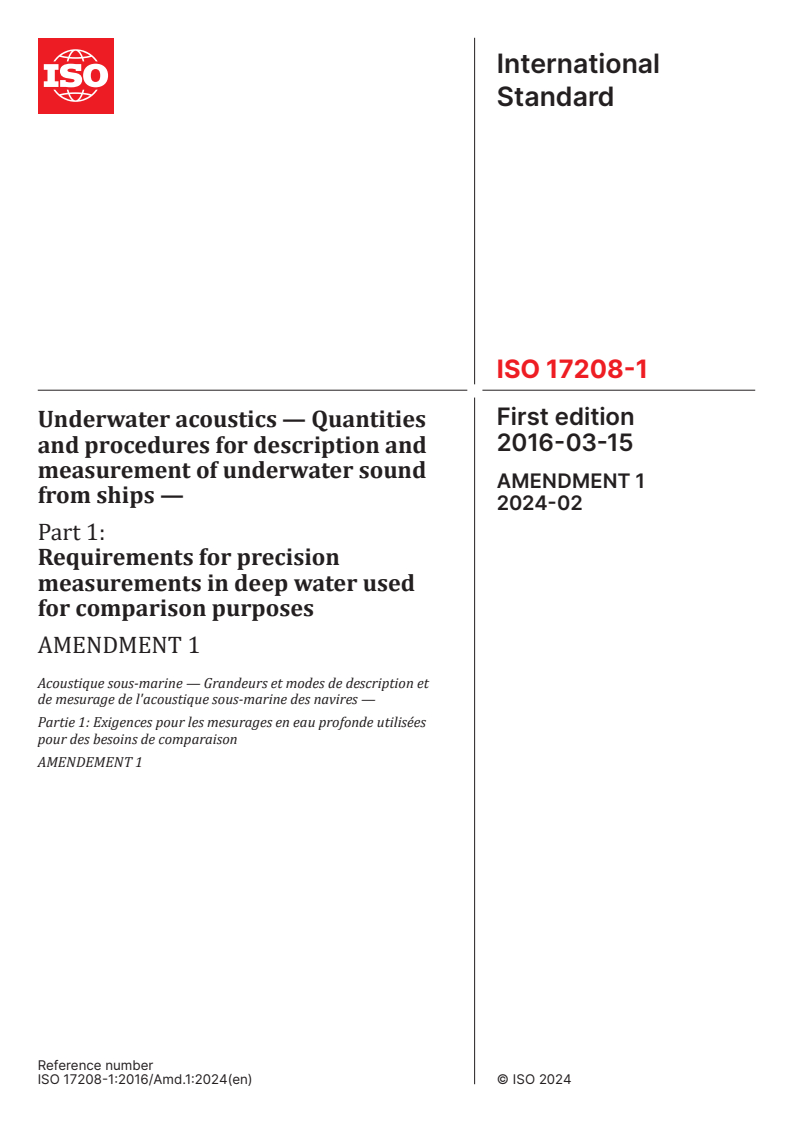
International
Standard
ISO 17208-1
First edition
Underwater acoustics — Quantities
2016-03-15
and procedures for description and
measurement of underwater sound
AMENDMENT 1
from ships —
2024-02
Part 1:
Requirements for precision
measurements in deep water used
for comparison purposes
AMENDMENT 1
Acoustique sous-marine — Grandeurs et modes de description et
de mesurage de l'acoustique sous-marine des navires —
Partie 1: Exigences pour les mesurages en eau profonde utilisées
pour des besoins de comparaison
AMENDEMENT 1
Reference number
ISO 17208-1:2016/Amd.1:2024(en) © ISO 2024
ISO 17208-1:2016/Amd.1:2024(en)
© ISO 2024
All rights reserved. Unless otherwise specified, or required in the context of its implementation, no part of this publication may
be reproduced or utilized otherwise in any form or by any means, electronic or mechanical, including photocopying, or posting on
the internet or an intranet, without prior written permission. Permission can be requested from either ISO at the address below
or ISO’s member body in the country of the requester.
ISO copyright office
CP 401 • Ch. de Blandonnet 8
CH-1214 Vernier, Geneva
Phone: +41 22 749 01 11
Email: copyright@iso.org
Website: www.iso.org
Published in Switzerland
ii
ISO 17208-1:2016/Amd.1:2024(en)
Foreword
ISO (the International Organization for Standardization) is a worldwide federation of national standards
bodies (ISO member bodies). The work of preparing International Standards is normally carried out through
ISO technical committees. Each member body interested in a subject for which a technical committee
has been established has the right to be represented on that committee. International organizations,
governmental and non-governmental, in liaison with ISO, also take part in the work. ISO collaborates closely
with the International Electrotechnical Commission (IEC) on all matters of electrotechnical standardization.
The procedures used to develop this document and those intended for its further maintenance are described
in the ISO/IEC Directives, Part 1. In particular, the different approval criteria needed for the different types
of ISO document should be noted. This document was drafted in accordance with the editorial rules of the
ISO/IEC Directives, Part 2 (see www.iso.org/directives).
ISO draws attention to the possibility that the implementation of this document may involve the use of (a)
patent(s). ISO takes no position concerning the evidence, validity or applicability of any claimed patent
rights in respect thereof. As of the date of publication of this document, ISO had not received notice of (a)
patent(s) which may be required to implement this document. However, implementers are cautioned that
this may not represent the latest information, which may be obtained from the patent database available at
www.iso.org/patents. ISO shall not be held responsible for identifying any or a
...