


IWA 15:2015
(Main)Specification and method for the determination of performance of automated liquid handling systems
Specification and method for the determination of performance of automated liquid handling systems
IWA 15:2015 specifies methods for testing the volumetric performance of air-displacement, system-liquid filled and positive displacement automated liquid handling systems (ALHS), including an estimation of measurement uncertainties and established traceability to reference standards (preferably, traceability to SI Units). The testing methods specified in this document may also be used to measure the volumetric performance of automated liquid delivery systems which do not aspirate the test liquid. IWA 15:2015 also specifies statistical methods for the determination of random and systematic errors (including intra-plate and inter-plate comparisons), analysis of measured results when using multichannel dispensing heads, and analysis depending on dispense patterns. It further defines terms and formulae to be used for summarizing test results. IWA 15:2015 also specifies the information to be provided to users of ALHS, including the display of summary results and performance claims. IWA 15:2015 is applicable to all ALHS with complete, installed liquid handling devices, including tips and other essential parts needed for delivering a specified volume, which perform liquid handling tasks without human intervention into microplates. Manipulation of the microplates on the deck of the automated liquid handling system may be achieved automatically, semi-automatically, or manually. IWA 15:2015 addresses the needs of: - suppliers of ALHS, as a basis for quality control including, where appropriate, the issuance of supplier's declarations; - test houses and other bodies, as a basis for independent certification and calibration; - users of the equipment, to enable calibration, verification, validation, and routine testing of trueness and precision. The tests established in this IWA should be carried out by trained personnel.
Spécification et méthode pour la détermination de performance des systèmes automatisés de manipulation de liquides
General Information
- Status
- Withdrawn
- Publication Date
- 14-Oct-2015
- Technical Committee
- ISO/TMBG - Technical Management Board - groups
- Drafting Committee
- ISO/TMBG - Technical Management Board - groups
- Current Stage
- 9599 - Withdrawal of International Standard
- Start Date
- 11-Aug-2022
- Completion Date
- 14-Feb-2026
Relations
- Effective Date
- 23-Apr-2020
- Revised
ISO 23783-1:2022 - Automated liquid handling systems — Part 1: Vocabulary and general requirements - Effective Date
- 23-Apr-2020
- Effective Date
- 23-Apr-2020


Get Certified
Connect with accredited certification bodies for this standard

ECOCERT
Organic and sustainability certification.

Eurofins Food Testing Global
Global leader in food, environment, and pharmaceutical product testing.

Intertek Bangladesh
Intertek certification and testing services in Bangladesh.
Sponsored listings
Frequently Asked Questions
IWA 15:2015 is a standard published by the International Organization for Standardization (ISO). Its full title is "Specification and method for the determination of performance of automated liquid handling systems". This standard covers: IWA 15:2015 specifies methods for testing the volumetric performance of air-displacement, system-liquid filled and positive displacement automated liquid handling systems (ALHS), including an estimation of measurement uncertainties and established traceability to reference standards (preferably, traceability to SI Units). The testing methods specified in this document may also be used to measure the volumetric performance of automated liquid delivery systems which do not aspirate the test liquid. IWA 15:2015 also specifies statistical methods for the determination of random and systematic errors (including intra-plate and inter-plate comparisons), analysis of measured results when using multichannel dispensing heads, and analysis depending on dispense patterns. It further defines terms and formulae to be used for summarizing test results. IWA 15:2015 also specifies the information to be provided to users of ALHS, including the display of summary results and performance claims. IWA 15:2015 is applicable to all ALHS with complete, installed liquid handling devices, including tips and other essential parts needed for delivering a specified volume, which perform liquid handling tasks without human intervention into microplates. Manipulation of the microplates on the deck of the automated liquid handling system may be achieved automatically, semi-automatically, or manually. IWA 15:2015 addresses the needs of: - suppliers of ALHS, as a basis for quality control including, where appropriate, the issuance of supplier's declarations; - test houses and other bodies, as a basis for independent certification and calibration; - users of the equipment, to enable calibration, verification, validation, and routine testing of trueness and precision. The tests established in this IWA should be carried out by trained personnel.
IWA 15:2015 specifies methods for testing the volumetric performance of air-displacement, system-liquid filled and positive displacement automated liquid handling systems (ALHS), including an estimation of measurement uncertainties and established traceability to reference standards (preferably, traceability to SI Units). The testing methods specified in this document may also be used to measure the volumetric performance of automated liquid delivery systems which do not aspirate the test liquid. IWA 15:2015 also specifies statistical methods for the determination of random and systematic errors (including intra-plate and inter-plate comparisons), analysis of measured results when using multichannel dispensing heads, and analysis depending on dispense patterns. It further defines terms and formulae to be used for summarizing test results. IWA 15:2015 also specifies the information to be provided to users of ALHS, including the display of summary results and performance claims. IWA 15:2015 is applicable to all ALHS with complete, installed liquid handling devices, including tips and other essential parts needed for delivering a specified volume, which perform liquid handling tasks without human intervention into microplates. Manipulation of the microplates on the deck of the automated liquid handling system may be achieved automatically, semi-automatically, or manually. IWA 15:2015 addresses the needs of: - suppliers of ALHS, as a basis for quality control including, where appropriate, the issuance of supplier's declarations; - test houses and other bodies, as a basis for independent certification and calibration; - users of the equipment, to enable calibration, verification, validation, and routine testing of trueness and precision. The tests established in this IWA should be carried out by trained personnel.
IWA 15:2015 is classified under the following ICS (International Classification for Standards) categories: 71.040.20 - Laboratory ware and related apparatus. The ICS classification helps identify the subject area and facilitates finding related standards.
IWA 15:2015 has the following relationships with other standards: It is inter standard links to ISO 23783-3:2022, ISO 23783-1:2022, ISO 23783-2:2022. Understanding these relationships helps ensure you are using the most current and applicable version of the standard.
IWA 15:2015 is available in PDF format for immediate download after purchase. The document can be added to your cart and obtained through the secure checkout process. Digital delivery ensures instant access to the complete standard document.
Standards Content (Sample)
INTERNATIONAL IWA
WORKSHOP 15
AGREEMENT
First edition
2015-10-15
Specification and method for the
determination of performance of
automated liquid handling systems
Spécification et méthode pour la détermination de performance des
systèmes automatisés de manipulation de liquides
Reference number
©
ISO 2015
© ISO 2015, Published in Switzerland
All rights reserved. Unless otherwise specified, no part of this publication may be reproduced or utilized otherwise in any form
or by any means, electronic or mechanical, including photocopying, or posting on the internet or an intranet, without prior
written permission. Permission can be requested from either ISO at the address below or ISO’s member body in the country of
the requester.
ISO copyright office
Ch. de Blandonnet 8 • CP 401
CH-1214 Vernier, Geneva, Switzerland
Tel. +41 22 749 01 11
Fax +41 22 749 09 47
copyright@iso.org
www.iso.org
ii © ISO 2015 – All rights reserved
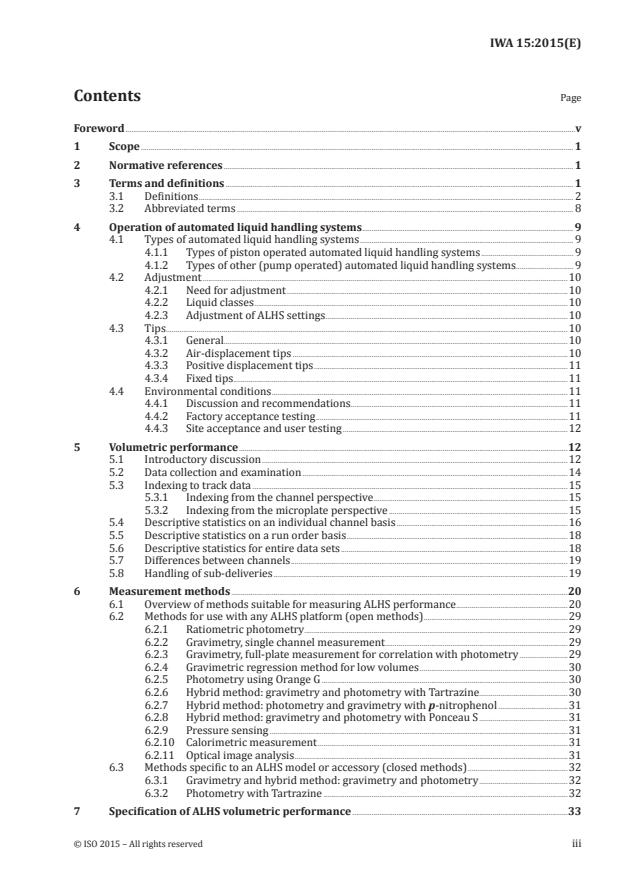
Contents Page
Foreword .v
1 Scope .1
2 Normative references .1
3 Terms and definitions .1
3.1 Definitions . 2
3.2 Abbreviated terms . 8
4 Operation of automated liquid handling systems .9
4.1 Types of automated liquid handling systems . 9
4.1.1 Types of piston operated automated liquid handling systems . 9
4.1.2 Types of other (pump operated) automated liquid handling systems. 9
4.2 Adjustment .10
4.2.1 Need for adjustment .10
4.2.2 Liquid classes .10
4.2.3 Adjustment of ALHS settings .10
4.3 Tips .10
4.3.1 General.10
4.3.2 Air-displacement tips .10
4.3.3 Positive displacement tips .11
4.3.4 Fixed tips.11
4.4 Environmental conditions .11
4.4.1 Discussion and recommendations.11
4.4.2 Factory acceptance testing .11
4.4.3 Site acceptance and user testing .12
5 Volumetric performance .12
5.1 Introductory discussion .12
5.2 Data collection and examination .14
5.3 Indexing to track data .15
5.3.1 Indexing from the channel perspective .15
5.3.2 Indexing from the microplate perspective .15
5.4 Descriptive statistics on an individual channel basis .16
5.5 Descriptive statistics on a run order basis .18
5.6 Descriptive statistics for entire data sets .18
5.7 Differences between channels .19
5.8 Handling of sub-deliveries .19
6 Measurement methods .20
6.1 Overview of methods suitable for measuring ALHS performance .20
6.2 Methods for use with any ALHS platform (open methods) .29
6.2.1 Ratiometric photometry .29
6.2.2 Gravimetry, single channel measurement .29
6.2.3 Gravimetry, full-plate measurement for correlation with photometry .29
6.2.4 Gravimetric regression method for low volumes .30
6.2.5 Photometry using Orange G .30
6.2.6 Hybrid method: gravimetry and photometry with Tartrazine . .30
6.2.7 Hybrid method: photometry and gravimetry with p-nitrophenol .31
6.2.8 Hybrid method: gravimetry and photometry with Ponceau S .31
6.2.9 Pressure sensing .31
6.2.10 Calorimetric measurement .31
6.2.11 Optical image analysis .31
6.3 Methods specific to an ALHS model or accessory (closed methods) .32
6.3.1 Gravimetry and hybrid method: gravimetry and photometry .32
6.3.2 Photometry with Tartrazine .32
7 Specification of ALHS volumetric performance .33
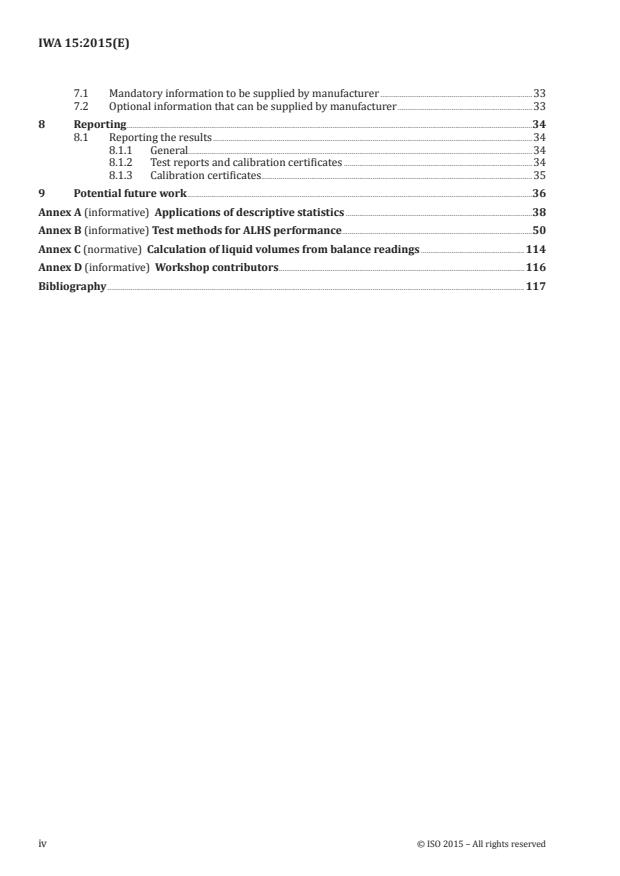
7.1 Mandatory information to be supplied by manufacturer .33
7.2 Optional information that can be supplied by manufacturer .33
8 Reporting .34
8.1 Reporting the results .34
8.1.1 General.34
8.1.2 Test reports and calibration certificates .34
8.1.3 Calibration certificates.35
9 Potential future work .36
Annex A (informative) Applications of descriptive statistics .38
Annex B (informative) Test methods for ALHS performance .50
Annex C (normative) Calculation of liquid volumes from balance readings .114
Annex D (informative) Workshop contributors .116
Bibliography .117
iv © ISO 2015 – All rights reserved
Foreword
ISO (the International Organization for Standardization) is a worldwide federation of national standards
bodies (ISO member bodies). The work of preparing International Standards is normally carried out
through ISO technical committees. Each member body interested in a subject for which a technical
committee has been established has the right to be represented on that committee. International
organizations, governmental and non-governmental, in liaison with ISO, also take part in the work.
ISO collaborates closely with the International Electrotechnical Commission (IEC) on all matters of
electrotechnical standardization.
The procedures used to develop this document and those intended for its further maintenance are
described in the ISO/IEC Directives, Part 1. In particular the different approval criteria needed for the
different types of ISO documents should be noted. This document was drafted in accordance with the
editorial rules of the ISO/IEC Directives, Part 2 (see www.iso.org/directives).
Attention is drawn to the possibility that some of the elements of this document may be the subject of
patent rights. ISO shall not be held responsible for identifying any or all such patent rights. Details of
any patent rights identified during the development of the document will be in the Introduction and/or
on the ISO list of patent declarations received (see www.iso.org/patents).
Any trade name used in this document is information given for the convenience of users and does not
constitute an endorsement.
For an explanation on the meaning of ISO specific terms and expressions related to conformity
assessment, as well as information about ISO’s adherence to the WTO principles in the Technical
Barriers to Trade (TBT) see the following URL: Foreword - Supplementary information
The committee responsible for this document is ISO/TMBG, Technical Management Board Groups.
International Workshop Agreement IWA 15:2015(E)
Specification and method for the determination of
performance of automated liquid handling systems
1 Scope
This International Workshop Agreement (IWA) specifies methods for testing the volumetric
performance of air-displacement, system-liquid filled and positive displacement automated liquid
handling systems (ALHS), including an estimation of measurement uncertainties and established
traceability to reference standards (preferably, traceability to SI Units). The testing methods specified
in this document may also be used to measure the volumetric performance of automated liquid delivery
systems which do not aspirate the test liquid.
This IWA also specifies statistical methods for the determination of random and systematic errors
(including intra-plate and inter-plate comparisons), analysis of measured results when using
multichannel dispensing heads, and analysis depending on dispense patterns. It further defines terms
and formulae to be used for summarizing test results.
This IWA also specifies the information to be provided to users of ALHS, including the display of
summary results and performance claims.
This IWA is applicable to all ALHS with complete, installed liquid handling devices, including tips and
other essential parts needed for delivering a specified volume, which perform liquid handling tasks
without human intervention into microplates. Manipulation of the microplates on the deck of the
automated liquid handling system may be achieved automatically, semi-automatically, or manually.
This IWA addresses the needs of:
— suppliers of ALHS, as a basis for quality control including, where appropriate, the issuance of
supplier’s declarations;
— test houses and other bodies, as a basis for independent certification and calibration;
— users of the equipment, to enable calibration, verification, validation, and routine testing of trueness
and precision.
The tests established in this IWA should be carried out by trained personnel.
2 Normative references
The following documents, in whole or in part, are normatively referenced in this document and are
indispensable for its application. For dated references, only the edition cited applies. For undated
references, the latest edition of the referenced document (including any amendments) applies.
ISO/IEC 17025, General requirements for the competence of testing and calibration laboratories
3 Terms and definitions
For purposes of this document, the following terms and definitions apply.
3.1 Definitions
3.1.1
accuracy
closeness of agreement between a delivered volume and the
target volume
Note 1 to entry: The concept ‘accuracy’ is not a quantity and is not given a numerical quantity value. A liquid
delivery is said to be more accurate when it is accomplished with a smaller liquid handling error.
[SOURCE: ISO/IEC Guide 99:2007, 2.13, modified]
3.1.2
air displacement
liquid handling principle in which a body of air is contained between the piston and the test liquid
Note 1 to entry: It is possible to have a large air gap (piston systems), or smaller air gap between the test liquid
and the system liquid (liquid filled systems).
3.1.3
ALHS uncertainty
non-negative parameter characterizing the dispersion of the measured volumes relative to the
target volume
Note 1 to entry: Uncertainty is inversely related to accuracy, and is a quantity value. This value should be
expressed in accordance with ISO/IEC Guide 98-3.
[SOURCE: ISO/IEC Guide 99:2007, 2.26, modified]
3.1.4
aliquot
single delivery during a multi-dispense
3.1.5
automated liquid handling system
ALHS
system with a complete, installed liquid handling device, including tips and other essential parts needed
for delivering a specified volume without human intervention into microplates
Note 1 to entry: Examples of automated liquid handling systems include automated pipetting systems (APS), and
automated dispensing systems (ADS).
3.1.6
calibration
operation that, under specified conditions, establishes a relation
between the target volume of the ALHS and the delivered volume
Note 1 to entry: A calibration may be expressed by a statement, a calibration curve or a calibration table. It may
include a correction, but correction or adjustment is not a required element of a calibration.
[SOURCE: ISO/IEC Guide 99:2007, 2.39, modified]
3.1.7
dead air volume
captive air volume
air gap
air volume between the lower part of the piston
and the surface of the aspirated liquid
Note 1 to entry: It is possible to have a large air gap (piston systems), or smaller air gap for liquid filled systems.
Sometimes called captive air volume.
2 © ISO 2015 – All rights reserved
Note 2 to entry: Commonly, an air gap can be adjusted through ALHS system parameters, while the dead air
volume or captive air volume cannot be adjusted (see 4.2.1).
3.1.8
delivered volume
quantity delivered by a liquid handling system
Note 1 to entry: Delivered volume is a conceptual term and cannot be known with complete certainty due to
measurement error.
3.1.9
dispense height
height at which the test liquid is dispensed relative to a stated reference
3.1.10
dispensing system
system for delivering liquids from a pre-filled liquid reservoir
3.1.11
disposable tip
tip, which is attached once and after use, as defined by the manufacturer, detached and intended to be
discarded
Note 1 to entry: Disposable tips are usually made of plastic.
Note 2 to entry: Disposable tips are in contrast to fixed tips, which are described in 4.3.4.
3.1.12
dry contact dispensing
dispensing of liquid while tip is in contact with the dry target
3.1.13
factory acceptance testing
internal vendor testing to ensure ALHS performance to specifications
3.1.14
forward mode pipetting
direct mode pipetting
pipetting mode where the entire aspirated volume is delivered
3.1.15
immersion depth
depth of the tip below the liquid surface
Note 1 to entry: Immersion depth can be applied to both aspiration and dispensing (wet contact).
[SOURCE: Toolpoint Photometric Volume Check Procedure:2008, modified]
3.1.16
individually controlled channel
liquid handling channel that can be operated independently of other channels
3.1.17
labware
materials used in conjunction with liquid handling operations
Note 1 to entry: Labware includes disposable tips, reservoirs, receiving vessels, adapters and microplates.
3.1.18
maximum permissible error
upper or lower permitted extreme value for the deviation of the dispensed volume from the target volume
3.1.19
maximum specified volume
largest volume for which the manufacturer offers specifications
Note 1 to entry: The maximum specified volume may vary depending on instrument configuration (e.g. disposable
tip size, syringe size).
3.1.20
measured volume
quantity reported by a volume measuring system
Note 1 to entry: In practice, all measurements contain some measurement error. The measured volume is a
quantity value and serves as an estimate of the delivered volume which is not known with complete certainty.
3.1.21
measurement method
measurement procedure
detailed description of a measurement according to one or more measurement principles
Note 1 to entry: The source document (ISO/IEC Guide 99) draws a distinction between ‘measurement method’ and
‘measurement procedure’ and that distinction is ignored here. In this IWA, the terms are used interchangeably.
Note 2 to entry: The measurement method descriptions in this IWA detail the steps needed to make a volume
measurement and calculate certain descriptive statistics. Additional details needed to operate the ALHS are
part of the ‘test process’ as defined in 3.1.43. In this IWA, the measurement method is one of the components of
a ‘test process.’
[SOURCE: ISO/IEC Guide 99:2007, 2.6, modified]
3.1.22
measurement uncertainty
non-negative parameter characterizing the dispersion of the measured volumes
relative to the delivered volume
Note 1 to entry: Uncertainty is inversely related to accuracy, and is a quantity value. This value should be
expressed in accordance with the ISO/IEC Guide 98-3.
[SOURCE: ISO/IEC Guide 99:2007, 2.26, modified]
3.1.23
metrological traceability
property of a measurement result whereby the result can be related to a reference through a
documented unbroken chain of calibrations, each contributing to the measurement uncertainty
Note 1 to entry: Additional information can be found in the notes to definition (ISO/IEC Guide 99:2007, 2.41) and
the related term ‘metrological traceability chain’ (ISO/IEC Guide 99:2007, 2.42).
[SOURCE: ISO/IEC Guide 99:2007, 2.41]
3.1.24
microplate
flat plate with an array of wells
[1-5]
Note 1 to entry: Some dimensions of microplates are defined in ANSI/SLAS standards.
3.1.25
minimum specified volume
smallest volume for which the manufacturer offers specifications
Note 1 to entry: The minimum specified volume may vary depending on instrument configuration.
4 © ISO 2015 – All rights reserved
3.1.26
multichannel head
group of liquid handling channels operated in common
Note 1 to entry: Common arrangements of multichannel heads include 8, 96, 384, and 1536 channel heads. Other
arrangements are possible, e.g. 2 channel to 1536 channel configurations.
Note 2 to entry: Pipetting channels in a multichannel head may be controlled by a single, common drive, or each
channel may be controlled individually.
3.1.27
multi dispense
repeat dispense
sequential dispense
a collection of dispenses without intervening aspiration
Note 1 to entry: First dispense can be different, and is frequently wasted.
Note 2 to entry: Repeat dispenses usually dispense repeatedly the same volume, while sequential dispenses
usually dispense different volumes.
3.1.28
non-contact dispensing
contact-free dispensing
free-jet dispensing
dispensing of the liquid while tip is in air and without contacting the target or the liquid contained
in the target
3.1.29
outlier
member of a set of values which is inconsistent with the other members of that set
3.1.30
pipetting system
system for aspirating and dispensing a specified volume of liquid
[SOURCE: Toolpoint Gravimetric Volume Check Procedure:2008, modified]
3.1.31
positive displacement
direct displacement
liquid handling principle in which a mechanical actuator is in direct contact with the test liquid
3.1.32
precision
the closeness of agreement between the measured volume of independent
delivered volumes under stipulated conditions
Note 1 to entry: Precision is conceptual and not a quantity value.
Note 2 to entry: Measurement precision is usually expressed numerically by measures of random error, such as
standard deviation, variance, or coefficient of variation under the specified conditions of measurement.
Note 3 to entry: The ‘stipulated conditions’ can be, for example, repeatability conditions of measurement,
intermediate precision conditions of measurement, or reproducibility conditions of measurement (see
ISO 5725-1:1994).
[SOURCE: ISO 5725-1:1994, 3.12, modified]
3.1.33
random error
component of liquid handling error that in replicate deliveries
varies in an unpredictable manner
[SOURCE: ISO/IEC Guide 99:2007, 2.19, modified]
3.1.34
reservoir
liquid container
vessel that contains the liquid
3.1.35
reverse mode pipetting
pipetting mode in which excess volume is aspirated and remains in the tip after delivery
3.1.36
single dispense
individual dispense
single dispense per aspiration
3.1.37
site acceptance testing
in-situ testing at the user’s site, typically part of the installation process
3.1.38
supplier’s declaration
document by which a supplier gives written assurance that an ALHS conforms to the requirements of
one or more commonly accepted industry standards
Note 1 to entry: This IWA can be referenced as an applicable industry standard.
3.1.39
systematic error
component of volumetric error that in replicate deliveries remains
constant or varies in a predictable manner
Note 1 to entry: Systematic error is estimated by calculating the average volume of a series of deliveries and
comparing it to the indicated volume of the automated liquid handling system. Frequently this result is expressed
as a percentage of the indicated volume.
[SOURCE: ISO/IEC Guide 99:2007, 2.17, modified]
3.1.40
system liquid
liquid used to transmit energy between a mechanical actuator and the test liquid
Note 1 to entry: System liquids can reduce or completely eliminate system dead air volume.
Note 2 to entry: System liquid is usually deionized water. For special applications organic solvents such as DMSO
or aqueous solutions such as saline (e.g. 0,9 % NaCl) can be used.
Note 3 to entry: System liquid can be used for flushing and rinsing tips to minimize cross contamination.
3.1.41
target volume
indicated volume
selected volume
volume which is intended to be delivered
6 © ISO 2015 – All rights reserved
3.1.42
test liquid
liquid used for the volume measurement
Note 1 to entry: May be aqueous or other solvents. Aqueous test liquids can be pure water or contain other
compounds such as buffers, dyes or salts. The chemical composition of the test liquid can vary significantly
depending on method.
3.1.43
test process
detailed description of an ALHS testing procedure including
system operation and measurement method
Note 1 to entry: The test process includes all details needed to reproduce the test or interpret the results. The
measurement method is defined in 3.1.21, and is only a part of the test process.
3.1.44
test report
document reporting the result of the testing
Note 1 to entry: Details regarding information contained in test reports is specified in Clause 8.
3.1.45
test result
value of a characteristic obtained by carrying out a specified test method
Note 1 to entry: Test result is a broader concept than measured volume. The test result can be a single measured
volume, a set of measured volumes, or descriptive statistics such as the mean or standard deviation of multiple
measurements. The test method should specify what form the test results take.
[SOURCE: ISO 5725-1:1994, 3.2]
3.1.46
traceability
metrological traceability
property of a measurement result whereby the result can be related to a reference through a
documented unbroken chain of calibrations, each contributing to the measurement uncertainty
[SOURCE: ISO/IEC Guide 99:2007, 2.41]
3.1.47
trueness
closeness of agreement between the average volume delivered in a
large series of deliveries and the target volume
Note 1 to entry: Trueness is inversely related to systematic error, but is not related to random error.
[SOURCE: ISO/IEC Guide 99:2007, 2.14, modified]
3.1.48
validation
confirmation, through the provision of objective evidence, that
the requirements for a specific intended use or application have been fulfilled
Note 1 to entry: The term “validated” is used to designate the corresponding status.
Note 2 to entry: The test protocol for this testing should reflect the liquid volumes and instrument settings, at
which the ALHS will be operated.
Note 3 to entry: A product may meet all of its specifications (verification), but that does not ensure that it will
work in the operating paradigm (validation).
3.1.49
verification
confirmation, through provision of objective evidence, that
volumetric performance specifications have been fulfilled
Note 1 to entry: The term “verified” is used to designate the corresponding status.
Note 2 to entry: Volumetric performance specifications may vary depending on the environment where the ALHS
is used, e.g. factory and field specifications may be different.
[SOURCE: ISO/IEC Guide 99:2007, 2.44, modified]
3.1.50
wet contact dispensing
dispensing of the test liquid while tip is in contact with liquid present in the target
3.2 Abbreviated terms
See Table 1.
Table 1 — Abbreviated terms used in this document
Abbreviated term Explanation
ADS Automated Dispensing System
ALHS Automated Liquid Handling System
APS Automated Pipetting System
C2C Channel-to-Channel
CV Coefficient of Variation
DI De-ionized
DMSO Dimethylsulfoxide
GA Grand Average
HVAC Heating, Ventilation, and Air Conditioning
IEC International Electrotechnical Commission
IWA International Workshop Agreement
MU Measurement Uncertainty
MW Molecular weight
NaOH Sodium hydroxide
OA Over All
OD Optical Density
p.a. pro analysi (purity grade of chemicals)
p-NP para-nitrophenol
RH Relative Humidity [%]
RSE Relative Systematic Error
rcf Relative centrifugal force
rpm Revolutions per minute
SD Standard Deviation
SMOW Surface Mean Ocean Water
8 © ISO 2015 – All rights reserved
4 Operation of automated liquid handling systems
4.1 Types of automated liquid handling systems
The purpose of this clause is to provide examples of some types of ALHS. This list is not intended to be a
[6]
comprehensive list as technologies continue to evolve.
4.1.1 Types of piston operated automated liquid handling systems
Automated liquid handling systems can operate as follows:
— variable volume; designed by the manufacturer to aspirate and dispense volumes selectable by the
user within the specified useful volume range of the dispense head and selected tips, for example
between 10 µl and 100 µl.
— a larger volume may be aspirated into the tips, followed by a series of subsequent dispenses of
smaller aliquots.
The piston can
— either have a body of air contained between the piston and the surface of the liquid
(air-displacement), or
— be in direct contact with the surface of the liquid (positive or direct displacement), or
— be in contact with a system liquid.
The system can
— have a single tip, or
— have multiple tips, operated by individual pistons, or
— have multiple tips, operated by a single, common drive or moving plate with multiple pistons
simultaneously driven by a common drive.
The tip can be
— permanently attached to the dispense channel of the ALHS, or
— disposable, and used for one or more aspirate and dispense sequences.
4.1.2 Types of other (pump operated) automated liquid handling systems
Pump operated automated liquid handling systems can operate as follows:
variable volume; designed by the manufacturer to dispense volumes selectable by the user within
the specified useful volume range of the dispense head.
The dispense head can
— be permanently attached to the instrument, or
— be exchangeable, e.g. to change the usable volume range or number of channels.
The system can
— have a peristaltic or diaphragm pump to aspirate liquid from a reservoir, or
— have a pressurized liquid reservoir and separate liquid valves to control the liquid delivery.
4.2 Adjustment
4.2.1 Need for adjustment
A standard parameter set for a given fluid class may need to be adjusted for optimizing the ALHS
performance. ALHS parameters may need to be adjusted in one or more of the following situations:
— to accommodate liquid-specific properties;
— following the replacement of system components;
— following change of labware components; or
— following a change of the location of operation sites (e.g. at the factory vs. the end user’s location).
The performance of an ALHS can be corrected and optimized by adjusting system parameters such as
the aspiration and dispense speeds, immersion depth of the tip, dispense height, air gaps, and others.
The scope of adjustable system parameters varies between ALHS models and the manufacturer’s
adjustment instructions should be followed.
Some ALHS can be used at volumes outside of the volume range specified by the manufacturer for the
installed system components. In this case, the ALHS performance at these volumes shall be validated
with a test method (see Clause 6) suitable for these used volumes.
4.2.2 Liquid classes
An automated liquid handling system is adjusted by its manufacturer for the delivery of its selected
volume (or multiple volumes as specified by the manufacturer). The manufacturer shall report the
test solution, instrument settings, and environmental basis used for defining the standard liquid class.
Users of ALHS who define liquid classes and test the volumetric performance of the ALHS shall report
the test liquid, instrument settings, and environmental basis for each tested liquid class.
4.2.3 Adjustment of ALHS settings
Some automated liquid handling systems have a provision for adjustment by the user when, for
example, it is found in routine calibration that the volume delivered is not within specification. Such
user adjustment shall be made according to the manufacturer’s instructions and by reference to one of
the methods for the determination of measurement error specified in this IWA.
4.3 Tips
4.3.1 General
The dispensing orifice of the tip shall be shaped in such a way that consistent dispensing of the liquid is
achieved. When the pipetting operation is completed, any amount of liquid remaining in or around the
dispensing orifice of the tip shall be consistent.
In the case of sterilizable tips, the sterilization procedures indicated as appropriate by the manufacturer
in user information or on packaging shall not negatively affect the metrological characteristics of the
tips such as shape, seal and wettability.
NOTE This requirement can be assessed by comparing errors of measurement using tips which have and
have not been sterilized.
4.3.2 Air-displacement tips
4.3.2.1 Air-displacement tips shall be disposable parts, usually made of plastic, which fit on the ALHS
dispensing head and prevent the instrument from contact with the aspirated liquid.
10 © ISO 2015 – All rights reserved
4.3.2.2 Disposable air-displacement tips shall be fitted in accordance with the ALHS supplier’s
instructions to form a good seal between the tip and the dispensing head.
Disposable tips should not be cleaned or reused unless their metrological characteristics are confirmed
and they are shown fit for use in the specific application (validation).
NOTE Variability of the amount of externally retained liquid or an incomplete seal will contribute to poor
precision when testing with one of the methods described in this IWA.
4.3.3 Positive displacement tips
4.3.3.1 Positive displacement tips shall consist of a plunger and a capillary which fit on the tip holder
of the dispensing head of the automated liquid handling system. Various materials may be used for the
plunger, such as metal, plastic, or ceramic and for the capillary, such as plastic or glass. These pipette
tips may be reusable or disposable (both plunger and capillary are changed together, per manufacturer’s
instructions).
4.3.3.2 The shape and material of the plunger and capillary shall confer a good seal of the tip, as well as
a smooth action between the plunger and the capillary, to ensure consistent dispensing of the liquid.
4.3.4 Fixed tips
4.3.4.1 Description and materials
Fixed tips can be manufactured from various materials, such as stainless steel or polymeric materials.
These tips may be coated for inertness to pipetted fluids or for specific functionality, e.g. conductivity
to sense contact with fluids in receptacles on the deck of the ALHS.
4.3.4.2 Development of cleaning protocol and testing / confirmation of metrological
characteristics
Functionality and metrological performance of fixed tips should be tested at regular intervals. It is
recommended to follow the manufacturer’s cleaning protocol and use instructions for best performance
of fixed tips.
4.3.4.3 Maintenance and exchange of fixed tips
Fixed tips should be examined for damage and tested for proper functionality at regular intervals
according to the manufacturer’s instructions, which should contain protocols for the maintenance and
replacement of such tips.
4.4 Environmental conditions
4.4.1 Discussion and recommendations
Changes in temperature, relative humidity, and barometric pressure can cause changes in the
volumetric performance of piston-operated automated liquid handling systems. It is recommended
that temperature and relative humidity be monitored at all locations where operational performance
testing of ALHS is conducted.
4.4.2 Factory acceptance testing
It is recommended that factory acceptance testing is performed in a location where the temperature and
relative humidity can be controlled. It is good practice to equilibrate all equipment at least 2 h prior to
testing in an environment as defined by the ALHS manufacturer. Both the ALHS and the test method can
have specific sensitivity to environmental conditions. The relevant environmental conditions and their
upper and lower limits (e.g. temperature, RH, barometric pressure) shall be identified and recorded.
This equipment includes the ALHS, and may include a balance, plate reader, pipettes, test liquids, weight
calibration standards, etc. Any deviations from the recommended conditions shall be recorded and
reported with the test results. Estimates of the measurement uncertainty shall be based on the actual
test conditions.
4.4.3 Site acceptance and user testing
It is recognized that automated liquid handling systems are frequently installed and used in locations
where temperature, relative humidity, and barometric pressure differ from factory testing conditions.
It is recommended that site acceptance testing be performed at prevailing local conditions, which
should be stable within the requirements of the test method and the manufacturer’s specifications
before and during the time of testing. For reference, the temperature and relative humidity with their
minimum and maximum values during the time of testing should be recorded. At a minimum, the
temperature or temperature range during the time of testing shall be reported with the test results
for all equipment used during this testing (e.g. ALHS, balance, plate reader, test liquids, etc.), and the
estimate of measurement uncertainty shall reflect the actual test conditions.
Regardless of available environmental controls, it is recommended that automated liquid handling
systems be situated in an appropriate environment that reduces temperature extremes (e.g. away from
windows with direct sunlight exposure, or concentrated heat sources such as autoclaves, HVAC systems
and vents, or high voltage installations). Manufacturer’s recommendations for the installation and use
environment of ALHS should be followed.
Deviations from ideal/recommended test conditions need to be reflected in the measurement
uncertainty (MU) estimate.
5 Volumetric performance
5.1 Introductory discussion
Automated liquid handling systems (ALHS) are designed to deliver amounts of liquid at a target volume.
The target volume is typically set using software or other digital control. Volumetric performance is
assessed by measuring the volume of each liquid delivery and evaluating the data.
Volumetric performance is typically assessed by suppliers as part of the manufacturing process quality
control or a supplier’s service offering. Volumetric performance can also be assessed by users, as well
as by third party testing and calibration service providers.
Automated liquid handling systems are designed to handle a variety of liquids of differing physical
properties such as density, viscosity, surface tension and contact angle against solid surfaces. The
volumetric performance of the ALHS can vary depending on these physical properties, so a description
of the test liquid shall be included when reports of volumetric performance are made. This description
of the test liquid may be made in terms of chemical composition, physical properties, or both.
Manufacturers of ALHS can make performance claims at various volumes for a particular instrument
configuration. The maximum specified volume and minimum specified volume establish a liquid
handling range over which the system manufacturer has established volumetric performance
specifications. However, in some systems it is possible for the user to program the system to deliver
volumes which are outside of this range (i.e. greater than the maximum specified volume or less than
the minimum specified volume).
In preparing for a volumetric performance test, the ALHS will be set to deliver a particular target
volume. For testing by the supplier, the target volume will frequently be identical to one of the
manufacturer’s specified volumes. Operators may decide to test at any target volume they wish.
During testing each delivered volume is expected to be slightly different from the target volume. The
delivered volume is a conceptual quantity because it cannot be known with certainty and can only be
approximated by measurement.
12 © ISO 2015 – All rights reserved
In order to evaluate volumetric performance, measurements are made of individual delivered volumes.
The measured volume is a quantity which consists of a numerical value and units. The recommended
units are microlitres (µl) though related units such as millilitres (ml) and nanolitres (nl) are sometimes
used and are also acceptable. The measured volume is an estimate of the delivered volume and
departs slightly from t
...
Questions, Comments and Discussion
Ask us and Technical Secretary will try to provide an answer. You can facilitate discussion about the standard in here.
Loading comments...