

ISO 4802-2:2023
(Main)Glassware — Hydrolytic resistance of the interior surfaces of glass containers — Part 2: Determination by flame spectrometry and classification
General Information
- Abstract
This document specifies: a) a method for determining the hydrolytic resistance of the interior surfaces of glass containers when subjected to attack by water at (121 ± 1) °C for (60 ± 1) min. The resistance is measured by determining the amount of sodium and other alkali metal or alkaline earth oxides in the extraction solution using flame atomic emission or absorption spectrometry (flame spectrometry); b) a classification of glass containers according to the hydrolytic resistance of the interior surfaces determined by the methods specified in this document. The test method specified in this document might not be applicable to containers whose surfaces have been treated for functional modifications, e.g. silicone (e.g. containers that are ready for direct filling).
- Status
- Published
- Publication Date
- 03-Dec-2023
- Current Stage
- 6060 - International Standard published
- Start Date
- 04-Dec-2023
- Due Date
- 26-Nov-2024
- Completion Date
- 04-Dec-2023
Buy Documents

ISO 4802-2:2023 - Glassware — Hydrolytic resistance of the interior surfaces of glass containers — Part 2: Determination by flame spectrometry and classification Released:4. 12. 2023

ISO 4802-2:2023 - Verrerie — Résistance hydrolytique des surfaces internes des récipients en verre — Partie 2: Détermination par spectrométrie de flamme et classification/19/2023
Overview
ISO 4802-2:2023 - Glassware - Hydrolytic resistance of the interior surfaces of glass containers - Part 2: Determination by flame spectrometry and classification describes a standardized laboratory method to evaluate how the inner surfaces of glass containers resist hydrolytic attack by water. The test uses controlled heating (121 ± 1 °C for 60 ± 1 min) and quantifies released alkali/alkaline‑earth species (notably sodium) in the extraction solution by flame atomic emission or absorption spectrometry (flame spectrometry). The document also defines a classification system (HC 1, HC 2, HC 3, HC B, HC D) for container hydrolytic resistance.
Key technical topics and requirements
- Test conditions: containers filled with specified water, loosely capped and heated at (121 ± 1) °C for (60 ± 1) min.
- Analytical method: measurement of sodium and other alkali/alkaline‑earth oxides in the extract by flame atomic emission or absorption spectrometry.
- Sample preparation: detailed procedures for cleaning, determination of filling volume (different rules for ampoules, syringes, flat‑ or round‑bottomed containers), and sample size.
- Classification: assignment to hydrolytic classes (HC 1, HC 2, HC 3, HC B, HC D) based on measured ion release and container‑specific limit values. Briefly:
- HC 1 - neutral/borosilicate glass with very high hydrolytic resistance (suitable for most preparations including parenterals);
- HC 2 - soda‑lime glass with high resistance due to surface treatment;
- HC 3 - typical soda‑lime‑silica glass with moderate resistance (often for non‑aqueous or less demanding uses).
- Scope limitations: may not be applicable to containers whose internal surfaces have been functionally modified (e.g., silicone‑coated containers ready for direct filling).
- Harmonization: updated to align cleaning and autoclaving procedures with Ph. Eur.; includes containers down to 0.5 ml filling volume.
Practical applications
- Pharmaceutical packaging qualification: verifying primary packaging (vials, ampoules, syringes, cartridges, bottles) for parenteral and other drug products.
- Quality control and lot release: routine testing to ensure glass batches meet hydrolytic resistance requirements.
- Material selection and supplier qualification: comparing glass types (borosilicate vs soda‑lime‑silica) and surface treatments.
- Regulatory support: producing test reports and classification data required by regulators or pharmacopeial monographs.
Who should use ISO 4802-2:2023
- Quality control laboratories in pharmaceutical and medical device companies
- Packaging engineers and material scientists selecting container types
- Regulatory affairs and compliance teams preparing submissions
- Glass manufacturers and contract testing organizations
Related standards
- ISO 4802-1 (titration method for hydrolytic resistance)
- ISO 719, ISO 720 (hydrolytic resistance of glass grains)
- Ph. Eur. and USP <660> (pharmacopoeial context for glass types and classifications)
Using ISO 4802-2:2023 helps ensure reproducible, comparable hydrolytic resistance data for glass containers and supports safe selection and qualification of primary packaging for pharmaceutical use.
Relations
- Effective Date
- 06-Jun-2022
Buy Documents
ISO 4802-2:2023 - Glassware — Hydrolytic resistance of the interior surfaces of glass containers — Part 2: Determination by flame spectrometry and classification Released:4. 12. 2023
ISO 4802-2:2023 - Verrerie — Résistance hydrolytique des surfaces internes des récipients en verre — Partie 2: Détermination par spectrométrie de flamme et classification/19/2023
Get Certified
Connect with accredited certification bodies for this standard

ECOCERT
Organic and sustainability certification.

Eurofins Food Testing Global
Global leader in food, environment, and pharmaceutical product testing.

Intertek Bangladesh
Intertek certification and testing services in Bangladesh.
Sponsored listings
Frequently Asked Questions
ISO 4802-2:2023 is a standard published by the International Organization for Standardization (ISO). Its full title is "Glassware — Hydrolytic resistance of the interior surfaces of glass containers — Part 2: Determination by flame spectrometry and classification". This standard covers: This document specifies: a) a method for determining the hydrolytic resistance of the interior surfaces of glass containers when subjected to attack by water at (121 ± 1) °C for (60 ± 1) min. The resistance is measured by determining the amount of sodium and other alkali metal or alkaline earth oxides in the extraction solution using flame atomic emission or absorption spectrometry (flame spectrometry); b) a classification of glass containers according to the hydrolytic resistance of the interior surfaces determined by the methods specified in this document. The test method specified in this document might not be applicable to containers whose surfaces have been treated for functional modifications, e.g. silicone (e.g. containers that are ready for direct filling).
This document specifies: a) a method for determining the hydrolytic resistance of the interior surfaces of glass containers when subjected to attack by water at (121 ± 1) °C for (60 ± 1) min. The resistance is measured by determining the amount of sodium and other alkali metal or alkaline earth oxides in the extraction solution using flame atomic emission or absorption spectrometry (flame spectrometry); b) a classification of glass containers according to the hydrolytic resistance of the interior surfaces determined by the methods specified in this document. The test method specified in this document might not be applicable to containers whose surfaces have been treated for functional modifications, e.g. silicone (e.g. containers that are ready for direct filling).
ISO 4802-2:2023 is classified under the following ICS (International Classification for Standards) categories: 71.040.20 - Laboratory ware and related apparatus. The ICS classification helps identify the subject area and facilitates finding related standards.
ISO 4802-2:2023 has the following relationships with other standards: It is inter standard links to ISO 4802-2:2016. Understanding these relationships helps ensure you are using the most current and applicable version of the standard.
ISO 4802-2:2023 is available in PDF format for immediate download after purchase. The document can be added to your cart and obtained through the secure checkout process. Digital delivery ensures instant access to the complete standard document.
Standards Content (Sample)
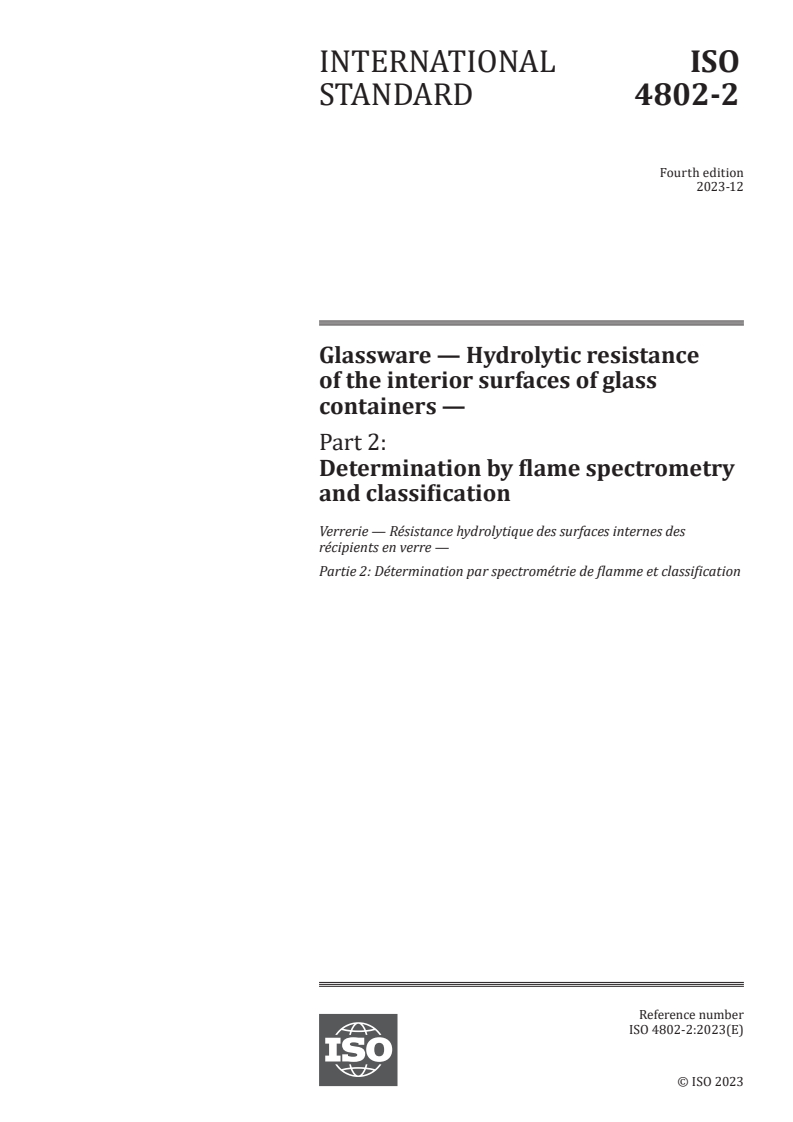
INTERNATIONAL ISO
STANDARD 4802-2
Fourth edition
2023-12
Glassware — Hydrolytic resistance
of the interior surfaces of glass
containers —
Part 2:
Determination by flame spectrometry
and classification
Verrerie — Résistance hydrolytique des surfaces internes des
récipients en verre —
Partie 2: Détermination par spectrométrie de flamme et classification
Reference number
© ISO 2023
All rights reserved. Unless otherwise specified, or required in the context of its implementation, no part of this publication may
be reproduced or utilized otherwise in any form or by any means, electronic or mechanical, including photocopying, or posting on
the internet or an intranet, without prior written permission. Permission can be requested from either ISO at the address below
or ISO’s member body in the country of the requester.
ISO copyright office
CP 401 • Ch. de Blandonnet 8
CH-1214 Vernier, Geneva
Phone: +41 22 749 01 11
Email: copyright@iso.org
Website: www.iso.org
Published in Switzerland
ii
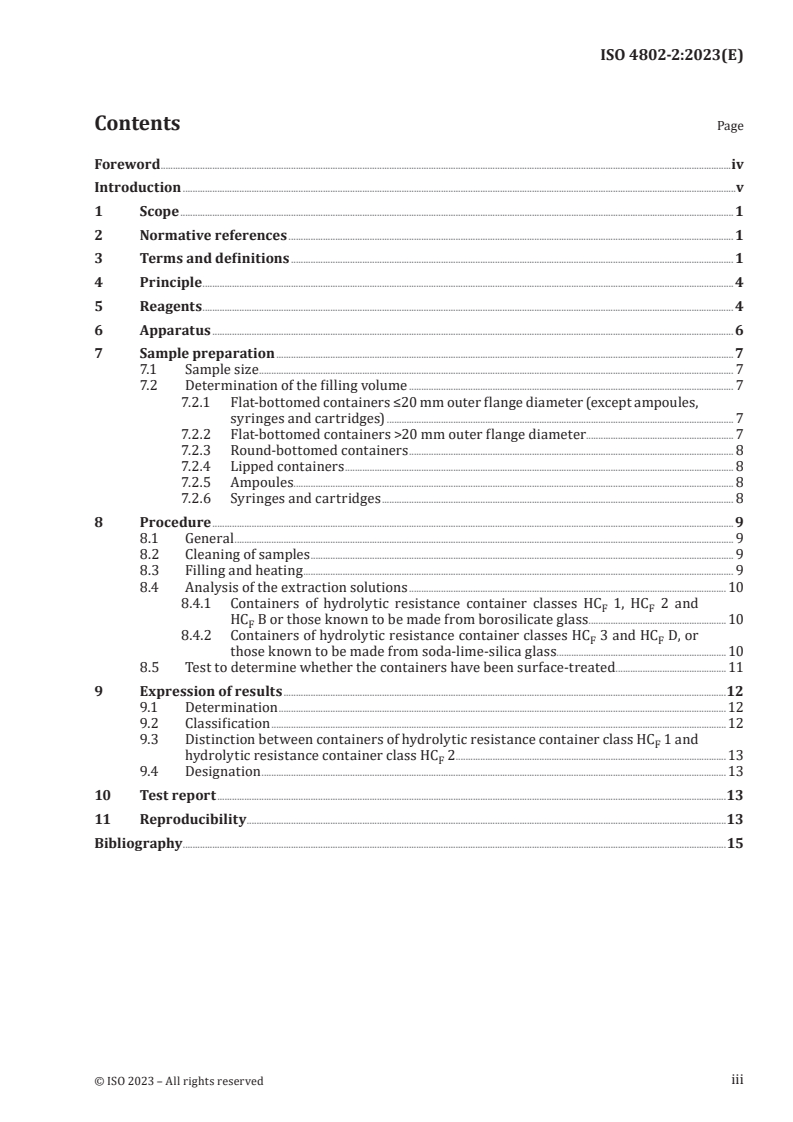
Contents Page
Foreword .iv
Introduction .v
1 Scope . 1
2 Normative references . 1
3 Terms and definitions . 1
4 Principle . 4
5 Reagents . 4
6 Apparatus . 6
7 Sample preparation .7
7.1 Sample size . 7
7.2 Determination of the filling volume . 7
7.2.1 Flat-bottomed containers ≤20 mm outer flange diameter (except ampoules,
syringes and cartridges) . 7
7.2.2 Flat-bottomed containers >20 mm outer flange diameter. 7
7.2.3 Round-bottomed containers . 8
7.2.4 Lipped containers . 8
7.2.5 Ampoules. 8
7.2.6 Syringes and cartridges . 8
8 Procedure .9
8.1 General . 9
8.2 Cleaning of samples . 9
8.3 Filling and heating . 9
8.4 Analysis of the extraction solutions . 10
8.4.1 Containers of hydrolytic resistance container classes HC 1, HC 2 and
F F
HC B or those known to be made from borosilicate glass . 10
F
8.4.2 Containers of hydrolytic resistance container classes HC 3 and HC D, or
F F
those known to be made from soda-lime-silica glass. 10
8.5 Test to determine whether the containers have been surface-treated. 11
9 Expression of results .12
9.1 Determination . 12
9.2 Classification .12
9.3 Distinction between containers of hydrolytic resistance container class HC 1 and
F
hydrolytic resistance container class HC 2 . 13
F
9.4 Designation . 13
10 Test report .13
11 Reproducibility .13
Bibliography .15
iii
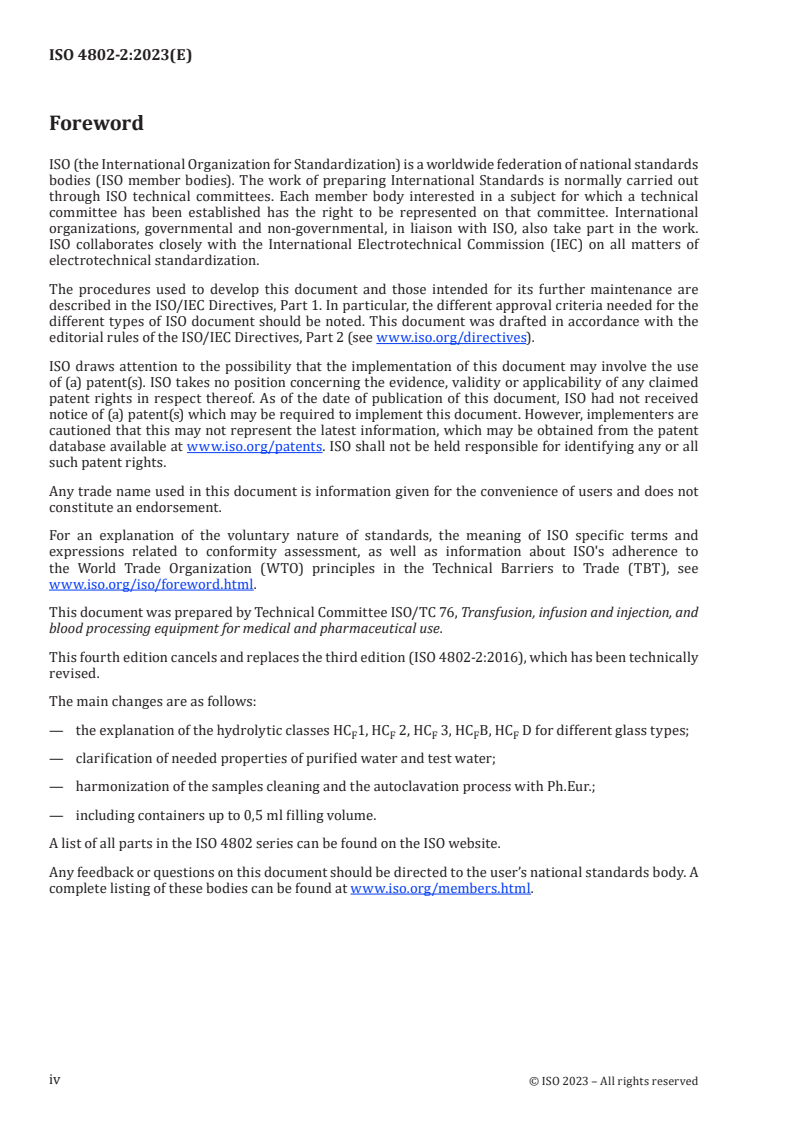
Foreword
ISO (the International Organization for Standardization) is a worldwide federation of national standards
bodies (ISO member bodies). The work of preparing International Standards is normally carried out
through ISO technical committees. Each member body interested in a subject for which a technical
committee has been established has the right to be represented on that committee. International
organizations, governmental and non-governmental, in liaison with ISO, also take part in the work.
ISO collaborates closely with the International Electrotechnical Commission (IEC) on all matters of
electrotechnical standardization.
The procedures used to develop this document and those intended for its further maintenance are
described in the ISO/IEC Directives, Part 1. In particular, the different approval criteria needed for the
different types of ISO document should be noted. This document was drafted in accordance with the
editorial rules of the ISO/IEC Directives, Part 2 (see www.iso.org/directives).
ISO draws attention to the possibility that the implementation of this document may involve the use
of (a) patent(s). ISO takes no position concerning the evidence, validity or applicability of any claimed
patent rights in respect thereof. As of the date of publication of this document, ISO had not received
notice of (a) patent(s) which may be required to implement this document. However, implementers are
cautioned that this may not represent the latest information, which may be obtained from the patent
database available at www.iso.org/patents. ISO shall not be held responsible for identifying any or all
such patent rights.
Any trade name used in this document is information given for the convenience of users and does not
constitute an endorsement.
For an explanation of the voluntary nature of standards, the meaning of ISO specific terms and
expressions related to conformity assessment, as well as information about ISO's adherence to
the World Trade Organization (WTO) principles in the Technical Barriers to Trade (TBT), see
www.iso.org/iso/foreword.html.
This document was prepared by Technical Committee ISO/TC 76, Transfusion, infusion and injection, and
blood processing equipment for medical and pharmaceutical use.
This fourth edition cancels and replaces the third edition (ISO 4802-2:2016), which has been technically
revised.
The main changes are as follows:
— the explanation of the hydrolytic classes HC 1, HC 2, HC 3, HC B, HC D for different glass types;
F F F F F
— clarification of needed properties of purified water and test water;
— harmonization of the samples cleaning and the autoclavation process with Ph.Eur.;
— including containers up to 0,5 ml filling volume.
A list of all parts in the ISO 4802 series can be found on the ISO website.
Any feedback or questions on this document should be directed to the user’s national standards body. A
complete listing of these bodies can be found at www.iso.org/members.html.
iv
Introduction
This document is largely based on a test method approved by the International Commission on Glass
(ICG), Technical Committee 2, Chemical Durability and Analysis, for measuring the hydrolytic resistance
of the interior surfaces of glass containers.
This document contains a classification which is related to but not equivalent to the classification set up
in ISO 4802-1 for the titration method.
The hydrolytic resistance of the inner glass surface is evaluated by determination of the released
alkali reacting ions. According to their hydrolytic resistance, glass containers are classified in defined
categories.
HC 1 glass containers are suitable for most preparations whether or not for parenteral administration.
F
HC 2 glass containers are suitable for most acidic and neutral, aqueous preparations whether or not for
F
parenteral administration.
HC 3 glass containers are in general suitable for non-aqueous preparations for parenteral
F
administration, for powders for parenteral administration (except for freeze-dried preparations) and
for preparations not for parenteral administration.
HC B glass containers are in general suitable for drinking ampoules (Container Class HGB 2 according
F
to ISO 719).
HC D glass containers are in general suitable for lower demands on hydrolytic resistance (Container
F
Class HGB 4 and HGB 5 according to ISO 719).
v
INTERNATIONAL STANDARD ISO 4802-2:2023(E)
Glassware — Hydrolytic resistance of the interior surfaces
of glass containers —
Part 2:
Determination by flame spectrometry and classification
1 Scope
This document specifies:
a) a method for determining the hydrolytic resistance of the interior surfaces of glass containers
when subjected to attack by water at (121 ± 1) °C for (60 ± 1) min. The resistance is measured by
determining the amount of sodium and other alkali metal or alkaline earth oxides in the extraction
solution using flame atomic emission or absorption spectrometry (flame spectrometry);
b) a classification of glass containers according to the hydrolytic resistance of the interior surfaces
determined by the methods specified in this document.
The test method specified in this document might not be applicable to containers whose surfaces have
been treated for functional modifications, e.g. silicone (e.g. containers that are ready for direct filling).
2 Normative references
The following documents are referred to in the text in such a way that some or all of their content
constitutes requirements of this document. For dated references, only the edition cited applies. For
undated references, the latest edition of the referenced document (including any amendments) applies.
ISO 385, Laboratory glassware — Burettes
ISO 719, Glass — Hydrolytic resistance of glass grains at 98 °C — Method of test and classification
ISO 720, Glass — Hydrolytic resistance of glass grains at 121 °C — Method of test and classification
ISO 1042, Laboratory glassware — One-mark volumetric flasks
ISO 3819, Laboratory glassware — Beakers
ISO 9187-1, Injection equipment for medical use — Part 1: Ampoules for injectables
3 Terms and definitions
For the purposes of this document, the following terms and definitions apply.
ISO and IEC maintain terminology databases for use in standardization at the following addresses:
— ISO Online browsing platform: available at https:// www .iso .org/ obp
— IEC Electropedia: available at https:// www .electropedia .org/
3.1
ampoule
small, normally flat-bottomed container having stems in many different forms
Note 1 to entry: Ampoules are usually thin-walled and have a capacity normally up to 30 ml. They are intended to
be closed, after filling, by flame sealing.
3.2
bottle
flat-bottomed container, made from moulded glass
Note 1 to entry: Bottles are normally thick-walled and have a capacity usually of more than 5 ml. They may be
of circular or other geometric cross-section. Bottles are sealed with a closure made from a material other than
glass, and not by flame-sealing.
3.3
brimful capacity
volume of water required to fill a container, placed on a flat, horizontal surface
3.4
container
article made from glass to be used as primary packaging material intended to come into direct contact
with a pharmaceutical preparation
EXAMPLE Bottles, vials, syringes, ampoules and cartridges. See also Figure 1.
Note 1 to entry: These containers are made from borosilicate or soda-lime-silica glass.
3.5
filling volume
defined volume of water to fill the test specimen
Note 1 to entry: For the determination of the filling volume, see 7.2. The filling volume is a test specific quantity
that is used to compare container sets from different sources or lots. It has no relation to the nominal product
volume.
3.6
borosilicate glass
silicate glass having a very high hydrolytic resistance due to its composition containing significant
amounts of boric oxide
Note 1 to entry: Borosilicate glass contains a mass fraction of boric oxide between 5 % and 13 %. This glass type
may also contain aluminium oxide and/or alkaline earth oxides.
Note 2 to entry: Neutral glass is a borosilicate glass having a very high hydrolytic resistance and a high thermal
shock resistance. When tested according to ISO 720, it meets the requirements of class HGA 1. Containers
properly made from this glass conform with hydrolytic resistance container class HC 1 of this document.
F
3.7
soda-lime-silica glass
silicate glass containing a mass fraction up to approximately 15 % of alkali metal oxides, mainly sodium
oxide, and a mass fraction up to about 15 % of alkaline earth oxides, mainly calcium oxide
Note 1 to entry: Containers made from this glass will have a moderate hydrolytic resistance due to the chemical
composition of the glass, and conform with hydrolytic resistance container class HC 3.
F
a) Example of a glass cylinder for a pen-injec- b) Example of an injection vial made of glass
tor/cartridge (see ISO 13926-1) tubing (see ISO 8362-1)
c) Example of a syringe glass barrel d) Example of a stem cut ampoule with con-
(see ISO 11040-4) striction (see ISO 9187-1)
Figure 1 — Examples of containers
3.8
surface treatment
treatment of the internal surface of glass containers with reagents in order to achieve a de-alkalized
surface and to produce a significantly lower release of alkali metal ions (and alkali earth metal ions)
Note 1 to entry: Surface treatment is used, for example, in order to change a soda-lime-silica glass container of
hydrolytic resistance class HC 3 to a container of hydrolytic resistance class HC 2 container. Treated containers
F F
are rinsed before use.
3.9
vial
small, flat-bottomed container, made from tubing or from moulded glass
Note 1 to entry: Vials are normally thick-walled and have a capacity up to 100 ml. They are normally sealed with
a closure made from a material other than glass, and not by flame-sealing.
4 Principle
This test method is a surface test applied to glass containers as produced and/or as delivered.
The containers to be tested are filled with specified water to a specified capacity. They are loosely
capped and then heated under specified conditions. The degree of the hydrolytic attack is measured
by flame spectrometric analysis of the extraction solutions. The measurement data shall be classified
in accordance with the limits defined in appropriate container specific limit values in accordance with
Table 2.
Dependent on different glass types, specific limit values are defined in the following:
The hydrolytic resistance is evaluated by determination of the released alkali reacting ions. According
to their hydrolytic resistance, glass containers are classified as follows:
— HC 1 glass containers: neutral glass, borosilicate glass with a high hydrolytic resistance due to the
F
chemical composition of the glass itself;
[12] [15]
NOTE 1 In the Ph.Eur. 3.2.1 and the USP <660> the hydrolytic resistance classification are designated
Type I.
— HC 2 glass containers: usually of soda-lime-silica glass with a high hydrolytic resistance resulting
F
from suitable treatment of the inner surface;
[12] [15]
NOTE 2 In the Ph.Eur. 3.2.1 and the USP <660> the hydrolytic resistance classification are designated
Type II.
— HC 3 glass containers: usually of soda-lime-silica glass with only moderate hydrolytic resistance;
F
[12] [15]
NOTE 3 In the Ph.Eur. 3.2.1 and the USP <660> the hydrolytic resistance classification are designated
Type III.
— HC B glass containers: usually made of borosilicate or soda-lime-silica glass composition with
F
higher hydrolytic resistance (container class: HGB 2 according to ISO 719);
— HC D glass containers: usually made of soda-lime-silica glass with low hydrolytic resistance
F
(container class: HGB 4 or HGB 5 according to ISO 719).
The index “F” indicates that the measures for the classification is based on Flame Spectrometry.
5 Reagents
During the test, unless otherwise stated, use only reagents of recognised analytical grade.
5.1 Test water, to be prepared as follows:
Prepare the test water from purified water (5.5) by multiple distillations. Remove the carbon dioxide
by boiling for at least 15 min before use in a boiling flask (6.3) of fused silica or borosilicate glass and
cool.
NOTE 1 Any other suitable method can be used, e.g. preparation of carbon dioxide-free water according to
[12] [15]
Ph.Eur. 3.2.1 , USP 660 .
When tested immediately before use, water prepared as described above shall produce an orange-
red (not violet-red or yellow) colour corresponding to the neutral point of methyl red indicator of
pH 5,5 ± 0,1 when 0,05 ml of methyl red indicator solution (5.5) is added to 50 ml of the water to be
examined.
This water may also be used as the reference solution (see 8.4).
The conductivity of the water shall not exceed 1 µS/cm, determined at 25 °C by an in-line conductivity
meter.
Where the use of test water is specified in the following analytical procedures the requirements for
bacterial endotoxins and microbial contamination are not relevant.
[12]
NOTE 2 This description is based on the Ph.Eur. 3.2.1 . In the Ph.Eur., water prepared as described above is
designated water R1.
[2]
NOTE 3 Water of Grade 2 according to ISO 3696 is suitable for this test.
5.2 Hydrochloric acid, solution, c(HCl) ≈ 2 mol/l.
5.3 Hydrochloric acid, solution, c(HCl) ≈ 6 mol/l (≈ 1 + 1).
5.4 Hydrofluoric acid, c(HF) ≈ 22 mol/l (i.e. ≈400 g HF/l solution).
CAUTION — Hydrofluoric acid is very toxic and highly corrosive. Consider using a material safety
data sheet.
5.5 Purified water, prepared by distillation, by ion exchange, by reverse osmosis or by any other
suitable method from water having drinking water quality.
Where the use of purified water is specified in the following analytical procedures, the requirements
for bacterial endotoxins and microbial contamination are not relevant.
NOTE 1 National or regional regulation on water intended for human consumption can apply.
NOTE 2 Water that corresponds to Grade 3 according to ISO 3696 is suitable.
[12]
NOTE 3 In the Ph.Eur. 3.2.1 , water as described above is designated water R.
5.6 Spectrochemical buffer solution (caesium chloride solution, CsCl).
Dissolve 80 g of caesium chloride in approximately 300 ml of test water (5.1), add 10 ml of hydrochloric
acid (5.3) and transfer to a 1 000 ml volumetric flask (6.3). Dilute to the mark with the test water (5.1)
and mix.
5.7 Stock solutions.
5.7.1 Dry sodium chloride, potassium chloride and calcium carbonate at (110 ± 5) °C for 2 h. Prepare
aqueous stock solutions, using the test water (5.1), directly from the chlorides and from the calcium
carbonate, after dissolving in the minimum amount of hydrochloric acid so that all solutions have
concentrations of 1 mg/ml, calculated as sodium oxide, potassium oxide and calcium oxide.
5.7.2 Commercially available standard solutions may also be used.
5.8 Standard solutions.
5.8.1 Prepare standard solutions by diluting the stock solutions (5.7) with the test water (5.1) to
obtain concentrations suitable for establishing the reference solutions in an appropriate manner, e.g.
with concentrations of 20 µg/ml of sodium oxide, potassium oxide and calcium oxide respectively.
5.8.2 Commercially available standard solutions may also be used.
5.9 Reference solutions.
The reference solutions for establishing the calibration graph (set of calibration solutions) shall be
prepared by diluting suitable concentrated standard solutions (5.8) with the
...
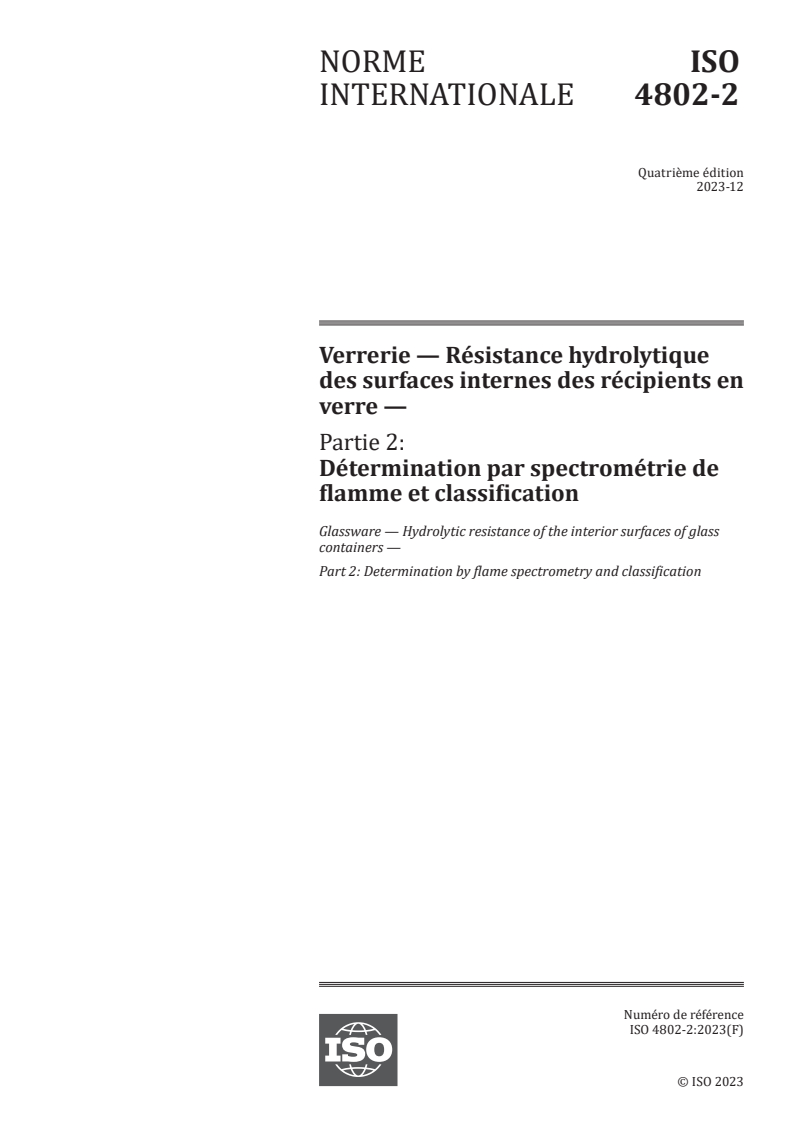
NORME ISO
INTERNATIONALE 4802-2
Quatrième édition
2023-12
Verrerie — Résistance hydrolytique
des surfaces internes des récipients en
verre —
Partie 2:
Détermination par spectrométrie de
flamme et classification
Glassware — Hydrolytic resistance of the interior surfaces of glass
containers —
Part 2: Determination by flame spectrometry and classification
Numéro de référence
DOCUMENT PROTÉGÉ PAR COPYRIGHT
© ISO 2023
Tous droits réservés. Sauf prescription différente ou nécessité dans le contexte de sa mise en œuvre, aucune partie de cette
publication ne peut être reproduite ni utilisée sous quelque forme que ce soit et par aucun procédé, électronique ou mécanique,
y compris la photocopie, ou la diffusion sur l’internet ou sur un intranet, sans autorisation écrite préalable. Une autorisation peut
être demandée à l’ISO à l’adresse ci-après ou au comité membre de l’ISO dans le pays du demandeur.
ISO copyright office
Case postale 401 • Ch. de Blandonnet 8
CH-1214 Vernier, Genève
Tél.: +41 22 749 01 11
E-mail: copyright@iso.org
Web: www.iso.org
Publié en Suisse
ii
Sommaire Page
Avant-propos .iv
Introduction .v
1 Domaine d’application . 1
2 Références normatives .1
3 Termes et définitions . 1
4 Principe. 4
5 Réactifs . 4
6 Appareillage . 6
7 Préparation des échantillons . 7
7.1 Taille de l’échantillon . 7
7.2 Détermination du volume de remplissage . 7
7.2.1 Récipients à fond plat d’un diamètre externe de col ≤ 20 mm (à l’exception
des ampoules, seringues et cartouches) . 7
7.2.2 Récipients à fond plat d’un diamètre externe de col > 20 mm . 8
7.2.3 Récipients à fond rond . 8
7.2.4 Récipients à bec . 8
7.2.5 Ampoules. 8
7.2.6 Seringues et cartouches . 8
8 Mode opératoire . 9
8.1 Généralités . 9
8.2 Nettoyage des échantillons . 9
8.3 Remplissage et chauffage . 9
8.4 Analyse des solutions d’extraction . 10
8.4.1 Récipients des classes de résistance hydrolytique de récipient HC 1, HC 2
F F
et HC B ou ceux connus comme étant en verre borosilicaté . 10
F
8.4.2 Récipients des classes de résistance hydrolytique de récipient HC 3
F
et HC D ou ceux connus comme étant en verre de silicate sodocalcique . 11
F
8.5 Essai permettant de déterminer si les récipients ont subi un traitement de surface . 11
9 Expression des résultats .12
9.1 Détermination . 12
9.2 Classification .12
9.3 Distinction entre les récipients de la classe de résistance hydrolytique de récipient
HC 1 et la classe de résistance hydrolytique de récipient HC 2 .13
F F
9.4 Désignation . 13
10 Rapport d’essai .13
11 Reproductibilité .14
Bibliographie .15
iii
Avant-propos
L'ISO (Organisation internationale de normalisation) est une fédération mondiale d'organismes
nationaux de normalisation (comités membres de l'ISO). L'élaboration des Normes internationales est
en général confiée aux comités techniques de l'ISO. Chaque comité membre intéressé par une étude
a le droit de faire partie du comité technique créé à cet effet. Les organisations internationales,
gouvernementales et non gouvernementales, en liaison avec l'ISO participent également aux travaux.
L'ISO collabore étroitement avec la Commission électrotechnique internationale (IEC) en ce qui
concerne la normalisation électrotechnique.
Les procédures utilisées pour élaborer le présent document et celles destinées à sa mise à jour sont
décrites dans les Directives ISO/IEC, Partie 1. Il convient, en particulier, de prendre note des différents
critères d'approbation requis pour les différents types de documents ISO. Le présent document a
été rédigé conformément aux règles de rédaction données dans les Directives ISO/IEC, Partie 2 (voir
www.iso.org/directives).
L’ISO attire l’attention sur le fait que la mise en application du présent document peut entraîner
l’utilisation d’un ou de plusieurs brevets. L’ISO ne prend pas position quant à la preuve, à la validité
et à l’applicabilité de tout droit de brevet revendiqué à cet égard. À la date de publication du présent
document, l’ISO n'avait pas reçu notification qu’un ou plusieurs brevets pouvaient être nécessaires à sa
mise en application. Toutefois, il y a lieu d’avertir les responsables de la mise en application du présent
document que des informations plus récentes sont susceptibles de figurer dans la base de données de
brevets, disponible à l'adresse www.iso.org/brevets. L’ISO ne saurait être tenue pour responsable de ne
pas avoir identifié tout ou partie de tels droits de propriété.
Les appellations commerciales éventuellement mentionnées dans le présent document sont données
pour information, par souci de commodité, à l’intention des utilisateurs et ne sauraient constituer un
engagement.
Pour une explication de la nature volontaire des normes, la signification des termes et expressions
spécifiques de l'ISO liés à l'évaluation de la conformité, ou pour toute information au sujet de l'adhésion
de l'ISO aux principes de l’Organisation mondiale du commerce (OMC) concernant les obstacles
techniques au commerce (OTC), voir www.iso.org/avant-propos.
Le présent document a été élaboré par le comité technique ISO/TC 76, Appareils de transfusion,
de perfusion et d’injection et appareils destinés au traitement du sang à usage médical et pharmaceutique.
Cette quatrième édition annule et remplace la troisième édition (ISO 4802-2:2016), qui a fait l’objet
d’une révision technique.
Les principales modifications sont les suivantes:
— explication des classes hydrolytiques HC 1, HC 2, HC 3, HC B, HC D pour différents types de
F F F F F
verres;
— clarification des propriétés nécessaires de l’eau purifiée et de l’eau d’essai;
— harmonisation du processus de nettoyage des échantillons et d’autoclavage avec la Ph. Eur.;
— intégration des récipients ayant un volume de remplissage allant jusqu’à 0,5 ml.
Une liste de toutes les parties de la série ISO 4802 se trouve sur le site web de l’ISO.
Il convient que l’utilisateur adresse tout retour d’information ou toute question concernant le présent
document à l’organisme national de normalisation de son pays. Une liste exhaustive desdits organismes
se trouve à l’adresse www.iso.org/fr/members.html.
iv
Introduction
Le présent document s’appuie en grande partie sur une méthode d’essai approuvée par la Commission
internationale du verre (ICG), comité technique 2, Durabilité chimique et analyse, pour mesurer la
résistance hydrolytique des surfaces internes des récipients en verre.
Le présent document contient une classification qui est liée, mais n’est pas équivalente, à la classification
établie dans l’ISO 4802-1 pour l’analyse titrimétrique.
La résistance hydrolytique de la surface interne du verre est évaluée par détermination des ions réactifs
alcalins relargués. En fonction de leur résistance hydrolytique, les récipients en verre sont classés dans
des catégories définies.
Les récipients en verre HC 1 conviennent à la plupart des préparations, qu’elles soient ou non destinées
F
à une administration parentérale.
Les récipients en verre HC 2 conviennent à la plupart des préparations aqueuses acides et neutres,
F
qu’elles soient ou non destinées à une administration parentérale.
Les récipients en verre HC 3 conviennent en général aux préparations non aqueuses destinées à une
F
administration parentérale, aux poudres destinées à une administration parentérale (à l’exception
des préparations lyophilisées) et aux préparations qui ne sont pas destinées à une administration
parentérale.
Les récipients en verre HC B conviennent généralement aux ampoules à boire (classe de récipient
F
HGB 2 selon l’ISO 719).
Les récipients en verre HC D conviennent généralement à des exigences plus faibles de résistance
F
hydrolytique (classes de récipient HGB 4 et HGB 5 selon l’ISO 719).
v
NORME INTERNATIONALE ISO 4802-2:2023(F)
Verrerie — Résistance hydrolytique des surfaces internes
des récipients en verre —
Partie 2:
Détermination par spectrométrie de flamme et
classification
1 Domaine d’application
Le présent document spécifie:
a) une méthode de détermination de la résistance hydrolytique des surfaces internes des récipients
en verre lorsqu’ils sont soumis à l’attaque de l’eau à (121 ± 1) °C durant (60 ± 1) min. La résistance
hydrolytique est mesurée par détermination de la quantité d’oxyde de sodium et d’autres
d’oxydes métalliques alcalins ou alcalino-terreux dans la solution d’extraction par spectrométrie
d’absorption ou d’émission atomique de flamme (spectrométrie de flamme);
b) une classification des récipients en verre selon la résistance hydrolytique des surfaces internes
déterminée par la méthode spécifiée dans le présent document.
La méthode d’essai spécifiée dans le présent document peut ne pas être applicable aux récipients dont
les surfaces ont été traitées pour des modifications fonctionnelles, comme le silicone (les récipients
prêts pour le remplissage direct, par exemple).
2 Références normatives
Les documents suivants sont cités dans le texte de sorte qu’ils constituent, pour tout ou partie de leur
contenu, des exigences du présent document. Pour les références datées, seule l’édition citée s’applique.
Pour les références non datées, la dernière édition du document de référence s'applique (y compris les
éventuels amendements).
ISO 385, Verrerie de laboratoire — Burettes
ISO 719, Verre — Résistance hydrolytique du verre en grains à 98 °C — Méthode d'essai et classification
ISO 720, Verre — Résistance hydrolytique du verre en grains à 121 °C — Méthode d'essai et classification
ISO 1042, Verrerie de laboratoire — Fioles jaugées à un trait
ISO 3819, Verrerie de laboratoire — Béchers
ISO 9187-1, Matériel d'injection à usage médical — Partie 1: Ampoules pour produits injectables
3 Termes et définitions
Pour les besoins du présent document, les termes et définitions suivants s’appliquent.
L’ISO et l’IEC tiennent à jour des bases de données terminologiques destinées à être utilisées en
normalisation, consultables aux adresses suivantes:
— ISO Online browsing platform: disponible à l’adresse https:// www .iso .org/ obp
— IEC Electropedia: disponible à l’adresse https:// www .electropedia .org/
3.1
ampoule
petit récipient normalement à fond plat et effilé aux extrémités selon différentes formes
Note 1 à l'article: Les ampoules ont généralement une paroi mince et une capacité allant jusqu’à 30 ml. Elles sont
destinées à être fermées, après remplissage, par scellage à la flamme.
3.2
bouteille
récipient à fond plat, en verre moulé
Note 1 à l'article: Les bouteilles ont généralement une paroi épaisse et une capacité supérieure à 5 ml.
Elles peuvent être cylindriques ou de section transversale ayant d’autres formes géométriques. Les bouteilles
sont bouchées à l’aide d’une fermeture en un matériau autre que le verre et non par scellage à la flamme.
3.3
capacité à ras bord
volume d’eau nécessaire pour remplir un récipient, placé sur une surface plane et horizontale
3.4
récipient
article en verre servant de conditionnement primaire, conçu pour être en contact direct avec une
préparation pharmaceutique
EXEMPLE Bouteilles, flacons, seringues, ampoules et cartouches. Voir également la Figure 1.
Note 1 à l'article: Ces récipients sont en verre borosilicaté ou en verre de silicate sodo-calcique.
3.5
volume de remplissage
volume d’eau défini pour remplir l’échantillon
Note 1 à l'article: Pour la détermination du volume de remplissage, voir 7.2. Le volume de remplissage est une
quantité spécifique à l’essai permettant de comparer plusieurs récipients issus de différentes sources ou lots. Il
n’a aucun lien avec le volume nominal du produit.
3.6
verre borosilicaté
verre silicaté ayant une très haute résistance hydrolytique en raison de sa composition et contenant des
quantités importantes d’oxyde de bore
Note 1 à l'article: Le verre borosilicaté contient une fraction massique d’oxyde de bore comprise entre 5 % et
13 %. Ce type de verre peut également contenir de l’oxyde d’aluminium et/ou des oxydes alcalino-terreux.
Note 2 à l'article: Le verre neutre est un verre borosilicaté ayant une très haute résistance hydrolytique et
une résistance au choc thermique élevée. Lorsqu’il est soumis à essai conformément à l’ISO 720, il satisfait aux
exigences de la classe HGA 1. Les récipients correctement fabriqués à partir de ce verre sont conformes à la classe
de résistance hydrolytique de récipient HC 1 du présent document.
F
3.7
verre de silicate sodocalcique
verre silicaté contenant une fraction massique allant jusqu’à environ 15 % d’oxydes de métaux alcalins,
principalement de l’oxyde de sodium, et une fraction massique allant jusqu’à environ 15 % d’oxydes
alcalino-terreux, principalement de l’oxyde de calcium
Note 1 à l'article: Les récipients fabriqués à partir de ce verre ont une résistance hydrolytique modérée en raison
de la composition chimique du verre et sont conformes à la classe de résistance hydrolytique de récipient HC 3.
F
a) Exemple de cylindre en verre pour stylo-in- b) Exemple de flacon pour produit injectable
jecteur/cartouche (voir l’ISO 13926-1) en verre étiré (voir l’ISO 8362-1)
c) Exemple de corps de seringue en verre d) Exemple d’ampoule à col coupé avec étran-
(voir l’ISO 11040-4) glement (voir l’ISO 9187-1)
Figure 1 — Exemples de récipients
3.8
traitement de surface
traitement de la surface interne des récipients en verre avec des réactifs en vue d’obtenir une surface
exempte d’alcalins et de produire un abaissement significatif du relargage d’ions de métaux alcalins
(et d’ions de métaux alcalino-terreux)
Note 1 à l'article: Un traitement de surface est utilisé, par exemple, pour transformer un récipient en verre de
silicate sodocalcique de la classe de résistance hydrolytique HC 3 en un récipient de la classe de résistance
F
hydrolytique HC 2. Les récipients traités sont rincés avant utilisation.
F
3.9
flacon
petit récipient à fond plat, fabriqué à partir de verre étiré ou de verre moulé
Note 1 à l'article: Les flacons ont normalement une paroi épaisse et une capacité allant jusqu’à 100 ml. Ils sont
normalement bouchés à l’aide d’une fermeture en un matériau autre que le verre et non par scellage à la flamme.
4 Principe
La présente méthode d’essai est un essai de surface appliqué aux récipients en verre tels qu’ils sont
produits et/ou tels qu’ils sont livrés.
Les récipients à soumettre à essai sont remplis avec une eau spécifiée jusqu’à une capacité déterminée.
Ils sont bouchés de manière non étanche, puis chauffés dans des conditions définies. Le degré de l’attaque
hydrolytique est mesuré par spectrométrie de flamme des solutions d’extraction. Les mesures doivent
être classées selon les valeurs limites adéquates propres au récipient, conformément au Tableau 2.
Selon les différents types de verre, des valeurs limites spécifiques sont définies ci-après.
La résistance hydrolytique est évaluée par détermination des ions réactifs alcalins relargués.
En fonction de leur résistance hydrolytique, les récipients en verre sont classés comme suit:
— récipients en verre HC 1: verre neutre, verre borosilicaté ayant une haute résistance hydrolytique
F
en raison de la composition chimique du verre lui-même;
[12] [15]
NOTE 1 Dans la Ph. Eur. 3.2.1 et l’USP <660> , la classification de la résistance hydrolytique est désignée
Type I.
— récipients en verre HC 2: généralement en verre de silicate sodocalcique ayant une résistance
F
hydrolytique élevée du fait d’un traitement approprié de la surface interne;
[12] [15]
NOTE 2 Dans la Ph. Eur. 3.2.1 et l’USP <660> la classification de la résistance hydrolytique est désignée
Type II.
— récipients en verre HC 3: généralement en verre de silicate sodocalcique ayant seulement une
F
résistance hydrolytique modérée;
[12] [15]
NOTE 3 Dans la Ph. Eur. 3.2.1 et l’USP <660> la classification de la résistance hydrolytique est désignée
Type III.
— récipients en verre HC B: généralement en verre borosilicaté ou en verre de silicate sodocalcique
F
ayant une résistance hydrolytique plus élevée (classe de récipient: HGB 2 selon l’ISO 719);
— récipients en verre HC D: généralement en verre de silicate sodocalcique ayant une faible résistance
F
hydrolytique (classe de récipient: HGB 4 ou HGB 5 selon l’ISO 719).
L’indice «F» indique que les mesures de la classification se basent sur la spectrométrie de flamme.
5 Réactifs
Au cours de l’essai, sauf indication contraire, utiliser uniquement des réactifs de qualité analytique
reconnue.
5.1 Eau d’essai, à préparer comme suit:
Préparer l’eau d’essai à partir d’eau purifiée (5.5) en effectuant plusieurs distillations. Chasser le dioxyde
de carbone par ébullition pendant au moins 15 min avant utilisation dans une fiole à ébullition (6.3) en
silice fondue ou en verre borosilicaté, puis laisser refroidir.
NOTE 1 Toute autre méthode appropriée peut être utilisée, par exemple la préparation d’eau exempte de
[12] [15]
dioxyde de carbone conformément à la Ph. Eur. 3.2.1 ou à l’USP 660 .
Lorsqu’elle est soumise à essai juste avant emploi, l’eau préparée comme décrit ci-dessus doit donner
une couleur rouge-orangé (et non pas rouge-violet ou jaune) correspondant au point neutre de la
solution d’indicateur de rouge de méthyle de pH 5,5 ± 0,1 lorsque 0,05 ml de solution d’indicateur de
rouge de méthyle (5.5) est ajouté à 50 ml de l’eau à examiner.
Cette eau peut également être utilisée comme solution standard (voir 8.4).
La conductivité de l’eau ne doit pas dépasser 1 µS/cm, déterminée à 25 °C par un conductimètre en
ligne.
Lorsque l’utilisation d’eau d’essai est spécifiée dans les modes opératoires d’analyse suivants,
les exigences relatives aux endotoxines bactériennes et à la contamination microbienne ne sont pas
requises.
[12]
NOTE 2 Cette description se fonde sur la Ph. Eur. 3.2.1 . Dans la Ph. Eur., l’eau préparée comme décrit ci-
dessus est désignée eau R1.
[2]
NOTE 3 L’eau de qualité 2 conformément à l’ISO 3696 convient à cet essai.
5.2 Acide chlorhydrique, solution, c(HCl) ≈ 2 mol/l.
5.3 Acide chlorhydrique, solution, c(HCl) ≈ 6 mol/l (≈ 1 + 1).
5.4 Acide fluorhydrique, c(HF) ≈ 22 mol/l (c’est-à-dire solution à ≈400 g HF/l).
ATTENTION — L’acide fluorhydrique est très toxique et extrêmement corrosif. Se référer à la
fiche de données de sécurité.
5.5 Eau purifiée, préparée par distillation, par échange d’ions, par osmose inverse ou par toute autre
méthode appropriée à partir d’eau ayant la qualité de l’eau potable.
Lorsque l’utilisation d’eau purifiée est spécifiée dans les modes opératoires d’analyse suivants,
les exigences relatives aux endotoxines bactériennes et à la contamination microbienne ne sont pas
requises.
NOTE 1 La réglementation nationale ou régionale relative à l’eau destinée à la consommation humaine peut
s’appliquer.
NOTE 2 L’eau qui correspond à la qualité 3 conformément à l’ISO 3696 convient.
[12]
NOTE 3 Dans la Ph. Eur. 3.2.1 , l’eau décrite ci-dessus est désignée eau R.
5.6 Solution tampon spectrochimique (solution de chlorure de césium, CsCl).
Dissoudre 80 g de chlorure de césium dans environ 300 ml d’eau d’essai (5.1), ajouter 10 ml d’acide
chlorhydrique (5.3) et transvaser dans une fiole jaugée de 1 000 ml (6.3). Diluer au volume avec de l’eau
d’essai (5.1) et homogénéiser.
5.7 Solutions mères
5.7.1 Sécher les chlorures de sodium et de potassium et le carbonate de calcium à (110 ± 5) °C durant
2 h. Préparer des solutions mères aqueuses en utilisant de l’eau d’essai (5.1), directement à partir des
chlorures et du carbonate de calcium, par dissolution dans la quantité minimale d’acide chlorhydrique,
de sorte que toutes les solutions contiennent respectivement 1 mg/ml d’oxyde de sodium, d’oxyde de
potassium et d’oxyde de calcium.
5.7.2 Des solutions étalons disponibles dans le commerce peuvent également être utilisées.
5.8 Solutions étalons
5.8.1 Préparer les solutions étalons en diluant les solutions mères (5.7) avec de l’eau d’essai (5.1) pour
obtenir les concentrations appropriées pour la préparation des solutions standard selon une procédure
convenable, par exemple avec des concentrations respectives de 20 µg/ml d’oxyde de sodium, d’oxyde de
potassium et d’oxyde de calcium.
5.8.2 Des solutions étalons disponibles dans le commerce peuvent également être utilisées.
5.9 Solutions standard
Les solutions standard permettant d’établir la courbe d’étalonnage (gamme d’étalonnage) doivent être
préparées en diluant les solutions étalons (5.8) concentrées appropriées avec de l’eau d’essai (5.1). Elles
doivent couvrir de manière optimale les domaines de mesure des éléments spécifiques, selon l’appareil
utilisé pour la mesure. Les domaines de concentration type des solutions standard sont:
— pour la détermination par spectrométrie d’émission atomique de flamme (SEAF) d’oxyde de sodium
et d’oxyde de potassium: jusqu’à 10 µg/ml;
— pour la détermination par spectrométrie d’absorption atomique de flamme (SAAF) de l’oxyde de
sodium et de l’oxyde de potassium: jusqu’à 3 µg/ml;
— pour la détermin
...