


ISO/FDIS 22915-13
(Main)Industrial trucks — Verification of stability — Part 13: Rough-terrain trucks with mast
Industrial trucks — Verification of stability — Part 13: Rough-terrain trucks with mast
Chariots de manutention — Vérification de la stabilité — Partie 13: Chariots tout-terrain à mât
General Information
- Status
- Not Published
- Technical Committee
- ISO/TC 110/SC 4 - Rough-terrain trucks
- Drafting Committee
- ISO/TC 110/SC 4/WG 10 - Stability
- Current Stage
- 5020 - FDIS ballot initiated: 2 months. Proof sent to secretariat
- Start Date
- 22-Jan-2026
- Completion Date
- 22-Jan-2026
Relations
- Consolidated By
ISO 9241-5:2024 - Ergonomics of human-system interaction — Part 5: Workstation layout and postural requirements - Effective Date
- 31-Dec-2022
- Effective Date
- 23-Apr-2020
- Effective Date
- 23-Apr-2020
Overview
ISO/FDIS 22915-13:2026 specifies the international standard for the verification of stability of rough-terrain industrial trucks equipped with a mast and rated to carry loads up to 10,000 kg. This standard targets rough-terrain counterbalanced trucks with fork arms or other load handling attachments and provides detailed test methods to ensure operational safety and performance under various conditions. It excludes trucks designed for freight container handling and variable-reach trucks with vertical mast attachments, covered in other parts of the ISO 22915 series.
Developed by ISO Technical Committee ISO/TC 110, Subcommittee SC 4, this standard reflects state-of-the-art requirements for verifying truck stability on tilt tables, ensuring alignment with regional safety criteria. The document is essential for manufacturers, testing bodies, and safety inspectors working with rough-terrain trucks to guarantee adherence to globally recognized safety benchmarks.
Key Topics
Test Conditions and Procedures
ISO/FDIS 22915-13 outlines five distinct tests simulating different stability scenarios involving lateral and longitudinal tilting, lifting heights, load positions, and truck orientations on a tilt table. These tests include:- Load and drive/steer axle positioning
- Stabilizer and axle oscillation locking usage
- Elevation of mast and load handling attachments with defined datum points
- Specific lateral test procedures including operator-selectable stabilizers and chassis leveling
- Regional tilt table slope variations based on geographic safety requirements
Truck Positioning on Tilt Table
Detailed instructions specify the proper truck orientation for each test type to accurately simulate real-world operating conditions-whether the truck is aligned straight or in a turning position, considering articulated chassis and axles.Load Handling and Lift Height
The standard requires tests at both travel height (typically 500 mm above the tilt table) and maximum lift height, with controls for backward tilt and load center displacement to realistically replicate operational stresses affecting truck stability.Verification Criteria
Stability verification is rigorously defined with test-specific criteria and pass/fail thresholds. Special emphasis is placed on lateral slope corrections and the interaction between stabilizers and axle locking mechanisms to ensure effectiveness in maintaining stability.Regional Safety Requirements
Recognizing diverse regional standards, the verification slopes vary-for example, North America requires a 6% slope for Test 1 and a 10% slope for Test 3, whereas other regions call for 7% and 12%, respectively. This ensures international applicability while respecting local regulations.
Applications
ISO/FDIS 22915-13:2026 is applied primarily in:
Manufacturing and Quality Assurance
Industrial truck manufacturers utilize the standard to design and validate rough-terrain trucks that meet global safety and stability criteria before market release.Safety Certification and Compliance Testing
Certification bodies rely on the test procedures for certifying rough-terrain trucks' stability performance, which is critical for operator safety and regulatory compliance.Fleet Operations Management
Operators and safety managers deploy these stability verification methods in routine inspections and maintenance to prevent accidents related to tipping or loss of control on uneven terrain.Research and Development
Engineers and designers use the requirements to innovate features such as advanced stabilizers, chassis articulation, and load handling systems that improve rough-terrain stability.
Related Standards
ISO 22915-1: Industrial trucks - Verification of stability - Part 1: General
Provides foundational principles and terminology referenced in ISO 22915-13 for test methods and definitions.ISO 22915-9: Industrial trucks - Verification of stability - Part 9: Counterbalance trucks with mast handling freight containers
Covers stability verification for trucks handling freight containers, distinct from but complementary to Part 13.ISO 5053-1: Industrial trucks - Vocabulary - Part 1: Types of industrial trucks
Establishes terms and definitions critical for correct interpretation of ISO 22915-13 requirements.
Understanding and implementing ISO/FDIS 22915-13 helps ensure the manufacturing and operation of safe, reliable rough-terrain trucks capable of stable performance in demanding environments. Compliance with this standard supports global harmonization of safety practices and facilitates international trade of industrial truck equipment.
Buy Documents
ISO/FDIS 22915-13 - Industrial trucks — Verification of stability — Part 13: Rough-terrain trucks with mast Released:8. 01. 2026
REDLINE ISO/FDIS 22915-13 - Industrial trucks — Verification of stability — Part 13: Rough-terrain trucks with mast Released:8. 01. 2026
Frequently Asked Questions
ISO/FDIS 22915-13 is a draft published by the International Organization for Standardization (ISO). Its full title is "Industrial trucks — Verification of stability — Part 13: Rough-terrain trucks with mast". This standard covers: Industrial trucks — Verification of stability — Part 13: Rough-terrain trucks with mast
Industrial trucks — Verification of stability — Part 13: Rough-terrain trucks with mast
ISO/FDIS 22915-13 is classified under the following ICS (International Classification for Standards) categories: 53.060 - Industrial trucks. The ICS classification helps identify the subject area and facilitates finding related standards.
ISO/FDIS 22915-13 has the following relationships with other standards: It is inter standard links to ISO 9241-5:2024, ISO 22915-13:2012/Cor 1:2013, ISO 22915-13:2012. Understanding these relationships helps ensure you are using the most current and applicable version of the standard.
ISO/FDIS 22915-13 is available in PDF format for immediate download after purchase. The document can be added to your cart and obtained through the secure checkout process. Digital delivery ensures instant access to the complete standard document.
Standards Content (Sample)
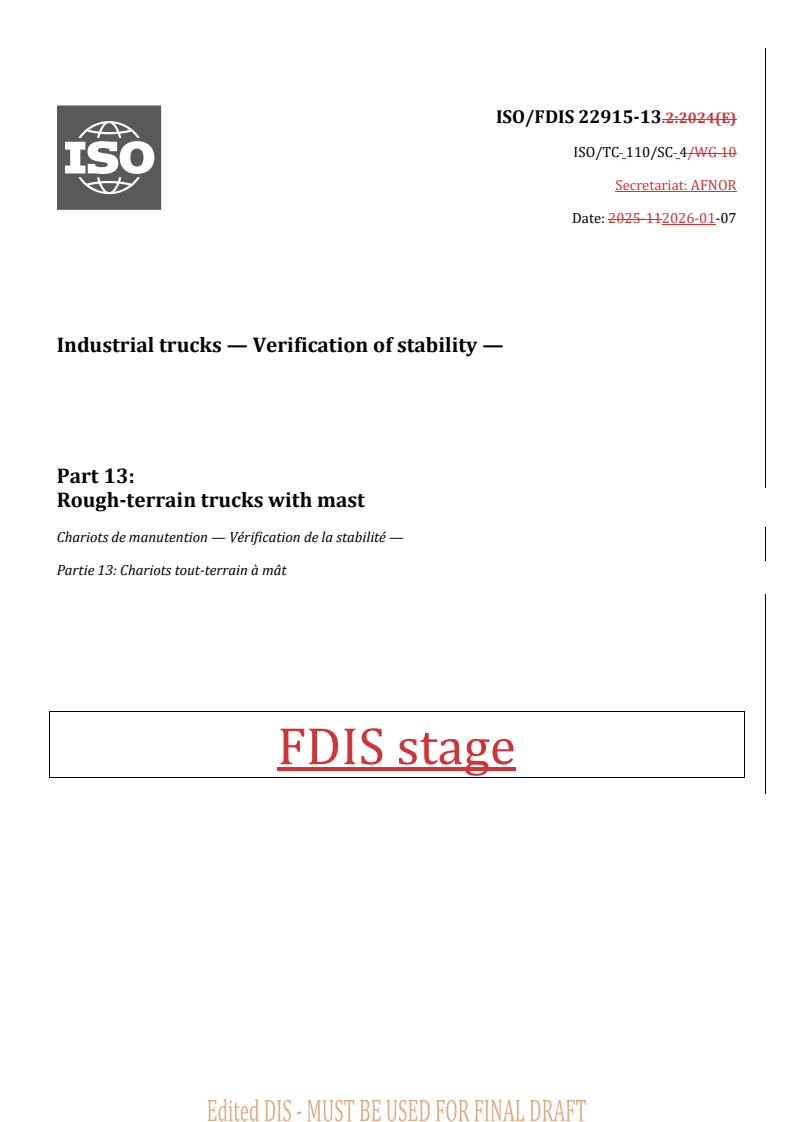
FINAL DRAFT
International
Standard
ISO/TC 110/SC 4
Industrial trucks — Verification of
Secretariat: AFNOR
stability —
Voting begins on:
2026-01-22
Part 13:
Rough-terrain trucks with mast
Voting terminates on:
2026-03-19
Chariots de manutention — Vérification de la stabilité —
Partie 13: Chariots tout-terrain à mât
RECIPIENTS OF THIS DRAFT ARE INVITED TO SUBMIT,
WITH THEIR COMMENTS, NOTIFICATION OF ANY
RELEVANT PATENT RIGHTS OF WHICH THEY ARE AWARE
AND TO PROVIDE SUPPOR TING DOCUMENTATION.
IN ADDITION TO THEIR EVALUATION AS
BEING ACCEPTABLE FOR INDUSTRIAL, TECHNO-
LOGICAL, COMMERCIAL AND USER PURPOSES, DRAFT
INTERNATIONAL STANDARDS MAY ON OCCASION HAVE
TO BE CONSIDERED IN THE LIGHT OF THEIR POTENTIAL
TO BECOME STAN DARDS TO WHICH REFERENCE MAY BE
MADE IN NATIONAL REGULATIONS.
Reference number
FINAL DRAFT
International
Standard
ISO/TC 110/SC 4
Industrial trucks — Verification of
Secretariat: AFNOR
stability —
Voting begins on:
Part 13:
Rough-terrain trucks with mast
Voting terminates on:
Chariots de manutention — Vérification de la stabilité —
Partie 13: Chariots tout-terrain à mât
RECIPIENTS OF THIS DRAFT ARE INVITED TO SUBMIT,
WITH THEIR COMMENTS, NOTIFICATION OF ANY
RELEVANT PATENT RIGHTS OF WHICH THEY ARE AWARE
AND TO PROVIDE SUPPOR TING DOCUMENTATION.
© ISO 2026
IN ADDITION TO THEIR EVALUATION AS
All rights reserved. Unless otherwise specified, or required in the context of its implementation, no part of this publication may
BEING ACCEPTABLE FOR INDUSTRIAL, TECHNO-
LOGICAL, COMMERCIAL AND USER PURPOSES, DRAFT
be reproduced or utilized otherwise in any form or by any means, electronic or mechanical, including photocopying, or posting on
INTERNATIONAL STANDARDS MAY ON OCCASION HAVE
the internet or an intranet, without prior written permission. Permission can be requested from either ISO at the address below
TO BE CONSIDERED IN THE LIGHT OF THEIR POTENTIAL
or ISO’s member body in the country of the requester.
TO BECOME STAN DARDS TO WHICH REFERENCE MAY BE
MADE IN NATIONAL REGULATIONS.
ISO copyright office
CP 401 • Ch. de Blandonnet 8
CH-1214 Vernier, Geneva
Phone: +41 22 749 01 11
Email: copyright@iso.org
Website: www.iso.org
Published in Switzerland Reference number
ii
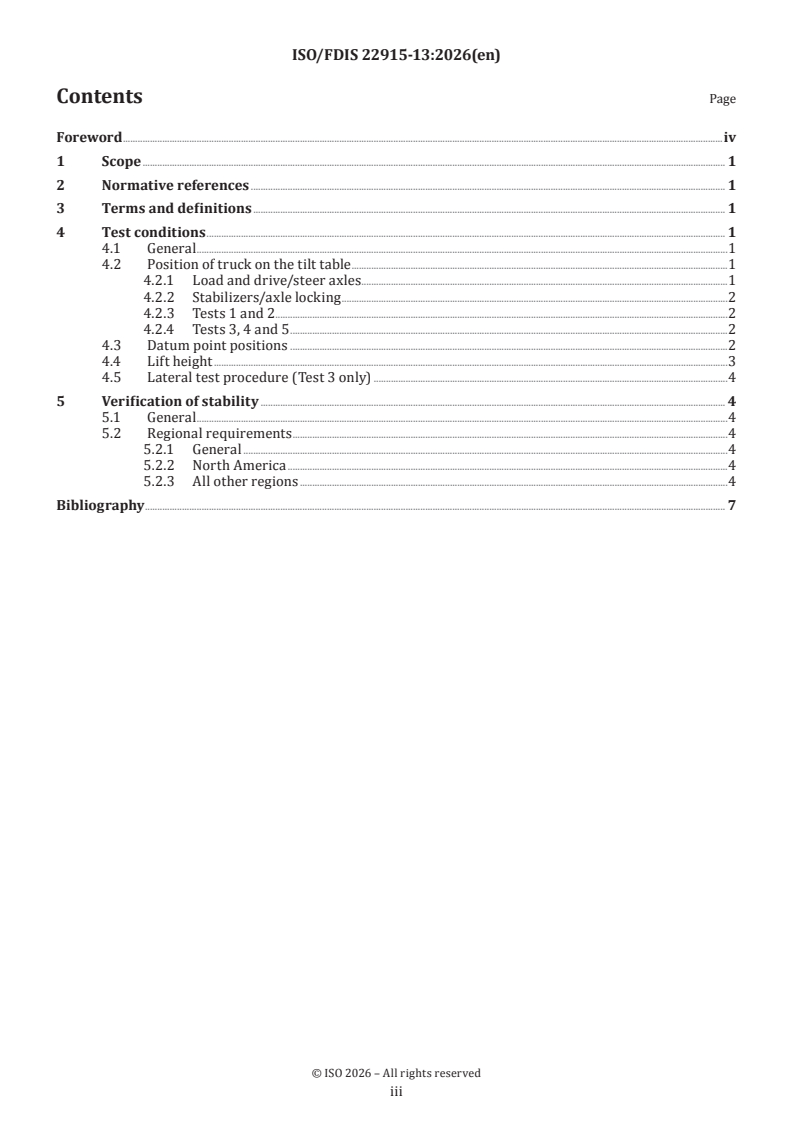
Contents Page
Foreword .iv
1 Scope . 1
2 Normative references . 1
3 Terms and definitions . 1
4 Test conditions . 1
4.1 General .1
4.2 Position of truck on the tilt table .1
4.2.1 Load and drive/steer axles .1
4.2.2 Stabilizers/axle locking .2
4.2.3 Tests 1 and 2 .2
4.2.4 Tests 3, 4 and 5 .2
4.3 Datum point positions .2
4.4 Lift height .3
4.5 Lateral test procedure (Test 3 only) .4
5 Verification of stability . 4
5.1 General .4
5.2 Regional requirements .4
5.2.1 General .4
5.2.2 North America .4
5.2.3 All other regions .4
Bibliography . 7
iii
Foreword
ISO (the International Organization for Standardization) is a worldwide federation of national standards
bodies (ISO member bodies). The work of preparing International Standards is normally carried out through
ISO technical committees. Each member body interested in a subject for which a technical committee
has been established has the right to be represented on that committee. International organizations,
governmental and non-governmental, in liaison with ISO, also take part in the work. ISO collaborates closely
with the International Electrotechnical Commission (IEC) on all matters of electrotechnical standardization.
The procedures used to develop this document and those intended for its further maintenance are described
in the ISO/IEC Directives, Part 1. In particular, the different approval criteria needed for the different types
of ISO documents should be noted. This document was drafted in accordance with the editorial rules of the
ISO/IEC Directives, Part 2 (see www.iso.org/directives).
ISO draws attention to the possibility that the implementation of this document may involve the use of (a)
patent(s). ISO takes no position concerning the evidence, validity or applicability of any claimed patent
rights in respect thereof. As of the date of publication of this document, ISO had not received notice of (a)
patent(s) which may be required to implement this document. However, implementers are cautioned that
this may not represent the latest information, which may be obtained from the patent database available at
www.iso.org/patents. ISO shall not be held responsible for identifying any or all such patent rights.
Any trade name used in this document is information given for the convenience of users and does not
constitute an endorsement.
For an explanation of the voluntary nature of standards, the meaning of ISO specific terms and expressions
related to conformity assessment, as well as information about ISO's adherence to the World Trade
Organization (WTO) principles in the Technical Barriers to Trade (TBT), see www.iso.org/iso/foreword.
...
ISO/TC 110/SC 4/WG 10
Secretariat: AFNOR
Date: 2025-112026-01-07
Industrial trucks — Verification of stability —
Part 13:
Rough-terrain trucks with mast
Chariots de manutention — Vérification de la stabilité —
Partie 13: Chariots tout-terrain à mât
FDIS stage
All rights reserved. Unless otherwise specified, or required in the context of its implementation, no part of this publication
may be reproduced or utilized otherwise in any form or by any means, electronic or mechanical, including photocopying,
or posting on the internet or an intranet, without prior written permission. Permission can be requested from either ISO
at the address below or ISO’s member body in the country of the requester.
ISO copyright office
CP 401 • Ch. de Blandonnet 8
CH-1214 Vernier, Geneva
Phone: + 41 22 749 01 11
EmailE-mail: copyright@iso.org
Website: www.iso.orgwww.iso.org
Published in Switzerland
ii © ISO #### 2026 – All rights reserved
ii
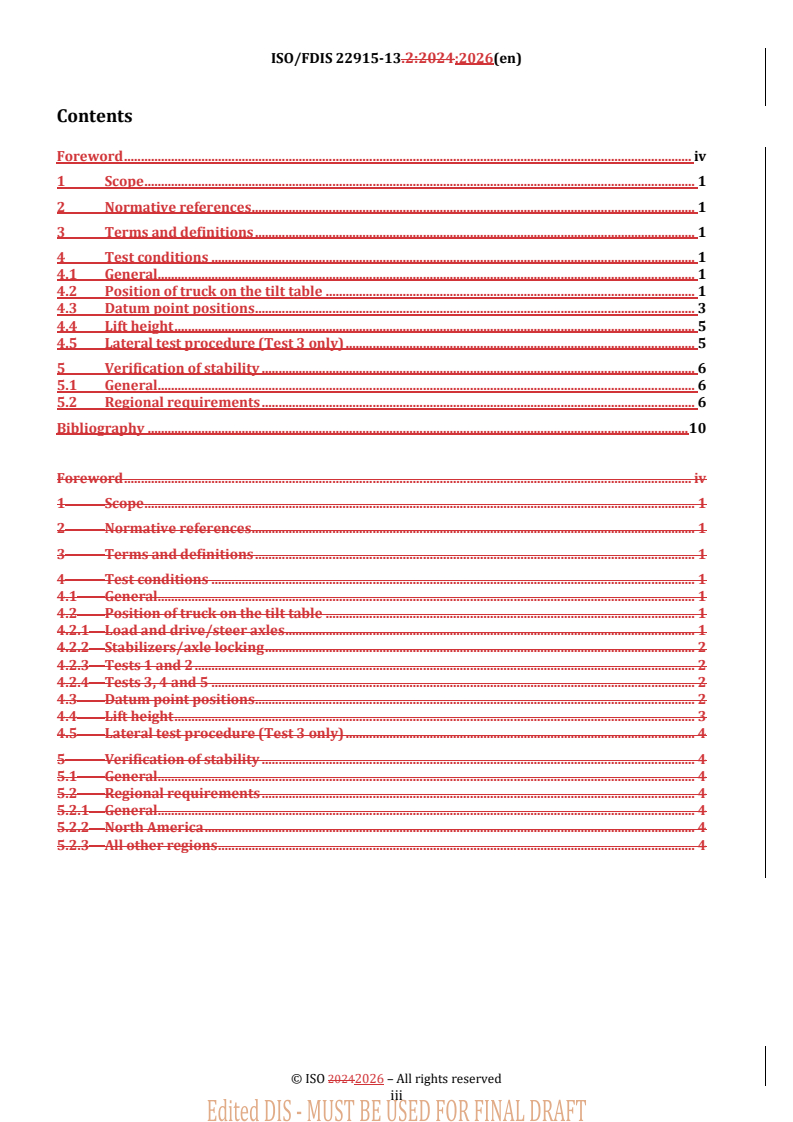
Contents
Foreword . iv
1 Scope . 1
2 Normative references . 1
3 Terms and definitions . 1
4 Test conditions . 1
4.1 General. 1
4.2 Position of truck on the tilt table . 1
4.3 Datum point positions . 3
4.4 Lift height . 5
4.5 Lateral test procedure (Test 3 only) . 5
5 Verification of stability . 6
5.1 General. 6
5.2 Regional requirements . 6
Bibliography . 10
Foreword . iv
1 Scope . 1
2 Normative references . 1
3 Terms and definitions . 1
4 Test conditions . 1
4.1 General. 1
4.2 Position of truck on the tilt table . 1
4.2.1 Load and drive/steer axles . 1
4.2.2 Stabilizers/axle locking . 2
4.2.3 Tests 1 and 2 . 2
4.2.4 Tests 3, 4 and 5 . 2
4.3 Datum point positions . 2
4.4 Lift height . 3
4.5 Lateral test procedure (Test 3 only) . 4
5 Verification of stability . 4
5.1 General. 4
5.2 Regional requirements . 4
5.2.1 General. 4
5.2.2 North America . 4
5.2.3 All other regions . 4
iii
Foreword
ISO (the International Organization for Standardization) is a worldwide federation of national standards
bodies (ISO member bodies). The work of preparing International Standards is normally carried out through
ISO technical committees. Each member body interested in a subject for which a technical committee has been
established has the right to be represented on that committee. International organizations, governmental and
non-governmental, in liaison with ISO, also take part in the work. ISO collaborates closely with the
International Electrotechnical Commission (IEC) on all matters of electrotechnical standardization.
The procedures used to develop this document and those intended for its further maintenance are described
in the ISO/IEC Directives, Part 1. In particular, the different approval criteria needed for the different types of
ISO documents should be noted. This document was drafted in accordance with the editorial rules of the
ISO/IEC Directives, Part 2 (see www.iso.org/directiveswww.iso.org/directives).
ISO draws attention to the possibility that the implementation of this document may involve the use of (a)
patent(s). ISO takes no position concerning the evidence, validity or applicability of any claimed patent rights
in respect thereof. As of the date of publication of this document, ISO had not received notice of (a) patent(s)
which may be required to implement this document. However, implementers are cautioned that this may not
represent the latest information, which may be obtained from the patent database available at
www.iso.org/patents.www.iso.org/patents. ISO shall not be held responsible for identifying any or all such
patent rights.
Any trade name used in this document is information given for the convenience of users and does not
constitute an endorsement.
For an explanation of the voluntary nature of standards, the meaning of ISO specific terms and expressions
related to conformity assessment, as well as information about ISO's adherence to the World Trade
Organization (WTO) principles in the Technical Barriers to Trade (TBT), see
www.iso.org/iso/foreword.htmlwww.iso.org/iso/foreword.html.
This document was prepared by Technical Committee ISO/TC 110, Industrial trucks, Subcommittee SC 4
Rough-terrain trucks.
This second edition cancels and replaces the first edition (ISO 22915-13:2012 and
ISO 22915-13:2012/Cor 1:2013), which has been technically revised. It also incorporates the Technical
Corrigendum ISO 22915-13:2012/Cor 1:2013.
The main change is as follows:
nd
— — subclause 4.4, (2 paragraph)4.4 has been modified to make test 3 realistic.
A list of all parts in the ISO 22915 series can be found on the ISO website.
Any feedback
...
Questions, Comments and Discussion
Ask us and Technical Secretary will try to provide an answer. You can facilitate discussion about the standard in here.
Loading comments...