

ISO 22915-25:2025
(Main)Industrial trucks — Verification of stability — Part 25: Rough-terrain variable-reach trucks operating in the special condition of handling freely suspended loads
General Information
- Abstract
This document specifies static tests for verifying the stability of non-slewing rough-terrain variable-reach trucks (hereafter referred to as non-slewing trucks) and slewing rough-terrain variable-reach trucks (hereafter referred to as slewing trucks) as defined in ISO 5053-1, operating in the special condition of handling freely suspended loads. Both non-slewing trucks and slewing trucks are hereafter referred to as trucks. This document applies to trucks fitted with a lifting attachment or lifting point when used in the following applications: — picking and placing loads (stationary operation) on substantially firm, smooth, level, and prepared surfaces; — travelling with load on unimproved natural terrain and disturbed-terrain with slopes not exceeding limits determined by the manufacturer, at travel speeds not exceeding 4 km/h and with boom angle and extension not exceeding the manufacturer's limits. This document does not deal with hazards that can occur due to the action of the wind on loads. It is not applicable to those trucks: — designed for handling freight containers; — with an articulating chassis; — equipped with integrated or non-integrated personnel work platforms; — with a work platform suspended from the extending structure.
- Status
- Published
- Publication Date
- 09-Oct-2025
- Technical Committee
- ISO/TC 110/SC 4 - Rough-terrain trucks
- Drafting Committee
- ISO/TC 110/SC 4/WG 3 - Freely suspended loads
- Current Stage
- 6060 - International Standard published
- Start Date
- 10-Oct-2025
- Due Date
- 06-Aug-2026
- Completion Date
- 10-Oct-2025
Buy Documents
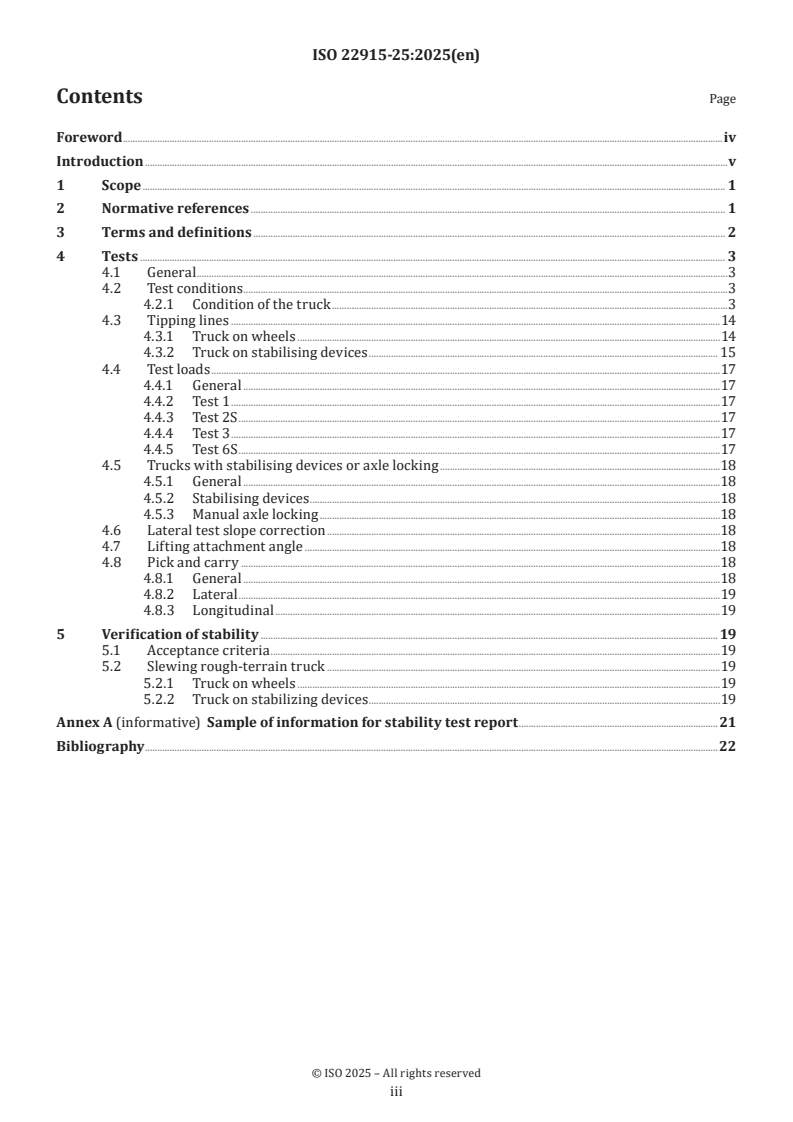

ISO 22915-25:2025 - Industrial trucks — Verification of stability — Part 25: Rough-terrain variable-reach trucks operating in the special condition of handling freely suspended loads Released:10/10/2025
ISO 22915-25:2025 - Chariots de manutention — Vérification de la stabilité — Partie 25: Chariots tout-terrain a portée variable fonctionnant dans la condition particuliere de manutention de charges librement suspendues Released:10/10/2025
Overview - ISO 22915-25:2025 (Industrial trucks - Verification of stability)
ISO 22915-25:2025 specifies static tests to verify the stability of rough‑terrain variable‑reach trucks operating in the special condition of handling freely suspended loads. It covers both non‑slewing and slewing rough‑terrain variable‑reach trucks as defined in ISO 5053‑1. The standard focuses on controlled static verifications (including considerations for dynamic factors) to measure resistance to overturning during pick‑and‑place and pick‑and‑carry operations on prepared or unimproved terrain.
Key topics and technical requirements
- Scope of application
- Trucks fitted with a lifting attachment or lifting point used for:
- Picking and placing loads on firm, smooth, level, prepared surfaces (stationary).
- Travelling with suspended loads on unimproved/disturbed terrain within manufacturer‑specified slope limits and ≤ 4 km/h travel speed.
- Exclusions: container handlers, trucks with articulating chassis, integrated/non‑integrated personnel platforms, and suspended work platforms.
- Trucks fitted with a lifting attachment or lifting point used for:
- Test methodology
- Static test procedures referenced to ISO 22915‑1 and tailored for rough‑terrain variable‑reach trucks.
- Test conditions addressing truck configuration, fuel/mass representation, and positioning on test slopes.
- Definition and measurement of tipping lines for trucks on wheels and on stabilising devices.
- Test types and parameters
- Detailed test loads and named tests (e.g., Test 1, Test 2S, Test 3, Test 6S) with configuration-dependent procedures.
- Considerations for stabilising devices, axle locking, lateral test slope correction, and lifting attachment angle.
- Specific provisions for pick‑and‑carry operations including lateral and longitudinal checks.
- Verification and acceptance
- Acceptance criteria and reporting requirements (sample test report format provided in informative annex).
Practical applications - who uses ISO 22915-25
- Equipment manufacturers verifying design stability of rough‑terrain variable‑reach trucks.
- Test laboratories and certification bodies performing stability verification and issuing compliance reports.
- Safety engineers and fleet managers assessing safe operating envelopes for pick‑and‑carry and suspended‑load tasks.
- Procurement teams and regulators specifying stability test requirements for rough‑terrain lifting equipment.
- Operators and trainers using test outcomes to inform safe operational limits and manufacturer recommendations.
Related standards
- ISO 22915‑1:2016 - General verification of stability
- ISO 22915‑14:2010 and ISO 22915‑24:2015 - Related variable‑reach rough‑terrain truck tests
- ISO 10896 series (Parts 1, 2, 4) - Safety requirements and verification for rough‑terrain trucks
- ISO 5053‑1 - Definitions for variable‑reach trucks
Keywords: ISO 22915-25:2025, industrial trucks, verification of stability, rough‑terrain variable‑reach trucks, freely suspended loads, static stability tests, slewing, non‑slewing, pick and carry.
Relations
- Effective Date
- 29-Jul-2023
Buy Documents
ISO 22915-25:2025 - Industrial trucks — Verification of stability — Part 25: Rough-terrain variable-reach trucks operating in the special condition of handling freely suspended loads Released:10/10/2025
ISO 22915-25:2025 - Chariots de manutention — Vérification de la stabilité — Partie 25: Chariots tout-terrain a portée variable fonctionnant dans la condition particuliere de manutention de charges librement suspendues Released:10/10/2025
Frequently Asked Questions
ISO 22915-25:2025 is a standard published by the International Organization for Standardization (ISO). Its full title is "Industrial trucks — Verification of stability — Part 25: Rough-terrain variable-reach trucks operating in the special condition of handling freely suspended loads". This standard covers: This document specifies static tests for verifying the stability of non-slewing rough-terrain variable-reach trucks (hereafter referred to as non-slewing trucks) and slewing rough-terrain variable-reach trucks (hereafter referred to as slewing trucks) as defined in ISO 5053-1, operating in the special condition of handling freely suspended loads. Both non-slewing trucks and slewing trucks are hereafter referred to as trucks. This document applies to trucks fitted with a lifting attachment or lifting point when used in the following applications: — picking and placing loads (stationary operation) on substantially firm, smooth, level, and prepared surfaces; — travelling with load on unimproved natural terrain and disturbed-terrain with slopes not exceeding limits determined by the manufacturer, at travel speeds not exceeding 4 km/h and with boom angle and extension not exceeding the manufacturer's limits. This document does not deal with hazards that can occur due to the action of the wind on loads. It is not applicable to those trucks: — designed for handling freight containers; — with an articulating chassis; — equipped with integrated or non-integrated personnel work platforms; — with a work platform suspended from the extending structure.
This document specifies static tests for verifying the stability of non-slewing rough-terrain variable-reach trucks (hereafter referred to as non-slewing trucks) and slewing rough-terrain variable-reach trucks (hereafter referred to as slewing trucks) as defined in ISO 5053-1, operating in the special condition of handling freely suspended loads. Both non-slewing trucks and slewing trucks are hereafter referred to as trucks. This document applies to trucks fitted with a lifting attachment or lifting point when used in the following applications: — picking and placing loads (stationary operation) on substantially firm, smooth, level, and prepared surfaces; — travelling with load on unimproved natural terrain and disturbed-terrain with slopes not exceeding limits determined by the manufacturer, at travel speeds not exceeding 4 km/h and with boom angle and extension not exceeding the manufacturer's limits. This document does not deal with hazards that can occur due to the action of the wind on loads. It is not applicable to those trucks: — designed for handling freight containers; — with an articulating chassis; — equipped with integrated or non-integrated personnel work platforms; — with a work platform suspended from the extending structure.
ISO 22915-25:2025 is classified under the following ICS (International Classification for Standards) categories: 53.060 - Industrial trucks. The ICS classification helps identify the subject area and facilitates finding related standards.
ISO 22915-25:2025 has the following relationships with other standards: It is inter standard links to ISO 16486-2:2024. Understanding these relationships helps ensure you are using the most current and applicable version of the standard.
ISO 22915-25:2025 is available in PDF format for immediate download after purchase. The document can be added to your cart and obtained through the secure checkout process. Digital delivery ensures instant access to the complete standard document.
Standards Content (Sample)
International
Standard
ISO 22915-25
First edition
Industrial trucks — Verification of
2025-10
stability —
Part 25:
Rough-terrain variable-reach trucks
operating in the special condition of
handling freely suspended loads
Chariots de manutention — Vérification de la stabilité —
Partie 25: Chariots tout-terrain à portée variable fonctionnant
dans la condition particulière de manutention de charges
librement suspendues
Reference number
© ISO 2025
All rights reserved. Unless otherwise specified, or required in the context of its implementation, no part of this publication may
be reproduced or utilized otherwise in any form or by any means, electronic or mechanical, including photocopying, or posting on
the internet or an intranet, without prior written permission. Permission can be requested from either ISO at the address below
or ISO’s member body in the country of the requester.
ISO copyright office
CP 401 • Ch. de Blandonnet 8
CH-1214 Vernier, Geneva
Phone: +41 22 749 01 11
Email: copyright@iso.org
Website: www.iso.org
Published in Switzerland
ii
Contents Page
Foreword .iv
Introduction .v
1 Scope . 1
2 Normative references . 1
3 Terms and definitions . 2
4 Tests . 3
4.1 General .3
4.2 Test conditions .3
4.2.1 Condition of the truck .3
4.3 Tipping lines .14
4.3.1 Truck on wheels .14
4.3.2 Truck on stabilising devices . 15
4.4 Test loads .17
4.4.1 General .17
4.4.2 Test 1 .17
4.4.3 Test 2S .17
4.4.4 Test 3 .17
4.4.5 Test 6S .17
4.5 Trucks with stabilising devices or axle locking .18
4.5.1 General .18
4.5.2 Stabilising devices .18
4.5.3 Manual axle locking .18
4.6 Lateral test slope correction .18
4.7 Lifting attachment angle .18
4.8 Pick and carry .18
4.8.1 General .18
4.8.2 Lateral .19
4.8.3 Longitudinal .19
5 Verification of stability . 19
5.1 Acceptance criteria .19
5.2 Slewing rough-terrain truck .19
5.2.1 Truck on wheels .19
5.2.2 Truck on stabilizing devices .19
Annex A (informative) Sample of information for stability test report .21
Bibliography .22
iii
Foreword
ISO (the International Organization for Standardization) is a worldwide federation of national standards
bodies (ISO member bodies). The work of preparing International Standards is normally carried out through
ISO technical committees. Each member body interested in a subject for which a technical committee
has been established has the right to be represented on that committee. International organizations,
governmental and non-governmental, in liaison with ISO, also take part in the work. ISO collaborates closely
with the International Electrotechnical Commission (IEC) on all matters of electrotechnical standardization.
The procedures used to develop this document and those intended for its further maintenance are described
in the ISO/IEC Directives, Part 1. In particular, the different approval criteria needed for the different types
of ISO documents should be noted. This document was drafted in accordance with the editorial rules of the
ISO/IEC Directives, Part 2 (see www.iso.org/directives).
ISO draws attention to the possibility that the implementation of this document may involve the use of (a)
patent(s). ISO takes no position concerning the evidence, validity or applicability of any claimed patent
rights in respect thereof. As of the date of publication of this document, ISO had not received notice of (a)
patent(s) which may be required to implement this document. However, implementers are cautioned that
this may not represent the latest information, which may be obtained from the patent database available at
www.iso.org/patents. ISO shall not be held responsible for identifying any or all such patent rights.
Any trade name used in this document is information given for the convenience of users and does not
constitute an endorsement.
For an explanation of the voluntary nature of standards, the meaning of ISO specific terms and expressions
related to conformity assessment, as well as information about ISO's adherence to the World Trade
Organization (WTO) principles in the Technical Barriers to Trade (TBT), see www.iso.org/iso/foreword.html.
This document was prepared by Technical Committee ISO/TC 110, Industrial trucks, Subcommittee SC 4,
Rough-terrain trucks.
A list of all parts in the ISO 22915 series can be found on the ISO website.
Any feedback or questions on this document should be directed to the user’s national standards body. A
complete listing of these bodies can be found at www.iso.org/members.html.
iv
Introduction
In this document, verification of stability is intended to be the measure of resistance to overturning under
rigidly-controlled static conditions that include considerations for dynamic factors for normal application
and operation of a rough-terrain variable-reach truck operating in the special condition of handling freely
suspended loads. Influencing factors include: mass, mass distribution, travel speed, wind actions, truck
configuration for pick and carry operation, wheelbase, truck suspension, tyre and boom deflection under load.
v
International Standard ISO 22915-25:2025(en)
Industrial trucks — Verification of stability —
Part 25:
Rough-terrain variable-reach trucks operating in the special
condition of handling freely suspended loads
1 Scope
This document specifies static tests for verifying the stability of non-slewing rough-terrain variable-reach
trucks (hereafter referred to as non-slewing trucks) and slewing rough-terrain variable-reach trucks
(hereafter referred to as slewing trucks) as defined in ISO 5053-1, operating in the special condition of handling
freely suspended loads. Both non-slewing trucks and slewing trucks are hereafter referred to as trucks.
This document applies to trucks fitted with a lifting attachment or lifting point when used in the following
applications:
— picking and placing loads (stationary operation) on substantially firm, smooth, level, and prepared
surfaces;
— travelling with load on unimproved natural terrain and disturbed-terrain with slopes not exceeding
limits determined by the manufacturer, at travel speeds not exceeding 4 km/h and with boom angle and
extension not exceeding the manufacturer's limits.
This document does not deal with hazards that can occur due to the action of the wind on loads.
It is not applicable to those trucks:
— designed for handling freight containers;
— with an articulating chassis;
— equipped with integrated or non-integrated personnel work platforms;
— with a work platform suspended from the extending structure.
2 Normative references
The following documents are referred to in the text in such a way that some or all of their content constitutes
requirements of this document. For dated references, only the edition cited applies. For undated references,
the latest edition of the referenced document (including any amendments) applies.
ISO 22915-1:2016, Industrial trucks — Verification of stability — Part 1: General
ISO 22915-14:2010, Industrial trucks — Verification of stability — Part 14: Rough-terrain variable-reach trucks
ISO 22915-24:2015, Industrial trucks — Verification of stability — Part 24: Slewing variable-reach rough-
terrain trucks
ISO 10896-1, Rough-terrain trucks — Safety requirements and verification — Part 1: Variable-reach trucks
ISO 10896-2, Rough-terrain trucks — Safety requirements and verification — Part 2: Slewing trucks
ISO 10896-4:2015, Rough-terrain trucks — Safety requirements and verification — Part 4: Additional
requirements for variable-reach trucks handling freely suspended loads
3 Terms and definitions
For the purposes of this document, the terms and definitions given in ISO 10896-1, ISO 10896-2, ISO 22915-1
and the following apply.
ISO and IEC maintain terminological databases for use in standardization at the following addresses:
— ISO Online browsing platform: available at https:// www .iso .org/ obp
— IEC Electropedia: available at https:// www .electropedia .org/
3.1
jib
device, telescopic or not, intended to extend forward the lifting point of the truck
Note 1 to entry: See Figure 1.
Figure 1 — Example of jib
[SOURCE: ISO 10896-4:2015, 3.3]
3.2
level ground
ground with a gradient of 0 % ± 2 %
[SOURCE: ISO 10896-1:2020, 3.22]
3.3
lifting accessory
component or device (e.g. sling), fitted to the lifting attachment (3.4) or lifting point (3.5) placed between the
lifting attachment or lifting point and the load
[SOURCE: ISO 10896-4:2015, 3.2, modified — included lifting point.]
3.4
lifting attachment
device mounted to the truck from which a lifting accessory (3.3) or a load, can be suspended
EXAMPLE Jib.
[SOURCE: ISO 10896-4:2015, 3.1, modified — example changed.]
3.5
lifting point
provision on the truck from which a load handling device (3.6) can be fitted or a lifting accessory (3.3) can be
suspended
Note 1 to entry: A lifting point is not a lifting attachment.
3.6
load handling device
device for grabbing, holding or attaching the load
EXAMPLE Hook, grab.
3.7
pick and carry
act of travelling with a suspended load (3.9)
[SOURCE: ISO 10896-4:2015, 3.10]
3.8
pick and carry configuration
configuration in which the truck is intended to travel with a suspended load (3.9) as specified by the
manufacturer
3.9
suspended load
load that can swing freely when attached to a lifting attachment (3.4) or lifting point (3.5) by means of a
lifting accessory (3.3) or a load handling device (3.6)
3.10
tipping line
line about which the truck tips
4 Tests
4.1 General
Testing and verification of stability shall be conducted in accordance with ISO 22915-1 and this document.
4.2 Test conditions
4.2.1 Condition of the truck
The tests shall be carried out on an operational truck in accordance with ISO 22915-1:2016, 4.3.1, with the
following exception:
In cases where the quantity of fuel affects the truck’s stability, either less than 15 % of tank capacity or more
than 90 % of tank capacity shall be used, whichever will worsen the stability condition being tested. It is
permissible to use a mass to represent the fuel load.
4.2.1.1 Position of truck on the test slope
4.2.1.1.1 Non-slewing trucks
For non-slewing trucks, the front axle centreline, rear axle centreline, stabilising device pads centreline (if
equipped) and longitudinal centre plane of the truck are shown in Figure 2.
Key
A-A longitudinal centre plane of the truck
B-B rear axle centreline
C-C front axle centreline
D-D stabilising device pads centreline (if equipped)
Figure 2 — Location of front and rear axles and stabilising devices — Non-slewing truck
4.2.1.1.2 Slewing trucks
For slewing trucks, the front axle centreline, rear axle centreline, front stabilising device pads centreline (if
equipped), rear stabilising device pads centreline (if equipped), and longitudinal centre plane of the truck
are shown in Figure 3 with the truck in the forward aligned position as defined in ISO 10896-2:2016, 3.19.
Key
A-A longitudinal centre plane of the truck
B-B rear axle centreline
C-C front axle centreline
D-D front stabilising device pads centreline (if equipped)
E-E rear stabilising device pads centreline (if equipped)
Figure 3 — Location of front and rear axles and front and rear stabilising devices — Slewing truck
4.2.1.2 Longitudinal tests
4.2.1.2.1 Test 1
For non-slewing trucks, when conducting test 1, the truck shall be positioned in accordance with
ISO 22915-14:2010 4.2.2, as shown in Figures 4 a) and 5 a). For slewing trucks, when conducting test 1, the
truck shall be positioned in accordance with ISO 22915-24:2015, 4.2.1 as shown in Figures 4 b), 4 c) and 4 d),
and 5 b), 5 c) and 5 d).
a) Test 1 — Non-slewing truck
b) Test 1 — Slewing truck (forward aligned position)
c) Test 1 — Slewing truck (side position, on wheels)
d) Test 1 — Slewing truck (side position, on stabilising devices)
Key
X-Y tilt axis of the tilt table
Figure 4 — Position of truck on the test slope for test 1 (side view)
a) Test 1 — Non-slewing truck
b) Test 1 — Slewing truck (forward aligned position)
c) Test 1 — Slewing truck (side position, on wheels)
Key
X-Y tilt axis of the tilt table
B-B rear axle centreline
C-C front axle centreline
d) Test 1 – Slewing truck (Side position, on stabilising devices)
Key
X-Y tilt axis of the tilt table
D-D front stabiliser centreline
E-E rear stab
...
Norme
internationale
ISO 22915-25
Première édition
Chariots de manutention —
2025-10
Vérification de la stabilité —
Partie 25:
Chariots tout-terrain à portée
variable fonctionnant dans
la condition particulière de
manutention de charges librement
suspendues
Industrial trucks — Verification of stability —
Part 25: Rough-terrain variable-reach trucks operating in the
special condition of handling freely suspended loads
Numéro de référence
DOCUMENT PROTÉGÉ PAR COPYRIGHT
© ISO 2025
Tous droits réservés. Sauf prescription différente ou nécessité dans le contexte de sa mise en œuvre, aucune partie de cette
publication ne peut être reproduite ni utilisée sous quelque forme que ce soit et par aucun procédé, électronique ou mécanique,
y compris la photocopie, ou la diffusion sur l’internet ou sur un intranet, sans autorisation écrite préalable. Une autorisation peut
être demandée à l’ISO à l’adresse ci-après ou au comité membre de l’ISO dans le pays du demandeur.
ISO copyright office
Case postale 401 • Ch. de Blandonnet 8
CH-1214 Vernier, Genève
Tél.: +41 22 749 01 11
E-mail: copyright@iso.org
Web: www.iso.org
Publié en Suisse
ii
Sommaire Page
Avant-propos .iv
Introduction .v
1 Domaine d’application . 1
2 Références normatives . 1
3 Termes et définitions . 2
4 Essais . 3
4.1 Généralités .3
4.2 Conditions d’essai . . .3
4.2.1 État du chariot .3
4.3 Lignes de basculement . 15
4.3.1 Chariot sur roues. 15
4.3.2 Chariot sur dispositifs stabilisateurs .16
4.4 Charges d’essai .18
4.4.1 Généralités .18
4.4.2 Essai 1 .18
4.4.3 Essai 2S .18
4.4.4 Essai 3 .18
4.4.5 Essai 6S .18
4.5 Chariots avec dispositifs stabilisateurs ou blocage d'essieu .19
4.5.1 Généralités .19
4.5.2 Dispositifs stabilisateurs .19
4.5.3 Blocage manuel d'essieu .19
4.6 Correction de pente d’essai latérale .19
4.7 Angle de l'accessoire de levage . .19
4.8 Pick and carry .19
4.8.1 Généralités .19
4.8.2 Latérale . 20
4.8.3 Longitudinale . 20
5 Vérification de la stabilité .20
5.1 Critères d’acceptation . . 20
5.2 Chariot tout-terrain rotatif . 20
5.2.1 Chariot sur roues. 20
5.2.2 Chariot sur dispositifs stabilisateurs .21
Annexe A (informative) Exemple d’informations pour le rapport d'essai de stabilité .22
Bibliographie .23
iii
Avant-propos
L'ISO (Organisation internationale de normalisation) est une fédération mondiale d'organismes nationaux
de normalisation (comités membres de l'ISO). L'élaboration des Normes internationales est en général
confiée aux comités techniques de l'ISO. Chaque comité membre intéressé par une étude a le droit de faire
partie du comité technique créé à cet effet. Les organisations internationales, gouvernementales et non
gouvernementales, en liaison avec l'ISO participent également aux travaux. L'ISO collabore étroitement avec
la Commission électrotechnique internationale (IEC) en ce qui concerne la normalisation électrotechnique.
Les procédures utilisées pour élaborer le présent document et celles destinées à sa mise à jour sont
décrites dans les Directives ISO/IEC, Partie 1. Il convient, en particulier, de prendre note des différents
critères d'approbation requis pour les différents types de documents ISO. Le présent document a
été rédigé conformément aux règles de rédaction données dans les Directives ISO/IEC, Partie 2 (voir
www.iso.org/directives).
L’ISO attire l’attention sur le fait que la mise en application du présent document peut entraîner l’utilisation
d’un ou de plusieurs brevets. L’ISO ne prend pas position quant à la preuve, à la validité et à l’applicabilité de
tout droit de propriété revendiqué à cet égard. À la date de publication du présent document, l’ISO n'avait pas
reçu notification qu’un ou plusieurs brevets pouvaient être nécessaires à sa mise en application. Toutefois,
il y a lieu d’avertir les responsables de la mise en application du présent document que des informations
plus récentes sont susceptibles de figurer dans la base de données de brevets, disponible à l'adresse
www.iso.org/brevets. L’ISO ne saurait être tenue pour responsable de ne pas avoir identifié tout ou partie de
tels droits de propriété.
Les appellations commerciales éventuellement mentionnées dans le présent document sont données pour
information, par souci de commodité, à l’intention des utilisateurs et ne sauraient constituer un engagement.
Pour une explication de la nature volontaire des normes, la signification des termes et expressions
spécifiques de l'ISO liés à l'évaluation de la conformité, ou pour toute information au sujet de l'adhésion de
l'ISO aux principes de l’Organisation mondiale du commerce (OMC) concernant les obstacles techniques au
commerce (OTC), voir www.iso.org/avant-propos.
Le présent document a été élaboré par le comité technique ISO/TC 110, Chariots de manutention, sous-comité
SC 4, Chariots tout-terrain.
Une liste de toutes les parties de la série ISO 22915 se trouve sur le site web de l'ISO.
Il convient que l’utilisateur adresse tout retour d’information ou toute question concernant le présent
document à l’organisme national de normalisation de son pays. Une liste exhaustive desdits organismes se
trouve à l’adresse www.iso.org/fr/members.html.
iv
Introduction
Dans le présent document, la vérification de la stabilité est destinée à être la mesure de la résistance au
renversement dans des conditions statiques strictement contrôlées qui comprennent des considérations pour
des facteurs dynamiques pour l’application et le fonctionnement normaux d’un chariot tout-terrain à portée
variable fonctionnant dans la condition particulière de manutention de charges librement suspendues. Les
facteurs d’influence comprennent: la masse, la distribution de masse, la vitesse de déplacement, les actions
du vent, la configuration du chariot pour une opération de pick and carry, l’empattement, la suspension du
chariot, la déformation des pneus et la déviation de la flèche sous charge.
v
Norme internationale ISO 22915-25:2025(fr)
Chariots de manutention — Vérification de la stabilité —
Partie 25:
Chariots tout-terrain à portée variable fonctionnant dans la
condition particulière de manutention de charges librement
suspendues
1 Domaine d’application
Le présent document spécifie des essais statiques pour vérifier la stabilité des chariots tout-terrain à portée
variable non rotatifs (ci-après désignés chariots non rotatifs) et des chariots tout-terrain à portée variable
rotatifs (ci-après désignés chariots rotatifs) tel que défini dans l’ISO 5053-1, fonctionnant dans la condition
particulière de manutention de charges librement suspendues. Les chariots non rotatifs et les chariots
rotatifs, sont ci-après désignés par chariots.
Le présent document s’applique aux chariots équipés d’un accessoire de levage ou d’un point de levage
lorsqu’ils sont utilisés dans les applications suivantes:
— prise et mise en place de la charge (état stationnaire) sur des surfaces essentiellement solides, lisses,
horizontales et aménagées;
— déplacement avec charge sur des terrains naturels non améliorés et des terrains non aménagés ayant
des pentes ne dépassant pas les limites déterminées par le fabricant, à des vitesses de déplacement
ne dépassant pas 4 km/h et avec un angle et une extension de flèche ne dépassant pas les limites du
fabricant.
Le présent document ne traite pas des phénomènes dangereux qui peuvent survenir en raison de l'action du
vent sur les charges.
Il ne s’applique pas aux chariots qui:
— sont conçus pour manipuler des conteneurs de fret;
— possèdent un châssis articulé;
— sont équipés de plateformes de travail pour le personnel, intégrées ou non intégrées;
— possèdent une plateforme suspendue à la structure d’extension.
2 Références normatives
Les documents suivants sont cités dans le texte de sorte qu’ils constituent, pour tout ou partie de leur
contenu, des exigences du présent document. Pour les références datées, seule l’édition citée s’applique. Pour
les références non datées, la dernière édition du document de référence s'applique (y compris les éventuels
amendements).
ISO 22915-1:2016, Chariots de manutention — Vérification de la stabilité — Partie 1: Généralités
ISO 22915-14:2010, Chariots de manutention — Vérification de la stabilité — Partie 14: Chariots tout-terrain à
portée variable
ISO 22915-24:2015, Chariots de manutention — Vérification de la stabilité — Partie 24: Chariots à portée
variable rotatifs tout-terrain
ISO 10896-1, Chariots tout-terrain — Exigences de sécurité et vérification — Partie 1: Chariots à portée variable
ISO 10896-2, Chariots tout-terrain — Exigences de sécurité et vérifications — Partie 2: Chariots rotatifs
ISO 10896-4:2015, Chariots tout-terrain — Exigences de sécurité et vérification — Partie 4: Exigences
additionnelles pour chariots à portée variable manipulant des charges suspendues à oscillation libre
3 Termes et définitions
Pour les besoins du présent document, les termes et définitions de l’ISO 10896-1, ISO 10896-2, ISO 22915-1
ainsi que les suivants s’appliquent.
L'ISO et l'IEC tiennent à jour des bases de données terminologiques destinées à être utilisées en normalisation,
consultables aux adresses suivantes:
— ISO Online browsing platform: disponible à l’adresse: https:// www .iso .org/ obp
— IEC Electropedia: disponible à l’adresse: https:// www .electropedia .org/
3.1
potence
dispositif, télescopique ou non, destiné à déployer vers l'avant le point de levage du chariot
Note 1 à l'article: Voir la Figure 1.
Figure 1 — Exemple de potence
[SOURCE: ISO 10896-4:2015, 3.3]
3.2
sol plat
sol avec une pente de 0 % ± 2 %
[SOURCE: ISO 10896-1:2020, 3.22]
3.3
équipement de levage
composant ou dispositif (par exemple, élingue), fixé à l’accessoire de levage (3.4) ou au point de levage (3.5)
placé entre l’accessoire de levage ou le point de levage et la charge
[SOURCE: ISO 10896-4:2015, 3.2, modifié pour inclure le point de levage]
3.4
accessoire de levage
dispositif monté sur le chariot auquel un équipement de levage (3.3) ou une charge peut être suspendu(e)
EXEMPLE Potence.
[SOURCE: ISO 10896-4:2015, 3.1, modifié - exemple modifié]
3.5
point de levage
disposition sur le chariot à partir de laquelle un dispositif de manutention de la charge peut être fixé (3.6) ou
un équipement de levage (3.3) peut être suspendu
Note 1 à l'article: Un point de levage n’est pas un accessoire de levage.
3.6
dispositif de manutention de la charge
dispositif pour saisir, maintenir ou fixer la charge
EXEMPLE Crochet, grappin.
3.7
pick and carry
action de se déplacer avec une charge suspendue (3.9)
[SOURCE: ISO 10896-4:2015, 3.10]
3.8
configuration de pick and carry
configuration dans laquelle le chariot est destiné à se déplacer avec une charge suspendue (3.9) tel que
spécifié par le fabricant
3.9
charge suspendue
charge qui peut se balancer librement lorsqu’elle est fixée à un accessoire de levage (3.4) ou à un point de
levage (3.5) au moyen d’un équipement de levage (3.3) ou d’un dispositif de manutention de la charge (3.6)
3.10
ligne de basculement
ligne sur laquelle le chariot bascule
4 Essais
4.1 Généralités
Les essais et la vérification de la stabilité doivent être conduits conformément à l’ISO 22915-1 et au présent
document.
4.2 Conditions d’essai
4.2.1 État du chariot
Les essais doivent être effectués sur un chariot en ordre de marche conformément à l’ISO 22915-1:2016,
4.3.1, avec l’exception suivante:
Dans les cas ou la quantité de carburant affecte la stabilité du chariot, moins de 15 % de la capacité du
réservoir ou plus de 90 % de la capacité du réservoir doivent être utilisés, en choisissant celui rendant la
condition de stabilité à l’essai la plus défavorable. Il est permis d’utiliser une masse pour représenter la
charge de carburant.
4.2.1.1 Position du chariot sur la pente d’essai
4.2.1.1.1 Chariots non rotatifs
Pour les chariots non rotatifs, la ligne médiane de l’essieu avant, la ligne médiane de l’essieu arrière, la ligne
médiane des patins des dispositifs stabilisateurs (si équipé) et le plan médian longitudinal du chariot sont
illustrés à la Figure 2.
Légende
A-A plan médian longitudinal du chariot
B-B ligne médiane de l’essieu arrière
C-C ligne médiane de l’essieu avant
D-D ligne médiane des patins des dispositifs stabilisateurs (si équipé)
Figure 2 — Emplacement des essieux avant et arrière et des dispositifs stabilisateurs — Chariot
non rotatif
4.2.1.1.2 Chariots rotatifs
Pour les chariots rotatifs, la ligne médiane de l’essieu avant, la ligne médiane de l’essieu arrière, la ligne
médiane des patins du dispositif stabilisateur avant (si équipé), la ligne médiane des patins du dispositif
stabilisateur arrière (si équipé), et le plan médian longitudinal du chariot sont illustrés à la Figure 3 avec le
chariot dans une position alignée avant tel que défini dans l’ISO 10896-2:2016, 3.19.
Légende
A-A plan médian longitudinal du chariot
B-B ligne médiane de l’essieu arrière
C-C ligne médiane de l’essieu avant
D-D ligne médiane des patins du dispositif stabilisateur avant (si équipé)
E-E ligne médiane des patins du dispositif stabilisateur arrière (si équipé)
Figure 3 — Emplacement des essieux avant et arrière et des dispositifs stabilisateurs avant et
arrière — Chariot rotatif
4.2.1.2 Essais longitudinaux
4.2.1.2.1 Essai 1
Pour les chariots non rotatifs lors de la conduite de l’essai 1, le chariot doit être positionné conformément à
l’ISO 22915-14:2010, 4.2.2, tel qu’illustré aux Figures 4 a) et 5 a). Pour les chariots rotatifs, lors de la conduite
de l’essai 1, le chariot doit être positionné conformément à l’ISO 22915-24:2015, 4.2.1, tel qu’illustré aux
Figures 4 b), 4 c) et 4 d), et 5 b), 5 c) et 5 d).
a) Essai 1 — Chariot non rotatif
b) Essai 1 — Chariot rotatif (position alignée vers l’avant)
c) Essai 1 — Chariot rotatif (position latérale, sur roues)
d) Essai 1 — Chariot rotatif (Position latérale, sur dispositifs stabilisateurs)
Légende
X-Y axe d'inclinaison de la plateforme inclinable
Figure 4 — Position du chariot sur la pente d’essai pour l’essai 1 (vue de dessus)
a) Essai 1 — Chariot non rotatif
b) Essai 1 — Chariot rotatif (position alignée vers l’avant)
c) Essai 1 — Chariot rotatif (position latérale, sur roues)
Légende
X-Y axe d'inclinaison de la plateforme inclinable
B-B ligne médiane de l’essieu arrière
C-C ligne médiane de l’essieu avant
d) Essai 1 — Chariot rotatif (Position latérale, sur dispositifs stabilisateurs)
Légende
X-Y axe d'inclinaison de la plateforme inclinable
D-D ligne médiane du stabilisateur avant
E-E ligne médiane du stabilisateur arrière
Figure 5 — Position du chariot sur la pente d’essai pour l’essai 1 (vue de dessus)
4.2.1.2.2 Essai 2S
Pour les chariots non rotatifs lors de la conduite de l’essai 2S, le chariot doit être positionné conformément à
l’ISO 22915-14:2010, 4.2.2, tel qu’illustré aux Figures 6 a) et 7 a).
Pour les chariots rotatifs lors de la conduite de l’essai 2S, le chariot doit être positionné conformément à
l’ISO 22915-24:2015, 4.2.2, tel qu’illustré aux Figures 6 b) et 7 b).
a) Chariot non rotatif
b) Chariot rotatif
Légende
X-Y axe d'inclinaison de la plateforme inclinable
Figure 6 — Position du chariot sur la pente d’essai pour l’essai 2S (vue latérale)
...