


ISO 20297-2:2023
(Main)Industrial trucks — Lorry-mounted trucks — Part 2: Safe use requirements
Industrial trucks — Lorry-mounted trucks — Part 2: Safe use requirements
This document specifies requirements for the application, inspection, training, maintenance, repair and safe operation (hereafter referred to collectively as the 'safe use') of industrial and rough-terrain lorry-mounted trucks (hereafter referred to as 'trucks') which have design features that allow them to be mounted for transport on a carrier vehicle. This document is intended to achieve the following: — the prevention of personal injuries, property damage and accidents; — the establishment of criteria for inspection, maintenance and operation; — the establishment of operator training requirements. NOTE National or local requirements can apply.
Chariots de manutention — Chariots embarqués sur porteur routier — Partie 2: Exigences pour l'utilisation en toute sécurité
General Information
- Status
- Published
- Publication Date
- 29-May-2023
- Technical Committee
- ISO/TC 110/SC 4 - Rough-terrain trucks
- Drafting Committee
- ISO/TC 110/SC 4/WG 9 - Lorry-mounted trucks
- Current Stage
- 6060 - International Standard published
- Start Date
- 30-May-2023
- Due Date
- 16-Nov-2022
- Completion Date
- 30-May-2023
Overview
ISO 20297-2:2023 - Industrial trucks - Lorry-mounted trucks - Part 2: Safe use requirements defines safe-use practices for industrial and rough-terrain lorry-mounted trucks (also called vehicle‑mounted or piggyback trucks) that can be transported on a carrier vehicle using a mounting kit. The standard covers requirements for application, inspection, training, maintenance, repair and day‑to‑day safe operation with the primary goals of preventing personal injury, property damage and accidents and establishing criteria for inspections and operator training. National or local regulations may also apply.
Key topics and technical requirements
The standard concentrates on practical safety controls and management responsibilities rather than design details. Key topics include:
- Scope and terms: definitions for lorry‑mounted truck types (industrial, rough‑terrain), operator, user, competent person, actual capacity and stability.
- General safety principles: responsibilities of users and operators; management practices; consideration of operating environment and load/attachment characteristics.
- Operator’s manuals and documentation: availability and use of manufacturer manuals and bulletins; referral to responsible entity when in doubt.
- Modifications and alterations: prohibition on changes affecting capacity, stability or safety without written approval from the original manufacturer (or documented competent‑person process if manufacturer unavailable).
- Operator qualifications and training: requirement that operators be competent and trained in accordance with ISO 23676 (operator training content and methods).
- Inspection, maintenance and repair: preparation, performance checks, inspection precautions and record keeping to ensure continued safe operation.
- Operational safety rules: pre‑use visual inspections, functional tests, safe procedures for dismounting/mounting, travelling, picking/placing loads, using attachments, refuelling and elevating personnel.
- Hazardous environments and transport: guidance where additional precautions are needed and safe methods for transporting trucks on carrier vehicles.
Practical applications and who uses it
ISO 20297-2:2023 is intended for:
- Fleet owners and users of lorry‑mounted trucks who need operational safety processes.
- Safety managers and site supervisors implementing safe‑use policies, inspections and training audits.
- Maintenance teams and service providers responsible for inspection, repair and documentation.
- Equipment manufacturers and mounting‑kit suppliers as a reference for safe‑use information to provide to users.
- Training organizations and auditors developing operator programs compliant with standardized requirements.
Adoption improves workplace safety, standardizes inspection and modification procedures, and supports consistent operator training and documentation practices.
Related standards
- ISO 20297-1:2017 - Safety requirements and verification (design/verification aspects)
- ISO 23676 - Rough‑terrain trucks - Operator training - Content and methods
- ISO 5057 - Inspection and repair of fork arms
Keywords: ISO 20297-2:2023, lorry-mounted trucks, safe use requirements, industrial trucks, operator training, inspection and maintenance, mounting kit, carrier vehicle, safety.
Frequently Asked Questions
ISO 20297-2:2023 is a standard published by the International Organization for Standardization (ISO). Its full title is "Industrial trucks — Lorry-mounted trucks — Part 2: Safe use requirements". This standard covers: This document specifies requirements for the application, inspection, training, maintenance, repair and safe operation (hereafter referred to collectively as the 'safe use') of industrial and rough-terrain lorry-mounted trucks (hereafter referred to as 'trucks') which have design features that allow them to be mounted for transport on a carrier vehicle. This document is intended to achieve the following: — the prevention of personal injuries, property damage and accidents; — the establishment of criteria for inspection, maintenance and operation; — the establishment of operator training requirements. NOTE National or local requirements can apply.
This document specifies requirements for the application, inspection, training, maintenance, repair and safe operation (hereafter referred to collectively as the 'safe use') of industrial and rough-terrain lorry-mounted trucks (hereafter referred to as 'trucks') which have design features that allow them to be mounted for transport on a carrier vehicle. This document is intended to achieve the following: — the prevention of personal injuries, property damage and accidents; — the establishment of criteria for inspection, maintenance and operation; — the establishment of operator training requirements. NOTE National or local requirements can apply.
ISO 20297-2:2023 is classified under the following ICS (International Classification for Standards) categories: 53.060 - Industrial trucks. The ICS classification helps identify the subject area and facilitates finding related standards.
ISO 20297-2:2023 is available in PDF format for immediate download after purchase. The document can be added to your cart and obtained through the secure checkout process. Digital delivery ensures instant access to the complete standard document.
Standards Content (Sample)
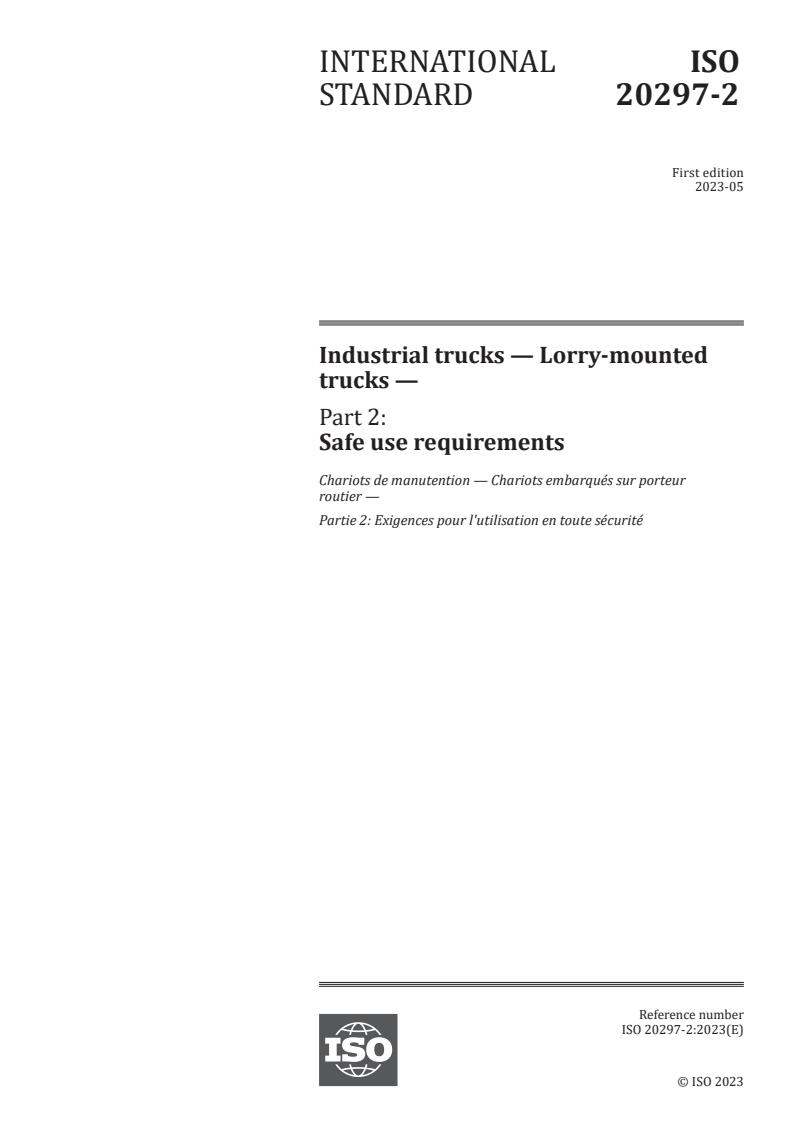
INTERNATIONAL ISO
STANDARD 20297-2
First edition
2023-05
Industrial trucks — Lorry-mounted
trucks —
Part 2:
Safe use requirements
Chariots de manutention — Chariots embarqués sur porteur
routier —
Partie 2: Exigences pour l'utilisation en toute sécurité
Reference number
© ISO 2023
All rights reserved. Unless otherwise specified, or required in the context of its implementation, no part of this publication may
be reproduced or utilized otherwise in any form or by any means, electronic or mechanical, including photocopying, or posting on
the internet or an intranet, without prior written permission. Permission can be requested from either ISO at the address below
or ISO’s member body in the country of the requester.
ISO copyright office
CP 401 • Ch. de Blandonnet 8
CH-1214 Vernier, Geneva
Phone: +41 22 749 01 11
Email: copyright@iso.org
Website: www.iso.org
Published in Switzerland
ii
Contents Page
Foreword .iv
Introduction .v
1 Scope . 1
2 Normative references . 1
3 Terms and definitions . 1
4 General requirements . 4
4.1 Principles . 4
4.2 Operator's manual(s) . . 4
4.3 Modifications or alterations . 4
4.4 Manufacturer's bulletins . 5
4.5 Operator qualifications and training . 5
4.6 Inspection and maintenance . 5
4.6.1 General . 5
4.6.2 Preparation for inspection or repair . 5
4.6.3 Performance checks . 6
4.6.4 Inspection and maintenance precautions . 6
4.6.5 Inspection and maintenance requirements . 7
4.7 Hazardous environments. 8
4.8 Refuelling . 8
4.9 Elevating personnel (use of personnel work platforms) . 8
5 Operating safety rules and precautions . 8
5.1 Operator's responsibility for safety . 8
5.2 Visual inspection and functional tests . 9
5.3 General operating instructions . 10
5.3.1 When dismounting the truck from the carrier vehicle . 10
5.3.2 When operating the truck once it has been dismounted. 10
5.4 Travelling .12
5.5 Picking and placing loads . 12
5.6 Using attachments . 13
5.7 Transporting the truck on a carrier vehicle . 14
Bibliography .15
iii
Foreword
ISO (the International Organization for Standardization) is a worldwide federation of national standards
bodies (ISO member bodies). The work of preparing International Standards is normally carried out
through ISO technical committees. Each member body interested in a subject for which a technical
committee has been established has the right to be represented on that committee. International
organizations, governmental and non-governmental, in liaison with ISO, also take part in the work.
ISO collaborates closely with the International Electrotechnical Commission (IEC) on all matters of
electrotechnical standardization.
The procedures used to develop this document and those intended for its further maintenance are
described in the ISO/IEC Directives, Part 1. In particular, the different approval criteria needed for the
different types of ISO documents should be noted. This document was drafted in accordance with the
editorial rules of the ISO/IEC Directives, Part 2 (see www.iso.org/directives).
Attention is drawn to the possibility that some of the elements of this document may be the subject of
patent rights. ISO shall not be held responsible for identifying any or all such patent rights. Details of
any patent rights identified during the development of the document will be in the Introduction and/or
on the ISO list of patent declarations received (see www.iso.org/patents).
Any trade name used in this document is information given for the convenience of users and does not
constitute an endorsement.
For an explanation of the voluntary nature of standards, the meaning of ISO specific terms and
expressions related to conformity assessment, as well as information about ISO's adherence to
the World Trade Organization (WTO) principles in the Technical Barriers to Trade (TBT), see
www.iso.org/iso/foreword.html.
This document was prepared by Technical Committee ISO/TC 110, Industrial trucks, Subcommittee
SC 4, Rough-terrain trucks.
A list of all parts in the ISO 20297 series can be found on the ISO website.
Any feedback or questions on this document should be directed to the user’s national standards body. A
complete listing of these bodies can be found at www.iso.org/members.html.
iv
Introduction
Lorry-mounted trucks are known by a variety of terms, including for example "vehicle-mounted trucks",
"piggyback trucks".
Lorry-mounted trucks can also be equipped with a variety of attachments.
v
INTERNATIONAL STANDARD ISO 20297-2:2023(E)
Industrial trucks — Lorry-mounted trucks —
Part 2:
Safe use requirements
1 Scope
This document specifies requirements for the application, inspection, training, maintenance, repair
and safe operation (hereafter referred to collectively as the 'safe use') of industrial and rough-terrain
lorry-mounted trucks (hereafter referred to as 'trucks') which have design features that allow them to
be mounted for transport on a carrier vehicle.
This document is intended to achieve the following:
— the prevention of personal injuries, property damage and accidents;
— the establishment of criteria for inspection, maintenance and operation;
— the establishment of operator training requirements.
NOTE National or local requirements can apply.
2 Normative references
The following documents are referred to in the text in such a way that some or all of their content
constitutes requirements of this document. For dated references, only the edition cited applies. For
undated references, the latest edition of the referenced document (including any amendments) applies.
ISO 5057, Industrial trucks — Inspection and repair of fork arms in service on fork-lift trucks
ISO 20297-1:2017, Industrial trucks — Lorry-mounted trucks — Part 1: Safety requirements and
verification
ISO 23676, Rough-terrain trucks — Operator training — Content and methods
3 Terms and definitions
For the purposes of this document, the following terms and definitions apply.
ISO and IEC maintain terminology databases for use in standardization at the following addresses:
— ISO Online browsing platform: available at https:// www .iso .org/ obp
— IEC Electropedia: available at https:// www .electropedia .org/
3.1
authorized person
person approved or assigned to perform a specific task or tasks at a specific location or locations at a
worksite
[SOURCE: ISO 11525-1:2020, 3.1]
3.2
user
person or entity responsible for assigning an operator (3.3) to operate a truck and specifying the tasks
to be performed
[SOURCE: ISO 11525-1:2020, 3.2]
3.3
operator
person who controls the operation (3.8) of the truck
[SOURCE: ISO 11525-1:2020, 3.3]
3.4
competent person
person who has acquired, through training, qualification, experience or a combination of these, the
knowledge and skill enabling that person to correctly perform the required tasks
[SOURCE: ISO 11525-1:2020, 3.4]
3.5
responsible entity
person or entity with responsibility for the design, specification, procurement, fabrication, manufacture,
assembly, provision of information and testing of a truck
[SOURCE: ISO 11525-1:2020, 3.5]
3.6
maintenance
act of upkeep, including inspection, lubrication, cleaning, adjustment and scheduled parts replacement
[SOURCE: ISO 11525-1:2020, 3.6]
3.7
modification
change to the truck that affects its operation (3.8), stability (3.9), actual capacity (3.17) or safety
[SOURCE: ISO 11525-1:2020, 3.7, modified — The term "capacity" has been replaced by "actual
capacity".]
3.8
operation
performance of functions of a truck within the scope of its specifications and in accordance with the
manufacturer’s instructions and work rules
[SOURCE: ISO 11525-1:2020, 3.8]
3.9
stability
ability of the truck to withstand conditions that would cause it to overturn
Note 1 to entry: Conditions that can affect stability include ground and floor conditions, gradient, speed, loading
(trucks equipped with attachments behave as partially loaded trucks even when operated without a load on the
attachment), dynamic and static forces, and incorrect tyre inflation and incorrect tyre type.
[SOURCE: ISO 11525-1:2020, 3.9, modified — "and incorrect tyre type" has been added to the end of
Note 1 to entry.]
3.10
lorry-mounted truck
wheeled, operator-controlled truck with a powered driving mechanism, designed either to carry, stack
or tier in racks any kind of load, and capable of self-loading to, and self-unloading from, a carrier vehicle
(3.14) using its load-lifting means
[SOURCE: ISO 20297-1:2017, 3.1, modified — The term "vehicle" has been replaced by "truck" and Note
1 to entry has been removed.]
3.11
industrial lorry-mounted truck
lorry-mounted truck (3.10) designed for operation (3.8) under normal operating conditions on
substantially firm, smooth, level, prepared and consolidated surfaces
[SOURCE: ISO 20297-1:2017, 3.1.1, modified — Note 1 to entry has been removed.]
3.12
rough-terrain lorry-mounted truck
lorry-mounted truck (3.10) designed for operation (3.8) under normal operating conditions on
unimproved natural terrain as well as the disturbed terrain of work sites
[SOURCE: ISO 20297-1:2017, 3.1.2, modified — Note 1 to entry has been removed.]
3.13
normal operating position
position specified by the manufacturer in which the operator (3.3) is able to control the truck operations
(3.8), including load-handling functions
[SOURCE: ISO 20297-1:2017, 3.13]
3.14
carrier vehicle
lorry or trailer that is suitable for transporting a lorry-mounted truck (3.10) by the fitting of a suitable
mounting kit (3.15)
[SOURCE: ISO 20297-1:2017, 3.15]
3.15
mounting kit
structure designed to fit a lorry-mounted truck (3.10) to a carrier vehicle (3.14)
[SOURCE: ISO 20297-1:2017, 3.16]
3.16
rated capacity
maximum load that an attachment is permitted by its manufacturer to handle in normal operation (3.8)
under specified conditions
[SOURCE: ISO 20297-1:2017, 3.3, modified — Domain "" and Note 1 to entry have been
removed.]
3.17
actual capacity
maximum load at a specified load centre distance, established by the manufacturer based on component
strength and truck stability (3.9), that the truck can carry, lift and stack to a specified lift height and
reach, in normal operation (3.8)
[SOURCE: ISO 20297-1:2017, 3.4, modified — Notes to entry have been removed.]
4 General requirements
4.1 Principles
4.1.1 This document shall be supplemented by good management practices, safety controls and the
application of sound principles of safety, training, inspection, maintenance, application selection and
operation. All data available regarding the parameters of intended use and the expected environment
shall be considered. Those with direct control over the application and operation of the truck shall be
responsible for ensuring good safety practices.
NOTE Different operating conditions can require additional safety precautions, training and special safe
operating procedures.
4.1.2 The operation of any truck is subject to certain hazards that can be protected against only by
the exercise of care and common sense. It is essential to have competent persons trained in the intended
use, safe operation, maintenance and service of the truck and any attachment(s).
4.1.3 The user shall ensure that the operator understands that safe operation of the truck is also the
operator’s responsibility.
4.1.4 The user shall take reasonable measures to ensure that the operator's mental or physical
condition will not impair their ability to operate the truck.
4.1.5 In addition to specific training, application selection and operation of the truck, the user shall
take the following characteristics for trucks into consideration:
— these trucks are primarily designed for handling supported loads on forks;
— other attachments can be fitted.
4.1.6 The user shall take reasonable measures (for example, spot checks) to ensure that the safe use
requirements are being applied during operation.
4.2 Operator's manual(s)
4.2.1 The user shall ensure that the operator's manual(s) and any additional safety manuals provided
by the manufacturer of the truck and mounting kit manufacturer (if available), are always available to
the operator and maintenance personnel.
4.2.2 The user, the operator, or both shall refer to the responsible entity if doubt arises on either the
use of the truck or the interpretation of the operator’s manual.
4.3 Modifications or alterations
4.3.1 Except as provided for below, no modifications or alterations to a truck that can affect its actual
capacity, stability or safe operation shall be made without the prior written approval of the original
truck manufacturer or its successor.
4.3.2 If the truck manufacturer is no longer in business and there is no successor, modifications or
alterations to the truck shall be carried out by a competent person under the following conditions:
a) the design, testing and implementation of the modification or alteration is made in accordance with
ISO 20297-1:2017;
b) a permanent record is kept of the design, tests and implementation of the modification or alteration;
c) appropriate changes are made to the information plate(s), documents, certificates, labels, tags and
operator’s manual(s);
d) a permanent and readily visible label is affixed to the truck stating the manner in which the truck
has been modified or altered, together with the date of the modification or alteration, and the
name of the person or organization responsible for the design, testing and implementation of the
modifications.
4.3.3 Upon completion of any approved modification or alteration and prior to truck operation, the
user shall ensure that the appropriate changes have been made to information plate(s), documents,
certificates, labels, tags and operator's manual(s) and any training, if required.
4.4 Manufacturer's bulletins
The user shall conform to the applicable bulletins as directed by the responsible entity.
4.5 Operator qualifications and training
4.5.1 Users shall only allow competent and authorized persons to operate a truck and are responsible
for ensuring that the operator has been trained in accordance with ISO 23676.
4.5.2 The user shall ensure that the operator has read and is familiar with the operator’s manual(s)
and any other safety information provided by the manufacturer and user on the particular truck being
operated, the application and environment in which the truck is to be used, and any attachments used.
4.5.3 The user shall ensure that the operator is familiar with worksite rules and layout, working
conditions, handling of loads found at the workplace and local emergency procedures.
4.6 Inspection and maintenance
4.6.1 General
4.6.1.1 The inspection and maintenance of trucks shall be performed in accordance with the
manufacturer's and user’s recommendations. This includes:
a) a planned system for scheduled inspection, lubrication, maintenance and adjustment;
b) verification that only competent and authorized persons are permitted to maintain, repair, rebuild,
adjust, and inspect trucks, in accordance with the manufacturer’s recommendations.
4.6.1.2 The user shall ensure that inspections and maintenance operations are conducted in an
authorized area where safe clearances exist.
4.6.1.3 The user shall ensure that appropriate personal protective equipment is available for use by
the authorized person.
4.6.2 Preparation for inspection or repair
In preparation for, and prior to, starting inspection or repair of a truck the authorized person shall:
— park the truck on a firm level surface;
— set the direction control in neutral, apply the parking brake, switch off the engine or power system
and remove the device (for example, key, key pad, magnetic card) that prevents starting without use
of such device;
— apply means to ensure the truck remains stationary (for example, wheel chocks, setting of park
brake);
— implement manufacturer-approved methods/devices as outlined in the operator's manual(s) to
prevent unintentional movement of the truck/components before working on or around it;
— eliminate the possibility of unintentional fluid escape before any part of that syst
...
Questions, Comments and Discussion
Ask us and Technical Secretary will try to provide an answer. You can facilitate discussion about the standard in here.
Loading comments...