

ISO 20297-1:2017
(Main)Industrial trucks — Lorry-mounted trucks — Part 1: Safety requirements and verification
General Information
- Abstract
ISO 20297-1:2017 specifies safety requirements and their verification for industrial and rough-terrain lorry‑mounted trucks (hereafter referred to as "trucks"). ISO 20297-1:2017 is applicable to those trucks capable of self-loading onto a carrier vehicle. It is not applicable to - trucks that are driven onto the carrier vehicle, or - trucks that are loaded onto the carrier vehicle with the assistance of external means, i.e. crane or other lifting device. ISO 20297-1:2017 deals with all significant hazards, hazardous situations or hazardous events relevant to machinery, when it is used as intended and under conditions of misuse which are reasonably foreseeable by the manufacturer. The significant hazards covered by this document are listed in Annex A. ISO 20297-1:2017 does not address hazards which can occur - during manufacture, - when handling suspended loads, which may swing freely, - when using trucks on public roads, - when operating in potentially explosive atmospheres, - with a battery or hybrid as the primary power source. ISO 20297-1:2017 does not address the requirements of road safety when the truck is mounted on the carrier vehicle. ISO 20297-1:2017 is not applicable to trucks manufactured before the date of its publication.
- Status
- Published
- Publication Date
- 19-Dec-2017
- Technical Committee
- ISO/TC 110/SC 4 - Rough-terrain trucks
- Drafting Committee
- ISO/TC 110/SC 4/WG 9 - Lorry-mounted trucks
- Current Stage
- 9093 - International Standard confirmed
- Start Date
- 16-Mar-2023
- Completion Date
- 29-Aug-2026
Buy Documents



ISO 20297-1:2017 - Industrial trucks -- Lorry-mounted trucks

ISO 20297-1:2017 - Industrial trucks — Lorry-mounted trucks — Part 1: Safety requirements and verification/20/2017


ISO 20297-1:2017 - Chariots de manutention -- Chariots embarqués sur porteur routier
ISO 20297-1:2017 - Chariots de manutention — Chariots embarqués sur porteur routier — Partie 1: Exigences de sécurité et vérification/20/2019
Overview
ISO 20297-1:2017 - Industrial trucks - Lorry‑mounted trucks - Part 1: Safety requirements and verification - defines safety requirements and verification methods for industrial and rough‑terrain lorry‑mounted trucks that are capable of self-loading onto a carrier vehicle. The standard addresses significant hazards during intended use and reasonably foreseeable misuse, and specifies design, protective measures and verification (functional and structural) needed to reduce risk. It explicitly excludes trucks driven onto carriers, trucks loaded by external lifting devices (cranes), hazards occurring during manufacture, use on public roads, operation in explosive atmospheres, risks from suspended swinging loads, and trucks with battery or hybrid primary power. ISO 20297-1:2017 does not apply to trucks manufactured before its publication date.
Key topics and requirements
The standard covers a comprehensive set of safety and verification topics relevant to lorry‑mounted trucks, including:
- Risk management and definition of normal operating conditions
- Controls and operator interfaces (preventing inadvertent activation, ground‑level controls, steering and load‑handling controls)
- Brakes, parking brake and failure of energy supply
- Hydraulic and lifting systems (chains, load holding, maximum lowering speed, stroke limitation)
- Structural integrity and verification (static and dynamic testing, test loads)
- Electrical and electronic systems (protection, connections, batteries)
- Stability, visibility and operator’s station (seating, enclosed cabs, access)
- Protective measures (guards, ROPS/FOPS, protection against crushing/shearing)
- Power systems, exhaust and cooling, fire protection and noise considerations
- Mounting kit and requirements for transport when the truck is mounted on a carrier
- Documentation and marking: operator and maintenance manuals, load charts and information for use
Practical applications
ISO 20297-1:2017 is used to:
- Guide manufacturers and designers in the safe design of self‑loading lorry‑mounted trucks
- Define verification tests for product development, validation and conformity assessment
- Support testing laboratories and certification bodies in functional and structural testing
- Inform fleet managers, purchasers and safety managers about required safety features and documentation (operator manuals, load charts, markings)
- Assist maintenance and training programs by specifying required information for safe operation and servicing
Who should use this standard
- Truck manufacturers and OEM engineers
- Design and safety engineers for mobile material‑handling equipment
- Test houses and conformity assessment organizations
- Fleet operators, procurement teams and workplace safety professionals
Related standards
Refer to other ISO machine‑safety and industrial‑truck standards for complementary guidance on general industrial truck safety, operator protection and testing methods. For full technical requirements and verification procedures, consult the official ISO 20297-1:2017 publication from ISO.
Relations
- Consolidated By
ISO 12671:2021 - Thermal spraying — Thermally sprayed coatings — Symbolic representation on drawings - Effective Date
- 06-Jun-2022
Buy Documents
ISO 20297-1:2017 - Industrial trucks -- Lorry-mounted trucks
ISO 20297-1:2017 - Industrial trucks — Lorry-mounted trucks — Part 1: Safety requirements and verification/20/2017
ISO 20297-1:2017 - Chariots de manutention -- Chariots embarqués sur porteur routier
ISO 20297-1:2017 - Chariots de manutention — Chariots embarqués sur porteur routier — Partie 1: Exigences de sécurité et vérification/20/2019
Frequently Asked Questions
ISO 20297-1:2017 is a standard published by the International Organization for Standardization (ISO). Its full title is "Industrial trucks — Lorry-mounted trucks — Part 1: Safety requirements and verification". This standard covers: ISO 20297-1:2017 specifies safety requirements and their verification for industrial and rough-terrain lorry‑mounted trucks (hereafter referred to as "trucks"). ISO 20297-1:2017 is applicable to those trucks capable of self-loading onto a carrier vehicle. It is not applicable to - trucks that are driven onto the carrier vehicle, or - trucks that are loaded onto the carrier vehicle with the assistance of external means, i.e. crane or other lifting device. ISO 20297-1:2017 deals with all significant hazards, hazardous situations or hazardous events relevant to machinery, when it is used as intended and under conditions of misuse which are reasonably foreseeable by the manufacturer. The significant hazards covered by this document are listed in Annex A. ISO 20297-1:2017 does not address hazards which can occur - during manufacture, - when handling suspended loads, which may swing freely, - when using trucks on public roads, - when operating in potentially explosive atmospheres, - with a battery or hybrid as the primary power source. ISO 20297-1:2017 does not address the requirements of road safety when the truck is mounted on the carrier vehicle. ISO 20297-1:2017 is not applicable to trucks manufactured before the date of its publication.
ISO 20297-1:2017 specifies safety requirements and their verification for industrial and rough-terrain lorry‑mounted trucks (hereafter referred to as "trucks"). ISO 20297-1:2017 is applicable to those trucks capable of self-loading onto a carrier vehicle. It is not applicable to - trucks that are driven onto the carrier vehicle, or - trucks that are loaded onto the carrier vehicle with the assistance of external means, i.e. crane or other lifting device. ISO 20297-1:2017 deals with all significant hazards, hazardous situations or hazardous events relevant to machinery, when it is used as intended and under conditions of misuse which are reasonably foreseeable by the manufacturer. The significant hazards covered by this document are listed in Annex A. ISO 20297-1:2017 does not address hazards which can occur - during manufacture, - when handling suspended loads, which may swing freely, - when using trucks on public roads, - when operating in potentially explosive atmospheres, - with a battery or hybrid as the primary power source. ISO 20297-1:2017 does not address the requirements of road safety when the truck is mounted on the carrier vehicle. ISO 20297-1:2017 is not applicable to trucks manufactured before the date of its publication.
ISO 20297-1:2017 is classified under the following ICS (International Classification for Standards) categories: 53.060 - Industrial trucks. The ICS classification helps identify the subject area and facilitates finding related standards.
ISO 20297-1:2017 has the following relationships with other standards: It is inter standard links to ISO 12671:2021. Understanding these relationships helps ensure you are using the most current and applicable version of the standard.
ISO 20297-1:2017 is available in PDF format for immediate download after purchase. The document can be added to your cart and obtained through the secure checkout process. Digital delivery ensures instant access to the complete standard document.
Standards Content (Sample)
INTERNATIONAL ISO
STANDARD 20297-1
First edition
2017-12
Industrial trucks — Lorry-mounted
trucks —
Part 1:
Safety requirements and verification
Chariots de manutention — Chariots embarqués sur porteur
routier —
Partie 1: Exigences de sécurité et
vérification
Reference number
©
ISO 2017
© ISO 2017, Published in Switzerland
All rights reserved. Unless otherwise specified, no part of this publication may be reproduced or utilized otherwise in any form
or by any means, electronic or mechanical, including photocopying, or posting on the internet or an intranet, without prior
written permission. Permission can be requested from either ISO at the address below or ISO’s member body in the country of
the requester.
ISO copyright office
Ch. de Blandonnet 8 • CP 401
CH-1214 Vernier, Geneva, Switzerland
Tel. +41 22 749 01 11
Fax +41 22 749 09 47
copyright@iso.org
www.iso.org
ii © ISO 2017 – All rights reserved
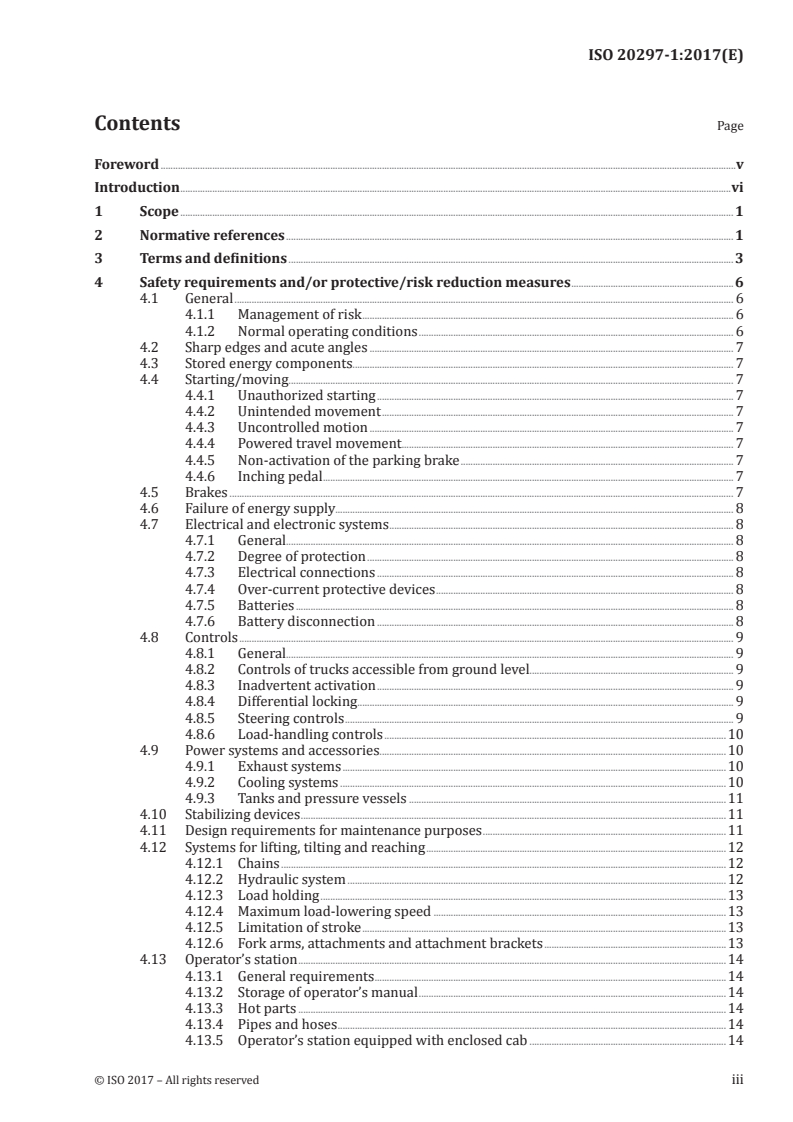
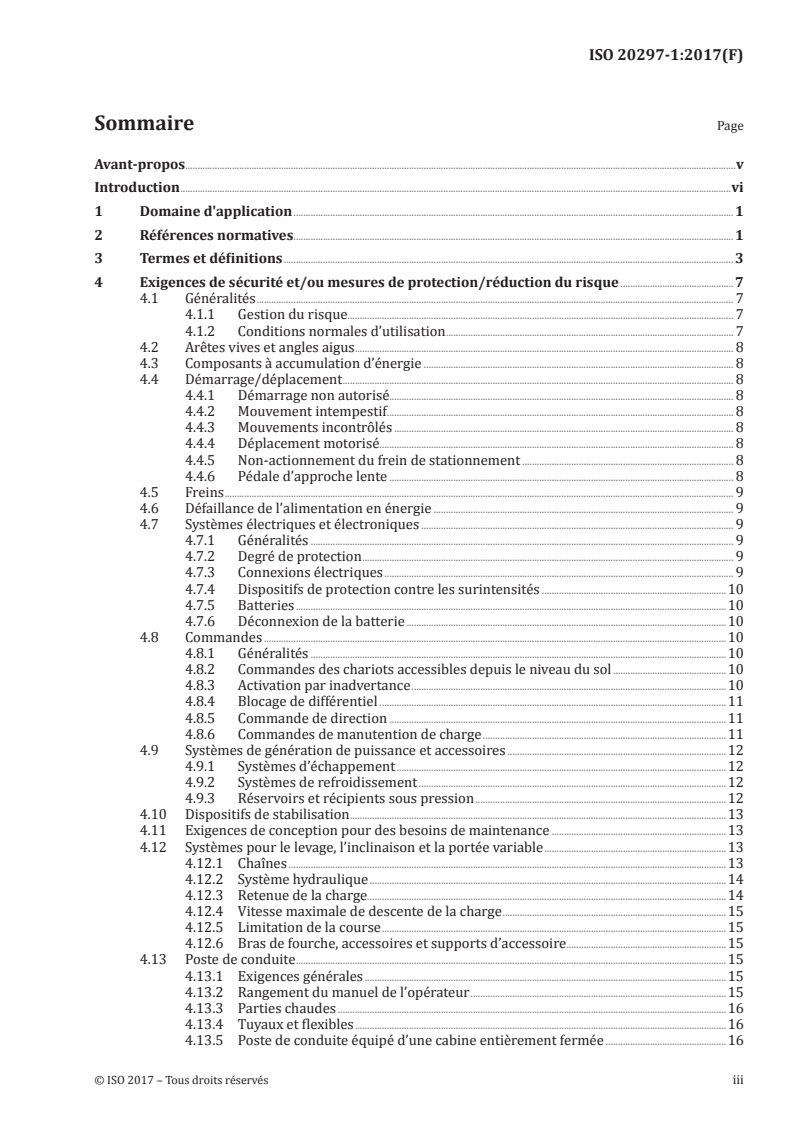
Contents Page
Foreword .v
Introduction .vi
1 Scope . 1
2 Normative references . 1
3 Terms and definitions . 3
4 Safety requirements and/or protective/risk reduction measures . 6
4.1 General . 6
4.1.1 Management of risk . 6
4.1.2 Normal operating conditions . 6
4.2 Sharp edges and acute angles . 7
4.3 Stored energy components. 7
4.4 Starting/moving. 7
4.4.1 Unauthorized starting . 7
4.4.2 Unintended movement . 7
4.4.3 Uncontrolled motion . 7
4.4.4 Powered travel movement. 7
4.4.5 Non-activation of the parking brake . 7
4.4.6 Inching pedal . 7
4.5 Brakes . 7
4.6 Failure of energy supply. 8
4.7 Electrical and electronic systems . 8
4.7.1 General. 8
4.7.2 Degree of protection . 8
4.7.3 Electrical connections . 8
4.7.4 Over-current protective devices . 8
4.7.5 Batteries . 8
4.7.6 Battery disconnection . 8
4.8 Controls . 9
4.8.1 General. 9
4.8.2 Controls of trucks accessible from ground level. 9
4.8.3 Inadvertent activation . 9
4.8.4 Differential locking . . . 9
4.8.5 Steering controls . 9
4.8.6 Load-handling controls .10
4.9 Power systems and accessories.10
4.9.1 Exhaust systems .10
4.9.2 Cooling systems .10
4.9.3 Tanks and pressure vessels .11
4.10 Stabilizing devices .11
4.11 Design requirements for maintenance purposes .11
4.12 Systems for lifting, tilting and reaching .12
4.12.1 Chains .12
4.12.2 Hydraulic system .12
4.12.3 Load holding .13
4.12.4 Maximum load-lowering speed .13
4.12.5 Limitation of stroke .13
4.12.6 Fork arms, attachments and attachment brackets .13
4.13 Operator’s station .14
4.13.1 General requirements .14
4.13.2 Storage of operator’s manual .14
4.13.3 Hot parts .14
4.13.4 Pipes and hoses .14
4.13.5 Operator’s station equipped with enclosed cab .14
4.13.6 Operator’s seat .16
4.13.7 Control panels and symbols on displays .16
4.14 Operator access .17
4.14.1 General requirements .17
4.14.2 Enclosed cab openings . .17
4.15 Protective measures and devices .17
4.15.1 Hot parts .17
4.15.2 Protection against crushing, shearing and trapping .17
4.15.3 Guards .17
4.15.4 Safety signs .18
4.15.5 Engine compartment . .18
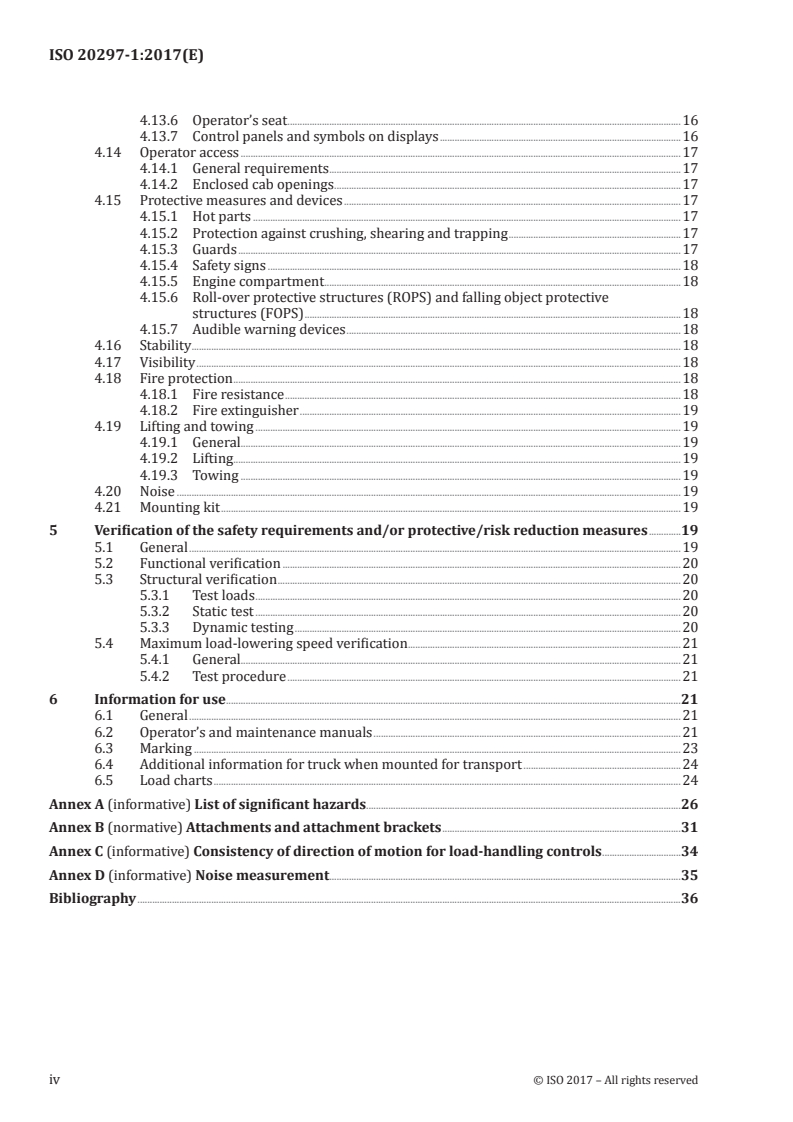
4.15.6 Roll-over protective structures (ROPS) and falling object protective
structures (FOPS) .18
4.15.7 Audible warning devices .18
4.16 Stability .18
4.17 Visibility .18
4.18 Fire protection .18
4.18.1 Fire resistance .18
4.18.2 Fire extinguisher .19
4.19 Lifting and towing .19
4.19.1 General.19
4.19.2 Lifting . .19
4.19.3 Towing .19
4.20 Noise .19
4.21 Mounting kit .19
5 Verification of the safety requirements and/or protective/risk reduction measures .19
5.1 General .19
5.2 Functional verification .20
5.3 Structural verification .20
5.3.1 Test loads .20
5.3.2 Static test .20
5.3.3 Dynamic testing .20
5.4 Maximum load-lowering speed verification .21
5.4.1 General.21
5.4.2 Test procedure .21
6 Information for use .21
6.1 General .21
6.2 Operator’s and maintenance manuals .21
6.3 Marking .23
6.4 Additional information for truck when mounted for transport .24
6.5 Load charts .24
Annex A (informative) List of significant hazards.26
Annex B (normative) Attachments and attachment brackets .31
Annex C (informative) Consistency of direction of motion for load-handling controls .34
Annex D (informative) Noise measurement.35
Bibliography .36
iv © ISO 2017 – All rights reserved
Foreword
ISO (the International Organization for Standardization) is a worldwide federation of national standards
bodies (ISO member bodies). The work of preparing International Standards is normally carried out
through ISO technical committees. Each member body interested in a subject for which a technical
committee has been established has the right to be represented on that committee. International
organizations, governmental and non-governmental, in liaison with ISO, also take part in the work.
ISO collaborates closely with the International Electrotechnical Commission (IEC) on all matters of
electrotechnical standardization.
The procedures used to develop this document and those intended for its further maintenance are
described in the ISO/IEC Directives, Part 1. In particular the different approval criteria needed for the
different types of ISO documents should be noted. This document was drafted in accordance with the
editorial rules of the ISO/IEC Directives, Part 2 (see www.iso.org/directives).
Attention is drawn to the possibility that some of the elements of this document may be the subject of
patent rights. ISO shall not be held responsible for identifying any or all such patent rights. Details of
any patent rights identified during the development of the document will be in the Introduction and/or
on the ISO list of patent declarations received (see www.iso.org/patents).
Any trade name used in this document is information given for the convenience of users and does not
constitute an endorsement.
For an explanation on the voluntary nature of standards, the meaning of ISO specific terms and
expressions related to conformity assessment, as well as information about ISO's adherence to the
World Trade Organization (WTO) principles in the Technical Barriers to Trade (TBT) see the following
URL: www.iso.org/iso/foreword.html.
This document was prepared by Technical Committee ISO/TC 110, Industrial trucks, Subcommittee SC
4, Rough-terrain trucks.
A list of all parts in the ISO 20297 series can be found on the ISO website.
Introduction
This document is a type-C standard as stated in ISO 12100.
This document is of relevance, in particular, for the following stakeholder groups representing the
market players with regard to machinery safety:
— machine manufacturers (small, medium and large enterprises);
— health and safety bodies (regulators, accident prevention organisations, market surveillance, etc.).
Others can be affected by the level of machinery safety achieved with the means of the document by the
above-mentioned stakeholder groups:
— machine users/employers (small, medium and large enterprises);
— machine users/employees (e.g. trade unions, organizations for people with special needs);
— service providers, e.g. for maintenance (small, medium and large enterprises);
— consumers (in the case of machinery intended for use by consumers).
The above-mentioned stakeholder groups have been given the possibility to participate at the drafting
process of this document.
The machinery concerned and the extent to which hazards, hazardous situations or hazardous events
are covered are indicated in the Scope of this document.
When requirements of this type-C standard are different from those which are stated in type-A or -B
standards, the requirements of this type-C standard take precedence over the requirements of the
other standards for machines that have been designed and built according to the requirements of this
type-C standard.
Lorry-mounted trucks are known by several terms, including “vehicle-mounted trucks” and “piggyback
trucks”. They can also be equipped with a variety of attachments. The trucks covered by this document
all have design features enabling them to be mounted for transport on a carrier vehicle.
vi © ISO 2017 – All rights reserved
INTERNATIONAL STANDARD ISO 20297-1:2017(E)
Industrial trucks — Lorry-mounted trucks —
Part 1:
Safety requirements and verification
1 Scope
This document specifies safety requirements and their verification for industrial and rough-terrain
lorry-mounted trucks (hereafter referred to as “trucks”).
It is applicable to those trucks capable of self-loading onto a carrier vehicle. It is not applicable to
— trucks that are driven onto the carrier vehicle, or
— trucks that are loaded onto the carrier vehicle with the assistance of external means, i.e. crane or
other lifting device.
This document deals with all significant hazards, hazardous situations or hazardous events relevant to
machinery, when it is used as intended and under conditions of misuse which are reasonably foreseeable
by the manufacturer. The significant hazards covered by this document are listed in Annex A.
This document does not address hazards which can occur
— during manufacture,
— when handling suspended loads, which may swing freely,
— when using trucks on public roads,
— when operating in potentially explosive atmospheres,
— with a battery or hybrid as the primary power source.
It does not address the requirements of road safety when the truck is mounted on the carrier vehicle.
It is not applicable to trucks manufactured before the date of its publication.
2 Normative references
The following documents, in whole or in part, are normatively referenced in this document and are
indispensable for its application. For dated references, only the edition cited applies. For undated
references, the latest edition of the referenced document (including any amendments) applies.
ISO 2330, Fork-lift trucks — Fork arms — Technical characteristics and testing
ISO 2860, Earth-moving machinery — Minimum access dimensions
ISO 2867:2011, Earth-moving machinery — Access systems
ISO 3449, Earth-moving machinery — Falling-object protective structures — Laboratory tests and
performance requirements
ISO 3457, Earth-moving machinery — Guards — Definitions and requirements
ISO 3471:2008, Earth-moving machinery — Roll-over protective structures — Laboratory tests and
performance requirements
ISO 3691-1:2011, Industrial trucks — Safety requirements and verification — Part 1: Self-propelled
industrial trucks, other than driverless trucks, variable-reach trucks and burden-carrier trucks
ISO 3795, Road vehicles, and tractors and machinery for agriculture and forestry — Determination of
burning behaviour of interior materials
ISO 5053-1, Industrial trucks — Terminology and classification — Part 1: Types of industrial trucks
ISO 5353, Earth-moving machinery, and tractors and machinery for agriculture and forestry — Seat
index point
ISO 6292, Powered industrial trucks and tractors — Brake performance and component strength
ISO 6682, Earth-moving machinery — Zones of comfort and reach for controls
ISO 6683, Earth-moving machinery — Seat belts and seat belt anchorages — Performance requirements
and tests
ISO 7000, Graphical symbols for use on equipment — Registered symbols
ISO 9244, Earth-moving machinery — Machine safety labels — General principles
ISO 9247, Earth-moving machinery — Electrical wires and cables — Principles of identification and marking
ISO 9533, Earth-moving machinery — Machine-mounted audible travel alarms and forward horns — Test
methods and performance criteria
ISO 10263-4, Earth-moving machinery — Operator enclosure environment — Part 4: Heating, ventilating
and air conditioning (HVAC) test method and performance
ISO 11112:1995, Earth-moving machinery — Operator's seat — Dimensions and requirements
ISO 12100:2010, Safety of machinery — General principles for design — Risk assessment and risk reduction
ISO 12508, Earth-moving machinery — Operator station and maintenance areas — Bluntness of edges
ISO 13564-1, Powered industrial trucks — Test methods for verification of visibility — Sit-on and stand-on
operator trucks and variable-reach trucks up to and including 10 t capacity
ISO 13732-1, Ergonomics of the thermal environment — Methods for the assessment of human responses to
contact with surfaces — Part 1: Hot surfaces
ISO 13849-1, Safety of machinery — Safety-related parts of control systems — Part 1: General principles
for design
ISO 15817, Earth-moving machinery — Safety requirements for remote operator control systems
ISO 15870, Powered industrial trucks — Safety signs and hazard pictorials — General principles
ISO 21507, Earth-moving machinery — Performance requirements for non-metallic fuel tanks
ISO 22915-3, Industrial trucks — Verification of stability — Part 3: Reach and straddle trucks
ISO 22915-7, Industrial trucks — Verification of stability — Part 7: Bidirectional and multidirectional trucks
ISO 22915-10, Industrial trucks — Verification of stability — Part 10: Additional stability test for trucks
operating in the special condition of stacking with load laterally displaced by powered devices
ISO 22915-13, Industrial trucks — Verification of stability — Part 13: Rough-terrain trucks with mast
ISO 22915-14, Industrial trucks — Verification of stability — Part 14: Rough-terrain variable-reach trucks
IEC 60529, Degrees of protection provided by enclosures (IP Code)
2 © ISO 2017 – All rights reserved
3 Terms and definitions
For the purposes of this document, the terms and definitions given in ISO 12100, ISO 5053-1 and the
following apply.
ISO and IEC maintain terminological databases for use in standardization at the following addresses:
— ISO Online browsing platform: available at https://www.iso.org/obp
— IEC Electropedia: available at http://www.electropedia.org/
3.1
lorry-mounted truck
wheeled, operator-controlled vehicle with a powered driving mechanism, designed either to carry,
stack or tier in racks any kind of load, and capable of self-loading to, and self-unloading from, a carrier
vehicle using its load-lifting means
Note 1 to entry: This definition is different from the one given in ISO 5053-1.
3.1.1
industrial lorry-mounted truck
lorry-mounted truck designed for operation under normal operating conditions on substantially firm,
smooth, level, prepared and consolidated surfaces
Note 1 to entry: Normal operating conditions are as described in 4.1.2.
3.1.2
rough-terrain lorry-mounted truck
lorry-mounted truck designed for operation under normal operating conditions on unimproved natural
terrain as well as the disturbed terrain of work sites
Note 1 to entry: Normal operating conditions are as described in 4.1.2.
3.2
rated capacity
Q
maximum load permitted by the manufacturer at the standard load centre distance (3.7) that
the truck is capable of lifting and transporting on fork arms (3.10) in normal conditions with the boom
(3.11), mast (3.12) or forks fully retracted
Note 1 to entry: See Figure 1.
3.3
rated capacity
maximum load that an attachment (3.14) is permitted by its manufacturer to handle in
normal operation under specified conditions
Note 1 to entry: The rated capacity of the attachment (3.14) can be associated with the load centre distance. See
Table 1.
3.4
actual capacity
maximum load at a specified load centre distance, established by the manufacturer based on component
strength and truck stability, that the truck can carry, lift and stack to a specified lift height (3.6) and
reach (3.5), in normal operation
Note 1 to entry: See Figure 1.
Note 2 to entry: The actual capacity depends on the configuration of the truck in respect of variables including
lift height (3.6), the reach (3.5) of the boom (3.11), the actual load centre, load-handling devices and stabilizing
devices (3.9).
Note 3 to entry: It defines the load-handling ability of the particular truck as equipped. Additional actual capacity
with removable attachments (3.14), where permitted, may also be established by the appropriate stability test or
by calculation verified by empirical data.
Key
d reach
D standard load-centre distance
G centre of gravity of the load
g point corresponding to vertical projection of G
Q rated capacity
Q actual capacity at maximum lift height
Q actual capacity at maximum reach
Figure 1 — Parameters for determining actual capacity of a truck with fork arms
3.5
reach
d
distance the load can be moved forward in the horizontal direction
Note 1 to entry: See Figure 1.
3.6
lift height
height from the ground to the upper face of the fork arms (3.10) or underside of the load, whichever is
the lower
4 © ISO 2017 – All rights reserved
3.7
standard load centre distance
D
distance from the centre of gravity of the load, horizontally rearwards to the front of the fork shanks
and vertically downwards to the upper faces of the fork arms (3.10)
Note 1 to entry: See Figure 1.
Note 2 to entry: Table 1 gives standard load centre distances in relation to rated capacity (3.2).
Table 1 — Standard load centre distances and rated capacities
Standard load centre distance
Rated capacity
D
Q
mm
kg
400 500 600 900 1 200
a
0 < 1 000 X X
c b
≥ 1 000 < 5 000 X X
≥ 5 000 < 10 000 X
≥ 10 000 < 20 000 X X X
≥ 20 000 < 25 000 X X
≥ 25 000 X
NOTE Trucks may be rated for special applications with load centres related to those applications.
a
600 mm is used in the USA.
b
600 mm is used in Asia, Australia and the USA.
c
500 mm is typically used in Europe.
3.8
lost load centre
LL
effective thickness
ET
horizontal shift in the standard load centre that may occur when removable attachments (3.14) are
added to a truck
3.9
stabilizing devices
extendable and/or pivoting mechanical supports used to improve the stability of a truck when
stationary
3.10
fork arms
load-supporting structures, each consisting of a shank (vertical portion) and blade (horizontal portion)
which are hook or shaft (pin)-mounted, fitted on the carriage and usually laterally adjusted manually
3.11
boom
pivoting support member that permits horizontal and vertical placement of the load or attachment (3.14)
[SOURCE: ISO 10896-1:2012, 3.14.]
3.12
mast
support member that permits vertical movement of the carriage
3.13
normal operating position
position specified by the manufacturer in which the operator is able to control the truck operations,
including load-handling functions
3.14
attachment
component or assembly of components which can be mounted on the attachment bracket for a specific use
3.15
carrier vehicle
lorry or trailer that is suitable for transporting a lorry-mounted truck (3.1) by the fitting of a suitable
mounting kit (3.16)
3.16
mounting kit
structure designed to fit a lorry-mounted truck (3.1) to a carrier vehicle
3.17
maximum working pressure
highest pressure at which a hydraulic circuit is intended to operate under normal operating conditions
Note 1 to entry: Normal operating conditions are as described in 4.1.2.
3.18
level ground
ground with a gradient of 0 ± 2 %
4 Safety requirements and/or protective/risk reduction measures
4.1 General
4.1.1 Management of risk
Trucks shall comply with the safety requirements and/or protective/risk reduction measures of
this clause.
In addition, the truck shall be designed according to the principles of ISO 12100:2010 for relevant but
not significant hazards which are not dealt with by this document.
4.1.2 Normal operating conditions
Normal operating conditions are considered to be the following:
— driving (travelling and manoeuvring) and load handling on surface conditions on which the truck is
designed to operate; such surface conditions shall be specified in the instruction handbook;
— driving with the horizontal load centre of gravity approximately on the longitudinal centre plane of
the truck;
— travelling with the load in the lowered (travel) position and with the load tilted backwards, where
applicable.
If the above is not sufficient to allow the conditions for stability of a particular truck type to be specified,
then the operating conditions shall be according to the International Standards referenced for stability
in 4.16.
6 © ISO 2017 – All rights reserved
4.2 Sharp edges and acute angles
Sharp edges and acute angles shall meet the requirements of ISO 12508 in areas to which the operator
can be exposed during operation, access, egress and daily maintenance.
4.3 Stored energy components
Components that store energy and can cause a risk of injury during removal or disassembly, e.g.
hydraulic accumulators, spring-applied brakes, shall be provided with a means to release the energy
before removal or disassembly and shall be clearly marked.
4.4 Starting/moving
4.4.1 Unauthorized starting
The truck shall be provided with a device (e.g. key, code, magnetic card) which prevents starting
without its use.
4.4.2 Unintended movement
The truck shall be fitted with a device which prevents the engine being started while the drive system
is engaged. When the drive system direction control is in neutral, provisions shall be made to locate
and maintain it in its neutral position.
4.4.3 Uncontrolled motion
The truck shall not move from rest, on level ground, until the drive system has been engaged.
4.4.4 Powered travel movement
Means shall be provided to prevent powered travel when the operator is not in the normal operating
position. Powered travel shall not occur automatically when the operator returns to the normal
operating position without an additional operation, e.g. by reset of the direction control to neutral.
Application of the parking brake shall apply neutral travel control.
4.4.5 Non-activation of the parking brake
If the operator leaves the operating position when the parking brake is not applied, means shall be
provided to warn the operator.
4.4.6 Inching pedal
If an inching pedal is fitted, it shall be depressed to modulate the transmission and may apply the
service brake. It shall be capable of being operated by the operator’s left foot. If there is no separate
means of applying the service brake, the inching pedal shall be a single pedal capable of being operated
equally by either foot.
NOTE ISO 21281 can be used for guidance.
4.5 Brakes
Trucks shall be equipped with a service brake or brakes and parking brake, in accordance with ISO 6292.
Where electromechanical brake systems are fitted, they shall be applied mechanically and released
electrically. Where hydro-mechanical parking brakes are fitted, they shall be applied mechanically
and released hydraulically. When the operator manually releases the parking brake from the normal
operating position, it shall not disable service brakes.
4.6 Failure of energy supply
Failure of the energy supply to a brake system shall not result in a total loss of braking.
The systems shall be able to bring the truck to a controlled stop and hold the truck in a parking position.
4.7 Electrical and electronic systems
4.7.1 General
Electrical components and conductors shall be installed in such a way as to minimize damage from
exposure to environmental conditions (corresponding to the use of the truck as intended by the
manufacturer) that can cause deterioration.
Electrical component insulation shall have flame-retardant properties. Means to prevent abrasion of
electrical component insulation shall be provided, e.g. when routed through frames and bulkheads.
Electrical wires/cables not protected by over-current devices shall not be routed such that they are in
contact with pipes or hoses containing fuel.
For safety-related parts of control systems, the principles given in ISO 13849-1 shall be followed, or
methods providing similar protection applied.
4.7.2 Degree of protection
All components installed on the truck’s exterior or directly exposed to the environment shall have at
least the degree of protection corresponding to IP55 according to IEC 60529.
4.7.3 Electrical connections
Electric wires and cables used to connect components in electric circuits shall be marked and identified
in accordance with ISO 9247.
This requirement does not apply to electrical circuits used for anti-theft systems, when fitted.
4.7.4 Over-current protective devices
Electric equipment, except the starter motor, alternator and combustion pre-heater, shall be protected
by an over-current device (e.g. fuse) or other device giving the same protection.
4.7.5 Batteries
Batteries shall be securely mounted in a ventilated location that provides access for maintenance.
Batteries and/or battery locations shall be designed and built or covered to minimize any hazard to the
operator caused by battery acid or acid vapours in the event of overturning the truck.
Electrically energized wires and cables (not connected to the frame) and connectors shall be covered
with insulation material.
4.7.6 Battery disconnection
It shall be possible to disconnect batteries quickly, e.g. by a quick coupling or an accessible isolator switch.
Symbol ISO 7000-2063 may be used for identification.
8 © ISO 2017 – All rights reserved
4.8 Controls
4.8.1 General
The controls (hand levers, joysticks, pedals, switches, etc.) and indicators of the truck and attachment
shall be
a) easy to access from the operator’s position,
b) clearly identified, indelible and visible in the operator’s station, with, if appropriate, graphical symbols
in accordance with ISO 7000 being used and described in the operator’s manual (see 6.2), and
c) designed such that movement of the controls to activate the functions and indicators corresponds
to the intended effect or common practice whenever possible.
For safety-related parts of control systems, the principles given in ISO 13849-1 shall be followed, or
methods providing similar protection applied. See also 4.4.1.
Remote operator control systems fitted to the truck shall comply with the relevant provisions of
ISO 15817, using ISO 6682 and ISO 10968 as guidance.
4.8.2 Controls of trucks accessible from ground level
Except when loading the truck on the carrier vehicle, mast, tilt, telescopic boom and carriage movement
shall not be possible through operation of the primary load-handling control when the operator is not
in the normal operating position.
4.8.3 Inadvertent activation
Controls that can cause a hazard due to inadvertent activation when the operator gets into or out of
the normal operator position shall be so arranged, deactivated or guarded as to minimize the risk. A
deactivation device shall either be self-acting or acting by compulsory activation of the relevant device.
4.8.4 Differential locking
If the truck is equipped with a pedal-operated differential lock, depressing the pedal shall lock the
differential.
If the truck is equipped with a differential lock that is engaged by other means (e.g. switch or hand
lever), the engaged and disengaged positions shall be clearly marked.
4.8.5 Steering controls
4.8.5.1 Steering direction
On trucks with steering wheel control, clockwise rotation of the steering wheel shall direct the truck to
the right when the truck is travelling in the forward direction.
4.8.5.2 Failure of power supply
In the event of an interruption of the power supplied to the steering system (including a dead engine), it
shall be possible to maintain the path being steered until the truck is brought to a stop.
4.8.5.3 Strength of components
The steering control and its support members shall be capable of withstanding a force of 900 N in any
direction at the actuating means (e.g. steering wheel) without any functional damage or permanent
deformation.
4.8.5.4 Steering knobs
Steering knobs (if installed) shall be capable of being reached by the operator’s hand from the top, and
shall be within the periphery of the steering wheel.
Steering knobs shall meet the strength requirements of 4.8.5.3.
4.8.6 Load-handling controls
4.8.6.1 General
Controls shall return to neutral when released and shall stop load movements, except where otherwise
specified in this document.
The controls for the load-handling functions shall be separate from the driving controls, except for the
travel direction control, which may or may not be separate. Annex C can be used as a guidance for
consistency of direction of motion for load-handling controls.
4.8.6.2 Multi-function controls
If a control is designed to perform more than one function, each separate function shall be clearly
identified in accordance with ISO 7000 in the operator’s station and explained in the operator’s manual
(see 6.2).
Visual indication shall be provided to inform the operator of the selected mode(s) of operation.
4.8.6.3 Stabilizing device control
On trucks equipped with stabilizing devices, con
...
INTERNATIONAL ISO
STANDARD 20297-1
First edition
2017-12
Industrial trucks — Lorry-mounted
trucks —
Part 1:
Safety requirements and verification
Chariots de manutention — Chariots embarqués sur porteur
routier —
Partie 1: Exigences de sécurité et
vérification
Reference number
©
ISO 2017
© ISO 2017, Published in Switzerland
All rights reserved. Unless otherwise specified, no part of this publication may be reproduced or utilized otherwise in any form
or by any means, electronic or mechanical, including photocopying, or posting on the internet or an intranet, without prior
written permission. Permission can be requested from either ISO at the address below or ISO’s member body in the country of
the requester.
ISO copyright office
Ch. de Blandonnet 8 • CP 401
CH-1214 Vernier, Geneva, Switzerland
Tel. +41 22 749 01 11
Fax +41 22 749 09 47
copyright@iso.org
www.iso.org
ii © ISO 2017 – All rights reserved
Contents Page
Foreword .v
Introduction .vi
1 Scope . 1
2 Normative references . 1
3 Terms and definitions . 3
4 Safety requirements and/or protective/risk reduction measures . 6
4.1 General . 6
4.1.1 Management of risk . 6
4.1.2 Normal operating conditions . 6
4.2 Sharp edges and acute angles . 7
4.3 Stored energy components. 7
4.4 Starting/moving. 7
4.4.1 Unauthorized starting . 7
4.4.2 Unintended movement . 7
4.4.3 Uncontrolled motion . 7
4.4.4 Powered travel movement. 7
4.4.5 Non-activation of the parking brake . 7
4.4.6 Inching pedal . 7
4.5 Brakes . 7
4.6 Failure of energy supply. 8
4.7 Electrical and electronic systems . 8
4.7.1 General. 8
4.7.2 Degree of protection . 8
4.7.3 Electrical connections . 8
4.7.4 Over-current protective devices . 8
4.7.5 Batteries . 8
4.7.6 Battery disconnection . 8
4.8 Controls . 9
4.8.1 General. 9
4.8.2 Controls of trucks accessible from ground level. 9
4.8.3 Inadvertent activation . 9
4.8.4 Differential locking . . . 9
4.8.5 Steering controls . 9
4.8.6 Load-handling controls .10
4.9 Power systems and accessories.10
4.9.1 Exhaust systems .10
4.9.2 Cooling systems .10
4.9.3 Tanks and pressure vessels .11
4.10 Stabilizing devices .11
4.11 Design requirements for maintenance purposes .11
4.12 Systems for lifting, tilting and reaching .12
4.12.1 Chains .12
4.12.2 Hydraulic system .12
4.12.3 Load holding .13
4.12.4 Maximum load-lowering speed .13
4.12.5 Limitation of stroke .13
4.12.6 Fork arms, attachments and attachment brackets .13
4.13 Operator’s station .14
4.13.1 General requirements .14
4.13.2 Storage of operator’s manual .14
4.13.3 Hot parts .14
4.13.4 Pipes and hoses .14
4.13.5 Operator’s station equipped with enclosed cab .14
4.13.6 Operator’s seat .16
4.13.7 Control panels and symbols on displays .16
4.14 Operator access .17
4.14.1 General requirements .17
4.14.2 Enclosed cab openings . .17
4.15 Protective measures and devices .17
4.15.1 Hot parts .17
4.15.2 Protection against crushing, shearing and trapping .17
4.15.3 Guards .17
4.15.4 Safety signs .18
4.15.5 Engine compartment . .18
4.15.6 Roll-over protective structures (ROPS) and falling object protective
structures (FOPS) .18
4.15.7 Audible warning devices .18
4.16 Stability .18
4.17 Visibility .18
4.18 Fire protection .18
4.18.1 Fire resistance .18
4.18.2 Fire extinguisher .19
4.19 Lifting and towing .19
4.19.1 General.19
4.19.2 Lifting . .19
4.19.3 Towing .19
4.20 Noise .19
4.21 Mounting kit .19
5 Verification of the safety requirements and/or protective/risk reduction measures .19
5.1 General .19
5.2 Functional verification .20
5.3 Structural verification .20
5.3.1 Test loads .20
5.3.2 Static test .20
5.3.3 Dynamic testing .20
5.4 Maximum load-lowering speed verification .21
5.4.1 General.21
5.4.2 Test procedure .21
6 Information for use .21
6.1 General .21
6.2 Operator’s and maintenance manuals .21
6.3 Marking .23
6.4 Additional information for truck when mounted for transport .24
6.5 Load charts .24
Annex A (informative) List of significant hazards.26
Annex B (normative) Attachments and attachment brackets .31
Annex C (informative) Consistency of direction of motion for load-handling controls .34
Annex D (informative) Noise measurement.35
Bibliography .36
iv © ISO 2017 – All rights reserved
Foreword
ISO (the International Organization for Standardization) is a worldwide federation of national standards
bodies (ISO member bodies). The work of preparing International Standards is normally carried out
through ISO technical committees. Each member body interested in a subject for which a technical
committee has been established has the right to be represented on that committee. International
organizations, governmental and non-governmental, in liaison with ISO, also take part in the work.
ISO collaborates closely with the International Electrotechnical Commission (IEC) on all matters of
electrotechnical standardization.
The procedures used to develop this document and those intended for its further maintenance are
described in the ISO/IEC Directives, Part 1. In particular the different approval criteria needed for the
different types of ISO documents should be noted. This document was drafted in accordance with the
editorial rules of the ISO/IEC Directives, Part 2 (see www.iso.org/directives).
Attention is drawn to the possibility that some of the elements of this document may be the subject of
patent rights. ISO shall not be held responsible for identifying any or all such patent rights. Details of
any patent rights identified during the development of the document will be in the Introduction and/or
on the ISO list of patent declarations received (see www.iso.org/patents).
Any trade name used in this document is information given for the convenience of users and does not
constitute an endorsement.
For an explanation on the voluntary nature of standards, the meaning of ISO specific terms and
expressions related to conformity assessment, as well as information about ISO's adherence to the
World Trade Organization (WTO) principles in the Technical Barriers to Trade (TBT) see the following
URL: www.iso.org/iso/foreword.html.
This document was prepared by Technical Committee ISO/TC 110, Industrial trucks, Subcommittee SC
4, Rough-terrain trucks.
A list of all parts in the ISO 20297 series can be found on the ISO website.
Introduction
This document is a type-C standard as stated in ISO 12100.
This document is of relevance, in particular, for the following stakeholder groups representing the
market players with regard to machinery safety:
— machine manufacturers (small, medium and large enterprises);
— health and safety bodies (regulators, accident prevention organisations, market surveillance, etc.).
Others can be affected by the level of machinery safety achieved with the means of the document by the
above-mentioned stakeholder groups:
— machine users/employers (small, medium and large enterprises);
— machine users/employees (e.g. trade unions, organizations for people with special needs);
— service providers, e.g. for maintenance (small, medium and large enterprises);
— consumers (in the case of machinery intended for use by consumers).
The above-mentioned stakeholder groups have been given the possibility to participate at the drafting
process of this document.
The machinery concerned and the extent to which hazards, hazardous situations or hazardous events
are covered are indicated in the Scope of this document.
When requirements of this type-C standard are different from those which are stated in type-A or -B
standards, the requirements of this type-C standard take precedence over the requirements of the
other standards for machines that have been designed and built according to the requirements of this
type-C standard.
Lorry-mounted trucks are known by several terms, including “vehicle-mounted trucks” and “piggyback
trucks”. They can also be equipped with a variety of attachments. The trucks covered by this document
all have design features enabling them to be mounted for transport on a carrier vehicle.
vi © ISO 2017 – All rights reserved
INTERNATIONAL STANDARD ISO 20297-1:2017(E)
Industrial trucks — Lorry-mounted trucks —
Part 1:
Safety requirements and verification
1 Scope
This document specifies safety requirements and their verification for industrial and rough-terrain
lorry-mounted trucks (hereafter referred to as “trucks”).
It is applicable to those trucks capable of self-loading onto a carrier vehicle. It is not applicable to
— trucks that are driven onto the carrier vehicle, or
— trucks that are loaded onto the carrier vehicle with the assistance of external means, i.e. crane or
other lifting device.
This document deals with all significant hazards, hazardous situations or hazardous events relevant to
machinery, when it is used as intended and under conditions of misuse which are reasonably foreseeable
by the manufacturer. The significant hazards covered by this document are listed in Annex A.
This document does not address hazards which can occur
— during manufacture,
— when handling suspended loads, which may swing freely,
— when using trucks on public roads,
— when operating in potentially explosive atmospheres,
— with a battery or hybrid as the primary power source.
It does not address the requirements of road safety when the truck is mounted on the carrier vehicle.
It is not applicable to trucks manufactured before the date of its publication.
2 Normative references
The following documents, in whole or in part, are normatively referenced in this document and are
indispensable for its application. For dated references, only the edition cited applies. For undated
references, the latest edition of the referenced document (including any amendments) applies.
ISO 2330, Fork-lift trucks — Fork arms — Technical characteristics and testing
ISO 2860, Earth-moving machinery — Minimum access dimensions
ISO 2867:2011, Earth-moving machinery — Access systems
ISO 3449, Earth-moving machinery — Falling-object protective structures — Laboratory tests and
performance requirements
ISO 3457, Earth-moving machinery — Guards — Definitions and requirements
ISO 3471:2008, Earth-moving machinery — Roll-over protective structures — Laboratory tests and
performance requirements
ISO 3691-1:2011, Industrial trucks — Safety requirements and verification — Part 1: Self-propelled
industrial trucks, other than driverless trucks, variable-reach trucks and burden-carrier trucks
ISO 3795, Road vehicles, and tractors and machinery for agriculture and forestry — Determination of
burning behaviour of interior materials
ISO 5053-1, Industrial trucks — Terminology and classification — Part 1: Types of industrial trucks
ISO 5353, Earth-moving machinery, and tractors and machinery for agriculture and forestry — Seat
index point
ISO 6292, Powered industrial trucks and tractors — Brake performance and component strength
ISO 6682, Earth-moving machinery — Zones of comfort and reach for controls
ISO 6683, Earth-moving machinery — Seat belts and seat belt anchorages — Performance requirements
and tests
ISO 7000, Graphical symbols for use on equipment — Registered symbols
ISO 9244, Earth-moving machinery — Machine safety labels — General principles
ISO 9247, Earth-moving machinery — Electrical wires and cables — Principles of identification and marking
ISO 9533, Earth-moving machinery — Machine-mounted audible travel alarms and forward horns — Test
methods and performance criteria
ISO 10263-4, Earth-moving machinery — Operator enclosure environment — Part 4: Heating, ventilating
and air conditioning (HVAC) test method and performance
ISO 11112:1995, Earth-moving machinery — Operator's seat — Dimensions and requirements
ISO 12100:2010, Safety of machinery — General principles for design — Risk assessment and risk reduction
ISO 12508, Earth-moving machinery — Operator station and maintenance areas — Bluntness of edges
ISO 13564-1, Powered industrial trucks — Test methods for verification of visibility — Sit-on and stand-on
operator trucks and variable-reach trucks up to and including 10 t capacity
ISO 13732-1, Ergonomics of the thermal environment — Methods for the assessment of human responses to
contact with surfaces — Part 1: Hot surfaces
ISO 13849-1, Safety of machinery — Safety-related parts of control systems — Part 1: General principles
for design
ISO 15817, Earth-moving machinery — Safety requirements for remote operator control systems
ISO 15870, Powered industrial trucks — Safety signs and hazard pictorials — General principles
ISO 21507, Earth-moving machinery — Performance requirements for non-metallic fuel tanks
ISO 22915-3, Industrial trucks — Verification of stability — Part 3: Reach and straddle trucks
ISO 22915-7, Industrial trucks — Verification of stability — Part 7: Bidirectional and multidirectional trucks
ISO 22915-10, Industrial trucks — Verification of stability — Part 10: Additional stability test for trucks
operating in the special condition of stacking with load laterally displaced by powered devices
ISO 22915-13, Industrial trucks — Verification of stability — Part 13: Rough-terrain trucks with mast
ISO 22915-14, Industrial trucks — Verification of stability — Part 14: Rough-terrain variable-reach trucks
IEC 60529, Degrees of protection provided by enclosures (IP Code)
2 © ISO 2017 – All rights reserved
3 Terms and definitions
For the purposes of this document, the terms and definitions given in ISO 12100, ISO 5053-1 and the
following apply.
ISO and IEC maintain terminological databases for use in standardization at the following addresses:
— ISO Online browsing platform: available at https://www.iso.org/obp
— IEC Electropedia: available at http://www.electropedia.org/
3.1
lorry-mounted truck
wheeled, operator-controlled vehicle with a powered driving mechanism, designed either to carry,
stack or tier in racks any kind of load, and capable of self-loading to, and self-unloading from, a carrier
vehicle using its load-lifting means
Note 1 to entry: This definition is different from the one given in ISO 5053-1.
3.1.1
industrial lorry-mounted truck
lorry-mounted truck designed for operation under normal operating conditions on substantially firm,
smooth, level, prepared and consolidated surfaces
Note 1 to entry: Normal operating conditions are as described in 4.1.2.
3.1.2
rough-terrain lorry-mounted truck
lorry-mounted truck designed for operation under normal operating conditions on unimproved natural
terrain as well as the disturbed terrain of work sites
Note 1 to entry: Normal operating conditions are as described in 4.1.2.
3.2
rated capacity
Q
maximum load permitted by the manufacturer at the standard load centre distance (3.7) that
the truck is capable of lifting and transporting on fork arms (3.10) in normal conditions with the boom
(3.11), mast (3.12) or forks fully retracted
Note 1 to entry: See Figure 1.
3.3
rated capacity
maximum load that an attachment (3.14) is permitted by its manufacturer to handle in
normal operation under specified conditions
Note 1 to entry: The rated capacity of the attachment (3.14) can be associated with the load centre distance. See
Table 1.
3.4
actual capacity
maximum load at a specified load centre distance, established by the manufacturer based on component
strength and truck stability, that the truck can carry, lift and stack to a specified lift height (3.6) and
reach (3.5), in normal operation
Note 1 to entry: See Figure 1.
Note 2 to entry: The actual capacity depends on the configuration of the truck in respect of variables including
lift height (3.6), the reach (3.5) of the boom (3.11), the actual load centre, load-handling devices and stabilizing
devices (3.9).
Note 3 to entry: It defines the load-handling ability of the particular truck as equipped. Additional actual capacity
with removable attachments (3.14), where permitted, may also be established by the appropriate stability test or
by calculation verified by empirical data.
Key
d reach
D standard load-centre distance
G centre of gravity of the load
g point corresponding to vertical projection of G
Q rated capacity
Q actual capacity at maximum lift height
Q actual capacity at maximum reach
Figure 1 — Parameters for determining actual capacity of a truck with fork arms
3.5
reach
d
distance the load can be moved forward in the horizontal direction
Note 1 to entry: See Figure 1.
3.6
lift height
height from the ground to the upper face of the fork arms (3.10) or underside of the load, whichever is
the lower
4 © ISO 2017 – All rights reserved
3.7
standard load centre distance
D
distance from the centre of gravity of the load, horizontally rearwards to the front of the fork shanks
and vertically downwards to the upper faces of the fork arms (3.10)
Note 1 to entry: See Figure 1.
Note 2 to entry: Table 1 gives standard load centre distances in relation to rated capacity (3.2).
Table 1 — Standard load centre distances and rated capacities
Standard load centre distance
Rated capacity
D
Q
mm
kg
400 500 600 900 1 200
a
0 < 1 000 X X
c b
≥ 1 000 < 5 000 X X
≥ 5 000 < 10 000 X
≥ 10 000 < 20 000 X X X
≥ 20 000 < 25 000 X X
≥ 25 000 X
NOTE Trucks may be rated for special applications with load centres related to those applications.
a
600 mm is used in the USA.
b
600 mm is used in Asia, Australia and the USA.
c
500 mm is typically used in Europe.
3.8
lost load centre
LL
effective thickness
ET
horizontal shift in the standard load centre that may occur when removable attachments (3.14) are
added to a truck
3.9
stabilizing devices
extendable and/or pivoting mechanical supports used to improve the stability of a truck when
stationary
3.10
fork arms
load-supporting structures, each consisting of a shank (vertical portion) and blade (horizontal portion)
which are hook or shaft (pin)-mounted, fitted on the carriage and usually laterally adjusted manually
3.11
boom
pivoting support member that permits horizontal and vertical placement of the load or attachment (3.14)
[SOURCE: ISO 10896-1:2012, 3.14.]
3.12
mast
support member that permits vertical movement of the carriage
3.13
normal operating position
position specified by the manufacturer in which the operator is able to control the truck operations,
including load-handling functions
3.14
attachment
component or assembly of components which can be mounted on the attachment bracket for a specific use
3.15
carrier vehicle
lorry or trailer that is suitable for transporting a lorry-mounted truck (3.1) by the fitting of a suitable
mounting kit (3.16)
3.16
mounting kit
structure designed to fit a lorry-mounted truck (3.1) to a carrier vehicle
3.17
maximum working pressure
highest pressure at which a hydraulic circuit is intended to operate under normal operating conditions
Note 1 to entry: Normal operating conditions are as described in 4.1.2.
3.18
level ground
ground with a gradient of 0 ± 2 %
4 Safety requirements and/or protective/risk reduction measures
4.1 General
4.1.1 Management of risk
Trucks shall comply with the safety requirements and/or protective/risk reduction measures of
this clause.
In addition, the truck shall be designed according to the principles of ISO 12100:2010 for relevant but
not significant hazards which are not dealt with by this document.
4.1.2 Normal operating conditions
Normal operating conditions are considered to be the following:
— driving (travelling and manoeuvring) and load handling on surface conditions on which the truck is
designed to operate; such surface conditions shall be specified in the instruction handbook;
— driving with the horizontal load centre of gravity approximately on the longitudinal centre plane of
the truck;
— travelling with the load in the lowered (travel) position and with the load tilted backwards, where
applicable.
If the above is not sufficient to allow the conditions for stability of a particular truck type to be specified,
then the operating conditions shall be according to the International Standards referenced for stability
in 4.16.
6 © ISO 2017 – All rights reserved
4.2 Sharp edges and acute angles
Sharp edges and acute angles shall meet the requirements of ISO 12508 in areas to which the operator
can be exposed during operation, access, egress and daily maintenance.
4.3 Stored energy components
Components that store energy and can cause a risk of injury during removal or disassembly, e.g.
hydraulic accumulators, spring-applied brakes, shall be provided with a means to release the energy
before removal or disassembly and shall be clearly marked.
4.4 Starting/moving
4.4.1 Unauthorized starting
The truck shall be provided with a device (e.g. key, code, magnetic card) which prevents starting
without its use.
4.4.2 Unintended movement
The truck shall be fitted with a device which prevents the engine being started while the drive system
is engaged. When the drive system direction control is in neutral, provisions shall be made to locate
and maintain it in its neutral position.
4.4.3 Uncontrolled motion
The truck shall not move from rest, on level ground, until the drive system has been engaged.
4.4.4 Powered travel movement
Means shall be provided to prevent powered travel when the operator is not in the normal operating
position. Powered travel shall not occur automatically when the operator returns to the normal
operating position without an additional operation, e.g. by reset of the direction control to neutral.
Application of the parking brake shall apply neutral travel control.
4.4.5 Non-activation of the parking brake
If the operator leaves the operating position when the parking brake is not applied, means shall be
provided to warn the operator.
4.4.6 Inching pedal
If an inching pedal is fitted, it shall be depressed to modulate the transmission and may apply the
service brake. It shall be capable of being operated by the operator’s left foot. If there is no separate
means of applying the service brake, the inching pedal shall be a single pedal capable of being operated
equally by either foot.
NOTE ISO 21281 can be used for guidance.
4.5 Brakes
Trucks shall be equipped with a service brake or brakes and parking brake, in accordance with ISO 6292.
Where electromechanical brake systems are fitted, they shall be applied mechanically and released
electrically. Where hydro-mechanical parking brakes are fitted, they shall be applied mechanically
and released hydraulically. When the operator manually releases the parking brake from the normal
operating position, it shall not disable service brakes.
4.6 Failure of energy supply
Failure of the energy supply to a brake system shall not result in a total loss of braking.
The systems shall be able to bring the truck to a controlled stop and hold the truck in a parking position.
4.7 Electrical and electronic systems
4.7.1 General
Electrical components and conductors shall be installed in such a way as to minimize damage from
exposure to environmental conditions (corresponding to the use of the truck as intended by the
manufacturer) that can cause deterioration.
Electrical component insulation shall have flame-retardant properties. Means to prevent abrasion of
electrical component insulation shall be provided, e.g. when routed through frames and bulkheads.
Electrical wires/cables not protected by over-current devices shall not be routed such that they are in
contact with pipes or hoses containing fuel.
For safety-related parts of control systems, the principles given in ISO 13849-1 shall be followed, or
methods providing similar protection applied.
4.7.2 Degree of protection
All components installed on the truck’s exterior or directly exposed to the environment shall have at
least the degree of protection corresponding to IP55 according to IEC 60529.
4.7.3 Electrical connections
Electric wires and cables used to connect components in electric circuits shall be marked and identified
in accordance with ISO 9247.
This requirement does not apply to electrical circuits used for anti-theft systems, when fitted.
4.7.4 Over-current protective devices
Electric equipment, except the starter motor, alternator and combustion pre-heater, shall be protected
by an over-current device (e.g. fuse) or other device giving the same protection.
4.7.5 Batteries
Batteries shall be securely mounted in a ventilated location that provides access for maintenance.
Batteries and/or battery locations shall be designed and built or covered to minimize any hazard to the
operator caused by battery acid or acid vapours in the event of overturning the truck.
Electrically energized wires and cables (not connected to the frame) and connectors shall be covered
with insulation material.
4.7.6 Battery disconnection
It shall be possible to disconnect batteries quickly, e.g. by a quick coupling or an accessible isolator switch.
Symbol ISO 7000-2063 may be used for identification.
8 © ISO 2017 – All rights reserved
4.8 Controls
4.8.1 General
The controls (hand levers, joysticks, pedals, switches, etc.) and indicators of the truck and attachment
shall be
a) easy to access from the operator’s position,
b) clearly identified, indelible and visible in the operator’s station, with, if appropriate, graphical symbols
in accordance with ISO 7000 being used and described in the operator’s manual (see 6.2), and
c) designed such that movement of the controls to activate the functions and indicators corresponds
to the intended effect or common practice whenever possible.
For safety-related parts of control systems, the principles given in ISO 13849-1 shall be followed, or
methods providing similar protection applied. See also 4.4.1.
Remote operator control systems fitted to the truck shall comply with the relevant provisions of
ISO 15817, using ISO 6682 and ISO 10968 as guidance.
4.8.2 Controls of trucks accessible from ground level
Except when loading the truck on the carrier vehicle, mast, tilt, telescopic boom and carriage movement
shall not be possible through operation of the primary load-handling control when the operator is not
in the normal operating position.
4.8.3 Inadvertent activation
Controls that can cause a hazard due to inadvertent activation when the operator gets into or out of
the normal operator position shall be so arranged, deactivated or guarded as to minimize the risk. A
deactivation device shall either be self-acting or acting by compulsory activation of the relevant device.
4.8.4 Differential locking
If the truck is equipped with a pedal-operated differential lock, depressing the pedal shall lock the
differential.
If the truck is equipped with a differential lock that is engaged by other means (e.g. switch or hand
lever), the engaged and disengaged positions shall be clearly marked.
4.8.5 Steering controls
4.8.5.1 Steering direction
On trucks with steering wheel control, clockwise rotation of the steering wheel shall direct the truck to
the right when the truck is travelling in the forward direction.
4.8.5.2 Failure of power supply
In the event of an interruption of the power supplied to the steering system (including a dead engine), it
shall be possible to maintain the path being steered until the truck is brought to a stop.
4.8.5.3 Strength of components
The steering control and its support members shall be capable of withstanding a force of 900 N in any
direction at the actuating means (e.g. steering wheel) without any functional damage or permanent
deformation.
4.8.5.4 Steering knobs
Steering knobs (if installed) shall be capable of being reached by the operator’s hand from the top, and
shall be within the periphery of the steering wheel.
Steering knobs shall meet the strength requirements of 4.8.5.3.
4.8.6 Load-handling controls
4.8.6.1 General
Controls shall return to neutral when released and shall stop load movements, except where otherwise
specified in this document.
The controls for the load-handling functions shall be separate from the driving controls, except for the
travel direction control, which may or may not be separate. Annex C can be used as a guidance for
consistency of direction of motion for load-handling controls.
4.8.6.2 Multi-function controls
If a control is designed to perform more than one function, each separate function shall be clearly
identified in accordance with ISO 7000 in the operator’s station and explained in the operator’s manual
(see 6.2).
Visual indication shall be provided to inform the operator of the selected mode(s) of operation.
4.8.6.3 Stabilizing device control
On trucks equipped with stabilizing devices, con
...
NORME ISO
INTERNATIONALE 20297-1
Première édition
2017-12
Chariots de manutention — Chariots
embarqués sur porteur routier —
Partie 1:
Exigences de sécurité et vérification
Industrial trucks — Lorry-mounted trucks —
Part 1: Safety requirements and verification
Numéro de référence
©
ISO 2017
DOCUMENT PROTÉGÉ PAR COPYRIGHT
© ISO 2017
Tous droits réservés. Sauf prescription différente ou nécessité dans le contexte de sa mise en œuvre, aucune partie de cette
publication ne peut être reproduite ni utilisée sous quelque forme que ce soit et par aucun procédé, électronique ou mécanique,
y compris la photocopie, ou la diffusion sur l’internet ou sur un intranet, sans autorisation écrite préalable. Une autorisation peut
être demandée à l’ISO à l’adresse ci-après ou au comité membre de l’ISO dans le pays du demandeur.
ISO copyright office
Case postale 401 • Ch. de Blandonnet 8
CH-1214 Vernier, Genève
Tél.: +41 22 749 01 11
Fax: +41 22 749 09 47
E-mail: copyright@iso.org
Web: www.iso.org
Publié en Suisse
ii © ISO 2017 – Tous droits réservés
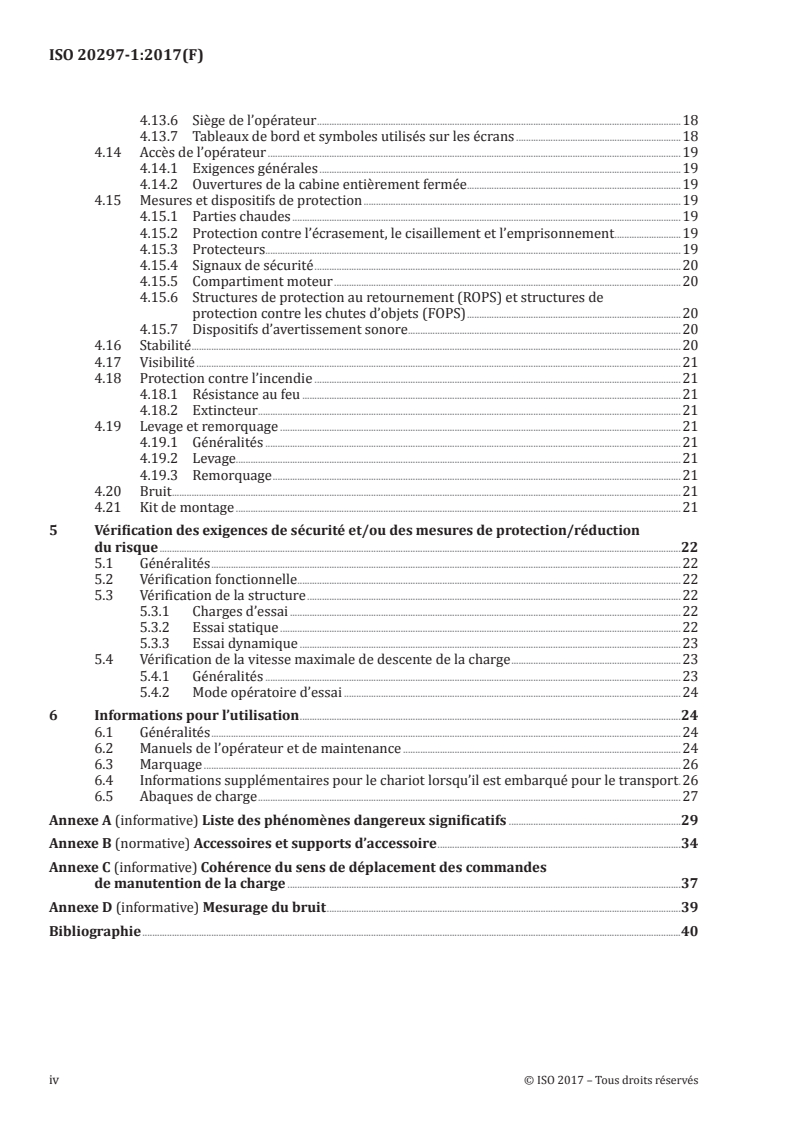
Sommaire Page
Avant-propos .v
Introduction .vi
1 Domaine d'application . 1
2 Références normatives . 1
3 Termes et définitions . 3
4 Exigences de sécurité et/ou mesures de protection/réduction du risque .7
4.1 Généralités . 7
4.1.1 Gestion du risque . . . 7
4.1.2 Conditions normales d’utilisation . 7
4.2 Arêtes vives et angles aigus . 8
4.3 Composants à accumulation d’énergie . 8
4.4 Démarrage/déplacement . 8
4.4.1 Démarrage non autorisé. 8
4.4.2 Mouvement intempestif . . 8
4.4.3 Mouvements incontrôlés . 8
4.4.4 Déplacement motorisé . . 8
4.4.5 Non-actionnement du frein de stationnement . 8
4.4.6 Pédale d’approche lente . 8
4.5 Freins . 9
4.6 Défaillance de l’alimentation en énergie . 9
4.7 Systèmes électriques et électroniques . 9
4.7.1 Généralités . 9
4.7.2 Degré de protection . 9
4.7.3 Connexions électriques . 9
4.7.4 Dispositifs de protection contre les surintensités .10
4.7.5 Batteries .10
4.7.6 Déconnexion de la batterie .10
4.8 Commandes .10
4.8.1 Généralités .10
4.8.2 Commandes des chariots accessibles depuis le niveau du sol .10
4.8.3 Activation par inadvertance .10
4.8.4 Blocage de différentiel .11
4.8.5 Commande de direction .11
4.8.6 Commandes de manutention de charge .11
4.9 Systèmes de génération de puissance et accessoires .12
4.9.1 Systèmes d’échappement .12
4.9.2 Systèmes de refroidissement .12
4.9.3 Réservoirs et récipients sous pression .12
4.10 Dispositifs de stabilisation .13
4.11 Exigences de conception pour des besoins de maintenance .13
4.12 Systèmes pour le levage, l’inclinaison et la portée variable .13
4.12.1 Chaînes .13
4.12.2 Système hydraulique .14
4.12.3 Retenue de la charge.14
4.12.4 Vitesse maximale de descente de la charge .15
4.12.5 Limitation de la course .15
4.12.6 Bras de fourche, accessoires et supports d’accessoire .15
4.13 Poste de conduite .15
4.13.1 Exigences générales .15
4.13.2 Rangement du manuel de l’opérateur .15
4.13.3 Parties chaudes .16
4.13.4 Tuyaux et flexibles .16
4.13.5 Poste de conduite équipé d’une cabine entièrement fermée .16
4.13.6 Siège de l’opérateur .18
4.13.7 Tableaux de bord et symboles utilisés sur les écrans .18
4.14 Accès de l’opérateur .19
4.14.1 Exigences générales .19
4.14.2 Ouvertures de la cabine entièrement fermée.19
4.15 Mesures et dispositifs de protection .19
4.15.1 Parties chaudes .19
4.15.2 Protection contre l’écrasement, le cisaillement et l’emprisonnement .19
4.15.3 Protecteurs . .19
4.15.4 Signaux de sécurité .20
4.15.5 Compartiment moteur .20
4.15.6 Structures de protection au retournement (ROPS) et structures de
protection contre les chutes d’objets (FOPS) .20
4.15.7 Dispositifs d’avertissement sonore .20
4.16 Stabilité .20
4.17 Visibilité .21
4.18 Protection contre l’incendie .21
4.18.1 Résistance au feu .21
4.18.2 Extincteur .21
4.19 Levage et remorquage .21
4.19.1 Généralités .21
4.19.2 Levage.21
4.19.3 Remorquage .21
4.20 Bruit .21
4.21 Kit de montage .21
5 Vérification des exigences de sécurité et/ou des mesures de protection/réduction
du risque .22
5.1 Généralités .22
5.2 Vérification fonctionnelle .22
5.3 Vérification de la structure .22
5.3.1 Charges d’essai .22
5.3.2 Essai statique .22
5.3.3 Essai dynamique .23
5.4 Vérification de la vitesse maximale de descente de la charge .23
5.4.1 Généralités .23
5.4.2 Mode opératoire d’essai .24
6 Informations pour l’utilisation .24
6.1 Généralités .24
6.2 Manuels de l’opérateur et de maintenance .24
6.3 Marquage .26
6.4 Informations supplémentaires pour le chariot lorsqu’il est embarqué pour le transport .26
6.5 Abaques de charge .27
Annexe A (informative) Liste des phénomènes dangereux significatifs .29
Annexe B (normative) Accessoires et supports d’accessoire .34
Annexe C (informative) Cohérence du sens de déplacement des commandes
de manutention de la charge .37
Annexe D (informative) Mesurage du bruit .39
Bibliographie .40
iv © ISO 2017 – Tous droits réservés
Avant-propos
L'ISO (Organisation internationale de normalisation) est une fédération mondiale d'organismes
nationaux de normalisation (comités membres de l'ISO). L'élaboration des Normes internationales est
en général confiée aux comités techniques de l'ISO. Chaque comité membre intéressé par une étude
a le droit de faire partie du comité technique créé à cet effet. Les organisations internationales,
gouvernementales et non gouvernementales, en liaison avec l'ISO participent également aux travaux.
L'ISO collabore étroitement avec la Commission électrotechnique internationale (IEC) en ce qui
concerne la normalisation électrotechnique.
Les procédures utilisées pour élaborer le présent document et celles destinées à sa mise à jour sont
décrites dans les Directives ISO/IEC, Partie 1. Il convient, en particulier de prendre note des différents
critères d'approbation requis pour les différents types de documents ISO. Le présent document a été
rédigé conformément aux règles de rédaction données dans les Directives ISO/IEC, Partie 2 (voir www
.iso .org/ directives).
L'attention est attirée sur le fait que certains des éléments du présent document peuvent faire l'objet de
droits de propriété intellectuelle ou de droits analogues. L'ISO ne saurait être tenue pour responsable
de ne pas avoir identifié de tels droits de propriété et averti de leur existence. Les détails concernant
les références aux droits de propriété intellectuelle ou autres droits analogues identifiés lors de
l'élaboration du document sont indiqués dans l'Introduction et/ou dans la liste des déclarations de
brevets reçues par l'ISO (voir www .iso .org/ brevets).
Les appellations commerciales éventuellement mentionnées dans le présent document sont données
pour information, par souci de commodité, à l’intention des utilisateurs et ne sauraient constituer un
engagement.
Pour une explication de la nature volontaire des normes, la signification des termes et expressions
spécifiques de l'ISO liés à l'évaluation de la conformité, ou pour toute information au sujet de l'adhésion
de l'ISO aux principes de l’Organisation mondiale du commerce (OMC) concernant les obstacles
techniques au commerce (OTC), voir le lien suivant: www .iso .org/ iso/ fr/ avant -propos .html.
Le présent document a été élaboré par le comité technique ISO/TC 110, Chariots de manutention, sous-
comité SC 4, Chariots tout-terrain.
Une liste de toutes les parties de la série ISO 20297 se trouve sur le site web de l’ISO.
Introduction
Le présent document est une norme de type C tel que mentionné dans l’ISO 12100.
Le présent document concerne, en particulier, les groupes de parties prenantes suivants représentant
les acteurs du marché en ce qui concerne la sécurité des machines:
— fabricants de machines (petites, moyennes et grandes entreprises);
— organismes de santé et de sécurité (autorités réglementaires, organismes de prévention des risques
professionnels, surveillance du marché, etc.).
D’autres partenaires peuvent être concernés par le niveau de sécurité des machines atteint à l’aide du
document par les groupes de parties prenantes mentionnés ci-dessus:
— utilisateurs de machines/employeurs (petites, moyennes et grandes entreprises);
— utilisateurs de machines/salariés (par exemple, syndicats de salariés, organisations représentant
des personnes ayant des besoins particuliers);
— prestataires de services, par exemple, sociétés de maintenance (petites, moyennes et grandes
entreprises);
— consommateurs (dans le cas de machines destinées à être utilisées par des consommateurs).
Les groupes de parties prenantes mentionnés ci-dessus ont eu la possibilité de participer à l’élaboration
du présent document.
Les machines concernées et l’étendue des phénomènes dangereux, situations dangereuses ou
événements dangereux couverts sont indiquées dans le Domaine d’application du présent document.
Lorsque les exigences de la présente norme de type C sont différentes de celles mentionnées dans les
normes de type A ou B, les exigences de la présente norme de type C prennent le pas sur les exigences
des autres normes, pour les machines qui ont été conçues et fabriquées conformément aux exigences de
la présente norme de type C.
Les chariots embarqués sur porteur routier sont connus sous plusieurs appellations, y compris
«chariots embarqués sur véhicule» et «chariots de ferroutage». Ils peuvent également être équipés
d’une grande variété d’accessoires. Les chariots couverts par le présent document possèdent tous des
caractéristiques de conception leur permettant d’être montés sur un véhicule porteur.
vi © ISO 2017 – Tous droits réservés
NORME INTERNATIONALE ISO 20297-1:2017(F)
Chariots de manutention — Chariots embarqués sur
porteur routier —
Partie 1:
Exigences de sécurité et vérification
1 Domaine d'application
Le présent document spécifie les exigences de sécurité et leur vérification pour des chariots industriels
et tout-terrain embarqués sur porteur routier (ci-après désignés «chariots»).
Il est applicable aux chariots capables de s’auto-charger sur un véhicule porteur. Il n’est pas applicable aux:
— chariots qui roulent sur le véhicule porteur, ou
— chariots qui sont chargés sur le véhicule porteur à l’aide de moyens externes, c’est-à-dire une grue
ou un autre dispositif de levage.
Le présent document traite de tous les phénomènes dangereux, situations dangereuses ou événements
dangereux significatifs relatifs aux machines lorsqu’elles sont utilisées comme prévu ou dans
des conditions de mauvaise utilisation qui sont raisonnablement prévisibles par le fabricant. Les
phénomènes dangereux significatifs couverts par le présent document sont énumérés dans l’Annexe A.
Le présent document ne traite pas des phénomènes dangereux qui peuvent apparaître:
— pendant la fabrication;
— au cours de la manutention de charges suspendues, qui peuvent osciller librement;
— lors de l’utilisation des chariots sur des voies publiques;
— lors du fonctionnement en atmosphères explosibles;
— si les chariots sont hybrides ou si leur source d’énergie principale est une batterie.
Il ne traite pas des exigences de sécurité routière lorsque le chariot est embarqué sur le véhicule porteur.
Il n’est pas applicable aux chariots fabriqués avant la date de sa publication.
2 Références normatives
Les documents ci-après, dans leur intégralité ou non, sont des références normatives indispensables à
l’application du présent document. Pour les références datées, seule l’édition citée s’applique. Pour les
références non datées, la dernière édition du document de référence s’applique (y compris les éventuels
amendements).
ISO 2330, Chariots élévateurs à fourches — Bras de fourche — Caractéristiques techniques et essais
ISO 2860, Engins de terrassement — Dimensions minimales des passages
ISO 2867:2011, Engins de terrassement — Moyens d'accès
ISO 3449, Engins de terrassement — Structures de protection contre les chutes d'objets — Essais de
laboratoire et critères de performance
ISO 3457, Engins de terrassement — Protecteurs — Définitions et exigences
ISO 3471:2008, Engins de terrassement — Structures de protection au retournement — Essais de
laboratoire et exigences de performance
ISO 3691-1:2011, Chariots de manutention — Exigences de sécurité et vérification — Partie 1: Chariots
de manutention automoteurs, autres que les chariots sans conducteur, les chariots à portée variable et les
chariots transporteurs de charges
ISO 3795, Véhicules routiers et tracteurs et matériels agricoles et forestiers — Détermination des
caractéristiques de combustion des matériaux intérieurs
ISO 5053-1, Chariots de manutention — Terminologie et classification — Partie 1: Types de chariots de
manutention
ISO 5353, Engins de terrassement, et tracteurs et matériels agricoles et forestiers — Point repère du siège
ISO 6292, Chariots de manutention et tracteurs industriels automoteurs — Performance de freinage et
résistance des éléments de frein
ISO 6682, Engins de terrassement — Zones de confort et d'accessibilité des commandes
ISO 6683, Engins de terrassement — Ceintures de sécurité et ancrages pour ceintures de sécurité —
Exigences de performance et essais
ISO 7000, Symboles graphiques utilisables sur le matériel — Symboles enregistrés
ISO 9244, Engins de terrassement — Étiquetage de sécurité de la machine — Principes généraux
ISO 9247, Engins de terrassement — Fils et câbles électriques — Principes d'identification et de marquage
ISO 9533, Engins de terrassement — Avertisseurs sonores de déplacement et de recul montés sur engins —
Méthodes d'essai et critères de performance
ISO 10263-4, Engins de terrassement — Environnement de l'enceinte de l'opérateur — Partie 4:
Performances et méthode d'essai des systèmes de chauffage, de ventilation et de climatisation (CVCA)
ISO 11112:1995, Engins de terrassement — Siège de l'opérateur — Dimensions et exigences
ISO 12100:2010, Sécurité des machines — Principes généraux de conception — Appréciation du risque et
réduction du risque
ISO 12508, Engins de terrassement — Poste de l'opérateur et zones de maintenance — Acuité des arêtes
ISO 13564-1, Chariots de manutention automoteurs — Méthodes d'essai pour la vérification de la
visibilité — Partie 1: Chariots à conducteur assis et debout et chariots à portée variable ayant une capacité
allant jusqu'à 10 t incluses
ISO 13732-1, Ergonomie des ambiances thermiques — Méthodes d'évaluation de la réponse humaine au
contact avec des surfaces — Partie 1: Surfaces chaudes
ISO 13849-1, Sécurité des machines — Parties des systèmes de commande relatives à la sécurité — Partie
1: Principes généraux de conception
ISO 15817, Engins de terrassement — Exigences de sécurité relatives aux systèmes de commande à distance
utilisés par l'opérateur
ISO 15870, Chariots de manutention automoteurs — Signaux de sécurité et de danger — Principes généraux
ISO 21507, Engins de terrassement — Exigences de performance pour les réservoirs de carburant non
métalliques
ISO 22915-3, Chariots de manutention — Vérification de la stabilité — Partie 3: Chariots à mât ou à fourche
rétractable
2 © ISO 2017 – Tous droits réservés
ISO 22915-7, Chariots de manutention — Vérification de la stabilité — Partie 7: Chariots bidirectionnels et
multidirectionnels
ISO 22915-10, Chariots de manutention — Vérification de la stabilité — Partie 10: Essai de stabilité
supplémentaire pour les chariots travaillant dans des conditions de gerbage spéciales avec la charge
décentrée latéralement par des dispositifs à moteur
ISO 22915-13, Chariots de manutention — Vérification de la stabilité — Partie 13: Chariots tout-terrain à mât
ISO 22915-14, Chariots de manutention — Vérification de la stabilité — Partie 14: Chariots tout-terrain à
portée variable
IEC 60529, Degrés de protection procurés par les enveloppes (Code IP)
3 Termes et définitions
Pour les besoins du présent document, les termes et définitions donnés dans les ISO 12100 et ISO 5053-1,
ainsi que les suivants, s’appliquent.
L’ISO et l’IEC tiennent à jour des bases de données terminologiques destinées à être utilisées en
normalisation, consultables aux adresses suivantes:
— ISO Online browsing platform: disponible à l’adresse https:// www .iso .org/ obp
— IEC Electropedia: disponible à l’adresse http:// www .electropedia .org/
3.1
chariot embarqué sur porteur routier
véhicule à roues commandé par un opérateur, équipé d’un mécanisme d’entraînement motorisé, conçu
pour transporter, gerber ou stocker dans des rayonnages toutes sortes de charges, et capable de s’auto-
charger et s’auto-décharger d’un véhicule porteur en utilisant son propre moyen de levage de charge
Note 1 à l'article: Cette définition est différente de celle donnée dans l’ISO 5053-1.
3.1.1
chariot industriel embarqué sur porteur routier
chariot embarqué sur porteur routier, conçu pour un fonctionnement dans les conditions normales
d’utilisation sur des surfaces substantiellement fermes, lisses, nivelées, aménagées et consolidées
Note 1 à l'article: Les conditions normales d’utilisation sont décrites en 4.1.2.
3.1.2
chariot tout-terrain embarqué sur porteur routier
chariot embarqué sur porteur routier, conçu pour un fonctionnement dans les conditions normales
d’utilisation sur des terrains naturels non aménagés, ainsi que sur les terrains accidentés des chantiers
de construction
Note 1 à l'article: Les conditions normales d’utilisation sont décrites en 4.1.2.
3.2
capacité nominale
Q
charge maximale autorisée par le fabricant à la distance normalisée du centre de la charge (3.7)
que le chariot est capable de lever et de transporter sur les bras de fourche (3.10) dans des conditions
normales avec la flèche (3.11), le mât (3.12) ou les fourches complètement rétractés
Note 1 à l'article: Voir la Figure 1.
3.3
capacité nominale
charge maximale qu’un accessoire (3.14) est autorisé par son fabricant à manipuler en
fonctionnement normal dans des conditions spécifiées
Note 1 à l'article: La capacité nominale de l’accessoire (3.14) peut être associée à la distance du centre de la
charge. Voir le Tableau 1.
3.4
capacité effective
charge maximale à une distance spécifiée du centre de la charge, établie par le fabricant sur la base de
la résistance des composants et de la stabilité du chariot, que le chariot peut transporter, lever et gerber
à une hauteur de levée (3.6) et une portée (3.5) spécifiées, en fonctionnement normal
Note 1 à l'article: Voir la Figure 1.
Note 2 à l'article: La capacité effective dépend de la configuration du chariot en termes de variables comprenant
la hauteur de levée (3.6), la portée (3.5) de la flèche (3.11), le centre réel de la charge, les dispositifs de manutention
de la charge et les dispositifs de stabilisation (3.9).
Note 3 à l'article: Elle définit l’aptitude à la manutention de la charge du chariot particulier tel qu’il est équipé.
Une capacité effective supplémentaire avec des accessoires (3.14) amovibles, lorsque autorisés, peut également
être établie par l’essai de stabilité approprié ou par calcul vérifié par des données empiriques.
4 © ISO 2017 – Tous droits réservés
Légende
d portée
D distance normalisée du centre de la charge
G centre de gravité de la charge
g point correspondant à la projection verticale de G
Q capacité nominale
Q capacité effective à la hauteur de levée maximale
Q capacité effective à la portée maximale
Figure 1 — Paramètres pour la détermination de la capacité effective d’un chariot avec bras
de fourche
3.5
portée
d
distance sur laquelle la charge peut être déplacée vers l’avant dans la direction horizontale
Note 1 à l'article: Voir la Figure 1.
3.6
hauteur de levée
hauteur à partir du sol jusqu’à la face supérieure des bras de fourche (3.10) ou la face inférieure de la
charge, selon la plus petite des deux
3.7
distance normalisée du centre de la charge
D
distance depuis le centre de gravité de la charge, horizontalement vers l’arrière jusqu’à la face avant
des parties verticales de la fourche et verticalement vers le bas jusqu’aux faces supérieures des bras de
fourche (3.10)
Note 1 à l'article: Voir la Figure 1.
Note 2 à l'article: Le Tableau 1 donne les distances normalisées du centre de la charge en fonction de la capacité
nominale (3.2).
Tableau 1 — Distances normalisées du centre de la charge et capacités nominales
Distance normalisée du centre de la charge
Capacité nominale
D
Q
mm
kg
400 500 600 900 1 200
a
0 < 1 000 X X
c b
≥ 1 000 < 5 000 X X
≥ 5 000 < 10 000 X
≥ 10 000 < 20 000 X X X
≥ 20 000 < 25 000 X X
≥ 25 000 X
NOTE Les chariots peuvent être classés pour des applications spéciales avec des centres de charge liés à ces applications.
a
600 mm est utilisé aux USA.
b
600 mm est utilisé en Asie, Australie et aux USA.
c
500 mm est généralement utilisé en Europe.
3.8
perte au centre de charge
LL
épaisseur effective
ET
déplacement horizontal du centre normalisé de la charge qui peut se produire lorsque des accessoires
(3.14) amovibles sont ajoutés à un chariot
3.9
dispositifs de stabilisation
supports mécaniques extensibles et/ou pivotants utilisés pour améliorer la stabilité d’un chariot
lorsqu’il est stationnaire
3.10
bras de fourche
structures supportant la charge, composées chacune d’un talon (portion verticale) et d’une lame
(portion horizontale), qui sont à tenon ou à goupille, fixées sur le tablier et habituellement à ajustement
latéral manuel
3.11
flèche
élément support pivotant qui permet le positionnement horizontal et vertical de la charge ou de
l’accessoire (3.14)
[SOURCE: ISO 10896-1:2012, 3.14.]
6 © ISO 2017 – Tous droits réservés
3.12
mât
élément support qui permet le mouvement vertical du tablier
3.13
position normale de conduite
position spécifiée par le fabricant, à partir de laquelle l’opérateur est capable de commander les
fonctions du chariot, y compris les fonctions de manutention de la charge
3.14
accessoire
composant ou assemblage de composants qui peut être monté sur le dispositif d'attache de l’accessoire
pour une utilisation spécifique
3.15
véhicule porteur
porteur routier ou remorque qui est approprié au transport d’un chariot embarqué sur porteur routier
(3.1) par l’installation d’un kit de montage (3.16) approprié
3.16
kit de montage
structure conçue pour installer un chariot embarqué sur porteur routier (3.1) sur un véhicule porteur
3.17
pression maximale de service
pression la plus haute à laquelle un circuit hydraulique est destiné à fonctionner dans des conditions
normales d’utilisation
Note 1 à l'article: Les conditions normales d’utilisation sont décrites en 4.1.2.
3.18
sol nivelé
sol avec une pente de 0 ± 2 %
4 Exigences de sécurité et/ou mesures de protection/réduction du risque
4.1 Généralités
4.1.1 Gestion du risque
Les chariots doivent être conformes aux exigences de sécurité et/ou aux mesures de protection/
réduction du risque du présent article.
En complément, le chariot doit être conçu conformément aux principes de l’ISO 12100:2010 pour
les phénomènes dangereux pertinents, mais non significatifs, qui ne sont pas traités dans le présent
document.
4.1.2 Conditions normales d’utilisation
Les conditions normales d’utilisation sont considérées comme étant les suivantes:
— conduite (roulage et manœuvre) et manutention de la charge dans des conditions de surface dans
lesquelles le chariot est conçu pour fonctionner; ces conditions de la surface doivent être spécifiées
dans la notice d’instructions;
— conduite avec le centre de gravité horizontal de la charge approximativement dans le plan médian
longitudinal du chariot;
— roulage avec la charge en position basse (roulage) et avec la charge inclinée vers l’arrière, le cas
échéant.
Si les conditions ci-dessus ne suffisent pas pour permettre de spécifier les conditions de stabilité d’un
type particulier de chariot, alors les conditions de fonctionnement doivent être conformes aux Normes
internationales référencées pour la stabilité en 4.16.
4.2 Arêtes vives et angles aigus
Les arêtes vives et les angles aigus doivent satisfaire aux exigences de l’ISO 12508 dans les zones où
l’opérateur peut être exposé pendant l’utilisation, l’accès, la sortie et la maintenance quotidienne.
4.3 Composants à accumulation d’énergie
Les composants qui stockent de l’énergie et qui peuvent causer un risque de blessure pendant la dépose
ou le démontage, par exemple, accumulateurs hydrauliques, freins à ressort, doivent être munis d’un
moyen de libérer l’énergie avant dépose ou démontage et doivent porter un marquage clair.
4.4 Démarrage/déplacement
4.4.1 Démarrage non autorisé
Le chariot doit être équipé d’un dispositif (par exemple, clé, code, carte magnétique) qui empêche le
démarrage sans son utilisation.
4.4.2 Mouvement intempestif
Le chariot doit être muni d’un dispositif qui empêche le démarrage du moteur alors que le système de
transmission est engagé. Lorsque la commande du sens de marche du système de transmission est au
point neutre, des dispositions doivent être prises pour la positionner et maintenir au point neutre.
4.4.3 Mouvements incontrôlés
Le chariot ne doit pas bouger de la position de repos sur un sol nivelé tant que le système de transmission
n’a pas été engagé.
4.4.4 Déplacement motorisé
Des moyens doivent être fournis pour empêcher le déplacement motorisé lorsque l’opérateur n’est pas
en position normale de conduite. Le déplacement motorisé ne doit pas se produire automatiquement
lorsque l’opérateur retourne à la position normale de conduite sans une autre opération, par exemple,
par réinitialisation de la commande du sens de la marche au point neutre.
L’actionnement du frein de stationnement doit entraîner la mise au neutre de la commande de
déplacement.
4.4.5 Non-actionnement du frein de stationnement
Si l’opérateur quitte la position de conduite lorsque le frein de stationnement n’est pas actionné, des
moyens doivent être fournis pour avertir l’opérateur.
4.4.6 Pédale d’approche lente
Si une pédale d’approche lente est montée, elle doit être enfoncée pour moduler la transmission et peut
actionner le frein de service. Elle doit pouvoir être actionnée par le pied gauche de l’opérateur. S’il n’y a
8 © ISO 2017 – Tous droits réservés
pas de moyen séparé pour actionner le frein de service, la pédale d’approche lente doit consister en une
seule pédale pouvant être actionnée de manière égale par n’importe quel pied.
NOTE L’ISO 21281 peut être utilisée comme guide.
4.5 Freins
Les chariots doivent être équipés d’un frein ou de freins de service et d’un frein de stationnement,
conformes à l’ISO 6292.
Lorsque des systèmes de frein électromécaniques sont montés, ils doivent être actionnés
mécaniquement et relâchés électriquement. Lorsque des freins de stationnement hydromécanique sont
montés, ils doivent être actionnés mécaniquement et relâchés hydrauliquement. Lorsque l’opérateur
relâche manuellement le frein de stationnement depuis la position normale de conduite, il ne doit pas
désactiver les freins de service.
4.6 Défaillance de l’alimentation en énergie
Une défaillance de l’alimentation en énergie d’un système de frein ne doit pas entraîner la perte totale
du freinage.
Les systèmes doivent pouvoir amener le chariot à un arrêt contrôlé et maintenir le chariot dans une
position de stationnement.
4.7 Systèmes électriques et électroniques
4.7.1 Généralités
Les composants et conducteurs électriques doivent être installés de façon à minimiser le dommage dû
à une exposition à des conditions environnementales (correspondant à l’utilisation du chariot telle que
prévue par le fabricant) qui peuvent causer une détérioration.
L’isolation du composant électrique doit avoir des propriétés ignifuges. Des moyens pour empêcher
l’abrasion de l’isolation du composant électrique doivent être prévus, par exemple, lorsqu’il traverse des
châssis et des cloisons.
Les fils/câbles électriques non protégés par des dispositifs contre les surintensités ne doivent pas être
disposés de sorte qu’ils soient en contact avec des tuyaux ou des flexibles contenant du carburant.
Pour les parties relatives à la sécurité des systèmes de commande, les principes donnés dans
l’ISO 13849-1 doivent être suivis ou des méthodes offrant une protection similaire appliquées.
4.7.2 Degré de protection
Tous les composants installés à l’extérieur du chariot ou directement exposés à l’environnement doivent
avoir au moins le degré de protection correspondant à IP55 conforme à l’IEC 60529.
4.7.3 Connexions électriques
Les fils et les câbles électriques utilisés pour connecter les composants dans les circuits électriques
doivent être marqués et identifiés conformément à l’ISO 9247.
Cette exigence ne s’applique pas aux circuits électriques utilisés pour les systèmes antivol, lorsqu’ils
sont montés.
4.7.4 Dispositifs de protection contre les surintensités
L’équipement électrique, à l’exception du démarreur, de l’alternateur et du préchauffage de la
combustion doit être protégé par un dispositif contre les surintensités (par exemple, un fusible) ou un
autre dispositif donnant la même protection.
4.7.5 Batteries
Les batteries doivent être solidement montées à un emplacement ventilé qui fournit un accès pour la
maintenance.
Les batteries et/ou les emplacements de batterie doivent être conçus et fabriqués ou protégés de
manière à minimiser tous les phénomènes dangereux pour l’opérateur causés par l’acide de la batterie
ou les vapeurs acides dans le cas d’un renversement du chariot.
Les fils et les câbles alimentés électriquement (non raccordés au châssis) et les connecteurs doivent être
recouverts d’un matériau isolant.
4.7.6 Déconnexion de la batterie
Il doit être possible de déconnecter les batteries rapidement, par exemple, à l’aide d’un couplage rapide
ou d’un sectionneur facilement accessible.
Le symbole ISO 7000-2063 peut être utilisé pour
...
NORME ISO
INTERNATIONALE 20297-1
Première édition
2017-12
Chariots de manutention — Chariots
embarqués sur porteur routier —
Partie 1:
Exigences de sécurité et vérification
Industrial trucks — Lorry-mounted trucks —
Part 1: Safety requirements and verification
Numéro de référence
©
ISO 2017
DOCUMENT PROTÉGÉ PAR COPYRIGHT
© ISO 2017
Tous droits réservés. Sauf prescription différente ou nécessité dans le contexte de sa mise en œuvre, aucune partie de cette
publication ne peut être reproduite ni utilisée sous quelque forme que ce soit et par aucun procédé, électronique ou mécanique,
y compris la photocopie, ou la diffusion sur l’internet ou sur un intranet, sans autorisation écrite préalable. Une autorisation peut
être demandée à l’ISO à l’adresse ci-après ou au comité membre de l’ISO dans le pays du demandeur.
ISO copyright office
Case postale 401 • Ch. de Blandonnet 8
CH-1214 Vernier, Genève
Tél.: +41 22 749 01 11
Fax: +41 22 749 09 47
E-mail: copyright@iso.org
Web: www.iso.org
Publié en Suisse
ii © ISO 2017 – Tous droits réservés
Sommaire Page
Avant-propos .v
Introduction .vi
1 Domaine d'application . 1
2 Références normatives . 1
3 Termes et définitions . 3
4 Exigences de sécurité et/ou mesures de protection/réduction du risque .7
4.1 Généralités . 7
4.1.1 Gestion du risque . . . 7
4.1.2 Conditions normales d’utilisation . 7
4.2 Arêtes vives et angles aigus . 8
4.3 Composants à accumulation d’énergie . 8
4.4 Démarrage/déplacement . 8
4.4.1 Démarrage non autorisé. 8
4.4.2 Mouvement intempestif . . 8
4.4.3 Mouvements incontrôlés . 8
4.4.4 Déplacement motorisé . . 8
4.4.5 Non-actionnement du frein de stationnement . 8
4.4.6 Pédale d’approche lente . 8
4.5 Freins . 9
4.6 Défaillance de l’alimentation en énergie . 9
4.7 Systèmes électriques et électroniques . 9
4.7.1 Généralités . 9
4.7.2 Degré de protection . 9
4.7.3 Connexions électriques . 9
4.7.4 Dispositifs de protection contre les surintensités .10
4.7.5 Batteries .10
4.7.6 Déconnexion de la batterie .10
4.8 Commandes .10
4.8.1 Généralités .10
4.8.2 Commandes des chariots accessibles depuis le niveau du sol .10
4.8.3 Activation par inadvertance .10
4.8.4 Blocage de différentiel .11
4.8.5 Commande de direction .11
4.8.6 Commandes de manutention de charge .11
4.9 Systèmes de génération de puissance et accessoires .12
4.9.1 Systèmes d’échappement .12
4.9.2 Systèmes de refroidissement .12
4.9.3 Réservoirs et récipients sous pression .12
4.10 Dispositifs de stabilisation .13
4.11 Exigences de conception pour des besoins de maintenance .13
4.12 Systèmes pour le levage, l’inclinaison et la portée variable .13
4.12.1 Chaînes .13
4.12.2 Système hydraulique .14
4.12.3 Retenue de la charge.14
4.12.4 Vitesse maximale de descente de la charge .15
4.12.5 Limitation de la course .15
4.12.6 Bras de fourche, accessoires et supports d’accessoire .15
4.13 Poste de conduite .15
4.13.1 Exigences générales .15
4.13.2 Rangement du manuel de l’opérateur .15
4.13.3 Parties chaudes .16
4.13.4 Tuyaux et flexibles .16
4.13.5 Poste de conduite équipé d’une cabine entièrement fermée .16
4.13.6 Siège de l’opérateur .18
4.13.7 Tableaux de bord et symboles utilisés sur les écrans .18
4.14 Accès de l’opérateur .19
4.14.1 Exigences générales .19
4.14.2 Ouvertures de la cabine entièrement fermée.19
4.15 Mesures et dispositifs de protection .19
4.15.1 Parties chaudes .19
4.15.2 Protection contre l’écrasement, le cisaillement et l’emprisonnement .19
4.15.3 Protecteurs . .19
4.15.4 Signaux de sécurité .20
4.15.5 Compartiment moteur .20
4.15.6 Structures de protection au retournement (ROPS) et structures de
protection contre les chutes d’objets (FOPS) .20
4.15.7 Dispositifs d’avertissement sonore .20
4.16 Stabilité .20
4.17 Visibilité .21
4.18 Protection contre l’incendie .21
4.18.1 Résistance au feu .21
4.18.2 Extincteur .21
4.19 Levage et remorquage .21
4.19.1 Généralités .21
4.19.2 Levage.21
4.19.3 Remorquage .21
4.20 Bruit .21
4.21 Kit de montage .21
5 Vérification des exigences de sécurité et/ou des mesures de protection/réduction
du risque .22
5.1 Généralités .22
5.2 Vérification fonctionnelle .22
5.3 Vérification de la structure .22
5.3.1 Charges d’essai .22
5.3.2 Essai statique .22
5.3.3 Essai dynamique .23
5.4 Vérification de la vitesse maximale de descente de la charge .23
5.4.1 Généralités .23
5.4.2 Mode opératoire d’essai .24
6 Informations pour l’utilisation .24
6.1 Généralités .24
6.2 Manuels de l’opérateur et de maintenance .24
6.3 Marquage .26
6.4 Informations supplémentaires pour le chariot lorsqu’il est embarqué pour le transport .26
6.5 Abaques de charge .27
Annexe A (informative) Liste des phénomènes dangereux significatifs .29
Annexe B (normative) Accessoires et supports d’accessoire .34
Annexe C (informative) Cohérence du sens de déplacement des commandes
de manutention de la charge .37
Annexe D (informative) Mesurage du bruit .39
Bibliographie .40
iv © ISO 2017 – Tous droits réservés
Avant-propos
L'ISO (Organisation internationale de normalisation) est une fédération mondiale d'organismes
nationaux de normalisation (comités membres de l'ISO). L'élaboration des Normes internationales est
en général confiée aux comités techniques de l'ISO. Chaque comité membre intéressé par une étude
a le droit de faire partie du comité technique créé à cet effet. Les organisations internationales,
gouvernementales et non gouvernementales, en liaison avec l'ISO participent également aux travaux.
L'ISO collabore étroitement avec la Commission électrotechnique internationale (IEC) en ce qui
concerne la normalisation électrotechnique.
Les procédures utilisées pour élaborer le présent document et celles destinées à sa mise à jour sont
décrites dans les Directives ISO/IEC, Partie 1. Il convient, en particulier de prendre note des différents
critères d'approbation requis pour les différents types de documents ISO. Le présent document a été
rédigé conformément aux règles de rédaction données dans les Directives ISO/IEC, Partie 2 (voir www
.iso .org/ directives).
L'attention est attirée sur le fait que certains des éléments du présent document peuvent faire l'objet de
droits de propriété intellectuelle ou de droits analogues. L'ISO ne saurait être tenue pour responsable
de ne pas avoir identifié de tels droits de propriété et averti de leur existence. Les détails concernant
les références aux droits de propriété intellectuelle ou autres droits analogues identifiés lors de
l'élaboration du document sont indiqués dans l'Introduction et/ou dans la liste des déclarations de
brevets reçues par l'ISO (voir www .iso .org/ brevets).
Les appellations commerciales éventuellement mentionnées dans le présent document sont données
pour information, par souci de commodité, à l’intention des utilisateurs et ne sauraient constituer un
engagement.
Pour une explication de la nature volontaire des normes, la signification des termes et expressions
spécifiques de l'ISO liés à l'évaluation de la conformité, ou pour toute information au sujet de l'adhésion
de l'ISO aux principes de l’Organisation mondiale du commerce (OMC) concernant les obstacles
techniques au commerce (OTC), voir le lien suivant: www .iso .org/ iso/ fr/ avant -propos .html.
Le présent document a été élaboré par le comité technique ISO/TC 110, Chariots de manutention, sous-
comité SC 4, Chariots tout-terrain.
Une liste de toutes les parties de la série ISO 20297 se trouve sur le site web de l’ISO.
Introduction
Le présent document est une norme de type C tel que mentionné dans l’ISO 12100.
Le présent document concerne, en particulier, les groupes de parties prenantes suivants représentant
les acteurs du marché en ce qui concerne la sécurité des machines:
— fabricants de machines (petites, moyennes et grandes entreprises);
— organismes de santé et de sécurité (autorités réglementaires, organismes de prévention des risques
professionnels, surveillance du marché, etc.).
D’autres partenaires peuvent être concernés par le niveau de sécurité des machines atteint à l’aide du
document par les groupes de parties prenantes mentionnés ci-dessus:
— utilisateurs de machines/employeurs (petites, moyennes et grandes entreprises);
— utilisateurs de machines/salariés (par exemple, syndicats de salariés, organisations représentant
des personnes ayant des besoins particuliers);
— prestataires de services, par exemple, sociétés de maintenance (petites, moyennes et grandes
entreprises);
— consommateurs (dans le cas de machines destinées à être utilisées par des consommateurs).
Les groupes de parties prenantes mentionnés ci-dessus ont eu la possibilité de participer à l’élaboration
du présent document.
Les machines concernées et l’étendue des phénomènes dangereux, situations dangereuses ou
événements dangereux couverts sont indiquées dans le Domaine d’application du présent document.
Lorsque les exigences de la présente norme de type C sont différentes de celles mentionnées dans les
normes de type A ou B, les exigences de la présente norme de type C prennent le pas sur les exigences
des autres normes, pour les machines qui ont été conçues et fabriquées conformément aux exigences de
la présente norme de type C.
Les chariots embarqués sur porteur routier sont connus sous plusieurs appellations, y compris
«chariots embarqués sur véhicule» et «chariots de ferroutage». Ils peuvent également être équipés
d’une grande variété d’accessoires. Les chariots couverts par le présent document possèdent tous des
caractéristiques de conception leur permettant d’être montés sur un véhicule porteur.
vi © ISO 2017 – Tous droits réservés
NORME INTERNATIONALE ISO 20297-1:2017(F)
Chariots de manutention — Chariots embarqués sur
porteur routier —
Partie 1:
Exigences de sécurité et vérification
1 Domaine d'application
Le présent document spécifie les exigences de sécurité et leur vérification pour des chariots industriels
et tout-terrain embarqués sur porteur routier (ci-après désignés «chariots»).
Il est applicable aux chariots capables de s’auto-charger sur un véhicule porteur. Il n’est pas applicable aux:
— chariots qui roulent sur le véhicule porteur, ou
— chariots qui sont chargés sur le véhicule porteur à l’aide de moyens externes, c’est-à-dire une grue
ou un autre dispositif de levage.
Le présent document traite de tous les phénomènes dangereux, situations dangereuses ou événements
dangereux significatifs relatifs aux machines lorsqu’elles sont utilisées comme prévu ou dans
des conditions de mauvaise utilisation qui sont raisonnablement prévisibles par le fabricant. Les
phénomènes dangereux significatifs couverts par le présent document sont énumérés dans l’Annexe A.
Le présent document ne traite pas des phénomènes dangereux qui peuvent apparaître:
— pendant la fabrication;
— au cours de la manutention de charges suspendues, qui peuvent osciller librement;
— lors de l’utilisation des chariots sur des voies publiques;
— lors du fonctionnement en atmosphères explosibles;
— si les chariots sont hybrides ou si leur source d’énergie principale est une batterie.
Il ne traite pas des exigences de sécurité routière lorsque le chariot est embarqué sur le véhicule porteur.
Il n’est pas applicable aux chariots fabriqués avant la date de sa publication.
2 Références normatives
Les documents ci-après, dans leur intégralité ou non, sont des références normatives indispensables à
l’application du présent document. Pour les références datées, seule l’édition citée s’applique. Pour les
références non datées, la dernière édition du document de référence s’applique (y compris les éventuels
amendements).
ISO 2330, Chariots élévateurs à fourches — Bras de fourche — Caractéristiques techniques et essais
ISO 2860, Engins de terrassement — Dimensions minimales des passages
ISO 2867:2011, Engins de terrassement — Moyens d'accès
ISO 3449, Engins de terrassement — Structures de protection contre les chutes d'objets — Essais de
laboratoire et critères de performance
ISO 3457, Engins de terrassement — Protecteurs — Définitions et exigences
ISO 3471:2008, Engins de terrassement — Structures de protection au retournement — Essais de
laboratoire et exigences de performance
ISO 3691-1:2011, Chariots de manutention — Exigences de sécurité et vérification — Partie 1: Chariots
de manutention automoteurs, autres que les chariots sans conducteur, les chariots à portée variable et les
chariots transporteurs de charges
ISO 3795, Véhicules routiers et tracteurs et matériels agricoles et forestiers — Détermination des
caractéristiques de combustion des matériaux intérieurs
ISO 5053-1, Chariots de manutention — Terminologie et classification — Partie 1: Types de chariots de
manutention
ISO 5353, Engins de terrassement, et tracteurs et matériels agricoles et forestiers — Point repère du siège
ISO 6292, Chariots de manutention et tracteurs industriels automoteurs — Performance de freinage et
résistance des éléments de frein
ISO 6682, Engins de terrassement — Zones de confort et d'accessibilité des commandes
ISO 6683, Engins de terrassement — Ceintures de sécurité et ancrages pour ceintures de sécurité —
Exigences de performance et essais
ISO 7000, Symboles graphiques utilisables sur le matériel — Symboles enregistrés
ISO 9244, Engins de terrassement — Étiquetage de sécurité de la machine — Principes généraux
ISO 9247, Engins de terrassement — Fils et câbles électriques — Principes d'identification et de marquage
ISO 9533, Engins de terrassement — Avertisseurs sonores de déplacement et de recul montés sur engins —
Méthodes d'essai et critères de performance
ISO 10263-4, Engins de terrassement — Environnement de l'enceinte de l'opérateur — Partie 4:
Performances et méthode d'essai des systèmes de chauffage, de ventilation et de climatisation (CVCA)
ISO 11112:1995, Engins de terrassement — Siège de l'opérateur — Dimensions et exigences
ISO 12100:2010, Sécurité des machines — Principes généraux de conception — Appréciation du risque et
réduction du risque
ISO 12508, Engins de terrassement — Poste de l'opérateur et zones de maintenance — Acuité des arêtes
ISO 13564-1, Chariots de manutention automoteurs — Méthodes d'essai pour la vérification de la
visibilité — Partie 1: Chariots à conducteur assis et debout et chariots à portée variable ayant une capacité
allant jusqu'à 10 t incluses
ISO 13732-1, Ergonomie des ambiances thermiques — Méthodes d'évaluation de la réponse humaine au
contact avec des surfaces — Partie 1: Surfaces chaudes
ISO 13849-1, Sécurité des machines — Parties des systèmes de commande relatives à la sécurité — Partie
1: Principes généraux de conception
ISO 15817, Engins de terrassement — Exigences de sécurité relatives aux systèmes de commande à distance
utilisés par l'opérateur
ISO 15870, Chariots de manutention automoteurs — Signaux de sécurité et de danger — Principes généraux
ISO 21507, Engins de terrassement — Exigences de performance pour les réservoirs de carburant non
métalliques
ISO 22915-3, Chariots de manutention — Vérification de la stabilité — Partie 3: Chariots à mât ou à fourche
rétractable
2 © ISO 2017 – Tous droits réservés
ISO 22915-7, Chariots de manutention — Vérification de la stabilité — Partie 7: Chariots bidirectionnels et
multidirectionnels
ISO 22915-10, Chariots de manutention — Vérification de la stabilité — Partie 10: Essai de stabilité
supplémentaire pour les chariots travaillant dans des conditions de gerbage spéciales avec la charge
décentrée latéralement par des dispositifs à moteur
ISO 22915-13, Chariots de manutention — Vérification de la stabilité — Partie 13: Chariots tout-terrain à mât
ISO 22915-14, Chariots de manutention — Vérification de la stabilité — Partie 14: Chariots tout-terrain à
portée variable
IEC 60529, Degrés de protection procurés par les enveloppes (Code IP)
3 Termes et définitions
Pour les besoins du présent document, les termes et définitions donnés dans les ISO 12100 et ISO 5053-1,
ainsi que les suivants, s’appliquent.
L’ISO et l’IEC tiennent à jour des bases de données terminologiques destinées à être utilisées en
normalisation, consultables aux adresses suivantes:
— ISO Online browsing platform: disponible à l’adresse https:// www .iso .org/ obp
— IEC Electropedia: disponible à l’adresse http:// www .electropedia .org/
3.1
chariot embarqué sur porteur routier
véhicule à roues commandé par un opérateur, équipé d’un mécanisme d’entraînement motorisé, conçu
pour transporter, gerber ou stocker dans des rayonnages toutes sortes de charges, et capable de s’auto-
charger et s’auto-décharger d’un véhicule porteur en utilisant son propre moyen de levage de charge
Note 1 à l'article: Cette définition est différente de celle donnée dans l’ISO 5053-1.
3.1.1
chariot industriel embarqué sur porteur routier
chariot embarqué sur porteur routier, conçu pour un fonctionnement dans les conditions normales
d’utilisation sur des surfaces substantiellement fermes, lisses, nivelées, aménagées et consolidées
Note 1 à l'article: Les conditions normales d’utilisation sont décrites en 4.1.2.
3.1.2
chariot tout-terrain embarqué sur porteur routier
chariot embarqué sur porteur routier, conçu pour un fonctionnement dans les conditions normales
d’utilisation sur des terrains naturels non aménagés, ainsi que sur les terrains accidentés des chantiers
de construction
Note 1 à l'article: Les conditions normales d’utilisation sont décrites en 4.1.2.
3.2
capacité nominale
Q
charge maximale autorisée par le fabricant à la distance normalisée du centre de la charge (3.7)
que le chariot est capable de lever et de transporter sur les bras de fourche (3.10) dans des conditions
normales avec la flèche (3.11), le mât (3.12) ou les fourches complètement rétractés
Note 1 à l'article: Voir la Figure 1.
3.3
capacité nominale
charge maximale qu’un accessoire (3.14) est autorisé par son fabricant à manipuler en
fonctionnement normal dans des conditions spécifiées
Note 1 à l'article: La capacité nominale de l’accessoire (3.14) peut être associée à la distance du centre de la
charge. Voir le Tableau 1.
3.4
capacité effective
charge maximale à une distance spécifiée du centre de la charge, établie par le fabricant sur la base de
la résistance des composants et de la stabilité du chariot, que le chariot peut transporter, lever et gerber
à une hauteur de levée (3.6) et une portée (3.5) spécifiées, en fonctionnement normal
Note 1 à l'article: Voir la Figure 1.
Note 2 à l'article: La capacité effective dépend de la configuration du chariot en termes de variables comprenant
la hauteur de levée (3.6), la portée (3.5) de la flèche (3.11), le centre réel de la charge, les dispositifs de manutention
de la charge et les dispositifs de stabilisation (3.9).
Note 3 à l'article: Elle définit l’aptitude à la manutention de la charge du chariot particulier tel qu’il est équipé.
Une capacité effective supplémentaire avec des accessoires (3.14) amovibles, lorsque autorisés, peut également
être établie par l’essai de stabilité approprié ou par calcul vérifié par des données empiriques.
4 © ISO 2017 – Tous droits réservés
Légende
d portée
D distance normalisée du centre de la charge
G centre de gravité de la charge
g point correspondant à la projection verticale de G
Q capacité nominale
Q capacité effective à la hauteur de levée maximale
Q capacité effective à la portée maximale
Figure 1 — Paramètres pour la détermination de la capacité effective d’un chariot avec bras
de fourche
3.5
portée
d
distance sur laquelle la charge peut être déplacée vers l’avant dans la direction horizontale
Note 1 à l'article: Voir la Figure 1.
3.6
hauteur de levée
hauteur à partir du sol jusqu’à la face supérieure des bras de fourche (3.10) ou la face inférieure de la
charge, selon la plus petite des deux
3.7
distance normalisée du centre de la charge
D
distance depuis le centre de gravité de la charge, horizontalement vers l’arrière jusqu’à la face avant
des parties verticales de la fourche et verticalement vers le bas jusqu’aux faces supérieures des bras de
fourche (3.10)
Note 1 à l'article: Voir la Figure 1.
Note 2 à l'article: Le Tableau 1 donne les distances normalisées du centre de la charge en fonction de la capacité
nominale (3.2).
Tableau 1 — Distances normalisées du centre de la charge et capacités nominales
Distance normalisée du centre de la charge
Capacité nominale
D
Q
mm
kg
400 500 600 900 1 200
a
0 < 1 000 X X
c b
≥ 1 000 < 5 000 X X
≥ 5 000 < 10 000 X
≥ 10 000 < 20 000 X X X
≥ 20 000 < 25 000 X X
≥ 25 000 X
NOTE Les chariots peuvent être classés pour des applications spéciales avec des centres de charge liés à ces applications.
a
600 mm est utilisé aux USA.
b
600 mm est utilisé en Asie, Australie et aux USA.
c
500 mm est généralement utilisé en Europe.
3.8
perte au centre de charge
LL
épaisseur effective
ET
déplacement horizontal du centre normalisé de la charge qui peut se produire lorsque des accessoires
(3.14) amovibles sont ajoutés à un chariot
3.9
dispositifs de stabilisation
supports mécaniques extensibles et/ou pivotants utilisés pour améliorer la stabilité d’un chariot
lorsqu’il est stationnaire
3.10
bras de fourche
structures supportant la charge, composées chacune d’un talon (portion verticale) et d’une lame
(portion horizontale), qui sont à tenon ou à goupille, fixées sur le tablier et habituellement à ajustement
latéral manuel
3.11
flèche
élément support pivotant qui permet le positionnement horizontal et vertical de la charge ou de
l’accessoire (3.14)
[SOURCE: ISO 10896-1:2012, 3.14.]
6 © ISO 2017 – Tous droits réservés
3.12
mât
élément support qui permet le mouvement vertical du tablier
3.13
position normale de conduite
position spécifiée par le fabricant, à partir de laquelle l’opérateur est capable de commander les
fonctions du chariot, y compris les fonctions de manutention de la charge
3.14
accessoire
composant ou assemblage de composants qui peut être monté sur le dispositif d'attache de l’accessoire
pour une utilisation spécifique
3.15
véhicule porteur
porteur routier ou remorque qui est approprié au transport d’un chariot embarqué sur porteur routier
(3.1) par l’installation d’un kit de montage (3.16) approprié
3.16
kit de montage
structure conçue pour installer un chariot embarqué sur porteur routier (3.1) sur un véhicule porteur
3.17
pression maximale de service
pression la plus haute à laquelle un circuit hydraulique est destiné à fonctionner dans des conditions
normales d’utilisation
Note 1 à l'article: Les conditions normales d’utilisation sont décrites en 4.1.2.
3.18
sol nivelé
sol avec une pente de 0 ± 2 %
4 Exigences de sécurité et/ou mesures de protection/réduction du risque
4.1 Généralités
4.1.1 Gestion du risque
Les chariots doivent être conformes aux exigences de sécurité et/ou aux mesures de protection/
réduction du risque du présent article.
En complément, le chariot doit être conçu conformément aux principes de l’ISO 12100:2010 pour
les phénomènes dangereux pertinents, mais non significatifs, qui ne sont pas traités dans le présent
document.
4.1.2 Conditions normales d’utilisation
Les conditions normales d’utilisation sont considérées comme étant les suivantes:
— conduite (roulage et manœuvre) et manutention de la charge dans des conditions de surface dans
lesquelles le chariot est conçu pour fonctionner; ces conditions de la surface doivent être spécifiées
dans la notice d’instructions;
— conduite avec le centre de gravité horizontal de la charge approximativement dans le plan médian
longitudinal du chariot;
— roulage avec la charge en position basse (roulage) et avec la charge inclinée vers l’arrière, le cas
échéant.
Si les conditions ci-dessus ne suffisent pas pour permettre de spécifier les conditions de stabilité d’un
type particulier de chariot, alors les conditions de fonctionnement doivent être conformes aux Normes
internationales référencées pour la stabilité en 4.16.
4.2 Arêtes vives et angles aigus
Les arêtes vives et les angles aigus doivent satisfaire aux exigences de l’ISO 12508 dans les zones où
l’opérateur peut être exposé pendant l’utilisation, l’accès, la sortie et la maintenance quotidienne.
4.3 Composants à accumulation d’énergie
Les composants qui stockent de l’énergie et qui peuvent causer un risque de blessure pendant la dépose
ou le démontage, par exemple, accumulateurs hydrauliques, freins à ressort, doivent être munis d’un
moyen de libérer l’énergie avant dépose ou démontage et doivent porter un marquage clair.
4.4 Démarrage/déplacement
4.4.1 Démarrage non autorisé
Le chariot doit être équipé d’un dispositif (par exemple, clé, code, carte magnétique) qui empêche le
démarrage sans son utilisation.
4.4.2 Mouvement intempestif
Le chariot doit être muni d’un dispositif qui empêche le démarrage du moteur alors que le système de
transmission est engagé. Lorsque la commande du sens de marche du système de transmission est au
point neutre, des dispositions doivent être prises pour la positionner et maintenir au point neutre.
4.4.3 Mouvements incontrôlés
Le chariot ne doit pas bouger de la position de repos sur un sol nivelé tant que le système de transmission
n’a pas été engagé.
4.4.4 Déplacement motorisé
Des moyens doivent être fournis pour empêcher le déplacement motorisé lorsque l’opérateur n’est pas
en position normale de conduite. Le déplacement motorisé ne doit pas se produire automatiquement
lorsque l’opérateur retourne à la position normale de conduite sans une autre opération, par exemple,
par réinitialisation de la commande du sens de la marche au point neutre.
L’actionnement du frein de stationnement doit entraîner la mise au neutre de la commande de
déplacement.
4.4.5 Non-actionnement du frein de stationnement
Si l’opérateur quitte la position de conduite lorsque le frein de stationnement n’est pas actionné, des
moyens doivent être fournis pour avertir l’opérateur.
4.4.6 Pédale d’approche lente
Si une pédale d’approche lente est montée, elle doit être enfoncée pour moduler la transmission et peut
actionner le frein de service. Elle doit pouvoir être actionnée par le pied gauche de l’opérateur. S’il n’y a
8 © ISO 2017 – Tous droits réservés
pas de moyen séparé pour actionner le frein de service, la pédale d’approche lente doit consister en une
seule pédale pouvant être actionnée de manière égale par n’importe quel pied.
NOTE L’ISO 21281 peut être utilisée comme guide.
4.5 Freins
Les chariots doivent être équipés d’un frein ou de freins de service et d’un frein de stationnement,
conformes à l’ISO 6292.
Lorsque des systèmes de frein électromécaniques sont montés, ils doivent être actionnés
mécaniquement et relâchés électriquement. Lorsque des freins de stationnement hydromécanique sont
montés, ils doivent être actionnés mécaniquement et relâchés hydrauliquement. Lorsque l’opérateur
relâche manuellement le frein de stationnement depuis la position normale de conduite, il ne doit pas
désactiver les freins de service.
4.6 Défaillance de l’alimentation en énergie
Une défaillance de l’alimentation en énergie d’un système de frein ne doit pas entraîner la perte totale
du freinage.
Les systèmes doivent pouvoir amener le chariot à un arrêt contrôlé et maintenir le chariot dans une
position de stationnement.
4.7 Systèmes électriques et électroniques
4.7.1 Généralités
Les composants et conducteurs électriques doivent être installés de façon à minimiser le dommage dû
à une exposition à des conditions environnementales (correspondant à l’utilisation du chariot telle que
prévue par le fabricant) qui peuvent causer une détérioration.
L’isolation du composant électrique doit avoir des propriétés ignifuges. Des moyens pour empêcher
l’abrasion de l’isolation du composant électrique doivent être prévus, par exemple, lorsqu’il traverse des
châssis et des cloisons.
Les fils/câbles électriques non protégés par des dispositifs contre les surintensités ne doivent pas être
disposés de sorte qu’ils soient en contact avec des tuyaux ou des flexibles contenant du carburant.
Pour les parties relatives à la sécurité des systèmes de commande, les principes donnés dans
l’ISO 13849-1 doivent être suivis ou des méthodes offrant une protection similaire appliquées.
4.7.2 Degré de protection
Tous les composants installés à l’extérieur du chariot ou directement exposés à l’environnement doivent
avoir au moins le degré de protection correspondant à IP55 conforme à l’IEC 60529.
4.7.3 Connexions électriques
Les fils et les câbles électriques utilisés pour connecter les composants dans les circuits électriques
doivent être marqués et identifiés conformément à l’ISO 9247.
Cette exigence ne s’applique pas aux circuits électriques utilisés pour les systèmes antivol, lorsqu’ils
sont montés.
4.7.4 Dispositifs de protection contre les surintensités
L’équipement électrique, à l’exception du démarreur, de l’alternateur et du préchauffage de la
combustion doit être protégé par un dispositif contre les surintensités (par exemple, un fusible) ou un
autre dispositif donnant la même protection.
4.7.5 Batteries
Les batteries doivent être solidement montées à un emplacement ventilé qui fournit un accès pour la
maintenance.
Les batteries et/ou les emplacements de batterie doivent être conçus et fabriqués ou protégés de
manière à minimiser tous les phénomènes dangereux pour l’opérateur causés par l’acide de la batterie
ou les vapeurs acides dans le cas d’un renversement du chariot.
Les fils et les câbles alimentés électriquement (non raccordés au châssis) et les connecteurs doivent être
recouverts d’un matériau isolant.
4.7.6 Déconnexion de la batterie
Il doit être possible de déconnecter les batteries rapidement, par exemple, à l’aide d’un couplage rapide
ou d’un sectionneur facilement accessible.
Le symbole ISO 7000-2063 peut être utilisé pour
...