

ISO 4143:1981
(Main)Shipbuilding — Inland vessels — Open rowing lifeboats
General Information
- Abstract
Specifies the types, main characteristics, design requirements and equipment for open rowing lifeboats carried in vessels which are not covered by the International Convention for the Safety of Life at Sea (1974), owing to their operational conditions.
- Status
- Withdrawn
- Publication Date
- 30-Apr-1981
- Technical Committee
- ISO/TC 8/SC 1 - Maritime safety
- Drafting Committee
- ISO/TC 8/SC 1/WG 1 - Lifesaving appliances and arrangements
- Current Stage
- 9599 - Withdrawal of International Standard
- Start Date
- 14-Nov-2024
- Completion Date
- 29-Aug-2026
Buy Documents
ISO 4143:1981 - Shipbuilding -- Inland vessels -- Open rowing lifeboats
ISO 4143:1981 - Shipbuilding — Inland vessels — Open rowing lifeboats/1/1981
ISO 4143:1981 - Construction navale -- Bateaux de navigation intérieure -- Canots de sauvetage ouverts a rames
ISO 4143:1981 - Construction navale — Bateaux de navigation intérieure — Canots de sauvetage ouverts à rames/1/1981
ISO 4143:1981 - Construction navale — Bateaux de navigation intérieure — Canots de sauvetage ouverts à rames/1/1981
Overview
ISO 4143:1981 is an international standard developed by the International Organization for Standardization (ISO) that specifies requirements for open rowing lifeboats used on inland vessels. This standard focuses on lifeboats carried by vessels not covered under the International Convention for the Safety of Life at Sea (SOLAS, 1974), addressing the unique operational conditions of inland navigation.
The standard outlines the types, main characteristics, design criteria, construction materials, equipment, and testing procedures for open rowing lifeboats. It is intended to ensure safety, reliability, and functionality of lifeboats in inland waterways where wave and weather conditions differ from open seas.
Key Topics
Scope and Application: ISO 4143 applies to open rowing lifeboats designed for inland vessels where SOLAS requirements do not apply. It covers types of hull materials, design parameters, buoyancy, stability, strength, equipment, and marking.
Definitions and Classifications:
- Standard open rowing lifeboat: A boat designed to rescue crew and passengers, meeting buoyancy, stability, strength, and equipment requirements.
- Hull materials: Classified as wood, metal, or plastic.
- Maximum useful load: Total mass of persons and equipment permissible in the lifeboat.
- Cubic capacity: Internal volume calculated for capacity and stability assessments.
Design Requirements:
- Buoyancy provided through watertight air cases or buoyant materials resistant to corrosion and oils.
- Stability ensured by specified minimum freeboard and resistance to heeling (listed in a heeling moment table based on capacity).
- Strength requirements ensure safe lowering and handling with maximum load.
- Materials must be approved by competent authorities and include anti-corrosive coatings for metal boats.
- Painted gunwales and lifelines with floats are mandatory safety features.
Equipment Specifications:
A detailed list of mandatory onboard equipment ensures the lifeboat is fully operational and compliant with safety regulations. This includes:- Full complement of oars plus spares
- Rowlocks and spares
- Boat-hook, baler, bucket
- Painter (rope), signal lamps, flares, boat cover, drain plugs, rudder with accessories
- Most equipment must be securely fastened within the lifeboat
Testing and Marking:
Lifeboats undergo a rigorous series of post-manufacture tests including measurements, freeboard verification, hull structural integrity, watertightness, stability, insubmersibility, air-case watertightness, and lifting device strength.
Boats made from plastic undergo additional impact and strength tests.
Markings must identify the shipowner, vessel name, manufacturer, and boat designation with corrosion-resistant plaques and permanent inscriptions.
Applications
ISO 4143:1981 primarily applies to shipbuilders, designers, and manufacturers of inland vessel lifeboats to ensure compliance with recognized safety standards. It is essential for:
- Shipyards and boat manufacturers specializing in inland navigation lifeboats.
- Regulatory authorities and competent bodies responsible for inland waterway vessel safety inspections and certifications.
- Operators of inland vessels who require standardized lifeboats that meet safety, stability, and operational guidelines for emergency evacuation.
- Safety auditors and maritime inspectors verifying compliance of inland vessels with national and international safety standards.
By following ISO 4143, inland vessels not falling under SOLAS zones can maintain consistent lifeboat safety, improving crew and passenger survivability in emergencies.
Related Standards
- International Convention for the Safety of Life at Sea (SOLAS), 1974 – Applies to ocean-going vessels with different lifeboat requirements.
- ISO/TC 8 - Shipbuilding Technical Committee – Responsible for developing shipbuilding-related ISO standards, including lifeboat standards for various vessel types.
- National inland navigation safety regulations – Often incorporate or reference ISO 4143 for lifeboat compliance on inland waterways.
Keywords: ISO 4143, open rowing lifeboats, inland vessels, lifeboat design, lifeboat equipment, lifeboat stability, lifeboat buoyancy, shipbuilding standards, inland navigation safety, lifeboat testing, maritime safety standards.
Relations
- Consolidated By
ISO 11111-5:2005 - Textile machinery — Safety requirements — Part 5: Preparatory machinery to weaving and knitting - Effective Date
- 06-Jun-2022
Buy Documents
ISO 4143:1981 - Shipbuilding -- Inland vessels -- Open rowing lifeboats
ISO 4143:1981 - Shipbuilding — Inland vessels — Open rowing lifeboats/1/1981
ISO 4143:1981 - Construction navale -- Bateaux de navigation intérieure -- Canots de sauvetage ouverts a rames
ISO 4143:1981 - Construction navale — Bateaux de navigation intérieure — Canots de sauvetage ouverts à rames/1/1981
ISO 4143:1981 - Construction navale — Bateaux de navigation intérieure — Canots de sauvetage ouverts à rames/1/1981
Get Certified
Connect with accredited certification bodies for this standard

DNV
DNV is an independent assurance and risk management provider.

Lloyd's Register
Lloyd's Register is a global professional services organisation specialising in engineering and technology.

FSC International
Forest Stewardship Council certification.
Sponsored listings
Frequently Asked Questions
ISO 4143:1981 is a standard published by the International Organization for Standardization (ISO). Its full title is "Shipbuilding — Inland vessels — Open rowing lifeboats". This standard covers: Specifies the types, main characteristics, design requirements and equipment for open rowing lifeboats carried in vessels which are not covered by the International Convention for the Safety of Life at Sea (1974), owing to their operational conditions.
Specifies the types, main characteristics, design requirements and equipment for open rowing lifeboats carried in vessels which are not covered by the International Convention for the Safety of Life at Sea (1974), owing to their operational conditions.
ISO 4143:1981 is classified under the following ICS (International Classification for Standards) categories: 47.060 - Inland navigation vessels. The ICS classification helps identify the subject area and facilitates finding related standards.
ISO 4143:1981 has the following relationships with other standards: It is inter standard links to ISO 11111-5:2005. Understanding these relationships helps ensure you are using the most current and applicable version of the standard.
ISO 4143:1981 is available in PDF format for immediate download after purchase. The document can be added to your cart and obtained through the secure checkout process. Digital delivery ensures instant access to the complete standard document.
Standards Content (Sample)
International Standard
INTERNATIONAL ORGANIZATION FOR STANDARDIZATION.MEX,4YHAPOflHAR OPTAHM3ALlMR fl0 CTAH~APTM3ALWWWORGANISATlON INTERNATIONALE DE NORMALISATION
Shipbuilding - Inland vessels - Open rowing lifeboats
Construction navale - Ba teaux de naviga tion in tbrieure - Canots de sauvetage ouverts 2 rames
First edition - 1981-05-15
U DC 629.125.51 Ref. No. ISO 4143-1981 (E)
Descriptors : shipbuilding, inland navigation, lifeboats, classification, dimensions, characteristics, design, accessories, tests, marking,
designation.
Price based on 4 pages
Foreword
ISO (the international Organization for Standardization) is a worldwide federation of
national Standards institutes (ISO member bedies). The work of developing Inter-
national Standards is carried out through ISO technical committees. Every member
body interested in a subject for which a technical committee has been set up has the
right to be represented on that committee. International organizations, governmental
and non-governmental, in liaison with ISO, also take part in the work.
Draft International Standards adopted by the technical committees are circulated to
the member bodies for approval before their acceptance as International Standards by
the ISO Council.
International Standard ISO 4143 was developed by Technical Committee ISO/TC 8,
Sh@bui/ding, and was circulated to the member bodies in November 1977.
lt has been approved by the member bodies of the following countries :
India Poland
Belgium
Brazil lreland Romania
Bulgaria Italy Spain ,
Japan Turkey
Chile
Czechoslovakia Korea, Dem. P. Rep. of United Kingdom
Finland Mexico USSR
Netherlands
France
The member body of the following country expressed disapproval of the document on
tech nical gro #unds
Germany, F. R.
0 International Organkation for Standardkation, 1981
Printed in Switzerland
ISO 4143-1981 (E)
INTERNATIONALSTANDARD
Shipbuilding - Inland vessels - Open rowing lifeboats
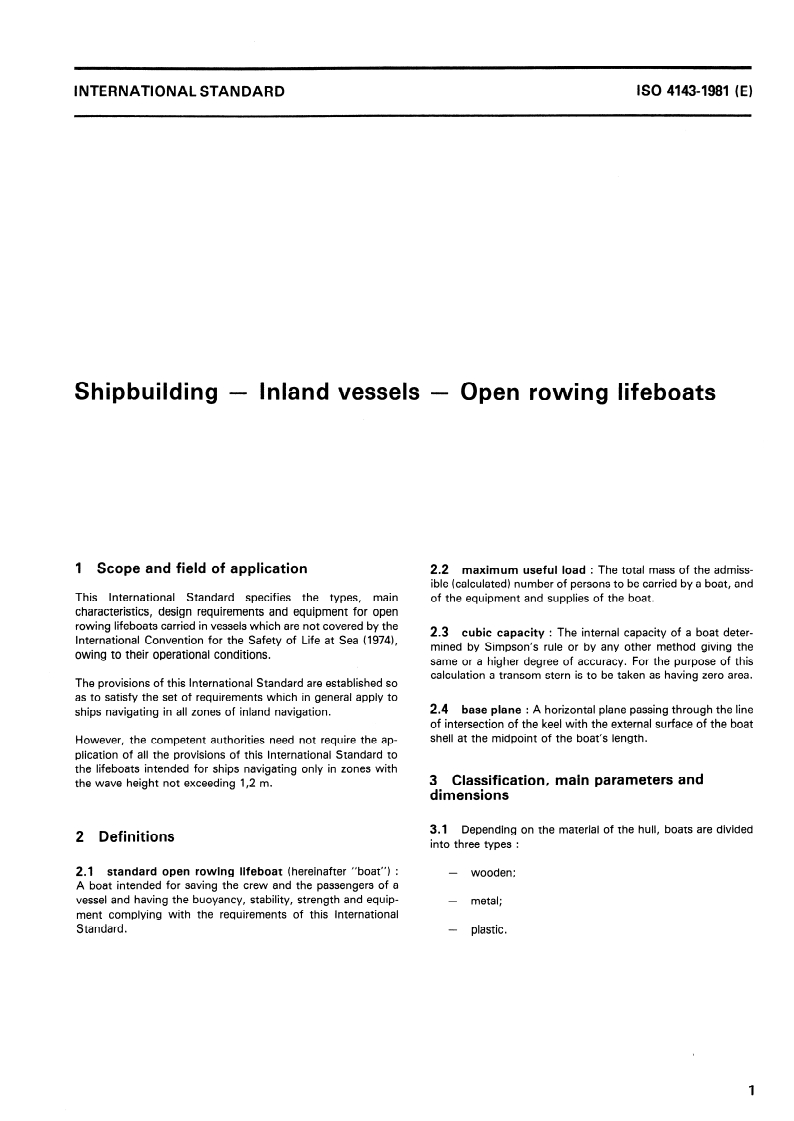
1 Scope and field of application
22 maximum useful Ioad : The total mass of the admiss-
ible (calculated) number of persons to be carried by a boat, and
This International Standard specifies the types, main of the equipment and supplies of the boat.
characteristics, design requirements and equipment for open
rowing lifeboats carried in vessels which are not covered by the
2.3 cubic capacity : The internal capacity of a boat deter-
International Convention for the Safety of Life at Sea (19741,
mined by Simpson’s rule or by any other method giving the
owing to their operational conditions.
same or a higher degree of accuracy. For the purpose of this
calculation a transom Stern is to be taken as having zero area.
The provisions of this International Standard are established so
as to satisfy the set of requirements which in general apply to
2.4 base plane : A horizontal plane passing through the line
ships navigating in all zones of inland navigation.
of intersection of the keel with the external surface of the boat
Shell at the midpoint of the boat’s length.
However, the competent authorities need not require the ap-
plication of all the provisions of this International Standard to
the lifeboats intended for ships navigating only in zones with
3 Classification, main Parameters and
the wave height not exceeding 1,2 m.
dimensions
3.1 Depending on the material of the hull, boats are divided
2 Definitions
into three types :
-
2.1 Standard open rowing lifeboat (hereinafter “boat”) :
wooden;
A boat intended for saving the crew and the passengers of a
-
vessel and having the buoyancy, stability, strength and equip-
metal;
ment complying with the requirements of this International
Standard. - plastic.
b) The bsat beirigg flsoded vvit water, ahe i-eserve busy-
The tolerante 0n k and .4 sh81 not exêeed 31 1 %, and
aney shall be ensuaed by vvatertight air-cases 0r by a bucqj-
B and H shall n0t exceed k 2 5%.
ant material proof agair~st c0rmsim-1 and resistant to oi& and
oil products.
The reserve buoyancy sha1l be suffizient $8 prevent a boat, with
its maximum useful load in the designated places, frm7 heekim~
when flosded to the upper edge of H-Ie gunwak, awd to keep
the freebsard amidships not Pess ahan 20 l-nm.
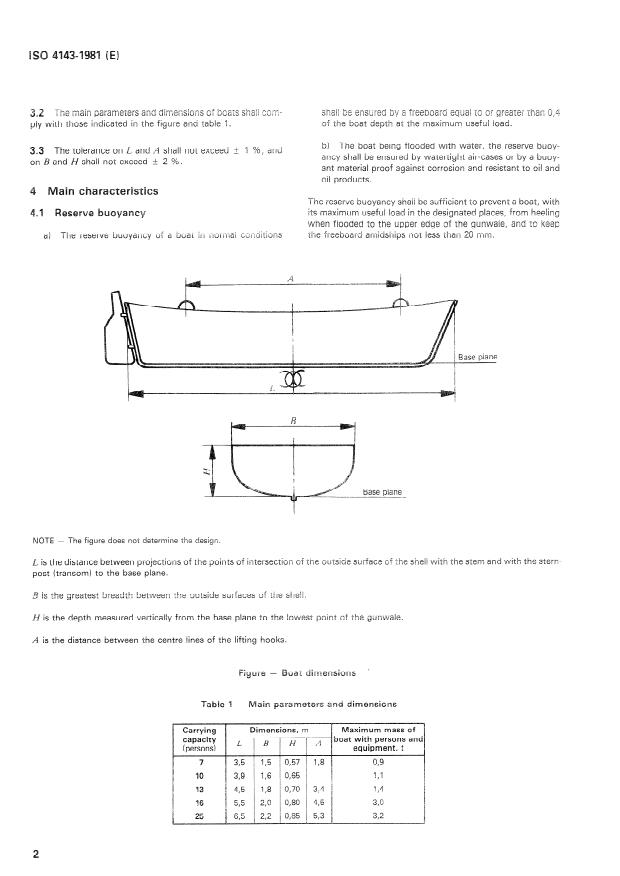
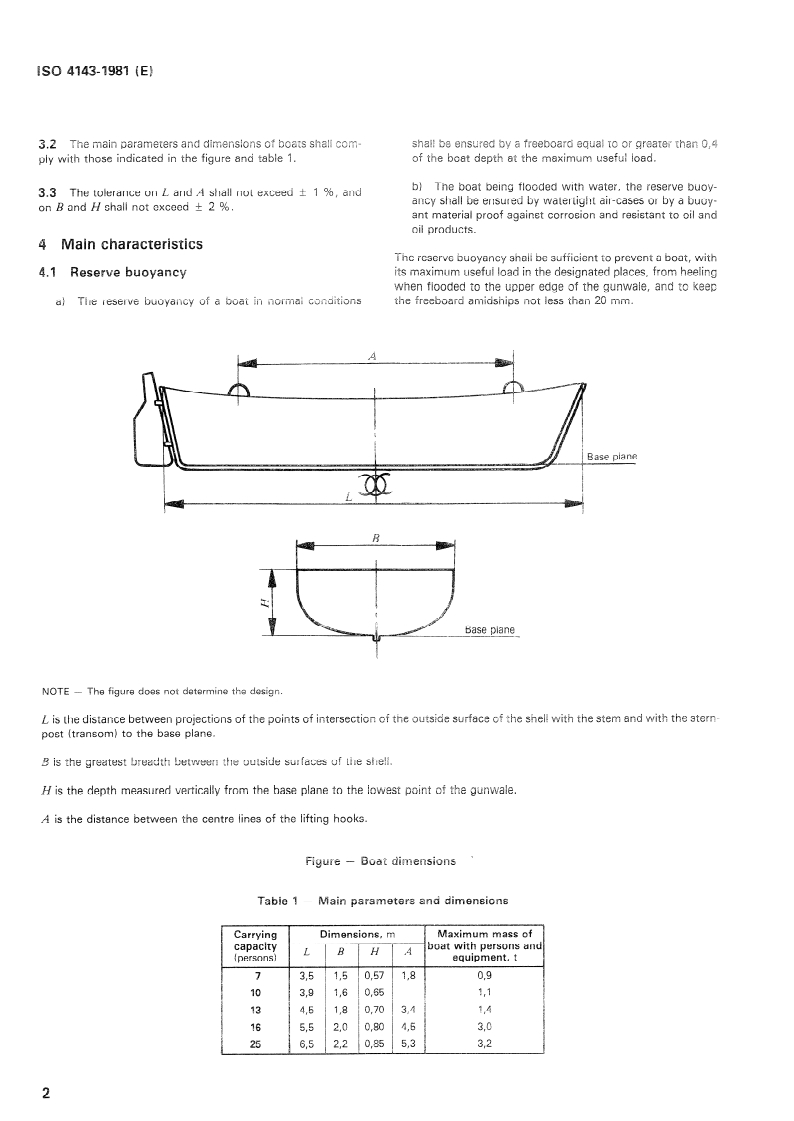
NOTE - The figure dses mf determine -he design.
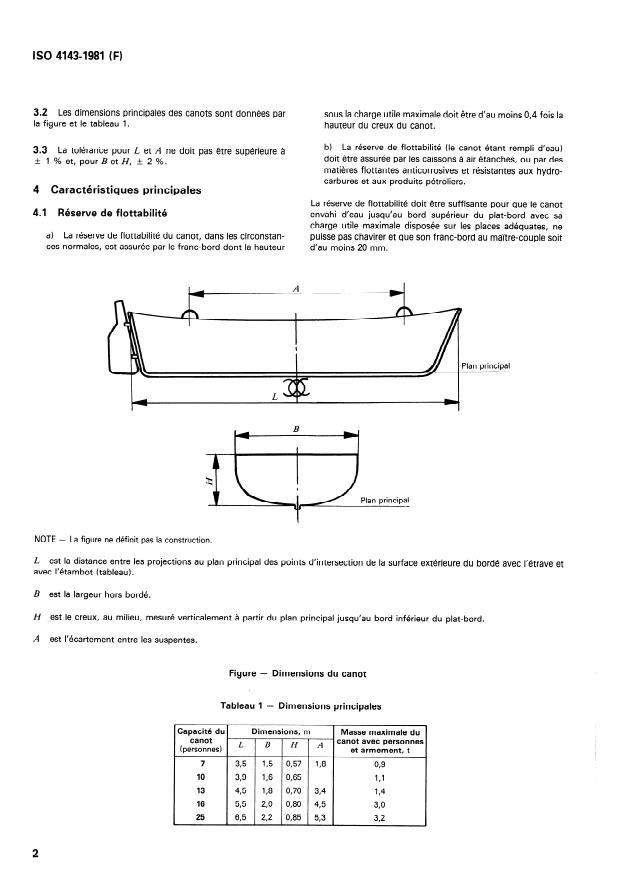
L is the distance between projections of the psints of intersection sf thie m~tside surface of ehe shel& vvith the sm-n and with the stern-
pest (transcaml Po the base plane.
B 9s the greatesl breadth between -d-E outside surfaces 0% she sheliL
ff SS the depth measured vertically from the base plane ts the Zowes~ point of the gumvale.
A is the distance between the centre lines 0% the liftirq hooks.
ISO 4143-1981 (E)
5.6 If cellular plastic is used instead of air-cases, it shall be of
4.2 Stabil@
a low-absorbing type (up to 5 mg per 100 ml).
The stability of a boat is considered ensured if the value of the
static movement required to heel the boat, afloat with its max-
5.7 All the thwarts and the side seats shall be fitted as low as
imum useful load, by 10° from the zero Position is not less than
possible in the boat.
that indicated in table 2 and if the freeboard is not less than
20 mm.
5.8 Metal boats shall have an anti-corrosion coatings.
Table 2 - Heeling moment
1 Heeling moment, N-m *
Carrying capacity (persons)
I
5.9 The gunwale surface and a side Strip 150 mm in width
7 245
from the upper edge shall be painted red-orange.
oop and
5.10 The boat shall have lifelines with floats at each I
keel rails on each side.
25 1 127
* 1 kgfmm = 9,8 N-m
...
International Standard
INTERNATIONAL ORGANIZATION FOR STANDARDIZATION.MEX,4YHAPOflHAR OPTAHM3ALlMR fl0 CTAH~APTM3ALWWWORGANISATlON INTERNATIONALE DE NORMALISATION
Shipbuilding - Inland vessels - Open rowing lifeboats
Construction navale - Ba teaux de naviga tion in tbrieure - Canots de sauvetage ouverts 2 rames
First edition - 1981-05-15
U DC 629.125.51 Ref. No. ISO 4143-1981 (E)
Descriptors : shipbuilding, inland navigation, lifeboats, classification, dimensions, characteristics, design, accessories, tests, marking,
designation.
Price based on 4 pages
Foreword
ISO (the international Organization for Standardization) is a worldwide federation of
national Standards institutes (ISO member bedies). The work of developing Inter-
national Standards is carried out through ISO technical committees. Every member
body interested in a subject for which a technical committee has been set up has the
right to be represented on that committee. International organizations, governmental
and non-governmental, in liaison with ISO, also take part in the work.
Draft International Standards adopted by the technical committees are circulated to
the member bodies for approval before their acceptance as International Standards by
the ISO Council.
International Standard ISO 4143 was developed by Technical Committee ISO/TC 8,
Sh@bui/ding, and was circulated to the member bodies in November 1977.
lt has been approved by the member bodies of the following countries :
India Poland
Belgium
Brazil lreland Romania
Bulgaria Italy Spain ,
Japan Turkey
Chile
Czechoslovakia Korea, Dem. P. Rep. of United Kingdom
Finland Mexico USSR
Netherlands
France
The member body of the following country expressed disapproval of the document on
tech nical gro #unds
Germany, F. R.
0 International Organkation for Standardkation, 1981
Printed in Switzerland
ISO 4143-1981 (E)
INTERNATIONALSTANDARD
Shipbuilding - Inland vessels - Open rowing lifeboats
1 Scope and field of application
22 maximum useful Ioad : The total mass of the admiss-
ible (calculated) number of persons to be carried by a boat, and
This International Standard specifies the types, main of the equipment and supplies of the boat.
characteristics, design requirements and equipment for open
rowing lifeboats carried in vessels which are not covered by the
2.3 cubic capacity : The internal capacity of a boat deter-
International Convention for the Safety of Life at Sea (19741,
mined by Simpson’s rule or by any other method giving the
owing to their operational conditions.
same or a higher degree of accuracy. For the purpose of this
calculation a transom Stern is to be taken as having zero area.
The provisions of this International Standard are established so
as to satisfy the set of requirements which in general apply to
2.4 base plane : A horizontal plane passing through the line
ships navigating in all zones of inland navigation.
of intersection of the keel with the external surface of the boat
Shell at the midpoint of the boat’s length.
However, the competent authorities need not require the ap-
plication of all the provisions of this International Standard to
the lifeboats intended for ships navigating only in zones with
3 Classification, main Parameters and
the wave height not exceeding 1,2 m.
dimensions
3.1 Depending on the material of the hull, boats are divided
2 Definitions
into three types :
-
2.1 Standard open rowing lifeboat (hereinafter “boat”) :
wooden;
A boat intended for saving the crew and the passengers of a
-
vessel and having the buoyancy, stability, strength and equip-
metal;
ment complying with the requirements of this International
Standard. - plastic.
b) The bsat beirigg flsoded vvit water, ahe i-eserve busy-
The tolerante 0n k and .4 sh81 not exêeed 31 1 %, and
aney shall be ensuaed by vvatertight air-cases 0r by a bucqj-
B and H shall n0t exceed k 2 5%.
ant material proof agair~st c0rmsim-1 and resistant to oi& and
oil products.
The reserve buoyancy sha1l be suffizient $8 prevent a boat, with
its maximum useful load in the designated places, frm7 heekim~
when flosded to the upper edge of H-Ie gunwak, awd to keep
the freebsard amidships not Pess ahan 20 l-nm.
NOTE - The figure dses mf determine -he design.
L is the distance between projections of the psints of intersection sf thie m~tside surface of ehe shel& vvith the sm-n and with the stern-
pest (transcaml Po the base plane.
B 9s the greatesl breadth between -d-E outside surfaces 0% she sheliL
ff SS the depth measured vertically from the base plane ts the Zowes~ point of the gumvale.
A is the distance between the centre lines 0% the liftirq hooks.
ISO 4143-1981 (E)
5.6 If cellular plastic is used instead of air-cases, it shall be of
4.2 Stabil@
a low-absorbing type (up to 5 mg per 100 ml).
The stability of a boat is considered ensured if the value of the
static movement required to heel the boat, afloat with its max-
5.7 All the thwarts and the side seats shall be fitted as low as
imum useful load, by 10° from the zero Position is not less than
possible in the boat.
that indicated in table 2 and if the freeboard is not less than
20 mm.
5.8 Metal boats shall have an anti-corrosion coatings.
Table 2 - Heeling moment
1 Heeling moment, N-m *
Carrying capacity (persons)
I
5.9 The gunwale surface and a side Strip 150 mm in width
7 245
from the upper edge shall be painted red-orange.
oop and
5.10 The boat shall have lifelines with floats at each I
keel rails on each side.
25 1 127
* 1 kgfmm = 9,8 N-m
...
Norme internationale
INTERNATIONAL ORGANIZATION FOR STANDARDIZATIONWVlE~YHAPO~HAFI OPI-AHM3ALWlR IlO CTAH~APTH3AWWWORGANISATION INTERNATIONALE DE NORMALISATION
Construction navale - Bateaux de navigation intérieure -
Canots de sauvetage ouverts à rames
Shipbuilding - lnland Vesse/s - Open rowing lifeboats
Première édition - 1981-05-15
I
CDU 629.125.51
Réf. no : ISO 4143-1981 (F)
îî
Y
Descripteurs : construction navale, navigation fluviale, canot de sauvetage, classification,
dimension, caractéristique, conception, accessoire,
essai, marquage, désignation.
Prix basé sur 4 pages
Avant-propos
L’ISO (Organisation internationale de normalisation) est une fédération mondiale
d’organismes nationaux de normalisation (comités membres de I’ISO). L’élaboration
des Normes internationales est confiée aux comités techniques de I’ISO. Chaque
comité membre intéressé par une étude a le droit de faire partie du comité technique
correspondant. Les organisations internationales, gouvernementales et non gouverne-
mentales, en liaison avec I’ISO, participent également aux travaux.
Les projets de Normes internationales adoptés par les comités techniques sont soumis
aux comités membres pour approbation, avant leur acceptation comme Normes inter-
nationales par le Conseil de I’ISO.
La Norme internationale ISO 4143 a été élaborée par le comité technique ISO/TC 8,
Construction navale, et a été soumise aux comités membres en novembre 1977.
Les comités membres des pays suivants l’ont approuvée :
Belgique France Pologne
Brésil Inde Roumanie
Bulgarie Royaume-Uni
Irlande
Chili Italie Tchécoslovaquie
Turquie
Corée, Rép. dém. p. de Japon
Espagne Mexique URSS
Finlande Pays- Bas
Le comité membre du pays suivant l’a désapprouvée pour des raisons techniques :
Allemagne, R. F.
0 Organisation internationale de normalisation, 1981
Imprimé en Suisse
ISO 41434981 (F)
NORME INTERNATIONALE
- Bateaux de navigation intérieure -
Construction navale
Canots de sauvetage ouverts à rames
2.2 charge utile maximale du canot : Masse totale (calcu-
1 Objet et domaine d’application
lée) comprenant le nombre total de personnes, les équipements
La présente Norme internationale définit les types, caractéristi- et l’armement.
ques principales, exigences de construction et l’armement des
canots de sauvetage ouverts à rames utilisés sur les bateaux de
navigation intérieure qui, d’après leurs conditions de naviga-
2.3 jauge brute du canot : Volume intérieur déterminé con-
tion, ne tombent pas sous le coup de la «Convention de sauve-
formément à la règle de Simpson, ou à une autre méthode cor-
tage de la vie humaine en mer» de 1974.
respondante donnant un degré de précision égal ou plus élevé.
Pour faire ce calcul, la surface du tableau doit être prise égale à
Les spécifications de la présente Norme internationale sont éta-
zéro.
blies de manière à satisfaire à l’ensemble des exigences qui,
généralement, s’appliquent aux bateaux circulant dans toutes
les zones de navigation intérieure.
2.4 plan principal : Plan horizontal passant à travers la ligne
de la quille et de la surface extérieure du bordé au milieu de la
Toutefois, pour les canots de sauvetage équipant des bateaux
longueur du canot.
circulant uniquement dans les zones où la hauteur des vagues
n’est pas supérieure à 1,2 m, les autorités compétentes n’exi-
gent pas l’application de toutes les spécifications de la présente
Norme internationale.
3 Classification, dimensions principales
2 Définitions
3.1 D’après le matériau de la coque, les canots sont divisés
en trois types, à savoir :
2.1 canot de sauvetage ouvert à rames normalisé
-
(nommé plus loin «canot») : Canot destiné à sauver les passa- en bois;
gers et l’équipage du bateau en cas d’avarie, et dont la flottabi-
-
métalliques;
lité, la stabilité et la solidité, ainsi que les équipements et I’arme-
ment satisfont aux exigences de la présente Norme internatio-
-
en matières plastiques.
nale.
ISO 4143-1981 (F)
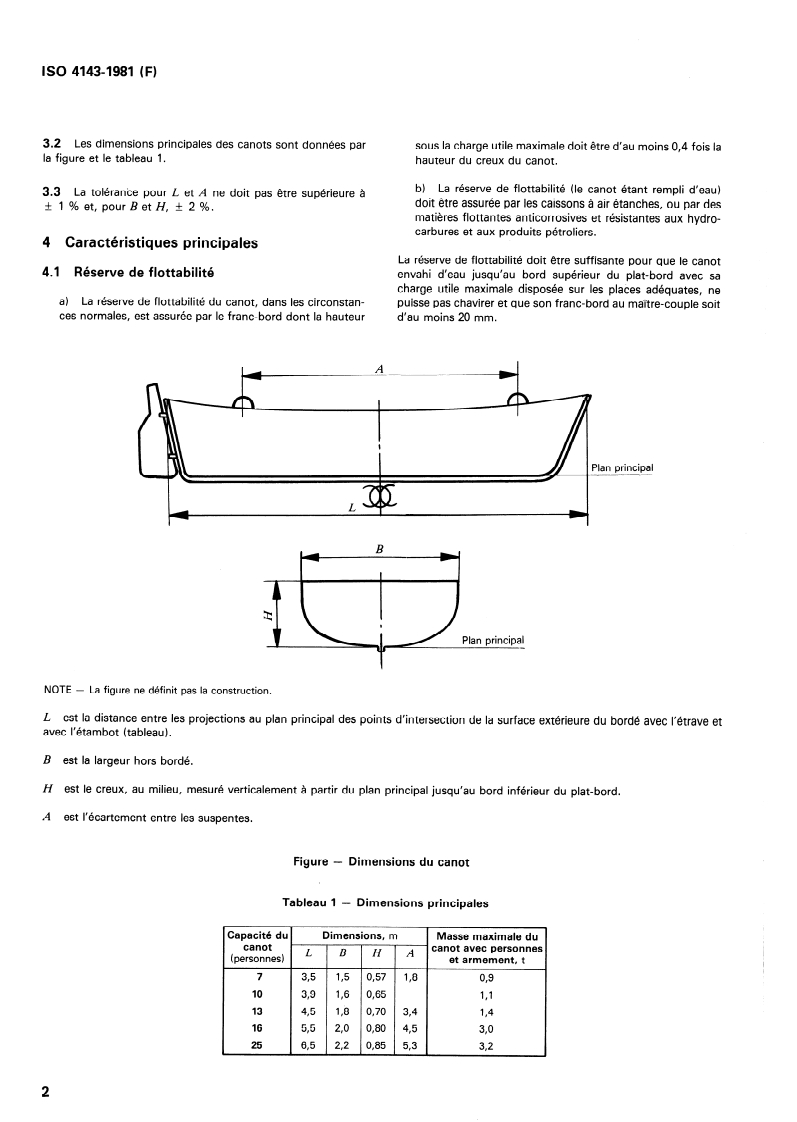
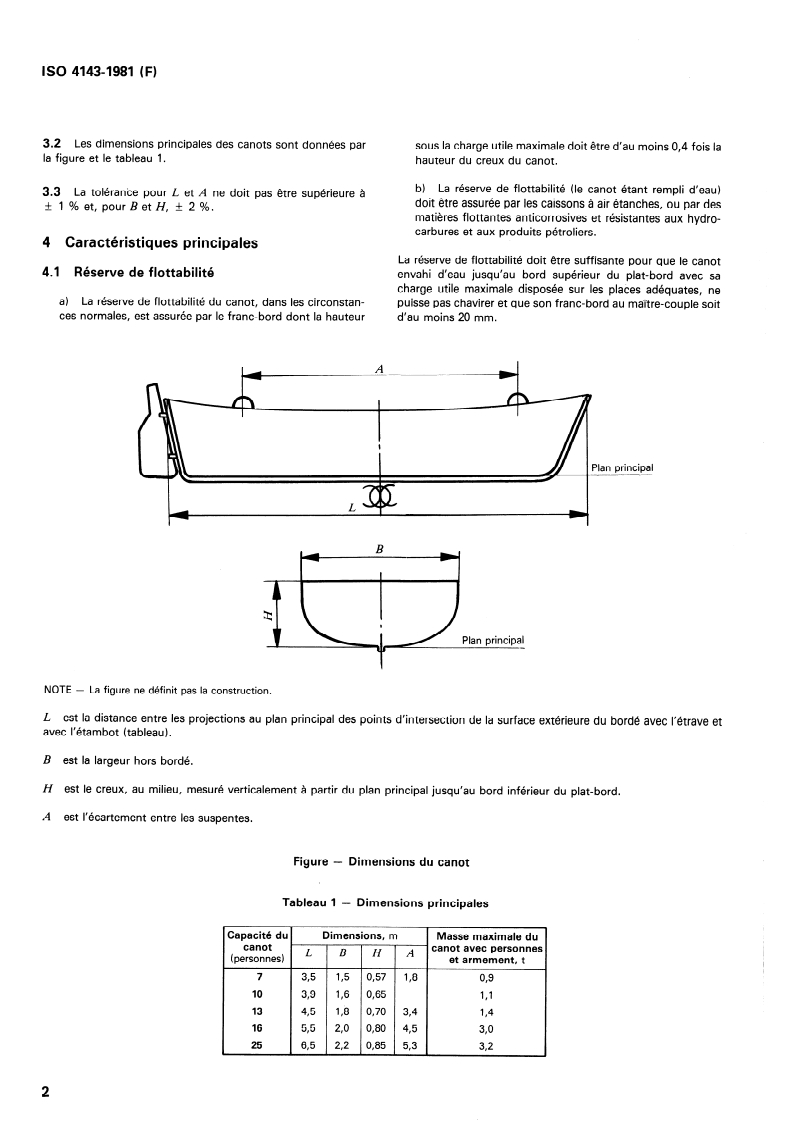
3.2 Les dimensions principales des canots sont données par
sous la charge utile maximale doit être d’au moins 0,4 fois la
la figure et le tableau 1.
hauteur du creux du canot.
b) La réserve de flottabilité (le canot étant rempli d’eau)
3.3 La tolérance pour L et A ne doit pas être supérieure à
doit être assurée par les caissons à air étanches, ou par des
rt 1 %et,pourBetH, k 2%.
matières flottantes anticorrosives et résistantes aux hydro-
carbures et aux produits pétroliers.
4 Caractéristiques principales
La réserve de flottabilité doit être suffisante pour que le canot
4.1 Réserve de flottabilité envahi d’eau jusqu’au bord supérieur du plat-bord avec sa
charge utile maximale disposée sur les places adéquates, ne
a) La réserve de flottabilité du canot, dans les circonstan- puisse pas chavirer et que son franc-bord au maître-couple soit
ces normales, est assurée par le franc-bord dont la hauteur
d’au moins 20 mm.
Plan principal
Plan principal
NOTE - La figure ne définit pas la construction.
L est la distance entre les projections au plan principal des points d’intersection de la surface extérieure du bordé avec l’étrave et
avec l’étambot (tableau).
B est la largeur hors bordé.
est le creux, au milieu, mesuré verticalement à partir du plan principal jusqu’au bord inférieur du plat-bord.
H
A est l’écartement entre les suspentes.
Figure - Dimensions du canot
Tableau 1 - Dimensions principales
7 3,5 1,5 0,57 1,8
1,6 0,65 1,1
10 3,9
4,5 1,8 0,70 3,4 114
16 5,5 2,0 0,80 4,5 3,O
25 6,5 2,2 0,85 5,3 32
ISO 4143-1981 (F)
5.6 Si, au lieu de caissons à air, on utilise des plastiques
4.2 Stabilité
expansés, ces derniers doivent avoir une faible absorptivité
(5 mg pour 100 ml).
La stabilité du canot sera considérée comme suffisante si la
valeur du moment nécessaire pour donner au canot à flot, avec
sa charge utile maximale, une bande de 10’ à partir de la posi-
5.7 Tous les sièges transversaux et latéraux doivent être ins-
tion du zéro, n’est pas inférieure à celle donnée dans le
tallés dans le canot le plus bas possible.
tableau 2, le franc-bord étant d’au moins 20 mm.
5.8 Les canots métalliques doivent recevoir une protection
Tableau 2 - Valeur du moment d’inclinaison
anticorrosive.
Capacité du canot (perso
...
Norme internationale
INTERNATIONAL ORGANIZATION FOR STANDARDIZATIONWVlE~YHAPO~HAFI OPI-AHM3ALWlR IlO CTAH~APTH3AWWWORGANISATION INTERNATIONALE DE NORMALISATION
Construction navale - Bateaux de navigation intérieure -
Canots de sauvetage ouverts à rames
Shipbuilding - lnland Vesse/s - Open rowing lifeboats
Première édition - 1981-05-15
I
CDU 629.125.51
Réf. no : ISO 4143-1981 (F)
îî
Y
Descripteurs : construction navale, navigation fluviale, canot de sauvetage, classification,
dimension, caractéristique, conception, accessoire,
essai, marquage, désignation.
Prix basé sur 4 pages
Avant-propos
L’ISO (Organisation internationale de normalisation) est une fédération mondiale
d’organismes nationaux de normalisation (comités membres de I’ISO). L’élaboration
des Normes internationales est confiée aux comités techniques de I’ISO. Chaque
comité membre intéressé par une étude a le droit de faire partie du comité technique
correspondant. Les organisations internationales, gouvernementales et non gouverne-
mentales, en liaison avec I’ISO, participent également aux travaux.
Les projets de Normes internationales adoptés par les comités techniques sont soumis
aux comités membres pour approbation, avant leur acceptation comme Normes inter-
nationales par le Conseil de I’ISO.
La Norme internationale ISO 4143 a été élaborée par le comité technique ISO/TC 8,
Construction navale, et a été soumise aux comités membres en novembre 1977.
Les comités membres des pays suivants l’ont approuvée :
Belgique France Pologne
Brésil Inde Roumanie
Bulgarie Royaume-Uni
Irlande
Chili Italie Tchécoslovaquie
Turquie
Corée, Rép. dém. p. de Japon
Espagne Mexique URSS
Finlande Pays- Bas
Le comité membre du pays suivant l’a désapprouvée pour des raisons techniques :
Allemagne, R. F.
0 Organisation internationale de normalisation, 1981
Imprimé en Suisse
ISO 41434981 (F)
NORME INTERNATIONALE
- Bateaux de navigation intérieure -
Construction navale
Canots de sauvetage ouverts à rames
2.2 charge utile maximale du canot : Masse totale (calcu-
1 Objet et domaine d’application
lée) comprenant le nombre total de personnes, les équipements
La présente Norme internationale définit les types, caractéristi- et l’armement.
ques principales, exigences de construction et l’armement des
canots de sauvetage ouverts à rames utilisés sur les bateaux de
navigation intérieure qui, d’après leurs conditions de naviga-
2.3 jauge brute du canot : Volume intérieur déterminé con-
tion, ne tombent pas sous le coup de la «Convention de sauve-
formément à la règle de Simpson, ou à une autre méthode cor-
tage de la vie humaine en mer» de 1974.
respondante donnant un degré de précision égal ou plus élevé.
Pour faire ce calcul, la surface du tableau doit être prise égale à
Les spécifications de la présente Norme internationale sont éta-
zéro.
blies de manière à satisfaire à l’ensemble des exigences qui,
généralement, s’appliquent aux bateaux circulant dans toutes
les zones de navigation intérieure.
2.4 plan principal : Plan horizontal passant à travers la ligne
de la quille et de la surface extérieure du bordé au milieu de la
Toutefois, pour les canots de sauvetage équipant des bateaux
longueur du canot.
circulant uniquement dans les zones où la hauteur des vagues
n’est pas supérieure à 1,2 m, les autorités compétentes n’exi-
gent pas l’application de toutes les spécifications de la présente
Norme internationale.
3 Classification, dimensions principales
2 Définitions
3.1 D’après le matériau de la coque, les canots sont divisés
en trois types, à savoir :
2.1 canot de sauvetage ouvert à rames normalisé
-
(nommé plus loin «canot») : Canot destiné à sauver les passa- en bois;
gers et l’équipage du bateau en cas d’avarie, et dont la flottabi-
-
métalliques;
lité, la stabilité et la solidité, ainsi que les équipements et I’arme-
ment satisfont aux exigences de la présente Norme internatio-
-
en matières plastiques.
nale.
ISO 4143-1981 (F)
3.2 Les dimensions principales des canots sont données par
sous la charge utile maximale doit être d’au moins 0,4 fois la
la figure et le tableau 1.
hauteur du creux du canot.
b) La réserve de flottabilité (le canot étant rempli d’eau)
3.3 La tolérance pour L et A ne doit pas être supérieure à
doit être assurée par les caissons à air étanches, ou par des
rt 1 %et,pourBetH, k 2%.
matières flottantes anticorrosives et résistantes aux hydro-
carbures et aux produits pétroliers.
4 Caractéristiques principales
La réserve de flottabilité doit être suffisante pour que le canot
4.1 Réserve de flottabilité envahi d’eau jusqu’au bord supérieur du plat-bord avec sa
charge utile maximale disposée sur les places adéquates, ne
a) La réserve de flottabilité du canot, dans les circonstan- puisse pas chavirer et que son franc-bord au maître-couple soit
ces normales, est assurée par le franc-bord dont la hauteur
d’au moins 20 mm.
Plan principal
Plan principal
NOTE - La figure ne définit pas la construction.
L est la distance entre les projections au plan principal des points d’intersection de la surface extérieure du bordé avec l’étrave et
avec l’étambot (tableau).
B est la largeur hors bordé.
est le creux, au milieu, mesuré verticalement à partir du plan principal jusqu’au bord inférieur du plat-bord.
H
A est l’écartement entre les suspentes.
Figure - Dimensions du canot
Tableau 1 - Dimensions principales
7 3,5 1,5 0,57 1,8
1,6 0,65 1,1
10 3,9
4,5 1,8 0,70 3,4 114
16 5,5 2,0 0,80 4,5 3,O
25 6,5 2,2 0,85 5,3 32
ISO 4143-1981 (F)
5.6 Si, au lieu de caissons à air, on utilise des plastiques
4.2 Stabilité
expansés, ces derniers doivent avoir une faible absorptivité
(5 mg pour 100 ml).
La stabilité du canot sera considérée comme suffisante si la
valeur du moment nécessaire pour donner au canot à flot, avec
sa charge utile maximale, une bande de 10’ à partir de la posi-
5.7 Tous les sièges transversaux et latéraux doivent être ins-
tion du zéro, n’est pas inférieure à celle donnée dans le
tallés dans le canot le plus bas possible.
tableau 2, le franc-bord étant d’au moins 20 mm.
5.8 Les canots métalliques doivent recevoir une protection
Tableau 2 - Valeur du moment d’inclinaison
anticorrosive.
Capacité du canot (perso
...
Norme internationale
INTERNATIONAL ORGANIZATION FOR STANDARDIZATIONWVlE~YHAPO~HAFI OPI-AHM3ALWlR IlO CTAH~APTH3AWWWORGANISATION INTERNATIONALE DE NORMALISATION
Construction navale - Bateaux de navigation intérieure -
Canots de sauvetage ouverts à rames
Shipbuilding - lnland Vesse/s - Open rowing lifeboats
Première édition - 1981-05-15
I
CDU 629.125.51
Réf. no : ISO 4143-1981 (F)
îî
Y
Descripteurs : construction navale, navigation fluviale, canot de sauvetage, classification,
dimension, caractéristique, conception, accessoire,
essai, marquage, désignation.
Prix basé sur 4 pages
Avant-propos
L’ISO (Organisation internationale de normalisation) est une fédération mondiale
d’organismes nationaux de normalisation (comités membres de I’ISO). L’élaboration
des Normes internationales est confiée aux comités techniques de I’ISO. Chaque
comité membre intéressé par une étude a le droit de faire partie du comité technique
correspondant. Les organisations internationales, gouvernementales et non gouverne-
mentales, en liaison avec I’ISO, participent également aux travaux.
Les projets de Normes internationales adoptés par les comités techniques sont soumis
aux comités membres pour approbation, avant leur acceptation comme Normes inter-
nationales par le Conseil de I’ISO.
La Norme internationale ISO 4143 a été élaborée par le comité technique ISO/TC 8,
Construction navale, et a été soumise aux comités membres en novembre 1977.
Les comités membres des pays suivants l’ont approuvée :
Belgique France Pologne
Brésil Inde Roumanie
Bulgarie Royaume-Uni
Irlande
Chili Italie Tchécoslovaquie
Turquie
Corée, Rép. dém. p. de Japon
Espagne Mexique URSS
Finlande Pays- Bas
Le comité membre du pays suivant l’a désapprouvée pour des raisons techniques :
Allemagne, R. F.
0 Organisation internationale de normalisation, 1981
Imprimé en Suisse
ISO 41434981 (F)
NORME INTERNATIONALE
- Bateaux de navigation intérieure -
Construction navale
Canots de sauvetage ouverts à rames
2.2 charge utile maximale du canot : Masse totale (calcu-
1 Objet et domaine d’application
lée) comprenant le nombre total de personnes, les équipements
La présente Norme internationale définit les types, caractéristi- et l’armement.
ques principales, exigences de construction et l’armement des
canots de sauvetage ouverts à rames utilisés sur les bateaux de
navigation intérieure qui, d’après leurs conditions de naviga-
2.3 jauge brute du canot : Volume intérieur déterminé con-
tion, ne tombent pas sous le coup de la «Convention de sauve-
formément à la règle de Simpson, ou à une autre méthode cor-
tage de la vie humaine en mer» de 1974.
respondante donnant un degré de précision égal ou plus élevé.
Pour faire ce calcul, la surface du tableau doit être prise égale à
Les spécifications de la présente Norme internationale sont éta-
zéro.
blies de manière à satisfaire à l’ensemble des exigences qui,
généralement, s’appliquent aux bateaux circulant dans toutes
les zones de navigation intérieure.
2.4 plan principal : Plan horizontal passant à travers la ligne
de la quille et de la surface extérieure du bordé au milieu de la
Toutefois, pour les canots de sauvetage équipant des bateaux
longueur du canot.
circulant uniquement dans les zones où la hauteur des vagues
n’est pas supérieure à 1,2 m, les autorités compétentes n’exi-
gent pas l’application de toutes les spécifications de la présente
Norme internationale.
3 Classification, dimensions principales
2 Définitions
3.1 D’après le matériau de la coque, les canots sont divisés
en trois types, à savoir :
2.1 canot de sauvetage ouvert à rames normalisé
-
(nommé plus loin «canot») : Canot destiné à sauver les passa- en bois;
gers et l’équipage du bateau en cas d’avarie, et dont la flottabi-
-
métalliques;
lité, la stabilité et la solidité, ainsi que les équipements et I’arme-
ment satisfont aux exigences de la présente Norme internatio-
-
en matières plastiques.
nale.
ISO 4143-1981 (F)
3.2 Les dimensions principales des canots sont données par
sous la charge utile maximale doit être d’au moins 0,4 fois la
la figure et le tableau 1.
hauteur du creux du canot.
b) La réserve de flottabilité (le canot étant rempli d’eau)
3.3 La tolérance pour L et A ne doit pas être supérieure à
doit être assurée par les caissons à air étanches, ou par des
rt 1 %et,pourBetH, k 2%.
matières flottantes anticorrosives et résistantes aux hydro-
carbures et aux produits pétroliers.
4 Caractéristiques principales
La réserve de flottabilité doit être suffisante pour que le canot
4.1 Réserve de flottabilité envahi d’eau jusqu’au bord supérieur du plat-bord avec sa
charge utile maximale disposée sur les places adéquates, ne
a) La réserve de flottabilité du canot, dans les circonstan- puisse pas chavirer et que son franc-bord au maître-couple soit
ces normales, est assurée par le franc-bord dont la hauteur
d’au moins 20 mm.
Plan principal
Plan principal
NOTE - La figure ne définit pas la construction.
L est la distance entre les projections au plan principal des points d’intersection de la surface extérieure du bordé avec l’étrave et
avec l’étambot (tableau).
B est la largeur hors bordé.
est le creux, au milieu, mesuré verticalement à partir du plan principal jusqu’au bord inférieur du plat-bord.
H
A est l’écartement entre les suspentes.
Figure - Dimensions du canot
Tableau 1 - Dimensions principales
7 3,5 1,5 0,57 1,8
1,6 0,65 1,1
10 3,9
4,5 1,8 0,70 3,4 114
16 5,5 2,0 0,80 4,5 3,O
25 6,5 2,2 0,85 5,3 32
ISO 4143-1981 (F)
5.6 Si, au lieu de caissons à air, on utilise des plastiques
4.2 Stabilité
expansés, ces derniers doivent avoir une faible absorptivité
(5 mg pour 100 ml).
La stabilité du canot sera considérée comme suffisante si la
valeur du moment nécessaire pour donner au canot à flot, avec
sa charge utile maximale, une bande de 10’ à partir de la posi-
5.7 Tous les sièges transversaux et latéraux doivent être ins-
tion du zéro, n’est pas inférieure à celle donnée dans le
tallés dans le canot le plus bas possible.
tableau 2, le franc-bord étant d’au moins 20 mm.
5.8 Les canots métalliques doivent recevoir une protection
Tableau 2 - Valeur du moment d’inclinaison
anticorrosive.
Capacité du canot (perso
...