

ISO 8385:2018
(Main)Ships and marine technology — Dredgers — Classification
General Information
- Abstract
ISO 8385:2018 provides a single classification for all types of dredgers designed for loosening, raising, transporting and disposing of dredged material.
- Status
- Published
- Publication Date
- 08-Apr-2018
- Technical Committee
- ISO/TC 8/SC 7 - Inland navigation vessels
- Drafting Committee
- ISO/TC 8/SC 7 - Inland navigation vessels
- Current Stage
- 9093 - International Standard confirmed
- Start Date
- 26-Mar-2025
- Completion Date
- 29-Aug-2026
Buy Documents

ISO 8385:2018 - Ships and marine technology -- Dredgers -- Classification
ISO 8385:2018 - Ships and marine technology — Dredgers — Classification/9/2018

ISO 8385:2018 - Navires et technologie maritime -- Dragues -- Classification
ISO 8385:2018 - Navires et technologie maritime — Dragues — Classification/9/2018
Overview
ISO 8385:2018 is an international standard that establishes a comprehensive classification system for dredgers used in the maritime and marine technology sectors. It covers all types of dredgers designed for loosening, raising, transporting, and disposing of dredged materials. This standard ensures consistency and clarity in the classification of dredging equipment based on functional and operational criteria. It is essential for manufacturers, operators, and regulatory bodies involved in dredging activities worldwide.
Key Topics
Scope and Application
- Applies to all dredgers regardless of type, function, and environment.
- Focus on classification through engineering condition, dredger parameters, and operating methods.
Classification Criteria
- Engineering Condition: Includes area of operation (inland waterways, coastal zones, offshore, ocean-going), special environments (tropical, arctic), and soil characteristics such as silts, sands, gravels, clays, and rocks.
- Dredger Parameters: Covers main performance parameters like hopper capacity, dredging depth, installed power, cutter head power, discharge pipeline dimensions, and bucket or grab capacities.
- Operating Method: Details soil extraction techniques, types of dredge pumps (centrifugal, air lift, pneumatic suction), suction heads (forward suction, draghead), dredging apparatus location, operating movements (longitudinal and lateral), propulsion, and disposal/transport of dredged material.
Power and Fuel Types
- Categories include diesel, electric, diesel-electric, diesel-hydraulic, electric hydraulic, and combinations.
- Energy source options now feature Liquefied Natural Gas (LNG), Compressed Natural Gas (CNG), solar, wind, and even nuclear power for clean energy implementations.
Dredging Methods
- Single and multi-bucket dredgers, cutter suction dredgers, grab dredgers, bucket chain dredgers, and rockbreakers.
- Specific methods for loosening soil, such as powered chisels or drilling for blasting.
Transportability and Crew Quarters
- Classifies the degree of transportability (non-dismountable, partly or fully dismountable).
- Designations for crew accommodation (none, day use, sleeping quarters).
Applications
ISO 8385:2018 plays a critical role in marine construction, port development, coastal protection, and environmental remediation projects involving dredging operations. Key practical applications include:
- Standardized Equipment Specification: Enables manufacturers to design dredgers compliant with global standards, facilitating international trade and interoperability.
- Operational Planning and Safety: Assists operators in selecting appropriate dredger types based on environmental and soil conditions, enhancing operational efficiency and safety.
- Regulatory Compliance: Helps regulatory bodies assess dredging equipment and methods used in projects, ensuring environmental and safety standards are met.
- Environmental Management: Supports effective dredged material disposal strategies to minimize ecological impact.
- Innovation and Sustainability: Incorporation of clean energy sources such as LNG, solar, and wind supports sustainable marine technology development.
Related Standards
ISO 8384: Ships and Marine Technology - Dredgers - Vocabulary
Provides standardized terms and definitions referenced in ISO 8385:2018 for consistent communication and understanding.ISO/IEC Directives, Part 1 and 2
Outline editorial rules and procedures applied during the development and maintenance of ISO standards, relevant to ISO 8385’s update process.International Maritime Organization (IMO) Guidelines
Complement ISO 8385 in regulatory frameworks governing marine equipment and environmental protection.
By adopting ISO 8385:2018, stakeholders benefit from a unified framework that enhances the classification, design, and usage of dredgers, aligning with international best practices and advancing the field of ships and marine technology. This ensures efficient dredging operations, environmental stewardship, and supports sustainable marine infrastructure development globally.
Relations
- Consolidates
EN ISO 8385:2018 - Ships and marine technology - Dredgers - Classification (ISO 8385:2018) - Effective Date
- 12-Feb-2026
- Effective Date
- 06-Jun-2022
- Effective Date
- 21-Nov-2015
Buy Documents
ISO 8385:2018 - Ships and marine technology -- Dredgers -- Classification
ISO 8385:2018 - Ships and marine technology — Dredgers — Classification/9/2018
ISO 8385:2018 - Navires et technologie maritime -- Dragues -- Classification
ISO 8385:2018 - Navires et technologie maritime — Dragues — Classification/9/2018
Get Certified
Connect with accredited certification bodies for this standard

DNV
DNV is an independent assurance and risk management provider.

Lloyd's Register
Lloyd's Register is a global professional services organisation specialising in engineering and technology.

FSC International
Forest Stewardship Council certification.
Sponsored listings
Frequently Asked Questions
ISO 8385:2018 is a standard published by the International Organization for Standardization (ISO). Its full title is "Ships and marine technology — Dredgers — Classification". This standard covers: ISO 8385:2018 provides a single classification for all types of dredgers designed for loosening, raising, transporting and disposing of dredged material.
ISO 8385:2018 provides a single classification for all types of dredgers designed for loosening, raising, transporting and disposing of dredged material.
ISO 8385:2018 is classified under the following ICS (International Classification for Standards) categories: 47.060 - Inland navigation vessels. The ICS classification helps identify the subject area and facilitates finding related standards.
ISO 8385:2018 has the following relationships with other standards: It is inter standard links to EN ISO 8385:2018, ISO 22669:2013, ISO 8385:1999. Understanding these relationships helps ensure you are using the most current and applicable version of the standard.
ISO 8385:2018 is available in PDF format for immediate download after purchase. The document can be added to your cart and obtained through the secure checkout process. Digital delivery ensures instant access to the complete standard document.
Standards Content (Sample)
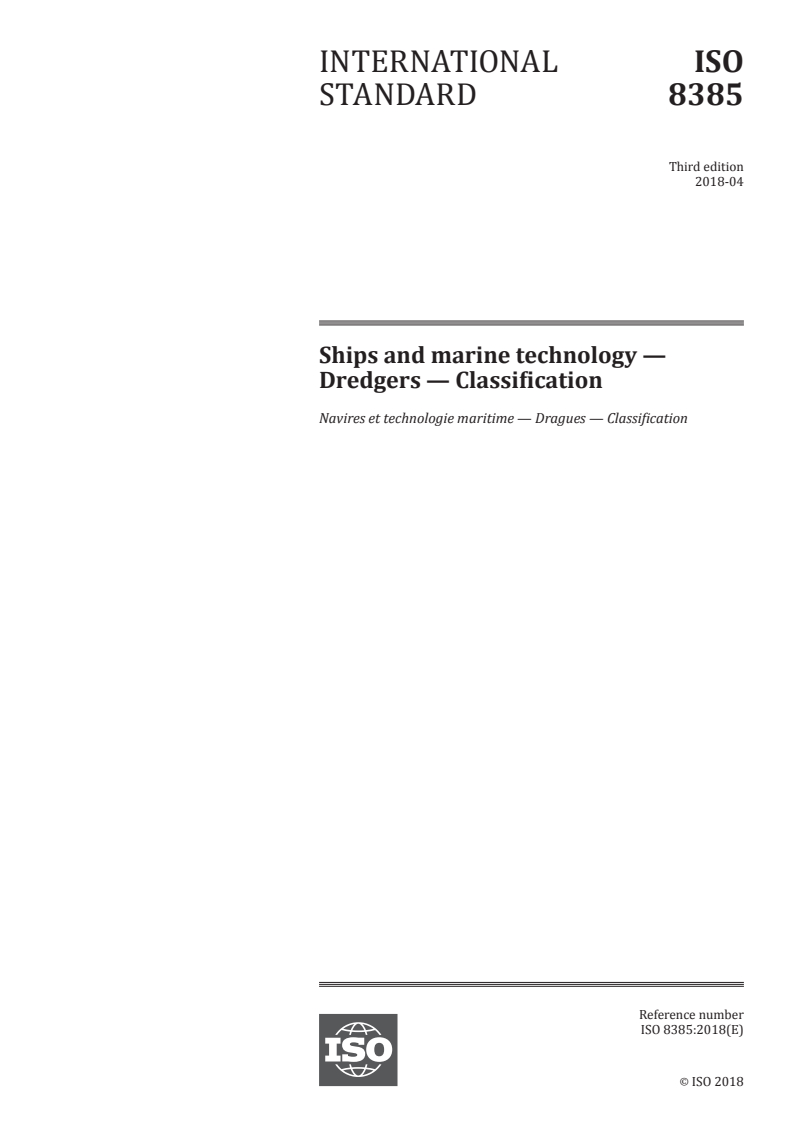
INTERNATIONAL ISO
STANDARD 8385
Third edition
2018-04
Ships and marine technology —
Dredgers — Classification
Navires et technologie maritime — Dragues — Classification
Reference number
©
ISO 2018
© ISO 2018
All rights reserved. Unless otherwise specified, or required in the context of its implementation, no part of this publication may
be reproduced or utilized otherwise in any form or by any means, electronic or mechanical, including photocopying, or posting
on the internet or an intranet, without prior written permission. Permission can be requested from either ISO at the address
below or ISO’s member body in the country of the requester.
ISO copyright office
CP 401 • Ch. de Blandonnet 8
CH-1214 Vernier, Geneva
Phone: +41 22 749 01 11
Fax: +41 22 749 09 47
Email: copyright@iso.org
Website: www.iso.org
Published in Switzerland
ii © ISO 2018 – All rights reserved
Contents Page
Foreword .iv
1 Scope . 1
2 Normative references . 1
3 Terms and definitions . 1
4 Classification . 1
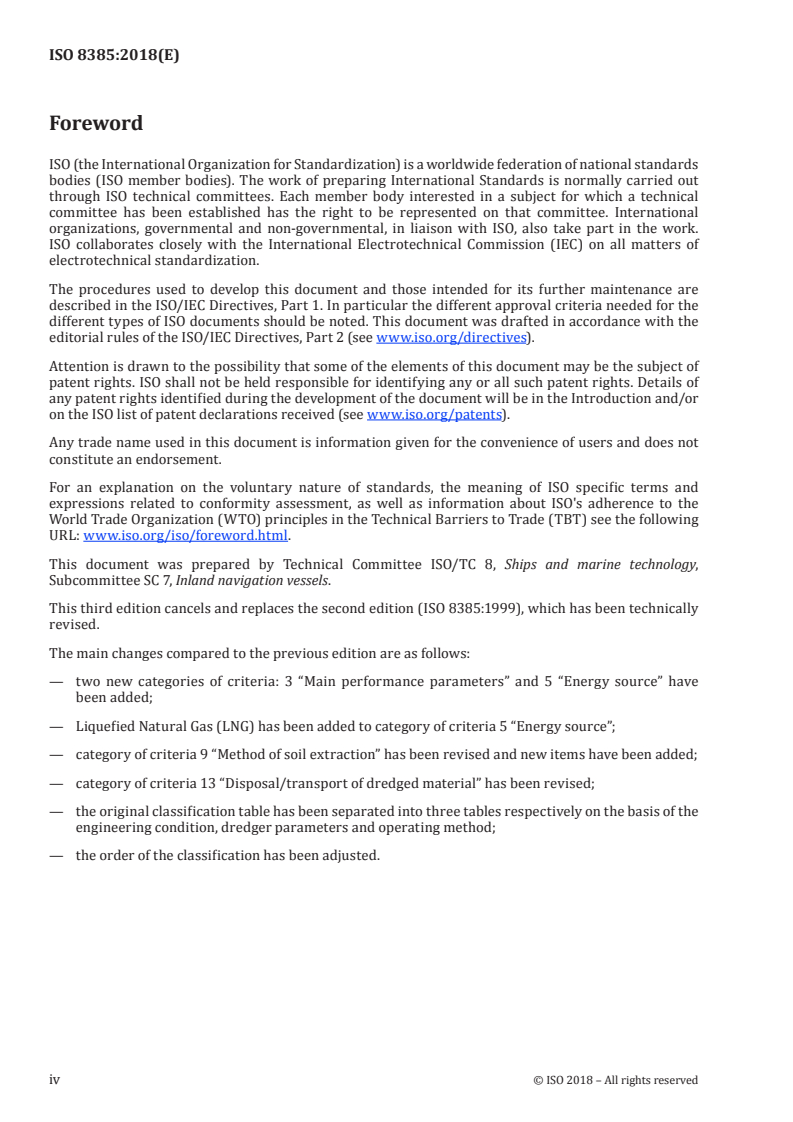
Foreword
ISO (the International Organization for Standardization) is a worldwide federation of national standards
bodies (ISO member bodies). The work of preparing International Standards is normally carried out
through ISO technical committees. Each member body interested in a subject for which a technical
committee has been established has the right to be represented on that committee. International
organizations, governmental and non-governmental, in liaison with ISO, also take part in the work.
ISO collaborates closely with the International Electrotechnical Commission (IEC) on all matters of
electrotechnical standardization.
The procedures used to develop this document and those intended for its further maintenance are
described in the ISO/IEC Directives, Part 1. In particular the different approval criteria needed for the
different types of ISO documents should be noted. This document was drafted in accordance with the
editorial rules of the ISO/IEC Directives, Part 2 (see www .iso .org/ directives).
Attention is drawn to the possibility that some of the elements of this document may be the subject of
patent rights. ISO shall not be held responsible for identifying any or all such patent rights. Details of
any patent rights identified during the development of the document will be in the Introduction and/or
on the ISO list of patent declarations received (see www .iso .org/ patents).
Any trade name used in this document is information given for the convenience of users and does not
constitute an endorsement.
For an explanation on the voluntary nature of standards, the meaning of ISO specific terms and
expressions related to conformity assessment, as well as information about ISO's adherence to the
World Trade Organization (WTO) principles in the Technical Barriers to Trade (TBT) see the following
URL: www .iso .org/ iso/ foreword .html.
This document was prepared by Technical Committee ISO/TC 8, Ships and marine technology,
Subcommittee SC 7, Inland navigation vessels.
This third edition cancels and replaces the second edition (ISO 8385:1999), which has been technically
revised.
The main changes compared to the previous edition are as follows:
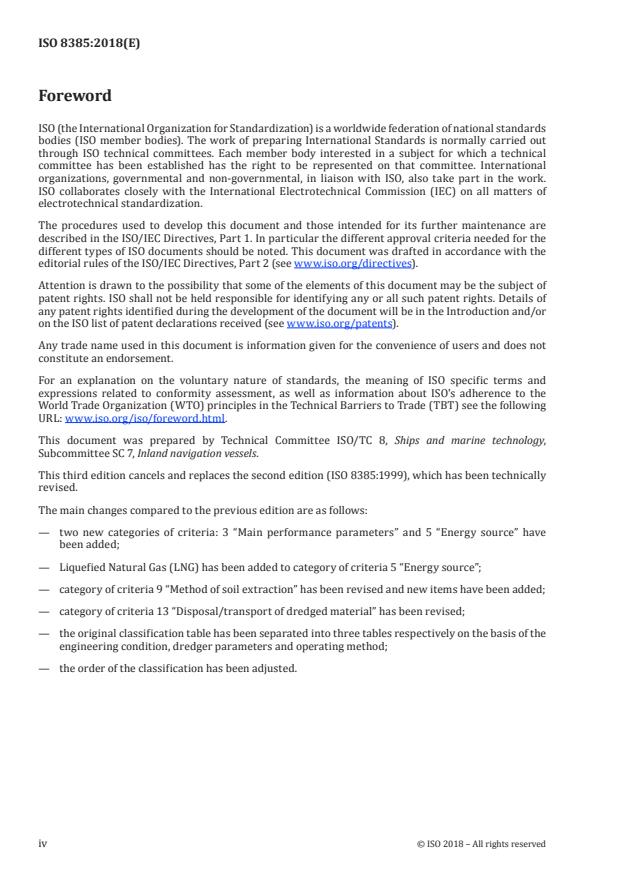
— two new categories of criteria: 3 “Main performance parameters” and 5 “Energy source” have
been added;
— Liquefied Natural Gas (LNG) has been added to category of criteria 5 “Energy source”;
— category of criteria 9 “Method of soil extraction” has been revised and new items have been added;
— category of criteria 13 “Disposal/transport of dredged material” has been revised;
— the original classification table has been separated into three tables respectively on the basis of the
engineering condition, dredger parameters and operating method;
— the order of the classification has been adjusted.
iv © ISO 2018 – All rights reserved
INTERNATIONAL STANDARD ISO 8385:2018(E)
Ships and marine techn
...
INTERNATIONAL ISO
STANDARD 8385
Third edition
2018-04
Ships and marine technology —
Dredgers — Classification
Navires et technologie maritime — Dragues — Classification
Reference number
©
ISO 2018
© ISO 2018
All rights reserved. Unless otherwise specified, or required in the context of its implementation, no part of this publication may
be reproduced or utilized otherwise in any form or by any means, electronic or mechanical, including photocopying, or posting
on the internet or an intranet, without prior written permission. Permission can be requested from either ISO at the address
below or ISO’s member body in the country of the requester.
ISO copyright office
CP 401 • Ch. de Blandonnet 8
CH-1214 Vernier, Geneva
Phone: +41 22 749 01 11
Fax: +41 22 749 09 47
Email: copyright@iso.org
Website: www.iso.org
Published in Switzerland
ii © ISO 2018 – All rights reserved
Contents Page
Foreword .iv
1 Scope . 1
2 Normative references . 1
3 Terms and definitions . 1
4 Classification . 1
Foreword
ISO (the International Organization for Standardization) is a worldwide federation of national standards
bodies (ISO member bodies). The work of preparing International Standards is normally carried out
through ISO technical committees. Each member body interested in a subject for which a technical
committee has been established has the right to be represented on that committee. International
organizations, governmental and non-governmental, in liaison with ISO, also take part in the work.
ISO collaborates closely with the International Electrotechnical Commission (IEC) on all matters of
electrotechnical standardization.
The procedures used to develop this document and those intended for its further maintenance are
described in the ISO/IEC Directives, Part 1. In particular the different approval criteria needed for the
different types of ISO documents should be noted. This document was drafted in accordance with the
editorial rules of the ISO/IEC Directives, Part 2 (see www .iso .org/ directives).
Attention is drawn to the possibility that some of the elements of this document may be the subject of
patent rights. ISO shall not be held responsible for identifying any or all such patent rights. Details of
any patent rights identified during the development of the document will be in the Introduction and/or
on the ISO list of patent declarations received (see www .iso .org/ patents).
Any trade name used in this document is information given for the convenience of users and does not
constitute an endorsement.
For an explanation on the voluntary nature of standards, the meaning of ISO specific terms and
expressions related to conformity assessment, as well as information about ISO's adherence to the
World Trade Organization (WTO) principles in the Technical Barriers to Trade (TBT) see the following
URL: www .iso .org/ iso/ foreword .html.
This document was prepared by Technical Committee ISO/TC 8, Ships and marine technology,
Subcommittee SC 7, Inland navigation vessels.
This third edition cancels and replaces the second edition (ISO 8385:1999), which has been technically
revised.
The main changes compared to the previous edition are as follows:
— two new categories of criteria: 3 “Main performance parameters” and 5 “Energy source” have
been added;
— Liquefied Natural Gas (LNG) has been added to category of criteria 5 “Energy source”;
— category of criteria 9 “Method of soil extraction” has been revised and new items have been added;
— category of criteria 13 “Disposal/transport of dredged material” has been revised;
— the original classification table has been separated into three tables respectively on the basis of the
engineering condition, dredger parameters and operating method;
— the order of the classification has been adjusted.
iv © ISO 2018 – All rights reserved
INTERNATIONAL STANDARD ISO 8385:2018(E)
Ships and marine techn
...
NORME ISO
INTERNATIONALE 8385
Troisième édition
2018-04
Navires et technologie maritime —
Dragues — Classification
Ships and marine technology — Dredgers — Classification
Numéro de référence
©
ISO 2018
DOCUMENT PROTÉGÉ PAR COPYRIGHT
© ISO 2018
Tous droits réservés. Sauf prescription différente ou nécessité dans le contexte de sa mise en oeuvre, aucune partie de cette
publication ne peut être reproduite ni utilisée sous quelque forme que ce soit et par aucun procédé, électronique ou mécanique,
y compris la photocopie, ou la diffusion sur l’internet ou sur un intranet, sans autorisation écrite préalable. Une autorisation peut
être demandée à l’ISO à l’adresse ci-après ou au comité membre de l’ISO dans le pays du demandeur.
ISO copyright office
Case postale 401 • Ch. de Blandonnet 8
CH-1214 Vernier, Geneva
Tél.: +41 22 749 01 11
Fax: +41 22 749 09 47
E-mail: copyright@iso.org
Web: www.iso.org
Publié en Suisse
ii © ISO 2018 – Tous droits réservés
Sommaire Page
Avant-propos .iv
1 Domaine d'application . 1
2 Références normatives . 1
3 Termes et définitions . 1
4 Classification . 1
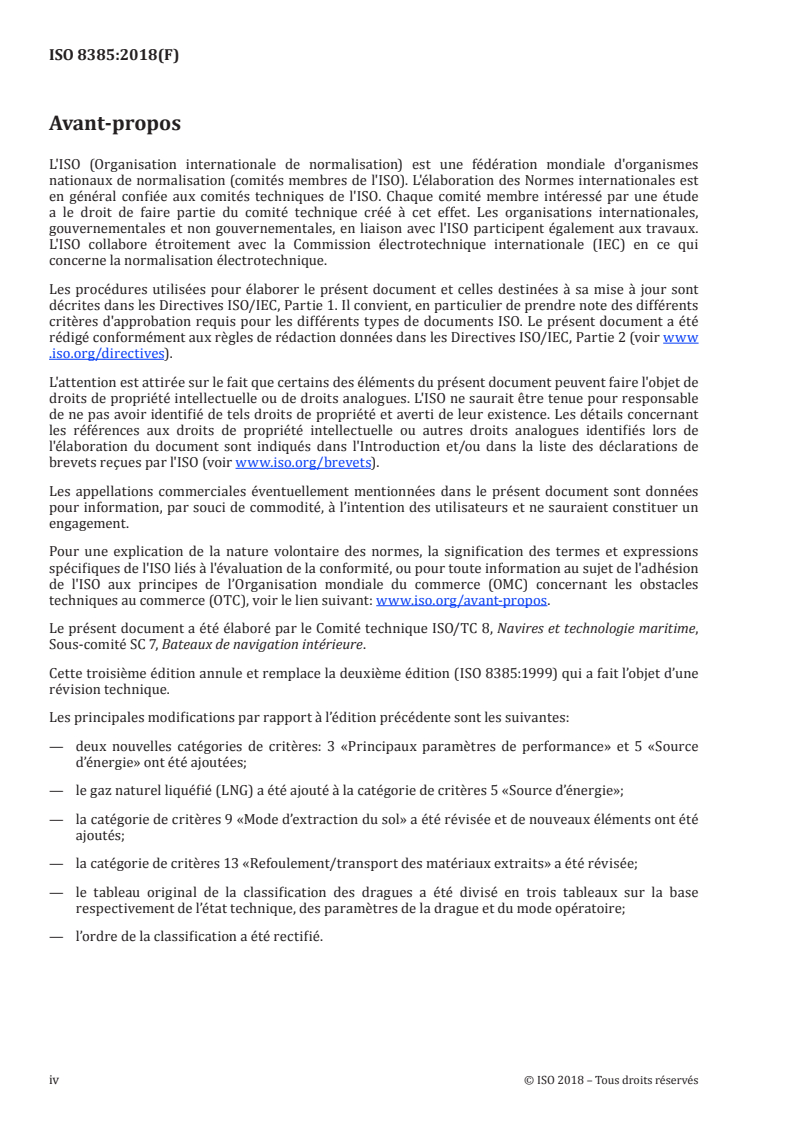
Avant-propos
L'ISO (Organisation internationale de normalisation) est une fédération mondiale d'organismes
nationaux de normalisation (comités membres de l'ISO). L'élaboration des Normes internationales est
en général confiée aux comités techniques de l'ISO. Chaque comité membre intéressé par une étude
a le droit de faire partie du comité technique créé à cet effet. Les organisations internationales,
gouvernementales et non gouvernementales, en liaison avec l'ISO participent également aux travaux.
L'ISO collabore étroitement avec la Commission électrotechnique internationale (IEC) en ce qui
concerne la normalisation électrotechnique.
Les procédures utilisées pour élaborer le présent document et celles destinées à sa mise à jour sont
décrites dans les Directives ISO/IEC, Partie 1. Il convient, en particulier de prendre note des différents
critères d'approbation requis pour les différents types de documents ISO. Le présent document a été
rédigé conformément aux règles de rédaction données dans les Directives ISO/IEC, Partie 2 (voir www
.iso .org/ directives).
L'attention est attirée sur le fait que certains des éléments du présent document peuvent faire l'objet de
droits de propriété intellectuelle ou de droits analogues. L'ISO ne saurait être tenue pour responsable
de ne pas avoir identifié de tels droits de propriété et averti de leur existence. Les détails concernant
les références aux droits de propriété intellectuelle ou autres droits analogues identifiés lors de
l'élaboration du document sont indiqués dans l'Introduction et/ou dans la liste des déclarations de
brevets reçues par l'ISO (voir www .iso .org/ brevets).
Les appellations commerciales éventuellement mentionnées dans le présent document sont données
pour information, par souci de commodité, à l’intention des utilisateurs et ne sauraient constituer un
engagement.
Pour une explication de la nature volontaire des normes, la signification des termes et expressions
spécifiques de l'ISO liés à l'évaluation de la conformité, ou pour toute information au sujet de l'adhésion
de l'ISO aux principes de l’Organisation mondiale du commerce (OMC) concernant les obstacles
techniques au commerce (OTC), voir le lien suivant: www .iso .org/ avant -propos.
Le présent document a été élaboré par le Comité technique ISO/TC 8, Navires et technologie maritime,
Sous-comité SC 7, Bateaux de navigation intérieure.
Cette troisième édition annule et remplace la deuxième édition (ISO 8385:1999) qui a fait l’objet d’une
révision technique.
Les principales modifications par rapport à l’édition précédente sont les suivantes:
— deux nouvelles catégories de critères: 3 «Principaux paramètres de performance» et 5 «Source
d’énergie» ont été ajoutées;
— le gaz naturel liquéfié (LNG) a été ajouté à la catégorie de critères 5 «Source d’énergie»;
— la catégorie de critères 9 «Mode d’extraction du sol» a été révisée et de nouveaux éléments ont été
ajoutés;
— la catégorie de critères 13 «Refoulement/transport des matériaux extraits» a été révisée;
— le tableau original de la classification des dragues a été divisé en trois tableaux sur la base
respectivement de l’état technique, des paramètres de la drague et du mode opératoire;
— l’ordre de la classification a été rectifié.
iv © ISO 2018 – Tous droits réservés
NORME INTERNATIONALE ISO 8385:2018(F)
Navires et technologie maritime — Dragues —
Classification
1 Domaine d'application
Le présent document établit une classification simple de tous les types de dragues destinées à la
séparation, au relevage, au transport et à la dépose de matériaux extraits.
2 Références normatives
Les documents suivants cités dans le texte constituent, pour tou
...
NORME ISO
INTERNATIONALE 8385
Troisième édition
2018-04
Navires et technologie maritime —
Dragues — Classification
Ships and marine technology — Dredgers — Classification
Numéro de référence
©
ISO 2018
DOCUMENT PROTÉGÉ PAR COPYRIGHT
© ISO 2018
Tous droits réservés. Sauf prescription différente ou nécessité dans le contexte de sa mise en oeuvre, aucune partie de cette
publication ne peut être reproduite ni utilisée sous quelque forme que ce soit et par aucun procédé, électronique ou mécanique,
y compris la photocopie, ou la diffusion sur l’internet ou sur un intranet, sans autorisation écrite préalable. Une autorisation peut
être demandée à l’ISO à l’adresse ci-après ou au comité membre de l’ISO dans le pays du demandeur.
ISO copyright office
Case postale 401 • Ch. de Blandonnet 8
CH-1214 Vernier, Geneva
Tél.: +41 22 749 01 11
Fax: +41 22 749 09 47
E-mail: copyright@iso.org
Web: www.iso.org
Publié en Suisse
ii © ISO 2018 – Tous droits réservés
Sommaire Page
Avant-propos .iv
1 Domaine d'application . 1
2 Références normatives . 1
3 Termes et définitions . 1
4 Classification . 1
Avant-propos
L'ISO (Organisation internationale de normalisation) est une fédération mondiale d'organismes
nationaux de normalisation (comités membres de l'ISO). L'élaboration des Normes internationales est
en général confiée aux comités techniques de l'ISO. Chaque comité membre intéressé par une étude
a le droit de faire partie du comité technique créé à cet effet. Les organisations internationales,
gouvernementales et non gouvernementales, en liaison avec l'ISO participent également aux travaux.
L'ISO collabore étroitement avec la Commission électrotechnique internationale (IEC) en ce qui
concerne la normalisation électrotechnique.
Les procédures utilisées pour élaborer le présent document et celles destinées à sa mise à jour sont
décrites dans les Directives ISO/IEC, Partie 1. Il convient, en particulier de prendre note des différents
critères d'approbation requis pour les différents types de documents ISO. Le présent document a été
rédigé conformément aux règles de rédaction données dans les Directives ISO/IEC, Partie 2 (voir www
.iso .org/ directives).
L'attention est attirée sur le fait que certains des éléments du présent document peuvent faire l'objet de
droits de propriété intellectuelle ou de droits analogues. L'ISO ne saurait être tenue pour responsable
de ne pas avoir identifié de tels droits de propriété et averti de leur existence. Les détails concernant
les références aux droits de propriété intellectuelle ou autres droits analogues identifiés lors de
l'élaboration du document sont indiqués dans l'Introduction et/ou dans la liste des déclarations de
brevets reçues par l'ISO (voir www .iso .org/ brevets).
Les appellations commerciales éventuellement mentionnées dans le présent document sont données
pour information, par souci de commodité, à l’intention des utilisateurs et ne sauraient constituer un
engagement.
Pour une explication de la nature volontaire des normes, la signification des termes et expressions
spécifiques de l'ISO liés à l'évaluation de la conformité, ou pour toute information au sujet de l'adhésion
de l'ISO aux principes de l’Organisation mondiale du commerce (OMC) concernant les obstacles
techniques au commerce (OTC), voir le lien suivant: www .iso .org/ avant -propos.
Le présent document a été élaboré par le Comité technique ISO/TC 8, Navires et technologie maritime,
Sous-comité SC 7, Bateaux de navigation intérieure.
Cette troisième édition annule et remplace la deuxième édition (ISO 8385:1999) qui a fait l’objet d’une
révision technique.
Les principales modifications par rapport à l’édition précédente sont les suivantes:
— deux nouvelles catégories de critères: 3 «Principaux paramètres de performance» et 5 «Source
d’énergie» ont été ajoutées;
— le gaz naturel liquéfié (LNG) a été ajouté à la catégorie de critères 5 «Source d’énergie»;
— la catégorie de critères 9 «Mode d’extraction du sol» a été révisée et de nouveaux éléments ont été
ajoutés;
— la catégorie de critères 13 «Refoulement/transport des matériaux extraits» a été révisée;
— le tableau original de la classification des dragues a été divisé en trois tableaux sur la base
respectivement de l’état technique, des paramètres de la drague et du mode opératoire;
— l’ordre de la classification a été rectifié.
iv © ISO 2018 – Tous droits réservés
NORME INTERNATIONALE ISO 8385:2018(F)
Navires et technologie maritime — Dragues —
Classification
1 Domaine d'application
Le présent document établit une classification simple de tous les types de dragues destinées à la
séparation, au relevage, au transport et à la dépose de matériaux extraits.
2 Références normatives
Les documents suivants cités dans le texte constituent, pour tou
...