

ISO 18421:2016
(Main)Ships and marine technology — Inland navigation vessels — Lifebuoy housings
General Information
- Abstract
ISO 18421:2016 specifies the construction and dimensions of housing for lifebuoys. The housing serves to encase a lifebuoy to protect it against deterioration from the elements and against vandalism.
- Status
- Published
- Publication Date
- 29-Mar-2016
- Technical Committee
- ISO/TC 8/SC 7 - Inland navigation vessels
- Drafting Committee
- ISO/TC 8/SC 7 - Inland navigation vessels
- Current Stage
- 9093 - International Standard confirmed
- Start Date
- 09-Sep-2026
- Completion Date
- 12-Sep-2026
Buy Documents
ISO 18421:2016 - Ships and marine technology -- Inland navigation vessels -- Lifebuoy housings
ISO 18421:2016 - Ships and marine technology — Inland navigation vessels — Lifebuoy housings/30/2016
Overview
ISO 18421:2016 is an international standard developed by ISO that specifies the construction and dimensions of lifebuoy housings for inland navigation vessels. The standard focuses on ensuring lifebuoy housings provide robust protection against environmental deterioration and vandalism. By setting clear guidelines on design, materials, and testing, ISO 18421:2016 enhances the reliability and accessibility of lifesaving equipment on inland waterways.
This standard is a key document for manufacturers, shipbuilders, and safety regulators involved in inland navigation vessel safety compliance. It replaces the first edition (ISO 18421:2013) with technical revisions, including adjusted dimensions, modified strength test procedures, and optional operational status checks.
Key Topics
Dimensions and Design
ISO 18421:2016 defines internal sized to accommodate lifebuoys with an outer diameter of 760 mm and specific thicknesses along with associated grab and throw lines. Design requirements ensure the lifebuoy and its lines remain secure but easily accessible when the cover is opened. Covers must include bolting, quick-release latches, and a captive connection to the housing.Material Requirements
The standard allows housings to be made from seawater-resistant materials such as plastics, aluminium, hot-dip galvanized steel, or stainless steel. Materials must meet stringent resistance requirements to withstand rain, spray, sun radiation, oil exposure, and corrosion according to IEC 60945.Resistance and Temperature Stability
Housings must maintain performance over a temperature range of −25 °C to +65 °C and demonstrate structural strength under a 100 kg load test applied via a textile belt, preventing loosening, deformation, or damage. Certificates verifying compliance with resistance to environmental factors are required.Colour and Markings
External surfaces must be orange or red for high visibility. Lifebuoy housings are permanently marked with the ISO 18421 reference and year of manufacture. Covers feature a lifebuoy symbol and include a plate with rescue and resuscitation instructions as per ISO 18422.Additional Functional Features
Optional features include an indicator showing whether a lifebuoy is present and a seal for tamper evidence. Mounting provisions ensure housings can be securely fixed to masts, posts, walls, or railings using four bolt holes.Testing and Certification
Type approval testing includes visual inspections, functional tests, resistance verification, and strength testing to certify that housings meet the standard’s performance criteria. Manufacturers must also provide mounting instructions.
Applications
ISO 18421:2016 is applicable primarily to lifebuoy housings on inland navigation vessels, including:
- River barges and cargo ships
- Passenger ferries and tour boats operating on inland waterways
- Tugboats and service vessels operating in canals and lakes
Adoption of this standard helps inland navigation operators ensure lifesaving equipment is protected, reliably functional, and accessible in emergencies. It also supports compliance with maritime safety regulations and enhances crew and passenger safety by reducing equipment failure rates caused by environmental exposure or vandalism.
Manufacturers utilize the standard as a benchmark for designing and producing lifebuoy housings that consistently meet the required operational and environmental durability.
Related Standards
- ISO 18422 – Ships and marine technology - Inland navigation vessels - Plate with instructions for rescue, resuscitation and first aid for drowning persons
- IEC 60945 – Maritime navigation and radiocommunication equipment and systems - General requirements - Methods of testing and required test results
- ISO 2768-1 – General tolerances - Part 1: Tolerances for linear and angular dimensions without individual tolerance indications
These standards complement ISO 18421 by providing guidelines for marking, testing, and rescue instructions associated with lifesaving equipment on vessels, ensuring a holistic approach to marine safety on inland waterways.
By adhering to ISO 18421:2016, inland navigation vessels enhance crew safety and regulatory compliance by ensuring lifebuoy housings are durable, weather-resistant, securely mounted, and clearly identifiable. This translates to improved readiness and response during maritime emergencies.
Relations
- Effective Date
- 25-Aug-2026
- Effective Date
- 25-Aug-2026
- Effective Date
- 25-Aug-2026
- Effective Date
- 05-Nov-2015
Buy Documents
ISO 18421:2016 - Ships and marine technology -- Inland navigation vessels -- Lifebuoy housings
ISO 18421:2016 - Ships and marine technology — Inland navigation vessels — Lifebuoy housings/30/2016
Get Certified
Connect with accredited certification bodies for this standard

DNV
DNV is an independent assurance and risk management provider.

Lloyd's Register
Lloyd's Register is a global professional services organisation specialising in engineering and technology.

FSC International
Forest Stewardship Council certification.
Sponsored listings
Frequently Asked Questions
ISO 18421:2016 is a standard published by the International Organization for Standardization (ISO). Its full title is "Ships and marine technology — Inland navigation vessels — Lifebuoy housings". This standard covers: ISO 18421:2016 specifies the construction and dimensions of housing for lifebuoys. The housing serves to encase a lifebuoy to protect it against deterioration from the elements and against vandalism.
ISO 18421:2016 specifies the construction and dimensions of housing for lifebuoys. The housing serves to encase a lifebuoy to protect it against deterioration from the elements and against vandalism.
ISO 18421:2016 is classified under the following ICS (International Classification for Standards) categories: 47.060 - Inland navigation vessels. The ICS classification helps identify the subject area and facilitates finding related standards.
ISO 18421:2016 has the following relationships with other standards: It is inter standard links to EN 14504:2016, EN 14504:2024, EN 14504:2019, ISO 18421:2013. Understanding these relationships helps ensure you are using the most current and applicable version of the standard.
ISO 18421:2016 is available in PDF format for immediate download after purchase. The document can be added to your cart and obtained through the secure checkout process. Digital delivery ensures instant access to the complete standard document.
Standards Content (Sample)
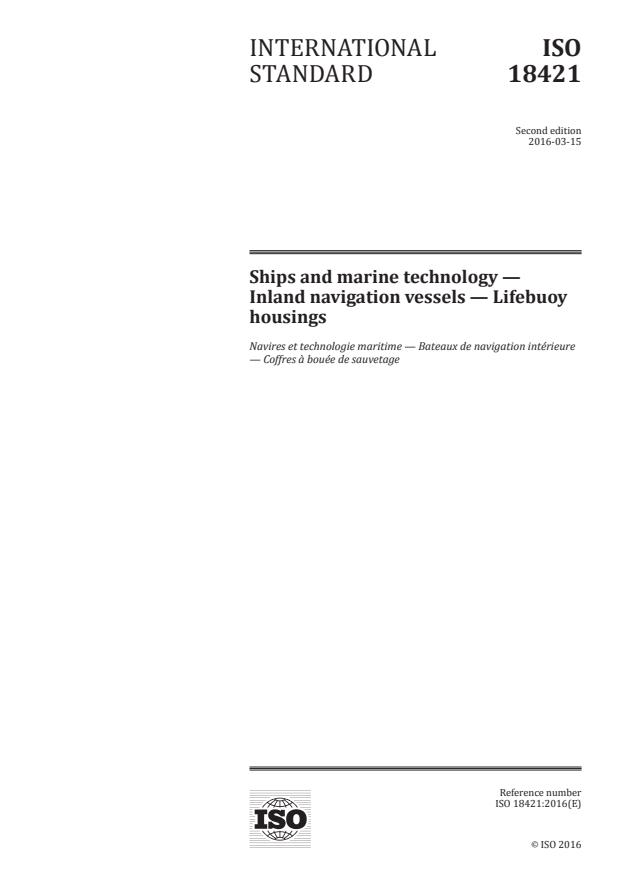
INTERNATIONAL ISO
STANDARD 18421
Second edition
2016-03-15
Ships and marine technology —
Inland navigation vessels — Lifebuoy
housings
Navires et technologie maritime — Bateaux de navigation intérieure
— Coffres à bouée de sauvetage
Reference number
©
ISO 2016
© ISO 2016, Published in Switzerland
All rights reserved. Unless otherwise specified, no part of this publication may be reproduced or utilized otherwise in any form
or by any means, electronic or mechanical, including photocopying, or posting on the internet or an intranet, without prior
written permission. Permission can be requested from either ISO at the address below or ISO’s member body in the country of
the requester.
ISO copyright office
Ch. de Blandonnet 8 • CP 401
CH-1214 Vernier, Geneva, Switzerland
Tel. +41 22 749 01 11
Fax +41 22 749 09 47
copyright@iso.org
www.iso.org
ii © ISO 2016 – All rights reserved
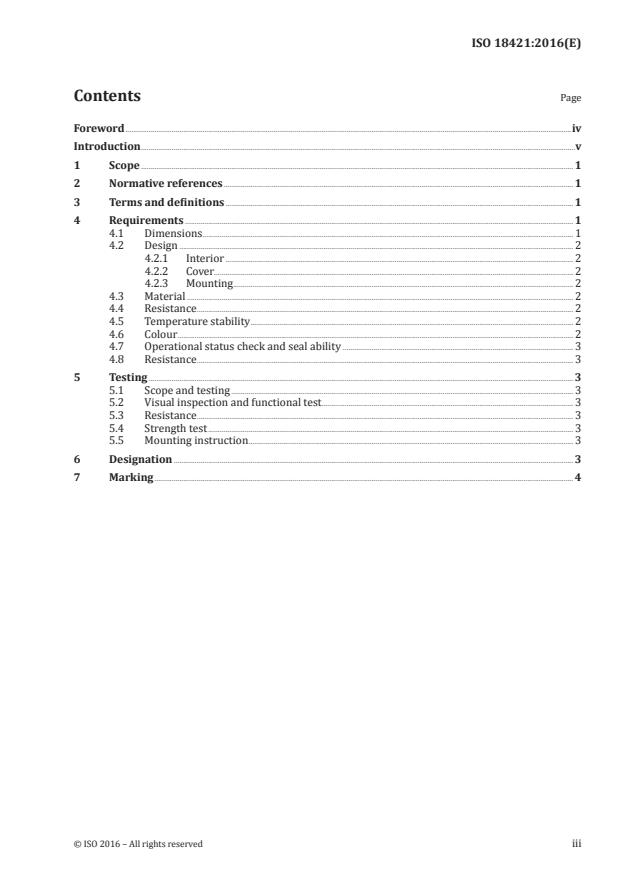
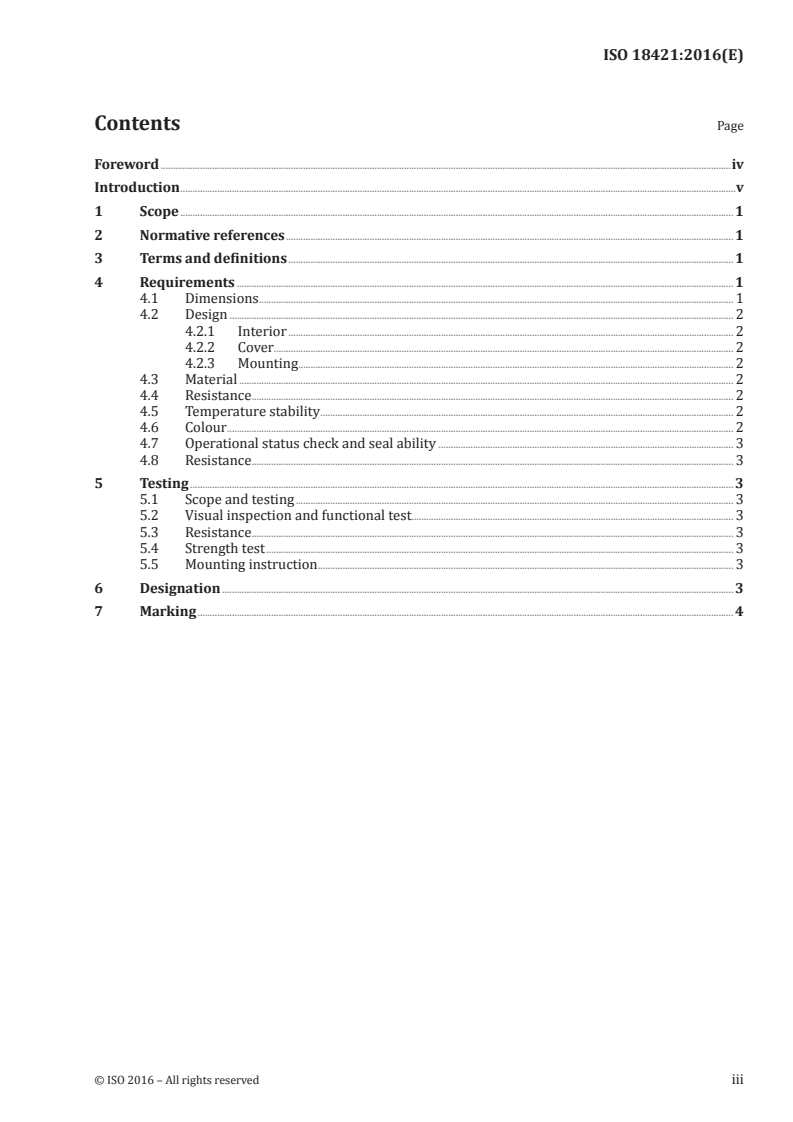
Contents Page
Foreword .iv
Introduction .v
1 Scope . 1
2 Normative references . 1
3 Terms and definitions . 1
4 Requirements . 1
4.1 Dimensions . 1
4.2 Design . 2
4.2.1 Interior . 2
4.2.2 Cover. 2
4.2.3 Mounting . 2
4.3 Material . 2
4.4 Resistance . 2
4.5 Temperature stability . 2
4.6 Colour . 2
4.7 Operational status check and seal ability . 3
4.8 Resistance . 3
5 Testing . 3
5.1 Scope and testing . 3
5.2 Visual inspection and functional test. 3
5.3 Resistance . 3
5.4 Strength test . 3
5.5 Mounting instruction . 3
6 Designation . 3
7 Marking . 4
Foreword
ISO (the International Organization for Standardization) is a worldwide federation of national standards
bodies (ISO member bodies). The work of preparing International Standards is normally carried out
through ISO technical committees. Each member body interested in a subject for which a technical
committee has been established has the right to be represented on that committee. International
organizations, governmental and non-governmental, in liaison with ISO, also take part in the work.
ISO collaborates closely with the International Electrotechnical Commission (IEC) on all matters of
electrotechnical standardization.
The procedures used to develop this document and those intended for its further maintenance are
described in the ISO/IEC Directives, Part 1. In particular the different approval criteria needed for the
different types of ISO documents should be noted. This document was drafted in accordance with the
editorial rules of the ISO/IEC Directives, Part 2 (see www.iso.org/directives).
Attention is drawn to the possibility that some of the elements of this document may be the subject of
patent rights. ISO shall not be held responsible for identifying any or all such patent rights. Detai
...
INTERNATIONAL ISO
STANDARD 18421
Second edition
2016-03-15
Ships and marine technology —
Inland navigation vessels — Lifebuoy
housings
Navires et technologie maritime — Bateaux de navigation intérieure
— Coffres à bouée de sauvetage
Reference number
©
ISO 2016
© ISO 2016, Published in Switzerland
All rights reserved. Unless otherwise specified, no part of this publication may be reproduced or utilized otherwise in any form
or by any means, electronic or mechanical, including photocopying, or posting on the internet or an intranet, without prior
written permission. Permission can be requested from either ISO at the address below or ISO’s member body in the country of
the requester.
ISO copyright office
Ch. de Blandonnet 8 • CP 401
CH-1214 Vernier, Geneva, Switzerland
Tel. +41 22 749 01 11
Fax +41 22 749 09 47
copyright@iso.org
www.iso.org
ii © ISO 2016 – All rights reserved
Contents Page
Foreword .iv
Introduction .v
1 Scope . 1
2 Normative references . 1
3 Terms and definitions . 1
4 Requirements . 1
4.1 Dimensions . 1
4.2 Design . 2
4.2.1 Interior . 2
4.2.2 Cover. 2
4.2.3 Mounting . 2
4.3 Material . 2
4.4 Resistance . 2
4.5 Temperature stability . 2
4.6 Colour . 2
4.7 Operational status check and seal ability . 3
4.8 Resistance . 3
5 Testing . 3
5.1 Scope and testing . 3
5.2 Visual inspection and functional test. 3
5.3 Resistance . 3
5.4 Strength test . 3
5.5 Mounting instruction . 3
6 Designation . 3
7 Marking . 4
Foreword
ISO (the International Organization for Standardization) is a worldwide federation of national standards
bodies (ISO member bodies). The work of preparing International Standards is normally carried out
through ISO technical committees. Each member body interested in a subject for which a technical
committee has been established has the right to be represented on that committee. International
organizations, governmental and non-governmental, in liaison with ISO, also take part in the work.
ISO collaborates closely with the International Electrotechnical Commission (IEC) on all matters of
electrotechnical standardization.
The procedures used to develop this document and those intended for its further maintenance are
described in the ISO/IEC Directives, Part 1. In particular the different approval criteria needed for the
different types of ISO documents should be noted. This document was drafted in accordance with the
editorial rules of the ISO/IEC Directives, Part 2 (see www.iso.org/directives).
Attention is drawn to the possibility that some of the elements of this document may be the subject of
patent rights. ISO shall not be held responsible for identifying any or all such patent rights. Detai
...