

ISO 8224-2:1991
(Main)Traveller irrigation machines — Part 2: Softwall hose and couplings — Test methods
General Information
- Abstract
This part applies to such hose and couplings used with stationary hose-coiling, mobile hose-laying or hose-coiling, and mobile hose-dragging irrigation machines used in agriculture and forestry. It specifies test methods for specific physical properties and accelerated durability tests. Eleven test procedures are given.
- Status
- Published
- Publication Date
- 23-Jan-1991
- Technical Committee
- ISO/TC 23/SC 18 - Irrigation and drainage equipment and systems
- Drafting Committee
- ISO/TC 23/SC 18 - Irrigation and drainage equipment and systems
- Current Stage
- 9093 - International Standard confirmed
- Start Date
- 06-Jun-2024
- Completion Date
- 29-Aug-2026
Buy Documents
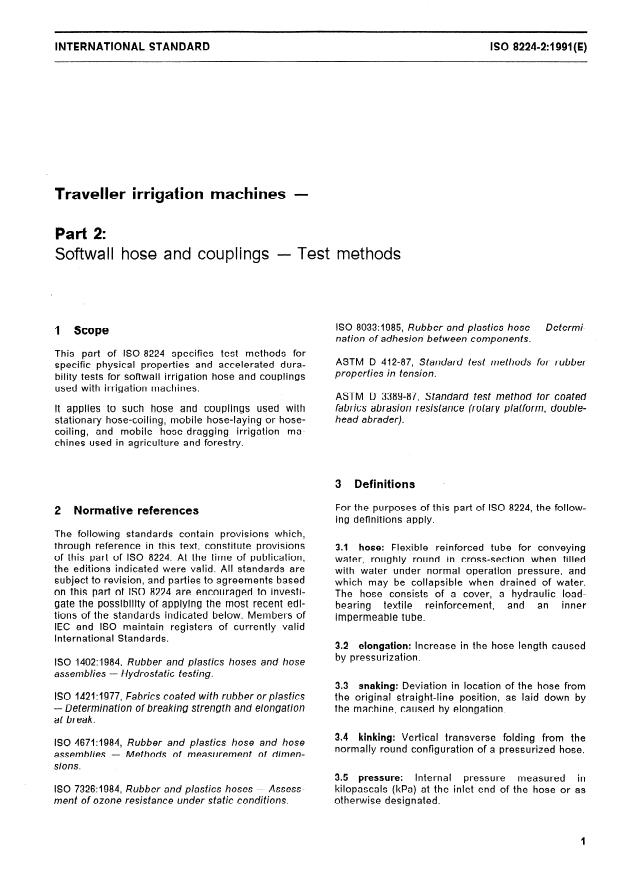
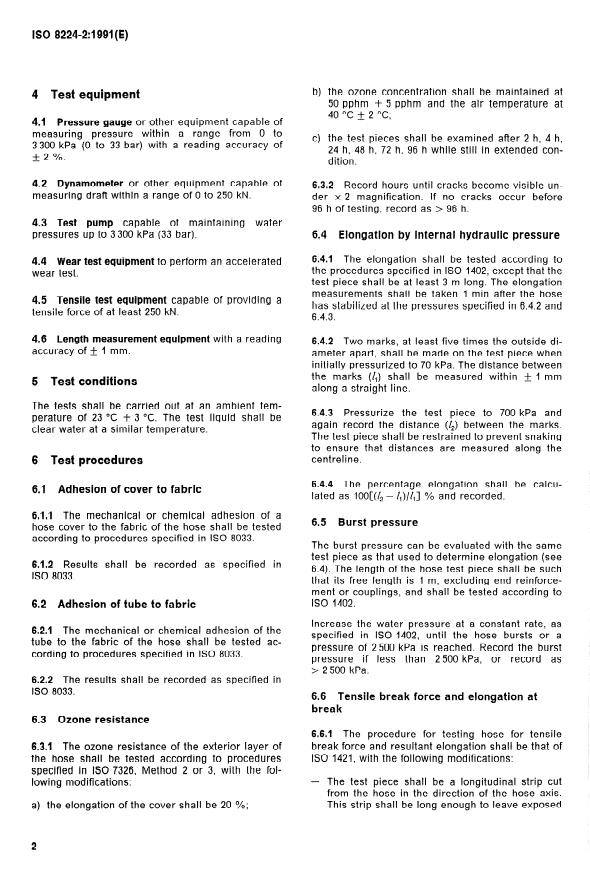
ISO 8224-2:1991 - Traveller irrigation machines — Part 2: Softwall hose and couplings — Test methods Released:1/24/1991
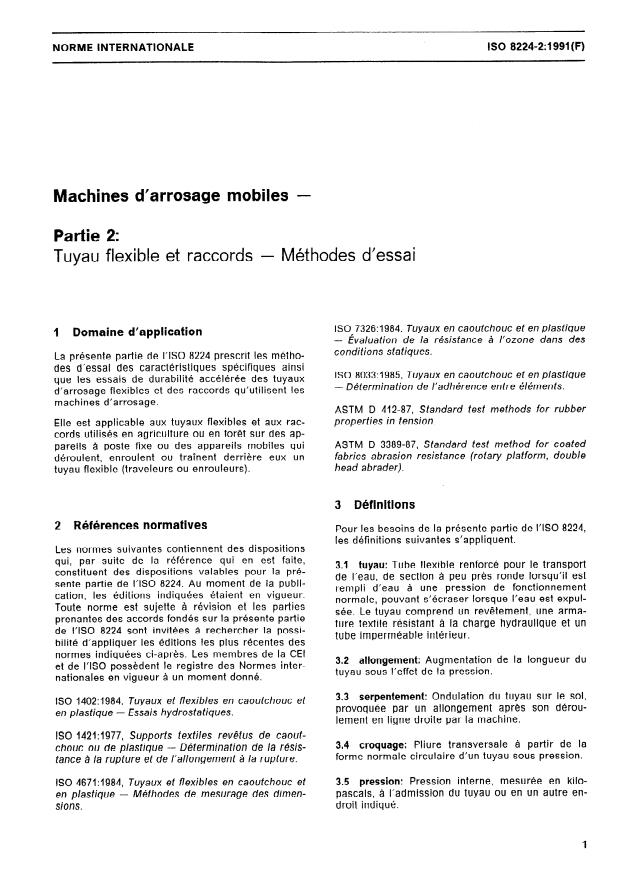
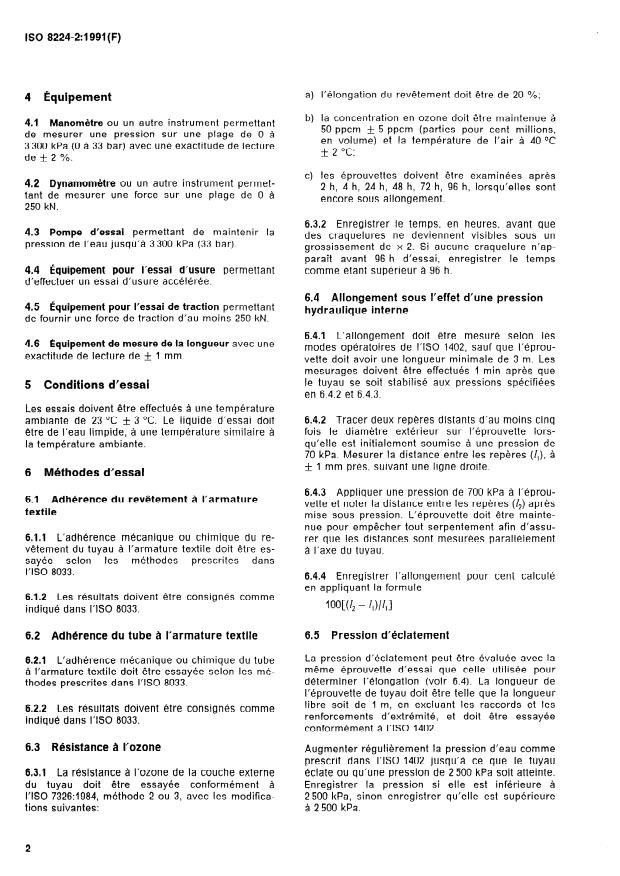
ISO 8224-2:1991 - Machines d'arrosage mobiles — Partie 2: Tuyau flexible et raccords — Méthodes d'essai Released:1/24/1991

ISO 8224-2:1991 - Machines d'arrosage mobiles — Partie 2: Tuyau flexible et raccords — Méthodes d'essai Released:1/24/1991
Overview
ISO 8224-2:1991 provides standardized test methods for evaluating softwall hoses and couplings used in traveller irrigation machines. These machines play a pivotal role in agricultural and forestry sectors for efficient water distribution. The standard outlines procedures to assess the physical properties and durability of hoses and couplings under both typical and accelerated conditions. By specifying eleven distinct test methods, ISO 8224-2 aims to ensure consistent, reliable performance and safety for hoses and couplings used with stationary hose-coiling, mobile hose-laying, hose-coiling, and mobile hose-dragging equipment.
Key Topics
This standard covers the following critical areas:
- Adhesion Tests: Verifies the bond between hose cover/tube and fabric using referenced ISO methods.
- Ozone Resistance: Examines the ability of hose materials to withstand ozone exposure, simulating outdoor conditions.
- Elongation and Burst Pressure: Measures the hose's extension under internal hydraulic pressure and determines maximum burst pressure.
- Tensile Strength and Elongation at Break: Evaluates how the hose responds to stretching forces until it fails.
- Kinking Resistance: Assesses the internal pressure at which the hose develops kinks, essential for drag-type irrigation.
- Abrasion Resistance: Uses accelerated wear tests to measure how long the hose cover withstands frictional wear before exposing reinforcement.
- Dimensional Checks: Establishes procedures for measuring inside and outside diameters under various pressures.
- Permanent Set: Determines the hose material’s ability to return to its original shape after being stretched.
- Hose and Coupling Assembly Tests: Includes pressure and longitudinal pull evaluations on hose-coupling assemblies.
Applications
Implementing ISO 8224-2:1991 brings direct benefits and practical solutions within irrigation system operations:
- Quality Assurance for Manufacturers: Ensures hoses and couplings consistently meet durability and reliability targets, supporting market acceptance and regulatory compliance.
- Enhanced System Performance: Operators and suppliers can select irrigation hoses and couplings that have proven resistance to burst, wear, and kinking, reducing equipment failures and downtime.
- Safety and Reliability in Field Use: Adherence to this standard promotes safer irrigation practices and mitigates risks associated with burst hoses or failed couplings.
- Benchmark for Procurement: Agricultural, forestry, and equipment procurement professionals can use ISO 8224-2 criteria to specify performance requirements in purchasing contracts, ensuring product comparability and suitability.
Related Standards
ISO 8224-2 references and aligns with several other prominent international standards for material and product testing:
- ISO 8033 - Rubber and plastics hose: Adhesion between components
- ISO 1402 - Rubber and plastics hoses: Hydrostatic testing
- ISO 1421 - Fabrics coated with rubber or plastics: Breaking strength and elongation at break
- ISO 4671 - Hose and hose assemblies: Dimensional measurement methods
- ISO 7326 - Rubber and plastics hoses: Assessment of ozone resistance
- ASTM D 412 - Rubber properties in tension
- ASTM D 3389 - Abrasion resistance for coated fabrics
These related standards provide further guidance on specific test procedures, ensuring consistency and interoperability in the evaluation of irrigation equipment components.
Keywords: traveller irrigation machines, softwall hose, hose couplings, agricultural irrigation standards, ISO 8224-2, test methods, durability tests, abrasion resistance, burst pressure, kinking resistance, agricultural hoses, forestry irrigation, hose assembly testing.
Relations
- Effective Date
- 25-Aug-2026
Buy Documents
ISO 8224-2:1991 - Traveller irrigation machines — Part 2: Softwall hose and couplings — Test methods Released:1/24/1991
ISO 8224-2:1991 - Machines d'arrosage mobiles — Partie 2: Tuyau flexible et raccords — Méthodes d'essai Released:1/24/1991
ISO 8224-2:1991 - Machines d'arrosage mobiles — Partie 2: Tuyau flexible et raccords — Méthodes d'essai Released:1/24/1991
Get Certified
Connect with accredited certification bodies for this standard

Control Union Certifications
Global certification for agriculture and sustainability.

ECOCERT
Organic and sustainability certification.

FSC International
Forest Stewardship Council certification.
Sponsored listings
Frequently Asked Questions
ISO 8224-2:1991 is a standard published by the International Organization for Standardization (ISO). Its full title is "Traveller irrigation machines — Part 2: Softwall hose and couplings — Test methods". This standard covers: This part applies to such hose and couplings used with stationary hose-coiling, mobile hose-laying or hose-coiling, and mobile hose-dragging irrigation machines used in agriculture and forestry. It specifies test methods for specific physical properties and accelerated durability tests. Eleven test procedures are given.
This part applies to such hose and couplings used with stationary hose-coiling, mobile hose-laying or hose-coiling, and mobile hose-dragging irrigation machines used in agriculture and forestry. It specifies test methods for specific physical properties and accelerated durability tests. Eleven test procedures are given.
ISO 8224-2:1991 is classified under the following ICS (International Classification for Standards) categories: 65.060.35 - Irrigation and drainage equipment. The ICS classification helps identify the subject area and facilitates finding related standards.
ISO 8224-2:1991 has the following relationships with other standards: It is inter standard links to EN 12325-2:1999. Understanding these relationships helps ensure you are using the most current and applicable version of the standard.
ISO 8224-2:1991 is available in PDF format for immediate download after purchase. The document can be added to your cart and obtained through the secure checkout process. Digital delivery ensures instant access to the complete standard document.
Standards Content (Sample)
INTERNATIONAL
STANDARD
First edition
199 1-02-0 1
Traveller irrigation machines -
Part 2:
Softwall hose and COUP
ings - Test methods
Machines d’arrosage mobiles -
Partie 2: Tuyau f7exible et raccords - Mkthodes d’essai
-------
Reference number
ISO 8224-2: 199 1 (E)
Foreword
ISO (the International Organization for Standardization) is a worldwide
federation of national Standards bodies (ISO member bodies). The work
of preparing International Standards is normally carried out through ISO
technical committees. Esch member body interested in a subject for
which a technical committee has been established has the right to be
represented on that committee. International organizations, govern-
mental and non-governmental, in liaison with ISO, also take part in the
work. ISO collaborates closely with the International Electrotechnicai
Commission (IEC) on all matters of electrotechnical standardization.
Draft International Standards adopted by the technical committees are
circulated to the member bodies for voting. Publication as an Inter-
national Standard requires approval by at least 75 % of the member
bodies casting a vote.
International Standard ISO 8224-2 was prepared by Technical Committee
*ISO/TC 23, Trattors and machinery for agriculture and forestry.
ISO 8224 consists of the following Parts, under the general title Traveller
irrigation machines:
- Part 1: Laboratory and field tesf methods
- Part 2: Softwall hose and couplings - Test methods
0 ISO 1991
All rights reserved. No part of this publication may be reproduced or utilized in any form
or by any means, electronie or mechanical, including photocopying and microfiim, without
Permission in writing from the publisher.
International Organization for Standardization
Case Postale 56 l CH-121 1 Geneve 20 l Switzerland
Printed in Switzerland
ii
INTERNATIONAL STANDARD
Traveller irrigation machines -
Part 2:
Softwall hose and couplings - Test methods
ISO 8033:1985, Rubber and plastics hose - Determi-
1 Scope
nation of adhesion between components.
This patt of ISO 8224 specifies test methods for
ASTM D 412-87, Standard test methods for rubber
specific physical properties and accelerated dura-
properties in tension.
bility tests for Softwall irrigation hose and couplings
used with irrigation machines.
ASTM D 3389-87, Standard test method for coated
fabrics abrasion resistance (rotary platform, double-
lt applies to such hose and couplings used with
head abrader).
stationary hose-coiling, mobile hose-laying or hose-
coiling, and mobile hose-dragging irrigation ma-
chines used in agriculture and forestry.
3 Definitions .
For the purposes of this part of ISO 8224, the follow-
2 Normative references
ing definitions apply.
The following Standards contain provisions which,
through reference in this text, constitute provisions
3.1 hose: Flexible reinforced tube for conveying
of this part of ISO 8224. At the time of publication,
water, roughly round in Cross-section when filled
the editions indicated were valid. All Standards are
with water under normal Operation pressure, and
subject to revision, and Parties to agreements based
which may be collapsible when drained of water.
on this part of ISO 8224 are encouraged to investi-
The hose consists of a cover, a hydraulic load-
gate the possibility of applying the most recent edi-
bearing textile reinforcement, and an inner
tions of the Standards indicated below. Members of
impermeable tube.
IEC and ISO maintain registers of currently valid
International Standards.
3.2 elongation: Increase in the hose length caused
by pressurization.
ISO 1402:1984, Rubber and plasfics hoses and hose
assemblies - Hydrostatic testing.
3.3 snaking: Deviation in location of the hose from
ISO 1421:1977, Fabrics coated with rubber or plastics the original straight-Iine Position, as laid down by
- Determination of breaking strength and elongation the machine, caused by elongation.
at break.
3.4 kinking: Vertical transverse folding from the
ISO 4671:1984, Rubber and plastics hose and hose
normally round configuration of a pressurized hose.
assemblies - Methods of measurement of dimen-
sions.
3.5 pressure: Internal pressure measured in
kilopascals (kPa) at the inlet end of the hose or as
ISO 7326:1984, Rubber and plastics hoses - Assess-
ment of ozone resistance under static conditions. otherwise designated.
ISO 822492:1991(E)
b) the ozone concentration shall be maintained at
4 Test equipment
50 pphm + 5 pphm and the air temperature at
40°C + 2k;
-
4.1 Pressure gauge or other equipment capable of
measuring pressure within a range from 0 to
c) the test pieces shall be examined after 2 h, 4 h,
3300 kPa (0 to 33 bar) with a reading accuracy of
24 h, 48 h, 72 h, 96 h while still in extended con-
+ 2 %.
-
dition.
4.2 Dynamometer or other equipment capable of
6.3.2 Record hours until Cracks become visible un-
measuring draft within a range of 0 to 250 kN.
der x 2 magnification. If no Cracks occur before
96 h of testing, record as > 96 h.
4.3 Test pump capable of maintaining water
pressures up to 3300 kPa (33 bar).
6.4 Elongation by internal hydraulic pressure
6.4.1 The elongation shall be tested according to
44 . Wear test equipment to perform an accelerated
the procedures specified in ISO 1402, except that the
wear test.
test piece shall be at least 3 m long. The elongation
measurements shall be taken 1 min after the hose
4.5 Tensile test equipment capable of providing a
has stabilized at the pressures specified in 6.4.2 and
tensile forte of at least 250 kN.
6.4.3.
46 . Length measurement equipment with a reading
6.4.2 Two marks, at least five times the outside di-
+ 1 mm.
acc uracy of
-
ameter apart, shall be made on the test piece when
initially pressurized to 70 kPa. The distance between
the marks (l,) shall be measured within + 1 mm
-
5 Test conditions
along a straight line.
The tests shall be carried out at an ambient tem-
6.4.3 Pressurize the test piece to 700 kPa and
perature of 23 *C + 3 *C. The test liquid shall be
-
again record the distance (1’) between the marks.
clear water at a similar temperature.
The test piece shall be restrained to prevent snaking
to ensure that distances are measured along the
centreline.
6 Test procedures
6.4.4 The percentage elongation shall be calcu-
6.1 Adhesion of cover to fabric
lated as lOOc(r, - /,)/Z,] % and recorded.
6.1.1 The mechanical or Chemical adhesion of a
6.5 Burst pressure
hose cover to the fabric of the hose shall be tested
according to procedures specified in ISO 8033.
The burst pressure ta
...
ISO
NORME
8224-2
INTERNATIONALE
Première édition
1991-02-01
Machines d’arrosage mobiles -
Partie 2:
Tuyau flexible et raccords - Méthodes d’essai
Traveller irrigation machines -
Part 2: Softwall hose and couplings - Test methods
--
Numéro de référence
Avant-propos
L’ISO (Organisation internationale de normalisation) est une fédération
mondiale d’organismes nationaux de normalisation (comités membres
de I’ISO). L’élaboration des Normes internationales est en général
confiée aux comités techniques de I’ISO. Chaque comité membre inté-
ressé par une étude a le droit de faire partie du comité technique créé
à cet effet. Les organisations internationales, gouvernementales et non
gouvernementales, en liaison avec I’ISO participent également aux tra-
vaux. L’ISO collabore étroitement avec la Commission électrotechnique
internationale (CEI) en ce qui concerne la normalisation électrotech-
nique.
Les projets de Normes internationales adoptés par les comités techni-
ques sont soumis aux comités membres pour vote. Leur publication
comme Normes internationales requiert l’approbation de 75 % au moins
des comités membres votants.
La Norme internationale ISO 8224-2 a été élaborée par le comité tech-
nique ISO/TC 23, Tracteurs et matériels agricoles et forestiers.
prend les parties su ivantes, présentées sous le titre gé-
L’ISO 8224 com
néral Mach ines d’arrosage mobiles:
- Partie 1: Méthodes d’essai en laboratoire et au champ
- Partie 2: Tuyau flexible et raccords - Méthodes d’essai
0 iso 1991
Droits de reproduction réservés. Aucune partie de cette publication ne peut être repro-
duite ni utilisée sous quelque forme que ce soit et par aucun procédé, électronique ou
mécanique, y compris la photocopie et les microfilms, sans l’accord écrit de l’éditeur.
Organisation international e de normalisation
Genève 20 l Suis se
Case Postale 56 l CH-121
imprimé en Suisse
ii
--- - -~ ~
NORME INTERNATIONALE ISO 822492:1991 (F)
Machines d’arrosage mobiles -
Partie 2:
Tuyau flexible et raccords - Méthodes d’essai
ISO 7326:1984, Tuyaux en caoutchouc et en plastique
1 Domaine d’application
-
Évaluation de la résistance à l’ozone dans des
conditions statiques.
La présente partie de I’ISO 8224 prescrit les métho-
des d’essai des caractéristiques spécifiques ainsi
ISO 8033:1985, Tuyaux en caoutchouc et en plastique
que les essais de durabilité accélérée des tuyaux
-
Détermination de l’adhérence entre éléments.
d’arrosage flexibles et des raccords qu’utilisent les
machines d’arrosage.
ASTM D 412-87, Standard test methods for rubber
properties in tension.
Elle est applicable aux tuyaux flexibles et aux rac-
cords utilisés en agriculture ou en forêt sur des ap-
ASTM D 3389-87, Standard test mefhod for coated
pareils à poste fixe ou des appareils mobiles qui
fabrics abrasion resistance (rotary platform, double
déroulent, enroulent ou traînent derrière eux un
tuyau flexible (traveleurs ou enrouleurs). head abrader).
3 Définitions
2 Références normatives
Pour les besoins de la présente partie de I’ISO 8224,
les définitions suivantes s’appliquent.
Les normes suivantes contiennent des dispositions
qui, par suite de la référence qui en est faite,
3.1 tuyau: Tube flexible renforcé pour le transport
constituent des dispositions valables pour la pré-
de l’eau, de section a peu près ronde lorsqu’il est
sente partie de I’ISO 8224. Au moment de la publi-
rempli d’eau à une pression de fonctionnement
cation, les éditions indiquées étaient en vigueur.
normale, pouvant s’écraser lorsque l’eau est expul-
Toute norme est sujette à révision et les parties
sée. Le tuyau comprend un revêtement, une arma-
prenantes des accords fondés sur la présente partie
ture textile résistant à la charge hydraulique et un
de I’ISO 8224 sont invitées à rechercher la possi-
tube imperméable intérieur.
bilité d’appliquer les éditions les plus récentes des
normes indiquées ci-après. Les membres de la CEI
3.2 allongement: Augmentation de la longueur du
et de I’ISO possèdent le registre des Normes inter-
tuyau sous l’effet de la pression.
nationales en vigueur à un moment donné.
3.3 serpentement: Ondulation du tuyau sur le sol,
ISO 1402:1984, Tuyaux et f7exibles en caoutchouc et
provoquée par un allongement après son dérou-
en plastique - Essais hydrostatiques.
lement en ligne droite par la machine.
ISO 1421:1977, Supports textiles revêtus de caout-
3.4 craquage: Pliure transversale à partir de la
chouc ou de plastique - Détermination de la résis-
forme normale circulaire d’un tuyau sous pression.
tance à la rupture et de l’allongement à la rupture.
ISO 4671:1984, Tuyaux et f7exibles en caoutchouc et 3.5 pression: Pression interne, mesurée en kilo-
en plastique - Méthodes de mesurage des dimen- pascals, à l’admission du tuyau ou en un autre en-
sions. droit indiqué.
ISO 822492:1991 (F)
a) l’élongation du revêtement doit être de 20 %;
4 Équipement
4.1 Manomètre ou un autre instrument permettant
de mesurer une pression sur une plage de 0 à
3300 kPa (0 à 33 bar) avec une exactitude de lecture
de + 2 %.
-
c) les éprouvettes doivent être examinées après
4.2 Dynamomètre ou un autre instrument permet-
2 h, 4 h, 24 h, 48 h, 72 h, 96 h, lorsqu’elles sont
tant de mesurer une force sur une plage de 0 à
encore sous allongement.
250 kN.
6.3.2 Enregistrer le temps, en heures, avant que
4.3 Pompe d’essai permettant de maintenir la
des craquelures ne deviennent visibles sous un
pression de l’eau jusqu’à 3 300 kPa (33 bar).
grossissement de x 2. Si aucune craquelure n’ap-
paraît avant 96 h d’essai, enregistrer le temps
4.4 Équipement pour l’essai d’usure permettant comme étant supérieur à 96 h.
d’effectuer un essai d’usure accélérée.
6.4 Allongement sous l’effet d’une pression
4.5 Équipement pour l’essai de traction permettant
hydraulique interne
de fournir une force de traction d’au moins 250 kN.
6.4.1 L’allongement doit être mesuré selon les
de la longueur avec une
4.6 Éq uipement de mesure
modes opératoires de I’ISO 1402, sauf que I’éprou-
mm.
exactitu de de lecture de + 1
-
vette doit avoir une longueur minimale de 3 m. Les
mesurages doivent être effectués 1 min après que
le tuyau se soit stabilisé aux pressions spécifiées
5 Conditions d’essai
en 6.4.2 et 6.4.3.
Les essais doivent être effectués à une température
6.4.2 Tracer deux repères distants d’au moins cinq
ambiante de 23 OC + 3 OC. Le liquide d’essai doit
fois le diamètre extérieur sur l’éprouvette lors-
être de l’eau limpide, à une température similaire à
qu’elle est initialement soumise à une pression de
la température ambiante.
70 kPa. Mesurer la distance entre les repères
+ 1 mm près, suivant une ligne droite.
-
6 Méthodes d’essai
6.4.3 Appliquer une pression de 700 kPa à I’éprou-
6.1 Adhérence du revêtement à l’armature
vette et noter la distance entre les repères (l*) après
textile
mise sous pression. L’éprouvette doit être mainte-
nue pour empêcher tout serpentement afin d’assu-
6.1.1 L’adhérence mécanique ou chimique du re-
rer que les distances sont mesurées parallèlement
vêtement du tuyau à l’armature textile doit être es-
à l’axe du tuyau.
selon les méthodes prescrites dans
sayée
I’ISO 8033.
6.4.4 Enregi stre r I’allon gement pour cent calculé
en ap pliquan t la formule
6.1.2 Les résultats doivent être consignés comme
1ow2 - WI
indiqué dans I’ISO 8033.
6.5 Pression d’éclatement
6.2 Adhérence
...
ISO
NORME
8224-2
INTERNATIONALE
Première édition
1991-02-01
Machines d’arrosage mobiles -
Partie 2:
Tuyau flexible et raccords - Méthodes d’essai
Traveller irrigation machines -
Part 2: Softwall hose and couplings - Test methods
--
Numéro de référence
Avant-propos
L’ISO (Organisation internationale de normalisation) est une fédération
mondiale d’organismes nationaux de normalisation (comités membres
de I’ISO). L’élaboration des Normes internationales est en général
confiée aux comités techniques de I’ISO. Chaque comité membre inté-
ressé par une étude a le droit de faire partie du comité technique créé
à cet effet. Les organisations internationales, gouvernementales et non
gouvernementales, en liaison avec I’ISO participent également aux tra-
vaux. L’ISO collabore étroitement avec la Commission électrotechnique
internationale (CEI) en ce qui concerne la normalisation électrotech-
nique.
Les projets de Normes internationales adoptés par les comités techni-
ques sont soumis aux comités membres pour vote. Leur publication
comme Normes internationales requiert l’approbation de 75 % au moins
des comités membres votants.
La Norme internationale ISO 8224-2 a été élaborée par le comité tech-
nique ISO/TC 23, Tracteurs et matériels agricoles et forestiers.
prend les parties su ivantes, présentées sous le titre gé-
L’ISO 8224 com
néral Mach ines d’arrosage mobiles:
- Partie 1: Méthodes d’essai en laboratoire et au champ
- Partie 2: Tuyau flexible et raccords - Méthodes d’essai
0 iso 1991
Droits de reproduction réservés. Aucune partie de cette publication ne peut être repro-
duite ni utilisée sous quelque forme que ce soit et par aucun procédé, électronique ou
mécanique, y compris la photocopie et les microfilms, sans l’accord écrit de l’éditeur.
Organisation international e de normalisation
Genève 20 l Suis se
Case Postale 56 l CH-121
imprimé en Suisse
ii
--- - -~ ~
NORME INTERNATIONALE ISO 822492:1991 (F)
Machines d’arrosage mobiles -
Partie 2:
Tuyau flexible et raccords - Méthodes d’essai
ISO 7326:1984, Tuyaux en caoutchouc et en plastique
1 Domaine d’application
-
Évaluation de la résistance à l’ozone dans des
conditions statiques.
La présente partie de I’ISO 8224 prescrit les métho-
des d’essai des caractéristiques spécifiques ainsi
ISO 8033:1985, Tuyaux en caoutchouc et en plastique
que les essais de durabilité accélérée des tuyaux
-
Détermination de l’adhérence entre éléments.
d’arrosage flexibles et des raccords qu’utilisent les
machines d’arrosage.
ASTM D 412-87, Standard test methods for rubber
properties in tension.
Elle est applicable aux tuyaux flexibles et aux rac-
cords utilisés en agriculture ou en forêt sur des ap-
ASTM D 3389-87, Standard test mefhod for coated
pareils à poste fixe ou des appareils mobiles qui
fabrics abrasion resistance (rotary platform, double
déroulent, enroulent ou traînent derrière eux un
tuyau flexible (traveleurs ou enrouleurs). head abrader).
3 Définitions
2 Références normatives
Pour les besoins de la présente partie de I’ISO 8224,
les définitions suivantes s’appliquent.
Les normes suivantes contiennent des dispositions
qui, par suite de la référence qui en est faite,
3.1 tuyau: Tube flexible renforcé pour le transport
constituent des dispositions valables pour la pré-
de l’eau, de section a peu près ronde lorsqu’il est
sente partie de I’ISO 8224. Au moment de la publi-
rempli d’eau à une pression de fonctionnement
cation, les éditions indiquées étaient en vigueur.
normale, pouvant s’écraser lorsque l’eau est expul-
Toute norme est sujette à révision et les parties
sée. Le tuyau comprend un revêtement, une arma-
prenantes des accords fondés sur la présente partie
ture textile résistant à la charge hydraulique et un
de I’ISO 8224 sont invitées à rechercher la possi-
tube imperméable intérieur.
bilité d’appliquer les éditions les plus récentes des
normes indiquées ci-après. Les membres de la CEI
3.2 allongement: Augmentation de la longueur du
et de I’ISO possèdent le registre des Normes inter-
tuyau sous l’effet de la pression.
nationales en vigueur à un moment donné.
3.3 serpentement: Ondulation du tuyau sur le sol,
ISO 1402:1984, Tuyaux et f7exibles en caoutchouc et
provoquée par un allongement après son dérou-
en plastique - Essais hydrostatiques.
lement en ligne droite par la machine.
ISO 1421:1977, Supports textiles revêtus de caout-
3.4 craquage: Pliure transversale à partir de la
chouc ou de plastique - Détermination de la résis-
forme normale circulaire d’un tuyau sous pression.
tance à la rupture et de l’allongement à la rupture.
ISO 4671:1984, Tuyaux et f7exibles en caoutchouc et 3.5 pression: Pression interne, mesurée en kilo-
en plastique - Méthodes de mesurage des dimen- pascals, à l’admission du tuyau ou en un autre en-
sions. droit indiqué.
ISO 822492:1991 (F)
a) l’élongation du revêtement doit être de 20 %;
4 Équipement
4.1 Manomètre ou un autre instrument permettant
de mesurer une pression sur une plage de 0 à
3300 kPa (0 à 33 bar) avec une exactitude de lecture
de + 2 %.
-
c) les éprouvettes doivent être examinées après
4.2 Dynamomètre ou un autre instrument permet-
2 h, 4 h, 24 h, 48 h, 72 h, 96 h, lorsqu’elles sont
tant de mesurer une force sur une plage de 0 à
encore sous allongement.
250 kN.
6.3.2 Enregistrer le temps, en heures, avant que
4.3 Pompe d’essai permettant de maintenir la
des craquelures ne deviennent visibles sous un
pression de l’eau jusqu’à 3 300 kPa (33 bar).
grossissement de x 2. Si aucune craquelure n’ap-
paraît avant 96 h d’essai, enregistrer le temps
4.4 Équipement pour l’essai d’usure permettant comme étant supérieur à 96 h.
d’effectuer un essai d’usure accélérée.
6.4 Allongement sous l’effet d’une pression
4.5 Équipement pour l’essai de traction permettant
hydraulique interne
de fournir une force de traction d’au moins 250 kN.
6.4.1 L’allongement doit être mesuré selon les
de la longueur avec une
4.6 Éq uipement de mesure
modes opératoires de I’ISO 1402, sauf que I’éprou-
mm.
exactitu de de lecture de + 1
-
vette doit avoir une longueur minimale de 3 m. Les
mesurages doivent être effectués 1 min après que
le tuyau se soit stabilisé aux pressions spécifiées
5 Conditions d’essai
en 6.4.2 et 6.4.3.
Les essais doivent être effectués à une température
6.4.2 Tracer deux repères distants d’au moins cinq
ambiante de 23 OC + 3 OC. Le liquide d’essai doit
fois le diamètre extérieur sur l’éprouvette lors-
être de l’eau limpide, à une température similaire à
qu’elle est initialement soumise à une pression de
la température ambiante.
70 kPa. Mesurer la distance entre les repères
+ 1 mm près, suivant une ligne droite.
-
6 Méthodes d’essai
6.4.3 Appliquer une pression de 700 kPa à I’éprou-
6.1 Adhérence du revêtement à l’armature
vette et noter la distance entre les repères (l*) après
textile
mise sous pression. L’éprouvette doit être mainte-
nue pour empêcher tout serpentement afin d’assu-
6.1.1 L’adhérence mécanique ou chimique du re-
rer que les distances sont mesurées parallèlement
vêtement du tuyau à l’armature textile doit être es-
à l’axe du tuyau.
selon les méthodes prescrites dans
sayée
I’ISO 8033.
6.4.4 Enregi stre r I’allon gement pour cent calculé
en ap pliquan t la formule
6.1.2 Les résultats doivent être consignés comme
1ow2 - WI
indiqué dans I’ISO 8033.
6.5 Pression d’éclatement
6.2 Adhérence
...