

ISO 11738:2021
(Main)Agricultural irrigation equipment — Control heads
General Information
- Abstract
This document specifies requirements for the components and method of installation of pressurized irrigation system control heads, referred to hereinafter as irrigation control heads, with a nominal size of up to and including 200 mm (nominal size of an irrigation control head or nominal size of a component). This document is applicable only to the above-ground components of irrigation control heads for sprinkler irrigation and micro-irrigation (mini-sprinklers, drip irrigation, etc.). It is applicable to the basic irrigation control head, on which other irrigation control and command components (electrical, electronic and hydraulic) can be assembled, but does not deal with these additional components. This document is not applicable to systems and/or components that can be required to prevent the water from freezing in the irrigation control head, such as dry-barrel hydrants or other types of hydrants. This document does not specify construction or operating requirements for the individual components that make up the irrigation control head. These requirements are specified in the relevant standards for each component.
- Status
- Published
- Publication Date
- 26-Oct-2021
- Technical Committee
- ISO/TC 23/SC 18 - Irrigation and drainage equipment and systems
- Drafting Committee
- ISO/TC 23/SC 18 - Irrigation and drainage equipment and systems
- Current Stage
- 6060 - International Standard published
- Start Date
- 27-Oct-2021
- Due Date
- 18-Mar-2022
- Completion Date
- 27-Oct-2021
Buy Documents
ISO 11738:2021 - Agricultural irrigation equipment -- Control heads
ISO 11738:2021 - Agricultural irrigation equipment — Control heads/27/2021
Overview
ISO 11738:2021 - "Agricultural irrigation equipment - Control heads" specifies requirements for the components and installation methods of pressurized irrigation system control heads (nominal size up to and including 200 mm). The standard applies to above‑ground control heads used in sprinkler irrigation and micro‑irrigation (mini‑sprinklers, drip irrigation, etc.). It covers the basic irrigation control head onto which electrical, electronic or additional hydraulic accessories may be assembled, but it does not set construction or operating requirements for those individual components (these are covered by their own standards) and it excludes freeze‑prevention hydrant types.
Key topics and technical requirements
- Scope and classification: Defines irrigation control head types - filtration, automation, pressure/flow regulation, chemigation, flow/volume measurement, and safety devices (check valves, backflow preventers, air‑release valves).
- Materials and components: Requirements for above‑ground materials and component selection (component construction standards are referenced separately).
- Installation guidance:
- Location: accessible, protected from damage, free of obstructive vegetation.
- Minimum installation height: components (except some ground‑standing types) installed at least 0.4 m above ground for serviceability.
- Support and stabilization: thrust blocks, rigid platforms or supports to prevent stress, vibration and enable safe operation.
- Drainage and environmental containment: drainage must prevent chemical or contaminated irrigation water from returning to ground or surface water and must contain spills responsibly.
- Security: prevent unauthorized access via fencing or locking.
- Component spacing and accessibility: Minimum clearances to allow meter/gauge reliability, filter cleaning, and component replacement; threaded nipples must allow wrench access.
- Test methods: Visual inspection, in‑situ hydraulic watertightness/resistance tests, and operational function tests to verify correct performance.
- Marking and documentation: Requirements for marking the irrigation control head and components for traceability and safe operation.
Practical applications and users
ISO 11738:2021 is used for:
- Specifying and procuring irrigation control heads for farms, nurseries and landscape irrigation.
- Design and installation guidance for irrigation contractors and system integrators.
- Quality and compliance checks by manufacturers and test laboratories.
- Asset management and maintenance planning for irrigation managers and agronomists.
- Regulatory bodies and consultants developing safe chemigation and filtration systems.
Typical users: irrigation equipment manufacturers, agricultural engineers, irrigation designers/contractors, farm managers, water‑resource planners and test/inspection bodies.
Related standards
- ISO 7-1 (pipe threads), ISO 7005-1/7005-2 (flanges) - normative references in ISO 11738.
- Component standards for valves, meters, filters and backflow preventers (refer to the specific product standards for construction and operating requirements).
- ISO 15081 (symbols) and component standards such as ISO 9912-1 and ISO 7714 are relevant for terminology and component definitions.
Keywords: ISO 11738:2021, irrigation control heads, agricultural irrigation equipment, pressurized irrigation system, sprinkler irrigation, micro-irrigation, filtration, chemigation, pressure regulation, flow measurement, installation requirements.
Relations
- Effective Date
- 23-Apr-2020
Buy Documents
ISO 11738:2021 - Agricultural irrigation equipment -- Control heads
ISO 11738:2021 - Agricultural irrigation equipment — Control heads/27/2021
Get Certified
Connect with accredited certification bodies for this standard

Control Union Certifications
Global certification for agriculture and sustainability.

ECOCERT
Organic and sustainability certification.

FSC International
Forest Stewardship Council certification.
Sponsored listings
Frequently Asked Questions
ISO 11738:2021 is a standard published by the International Organization for Standardization (ISO). Its full title is "Agricultural irrigation equipment — Control heads". This standard covers: This document specifies requirements for the components and method of installation of pressurized irrigation system control heads, referred to hereinafter as irrigation control heads, with a nominal size of up to and including 200 mm (nominal size of an irrigation control head or nominal size of a component). This document is applicable only to the above-ground components of irrigation control heads for sprinkler irrigation and micro-irrigation (mini-sprinklers, drip irrigation, etc.). It is applicable to the basic irrigation control head, on which other irrigation control and command components (electrical, electronic and hydraulic) can be assembled, but does not deal with these additional components. This document is not applicable to systems and/or components that can be required to prevent the water from freezing in the irrigation control head, such as dry-barrel hydrants or other types of hydrants. This document does not specify construction or operating requirements for the individual components that make up the irrigation control head. These requirements are specified in the relevant standards for each component.
This document specifies requirements for the components and method of installation of pressurized irrigation system control heads, referred to hereinafter as irrigation control heads, with a nominal size of up to and including 200 mm (nominal size of an irrigation control head or nominal size of a component). This document is applicable only to the above-ground components of irrigation control heads for sprinkler irrigation and micro-irrigation (mini-sprinklers, drip irrigation, etc.). It is applicable to the basic irrigation control head, on which other irrigation control and command components (electrical, electronic and hydraulic) can be assembled, but does not deal with these additional components. This document is not applicable to systems and/or components that can be required to prevent the water from freezing in the irrigation control head, such as dry-barrel hydrants or other types of hydrants. This document does not specify construction or operating requirements for the individual components that make up the irrigation control head. These requirements are specified in the relevant standards for each component.
ISO 11738:2021 is classified under the following ICS (International Classification for Standards) categories: 65.060.35 - Irrigation and drainage equipment. The ICS classification helps identify the subject area and facilitates finding related standards.
ISO 11738:2021 has the following relationships with other standards: It is inter standard links to ISO 11738:2000. Understanding these relationships helps ensure you are using the most current and applicable version of the standard.
ISO 11738:2021 is available in PDF format for immediate download after purchase. The document can be added to your cart and obtained through the secure checkout process. Digital delivery ensures instant access to the complete standard document.
Standards Content (Sample)
INTERNATIONAL ISO
STANDARD 11738
Second edition
2021-10
Agricultural irrigation equipment —
Control heads
Matériel agricole d'irrigation — Installations de tête
Reference number
© ISO 2021
All rights reserved. Unless otherwise specified, or required in the context of its implementation, no part of this publication may
be reproduced or utilized otherwise in any form or by any means, electronic or mechanical, including photocopying, or posting on
the internet or an intranet, without prior written permission. Permission can be requested from either ISO at the address below
or ISO’s member body in the country of the requester.
ISO copyright office
CP 401 • Ch. de Blandonnet 8
CH-1214 Vernier, Geneva
Phone: +41 22 749 01 11
Email: copyright@iso.org
Website: www.iso.org
Published in Switzerland
ii
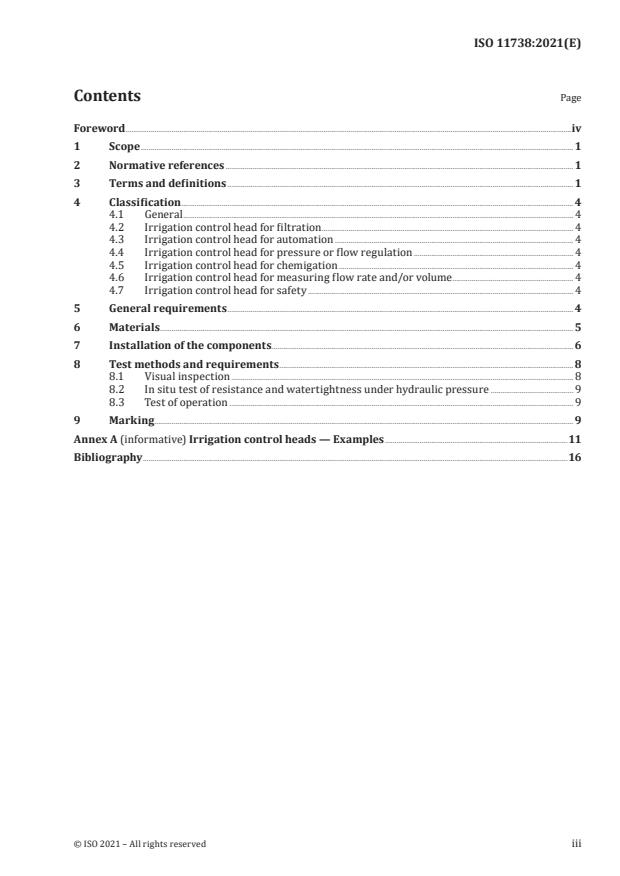
Contents Page
Foreword .iv
1 Scope . 1
2 Normative references . 1
3 Terms and definitions . 1
4 Classification . 4
4.1 General . 4
4.2 Irrigation control head for filtration . 4
4.3 Irrigation control head for automation . 4
4.4 Irrigation control head for pressure or flow regulation . 4
4.5 Irrigation control head for chemigation . 4
4.6 Irrigation control head for measuring flow rate and/or volume . 4
4.7 Irrigation control head for safety . 4
5 General requirements . 4
6 Materials . 5
7 Installation of the components . .6
8 Test methods and requirements . 8
8.1 Visual inspection . 8
8.2 In situ test of resistance and watertightness under hydraulic pressure . 9
8.3 Test of operation . 9
9 Marking . . 9
Annex A (informative) Irrigation control heads — Examples .11
Bibliography .16
iii
Foreword
ISO (the International Organization for Standardization) is a worldwide federation of national standards
bodies (ISO member bodies). The work of preparing International Standards is normally carried out
through ISO technical committees. Each member body interested in a subject for which a technical
committee has been established has the right to be represented on that committee. International
organizations, governmental and non-governmental, in liaison with ISO, also take part in the work.
ISO collaborates closely with the International Electrotechnical Commission (IEC) on all matters of
electrotechnical standardization.
The procedures used to develop this document and those intended for its further maintenance are
described in the ISO/IEC Directives, Part 1. In particular, the different approval criteria needed for the
different types of ISO documents should be noted. This document was drafted in accordance with the
editorial rules of the ISO/IEC Directives, Part 2 (see www.iso.org/directives).
Attention is drawn to the possibility that some of the elements of this document may be the subject of
patent rights. ISO shall not be held responsible for identifying any or all such patent rights. Details of
any patent rights identified during the development of the document will be in the Introduction and/or
on the ISO list of patent declarations received (see www.iso.org/patents).
Any trade name used in this document is information given for the convenience of users and does not
constitute an endorsement.
For an explanation of the voluntary nature of standards, the meaning of ISO specific terms and
expressions related to conformity assessment, as well as information about ISO's adherence to
the World Trade Organization (WTO) principles in the Technical Barriers to Trade (TBT), see
www.iso.org/iso/foreword.html.
This document was prepared by Technical Committee ISO/TC 23, Tractors and machinery for agriculture
and forestry, Subcommittee SC 18, Irrigation and drainage equipment and systems.
This second edition cancels and replaces the first edition (ISO 11738:2000), which has been technically
revised.
The main changes compared to the previous edition are as follows.
— New types of control heads and components of control heads were included, for example, irrigation
control head for filtration with two or more media filters.
— Symbols used in this edition were changed or revised to conform to ISO 15081:2011.
Any feedback or questions on this document should be directed to the user’s national standards body. A
complete listing of these bodies can be found at www.iso.org/members.html.
iv
INTERNATIONAL STANDARD ISO 11738:2021(E)
Agricultural irrigation equipment — Control heads
1 Scope
This document specifies requirements for the components and method of installation of pressurized
irrigation system control heads, referred to hereinafter as irrigation control heads, with a nominal
size of up to and including 200 mm (nominal size of an irrigation control head or nominal size of a
component).
This document is applicable only to the above-ground components of irrigation control heads for
sprinkler irrigation and micro-irrigation (mini-sprinklers, drip irrigation, etc.). It is applicable to the
basic irrigation control head, on which other irrigation control and command components (electrical,
electronic and hydraulic) can be assembled, but does not deal with these additional components.
This document is not applicable to systems and/or components that can be required to prevent the
water from freezing in the irrigation control head, such as dry-barrel hydrants or other types of
hydrants.
This document does not specify construction or operating requirements for the individual components
that make up the irrigation control head. These requirements are specified in the relevant standards
for each component.
2 Normative references
The following documents are referred to in the text in such a way that some or all of their content
constitutes requirements of this document. For dated references, only the edition cited applies. For
undated references, the latest edition of the referenced document (including any amendments) applies.
ISO 7-1, Pipe threads where pressure-tight joints are made on the threads — Part 1: Dimensions, tolerances
and designation
ISO 7005-1, Pipe flanges — Part 1: Steel flanges for industrial and general service piping systems
ISO 7005-2, Metallic flanges — Part 2: Cast iron flanges
3 Terms and definitions
For the purposes of this document, the following terms and definitions apply.
ISO and IEC maintain terminological databases for use in standardization at the following addresses:
— ISO Online browsing platform: available at https:// www .iso .org/ obp
— IEC Electropedia: available at http:// www .electropedia .org/
3.1
activating valve
type of valve which is used to initiate and shut off the flow of water through an irrigation control head
(3.8)
EXAMPLE Manually operated valve, hydraulically operated valve, volumetric valve (3.17).
3.2
automatic self-cleaning strainer-type filter
filter with a flushing capability automatically activated by pressure differential, by duration of
infiltration, by volume of water filtered, by some other physical quantity or by any combination of these
3.3
air release valve
valve which opens automatically to allow air from the atmosphere to enter the water pipeline during
drainage of the line and/or venting of air from the water pipeline to the atmosphere during filling or
during normal operation of the pipeline under pressure
3.4
backflow preventer
mechanical assembly to prevent flow of water backwards into the distributing pipes of a water supply
system to protect against entry of substances which can constitute a health hazard
3.5
check valve
valve which permits flow of water in one direction only
3.6
fertilizer injector tank
pressure vessel connected to an irrigation system (3.9) in an in-line or on-line configuration, together
with the pipes and fittings connecting it to the irrigation system, for the purpose of injecting chemicals
into the irrigation system
3.7
water-driven chemical injector pump
hydraulic pump intended to inject chemicals into an irrigation system (3.9), powered by a single source
energy supplied by irrigation water (3.10) through a hydraulic motor, such as a piston or turbine
3.8
irrigation control head
assembly of components and pipes installed at the head of an irrigated plot which serves to control the
functioning of an irrigation system (3.9), that is, initiation and shutting off of the flow of water, pressure
regulation, water metering, filtration (3.19) and injection of chemicals
3.9
irrigation system
assembly of pipes, components, and devices installed in the field for the purpose of irrigating a specific
area
3.10
irrigation water
water of potable quality, which may contain chemicals of a type and concentration generally used in
agricultural irrigation or which is of a quality approved for use in irrigation
3.11
nominal size of an irrigation control head
numerical designation used to refer to the size of the pipe at the inlet or the outlet, whichever is smaller,
of an irrigation control head (3.8)
3.12
nominal size of a component
numerical designation used to refer to the size of an irrigation control head (3.8) which is identical to the
nominal diameter of the pipe or pipes to which the irrigation control head is intended to be connected
directly without an intermediate fitting
Note 1 to entry: A single number designation is adequate if the inlet and outlet ports are of the same size.
3.13
pressure regulator
valve in which the water passage widens or narrows automatically without an external device to
maintain the pressure at the outlet of the valve close to a pre-set value under varying pressures or flow
rates at the inlet of the valve
3.14
union
threaded coupling which is used to connect two pipes and which does not require rotation of the pipes
during assembly and disassembly
3.15
media filter
filter in which clogging material is trapped within the interior of a three-dimensional filter medium,
such as sand, gravel, textile, fibres or a porous mass of bonded particles
3.16
strainer-type filter
strainer
device containing one or more filter elements, such as a screen or a mesh, used for separating clogging
material from water flowing through the device by collecting it on the surface of the filter element or
elements
[SOURCE: ISO 9912-1:2004, 2.8]
3.17
volumetric valve
valve capable of automatically delivering pre-set volumes of water within the range of flow rates, as a
result of measuring the volume of water flowing through the valve
[SOURCE: ISO 7714:2018, 3.1]
3.18
pressure regulation
reduction of pressure prevailing in a supply line to maintain it at a relatively constant pre-set value in
an irrigation system (3.9)
3.19
filtration
process which employs a permeable medium and/or a spinning component to separate, from water, any
materials that would clog an irrigation system (3.9) and which also employs a means for removing these
materials from the permeable medium or the spinning component in order to renew the capacity of the
permeable medium or the spinning component to separate these materials from the water
3.20
chemigation
injection of chemicals, including fertilizers, into irrigation water (3.10) and conveyance of these
chemicals to plants
3.21
automation
methods and means of activating or terminating operation of an irrigation system (3.9) or of changing
its operating conditions according to a preconceived plan and without manual intervention
3.22
flow regulation
function intended to control the flow rate of water to reduce it to that required in an irrigation system
(3.9) and maintain it at a relatively constant value
4 Classification
4.1 General
Irrigation control heads are classified according to their main function, as indicated in 4.2 to 4.7.
NOTE Most irrigation control heads fulfil a number of functions simultaneously. The following classification
is made principally in order to facilitate reference to these functions in this document.
4.2 Irrigation control head for filtration
Strainer-type filter, automatic filter, media filter, etc.
See examples in Figures A.1, A.3, A.4, A.5 and A.6.
4.3 Irrigation control head for automation
Volumetric valve-controlled, hydraulically operated, electrically operated, electronically operated,
computer-controlled, etc.
See examples in Figures A.2 and A.3.
4.4 Irrigation control head for pressure or flow regulation
See examples in Figures A.2 and A.3.
4.5 Irrigation control head for chemigation
With chemical injection tank unit or electrically or hydraulically operated chemical injection pump.
See example in Figure A.6.
4.6 Irrigation control head for measuring flow rate and/or volume
With water meter, flow meter.
See examples in Figures A.2 and A.3.
4.7 Irrigation control head for safety
With check valve, backflow preventer, vacuum relief valve or air-release valve.
See example in Figure A.6.
5 General requirements
5.1 The irrigation control head shall be located in a place which is convenient for access and
operation, free from weeds or other objectionable growth, such as tall brush and heavy vines, and
which is protected from accidental mechanical damage by vehicles, tractors or livestock, and fire.
In medium-textured and fine-textured soils, or in poor drainage conditions, gravel or a similar material
shall be spread around the area of the irrigation control head in order to avoid accumulation of mud and
maintain stable soil conditions around the irrigation control head. Alternatively, the irrigation control
head may be assembled on a rigid platform made of concrete or other suitable material.
Drainage facilities shall be provided in the area of the irrigation control head, especially for those
irrigation control heads that contain a filtration device, a chemical injector pump or tank, or a
discharging backflow preventer.
The drainage shall be such that spills of chemicals or irrigation water containing injected chemicals
cannot return directly to ground or surface water supplies and shall contain them in an environmentally
sound manner.
The irrigation control head shall be installed in a manner to prevent access to it by children or
unauthorized persons who might tamper with the components or with the chemicals. This can be
accomplished with fenced enclosures or locking mechanisms on the various components and containers.
5.2 The height of the installation shall provide for convenient disassembly and assembly of the
various components for the purpose of cleaning, repair and replacement while preventing entry of dirt
or debris into the irrigation system. The components shall be installed at a minimum height of 0,4 m
above the ground surface. This requirement does not apply to system components standing on the
ground surface such as media filters.
5.3 Irrigation control heads shall be supported to prevent or reduce structural stresses in their
components and to prevent vibration of the irrigation control heads during operation.
The required stabilization shall be obtained by a thrust block at the inlet and outlet pipes and/or
suitable supports, if necessary, especially beneath the heavy components of the irrigation control head.
5.4 The distance of the different components of the irrigation control head from each other shall
be sufficient to ensure reliable function of meters and gauges in accordance with manufacturer
requirements and to facilitate operation of the system, maintenance and cleaning of filters and
dismantling and replacement of those parts which are replaceable in the field. The exposed length of
the threaded nipples after their assembly shall be sufficient to enable convenient gripping with a pipe
wrench.
Water meters shall be installed in accordance with the general specifications concerning these meters.
5.5 The components of an irrigation control head shall be connected to the piping by means of
threads, flanges or other suitable means of connection.
Threads of components for connection of the irrigation control head to the irrigation pipeline shall
conform with ISO 7-1. However, other threads are allowed provided that a suitable adaptor is supplied
with each threaded connection, making it conform with ISO 7-1.
Flanges shall conform with ISO 7005-1 or ISO 7005-2.
6 Materials
6.1 The pipes and components from which the irrigation control head is assembled shall be made of
materials resistant to irrigation
...
INTERNATIONAL ISO
STANDARD 11738
Second edition
2021-10
Agricultural irrigation equipment —
Control heads
Matériel agricole d'irrigation — Installations de tête
Reference number
© ISO 2021
All rights reserved. Unless otherwise specified, or required in the context of its implementation, no part of this publication may
be reproduced or utilized otherwise in any form or by any means, electronic or mechanical, including photocopying, or posting on
the internet or an intranet, without prior written permission. Permission can be requested from either ISO at the address below
or ISO’s member body in the country of the requester.
ISO copyright office
CP 401 • Ch. de Blandonnet 8
CH-1214 Vernier, Geneva
Phone: +41 22 749 01 11
Email: copyright@iso.org
Website: www.iso.org
Published in Switzerland
ii
Contents Page
Foreword .iv
1 Scope . 1
2 Normative references . 1
3 Terms and definitions . 1
4 Classification . 4
4.1 General . 4
4.2 Irrigation control head for filtration . 4
4.3 Irrigation control head for automation . 4
4.4 Irrigation control head for pressure or flow regulation . 4
4.5 Irrigation control head for chemigation . 4
4.6 Irrigation control head for measuring flow rate and/or volume . 4
4.7 Irrigation control head for safety . 4
5 General requirements . 4
6 Materials . 5
7 Installation of the components . .6
8 Test methods and requirements . 8
8.1 Visual inspection . 8
8.2 In situ test of resistance and watertightness under hydraulic pressure . 9
8.3 Test of operation . 9
9 Marking . . 9
Annex A (informative) Irrigation control heads — Examples .11
Bibliography .16
iii
Foreword
ISO (the International Organization for Standardization) is a worldwide federation of national standards
bodies (ISO member bodies). The work of preparing International Standards is normally carried out
through ISO technical committees. Each member body interested in a subject for which a technical
committee has been established has the right to be represented on that committee. International
organizations, governmental and non-governmental, in liaison with ISO, also take part in the work.
ISO collaborates closely with the International Electrotechnical Commission (IEC) on all matters of
electrotechnical standardization.
The procedures used to develop this document and those intended for its further maintenance are
described in the ISO/IEC Directives, Part 1. In particular, the different approval criteria needed for the
different types of ISO documents should be noted. This document was drafted in accordance with the
editorial rules of the ISO/IEC Directives, Part 2 (see www.iso.org/directives).
Attention is drawn to the possibility that some of the elements of this document may be the subject of
patent rights. ISO shall not be held responsible for identifying any or all such patent rights. Details of
any patent rights identified during the development of the document will be in the Introduction and/or
on the ISO list of patent declarations received (see www.iso.org/patents).
Any trade name used in this document is information given for the convenience of users and does not
constitute an endorsement.
For an explanation of the voluntary nature of standards, the meaning of ISO specific terms and
expressions related to conformity assessment, as well as information about ISO's adherence to
the World Trade Organization (WTO) principles in the Technical Barriers to Trade (TBT), see
www.iso.org/iso/foreword.html.
This document was prepared by Technical Committee ISO/TC 23, Tractors and machinery for agriculture
and forestry, Subcommittee SC 18, Irrigation and drainage equipment and systems.
This second edition cancels and replaces the first edition (ISO 11738:2000), which has been technically
revised.
The main changes compared to the previous edition are as follows.
— New types of control heads and components of control heads were included, for example, irrigation
control head for filtration with two or more media filters.
— Symbols used in this edition were changed or revised to conform to ISO 15081:2011.
Any feedback or questions on this document should be directed to the user’s national standards body. A
complete listing of these bodies can be found at www.iso.org/members.html.
iv
INTERNATIONAL STANDARD ISO 11738:2021(E)
Agricultural irrigation equipment — Control heads
1 Scope
This document specifies requirements for the components and method of installation of pressurized
irrigation system control heads, referred to hereinafter as irrigation control heads, with a nominal
size of up to and including 200 mm (nominal size of an irrigation control head or nominal size of a
component).
This document is applicable only to the above-ground components of irrigation control heads for
sprinkler irrigation and micro-irrigation (mini-sprinklers, drip irrigation, etc.). It is applicable to the
basic irrigation control head, on which other irrigation control and command components (electrical,
electronic and hydraulic) can be assembled, but does not deal with these additional components.
This document is not applicable to systems and/or components that can be required to prevent the
water from freezing in the irrigation control head, such as dry-barrel hydrants or other types of
hydrants.
This document does not specify construction or operating requirements for the individual components
that make up the irrigation control head. These requirements are specified in the relevant standards
for each component.
2 Normative references
The following documents are referred to in the text in such a way that some or all of their content
constitutes requirements of this document. For dated references, only the edition cited applies. For
undated references, the latest edition of the referenced document (including any amendments) applies.
ISO 7-1, Pipe threads where pressure-tight joints are made on the threads — Part 1: Dimensions, tolerances
and designation
ISO 7005-1, Pipe flanges — Part 1: Steel flanges for industrial and general service piping systems
ISO 7005-2, Metallic flanges — Part 2: Cast iron flanges
3 Terms and definitions
For the purposes of this document, the following terms and definitions apply.
ISO and IEC maintain terminological databases for use in standardization at the following addresses:
— ISO Online browsing platform: available at https:// www .iso .org/ obp
— IEC Electropedia: available at http:// www .electropedia .org/
3.1
activating valve
type of valve which is used to initiate and shut off the flow of water through an irrigation control head
(3.8)
EXAMPLE Manually operated valve, hydraulically operated valve, volumetric valve (3.17).
3.2
automatic self-cleaning strainer-type filter
filter with a flushing capability automatically activated by pressure differential, by duration of
infiltration, by volume of water filtered, by some other physical quantity or by any combination of these
3.3
air release valve
valve which opens automatically to allow air from the atmosphere to enter the water pipeline during
drainage of the line and/or venting of air from the water pipeline to the atmosphere during filling or
during normal operation of the pipeline under pressure
3.4
backflow preventer
mechanical assembly to prevent flow of water backwards into the distributing pipes of a water supply
system to protect against entry of substances which can constitute a health hazard
3.5
check valve
valve which permits flow of water in one direction only
3.6
fertilizer injector tank
pressure vessel connected to an irrigation system (3.9) in an in-line or on-line configuration, together
with the pipes and fittings connecting it to the irrigation system, for the purpose of injecting chemicals
into the irrigation system
3.7
water-driven chemical injector pump
hydraulic pump intended to inject chemicals into an irrigation system (3.9), powered by a single source
energy supplied by irrigation water (3.10) through a hydraulic motor, such as a piston or turbine
3.8
irrigation control head
assembly of components and pipes installed at the head of an irrigated plot which serves to control the
functioning of an irrigation system (3.9), that is, initiation and shutting off of the flow of water, pressure
regulation, water metering, filtration (3.19) and injection of chemicals
3.9
irrigation system
assembly of pipes, components, and devices installed in the field for the purpose of irrigating a specific
area
3.10
irrigation water
water of potable quality, which may contain chemicals of a type and concentration generally used in
agricultural irrigation or which is of a quality approved for use in irrigation
3.11
nominal size of an irrigation control head
numerical designation used to refer to the size of the pipe at the inlet or the outlet, whichever is smaller,
of an irrigation control head (3.8)
3.12
nominal size of a component
numerical designation used to refer to the size of an irrigation control head (3.8) which is identical to the
nominal diameter of the pipe or pipes to which the irrigation control head is intended to be connected
directly without an intermediate fitting
Note 1 to entry: A single number designation is adequate if the inlet and outlet ports are of the same size.
3.13
pressure regulator
valve in which the water passage widens or narrows automatically without an external device to
maintain the pressure at the outlet of the valve close to a pre-set value under varying pressures or flow
rates at the inlet of the valve
3.14
union
threaded coupling which is used to connect two pipes and which does not require rotation of the pipes
during assembly and disassembly
3.15
media filter
filter in which clogging material is trapped within the interior of a three-dimensional filter medium,
such as sand, gravel, textile, fibres or a porous mass of bonded particles
3.16
strainer-type filter
strainer
device containing one or more filter elements, such as a screen or a mesh, used for separating clogging
material from water flowing through the device by collecting it on the surface of the filter element or
elements
[SOURCE: ISO 9912-1:2004, 2.8]
3.17
volumetric valve
valve capable of automatically delivering pre-set volumes of water within the range of flow rates, as a
result of measuring the volume of water flowing through the valve
[SOURCE: ISO 7714:2018, 3.1]
3.18
pressure regulation
reduction of pressure prevailing in a supply line to maintain it at a relatively constant pre-set value in
an irrigation system (3.9)
3.19
filtration
process which employs a permeable medium and/or a spinning component to separate, from water, any
materials that would clog an irrigation system (3.9) and which also employs a means for removing these
materials from the permeable medium or the spinning component in order to renew the capacity of the
permeable medium or the spinning component to separate these materials from the water
3.20
chemigation
injection of chemicals, including fertilizers, into irrigation water (3.10) and conveyance of these
chemicals to plants
3.21
automation
methods and means of activating or terminating operation of an irrigation system (3.9) or of changing
its operating conditions according to a preconceived plan and without manual intervention
3.22
flow regulation
function intended to control the flow rate of water to reduce it to that required in an irrigation system
(3.9) and maintain it at a relatively constant value
4 Classification
4.1 General
Irrigation control heads are classified according to their main function, as indicated in 4.2 to 4.7.
NOTE Most irrigation control heads fulfil a number of functions simultaneously. The following classification
is made principally in order to facilitate reference to these functions in this document.
4.2 Irrigation control head for filtration
Strainer-type filter, automatic filter, media filter, etc.
See examples in Figures A.1, A.3, A.4, A.5 and A.6.
4.3 Irrigation control head for automation
Volumetric valve-controlled, hydraulically operated, electrically operated, electronically operated,
computer-controlled, etc.
See examples in Figures A.2 and A.3.
4.4 Irrigation control head for pressure or flow regulation
See examples in Figures A.2 and A.3.
4.5 Irrigation control head for chemigation
With chemical injection tank unit or electrically or hydraulically operated chemical injection pump.
See example in Figure A.6.
4.6 Irrigation control head for measuring flow rate and/or volume
With water meter, flow meter.
See examples in Figures A.2 and A.3.
4.7 Irrigation control head for safety
With check valve, backflow preventer, vacuum relief valve or air-release valve.
See example in Figure A.6.
5 General requirements
5.1 The irrigation control head shall be located in a place which is convenient for access and
operation, free from weeds or other objectionable growth, such as tall brush and heavy vines, and
which is protected from accidental mechanical damage by vehicles, tractors or livestock, and fire.
In medium-textured and fine-textured soils, or in poor drainage conditions, gravel or a similar material
shall be spread around the area of the irrigation control head in order to avoid accumulation of mud and
maintain stable soil conditions around the irrigation control head. Alternatively, the irrigation control
head may be assembled on a rigid platform made of concrete or other suitable material.
Drainage facilities shall be provided in the area of the irrigation control head, especially for those
irrigation control heads that contain a filtration device, a chemical injector pump or tank, or a
discharging backflow preventer.
The drainage shall be such that spills of chemicals or irrigation water containing injected chemicals
cannot return directly to ground or surface water supplies and shall contain them in an environmentally
sound manner.
The irrigation control head shall be installed in a manner to prevent access to it by children or
unauthorized persons who might tamper with the components or with the chemicals. This can be
accomplished with fenced enclosures or locking mechanisms on the various components and containers.
5.2 The height of the installation shall provide for convenient disassembly and assembly of the
various components for the purpose of cleaning, repair and replacement while preventing entry of dirt
or debris into the irrigation system. The components shall be installed at a minimum height of 0,4 m
above the ground surface. This requirement does not apply to system components standing on the
ground surface such as media filters.
5.3 Irrigation control heads shall be supported to prevent or reduce structural stresses in their
components and to prevent vibration of the irrigation control heads during operation.
The required stabilization shall be obtained by a thrust block at the inlet and outlet pipes and/or
suitable supports, if necessary, especially beneath the heavy components of the irrigation control head.
5.4 The distance of the different components of the irrigation control head from each other shall
be sufficient to ensure reliable function of meters and gauges in accordance with manufacturer
requirements and to facilitate operation of the system, maintenance and cleaning of filters and
dismantling and replacement of those parts which are replaceable in the field. The exposed length of
the threaded nipples after their assembly shall be sufficient to enable convenient gripping with a pipe
wrench.
Water meters shall be installed in accordance with the general specifications concerning these meters.
5.5 The components of an irrigation control head shall be connected to the piping by means of
threads, flanges or other suitable means of connection.
Threads of components for connection of the irrigation control head to the irrigation pipeline shall
conform with ISO 7-1. However, other threads are allowed provided that a suitable adaptor is supplied
with each threaded connection, making it conform with ISO 7-1.
Flanges shall conform with ISO 7005-1 or ISO 7005-2.
6 Materials
6.1 The pipes and components from which the irrigation control head is assembled shall be made of
materials resistant to irrigation
...