

ISO 16399:2023
(Main)Agricultural irrigation equipment — Meters for irrigation water
General Information
- Abstract
This document specifies the requirements and certification procedures for water meters, irrespective of the design technologies used to meter the actual volume of cold water or heated water flowing through a fully charged closed conduit. These water meters incorporate devices, which indicate the integrated volume. It applies to water meters intended for irrigation use (herein after referred to as water meters), regardless of the water quality used for this purpose. This document also applies to water meters based on electrical or electronic principles and to water meters based on mechanical principles, incorporating electronic devices used to meter the actual volume flow of cold water. It provides metrological requirements for electronic ancillary devices when they are subject to metrological control. NOTE Clean water meters are different from irrigation water meters. This document is based on clean water meters standards but, it is important to develop a specific standard for irrigation water meters indicating their specific requirements.
- Status
- Published
- Publication Date
- 12-Feb-2023
- Technical Committee
- ISO/TC 23/SC 18 - Irrigation and drainage equipment and systems
- Drafting Committee
- ISO/TC 23/SC 18 - Irrigation and drainage equipment and systems
- Current Stage
- 6060 - International Standard published
- Start Date
- 13-Feb-2023
- Due Date
- 02-Dec-2023
- Completion Date
- 13-Feb-2023
Overview
ISO 16399:2023 - "Agricultural irrigation equipment - Meters for irrigation water" - defines requirements and certification procedures for water meters used in irrigation systems. It covers meters of mechanical, electrical or electronic design that measure the volume of cold or heated water flowing through a fully charged closed conduit and that incorporate devices indicating integrated volume. The standard adapts clean‑water meter principles to the specific needs of irrigation, and includes metrological rules for electronic ancillary devices when under metrological control.
Key topics and technical requirements
- Scope and applicability: Applies to irrigation water meters regardless of water quality and to meters based on mechanical or electronic principles.
- Metrological requirements: Defines measuring ranges, permanent and overload flow rates (Q1…Q4), accuracy classes and maximum permissible error (MPE) provisions. Notably, the ratio Q2/Q1 is specified as 1.6.
- Temperature and pressure: Harmonized system temperature for irrigation meters updated to 60 °C; standard test water temperature range updated to 4 °C – 35 °C. Static pressure requirements and pressure‑loss limits are defined.
- Electronic ancillary devices: Requirements and test procedures for electronic components and pulse outputs when they are subject to metrological control. Annex A addresses pulse input solutions.
- Mechanical and constructional requirements: Materials, construction, markings, indicating devices, sealing, security and protection against tampering.
- Performance and type tests: Extensive test methods including static pressure, determination of errors, pressure loss, reverse flow, flow disturbance, endurance (durability and resistance to particles), magnetic field testing and tests on ancillary devices. Annex B specifies flow disturbors.
- Installation and operational notes: Rated operating conditions, installation conditions and face‑to‑face dimensions for regulators (noting updates for plastic‑body regulators).
Practical applications and who uses ISO 16399
ISO 16399 is practical for:
- Meter manufacturers designing irrigation-specific water meters and electronic ancillary devices.
- Testing and certification bodies conducting type approval and conformity assessment.
- Irrigation system designers and OEMs specifying meters that meet metrological and durability requirements.
- Agricultural water managers, utilities and large‑scale growers procuring reliable flow measurement for water accounting, irrigation scheduling and billing.
- Regulators and procurement teams creating technical specifications and tender documents.
Related standards (normative references)
- ISO 4064-1:2014 - Water meters for cold potable water and hot water (metrological & technical requirements)
- ISO 4064-2:2014 - Test methods for water meters
- ISO 9644 - Pressure losses in irrigation valves - Test method
- ISO/IEC Guide 98-3 - Uncertainty of measurement (GUM)
Keywords: ISO 16399, irrigation water meters, water meter standard, metrological requirements, performance tests, agricultural irrigation equipment, electronic ancillary devices.
Relations
- Effective Date
- 02-Dec-2023
- Effective Date
- 23-Apr-2020
Get Certified
Connect with accredited certification bodies for this standard

Control Union Certifications
Global certification for agriculture and sustainability.

ECOCERT
Organic and sustainability certification.

FSC International
Forest Stewardship Council certification.
Sponsored listings
Frequently Asked Questions
ISO 16399:2023 is a standard published by the International Organization for Standardization (ISO). Its full title is "Agricultural irrigation equipment — Meters for irrigation water". This standard covers: This document specifies the requirements and certification procedures for water meters, irrespective of the design technologies used to meter the actual volume of cold water or heated water flowing through a fully charged closed conduit. These water meters incorporate devices, which indicate the integrated volume. It applies to water meters intended for irrigation use (herein after referred to as water meters), regardless of the water quality used for this purpose. This document also applies to water meters based on electrical or electronic principles and to water meters based on mechanical principles, incorporating electronic devices used to meter the actual volume flow of cold water. It provides metrological requirements for electronic ancillary devices when they are subject to metrological control. NOTE Clean water meters are different from irrigation water meters. This document is based on clean water meters standards but, it is important to develop a specific standard for irrigation water meters indicating their specific requirements.
This document specifies the requirements and certification procedures for water meters, irrespective of the design technologies used to meter the actual volume of cold water or heated water flowing through a fully charged closed conduit. These water meters incorporate devices, which indicate the integrated volume. It applies to water meters intended for irrigation use (herein after referred to as water meters), regardless of the water quality used for this purpose. This document also applies to water meters based on electrical or electronic principles and to water meters based on mechanical principles, incorporating electronic devices used to meter the actual volume flow of cold water. It provides metrological requirements for electronic ancillary devices when they are subject to metrological control. NOTE Clean water meters are different from irrigation water meters. This document is based on clean water meters standards but, it is important to develop a specific standard for irrigation water meters indicating their specific requirements.
ISO 16399:2023 is classified under the following ICS (International Classification for Standards) categories: 65.060.35 - Irrigation and drainage equipment. The ICS classification helps identify the subject area and facilitates finding related standards.
ISO 16399:2023 has the following relationships with other standards: It is inter standard links to ISO 16399:2023/Amd 1:2025, ISO 16399:2014. Understanding these relationships helps ensure you are using the most current and applicable version of the standard.
ISO 16399:2023 is available in PDF format for immediate download after purchase. The document can be added to your cart and obtained through the secure checkout process. Digital delivery ensures instant access to the complete standard document.
Standards Content (Sample)
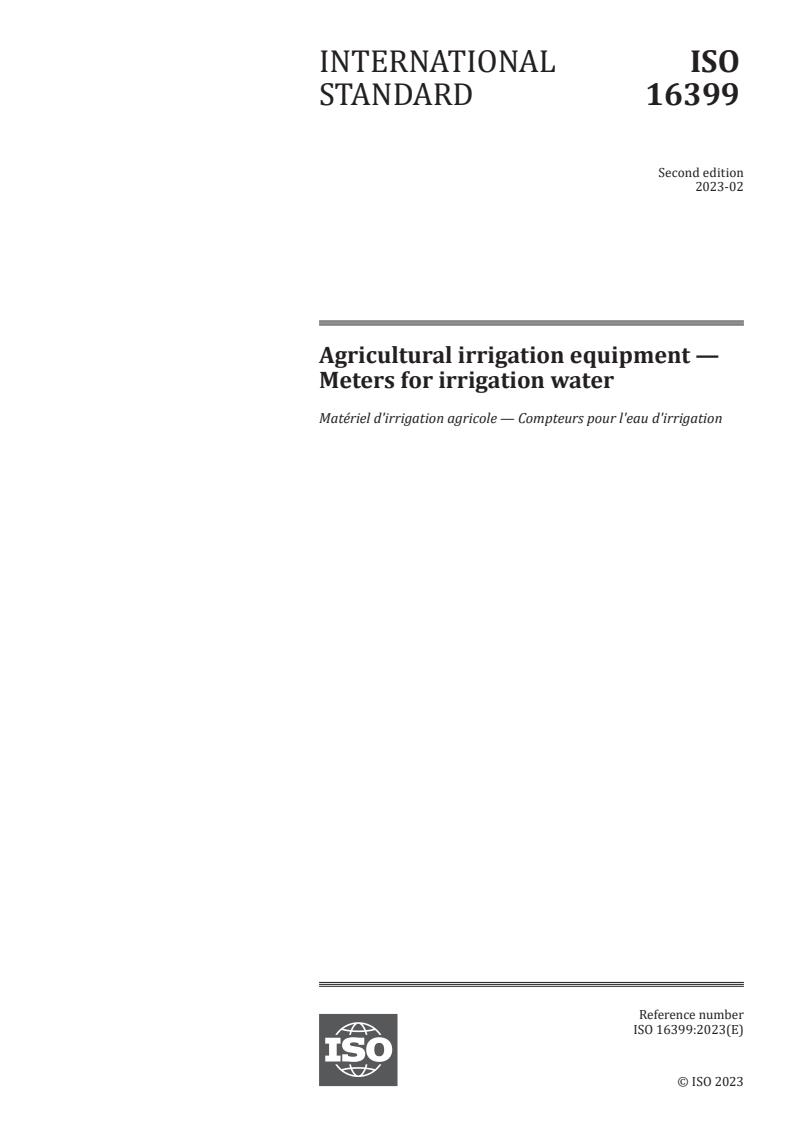
INTERNATIONAL ISO
STANDARD 16399
Second edition
2023-02
Agricultural irrigation equipment —
Meters for irrigation water
Matériel d'irrigation agricole — Compteurs pour l'eau d'irrigation
Reference number
© ISO 2023
All rights reserved. Unless otherwise specified, or required in the context of its implementation, no part of this publication may
be reproduced or utilized otherwise in any form or by any means, electronic or mechanical, including photocopying, or posting on
the internet or an intranet, without prior written permission. Permission can be requested from either ISO at the address below
or ISO’s member body in the country of the requester.
ISO copyright office
CP 401 • Ch. de Blandonnet 8
CH-1214 Vernier, Geneva
Phone: +41 22 749 01 11
Email: copyright@iso.org
Website: www.iso.org
Published in Switzerland
ii
Contents Page
Foreword .v
1 Scope . 1
2 Normative references . 1
3 Terms and definitions . 1
4 Metrological requirements . .5
4.1 Values of Q , Q , Q and Q . 5
1 2 3 4
4.1.1 Permanent flow rate (Q ) . 5
4.1.2 Measuring range . 6
4.1.3 Relationship between permanent flow rate (Q ) and overload flow rate (Q ) . 6
3 4
4.1.4 The ratio Q /Q shall be 1,6 . 6
2 1
4.2 Maximum permissible error (MPE) . 6
4.2.1 Formulation . 6
4.2.2 Accuracy class . 7
4.2.3 Meter temperature classes . 7
4.2.4 Reverse flow . 7
4.2.5 Absence of flow or of water . 8
4.2.6 Static pressure . 8
4.3 Requirements for meters and ancillary devices . 8
5 Water meters equipped with electronic devices . 8
6 Technical characteristics .8
6.1 Materials and construction of water meters . 8
6.2 Adjustment and correction . . 9
6.3 Installation conditions . 9
6.4 Rated operating conditions . 9
6.5 Pressure loss . 10
6.6 Marks and inscriptions . 10
6.7 Indicating device . . 11
6.7.1 General requirements . 11
6.7.2 Types of indicating device .12
6.8 Sealing and security .13
6.8.1 Meter security and protection against manipulations .13
6.8.2 Mechanical protection devices . 13
6.8.3 Electronic sealing devices . 13
6.9 Other devices .13
7 Performance tests .13
7.1 General conditions for the tests . 13
7.1.1 Water quality .13
7.1.2 Reference conditions . 14
7.1.3 General rules concerning test installation and location . 14
7.2 Static pressure test . 14
7.2.1 General . 14
7.2.2 Preparation . 14
7.2.3 Test procedure.15
7.2.4 Acceptance criteria . 15
7.3 Determination of errors . 15
7.3.1 General .15
7.3.2 Preparation .15
7.3.3 Test procedure. 21
7.3.4 Acceptance criteria . 21
7.4 Pressure loss test . 21
7.4.1 General . 21
7.4.2 Preparation . 21
iii
7.4.3 Test procedure.22
7.4.4 Calculation of the actual Δp of a water meter. 24
7.4.5 Acceptance criteria . 24
7.5 Reverse flow test . 24
7.5.1 General . 24
7.5.2 Preparation . 24
7.5.3 Test procedure. 24
7.5.4 Acceptance criteria . 25
7.6 Flow disturbance tests . 25
7.6.1 General . 25
7.6.2 Objective of the test .26
7.6.3 Preparation . 26
7.6.4 Test procedure.26
7.6.5 Acceptance criteria . 26
7.7 Endurance tests .28
7.7.1 Durability test .28
7.7.2 Resistance to solid particles test . 33
7.8 Magnetic field testing . 35
7.9 Test on ancillary devices of a water meter . 35
8 Tests related to the influence quantities and perturbations .35
Annex A (informative) Pulse input solutions .36
Annex B (normative) Flow disturbers .42
Bibliography .56
iv
Foreword
ISO (the International Organization for Standardization) is a worldwide federation of national standards
bodies (ISO member bodies). The work of preparing International Standards is normally carried out
through ISO technical committees. Each member body interested in a subject for which a technical
committee has been established has the right to be represented on that committee. International
organizations, governmental and non-governmental, in liaison with ISO, also take part in the work.
ISO collaborates closely with the International Electrotechnical Commission (IEC) on all matters of
electrotechnical standardization.
The procedures used to develop this document and those intended for its further maintenance are
described in the ISO/IEC Directives, Part 1. In particular, the different approval criteria needed for the
different types of ISO documents should be noted. This document was drafted in accordance with the
editorial rules of the ISO/IEC Directives, Part 2 (see www.iso.org/directives).
Attention is drawn to the possibility that some of the elements of this document may be the subject of
patent rights. ISO shall not be held responsible for identifying any or all such patent rights. Details of
any patent rights identified during the development of the document will be in the Introduction and/or
on the ISO list of patent declarations received (see www.iso.org/patents).
Any trade name used in this document is information given for the convenience of users and does not
constitute an endorsement.
For an explanation of the voluntary nature of standards, the meaning of ISO specific terms and
expressions related to conformity assessment, as well as information about ISO's adherence to
the World Trade Organization (WTO) principles in the Technical Barriers to Trade (TBT), see
www.iso.org/iso/foreword.html.
This document was prepared by Technical Committee ISO/TC 23, Tractors and machinery for agriculture
and forestry, Subcommittee SC 18, Irrigation and drainage equipment and systems.
This second edition cancels and replaces the first edition (ISO 16399:2014), which has been technically
revised.
The main changes are as follows:
— the range of pressure regulators sizes has been extended up to DN 100 (4");
— the water temperature of the irrigation system has been harmonized to 60 °C;
— the normative references have been updated;
— the terms and definitions have been updated;
— the testing water temperature range has been updated to 4 °C to 35 °C;
— the face-to-face distance of the flanged bodies of the pressure regulators has been updated to ±4 mm
for plastics-body regulators.
Any feedback or questions on this document should be directed to the user’s national standards body. A
complete listing of these bodies can be found at www.iso.org/members.html.
v
INTERNATIONAL STANDARD ISO 16399:2023(E)
Agricultural irrigation equipment — Meters for irrigation
water
1 Scope
This document specifies the requirements and certification procedures for water meters, irrespective
of the design technologies used to meter the actual volume of cold water or heated water flowing
through a fully charged closed conduit. These water meters incorporate devices, which indicate the
integrated volume. It applies to water meters intended for irrigation use (herein after referred to as
water meters), regardless of the water quality used for this purpose.
This document also applies to water meters based on electrical or electronic principles and to water
meters based on mechanical principles, incorporating electronic devices used to meter the actual
volume flow of cold water. It provides metrological requirements for electronic ancillary devices when
they are subject to metrological control.
NOTE Clean water meters are different from irrigation water meters. This document is based on clean water
meters standards but, it is important to develop a specific standard for irrigation water meters indicating their
specific requirements.
2 Normative references
The following documents are referred to in the text in such a way that some or all of their content
constitutes requirements of this document. For dated references, only the edition cited applies. For
undated references, the latest edition of the referenced document (including any amendments) applies.
ISO 4064-1:2014, Water meters for cold potable water and hot water — Part 1: Metrological and technical
requirements
ISO 4064-2:2014, Water meters for cold potable water and hot water — Part 2: Test methods
ISO 9644, Agricultural irrigation equipment — Pressure losses in irrigation valves — Test method
ISO/IEC Guide 98-3, Uncertainty of measurement — Part 3: Guide to the expression of uncertainty in
me a s ur ement (GUM: 1995)
3 Terms and definitions
For the purposes of this document, the following terms and definitions apply.
ISO and IEC maintain terminological databases for use in standardization at the following addresses:
— ISO Online browsing platform: available at https:// www .iso .org/ obp
— IEC Electropedia: available at https:// www .electropedia .org/
3.1
actual volume
total volume of water passing through the meter, disregarding the time taken
Note 1 to entry: The actual volume is calculated from a reference volume as determined by a suitable measurement
standard taking into account differences in metering conditions, as appropriate.
3.2
adjustment device
part of the meter that allows adjustment of the indicated values such that the error curve of the meter is
generally shifted parallel to itself to find in the envelope of maximum permissible errors (3.17)
3.3
ancillary device
device intended to perform a specific function, directly involved in elaborating, transmitting or
displaying measured values
Note 1 to entry: The main ancillary devices are:
a) zero-setting device;
b) price-indicating device;
c) repeating indicating device;
d) printing device;
e) memory device;
f) tariff control device;
g) pre-setting device;
h) self-service device;
i) flow sensor movement detector (for detecting movement of the flow sensor before this is clearly visible on
the indicating device);
j) remote reading device (which may be incorporated permanently or added temporarily).
3.4
bounce
momentary re-opening of a contact after initial closing, or a momentary closing after initial opening
3.5
bounce time
interval of time between the instant of the first closing (or opening) and the instant of the final closing
(or opening) of the reed contact unit (3.28)
3.6
calculator
part of the meter that transforms the output signals from the measurement transducer(s) and, possibly,
form associated measuring instruments and, if appropriate, stores the results in memory until they are
used
Note 1 to entry: The gearing is considered to be the calculator in a mechanical meter.
Note 2 to entry: The calculator may be capable of communicating both ways with ancillary devices.
3.7
correction device
device connected to or incorporated in the meter for automatic correction of the volume of water at
metering conditions, by taking into account the flow rate (3.10) and/or the characteristics of the water
to be measured and the pre-established calibration curves
3.8
durability
ability of a meter to maintain its performance characteristics over a period of use
3.9
error
measured quantity value minus a reference quantity value
V −V
i a
×100(%)
V
a
3.10
flow rate
volume of water flowing through the meter per unit time
3.11
indicating device
part of the meter that provides an indication corresponding to the volume of water passing through the
meter
3.12
indicated volume
volume of water indicated by the meter, corresponding to the actual volume (3.1)
3.13
influence factor
influence variable (3.14) having a value within the rated operating conditions (3.27) specified for a water
meter (3.32)
3.14
influence variable
quantity that, in a direct measurement, does not affect the quantity that is actually measured, but
affects the relation between the indication and the measurement result
3.15
maximum admissible pressure
maximum internal pressure that the meter can withstand permanently, within its rated operating
conditions (3.27), without deterioration of its metrological performance
Note 1 to entry: MAP is equivalent to nominal pressure (PN).
3.16
maximum admissible temperature
MAT
maximum water temperatures that a meter can withstand permanently, within its rated operating
conditions (3.27), without deterioration of its metrological performance
3.17
maximum permissible error
MPE
extreme value of error, with respect to a known reference quantity value, permitted by the specifications
given in this document
3.18
measurement transducer
part of the meter that transforms the flow rate (3.10) or volume of water to be measured into signals
which are passed to the calculator (3.6) and includes the sensor (3.29)
Note 1 to entry: The measurement transducer may function autonomously or use an external power source and
may be based on a mechanical, electrical or electronic principle.
3.19
metering conditions
conditions of the water, the volume of which is to be measured, at the point of measurement
EXAMPLE Water temperature, water pressure.
3.20
minimum admissible temperature
mAT
minimum water temperatures that a meter can withstand permanently, within its rated operating
conditions (3.27), without deterioration of its metrological performance
3.21
minimum flow rate
Q
lowest flow rate (3.10) at which the meter is designed to operate within the maximum permissible error
(3.17)
3.22
nominal diameter
alphanumeric designation of the size of pipe work components, used for reference purposes, comprising
the letters DN followed by a dimensionless round number which is loosely related to the effective
dimensions, in millimetres, of the bore or external diameter of the end connections
3.23
operate position time
interval of time between the instant the reed contact unit (3.28) is in the operate position and the
instant of the removal of the applied magnetic field to the contact
Note 1 to entry: It includes the closing bounce time (3.5) in a normally open contact or the opening bounce time in
a normally closed contact.
3.24
overload flow rate
Q
highest flow rate (3.10) at which the water meter (3.32) is designed to operate for a short period of time
within its maximum permissible error (3.17), while maintaining its metrological performance when it is
subsequently operating within the rated operating conditions (3.27)
3.25
permanent flow rate
Q
highest flow rate (3.10) within the rated operating conditions (3.27) at which the meter is designed to
operate within the maximum permissible errors (3.17)
3.26
pressure loss
difference in pressure due to water flow between two specified points in a system or in part of a system
3.27
rated operating condition
operating conditions requiring fulfilment during measurement in order that a meter performs as
designed
[SOURCE: VIM: 2012, 4.9]
3.28
reed contact unit
assembly containing contact blades, some or all of magnetic material, hermetically sealed in an envelope
and controlled by means of externally generated magnetic field (e.g. a pulse generator)
3.29
sensor
element of a meter that is directly affected by a phenomenon, body or substance carrying a quantity to
be measured
Note 1 to entry: For a water meter, the sensor may be a disc, piston, wheel or turbine element, the electrodes
on an electromagnetic meter, or another element. The element senses the flow rate or volume of water passing
through the meter an is referred to as a “flow sensor” or “volume sensor”.
3.30
test flow rate
mean flow rate (3.10) during a test, calculated from the indications of a calibrated reference device
3.31
transitional flow rate
Q
flow rate (3.10) between the permanent flow rate (3.25) and the minimum flow rate (3.21) that divides
the flow rate range into two zones, the upper zone and the lower zone, each characterized by its own
maximum permissible error (3.17)
3.32
water meter
instrument intended to measure continuously, memorize and display the volume of water passing
through the measurement transducer at metering conditions
Note 1 to entry: When a device claiming to be a water meter has the intended use of documenting water flow for
payment purposes, then that device must include, at least, a measurement transducer, a calculator (including
adjustment or correction devices, if present) and an indicating device. These three devices may be in different
housings. Water meters not intended for payment purposes only need to be compatible, in some way, with all the
aforementioned three devices.
[SOURCE: OIML R49 -1: 2006]
3.33
working pressure
average water pressure in the pipe measured upstream and downstream of the meter
3.34
working temperature
T
w
water temperature in the pipe measured upstream of a water meter (3.32)
[SOURCE: OIML R49 -1: 2006]
4 Metrological requirements
4.1 Values of Q , Q , Q and Q
1 2 3 4
4.1.1 Permanent flow rate (Q )
The value of Q , in (m /h), shall be chosen from the following list:
1,0 1,6 2,5 4,0 6,3
10 16 25 40 63
100 160 250 400 630
1 000 1 600 2 500 4 000 6 300
This list may be extended to higher or lower values in the series.
4.1.2 Measuring range
The measuring range for the flow rate is defined by the ratio (R) Q /Q . The values shall be chosen from
3 1
the following list:
10 12,5 16 20 25 31,5 40 50 63 80
100 125 160 200 250 315 400 500 630 800
This list may be extended to higher values in the series.
4.1.3 Relationship between permanent flow rate (Q) and overload flow rate (Q )
3 4
The overload flow rate is defined by Formula (1):
Q /Q = 1,25 (1)
4 3
4.1.4 The ratio Q /Q shall be 1,6
2 1
The transitional flow rate is defined by Formula (2):
Q /Q = 1,6 (2)
2 1
e.g.: Q = 100; Q /Q = 10 (R10); Q /Q = 1,6; Q /Q = 1,25
3 3 1 2 1 4 3
where
Q 100 m /h;
Q 10 m /h;
Q 16 m /h;
Q 125 m /h.
4.2 Maximum permissible error (MPE)
4.2.1 Formulation
The error is expressed as a percentage, and is calculated using Formula (3):
V −V
()
a
i
ε = ×100 % (3)
()
V
a
where
V is the indicated volume;
i
V is the actual volume.
a
4.2.2 Accuracy class
4.2.2.1 General
A water meter shall be designed and manufactured such that its errors do not exceed the maximum
permissible errors (MPE).
A water meter shall be designated as either accuracy class 1 or accuracy class 2, according to the
requirements of 4.2.2.2 or 4.2.2.3, respectively.
The meter manufacturer shall specify the accuracy class.
The requirements relating to the MPEs shall be met for all temperature and pressure variations
occurring within the rated operating conditions of a water meter.
The two accuracy classes are providing the end users with the option to choose the right meter that
best fits their application (flow ranges and measuring accuracy.
4.2.2.2 Accuracy class 1 water meters
The MPE for the upper flow rate zone (Q ≤ Q ≤ Q ) is ±1 %, for temperatures from 0,1 °C to 30 °C, and
2 4
2 % for temperatures greater than 30 °C.
The MPE for the lower flow rate zone (Q ≤ Q < Q ) is ±3 % regardless of the temperature range.
1 2
4.2.2.3 Accuracy class 2 water meters
The MPE for the upper flow rate zone (Q ≤ Q ≤ Q ) is ±2 %, for temperatures from 0,1 °C to 30 °C, and
2 4
3 % for temperatures greater than 30 °C.
The MPE for the lower flow rate zone (Q ≤ Q < Q ) is ±5 % regardless of the temperature range.
1 2
4.2.3 Meter temperature classes
The meters form water temperature classes corresponding to the various ranges, chosen by the
manufacturer from the values given in Table 1.
The water temperature shall be measured at the inlet of the meter.
Table 1 — Temperature classes
Class mAT (°C) MAT (°C)
T30 0,1 30
T50 0,1 50
4.2.4 Reverse flow
For meters designed to measure reverse flow, the permanent flow rate and the measuring range may be
different in each direction.
The manufacturer shall specify whether or not the meter is designed to measure reverse flow.
If the meter is designed to measure reverse flow, the volume passed during reverse flow shall either
be subtracted from the indicated volume or the meter shall record it separately. The MPE of 4.2.2.2 or
4.2.2.3 shall be met for both forward and reverse flow. For meters designed to measure reverse flow,
the permanent flow rate and the measuring range may be different in each direction.
If the meter is not designed to measure reverse flow, the meter shall either prevent reverse flow or it
shall not calculate or report reverse flow if it occurs and any accidental reverse flow shall not change
the indicated volume reported by the meter. Additionally, a meter that is not designed to measure
reverse flow shall not have any deterioration or change in its metrological properties for forward flow
if exposed to reverse flows up to the nominal maximum flow rate.
4.2.5 Absence of flow or of water
The water meter totalization shall not change in the absence either flow or of water.
4.2.6 Static pressure
A water meter shall be capable of withstanding the following test pressures without leakage or damage:
a) 1,6 times the maximum admissible pressure applied for 15 min;
b) twice the maximum admissible pressure applied for 1 min.
4.3 Requirements for meters and ancillary devices
The meters with electronic parts and/or ancillary devices shall comply with the requirements establish
in ISO 4064-1:2014, 4.3.
5 Water meters equipped with electronic devices
The meters equipped with electronic devices shall comply with the requirements stablish in
ISO 4064-1:2014, Clause 5.
6 Technical characteristics
6.1 Materials and construction of water meters
A water meter shall be manufactured from materials of adequate strength and durability for the
purpose for which it is to be used.
A water meter shall be manufactured from materials, which shall not be adversely affected by the water
temperature variations, within the working temperature range.
All parts of a water meter in contact with the water flowing through it shall be manufactured from
materials which are conventionally known to be non-toxic, non-contaminating, and biologically inert.
The complete water meter shall be manufactured from materials which are resistant to internal and
external corrosion or which are protected by a suitable surface treatment.
A water meter indicating device shall be protected by a transparent window. A cover of a suitable type
may also be provided as additional protection.
Where there is a risk of condensation forming on the underside of the window of a water meter indicating
device, the water meter shall incorporate devise for prevention or elimination of condensation.
A water meter shall be of such design, composition, and construction that it does not facilitate the
perpetration of fraud.
A water meter shall be fitted with a metrologically controlled display. The display shall be readily
accessible to the customer, without requiring the use of a tool.
A water meter shall be of such design, composition, and construction that it does not exploit the MPE or
favour any party.
6.2 Adjustment and correction
A water meter may be fitted with an adjustment device, and/or a correction device. Any adjustment
shall be performed in such a way as to adjust the errors of the water meter to values as close as practical
to zero so that the meter may not exploit the MPE or systematically favour any party.
If the devices are mounted on the outside of the water meter, provision for sealing shall be made
(see 6.8.2).
6.3 Installation conditions
The water meter shall be installed such that it is completely filled with water under normal conditions.
Under specific installation conditions, a strainer or filter, fitted at the inlet of a meter or in the upstream
pipeline, may be required.
Provision may be made on a water meter to allow it to be correctly levelled during installation.
If the accuracy of a water meter is affected by disturbance in the upstream or downstream pipeline
(e.g. due to the presence of bends, valves or pumps), the water meter shall be provided with a sufficient
number of straight pipe lengths, with or without a low straightener, as specified by the manufacturer,
so that the indications of the installed water meter meet the requirements of 4.2.2.2 or 4.2.2.3.
A meter manufacturer shall specify the flow profile sensitivity class indicating:
— Sensitivity to irregularity in the upstream velocity profiles:
UX, where X is replaced with the manufacturer’s nominal diameter requirement, rounded up to the
nearest whole number.
When a straightener is required by the manufacturer, the class shall be UXS, where X is replaced
with the manufacturer’s nominal diameter requirement (with the straightener), rounded up to the
nearest whole number.
If a straightener is optional, both UX and UXS forms shall be used.
— Sensitivity to irregularity in the downstream velocity profiles:
DX, where X is replaced with the manufacturer’s nominal diameter requirement, rounded up to the
nearest whole number.
When a straightener is required by the manufacturer, the class shall be DXS, where X is replaced
with the manufacturer’s nominal diameter requirement (with the straightener), rounded up to the
nearest whole number.
If a straightener is optional, both UX and DXS forms shall be used.
6.4 Rated operating conditions
The rated operating conditions for a water meter shall be as follows:
a) ambient temperature range (T ): 0,1 °C ≤ T < 60 °C;
amb amb
b) pressure (P): 0,03 MPa (0,3 bar) to at least 1 MPa (10 bar), except for meters of DN ≥ 500, where the
maximum admissible pressure (MAP) shall be at least 0,6 MPa (6 bar);
c) Water temperature range [working temperature (T )]: 0,1 °C ≤ T < 30 °C;
w w
d) Flow rate range (Q): Q (minimum flow rate) < Q ≤ Q (permanent flow rate).
1 3
6.5 Pressure loss
The pressure loss through a water meter, including its filter or strainer and/or straightener, where
either of these forms an integral part of the water meter, shall not be greater than the maximum value
of the pressure loss corresponding to the class declared by the manufacturer, between Q and Q .
1 3
The pressure loss class is selected by the manufacturer from values taken from Table 2.
Table 2 — Pressure-loss classes
Maximum pressure-loss
Class
(kPa) (bar)
Δp 100 100 1,00
Δp 63 63 0,63
Δp 40 40 0,40
Δp 25 25 0,25
Δp 16 16 0,16
Δp 10 10 0,10
NOTE Maximum head loss can differ and be higher to the Q corresponding head loss.
6.6 Marks and inscriptions
A water meter shall be clearly and indelibly marked with the following information, either grouped or
distributed, on the casing, the indicating device dial, an identification plate or the meter cover, if it is not
detachable. These markings shall be visible without dismantling the water meter after the instrument
has been placed on the market or put into use.
a) Unit of measurement.
b) Accuracy class, where it differs from accuracy class 2.
c) Numerical value of Q and the ratio Q /Q : if the meter measures reverse flow and the values of
3 3 1
Q and the ratio Q /Q are different in the two directions, both values of Q and Q /Q shall be
3 3 1 3 3 1
inscribed; the direction of flow to which each pair of values refers shall be clear. The ratio Q /
Q may be expressed as R, e.g. “R40”. If the meter has different values of Q /Q in horizontal and
1 3 1
vertical positions, both values of Q /Q shall be inscribed, and the orientation to which each value
3 1
refers shall be clear.
d) Name or trademark of the manufacturer.
e) Year of manufacture, the last two digits of the year of manufacture, or the month and year of
manufacture.
f) Serial number (as near as possible to the indicating device).
g) Direction of flow, by means of an arrow (shown on both sides of the body or on one side only
provided the direction of flow arrow is easily visible under all circumstances).
h) Maximum admissible pressure (MAP) if it exceeds 1 MPa (10 bar) or 0,6 MPa (6 bar) for DN ≥ 500.
i) Letter V or H, if the meter can only be operated in the vertical or horizontal position.
j) The pressure loss class where it differs from Δp 100.
k) The installation sensitivity class where it differs from U0/D0.
For a water meter with electronic devices, the following additional inscriptions shall be applied where
appropriate.
l) For an external power supply: the voltage and frequency.
m) For a replaceable battery: the latest date by which the battery shall be replaced.
n) For a non-replaceable battery: the latest date by which the meter shall be replaced.
o) Environmental classification.
p) Electromagnetic environmental class.
The environmental classification and electromagnetic environmental class may be given on a separate
datasheet, unambiguously related to the meter by a unique identification, and not on the meter itself.
An example of the required marks and inscriptions for a meter without electronic devices follows:
EXAMPLE Q3 63; R 125; H; → 123456; 08; ABC
— Q = 63 m /h;
— Q /Q = 125;
3 1
— horizontal mounting;
— pressure loss class Δp 63;
— maximum admissible pressure: 1 MPa (10 bar);
— flow profile sensitivity class U0/D0;
— serial number: 123456;
— year of manufacture: 2008;
— manufacturer ABC.
6.7 Indicating device
6.7.1 General requirements
6.7.1.1 Function
The indicating device shall always guarantee reading of volumes without ambiguity.
6.7.1.2 Unit of measurement
The indicated volume of water shall be expressed preferably, in cubic meters. The other units that can be
used are: litres, mega litres, acre-feet, acre-inches, gallons, or thousands of gallons. The manufacturer
shall include documentation describing the units, the symbol used to identify the units, and a conversion
factor to compute an equivalent value of cubic meters. When a meter’s indicating device is capable of
displaying different units, the display device must clearly indicate what units are used at any given
time.
6.7.1.3 Indicating range
This requirement is set in Table 3.
Table 3 — Indicating range
Indicating range
Q
(minimum values)
m /h
m
Q 6,3 9 999
3 ≤
6,3 < Q ≤ 63 99 999
63 < Q ≤ 630 999 999
630 < Q ≤ 6 300 9 999 999
6.7.1.4 Colour coding for indicating devices
The colour black shall be used to indicate the cubic metre and its multiples.
The colour red shall be used to indicate sub-multiples of a cubic metre.
These colours shall be applied to the pointers, indices, numbers, wheels, discs, dials or aperture frames.
Other manners of indicating the volume for electronic water meters may be used, provided the volume is
expressed in cubic metres, and there is no ambiguity in distinguishing between the primary indication
and alternative displays, e.g. sub-multiples for verification and testing.
6.7.2 Types of indicating device
6.7.2.1 General
Any of the following types shall be used.
6.7.2.2 Type 1 – Analogue device
The indicated volume is indicated by continuous movement of
a) one or more pointers moving relative to graduated scales, or
b) one or more circular scales or drums each passing an index.
n
The value expressed in cubic metres for each scale division shall be of the form 10 , where n is a positive
or negative whole number or zero, thereby establishing a system of consecutive decades. Each scale
shall either be graduated in values expressed in cubic metres or accompanied by a multiplication factor
(x0,001; x0,01; x0,1; x1; x10; x100; x1 000, etc.).
6.7.2.3 Type 2 – Digital device
The indicated volume is given by a line of adjacent digits appearing in one or more apertures. The
advance of a given digit shall be completed while the digit of the next immediately lower decade changes
from 0 to 0. The apparent height of the digits shall be at least 4 mm.
For non-electronic devices:
a) if the lowest value decade has a continuous movement, the aperture shall be large enough to permit
a digit to be read unambiguously.
For electronic devices:
b) either permanent or non-permanent displays are permitted – for non-permanent displays, the
volume shall be able to be displayed at any time for at least 10 s;
c) the meter shall provide visual checking of the entire display which shall have the following
sequence:
1) for seven segment type displaying all the
...