

ISO 16399:2023/Amd 1:2025
(Amendment)Agricultural irrigation equipment — Meters for irrigation water — Amendment 1
General Information
- Abstract
- Status
- Published
- Publication Date
- 20-Feb-2025
- Technical Committee
- ISO/TC 23/SC 18 - Irrigation and drainage equipment and systems
- Drafting Committee
- ISO/TC 23/SC 18 - Irrigation and drainage equipment and systems
- Current Stage
- 6060 - International Standard published
- Start Date
- 21-Feb-2025
- Due Date
- 29-Nov-2025
- Completion Date
- 21-Feb-2025

Overview
ISO 16399:2023/Amd 1:2025 is an important amendment to the international standard for agricultural irrigation equipment, specifically focusing on meters used to measure irrigation water flow. Published by the International Organization for Standardization (ISO), this amendment updates key technical aspects related to flow profile sensitivity and marking requirements for irrigation water meters. The standard supports the accurate and reliable measurement of irrigation water - essential for efficient water management in agriculture.
Key Topics
Flow Profile Sensitivity Classes
ISO 16399:2023/Amd 1:2025 introduces detailed tables defining sensitivity classes for irrigation water meters based on irregularities in upstream and downstream velocity profiles. These classes (U0 to U15S for upstream and D0 to D3S for downstream) guide manufacturers and users in specifying meter performance relative to flow disturbances.Straightener Pipe Length Recommendations
The amendment provides recommended pipe lengths before and after the meter (measured in multiples of nominal diameter DN) required to achieve specified sensitivity classes, with or without flow straighteners.Marking and Identification Requirements
New comprehensive guidelines specify what information must be clearly marked on water meters to ensure traceability, usability, and regulatory compliance. These include:- Unit of measurement and accuracy class
- Flow rate values (Q and Q3), directionality of measurement, and flow ratio (Q3/Q1)
- Manufacturer’s name, serial number, and date of manufacture
- Direction of flow and mounting orientation (vertical or horizontal)
- Maximum admissible pressure and temperature class
- Pressure loss and installation sensitivity class
- Additional markings for electronic devices such as power supply details, battery replacement dates, environmental classification, and electromagnetic compatibility
Extended Electronic Device Marking
Meters with electronic components have further marking obligations to clearly communicate power requirements, battery life expectancy, and relevant environmental classes.
Applications
ISO 16399:2023/Amd 1:2025 is essential for manufacturers, installers, and users of irrigation water meters in agricultural settings. Benefits and applications include:
Enhanced Accuracy and Reliability
The classification of flow profile sensitivity helps ensure meters provide precise water measurement despite varying flow conditions, improving irrigation efficiency and crop yield.Standardized Installation Guidance
Recommended straight pipe lengths and flow straightener use minimize measurement errors, helping irrigation systems maintain optimal water distribution.Clear Meter Identification
Markings facilitate easy identification, installation verification, and maintenance tracking for irrigation managers, reducing downtime and operational risks.Compatibility With Electronic Metering Technologies
Updated requirements support integration of modern electronic meters, ensuring interoperability and compliance with environmental and electromagnetic standards.Sustainability and Resource Management
Reliable water measurement enables better water conservation practices and supports regulatory and sustainability reporting in precision agriculture.
Related Standards
ISO 7027 - Water Quality: Guidelines on Measurement and Assessment
Provides context on water quality parameters relevant to metering equipment durability and accuracy.ISO 14000 Series - Environmental Management Standards
Offers complementary frameworks that irrigation water meters may align with concerning environmental classification and sustainability.IEC 60529 - Protection Degrees (IP Code)
Relevant for electronic water meters to ensure appropriate ingress protection against water and dust.ISO 13958 - Equipment for Crop Protection
Relates to agricultural equipment standards that may intersect with irrigation system setup.ISO/IEC Directives, Part 2
Governs the editorial rules and processes for standard development, ensuring clarity and consistency for documents like ISO 16399.
Adhering to ISO 16399:2023/Amd 1:2025 ensures that irrigation water meters meet international benchmarks for performance and marking, supporting agricultural water efficiency and technological advancement in irrigation systems worldwide.
Relations
- Effective Date
- 02-Dec-2023
Get Certified
Connect with accredited certification bodies for this standard

Control Union Certifications
Global certification for agriculture and sustainability.

ECOCERT
Organic and sustainability certification.

FSC International
Forest Stewardship Council certification.
Sponsored listings
Frequently Asked Questions
ISO 16399:2023/Amd 1:2025 is a standard published by the International Organization for Standardization (ISO). Its full title is "Agricultural irrigation equipment — Meters for irrigation water — Amendment 1". This standard covers: Agricultural irrigation equipment — Meters for irrigation water — Amendment 1
Agricultural irrigation equipment — Meters for irrigation water — Amendment 1
ISO 16399:2023/Amd 1:2025 is classified under the following ICS (International Classification for Standards) categories: 65.060.35 - Irrigation and drainage equipment. The ICS classification helps identify the subject area and facilitates finding related standards.
ISO 16399:2023/Amd 1:2025 has the following relationships with other standards: It is inter standard links to ISO 16399:2023. Understanding these relationships helps ensure you are using the most current and applicable version of the standard.
ISO 16399:2023/Amd 1:2025 is available in PDF format for immediate download after purchase. The document can be added to your cart and obtained through the secure checkout process. Digital delivery ensures instant access to the complete standard document.
Standards Content (Sample)
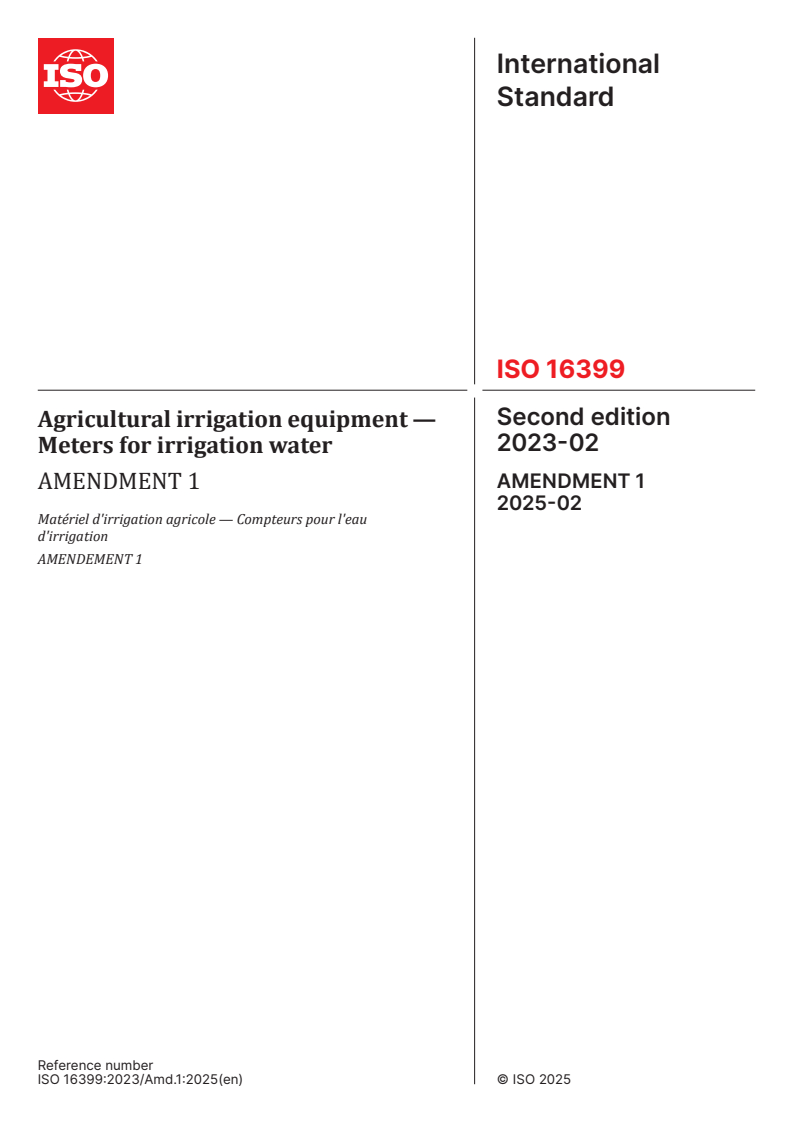
International
Standard
ISO 16399
Second edition
Agricultural irrigation equipment —
2023-02
Meters for irrigation water
AMENDMENT 1
AMENDMENT 1
2025-02
Matériel d'irrigation agricole — Compteurs pour l'eau
d'irrigation
AMENDEMENT 1
Reference number
ISO 16399:2023/Amd.1:2025(en) © ISO 2025
ISO 16399:2023/Amd.1:2025(en)
© ISO 2025
All rights reserved. Unless otherwise specified, or required in the context of its implementation, no part of this publication may
be reproduced or utilized otherwise in any form or by any means, electronic or mechanical, including photocopying, or posting on
the internet or an intranet, without prior written permission. Permission can be requested from either ISO at the address below
or ISO’s member body in the country of the requester.
ISO copyright office
CP 401 • Ch. de Blandonnet 8
CH-1214 Vernier, Geneva
Phone: +41 22 749 01 11
Email: copyright@iso.org
Website: www.iso.org
Published in Switzerland
ii
ISO 16399:2023/Amd.1:2025(en)
Foreword
ISO (the International Organization for Standardization) is a worldwide federation of national standards
bodies (ISO member bodies). The work of preparing International Standards is normally carried out through
ISO technical committees. Each member body interested in a subject for which a technical committee
has been established has the right to be represented on that committee. International organizations,
governmental and non-governmental, in liaison with ISO, also take part in the work. ISO collaborates closely
with the International Electrotechnical Commission (IEC) on all matters of electrotechnical standardization.
The procedures used to develop this document and those intended for its further maintenance are described
in the ISO/IEC Directives, Part 1. In particular, the different approval criteria needed for the different types
of ISO document should be noted. This document was drafted in accordance with the editorial rules of the
ISO/IEC Directives, Part 2 (see www.iso.org/directives).
ISO draws attention to the possibility that the implementation of this document may involve the use of (a)
patent(s). ISO takes no position concerning the evidence, validity or applicability of any claimed patent
rights in respect thereof. As of the date of publication of this document, ISO had not received notice of (a)
patent(s) which may be required to implement this document. However, implementers are cautioned that
this may not represent the latest information, which may be obtained from the patent database available at
www.iso.org/patents. ISO shall not be held responsible for identifying any or all such patent rights.
Any trade name used in this document is information given for the convenience of users and does not
constitute an endorsement.
For an explanation of the voluntary nature of standards, the meaning of ISO specific terms and expressions
related to conformity assessment, as well as information about ISO's adherence to the World Trade
Organization (WTO) principles in the Technical Barriers to Trade (TBT), see www.iso.org/iso/foreword.html.
This document was prepared by Technical Committee ISO/TC 23, Tractors and machinery for agriculture and
forestry, Subcommittee SC 18, Irrigation and drainage equipment and systems.
Any feedback or questions on this document should be directed to the user’s national standards body. A
complete listing of these bodies can be found at www.iso.org/members.html.
iii
ISO 16399:2023/Amd.1:2025(en)
Agricultural irrigation equipment — Meters for irrigation water
AMENDMENT 1
6.3
Add the following tables under each list item and renumber the subsequent tables:
— Sensitivity to irregularity in the upstream velocity profiles:
— Water meter manufacturers can specify the flow profile sensitivity class in accordance with Table 2,
based on the results of the relevant tests specified in 7.5.
Table 2 — Sensitivity to the irregularity in the u
...