

ISO 24120-2:2023
(Main)Agricultural irrigation equipment — Guideline on the implementation of pressurized irrigation systems — Part 2: Drip irrigation
General Information
- Abstract
This document provides a guideline for the implementation of pressurized drip irrigation systems. It is applicable to both small-scale family agriculture and large-scale commercial agriculture, in open fields or within enclosed growing structures (e.g. greenhouse, net house). This document is intended for the use of agriculture ministries, agronomists, irrigation planners, farmers and other end-users.
- Status
- Published
- Publication Date
- 22-Jan-2023
- Technical Committee
- ISO/TC 23/SC 18 - Irrigation and drainage equipment and systems
- Drafting Committee
- ISO/TC 23/SC 18 - Irrigation and drainage equipment and systems
- Current Stage
- 6060 - International Standard published
- Start Date
- 23-Jan-2023
- Due Date
- 02-Feb-2024
- Completion Date
- 23-Jan-2023
Overview
ISO 24120-2:2023 - "Agricultural irrigation equipment - Guideline on the implementation of pressurized irrigation systems - Part 2: Drip irrigation" is an international guideline for planning, designing, installing and operating pressurized drip irrigation systems. Applicable to both small-scale family agriculture and large-scale commercial agriculture, it covers systems in open fields and enclosed growing structures (greenhouses, net houses). The document is intended for agriculture ministries, agronomists, irrigation planners, farmers and other end‑users.
Key topics and technical requirements
The standard provides practical guidance across the full drip irrigation lifecycle, including:
- Principles of drip irrigation: water sources, system layout and environmental considerations (weather, enclosed structures).
- Drippers classification: unregulated vs. regulated drippers and specific applications for each type.
- Control head components: guidance on water meters, control valves and valve types used in drip networks.
- Filtration systems: filtration methods and requirements to protect emitters and ensure long-term performance.
- Design principles: design of water sources (surface water, canals, rivers), factors affecting water quality, network design (main line, sub-mains, laterals), velocity, head location, air/vacuum valves, and material selection.
- Dripper and lateral parameters: recommended considerations for dripper flow rate, dripper line length, and pipeline joints for potable or wastewater use.
- Monitoring and data: crop data, soil moisture monitoring, water monitoring and integration of weather station information for irrigation scheduling.
- Chemical injection systems: fertigation and chemigation design, dosing units (venturi, electric injectors), and safety/benefits.
- Pumping and pump stations: pump types, power sources, capacity, selection criteria and performance curves.
- Operation, maintenance and training: start-up procedures, periods of inactivity (freezing hazards), operator training and technical support.
- Specific system types: guidance on Low Pressure Systems (LPS) and Family Drip Systems (FDS) with benefits, limitations and component descriptions.
Practical applications and who uses it
ISO 24120-2:2023 is practical for:
- Irrigation planners and designers creating efficient drip networks for farms and greenhouses.
- Agronomists and farm managers optimizing water and nutrient delivery via fertigation.
- Agriculture ministries and policymakers developing standards and funding programs for irrigation projects.
- Farmers and extension agents implementing family drip systems and low-pressure solutions to increase water-use efficiency.
Benefits include improved water efficiency, emitter longevity, better crop yields through precise drip irrigation and safer chemical injection practices.
Related standards
ISO 24120-2:2023 is part of the broader ISO guidance on pressurized irrigation systems. Users should also consult other relevant ISO standards and national regulations for materials, wastewater reuse, electrical safety and environmental protection when implementing drip irrigation systems.
Get Certified
Connect with accredited certification bodies for this standard

Control Union Certifications
Global certification for agriculture and sustainability.

ECOCERT
Organic and sustainability certification.

FSC International
Forest Stewardship Council certification.
Sponsored listings
Frequently Asked Questions
ISO 24120-2:2023 is a standard published by the International Organization for Standardization (ISO). Its full title is "Agricultural irrigation equipment — Guideline on the implementation of pressurized irrigation systems — Part 2: Drip irrigation". This standard covers: This document provides a guideline for the implementation of pressurized drip irrigation systems. It is applicable to both small-scale family agriculture and large-scale commercial agriculture, in open fields or within enclosed growing structures (e.g. greenhouse, net house). This document is intended for the use of agriculture ministries, agronomists, irrigation planners, farmers and other end-users.
This document provides a guideline for the implementation of pressurized drip irrigation systems. It is applicable to both small-scale family agriculture and large-scale commercial agriculture, in open fields or within enclosed growing structures (e.g. greenhouse, net house). This document is intended for the use of agriculture ministries, agronomists, irrigation planners, farmers and other end-users.
ISO 24120-2:2023 is classified under the following ICS (International Classification for Standards) categories: 65.060.35 - Irrigation and drainage equipment. The ICS classification helps identify the subject area and facilitates finding related standards.
ISO 24120-2:2023 is available in PDF format for immediate download after purchase. The document can be added to your cart and obtained through the secure checkout process. Digital delivery ensures instant access to the complete standard document.
Standards Content (Sample)
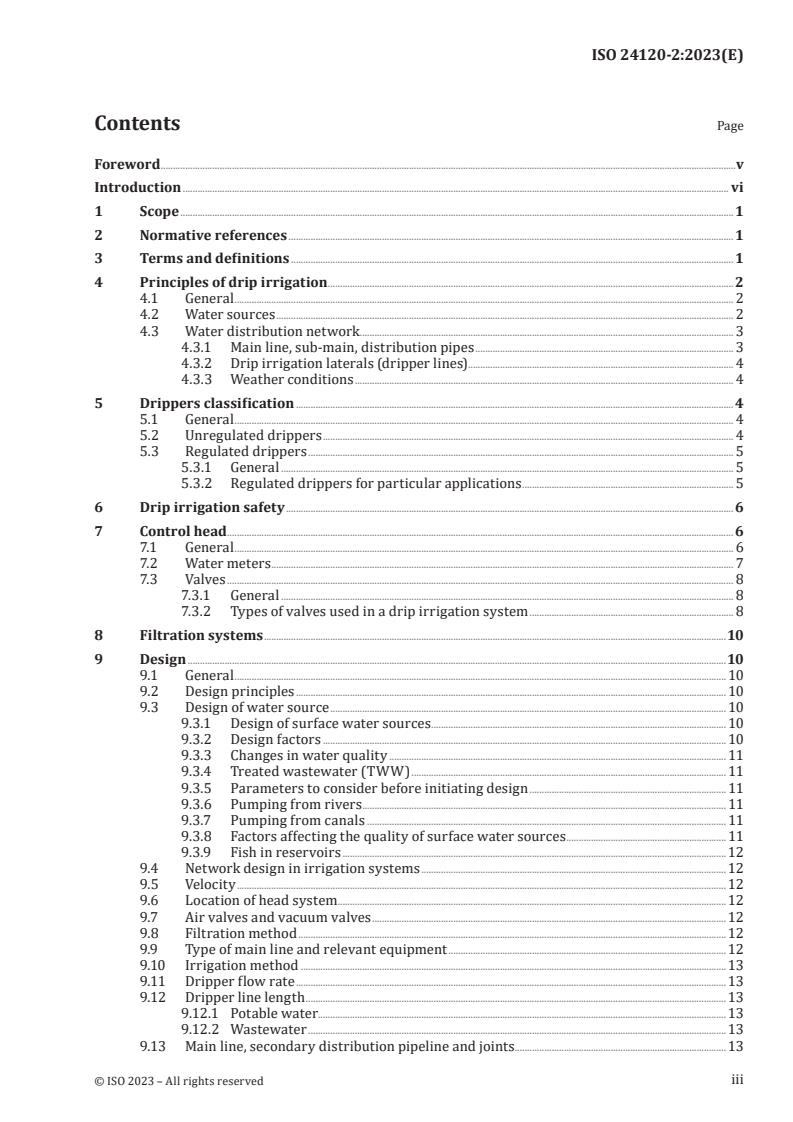
INTERNATIONAL ISO
STANDARD 24120-2
First edition
2023-01
Agricultural irrigation equipment —
Guideline on the implementation of
pressurized irrigation systems —
Part 2:
Drip irrigation
Matériel agricole d'irrigation — Lignes directrices relatives à la mise
en œuvre des systèmes d'irrigation sous pression —
Partie 2: Irrigation goutte à goutte
Reference number
© ISO 2023
All rights reserved. Unless otherwise specified, or required in the context of its implementation, no part of this publication may
be reproduced or utilized otherwise in any form or by any means, electronic or mechanical, including photocopying, or posting on
the internet or an intranet, without prior written permission. Permission can be requested from either ISO at the address below
or ISO’s member body in the country of the requester.
ISO copyright office
CP 401 • Ch. de Blandonnet 8
CH-1214 Vernier, Geneva
Phone: +41 22 749 01 11
Email: copyright@iso.org
Website: www.iso.org
Published in Switzerland
ii
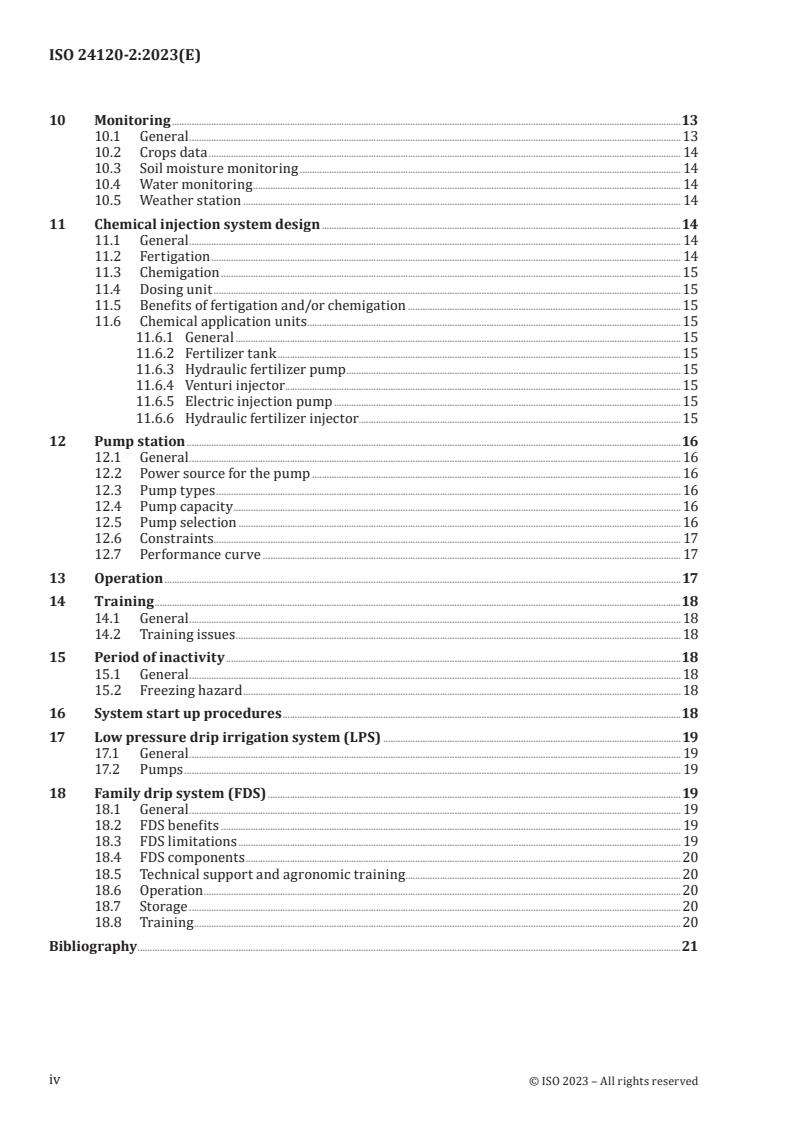
Contents Page
Foreword .v
Introduction . vi
1 Scope . 1
2 Normative references . 1
3 Terms and definitions . 1
4 Principles of drip irrigation .2
4.1 General . 2
4.2 Water sources . 2
4.3 Water distribution network . . 3
4.3.1 Main line, sub-main, distribution pipes . 3
4.3.2 Drip irrigation laterals (dripper lines) . 4
4.3.3 Weather conditions . 4
5 Drippers classification . 4
5.1 General . 4
5.2 Unregulated drippers . 4
5.3 Regulated drippers . 5
5.3.1 General . 5
5.3.2 Regulated drippers for particular applications . 5
6 Drip irrigation safety . 6
7 Control head . 6
7.1 General . 6
7.2 Water meters . 7
7.3 Valves . 8
7.3.1 General . 8
7.3.2 Types of valves used in a drip irrigation system . 8
8 Filtration systems .10
9 Design .10
9.1 General . 10
9.2 Design principles . 10
9.3 Design of water source . 10
9.3.1 Design of surface water sources . 10
9.3.2 Design factors . 10
9.3.3 Changes in water quality . 11
9.3.4 Treated wastewater (TWW) . 11
9.3.5 Parameters to consider before initiating design . 11
9.3.6 Pumping from rivers . 11
9.3.7 Pumping from canals . 11
9.3.8 Factors affecting the quality of surface water sources . 11
9.3.9 Fish in reservoirs .12
9.4 Network design in irrigation systems .12
9.5 Velocity . 12
9.6 Location of head system . .12
9.7 Air valves and vacuum valves .12
9.8 Filtration method .12
9.9 Type of main line and relevant equipment .12
9.10 Irrigation method .13
9.11 Dripper flow rate . 13
9.12 Dripper line length . 13
9.12.1 Potable water . 13
9.12.2 Wastewater .13
9.13 Main line, secondary distribution pipeline and joints. 13
iii
10 Monitoring .13
10.1 General .13
10.2 Crops data . 14
10.3 Soil moisture monitoring . 14
10.4 Water monitoring . 14
10.5 Weather station . 14
11 Chemical injection system design .14
11.1 General . 14
11.2 Fertigation . 14
11.3 Chemigation . 15
11.4 Dosing unit . 15
11.5 Benefits of fertigation and/or chemigation . 15
11.6 Chemical application units . . .15
11.6.1 General .15
11.6.2 Fertilizer tank . 15
11.6.3 Hydraulic fertilizer pump . 15
11.6.4 Venturi injector . .15
11.6.5 Electric injection pump . 15
11.6.6 Hydraulic fertilizer injector . 15
12 Pump station .16
12.1 General . 16
12.2 Power source for the pump . 16
12.3 Pump types . 16
12.4 Pump capacity . 16
12.5 Pump selection . 16
12.6 Constraints. 17
12.7 Performance curve . 17
13 Operation .17
14 Training .18
14.1 General . 18
14.2 Training issues . 18
15 Period of inactivity .18
15.1 General . 18
15.2 Freezing hazard . 18
16 System start up procedures .18
17 Low pressure drip irrigation system (LPS) .19
17.1 General . 19
17.2 Pumps . 19
18 Family drip system (FDS) .19
18.1 General . 19
18.2 FDS benefits . 19
18.3 FDS limitations . 19
18.4 FDS components . 20
18.5 Technical support and agronomic training . 20
18.6 Operation . 20
18.7 Storage . 20
18.8 Training . 20
Bibliography .21
iv
Foreword
ISO (the International Organization for Standardization) is a worldwide federation of national standards
bodies (ISO member bodies). The work of preparing International Standards is normally carried out
through ISO technical committees. Each member body interested in a subject for which a technical
committee has been established has the right to be represented on that committee. International
organizations, governmental and non-governmental, in liaison with ISO, also take part in the work.
ISO collaborates closely with the International Electrotechnical Commission (IEC) on all matters of
electrotechnical standardization.
The procedures used to develop this document and those intended for its further maintenance are
described in the ISO/IEC Directives, Part 1. In particular, the different approval criteria needed for the
different types of ISO documents should be noted. This document was drafted in accordance with the
editorial rules of the ISO/IEC Directives, Part 2 (see www.iso.org/directives).
Attention is drawn to the possibility that some of the elements of this document may be the subject of
patent rights. ISO shall not be held responsible for identifying any or all such patent rights. Details of
any patent rights identified during the development of the document will be in the Introduction and/or
on the ISO list of patent declarations received (see www.iso.org/patents).
Any trade name used in this document is information given for the convenience of users and does not
constitute an endorsement.
For an explanation of the voluntary nature of standards, the meaning of ISO specific terms and
expressions related to conformity assessment, as well as information about ISO's adherence to
the World Trade Organization (WTO) principles in the Technical Barriers to Trade (TBT), see
www.iso.org/iso/foreword.html.
This document was prepared by Technical Committee ISO/TC 23, Tractors and machinery for agriculture
and forestry, Subcommittee SC 18, Irrigation and drainage equipment and systems.
A list of all parts in the ISO 24120 series can be found on the ISO website.
Any feedback or questions on this document should be directed to the user’s national standards body. A
complete listing of these bodies can be found at www.iso.org/members.html.
v
Introduction
Dwindling vital natural resources, such as land and water, and rising world population, pose a constant
threat that can develop into a future food and water crisis. Given the limited availability of water
and land resources, the amount of food grown today needs to be increased to meet the demands of
tomorrow. Reduction of available water for human consumption needs to be addressed. As direct
consumption of fresh water by populations cannot be decreased, the amount of water consumed by
agricultural uses needs to be reduced and allocated for domestic or industrial use.
Drip irrigation addresses water scarcity and other environmental considerations. Its use can save large
amounts of water (over 50 % of water can be saved for certain crop types) and increase yields.
Drip irrigation not only addresses the need to reduce water consumption and increase yield, but also
requires less labour and energy for operation, leading to lower costs to farmers due to reduced usage of
labour, fertilizers and other chemicals.
Drip irrigation relates to sustainability agriculture issues, and can be used in dry areas, in saline
soil with saline water, and in steep-sloped topographies, where other irrigation methods cannot be
practiced without using pressure compensated units.
Drip irrigation is easy to handle and operate once installed. It is suitable for automation and remote
operation by computer or mobile phone. The system’s simplicity makes it easy to install, operate,
maintain and repair.
Other than irrigation, the drip irrigation method is used as a delivery system for fertilizers and other
agrochemicals. Drip irrigation’s advantage as a delivery system is its ability to optimize fertilizer
usage, and distribute it exactly where needed, in the root zone, while minimizing its release to the
environment.
Adoption of drip irrigation can help achieve sufficient fresh water availability for domestic use and
sufficient food quantity and quality and quality for reasonable pricing, while increasing farmers’
income with yield increases and cost reduction, and ensuring food security.
Drip irrigation systems also have limitations mainly related to high investment costs and extensive
maintenance requirements necessary to achieve and maintain the irrigation system performance.
Maintenance routines include water filtration, field inspection, maintenance of driplines, main line
flushing, and chemical water treatment.
The purpose of this document is to provide a guideline on the implementation of drip irrigation.
vi
INTERNATIONAL STANDARD ISO 24120-2:2023(E)
Agricultural irrigation equipment — Guideline on the
implementation of pressurized irrigation systems —
Part 2:
Drip irrigation
1 Scope
This document provides a guideline for the implementation of pressurized drip irrigation systems.
It is applicable to both small-scale family agriculture and large-scale commercial agriculture, in open
fields or within enclosed growing structures (e.g. greenhouse, net house).
This document is intended for the use of agriculture ministries, agronomists, irrigation planners,
farmers and other end-users.
2 Normative references
There are no normative references in this document.
3 Terms and definitions
For the purpose of this document, the following terms and definitions apply.
ISO and IEC maintain terminology databases for use in standardization at the following addresses:
— ISO Online browsing platform: available at https:// www .iso .org/ obp
— IEC Electropedia: available at https:// www .electropedia .org/
3.1
anti-siphon dripper
anti-siphon emitter
dripper (3.3) with an interior mechanism which prevents suction of pollutants from outside the dripper
line
3.2
chemigation
application of any chemical through an irrigation system
3.3
emitter
dripper
device fitted to an irrigation lateral and intended to discharge water in the form of drops or continuous
flow at flow rates not exceeding 24 l/h, except during flushing
[SOURCE: ISO 9261:2004, 3.1]
3.4
fertigation
injection of soluble fertilizers into the irrigation system together with irrigation water
3.5
on-line emitter
on-line dripper
emitter intended for installation in the wall of an irrigation lateral, either directly or indirectly by
means such as tubing
[SOURCE: ISO 9261:2004, 3.3]
3.6
regulated emitter
emitting pipe
pressure compensating emitter/emitting pipe
emitter/emitting pipe which maintains a relatively constant flow rate at varying water pressures at the
emitter/emitting pipe inlet within the limits specified by the manufacturer
[SOURCE: ISO 9261:2004, 3.7]
3.7
regulated non-leakage dripper
compensated non-leakage (CNL)
emitter/emitting pipe whose flow is zero whenever the pressure at the inlet of the emitter/emitting
pipe is lower than a value (other than zero) declared by the manufacturer
[SOURCE: ISO 9261:2004, 3.9, modified — Term name has been changed.]
3.8
unregulated dripper
non-pressure compensating emitter
emitter/emitting pipe whose flow rate varies with inlet water pressure
[SOURCE: ISO 9261:2004, 3.10]
4 Principles of drip irrigation
4.1 General
This document relies on the main principles of drip irrigation as set forth in ISO/IWA 20 and ISO 9261.
The main principles of drip irrigation are described in ISO 24120-1.
4.2 Water sources
The main types of water sources for drip irrigation are:
— surface water sources,
— groundwater sources,
— brackish water,
— treated wastewater (TTW), and
— desalinated water.
Many existing and potential water supply sources for irrigation systems are derived from surface
water, which does not tend to have high levels of salts (with the exception of some coastal areas), and
thus the irrigation systems are usually less prone to formation of precipitates in drippers when using a
surface water source.
Some surface water sources, however, tend to introduce biological hazards, as well as silt. If TWW is
considered as a source, quality and clogging potential will vary depending upon the extent of treatment.
Groundwater is generally of higher quality than surface water. However, iron, manganese, hydrogen
sulfide, pH, soluble salts, hardness, and alkalinity levels should be measured, as levels that are higher
than values determined as acceptable irrigation water quality can lead to dripper clogging and
treatment can be required.
4.3 Water distribution network
4.3.1 Main line, sub-main, distribution pipes
Main lines carry water through the entire irrigation system, from the pump through the filters, valves
and drippers.
All main line and fittings should be properly sized to withstand maximum static and operating
pressures and convey water without excessive pressure loss or gain.
PVC piping may be used throughout the system, or in combination with steel piping at the pump station.
Polyethylene (PE) or flexible pipes may be used for sub-mains and distribution pipes. PE and PVC piping
should be UV protected or buried. Pipes from other materials are permitted if they comply with local
requirements.
Thermal expansion and contraction that occur under normal on-surface operating conditions should be
taken into consideration (each type of pipe material is affected to a different degree), when designing
and installing the system.
Main lines are connected to one another with welds, glue or friction fittings, according to the type of
piping in use, and are anchored to the infrastructure supporting them. All main lines should be properly
secured and anchored.
In a subsurface drip irrigation (SDI) system, the main line is more difficult to access and repair. All
fittings should be secured at installation, to save significant repair issues later. After the initial growth
stage of the crop, on-going maintenance should be implemented.
In irrigation design, pipe sizes are specified based on water quality and water velocity, economic
considerations, friction loss, water hammer considerations and flushing concerns. As pipe size
increases, friction loss decreases (with reduced pumping cost) but initial cost increases.
If water quality is poor, particularly in wastewater, the designer should consider increasing the water
velocity in mains and submains to avoid sedimentation in the pipes. In most cases, the distribution pipe
is installed above the elevation of the dripper lines.
Irregular field shapes are common due to topography and property boundaries. At the planning stage,
care should be taken to properly size sub-main and distribution lines where field shape varies. Sub-
main and distribution lines for irregularly shaped fields are designed based on actual flow rates of the
dripper lines.
The piping system should be designed not only to allow the flow rate necessary for normal irrigation but
also to allow sufficient flow rate for proper flushing velocities in the system (recommended minimum:
1 m/s).
Design objectives for drip system flushing can result in the selection of different pipe diameters than
those selected in the design process for normal operation. This is because the flushing flow rate
required for achieving a desired flushing velocity in any section of a main, sub-main or distribution
pipe can be different than the design flow rate for regular operation.
4.3.2 Drip irrigation laterals (dripper lines)
Dripper lines are the heart of a drip irrigation system. In any irrigation system, the design process
starts at the last plant and proceeds to the head system.
In the design of a dripper line, the following should be considered: dripper line selection, wall thickness,
diameter, nominal pressure, dripper flow rate, spacing between drippers, spacing between dripper
lines, and specification of dripper line insertion depth (in SDI).
4.3.3 Weather conditions
4.3.3.1 General
For surface and subsurface main pipe, attention should be given to two operating conditions listed in
4.3.3.2 and 4.3.3.3.
4.3.3.2 High temperature areas
The operating temperatures recommended by the manufacturer should not be exceeded. The
manufacturer's responsibility normally applies to the pipe and all its connectors.
4.3.3.3 Low temperature area
In countries where temperatures in winter can be below 0 °c, water should be drained from the pipes of
any irrigation system and dripper lines, to protect the main and submain pipes.
5 Drippers classification
5.1 General
Drippers incorporated at uniform spacing along the dripper line deliver water and nutrients directly to
the plant root zone.
A typical drip irrigation system includes thousands of drippers. Each dripper should be durable,
resistant to clogging, and emit the same amount of water under the same conditions and over time.
Good design of the emitter can increase its long-term trouble-free performance.
The flow rate, working pressure and spacing of the drippers should be considered in determining the
wetting pattern and to prevent runoff or deep percolation.
A properly operated and maintained drip irrigation system provides water and nutrients to the crop
root zone without runoff or deep percolation.
Two types of integral drippers are available, as described in 5.2 and 5.3.
5.2 Unregulated drippers
Unregulated drippers supply a flow rate that is based on the working pressure.
As long as the working pressure remains within the allowable pressure range, unregulated drippers
provide uniform irrigation by maintaining a limited differential flow that was designed and installed
for (10 % desirable, or in accordance with national or international standards), from the first lateral
dripper to the last one in the same cycle operation.
The dripper flow rate, pipe inside diameter, dripper spacing, and dripper design determine the pressure
head losses within the dripper line.
Differences in elevation also affect the system.
5.3 Regulated drippers
5.3.1 General
As long as the working pressure remains within the allowable pressure range, regulated drippers
provide uniform irrigation by maintaining a constant flow rate regardless of the working pressure.
A regulated dripper contains a diaphragm, which is activated by the continual differential pressure
created by the dripper's labyrinth, thus maintaining a constant dripper flow within the limits specified
by the manufacturer.
Due to the free-floating diaphragm, the dripper’s action can be precise, immediate, sensitive, continually
self-adjusting and constantly self-flushing. Particles that cause clogging will either be flushed out
through the wide water passages or increase the pressure differential. This causes the diaphragm
to momentarily increase the cross-section area for outgoing water, and thus flush the dirt out of the
system.
The diaphragm movement maintains constant differential pressure within the water passage, resulting
in a uniform flow rate at a wide pressure range.
Regulated drippers deliver the same flow rate regardless of the dripper line length (as long as the
drippers operate within its working range as specified by the manufacturer).
5.3.2 Regulated drippers for particular applications
5.3.2.1 Anti-siphon (AS) drippers
The mechanism of anti-siphon (AS) drippers prevents suction of the outside dirt into the dripper line,
providing critical protection against dripper clogging. It is ideal for subsurface drip irrigation (SDI) and
can be used in on surface (orchards, plantation) and subsurface (SDI).
Irrigation systems do not usually operate during rain. Rain often causes saturation of the soil or
standing water around the dripper lines. Between irrigation cycles, when the system is not pressurized,
it acts as a drainage system. If particles are drawn into the dripper under negative pressure, it can lead
to the drippers clogging.
To overcome this problem, the mechanism of anti-siphon drippers seals the dripper when the system is
not pressurized, thus preventing pollutants from entering the system.
Suction of contaminants into the pipe can also happen when the dripline is emptying, creating a vacuum
that sucks dirt through the hole onto the dripper, which risks clogging it.
5.3.2.2 Regulated non-leakage drippers/ CNL drippers
The compensated non-leakage (CNL) feature prevents system drainage between irrigation cycles, when
the system is not fully pressurized. It ensures uniform water and nutrient distribution during pulse
irrigation.
Dripper lines remain full between irrigation cycles, eliminating drainage and refill of the dripper lines,
thus making the application more uniform.
It is recommended to use pressure-compensating (PC) drippers when the terrain slope is greater than
2 %.
CNL drippers are more sensitive to clogging and require more frequent maintenance routines,
particularly for crops sensitive to excessive or insufficient irrigation.
For subsurface systems, AS drippers are be preferred.
5.3.2.3 On-line drippers
On-line drippers are used mainly for greenhouse, nursery and fruit tree applications. On-line emitters
are emitters that are inserted into a regular pipe at different spacing according to the agronomical
requirements.
On-line pressure-compensating (PC) drippers may be used for precise, efficient and uniform flow
distribution over the entire growing area and for high resistance to common chemicals and nutrients.
6 Drip irrigation safety
When designing, installing, operating, maintaining, and troubleshooting the drip irrigation system:
— local safety regulations should be determined;
— measures should be taken to prevent the infiltration of nutrients, acids and chemicals into the water
source.
When installing electrical installations:
— only authorized electricians should perform the installation,
— local safety standards and regulations should be determined.
When not handled properly, nutrients, acids and chemicals can cause serious injury or even death. They
can also damage the crop, soil and irrigation system, as well as the environment.
The grower should be responsible for the proper handling of nutrients, acids and chemicals.
The nutrient/acid/chemical manufacturer's instructions and the regulations issued by the relevant
local authority should be determined.
Protective equipment, gloves and goggles should be used when handling nutrients, acids and chemicals.
In an agricultural environment, protective footwear should be worn.
Opening or closing of any manual valve should be gradual, to prevent damage to the system by water
hammer.
7 Control head
7.1 General
The control head should include a manual valve, air relief valve, hydraulic valve, water meter, pressure
gauge, pressure regulator, filters, automation fittings and other accessories, see Figure 1.
Key
1 water source 13 dosing unit
2 pumping station 14 fertilizer tank
3 air valve 15 irrigation controller
4 pressure gauge 16 main line
5 check valve 17 sub main line
6 shock absorber 18 distribution line
7 manual valve 19 kinetic valve (vacuum breaker)
8 main filtration unit 20 dripper line
9 main filtration automatic drainage valve 21 flushing valve
10 water meter 22 flushing manifold
11 hydraulic valve 23 fertilizer filet
12 secondary filtration unit
Figure 1 — Control head scheme
7.2 Water meters
Water meters provide information regarding water application rate, which is essential for irrigation
scheduling, and for the monitoring of dripper clogging. Propeller meters are the most common type in
agricultural applications.
To detect clogging or leaks in the irrigation system, the flow rate in the system should be checked often.
A variation in flow rate over time can indicate clogging. Before checking the flow rate, it should be
confirmed that the pressure in the system is as designed. For accurate and useful data about the drip
irrigation system, the operating pressure of the system should be as initially designed.
If the operating pressure is allowed to vary, the acquired flow rates will be valid but not usefully
comparable for the purpose of clogging detection.
7.3 Valves
7.3.1 General
In an irrigation system, water flow rate and pressure throughout the system should be precisely
controlled to ensure efficient and timely water application, therefore valves should be properly selected
and placed.
Valves play key roles in controlling pressure, flow and distribution under different conditions, to
optimize performance, facilitate management, and reduce maintenance requirements.
It is not recommended to use oversized valves due to reduction of the flow velocity, as well as undersized
valves which restrict flow rate and cause excessive pressure loss.
7.3.2 Types of valves used in a drip irrigation system
7.3.2.1 Manual control valve
The following common types of manual control valves are used in drip irrigation systems.
a) Ball valve
Ball valve is a quarter-turn valve. In a ball valve, the closing mechanism is a sphere (ball) with a port
through the middle, connected to a lever in line with it that shows the valve's position. Rotating the lever
turns the ball so that when the port is in line with the pipe, flow will occur, and when perpendicular to
the pipe, flow is blocked.
b) Butterfly valve
Butterfly valve is a quarter-turn valve. Its operation is similar to that of a ball valve. The closing
mechanism takes the form of a disc positioned in the centre of the valve. A rod, connected to a lever
or a wheel, passes through the middle of the disc, rotates the lever, turning the disc either parallel or
perpendicular to the flow.
Unlike a ball valve, the disc in a butterfly valve is always present within the flow, therefore a slight
pressure drop is always induced in the flow, regardless of valve position.
c) Gate valve
Gate (sluice) valve opens by lifting a gate (wedge) out of the path of the fluid. When the gate valve is
fully open, there is no obstruction in the flow path, resulting in very low friction loss.
The gate valve is designed to be fully opened or closed and may not be used to regulate the flow.
d) Globe valve
Globe valve is operated by screw action using a handwheel and may be used to regulate the flow or the
pressure with minimum friction loss.
It consists of a movable disc plug aligned with a fixed ring located in the stream.
7.3.2.2 Check valve (non-return valve)
7.3.2.2.1 General
The function of the check valve is to prevent water flow in the opposite direction to that desired.
It serves various purposes.
— When installed at the outlet of a pump that pumps water to a field at a higher elevation, it protects
the pump from the back wave of water hammer.
— When installed at the o
...