

ISO 24120-1:2022
(Main)Agricultural irrigation equipment — Guideline on the implementation of pressurized irrigation systems — Part 1: General principles of irrigation
General Information
- Abstract
This document provides a guideline for the implementation of pressurized irrigation systems. It is applicable to small-scale family agriculture and large-scale commercial agriculture, in open fields or within enclosed growing structures (e.g. greenhouse, net house). This document is intended for the use of agriculture ministries, agronomists, irrigation planners, farmers and end-users.
- Status
- Published
- Publication Date
- 29-Jun-2022
- Technical Committee
- ISO/TC 23/SC 18 - Irrigation and drainage equipment and systems
- Drafting Committee
- ISO/TC 23/SC 18/WG 13 - Implementation of pressurized irrigation systems
- Current Stage
- 6060 - International Standard published
- Start Date
- 30-Jun-2022
- Due Date
- 13-May-2022
- Completion Date
- 30-Jun-2022


Overview
ISO 24120-1:2022 - Agricultural irrigation equipment: Guideline on the implementation of pressurized irrigation systems - Part 1: General principles of irrigation provides practical guidance for planning and implementing pressurized irrigation systems (e.g., drip and sprinkler) across scales - from small family farms to large commercial operations, in open fields and enclosed structures such as greenhouses and net houses. The document focuses on the fundamental soil‑water‑plant relationships, water management, design inputs and basic calculation methods used to develop efficient pressurized irrigation schemes.
Key topics and technical requirements
- Soil–water relationship: explanation of soil as a three‑phase system (solids, water, air); soil texture, porosity ranges (sandy, medium, clay soils) and implication for water storage.
- Soil moisture measurement methods: gravimetric method, conversion between gravimetric and volumetric water content, use of undisturbed samples (e.g., Uhland sampler).
- Water retention concepts: definitions and use of saturation, field capacity (θFC), permanent wilting point (θWP) and calculation of total available water (TAW) for a soil layer.
- Soil water potential and movement: components of total water potential (gravitational, matrix, osmotic) and their role in water movement.
- Wetting front and wetted volume: concepts and informative annexes providing methods for estimating wetted bulbs around emitters.
- Water sources and quality: identification of source types and discussion of effects of chemical/biological water quality on soils, crops, filters and emitters.
- Water distribution network: guidance on main, sub‑main and distribution piping for pressurized systems.
- Design inputs and data collection: recommended datasets for design - soil, topography, climate, water source/quality, crop characteristics and local regulations.
- Irrigation scheduling and calculations: methods to calculate net irrigation depth (NID), gross irrigation depth (GID), management allowable deficit, leaching requirements, crop water requirements and irrigation intervals.
- Informative annexes: sample soil data, methods for wetted volume determination, crop salt‑tolerance tables and bibliography.
Practical applications and users
ISO 24120-1:2022 is intended for: agriculture ministries, agronomists, irrigation planners, farmers and end‑users. Use cases include:
- Designing efficient drip or sprinkler systems for orchards, field crops and greenhouse production.
- Developing irrigation schedules based on local soils, climate and crop needs.
- Assessing impacts of irrigation water quality on equipment and soil salinity management.
- Training and guidance materials for extension services and farm advisors.
Related standards
- This document is Part 1 of the ISO 24120 series. A complete list of other parts and related ISO irrigation standards is available on the ISO website (search ISO 24120 series).
Keywords: ISO 24120-1:2022, pressurized irrigation systems, irrigation design, soil‑water relationship, irrigation scheduling, drip irrigation, sprinkler irrigation, greenhouse irrigation.
Get Certified
Connect with accredited certification bodies for this standard

Control Union Certifications
Global certification for agriculture and sustainability.

ECOCERT
Organic and sustainability certification.

FSC International
Forest Stewardship Council certification.
Sponsored listings
Frequently Asked Questions
ISO 24120-1:2022 is a standard published by the International Organization for Standardization (ISO). Its full title is "Agricultural irrigation equipment — Guideline on the implementation of pressurized irrigation systems — Part 1: General principles of irrigation". This standard covers: This document provides a guideline for the implementation of pressurized irrigation systems. It is applicable to small-scale family agriculture and large-scale commercial agriculture, in open fields or within enclosed growing structures (e.g. greenhouse, net house). This document is intended for the use of agriculture ministries, agronomists, irrigation planners, farmers and end-users.
This document provides a guideline for the implementation of pressurized irrigation systems. It is applicable to small-scale family agriculture and large-scale commercial agriculture, in open fields or within enclosed growing structures (e.g. greenhouse, net house). This document is intended for the use of agriculture ministries, agronomists, irrigation planners, farmers and end-users.
ISO 24120-1:2022 is classified under the following ICS (International Classification for Standards) categories: 65.060.35 - Irrigation and drainage equipment. The ICS classification helps identify the subject area and facilitates finding related standards.
ISO 24120-1:2022 is available in PDF format for immediate download after purchase. The document can be added to your cart and obtained through the secure checkout process. Digital delivery ensures instant access to the complete standard document.
Standards Content (Sample)
INTERNATIONAL ISO
STANDARD 24120-1
First edition
2022-06
Agricultural irrigation equipment —
Guideline on the implementation of
pressurized irrigation systems —
Part 1:
General principles of irrigation
Matériel agricole d'irrigation — Lignes directrices relatives à la mise
en œuvre des systèmes d'irrigation sous pression —
Partie 1: Principes généraux d'irrigation
Reference number
© ISO 2022
All rights reserved. Unless otherwise specified, or required in the context of its implementation, no part of this publication may
be reproduced or utilized otherwise in any form or by any means, electronic or mechanical, including photocopying, or posting on
the internet or an intranet, without prior written permission. Permission can be requested from either ISO at the address below
or ISO’s member body in the country of the requester.
ISO copyright office
CP 401 • Ch. de Blandonnet 8
CH-1214 Vernier, Geneva
Phone: +41 22 749 01 11
Email: copyright@iso.org
Website: www.iso.org
Published in Switzerland
ii
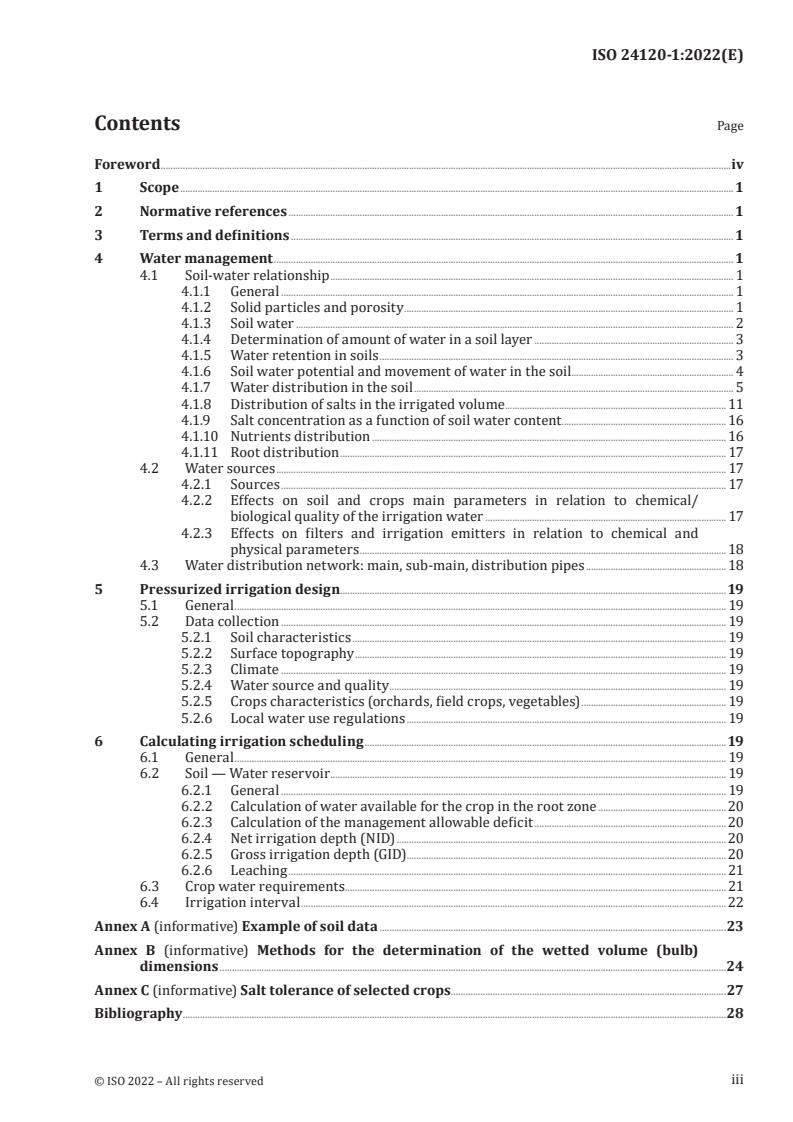
Contents Page
Foreword .iv
1 Scope . 1
2 Normative references . 1
3 Terms and definitions . 1
4 Water management .1
4.1 Soil-water relationship . 1
4.1.1 General . 1
4.1.2 Solid particles and porosity . 1
4.1.3 Soil water . 2
4.1.4 Determination of amount of water in a soil layer . 3
4.1.5 Water retention in soils . 3
4.1.6 Soil water potential and movement of water in the soil . . 4
4.1.7 Water distribution in the soil . 5
4.1.8 Distribution of salts in the irrigated volume . 11
4.1.9 Salt concentration as a function of soil water content . 16
4.1.10 Nutrients distribution . 16
4.1.11 Root distribution . 17
4.2 Water sources . 17
4.2.1 Sources . 17
4.2.2 Effects on soil and crops main parameters in relation to chemical/
biological quality of the irrigation water . 17
4.2.3 Effects on filters and irrigation emitters in relation to chemical and
physical parameters . 18
4.3 Water distribution network: main, sub-main, distribution pipes . 18
5 Pressurized irrigation design .19
5.1 General . 19
5.2 Data collection . 19
5.2.1 Soil characteristics . 19
5.2.2 Surface topography . 19
5.2.3 Climate . 19
5.2.4 Water source and quality . 19
5.2.5 Crops characteristics (orchards, field crops, vegetables) . 19
5.2.6 Local water use regulations . 19
6 Calculating irrigation scheduling .19
6.1 General . 19
6.2 Soil — Water reservoir . 19
6.2.1 General . 19
6.2.2 Calculation of water available for the crop in the root zone .20
6.2.3 Calculation of the management allowable deficit . 20
6.2.4 Net irrigation depth (NID) . 20
6.2.5 Gross irrigation depth (GID). 20
6.2.6 Leaching . 21
6.3 Crop water requirements. 21
6.4 Irrigation interval . 22
Annex A (informative) Example of soil data .23
Annex B (informative) Methods for the determination of the wetted volume (bulb)
dimensions .24
Annex C (informative) Salt tolerance of selected crops .27
Bibliography .28
iii
Foreword
ISO (the International Organization for Standardization) is a worldwide federation of national standards
bodies (ISO member bodies). The work of preparing International Standards is normally carried out
through ISO technical committees. Each member body interested in a subject for which a technical
committee has been established has the right to be represented on that committee. International
organizations, governmental and non-governmental, in liaison with ISO, also take part in the work.
ISO collaborates closely with the International Electrotechnical Commission (IEC) on all matters of
electrotechnical standardization.
The procedures used to develop this document and those intended for its further maintenance are
described in the ISO/IEC Directives, Part 1. In particular, the different approval criteria needed for the
different types of ISO documents should be noted. This document was drafted in accordance with the
editorial rules of the ISO/IEC Directives, Part 2 (see www.iso.org/directives).
Attention is drawn to the possibility that some of the elements of this document may be the subject of
patent rights. ISO shall not be held responsible for identifying any or all such patent rights. Details of
any patent rights identified during the development of the document will be in the Introduction and/or
on the ISO list of patent declarations received (see www.iso.org/patents).
Any trade name used in this document is information given for the convenience of users and does not
constitute an endorsement.
For an explanation of the voluntary nature of standards, the meaning of ISO specific terms and
expressions related to conformity assessment, as well as information about ISO's adherence to
the World Trade Organization (WTO) principles in the Technical Barriers to Trade (TBT), see
www.iso.org/iso/foreword.html.
This document was prepared by Technical Committee ISO/TC 23, Tractors and machinery for agriculture
and forestry, Subcommittee SC 18, Irrigation and drainage equipment and systems.
A list of all parts in the ISO 24120 series can be found on the ISO website.
Any feedback or questions on this document should be directed to the user’s national standards body. A
complete listing of these bodies can be found at www.iso.org/members.html.
iv
INTERNATIONAL STANDARD ISO 24120-1:2022(E)
Agricultural irrigation equipment — Guideline on the
implementation of pressurized irrigation systems —
Part 1:
General principles of irrigation
1 Scope
This document provides a guideline for the implementation of pressurized irrigation systems.
It is applicable to small-scale family agriculture and large-scale commercial agriculture, in open fields
or within enclosed growing structures (e.g. greenhouse, net house).
This document is intended for the use of agriculture ministries, agronomists, irrigation planners,
farmers and end-users.
2 Normative references
There are no normative references in this document.
3 Terms and definitions
For the purposes of this document, the following terms and definitions apply.
ISO and IEC maintain terminological databases for use in standardization at the following addresses:
— ISO Online browsing platform: available at https:// www .iso .org/ obp
— IEC Electropedia: available at https:// www .electropedia .org/
3.1
wetting front
boundary between the wetted region and the drier region of soil during infiltration
[SOURCE: Glossary of Soil Science terms, modified — 'dry' substituted with 'drier'.]
4 Water management
4.1 Soil-water relationship
4.1.1 General
The soil is a three-phase system (mineral and organic solid particles, water and air). It is a reservoir
of water used by plants. To design an irrigation system, the soil-water-plant relations, as described in
Clause 4, should be considered. Examples of values of soil physical parameters are presented in Annex A.
4.1.2 Solid particles and porosity
The soil volume is made up of solid particles of different sizes (sand, silt and clay) and pores. The relative
content of the three groups of particles defines the soil texture.
The volume not filled by the solid particles defines the soil pores. The total volume and size of pores
depend on the soil texture. The higher the soil clay content, the higher the total porosity of the soil and
lower pore size. The total porosity is between 35 % to 40 % in sandy soils, 50 % in medium soils and
can reach 60 % for clay soils.
Under conditions of soil water saturation, all the pores of the soil are full of water and, as a consequence,
do not contain air.
4.1.3 Soil water
The percentage of water relative to the mass of solids is the relation between the mass of the water and
the mass of the particles [as shown in Formula (1)] and is commonly determined by the gravimetric
method.
m
w
w=×100 (1)
m
s
where
w is the gravimetric water content (%);
m is the mass of the water (g);
w
m is the mass of dry soil or mass of solids (g).
s
The gravimetric method is the most accurate method (i.e., the standard method) for determining the
soil water, and it consists of drying samples of soil in an oven at 105 °C for 24 h (or until the sample
reaches steady mass). The gravimetric water content (w) can be obtained using Formula (2):
mm−
w+cd+c
w= ×100 (2)
mm−
d+c c
where
m is the tare of the container;
c
m is the mass of wet soil + container;
w+c
m is the mass of dry soil + container.
d+c
The percentage of water relative to soil volume (i.e. the volumetric water content) is the relation
between the volume of water and the total volume of soil. See Formula (3).
V
w
θ= ×100 (3)
V
t
where
θ is the volumetric water content (%);
V is the volume of the water (cm );
w
V is the total volume of the soil (cm ).
t
The gravimetric method can be used to determine the soil bulk density, the gravimetric water content
and the volumetric water content. For that purpose, undeformed soil samples should be collected
using the Uhland soil sampler or other similar device for extracting undeformed samples. The soil
bulk density is obtained by Formula (4), in which the total volume of soil is equal to the volume of the
-3
container. Assuming the water density as a constant equal to 1 g cm , the volumetric water content is
obtained by Formula (5).
m
s
ρ = (4)
b
V
t
θρ=×w (5)
b
where
θ is the volumetric water content (%);
w is the gravimetric water content (%);
-3
ρ
is the soil bulk density (g · cm ).
b
4.1.4 Determination of amount of water in a soil layer
The amount of water in a soil layer can be expressed as water depth (mm). See Formula (6).
θ
hn=× (6)
where
h is the water depth in a particular layer of soil (mm);
θ is the volumetric water content (%);
n is the thickness of the particular layer (mm).
NOTE
-2 3 -1
1 mm = 1 l m = 10 m ha
1 ha = 10 000 m
4.1.5 Water retention in soils
Knowing the amount of water in the soil without knowing other soil characteristics is insufficient to
determine the amount of water available for crops, in order to programme the irrigation regime.
The water held in the soil pores is a result of the surface tension of the water in contact with the air and
the contact angle between the water and the soil particles. As a result, there is a retention force in the
soil pores (capillarity) that increases with a decrease in the diameter of the soil pores.
Each soil has its own characteristic water retention curve (the water tension relative to the change in
the moisture) according to its texture and structure that defines its pore size distribution.
According to the water retention curve, three water conditions in the soil can be defined.
— Saturation: after an excessive rainfall or irrigation, all the soil pores become full of water, and
drainage downward immediately starts, faster in sandy soils and slower in soils with increasing
clay content.
— Field capacity (θ ): the water content in the soil 1 to 3 days after saturation condition and drainage
FC
has largely ceased.
— Wilting point (θ ): as water is extracted from the soil through evapotranspiration (from plants
WP
and soils), the water tension is increased (up to 1,5 MPa) at a value whereby most plants can no
longer extract water and wilt permanently.
The total available water of the soil can be calculated as the difference between the water content at
field capacity and permanent wilting point, expressed in percentage. See Formula (7).
θθ−
FC WP
Wn= (7)
TA
where
W is the total available water in a particular soil layer (mm);
TA
θ is the volumetric water content at the field capacity (%);
FC
θ is the volumetric water content at the wilting point (%);
WP
n is the thickness of the particular layer (mm).
4.1.6 Soil water potential and movement of water in the soil
The water in the soil is subject to a number of forces, which cause the potential of the soil water to differ
from the potential of pure and free water. These forces result from the attraction of water to the solid
matrix of the soil (clay particles and organic matter), as well as the presence of dissolved salts, and the
influence of the force of gravity. The total water potential in the soil can be presented as the sum of the
individual contribution of each of these forces, as expressed using Formula (8).
ΨΨ=+ΨΨ++. (8)
tg mo
where
Ψ is the total water potential in the soil;
t
Ψ is the gravitational potential;
g
Ψ is the matrix potential;
m
Ψ is the osmotic potential;
o
… are expressions for other terms of the potential of water in the soil that exist theoretically.
The direction of water movement between two points in the soil is determined by the existence of a
difference in the total water potential (Ψ ). The movement occurs from the point of highest potential
t
to the point of lower potential. In the movement of water between two points within the soil, the osmotic
potential (Ψ ) is negligible (in the absence of a semi-permeable membrane between the two points), so
o
that the total potential is restricted to the sum of the gravitational potential (Ψ ) and the matrix
g
potential (Ψ ) (ΨΨ=+Ψ ).
m tg m
The gravitational potential of water at a given point in the soil is determined by the relative elevation of
the point in the soil (relative to the surface, for example).
The matrix potential is also called capillary potential. It results from capillarity (which depends on the
size of the pores in the soil) and water adsorption forces (by attraction to solid soil particles, especially
clay and organic matter).
4.1.7 Water distribution in the soil
4.1.7.1 Methods with total surface wetting
Irrigation methods with total surface wetting (surface basin irrigation and some sprinkler irrigation)
are designed to perform a uniform distribution of water over the entire surface of the soil, similar to
natural rainfall. The driving force in the movement of water in the soil during irrigation is the force of
gravity (the difference in the gravitational potential of soil water between the surface and the deeper
layers of the soil) and the difference in the matrix potential of the soil between both sides of the wetting
front.
In general, the wetting front is a plane that advances in parallel to the soil surface. The horizontal
movement of water occurs when there is a difference in soil moisture, that is, a difference in the matrix
potential between two points at the same depth in the soil. In methods with total surface wetting, this
difference exists only within the boundaries of the irrigated plot in which the contact plane between
the wet zone and the dry zone (the wetting front in the plot boundaries) represents a very small area in
relation to the surface of the area and the wetting front in the vertical direction. This is why the lateral
movement is very small in relation to vertical movement, and the volume wetted by the movement of
water in the horizontal direction is minimal in relation to the total volume of soil irrigated. The water
pattern in basin is shown in Figure 1 and in sprinkler irrigation in Figure 2.
In basin irrigation, at the ideal wetting pattern, there are small percolation losses close to the field
channel, and in consequence a low depth of percolation at the opposite end. When the inflow rate is not
enough, percolation is high near the canal, and the depth of percolation towards the end is lower than in
optimal conditions (see Figure 1).
In sprinkler irrigation, the uniform water distribution on the soil surface is obtained by establishing
a sufficient overlap of distribution patterns from adjacent sprinklers. The degree of overlap depends
on the characteristic distribution pattern of the individual sprinkler, which in turn is a function of the
sprinkler type, height of sprinklers above crop, nozzles, pressure head and wind conditions. The degree
of overlap and uniformity is also dependent on the speed of movement and whether a 30 s, 60 s, 120 s
(or other) setting is used for the percent timer.
a) Ideal wetting pattern
b) Wetting pattern with insufficient flow rate
Key
1 field channel
2 bund
3 root zone
4 low percolation losses
5 high percolation losses
6 too dry
[1]
Figure 1 — Basin irrigation water distribution
a) Wetting pattern for a single sprinkler
b) Wetting pattern of several sprinklers with superposition between wetting zones
Key
1 lateral
2 sprinkler
3 spacing
4 wetted zone
[1]
Figure 2 — Sprinkler irrigation
4.1.7.2 Methods with partial surface wetting
4.1.7.2.1 General
In irrigation methods with partial soil wetting (furrows, drip irrigation, micro-sprinklers and some
cases of irrigation on moving equipment such as LEPA – low energy precision application), the wetting
zone is characterized by having a special shape due to the forces that act on the water during its
infiltration and its movement in the soil. Water is moved by the difference in the total potential of water
in the soil [see Formula (8)]. In the vertical movement, the differences in the gravitational potential act
as well as in the matrix potential. In the horizontal movement there are only differences in the matrix
potential.
The general tendency is that the vertical movement (gradient in the matrix potential and the
gravitational potential) is greater than the horizontal movement (result of the gradient in the matrix
potential only). The difference between the two directions of movement will be greater as the content
of clay in the soil becomes lower. This is because the difference in the potential matrix between the wet
zone of the soil and the dry zone is greater in higher clay content, while there is no difference in the
gravitational component between the soils, whatever their texture.
4.1.7.2.2 Furrow irrigation
The water flows in the furrow and infiltrates down and to the sides of an individual furrow (see
Figure 3).
Key
A sandy soil
B loam soil
C clayey soil
1 wetted zone
[1]
Figure 3 — Movement of water in irrigation by furrows in soils of different texture
4.1.7.2.3 Drip irrigation
Below and around the dripper, where the water drops drop by drop, a wetted soil zone is formed, within
it three zones can be distinguished (see Figure 4):
— Saturated zone: immediately below and around the dripper a saturated zone is formed, from which
the water moves towards the interior of the soil. In this area there is excess water and lack of air.
Especially in soils of medium or clayey texture there is a small accumulation of water on the surface,
from which the water infiltrates into the saturated zone.
— Equilibrium zone: it is an intermediate zone, in which the moisture content is close to field capacity,
so there is an optimal ratio between the water and air content.
— Wetting front: it is the boundary between the intermediate zone and the dry zone or with moisture
content similar to that existing at the time of beginning of irrigation. In this area there is a deficit of
humidity and the aeration of the soil is maximal.
Key
A clayey soil
B sandy soil
H horizontal dimension
V vertical dimension
1 saturated zone
2 equilibrium zone
3 dry zone (wetting front)
4 dripper
Figure 4 — Wetting bulb in the drip irrigation in two soils of different texture
The shape and dimensions of the wetting zone (bulb) depend on five factors:
— Soil: when a certain amount of water is applied, the bulb that forms on a clayey soil (with a low
hydraulic conductivity in saturated soil) will be shallower and wider compared to a sandy soil
(with a high saturated hydraulic conductivity). In the latter, the vertical dimension will be more
developed, while the horizontal dimension will be narrow.
— Dripper discharge: for a given soil, an increase in the dripper discharge means an increase in the
radius of the saturated zone, i.e. a wider and more superficial bulb. For the same dripper discharge,
the higher the soil clay content, the greater the radius of the saturated zone.
— Duration of irrigation: the horizontal dimension increases from the irrigation beginning and as long
as it continues, up to a certain limit that also depends on the texture of the soil and the discharge
of the dripper. Above this limit the movement of water will be mainly in the vertical direction, thus
decreasing the irrigation efficiency due to the loss of water by drainage below the root zone.
— Irrigation frequency: as the water content in the soil decreases, the water tension in the soil
increases. The hydraulic conductivity of soil has a wide influence on the behaviour of the water
in the soil wetting from a dripper. The hydraulic conductivity decreases exponentially with an
increase in the water tension in the soil (decrease in water content), and the movement of the water
is slower. Under these conditions, the relative importance of the matrix potential is greater than the
gravitational potential, resulting in a more accentuated horizontal movement.
— Calculation of the bulb dimensions and drippers spacing: the dripper spacing is the spacing
(distance) between drippers along a lateral line. The optimum distance between drippers is that
which represents 80 % of the diameter wetted by an individual dripper, which was calculated or
estimated in the field. With this spacing, an overlapping will be obtained between the wetted areas
of neighbouring drippers. At the same time, a wet strip will be received along the drippers lateral.
Examples of some means of estimating the wetted area dimensions are presented in Annex B.
Manufacturers of drip irrigation systems present in their catalogues the recommended spacing data,
according to their experience, for different soils and crops.
4.1.7.2.4 Micro-sprinkler irrigation
Similar to drip irrigation, the wetting of the soil in this method of irrigation is partial. There are
different types of micro-sprinklers with different water distribution patterns over the soil surface (see
Figure 5). Thus, the distribution of water in the soil in micro sprinkler irrigation depends on the water
distribution pattern on the surface and the radius achieved by the water distributed by the micro-
sprinkler. The pattern of water movement in the soil differs from that of a point source (dripper), and
is similar to the pattern in sprinkler irrigation. In cases in which an individual emitter is placed, i.e. an
emitter per tree in a plantation, there will be movement of water to the sides due to the difference in the
potential of the water between the wetted and dry areas (see Figure 6). In many cases, the emitters are
located in such a way that there is an overlap between wetted zones of adjacent emitters, and there will
be a continuous wetted strip along the row of trees. In this case, the lateral movement of the water will
be towards the area between the rows of trees.
Key
T triangle
H hump
E even graph
Figure 5 — Schematic description of water distribution from individual micro-sprinklers
Figure 6 — Wetting pattern in individual micro-sprinklers
4.1.7.2.5 Moving equipment — Centre pivots and linears — Subset of sprinkler irrigation
Below and around the distribution device, where the water is delivered, a wetted soil zone is formed.
Within it three zones can be distinguished:
— Saturated zone: immediately below and in the direction of movement in the path of the application
device a saturated zone is formed from which the water moves into the soil. The saturated zone in
the wetted soil under micro-sprinkler is bigger than in dripper irrigated soils. In this area there
is excess water and lack of air. Especially in soils of medium or clayey texture, there is a small
accumulation of water on the surface, from which the water infiltrates into the saturated zone.
— Equilibrium zone: it is an intermediate zone, in which the moisture content is close to field capacity,
so there is an optimal ratio between the water and air content.
— Wetting front: it is the boundary between the intermediate zone and the dry zone or with moisture
content similar to that existing at the time of beginning irrigation. In this area there is a deficit of
humidity and the aeration of the soil is maximal.
The shape and dimensions of the wetting zone depend on five factors:
— Soil: when a certain amount of water is applied, the bulb that forms on a clayey soil (with a low
hydraulic conductivity in saturated soil) will be shallower and wider compared to a sandy soil
(with a high saturated hydraulic conductivity). In the latter, the vertical dimension will be more
developed, while the horizontal dimension will be narrow.
— Moving application device: for a given soil, an increase in the application means an increase in the
width of the saturated zone. For the application device discharge, the higher the soil clay content, the
greater the width of the saturated zone, which may lead to water moving ahead of the application
device. This will depend on the speed of movement of the moving application device.
— The duration of the irrigation: the horizontal dimension increases from the irrigation beginning
and as long as it continues, up to a certain limit that also depends on the texture of the soil and the
movement of the water application device. Above this limit, the movement of water will be mainly in
the vertical direction, thus decreasing the irrigation efficiency due to the loss of water by drainage
below the root zone.
— The irrigation frequency: as the water content in the soil decreases, the water tension in the soil
increases. The hydraulic conductivity of soil has a wide influence on the behaviour of the water in
the soil wetting from the application device. Due to this, it is important to note that the hydraulic
conductivity decreases exponentially with an increase in the water tension in the soil (decrease in
water content), the movement of the water is slower. Under these conditions the relative importance
of the matrix potential is greater than the gravitational potential, resulting in a more accentuated
horizontal movement.
— Calculation of the bulb dimensions: the spacing is the spacing (distance) between water application
devices along the pipeline and speed of movement of the pipeline. Distance between the wetted areas
of water application devices along the pipeline is dependent on the soil and crop. The movement is
how overlap will be obtained in the direction of movement.
4.1.8 Distribution of salts in the irrigated volume
4.1.8.1 General
All sources of irrigation contain dissolved salts. The concentration and composition depend on the
source. Dissolved salts accumulate in the root zone when water evaporates from the soil surface and by
transpiration from the crops. Soil salinity is uneven in width and depth, while roots develop and absorb
water and nutrients mainly from those soil volumes where salinity is relatively low and moisture is
relatively high. The main root zone volume is determined by a number of major factors:
— water salt content;
— irrigation management;
— fertilization management;
— irrigation method;
— water evapotranspiration;
— type of soil;
— rainwater.
Soil is salinized when the soil concentration in the root zone reaches a level higher than the plant
sensitivity for optimum plant growth and yield. Plants differ in this sensitivity between very sensitive
to very resistant.
Dissolved salts move along the soil with water, the distribution of salts is determined by the water
flow patterns in the soil. Salts have a maximum concentration in the wetting front of infiltrating water.
Accordingly, the distribution of salts in the soil is correlated with the distribution of water previously
presented.
4.1.8.2 Salt distribution under furrow irrigation
Furrow irrigation is considered a good method to prevent salt accumulation due to large, deep
percolation that can leach salts away from the root zone. However, furrow irrigation can promote salt
accumulation on the furrows’ edge and ridge between two furrows (see Figure 7). Furthermore, salt
can accumulate on the edges at the wetting front in the soil profile, right above the root zone.
Key
D depth in cm
T total salt present in soil profile
1 zone of salt accumulation
2 water in furrow
0,01-0,02
0,02-0,1
0,1-0,2
0,2-0,5
0,5-2,0
[4]
Figure 7 — Salt accumulation in soil profile in furrow irrigated field
4.1.8.3 Salt distribution under sprinkler irrigation
In sprinkler irrigation, because water is applied to all of the soil surface and water flows downward,
salt concentrations are relatively uniform at each depth across the soil. Sprinkler irrigation systems
that wet the entire soil surface create a profile that steadily increases in salinity with soil depth to the
bottom of the root zone (see Figure 8).
Key
L low salinity
H high salinity
Figure 8 — Salt accumulation in soil profile in sprinkler irrigated field
4.1.8.4 Salt distribution under the drip irrigation
During drip irrigation, a large amount of salts are transported within the wetted volume. After
several irrigation cycles, water evapotranspiration and salt transport, large differences in the salinity
concentration of the soil solution are created within the wetted volume, margins, and soil (see Figure 9).
Under the ponded area, the lowest soil salinity is in a leached volume. From this area and towards the
perimeter of the wetted area, the concentration of salts increases gradually. The increase is smallest in
the vertical direction and largest in the horizontal direction. Very high salinity can be observed in the
bottom of the wetted zone and in the top (because water evaporation from the soil surface).
Key
1 dripper
2 ponded area
3 leached volume
4 salt accumulation
5 high salinity
6 extreme high salinity
[6]
Figure 9 — Salt distribution pattern under an individual dripper
4.1.8.5 Salt distribution under micro-sprinkler irrigation
The distribution of dissolved salts in micro-sprinklers wetting patterns may differ from that of sprinkler
irrigation. For a micro-spray system that sprays a relatively large wetted zone around each plant, salt
may accumulate within each zone in a pattern not unlike that of an individual sprinkler. In contrast,
for an irrigation system employing bubblers, salt tends to accumulate mainly in the outer fringes of the
[7]
wetted zone (see Figure 10) .
A B
Key
A micro-spray;
B bubbler
[7]
Figure 10 — Salt distribution pattern under an individual micro-sprinkler
4.1.9 Salt concentration as a function of soil water content
Salt accumulation in the soil occurs also with relatively low salinity water sources. After irrigation,
and a subsequent drainage of water excess, the soil reaches the field water content capacity. The water
content is high and therefore the salts are at a relatively lower concentration. Between two irrigation
operations, the soil water content decreases due to evaporation from the soil surface and water
consumption by the plant. This decrease in water content means that salts in the soil are dissolved in
less water and, therefore, the concentration of salts in the soil solution increases. Thus, with the gradual
reduction in water content, there is a gradual increase in the concentration of salts. The salinity effect
on crops is reduced by maintaining a high moisture level in the soil. The way to do this is by applying
frequent irrigation that keeps the soil in moisture at a value close to the field capacity.
With furrow irrigation, maintaining high moisture levels can be done only if irrigation is applied every
day. This requires a high water and energy investment, which is not practical. With drip irrigation,
daily application is common practice. Therefore, drip irrigation systems can reduce the salinity effect,
and can be used in saline soils or with saline irrigation water. The other irrigation methods may also
have the effect of frequent irrigation on salinity while practically allowing this irrigation management.
Micro-sprinklers fixedly located in the plots can apply daily irrigation and up to several irrigations
per day such as drip irrigation. One of the disadvantages in sprinkler and micro-sprinkler irrigation of
increasing the frequency of irrigation is to increase water losses through evaporation during irrigation
or from the irrigation surface. In saline conditions, leaching accumulated salts can overcome the salinity
effect. However, in non-saline conditions, high irrigation frequency is not necessarily required, and all
irrigation systems may be used to grow crops successfully.
4.1.10 Nutrients distribution
Distribution of nutrients in the soil, applied through fertilization on the soil surface and incorporation
in the soil profile, or via fertigation, depends on the interaction between the nutritional elements and
the soil components.
Nitrogen as nitrate is mobile, and is distributed in the wetted zone similarly as described for the soluble
salts, for the various irrigation methods, in 4.1.8. When nitrogen fertilizers containing ammonium
nitrogen are applied, initially the ammonium cation is adsorbed on clay particles and the movement
in the soil is limited. Ammonium passes gradually through the nitrification process, transforming into
nitrate that moves in the soil as soluble salt.
Phosphorus mobility in soil is limited. In alkaline and neutral soils, phosphorous precipitates from the
soil solution with calcium and magnesium as insoluble salts. In acid soils, it precipitates with iron and
aluminium and remains in the upper soil layer.
Potassium cations are adsorbed on clay minerals and their movement in clay and medium texture soils
[8]
is limited. Most applied potassium remains in the upper soil layer .
If potassium and phosphorous are applied on the soil surface, these nutrients are left in the upper
centimetres of the soil and do not penetrate into the root zone, including after rain or sprinkler
irrigation. Only after tillage are these nutrients incorporated into the root zone. It is different in drip
irrigation and partially in micro-sprinkler irrigation, in which these nutrients are added by fertigation,
[9]
and have greater mobility and deepen within the root zone .
Strongly adsorbed nutrients have reduced mobility in soils, compared with un-adsorbed ions. For a given
concentration, the buffer capacity of a clayey soil exceeds that of a sandy soil, therefore, the mobility of
[9]
adsorbed ions in fine-textured soils is less than in coarse textured soils . For example, phosphorous
concentration, after application via a point source, was restricted to distances of 12 cm and 7 cm from
the emitter in sandy and clayey soils, respectively. Phosphate applied via trickle irrigation moved to
a much greater distance than when it is applied on the soils surface by sprinkler irrigation. At point
source application all the phosphorous is applied over a small surface area, so that soil adsorption sites
are saturated and the P migration is greater.
Similarly, the soil adsorption affects the potassium movement in soil under the different water
application methods.
4.1.11 Root distribution
Water application regime and water distribution pattern in the soil affect root system and distribution.
Each plant family has a typical root pattern stemming from the growing conditions. Root systems can
be shallow or deep, dense, branched or sparse, and are not related to the shape of the plant’s canopy.
Frequent and small water applications with drip irrigation lead to a shallow and compact root systems
in comparison to sprinkler irrigation (see Figure 11). On the other hand, due to improved aeration and
nutrition in drip irrigated soil volume, the density of the active fine roots is significantly higher than the
[8]
density of root systems growing under sprinkler irrigation (see Figure 11) . However, moving water
application devices can overcome shortcomings of fixed sprinklers by improved timing of delivery and
volume.
Source: Netafim
Figure 11 — Root system in drip irrigation (right) in comparison to root system in
...