

ISO 15471:2016
(Main)Surface chemical analysis — Auger electron spectroscopy — Description of selected instrumental performance parameters
General Information
- Abstract
ISO 15471:2016 specifies the requirements for the description of specific aspects of the performance of an Auger electron spectrometer.
- Status
- Published
- Publication Date
- 04-Sep-2016
- Technical Committee
- ISO/TC 201/SC 7 - Electron spectroscopies
- Drafting Committee
- ISO/TC 201/SC 7 - Electron spectroscopies
- Current Stage
- 9093 - International Standard confirmed
- Start Date
- 10-Dec-2021
- Completion Date
- 29-Aug-2026
Buy Documents

ISO 15471:2016 - Surface chemical analysis -- Auger electron spectroscopy -- Description of selected instrumental performance parameters
ISO 15471:2016 - Surface chemical analysis — Auger electron spectroscopy — Description of selected instrumental performance parameters/5/2016
Overview
ISO 15471:2016 is an international standard published by the International Organization for Standardization (ISO) that focuses on surface chemical analysis using Auger Electron Spectroscopy (AES). This standard provides detailed requirements for describing selected instrumental performance parameters of an Auger electron spectrometer. The document aims to establish common terminology and methods that allow for consistent performance description and comparison among AES instruments from different manufacturers.
Primarily, ISO 15471:2016 addresses key technical specifications, including system configuration, electron gun cathode details, lateral resolution, spectrometer intensity and energy resolution, spectrometer energy scale, and performance evaluation techniques. It serves to complement manufacturers' specifications by offering a standardized baseline for reporting instrument characteristics-enhancing reliability and reproducibility in surface chemical analysis.
Key Topics
Method of Analysis
Defines the basic analytical processes used in AES and optional analytical techniques available within the system.Sample Requirements
Specifies limitations regarding the size, shape, and types of samples that can be analyzed under official performance criteria, including restrictions for specialized modes like angle-resolved measurements or analysis of insulators.System Configuration
Details the designed geometric setup of significant analytical components, including tolerances such as angular precision.Electron Gun Cathode
Requires specification of cathode type (e.g., thermionic tungsten, LaB6, Schottky) and cathode lifetime based on emission currents at defined operating conditions.Lateral Resolution and Beam Current
Describes methods to determine spatial resolution using samples with well-defined features or edges, including three standardized methods (isolated feature measurement, dual-material boundary measurement, and knife-edge over hole method). Performance curves relating beam current and lateral resolution at specific energies (5 keV and 10 keV) are specified.Spectrometer Intensity Performance and Energy Resolution
Covers quantitative evaluation of spectrometer intensity using copper peak signals, background noise measurement techniques, and characterization of peak full width half maximum (FWHM). Methods for determining noise levels involve statistical analyses of the background signal.Spectrometer Energy Scale
Specifies requirements for energy scale calibration related to the Fermi level, including linearity, repeatability, and calibration accuracy over time.Additional Parameters
Includes instrument aberration, analytical area dimensions, image drift, and vacuum conditions critical to AES performance.
Applications
ISO 15471:2016 is essential for professionals involved in surface chemical analysis, especially those using Auger Electron Spectroscopy or Scanning Auger Electron Microscopy (SAM). The standard helps in:
Instrument Specification and Comparison
Enables researchers and engineers to objectively assess and compare AES instruments from different manufacturers based on uniform performance metrics.Quality Assurance
Facilitates consistent reporting and validation of instrument capabilities for routine surface analysis in fields such as materials science, semiconductor fabrication, corrosion engineering, and thin film analysis.Instrument Development and Testing
Guides manufacturers in testing and defining performance parameters to meet international requirements and improve product reliability.Method Standardization
Supports laboratories by providing standardized protocols for characterizing lateral resolution, spectrometer sensitivity, and energy calibration of AES instruments.
Related Standards
ISO 18115-1: Surface chemical analysis - Vocabulary - Part 1
Defines terminology used in spectroscopy, including terms relevant to AES.ISO/TR 19319: Auger electron spectroscopy (AES) - Methods for lateral resolution measurement
Provides guidance on lateral resolution measurement techniques complementing the methods described in ISO 15471.ISO/IEC Directives, Part 1 and Part 2
Outline the editorial and procedural rules for developing ISO standards.
Keywords: ISO 15471:2016, Auger Electron Spectroscopy, AES, surface chemical analysis, instrumental performance parameters, lateral resolution, spectrometer energy scale, electron gun cathode, spectrometer intensity, surface analysis standards, scanning Auger electron microscope, SAM, instrument calibration.
Relations
- Effective Date
- 06-Jun-2022
- Effective Date
- 09-Apr-2016
Buy Documents
ISO 15471:2016 - Surface chemical analysis -- Auger electron spectroscopy -- Description of selected instrumental performance parameters
ISO 15471:2016 - Surface chemical analysis — Auger electron spectroscopy — Description of selected instrumental performance parameters/5/2016
Get Certified
Connect with accredited certification bodies for this standard

ECOCERT
Organic and sustainability certification.

Eurofins Food Testing Global
Global leader in food, environment, and pharmaceutical product testing.

Intertek Bangladesh
Intertek certification and testing services in Bangladesh.
Sponsored listings
Frequently Asked Questions
ISO 15471:2016 is a standard published by the International Organization for Standardization (ISO). Its full title is "Surface chemical analysis — Auger electron spectroscopy — Description of selected instrumental performance parameters". This standard covers: ISO 15471:2016 specifies the requirements for the description of specific aspects of the performance of an Auger electron spectrometer.
ISO 15471:2016 specifies the requirements for the description of specific aspects of the performance of an Auger electron spectrometer.
ISO 15471:2016 is classified under the following ICS (International Classification for Standards) categories: 71.040.40 - Chemical analysis. The ICS classification helps identify the subject area and facilitates finding related standards.
ISO 15471:2016 has the following relationships with other standards: It is inter standard links to ISO 8637-2:2024, ISO 15471:2004. Understanding these relationships helps ensure you are using the most current and applicable version of the standard.
ISO 15471:2016 is available in PDF format for immediate download after purchase. The document can be added to your cart and obtained through the secure checkout process. Digital delivery ensures instant access to the complete standard document.
Standards Content (Sample)
INTERNATIONAL ISO
STANDARD 15471
Second edition
2016-09-01
Surface chemical analysis — Auger
electron spectroscopy — Description
of selected instrumental performance
parameters
Analyse chimique des surfaces — Spectroscopie d’électrons Auger
— Description de certains paramètres relatifs à la performance
instrumentale
Reference number
©
ISO 2016
© ISO 2016, Published in Switzerland
All rights reserved. Unless otherwise specified, no part of this publication may be reproduced or utilized otherwise in any form
or by any means, electronic or mechanical, including photocopying, or posting on the internet or an intranet, without prior
written permission. Permission can be requested from either ISO at the address below or ISO’s member body in the country of
the requester.
ISO copyright office
Ch. de Blandonnet 8 • CP 401
CH-1214 Vernier, Geneva, Switzerland
Tel. +41 22 749 01 11
Fax +41 22 749 09 47
copyright@iso.org
www.iso.org
ii © ISO 2016 – All rights reserved
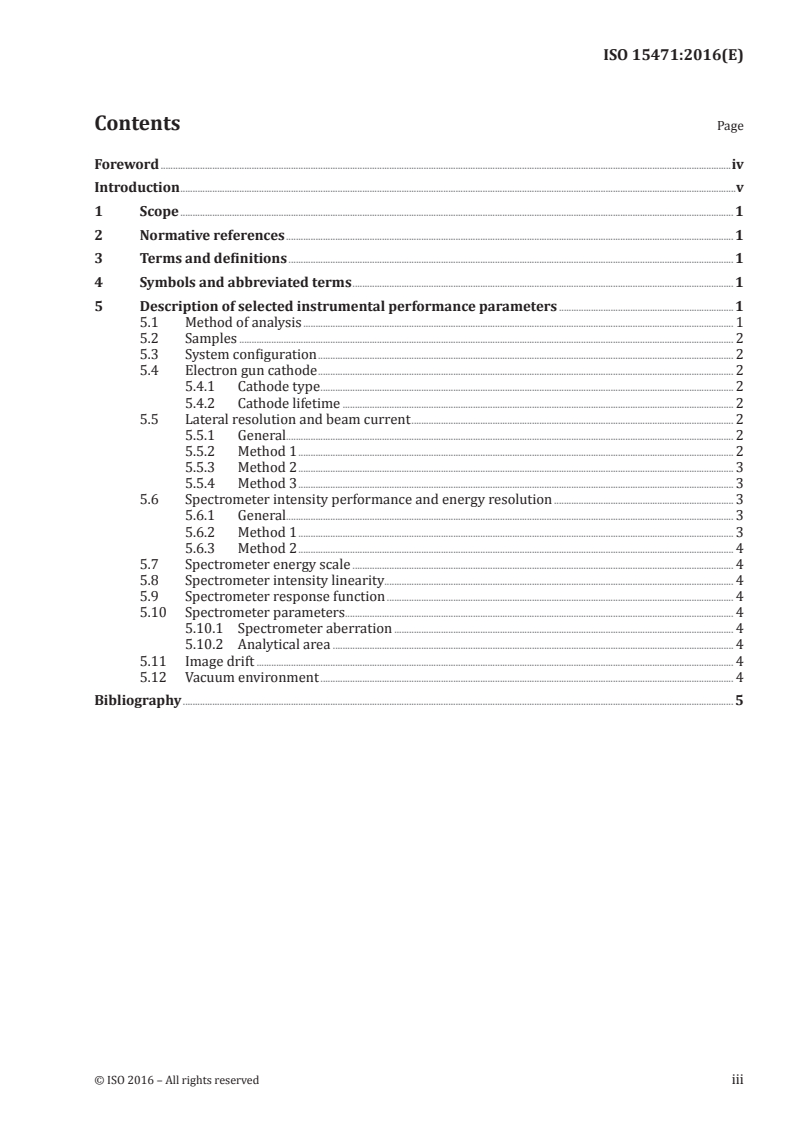
Contents Page
Foreword .iv
Introduction .v
1 Scope . 1
2 Normative references . 1
3 Terms and definitions . 1
4 Symbols and abbreviated terms . 1
5 Description of selected instrumental performance parameters . 1
5.1 Method of analysis . 1
5.2 Samples . 2
5.3 System configuration . 2
5.4 Electron gun cathode . 2
5.4.1 Cathode type . 2
5.4.2 Cathode lifetime . 2
5.5 Lateral resolution and beam current . 2
5.5.1 General. 2
5.5.2 Method 1 . 2
5.5.3 Method 2 . 3
5.5.4 Method 3 . 3
5.6 Spectrometer intensity performance and energy resolution . 3
5.6.1 General. 3
5.6.2 Method 1 . 3
5.6.3 Method 2 . 4
5.7 Spectrometer energy scale . 4
5.8 Spectrometer intensity linearity. 4
5.9 Spectrometer response function . 4
5.10 Spectrometer parameters . . 4
5.10.1 Spectrometer aberration . 4
5.10.2 Analytical area . 4
5.11 Image drift . 4
5.12 Vacuum environment . 4
Bibliography . 5
Foreword
ISO (the International Organization for Standardization) is a worldwide federation of national standards
bodies (ISO member bodies). The work of preparing International Standards is normally carried out
through ISO technical committees. Each member body interested in a subject for which a technical
committee has been established has the right to be represented on that committee. International
organizations, governmental and non-governmental, in liaison with ISO, also take part in the work.
ISO collaborates closely with the International Electrotechnical Commission (IEC) on all matters of
electrotechnical standardization.
The procedures used to develop this document and those intended for its further maintenance are
described in the ISO/IEC Directives, Part 1. In particular the different approval criteria needed for the
different types of ISO documents should be noted. This document was drafted in accordance with the
editorial rules of the ISO/IEC Directives, Part 2 (see www.iso.org/directives).
Attention is drawn to the possibility that some of the elements of this document may be the subject of
patent rights. ISO shall not be held responsible for identifying any or all such patent rights. Details of
any patent rights identified during the development of the document will be in the Introduction and/or
on the ISO list of patent declarations received (see www.iso.org/patents).
Any trade name used in this document is information given for the convenience of users and does not
constitute an endorsement.
For an explanation on the meaning of ISO specific terms and expressions related to conformity assessment,
as well as information about ISO’s adherence to the World Trade Organization (WTO) principles in the
Technical Barriers to Trade (TBT) see the following URL: www.iso.org/iso/foreword.html.
The committee responsible for this document is ISO/TC 201, Surface chemical analysis, Subcommittee
SC 7, Electron spectroscopies.
This second edition cancels and replaces the first edition (ISO 15471:2004), of which it constitutes a
minor revision with the following modifications:
— addition of a Bibliography;
— minor editorial changes to the text.
iv © ISO 2016 – All rights reserved
Introduction
Auger electron spectrometers (AESs) and scanning Auger electron microscopes (SAMs) are produced
by many manufacturers throughout the world. While the basic principles of the AES analytical method
in each instrument are the same, the specific designs of the instruments and the way that performance
specifications are provided differ widely. As a result, it is often difficult to compare the performance
of instruments from one manufacturer with those from another. This International Standard provides
a basic list of items devised to enable all Auger electron spectrometers to be described in a common
manner. This International Standard is not intended to replace the manufacturer’s specification,
which may extend to 30 or more pages. It is intended that, where certain items are contained in that
specification, there are agreed and defined meanings to those items.
INTERNATIONAL STANDARD ISO 15471:2016(E)
Surface chemical analysis — Auger electron spectroscopy
— Description of selected instrumental performance
parameters
1 Scope
This International Standard specifies the requirements for the description of specific aspects of the
performance of an Auger electron spectrometer.
2 Normative references
The following documents, in whole or in part, are normatively referenced in this document and are
indispensable for its application. For dated references, only the edition cited applies. For undated
references, the latest edition of the referenced document (including any amendments) applies.
ISO 18115-1, Surface chemical analysis — Vocabulary — Part 1: General terms and terms used in
spectroscopy
3 Terms and definitions
For the purposes of this document, the terms
...
INTERNATIONAL ISO
STANDARD 15471
Second edition
2016-09-01
Surface chemical analysis — Auger
electron spectroscopy — Description
of selected instrumental performance
parameters
Analyse chimique des surfaces — Spectroscopie d’électrons Auger
— Description de certains paramètres relatifs à la performance
instrumentale
Reference number
©
ISO 2016
© ISO 2016, Published in Switzerland
All rights reserved. Unless otherwise specified, no part of this publication may be reproduced or utilized otherwise in any form
or by any means, electronic or mechanical, including photocopying, or posting on the internet or an intranet, without prior
written permission. Permission can be requested from either ISO at the address below or ISO’s member body in the country of
the requester.
ISO copyright office
Ch. de Blandonnet 8 • CP 401
CH-1214 Vernier, Geneva, Switzerland
Tel. +41 22 749 01 11
Fax +41 22 749 09 47
copyright@iso.org
www.iso.org
ii © ISO 2016 – All rights reserved
Contents Page
Foreword .iv
Introduction .v
1 Scope . 1
2 Normative references . 1
3 Terms and definitions . 1
4 Symbols and abbreviated terms . 1
5 Description of selected instrumental performance parameters . 1
5.1 Method of analysis . 1
5.2 Samples . 2
5.3 System configuration . 2
5.4 Electron gun cathode . 2
5.4.1 Cathode type . 2
5.4.2 Cathode lifetime . 2
5.5 Lateral resolution and beam current . 2
5.5.1 General. 2
5.5.2 Method 1 . 2
5.5.3 Method 2 . 3
5.5.4 Method 3 . 3
5.6 Spectrometer intensity performance and energy resolution . 3
5.6.1 General. 3
5.6.2 Method 1 . 3
5.6.3 Method 2 . 4
5.7 Spectrometer energy scale . 4
5.8 Spectrometer intensity linearity. 4
5.9 Spectrometer response function . 4
5.10 Spectrometer parameters . . 4
5.10.1 Spectrometer aberration . 4
5.10.2 Analytical area . 4
5.11 Image drift . 4
5.12 Vacuum environment . 4
Bibliography . 5
Foreword
ISO (the International Organization for Standardization) is a worldwide federation of national standards
bodies (ISO member bodies). The work of preparing International Standards is normally carried out
through ISO technical committees. Each member body interested in a subject for which a technical
committee has been established has the right to be represented on that committee. International
organizations, governmental and non-governmental, in liaison with ISO, also take part in the work.
ISO collaborates closely with the International Electrotechnical Commission (IEC) on all matters of
electrotechnical standardization.
The procedures used to develop this document and those intended for its further maintenance are
described in the ISO/IEC Directives, Part 1. In particular the different approval criteria needed for the
different types of ISO documents should be noted. This document was drafted in accordance with the
editorial rules of the ISO/IEC Directives, Part 2 (see www.iso.org/directives).
Attention is drawn to the possibility that some of the elements of this document may be the subject of
patent rights. ISO shall not be held responsible for identifying any or all such patent rights. Details of
any patent rights identified during the development of the document will be in the Introduction and/or
on the ISO list of patent declarations received (see www.iso.org/patents).
Any trade name used in this document is information given for the convenience of users and does not
constitute an endorsement.
For an explanation on the meaning of ISO specific terms and expressions related to conformity assessment,
as well as information about ISO’s adherence to the World Trade Organization (WTO) principles in the
Technical Barriers to Trade (TBT) see the following URL: www.iso.org/iso/foreword.html.
The committee responsible for this document is ISO/TC 201, Surface chemical analysis, Subcommittee
SC 7, Electron spectroscopies.
This second edition cancels and replaces the first edition (ISO 15471:2004), of which it constitutes a
minor revision with the following modifications:
— addition of a Bibliography;
— minor editorial changes to the text.
iv © ISO 2016 – All rights reserved
Introduction
Auger electron spectrometers (AESs) and scanning Auger electron microscopes (SAMs) are produced
by many manufacturers throughout the world. While the basic principles of the AES analytical method
in each instrument are the same, the specific designs of the instruments and the way that performance
specifications are provided differ widely. As a result, it is often difficult to compare the performance
of instruments from one manufacturer with those from another. This International Standard provides
a basic list of items devised to enable all Auger electron spectrometers to be described in a common
manner. This International Standard is not intended to replace the manufacturer’s specification,
which may extend to 30 or more pages. It is intended that, where certain items are contained in that
specification, there are agreed and defined meanings to those items.
INTERNATIONAL STANDARD ISO 15471:2016(E)
Surface chemical analysis — Auger electron spectroscopy
— Description of selected instrumental performance
parameters
1 Scope
This International Standard specifies the requirements for the description of specific aspects of the
performance of an Auger electron spectrometer.
2 Normative references
The following documents, in whole or in part, are normatively referenced in this document and are
indispensable for its application. For dated references, only the edition cited applies. For undated
references, the latest edition of the referenced document (including any amendments) applies.
ISO 18115-1, Surface chemical analysis — Vocabulary — Part 1: General terms and terms used in
spectroscopy
3 Terms and definitions
For the purposes of this document, the terms
...