

ISO 10810:2019
(Main)Surface chemical analysis — X-ray photoelectron spectroscopy — Guidelines for analysis
General Information
- Abstract
This document is intended to aid the operators of X-ray photoelectron spectrometers in their analysis of typical samples. It takes the operator through the analysis from the handling of the sample and the calibration and setting-up of the spectrometer to the acquisition of wide and narrow scans and also gives advice on quantification and on preparation of the final report.
- Status
- Published
- Publication Date
- 21-Aug-2019
- Technical Committee
- ISO/TC 201/SC 7 - Electron spectroscopies
- Current Stage
- 9060 - Close of review
- Completion Date
- 04-Mar-2030
Buy Documents

ISO 10810:2019 - Surface chemical analysis -- X-ray photoelectron spectroscopy -- Guidelines for analysis

ISO 10810:2019 - Surface chemical analysis — X-ray photoelectron spectroscopy — Guidelines for analysis/22/2019
Overview
ISO 10810:2019 - Surface chemical analysis: X‑ray photoelectron spectroscopy (XPS) - Guidelines for analysis provides practical guidance for operators of XPS instruments. The standard walks users through the full analysis workflow: specimen handling and mounting, spectrometer calibration and set‑up, acquisition of wide and narrow scans, quantification approaches, depth profiling considerations and preparation of the final test report. It is intended as a hands‑on guide to improve consistency and reliability of routine XPS measurements across research, industrial and quality‑control laboratories.
Key technical topics and requirements
- Specimen characterization and handling - guidance on many specimen forms (single crystals, films, multilayers, powders, fibres, porous/non‑porous samples, semiconductor wafers, nanoparticles) and on treatments such as heating, fracture, ion bombardment and exposure to gases/liquids.
- Instrument characterization and checks - system health checks, mechanical and vacuum integrity, sample holder considerations and recommended instrument checks before analysis.
- Calibration requirements - procedures for calibration of the binding‑energy scale and intensity response (IERF), tests for intensity linearity, lateral and depth resolution checks, and recommendations for charge correction.
- Instrument set‑up and acquisition - advice on optimum settings, system configuration, X‑ray source conditions, energy resolution, energy range, step size and acquisition modes for both wide (survey) and narrow high‑resolution scans.
- Data analysis and quantification - identification and chemical‑state determination from narrow scans, quantitative composition calculation, background treatments (including use of Tougaard extrinsic background), and cautions on using the C 1s peak as only an approximate binding‑energy reference.
- Depth profiling - discussion of ion bombardment approaches, including mention of ionised clusters of inert gas atoms for depth profiling in modern practice.
- Test reporting - recommended content for final reports to ensure transparency and reproducibility.
Practical applications
ISO 10810:2019 is directly applicable to:
- Materials and surface scientists performing XPS for research and development.
- Industrial quality‑control and failure‑analysis labs assessing coatings, contaminants, corrosion layers, catalysts, polymers, semiconductors and nanoparticles.
- Analytical service providers and instrument engineers implementing or auditing XPS measurement procedures.
- Laboratories seeking consistent, documented workflows for regulatory compliance or cross‑laboratory comparison.
Who should use this standard
- XPS instrument operators and laboratory managers
- Surface analysis specialists and analytical chemists
- Standards bodies and accreditation assessors
- R&D teams in electronics, coatings, catalysis, and nanomaterials
Related standards
ISO 10810 complements other surface analysis and spectroscopy standards (refer to ISO/TC 201 publications). Users should consult instrument manufacturer guidance and relevant normative references cited in ISO 10810 when implementing procedures.
Keywords: ISO 10810, XPS guidelines, X‑ray photoelectron spectroscopy, surface chemical analysis, binding energy calibration, Tougaard background, depth profiling, XPS quantification.
Relations
- Consolidated By
ISO 10555-4:2023 - Intravascular catheters — Sterile and single-use catheters — Part 4: Balloon dilatation catheters - Effective Date
- 06-Jun-2022
- Effective Date
- 29-Jul-2017
Buy Documents
ISO 10810:2019 - Surface chemical analysis -- X-ray photoelectron spectroscopy -- Guidelines for analysis
ISO 10810:2019 - Surface chemical analysis — X-ray photoelectron spectroscopy — Guidelines for analysis/22/2019
Get Certified
Connect with accredited certification bodies for this standard

ECOCERT
Organic and sustainability certification.

Eurofins Food Testing Global
Global leader in food, environment, and pharmaceutical product testing.

Intertek Bangladesh
Intertek certification and testing services in Bangladesh.
Sponsored listings
Frequently Asked Questions
ISO 10810:2019 is a standard published by the International Organization for Standardization (ISO). Its full title is "Surface chemical analysis — X-ray photoelectron spectroscopy — Guidelines for analysis". This standard covers: This document is intended to aid the operators of X-ray photoelectron spectrometers in their analysis of typical samples. It takes the operator through the analysis from the handling of the sample and the calibration and setting-up of the spectrometer to the acquisition of wide and narrow scans and also gives advice on quantification and on preparation of the final report.
This document is intended to aid the operators of X-ray photoelectron spectrometers in their analysis of typical samples. It takes the operator through the analysis from the handling of the sample and the calibration and setting-up of the spectrometer to the acquisition of wide and narrow scans and also gives advice on quantification and on preparation of the final report.
ISO 10810:2019 is classified under the following ICS (International Classification for Standards) categories: 71.040.40 - Chemical analysis. The ICS classification helps identify the subject area and facilitates finding related standards.
ISO 10810:2019 has the following relationships with other standards: It is inter standard links to ISO 10555-4:2023, ISO 10810:2010. Understanding these relationships helps ensure you are using the most current and applicable version of the standard.
ISO 10810:2019 is available in PDF format for immediate download after purchase. The document can be added to your cart and obtained through the secure checkout process. Digital delivery ensures instant access to the complete standard document.
Standards Content (Sample)
INTERNATIONAL ISO
STANDARD 10810
Second edition
2019-08
Surface chemical analysis — X-ray
photoelectron spectroscopy —
Guidelines for analysis
Analyse chimique des surfaces — Spectroscopie de photoélectrons par
rayons X — Lignes directrices pour l'analyse
Reference number
©
ISO 2019
© ISO 2019
All rights reserved. Unless otherwise specified, or required in the context of its implementation, no part of this publication may
be reproduced or utilized otherwise in any form or by any means, electronic or mechanical, including photocopying, or posting
on the internet or an intranet, without prior written permission. Permission can be requested from either ISO at the address
below or ISO’s member body in the country of the requester.
ISO copyright office
CP 401 • Ch. de Blandonnet 8
CH-1214 Vernier, Geneva
Phone: +41 22 749 01 11
Fax: +41 22 749 09 47
Email: copyright@iso.org
Website: www.iso.org
Published in Switzerland
ii © ISO 2019 – All rights reserved
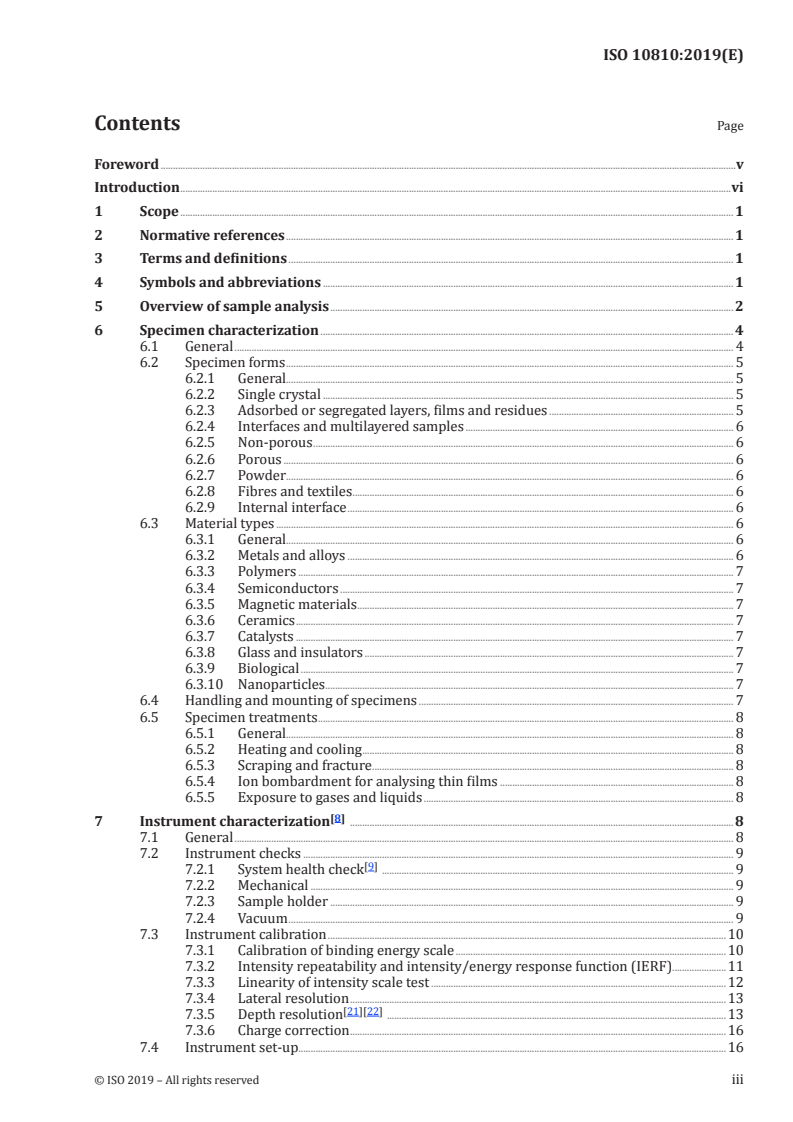
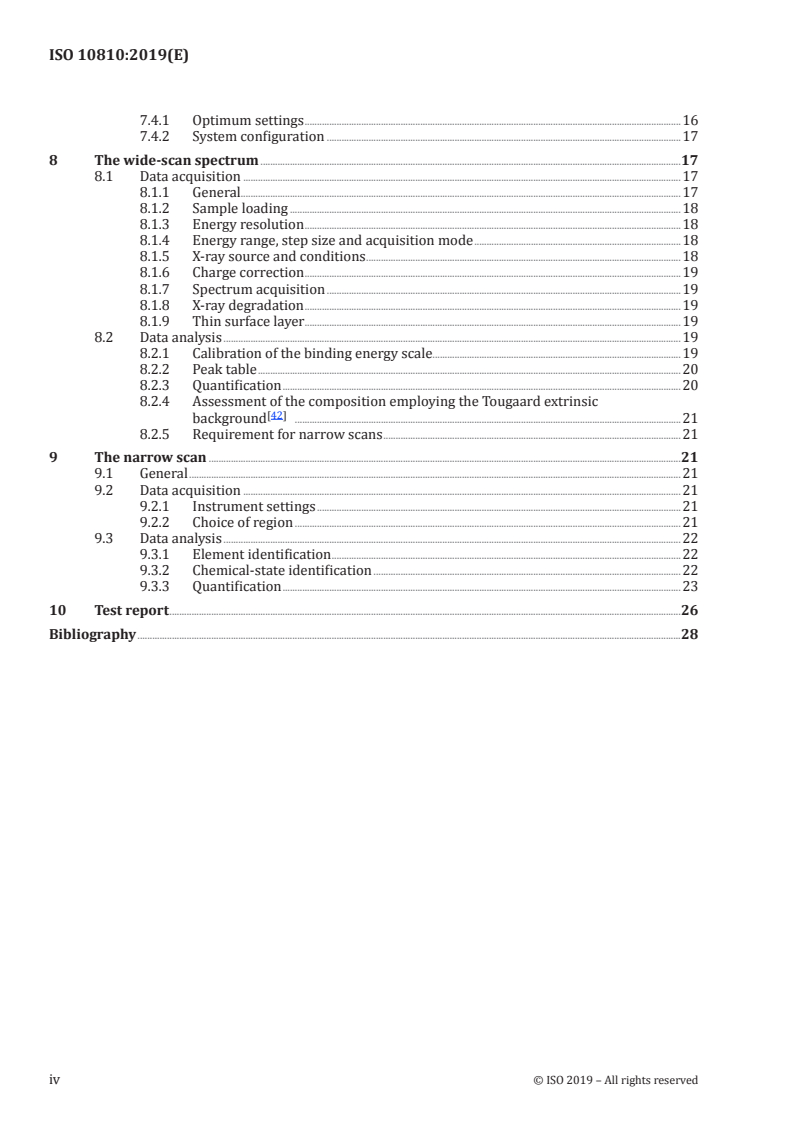
Contents Page
Foreword .v
Introduction .vi
1 Scope . 1
2 Normative references . 1
3 Terms and definitions . 1
4 Symbols and abbreviations . 1
5 Overview of sample analysis . 2
6 Specimen characterization . 4
6.1 General . 4
6.2 Specimen forms . 5
6.2.1 General. 5
6.2.2 Single crystal . 5
6.2.3 Adsorbed or segregated layers, films and residues . 5
6.2.4 Interfaces and multilayered samples . 6
6.2.5 Non-porous . 6
6.2.6 Porous . 6
6.2.7 Powder . . 6
6.2.8 Fibres and textiles . 6
6.2.9 Internal interface . 6
6.3 Material types . 6
6.3.1 General. 6
6.3.2 Metals and alloys . 6
6.3.3 Polymers . 7
6.3.4 Semiconductors . 7
6.3.5 Magnetic materials . 7
6.3.6 Ceramics . 7
6.3.7 Catalysts . 7
6.3.8 Glass and insulators . 7
6.3.9 Biological . 7
6.3.10 Nanoparticles . 7
6.4 Handling and mounting of specimens . 7
6.5 Specimen treatments . 8
6.5.1 General. 8
6.5.2 Heating and cooling . 8
6.5.3 Scraping and fracture . . 8
6.5.4 Ion bombardment for analysing thin films . 8
6.5.5 Exposure to gases and liquids . 8
[8]
7 Instrument characterization . 8
7.1 General . 8
7.2 Instrument checks . 9
[9]
7.2.1 System health check . 9
7.2.2 Mechanical . 9
7.2.3 Sample holder . 9
7.2.4 Vacuum . 9
7.3 Instrument calibration .10
7.3.1 Calibration of binding energy scale .10
7.3.2 Intensity repeatability and intensity/energy response function (IERF).11
7.3.3 Linearity of intensity scale test .12
7.3.4 Lateral resolution .13
[21][22]
7.3.5 Depth resolution .13
7.3.6 Charge correction .16
7.4 Instrument set-up.16
7.4.1 Optimum settings .16
7.4.2 System configuration .17
8 The wide-scan spectrum .17
8.1 Data acquisition .17
8.1.1 General.17
8.1.2 Sample loading .18
8.1.3 Energy resolution .18
8.1.4 Energy range, step size and acquisition mode .18
8.1.5 X-ray source and conditions .18
8.1.6 Charge correction .19
8.1.7 Spectrum acquisition .19
8.1.8 X-ray degradation .19
8.1.9 Thin surface layer .19
8.2 Data analysis .19
8.2.1 Calibration of the binding energy scale .19
8.2.2 Peak table .20
8.2.3 Quantification .20
8.2.4 Assessment of the composition employing the Tougaard extrinsic
[42]
background .21
8.2.5 Requirement for narrow scans .21
9 The narrow scan .21
9.1 General .21
9.2 Data acquisition .21
9.2.1 Instrument settings .21
9.2.2 Choice of region .21
9.3 Data analysis .22
9.3.1 Element identification .22
9.3.2 Chemical-state identification .22
9.3.3 Quantification .23
10 Test report .26
Bibliography .28
iv © ISO 2019 – All rights reserved
Foreword
ISO (the International Organization for Standardization) is a worldwide federation of national standards
bodies (ISO member bodies). The work of preparing International Standards is normally carried out
through ISO technical committees. Each member body interested in a subject for which a technical
committee has been established has the right to be represented on that committee. International
organizations, governmental and non-governmental, in liaison with ISO, also take part in the work.
ISO collaborates closely with the International Electrotechnical Commission (IEC) on all matters of
electrotechnical standardization.
The procedures used to develop this document and those intended for its further maintenance are
described in the ISO/IEC Directives, Part 1. In particular, the different approval criteria needed for the
different types of ISO documents should be noted. This document was drafted in accordance with the
editorial rules of the ISO/IEC Directives, Part 2 (see www .iso .org/directives).
Attention is drawn to the possibility that some of the elements of this document may be the subject of
patent rights. ISO shall not be held responsible for identifying any or all such patent rights. Details of
any patent rights identified during the development of the document will be in the Introduction and/or
on the ISO list of patent declarations received (see www .iso .org/patents).
Any trade name used in this document is information given for the convenience of users and does not
constitute an endorsement.
For an explanation of the voluntary nature of standards, the meaning of ISO specific terms and
expressions related to conformity assessment, as well as information about ISO's adherence to the
World Trade Organization (WTO) principles in the Technical Barriers to Trade (TBT) see www .iso
.org/iso/foreword .html.
This document was prepared by Technical Committee ISO/TC 201, Surface chemical analysis,
Subcommittee SC 7, Electron spectroscopies.
This second edition cancels and replaces the first edition (ISO 10810:2010), which has been technically
revised. The main changes to the previous edition are as follows:
— Table 3: semiconductor wafer added as a specimen form;
— 6.2.7: paragraph replaced to reflect modern practice;
— 6.3.10: nanoparticles added as a material type;
— Clause 8 and the flow chart in Figure 6 have been thoroughly revised to improve clarity. The cells in
the flow chart now contain references to the appropriate subclause within Clause 8;
— 8.2.1: it is now pointed out that the use of the C 1s peak provides only an approximate binding
energy reference;
— 9.3.3.3: mention has been made of the use of ionised clusters of inert gas atoms for depth profiling.
Any feedback or questions on this document should be directed to the user’s national standards body. A
complete listing of these bodies can be found at www .iso .org/members .html.
Introduction
X-ray photoelectron spectroscopy (XPS) is used extensively for the surface (1 nm to 10 nm) analysis
of materials. Elements in the sample (with the exception of hydrogen and helium) are identified from
comparisons of the measured binding energies of their core levels with tabulations of those energies
for the different elements. Their chemical states may be determined from shifts in peak positions and
other parameters compared with the data for that element in its pure elemental state. Information on
the quantities of such elements can be derived from the measured intensities of photoelectron peaks.
Calculation of the quantities of the constituent chemical species present in the surface layer studied
(outer 1 nm to 10 nm) may then be made using formulae and relative-sensitivity factors provided by the
spectrometer manufacturer or locally measured relative-sensitivity factors and appropriate software.
This guidance document is intended to aid the operators of X-ray photoelectron spectrometers in their
analysis of the surfaces (outer 1 nm to 10 nm) of typical samples.
vi © ISO 2019 – All rights reserved
INTERNATIONAL STANDARD ISO 10810:2019(E)
Surface chemical analysis — X-ray photoelectron
spectroscopy — Guidelines for analysis
1 Scope
This document is intended to aid the operators of X-ray photoelectron spectrometers in their analysis
of typical samples. It takes the operator through the analysis from the handling of the sample and the
calibration and setting-up of the spectrometer to the acquisition of wide and narrow scans and also
gives advice on quantification and on preparation of the final report.
2 Normative references
The following documents are referred to in the text in such a way that some or all of their content
constitutes requirements of this document. For dated references, only the edition cited applies. For
undated references, the latest edition of the referenced document (including any amendments) applies.
ISO 18115-1, Surface chemical analysis — Vocabulary — Part 1: General terms and terms used in
spectroscopy
3 Terms and definitions
For the purposes of this document, the terms and definitions given in ISO 18115-1 apply.
ISO and IEC maintain terminological databases for use in standardization at the following addresses:
— ISO Online browsing platform: available at https: //www .iso .org/obp
— IEC Electropedia: available at http: //www .electropedia .org/
4 Symbols and abbreviations
AES Auger electron spectroscopy
ARXPS angle-resolved X-ray photoelectron spectroscopy
CCQM consultative committee for amount of substance
CRM certified reference material
EAL effective attenuation length
FAT fixed analyser transmission
FRR fixed retard ratio
FWHM full width at half maximum
IERF intensity/energy response function
NIST National Institute of Standards and Technology
NPL National Physical Laboratory
RM reference material
S/N signal-to-noise ratio
XPS X-ray photoelectron spectroscopy
Δ difference between the measured and reference energies for Au 4f
Au 7/2
Δ difference between the measured and reference energies for Cu 2p
Cu 3/2
5 Overview of sample analysis
Figure 1 is a flow chart illustrating the analysis of a typical sample by XPS. A preliminary consultation
with the supplier of the sample should be used to ensure that the sample is supplied in the form most
[2]
appropriate for analysis. ISO 18117 explains the issues involved with prior handling by the supplier
and also gives information on the most suitable container for transportation. In this consideration, the
analyst should also identify any particular problems likely to arise. Table 1 provides a list of example
problems. Prior to any work, discussions should be held between the analyst and the customer to
gain as much information as possible by reviewing what is already known regarding the sample and
[2]
its history. In addition to the information listed in ISO 18117 , Table 2 indicates information that
will assist in deciding how to conduct the XPS analysis. Following these preliminary discussions,
the sample(s) may need to be prepared to allow mounting in the spectrometer and to reduce, where
[1]
possible, the subsequent analysis time. ISO 18116 provides details of how to do this. The analyst
will be responsible for the instrument characterization, which will include the calibration state and
the overall performance of the XPS instrument. A guide to calibration of the energy scale is given in
[14] [9] [18]
ISO 15472 . Checks for the intensity scale are given in ISO 24237 and ISO 21270 .
Once the specimen has been mounted in the spectrometer and the system pumped down, data
acquisition can commence. A wide scan should be obtained first and then analysed to determine the
[31]
elements present. ISO 16243 provides information on recording and reporting data in XPS. The wide-
scan spectrum can provide qualitative and semiquantitative information regarding composition and
the depth distribution of species. This may yield sufficient information to satisfy the customer and the
analysis may be terminated. However, in most cases, more data are required and narrow-scan spectra
will then be recorded from regions identified in the wide-scan spectrum. Analysis of these narrow-
scan spectra will provide chemical-state information, more accurate quantitative information and
near-surface depth information. At a later time in the investigation the wide scan should be repeated
to determine if there has been degradation (e.g. due to X-ray irradiation or to surface reactions with
ambient gases in the vacuum system). Following evaluation of the XPS data, the analyst should produce
a report.
2 © ISO 2019 – All rights reserved
Table 1 — Problems likely to arise and related ISO standards
Problem Example ISO standard
[1]
Outgassing Water vapour ISO 18116
Degradation Polymers and organics ISO 18554
[28]
Charging Insulators ISO 19318
Reduction Oxides
Contaminant mobility Chlorine
[1]
Sample containment Powders ISO 18116
Surface topography Fibres
Table 2 — Sample information and history
Sample information and history
Thermal
Contamination
Possible composition
Segregation
Surface layer
Homogeneous
Islands
NOTE The numbers in brackets indicate the respective subclauses in this document.
Figure 1 — Flow chart of an XPS analysis
6 Specimen characterization
6.1 General
The complexity of the interacting factors in XPS analyses arises from the many different forms of
specimen materials and the variety of material types that may be encountered as well as from the
different XPS experiments that might be required. Table 3 illustrates possible specimen forms, material
types, and XPS experiments or issues for further review. The analyst should also be aware that samples
can consist of multiple components and phases, and that identification of the components and phases
present (and their spatial arrangements) can be an important part of an XPS analysis. A further
complication is that non-conducting samples may charge.
4 © ISO 2019 – All rights reserved
Table 3 — Some specimen forms, material types, in situ specimen treatments
and possible XPS experiments
Specimen forms Material types In situ specimen treatments XPS experiments
Adsorbed layers (6.2.3) Alloy (6.3.2) Cooling (6.5.2) Angle-resolved XPS
Amorphous Biological (6.3.9) Degradation Small area analysis
Fibres (6.2.8) Catalyst (6.3.7) Deposit thin films Large area analysis
Films (6.2.3) Ceramic (6.3.6) Expose to high gas pressure Depth profile
(6.5.5)
Interface (6.2.4) Composite Fracture (6.5.3) Imaging
Internal interface (6.2.9) Glass (6.3.8) Heating (6.5.2) Line scan
Liquid Insulator (6.3.8) Insert into liquids (6.5.5)
Multilayered (6.2.4) Magnetic metal (6.3.5) Ion bombardment (6.5.4)
Nano-material Metal (6.3.2) Scraping (6.5.3)
Non-metal (pure)
Non-porous (6.2.5) element
Pattern system Polymer (6.3.3)
Polycrystal Semiconductor (6.3.4)
Porous (6.2.6)
Powder (6.2.7)
Residue (6.2.3)
Segregated layer (6.2.3)
Single crystal (6.2.2)
Solid
Semiconductor wafer Semiconductor Ozone and UV/ozone cleaning
Textile (6.2.8)
Contamination
6.2 Specimen forms
6.2.1 General
The form of the specimen to be analysed will strongly dictate the kinds of experimental approach that
can and need to be employed.
6.2.2 Single crystal
This type of sample should have a flat surface. Quantitative analyses will generally be difficult because
of anisotropies in the angular distributions of the photoemitted electrons due to electron diffraction
[3][4]
or to forward-focusing effects . These anisotropies are nevertheless useful in determining the
structural properties of the sample.
6.2.3 Adsorbed or segregated layers, films and residues
It should, in general, be possible to obtain a quantitative analysis and chemical-state information for
[5][6]
adsorbed or segregated layers, films and residues . If the substrate is a single crystal, however,
quantitative analyses will generally be difficult, but the angular distributions of the photoemitted
[3]
electrons can give useful structural information . Angle-resolved XPS (ARXPS), as described in 9.3.3,
will enable the layer thickness to be determined, provided the layer thickness does not exceed around
three times the effective attenuation length (EAL) of the substrate peak. This will be of progressively
lower accuracy for films above one EAL in thickness.
6.2.4 Interfaces and multilayered samples
Ion sputter depth profiling should permit the depth distribution and thickness of the layers to be
determined, together with a semiquantitative analysis of the layers, as described in 9.3.3.
6.2.5 Non-porous
A quantitative analysis together with chemical-state information can be obtained.
6.2.6 Porous
Only a semiquantitative analysis may be possible since the sample will have a rough surface.
6.2.7 Powder
Powders may be analysed directly from a suitable boat, or compressed into a pellet using a clean, metal
press. Ensure that the particles do not spill from the holder and do not tilt the sample. Alternatively, the
sample may be mounted in, or on, a suitable matrix (e.g. indium). Double-sided, conductive, adhesive
tape is also suitable and convenient as a mounting material. The use of outgassing mounting materials
should be avoided. Signals from the substrate or holder may interfere with the signal from the powder.
As for porous materials, it is likely that only semiquantitative analysis will be possible. Before mounting
the sample holder in the analysis chamber, check that the powder particles are firmly attached to the
substrate. In some cases, differential charging could be a problem.
6.2.8 Fibres and textiles
For fibre analysis, the alignment of the fibres relative to the X-ray source may be an important factor.
The diameter of the fibre relative to the diameter of the analysis area will also affect the ability to
quantify the data. If possible, mount several fibres in a bundle to increase the surface area. However,
a quantitative analysis will generally not be possible with many manufacturers' software systems,
although some chemical-state information can be obtained. Under certain conditions, it is possible to
analyse one monofibre, using a coaxial ion gun to conduct a sputter depth profile or, if there is sufficient
spatial resolution in relation to the fibre diameter, ARXPS may be conducted around the circumference.
6.2.9 Internal interface
An internal interface can be analysed using ARXPS, as described in 9.3.3, bearing in mind the depth
limit of around three times the EAL discussed in 6.2.3. To analyse a weak or brittle internal interface
that occurs at greater depths, it is generally necessary to first expose the interface in the ultra-high
vacuum, for example by use of fracture stages. For other internal interfaces, one of the forms of depth
[21]
profiling described in ISO/TR 15969 may prove effective.
6.3 Material types
6.3.1 General
For different materials, there are various consequences for an XPS experiment that may need to be
considered. For example, problems may arise when analysing magnetic, radioactive and outgassing
samples.
6.3.2 Metals and alloys
With specimens in this category, there should be minimal surface charging, but there may be a surface
oxide film together with a high level of carbon contamination. In general, there should be no need for
surface treatment prior to analysis. However, in many cases in situ ion sputtering is carried out prior to
analysis to remove any oxide/contaminant overlayer.
6 © ISO 2019 – All rights reserved
6.3.3 Polymers
It may be difficult to achieve the desired vacuum with this category of sample due to outgassing. During
analysis, adventitious carbon and possibly sample charging and sample degradation may occur. The
spectra should contain intense peaks from C, O and N, possibly also from F, Cl and S.
6.3.4 Semiconductors
There should be minimal surface charging with these specimens and there should be low levels of
carbon contamination. However, expect to see a surface oxide.
6.3.5 Magnetic materials
Take care when handling magnetic materials. First demagnetize them, if possible, and analyse with any
magnetic immersion lens switched off. A magnetized sample will affect the performance of a magnetic
lens in a way which will depend on the kinetic energy of the electrons being analysed. A magnetized
sample may also lead to changes in a measured spectrum that depend on the electron energy. Expect
the analysis to be similar to that for metals and alloys.
6.3.6 Ceramics
Sintered or porous ceramics may outgas and it may be difficult to evacuate the chamber to a pressure
sufficiently low for XPS analysis. A threshold pressure may be set by the manufacturer to protect the
X-ray source or other instrumental items. There may be significant surface charging and one should
expect moderate levels of surface carbon contamination.
6.3.7 Catalysts
These samples may behave in a similar way to ceramics, and there may be health and safety
considerations when handling.
6.3.8 Glass and insulators
These samples may be analysed but will charge, and the use of an electron flood gun with or without a
low-energy positive-ion flood may be necessary to reduce the effect of charging.
6.3.9 Biological
These samples may outgas in the spectrometer and suffer degradation due to either the vacuum
environment or the X-ray flux or both.
6.3.10 Nanoparticles
Many nanoparticles are susceptible to change as a function of time. The rate and nature of this change
will depend upon the environment to which they are exposed. It is necessary to take care in handling
to mitigate the effect of the environment. Nanoparticles are often stored under liquid; outgassing may
therefore occur once they are loaded into the spectrometer. Nanoparticles are usually dispersed on a
substrate prior to analysis. Signals from the substrate (or a contamination layer at the surface of the
substrate) may interfere with the signal from the nanoparticles and the method used can affect the
degree of dispersion. Non-volatile solutes, such as salts, will deposit with the particles unless special
care is taken to remove them prior to sample preparation.
6.4 Handling and mounting of specimens
[1]
Guidelines for the preparation and mounting of specimens for analysis are given in ISO 18116 and
[2]
ISO 18117 , and general information on specimen handling is also available in References [5] to [7].
6.5 Specimen treatments
6.5.1 General
There are many in situ treatments available to the analyst to obtain relevant data. Surface layers may
be sputtered away using gas and/or liquid-metal ions, but these may, in turn, modify the surface by
implanting ions and by preferential sputtering of elements. In many cases, surfaces may be cleaned
with minimal surface modification using ions consisting of noble gas clusters. Motion transfer devices
fitted with, for example, knives permit surface layers to be removed without exposing the underlying
layer to atmospheric pressure. Heating and cooling stages allow the sample temperature to be modified.
Fracture stages allow internal interfaces to be exposed.
6.5.2 Heating and cooling
Many XPS spectrometers are equipped with heating and cooling stages. Cooling is achieved by passing
liquid nitrogen through a conducting metal block, although it is rarely possible to reach 77 K and
minimum temperatures of 100 K are more realistic, while heating may be achieved by passing a current
through a resistive coil, by shining an infrared lamp onto the sample or by using a hot liquid in the
cooling stage.
6.5.3 Scraping and fracture
A fresh surface of a material can be produced either by removing layers from the surface using a sharp
implement attached to a transfer device with lateral movement or by cleavage using an impact fracture
device at room, or a reduced, temperature. The cooling will enhance the brittleness of many samples.
6.5.4 Ion bombardment for analysing thin films
Ion bombardment is usually with argon ions, although other inert-gas ions, liquid-metal ions (such as
+ +
gallium) or cluster ions (such as C or Ar ) can be used to remove surface layers from the sample.
60 n
However, preferential sputtering may result in an analysed surface that is not representative of the
original sample.
6.5.5 Exposure to gases and liquids
Chambers with interlocks from the analytical chamber can be used to expose a clean surface prepared
as in 6.5.2 to 6.5.4 to high-pressure gases and to liquids over a range of temperatures. The chamber is
then evacuated and the sample transferred back to the analytical chamber for analysis. Alternatively,
samples may be removed from the system into a pumped transfer module for treatment in other
equipment before returning via a similar route.
[8]
7 Instrument characterization
7.1 General
X-ray photoelectron spectrometers are not constructed to a standard design, and each instrument
will be configured to operate most efficiently in a particular mode. The majority of XPS instruments
currently produced will be supplied with an X-ray monochromator. A small analysis area may be defined
or the sample imaged with selected photoelectrons either by focusing monochromated X-rays or by
focusing the emitted electrons, However, significant quantities of XPS analysis are routinely conducted
with simpler instruments that use broad beams of non-monochromatized X-rays to analyse the sample.
8 © ISO 2019 – All rights reserved
7.2 Instrument checks
[9]
7.2.1 System health check
Use of a reference sample of gold, silver and/or copper mounted permanently in the analysis chamber
is convenient for checking the system, but it is also advisable to have a sample of a frequently analysed
material (e.g. a silicon wafer in a semiconductor laboratory). A spectrum recorded from the reference
sample will indicate if the measured energies of the calibrating peaks have drifted. It will also indicate
the state of a non-monochromatized X-ray source by showing the presence of ghost peaks from Cu, Mg
[10]
or Al in the X-ray anode, suggesting it is nearing the end of its life. In addition, it will indicate, by
the presence of a high background and increased contamination, that the X-ray window is damaged,
and monitoring the intensity of the gold peaks will indicate the efficiency of the X-ray source and
the electron detectors. The signal intensity will vary with energy resolution, spatial resolution and
depth resolution. The ultimate performance is not always required, and the analyst may need good
repeatability rather than the limits of performance — i.e. good signal levels at modest energy or spatial
resolution. The operator should identify the acceptable intensity level for given conditions and regularly
monitor the instrument to ensure that this level, or a better level, is maintained.
A formal procedure for regularly assessing the performance of an X-ray photoelectron spectrometer is
described in ISO 16129.
7.2.2 Mechanical
The sample is mounted on the sample stage, which may have X, Y and Z movements as well as tilt.
Proper adjustment of the sample height is crucially important when a focused monochromatic X-ray
source is used.
Tilt needs to be determined accurately from the spectrometer axis, because an error of 0,3° in a tilt
angle at 60° will result in a 1 % error in the total film thickness. Methods of calibrating emission angles
[11]
are described by Seah and Spencer (where errors of 2,6° were found in the nominal settings) and
[12] [13]
by Kim et al. and Seah . ARXPS experiments may require the sample to be tilted over an angular
range of, typically, 0° to 60° from the surface normal. This may not be possible if the sample is large (e.g.
a silicon wafer) and cannot be cut to fit the system.
7.2.3 Sample holder
The sample holder may have facilities for heating and cooling of the sample. The temperature of the
sample should be determined by calibration, using a thermocouple or other suitable device. The sample
stage may already have a thermocouple attached, but there may be a temperature gradient between the
sample surface and the thermocouple position. The temperature measurement should be made with
and without the X-ray source and/or ion sputter gun operating, as adventitious heating may influence
the measurements.
7.2.4 Vacuum
The vacuum in the analysis chamber can become degraded for various reasons. The pumps may
deteriorate (e.g. liquid-nitrogen traps not topped up, ion pumps releasing previously pumped gases), the
window on the X-ray source may fail or components may become heated and outgas. During analysis, the
sample may degrade due to heating and, during depth profiling, the sample may react with impurities
in the sputtering gas. The pressure in the analysis chamber should be continuously monitored and, if
an unusual increase in pressure occurs, a mass spectrometer should be used to identify the gas species
present in order to determine if they are likely to react with the specimen.
7.3 Instrument calibration
7.3.1 Calibration of binding energy scale
XPS is frequently used for the determination and measurement of chemical shifts of elemental
photoelectron and Auger electron lines. Identification of chemical states is based on measurements of
peak shifts down to 0,1 eV. It is important that the instrumental binding-energy scale be calibrated
to an accuracy of 0,2 eV or better in order for useful comparisons to be made with published or other
[14]
reference data. ISO 15472 describes the method for the accurate calibration of energy scales. This
should be used with reference samples of pure gold, silver and copper to enable the calibrations to
be made using unmonochromatized Mg or Al X-rays or monochromatic Al X-rays. It is valid, at the
accuracy stated, for binding energies in the range 0 eV to 1 040 eV (users normally extend this to the
full energy range available, but note that extrapolating a calibration is significantly more uncertain
than interpolating it and so the uncertainty beyond 1 040 eV is unspecified), but is only applicable to
instruments fitted with ion guns for specimen cleaning.
Briefly, the method involves ion cleaning of the samples and an initial set of measurements performed
once, followed by a second, simpler, set of measurements performed at regular intervals. In the first set
of measurements, the binding energies of the Cu 2p and Au 4f peaks are recorded to obtain the
3/2 7/2
energy scale calibration. In instruments with unmonochromatized X-ray sources, the Cu L VV Auger
peak energy is measured and, in instruments with a monochromatized Al X-ray source, the Ag 3d peak
5/2
binding energy is recorded to determine the linearity of the energy scale. In subsequent measurements,
the binding energies of the Au 4f and Cu 2p peaks are recorded at regular intervals.
7/2 3/2
Results of the second set of measurements are generally limited by drift, and the operator should
keep records and pre
...
INTERNATIONAL ISO
STANDARD 10810
Second edition
2019-08
Surface chemical analysis — X-ray
photoelectron spectroscopy —
Guidelines for analysis
Analyse chimique des surfaces — Spectroscopie de photoélectrons par
rayons X — Lignes directrices pour l'analyse
Reference number
©
ISO 2019
© ISO 2019
All rights reserved. Unless otherwise specified, or required in the context of its implementation, no part of this publication may
be reproduced or utilized otherwise in any form or by any means, electronic or mechanical, including photocopying, or posting
on the internet or an intranet, without prior written permission. Permission can be requested from either ISO at the address
below or ISO’s member body in the country of the requester.
ISO copyright office
CP 401 • Ch. de Blandonnet 8
CH-1214 Vernier, Geneva
Phone: +41 22 749 01 11
Fax: +41 22 749 09 47
Email: copyright@iso.org
Website: www.iso.org
Published in Switzerland
ii © ISO 2019 – All rights reserved
Contents Page
Foreword .v
Introduction .vi
1 Scope . 1
2 Normative references . 1
3 Terms and definitions . 1
4 Symbols and abbreviations . 1
5 Overview of sample analysis . 2
6 Specimen characterization . 4
6.1 General . 4
6.2 Specimen forms . 5
6.2.1 General. 5
6.2.2 Single crystal . 5
6.2.3 Adsorbed or segregated layers, films and residues . 5
6.2.4 Interfaces and multilayered samples . 6
6.2.5 Non-porous . 6
6.2.6 Porous . 6
6.2.7 Powder . . 6
6.2.8 Fibres and textiles . 6
6.2.9 Internal interface . 6
6.3 Material types . 6
6.3.1 General. 6
6.3.2 Metals and alloys . 6
6.3.3 Polymers . 7
6.3.4 Semiconductors . 7
6.3.5 Magnetic materials . 7
6.3.6 Ceramics . 7
6.3.7 Catalysts . 7
6.3.8 Glass and insulators . 7
6.3.9 Biological . 7
6.3.10 Nanoparticles . 7
6.4 Handling and mounting of specimens . 7
6.5 Specimen treatments . 8
6.5.1 General. 8
6.5.2 Heating and cooling . 8
6.5.3 Scraping and fracture . . 8
6.5.4 Ion bombardment for analysing thin films . 8
6.5.5 Exposure to gases and liquids . 8
[8]
7 Instrument characterization . 8
7.1 General . 8
7.2 Instrument checks . 9
[9]
7.2.1 System health check . 9
7.2.2 Mechanical . 9
7.2.3 Sample holder . 9
7.2.4 Vacuum . 9
7.3 Instrument calibration .10
7.3.1 Calibration of binding energy scale .10
7.3.2 Intensity repeatability and intensity/energy response function (IERF).11
7.3.3 Linearity of intensity scale test .12
7.3.4 Lateral resolution .13
[21][22]
7.3.5 Depth resolution .13
7.3.6 Charge correction .16
7.4 Instrument set-up.16
7.4.1 Optimum settings .16
7.4.2 System configuration .17
8 The wide-scan spectrum .17
8.1 Data acquisition .17
8.1.1 General.17
8.1.2 Sample loading .18
8.1.3 Energy resolution .18
8.1.4 Energy range, step size and acquisition mode .18
8.1.5 X-ray source and conditions .18
8.1.6 Charge correction .19
8.1.7 Spectrum acquisition .19
8.1.8 X-ray degradation .19
8.1.9 Thin surface layer .19
8.2 Data analysis .19
8.2.1 Calibration of the binding energy scale .19
8.2.2 Peak table .20
8.2.3 Quantification .20
8.2.4 Assessment of the composition employing the Tougaard extrinsic
[42]
background .21
8.2.5 Requirement for narrow scans .21
9 The narrow scan .21
9.1 General .21
9.2 Data acquisition .21
9.2.1 Instrument settings .21
9.2.2 Choice of region .21
9.3 Data analysis .22
9.3.1 Element identification .22
9.3.2 Chemical-state identification .22
9.3.3 Quantification .23
10 Test report .26
Bibliography .28
iv © ISO 2019 – All rights reserved
Foreword
ISO (the International Organization for Standardization) is a worldwide federation of national standards
bodies (ISO member bodies). The work of preparing International Standards is normally carried out
through ISO technical committees. Each member body interested in a subject for which a technical
committee has been established has the right to be represented on that committee. International
organizations, governmental and non-governmental, in liaison with ISO, also take part in the work.
ISO collaborates closely with the International Electrotechnical Commission (IEC) on all matters of
electrotechnical standardization.
The procedures used to develop this document and those intended for its further maintenance are
described in the ISO/IEC Directives, Part 1. In particular, the different approval criteria needed for the
different types of ISO documents should be noted. This document was drafted in accordance with the
editorial rules of the ISO/IEC Directives, Part 2 (see www .iso .org/directives).
Attention is drawn to the possibility that some of the elements of this document may be the subject of
patent rights. ISO shall not be held responsible for identifying any or all such patent rights. Details of
any patent rights identified during the development of the document will be in the Introduction and/or
on the ISO list of patent declarations received (see www .iso .org/patents).
Any trade name used in this document is information given for the convenience of users and does not
constitute an endorsement.
For an explanation of the voluntary nature of standards, the meaning of ISO specific terms and
expressions related to conformity assessment, as well as information about ISO's adherence to the
World Trade Organization (WTO) principles in the Technical Barriers to Trade (TBT) see www .iso
.org/iso/foreword .html.
This document was prepared by Technical Committee ISO/TC 201, Surface chemical analysis,
Subcommittee SC 7, Electron spectroscopies.
This second edition cancels and replaces the first edition (ISO 10810:2010), which has been technically
revised. The main changes to the previous edition are as follows:
— Table 3: semiconductor wafer added as a specimen form;
— 6.2.7: paragraph replaced to reflect modern practice;
— 6.3.10: nanoparticles added as a material type;
— Clause 8 and the flow chart in Figure 6 have been thoroughly revised to improve clarity. The cells in
the flow chart now contain references to the appropriate subclause within Clause 8;
— 8.2.1: it is now pointed out that the use of the C 1s peak provides only an approximate binding
energy reference;
— 9.3.3.3: mention has been made of the use of ionised clusters of inert gas atoms for depth profiling.
Any feedback or questions on this document should be directed to the user’s national standards body. A
complete listing of these bodies can be found at www .iso .org/members .html.
Introduction
X-ray photoelectron spectroscopy (XPS) is used extensively for the surface (1 nm to 10 nm) analysis
of materials. Elements in the sample (with the exception of hydrogen and helium) are identified from
comparisons of the measured binding energies of their core levels with tabulations of those energies
for the different elements. Their chemical states may be determined from shifts in peak positions and
other parameters compared with the data for that element in its pure elemental state. Information on
the quantities of such elements can be derived from the measured intensities of photoelectron peaks.
Calculation of the quantities of the constituent chemical species present in the surface layer studied
(outer 1 nm to 10 nm) may then be made using formulae and relative-sensitivity factors provided by the
spectrometer manufacturer or locally measured relative-sensitivity factors and appropriate software.
This guidance document is intended to aid the operators of X-ray photoelectron spectrometers in their
analysis of the surfaces (outer 1 nm to 10 nm) of typical samples.
vi © ISO 2019 – All rights reserved
INTERNATIONAL STANDARD ISO 10810:2019(E)
Surface chemical analysis — X-ray photoelectron
spectroscopy — Guidelines for analysis
1 Scope
This document is intended to aid the operators of X-ray photoelectron spectrometers in their analysis
of typical samples. It takes the operator through the analysis from the handling of the sample and the
calibration and setting-up of the spectrometer to the acquisition of wide and narrow scans and also
gives advice on quantification and on preparation of the final report.
2 Normative references
The following documents are referred to in the text in such a way that some or all of their content
constitutes requirements of this document. For dated references, only the edition cited applies. For
undated references, the latest edition of the referenced document (including any amendments) applies.
ISO 18115-1, Surface chemical analysis — Vocabulary — Part 1: General terms and terms used in
spectroscopy
3 Terms and definitions
For the purposes of this document, the terms and definitions given in ISO 18115-1 apply.
ISO and IEC maintain terminological databases for use in standardization at the following addresses:
— ISO Online browsing platform: available at https: //www .iso .org/obp
— IEC Electropedia: available at http: //www .electropedia .org/
4 Symbols and abbreviations
AES Auger electron spectroscopy
ARXPS angle-resolved X-ray photoelectron spectroscopy
CCQM consultative committee for amount of substance
CRM certified reference material
EAL effective attenuation length
FAT fixed analyser transmission
FRR fixed retard ratio
FWHM full width at half maximum
IERF intensity/energy response function
NIST National Institute of Standards and Technology
NPL National Physical Laboratory
RM reference material
S/N signal-to-noise ratio
XPS X-ray photoelectron spectroscopy
Δ difference between the measured and reference energies for Au 4f
Au 7/2
Δ difference between the measured and reference energies for Cu 2p
Cu 3/2
5 Overview of sample analysis
Figure 1 is a flow chart illustrating the analysis of a typical sample by XPS. A preliminary consultation
with the supplier of the sample should be used to ensure that the sample is supplied in the form most
[2]
appropriate for analysis. ISO 18117 explains the issues involved with prior handling by the supplier
and also gives information on the most suitable container for transportation. In this consideration, the
analyst should also identify any particular problems likely to arise. Table 1 provides a list of example
problems. Prior to any work, discussions should be held between the analyst and the customer to
gain as much information as possible by reviewing what is already known regarding the sample and
[2]
its history. In addition to the information listed in ISO 18117 , Table 2 indicates information that
will assist in deciding how to conduct the XPS analysis. Following these preliminary discussions,
the sample(s) may need to be prepared to allow mounting in the spectrometer and to reduce, where
[1]
possible, the subsequent analysis time. ISO 18116 provides details of how to do this. The analyst
will be responsible for the instrument characterization, which will include the calibration state and
the overall performance of the XPS instrument. A guide to calibration of the energy scale is given in
[14] [9] [18]
ISO 15472 . Checks for the intensity scale are given in ISO 24237 and ISO 21270 .
Once the specimen has been mounted in the spectrometer and the system pumped down, data
acquisition can commence. A wide scan should be obtained first and then analysed to determine the
[31]
elements present. ISO 16243 provides information on recording and reporting data in XPS. The wide-
scan spectrum can provide qualitative and semiquantitative information regarding composition and
the depth distribution of species. This may yield sufficient information to satisfy the customer and the
analysis may be terminated. However, in most cases, more data are required and narrow-scan spectra
will then be recorded from regions identified in the wide-scan spectrum. Analysis of these narrow-
scan spectra will provide chemical-state information, more accurate quantitative information and
near-surface depth information. At a later time in the investigation the wide scan should be repeated
to determine if there has been degradation (e.g. due to X-ray irradiation or to surface reactions with
ambient gases in the vacuum system). Following evaluation of the XPS data, the analyst should produce
a report.
2 © ISO 2019 – All rights reserved
Table 1 — Problems likely to arise and related ISO standards
Problem Example ISO standard
[1]
Outgassing Water vapour ISO 18116
Degradation Polymers and organics ISO 18554
[28]
Charging Insulators ISO 19318
Reduction Oxides
Contaminant mobility Chlorine
[1]
Sample containment Powders ISO 18116
Surface topography Fibres
Table 2 — Sample information and history
Sample information and history
Thermal
Contamination
Possible composition
Segregation
Surface layer
Homogeneous
Islands
NOTE The numbers in brackets indicate the respective subclauses in this document.
Figure 1 — Flow chart of an XPS analysis
6 Specimen characterization
6.1 General
The complexity of the interacting factors in XPS analyses arises from the many different forms of
specimen materials and the variety of material types that may be encountered as well as from the
different XPS experiments that might be required. Table 3 illustrates possible specimen forms, material
types, and XPS experiments or issues for further review. The analyst should also be aware that samples
can consist of multiple components and phases, and that identification of the components and phases
present (and their spatial arrangements) can be an important part of an XPS analysis. A further
complication is that non-conducting samples may charge.
4 © ISO 2019 – All rights reserved
Table 3 — Some specimen forms, material types, in situ specimen treatments
and possible XPS experiments
Specimen forms Material types In situ specimen treatments XPS experiments
Adsorbed layers (6.2.3) Alloy (6.3.2) Cooling (6.5.2) Angle-resolved XPS
Amorphous Biological (6.3.9) Degradation Small area analysis
Fibres (6.2.8) Catalyst (6.3.7) Deposit thin films Large area analysis
Films (6.2.3) Ceramic (6.3.6) Expose to high gas pressure Depth profile
(6.5.5)
Interface (6.2.4) Composite Fracture (6.5.3) Imaging
Internal interface (6.2.9) Glass (6.3.8) Heating (6.5.2) Line scan
Liquid Insulator (6.3.8) Insert into liquids (6.5.5)
Multilayered (6.2.4) Magnetic metal (6.3.5) Ion bombardment (6.5.4)
Nano-material Metal (6.3.2) Scraping (6.5.3)
Non-metal (pure)
Non-porous (6.2.5) element
Pattern system Polymer (6.3.3)
Polycrystal Semiconductor (6.3.4)
Porous (6.2.6)
Powder (6.2.7)
Residue (6.2.3)
Segregated layer (6.2.3)
Single crystal (6.2.2)
Solid
Semiconductor wafer Semiconductor Ozone and UV/ozone cleaning
Textile (6.2.8)
Contamination
6.2 Specimen forms
6.2.1 General
The form of the specimen to be analysed will strongly dictate the kinds of experimental approach that
can and need to be employed.
6.2.2 Single crystal
This type of sample should have a flat surface. Quantitative analyses will generally be difficult because
of anisotropies in the angular distributions of the photoemitted electrons due to electron diffraction
[3][4]
or to forward-focusing effects . These anisotropies are nevertheless useful in determining the
structural properties of the sample.
6.2.3 Adsorbed or segregated layers, films and residues
It should, in general, be possible to obtain a quantitative analysis and chemical-state information for
[5][6]
adsorbed or segregated layers, films and residues . If the substrate is a single crystal, however,
quantitative analyses will generally be difficult, but the angular distributions of the photoemitted
[3]
electrons can give useful structural information . Angle-resolved XPS (ARXPS), as described in 9.3.3,
will enable the layer thickness to be determined, provided the layer thickness does not exceed around
three times the effective attenuation length (EAL) of the substrate peak. This will be of progressively
lower accuracy for films above one EAL in thickness.
6.2.4 Interfaces and multilayered samples
Ion sputter depth profiling should permit the depth distribution and thickness of the layers to be
determined, together with a semiquantitative analysis of the layers, as described in 9.3.3.
6.2.5 Non-porous
A quantitative analysis together with chemical-state information can be obtained.
6.2.6 Porous
Only a semiquantitative analysis may be possible since the sample will have a rough surface.
6.2.7 Powder
Powders may be analysed directly from a suitable boat, or compressed into a pellet using a clean, metal
press. Ensure that the particles do not spill from the holder and do not tilt the sample. Alternatively, the
sample may be mounted in, or on, a suitable matrix (e.g. indium). Double-sided, conductive, adhesive
tape is also suitable and convenient as a mounting material. The use of outgassing mounting materials
should be avoided. Signals from the substrate or holder may interfere with the signal from the powder.
As for porous materials, it is likely that only semiquantitative analysis will be possible. Before mounting
the sample holder in the analysis chamber, check that the powder particles are firmly attached to the
substrate. In some cases, differential charging could be a problem.
6.2.8 Fibres and textiles
For fibre analysis, the alignment of the fibres relative to the X-ray source may be an important factor.
The diameter of the fibre relative to the diameter of the analysis area will also affect the ability to
quantify the data. If possible, mount several fibres in a bundle to increase the surface area. However,
a quantitative analysis will generally not be possible with many manufacturers' software systems,
although some chemical-state information can be obtained. Under certain conditions, it is possible to
analyse one monofibre, using a coaxial ion gun to conduct a sputter depth profile or, if there is sufficient
spatial resolution in relation to the fibre diameter, ARXPS may be conducted around the circumference.
6.2.9 Internal interface
An internal interface can be analysed using ARXPS, as described in 9.3.3, bearing in mind the depth
limit of around three times the EAL discussed in 6.2.3. To analyse a weak or brittle internal interface
that occurs at greater depths, it is generally necessary to first expose the interface in the ultra-high
vacuum, for example by use of fracture stages. For other internal interfaces, one of the forms of depth
[21]
profiling described in ISO/TR 15969 may prove effective.
6.3 Material types
6.3.1 General
For different materials, there are various consequences for an XPS experiment that may need to be
considered. For example, problems may arise when analysing magnetic, radioactive and outgassing
samples.
6.3.2 Metals and alloys
With specimens in this category, there should be minimal surface charging, but there may be a surface
oxide film together with a high level of carbon contamination. In general, there should be no need for
surface treatment prior to analysis. However, in many cases in situ ion sputtering is carried out prior to
analysis to remove any oxide/contaminant overlayer.
6 © ISO 2019 – All rights reserved
6.3.3 Polymers
It may be difficult to achieve the desired vacuum with this category of sample due to outgassing. During
analysis, adventitious carbon and possibly sample charging and sample degradation may occur. The
spectra should contain intense peaks from C, O and N, possibly also from F, Cl and S.
6.3.4 Semiconductors
There should be minimal surface charging with these specimens and there should be low levels of
carbon contamination. However, expect to see a surface oxide.
6.3.5 Magnetic materials
Take care when handling magnetic materials. First demagnetize them, if possible, and analyse with any
magnetic immersion lens switched off. A magnetized sample will affect the performance of a magnetic
lens in a way which will depend on the kinetic energy of the electrons being analysed. A magnetized
sample may also lead to changes in a measured spectrum that depend on the electron energy. Expect
the analysis to be similar to that for metals and alloys.
6.3.6 Ceramics
Sintered or porous ceramics may outgas and it may be difficult to evacuate the chamber to a pressure
sufficiently low for XPS analysis. A threshold pressure may be set by the manufacturer to protect the
X-ray source or other instrumental items. There may be significant surface charging and one should
expect moderate levels of surface carbon contamination.
6.3.7 Catalysts
These samples may behave in a similar way to ceramics, and there may be health and safety
considerations when handling.
6.3.8 Glass and insulators
These samples may be analysed but will charge, and the use of an electron flood gun with or without a
low-energy positive-ion flood may be necessary to reduce the effect of charging.
6.3.9 Biological
These samples may outgas in the spectrometer and suffer degradation due to either the vacuum
environment or the X-ray flux or both.
6.3.10 Nanoparticles
Many nanoparticles are susceptible to change as a function of time. The rate and nature of this change
will depend upon the environment to which they are exposed. It is necessary to take care in handling
to mitigate the effect of the environment. Nanoparticles are often stored under liquid; outgassing may
therefore occur once they are loaded into the spectrometer. Nanoparticles are usually dispersed on a
substrate prior to analysis. Signals from the substrate (or a contamination layer at the surface of the
substrate) may interfere with the signal from the nanoparticles and the method used can affect the
degree of dispersion. Non-volatile solutes, such as salts, will deposit with the particles unless special
care is taken to remove them prior to sample preparation.
6.4 Handling and mounting of specimens
[1]
Guidelines for the preparation and mounting of specimens for analysis are given in ISO 18116 and
[2]
ISO 18117 , and general information on specimen handling is also available in References [5] to [7].
6.5 Specimen treatments
6.5.1 General
There are many in situ treatments available to the analyst to obtain relevant data. Surface layers may
be sputtered away using gas and/or liquid-metal ions, but these may, in turn, modify the surface by
implanting ions and by preferential sputtering of elements. In many cases, surfaces may be cleaned
with minimal surface modification using ions consisting of noble gas clusters. Motion transfer devices
fitted with, for example, knives permit surface layers to be removed without exposing the underlying
layer to atmospheric pressure. Heating and cooling stages allow the sample temperature to be modified.
Fracture stages allow internal interfaces to be exposed.
6.5.2 Heating and cooling
Many XPS spectrometers are equipped with heating and cooling stages. Cooling is achieved by passing
liquid nitrogen through a conducting metal block, although it is rarely possible to reach 77 K and
minimum temperatures of 100 K are more realistic, while heating may be achieved by passing a current
through a resistive coil, by shining an infrared lamp onto the sample or by using a hot liquid in the
cooling stage.
6.5.3 Scraping and fracture
A fresh surface of a material can be produced either by removing layers from the surface using a sharp
implement attached to a transfer device with lateral movement or by cleavage using an impact fracture
device at room, or a reduced, temperature. The cooling will enhance the brittleness of many samples.
6.5.4 Ion bombardment for analysing thin films
Ion bombardment is usually with argon ions, although other inert-gas ions, liquid-metal ions (such as
+ +
gallium) or cluster ions (such as C or Ar ) can be used to remove surface layers from the sample.
60 n
However, preferential sputtering may result in an analysed surface that is not representative of the
original sample.
6.5.5 Exposure to gases and liquids
Chambers with interlocks from the analytical chamber can be used to expose a clean surface prepared
as in 6.5.2 to 6.5.4 to high-pressure gases and to liquids over a range of temperatures. The chamber is
then evacuated and the sample transferred back to the analytical chamber for analysis. Alternatively,
samples may be removed from the system into a pumped transfer module for treatment in other
equipment before returning via a similar route.
[8]
7 Instrument characterization
7.1 General
X-ray photoelectron spectrometers are not constructed to a standard design, and each instrument
will be configured to operate most efficiently in a particular mode. The majority of XPS instruments
currently produced will be supplied with an X-ray monochromator. A small analysis area may be defined
or the sample imaged with selected photoelectrons either by focusing monochromated X-rays or by
focusing the emitted electrons, However, significant quantities of XPS analysis are routinely conducted
with simpler instruments that use broad beams of non-monochromatized X-rays to analyse the sample.
8 © ISO 2019 – All rights reserved
7.2 Instrument checks
[9]
7.2.1 System health check
Use of a reference sample of gold, silver and/or copper mounted permanently in the analysis chamber
is convenient for checking the system, but it is also advisable to have a sample of a frequently analysed
material (e.g. a silicon wafer in a semiconductor laboratory). A spectrum recorded from the reference
sample will indicate if the measured energies of the calibrating peaks have drifted. It will also indicate
the state of a non-monochromatized X-ray source by showing the presence of ghost peaks from Cu, Mg
[10]
or Al in the X-ray anode, suggesting it is nearing the end of its life. In addition, it will indicate, by
the presence of a high background and increased contamination, that the X-ray window is damaged,
and monitoring the intensity of the gold peaks will indicate the efficiency of the X-ray source and
the electron detectors. The signal intensity will vary with energy resolution, spatial resolution and
depth resolution. The ultimate performance is not always required, and the analyst may need good
repeatability rather than the limits of performance — i.e. good signal levels at modest energy or spatial
resolution. The operator should identify the acceptable intensity level for given conditions and regularly
monitor the instrument to ensure that this level, or a better level, is maintained.
A formal procedure for regularly assessing the performance of an X-ray photoelectron spectrometer is
described in ISO 16129.
7.2.2 Mechanical
The sample is mounted on the sample stage, which may have X, Y and Z movements as well as tilt.
Proper adjustment of the sample height is crucially important when a focused monochromatic X-ray
source is used.
Tilt needs to be determined accurately from the spectrometer axis, because an error of 0,3° in a tilt
angle at 60° will result in a 1 % error in the total film thickness. Methods of calibrating emission angles
[11]
are described by Seah and Spencer (where errors of 2,6° were found in the nominal settings) and
[12] [13]
by Kim et al. and Seah . ARXPS experiments may require the sample to be tilted over an angular
range of, typically, 0° to 60° from the surface normal. This may not be possible if the sample is large (e.g.
a silicon wafer) and cannot be cut to fit the system.
7.2.3 Sample holder
The sample holder may have facilities for heating and cooling of the sample. The temperature of the
sample should be determined by calibration, using a thermocouple or other suitable device. The sample
stage may already have a thermocouple attached, but there may be a temperature gradient between the
sample surface and the thermocouple position. The temperature measurement should be made with
and without the X-ray source and/or ion sputter gun operating, as adventitious heating may influence
the measurements.
7.2.4 Vacuum
The vacuum in the analysis chamber can become degraded for various reasons. The pumps may
deteriorate (e.g. liquid-nitrogen traps not topped up, ion pumps releasing previously pumped gases), the
window on the X-ray source may fail or components may become heated and outgas. During analysis, the
sample may degrade due to heating and, during depth profiling, the sample may react with impurities
in the sputtering gas. The pressure in the analysis chamber should be continuously monitored and, if
an unusual increase in pressure occurs, a mass spectrometer should be used to identify the gas species
present in order to determine if they are likely to react with the specimen.
7.3 Instrument calibration
7.3.1 Calibration of binding energy scale
XPS is frequently used for the determination and measurement of chemical shifts of elemental
photoelectron and Auger electron lines. Identification of chemical states is based on measurements of
peak shifts down to 0,1 eV. It is important that the instrumental binding-energy scale be calibrated
to an accuracy of 0,2 eV or better in order for useful comparisons to be made with published or other
[14]
reference data. ISO 15472 describes the method for the accurate calibration of energy scales. This
should be used with reference samples of pure gold, silver and copper to enable the calibrations to
be made using unmonochromatized Mg or Al X-rays or monochromatic Al X-rays. It is valid, at the
accuracy stated, for binding energies in the range 0 eV to 1 040 eV (users normally extend this to the
full energy range available, but note that extrapolating a calibration is significantly more uncertain
than interpolating it and so the uncertainty beyond 1 040 eV is unspecified), but is only applicable to
instruments fitted with ion guns for specimen cleaning.
Briefly, the method involves ion cleaning of the samples and an initial set of measurements performed
once, followed by a second, simpler, set of measurements performed at regular intervals. In the first set
of measurements, the binding energies of the Cu 2p and Au 4f peaks are recorded to obtain the
3/2 7/2
energy scale calibration. In instruments with unmonochromatized X-ray sources, the Cu L VV Auger
peak energy is measured and, in instruments with a monochromatized Al X-ray source, the Ag 3d peak
5/2
binding energy is recorded to determine the linearity of the energy scale. In subsequent measurements,
the binding energies of the Au 4f and Cu 2p peaks are recorded at regular intervals.
7/2 3/2
Results of the second set of measurements are generally limited by drift, and the operator should
keep records and pre
...