

ISO 5861:2024
(Main)Surface chemical analysis — X-ray photoelectron spectroscopy — Method of intensity calibration for quartz-crystal monochromated Al Kα XPS instruments
General Information
- Abstract
This document specifies a procedure by which the intensity scale of an X-ray photoelectron spectrometer that employs a concentric hemispherical analyser can be calibrated using low-density poly(ethylene). This document is applicable to instruments using quartz-crystal-monochromated Al Kα X-rays and is suitable for all instrument geometries. The intensity calibration is only valid for the specific settings of the instrument (pass energy or retardation ratio, lens mode, slit and aperture settings) used during the calibration procedure. The intensity calibration is applicable at kinetic energies higher than 180 eV. The intensity calibration is suitable for instruments that do not have an ion gun for the purpose of cleaning metal specimens in-situ (i.e. Au, Ag, Cu), or exhibit detector saturation when these specimens are measured using standard instrument parameters. This document is not applicable to XPS instruments which do not have a system of charge compensation, or instruments that have a non-linear intensity response. This document is not applicable to instruments and operating modes which generate significant intensity from electrons scattered internally in the spectrometer (i.e. >1 % contribution of scattering intensity to the total spectral intensity).
- Status
- Published
- Publication Date
- 06-Jun-2024
- Technical Committee
- ISO/TC 201/SC 7 - Electron spectroscopies
- Drafting Committee
- ISO/TC 201/SC 7 - Electron spectroscopies
- Current Stage
- 6060 - International Standard published
- Start Date
- 07-Jun-2024
- Due Date
- 22-Jul-2024
- Completion Date
- 07-Jun-2024


Overview
ISO 5861:2024 - Surface chemical analysis - XPS intensity calibration specifies a reproducible procedure to calibrate the intensity scale of X‑ray photoelectron spectroscopy (XPS) instruments that use quartz‑crystal‑monochromated Al Kα X‑rays and a concentric hemispherical analyser. The method uses clean low‑density poly(ethylene) (LDPE) as a reference material to determine the instrument’s relative response (throughput) as a function of electron kinetic energy (applicable for kinetic energies > 180 eV). The resulting relative response is traceable to reference spectra for Cu, Ag and Au held by the National Physical Laboratory (UK).
Key topics and requirements
- Scope and applicability
- Applies to instruments with quartz‑crystal‑monochromated Al Kα X‑ray sources and charge compensation systems.
- Suitable for all geometries of concentric hemispherical analysers.
- Not applicable to instruments without charge compensation, with non‑linear intensity response, or where internal spectrometer scattering contributes >1% of total intensity.
- Reference material
- Uses LDPE (low‑density polyethylene) as the calibrated reference for intensity measurements.
- Instrument settings
- Calibration is valid only for the exact instrument settings used during calibration (pass energy or retardation ratio, lens mode, slit/aperture).
- Pass energy recommendations: higher pass energies and smaller entrance slits reduce analyser scattering; a pass energy of ~50 eV is usually sufficient to keep internal scattering under 1%.
- Data acquisition and processing
- Pulse‑counting detector operation within its linear regime is required.
- Procedures cover preparation, noise spectrum measurement, LDPE spectra acquisition, and data preparation.
- Relative response function
- Calculation of relative throughput T(E) across kinetic energies, error estimation, and use for correcting survey spectra and quantification.
Practical applications and users
- Surface analysts and researchers who require accurate, comparable XPS intensity scales for elemental quantification and depth profiling.
- Calibration and metrology laboratories and national labs seeking traceable intensity scales.
- Analytical service providers and industrial QC labs that must ensure inter‑laboratory comparability of XPS results.
- Instrument manufacturers implementing or validating detector performance and calibration routines.
- Benefits include improved comparability of XPS data, traceability to reference spectra, and greater confidence in quantitative surface chemical analysis.
Related standards
- Normative reference: ISO 18115‑1 (Surface chemical analysis - Vocabulary).
- ISO 5861:2024 complements other standards and guidance on XPS instrument performance, detector linearity and surface analysis best practice (see clauses on operating requirements and normative references in the standard).
Keywords: ISO 5861:2024, XPS intensity calibration, quartz‑crystal‑monochromated Al Kα, LDPE reference, concentric hemispherical analyser, relative response, X‑ray photoelectron spectroscopy.
Get Certified
Connect with accredited certification bodies for this standard

ECOCERT
Organic and sustainability certification.

Eurofins Food Testing Global
Global leader in food, environment, and pharmaceutical product testing.

Intertek Bangladesh
Intertek certification and testing services in Bangladesh.
Sponsored listings
Frequently Asked Questions
ISO 5861:2024 is a standard published by the International Organization for Standardization (ISO). Its full title is "Surface chemical analysis — X-ray photoelectron spectroscopy — Method of intensity calibration for quartz-crystal monochromated Al Kα XPS instruments". This standard covers: This document specifies a procedure by which the intensity scale of an X-ray photoelectron spectrometer that employs a concentric hemispherical analyser can be calibrated using low-density poly(ethylene). This document is applicable to instruments using quartz-crystal-monochromated Al Kα X-rays and is suitable for all instrument geometries. The intensity calibration is only valid for the specific settings of the instrument (pass energy or retardation ratio, lens mode, slit and aperture settings) used during the calibration procedure. The intensity calibration is applicable at kinetic energies higher than 180 eV. The intensity calibration is suitable for instruments that do not have an ion gun for the purpose of cleaning metal specimens in-situ (i.e. Au, Ag, Cu), or exhibit detector saturation when these specimens are measured using standard instrument parameters. This document is not applicable to XPS instruments which do not have a system of charge compensation, or instruments that have a non-linear intensity response. This document is not applicable to instruments and operating modes which generate significant intensity from electrons scattered internally in the spectrometer (i.e. >1 % contribution of scattering intensity to the total spectral intensity).
This document specifies a procedure by which the intensity scale of an X-ray photoelectron spectrometer that employs a concentric hemispherical analyser can be calibrated using low-density poly(ethylene). This document is applicable to instruments using quartz-crystal-monochromated Al Kα X-rays and is suitable for all instrument geometries. The intensity calibration is only valid for the specific settings of the instrument (pass energy or retardation ratio, lens mode, slit and aperture settings) used during the calibration procedure. The intensity calibration is applicable at kinetic energies higher than 180 eV. The intensity calibration is suitable for instruments that do not have an ion gun for the purpose of cleaning metal specimens in-situ (i.e. Au, Ag, Cu), or exhibit detector saturation when these specimens are measured using standard instrument parameters. This document is not applicable to XPS instruments which do not have a system of charge compensation, or instruments that have a non-linear intensity response. This document is not applicable to instruments and operating modes which generate significant intensity from electrons scattered internally in the spectrometer (i.e. >1 % contribution of scattering intensity to the total spectral intensity).
ISO 5861:2024 is classified under the following ICS (International Classification for Standards) categories: 71.040.40 - Chemical analysis. The ICS classification helps identify the subject area and facilitates finding related standards.
ISO 5861:2024 is available in PDF format for immediate download after purchase. The document can be added to your cart and obtained through the secure checkout process. Digital delivery ensures instant access to the complete standard document.
Standards Content (Sample)
International
Standard
ISO 5861
First edition
Surface chemical analysis — X-ray
2024-06
photoelectron spectroscopy —
Method of intensity calibration for
quartz-crystal monochromated Al
Kα XPS instruments
Reference number
© ISO 2024
All rights reserved. Unless otherwise specified, or required in the context of its implementation, no part of this publication may
be reproduced or utilized otherwise in any form or by any means, electronic or mechanical, including photocopying, or posting on
the internet or an intranet, without prior written permission. Permission can be requested from either ISO at the address below
or ISO’s member body in the country of the requester.
ISO copyright office
CP 401 • Ch. de Blandonnet 8
CH-1214 Vernier, Geneva
Phone: +41 22 749 01 11
Email: copyright@iso.org
Website: www.iso.org
Published in Switzerland
ii
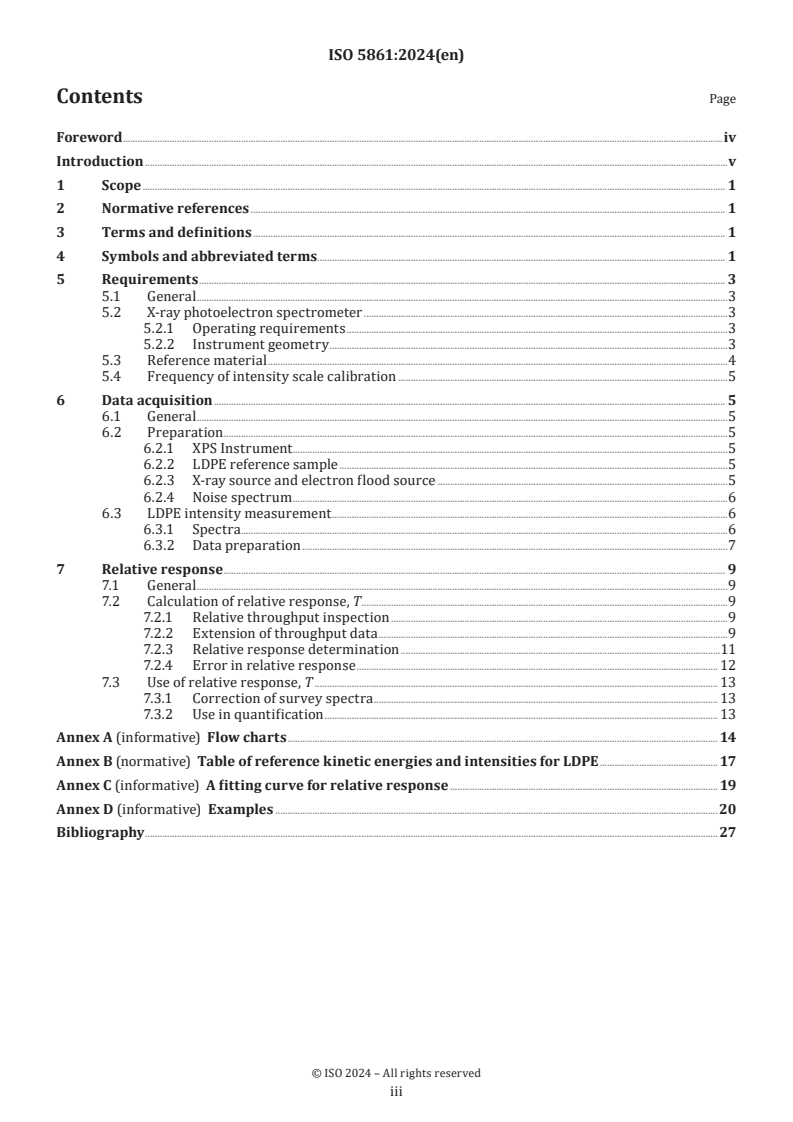
Contents Page
Foreword .iv
Introduction .v
1 Scope . 1
2 Normative references . 1
3 Terms and definitions . 1
4 Symbols and abbreviated terms. 1
5 Requirements . 3
5.1 General .3
5.2 X-ray photoelectron spectrometer .3
5.2.1 Operating requirements .3
5.2.2 Instrument geometry .3
5.3 Reference material .4
5.4 Frequency of intensity scale calibration .5
6 Data acquisition . 5
6.1 General .5
6.2 Preparation .5
6.2.1 XPS Instrument . .5
6.2.2 LDPE reference sample .5
6.2.3 X-ray source and electron flood source .5
6.2.4 Noise spectrum .6
6.3 LDPE intensity measurement .6
6.3.1 Spectra . .6
6.3.2 Data preparation .7
7 Relative response . 9
7.1 General .9
7.2 Calculation of relative response, T .9
7.2.1 Relative throughput inspection .9
7.2.2 Extension of throughput data .9
7.2.3 Relative response determination .11
7.2.4 Error in relative response . 12
7.3 Use of relative response, T . 13
7.3.1 Correction of survey spectra . 13
7.3.2 Use in quantification . 13
Annex A (informative) Flow charts . 14
Annex B (normative) Table of reference kinetic energies and intensities for LDPE . 17
Annex C (informative) A fitting curve for relative response . 19
Annex D (informative) Examples .20
Bibliography .27
iii
Foreword
ISO (the International Organization for Standardization) is a worldwide federation of national standards
bodies (ISO member bodies). The work of preparing International Standards is normally carried out through
ISO technical committees. Each member body interested in a subject for which a technical committee
has been established has the right to be represented on that committee. International organizations,
governmental and non-governmental, in liaison with ISO, also take part in the work. ISO collaborates closely
with the International Electrotechnical Commission (IEC) on all matters of electrotechnical standardization.
The procedures used to develop this document and those intended for its further maintenance are described
in the ISO/IEC Directives, Part 1. In particular, the different approval criteria needed for the different types
of ISO document should be noted. This document was drafted in accordance with the editorial rules of the
ISO/IEC Directives, Part 2 (see www.iso.org/directives).
ISO draws attention to the possibility that the implementation of this document may involve the use of (a)
patent(s). ISO takes no position concerning the evidence, validity or applicability of any claimed patent
rights in respect thereof. As of the date of publication of this document, ISO had not received notice of (a)
patent(s) which may be required to implement this document. However, implementers are cautioned that
this may not represent the latest information, which may be obtained from the patent database available at
www.iso.org/patents. ISO shall not be held responsible for identifying any or all such patent rights.
Any trade name used in this document is information given for the convenience of users and does not
constitute an endorsement.
For an explanation of the voluntary nature of standards, the meaning of ISO specific terms and expressions
related to conformity assessment, as well as information about ISO's adherence to the World Trade
Organization (WTO) principles in the Technical Barriers to Trade (TBT), see www.iso.org/iso/foreword.html.
This document was prepared by Technical Committee ISO/TC 201, Surface chemical analysis, Subcommittee
SC 7, Electron spectroscopies.
Any feedback or questions on this document should be directed to the user’s national standards body. A
complete listing of these bodies can be found at www.iso.org/members.html.
iv
Introduction
X-ray photoelectron spectroscopy is routinely used to measure the elemental composition of surfaces and
the depth distribution of those elements. The translation of peak intensities into elemental compositions
and depth distributions in the absence of reference materials relies upon comparison of the relative peak
intensities to external reference data. The kinetic energies of the peaks being compared are different
and therefore it is important to know the relative transmission and detection efficiency of electrons at
different kinetic energies to achieve a meaningful comparison to the external reference data. International
interlaboratory studies demonstrate that XPS instruments display markedly different transmission
characteristics. Consistent intensity scale calibration enables the direct comparison of XPS results and
enables international trade through trust in measurements throughout the supply chain and in the
comparability of data from analytical service providers.
This document provides a method to determine the relative response of X-ray photoelectron spectrometers
which utilise quartz-crystal-monochromated Al Kα radiation as the excitation source. Clean low-
density poly(ethylene) is employed as a reference material. Measured intensities from clean low-density
poly(ethylene) are compared to reference intensities at specific electron kinetic energies to determine
the relative response of electrons to the detector. The resulting relative response function is traceable to
accurate reference spectra for copper, silver and gold held by the National Physical Laboratory, UK.
v
International Standard ISO 5861:2024(en)
Surface chemical analysis — X-ray photoelectron
spectroscopy — Method of intensity calibration for quartz-
crystal monochromated Al Kα XPS instruments
1 Scope
This document specifies a procedure by which the intensity scale of an X-ray photoelectron spectrometer
that employs a concentric hemispherical analyser can be calibrated using low-density poly(ethylene).
This document is applicable to instruments using quartz-crystal-monochromated Al Kα X-rays and is
suitable for all instrument geometries. The intensity calibration is only valid for the specific settings of
the instrument (pass energy or retardation ratio, lens mode, slit and aperture settings) used during the
calibration procedure. The intensity calibration is applicable at kinetic energies higher than 180 eV. The
intensity calibration is suitable for instruments that do not have an ion gun for the purpose of cleaning metal
specimens in-situ (i.e. Au, Ag, Cu), or exhibit detector saturation when these specimens are measured using
standard instrument parameters.
This document is not applicable to XPS instruments which do not have a system of charge compensation,
or instruments that have a non-linear intensity response. This document is not applicable to instruments
and operating modes which generate significant intensity from electrons scattered internally in the
spectrometer (i.e. >1 % contribution of scattering intensity to the total spectral intensity).
2 Normative references
The following documents are referred to in the text in such a way that some or all of their content constitutes
requirements of this document. For dated references, only the edition cited applies. For undated references,
the latest edition of the referenced document (including any amendments) applies.
ISO 18115-1, Surface chemical analysis — Vocabulary — Part 1: General terms and terms used in spectroscopy
3 Terms and definitions
For the purposes of this document, the terms and definitions given in ISO 18115-1 and the following apply.
ISO and IEC maintain terminology databases for use in standardization at the following addresses:
— ISO Online browsing platform: available at https:// www .iso .org/ obp
— IEC Electropedia: available at https:// www .electropedia .org/
3.1
relative throughput
ratio of measured signal rate to the known intensity from a reference sample as a function of electron
kinetic energy
Note 1 to entry: Relative throughput is related to the spectrometer response function and is distinguished in this
document as the experimentally determined response.
4 Symbols and abbreviated terms
For the purposes of this document the following abbreviations apply.
®1)
LDPE low density poly(ethylene), or low density polyethylene, CAS RN
9002-88-4
XPS X-ray photoelectron spectroscopy
For the purposes of this document the following symbols apply.
-1
A XPS peak area eV s
a an exponent
b an exponent
β detection angle between incoming X-rays and outgoing electrons
-1
C count rate from reference material s
-1
D noise rate s
E analyser kinetic energy eV
F correction for angular emission
g instrument geometry factor
-1
h magnitude of the slope of the survey spectra intensity ratio keV
I angle-averaged reference intensity I
A
K reference kinetic energy, equal to E + q eV
M number of independent parameters in a functional description of T
-1 -1
Q relative throughput: ratio of signal rate, S, to the reference intensity, R I s
A
q electric potential energy of reference material relative to spectrometer eV
-1
R reference intensity for the XPS instrument s
-1
S signal rate: the difference between count rate, C, and noise rate, D s
s average matrix relative sensitivity factor
-1
σ standard uncertainty of count rate s
C
-1 -1
σ standard uncertainty of relative throughput Q I s
Q A
-1 -1
σ mean standard uncertainty of relative throughput Q I s
q A
-1
σ standard uncertainty of signal rate S s
S
-1 -1
σ standard uncertainty of relative response T I s
T A
-1 -1
T relative response of a spectrometer I s
A
W X-ray anode power W
W X-ray anode power used during LDPE reference material analysis W
r
1) CAS Registry Number® is a trademark of the American Chemical Society (ACS). This information is given for the
convenience of users of this document and does not constitute an endorsement by ISO of the product named. Equivalent
products may be used if they can be shown to lead to the same results.
X root mean square error of a functional description of T relative to Q
x relative atomic concentration at. %
ξ dihedral angle between X-ray anode-monochromator-sample plane and monochro-
mator-sample-electron analyser plane
-1
Y XPS signal rate from a sample s
Z calibrated XPS intensity from a sample I
A
5 Requirements
5.1 General
Annex A.1 shows a flow chart (Figure A.1) for instrument set-up and the acquisition of data and summarises
the steps to be taken in Clause 5.
5.2 X-ray photoelectron spectrometer
5.2.1 Operating requirements
The XPS instrument requires a monochromated Al Kα X-ray source and a charge compensation system such
as a low energy electron flood source or low energy ion source. The XPS spectrometer shall be operated
in a pulse-counting mode. Count rates that are used for calibration following the procedures in this
document shall be within the linear operating regime of the detector. The pass energy and slit widths of
the spectrometer shall be set to minimise the contribution of electrons scattered within the analyser to the
recorded count rate. In the case that analyser internal scattering can be measured, the contribution shall
comprise less than 1 % of the count rate.
[1,2]
NOTE Linearity of the intensity scale can be confirmed using methods described in other documents .
[3,4]
Scattering in electron spectrometers can be diagnosed and minimised , but significant scattering intensity
shall be reported to the instrument manufacturer for corrective action. For concentric hemispherical
analysers, higher pass energies and smaller entrance slit widths reduce the effect of scattering. A pass energy
of 50 eV or higher is usually sufficient to ensure that the major scattering contributions are significantly less
than 1 %.
5.2.2 Instrument geometry
The geometry of the XPS spectrometer shall be known. The geometry is characterised by two angles: the
detection angle β which is the angle between the incoming X-rays from the monochromator and the outgoing
electrons directly toward the electrostatic lens column; and ξ, the dihedral angle between the plane defined
by the centres of the X-ray anode, the monochromator, and the sample (which is assumed to be in the focal
point of the X-ray spot and analyser defined analysis spot) and the plane defined by the centres of the
monochromator, sample and electrostatic lens column. Figure 1 provides a schematic of the XPS instrument
geometry used in this document to help identify the angles β and ξ. The instrument manufacturer will know
the exact angles of β and ξ from chamber design schematics.
Key
A centre of X-ray anode M centre of quartz-crystal monochromator
S analysis point on sample L centre of analyser lens
β angle between lines MS and SL ξ dihedral angle between planes LSM and SMA
Figure 1 — Schematic of XPS instrument geometry showing the angles β and ξ
From these two angles, the geometry factor of the instrument shall be calculated using Formula (1).
g =−()2,,990 0 765cos, βξ()0 500−0,c042 os20sin,β − 995 (1)
where
g is the instrument geometry factor;
β is the detection angle;
ξ is the dihedral angle.
NOTE 1 Formula (1) contains numerical values that arise from the nearly identical angular emission distributions
[5]
of C 1s and C 2s electrons and the X-ray polarisation induced by the monochromator .
NOTE 2 Most commercial spectrometers have a coplanar dihedral angle, ξ = 180°, and a detection angle, β, between
45° and 60°. Useful numerical values of g are: –0,434 2 for β = 45°; –0,217 7 for β = 54,7°; –0,099 3 for β = 60° and;
+0,374 4 for β = 90°.
NOTE 3 Exact angles of β and ξ can be obtained from the instrument manufacturer.
5.3 Reference material
The reference material shall be LDPE sheet of approximately 1 mm thickness free from obvious polymer
damage or discolouration. Cut the LDPE sheet to a size suitable for analysis using clean metal scissors and
affix to a sample holder. Use a brand-new disposable scalpel, or a scalpel cleaned with an isopropanol alcohol-
soaked tissue, to uniformly scrape the surface immediately prior to inserting it into the XPS instrument. A
visual inspection of the XPS survey scans should exhibit no peaks other than those due to carbon. If this
condition is met, then the LDPE sheet is suitable as a reference material for use with this document. At the
conclusion of this protocol, the reference LDPE should be stored in the dark, avoiding exposure to humidity
and high temperatures or proximity to volatile solvents or fumes, until required.
If peaks due to elements apart from carbon are observable in the LDPE X-ray photoelectron spectrum, the
sample shall be removed and cleaned again by additional scraping using a different clean metal scalpel. If
repeated cleaning does not remove the non-carbon elemental peaks, then an alternative source of LDPE
shall be sought.
In subsequent uses of this document, stored and previously used LDPE reference samples shall be scraped
before use.
NOTE 1 Contamination can also arise from the XPS instrument and sample holder. Failure to obtain clean LDPE can
also indicate that the XPS instrument requires baking or sample holders require cleaning.
NOTE 2 Clean, uncoated razor blades without a lubricant coating such as PTFE can be used in place of a scalpel.
5.4 Frequency of intensity scale calibration
Intensity calibration shall be performed at a maximum interval of one year, or more frequently if changes in
intensity response are identified and occur over a shorter period. Intensity calibration is also required after
maintenance, alteration of instrument configuration, or a bake-out.
NOTE ISO 24237, repeatability and constancy of intensity scale, ISO 16129, procedures for assessing the day-
to-day performance of an X-ray photoelectron spectrometer and other documents provide methods for identifying
[6-8]
changes in instrument response .
6 Data acquisition
6.1 General
Annex A.1 shows a flow chart (Figure A.1) for instrument set-up and the acquisition of data that summarises
the steps to be taken in Clause 6. Additionally, A.2 shows a flow chart (Figure A.2) for the inspection of data
and determining Q(E) that summarises the steps to be taken in Clause 6.
6.2 Preparation
6.2.1 XPS Instrument
Operate the instrument in accordance with the manufacturer’s instructions. Turn on the XPS instrument
control and high voltage power supplies at least three hours before proceeding. Set the instrument to the
required operating mode, pass energy or retardation ratio, slit widths and aperture settings for which the
intensity calibration is required.
6.2.2 LDPE reference sample
Prepare the LDPE reference sample by mounting on a sample holder and scraping with a scalpel described in
5.3. Immediately place the reference sample in the instrument load lock, evacuate the load lock chamber and
transfer it to the analysis chamber as soon as possible. Position the reference sample away from the analysis
position so that it will not be exposed to X-rays during X-ray source warm up, see 6.2.3.
6.2.3 X-ray source and electron flood source
Turn on the X-ray source at a normal operating power. Turn on the electron flood source and set it to typical
operating parameters. Wait for at least 30 min for the X-ray source and electron flood source to equilibrate
before proceeding. The X-ray power used for acquiring the reference spectra, W , shall be recorded.
r
Similar to instrument parameters described in 6.2.1, the resulting intensity calibration obtained from this
procedure is also a function of the X-ray source energy, optics, and spot size. Multiple calibrations shall be
obtained for different X-ray source parameters except for W .
r
6.2.4 Noise spectrum
Ensure that neither the LDPE sample, nor any part of the manipulator is in, or in proximity to, the analysis
position. This is achieved by moving them as far away from the analysis position as the instrument will
allow. Acquire a survey spectrum from 175 eV to 1 500 eV kinetic energy. The acquisition time shall be
greater than 10 minutes to ensure statistical relevance. The data shall be plotted and visually inspected for
any kinetic energy dependent structure. If there is no evidence of kinetic energy dependent structure in the
noise spectrum then the noise rate, D, will be determined from the LDPE spectra, see 6.3.2.2.
If there is evident structure in the noise spectrum, then the measurement shall immediately be repeated
to ensure that it is reproducible. If the noise spectrum is reproducible and can be described using a simple
energy-dependent function, such as a power law or polynomial, then the noise spectrum shall be fitted. The
fit shall be used to establish the kinetic energy dependent value of the noise rate, D.
If the noise spectrum is not reproducible then this document is not applicable. If the noise spectrum cannot
be described by a simple energy-dependent function, then this document is not applicable.
-1
NOTE 1 Typically XPS spectrometers will have energy independent and low noise count rates, less than 10 s . A
high noise count rate indicates that the discriminator setting is incorrect and requires adjustment.
NOTE 2 A reproducible energy-dependent noise spectrum indicates that there is a fault with the spectrometer.
An irreproducible energy-dependent noise spectrum indicates that there is interference from other equipment or an
unstable power supply.
6.3 LDPE intensity measurement
6.3.1 Spectra
6.3.1.1 Initial survey spectrum
Move the LDPE reference sample into the analysis position with the sample normal directed toward the
analyser and optimise the position according to the manufacturer’s instructions or local procedures.
Optimise the electron flood source to achieve a stable surface potential. Acquire a survey spectrum from
175 eV to 1 500 eV kinetic energy. The acquisition time and number of sweeps shall be set to achieve at least
5 000 counts at 1 000 eV kinetic energy to ensure statistical relevance. The spectrum shall be inspected to
confirm the absence of peaks due to elements other than carbon. If other peaks are observed then the LDPE
shall be removed and cleaned again, see 5.3.
NOTE The C 1s peak is normally between 1 200 eV and 1 206 eV kinetic energy with low energy electron flood
compensation.
6.3.1.2 High kinetic energy region spectrum
Without moving the sample or adjusting the instrument in any way, acquire a spectrum from 1 195 eV
to 1 500 eV kinetic energy. The acquisition time and number of sweeps shall be set to achieve at least
10 000 counts at 1 350 eV kinetic energy to ensure statistical relevance.
NOTE The total acquisition time for the high kinetic energy region will typically be more than ten times that of
the initial survey spectrum.
6.3.1.3 Final survey spectrum
Without moving the sample or adjusting the instrument in any way, acquire a final survey spectrum from
175 eV to 1 500 eV kinetic energy using the same acquisition parameters as the initial survey spectrum
6.3.1.1.
6.3.1.4 Data inspection
Ensure that the intensities in the spectra have not been modified by the software, for example using the
manufacturer’s intensity calibration procedure. Plot all spectra as count rate against kinetic energy and
ensure that, in an overlay, there are no significant differences in count rate for the inelastic background
beyond the range of the spectral noise. If this condition is not met, then the data shall not be used for
intensity calibration.
If there are any elemental peaks observed in the spectra which are from elements other than carbon then
the data shall not be used for intensity calibration and the LDPE cleaning procedure revisited, see 5.3.
Divide the intensity of the final survey spectrum by the correspondin
...