


ISO 19136:2007
(Main)Geographic information — Geography Markup Language (GML)
Geographic information — Geography Markup Language (GML)
The Geography Markup Language (GML) is an XML encoding in compliance with ISO 19118 for the transport and storage of geographic information modelled in accordance with the conceptual modelling framework used in the ISO 19100 series of International Standards and including both the spatial and non-spatial properties of geographic features. ISO 19136:2007 defines the XML Schema syntax, mechanisms and conventions that: provide an open, vendor-neutral framework for the description of geospatial application schemas for the transport and storage of geographic information in XML; allow profiles that support proper subsets of GML framework descriptive capabilities; support the description of geospatial application schemas for specialized domains and information communities; enable the creation and maintenance of linked geographic application schemas and datasets; support the storage and transport of application schemas and data sets; increase the ability of organizations to share geographic application schemas and the information they describe. Implementers may decide to store geographic application schemas and information in GML, or they may decide to convert from some other storage format on demand and use GML only for schema and data transport. NOTE If an ISO 19109 conformant application schema described in UML is used as the basis for the storage and transportation of geographic information, ISO 19136 provides normative rules for the mapping of such an application schema to a GML application schema in XML Schema and, as such, to an XML encoding for data with a logical structure in accordance with the ISO 19109 conformant application schema.
Information géographique — Langage de balisage en géographie (GML)
Le langage GML (Geography Markup Language, langage de balisage en géographie) est un codage XML conforme à l'ISO 19118 pour le transport et le stockage des informations géographiques modélisées conformément au cadre de modélisation conceptuelle utilisé dans la série de Normes internationales ISO 19100 et comprenant les propriétés spatiales et non spatiales des entités géographiques. L'ISO 19136:2007 définit la syntaxe, les mécanismes et les conventions du schéma XML qui offrent un cadre ouvert indépendant du fournisseur pour la description des schémas d'application géospatiale pour le transport et le stockage des informations géographiques en langage XML; autorisent les profils prenant en charge les sous-ensembles corrects de possibilités descriptives du cadre GML; prennent en charge la description des schémas d'application géospatiale pour les domaines et communautés d'informations spécialisés; permettent de créer et d'entretenir des schémas d'application géographique associés et des ensembles de données; prennent en charge le stockage et le transport des schémas d'application et des ensembles de données; augmentent les possibilités d'organisation pour partager des schémas d'application géographique et les informations qu'ils décrivent. Les implémenteurs peuvent choisir de stocker les schémas d'application géographique et les informations en GML, ou de les convertir à la demande à partir d'un autre format de stockage et d'utiliser GML uniquement pour le schéma et le transport des données. NOTE Si un schéma d'application conforme à l'ISO 19109 décrit en langage UML est utilisé comme base du stockage et du transport des informations géographiques, l'ISO 19136:2007 donne les règles normatives de mise en correspondance de ce type de schéma d'application avec le schéma d'application GML en langage XML et, en tant que tel, avec le codage XML pour les données dotées d'une structure logique conformément au schéma d'application conforme à l'ISO 19109.
General Information
- Status
- Withdrawn
- Publication Date
- 22-Aug-2007
- Withdrawal Date
- 22-Aug-2007
- Technical Committee
- ISO/TC 211 - Geographic information/Geomatics
- Drafting Committee
- ISO/TC 211/WG 4 - Geospatial services
- Current Stage
- 9599 - Withdrawal of International Standard
- Start Date
- 09-Jan-2020
- Completion Date
- 14-Feb-2026
Relations
- Revised
ISO 19136-1:2020 - Geographic information — Geography Markup Language (GML) — Part 1: Fundamentals - Effective Date
- 14-Apr-2018
- Effective Date
- 23-Feb-2012
Buy Documents
ISO 19136:2007 - Geographic information -- Geography Markup Language (GML)

ISO 19136:2007 - Geographic information -- Geography Markup Language (GML)

ISO 19136:2007 - Information géographique -- Langage de balisage en géographie (GML)
ISO 19136:2007 - Information géographique -- Langage de balisage en géographie (GML)
Get Certified
Connect with accredited certification bodies for this standard

BSI Group
BSI (British Standards Institution) is the business standards company that helps organizations make excellence a habit.

NYCE
Mexican standards and certification body.
Sponsored listings
Frequently Asked Questions
ISO 19136:2007 is a standard published by the International Organization for Standardization (ISO). Its full title is "Geographic information — Geography Markup Language (GML)". This standard covers: The Geography Markup Language (GML) is an XML encoding in compliance with ISO 19118 for the transport and storage of geographic information modelled in accordance with the conceptual modelling framework used in the ISO 19100 series of International Standards and including both the spatial and non-spatial properties of geographic features. ISO 19136:2007 defines the XML Schema syntax, mechanisms and conventions that: provide an open, vendor-neutral framework for the description of geospatial application schemas for the transport and storage of geographic information in XML; allow profiles that support proper subsets of GML framework descriptive capabilities; support the description of geospatial application schemas for specialized domains and information communities; enable the creation and maintenance of linked geographic application schemas and datasets; support the storage and transport of application schemas and data sets; increase the ability of organizations to share geographic application schemas and the information they describe. Implementers may decide to store geographic application schemas and information in GML, or they may decide to convert from some other storage format on demand and use GML only for schema and data transport. NOTE If an ISO 19109 conformant application schema described in UML is used as the basis for the storage and transportation of geographic information, ISO 19136 provides normative rules for the mapping of such an application schema to a GML application schema in XML Schema and, as such, to an XML encoding for data with a logical structure in accordance with the ISO 19109 conformant application schema.
The Geography Markup Language (GML) is an XML encoding in compliance with ISO 19118 for the transport and storage of geographic information modelled in accordance with the conceptual modelling framework used in the ISO 19100 series of International Standards and including both the spatial and non-spatial properties of geographic features. ISO 19136:2007 defines the XML Schema syntax, mechanisms and conventions that: provide an open, vendor-neutral framework for the description of geospatial application schemas for the transport and storage of geographic information in XML; allow profiles that support proper subsets of GML framework descriptive capabilities; support the description of geospatial application schemas for specialized domains and information communities; enable the creation and maintenance of linked geographic application schemas and datasets; support the storage and transport of application schemas and data sets; increase the ability of organizations to share geographic application schemas and the information they describe. Implementers may decide to store geographic application schemas and information in GML, or they may decide to convert from some other storage format on demand and use GML only for schema and data transport. NOTE If an ISO 19109 conformant application schema described in UML is used as the basis for the storage and transportation of geographic information, ISO 19136 provides normative rules for the mapping of such an application schema to a GML application schema in XML Schema and, as such, to an XML encoding for data with a logical structure in accordance with the ISO 19109 conformant application schema.
ISO 19136:2007 is classified under the following ICS (International Classification for Standards) categories: 35.240.70 - IT applications in science. The ICS classification helps identify the subject area and facilitates finding related standards.
ISO 19136:2007 has the following relationships with other standards: It is inter standard links to ISO 19136-1:2020, ISO 19136-2:2015. Understanding these relationships helps ensure you are using the most current and applicable version of the standard.
ISO 19136:2007 is available in PDF format for immediate download after purchase. The document can be added to your cart and obtained through the secure checkout process. Digital delivery ensures instant access to the complete standard document.
Standards Content (Sample)
INTERNATIONAL ISO
STANDARD 19136
First edition
2007-09-01
Geographic information — Geography
Markup Language (GML)
Information géographique — Langage de balisage en géographie
(GML)
Reference number
©
ISO 2007
PDF disclaimer
This PDF file may contain embedded typefaces. In accordance with Adobe's licensing policy, this file may be printed or viewed but
shall not be edited unless the typefaces which are embedded are licensed to and installed on the computer performing the editing. In
downloading this file, parties accept therein the responsibility of not infringing Adobe's licensing policy. The ISO Central Secretariat
accepts no liability in this area.
Adobe is a trademark of Adobe Systems Incorporated.
Details of the software products used to create this PDF file can be found in the General Info relative to the file; the PDF-creation
parameters were optimized for printing. Every care has been taken to ensure that the file is suitable for use by ISO member bodies. In
the unlikely event that a problem relating to it is found, please inform the Central Secretariat at the address given below.
© ISO 2007
All rights reserved. Unless otherwise specified, no part of this publication may be reproduced or utilized in any form or by any means,
electronic or mechanical, including photocopying and microfilm, without permission in writing from either ISO at the address below or
ISO's member body in the country of the requester.
ISO copyright office
Case postale 56 • CH-1211 Geneva 20
Tel. + 41 22 749 01 11
Fax + 41 22 749 09 47
E-mail copyright@iso.org
Web www.iso.org
Published in Switzerland
ii © ISO 2007 – All rights reserved
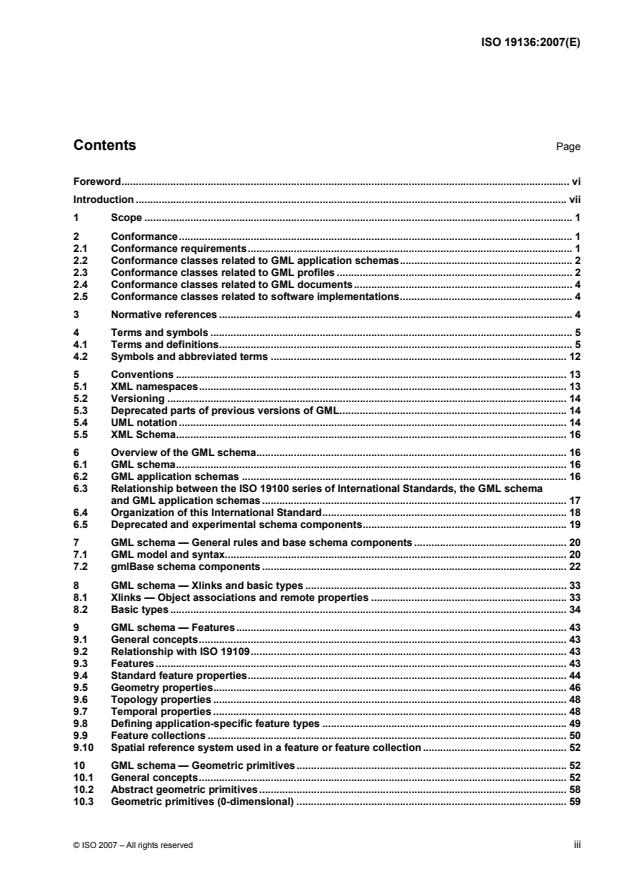
Contents Page
Foreword. vi
Introduction . vii
1 Scope . 1
2 Conformance. 1
2.1 Conformance requirements. 1
2.2 Conformance classes related to GML application schemas. 2
2.3 Conformance classes related to GML profiles . 2
2.4 Conformance classes related to GML documents. 4
2.5 Conformance classes related to software implementations. 4
3 Normative references . 4
4 Terms and symbols . 5
4.1 Terms and definitions. 5
4.2 Symbols and abbreviated terms . 12
5 Conventions . 13
5.1 XML namespaces. 13
5.2 Versioning . 14
5.3 Deprecated parts of previous versions of GML. 14
5.4 UML notation. 14
5.5 XML Schema. 16
6 Overview of the GML schema. 16
6.1 GML schema. 16
6.2 GML application schemas . 16
6.3 Relationship between the ISO 19100 series of International Standards, the GML schema
and GML application schemas . 17
6.4 Organization of this International Standard.18
6.5 Deprecated and experimental schema components. 19
7 GML schema — General rules and base schema components . 20
7.1 GML model and syntax. 20
7.2 gmlBase schema components . 22
8 GML schema — Xlinks and basic types . 33
8.1 Xlinks — Object associations and remote properties . 33
8.2 Basic types . 34
9 GML schema — Features. 43
9.1 General concepts. 43
9.2 Relationship with ISO 19109. 43
9.3 Features . 43
9.4 Standard feature properties. 44
9.5 Geometry properties. 46
9.6 Topology properties . 48
9.7 Temporal properties . 48
9.8 Defining application-specific feature types .49
9.9 Feature collections . 50
9.10 Spatial reference system used in a feature or feature collection . 52
10 GML schema — Geometric primitives. 52
10.1 General concepts. 52
10.2 Abstract geometric primitives . 58
10.3 Geometric primitives (0-dimensional) . 59
10.4 Geometric primitives (1-dimensional). 60
10.5 Geometric primitives (2-dimensional). 72
10.6 Geometric primitives (3-dimensional). 81
11 GML schema — Geometric complex, geometric composites and geometric aggregates . 83
11.1 Overview . 83
11.2 Geometric complex and geometric composites. 84
11.3 Geometric aggregates . 86
12 GML schema — Coordinate reference systems schemas. 91
12.1 Overview . 91
12.2 Reference systems . 93
12.3 Coordinate reference systems. 95
12.4 Coordinate systems. 103
12.5 Datums . 110
12.6 Coordinate operations. 117
13 GML schema — Topology. 129
13.1 General concepts . 129
13.2 Abstract topology . 130
13.3 Topological primitives . 130
13.4 Topological collections . 135
13.5 Topology complex . 137
14 GML schema — Temporal information and dynamic features. 139
14.1 General concepts . 139
14.2 Temporal schema. 140
14.3 Temporal topology schema . 148
14.4 Temporal reference systems . 151
14.5 Representing dynamic features. 158
15 GML schema — Definitions and dictionaries. 162
15.1 Overview . 162
15.2 Dictionary schema . 162
16 GML schema — Units, measures and values. 165
16.1 Introduction . 165
16.2 Units schema. 165
16.3 Measures schema . 171
16.4 Value objects schema. 172
17 GML schema — Directions. 179
17.1 Direction schema . 179
17.2 direction, DirectionPropertyType . 179
17.3 DirectionVectorType . 180
17.4 DirectionDescriptionType . 180
18 GML schema — Observations . 181
18.1 Observations . 181
18.2 Observation schema. 182
19 GML schema — Coverages. 185
19.1 The coverage model and representations. 185
19.2 Grids schema. 188
19.3 Coverage schema . 191
20 Profiles . 205
20.1 Profiles of GML and application schemas. 205
20.2 Definition of profile . 205
20.3 Relation to application schema . 205
20.4 Rules for elements and types in a profile. 206
20.5 Rules for referencing GML profiles from application schemas . 207
20.6 Recommendations for application schemas using GML profiles. 207
20.7 Summary of rules for GML profiles. 208
iv © ISO 2007 – All rights reserved
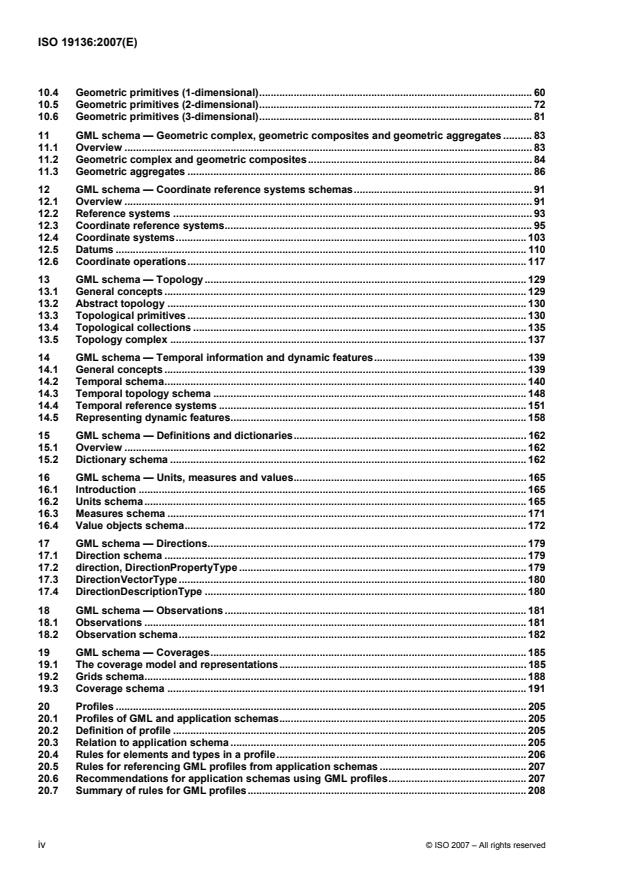
21 Rules for GML application schemas. 208
21.1 Instances of GML objects . 208
21.2 GML application schemas . 209
21.3 Schemas defining Features and Feature Collections. 212
21.4 Schemas defining spatial geometries . 213
21.5 Schemas defining spatial topologies . 214
21.6 Schemas defining time. 215
21.7 Schemas defining coordinate reference systems. 215
21.8 Schemas defining coverages . 216
21.9 Schemas defining observations. 218
21.10 Schemas defining dictionaries and definitions . 219
21.11 Schemas defining values. 220
21.12 GML profiles of the GML schema. 220
Annex A (normative) Abstract test suites for GML application schemas, GML profiles and GML
documents. 223
Annex B (normative) Abstract test suite for software implementations. 238
Annex C (informative) GML schema. 242
Annex D (normative) Implemented Profile of the ISO 19100 series of International Standards and
Extensions. 244
Annex E (normative) UML-to-GML application schema encoding rules . 309
Annex F (normative) GML-to-UML application schema encoding rules . 329
Annex G (informative) Guidelines for subsetting the GML schema . 339
Annex H (informative) Default styling . 352
Annex I (informative) Backwards compatibility with earlier versions of GML. 363
Annex J (informative) Modularization and dependencies. 380
Bibliography . 382
Index. 384
Foreword
ISO (the International Organization for Standardization) is a worldwide federation of national standards bodies
(ISO member bodies). The work of preparing International Standards is normally carried out through ISO
technical committees. Each member body interested in a subject for which a technical committee has been
established has the right to be represented on that committee. International organizations, governmental and
non-governmental, in liaison with ISO, also take part in the work. ISO collaborates closely with the
International Electrotechnical Commission (IEC) on all matters of electrotechnical standardization.
International Standards are drafted in accordance with the rules given in the ISO/IEC Directives, Part 2.
The main task of technical committees is to prepare International Standards. Draft International Standards
adopted by the technical committees are circulated to the member bodies for voting. Publication as an
International Standard requires approval by at least 75 % of the member bodies casting a vote.
Attention is drawn to the possibility that some of the elements of this document may be the subject of patent
rights. ISO shall not be held responsible for identifying any or all such patent rights.
ISO 19136 was prepared by Technical Committee ISO/TC 211, Geographic information/Geomatics.
The Geography Markup Language (GML) was originally developed within the Open Geospatial Consortium,
Inc. (OGC). ISO 19136 was prepared by ISO/TC 211 jointly with OGC.
vi © ISO 2007 – All rights reserved
Introduction
Geography Markup Language is an XML grammar written in XML Schema for the description of application
schemas as well as the transport and storage of geographic information.
The key concepts used by Geography Markup Language (GML) to model the world are drawn from the
ISO 19100 series of International Standards and the OpenGIS Abstract Specification.
A feature is an “abstraction of real world phenomena” (ISO 19101); it is a geographic feature if it is associated
with a location relative to the Earth. So a digital representation of the real world may be thought of as a set of
features. The state of a feature is defined by a set of properties, where each property may be thought of as a
{name, type, value} triple.
The number of properties a feature may have, together with their names and types, is determined by its type
definition. Geographic features with geometry are those with properties that may be geometry-valued. A
feature collection is a collection of features that may itself be regarded as a feature; as a consequence a
feature collection has a feature type and thus may have distinct properties of its own, in addition to the
features it contains.
Following ISO 19109, the feature types of an application or application domain is usually captured in an
application schema. A GML application schema is specified in XML Schema and can be constructed in two
different and alternative ways:
⎯ by adhering to the rules specified in ISO 19109 for application schemas in UML, and conforming to both
the constraints on such schemas and the rules for mapping them to GML application schemas specified
in this International Standard;
⎯ by adhering to the rules for GML application schemas specified in this International Standard for creating
a GML application schema directly in XML Schema.
Both ways are supported by this International Standard. To ensure proper use of the conceptual modelling
framework of the ISO 19100 series of International Standards, all application schemas are expected to be
modelled in accordance with the General Feature Model as specified in ISO 19109. Within the ISO 19100
series, UML is the preferred language by which to model conceptual schemas.
GML specifies XML encodings, conformant with ISO 19118, of several of the conceptual classes defined in
the ISO 19100 series of International Standards and the OpenGIS Abstract Specification. These conceptual
models include those defined in:
⎯ ISO/TS 19103 — Conceptual schema language (units of measure, basic types);
⎯ ISO 19107 — Spatial schema (geometry and topology objects);
⎯ ISO 19108 — Temporal schema (temporal geometry and topology objects, temporal reference systems);
⎯ ISO 19109 — Rules for application schemas (features);
⎯ ISO 19111 — Spatial referencing by coordinates (coordinate reference systems);
⎯ ISO 19123 — Schema for coverage geometry and functions.
The aim is to provide a standardized encoding (i.e. a standardized implementation in XML) of types specified
in the conceptual models specified by the International Standards listed above. If every application schema
were encoded independently and the encoding process included the types from, for example, ISO 19108, then,
without unambiguous and completely fixed encoding rules, the XML encodings would be different. Also, since
every implementation platform has specific strengths and weaknesses, it is helpful to standardize XML
encodings for core geographic information concepts modelled in the ISO 19100 series of International
Standards and commonly used in application schemas.
In many cases, the mapping from the conceptual classes is straightforward, while in some cases the mapping
is more complex (a detailed description of the mapping is part of this International Standard).
In addition, GML provides XML encodings for additional concepts not yet modelled in the ISO 19100 series of
International Standards or the OpenGIS Abstract Specification, for example, dynamic features, simple
observations or value objects.
Predefined types of geographic feature in GML include coverages and simple observations.
A coverage is a subtype of feature that has a coverage function with a spatiotemporal domain and a value set
range of homogeneous 1- to n-dimensional tuples. A coverage may represent one feature or a collection of
features “to model and make visible spatial relationships between, and the spatial distribution of, Earth
[20]
phenomena” (OGC Abstract Specification Topic 6 ) and a coverage “acts as a function to return values
from its range for any direct position within its spatiotemporal domain” (ISO 19123).
An observation models the act of observing, often with a camera or some other procedure, a person or some
form of instrument (Merriam-Webster Dictionary: “an act of recognizing and noting a fact or occurrence often
involving measurement with instruments”). An observation is considered to be a GML feature with a time at
which the observation took place, and with a value for the observation.
A reference system provides a scale of measurement for assigning values to a position, time or other
descriptive quantity or quality.
A coordinate reference system consists of a set of coordinate system axes that is related to the Earth through
a datum that defines the size and shape of the Earth.
A temporal reference system provides standard units for measuring time and describing temporal length or
duration.
A reference system dictionary provides definitions of reference systems used in spatial or temporal
geometries.
Spatial geometries are the values of spatial feature properties. They indicate the coordinate reference system
in which their measurements have been made. The “parent” geometry element of a geometric complex or
geometric aggregate makes this indication for its constituent geometries.
Temporal geometries are the values of temporal feature properties. Like their spatial counterparts, temporal
geometries indicate the temporal reference system in which their measurements have been made.
Spatial or temporal topologies are used to express the different topological relationships between features.
A units of measure dictionary provides definitions of numerical measures of physical quantities, such as length,
temperature and pressure, and of conversions between units.
viii © ISO 2007 – All rights reserved
INTERNATIONAL STANDARD ISO 19136:2007(E)
Geographic information — Geography Markup Language (GML)
1 Scope
The Geography Markup Language (GML) is an XML encoding in compliance with ISO 19118 for the transport
and storage of geographic information modelled in accordance with the conceptual modelling framework used
in the ISO 19100 series of International Standards and including both the spatial and non-spatial properties of
geographic features.
This International Standard defines the XML Schema syntax, mechanisms and conventions that:
⎯ provide an open, vendor-neutral framework for the description of geospatial application schemas for the
transport and storage of geographic information in XML;
⎯ allow profiles that support proper subsets of GML framework descriptive capabilities;
⎯ support the description of geospatial application schemas for specialized domains and information
communities;
⎯ enable the creation and maintenance of linked geographic application schemas and datasets;
⎯ support the storage and transport of application schemas and datasets;
⎯ increase the ability of organizations to share geographic application schemas and the information they
describe.
Implementers may decide to store geographic application schemas and information in GML, or they may
decide to convert from some other storage format on demand and use GML only for schema and data
transport.
NOTE If an ISO 19109 conformant application schema described in UML is used as the basis for the storage and
transportation of geographic information, this International Standard provides normative rules for the mapping of such an
application schema to a GML application schema in XML Schema and, as such, to an XML encoding for data with a
logical structure in accordance with the ISO 19109 conformant application schema.
2 Conformance
2.1 Conformance requirements
Clauses 7 to 19 of this International Standard specify XML Schema components, i.e. the GML schema, which
shall be used in GML application schemas in accordance with Clause 21. Clause 20 specifies rules for the
specification of a GML profile that may be defined for use in a GML application schema.
Few applications will require the full range of capabilities described by the GML schema. This clause,
therefore, defines a set of conformance classes that will support applications whose requirements range from
the minimum necessary to define simple feature types to full use of the GML schema.
Most of the schema components specified in this International Standard implement concepts defined in the
ISO 19100 series of International Standards. In these cases, the conformance classes defined in this
International Standard are based on the conformance classes defined in the corresponding standard.
Any GML application schema, GML profile or software implementation claiming conformance with one of the
conformance classes shall pass all test cases of the corresponding abstract test suite.
Any software implementation claiming conformance to this International Standard shall document the GML
profile supported by the implementation. The GML profile shall pass all mandatory test cases of the abstract
test suite corresponding to GML profiles.
2.2 Conformance classes related to GML application schemas
GML application schemas claiming conformance to this International Standard shall conform to the rules
specified in Clauses 7 to 21 and pass all relevant test cases of the abstract test suite in A.1.
Depending on the characteristics of a GML application schema, 12 conformance classes are distinguished.
Table 1 lists these classes and the corresponding subclause of the abstract test suite.
Table 1 — Conformance classes related to GML application schemas
Subclause of the
Conformance class
abstract test suite
All GML application schemas A.1.1
GML application schemas converted from an ISO 19109 application schema in UML A.1.2
GML application schemas to be converted to an ISO 19109 application schema in UML A.1.3
GML application schemas defining features and feature collections A.1.4
GML application schemas defining spatial geometries A.1.5
GML application schemas defining spatial topologies A.1.6
GML application schemas defining time A.1.7
GML application schemas defining coordinate reference systems A.1.8
GML application schemas defining coverages A.1.9
GML application schemas defining observations A.1.10
GML application schemas defining dictionaries and definitions A.1.11
GML application schemas defining values A.1.12
2.3 Conformance classes related to GML profiles
The requirements of an application schema determine the XML Schema components from the GML schema
that shall be included in a GML profile. GML profiles claiming conformance to this International Standard shall
satisfy the requirements of the abstract test suite in A.2.
Depending on the contents and requirements concerning a specific GML profile, 31 conformance classes are
distinguished. Table 2 lists these classes and the corresponding subclause of the abstract test suite.
2 © ISO 2007 – All rights reserved
Table 2 — Conformance classes related to GML profiles
Subclause of the
Conformance class
abstract test suite
All GML profiles A.2.1
Geometric primitives (spatial) — 0-dimensional A.2.2.1.1
Geometric primitives (spatial) — 0/1-dimensional A.2.2.1.2
Geometric primitives (spatial) — 0/1/2-dimensional A.2.2.1.3
Geometric primitives (spatial) — 0/1/2/3-dimensional A.2.2.1.4
Geometric complexes (spatial) — 0/1-dimensional A.2.3.1.1
Geometric complexes (spatial) — 0/1/2-dimensional A.2.3.1.2
Geometric complexes (spatial) — 0/1/2/3-dimensional A.2.3.1.3
Topologic complexes (spatial) — 0/1-dimensional A.2.4.1.1
Topologic complexes (spatial) — 0/1/2-dimensional A.2.4.1.2
Topologic complexes (spatial) — 0/1/2/3-dimensional A.2.4.1.3
Topologic complexes with geometric realization (spatial) — 1-dimensional A.2.5.1.1
Topologic complexes with geometric realization (spatial) — 2-dimensional A.2.5.1.2
Topologic complexes with geometric realization (spatial) — 3-dimensional A.2.5.1.3
Coordinate reference systems A.2.6
Coordinate operations between two coordinate reference systems A.2.7
Temporal geometry — 0-dimensional A.2.8.1
Temporal geometry — 0/1-dimensional A.2.8.2
Temporal topology A.2.9
Temporal reference systems A.2.10
Dynamic features A.2.11
Dictionaries A.2.12
Units dictionaries A.2.13
Observations A.2.14
Abstract coverage A.2.15.1
Discrete point coverage A.2.15.2
Discrete curve coverage A.2.15.3
Discrete surface coverage A.2.15.4
Discrete solid coverage A.2.15.5
Grid coverage A.2.15.6
Continuous coverage A.2.15.7
Curve implementations, for those GML profiles including 1-dimensional spatial geometry objects, shall always
include a “linear” interpolation technique. Surface implementations, for those GML profiles including
2-dimensional spatial geometry objects, shall always include a “planar” interpolation technique. Additional
curve and surface interpolation mechanisms are optional but, if implemented, they shall follow the definition
included in this International Standard.
NOTE 1 Compare these conformance classes with ISO 19107:2003, Clause 2, ISO 19108:2002, 2.2, and
ISO 19123:2005, Clause 2.
NOTE 2 A GML profile conforming to the three conformance classes “Geometric primitives (spatial) — 0-dimensional”,
“Geometric primitives (spatial) — 0/1-dimensional”, and “Geometric primitives (spatial) — 0/1/2-dimensional” (in addition to
conformance class “All GML profiles”) conforms to the spatial profile defined in ISO 19137:2007 and the respective
conformance tests in ISO 19137:2007, B.1, B.2 and B.3.
2.4 Conformance classes related to GML documents
GML documents claiming conformance to this International Standard shall conform to the rules specified in
Clauses 7 to 21 and pass all relevant test cases of the abstract test suite in A.3.
2.5 Conformance classes related to software implementations
Software implementations reading or writing GML or GML application schemas claiming conformance to this
International Standard shall pass all of the corresponding abstract test suites described in the abstract test
suite in Annex B.
Depending on the capabilities of the implementation, 11 conformance classes are distinguished. Table 3 lists
these classes and the corresponding subclause of the abstract test suite.
Table 3 — Conformance classes related to implementations
Subclause of the
Conformance class
abstract test suite
All software implementations B.1
Support for remote simple Xlinks B.2.1
Support for extended Xlinks B.2.2
Support for nillable properties B.2.3
Support for units of measurement B.2.4
Support for ownership semantics of properties B.2.5
Metadata properties B.2.6
Support for GML profiles in instance validation B.2.7
Writing GML B.3
Reading GML B.4
Writing GML application schemas B.5
Reading GML application schemas B.6
3 Normative references
The following referenced documents are indispensable for the application of this document. For dated
references, only the edition cited applies. For undated references, the latest edition of the referenced
document (including any amendments) applies.
ISO 8601, Data elements and interchange formats — Information interchange — Representation of dates and
times
ISO/IEC 11404:1996, Information technology — Programming languages, their environments and system
software interfaces — Language-independent datatypes
ISO/TS 19103:2005, Geographic information — Conceptual schema language
ISO 19107:2003, Geographic information — Spatial schema
4 © ISO 2007 – All rights reserved
ISO 19108:2002, Geographic information — Temporal schema
ISO 19109:2005, Geographic information — Rules for application schema
ISO 19111:2007, Geographic information — Spatial referencing by coordinates
ISO 19115:2003, Geographic information — Metadata
ISO 19118:2005, Geographic information — Encoding
ISO 19123:2005, Geographic information — Schema for coverage geometry and functions
ISO/TS 19139, Geographic information — Metadata — XML schema implementation
ISO/IEC 19757-3, Information technology — Document Schema Definition Languages (DSDL) — Part 3:
Rule-based validation — Schematron
ISO 80000-3, Quantities and units — Part 3: Space and time
IETF RFC 2396, Uniform Resource Identifiers (URI): Generic Syntax (August 1998)
W3C XLink, XML Linking Language (XLink) Version 1.0, W3C Recommendation (27 June 2001)
W3C XML, Extensible Markup Language (XML) 1.0 (Third Edition), W3C Recommendation (4 February 2004)
W3C XML Namespaces, Namespaces in XML, W3C Recommendation (14 January 1999)
W3C XML Schema Part 1, XML Schema Part 1: Structures, W3C Recommendation (2 May 2001)
W3C XML Schema Part 2, XML Schema Part 2: Datatypes, W3C Recommendation (2 May 2001)
4 Terms and symbols
4.1 Terms and definitions
For the purposes of this document, the following terms and definitions apply.
4.1.1
application schema
conceptual schema for data required by one or more applications
[ISO 19101:2002]
4.1.2
association
semantic relationship between two or more classifiers that specifies connections among their instances
[ISO/IEC 19501:2005:]
4.1.3
attribute
name-value pair contained in an element
NOTE In this document an attribute is an XML attribute unless otherwise specified. The syntax of an XML attribute is
“Attribute::= Name = AttValue”. An attribute typically acts as an XML element modifier (e.g. ; here
gml:id is an attribute).
4.1.4
boundary
set that represents the limit of an entity
[ISO 19107:2003]
4.1.5
child element
immediate descendant element of an element
4.1.6
closure
union of the interior and boundary of a topological or geometric object
[ISO 19107:2003]
4.1.7
codelist
value domain including a code for each permissible value
4.1.8
codespace
rule or authority for a code, name, term or category
EXAMPLE Examples of codespaces include dictionaries, authorities, codelists, etc.
4.1.9
composite curve
sequence of curves such that each curve (except the first) starts at the end point of the previous curve in
the sequence
[ISO 19107:2003]
NOTE A composite curve, as a set of direct positions, has all the properties of a curve.
4.1.10
composite solid
connected set of solids adjoining one another along shared boundary surfaces
[ISO 19107:2003]
NOTE A composite solid, as a set of direct positions, has all the properties of a solid.
4.1.11
composite surface
connected set of surfaces adjoining one another along shared boundary curves
[ISO 19107:2003]
NOTE A composite surface, as a set of direct positions, has all the properties of a surface.
4.1.12
coordinate
one of a sequence of n numbers designating the position of a point in n-dimensional space
[ISO 19111:2007]
NOTE In a coordinate reference system, the n numbers shall be qualified by units.
4.1.13
coordinate reference system
coordinate system that is related to an object by a datum
[ISO 19111:2007]
6 © ISO 2007 – All rights reserved
4.1.14
coordinate system
set of mathematical rules for specifying how coordinates are to be assigned to points
[ISO 19111:2007]
4.1.15
coordinate tuple
tuple composed of a sequence of coordinates
[ISO 19111:2007]
4.1.16
coverage
feature that acts as a function to return values from its range for any direct position within its spatial,
temporal or spatiotemporal domain
[ISO 19123:2005]
4.1.17
curve
1-dimensional geometric primitive, representing the continuous image of a line
[ISO 19107:2003]
NOTE The boundary of a curve is the set of points at either end of the curve. If the curve is a cycle, the two ends are
identical, and the curve (if topologically closed) is considered to not have a boundary. The first point is called the start
point, and the last is the end point. Connectivity of the curve is guaranteed by the “continuous image of a line” clause. A
topological theorem states that a continuous image of a connected set is connected.
4.1.18
data type
specification of a value domain with operations allowed on values in this domain
[ISO/TS 19103:2005]
EXAMPLE Integer, Real, Boolean, String, Date (conversion of data into a series of codes).
NOTE Data types include primitive predefined types and user-definable types. All instances of a data type lack
identity.
4.1.19
datum
parameter or set of parameters that define the position of the origin, the scale, and the orientation of a
coordinate system
[ISO 19111:2007]
NOTE A datum may be a geodetic datum, a vertical datum, an engineering datum, an image datum or a temporal
datum.
4.1.20
direct position
position described by a single set of coordinates within a coordinate reference system
[ISO 19107:2003]
4.1.21
domain
well-defined set
[ISO/TS 19103:2005]
NOTE 1 A mathematical function may be defined on this set, i.e. in a function f:AÆB, A is the domain of the function f.
NOTE 2 A domain as in domain of discourse refers to a subject or area of interest.
4.1.22
edge
1-dimensional topological primitive
[ISO 19107:2003]
4.1.23
element
basic information item of an XML document containing child elements, attributes and character data
NOTE From the XML Information Set: “Each XML document contains one or more elements, the boundaries of which
are either delimited by start-tags and end-tags, or, for empty elements, by an empty-element tag. Each element has a typ
...
INTERNATIONAL ISO
STANDARD 19136
First edition
2007-09-01
Geographic information — Geography
Markup Language (GML)
Information géographique — Langage de balisage en géographie
(GML)
Reference number
©
ISO 2007
PDF disclaimer
PDF files may contain embedded typefaces. In accordance with Adobe's licensing policy, such files may be printed or viewed but shall
not be edited unless the typefaces which are embedded are licensed to and installed on the computer performing the editing. In
downloading a PDF file, parties accept therein the responsibility of not infringing Adobe's licensing policy. The ISO Central Secretariat
accepts no liability in this area.
Adobe is a trademark of Adobe Systems Incorporated.
Details of the software products used to create the PDF file(s) constituting this document can be found in the General Info relative to
the file(s); the PDF-creation parameters were optimized for printing. Every care has been taken to ensure that the files are suitable for
use by ISO member bodies. In the unlikely event that a problem relating to them is found, please inform the Central Secretariat at the
address given below.
This CD-ROM contains the publication ISO 19136:2007 in portable document format (PDF), which can be
viewed using Adobe® Acrobat® Reader.
Adobe and Acrobat are trademarks of Adobe Systems Incorporated.
© ISO 2007
All rights reserved. Unless otherwise specified, no part of this CD-ROM may be reproduced, stored in a retrieval system or transmitted in
any form or by any means without prior permission from ISO. Requests for permission to reproduce this product should be addressed to
ISO copyright office • Case postale 56 • CH-1211 Geneva 20 • Switzerland
Internet copyright@iso.org
Reproduction may be
...
NORME ISO
INTERNATIONALE 19136
Première édition
2007-09-01
Information géographique — Langage de
balisage en géographie (GML)
Geographic information — Geography Markup Language (GML)
Numéro de référence
©
ISO 2007
PDF – Exonération de responsabilité
Les fichiers PDF peuvent contenir des polices de caractères intégrées. Conformément aux conditions de licence d'Adobe, ils peuvent
être imprimés ou visualisés, mais ne doivent pas être modifiés à moins que l'ordinateur employé à cet effet ne bénéficie d'une licence
autorisant l'utilisation de ces polices et que celles-ci y soient installées. Lors du téléchargement de fichiers PDF, les parties
concernées acceptent de fait la responsabilité de ne pas enfreindre les conditions de licence d'Adobe. Le Secrétariat central de l'ISO
décline toute responsabilité en la matière.
Adobe est une marque déposée d'Adobe Systems Incorporated.
Les détails relatifs aux produits logiciels utilisés pour la création du ou des fichiers PDF qui constituent cette publication sont
disponibles dans la rubrique General Info des fichiers; les paramètres de création PDF ont été optimisés pour l'impression. Toutes les
mesures ont été prises pour garantir l'exploitation de ces fichiers par les comités membres de l'ISO. Dans le cas peu probable où
surviendrait un problème d'utilisation, veuillez en informer le Secrétariat central à l'adresse donnée ci-dessous.
Le présent CD-ROM contient la publication ISO 19136:2007 au format PDF (portable document format), qui
peut être visualisée en utilisant Adobe® Acrobat® Reader.
Adobe et Acrobat sont des marques déposées de Adobe Systems Incorporated.
DOCUMENT PROTÉGÉ PAR COPYRIGHT
© ISO 2007
Tous droits réservés. Sauf exigence particulière d'installation et sauf stipulation contraire, aucune partie de ce CD-ROM/DVD ne peut être
reproduite, enregistrée dans un système d'extraction ou transmise, sous quelque forme que ce soit et par aucun procédé, sans l'accord
préalable de l'ISO. Les demandes d'autorisation de reproduction de ce produit doivent être envoyées à l'adresse ci-après.
ISO copyright office • Case postale 56 • CH-1211 Geneva 20 • Switzerland
Internet
...
NORME ISO
INTERNATIONALE 19136
Première édition
2007-09-01
Information géographique — Langage de
balisage en géographie (GML)
Geographic information — Geography Markup Language (GML)
Numéro de référence
©
ISO 2007
PDF – Exonération de responsabilité
Le présent fichier PDF peut contenir des polices de caractères intégrées. Conformément aux conditions de licence d'Adobe, ce fichier
peut être imprimé ou visualisé, mais ne doit pas être modifié à moins que l'ordinateur employé à cet effet ne bénéficie d'une licence
autorisant l'utilisation de ces polices et que celles-ci y soient installées. Lors du téléchargement de ce fichier, les parties concernées
acceptent de fait la responsabilité de ne pas enfreindre les conditions de licence d'Adobe. Le Secrétariat central de l'ISO décline toute
responsabilité en la matière.
Adobe est une marque déposée d'Adobe Systems Incorporated.
Les détails relatifs aux produits logiciels utilisés pour la création du présent fichier PDF sont disponibles dans la rubrique General Info
du fichier; les paramètres de création PDF ont été optimisés pour l'impression. Toutes les mesures ont été prises pour garantir
l'exploitation de ce fichier par les comités membres de l'ISO. Dans le cas peu probable où surviendrait un problème d'utilisation,
veuillez en informer le Secrétariat central à l'adresse donnée ci-dessous.
DOCUMENT PROTÉGÉ PAR COPYRIGHT
© ISO 2007
Droits de reproduction réservés. Sauf prescription différente, aucune partie de cette publication ne peut être reproduite ni utilisée sous
quelque forme que ce soit et par aucun procédé, électronique ou mécanique, y compris la photocopie et les microfilms, sans l'accord écrit
de l'ISO à l'adresse ci-après ou du comité membre de l'ISO dans le pays du demandeur.
ISO copyright office
Case postale 56 • CH-1211 Geneva 20
Tel. + 41 22 749 01 11
Fax + 41 22 749 09 47
E-mail copyright@iso.org
Web www.iso.org
Version française parue en 2009
Publié en Suisse
ii © ISO 2007 – Tous droits réservés
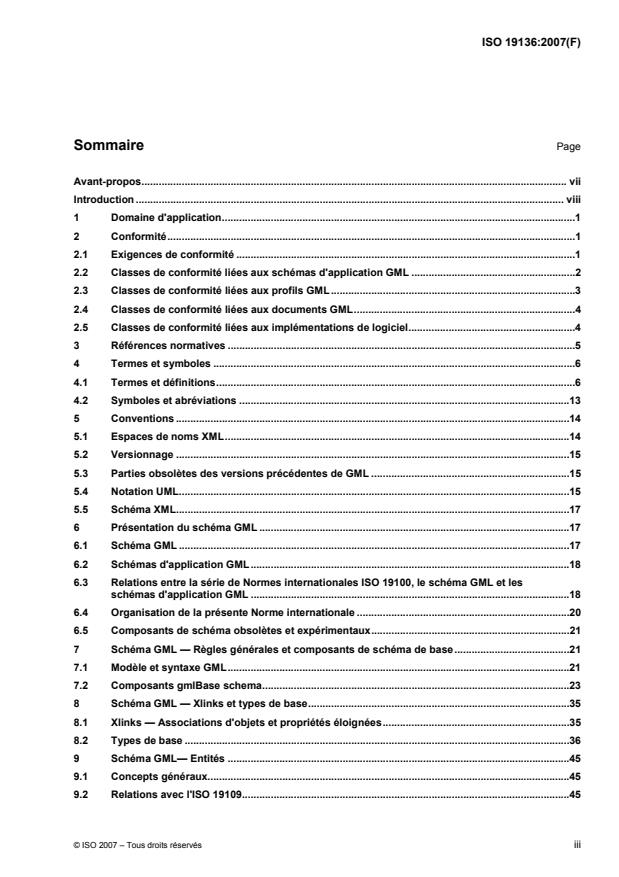
Sommaire Page
Avant-propos. vii
Introduction . viii
1 Domaine d'application.1
2 Conformité.1
2.1 Exigences de conformité .1
2.2 Classes de conformité liées aux schémas d'application GML .2
2.3 Classes de conformité liées aux profils GML.3
2.4 Classes de conformité liées aux documents GML.4
2.5 Classes de conformité liées aux implémentations de logiciel.4
3 Références normatives .5
4 Termes et symboles .6
4.1 Termes et définitions.6
4.2 Symboles et abréviations .13
5 Conventions .14
5.1 Espaces de noms XML.14
5.2 Versionnage .15
5.3 Parties obsolètes des versions précédentes de GML .15
5.4 Notation UML.15
5.5 Schéma XML.17
6 Présentation du schéma GML .17
6.1 Schéma GML .17
6.2 Schémas d'application GML.18
6.3 Relations entre la série de Normes internationales ISO 19100, le schéma GML et les
schémas d'application GML .18
6.4 Organisation de la présente Norme internationale .20
6.5 Composants de schéma obsolètes et expérimentaux.21
7 Schéma GML — Règles générales et composants de schéma de base.21
7.1 Modèle et syntaxe GML.21
7.2 Composants gmlBase schema.23
8 Schéma GML — Xlinks et types de base.35
8.1 Xlinks — Associations d'objets et propriétés éloignées.35
8.2 Types de base .36
9 Schéma GML— Entités .45
9.1 Concepts généraux.45
9.2 Relations avec l'ISO 19109.45
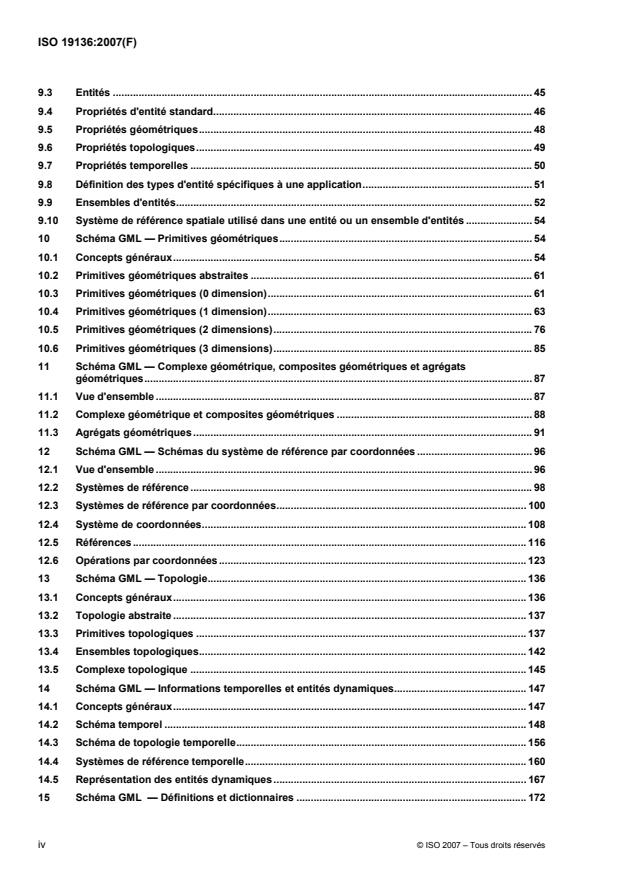
9.3 Entités . 45
9.4 Propriétés d'entité standard. 46
9.5 Propriétés géométriques. 48
9.6 Propriétés topologiques. 49
9.7 Propriétés temporelles . 50
9.8 Définition des types d'entité spécifiques à une application. 51
9.9 Ensembles d'entités. 52
9.10 Système de référence spatiale utilisé dans une entité ou un ensemble d'entités . 54
10 Schéma GML — Primitives géométriques. 54
10.1 Concepts généraux. 54
10.2 Primitives géométriques abstraites . 61
10.3 Primitives géométriques (0 dimension). 61
10.4 Primitives géométriques (1 dimension). 63
10.5 Primitives géométriques (2 dimensions).76
10.6 Primitives géométriques (3 dimensions).85
11 Schéma GML — Complexe géométrique, composites géométriques et agrégats
géométriques. 87
11.1 Vue d'ensemble . 87
11.2 Complexe géométrique et composites géométriques . 88
11.3 Agrégats géométriques . 91
12 Schéma GML — Schémas du système de référence par coordonnées . 96
12.1 Vue d'ensemble . 96
12.2 Systèmes de référence . 98
12.3 Systèmes de référence par coordonnées. 100
12.4 Système de coordonnées. 108
12.5 Références. 116
12.6 Opérations par coordonnées. 123
13 Schéma GML — Topologie. 136
13.1 Concepts généraux. 136
13.2 Topologie abstraite . 137
13.3 Primitives topologiques . 137
13.4 Ensembles topologiques. 142
13.5 Complexe topologique . 145
14 Schéma GML — Informations temporelles et entités dynamiques. 147
14.1 Concepts généraux. 147
14.2 Schéma temporel . 148
14.3 Schéma de topologie temporelle. 156
14.4 Systèmes de référence temporelle. 160
14.5 Représentation des entités dynamiques . 167
15 Schéma GML — Définitions et dictionnaires . 172
iv © ISO 2007 – Tous droits réservés
15.1 Vue d'ensemble.172
15.2 Schéma de dictionnaire .172
16 Schéma GML — Unités, mesures et valeurs.175
16.1 Introduction.175
16.2 Schéma des unités .175
16.3 Schéma des mesures .182
16.4 Schéma d'objets de valeur.183
17 Schéma GML — Directions.191
17.1 Schéma de direction.191
17.2 direction, DirectionPropertyType.191
17.3 DirectionVectorType.191
17.4 DirectionDescriptionType .192
18 Schéma GML — Observations .193
18.1 Observations.193
18.2 Schéma d'observation.193
19 Schéma GML — Couvertures .197
19.1 Modèle de couverture et représentations .197
19.2 Schéma de grilles .200
19.3 Schéma de couverture .203
20 Profils.218
20.1 Profils de GML et schémas d'application.218
20.2 Définition du profil.219
20.3 Relation au schéma d'application.219
20.4 Règles relatives aux éléments et types d'un profil .220
20.5 Règles de référencement des profils GML issus des schémas d'application .221
20.6 Recommandations pour les schémas d'application utilisant des profils GML.221
20.7 Récapitulatif des règles des profils GML.222
21 Règles pour les schémas d'application GML .222
21.1 Instances d'objets GML.222
21.2 Schémas d'application GML.223
21.3 Schémas définissant des entités et des ensembles d'entités .226
21.4 Schémas définissant des géométries spatiales .227
21.5 Schémas définissant des topologies spatiales .228
21.6 Schémas définissant le temps .229
21.7 Schémas définissant des systèmes de référence par coordonnées .230
21.8 Schémas définissant les couvertures .231
21.9 Schémas définissant des observations .233
21.10 Schémas définissant des dictionnaires et des définitions .234
21.11 Schémas définissant des valeurs .234
21.12 Profils GML du schéma GML.235
Annexe A (normative) Suites d'essais abstraits pour les schémas d'application GML, les
profils GML et les documents GML. 237
Annexe B (normative) Suite d'essais abstraits pour les implémentations logicielles. 253
Annexe C (informative) Schéma GML. 258
Annexe D (normative) Profil implémenté de la série de Normes internationales ISO 19100 et
extensions. 260
Annexe E (normative) Règles de codage du schéma d'application UML vers GML . 325
Annexe F (normative) Règles de codage du schéma d'application GML vers UML. 347
Annexe G (informative) Instructions de définition de sous-ensembles du schéma GML. 357
Annexe H (informative) Style par défaut . 370
Annexe I (informative) Compatibilité aval avec les versions précédentes de GML. 382
Annexe J (informative) Modularisation et dépendances . 400
Bibliographie . 403
Index . 405
vi © ISO 2007 – Tous droits réservés
Avant-propos
L'ISO (Organisation internationale de normalisation) est une fédération mondiale d'organismes nationaux de
normalisation (comités membres de l'ISO). L'élaboration des Normes internationales est en général confiée
aux comités techniques de l'ISO. Chaque comité membre intéressé par une étude a le droit de faire partie du
comité technique créé à cet effet. Les organisations internationales, gouvernementales et non
gouvernementales, en liaison avec l'ISO participent également aux travaux. L'ISO collabore étroitement avec
la Commission électrotechnique internationale (CEI) en ce qui concerne la normalisation électrotechnique.
Les Normes internationales sont rédigées conformément aux règles données dans les Directives ISO/CEI,
Partie 2.
La tâche principale des comités techniques est d'élaborer les Normes internationales. Les projets de Normes
internationales adoptés par les comités techniques sont soumis aux comités membres pour vote. Leur
publication comme Normes internationales requiert l'approbation de 75 % au moins des comités membres
votants.
L'attention est appelée sur le fait que certains des éléments du présent document peuvent faire l'objet de
droits de propriété intellectuelle ou de droits analogues. L'ISO ne saurait être tenue pour responsable de ne
pas avoir identifié de tels droits de propriété et averti de leur existence.
L'ISO 19136 a été élaborée par le comité technique ISO/TC 211, Information géographique/Géomatique.
À l'origine, le langage GML (Geography Markup Language, Langage de balisage en géographie) a été
développé au sein de l'OGC (Open Geospatial Consortium, Inc.). L'ISO 19136 a été élaborée par
l'ISO/TC 211 en collaboration avec l'OGC.
Introduction
Le langage GML (Geography Markup Language) est une grammaire XML écrite dans un schéma XML afin de
décrire les schémas d'application ainsi que le transport et le stockage des informations géographiques.
Les concepts fondamentaux sur lesquels repose le langage GML pour modéliser le monde sont issus de la
série de Normes internationales ISO 19100 et de l'OpenGIS Abstract Specification.
Une entité est une «abstraction des phénomènes réels» (ISO 19101); il s'agit d'une entité géographique
associée à un emplacement de la surface de la Terre. Par conséquent, une représentation numérique de la
réalité peut être considérée comme un ensemble d'entités. L'état d'une entité est défini par un ensemble de
propriétés, chacune d'elles pouvant être considérée comme un triptyque {nom, type, valeur}.
Le nombre de propriétés que peut contenir une entité, accompagnées de leurs noms et de leurs types, est
déterminé par la définition de son type. Les entités géographiques avec géométrie sont celles dont les
propriétés peuvent être associées à une valeur géométrique. Un ensemble d'entités peut être considéré en
tant que tel comme une entité; par conséquent, il est associé à un type d'entités et peut donc être doté de
propriétés distinctes qui lui sont propres, en plus des caractéristiques qu'il contient.
Suivant l'ISO 19109, les types d'entité d'une application ou d'un domaine d'application sont en général
rassemblés dans un schéma d'application. Un schéma d'application GML est spécifié en langage XML
Schema et peut être construit de deux manières différentes:
⎯ en respectant les règles spécifiées dans l'ISO 19109 pour les schémas d'application en langage UML,
puis en se conformant aux contraintes liées à ce type de schéma et aux règles de leur mise en
correspondance avec les schémas d'application GML spécifiés dans la présente Norme internationale;
⎯ en respectant les règles des schémas d'application GML spécifiés dans la présente Norme internationale
afin de créer un schéma d'application GML directement dans le schéma XML .
.
Les deux méthodes sont prises en charge par la présente Norme internationale. Pour assurer une utilisation
correcte du cadre de modélisation conceptuel de la série de Normes internationales ISO 19100, tous les
schémas d'application sont censés être modélisés conformément au modèle sémantique (voir l'ISO 19109).
Dans la série ISO 19100, UML est le langage favori permettant de modéliser les schémas conceptuels.
Le langage GML spécifie les codages XML, conformément à l'ISO 19118, de plusieurs classes conceptuelles
définies dans la série de Normes internationales ISO 19100 et l'OpenGIS Abstract Specification. Ces modèles
conceptuels incluent ceux définis dans
⎯ l'ISO/TS 19103 — Schéma de langage conceptuel (unités de mesure, types de base);
⎯ l'ISO 19107 — Schéma spatial (objets de géométrie et de topologie);
⎯ l'ISO 19108 — Schéma temporel (objets de géométrie et de topologie temporelle, systèmes de référence
temporelle);
⎯ l'ISO 19109 — Règles de schéma d'application (caractéristiques);
⎯ l'ISO 19111 — Systèmes de références spatiales par coordonnées (systèmes de référence par
coordonnées);
⎯ l'ISO 19123 — Schéma de la géométrie et des fonctions de couverture.
viii © ISO 2007 – Tous droits réservés
Il s'agit de fournir un codage normalisé (c'est-à-dire une implémentation normalisée en langage XML) des
types spécifiés dans les modèles conceptuels indiqués par les Normes internationales ci-dessus. Si chaque
schéma d'application était codé de manière indépendante et que le processus de codage contenait les types
issus, par exemple de l'ISO 19108, les codages XML seraient différents en l'absence de règles de codage
non équivoques et totalement fixes. De même, étant donné que des forces et des faiblesses caractérisent
chacune des plates-formes de mise en œuvre, il est utile de normaliser les codages XML des concepts
essentiels d'informations géographiques modélisés dans la série de Normes internationales ISO 19100 et
habituellement utilisés dans les schémas d'application.
Dans la plupart des cas, la mise en correspondance à partir de classes conceptuelles est simple, alors que
dans d'autres cas elle peut s'avérer plus complexe (la présente Norme internationale donne une description
détaillée de la mise en correspondance).
En outre, le langage GML offre des codages XML pour les concepts supplémentaires qui n'ont pas encore été
modélisés dans la série de Normes internationales ISO 19100 ou l'OpenGIS Abstract Specification, par
exemple les entités dynamiques, les observations simples ou les objets de valeur.
Les types prédéfinis d'entité géographique en langage GML incluent les couvertures et les observations
simples.
Une couverture est un sous-type d'entité ayant une fonction de couverture avec un domaine spatio-temporel
et une plage d'ensembles de valeurs d'uplets homogènes de 1 à n dimensions. Une couverture peut
représenter une entité ou un ensemble d'entités «permettant de modéliser et de créer des relations spatiales
visibles et une répartition spatiale entre des phénomènes terrestres» (OGC Abstract Specification
[20]
Topic 6 ); une couverture “fait office de fonction qui renvoie des valeurs de sa plage pour une position
directe de son domaine spatio-temporel” (ISO 19123).
Une observation permet de modéliser l'acte d'observation, souvent à l'aide d'une caméra ou de tout autre
mode opératoire, une personne ou certaines formes d'instrument (Merriam-Webster Dictionary: «acte
consistant à reconnaître et à noter un fait ou une occurrence, souvent par des mesures à l'aide
d'instruments»). Une observation est considérée comme une entité GML avec une heure à laquelle a eu lieu
l'observation et une valeur d'observation.
Un système de référence offre une échelle de mesure permettant d'attribuer des valeurs à une position, une
heure ou une autre quantité ou qualité descriptive.
Un système de référence par coordonnées est composé d'un ensemble d'axes de système de coordonnées
lié à la Terre par une référence qui définit la dimension et la forme de la Terre.
Un système de référence temporel offre des unités normalisées de mesure du temps et de description de la
longueur ou durée temporelle.
Un dictionnaire de systèmes de référence définit les systèmes de référence utilisés dans les géométries
spatiales et temporelles.
Les géométries spatiales sont les valeurs des propriétés de l'entité spatiale. Elles indiquent le système de
référence par coordonnées dans lequel les mesures ont été réalisées. L'élément géométrique “parent” d'un
complexe géométrique ou d'un agrégat géométrique indique les géométries de ses composants.
Les géométries temporelles sont les valeurs des propriétés de l'entité temporelle. Comme leurs homologues
spatiaux, les géométries temporelles indiquent le système de référence temporel dans lequel les mesures ont
été réalisées.
Les topologies spatiales ou temporelles permettent d'exprimer les différentes relations topologiques entre les
entités.
Un dictionnaire des unités de mesure définit les mesures numériques des grandeurs physiques, par exemple
la longueur, la température et la pression, et propose des conversions entre ces unités.
NORME INTERNATIONALE ISO 19136:2007(F)
Information géographique — Langage de balisage en
géographie (GML)
1 Domaine d'application
Le langage GML (Geography Markup Language, Langage de balisage en géographie) est un codage XML
conforme à l'ISO 19118 pour le transport et le stockage des informations géographiques modélisées
conformément au cadre de modélisation conceptuelle utilisé dans la série de Normes internationales
ISO 19100, et comprenant les propriétés spatiales et non spatiales des entités géographiques.
La présente Norme internationale définit la syntaxe, les mécanismes et les conventions du schéma XML qui
⎯ offrent un cadre ouvert indépendant du fournisseur pour la description des schémas d'application
géospatiale pour le transport et le stockage des informations géographiques en langage XML;
⎯ autorisent les profils prenant en charge les sous-ensembles corrects de possibilités descriptives du
cadre GML;
⎯ prennent en charge la description des schémas d'application géospatiale pour les domaines et
communautés d'informations spécialisés;
⎯ permettent de créer et d'entretenir des schémas d'application géographique associés et des ensembles
de données;
⎯ prennent en charge le stockage et le transport des schémas d'application et des ensembles de données;
⎯ augmentent les possibilités d'organisation pour partager des schémas d'application géographique et les
informations qu'ils décrivent.
Les implémenteurs peuvent choisir de stocker les schémas d'application géographique et les informations
en GML, ou de les convertir à la demande à partir d'un autre format de stockage et d'utiliser GML uniquement
pour le schéma et le transport des données.
NOTE Si un schéma d'application conforme à l'ISO 19109 décrit en langage UML est utilisé comme base du
stockage et du transport des informations géographiques, la présente Norme internationale donne les règles normatives
de mise en correspondance de ce type de schéma d'application avec le schéma d'application GML en langage XML et, en
tant que tel, avec le codage XML pour les données dotées d'une structure logique conformément au schéma d'application
conforme à l'ISO 19109.
2 Conformité
2.1 Exigences de conformité
Les Articles 7 à 19 de la présente Norme internationale spécifient les composants du schéma XML,
c'est-à-dire le schéma GML, qui doit être utilisé dans les schémas d'application GML conformément à l'Article
21. L'Article 20 précise les règles de spécification d'un profil GML qui peut être utilisé dans un schéma
d'application GML.
Certaines applications nécessitent une gamme complète de possibilités décrites par le schéma GML. Par
conséquent, le présent article définit un ensemble de classes de conformité qui prennent en charge les
applications dont les exigences s'étendent du minimum nécessaire à la définition de types d'entité simple
jusqu'à l'utilisation complète du schéma GML.
La plupart des composants du schéma spécifiés dans la présente Norme internationale mettent en œuvre les
concepts définis dans la série de Normes internationales ISO 19100. Dans ces différents cas, les classes de
conformité définies dans la présente Norme internationale reposent sur celles définies dans la norme
correspondante.
Tout schéma d'application GML, profil GML ou implémentation de logiciel revendiquant la conformité à l'une
des classes de conformité doit satisfaire à tous les cas d'essai de la suite d'essais sommaires
correspondante.
Toute implémentation de logiciel revendiquant la conformité à la présente Norme internationale doit
documenter le profil GML pris en charge par l'implémentation. Le profil GML doit satisfaire à tous les cas
d'essai de la suite d'essais sommaires correspondant aux profils GML.
2.2 Classes de conformité liées aux schémas d'application GML
Les schémas d'application GML revendiquant la conformité à la présente Norme internationale doivent
respecter les règles spécifiées dans les Articles 7 à 21 et satisfaire à tous les cas d'essai correspondants de
la suite d'essais sommaires indiquée en A.1.
Selon les caractéristiques d'un schéma d'application GML, 12 classes de conformité sont définies. Le
Tableau 1 répertorie ces classes et indique le paragraphe correspondant de la suite d'essais sommaires.
Tableau 1 — Classes de conformité liées aux schémas d'application GML
Paragraphe de la suite
Classe de conformité
d'essais sommaires
Tous les schémas d'application GML A.1.1
Schémas d'application GML convertis d'un schéma d'application ISO 19109 A.1.2
en langage UML
Schémas d'application GML à convertir en schéma d'application ISO 19109 en langage A.1.3
UML
Schémas d'application GML définissant les entités et ensembles d'entités A.1.4
Schémas d'application GML définissant des géométries spatiales A.1.5
Schémas d'application GML définissant des topologies spatiales A.1.6
Schémas d'application GML définissant une durée A.1.7
Schémas d'application GML définissant des systèmes de référence par coordonnées A.1.8
Schémas d'application GML définissant des couvertures A.1.9
Schémas d'application GML définissant des observations A.1.10
Schémas d'application GML définissant des dictionnaires et des définitions A.1.11
Schémas d'application GML définissant des valeurs A.1.12
2 © ISO 2007 – Tous droits réservés
2.3 Classes de conformité liées aux profils GML
Les exigences d'un schéma d'application déterminent les composants du schéma XML à partir du
schéma GML qui doit être inclus dans un profil GML. Les profils GML revendiquant la conformité à la présente
Norme internationale doivent satisfaire les exigences de la suite d'essais sommaires indiqués en A.2.
Selon le contenu et les exigences relatives à un profil GML particulier, 31 classes de conformité sont définies.
Le Tableau 2 répertorie ces classes et indique le paragraphe correspondant de la suite d'essais sommaires.
Tableau 2 — Classes de conformité liées aux profils GML
Paragraphe de la suite d'essais
Classe de conformité
sommaires
Tous les profils GML A.2.1
Primitives géométriques (spatiales) — 0 dimension A.2.2.1.1
Primitives géométriques (spatiales) — 0/1 dimension A.2.2.1.2
Primitives géométriques (spatiales) — 0/1/2 dimension(s) A.2.2.1.3
Primitives géométriques (spatiales) — 0/1/2/3 dimension(s) A.2.2.1.4
Complexes géométriques (spatiaux) — 0/1 dimension A.2.3.1.1
Complexes géométriques (spatiaux) — 0/1/2 dimension(s) A.2.3.1.2
Complexes géométriques (spatiaux) — 0/1/2/3 dimension(s) A.2.3.1.3
Complexes topologiques (spatiaux) — 0/1 dimension A.2.4.1.1
Complexes topologiques (spatiaux) — 0/1/2 dimension(s) A.2.4.1.2
Complexes topologiques (spatiaux) — 0/1/2/3 dimension(s) A.2.4.1.3
Complexes topologiques avec réalisation géométrique (spatiaux) — 1 dimension A.2.5.1.1
Complexes topologiques avec réalisation géométrique (spatiaux) — 2 dimensions A.2.5.1.2
Complexes topologiques avec réalisation géométrique (spatiaux) — 3 dimensions A.2.5.1.3
Systèmes de référence par coordonnées A.2.6
Opérations par coordonnées entre deux systèmes de référence par coordonnées A.2.7
Géométrie temporelle — 0 dimension A.2.8.1
Géométrie temporelle — 0/1 dimension A.2.8.2
Topologie temporelle A.2.9
Systèmes de référence temporelle A.2.10
Entités dynamiques A.2.11
Dictionnaires A.2.12
Dictionnaires d'unités A.2.13
Observations A.2.14
Couverture sommaire A.2.15.1
Couverture de point discrète A.2.15.2
Couverture de courbe discrète A.2.15.3
Couverture de surface discrète A.2.15.4
Couverture de solide discrète A.2.15.5
Couverture de grille A.2.15.6
Couverture continue A.2.15.7
Les implémentations de courbe, pour les profils GML comportant des objets à géométrie spatiale à
1 dimension, doivent toujours inclure une technique d'interpolation «linéaire». Les implémentations de
surface, pour les profils GML comportant des objets à géométrie spatiale à 2 dimensions, doivent toujours
inclure une technique d'interpolation «planaire». Les mécanismes supplémentaires d'interpolation de courbe
et de surface sont facultatifs mais, s'ils sont mis en œuvre, ils doivent se conformer à la définition donnée par
la présente Norme internationale.
NOTE 1 Comparer ces classes de conformité à l'ISO 19107:2003, Article 2, à l'ISO 19108:2002, 2.2 et à
l'ISO 19123:2005, Article 2.
NOTE 2 Un profil GML se conformant aux trois classes de conformité «Primitives géométriques (spatiales) —
0 dimension», «Primitives géométriques (spatiales) — 0/1 dimension» et «Primitives géométriques (spatiales) —
0/1/2 dimension(s)» (outre la classe de conformité «Tous les profils GML») se conforme aux profils spatiaux définis dans
l'ISO 19137:2007 et aux essais de conformité respectifs de l'ISO 19137:2007, B.1, B.2 et B.3.
2.4 Classes de conformité liées aux documents GML
Les documents GML revendiquant la conformité à la présente Norme internationale doivent respecter les
règles spécifiées dans les Articles 7 à 21 et satisfaire à tous les cas d'essai correspondants de la suite
d'essais sommaires indiquée en A.3.
2.5 Classes de conformité liées aux implémentations de logiciel
Les implémentations de logiciel lisant ou écrivant en langage GML ou les schémas d'application GML
revendiquant la conformité à la présente Norme internationale doivent remplir toutes les exigences de la suite
d'essais sommaires correspondante décrite dans la suite d'essais sommaires de l'Annexe B.
Selon les possibilités de l'implémentation, 11 classes de conformité sont définies. Le Tableau 3 répertorie ces
classes et indique le paragraphe correspondant de la suite d'essais sommaires.
Tableau 3 — Classes de conformité liées aux implémentations
Paragraphe de la suite d'essais
Classe de conformité
sommaires
Toutes les implémentations de logiciel B.1
Support des Xlinks simples distants B.2.1
Support des Xlinks étendus B.2.2
Support des propriétés pouvant prendre une valeur nulle B.2.3
Support des unités de mesure B.2.4
Support de la sémantique de propriété des propriétés B.2.5
Propriétés des métadonnées B.2.6
Support des profils GML dans la validation d'instance B.2.7
Écriture GML B.3
Lecture GML B.4
Écriture des schémas d'application GML B.5
Lecture des schémas d'application GML B.6
4 © ISO 2007 – Tous droits réservés
3 Références normatives
Les documents de référence suivants sont indispensables pour l'application du présent document. Pour les
références datées, seule l'édition citée s'applique. Pour les références non datées, la dernière édition du
document de référence s'applique (y compris les éventuels amendements).
ISO 8601, Éléments de données et formats d'échange — Échange d'information — Représentation de la date
et de l'heure
ISO/CEI 11404:2007, Technologies de l'information — Types de données à but général (GPD)
ISO/TS 19103:2005, Information géographique — Schéma de language conceptuel
ISO 19107:2003, Information géographique — Schéma spatial
ISO 19108:2002, Information géographique — Schéma temporel
ISO 19109:2005, Information géographique — Règles de schéma d'application
ISO 19111:2007, Information géographique — Système de références spatiales par coordonnées
ISO 19115:2003, Information géographique — Métadonnées
ISO 19118:2005, Information géographique — Codage
ISO 19123:2005, Information géographique — Schéma de la géométrie et des fonctions de couverture
ISO/TS 19139, Information géographique — Métadonnées — Implémentation de schémas XML
ISO/IEC 19757-3, Technologies de l'information — Langages de définition de schéma de documents
(DSDL) — Partie 3: Validation de règles orientées — Schematron
ISO 80000-3, Grandeurs et unités — Partie 3: Espace et temps
IETF RFC 2396, Uniform Resource Identifiers (URI): Generic Syntax (August 1998)
W3C XLink, XML Linking Language (XLink) Version 1.0, W3C Recommendation (27 June 2001)
W3C XML, Extensible Markup Language (XML) 1.0 (Third Edition), W3C Recommendation (4 February 2004)
W3C XML Namespaces, Namespaces in XML, W3C Recommendation (14 January 1999)
W3C XML Schema Part 1, XML Schema Part 1: Structures, W3C Recommendation (2 May 2001)
W3C XML Schema Part 2, XML Schema Part 2: Datatypes, W3C Recommendation (2 May 2001)
4 Termes et symboles
4.1 Termes et définitions
Pour les besoins du présent document, les termes et définitions suivants s'appliquent.
4.1.1
schéma d'application
schéma conceptuel des données requises par une ou plusieurs applications
[ISO 19101:2002]
4.1.2
association
relation sémantique entre au moins deux classificateurs qui précise les connexions entre leurs instances
[ISO/CEI 19501:2005]
4.1.3
attribut
paire nom-valeur que contient un élément
NOTE Dans ce document, attribut s'entend d'un attribut XML, sauf indication contraire. La syntaxe d'un attribut XML
est “Attribute::= Name = AttValue”. En règle générale, un attribut fait office de modificateur d'élément XML (par exemple:
; ici, «gml:id» est un attribut).
4.1.4
frontière
ensemble représentant la frontière d'une entité
[ISO 19107:2003]
4.1.5
élément enfant
élément descendant immédiatement d'un autre élément
4.1.6
clôture
union de l'intérieur et de la frontière d'un objet topologique ou géométrique
[ISO 19107:2003]
4.1.7
liste de codes
domaine de valeur contenant un code pour chaque valeur admise
4.1.8
espace de code
règle ou autorité d'un code, d'un nom, d'un terme ou d'une catégorie
EXEMPLE Les dictionnaires, les autorités ou les listes de codes sont des exemples d'espaces de code.
4.1.9
courbe composite
séquence de courbes dans laquelle chaque courbe (sauf la première) commence au dernier point de la
courbe précédente de la séquence
[ISO 19107:2003]
NOTE Une courbe composite, en tant qu'ensemble de positions directes, a toutes les propriétés d'une courbe.
6 © ISO 2007 – Tous droits réservés
4.1.10
solide composite
ensemble de solides connectés contigus le long de surfaces frontière partagées
[ISO 19107:2003]
NOTE Un solide composite, en tant qu'ensemble de positions directes, a toutes les propriétés d'un solide.
4.1.11
surface composite
ensemble de surfaces connectées contiguës le long de courbes frontière partagées
[ISO 19107:2003]
NOTE Une surface composite, en tant qu'ensemble de positions directes, a toutes les propriétés d'une surface.
4.1.12
coordonnée
séquence de n nombres désignant
...
Questions, Comments and Discussion
Ask us and Technical Secretary will try to provide an answer. You can facilitate discussion about the standard in here.
Loading comments...