

ISO/TS 19166:2025
(Main)Geographic information — Building information modelling (BIM) to geographic information systems (GIS) conceptual mapping (B2GM)
General Information
- Abstract
This document defines the conceptual framework and mechanisms for mapping information elements from building information modelling (BIM) to geographic information systems (GIS) to access the required information based on specific user requirements. The conceptual framework for mapping BIM information to GIS is defined with the following three mapping mechanisms: — BIM to GIS perspective definition (B2G PD); — BIM to GIS element mapping (B2G EM); — BIM to GIS level of detail (LOD) mapping (B2G LM). This document does not describe physical schema integration or mapping between BIM and GIS models because the physical schema integration or mapping between two heterogeneous models is very complex and can cause a variety of ambiguity problems (see REF Annex_D \r \h Annex D 08D0C9EA79F9BACE118C8200AA004BA90B02000000080000000800000041006E006E00650078005F0044000000 ). Developing a unified information model between BIM and GIS is a desirable goal, but it is out of the scope of this document. This document is applicable to the following concepts: — definition for BIM to GIS conceptual mapping requirement description; — definition of BIM to GIS conceptual mapping framework and component; — definition of mapping for export from one schema into another. This document does not apply to the following concepts: — definition of any particular mapping application requirement and mechanism; — bi-directional mapping method between BIM and GIS; — definition of physical schema mapping between BIM and GIS; — definition of coordinate system mapping between BIM and GIS; — definition of relationship mapping between BIM and GIS; — implementation of the application schema. NOTE For cases involving requirements related to geo-referencing for providing the position and orientation of the BIM model based on GIS, other standards exist such as REF ISO_19111 \r \h ISO 19111 08D0C9EA79F9BACE118C8200AA004BA90B02000000080000000A000000490053004F005F00310039003100310031000000 and the Information Delivery Manual (IDM) from buildingSMART on Geo-referencing BIM.
- Status
- Published
- Publication Date
- 26-Nov-2025
- Technical Committee
- ISO/TC 211 - Geographic information/Geomatics
- Drafting Committee
- ISO/TC 211/WG 10 - Ubiquitous public access
- Current Stage
- 6060 - International Standard published
- Start Date
- 27-Nov-2025
- Due Date
- 18-May-2026
- Completion Date
- 27-Nov-2025


Overview
ISO/TS 19166:2025 - Geographic information - Building information modelling (BIM) to geographic information systems (GIS) conceptual mapping (B2GM) defines a conceptual framework and mechanisms for mapping information elements from BIM to GIS. The Technical Specification focuses on how to access and transform BIM data to meet specific GIS user requirements without prescribing physical schema integration or implementation details. It is the second edition (2025) and is intended primarily for information query, visualization and urban facility scenarios.
Key topics and requirements
- Three core mapping mechanisms (B2GM):
- BIM to GIS perspective definition (B2G PD): Defines user-specific perspectives (data, logic and style views) to extract and transform BIM and other source data into a GIS-oriented view.
- BIM to GIS element mapping (B2G EM): Specifies mapping rules for transforming BIM elements (walls, doors, rooms, etc.) into corresponding GIS elements.
- BIM to GIS level of detail mapping (B2G LM): Defines LOD mapping rules that determine which geometric and semantic details are extracted from BIM to satisfy GIS LOD requirements (visualization, analysis).
- Scope limits and exclusions: The specification explicitly does not cover:
- Physical schema integration or one-to-one physical mapping between BIM and GIS models
- Bi-directional mappings, coordinate system mapping, relationship mapping, or application schema implementations
- Conformance and testing: Includes an abstract test suite (Annex A) and informative examples (Annexes B–E) to guide conceptual conformance and validation.
- Standards-based approach: Encourages use of existing standards such as GML and IFC, and references LandInfra for infrastructure models where applicable.
Applications and practical value
- Urban facility management (UFM) - integrate BIM details into city-scale GIS for asset tracking and operations
- Indoor services and emergency management - use BIM-derived geometry and semantics to support routing, evacuation, and indoor navigation in GIS applications
- Outdoor–indoor linkage - enable seamless navigation and contextual analysis that span building interiors and urban contexts
- Facility, energy and environmental management - combine BIM component attributes with GIS context for lifecycle and sustainability analysis
- Visualization and information query services - support GIS visual layers derived from BIM at appropriate LODs
Who should use this standard
- GIS professionals and data architects integrating BIM content into GIS
- BIM managers and digital twin teams seeking standard mapping approaches
- Software vendors and solution integrators building export/import or transformation tools
- Urban planners, facility managers and asset owners who require consistent BIM→GIS data representations
Related standards
- ISO 19136-1 (GML) - geographic data encoding
- ISO 16739-1 (IFC) - BIM data model
- ISO 19111 - spatial referencing (geo-referencing)
- OGC LandInfra and buildingSMART IDM - complementary models and geo-referencing guidance
Keywords: ISO/TS 19166:2025, BIM to GIS, B2GM, B2G PD, B2G EM, B2G LM, level of detail, mapping rules, building information modelling, geographic information systems.
Relations
- Effective Date
- 12-Feb-2026
- Effective Date
- 03-May-2025
- Effective Date
- 07-Jan-2025
Get Certified
Connect with accredited certification bodies for this standard

BSI Group
BSI (British Standards Institution) is the business standards company that helps organizations make excellence a habit.

NYCE
Mexican standards and certification body.
Sponsored listings
Frequently Asked Questions
ISO/TS 19166:2025 is a technical specification published by the International Organization for Standardization (ISO). Its full title is "Geographic information — Building information modelling (BIM) to geographic information systems (GIS) conceptual mapping (B2GM)". This standard covers: This document defines the conceptual framework and mechanisms for mapping information elements from building information modelling (BIM) to geographic information systems (GIS) to access the required information based on specific user requirements. The conceptual framework for mapping BIM information to GIS is defined with the following three mapping mechanisms: — BIM to GIS perspective definition (B2G PD); — BIM to GIS element mapping (B2G EM); — BIM to GIS level of detail (LOD) mapping (B2G LM). This document does not describe physical schema integration or mapping between BIM and GIS models because the physical schema integration or mapping between two heterogeneous models is very complex and can cause a variety of ambiguity problems (see REF Annex_D \r \h Annex D 08D0C9EA79F9BACE118C8200AA004BA90B02000000080000000800000041006E006E00650078005F0044000000 ). Developing a unified information model between BIM and GIS is a desirable goal, but it is out of the scope of this document. This document is applicable to the following concepts: — definition for BIM to GIS conceptual mapping requirement description; — definition of BIM to GIS conceptual mapping framework and component; — definition of mapping for export from one schema into another. This document does not apply to the following concepts: — definition of any particular mapping application requirement and mechanism; — bi-directional mapping method between BIM and GIS; — definition of physical schema mapping between BIM and GIS; — definition of coordinate system mapping between BIM and GIS; — definition of relationship mapping between BIM and GIS; — implementation of the application schema. NOTE For cases involving requirements related to geo-referencing for providing the position and orientation of the BIM model based on GIS, other standards exist such as REF ISO_19111 \r \h ISO 19111 08D0C9EA79F9BACE118C8200AA004BA90B02000000080000000A000000490053004F005F00310039003100310031000000 and the Information Delivery Manual (IDM) from buildingSMART on Geo-referencing BIM.
This document defines the conceptual framework and mechanisms for mapping information elements from building information modelling (BIM) to geographic information systems (GIS) to access the required information based on specific user requirements. The conceptual framework for mapping BIM information to GIS is defined with the following three mapping mechanisms: — BIM to GIS perspective definition (B2G PD); — BIM to GIS element mapping (B2G EM); — BIM to GIS level of detail (LOD) mapping (B2G LM). This document does not describe physical schema integration or mapping between BIM and GIS models because the physical schema integration or mapping between two heterogeneous models is very complex and can cause a variety of ambiguity problems (see REF Annex_D \r \h Annex D 08D0C9EA79F9BACE118C8200AA004BA90B02000000080000000800000041006E006E00650078005F0044000000 ). Developing a unified information model between BIM and GIS is a desirable goal, but it is out of the scope of this document. This document is applicable to the following concepts: — definition for BIM to GIS conceptual mapping requirement description; — definition of BIM to GIS conceptual mapping framework and component; — definition of mapping for export from one schema into another. This document does not apply to the following concepts: — definition of any particular mapping application requirement and mechanism; — bi-directional mapping method between BIM and GIS; — definition of physical schema mapping between BIM and GIS; — definition of coordinate system mapping between BIM and GIS; — definition of relationship mapping between BIM and GIS; — implementation of the application schema. NOTE For cases involving requirements related to geo-referencing for providing the position and orientation of the BIM model based on GIS, other standards exist such as REF ISO_19111 \r \h ISO 19111 08D0C9EA79F9BACE118C8200AA004BA90B02000000080000000A000000490053004F005F00310039003100310031000000 and the Information Delivery Manual (IDM) from buildingSMART on Geo-referencing BIM.
ISO/TS 19166:2025 is classified under the following ICS (International Classification for Standards) categories: 35.240.70 - IT applications in science. The ICS classification helps identify the subject area and facilitates finding related standards.
ISO/TS 19166:2025 has the following relationships with other standards: It is inter standard links to CEN ISO/TS 19166:2025, ISO/TS 22028-5:2023, ISO/TS 19166:2021. Understanding these relationships helps ensure you are using the most current and applicable version of the standard.
ISO/TS 19166:2025 is available in PDF format for immediate download after purchase. The document can be added to your cart and obtained through the secure checkout process. Digital delivery ensures instant access to the complete standard document.
Standards Content (Sample)
Technical
Specification
ISO/TS 19166
Second edition
Geographic information — Building
2025-11
information modelling (BIM) to
geographic information systems
(GIS) conceptual mapping (B2GM)
Information géographique — Cartographie conceptuelle de
la modélisation des informations de la construction (BIM) aux
systèmes d'information géographique (GIS) (B2GM)
Reference number
© ISO 2025
All rights reserved. Unless otherwise specified, or required in the context of its implementation, no part of this publication may
be reproduced or utilized otherwise in any form or by any means, electronic or mechanical, including photocopying, or posting on
the internet or an intranet, without prior written permission. Permission can be requested from either ISO at the address below
or ISO’s member body in the country of the requester.
ISO copyright office
CP 401 • Ch. de Blandonnet 8
CH-1214 Vernier, Geneva
Phone: +41 22 749 01 11
Email: copyright@iso.org
Website: www.iso.org
Published in Switzerland
ii
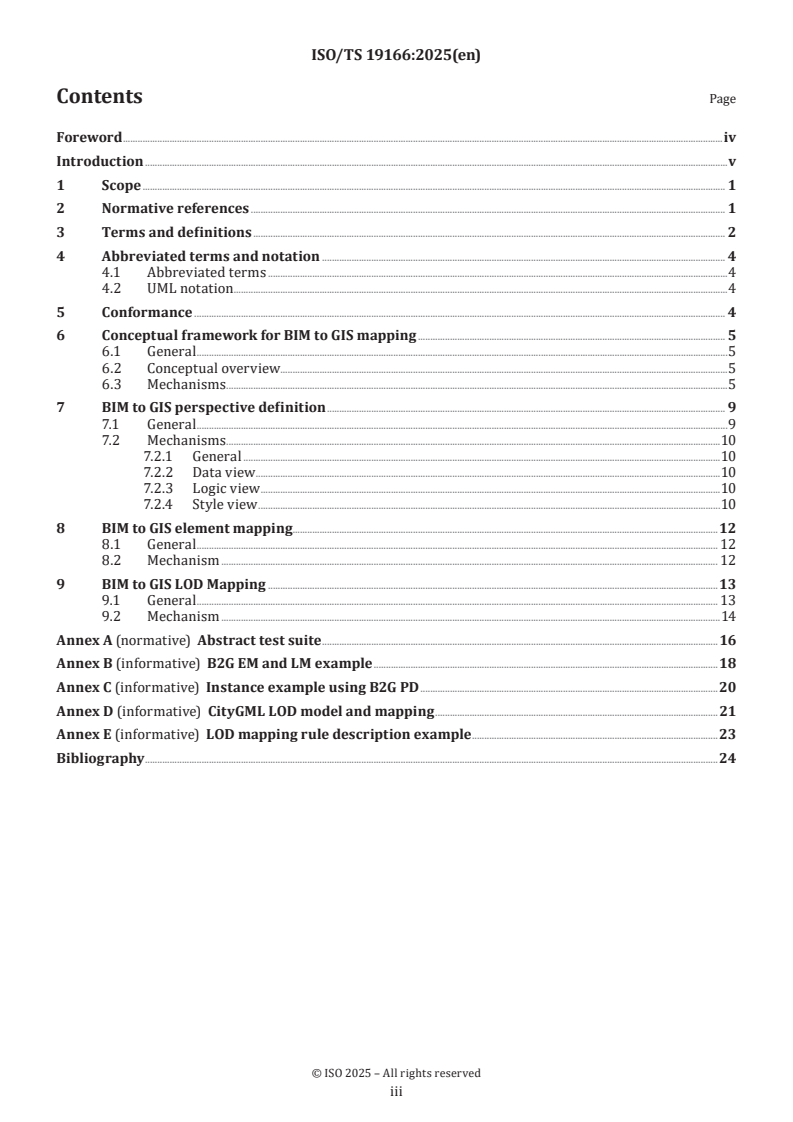
Contents Page
Foreword .iv
Introduction .v
1 Scope . 1
2 Normative references . 1
3 Terms and definitions . 2
4 Abbreviated terms and notation . 4
4.1 Abbreviated terms .4
4.2 UML notation.4
5 Conformance . 4
6 Conceptual framework for BIM to GIS mapping . 5
6.1 General .5
6.2 Conceptual overview.5
6.3 Mechanisms . .5
7 BIM to GIS perspective definition . 9
7.1 General .9
7.2 Mechanisms . .10
7.2.1 General .10
7.2.2 Data view . .10
7.2.3 Logic view .10
7.2.4 Style view .10
8 BIM to GIS element mapping . .12
8.1 General . 12
8.2 Mechanism . 12
9 BIM to GIS LOD Mapping .13
9.1 General . 13
9.2 Mechanism .14
Annex A (normative) Abstract test suite .16
Annex B (informative) B2G EM and LM example .18
Annex C (informative) Instance example using B2G PD .20
Annex D (informative) CityGML LOD model and mapping .21
Annex E (informative) LOD mapping rule description example .23
Bibliography .24
iii
Foreword
ISO (the International Organization for Standardization) is a worldwide federation of national standards
bodies (ISO member bodies). The work of preparing International Standards is normally carried out through
ISO technical committees. Each member body interested in a subject for which a technical committee
has been established has the right to be represented on that committee. International organizations,
governmental and non-governmental, in liaison with ISO, also take part in the work. ISO collaborates closely
with the International Electrotechnical Commission (IEC) on all matters of electrotechnical standardization.
The procedures used to develop this document and those intended for its further maintenance are described
in the ISO/IEC Directives, Part 1. In particular, the different approval criteria needed for the different types
of ISO document should be noted. This document was drafted in accordance with the editorial rules of the
ISO/IEC Directives, Part 2 (see www.iso.org/directives).
ISO draws attention to the possibility that the implementation of this document may involve the use of (a)
patent(s). ISO takes no position concerning the evidence, validity or applicability of any claimed patent
rights in respect thereof. As of the date of publication of this document, ISO had not received notice of (a)
patent(s) which may be required to implement this document. However, implementers are cautioned that
this may not represent the latest information, which may be obtained from the patent database available at
www.iso.org/patents. ISO shall not be held responsible for identifying any or all such patent rights.
Any trade name used in this document is information given for the convenience of users and does not
constitute an endorsement.
For an explanation of the voluntary nature of standards, the meaning of ISO specific terms and expressions
related to conformity assessment, as well as information about ISO’s adherence to the World Trade
Organization (WTO) principles in the Technical Barriers to Trade (TBT), see www.iso.org/iso/foreword.html.
This document was prepared by Technical Committee ISO/TC 211, Geographic information/Geomatics, in
collaboration with the European Committee for Standardization (CEN) Technical Committee CEN/TC 287,
Geographic Information, in accordance with the Agreement on technical cooperation between ISO and CEN
(Vienna Agreement).
This second edition cancels and replaces the first edition (ISO/TS 19166:2021), which has been technically
revised.
The main changes are as follows:
— definitions 3.3, 3.9, 3.10 and 3.13 have been revised;
— Figure 4, Figure 5, Figure 7, Figure 9 and Figure 10 have been revised.
Any feedback or questions on this document should be directed to the user’s national standards body. A
complete listing of these bodies can be found at www.iso.org/members.html.
iv
Introduction
Building information modelling (BIM) contains rich information related to building elements such as doors,
walls, windows, MEP (mechanical, electrical and plumbing) and others. In addition, BIM models can include
information about other features than buildings which are relevant to geographic information systems (GIS).
From the viewpoint of GIS, there are many benefits related to using BIM information in GIS applications.
Some examples are:
a) indoor service implementation such as emergency management (routing, evacuation path finding under
fire situation);
b) outdoor–indoor linkage service, such as seamless navigation;
c) effective facility/energy/environment management considering objects related BIM based on GIS.
Although there have been some attempts to harvest the rich information contained in BIM models and use
it in GIS, there is no established way to map the information elements between the two modelling worlds.
A proper mapping method is clearly required. Before the implementation of the information mapping,
however, mapping mechanisms for linking appropriate information elements from BIM to GIS should be
clearly defined. In addition, for the mapping mechanisms to work together, a conceptual framework for the
mapping process based on open standards between BIM and GIS should be established.
This document provides the conceptual framework for BIM to GIS information mapping and required
mapping mechanisms.
A brief explanation of each mapping mechanism is as follows:
— BIM to GIS perspective definition (B2G PD): Supports perspective information representation depending
on the specific requirement such as the urban facility management (UFM). “Perspective” depends on
the use case. For example, to manage the urban facilities, the required data should be collected from
the various data sources, including the BIM model, and transformed to represent in the user-specific
perspective. PD defines a data view to extract the data required and transform the information from the
various data sources.
— BIM to GIS element mapping (B2G EM): Supports the element mapping from BIM model to GIS model.
As the BIM and GIS model schemas are different, B2G EM requires a mapping rule specifying how to
transform from a BIM model to a GIS model element.
— BIM to GIS level of detail (LOD) mapping (B2G LM): Supports the LOD mapping from BIM model to GIS
model. LOD in GIS is a deliberate choice of data included/excluded from a model to satisfy certain use
cases including visualization. The relevant geometric and other information for the LODs required in the
target GIS model should be extracted/or queried from the BIM model. This can be defined by the LOD
mapping ruleset.
This document is applicable to information query services such as UFM operation. BIM object visualization
in GIS and other application services that require query processing depending on the relationship between
BIM and GIS objects, either in the real or virtual world, will be able to use the mechanisms defined in this
document for mapping the required information elements between the two systems. Although this document
describes mapping information elements from BIM to GIS in general, the primary concern of this document
is mapping BIM models to GIS models for visualization.
The conceptual mapping mechanism defined in this document uses existing international standards such as
[1]
Geography Markup Language (GML) (ISO 19136-1 ) and Industry Foundation Classes (IFC) (ISO 16739-1
[2]
). The Open Geospatial Consortium (OGC)’s Land and Infrastructure Conceptual Model Standard (LandInfra)
[3]
(OGC 15-111r1 ) defines the information model of infrastructure such as roads. As LandInfra has been
designed with a common conceptual model between the BIM and GIS communities, transferring information
from LandInfra BIM models to LandInfra GIS models is usually reasonably straightforward. This document,
therefore, concentrates on mapping from BIM models not based on LandInfra.
v
Technical Specification ISO/TS 19166:2025(en)
Geographic information — Building information modelling
(BIM) to geographic information systems (GIS) conceptual
mapping (B2GM)
1 Scope
This document defines the conceptual framework and mechanisms for mapping information elements
from building information modelling (BIM) to geographic information systems (GIS) to access the required
information based on specific user requirements.
The conceptual framework for mapping BIM information to GIS is defined with the following three mapping
mechanisms:
— BIM to GIS perspective definition (B2G PD);
— BIM to GIS element mapping (B2G EM);
— BIM to GIS level of detail (LOD) mapping (B2G LM).
This document does not describe physical schema integration or mapping between BIM and GIS models
because the physical schema integration or mapping between two heterogeneous models is very complex
and can cause a variety of ambiguity problems (see Annex D). Developing a unified information model
between BIM and GIS is a desirable goal, but it is out of the scope of this document.
This document is applicable to the following concepts:
— definition for BIM to GIS conceptual mapping requirement description;
— definition of BIM to GIS conceptual mapping framework and component;
— definition of mapping for export from one schema into another.
This document does not apply to the following concepts:
— definition of any particular mapping application requirement and mechanism;
— bi-directional mapping method between BIM and GIS;
— definition of physical schema mapping between BIM and GIS;
— definition of coordinate system mapping between BIM and GIS;
— definition of relationship mapping between BIM and GIS;
— implementation of the application schema.
NOTE For cases involving requirements related to geo-referencing for providing the position and orientation of
[4]
the BIM model based on GIS, other standards exist such as ISO 19111 and the Information Delivery Manual (IDM)
from buildingSMART on Geo-referencing BIM.
2 Normative references
There are no normative references in this document.
3 Terms and definitions
For the purposes of this document, the following terms and definitions apply.
ISO and IEC maintain terminology databases for use in standardization at the following addresses:
— ISO Online browsing platform: available at https:// www .iso .org/ obp
— IEC Electropedia: available at https:// www .electropedia .org/
3.1
application
manipulation and processing of data in support of user requirements
[5]
[SOURCE: ISO 19101-1:2014 , 4.1.1]
3.2
application schema
conceptual schema for data required by one or more applications (3.1)
[5]
[SOURCE: ISO 19101-1:2014 , 4.1.2]
3.3
class
classifier of a set of objects (3.8)
[6]
[SOURCE: ISO 19103:2024 , 3.14]
3.4
element
component including geometry, property, method, and relationship in a BIM or GIS model (3.7)
EXAMPLE In BIM, site, building, wall, door and room are examples of elements, whereas in a GIS, site, building,
wall, room with infrastructure such as road, and bridge are examples of elements.
3.5
feature
abstraction of real-world phenomena
Note 1 to entry: A feature composed of other features is called a complex feature.
[5]
[SOURCE: ISO 19101-1:2014 , 4.1.11, modified — Note 1 to entry modified.]
3.6
level of detail
LOD
alternate representations of an object (3.8) at varying fidelities based on specific criteria
Note 1 to entry: The levels of detail concept of CityGML is widely accepted by the market and by the scientific
community. The term “LODX model” (X = {0, 1, 2, 3, 4}) is frequently used to address the complexity of existing city
models (3.7)and their suitability for specific applications (3.1). Buildings are represented by non-vertical polygons,
either at roof or at footprint level. In LOD1, volume objects such as buildings are modelled in a generalized way as
prismatic block models with vertical walls and horizontal ‘roofs’. In LOD2, the (prototypic) roof shape of buildings is
represented, as well as thematic ground, wall, and roof surfaces along with additional structures such as balconies
and dormers. LOD3 is the most detailed level for the outermost shape of objects. For buildings, openings are added as
thematic objects. In LOD4, interior structures (rooms, etc.) are added to the most accurate outer representation, which
is called LOD4 but almost identically to the LOD3 outer surface.
Note 2 to entry: It is important to note the distinction between the term LOD (levels of detail) in GIS usage and the
term LOD in BIM LOD (Level of Development). LOD in GIS is a deliberate choice of data included/excluded from a model
to satisfy certain use cases including visualization. LOD in BIM refers to the maturity of the planning process of the
real-world object modelled.
[7]
[SOURCE: ISO/IEC 18023-1:2006 , 3.1.8, modified — “specific criteria” replaced “some criteria” in the
definition. Notes 1 and 2 to entry added.]
3.7
model
abstraction of some aspects of reality
[8]
[SOURCE: ISO 19109:2025 , 3.1.15]
3.8
object
individual with a state and relationships to other individuals
[6]
[SOURCE: ISO 19103:2024 , 3.54, modified — Notes 1 and 2 to entry deleted.]
3.9
package
element (3.4) that is used to group elements, and provides a namespace for the grouped elements
[6]
[SOURCE: ISO 19103:2024 , 3.56, modified — Note 1 to entry deleted.]
3.10
perspective
definition of the necessary data and behaviours for the use case context
Note 1 to entry: Perspective in the construction industry in general, and construction modelling in particular, is more
like the common dictionary definition: the art of representing three-dimensional objects (3.8) on a two-dimensional
surface so as to give the right impression of their height, width, depth and position in relation to each other.
Note 2 to entry: The use of “perspective” in this document is similar to the BIM concept of “model view”, which has
the definition: “a specification which identifies the properties and specifies the exchange requirements”, i.e. what the
customer wants/needs in the model (3.7) at that stage.
3.11
runtime
element (3.4) consisting of code and data produced by the compilation of a source element
[9]
[SOURCE: ISO/IEC 1989:2023 , 3.159, modified — “element” deleted in the term.]
3.12
system
set of applications (3.1), services, information technology assets or other information handling components
[10]
[SOURCE: ISO/IEC 29134:2023 , 3.13, modified — Admitted term “information system” deleted.]
3.13
system property
customized system (3.12) settings used when automatically creating a model (3.7)
EXAMPLE GUID.
4 Abbreviated terms and notation
4.1 Abbreviated terms
B2G EM BIM to GIS element mapping
B2G LM BIM to GIS LOD mapping
B2G PD BIM to GIS perspective definition
B2G CM BIM to GIS conceptual mapping
BIM building information modelling
BIM model building information model
B-rep boundary representation
ETL extract/transform/load
FM facility management
FK foreign key
GIS geographic information system
GIS model geographic information system model
GFM general feature model
GUID Globally Unique Identifier
LOD level of detail
OBB oriented bounding box
PD perspective definition
PK primary key
PSet property set
UML Unified Modeling Language
URI Uniform Resource Identifier
XML Extensible Markup Language
4.2 UML notation
[11]
In this document, conceptual schemas are presented in the Unified Modeling Language (UML). ISO 19103
Conceptual schema language presents the specific profile of UML used in this document.
5 Conformance
The requirement classes defined in Clause 7, Clause 8, Clause 9 and Annex A shall be applied.
6 Conceptual framework for BIM to GIS mapping
6.1 General
The BIM to GIS conceptual mapping (B2G CM) is the conceptual framework for object mapping from a BIM
model to a GIS model which includes the transform ruleset related to class elements, LODs and geometries.
B2G CM considers the following:
— The way for users to design, predict and check the results of model integration explicitly.
— The way for users to define, connect and integrate the data they need from a user perspective.
— The way for users to exclude unnecessary data and determine the amount of data needed.
6.2 Conceptual overview
Figure 1 presents a conceptual overview of B2G CM as defined in this document and presents the relationship
of the mapping mechanisms:
— Perspective definition (PD) for data view (B2G PD): Perspective information representation depending
on the specific use cases such as user facility management. “Perspective” is dependent on the use case to
extract the needed data. PD consists of three mechanisms to extract the external data needed.
— Element mapping from BIM to GIS model (B2G EM): To transform the elements from the BIM model to
the GIS model, it is necessary to define the element mapping mechanism that transforms the BIM to GIS
model elements. Element mapping describes the mapping requirement definition related to the element
mapping mechanism from the viewpoint of specific use cases.
— LOD definition and mapping from BIM model to GIS model (B2G LM): The LOD models define a visualization
[12]
mechanism. However, there is no LOD schema in BIM objects defined in the BIM model, ISO 16739-1 .
To represent BIM geometry in a GIS, LOD information can be extracted from the BIM model.
B2G
Perspective
Definition
(PD)
B2G
Mapping
B2G
B2G LOD
Element
Mapping
Mapping
(LM)
(EM)
Figure 1 — B2G CM conceptual overview
6.3 Mechanisms
Using the mapping framework defined in this document, it is possible to query the information from the
linked database that utilizes the BIM information. Figure 2 shows use cases of querying information from an
integrated database that includes both GIS and BIM information elements.
Set connection
information with
legacy DB
Define B2G PD
Set link information
with BIM
Define B2G EM
Actor
Define B2G LM
Link and map
Query information elements between
from the linked DB BIM and Geospatial
DB
Key
DB database
Figure 2 — Link database and integrated query based on B2G CM use cases
B2G CM supports BIM model-to-GIS model mapping under the BIM and GIS model requirement scope in
Table 1. The geometry of the BIM and GIS models should be able to define the B-rep by referring to the
[13] [14]
ISO 19109 general feature model (GFM) and ISO 19107 spatial schema, as shown in Figure 3.
GFM BIM model B2GM GIS model
Figure 3 — BIM and GIS model requirement
The minimum information requirements for BIM model-to-GIS model mapping by model package are defined
in Table 1.
Table 1 — Package requirements
Package Requirements
BIM model A BIM model shall define the following object information:
— BM1. BIM_element: capability to define the runtime of construction components, geometry,
property and relationship.
— BM2. runtime: capability to identify the types of BIM element. The types are building
information components such as walls, doors, and rooms.
— BM3. geometry: capability to contain the solid information including B-rep (boundary
representation) based on GM_Solid. The B-rep information shall include the topology such
as the vertex, edge, loop and faces.
— BM4. property_set: capability to categorize the attributes of the BIM elements and to
define the {name, value type, initial value} pairs.
— In addition, the system properties of the property information shall be defined. The system
properties are automatically created when creating a BIM model. The system properties
are the BIM element name and the GUID.
— BM5(optional). relationship: capability to contain the relationships between the BIM
elements. The relationships follow the UML relationships. The relationships covered in
this document are Association, Dependency and Generalization.
GIS model A GIS m
...