

ISO 19135:2026
(Main)Geographic information — Registration and register governance
General Information
- Abstract
This document defines a framework for the extensible registration of information — an approach used to manage an information register. This framework specifies the following requirements of an information register: capability requirements that an information register uses to manage register content; governance requirements that define a set of processes and rules used in the establishment, management, operation, content publication and use of an information register. The following considerations are out of scope of this document: implementation details for the realization of an information register; content and related definitions that are managed within an information register.
- Status
- Published
- Publication Date
- 04-Feb-2026
- Technical Committee
- ISO/TC 211 - Geographic information/Geomatics
- Drafting Committee
- ISO/TC 211/WG 9 - Information management
- Current Stage
- 6060 - International Standard published
- Start Date
- 05-Feb-2026
- Due Date
- 14-Sep-2025
- Completion Date
- 05-Feb-2026
Buy Documents

ISO 19135:2026 - Geographic information — Registration and register governance Released:5. 02. 2026
ISO 19135:2026 - Information géographique — Enregistrement et gouvernance de registre Released:5. 02. 2026
Overview
ISO 19135:2026, Geographic information - Registration and register governance, is an international standard developed by the International Organization for Standardization (ISO). The standard establishes a comprehensive framework for the extensible registration of information. It lays out key requirements and guidance for the governance of information registers, focusing on the management, operation, publication, and use of register content. While ISO 19135:2026 sets out the essential capabilities and processes for effective register governance, it does not specify implementation details or the content of the registers themselves.
ISO 19135:2026 is particularly relevant for organizations and stakeholders involved in geographic information systems (GIS), data management, and digital registers that require rigorous governance and persistent identification of registered items. The standard promotes technologically neutral, enduring, and integrity-protected data registration practices.
Key Topics
- Framework for Registers: Defines a general approach to the extensible registration of information, ensuring consistency and interoperability between different registers.
- Governance Requirements: Outlines a set of processes and rules for establishing, managing, and operating information registers, including the publication and use of register content.
- Roles and Responsibilities: Clarifies the responsibilities of key actors such as register owners, register managers, control bodies, register users, and proposers.
- Persistent Identification: Ensures stable and persistent identification schemes for registered items, supporting the integrity and traceability of data.
- Change Management: Supports the recording and management of change history, enabling versioning, and consistent evolution of registers.
- Compliance and Integrity: Emphasizes adherence to commitments, neutrality regarding technologies, and protection of data integrity.
Applications
ISO 19135:2026 provides practical value across multiple domains where the registration and governance of geographic information is critical. Typical applications include:
- Geographic Information Systems (GIS): Facilitates the management of mutable reference data, code lists, ontologies, and naming systems, ensuring authorized updates and clear change history.
- Standardization Bodies and Data Repositories: Supports the publication and maintenance of standardized data definitions, classifications, and identifiers crucial for data sharing and interoperability.
- Government and Public Sector: Enhances the management of official registers such as land parcels, administrative units, and thematic datasets, providing a clear governance structure that ensures data quality and compliance.
- Scientific and Research Communities: Offers a basis for managing taxonomies, vocabularies, and scientific datasets, enabling transparent update processes and robust referencing.
- Enterprise Data Management: Assists businesses in maintaining controlled vocabularies, product registries, and metadata repositories, facilitating data integration and auditability.
Related Standards
ISO 19135:2026 is part of the ISO/TC 211 suite of geographic information standards and is designed to work alongside related frameworks, including:
- ISO 19115 - Geographic information - Metadata: Establishes principles for describing geographic information and services.
- ISO 19157 - Geographic information - Data quality: Specifies measures for data quality assurance in geographic information.
- ISO 19107 - Geographic information - Spatial schema: Provides spatial schema definitions to support spatial referencing.
- ISO 19126 - Geographic information - Feature concept dictionaries and registries: Focuses on the structure and governance of feature catalogues and concept dictionaries.
By implementing ISO 19135:2026, organizations can ensure that their information registers are well-governed, interoperable, and compliant with international best practices for geographic information management and registration.
Relations
- Consolidates
EN ISO 19135:2026 - Geographic information - Registration and register governance (ISO 19135:2026) - Effective Date
- 12-Feb-2026
- Effective Date
- 23-Sep-2023
- Revises
ISO 19135-1:2015 - Geographic information — Procedures for item registration — Part 1: Fundamentals - Effective Date
- 16-Sep-2023
- Effective Date
- 16-Sep-2023
Buy Documents
ISO 19135:2026 - Geographic information — Registration and register governance Released:5. 02. 2026
ISO 19135:2026 - Information géographique — Enregistrement et gouvernance de registre Released:5. 02. 2026
Get Certified
Connect with accredited certification bodies for this standard

BSI Group
BSI (British Standards Institution) is the business standards company that helps organizations make excellence a habit.

NYCE
Mexican standards and certification body.
Sponsored listings
Frequently Asked Questions
ISO 19135:2026 is a standard published by the International Organization for Standardization (ISO). Its full title is "Geographic information — Registration and register governance". This standard covers: This document defines a framework for the extensible registration of information — an approach used to manage an information register. This framework specifies the following requirements of an information register: capability requirements that an information register uses to manage register content; governance requirements that define a set of processes and rules used in the establishment, management, operation, content publication and use of an information register. The following considerations are out of scope of this document: implementation details for the realization of an information register; content and related definitions that are managed within an information register.
This document defines a framework for the extensible registration of information — an approach used to manage an information register. This framework specifies the following requirements of an information register: capability requirements that an information register uses to manage register content; governance requirements that define a set of processes and rules used in the establishment, management, operation, content publication and use of an information register. The following considerations are out of scope of this document: implementation details for the realization of an information register; content and related definitions that are managed within an information register.
ISO 19135:2026 is classified under the following ICS (International Classification for Standards) categories: 35.240.70 - IT applications in science. The ICS classification helps identify the subject area and facilitates finding related standards.
ISO 19135:2026 has the following relationships with other standards: It is inter standard links to EN ISO 19135:2026, ISO 24224:2022, ISO 19135-1:2015, ISO 19135-1:2015/Amd 1:2021. Understanding these relationships helps ensure you are using the most current and applicable version of the standard.
ISO 19135:2026 is available in PDF format for immediate download after purchase. The document can be added to your cart and obtained through the secure checkout process. Digital delivery ensures instant access to the complete standard document.
Standards Content (Sample)
International
Standard
ISO 19135
Second edition
Geographic information —
2026-02
Registration and register
governance
Information géographique — Enregistrement et gouvernance de
registre
Reference number
© ISO 2026
All rights reserved. Unless otherwise specified, or required in the context of its implementation, no part of this publication may
be reproduced or utilized otherwise in any form or by any means, electronic or mechanical, including photocopying, or posting on
the internet or an intranet, without prior written permission. Permission can be requested from either ISO at the address below
or ISO’s member body in the country of the requester.
ISO copyright office
CP 401 • Ch. de Blandonnet 8
CH-1214 Vernier, Geneva
Phone: +41 22 749 01 11
Email: copyright@iso.org
Website: www.iso.org
Published in Switzerland
ii
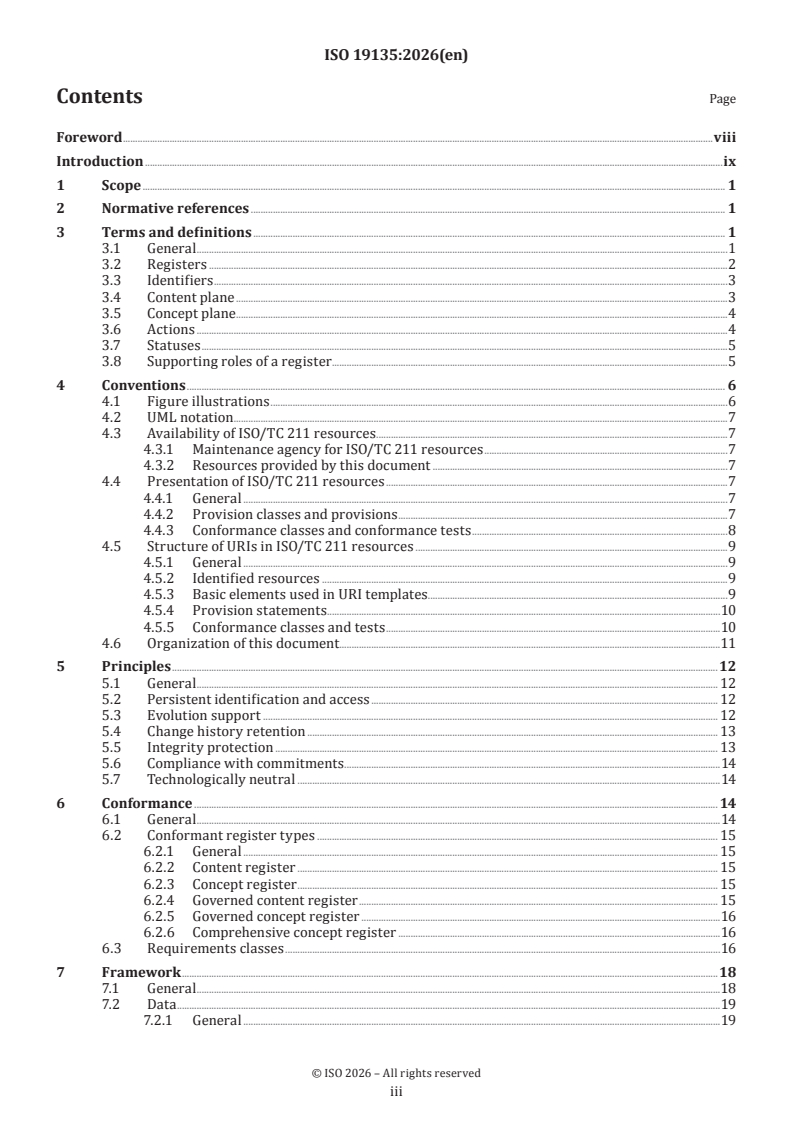
Contents Page
Foreword .viii
Introduction .ix
1 Scope . 1
2 Normative references . 1
3 Terms and definitions . 1
3.1 General .1
3.2 Registers .2
3.3 Identifiers .3
3.4 Content plane .3
3.5 Concept plane . .4
3.6 Actions .4
3.7 Statuses .5
3.8 Supporting roles of a register .5
4 Conventions . 6
4.1 Figure illustrations .6
4.2 UML notation.7
4.3 Availability of ISO/TC 211 resources .7
4.3.1 Maintenance agency for ISO/TC 211 resources .7
4.3.2 Resources provided by this document .7
4.4 Presentation of ISO/TC 211 resources .7
4.4.1 General .7
4.4.2 Provision classes and provisions .7
4.4.3 Conformance classes and conformance tests .8
4.5 Structure of URIs in ISO/TC 211 resources .9
4.5.1 General .9
4.5.2 Identified resources .9
4.5.3 Basic elements used in URI templates.9
4.5.4 Provision statements.10
4.5.5 Conformance classes and tests .10
4.6 Organization of this document .11
5 Principles .12
5.1 General . 12
5.2 Persistent identification and access . 12
5.3 Evolution support . 12
5.4 Change history retention . 13
5.5 Integrity protection . 13
5.6 Compliance with commitments .14
5.7 Technologically neutral .14
6 Conformance . 14
6.1 General .14
6.2 Conformant register types . 15
6.2.1 General . 15
6.2.2 Content register . 15
6.2.3 Concept register . 15
6.2.4 Governed content register . 15
6.2.5 Governed concept register .16
6.2.6 Comprehensive concept register .16
6.3 Requirements classes .16
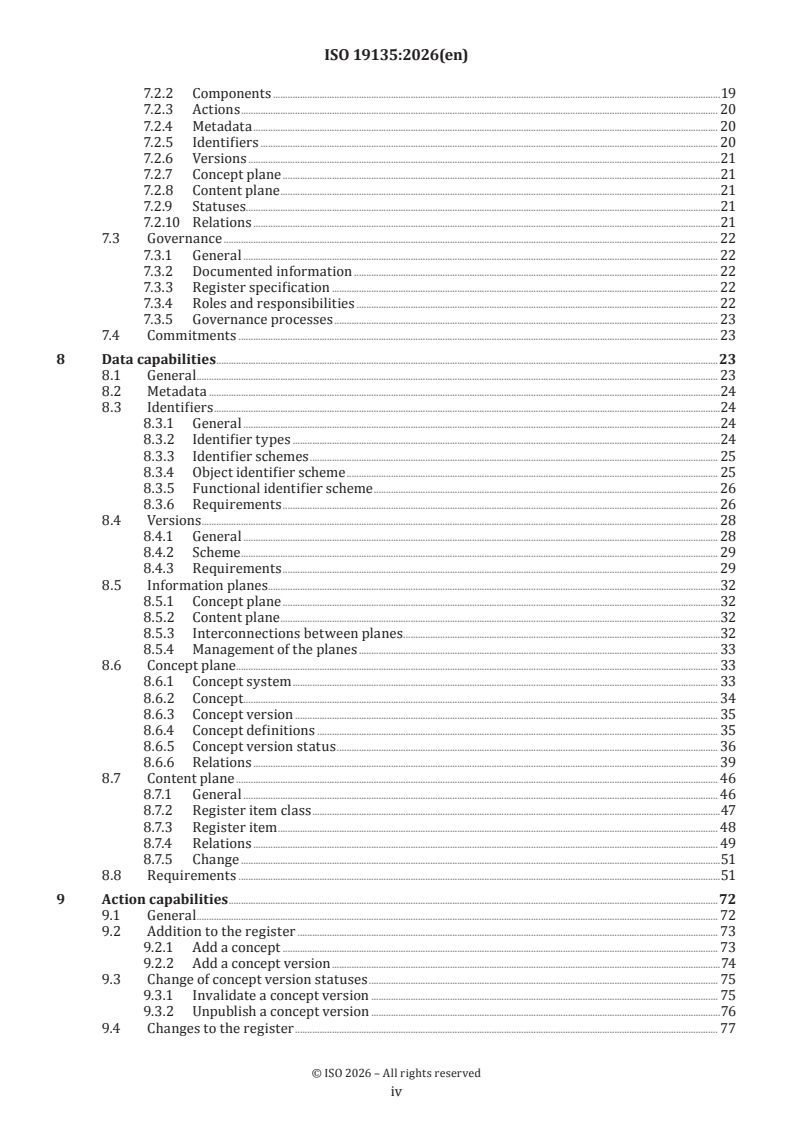
7 Framework .18
7.1 General .18
7.2 Data .19
7.2.1 General .19
iii
7.2.2 Components .19
7.2.3 Actions . 20
7.2.4 Metadata . 20
7.2.5 Identifiers . 20
7.2.6 Versions .21
7.2.7 Concept plane .21
7.2.8 Content plane .21
7.2.9 Statuses.21
7.2.10 Relations .21
7.3 Governance . 22
7.3.1 General . 22
7.3.2 Documented information . 22
7.3.3 Register specification . 22
7.3.4 Roles and responsibilities . 22
7.3.5 Governance processes . 23
7.4 Commitments . 23
8 Data capabilities .23
8.1 General . 23
8.2 Metadata .24
8.3 Identifiers .24
8.3.1 General .24
8.3.2 Identifier types .24
8.3.3 Identifier schemes . 25
8.3.4 Object identifier scheme . 25
8.3.5 Functional identifier scheme . 26
8.3.6 Requirements . 26
8.4 Versions . . 28
8.4.1 General . 28
8.4.2 Scheme . 29
8.4.3 Requirements . 29
8.5 Information planes.32
8.5.1 Concept plane .32
8.5.2 Content plane .32
8.5.3 Interconnections between planes .32
8.5.4 Management of the planes . 33
8.6 Concept plane . . 33
8.6.1 Concept system . 33
8.6.2 Concept . . 34
8.6.3 Concept version . 35
8.6.4 Concept definitions . 35
8.6.5 Concept version status . 36
8.6.6 Relations . 39
8.7 Content plane . 46
8.7.1 General . 46
8.7.2 Register item class .47
8.7.3 Register item . 48
8.7.4 Relations . 49
8.7.5 Change .51
8.8 Requirements .51
9 Action capabilities .72
9.1 General . 72
9.2 Addition to the register . 73
9.2.1 Add a concept . 73
9.2.2 Add a concept version .74
9.3 Change of concept version statuses . 75
9.3.1 Invalidate a concept version . 75
9.3.2 Unpublish a concept version .76
9.4 Changes to the register . 77
iv
9.4.1 General . 77
9.4.2 Concept supersession . 78
9.4.3 Concept version supersession . 80
9.4.4 Substantive change . 81
9.4.5 Clarification change . 83
9.4.6 Correctional change . 86
9.5 Destructive changes . 88
9.5.1 Redaction . 88
9.5.2 Delete a concept . 89
9.5.3 Delete a concept version . 90
9.6 Concept definition .91
9.6.1 General .91
9.6.2 Add a concept definition .91
9.6.3 Add a concept definition version . . 92
9.6.4 Migrating a concept realization to an evolved concept definition with unchanged
semantics . 93
9.6.5 Migrate a concept realization to an evolved concept definition with changed
semantics . 94
9.6.6 Add a concept realization through new semantics provided in an evolved
concept definition . 97
9.7 Concept domains . 98
9.8 Concept incorporation . 99
9.8.1 General . 99
9.8.2 Unversioned and versioned incorporated concepts . 99
9.8.3 Creating an incorporating concept . 103
9.8.4 Updating an incorporating concept . 103
9.8.5 Modify an incorporated concept . 104
9.8.6 Modify both an incorporated concept and an incorporating concept . 106
9.9 Concept composition . 108
9.9.1 General . 108
9.9.2 Add a composed concept . 109
9.9.3 Add a realized composed concept .110
9.9.4 Modify composed concept parts . 111
9.9.5 Modify composed concept part definitions . 112
9.10 Concept inheritance . 113
9.10.1 General . 113
9.10.2 Add an inherited concept . 113
9.10.3 Add a realized inherited concept .114
9.10.4 Modify inherited concept definitions .116
9.10.5 Usage within incorporated or composed concepts . 118
9.11 Requirements .119
10 Governance processes .131
10.1 General . 131
10.2 Establishing a register . 132
10.2.1 General . 132
10.2.2 Requirements . 132
10.3 Operating a register .134
10.3.1 Proposal process .134
10.3.2 Approval process . 136
10.3.3 Appeal process .138
10.3.4 Content management process . 140
10.4 Decommissioning a register .141
10.4.1 General .141
10.4.2 Requirements .141
11 Roles and responsibilities .143
11.1 General .143
11.2 Register owner . 144
11.3 Register manager . 146
v
11.4 Control body .147
11.5 Register system manager . 148
11.6 Proposer . 148
11.7 Register user . 149
12 Documented information .149
12.1 Register specification . 149
12.1.1 General . 149
12.1.2 Requirements . 150
12.2 Proposal instructions . 156
13 Conceptual model .156
13.1 Overview . 156
13.2 Components package . 157
13.2.1 Components overview . 157
13.2.2 Defining tables . 158
13.3 Identifiers package . 162
13.3.1 Identifiers overview . 162
13.3.2 Defining tables . 162
13.4 Statuses package . 164
13.4.1 Statuses overview . 164
13.4.2 Defining tables . 165
13.5 Relations package .167
13.5.1 Relations overview .167
13.5.2 Defining tables . 168
13.6 Proposal and appeal package .171
13.6.1 Proposal and appeal overview .171
13.6.2 Defining tables . 172
13.7 Requirements . 173
14 Commitments .173
14.1 General . 173
14.2 Access commitments . .174
14.2.1 General .174
14.2.2 Metadata access .174
14.2.3 Content access.174
14.2.4 Historic access .174
14.3 Persistence, integrity and traceability commitments .174
14.3.1 General .174
14.3.2 Identifier persistence . 175
14.3.3 Metadata persistence and retention . 175
14.3.4 Content persistence and retention . 175
14.3.5 Historic persistence with full traceability .176
14.4 Transparency commitments . 177
14.4.1 General . 177
14.4.2 Metadata transparency . 177
14.4.3 Content transparency . 178
14.4.4 Historic transparency . 178
14.5 Compliance . 178
14.6 Documentation . 178
14.7 Requirements . 178
Annex A (normative) Conformance test suite . 184
Annex B (informative) Differences with ISO 19135-1:2015 . 263
Annex C (informative) Register specification template.265
Annex D (info
...
Norme
internationale
ISO 19135
Deuxième édition
Information géographique —
2026-02
Enregistrement et gouvernance de
registre
Geographic information — Registration and register governance
Numéro de référence
DOCUMENT PROTÉGÉ PAR COPYRIGHT
© ISO 2026
Tous droits réservés. Sauf prescription différente ou nécessité dans le contexte de sa mise en œuvre, aucune partie de cette
publication ne peut être reproduite ni utilisée sous quelque forme que ce soit et par aucun procédé, électronique ou mécanique,
y compris la photocopie, ou la diffusion sur l’internet ou sur un intranet, sans autorisation écrite préalable. Une autorisation peut
être demandée à l’ISO à l’adresse ci-après ou au comité membre de l’ISO dans le pays du demandeur.
ISO copyright office
Case postale 401 • Ch. de Blandonnet 8
CH-1214 Vernier, Genève
Tél.: +41 22 749 01 11
E-mail: copyright@iso.org
Web: www.iso.org
Publié en Suisse
ii
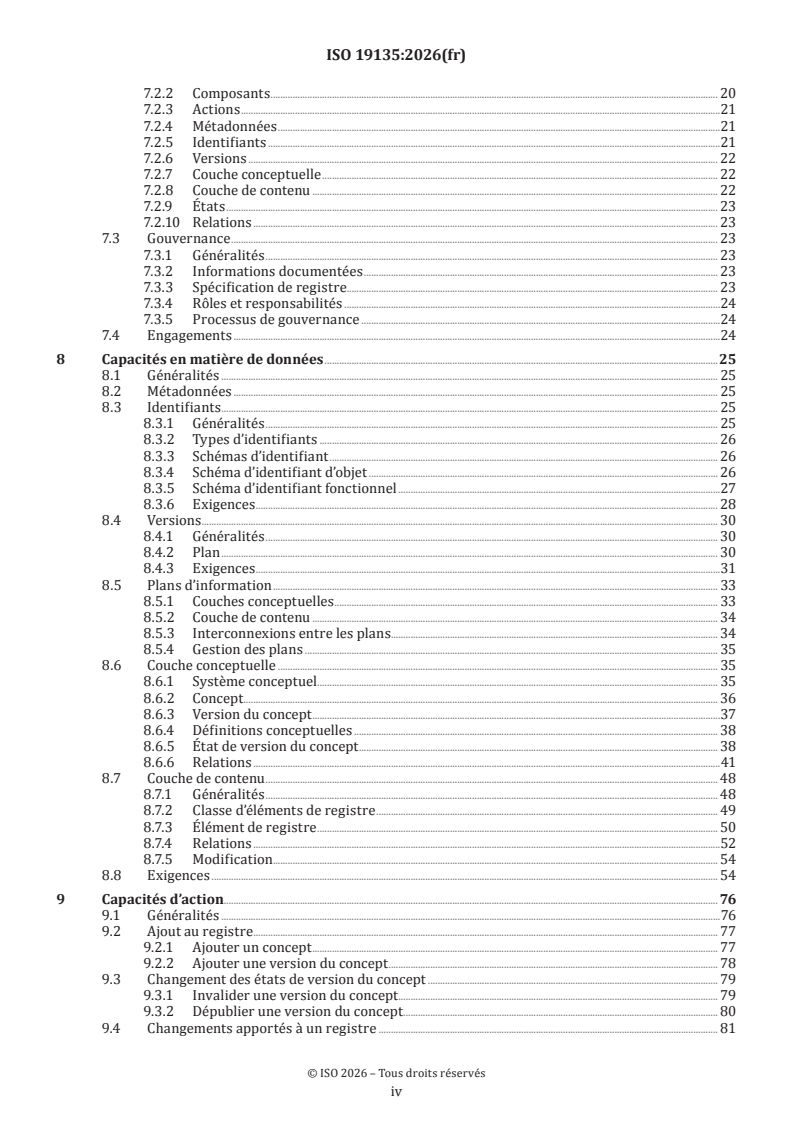
Sommaire Page
Avant-propos .viii
Introduction .x
1 Domaine d’application . 1
2 Références normatives . 1
3 Termes et définitions . 1
3.1 Généralités .1
3.2 Registres .2
3.3 Identifiants .3
3.4 Couche de contenu .3
3.5 Couche conceptuelle .4
3.6 Actions .4
3.7 États .5
3.8 Rôles de support d’un registre .6
4 Conventions . 7
4.1 Illustrations .7
4.2 Notation UML .7
4.3 Disponibilité des ressources de l’ISO/TC 211 .7
4.3.1 Autorité de mise à jour des ressources de l’ISO/TC 211 .7
4.3.2 Ressources fournies par le présent document .7
4.4 Présentation des ressources de l’ISO/TC 211 .8
4.4.1 Généralités .8
4.4.2 Classes de disposition et dispositions .8
4.4.3 Classes et tests de conformité .9
4.5 Structure d’URI dans les ressources de l’ISO/TC 211 .9
4.5.1 Généralités .9
4.5.2 Ressources identifiées .10
4.5.3 Éléments de base utilisés dans les modèles d’URI .10
4.5.4 Déclaration de disposition .10
4.5.5 Classes et tests de conformité .11
4.6 Organisation du présent document .11
5 Principes .12
5.1 Généralités . 12
5.2 Identification et accès persistants . 12
5.3 Prise en charge de l’évolution . 13
5.4 Conservation de l’historique des changements . 13
5.5 Protection de l’intégrité .14
5.6 Conformité aux engagements .14
5.7 Indépendance vis-à-vis de la technologie . 15
6 Conformité .15
6.1 Généralités . 15
6.2 Types de registres conformes . 15
6.2.1 Généralités . 15
6.2.2 Registre de contenu .16
6.2.3 Registre conceptuel .16
6.2.4 Registre de contenu régi .16
6.2.5 Registre conceptuel régi .16
6.2.6 Registre conceptuel détaillé .17
6.3 Classes d’exigence .17
7 Cadre . 19
7.1 Généralités .19
7.2 Données .19
7.2.1 Généralités .19
iii
7.2.2 Composants . 20
7.2.3 Actions .21
7.2.4 Métadonnées .21
7.2.5 Identifiants .21
7.2.6 Versions . 22
7.2.7 Couche conceptuelle . 22
7.2.8 Couche de contenu . 22
7.2.9 États . 23
7.2.10 Relations . 23
7.3 Gouvernance . 23
7.3.1 Généralités . 23
7.3.2 Informations documentées . 23
7.3.3 Spécification de registre. 23
7.3.4 Rôles et responsabilités .24
7.3.5 Processus de gouvernance .24
7.4 Engagements .24
8 Capacités en matière de données .25
8.1 Généralités . 25
8.2 Métadonnées . 25
8.3 Identifiants . . 25
8.3.1 Généralités . 25
8.3.2 Types d’identifiants . 26
8.3.3 Schémas d’identifiant . 26
8.3.4 Schéma d’identifiant d’objet . 26
8.3.5 Schéma d’identifiant fonctionnel .27
8.3.6 Exigences . 28
8.4 Versions . . 30
8.4.1 Généralités . 30
8.4.2 Plan . 30
8.4.3 Exigences .31
8.5 Plans d’information . 33
8.5.1 Couches conceptuelles . 33
8.5.2 Couche de contenu . 34
8.5.3 Interconnexions entre les plans . . 34
8.5.4 Gestion des plans . 35
8.6 Couche conceptuelle . 35
8.6.1 Système conceptuel . . 35
8.6.2 Concept . . 36
8.6.3 Version du concept .37
8.6.4 Définitions conceptuelles . 38
8.6.5 État de version du concept . 38
8.6.6 Relations .41
8.7 Couche de contenu . 48
8.7.1 Généralités . 48
8.7.2 Classe d’éléments de registre . 49
8.7.3 Élément de registre . 50
8.7.4 Relations .52
8.7.5 Modification . . . 54
8.8 Exigences . 54
9 Capacités d’action. 76
9.1 Généralités .76
9.2 Ajout au registre. 77
9.2.1 Ajouter un concept . 77
9.2.2 Ajouter une version du concept . 78
9.3 Changement des états de version du concept . 79
9.3.1 Invalider une version du concept . 79
9.3.2 Dépublier une version du concept . 80
9.4 Changements apportés à un registre . 81
iv
9.4.1 Généralités . 81
9.4.2 Remplacement de concept . . 82
9.4.3 Remplacement d’une version du concept . 84
9.4.4 Changement substantiel . 85
9.4.5 Changement de clarification . 87
9.4.6 Changement de correction .91
9.5 Changements destructifs . 93
9.5.1 Expurgation . 93
9.5.2 Supprimer un concept . 94
9.5.3 Supprimer une version du concept . 95
9.6 Définition conceptuelle . 96
9.6.1 Généralités . 96
9.6.2 Ajouter une définition conceptuelle . 97
9.6.3 Ajouter une version de définition conceptuelle . 97
9.6.4 Migration d’une réalisation de concept vers une définition conceptuelle évoluée
avec une sémantique inchangée . 98
9.6.5 Faire migrer une réalisation de concept vers une définition conceptuelle
évoluée avec une sémantique modifiée . 100
9.6.6 Ajouter une réalisation de concept par l’intermédiaire d’une nouvelle
sémantique fournie dans une définition conceptuelle évoluée . 103
9.7 Domaines de concept . 104
9.8 Intégration de concept . 105
9.8.1 Généralités . 105
9.8.2 Concepts incorporés non-versionnés et versionnés . 106
9.8.3 Création d’un concept incorporant . 109
9.8.4 Mise à jour d’un concept incorporant . 109
9.8.5 Modifier un concept incorporé .110
9.8.6 Modifier à la fois un concept incorporé et un concept incorporant . 112
9.9 Composition de concept.114
9.9.1 Généralités .114
9.9.2 Ajouter un concept composé . 115
9.9.3 Ajouter un concept composé réalisé .116
9.9.4 Modifier des parties de concept composé .117
9.9.5 Modifier des définitions de parties de concept composé . 118
9.10 Héritage de concept .119
9.10.1 Généralités .119
9.10.2 Ajouter un concept hérité . 120
9.10.3 Ajouter un concept hérité réalisé . 120
9.10.4 Modifier des définitions conceptuelles héritées . 122
9.10.5 Utilisation au sein de concepts incorporés ou composés . 124
9.11 Exigences . 125
10 Processus de gouvernance .139
10.1 Généralités . 139
10.2 Établissement d’un registre . 139
10.2.1 Généralités . 139
10.2.2 Exigences . 140
10.3 Fonctionnement d’un registre .141
10.3.1 Processus de proposition.141
10.3.2 Processus d’approbation .143
10.3.3 Processus d’appel .145
10.3.4 Processus de gestion du contenu . 148
10.4 Déclassement d’un registre . 149
10.4.1 Généralités . 149
10.4.2 Exigences . 149
11 Rôles et responsabilités .151
11.1 Généralités . 151
11.2 Propriétaire de registre . 152
11.3 Gestionnaire de registre . 155
v
11.4 Organisme de contrôle . 155
11.5 Gestionnaire de système de registre . 156
11.6 Soumissionnaire. 156
11.7 Utilisateur de registre . . 157
12 Informations documentées .157
12.1 Spécification de registre . 157
12.1.1 Généralités . 157
12.1.2 Exigences .158
12.2 Instructions relatives à la proposition . 165
13 Modèle conceptuel . .166
13.1 Vue d’ensemble . 166
13.2 Paquetage de composants . 166
13.2.1 Vue d’ensemble des composants . 166
13.2.2 Tableaux de définition .167
13.3 Paquetage d’identifiants . 172
13.3.1 Vue d’ensemble des identifiants . 172
13.3.2 Tableaux de définition . 172
13.4 Paquetage d’états.174
13.4.1 Vue d’ensemble des états .174
13.4.2 Tableaux de définition . 175
13.5 Paquetage des relations . . 177
13.5.1 Vue d’ensemble des relations . 177
13.5.2 Tableaux de définition . 178
13.6 Paquetage de proposition et d’appel . 181
13.6.1 Vue d’ensemble de proposition et appel . 181
13.6.2 Tableaux de définition . 181
13.7 Exigences . 182
14 Engagements .183
14.1 Généralités . 183
14.2 Engagements d’accès . 183
14.2.1 Généralités . 183
14.2.2 Accès aux métadonnées .184
14.2.3 Accès au contenu .184
14.2.4 Accès à l’historique . . .184
14.3 Engagements de persistance, d’intégrité et de traçabilité .184
14.3.1 Généralités .184
14.3.2 Persistance des identifiants .184
14.3.3 Persistance et conservation des métadonnées . 185
14.3.4 Persistance et conservation du contenu . 185
14.3.5 Persistance de l’historique avec traçabilité complète . 185
14.4 Engagements de transparence . 187
14.4.1 Généralités . 187
14.4.2 Transparence des métadonnées . 187
14.4.3 Transparence du contenu . 187
14.4.4 Transparence de l’historique . 187
14.5 Conformité. 187
14.6 Documentation . 188
14.7 Exigences . 188
Annexe A (normative) Suite de tests de conformité .194
Annexe B (informative) Différences avec l’ISO 19135-1:2015 . 280
Annexe C (informative) Modèle de spécification de registre . 282
Annexe D (informative) Exemple de spécification de registre: Spécification du registre des
unités de mesure («RUM») . 284
Annexe E (informative) Registres composites .293
vi
Bibliographie .302
vii
Avant-propos
L’ISO (Organisation internationale de normalisation) est une fédération mondiale d’organismes nationaux
de normalisation (comités membres de l’ISO). L’élaboration des Normes internationales est en général
confiée aux comités techniques de l’ISO. Chaque comité membre intéressé par une étude a
...