

ISO 14919:2023
(Main)Thermal spraying — Wires, rods and cords for flame and arc spraying — Classification and technical supply conditions
General Information
- Abstract
This document specifies requirements for classification of metal and non-metal wires (solid and cored), rods, cords processed by means of thermal spraying, especially by arc and flame spraying.
- Status
- Published
- Publication Date
- 30-Oct-2023
- Technical Committee
- ISO/TC 107 - Metallic and other inorganic coatings
- Drafting Committee
- ISO/TC 107 - Metallic and other inorganic coatings
- Current Stage
- 6060 - International Standard published
- Start Date
- 31-Oct-2023
- Due Date
- 02-Nov-2023
- Completion Date
- 31-Oct-2023
Buy Documents

ISO 14919:2023 - Thermal spraying — Wires, rods and cords for flame and arc spraying — Classification and technical supply conditions Released:31. 10. 2023

ISO 14919:2023 - Projection thermique — Fils, baguettes et cordons pour projection thermique a l'arc et au pistolet dans une flamme — Classification et conditions techniques d'approvisionnement Released:31. 10. 2023
Overview
ISO 14919:2023 - Thermal spraying - Wires, rods and cords for flame and arc spraying - Classification and technical supply conditions defines how metal and non‑metal feedstock (solid and cored wires, rods and cords) used for arc and flame thermal spraying are classified and supplied. The third edition (2023) updates material coverage and supply requirements to help manufacturers, specifiers and quality teams select and control spray consumables consistently.
Key topics and technical requirements
- Classification by manufacturing process and structure - solid wire/rod, powder‑metallurgical wire/rod, cored and folded wires, cords (extruded), and oxide ceramic rods are categorized by production route and internal structure.
- Material groups and chemical composition - detailed material groups (tin, zinc, aluminium, copper, iron, nickel, molybdenum, oxide ceramics) with composition limits are provided in Tables 3–10 to standardize alloy identity and performance expectations.
- Sizes and tolerances - dimensions and manufacture tolerances for wires, rods and cords to ensure feedability and process reproducibility.
- Properties - mechanical and surface properties plus workability requirements (for example wire winding) relevant to spraying performance.
- Designation and technical supply conditions - standardized naming, forms of delivery, identification, packaging, storage and inspection documentation are specified to support traceability.
- Inspection documents - requirements for documentation and certificates accompanying deliveries (see clause on inspection documents).
Notable update: the 2023 edition adds specific Zn‑Al alloy variants (ZnAl2, ZnAl4, ZnAl22) to the zinc alloy table.
Practical applications and users
Who uses ISO 14919:2023:
- Thermal spray feedstock producers and alloy manufacturers - for product classification, composition control and labelling.
- Thermal spray operators and coating suppliers - to select appropriate wires/rods/cords for arc and flame spraying processes.
- Specification writers, OEMs and procurement teams - to write clear purchase and quality requirements for spray consumables.
- Quality assurance and inspection personnel - to verify dimensions, composition, packaging and documentation conformity.
- Surface engineering and repair workshops - to ensure consistent coating feedstock and predictable coating properties.
Practical benefits:
- Ensures consistent feedstock selection and interchangeability across suppliers.
- Reduces process variability through standardized dimensions, chemistries and documentation.
- Improves traceability and conformity for safety‑critical or high‑value coatings.
Related standards
- ISO 544:2017 - Welding consumables - Technical delivery conditions for filler materials and fluxes (relevant for product dimensions and markings).
- ISO 10474:2013 - Steel and steel products - Inspection documents (relevant for inspection and certification).
Keywords: ISO 14919:2023, thermal spraying, wires rods cords, flame spraying, arc spraying, classification, technical supply conditions, spray consumables, alloy composition, feedstock specification.
Relations
- Effective Date
- 12-Feb-2026
- Consolidates
ISO 23411:2020 - Small craft — Steering wheels - Effective Date
- 06-Jun-2022
- Effective Date
- 06-Jun-2022
Buy Documents
ISO 14919:2023 - Thermal spraying — Wires, rods and cords for flame and arc spraying — Classification and technical supply conditions Released:31. 10. 2023
ISO 14919:2023 - Projection thermique — Fils, baguettes et cordons pour projection thermique a l'arc et au pistolet dans une flamme — Classification et conditions techniques d'approvisionnement Released:31. 10. 2023
Get Certified
Connect with accredited certification bodies for this standard

DVS-ZERT GmbH
German welding certification society.
CARES (UK Certification Authority for Reinforcing Steels)
UK certification for reinforcing steels and construction.
EWF/IIW (European/International Welding Federation)
International welding personnel certification.
Sponsored listings
Frequently Asked Questions
ISO 14919:2023 is a standard published by the International Organization for Standardization (ISO). Its full title is "Thermal spraying — Wires, rods and cords for flame and arc spraying — Classification and technical supply conditions". This standard covers: This document specifies requirements for classification of metal and non-metal wires (solid and cored), rods, cords processed by means of thermal spraying, especially by arc and flame spraying.
This document specifies requirements for classification of metal and non-metal wires (solid and cored), rods, cords processed by means of thermal spraying, especially by arc and flame spraying.
ISO 14919:2023 is classified under the following ICS (International Classification for Standards) categories: 25.220.20 - Surface treatment. The ICS classification helps identify the subject area and facilitates finding related standards.
ISO 14919:2023 has the following relationships with other standards: It is inter standard links to EN ISO 14919:2023, ISO 23411:2020, ISO 14919:2015. Understanding these relationships helps ensure you are using the most current and applicable version of the standard.
ISO 14919:2023 is available in PDF format for immediate download after purchase. The document can be added to your cart and obtained through the secure checkout process. Digital delivery ensures instant access to the complete standard document.
Standards Content (Sample)
INTERNATIONAL ISO
STANDARD 14919
Third edition
2023-10
Thermal spraying — Wires, rods and
cords for flame and arc spraying —
Classification and technical supply
conditions
Projection thermique — Fils, baguettes et cordons pour projection
thermique à l'arc et au pistolet dans une flamme — Classification et
conditions techniques d'approvisionnement
Reference number
© ISO 2023
All rights reserved. Unless otherwise specified, or required in the context of its implementation, no part of this publication may
be reproduced or utilized otherwise in any form or by any means, electronic or mechanical, including photocopying, or posting on
the internet or an intranet, without prior written permission. Permission can be requested from either ISO at the address below
or ISO’s member body in the country of the requester.
ISO copyright office
CP 401 • Ch. de Blandonnet 8
CH-1214 Vernier, Geneva
Phone: +41 22 749 01 11
Email: copyright@iso.org
Website: www.iso.org
Published in Switzerland
ii
Contents Page
Foreword .iv
1 Scope . 1
2 Normative references . 1
3 Terms and definitions . 1
4 Classification . 1
4.1 Classification according to the manufacturing process and resulting structure . 1
4.2 Classification according to material groups and chemical composition . 2
5 Sizes and tolerances .10
6 Properties .11
6.1 Mechanical properties . 11
6.2 Surface properties . 11
6.3 Workability — Winding of wires .12
7 Designation .12
8 Technical supply conditions .12
8.1 Forms of delivery .12
8.2 Identification . 14
8.3 Packaging and storage . 14
9 Inspection documents .15
iii
Foreword
ISO (the International Organization for Standardization) is a worldwide federation of national standards
bodies (ISO member bodies). The work of preparing International Standards is normally carried out
through ISO technical committees. Each member body interested in a subject for which a technical
committee has been established has the right to be represented on that committee. International
organizations, governmental and non-governmental, in liaison with ISO, also take part in the work.
ISO collaborates closely with the International Electrotechnical Commission (IEC) on all matters of
electrotechnical standardization.
The procedures used to develop this document and those intended for its further maintenance are
described in the ISO/IEC Directives, Part 1. In particular, the different approval criteria needed for the
different types of ISO document should be noted. This document was drafted in accordance with the
editorial rules of the ISO/IEC Directives, Part 2 (see www.iso.org/directives).
ISO draws attention to the possibility that the implementation of this document may involve the use
of (a) patent(s). ISO takes no position concerning the evidence, validity or applicability of any claimed
patent rights in respect thereof. As of the date of publication of this document, ISO had not received
notice of (a) patent(s) which may be required to implement this document. However, implementers are
cautioned that this may not represent the latest information, which may be obtained from the patent
database available at www.iso.org/patents. ISO shall not be held responsible for identifying any or all
such patent rights.
Any trade name used in this document is information given for the convenience of users and does not
constitute an endorsement.
For an explanation of the voluntary nature of standards, the meaning of ISO specific terms and
expressions related to conformity assessment, as well as information about ISO’s adherence to
the World Trade Organization (WTO) principles in the Technical Barriers to Trade (TBT), see
www.iso.org/iso/foreword.html.
This document was prepared by Technical Committee ISO/TC 107, Metallic and other inorganic coatings,
in collaboration with the European Committee for Standardization (CEN) Technical Committee CEN/
TC 240, Thermal spraying and thermally sprayed coatings, in accordance with the Agreement on technical
cooperation between ISO and CEN (Vienna Agreement).
This third edition cancels and replaces the second edition (ISO 14919:2015), which has been technically
revised.
The main changes are as follows:
— addition of the alloy ZnAl2, ZnAl4 and ZnAl22 in Table 4.
Any feedback or questions on this document should be directed to the user’s national standards body. A
complete listing of these bodies can be found at www.iso.org/members.html.
iv
INTERNATIONAL STANDARD ISO 14919:2023(E)
Thermal spraying — Wires, rods and cords for flame
and arc spraying — Classification and technical supply
conditions
1 Scope
This document specifies requirements for classification of metal and non-metal wires (solid and cored),
rods, cords processed by means of thermal spraying, especially by arc and flame spraying.
2 Normative references
The following documents are referred to in the text in such a way that some or all of their content
constitutes requirements of this document. For dated references, only the edition cited applies. For
undated references, the latest edition of the referenced document (including any amendments) applies.
ISO 544:2017, Welding consumables — Technical delivery conditions for filler materials and fluxes — Type
of product, dimensions, tolerances and markings
ISO 10474:2013, Steel and steel products — Inspection documents
3 Terms and definitions
No terms and definitions are listed in this document.
ISO and IEC maintain terminology databases for use in standardization at the following addresses:
— ISO Online browsing platform: available at https:// www .iso .org/ obp
— IEC Electropedia: available at https:// www .electropedia .org/
4 Classification
4.1 Classification according to the manufacturing process and resulting structure
The thermal spray materials are classified according to the manufacturing process and the resulting
structure, as given in Table 1.
Table 1 — Classification of thermal spraying material and resulting structure
Number Term Manufacturing process Structure
1 solid wire/rod metallurgical manufacturing and forming homogeneous
composition
2 solid wire/rod powder metallurgical manufacturing and forming homogeneous
composition
3 cored wire filling up a metal tube and compressed by means of forming seamless metal
(tube shaped shell with powder
wire) filling
4 cored wire forming a metal sheet with powder filling, binder and com- metal shell with
(folded wire) pressed by means of drawing powder filling
5 cords simultaneous extruding of powder, binder and organic sheath plastic shell with
powder filling
TTabablele 1 1 ((ccoonnttiinnueuedd))
Number Term Manufacturing process Structure
6 oxide ceramic extruding and sintering respectively drying of ceramic mate- porous rod con-
rods rial sisting of bonded
ceramic particles
4.2 Classification according to material groups and chemical composition
The material groups are given in Table 2. The chemical composition shall conform to Tables 3 to 10.
Table 2 — Classification according to material groups
Code number Term
1 tin and tin alloys
2 zinc and zinc alloys
3 aluminium and aluminium alloys
4 copper and copper alloys
5 iron and iron alloys
6 nickel and nickel alloys
7 molybdenum
8 oxide ceramics
Table 3 — Tin and tin alloys
Code Symbol Alloying elements Other elements Manufacturing
number % (mass fraction) % (mass fraction) process
1.1 Sn99 Sn ≥ 99,95 total ≤ 0,05
Sb ≤ 0,02
Ag ≤ 0,01
Bi ≤ 0,002
Cu ≤ 0,01
Fe ≤ 0,01
Pb ≤ 0,02
Al+Cd+Zn ≤ 0,002
1.2 SnSbCu84 Sb 7 to 8 Pb ≤ 0,35
Cu 3 to 4
As ≤ 0,1
remainder Sn
Bi ≤ 0,08
Fe ≤ 0,1
Al ≤ 0,01
Zn ≤ 0,01
other:
≤ 0,2
total
Table 4 — Zinc and zinc alloys
Code Symbol Alloying elements Other elements Manufacturing
number % (mass fraction) % (mass fraction) process
total ≤ 0,010
Pb ≤ 0,007
Cd ≤ 0,004
2.1 Zn99,99 Zn ≥ 99,99 Pb+Cd ≤ 0,011 1
Sn ≤ 0,001
Fe ≤ 0,005
Cu ≤ 0,002
other:
≤ 0,12
total
total ≤ 1,0
Pb ≤ 0,05
Cd ≤ 0,005
Pb+Cd ≤ 0,06
Sn ≤ 0,001
2.2 Zn99 Zn ≥ 99 Fe ≤ 0,01 1
Cu ≤ 0,7
Mo ≤ 0,01
Ti ≤ 0,16
Mg ≤ 0,01
Al ≤ 0,01
other:
≤ 0,12
total
Zn 84 to 86 total ≤ 0,17
Al 14 to 16 Pb ≤ 0,007
Cd ≤ 0,004
Pb+Cd ≤ 0,011
2.3 ZnAl15 1
Sn ≤ 0,001
Fe ≤ 0,02
Cu ≤ 0,01
Si ≤ 0,12
Zn 97,5 to 98,5 total ≤ 0,17
Al 1,5 to 2,5 Pb ≤ 0,007
Cd ≤ 0,004
Pb+Cd ≤ 0,011
2.4 ZnAl2 1
Sn ≤ 0,001
Fe ≤ 0,02
Cu ≤ 0,01
Si ≤ 0,12
TTabablele 4 4 ((ccoonnttiinnueuedd))
Code Symbol Alloying elements Other elements Manufacturing
number % (mass fraction) % (mass fraction) process
Zn 95,5 to 96,5 total ≤ 0,17
Al 3,5 to 4,5 Pb ≤ 0,007
Cd ≤ 0,004
Pb+Cd ≤ 0,011
2.5 ZnAl4 1
Sn ≤ 0,001
Fe ≤ 0,02
Cu ≤ 0,01
Si ≤ 0,12
Zn 77 to 79 total ≤ 0,17
Al 21 to 23 Pb ≤ 0,007
Cd ≤ 0,004
Pb+Cd ≤ 0,011
2.6 ZnAl22 1
Sn ≤ 0,001
Fe ≤ 0,05
Cu ≤ 0,01
Si ≤ 0,12
Table 5 — Aluminium and aluminium alloys
Code Symbol Alloying elements Other elements Manufacturing
number % (mass fraction) % (mass fraction) process
3.2 Al99,5 Al ≥ 99,5 total ≤ 0,3
Si ≤ 0,25
Fe ≤ 0,40
Ti ≤ 0,02
Cu ≤ 0,02
Zn ≤ 0,07
Mn ≤ 0,02
other: ≤ 0,03
particular
3.3 AlMg5 Mg 4,5 to 5,6 total ≤ 0,9
Mn 0,05 to 0,20
Si ≤ 0,30
Cr 0,05 to 0,20
Fe ≤ 0,40
Ti 0,06 to 0,20
remainder Al 1
Cu ≤ 0,10
Zn ≤ 0,10
other: ≤ 0,15
particular
3.4 AlZn5 Zn 4,5 to 5,1 total ≤ 1
remainder Al
Si ≤ 0,30
Fe ≤ 0,40
Cu ≤ 0,05
Sn ≤ 0,20
other: ≤ 0,05
particular
TTabablele 5 5 ((ccoonnttiinnueuedd))
Code Symbol Alloying elements Other elements Manufacturing
number % (mass fraction) % (mass fraction) process
3.5 AlSi5 Si 4,5 to 6,0 total ≤ 1
remainder Al
Si ≤ 0,30
Fe ≤ 0,80
Cu ≤ 0,30
Mn ≤ 0,05
Mg ≤ 0,05
Zn ≤ 0,10
Sn ≤ 0,20
other: ≤ 0,15
particular
3.6 AlSi12 Si 11,0 to 13,0 total ≤ 1
remainder Al
Fe ≤ 0,80
Cu ≤ 0,30
Mn ≤ 0,15
Mg ≤ 0,10 1
Zn ≤ 0,20
Ti ≤ 0,15
other particular: ≤ 0,05
other total: ≤ 0,15
Table 6 — Copper and copper alloys
Code Symbol Alloying elements Other elements Manufacturing
number % (mass fraction) % (mass fraction) process
4.1 Cu99 Cu ≥ 99,9 other ≤ 0,01 1
4.2 CuZn37 Cu 62,0 to 64 Al ≤ 0,03
remainder Zn
Fe ≤ 0,1
Mn ≤ 0,1
Ni ≤ 0,3
Pb ≤ 0,1
Sb ≤ 0,01
Sn ≤ 0,1
other: ≤ 0,5
total
4.3 CuZn39 Cu 56 to 62 Ni ≤ 1,5
Sn 0,5 to 1,5
Mn ≤ 1,0
Si 0,1 to 0,5
Fe ≤ 0,5
remainder Zn
Al ≤ 0,01
Pb ≤ 0,03
other: ≤ 0,2
total
TTabablele 6 6 ((ccoonnttiinnueuedd))
Code Symbol Alloying elements Other elements Manufacturing
number % (ma
...
NORME ISO
INTERNATIONALE 14919
Troisième édition
2023-10
Projection thermique — Fils,
baguettes et cordons pour
projection thermique à l'arc et
au pistolet dans une flamme —
Classification et conditions techniques
d'approvisionnement
Thermal spraying — Wires, rods and cords for flame and arc spraying
— Classification and technical supply conditions
Numéro de référence
DOCUMENT PROTÉGÉ PAR COPYRIGHT
© ISO 2023
Tous droits réservés. Sauf prescription différente ou nécessité dans le contexte de sa mise en œuvre, aucune partie de cette
publication ne peut être reproduite ni utilisée sous quelque forme que ce soit et par aucun procédé, électronique ou mécanique,
y compris la photocopie, ou la diffusion sur l’internet ou sur un intranet, sans autorisation écrite préalable. Une autorisation peut
être demandée à l’ISO à l’adresse ci-après ou au comité membre de l’ISO dans le pays du demandeur.
ISO copyright office
Case postale 401 • Ch. de Blandonnet 8
CH-1214 Vernier, Genève
Tél.: +41 22 749 01 11
E-mail: copyright@iso.org
Web: www.iso.org
Publié en Suisse
ii
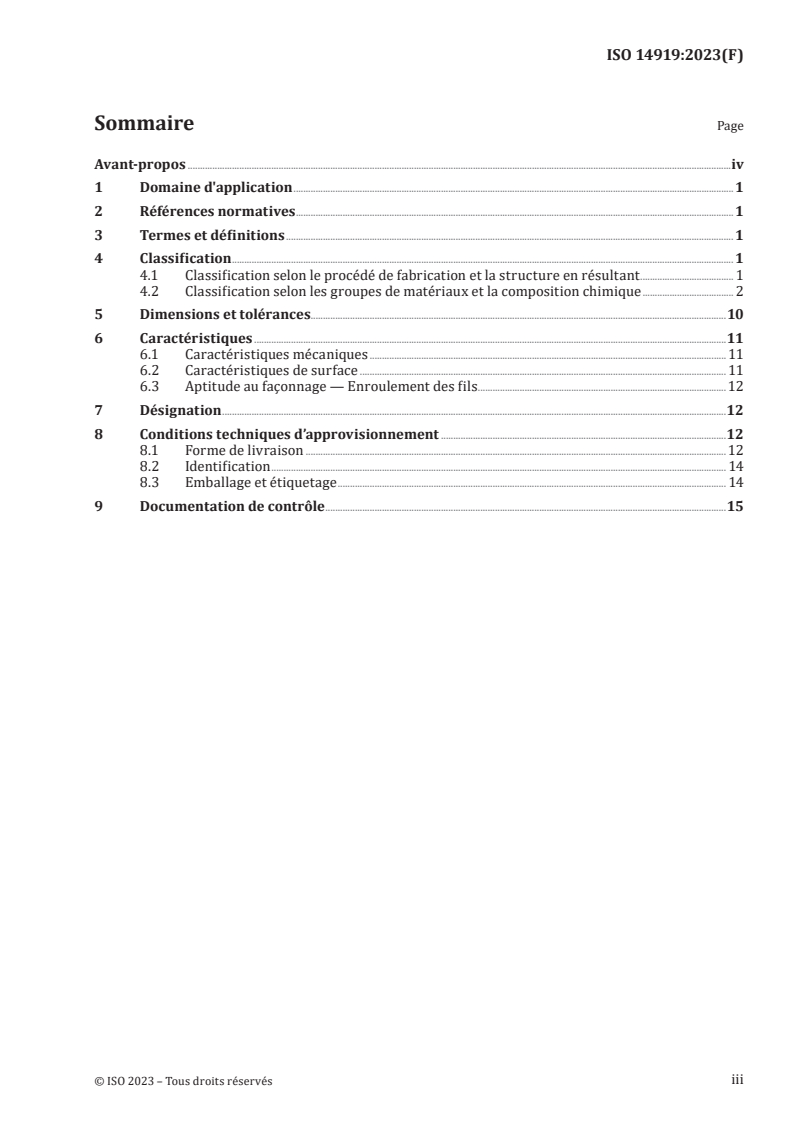
Sommaire Page
Avant-propos .iv
1 Domaine d'application .1
2 Références normatives .1
3 Termes et définitions . 1
4 Classification . 1
4.1 Classification selon le procédé de fabrication et la structure en résultant . 1
4.2 Classification selon les groupes de matériaux et la composition chimique . 2
5 Dimensions et tolérances.10
6 Caractéristiques .11
6.1 Caractéristiques mécaniques . 11
6.2 Caractéristiques de surface . 11
6.3 Aptitude au façonnage — Enroulement des fils .12
7 Désignation .12
8 Conditions techniques d’approvisionnement .12
8.1 Forme de livraison .12
8.2 Identification . 14
8.3 Emballage et étiquetage . 14
9 Documentation de contrôle .15
iii
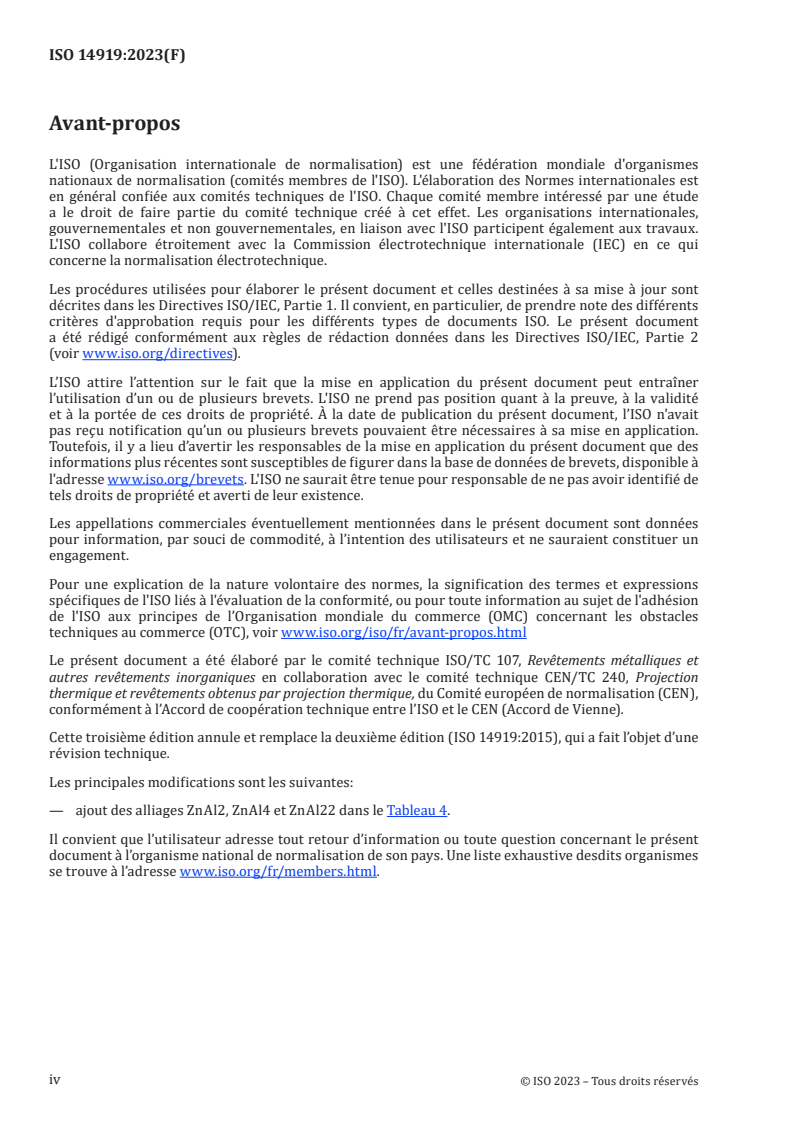
Avant-propos
L'ISO (Organisation internationale de normalisation) est une fédération mondiale d'organismes
nationaux de normalisation (comités membres de l'ISO). L'élaboration des Normes internationales est
en général confiée aux comités techniques de l'ISO. Chaque comité membre intéressé par une étude
a le droit de faire partie du comité technique créé à cet effet. Les organisations internationales,
gouvernementales et non gouvernementales, en liaison avec l'ISO participent également aux travaux.
L'ISO collabore étroitement avec la Commission électrotechnique internationale (IEC) en ce qui
concerne la normalisation électrotechnique.
Les procédures utilisées pour élaborer le présent document et celles destinées à sa mise à jour sont
décrites dans les Directives ISO/IEC, Partie 1. Il convient, en particulier, de prendre note des différents
critères d'approbation requis pour les différents types de documents ISO. Le présent document
a été rédigé conformément aux règles de rédaction données dans les Directives ISO/IEC, Partie 2
(voir www.iso.org/directives).
L’ISO attire l’attention sur le fait que la mise en application du présent document peut entraîner
l’utilisation d’un ou de plusieurs brevets. L'ISO ne prend pas position quant à la preuve, à la validité
et à la portée de ces droits de propriété. À la date de publication du présent document, l’ISO n'avait
pas reçu notification qu’un ou plusieurs brevets pouvaient être nécessaires à sa mise en application.
Toutefois, il y a lieu d’avertir les responsables de la mise en application du présent document que des
informations plus récentes sont susceptibles de figurer dans la base de données de brevets, disponible à
l'adresse www.iso.org/brevets. L'ISO ne saurait être tenue pour responsable de ne pas avoir identifié de
tels droits de propriété et averti de leur existence.
Les appellations commerciales éventuellement mentionnées dans le présent document sont données
pour information, par souci de commodité, à l’intention des utilisateurs et ne sauraient constituer un
engagement.
Pour une explication de la nature volontaire des normes, la signification des termes et expressions
spécifiques de l'ISO liés à l'évaluation de la conformité, ou pour toute information au sujet de l'adhésion
de l'ISO aux principes de l’Organisation mondiale du commerce (OMC) concernant les obstacles
techniques au commerce (OTC), voir www.iso.org/iso/fr/avant-propos.html
Le présent document a été élaboré par le comité technique ISO/TC 107, Revêtements métalliques et
autres revêtements inorganiques en collaboration avec le comité technique CEN/TC 240, Projection
thermique et revêtements obtenus par projection thermique, du Comité européen de normalisation (CEN),
conformément à l’Accord de coopération technique entre l’ISO et le CEN (Accord de Vienne).
Cette troisième édition annule et remplace la deuxième édition (ISO 14919:2015), qui a fait l’objet d’une
révision technique.
Les principales modifications sont les suivantes:
— ajout des alliages ZnAl2, ZnAl4 et ZnAl22 dans le Tableau 4.
Il convient que l’utilisateur adresse tout retour d’information ou toute question concernant le présent
document à l’organisme national de normalisation de son pays. Une liste exhaustive desdits organismes
se trouve à l’adresse www.iso.org/fr/members.html.
iv
NORME INTERNATIONALE ISO 14919:2023(F)
Projection thermique — Fils, baguettes et cordons
pour projection thermique à l'arc et au pistolet dans
une flamme — Classification et conditions techniques
d'approvisionnement
1 Domaine d'application
Le présent document spécifie les exigences en matière de classification des fils métalliques et non
métalliques (pleins et fourrés), des baguettes, des cordons traités par projection thermique, notamment
les procédés à l’arc et dans la flamme.
2 Références normatives
Les documents suivants sont cités dans le texte de sorte qu’ils constituent, pour tout ou partie de leur
contenu, des exigences du présent document. Pour les références datées, seule l’édition citée s’applique.
Pour les références non datées, la dernière édition du document de référence s'applique (y compris les
éventuels amendements).
ISO 544:2017, Produits consommables pour le soudage — Conditions techniques de livraison des produits
d'apport et des flux — Type de produits, dimensions, tolérances et marquage
ISO 10474:2013, Aciers et produits sidérurgiques — Documents de contrôle
3 Termes et définitions
Aucun terme n'est défini dans le présent document.
L'ISO et l'IEC tiennent à jour des bases de données terminologiques destinées à être utilisées en
normalisation, consultables aux adresses suivantes:
— ISO Online browsing platform: disponible à l'adresse https:// www .iso .org/ obp
— IEC Electropedia: disponible à l'adresse https:// www .electropedia .org/
4 Classification
4.1 Classification selon le procédé de fabrication et la structure en résultant
Les matériaux pour projection thermique sont classés selon le procédé de fabrication et la structure en
résultant, comme indiqué dans le Tableau 1.
Tableau 1 — Classification des matériaux pour projection thermique et des structures
en résultant
Numéro Désignation Procédé de fabrication Structure
1 Baguette ou fil Fabrication et formage par voie métallurgique Composition homogène
pleins
2 Baguette ou fil Procédés de fabrication et de formage propres à la métal- Composition homogène
pleins lurgie des poudres
TTabableleaauu 1 1 ((ssuuiitte)e)
Numéro Désignation Procédé de fabrication Structure
3 Fil fourré (en Remplissage d'un tube métallique comprimé par formage Enveloppe métallique
forme de tube) sans soudure remplie
de poudre
4 Fil fourré Formage d'une tôle métallique remplie de poudre et de Enveloppe métallique
(agrafé) liant, comprimée par étirage remplie de poudre
5 Cordons Extrusion simultanée d‘une enveloppe de poudre, de liant Enveloppe en plastique
et d’une enveloppe organique remplie de poudre
6 Baguettes en Extrusion et frittage et séchage de matériaux en céra- Baguette poreuse
céramique mique constituée de parti-
(d'oxyde) cules de céramique
agglomérées
4.2 Classification selon les groupes de matériaux et la composition chimique
Les groupes de matériaux figurent dans le Tableau 2 et la composition chimique doit être conforme aux
Tableaux 3 à 10.
Tableau 2 — Classification selon les groupes de matériaux
Numéro de code Désignation
1 Étain et alliages d’étain
2 Zinc et alliages de zinc
3 Aluminium et alliages d‘aluminium
4 Cuivre et alliages de cuivre
5 Fer et alliages de fer
6 Nickel et alliages de nickel
7 Molybdène
8 Céramique d'oxyde
Tableau 3 — Étain et alliages d’étain
Numéro de Symbole Éléments d’alliage Autres éléments Procédé de fabri-
code % (en fraction massique) % (en fraction massique) cation
1.1 Sn99 Sn ≥ 99,95 total ≤ 0,05
Sb ≤ 0,02
Ag ≤ 0,01
Bi ≤ 0,002
Cu ≤ 0,01
Fe ≤ 0,01
Pb ≤ 0,02
Al+Cd+Zn ≤ 0,002
1.2 SnSbCu84 Sb 7 à 8 Pb ≤ 0,35
Cu 3 à 4
As ≤ 0,1
Sn résiduel
Bi ≤ 0,08
Fe ≤ 0,1
Al ≤ 0,01
Zn ≤ 0,01
autre:
≤ 0,2
total
Tableau 4 — Zinc et alliages de zinc
Numéro Symbole Éléments d’alliage Autres éléments Procédé de
de code % (en fraction massique) % (en fraction massique) fabrication
total ≤ 0,010
Pb ≤ 0,007
Cd ≤ 0,004
2.1 Zn99,99 Zn ≥ 99,99 Pb+Cd ≤ 0,011 1
Sn ≤ 0,001
Fe ≤ 0,005
Cu ≤ 0,002
autre:
≤ 0,12
total
total ≤ 1,0
Pb ≤ 0,05
Cd ≤ 0,005
Pb+Cd ≤ 0,06
Sn ≤ 0,001
2.2 Zn99 Zn ≥ 99 Fe ≤ 0,01 1
Cu ≤ 0,7
Mo ≤ 0,01
Ti ≤ 0,16
Mg ≤ 0,01
Al ≤ 0,01
autre:
≤ 0,12
total
Zn 84 à 86 total ≤ 0,17
Al 14 à 16 Pb ≤ 0,007
Cd ≤ 0,004
Pb+Cd ≤ 0,011
2.3 ZnAl15 1
Sn ≤ 0,001
Fe ≤ 0,02
Cu ≤ 0,01
Si ≤ 0,12
Zn 97,5 à 98,5 total ≤ 0,17
Al 1,5 à 2,5 Pb ≤ 0,007
Cd ≤ 0,004
Pb+Cd ≤ 0,011
2.4 ZnAl2 1
Sn ≤ 0,001
Fe ≤ 0,02
Cu ≤ 0,01
Si ≤ 0,12
TTabableleaauu 4 4 ((ssuuiitte)e)
Numéro Symbole Éléments d’alliage Autres éléments Procédé de
de code % (en fraction massique) % (en fraction massique) fabrication
Zn 95,5 à 96,5 total ≤ 0,17
Al 3,5 à 4,5 Pb ≤ 0,007
Cd ≤ 0,004
Pb+Cd ≤ 0,011
2.5 ZnAl4 1
Sn ≤ 0,001
Fe ≤ 0,02
Cu ≤ 0,01
Si ≤ 0,12
Zn 77 à 79 total ≤ 0,17
Al 21 à 23 Pb ≤ 0,007
Cd ≤ 0,004
Pb+Cd ≤ 0,011
2.6 ZnAl22 1
Sn ≤ 0,001
Fe ≤ 0,05
Cu ≤ 0,01
Si ≤ 0,12
Tableau 5 — Aluminium et alliages d‘aluminium
Numéro Symbole Éléments d’alliage Autres éléments Procédé de
de code % (en fraction massique) % (en fraction massique) fabrication
3.2 Al99,5 Al ≥ 99,5 total ≤ 0,3
Si ≤ 0,25
Fe ≤ 0,40
Ti ≤ 0,02
Cu ≤ 0,02
Zn ≤ 0,07
Mn ≤ 0,02
autre: ≤ 0,03
particulier
3.3 AlMg5 Mg 4,5 à 5,6 total ≤ 0,9
Mn 0,05 à 0,20
Si ≤ 0,30
Cr 0,05 à 0,20
Fe ≤ 0,40
Ti 0,06 à 0,20
Al résiduel 1
Cu ≤ 0,10
Zn ≤ 0,10
autre: ≤ 0,15
particulier
3.4 AlZn5 Zn 4,5 à 5,1 total ≤ 1
Al résiduel
Si ≤ 0,30
Fe ≤ 0,40
Cu ≤ 0,05
Sn ≤ 0,20
autre: ≤ 0,05
particulier
TTabableleaauu 5 5 ((ssuuiitte)e)
Numéro Symbole Éléments d’alliage Autres éléments Procédé de
de code % (en fraction massique) % (en fraction massique) fabrication
3.5 AlSi5 Si 4,5 à 6,0 total ≤ 1
Al résiduel
Si ≤ 0,30
Fe ≤ 0,80
Cu ≤ 0,30
Mn ≤ 0,05
Mg ≤ 0,05
Zn ≤ 0,10
Sn ≤ 0,20
autre: ≤ 0,15
particulier
3.6 AlSi12 Si 11,0 à 13,0 total ≤ 1
Al résiduel
Fe ≤ 0,80
Cu ≤ 0,30
Mn ≤ 0,15
Mg ≤ 0,10
Zn ≤ 0,20
Ti ≤ 0,15
autre particu- ≤ 0,05
lier:
autre total: ≤ 0,15
Tableau 6 — Cuivre et alliages de cuivre
Numéro Symbole Éléments d’alliage Autres éléments Procédé de
de code % (en fraction massique) % (en fraction massique) fabrication
4.1 Cu99 Cu ≥ 99,9 autre ≤ 0,01 1
4.2 CuZn37 Cu 62,0 à 64 Al ≤ 0,03
Zn résiduel
Fe ≤ 0,1
Mn ≤ 0,1
Ni ≤ 0,3
Pb ≤ 0,1
Sb ≤ 0,01
Sn ≤ 0,1
autre: ≤ 0,5
total
4.3 CuZn39 Cu 56 à 62 Ni ≤ 1,5
Sn 0,5 à 1,5
Mn ≤ 1,0
Si 0,1 à 0,5
Fe ≤ 0,5
Zn résiduel
Al ≤ 0,01
Pb ≤ 0,03
autre: ≤ 0,2
total
TTabableleaauu 6 6 ((ssuuiitte)e)
Numéro Symbole Éléments d’alliage Autres éléments Procédé de
de code % (en fraction massique) % (en fraction massique) fabrication
4.4 CuSn6 Sn 5,0 à 8,0 Fe ≤ 0,1
Cu résiduel
Al ≤ 0,01
Zn ≤ 0,1
Pb ≤ 0,02
P 0,01 à 0,4
autre: ≤ 0,4
total
4.6 CuAl8 Al 7,5 à 9,5 Mn ≤ 1,8
Cu résiduel
Ni ≤ 0,8
Fe ≤ 0,5 1
Si ≤ 0,2
Zn ≤ 0,2
autre: ≤ 0,5
total
4.7 CuAl10 Al 8,5 à 11 Ni+Co ≤ 1,0
Fe 0,5 à 1,5
Pb ≤ 0,02
Cu résiduel
Si ≤ 0,1
Mn ≤ 0,03
Zn ≤ 0,02
autre: ≤ 0,3
total
Tableau 7 — Fer et alliages de fer
Numéro Symbole Éléments d
...