

ISO 18639-4:2018
(Main)PPE ensembles for firefighters undertaking specific rescue activities — Part 4: Gloves
General Information
- Abstract
This document provides the principles that govern the development of incident type and/or hazard specific test methods and minimum performance requirements for protective gloves for firefighters while engaged in specific rescue activities. Gloves related to specific specialist rescue activities, such as road traffic crash (RTC) and urban search and rescue (USAR), are documented in individual subclauses of this document. NOTE Further guidance can be found in ISO 18639-1. The purpose of this document is to ensure that minimum performance requirements for incident type and/or hazard specific protective gloves are designated. This document deals with "rescue from emergencies involving modes of transportation" in particular performance requirements for personal protective equipment (PPE) intended to be used by firefighters, primarily but not solely to protect against hazard exposure at non fire rescue activities involving road traffic crash (RTC) or motor vehicle accidents (MVA). This document covers general glove design, the minimum performance level of the materials used and the methods of test for determining this performance level. This document does not cover special gloves for use in other high risk situations such as firefighting. This document does not cover protection for the head, torso, arms, legs and feet. These are covered in other parts of the ISO 18639 series. It does not cover protection of the hands against other hazards, e.g. chemical, biological, radiation and electrical hazards, except for limited, accidental exposure to fire ground chemicals and blood or body fluids. Selection of the appropriate system of personal protective equipment (PPE), including gloves, is dependent on carrying out an effective risk assessment which identifies the hazard to be faced, evaluates the likelihood of those hazards and provides the means of reducing or eliminating these hazards.
- Status
- Published
- Publication Date
- 07-Nov-2018
- Technical Committee
- ISO/TC 94/SC 14 - Firefighters' personal equipment
- Drafting Committee
- ISO/TC 94/SC 14/WG 5 - Non-fire rescue incidents (Rescue)
- Current Stage
- 9092 - International Standard to be revised
- Start Date
- 22-Oct-2024
- Completion Date
- 29-Aug-2026
Buy Documents


ISO 18639-4:2018 - PPE ensembles for firefighters undertaking specific rescue activities


ISO 18639-4:2018 - PPE ensembles for firefighters undertaking specific rescue activities — Part 4: Gloves/8/2018
Overview
ISO 18639-4:2018 defines principles, test methods and minimum performance requirements for protective gloves used by firefighters undertaking specific rescue activities (not primary firefighting). Part 4 of the ISO 18639 series focuses on gloves for specialist rescue scenarios such as road traffic crash (RTC)/motor vehicle accidents (MVA) and urban search and rescue (USAR). It covers glove design, material performance and test methods to ensure hands are protected during non-fire rescue operations while noting limitations (e.g., it does not replace full firefighting gloves or certify protection against chemical, biological, radiation or electrical hazards beyond limited accidental exposures).
Key topics and requirements
The standard addresses practical, testable elements of glove performance, including:
- Design & sizing: hand dimensions, minimum sizing, glove body length, wristlet/cuff and labelling requirements.
- Pre-treatment and conditioning: inspection, specimen selection, laundering and conditioning procedures before testing.
- Heat & flame considerations: flame resistance and heat transfer tests covering flame, radiant and conductive exposure; heat resistance criteria are specified without prescribing firefighting-level protection.
- Mechanical performance: abrasion, cut, tear and puncture resistance to support rescue tasks involving sharp edges and debris.
- Liquid penetration: optional tests for resistance to blood, body fluids and limited liquid exposure.
- Whole-glove integrity: tests to ensure seams, closures and materials retain protection during use.
- Ergonomics & usability: dexterity, grip performance, donning tests and label legibility to ensure operational effectiveness.
- Material safety: checks such as leather chromium(VI) content where applicable.
- Documentation & marking: manufacturer information, marking and annexes (normative grip, donning and integrity tests; informative marking guidance).
Practical applications
ISO 18639-4:2018 is intended for:
- PPE manufacturers designing and certifying rescue-specific gloves (RTC, USAR).
- Testing laboratories conducting performance assessments and conformity tests.
- Procurement and safety managers specifying glove requirements for fire and rescue services.
- Firefighters and trainers evaluating glove selection based on task-specific risk assessments.
Using this standard helps ensure gloves balance protection, dexterity and durability for non-fire rescue tasks while clarifying limitations and integration in a broader PPE ensemble.
Related standards
- ISO 18639-1 (general guidance for PPE ensembles for specific rescue activities)
- Referenced test standards cited within ISO 18639-4, e.g., ISO 6942, ISO 9151, and textile/procedure standards used for conditioning and abrasion testing.
Keyword focus: ISO 18639-4:2018, PPE ensembles, firefighters gloves, RTC, USAR, glove performance, heat resistance, abrasion resistance, whole glove integrity, PPE risk assessment.
Relations
- Effective Date
- 01-Jan-2022
Buy Documents
ISO 18639-4:2018 - PPE ensembles for firefighters undertaking specific rescue activities
ISO 18639-4:2018 - PPE ensembles for firefighters undertaking specific rescue activities — Part 4: Gloves/8/2018
Get Certified
Connect with accredited certification bodies for this standard

CIS Institut d.o.o.
Personal Protective Equipment (PPE) certification body. Notified Body NB-2890 for EU Regulation 2016/425 PPE.

Kiwa BDA Testing
Building and construction product certification.
Kmetijski inštitut Slovenije
Agricultural Institute of Slovenia. Soil testing, plant health, agricultural product analysis.
Sponsored listings
Frequently Asked Questions
ISO 18639-4:2018 is a standard published by the International Organization for Standardization (ISO). Its full title is "PPE ensembles for firefighters undertaking specific rescue activities — Part 4: Gloves". This standard covers: This document provides the principles that govern the development of incident type and/or hazard specific test methods and minimum performance requirements for protective gloves for firefighters while engaged in specific rescue activities. Gloves related to specific specialist rescue activities, such as road traffic crash (RTC) and urban search and rescue (USAR), are documented in individual subclauses of this document. NOTE Further guidance can be found in ISO 18639-1. The purpose of this document is to ensure that minimum performance requirements for incident type and/or hazard specific protective gloves are designated. This document deals with "rescue from emergencies involving modes of transportation" in particular performance requirements for personal protective equipment (PPE) intended to be used by firefighters, primarily but not solely to protect against hazard exposure at non fire rescue activities involving road traffic crash (RTC) or motor vehicle accidents (MVA). This document covers general glove design, the minimum performance level of the materials used and the methods of test for determining this performance level. This document does not cover special gloves for use in other high risk situations such as firefighting. This document does not cover protection for the head, torso, arms, legs and feet. These are covered in other parts of the ISO 18639 series. It does not cover protection of the hands against other hazards, e.g. chemical, biological, radiation and electrical hazards, except for limited, accidental exposure to fire ground chemicals and blood or body fluids. Selection of the appropriate system of personal protective equipment (PPE), including gloves, is dependent on carrying out an effective risk assessment which identifies the hazard to be faced, evaluates the likelihood of those hazards and provides the means of reducing or eliminating these hazards.
This document provides the principles that govern the development of incident type and/or hazard specific test methods and minimum performance requirements for protective gloves for firefighters while engaged in specific rescue activities. Gloves related to specific specialist rescue activities, such as road traffic crash (RTC) and urban search and rescue (USAR), are documented in individual subclauses of this document. NOTE Further guidance can be found in ISO 18639-1. The purpose of this document is to ensure that minimum performance requirements for incident type and/or hazard specific protective gloves are designated. This document deals with "rescue from emergencies involving modes of transportation" in particular performance requirements for personal protective equipment (PPE) intended to be used by firefighters, primarily but not solely to protect against hazard exposure at non fire rescue activities involving road traffic crash (RTC) or motor vehicle accidents (MVA). This document covers general glove design, the minimum performance level of the materials used and the methods of test for determining this performance level. This document does not cover special gloves for use in other high risk situations such as firefighting. This document does not cover protection for the head, torso, arms, legs and feet. These are covered in other parts of the ISO 18639 series. It does not cover protection of the hands against other hazards, e.g. chemical, biological, radiation and electrical hazards, except for limited, accidental exposure to fire ground chemicals and blood or body fluids. Selection of the appropriate system of personal protective equipment (PPE), including gloves, is dependent on carrying out an effective risk assessment which identifies the hazard to be faced, evaluates the likelihood of those hazards and provides the means of reducing or eliminating these hazards.
ISO 18639-4:2018 is classified under the following ICS (International Classification for Standards) categories: 13.340.40 - Hand and arm protection. The ICS classification helps identify the subject area and facilitates finding related standards.
ISO 18639-4:2018 has the following relationships with other standards: It is inter standard links to ISO 18639-4:2018/Amd 1:2023. Understanding these relationships helps ensure you are using the most current and applicable version of the standard.
ISO 18639-4:2018 is available in PDF format for immediate download after purchase. The document can be added to your cart and obtained through the secure checkout process. Digital delivery ensures instant access to the complete standard document.
Standards Content (Sample)
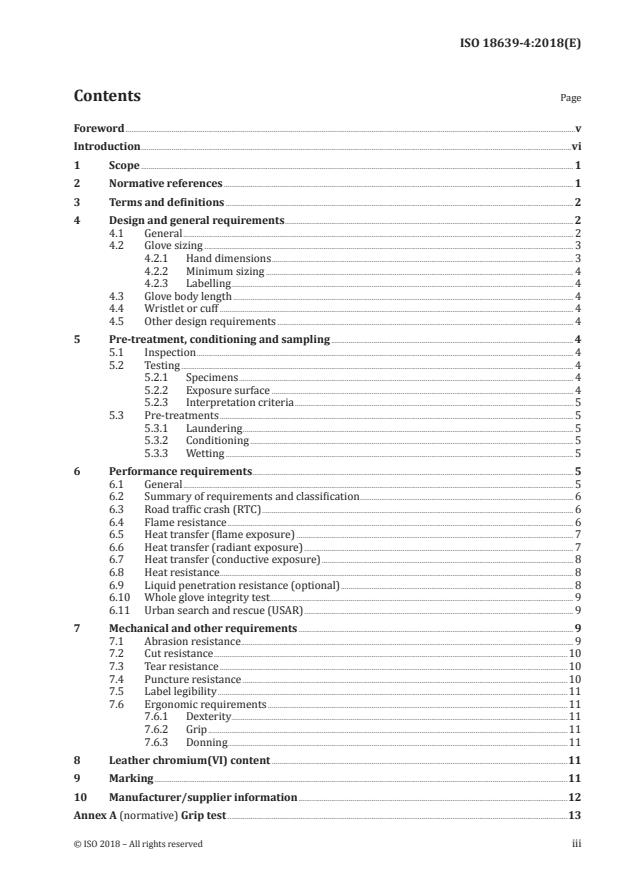
INTERNATIONAL ISO
STANDARD 18639-4
First edition
2018-11
PPE ensembles for firefighters
undertaking specific rescue
activities —
Part 4:
Gloves
Équipements de protection personnelle pour pompiers entreprenant
des activités de sauvetage particulières —
Partie 4: Gants
Reference number
©
ISO 2018
© ISO 2018
All rights reserved. Unless otherwise specified, or required in the context of its implementation, no part of this publication may
be reproduced or utilized otherwise in any form or by any means, electronic or mechanical, including photocopying, or posting
on the internet or an intranet, without prior written permission. Permission can be requested from either ISO at the address
below or ISO’s member body in the country of the requester.
ISO copyright office
CP 401 • Ch. de Blandonnet 8
CH-1214 Vernier, Geneva
Phone: +41 22 749 01 11
Fax: +41 22 749 09 47
Email: copyright@iso.org
Website: www.iso.org
Published in Switzerland
ii © ISO 2018 – All rights reserved
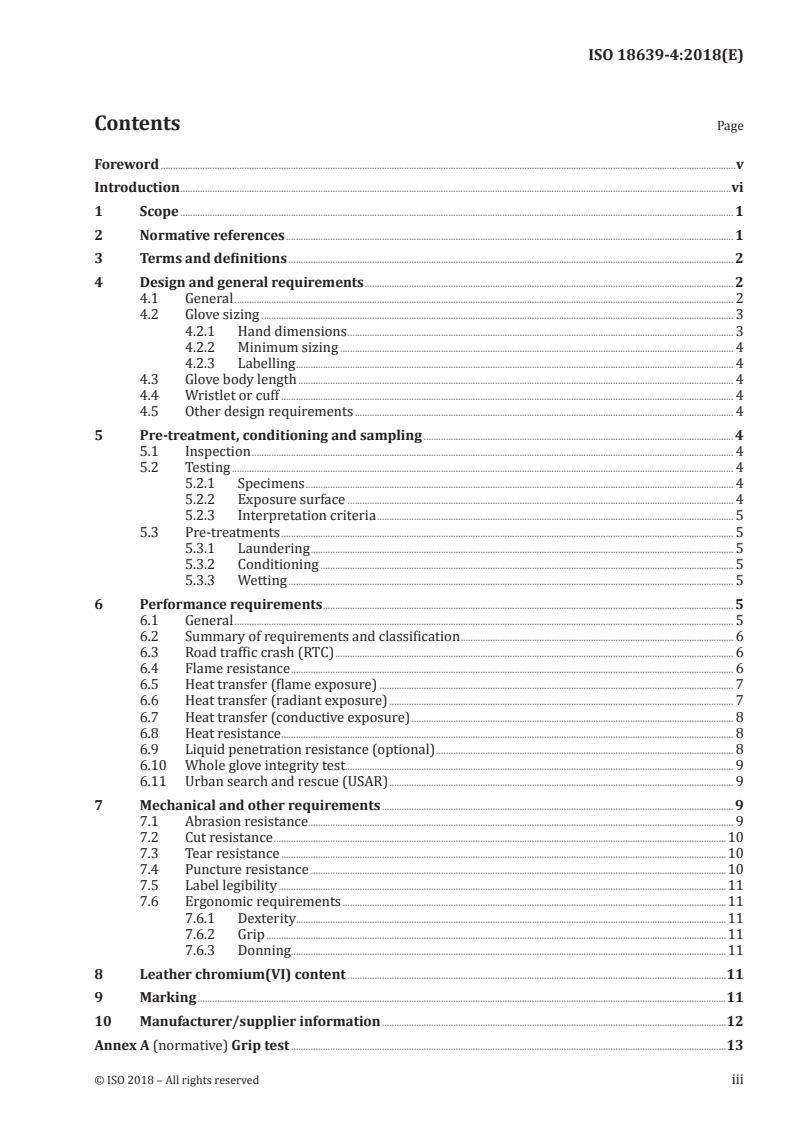
Contents Page
Foreword .v
Introduction .vi
1 Scope . 1
2 Normative references . 1
3 Terms and definitions . 2
4 Design and general requirements . 2
4.1 General . 2
4.2 Glove sizing . 3
4.2.1 Hand dimensions . 3
4.2.2 Minimum sizing . 4
4.2.3 Labelling . 4
4.3 Glove body length . 4
4.4 Wristlet or cuff . 4
4.5 Other design requirements . 4
5 Pre-treatment, conditioning and sampling . 4
5.1 Inspection . 4
5.2 Testing . 4
5.2.1 Specimens . 4
5.2.2 Exposure surface . 4
5.2.3 Interpretation criteria . 5
5.3 Pre-treatments . 5
5.3.1 Laundering . 5
5.3.2 Conditioning . 5
5.3.3 Wetting . 5
6 Performance requirements . 5
6.1 General . 5
6.2 Summary of requirements and classification . 6
6.3 Road traffic crash (RTC) . 6
6.4 Flame resistance . 6
6.5 Heat transfer (flame exposure) . 7
6.6 Heat transfer (radiant exposure) . 7
6.7 Heat transfer (conductive exposure) . 8
6.8 Heat resistance . 8
6.9 Liquid penetration resistance (optional) . 8
6.10 Whole glove integrity test. 9
6.11 Urban search and rescue (USAR) . 9
7 Mechanical and other requirements . 9
7.1 Abrasion resistance . 9
7.2 Cut resistance .10
7.3 Tear resistance .10
7.4 Puncture resistance .10
7.5 Label legibility .11
7.6 Ergonomic requirements .11
7.6.1 Dexterity.11
7.6.2 Grip .11
7.6.3 Donning.11
8 Leather chromium(VI) content .11
9 Marking .11
10 Manufacturer/supplier information .12
Annex A (normative) Grip test .13
Annex B (normative) Donning test .15
Annex C (normative) Whole glove integrity test .16
Annex D (informative) Marking .17
Bibliography .20
iv © ISO 2018 – All rights reserved
Foreword
ISO (the International Organization for Standardization) is a worldwide federation of national standards
bodies (ISO member bodies). The work of preparing International Standards is normally carried out
through ISO technical committees. Each member body interested in a subject for which a technical
committee has been established has the right to be represented on that committee. International
organizations, governmental and non-governmental, in liaison with ISO, also take part in the work.
ISO collaborates closely with the International Electrotechnical Commission (IEC) on all matters of
electrotechnical standardization.
The procedures used to develop this document and those intended for its further maintenance are
described in the ISO/IEC Directives, Part 1. In particular, the different approval criteria needed for the
different types of ISO documents should be noted. This document was drafted in accordance with the
editorial rules of the ISO/IEC Directives, Part 2 (see www .iso .org/directives).
Attention is drawn to the possibility that some of the elements of this document may be the subject of
patent rights. ISO shall not be held responsible for identifying any or all such patent rights. Details of
any patent rights identified during the development of the document will be in the Introduction and/or
on the ISO list of patent declarations received (see www .iso .org/patents).
Any trade name used in this document is information given for the convenience of users and does not
constitute an endorsement.
For an explanation of the voluntary nature of standards, the meaning of ISO specific terms and
expressions related to conformity assessment, as well as information about ISO's adherence to the
World Trade Organization (WTO) principles in the Technical Barriers to Trade (TBT) see www .iso
.org/iso/foreword .html.
This document was prepared by Technical Committee ISO/TC 94, Personal safety — Personal protective
equipment, Subcommittee SC 14, Firefighters' personal equipment.
A list of all parts in the ISO 18639 series can be found on the ISO website.
Any feedback or questions on this document should be directed to the user’s national standards body. A
complete listing of these bodies can be found at www .iso .org/members .html.
Introduction
ISO 18639 is a series of standards for personal protective equipment (PPE) for firefighters when
engaged in specific rescue activities. It is not possible to provide a standard for PPE to cover all of the
diverse range of rescue scenarios that firefighters are likely to encounter so it is important that risk
assessments be undertaken to determine if the PPE covered by the ISO 18639 series is suitable for its
intended use and the expected exposure to hazards. For complete protection against exposures, the
risk assessment should allow protection of the whole body including the torso, arms and legs, head,
face, hands and feet.
For certain rescue activities, safety ropes and harnesses can be required. For certain rescue situations,
special PPE for use in and on water can be required. In some cases, appropriate respiratory protection
can also be identified as being necessary.
The performance requirements specified in this document take account of accidental exposure to
heat and flame, but do not cover PPE for firefighting. While this document takes account of accidental
exposure to some common chemicals, it is not intended that PPE conforming to this document should
be considered as providing chemical protection as a primary function. It does not cover PPE to protect
against biological, electrical or radiation hazards. The risk assessment should determine whether PPE
complying with this document or to the requirements of any other relevant standard is more suitable.
Firefighters should be trained in the use, care and maintenance of the PPE covered by this document,
including an understanding of its limitations.
vi © ISO 2018 – All rights reserved
INTERNATIONAL STANDARD ISO 18639-4:2018(E)
PPE ensembles for firefighters undertaking specific rescue
activities —
Part 4:
Gloves
1 Scope
This document provides the principles that govern the development of incident type and/or hazard
specific test methods and minimum performance requirements for protective gloves for firefighters
while engaged in specific rescue activities.
Gloves related to specific specialist rescue activities, such as road traffic crash (RTC) and urban search
and rescue (USAR), are documented in individual subclauses of this document.
NOTE Further guidance can be found in ISO 18639-1.
The purpose of this document is to ensure that minimum performance requirements for incident type
and/or hazard specific protective gloves are designated.
This document deals with “rescue from emergencies involving modes of transportation” in particular
performance requirements for personal protective equipment (PPE) intended to be used by firefighters,
primarily but not solely to protect against hazard exposure at non fire rescue activities involving road
traffic crash (RTC) or motor vehicle accidents (MVA).
This document covers general glove design, the minimum performance level of the materials used and
the methods of test for determining this performance level.
This document does not cover special gloves for use in other high risk situations such as firefighting.
This document does not cover protection for the head, torso, arms, legs and feet. These are covered in
other parts of the ISO 18639 series. It does not cover protection of the hands against other hazards,
e.g. chemical, biological, radiation and electrical hazards, except for limited, accidental exposure to fire
ground chemicals and blood or body fluids.
Selection of the appropriate system of personal protective equipment (PPE), including gloves, is
dependent on carrying out an effective risk assessment which identifies the hazard to be faced,
evaluates the likelihood of those hazards and provides the means of reducing or eliminating these
hazards.
2 Normative references
The following documents are referred to in the text in such a way that some or all of their content
constitutes requirements of this document. For dated references, only the edition cited applies. For
undated references, the latest edition of the referenced document (including any amendments) applies.
ISO 139, Textiles — Standard atmospheres for conditioning and testing
ISO 3175-1, Textiles — Professional care, drycleaning and wetcleaning of fabrics and garments — Part 1:
Assessment of performance after cleaning and finishing
ISO 6330:2012, Textiles — Domestic washing and drying procedures for textile testing
ISO 6942:2002, Protective clothing — Protection against heat and fire — Method of test: Evaluation of
materials and material assemblies when exposed to a source of radiant heat
ISO 9151, Protective clothing against heat and flame — Determination of heat transmission on exposure
to flame
ISO 12127-1, Clothing for protection against heat and flame — Determination of contact heat transmission
through protective clothing or constituent materials — Part 1: Contact heat produced by heating cylinder
ISO 12947-4, Textiles — Determination of the abrasion resistance of fabrics by the Martindale method —
Part 4: Assessment of appearance change
ISO 13994:2005, Clothing for protection against liquid chemicals — Determination of the resistance of
protective clothing materials to penetration by liquids under pressure
ISO 13995, Protective clothing — Mechanical properties — Test method for the determination of the
resistance to puncture and dynamic tearing of materials
ISO 13996, Protective clothing — Mechanical properties — Determination of resistance to puncture
ISO 13997, Protective clothing — Mechanical properties — Determination of resistance to cutting by
sharp objects
ISO 15025:2016, Protective clothing — Protection against flame — Method of test for limited flame spread
ISO 17075 (all parts), Leather — Chemical determination of chromium(VI) content in leather
ISO 17493, Clothing and equipment for protection against heat — Test method for convective heat
resistance using a hot air circulating oven
ISO 18639-1, PPE ensembles for firefighters undertaking specific rescue activities — Part 1: General
ISO/TR 19591, Personal protective equipment for firefighters — Standard terms and definitions
EN 420:2003+A1: 2009, General requirements for gloves
3 Terms and definitions
For the purposes of this document, the terms and definitions given in ISO/TR 19591 apply.
ISO and IEC maintain terminological databases for use in standardization at the following addresses:
— ISO Online browsing platform: available at https: //www .iso .org/obp
— IEC Electropedia: available at http: //www .electropedia .org/
4 Design and general requirements
4.1 General
The protective glove shall be designed and manufactured so that in the foreseeable conditions of use
for which it is intended, the user can perform the hazard related activity normally while achieving
appropriate protection at the highest possible level.
If required, the glove shall be designed to minimize the time needed for putting on and taking off.
When the glove construction includes seams, the material and strength of the seams shall be such that
the overall performance of the glove is not significantly decreased. Where relevant, test methods and
requirements can be found in the specific standards listed in the Bibliography.
2 © ISO 2018 – All rights reserved
Gloves shall consist of a component assembly meeting the performance requirements of this document.
This component assembly shall be permitted to be configured as a continuous or joined single layer or
as continuous or joined multiple layers.
4.2 Glove sizing
4.2.1 Hand dimensions
Hand dimensions for selection of proper glove size shall consist of measuring two dimensions, hand
circumference and hand length, as shown in Figure 1.
Hand length shall be measured by placing the subject’s hand, palm down, on a piece of paper with the
fingers together and the hand and arm in a straight line. The thumb shall be fully abducted, extended
away from the palm as far as possible. The paper shall be marked at the tip of the third, or middle finger.
A mark shall be placed in the notch at the base of the thumb where the thumb joins the wrist. The
straight-line distance between the two points shall be measured to the nearest millimetre, as shown in
Figure 1.
Hand circumference shall be measured by placing a flexible measuring tape on a table or other flat
surface with the numerals facing downward. The subject shall place the right hand, palm down
and fingers together, in the middle of the tape so that the tape can pass over the back of the hand
(metacarpals). The circumference shall be measured to the nearest millimetre, 20 mm from the crotch
between thumb and index finger as shown in Figure 1.
Dimensions in millimetres
Key
a
Hand length.
b
Position where circumference is measured.
c
Minimum glove body length from wrist crease.
d
Wrist cease.
Figure 1 — Method of measuring hand dimensions for selection of proper glove
4.2.2 Minimum sizing
Gloves shall be provided in a minimum of 6 unique and distinct sizes. The manufacturer shall indicate
the range in hand circumference and hand length for wearers of each glove size as specified in 4.2.1.
NOTE This requirement is intended to allow manufacturers to report information to the user that assists in
their selection of the appropriate size. Standard sizes are not defined in this document.
4.2.3 Labelling
Glove size shall be indicated on the label. Manufacturers should provide information to the end user or
purchaser on how they have defined their sizes in terms of hand length and circumference as specified
in 4.2.1.
4.3 Glove body length
The glove body shall extend circumferentially beyond the wrist crease ≥ 25 mm. See “c” in Figure 1.
4.4 Wristlet or cuff
The sample glove body and the cuff or wristlet shall extend circumferentially at least 50 mm beyond
the wrist crease shown in Figure 1.
4.5 Other design requirements
Gloves shall be designed to restrict the entry of foreign particles through the glove openings.
Gloves shall be compatible with the sleeves of the firefighters’ protective clothing used.
Any labels or accessories shall not adversely affect the performance of the gloves or present a hazard to
the wearer.
5 Pre-treatment, conditioning and sampling
5.1 Inspection
Inspection for determining conformity with the design requirements specified in Clause 4 shall be
performed on whole gloves.
5.2 Testing
5.2.1 Specimens
Testing for determining material and component conformity with the requirements specified in Clause 6
shall be performed on samples representative of all the materials and components used in the actual
construction of the protective glove. If suitably sized representative materials and components for the
respective test method cannot be obtained, then samples from the glove shall be used as specified in
the performance requirement. The appropriate testing laboratory shall be permitted to also use sample
materials cut from representative protective gloves.
All specimens shall be taken from the palm of the different gloves for classification purposes. If relevant,
additio
...
INTERNATIONAL ISO
STANDARD 18639-4
First edition
2018-11
PPE ensembles for firefighters
undertaking specific rescue
activities —
Part 4:
Gloves
Équipements de protection personnelle pour pompiers entreprenant
des activités de sauvetage particulières —
Partie 4: Gants
Reference number
©
ISO 2018
© ISO 2018
All rights reserved. Unless otherwise specified, or required in the context of its implementation, no part of this publication may
be reproduced or utilized otherwise in any form or by any means, electronic or mechanical, including photocopying, or posting
on the internet or an intranet, without prior written permission. Permission can be requested from either ISO at the address
below or ISO’s member body in the country of the requester.
ISO copyright office
CP 401 • Ch. de Blandonnet 8
CH-1214 Vernier, Geneva
Phone: +41 22 749 01 11
Fax: +41 22 749 09 47
Email: copyright@iso.org
Website: www.iso.org
Published in Switzerland
ii © ISO 2018 – All rights reserved
Contents Page
Foreword .v
Introduction .vi
1 Scope . 1
2 Normative references . 1
3 Terms and definitions . 2
4 Design and general requirements . 2
4.1 General . 2
4.2 Glove sizing . 3
4.2.1 Hand dimensions . 3
4.2.2 Minimum sizing . 4
4.2.3 Labelling . 4
4.3 Glove body length . 4
4.4 Wristlet or cuff . 4
4.5 Other design requirements . 4
5 Pre-treatment, conditioning and sampling . 4
5.1 Inspection . 4
5.2 Testing . 4
5.2.1 Specimens . 4
5.2.2 Exposure surface . 4
5.2.3 Interpretation criteria . 5
5.3 Pre-treatments . 5
5.3.1 Laundering . 5
5.3.2 Conditioning . 5
5.3.3 Wetting . 5
6 Performance requirements . 5
6.1 General . 5
6.2 Summary of requirements and classification . 6
6.3 Road traffic crash (RTC) . 6
6.4 Flame resistance . 6
6.5 Heat transfer (flame exposure) . 7
6.6 Heat transfer (radiant exposure) . 7
6.7 Heat transfer (conductive exposure) . 8
6.8 Heat resistance . 8
6.9 Liquid penetration resistance (optional) . 8
6.10 Whole glove integrity test. 9
6.11 Urban search and rescue (USAR) . 9
7 Mechanical and other requirements . 9
7.1 Abrasion resistance . 9
7.2 Cut resistance .10
7.3 Tear resistance .10
7.4 Puncture resistance .10
7.5 Label legibility .11
7.6 Ergonomic requirements .11
7.6.1 Dexterity.11
7.6.2 Grip .11
7.6.3 Donning.11
8 Leather chromium(VI) content .11
9 Marking .11
10 Manufacturer/supplier information .12
Annex A (normative) Grip test .13
Annex B (normative) Donning test .15
Annex C (normative) Whole glove integrity test .16
Annex D (informative) Marking .17
Bibliography .20
iv © ISO 2018 – All rights reserved
Foreword
ISO (the International Organization for Standardization) is a worldwide federation of national standards
bodies (ISO member bodies). The work of preparing International Standards is normally carried out
through ISO technical committees. Each member body interested in a subject for which a technical
committee has been established has the right to be represented on that committee. International
organizations, governmental and non-governmental, in liaison with ISO, also take part in the work.
ISO collaborates closely with the International Electrotechnical Commission (IEC) on all matters of
electrotechnical standardization.
The procedures used to develop this document and those intended for its further maintenance are
described in the ISO/IEC Directives, Part 1. In particular, the different approval criteria needed for the
different types of ISO documents should be noted. This document was drafted in accordance with the
editorial rules of the ISO/IEC Directives, Part 2 (see www .iso .org/directives).
Attention is drawn to the possibility that some of the elements of this document may be the subject of
patent rights. ISO shall not be held responsible for identifying any or all such patent rights. Details of
any patent rights identified during the development of the document will be in the Introduction and/or
on the ISO list of patent declarations received (see www .iso .org/patents).
Any trade name used in this document is information given for the convenience of users and does not
constitute an endorsement.
For an explanation of the voluntary nature of standards, the meaning of ISO specific terms and
expressions related to conformity assessment, as well as information about ISO's adherence to the
World Trade Organization (WTO) principles in the Technical Barriers to Trade (TBT) see www .iso
.org/iso/foreword .html.
This document was prepared by Technical Committee ISO/TC 94, Personal safety — Personal protective
equipment, Subcommittee SC 14, Firefighters' personal equipment.
A list of all parts in the ISO 18639 series can be found on the ISO website.
Any feedback or questions on this document should be directed to the user’s national standards body. A
complete listing of these bodies can be found at www .iso .org/members .html.
Introduction
ISO 18639 is a series of standards for personal protective equipment (PPE) for firefighters when
engaged in specific rescue activities. It is not possible to provide a standard for PPE to cover all of the
diverse range of rescue scenarios that firefighters are likely to encounter so it is important that risk
assessments be undertaken to determine if the PPE covered by the ISO 18639 series is suitable for its
intended use and the expected exposure to hazards. For complete protection against exposures, the
risk assessment should allow protection of the whole body including the torso, arms and legs, head,
face, hands and feet.
For certain rescue activities, safety ropes and harnesses can be required. For certain rescue situations,
special PPE for use in and on water can be required. In some cases, appropriate respiratory protection
can also be identified as being necessary.
The performance requirements specified in this document take account of accidental exposure to
heat and flame, but do not cover PPE for firefighting. While this document takes account of accidental
exposure to some common chemicals, it is not intended that PPE conforming to this document should
be considered as providing chemical protection as a primary function. It does not cover PPE to protect
against biological, electrical or radiation hazards. The risk assessment should determine whether PPE
complying with this document or to the requirements of any other relevant standard is more suitable.
Firefighters should be trained in the use, care and maintenance of the PPE covered by this document,
including an understanding of its limitations.
vi © ISO 2018 – All rights reserved
INTERNATIONAL STANDARD ISO 18639-4:2018(E)
PPE ensembles for firefighters undertaking specific rescue
activities —
Part 4:
Gloves
1 Scope
This document provides the principles that govern the development of incident type and/or hazard
specific test methods and minimum performance requirements for protective gloves for firefighters
while engaged in specific rescue activities.
Gloves related to specific specialist rescue activities, such as road traffic crash (RTC) and urban search
and rescue (USAR), are documented in individual subclauses of this document.
NOTE Further guidance can be found in ISO 18639-1.
The purpose of this document is to ensure that minimum performance requirements for incident type
and/or hazard specific protective gloves are designated.
This document deals with “rescue from emergencies involving modes of transportation” in particular
performance requirements for personal protective equipment (PPE) intended to be used by firefighters,
primarily but not solely to protect against hazard exposure at non fire rescue activities involving road
traffic crash (RTC) or motor vehicle accidents (MVA).
This document covers general glove design, the minimum performance level of the materials used and
the methods of test for determining this performance level.
This document does not cover special gloves for use in other high risk situations such as firefighting.
This document does not cover protection for the head, torso, arms, legs and feet. These are covered in
other parts of the ISO 18639 series. It does not cover protection of the hands against other hazards,
e.g. chemical, biological, radiation and electrical hazards, except for limited, accidental exposure to fire
ground chemicals and blood or body fluids.
Selection of the appropriate system of personal protective equipment (PPE), including gloves, is
dependent on carrying out an effective risk assessment which identifies the hazard to be faced,
evaluates the likelihood of those hazards and provides the means of reducing or eliminating these
hazards.
2 Normative references
The following documents are referred to in the text in such a way that some or all of their content
constitutes requirements of this document. For dated references, only the edition cited applies. For
undated references, the latest edition of the referenced document (including any amendments) applies.
ISO 139, Textiles — Standard atmospheres for conditioning and testing
ISO 3175-1, Textiles — Professional care, drycleaning and wetcleaning of fabrics and garments — Part 1:
Assessment of performance after cleaning and finishing
ISO 6330:2012, Textiles — Domestic washing and drying procedures for textile testing
ISO 6942:2002, Protective clothing — Protection against heat and fire — Method of test: Evaluation of
materials and material assemblies when exposed to a source of radiant heat
ISO 9151, Protective clothing against heat and flame — Determination of heat transmission on exposure
to flame
ISO 12127-1, Clothing for protection against heat and flame — Determination of contact heat transmission
through protective clothing or constituent materials — Part 1: Contact heat produced by heating cylinder
ISO 12947-4, Textiles — Determination of the abrasion resistance of fabrics by the Martindale method —
Part 4: Assessment of appearance change
ISO 13994:2005, Clothing for protection against liquid chemicals — Determination of the resistance of
protective clothing materials to penetration by liquids under pressure
ISO 13995, Protective clothing — Mechanical properties — Test method for the determination of the
resistance to puncture and dynamic tearing of materials
ISO 13996, Protective clothing — Mechanical properties — Determination of resistance to puncture
ISO 13997, Protective clothing — Mechanical properties — Determination of resistance to cutting by
sharp objects
ISO 15025:2016, Protective clothing — Protection against flame — Method of test for limited flame spread
ISO 17075 (all parts), Leather — Chemical determination of chromium(VI) content in leather
ISO 17493, Clothing and equipment for protection against heat — Test method for convective heat
resistance using a hot air circulating oven
ISO 18639-1, PPE ensembles for firefighters undertaking specific rescue activities — Part 1: General
ISO/TR 19591, Personal protective equipment for firefighters — Standard terms and definitions
EN 420:2003+A1: 2009, General requirements for gloves
3 Terms and definitions
For the purposes of this document, the terms and definitions given in ISO/TR 19591 apply.
ISO and IEC maintain terminological databases for use in standardization at the following addresses:
— ISO Online browsing platform: available at https: //www .iso .org/obp
— IEC Electropedia: available at http: //www .electropedia .org/
4 Design and general requirements
4.1 General
The protective glove shall be designed and manufactured so that in the foreseeable conditions of use
for which it is intended, the user can perform the hazard related activity normally while achieving
appropriate protection at the highest possible level.
If required, the glove shall be designed to minimize the time needed for putting on and taking off.
When the glove construction includes seams, the material and strength of the seams shall be such that
the overall performance of the glove is not significantly decreased. Where relevant, test methods and
requirements can be found in the specific standards listed in the Bibliography.
2 © ISO 2018 – All rights reserved
Gloves shall consist of a component assembly meeting the performance requirements of this document.
This component assembly shall be permitted to be configured as a continuous or joined single layer or
as continuous or joined multiple layers.
4.2 Glove sizing
4.2.1 Hand dimensions
Hand dimensions for selection of proper glove size shall consist of measuring two dimensions, hand
circumference and hand length, as shown in Figure 1.
Hand length shall be measured by placing the subject’s hand, palm down, on a piece of paper with the
fingers together and the hand and arm in a straight line. The thumb shall be fully abducted, extended
away from the palm as far as possible. The paper shall be marked at the tip of the third, or middle finger.
A mark shall be placed in the notch at the base of the thumb where the thumb joins the wrist. The
straight-line distance between the two points shall be measured to the nearest millimetre, as shown in
Figure 1.
Hand circumference shall be measured by placing a flexible measuring tape on a table or other flat
surface with the numerals facing downward. The subject shall place the right hand, palm down
and fingers together, in the middle of the tape so that the tape can pass over the back of the hand
(metacarpals). The circumference shall be measured to the nearest millimetre, 20 mm from the crotch
between thumb and index finger as shown in Figure 1.
Dimensions in millimetres
Key
a
Hand length.
b
Position where circumference is measured.
c
Minimum glove body length from wrist crease.
d
Wrist cease.
Figure 1 — Method of measuring hand dimensions for selection of proper glove
4.2.2 Minimum sizing
Gloves shall be provided in a minimum of 6 unique and distinct sizes. The manufacturer shall indicate
the range in hand circumference and hand length for wearers of each glove size as specified in 4.2.1.
NOTE This requirement is intended to allow manufacturers to report information to the user that assists in
their selection of the appropriate size. Standard sizes are not defined in this document.
4.2.3 Labelling
Glove size shall be indicated on the label. Manufacturers should provide information to the end user or
purchaser on how they have defined their sizes in terms of hand length and circumference as specified
in 4.2.1.
4.3 Glove body length
The glove body shall extend circumferentially beyond the wrist crease ≥ 25 mm. See “c” in Figure 1.
4.4 Wristlet or cuff
The sample glove body and the cuff or wristlet shall extend circumferentially at least 50 mm beyond
the wrist crease shown in Figure 1.
4.5 Other design requirements
Gloves shall be designed to restrict the entry of foreign particles through the glove openings.
Gloves shall be compatible with the sleeves of the firefighters’ protective clothing used.
Any labels or accessories shall not adversely affect the performance of the gloves or present a hazard to
the wearer.
5 Pre-treatment, conditioning and sampling
5.1 Inspection
Inspection for determining conformity with the design requirements specified in Clause 4 shall be
performed on whole gloves.
5.2 Testing
5.2.1 Specimens
Testing for determining material and component conformity with the requirements specified in Clause 6
shall be performed on samples representative of all the materials and components used in the actual
construction of the protective glove. If suitably sized representative materials and components for the
respective test method cannot be obtained, then samples from the glove shall be used as specified in
the performance requirement. The appropriate testing laboratory shall be permitted to also use sample
materials cut from representative protective gloves.
All specimens shall be taken from the palm of the different gloves for classification purposes. If relevant,
additio
...