


ISO 24102:2010
(Main)Intelligent transport systems — Communications access for land mobiles (CALM) — Management
Intelligent transport systems — Communications access for land mobiles (CALM) — Management
ISO 24102:2010 provides specifications for intelligent transport systems (ITS) station management to be compliant with the ITS station reference architecture and the set of communications access for land mobiles (CALM) related standards. Management actions are specified via service access points; messages and data that flow between the ITS station management entity and the security entity, the application entity and the various communication protocol layers of the ITS station reference architecture; and protocol data units for management communications between addressable instances of functionality of an ITS station.
Systèmes intelligents de transport — Accès aux communications des services mobiles terrestres (CALM) — Gestion
General Information
- Status
- Withdrawn
- Publication Date
- 04-Nov-2010
- Withdrawal Date
- 04-Nov-2010
- Technical Committee
- ISO/TC 204 - Intelligent transport systems
- Drafting Committee
- ISO/TC 204/WG 16 - Communications
- Current Stage
- 9599 - Withdrawal of International Standard
- Start Date
- 19-Nov-2015
- Completion Date
- 14-Feb-2026
Relations
- Effective Date
- 23-Feb-2012
- Effective Date
- 23-Feb-2012
- Effective Date
- 23-Feb-2012
- Effective Date
- 23-Feb-2012
- Effective Date
- 23-Feb-2012
Get Certified
Connect with accredited certification bodies for this standard

BSI Group
BSI (British Standards Institution) is the business standards company that helps organizations make excellence a habit.

Great Wall Tianjin Quality Assurance Center
Established 1993, first batch to receive national accreditation with IAF recognition.
Hong Kong Quality Assurance Agency (HKQAA)
Hong Kong's leading certification body.
Sponsored listings
Frequently Asked Questions
ISO 24102:2010 is a standard published by the International Organization for Standardization (ISO). Its full title is "Intelligent transport systems — Communications access for land mobiles (CALM) — Management". This standard covers: ISO 24102:2010 provides specifications for intelligent transport systems (ITS) station management to be compliant with the ITS station reference architecture and the set of communications access for land mobiles (CALM) related standards. Management actions are specified via service access points; messages and data that flow between the ITS station management entity and the security entity, the application entity and the various communication protocol layers of the ITS station reference architecture; and protocol data units for management communications between addressable instances of functionality of an ITS station.
ISO 24102:2010 provides specifications for intelligent transport systems (ITS) station management to be compliant with the ITS station reference architecture and the set of communications access for land mobiles (CALM) related standards. Management actions are specified via service access points; messages and data that flow between the ITS station management entity and the security entity, the application entity and the various communication protocol layers of the ITS station reference architecture; and protocol data units for management communications between addressable instances of functionality of an ITS station.
ISO 24102:2010 is classified under the following ICS (International Classification for Standards) categories: 03.220.01 - Transport in general; 35.240.60 - IT applications in transport. The ICS classification helps identify the subject area and facilitates finding related standards.
ISO 24102:2010 has the following relationships with other standards: It is inter standard links to ISO 24102-2:2015, ISO 24102-3:2013, ISO 24102-5:2013, ISO 24102-1:2013, ISO 24102-4:2013. Understanding these relationships helps ensure you are using the most current and applicable version of the standard.
ISO 24102:2010 is available in PDF format for immediate download after purchase. The document can be added to your cart and obtained through the secure checkout process. Digital delivery ensures instant access to the complete standard document.
Standards Content (Sample)
INTERNATIONAL ISO
STANDARD 24102
First edition
2010-11-15
Intelligent transport systems —
Communications access for land mobiles
(CALM) — Management
Systèmes intelligents de transport — Accès aux communications des
services mobiles terrestres (CALM) — Gestion
Reference number
©
ISO 2010
PDF disclaimer
This PDF file may contain embedded typefaces. In accordance with Adobe's licensing policy, this file may be printed or viewed but
shall not be edited unless the typefaces which are embedded are licensed to and installed on the computer performing the editing. In
downloading this file, parties accept therein the responsibility of not infringing Adobe's licensing policy. The ISO Central Secretariat
accepts no liability in this area.
Adobe is a trademark of Adobe Systems Incorporated.
Details of the software products used to create this PDF file can be found in the General Info relative to the file; the PDF-creation
parameters were optimized for printing. Every care has been taken to ensure that the file is suitable for use by ISO member bodies. In
the unlikely event that a problem relating to it is found, please inform the Central Secretariat at the address given below.
© ISO 2010
All rights reserved. Unless otherwise specified, no part of this publication may be reproduced or utilized in any form or by any means,
electronic or mechanical, including photocopying and microfilm, without permission in writing from either ISO at the address below or
ISO's member body in the country of the requester.
ISO copyright office
Case postale 56 • CH-1211 Geneva 20
Tel. + 41 22 749 01 11
Fax + 41 22 749 09 47
E-mail copyright@iso.org
Web www.iso.org
Published in Switzerland
ii © ISO 2010 – All rights reserved
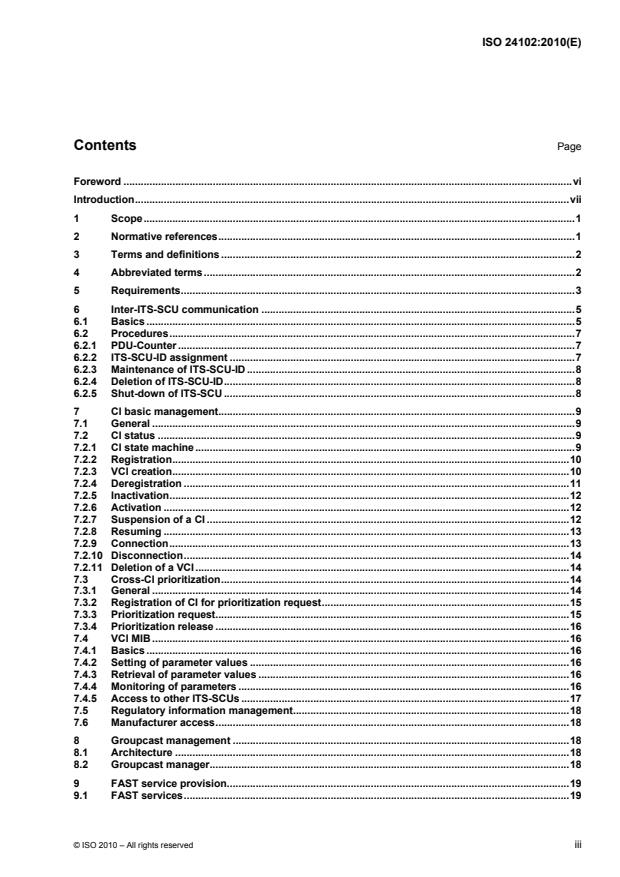
Contents Page
Foreword .vi
Introduction.vii
1 Scope.1
2 Normative references.1
3 Terms and definitions .2
4 Abbreviated terms.2
5 Requirements.3
6 Inter-ITS-SCU communication .5
6.1 Basics .5
6.2 Procedures.7
6.2.1 PDU-Counter .7
6.2.2 ITS-SCU-ID assignment .7
6.2.3 Maintenance of ITS-SCU-ID .8
6.2.4 Deletion of ITS-SCU-ID.8
6.2.5 Shut-down of ITS-SCU .8
7 CI basic management.9
7.1 General .9
7.2 CI status .9
7.2.1 CI state machine.9
7.2.2 Registration.10
7.2.3 VCI creation.10
7.2.4 Deregistration .11
7.2.5 Inactivation.12
7.2.6 Activation .12
7.2.7 Suspension of a CI .12
7.2.8 Resuming .13
7.2.9 Connection.13
7.2.10 Disconnection.14
7.2.11 Deletion of a VCI.14
7.3 Cross-CI prioritization.14
7.3.1 General .14
7.3.2 Registration of CI for prioritization request.15
7.3.3 Prioritization request.15
7.3.4 Prioritization release .16
7.4 VCI MIB .16
7.4.1 Basics .16
7.4.2 Setting of parameter values .16
7.4.3 Retrieval of parameter values .16
7.4.4 Monitoring of parameters .16
7.4.5 Access to other ITS-SCUs .17
7.5 Regulatory information management.18
7.6 Manufacturer access.18
8 Groupcast management .18
8.1 Architecture .18
8.2 Groupcast manager.18
9 FAST service provision.19
9.1 FAST services.19
9.2 Frame flow . 19
9.2.1 Overview . 19
9.2.2 Service advertisement frame. 21
9.2.3 Service context frame . 22
9.2.4 Service identifier. 23
9.2.5 Service operation phase . 24
9.3 FAST service initialization phase. 24
9.3.1 Service provider. 24
9.3.2 Service user. 25
9.4 FAST service operation phase . 25
9.5 FAST initialization of IPv6 based services. 25
9.6 Service termination. 25
9.7 Duplicate services . 25
10 Congestion control. 26
11 Radar view . 27
12 CI selection management . 27
13 Legacy CI. 29
13.1 Registration. 29
13.2 CI states. 29
14 Management data elements. 29
14.1 ITS-SCU list . 29
14.2 VCI list. 30
14.3 VCI performance parameter list . 30
14.4 Cross-CI prioritization list. 31
14.5 Application requirement list . 33
15 MN-SAP. 33
15.1 General. 33
15.2 MN-COMMAND. 34
15.2.1 MN-COMMANDs. 34
15.2.2 MN-COMMAND.request. 34
15.2.3 MN-COMMAND.confirm. 34
15.3 MN-REQUEST. 35
15.3.1 MN-REQUESTs. 35
15.3.2 MN-REQUEST.request. 35
15.3.3 MN-REQUEST.confirm . 36
16 MF-SAP . 37
16.1 General. 37
16.2 MF-COMMAND . 37
16.2.1 MF-COMMANDs . 37
16.2.2 MF-COMMAND.request . 37
16.2.3 MF-COMMAND.confirm . 38
16.3 MF-REQUEST . 39
16.3.1 MF-REQUESTs . 39
16.3.2 MF-REQUEST.request . 39
16.3.3 MF-REQUEST.confirm. 40
17 Conformance. 40
18 Test methods. 40
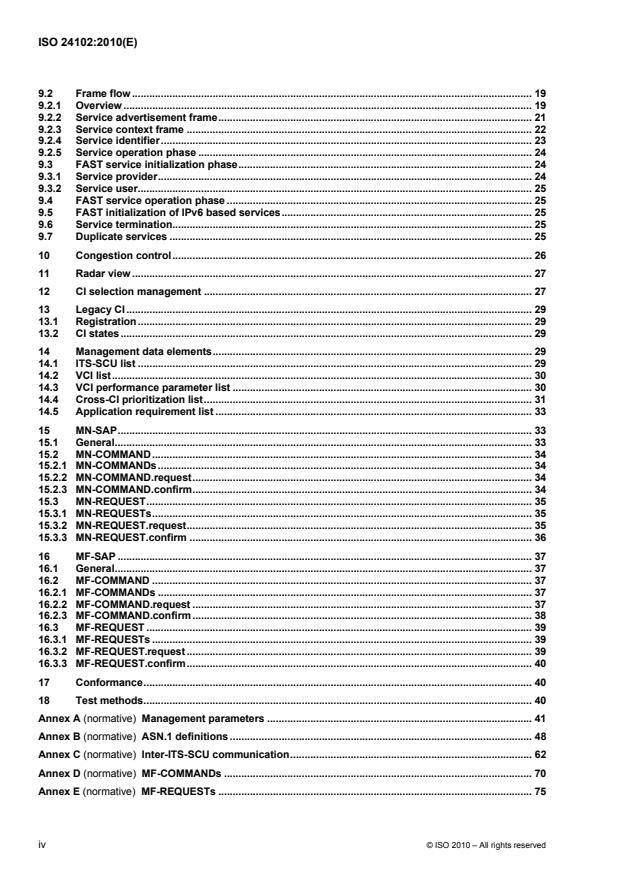
Annex A (normative) Management parameters . 41
Annex B (normative) ASN.1 definitions . 48
Annex C (normative) Inter-ITS-SCU communication. 62
Annex D (normative) MF-COMMANDs . 70
Annex E (normative) MF-REQUESTs . 75
iv © ISO 2010 – All rights reserved
Annex F (normative) MN-COMMANDs .82
Annex G (normative) MN-REQUESTs .85
Bibliography.89
Foreword
ISO (the International Organization for Standardization) is a worldwide federation of national standards bodies
(ISO member bodies). The work of preparing International Standards is normally carried out through ISO
technical committees. Each member body interested in a subject for which a technical committee has been
established has the right to be represented on that committee. International organizations, governmental and
non-governmental, in liaison with ISO, also take part in the work. ISO collaborates closely with the
International Electrotechnical Commission (IEC) on all matters of electrotechnical standardization.
International Standards are drafted in accordance with the rules given in the ISO/IEC Directives, Part 2.
The main task of technical committees is to prepare International Standards. Draft International Standards
adopted by the technical committees are circulated to the member bodies for voting. Publication as an
International Standard requires approval by at least 75 % of the member bodies casting a vote.
Attention is drawn to the possibility that some of the elements of this document may be the subject of patent
rights. ISO shall not be held responsible for identifying any or all such patent rights.
ISO 24102 was prepared by Technical Committee ISO/TC 204, Intelligent transport systems.
vi © ISO 2010 – All rights reserved
Introduction
This International Standard is part of a family of International Standards for communications access for land
mobiles (CALM). An introduction to the whole set of International Standards is provided in ISO 21217.
This International Standard determines the intelligent transport systems (ITS) station management.
INTERNATIONAL STANDARD ISO 24102:2010(E)
Intelligent transport systems — Communications access for
land mobiles (CALM) — Management
1 Scope
This International Standard provides specifications for intelligent transport systems (ITS) station management
to be compliant with the ITS station reference architecture and the set of communications access for land
mobiles (CALM) related standards.
Management actions are specified via
a) service access points,
b) messages and data that flow between the ITS station management entity and the security entity, the
application entity and the various communication protocol layers of the ITS station reference architecture,
and
c) protocol data units for management communications between addressable instances of functionality of an
ITS station.
2 Normative references
The following referenced documents are indispensable for the application of this document. For dated
references, only the edition cited applies. For undated references, the latest edition of the referenced
document (including any amendments) applies.
ISO/IEC 8825-2, Information technology — ASN.1 encoding rules: Specification of Packed Encoding Rules
(PER)
ISO 15628:2007, Road transport and traffic telematics — Dedicated short range communication (DSRC) —
DSRC application layer
ISO 21210, Intelligent transport systems — Communications access for land mobiles (CALM) — IPv6
Networking
ISO 21217, Intelligent transport systems — Communications access for land mobiles (CALM) — Architecture
ISO 21218:2008, Intelligent transport systems — Communications access for land mobiles (CALM) —
Medium service access points
ISO 29281, Intelligent transport systems — Communications access for land mobiles (CALM) — Non-IP
networking
3 Terms and definitions
For the purposes of this document, the terms and definitions given in ISO 21217, ISO 21210, ISO 29281,
ISO 21218, and the following apply.
NOTE Terminology in the set of CALM standards was modified during the process of harmonizing International
Standards. This might lead to an editorial difference in terms used in this International Standard and in other International
Standards from the set of CALM standards. These editorial differences will be resolved during the ongoing process of
harmonizing the whole set of CALM standards.
3.1
regulatory information
set of regulatory requirements for radio wave emission
3.2
ITS-S communication unit
addressable instance of the ITS station reference architecture comprising as a minimum the ITS-S router
functionality
NOTE ITS-SCU (ITS-S communication unit) previously was named CCK (CALM communication kernel).
4 Abbreviated terms
For the purposes of this document, the abbreviated terms given in ISO 21217, ISO 21210, ISO 29281,
ISO 21218, and the following apply.
CI Communication Interface
ETSI European Telecommunications Standards Institute
ITS-SCU ITS Station Communication Unit
ITSSI ITS State Information
LDM Local Dynamic Map
MAC Medium Access Control
MIB Management Information Base
MF-COMMAND command issued by the ITS station management entity and sent to the facilities layer
via the MF-SAP
MF-REQUEST command issued by the facilities layer and sent to the ITS station management entity
via the MF-SAP
MI-COMMAND command issued by the ITS station management entity and sent to the access layer via
the MI-SAP
MI-GETPARAM command issued by the ITS station management entity in order to get the value of one
or several CI parameters; it is sent via the MI-SAP to the access layer
MI-REQUEST command issued by the access layer and sent to the ITS station management entity via
the MI-SAP
MI-SETPARAM command issued by the ITS station management entity in order to set the value of one
or several CI parameters. It is sent via the MI-SAP to the access layer
MN-COMMAND command issued by the ITS station management entity and sent to the networking and
transport layer via the MN-SAP
2 © ISO 2010 – All rights reserved
MN-REQUEST command issued by the networking and transport layer and sent to the ITS station
management entity via the MN-SAP
n.a. not applicable
PDUs Protocol Data Units
QoS Quality of Service
RI Regulatory Information
SAF Service Advertisement Frame
SCF Service Context Frame
SID Service Identifier
STA Service Table for Advertisement
VCI Virtual Communication Interface
NOTE During the process of harmonizing the CALM standards, the SAP names were changed. Subsequently, the
names of services and service primitives changed accordingly.
5 Requirements
The ITS station management entity specified in this International Standard provides functionality related to the
⎯ management of communication protocol layers and the security entity presented in the ITS station
reference architecture specified in ISO 21217 and presented in Figure 1, and
⎯ station-local management communications (Inter-ITS-SCU communications) enabling a sub-division of an
ITS station into several addressable entities, e.g. hosts and routers,
in line with the general ITS architecture specified in ISO 21217.
Figure 1 — ITS station reference architecture with named interfaces
ITS station management is specified as a distributed process, where no supervisory entity is employed.
The ITS station management entity shall provide the service primitives of the
a) MI-SAP, specified in ISO 21218,
b) MN-SAP, specified in this International Standard,
c) MF-SAP, specified in this International Standard.
NOTE 1 SAPs can be non-exposed interfaces. Thus service primitives of SAPs are not subject to conformance tests.
NOTE 2 The MA-interface presented in Figure 1 is not specified in this International Standard, although it is recognized
as part of the ITS station reference architecture specified in ISO 21217.
The ITS station management entity shall use the service primitives provided in the NF-SAP, specified in
ISO 29281 and in ISO 21210 for the purpose of "Inter-ITS-SCU Communication".
NOTE 3 Figure 18 in ISO 21217 presents details on the ITS-SCU, i.e. an extension on the basic ITS station reference
model presenting the NF-SAP connected to the management entity.
Means to secure the access to management functionality need to be specified within the global context of
CALM security. This may require, e.g. defining further Inter-ITS-SCU communication PDUs for authentication
of ITS-SCUs. Details are outside the scope of this International Standard.
Detailed mandatory requirements are specified in the following clauses of this International Standard.
⎯ Clause 6 specifies "Inter-ITS-SCU communications", i.e. how management commands are exchanged
between different addressable entities of an ITS station.
⎯ Clause 7 specifies basic management procedures related to communication interfaces.
⎯ Clause 8 specifies groupcast management.
⎯ Clause 9 specifies FAST service provisions.
⎯ Clause 10 specifies congestion control.
⎯ Clause 11 specifies the concept of "Radar View" and the link to the "Local Dynamic Map" (LDM)
application.
⎯ Clause 12 specifies communication interfaces (CI) selection management.
⎯ Clause 13 specifies management of "Legacy CIs".
⎯ Clause 14 specifies management data elements.
⎯ Clause 15 specifies the MN-SAP of the networking and transport layer.
⎯ Clause 16 specifies the MF-SAP of the facilities layer.
⎯ Clause 17 specifies conformance declaration and test methods.
⎯ Annexes provide further mandatory requirements.
4 © ISO 2010 – All rights reserved
6 Inter-ITS-SCU communication
6.1 Basics
Management communications between ITS-SCUs of the same ITS station, as specified in ISO 21217, shall be
based on the ITS station-internal network presented in ISO 21217.
NOTE Installations can provide technically different realizations of the ITS station internal network which can be used
to carry inter-ITS-SCU management packets. Details are outside the scope of this International Standard.
The following protocol data units (PDU) shall be used:
⎯ ITS-SCU-Mngmt-Request;
⎯ ITS-SCU-Mngmt-Response.
Details on parameters of these PDUs are shown in Table 1.
Table 1 — Inter-ITS-SCU management PDUs
PDU element ITS-SCU-Mngmt-Request ITS-SCU-Mngmt-Response
SourceITS-SCU-ID ITS-SCU-ID of source ITS-SCU, ITS-SCU-ID of ITS-SCU, which
which produces the request. See produces the response.
parameter 3 "ITS-scuId" specified
in Annex A.
DestinationITS-SCU-ID ITS-SCU-ID of destination ITS- Same as SourceITS-SCU-ID of
SCU, which shall evaluate the related request if not requested
request. otherwise in this International
Standard.
PDU-Counter Even number generated from a PDU-Counter of related request
cyclic counter at the ITS-SCU, incremented by one.
which produces the request.
PDU-ID Unique identifier of the content of Same as in ITS-SCU-Mngmt-
the request. Request.
Data Octet string specific to the PDU- Octet string specific to the PDU-
ID, carrying the request. ID, carrying the response.
ErrorStatus Not existent. Existent.
0: No error happened
>0: Number indicating type of
error.
Figure 2 illustrates Table 1. The element "SourceITS-SCU-ID" shall be transmitted first. In a serial
communication link, the most significant byte of an element shall be transmitted first, and the least significant
bit of a byte shall be transmitted first.
Figure 2 — Inter-ITS-SCU PDU structure
The ASN.1 specification of the PDUs is provided in Annex B of this International Standard.
NOTE PDU-ID and Data are coded together in an ASN.1 "CHOICE" type. The ASN.1 tag number equals the PDU-ID.
ITS-SCU-ID values used in parameters "SourceITS-SCU-ID" and "DestinationITS-SCU-ID" shall be as
specified in Table 2.
Table 2 — ITS-SCU-ID value assignment
SourceITS- DestinationITS- Description
SCU-ID SCU-ID
0 Reserved. Used to indicate "own/local ITS-SCU".
n.a. 1 ITS-SCU-ID identifying ITS-SCUs of all hosts.
n.a. 2 ITS-SCU-ID identifying ITS-SCUs of all routers.
3 - 7 Reserved for future use.
8 . 254 ITS-SCU-ID identifying uniquely a specific ITS-SCU in an ITS
station.
n.a. 255 ITS-SCU-ID identifying all ITS-SCUs, i.e. those of hosts and
routers.
"PDU-ID" values and the related "Data" values shall be set as specified in Annex C of this International
Standard.
"ErrorStatus" values shall be set as specified in Table 3.
6 © ISO 2010 – All rights reserved
Table 3 — ErrorStatus value assignment
ErrorStatus Description
0 No error
1 PDU-ID unknown or not implemented
2 Duplicate ITS-SCU-ID
3 . 254 Reserved for future use
255 Unspecified error
6.2 Procedures
6.2.1 PDU-Counter
"PDU-Counter" values shall be set uniquely in an ITS-SCU under the control of the ITS station management
entity issuing the request. For every next ITS-SCU-Mngmt-Request PDU, the counter value shall be
incremented by two. It shall wrap from 254 to zero.
6.2.2 ITS-SCU-ID assignment
The ITS-SCU shall randomly generate a unique ITS-SCU-ID as specified in Table 2 as its own ITS-SCU-ID
and shall put the selected ITS-SCU-ID to its local ITS-SCU-list. ITS-SCU-ID values already being in the local
ITS-SCU-list indicate usage by another ITS-SCU in the same station and shall not be selected. Then the ITS-
SCU-Mngmt-Request 0 "ITS-SCU-id(new)" shall be sent to all ITS-SCUs, indicating a first choice of ITS-SCU-
ID in the "SourceITS-SCU-ID element, or a new choice of ITS-SCU-ID, and the type of ITS-SCU in the "Data"
element. In case of a negative acknowledgement, i.e. indication of usage of this ITS-SCU-ID value by another
ITS-SCU, see below, the ITS-SCU shall repeat the procedure with a new ITS-SCU-ID value.
Upon activation, an ITS-SCU may listen to receive ITS-SCU-Mngmt-Request 0 "ITS-SCU-id" messages or
ITS-SCU-Mngmt-Response 0 "ITS-SCU-id" messages in order to identify already allocated ITS-SCU-IDs.
Upon reception of an ITS-SCU-Mngmt-Request 0 "ITS-SCU-id(new)", an ITS-SCU shall check the SourceITS-
SCU-ID.
⎯ If the SourceITS-SCU-ID is equal to the own ITS-SCU-ID, the receiving ITS-SCU shall send an ITS-SCU-
Mngmt-Response 0 "ITS-SCU-id" to all ITS-SCUs, reporting the own ITS-SCU-ID and type of ITS-SCU to
all ITS-SCUs, indicating ErrorStatus=2.
⎯ If the SourceITS-SCU-ID is different to the own ITS-SCU-ID, the ITS-SCU shall take this information to its
local ITS-SCU-list, if not already present there. An existing entry shall not be updated with this new
information. The ITS-SCU shall acknowledge the ITS-SCU-Mngmt-Request with the ITS-SCU-Mngmt-
Response 0 "ITS-SCU-id", reporting the own ITS-SCU-ID and type of ITS-SCU, indicating ErrorStatus=0.
Upon reception of an ITS-SCU-Mngmt-Request 0 "ITS-SCU-id(alive)", an ITS-SCU shall check the
SourceITS-SCU-ID.
⎯ If the SourceITS-SCU-ID is equal to the own ITS-SCU-ID, the receiving ITS-SCU shall send an ITS-SCU-
Mngmt-Response 0 "-id" to all ITS-SCUs, reporting the own ITS-SCU-ID and type of ITS-SCU to all ITS-
SCUs, indicating ErrorStatus=2. All ITS-SCUs with this ITS-SCU-ID shall invalidate this ITS-SCU-ID and
shall start the procedure to select a new ITS-SCU-ID.
⎯ If the SourceITS-SCU-ID is different to the own ITS-SCU-ID, the ITS-SCU shall take this information to its
local ITS-SCU-list, if not already present there. The ITS-SCU-Mngmt-Request shall not be acknowledged
with an ITS-SCU-Mngmt-Response.
Upon reception of an ITS-SCU-Mngmt-Response 0 "ITS-SCU-id", an ITS-SCU shall check the ErrorStatus.
⎯ In case of ErrorStatus=0, the ITS-SCU shall take this information to its local ITS-SCU-list, if not already
present there.
⎯ In case of ErrorStatus=2, an address conflict was detected. The procedure to be selected upon this event
depends on the value of "Message" and SourceITS-SCU-ID contained in the ITS-SCU-Mngmt-Response
as presented in Table 4.
Table 4 — Error handling procedure for ITS-SCU-Mngmt-Response 0
ITS-SCU-Mngmt-Response 0 SourceITS-SCU-ID = SourceITS-SCU-ID ≠
"ITS-SCU-id (ErrorStatus = 2)" own ITS-SCU-ID own ITS-SCU-ID
Message = new Map ITS-SCU-ID to ITS-SCUtype Nothing shall be done.
reported in the response.
Restart ITS-SCU-ID assignment
process.
IMPORTANT — This should IMPORTANT — This should
Message = alive
never happen. never happen.
Reset ITS-SCU and restart ITS- Delete SourceITS-SCU-ID from
SCU-ID assignment process. local ITS-SCU-list.
Request deletion of related
entries in forwarding tables.
IMPORTANT — This should never happen.
Message = delete
Nothing shall be done.
AN ITS-SCU shall be considered to be fully alive only upon first successful reception of ITS-SCU-Mngmt-
Request 0 "ITS-SCU-id(alive)".
6.2.3 Maintenance of ITS-SCU-ID
Every ITS-SCU shall periodically transmit the "alive-signal" Mngmt-Request 0 "ITS-SCU-id(alive)" in order to
indicate its presence in the ITS station. The period of transmission shall be as set in parameter 11 "Talive"
specified in Annex A. The value of "Talive" shall be defined by implementation and shall be unique in an ITS
station.
The ITS-SCU periodically shall check the local ITS-SCU-list. If for a period of at least three times "Talive" no
"alive-signal" Mngmt-Request 0 "ITS-SCU-id(alive)" was received, the ITS-SCU shall assume that this ITS-
SCU is no longer alive. The ITS-SCU-ID shall be deleted from the local ITS-SCU-list.
6.2.4 Deletion of ITS-SCU-ID
Deletion of an ITS-SCU-ID from the local ITS-SCU-list shall result in deleting all related entries in forwarding
tables.
6.2.5 Shut-down of ITS-SCU
Prior to performing a shut-down of ITS-SCU, the Mngmt-Request 0 "ITS-SCU-id(delete)" message shall be
sent to all ITS-SCUs.
8 © ISO 2010 – All rights reserved
7 CI basic management
7.1 General
Basic management procedures related to communication interfaces (CI) shall access a CI/VCI via the MI-SAP
specified in ISO 21218.
Any change of status of a CI/VCI shall be reported to all ITS-SCUs with ITS-SCU-Mngmt-Request 10 "VCI-
update". Reception of such a notification shall not be acknowledged.
Management communications with CIs/VCIs in other ITS-SCUs shall be with Inter-ITS-SCU communication
PDUs 5 "MI-rcmd", 6 "MI-rreq", 7 "MI-rget" and 8 "MI-rset" as specified in this International Standard.
SAPs and the related service primitives can not be tested and are not mandatory. However in the context of
this International Standard, the elements of the service primitives may be an integral part of PDUs exchanged
between physical entities in an ITS station using "Inter-ITS-SCU Communications". As PDUs are testable,
those elements of service primitives that are part of a PDU become testable.
7.2 CI status
7.2.1 CI state machine
Figure 3 shows the CI state machine specified in ISO 21218.
Figure 3 — CI state machine ISO 21218
NOTE ISO 21218:2008 uses the term "reactivate" instead of "resume".
7.2.2 Registration
Registration of a CI at the ITS station management entity is the process to make the CI known to the ITS
station management entity, and to make it addressable via a unique MedID, see ISO 21218.
Registration of a CI shall be done as specified in ISO 21218.
The medium identifier MedID, part of the CI-ID as specified in ISO 21218, and assigned to a CI during the
process of registration shall be generated randomly. The MedID shall be unique within an ITS-SCU.
Upon successful registration of a CI, the ITS station management entity shall create an entry in the VCI list
with the values specified in Table 5.
Table 5 — Entry in VCI list upon registration of CI
CI-ID Medium CI/VCI Status ConnectMode NWsupport Peer MAC
address
ITS-SCU-ID and Set equal to MI- "registered", see Set equal to MI- Set equal to MI- Set to zero.
MedID set. parameter 22 ISO 21218. parameter 51 parameter 23
SerialNumber "Medium". See "Connect". "NWsupport".
set to zero. ISO 21218.
CtrlCI bits set to
zero.
7.2.3 VCI creation
Creation of a VCI may be done
⎯ upon request of the ITS station management entity, or
⎯ upon request of a networking protocol, or
⎯ by the CI on its own.
Creation of a VCI shall be done as specified in ISO 21218.
Upon successful creation of a VCI the ITS station management entity
⎯ shall create an entry in the VCI list with the values specified in Tables 6, 7 and 8, as applicable,
⎯ shall create initial entries in the forwarding tables of all supported networking protocols using MN-
COMMAND 1, if applicable.
Table 6 — Entry in VCI list indicating an active CI
CI-ID Medium CI/VCI Status ConnectMode NWsupport Peer MAC
address
ITS-SCU-ID and Set equal to MI- "active", see Set equal to MI- Set equal to MI- Unknown, set to
MedID set. parameter 22 ISO 21218. parameter 51 parameter 23 zero.
SerialNumber "Medium". See "Connect". "NWsupport".
set to zero. ISO 21218.
CtrlCI bits set to
zero.
10 © ISO 2010 – All rights reserved
Table 7 — Entry in VCI List upon creation of a broadcast VCI
CI-ID Medium CI/VCI Status ConnectMode NWsupport Peer MAC
address
ITS-SCU-ID and Set equal to MI- "active", see Not used. Set Set equal to MI- Not used. Set to
MedID set. parameter 22 ISO 21218. equal to MI- parameter 23 zero.
SerialNumber "Medium". See parameter 51 "NWsupport".
set to 65535. ISO 21218. "Connect".
G/U bit set to 1.
Other CtrlCI bits
set to zero.
Table 8 — Entry in VCI List upon creation of a multicast VCI
CI-ID Medium CI/VCI Status ConnectMode NWsupport Peer MAC
address
ITS-SCU-ID and Set equal to MI- "active", see Not used. Set Set equal to MI- Not used. Set to
MedID set. parameter 22 ISO 21218. equal to MI- parameter 23 zero.
SerialNumber "Medium". See parameter 51 "NWsupport".
set to multicast
ISO 21218. "Connect".
group number.
G/U bit set to 1.
Other CtrlCI bits
set to zero.
Upon request of a networking protocol to create a VCI with a specific relation to a peer station, of which the
MAC address is known a priori, and with specific settings of the MI-parameters, the ITS station management
entity shall create the VCI and perform all required settings. The state of the VCI shall be set to "connected",
see Table 9. The ITS station management entity shall update the VCI list and the forwarding tables.
7.2.4 Deregistration
Deregistration of a CI at the ITS station management entity is the process reversal to the registration process.
Successful deregistration is a prerequisite to remove a CI from the system during operation.
Deregistration of a CI may be done
⎯ by the CI on its own,
⎯ upon request of the ITS station management entity as specified in this International Standard.
Deregistration of a CI shall be done as specified in ISO 21218.
Upon successful deregistration, the ITS station management entity
⎯ shall delete all entries of this CI and the related VCIs in the VCI list,
⎯ may re-use the value of MedID of this CI, but only in case there are no more so far unused MedID values
available for registration of a new CI, and
⎯ shall delete all entries of this CI and the related VCIs in the forwarding tables using MN-COMMAND 3.
NOTE Not to reuse a MedID value immediately allows the upper OSI layers to "time-out", i.e. to avoid addressing
conflicts.
7.2.5 Inactivation
Inactivation of a CI is the process to reset the CI and to block all subsequent communications.
Inactivation of a CI may be done upon request of the ITS station management entity.
NOTE Conditions when a CI shall or may be inactivated are not specified in this International Standard.
Inactivation of a CI shall be done as specified in ISO 21218.
Upon successful inactivation, the ITS station management entity
⎯ shall change the status element of this CI in the VCI list to "inactive", and shall delete the entries of all
related VCIs in the VCI list,
⎯ change the CI state of this CI in the forwarding tables to "inactive", and shall delete the entries of all
related VCIs in the forwarding tables using MN-COMMAND 3.
7.2.6 Activation
Activation of a CI is the process to enable communications in an inactive CI. Upon successful activation the
ITS station management entity shall change the status element of this CI to the value "registered".
Activation of a CI may be done upon request of the ITS station management entity as specified in this
International Standard.
NOTE Requirements on events upon which a CI shall or may be activated are not specified in this International
Standard.
Activation of a CI shall be done as specified in ISO 21218.
Upon successful activation, the ITS station management entity shall change the status element of this CI in
the VCI list to the value "registered".
7.2.7 Suspension of a CI
Suspension of a CI is the process to put all communications of a CI on hold, without deleting any packets or
state variables.
Suspension of a CI may be done upon request of the ITS station management entity as specified in this
International Standard.
NOTE Requirements when a CI shall or may be suspended are not specified in this International Standard.
Suspension of a CI shall be done as specified in ISO 21218.
Upon successful suspension, the ITS station management entity
⎯ shall change the status element of this CI and the related VCIs in the VCI list to "suspended", and
⎯ shall change the CI state of this CI and the related VCIs in the forwarding tables to "suspended" using
MN-COMMAND 2.
12 © ISO 2010 – All rights reserved
7.2.8 Resuming
Resuming of a CI is the process to enable communications in a suspended CI.
Resuming of a CI may be done upon request of the ITS station management entity.
NOTE 1 Conditions when a CI shall or may be reactivated are not specified in this International Standard.
Resuming of a CI shall be done as specified in ISO 21218.
Upon successful resuming, the ITS station management entity shall change
⎯ the status element of this CI in the VCI list to "active", and the status of the related VCIs in the VCI list to
"connected", and
⎯ the CI state of this CI and the related VCIs in the forwarding tables to "connected" using MN-COMMAND 2.
NOTE 2 This VCI state might be wrong. However this w
...
Questions, Comments and Discussion
Ask us and Technical Secretary will try to provide an answer. You can facilitate discussion about the standard in here.
Loading comments...