


ISO 12003-2:2008
(Main)Agricultural and forestry tractors — Roll-over protective structures on narrow-track wheeled tractors — Part 2: Rear-mounted ROPS
Agricultural and forestry tractors — Roll-over protective structures on narrow-track wheeled tractors — Part 2: Rear-mounted ROPS
ISO 12003-2:2008 specifies procedures for both the static and dynamic testing of roll-over protective structures (ROPS) rear-mounted on narrow-track wheeled agricultural and forestry tractors. It defines the clearance zone and acceptance conditions for rigid or tiltable, rear, two-post roll bar, frame and cab ROPS, and is applicable to tractors so equipped having the following characteristics. A ground clearance of not more than 600 mm beneath the lowest points of the front- and rear-axle housings (not considering lower points on the axle differential). A fixed or adjustable minimum track width of one of the two axles of less than 1 150 mm when fitted with the widest specified tyres, and with the overall width of the other axle being less than that of the first axle. A mass greater than 600 kg but less than 3 000 kg, unladen, including the ROPS and tyres of the largest size recommended by the manufacturer.
Tracteurs agricoles et forestiers — Structures de protection contre le retournement (ROPS) pour tracteurs à roues à voie étroite — Partie 2: ROPS montées à l'arrière
L'ISO 12003-2:2008 spécifie des modes opératoires d'essai statique et dynamique, la zone de dégagement et les conditions d'acceptation des structures de protection contre le retournement (ROPS) à deux montants, rigides ou inclinables, en cabine, bâti ou arceau de sécurité, montées à l'arrière sur les tracteurs agricoles et forestiers à roues à voie étroite. Elle est applicable aux tracteurs ainsi équipés, présentant les caractéristiques suivantes. Garde au sol inférieure ou égale à 600 mm en dessous des points les plus bas de l'essieu avant et arrière, à l'exception des points inférieurs sur le différentiel de l'essieu. Largeur de voie minimale fixe ou réglable de l'un des deux essieux inférieure à 1 150 mm, les pneus les plus larges spécifiés étant montés et la largeur globale de l'autre essieu étant inférieure à celle du premier essieu. Masse supérieure à 600 kg mais inférieure à 3 000 kg, à vide, mais en comptant la ROPS et la plus grande taille de pneus recommandée par le constructeur.
General Information
- Status
- Withdrawn
- Publication Date
- 22-Jul-2008
- Withdrawal Date
- 22-Jul-2008
- Technical Committee
- ISO/TC 23/SC 2 - Common tests
- Drafting Committee
- ISO/TC 23/SC 2 - Common tests
- Current Stage
- 9599 - Withdrawal of International Standard
- Start Date
- 11-Jun-2021
- Completion Date
- 14-Feb-2026
Relations
- Effective Date
- 09-Feb-2026
- Effective Date
- 09-Feb-2026
- Effective Date
- 09-Feb-2026
- Effective Date
- 23-Apr-2020
- Effective Date
- 15-Apr-2008
Buy Documents
ISO 12003-2:2008 - Agricultural and forestry tractors -- Roll-over protective structures on narrow-track wheeled tractors
ISO 12003-2:2008 - Tracteurs agricoles et forestiers -- Structures de protection contre le retournement (ROPS) pour tracteurs a roues a voie étroite
Get Certified
Connect with accredited certification bodies for this standard

Control Union Certifications
Global certification for agriculture and sustainability.

ECOCERT
Organic and sustainability certification.

Rainforest Alliance Certification
Sustainable agriculture and forestry certification.
Sponsored listings
Frequently Asked Questions
ISO 12003-2:2008 is a standard published by the International Organization for Standardization (ISO). Its full title is "Agricultural and forestry tractors — Roll-over protective structures on narrow-track wheeled tractors — Part 2: Rear-mounted ROPS". This standard covers: ISO 12003-2:2008 specifies procedures for both the static and dynamic testing of roll-over protective structures (ROPS) rear-mounted on narrow-track wheeled agricultural and forestry tractors. It defines the clearance zone and acceptance conditions for rigid or tiltable, rear, two-post roll bar, frame and cab ROPS, and is applicable to tractors so equipped having the following characteristics. A ground clearance of not more than 600 mm beneath the lowest points of the front- and rear-axle housings (not considering lower points on the axle differential). A fixed or adjustable minimum track width of one of the two axles of less than 1 150 mm when fitted with the widest specified tyres, and with the overall width of the other axle being less than that of the first axle. A mass greater than 600 kg but less than 3 000 kg, unladen, including the ROPS and tyres of the largest size recommended by the manufacturer.
ISO 12003-2:2008 specifies procedures for both the static and dynamic testing of roll-over protective structures (ROPS) rear-mounted on narrow-track wheeled agricultural and forestry tractors. It defines the clearance zone and acceptance conditions for rigid or tiltable, rear, two-post roll bar, frame and cab ROPS, and is applicable to tractors so equipped having the following characteristics. A ground clearance of not more than 600 mm beneath the lowest points of the front- and rear-axle housings (not considering lower points on the axle differential). A fixed or adjustable minimum track width of one of the two axles of less than 1 150 mm when fitted with the widest specified tyres, and with the overall width of the other axle being less than that of the first axle. A mass greater than 600 kg but less than 3 000 kg, unladen, including the ROPS and tyres of the largest size recommended by the manufacturer.
ISO 12003-2:2008 is classified under the following ICS (International Classification for Standards) categories: 65.060.10 - Agricultural tractors and trailed vehicles. The ICS classification helps identify the subject area and facilitates finding related standards.
ISO 12003-2:2008 has the following relationships with other standards: It is inter standard links to EN 15694:2009, EN 16990:2020, EN 15694:2009+A1:2015, ISO 12003-2:2021, ISO 12003-2:2002. Understanding these relationships helps ensure you are using the most current and applicable version of the standard.
ISO 12003-2:2008 is available in PDF format for immediate download after purchase. The document can be added to your cart and obtained through the secure checkout process. Digital delivery ensures instant access to the complete standard document.
Standards Content (Sample)
INTERNATIONAL ISO
STANDARD 12003-2
Second edition
2008-08-01
Agricultural and forestry tractors —
Roll-over protective structures on
narrow-track wheeled tractors —
Part 2:
Rear-mounted ROPS
Tracteurs agricoles et forestiers — Structures de protection contre le
retournement (ROPS) pour tracteurs à roues à voie étroite —
Partie 2: ROPS montées à l'arrière
Reference number
©
ISO 2008
PDF disclaimer
This PDF file may contain embedded typefaces. In accordance with Adobe's licensing policy, this file may be printed or viewed but
shall not be edited unless the typefaces which are embedded are licensed to and installed on the computer performing the editing. In
downloading this file, parties accept therein the responsibility of not infringing Adobe's licensing policy. The ISO Central Secretariat
accepts no liability in this area.
Adobe is a trademark of Adobe Systems Incorporated.
Details of the software products used to create this PDF file can be found in the General Info relative to the file; the PDF-creation
parameters were optimized for printing. Every care has been taken to ensure that the file is suitable for use by ISO member bodies. In
the unlikely event that a problem relating to it is found, please inform the Central Secretariat at the address given below.
© ISO 2008
All rights reserved. Unless otherwise specified, no part of this publication may be reproduced or utilized in any form or by any means,
electronic or mechanical, including photocopying and microfilm, without permission in writing from either ISO at the address below or
ISO's member body in the country of the requester.
ISO copyright office
Case postale 56 • CH-1211 Geneva 20
Tel. + 41 22 749 01 11
Fax + 41 22 749 09 47
E-mail copyright@iso.org
Web www.iso.org
Published in Switzerland
ii © ISO 2008 – All rights reserved
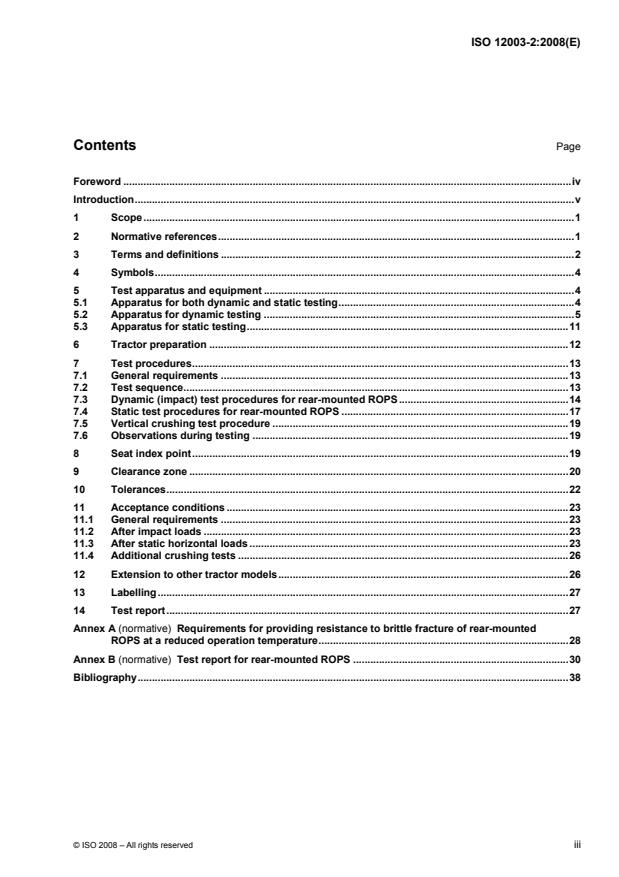
Contents Page
Foreword .iv
Introduction.v
1 Scope.1
2 Normative references.1
3 Terms and definitions .2
4 Symbols.4
5 Test apparatus and equipment .4
5.1 Apparatus for both dynamic and static testing.4
5.2 Apparatus for dynamic testing .5
5.3 Apparatus for static testing.11
6 Tractor preparation .12
7 Test procedures.13
7.1 General requirements .13
7.2 Test sequence.13
7.3 Dynamic (impact) test procedures for rear-mounted ROPS .14
7.4 Static test procedures for rear-mounted ROPS .17
7.5 Vertical crushing test procedure .19
7.6 Observations during testing .19
8 Seat index point.19
9 Clearance zone .20
10 Tolerances.22
11 Acceptance conditions .23
11.1 General requirements .23
11.2 After impact loads .23
11.3 After static horizontal loads .23
11.4 Additional crushing tests .26
12 Extension to other tractor models.26
13 Labelling.27
14 Test report.27
Annex A (normative) Requirements for providing resistance to brittle fracture of rear-mounted
ROPS at a reduced operation temperature.28
Annex B (normative) Test report for rear-mounted ROPS .30
Bibliography.38
Foreword
ISO (the International Organization for Standardization) is a worldwide federation of national standards bodies
(ISO member bodies). The work of preparing International Standards is normally carried out through ISO
technical committees. Each member body interested in a subject for which a technical committee has been
established has the right to be represented on that committee. International organizations, governmental and
non-governmental, in liaison with ISO, also take part in the work. ISO collaborates closely with the
International Electrotechnical Commission (IEC) on all matters of electrotechnical standardization.
International Standards are drafted in accordance with the rules given in the ISO/IEC Directives, Part 2.
The main task of technical committees is to prepare International Standards. Draft International Standards
adopted by the technical committees are circulated to the member bodies for voting. Publication as an
International Standard requires approval by at least 75 % of the member bodies casting a vote.
Attention is drawn to the possibility that some of the elements of this document may be the subject of patent
rights. ISO shall not be held responsible for identifying any or all such patent rights.
ISO 12003-2 was prepared by Technical Committee ISO/TC 23, Tractors and machinery for agriculture and
forestry, Subcommittee SC 2, Common tests.
This second edition cancels and replaces the first edition (ISO 12003-2:2002), which has been technically
revised.
ISO 12003 consists of the following parts, under the general title Agricultural and forestry tractors — Roll-over
protective structures on narrow-track wheeled tractors:
⎯ Part 1: Front-mounted ROPS
⎯ Part 2: Rear-mounted ROPS
iv © ISO 2008 – All rights reserved
Introduction
Testing of roll-over protective structures (ROPS) for tractors for agriculture and forestry aims at minimizing the
likelihood of driver injury resulting from accidental overturning during normal operation (e.g. field work) of the
tractor. The strength of the roll-over protective structure is tested by applying loads to simulate actual loads
which may be imposed on the cab or frame when the tractor overturns either to the rear or to the side without
free fall. The tests allow observations to be made on the strength of the structure and the attachment brackets
to the tractor and also of the tractor parts that may be affected by the load imposed on the structure.
This part of ISO 12003 enables the strength of a tractor's rear-mounted roll-over protective structure to be
tested by the application of dynamic and static loads that simulate the actual loads which can be imposed on
the cab or frame when the tractor overturns either to the rear or to the side without free fall.
INTERNATIONAL STANDARD ISO 12003-2:2008(E)
Agricultural and forestry tractors — Roll-over protective
structures on narrow-track wheeled tractors —
Part 2:
Rear-mounted ROPS
1 Scope
This part of ISO 12003 specifies procedures for both the static and dynamic testing of roll-over protective
structures (ROPS) rear-mounted on narrow-track wheeled agricultural and forestry tractors. It defines the
clearance zone and acceptance conditions for rigid or tiltable, rear, two-post roll bar, frame and cab ROPS,
and is applicable to tractors so equipped having the following characteristics.
⎯ A ground clearance of not more than 600 mm beneath the lowest points of the front- and rear-axle
housings (not considering lower points on the axle differential).
⎯ A fixed or adjustable minimum track width of one of the two axles of less than 1 150 mm when fitted with
the widest specified tyres, and with the overall width of the other axle being less than that of the first axle.
⎯ A mass greater than 600 kg but less than 3 000 kg, unladen, including the ROPS and tyres of the largest
size recommended by the manufacturer.
2 Normative references
The following referenced documents are indispensable for the application of this document. For dated
references, only the edition cited applies. For undated references, the latest edition of the referenced
document (including any amendments) applies.
ISO 630, Structural steels — Plates, wide flats, bars, sections and profiles
ISO 898-1:1999, Mechanical properties of fasteners made of carbon steel and alloy steel — Part 1: Bolts,
screws and studs
ISO 898-2:1992, Mechanical properties of fasteners — Part 2: Nuts with specified proof load values — Coarse
thread
ISO 2408, Steel wire ropes for general purposes — Minimum requirements
ISO 5353, Earth-moving machinery, and tractors and machinery for agriculture and forestry — Seat index
point
ASTM A370, Standard Test Methods and Definitions for Mechanical Testing of Steel Products
3 Terms and definitions
For the purposes of this document, the following terms and definitions apply.
3.1
roll-over protective structure
ROPS
framework protecting drivers of wheeled agricultural and forestry tractors, which minimizes the likelihood of
driver injury resulting from accidental overturning during normal field work
NOTE The ROPS is characterized by the provision of space for a clearance zone, either inside the envelope of the
structure or within a space bounded by a series of straight lines from the outer edges of the structure to any part of the
tractor that might come into contact with the ground; it is capable of supporting the tractor in an overturned position.
3.2
rear-mounted ROPS
two-post, roll-bar-type, roll-over protective structure mounted on the tractor rearwards of the driving seat, or a
frame or cab
NOTE Compare with front-mounted ROPS described in ISO 12003-1.
3.3
tractor mass
mass of the unladen tractor in working order with tanks and radiator full, rear-mounted ROPS with cladding,
and any track equipment or additional front-wheel drive components required for normal use
NOTE The operator, optional ballast weights, additional wheel equipment, and special equipment and tools are not
included.
3.4
reference mass
mass, not less than the tractor mass, selected by the manufacturer for calculation of the energy inputs to be
used in the tests
3.5
horizontal loading test
application of a horizontal load to the rear, front and side of the roll-over protective structure
3.6
crushing test
application of a vertical static load through a beam placed laterally across the uppermost members of the rear-
mounted ROPS
3.7
reference plane
vertical plane, generally longitudinal to the tractor and passing through the seat index point and the steering-
wheel centre
NOTE Normally this reference plane coincides with the longitudinal median plane of the tractor.
2 © ISO 2008 – All rights reserved
3.8
longitudinal median plane
longitudinal plane of symmetry
zero Y plane
vertical plane Y passing through the mid-points of AB, perpendicular to AB, where, for each wheel, the vertical
plane passing through its axis cuts the mid-plane of the wheel following a straight line ∆ which meets the
supporting surface of the vehicle at one point, and where A and B are two points thus defined which
correspond to two wheels, both of which are either steering or powered wheels, situated respectively at the
two ends of the same real or imaginary axle
See Figure 1.
NOTE 1 “Mid-plane of the wheel” designates the plane equidistant from the inner edges of the rim. In the case of dual
wheels, the straight line ∆ is, in this particular case, the intersection of the mid-plane of the dual wheels and the vertical
plane passing through the axis of the axle pin.
[1]
NOTE 2 Adapted from ISO 612:1978 , Clause 5.
Figure 1 — Longitudinal median plane
3.9
impact test
application of a dynamic load produced by a block acting as a pendulum
3.10
wheelbase
horizontal distance between the two vertical planes passing through the rotational centre-lines of the wheels,
where one plane is for the front wheels and the other for the rear wheels
4 Symbols
See Table 1.
Table 1 — Symbols
Symbol Description Unit
a Half of the horizontal seat adjustment mm
h
a Half of the vertical seat adjustment mm
v
B Minimum overall width of the tractor mm
B Maximum outer width of the rear-mounted ROPS mm
b
Deflection of the ROPS for the calculated basic energy at the point of, and in line with, the
D mm
load application
E Energy to be absorbed during longitudinal loading J
il
E Energy to be absorbed during side loading J
is
F Static load force N
F Maximum static load force occurring during loading, with the exception of overload N
max
F Vertical crushing force N
v
H Falling height of the pendulum block mm
I Moment of inertia about rear axle, whatever the mass of the rear wheels may be kg⋅m
L Tractor reference wheelbase mm
m Tractor mass (see 3.5) kg
m Reference mass (see 3.4) kg
t
W Overall width of the upper part of the protective structure mm
5 Test apparatus and equipment
5.1 Apparatus for both dynamic and static testing
5.1.1 Clearance zone framework
Means to prove that the clearance zone has not been entered during the test: a measuring rig complying with
Figures 10 and 11 can be used.
5.1.2 Apparatus for crushing tests
The crushing tests shall be carried out by means of the elements described in 5.1.2.1 and 5.1.2.2.
5.1.2.1 Means to apply downward force on the protective structure, such as that shown in Figure 2,
including a stiff beam with a width of 250 mm.
5.1.2.2 Equipment to measure total vertical force applied.
4 © ISO 2008 – All rights reserved
Key
1 universal pin joints
2 hydraulic cylinder
3 supports
4 crushing beam
a
Direction of force.
Figure 2 — Crushing test — Example
5.2 Apparatus for dynamic testing
5.2.1 Device to strike a blow against the protective structure
A pendulum block with mass of 2 000 kg. The pendulum block mass does not include the mass of the chains.
The maximum chain mass shall be 100 kg. The dimensions of the block, which shall be suspended from two
chains from pivot points 6 m or more above ground level, shall be as shown in Figure 3. The pendulum block
centre of gravity shall coincide with its geometric centre.
Dimensions in millimetres
Key
1 attachment for release mechanism
2 height adjustment
3 impact face
4 hooks to hold spare chain
5 pendulum chains
a
Axis of centre of gravity.
Figure 3 — Illustration of pendulum block
5.2.2 Pendulum supports
The pendulum pivot points shall be rigidly fixed such that their displacement in any direction does not exceed
1 % of the height of fall.
5.2.3 Means to lash the tractor to the ground
The tractor shall be lashed, by means of steel wire ropes incorporating tensioning devices, to ground rails
preferably spaced approximately 600 mm apart throughout the area immediately below the pivot points and
extending for approximately 9 m along the pendulum block axis and approximately 1 800 mm to either side.
The points of attachment of the lashings shall be approximately 2 000 mm behind the rear axle and 1 500 mm
in front of the front axle. There shall be two lashings on each axle, one on each side of the median plane of
the tractor. The lashings shall be steel cable of 12,5 mm to 15 mm diameter, tensile strength 1 100 MPa to
1 260 MPa, meeting the requirements of ISO 2408. Details of the lashing means are given in Figures 4, 5
and 6.
The front and rear wheels are not required to be in line if this is more convenient for attaching appropriate
ropes.
6 © ISO 2008 – All rights reserved
5.2.4 Softwood beam
A softwood beam, of cross-section 150 mm × 150 mm, to restrain the rear wheels when striking from the front
or rear, and to clamp against the side of the front and rear wheels when striking from the side, as shown in
Figures 4, 5 and 6.
Dimensions in millimetres
Key
1 positioning tie
2 150 mm square softwood beam clamped behind both rear wheels after anchoring
3 travel arc of pendulum block centre of gravity passing through contact point
Figure 4 — Example of lashing method — Impact from rear
Dimensions in millimetres
Key
1 positioning tie
2 150 mm square softwood beam clamped behind both rear wheels after anchoring
3 travel arc of pendulum block centre of gravity passing through contact point
Figure 5 — Example of lashing method — Impact from front
8 © ISO 2008 – All rights reserved
Key
1 travel arc of pendulum block centre of gravity passing through contact point
2 lashing (see 5.2.3)
3 150 mm square softwood beam
4 wooden prop
a
Chamfered.
b
Rounded to secure contact against rim.
Figure 6 — Example of lashing method — Impact from side
5.2.5 Wooden prop
Wooden prop to restrain the opposite rear wheel when striking from the side as shown in Figure 6. Its length
shall be 20 to 25 times its thickness and its width 2 to 3 times its thickness.
5.2.6 Props and lashings for articulated tractors
The central pivot of an articulated tractor shall be supported and lashed down as appropriate for all test
procedures. For the side impact test procedure, the pivot shall also be propped from the side opposite the
impact.
5.2.7 Tyre pressures and deflection
The tractor tyres shall not be liquid-ballasted and shall be inflated to the pressures prescribed by the tractor
manufacturer for field work. The lashings shall be tensioned in each particular case such that the tyres
undergo a deflection equal to 12 % of the tyre wall height (distance between the ground and the lowest point
of the rim) before tensioning.
5.2.8 Device to measure elastic deflection
Device to measure elastic deflection, such as that shown in Figure 7, in a horizontal plane that coincides with
the upper limiting surface of the clearance zone.
Key
1 permanent deflection
2 elastic deflection
3 total (permanent + elastic) deflection
4 friction collar
5 horizontal rod attached to frame
6 vertical bar attached to tractor chassis
Figure 7 — Apparatus for measuring elastic deflection – Example
10 © ISO 2008 – All rights reserved
5.3 Apparatus for static testing
5.3.1 Material, equipment and attachment means to ensure that the tractor chassis is firmly fixed to the
ground (and supported) independently of the tyres.
5.3.2 Means to apply a horizontal force to the ROPS, such as shown in Figures 8 and 9, complying with the
requirements of 5.3.2.1 to 5.3.2.4.
Key
1 seat index point
2 seat index point, longitudinal centre plane
a
Rear load.
b
Front load.
c
Second longitudinal load, front or rear.
d
Longitudinal load, rear or front.
Figure 8 — Front and rear load application
Dimensions in millimetres
Key
1 seat index point
2 point of side load application (see 7.4.5)
3 deflection due to rear longitudinal loading
4 seat index point, longitudinal centre plane
a
Load.
Figure 9 — Side load application
5.3.2.1 It shall be ensured that the load can be uniformly distributed normal to the direction of loading and
along a beam of length between 250 mm and 700 mm, in an exact multiple of 50 mm.
5.3.2.2 The edges of the beam in contact with the ROPS shall be curved with a maximum radius of
50 mm.
5.3.2.3 Universal joints, or the equivalent, shall be incorporated to ensure that the loading device does
not constrain the structure in rotation or translation in any direction other than the loading direction.
5.3.2.4 Where the roll-over protective structure length, covered by the appropriate load-applying beam,
does not constitute a straight line normal to the direction of load application, the space shall be packed so as
to distribute the load over this length.
5.3.3 Equipment to measure force and deflection along the direction of application of the force and relative
to the tractor chassis. To ensure accuracy, measurements shall be taken as continuous recordings. The
measuring devices shall be located so as to record the force and deflection at the point of, and along the line
of, loading.
6 Tractor preparation
The rear-mounted ROPS under test shall be in accordance with production specifications and shall be fitted in
its protective position to the appropriate tractor model chosen in accordance with the manufacturer's declared
attachment method.
NOTE A complete tractor is not required for the static strength test; however, the protective structure and part of the
tractor to which it is attached represent an operating installation; hereinafter referred to as “the assembly”.
12 © ISO 2008 – All rights reserved
The tractor as assembled (or the assembly) must be fitted with all series production components which may
affect the strength of the protective structure or which may be necessary for the strength test.
All detachable windows, panels and removable non-structural fittings shall be removed so that they do not
contribute to the strength of the rear-mounted ROPS.
Where it is possible to fix doors and windows open or remove them during work, they shall be either removed
or fixed open for the test, so that they do not add to the strength of the rear-mounted ROPS. It shall be noted
whether, in this position, they would create a hazard for the driver in the event of overturning.
For a test conducted according to the dynamic test procedure, a track width shall be chosen so that the rear-
mounted ROPS will not, in as far as possible, be supported by the tyres during the strength test procedure. If
conducting testing according to the static test procedure, the wheels may be removed.
7 Test procedures
7.1 General requirements
7.1.1 lf, during any test, any part of the tractor restraining equipment breaks or moves, the test shall be
restarted.
7.1.2 No repairs or adjustments to the tractor or rear-mounted ROPS may be carried out during the tests.
7.1.3 For the dynamic test, the tractor gear box shall be in neutral and the brakes off during testing.
7.1.4 lf the tractor is fitted with a suspension system between the tractor body and the wheels, it shall be
blocked during testing.
7.1.5 The side chosen for application of the first impact from the rear (in the case of dynamic test
procedures) or the first load from the rear (in the case of static test procedures) shall be that which will result
in the application of the series of impacts or loads under the most unfavourable conditions for the rear-
mounted ROPS. The lateral and rear impacts or loads shall be on different sides of the longitudinal median
plane of the rear-mounted ROPS. The front impact or load shall be on the same side of the longitudinal
median plane as the side impact or load.
7.2 Test sequence
Either the dynamic or the static test procedure, at the discretion of the manufacturer, shall be carried out on
the rear-mounted ROPS, the two methods being considered equivalent. The crushing test procedure is
common to both test methods.
The sequence of strength testing of the rear-mounted ROPS shall be as follows:
a) impact (dynamic test procedure) or longitudinal loading (static test procedure) applied from the rear;
b) vertical crushing (dynamic and static test procedure);
c) impact (dynamic test procedure) or longitudinal loading (static test procedure) applied from the front;
d) impact (dynamic test procedure) or horizontal loading (static test procedure) applied from the side;
e) vertical crushing (dynamic and static test procedure).
For a tractor with a reversible driving position, the front wheels of the tractor shall be as defined by the
manufacturer. However, where the front/rear of the tractor is not clearly defined, the front wheels shall be
assumed to be those carrying less than 50 % of the tractor mass.
7.3 Dynamic (impact) test procedures for rear-mounted ROPS
7.3.1 Rear impact test procedure
7.3.1.1 The tractor shall be positioned in relation to the pendulum block such that the block will strike the
rear-mounted ROPS when the impact face of the block and the supporting chains or wire ropes are at an
angle with the vertical plane, α, equal to m /100 with a 20° maximum, unless, during deflection, the rear-
t
mounted ROPS at the point of contact forms a greater angle to the vertical. In that case, the impact face of the
block shall be adjusted by means of an additional support such that it is parallel to the rear-mounted ROPS at
the point of impact at the moment of maximum deflection, the supporting chains or wire ropes remaining at the
specified angle.
The suspended height of the pendulum block shall be adjusted and any necessary steps taken to prevent the
block from turning about the point of impact.
The point of impact is that part of the rear-mounted ROPS likely to hit the ground first in a rearward
overturning accident, normally the upper edge. The position of the centre of gravity of the block shall be one-
sixth the width of the top of the rear-mounted ROPS, inwards from a vertical plane parallel to the median
plane of the tractor touching the outside extremity of the top of the rear-mounted ROPS.
lf the rear-mounted ROPS is curved or protruding at this point, add wedges enabling the impact to be applied
to it, but without thereby reinforcing the rear-mounted ROPS.
7.3.1.2 The tractor shall be lashed to the ground as prescribed in 5.2.3 and as shown in Figure 4 and the
lashings tensioned as prescribed in 5.2.7. The rear lashings shall, in addition, be so arranged that the point of
convergence of the two wire ropes is located in the vertical plane in which the centre of gravity of the
pendulum block travels. With the wire ropes tensioned, the wedging beam shall be placed in front of, and tight
against, the rear wheels, and then fixed to the ground.
7.3.1.3 lf the tractor is of the articulated type, its pivot shall be additionally supported by a wooden block
at least 100 mm square and firmly lashed to the ground.
7.3.1.4 The pendulum block shall be pulled back to achieve the height, H, of its centre of gravity as given
by one of the following two formulae:
−82
H=×2,165 10 mL×
t
or
−2
H=×5,73 10 mI×
t
7.3.1.5 For tractors with a reversible seat position, one of the preceding formulae or one of the following
formulae shall be used, whichever gives the greater result.
⎯ For tractors with a reference mass of less than 2 000 kg:
H=+25 0,07m
t
⎯ For tractors with a reference mass of 2 000 kg to 3 000 kg:
H=+125 0,02m
t
7.3.1.6 The pendulum block shall be released so that it strikes the rear-mounted ROPS.
14 © ISO 2008 – All rights reserved
7.3.2 Front impact test procedure
7.3.2.1 The tractor shall be positioned in relation to the pendulum block such that the block will strike the
rear-mounted ROPS when the impact face of the block and the supporting chains or wire ropes are at an
angle with the vertical plane, α, equal to m/100 with a 20° maximum, unless, during deflection, the rear-
t
mounted ROPS at the point of contact forms a greater angle to the vertical. In that case, the impact face of the
block shall be adjusted by means of an additional support such that it is parallel to the rear-mounted ROPS at
the point of impact at the moment of maximum deflection, with the supporting chains or wire ropes remaining
at the specified angle.
The suspended height of the pendulum block shall be adjusted and any necessary steps taken to prevent the
block from turning about the point of impact.
The point of impact is that part of the rear-mounted ROPS likely to hit the ground first in a rearward
overturning accident, normally the upper edge. The position of the centre of gravity of the block shall be one-
sixth the width of the top of the rear-mounted ROPS, inwards from a vertical plane parallel to the median
plane of the tractor touching the outside extremity of the top of the rear-mounted ROPS.
If the rear-mounted ROPS is curved or protruding at this point, add wedges enabling the impact to be applied
to it, but without thereby reinforcing the rear-mounted ROPS.
7.3.2.2 The tractor shall be lashed to the ground as prescribed in 5.2.3 and as shown in Figure 5 and the
lashings tensioned as prescribed in 5.2.7. The rear lashings shall, in addition, be so arranged that the point of
convergence of the two wire ropes is located in the vertical plane in which the centre of gravity of the
pendulum block travels. With the wire ropes tensioned, the wedging beam shall be placed in front of, and tight
against, the rear wheels and then fixed to the ground.
7.3.2.3 lf the tractor is of the articulated type, its pivot shall be additionally supported by a wooden block
at least 100 mm square and firmly lashed to the ground.
7.3.2.4 The pendulum block shall be pulled back to achieve the height, H, as given by one of the
following two formulae.
⎯ For tractors with a reference mass of less than 2 000 kg:
H=+25 0,07m
t
⎯ For tractors with a reference mass of 2 000 kg to 3 000 kg:
H=+125 0,02m
t
7.3.2.5 For tractors with a reversible seat position and a rear, two-post roll bar, the preceding formulae
shall be used.
For tractors with a reversible seat position and any other type of rear-mounted ROPS, one of the preceding
formulae or one of the following formulae shall be used, whichever gives the greater result.
−82
H=×2,165 10 mL×
t
or
−2
H=×5,73 10 mI×
t
7.3.2.6 Release the pendulum block so that it strikes the rear-mounted ROPS.
7.3.3 Side impact test procedure
7.3.3.1 The tractor shall be positioned in relation to the pendulum block such that the block will strike the
rear-mounted ROPS when the impact face of the block and the supporting chains or wire ropes are vertical,
unless, during deflection, the rear-mounted ROPS at the point of contact forms an angle of less than 20° to
the vertical. In this case, the impact face of the block shall be adjusted by means of an additional support such
that it is parallel to the rear-mounted ROPS at the point of impact at the moment of maximum deflection, with
the supporting chains or wire ropes remaining vertical on impact.
The suspended height of the pendulum block shall be adjusted and any necessary steps taken to prevent the
block from turning about the point of impact.
The point of impact shall be that part of the rear-mounted ROPS likely to hit the ground first in a sideways
overturning accident (normally the upper edge). Unless it is certain that another part of this edge would hit the
ground first, the point of impact shall be in the plane at right angles to the median plane and passing 60 mm in
front of the SIP.
7.3.3.2 The tractor shall be lashed to the ground as prescribed in 5.2.3 and as shown in Figure 6 and the
lashings tensioned to produce the tyre deflection values given in 5.2.7 on the side which is to receive the
impact. The wedging beam shall be placed on the ground, pushed tight against the tyres on the side opposite
that which is to receive the impact and then fixed to the ground. (It may be necessary to use two beams or
wedges if the outer sides of the front and rear tyres are not in the same vertical plane.)
The wooden prop shall be placed, as shown in Figure 6, against the rim of the wheel opposite to the impact,
pushed firmly against the rim and fixed at its base. The length of the prop shall be chosen such that it makes
an angle of 30° ± 3° with the ground when in position against the rim. In addition, its length shall, if possible,
be between 20 and 25 times greater than its thickness, and its width between two and three times greater
than its thickness. The props shall be shaped at both ends.
7.3.3.3 lf the tractor is of the articulated type, its pivot shall, in addition, be supported by a wooden block
at least 100 mm square, as well as being laterally supported by a block similar to that specified in 7.3.1 for
articulated type tractors against the rear wheel. Lash the point of articulation firmly to the ground.
7.3.3.4 The pendulum block shall be pulled back to achieve the height, H, as given by whichever of the
following two formulae is applicable.
⎯ For tractors with a reference mass of less than 2 000 kg:
H=+25 0,20m
t
⎯ For tractors with a reference mass of 2 000 kg to 3 000 kg:
H=+125 0,15m
t
7.3.3.5 For tractors with a reversible seat position and a rear, two-post roll bar, one of the preceding
formulae or one of the following formulae shall be used, whichever gives the greater result.
⎯ For tractors with a reference mass of less than 2 000 kg:
25++0,2mB B
()( )
tb
H =
2B
⎯ For tractors with a reference mass of 2 000 kg to 3 000 kg:
125++0,15mB B
()
()tb
H =
2B
16 © ISO 2008 – All rights reserved
For tractors with a reversible seat position and any other type of rear-mounted ROPS, the following formulae
shall be used.
⎯ For tractors with a reference mass of less than 2 000 kg:
H=+25 0,20m
t
⎯ For tractors with a reference mass of 2 000 kg to 3 000 kg:
H=+125 0,15m
t
The load shall be applied in the vertical plane, at mid-point between the two SIPs.
7.3.3.6 The pendulum block shall be released so that it strikes the rear-mounted ROPS.
7.4 Static test procedures for rear-mounted ROPS
7.4.1 Test preparation
7.4.1.1 The assembly shall be secured to the bedplate so that the members connecting the assembly
and the bedplate do not deflect significantly in relation to the roll-over protective structure under loading. The
assembly shall not receive any support under loading other than that due to the initial attachment.
7.4.1.2 A track width setting for the rear wheels if present shall be chosen such that no interference exists
with the roll-over protective structure during the tests.
7.4.1.3 The assembly shall be supported and secured or modified so that all the test energy is absorbed
by the roll-over protective structure and its attachment to the tractor rigid components.
7.4.2 General requirements for horizontal loading test procedures
7.4.2.1 The loads applied to the roll-over protective structure shall be distributed by means of a stiff
beam, complying with the requirements of 5.3.2, located normal to the direction of load application; the stiff
beam may have a means of preventing its being displaced sideways. The rate of load application shall be
such that the rate of deflection does not exceed 5 mm/s. As the load is applied, force and deflection data shall
be recorded simultaneously as continuous recordings to ensure accuracy. Once the initial application has
commenced, the load shall not be reduced until the test has been completed; but it is permissible to cease
increasing the load if desired, for example to record measurements.
7.4.2.2 If the structural member to which the load is to be applied is curved, the requirements of 5.3.2.4
shall be met. The application of the load shall, however, still comply with the requirements of 7.4.2.1 and
5.3.2.
7.4.2.3 If no structural cross-member exists at the application point, a substitute test beam which does
not add strength to the structure may be used to complete the test procedure.
7.4.3 Rear loading
Apply the load horizontally, in a vertical plane parallel to the tractor's median plane. The load application point
shall be that part of the rear-mounted ROPS likely to hit the ground first in a rearward overturning accident,
normally the upper edge. The vertical plane in which the load is applied is located at a distance of one-third
the external width of the upper part of the rear-mounted ROPS from the median plane. lf the rear-mounted
ROPS is curved or protruding at this point, wedges enabling the load to be applied to it shall be added, without
thereby reinforcing the rear-mounted ROPS.
The tractor or assembly shall be secured to the ground using lashings in accordance with 5.3.1.
The energy absorbed by the rear-mounted ROPS during the test shall be at least:
−72
E=×2,165 10 mL×
il t
or
E=×0,574 I
il
For tractors with a reversible seat position, either of the preceding formulae, or the following formula, shall be
used:
E=+500 0,5m
il t
7.4.4 Front loading
Apply the load horizontally, in a vertical plane parallel to the tractor's reference plane and located at a distance
of one-third the external width of the upper part of the rear-mounted ROPS from the reference plane. The load
application point is that part of the rear-mounted ROPS likely to hit the ground first, were the tractor to
overturn in a sideways direction while travelling forwards, normally the upper corner. lf the rear-mounted
ROPS is curved or protruding at this point, wedges enabling the load to be applied thereon shall be added,
without thereby reinforcing the rear-mounted ROPS.
The tractor or assembly shall be lashed to the ground in accordance with 5.3.1.
The energy absorbed by the rear-mounted ROPS during the test shall be at least:
E=+500 0,5m
il t
For tractors with a reversible seat position and a rear, two-post roll bar, the same formula shall be used.
For tractors with a reversible seat position and other types of rear-mounted ROPS, either the preceding
formula or one of the following formulae shall be used, whichever gives the greater result:
−72
E=×2,165 10 mL×
il t
or
E=×0,574 I
il
7.4.5 Side loading
Apply the load horizontally, in a vertical plane perpendicular to the tractor's median plane, passing 60 mm in
front of the SIP (see Figure 9 and Clause 8) with the seat in the longitudinal seat adjustment mid-position. The
load application point is that part of the rear-mounted ROPS likely to hit the ground first in a sideways
overturning accident, normally the upper edge.
The tractor or assembly shall be secured to the ground in accordance with 5.3.1.
The energy absorbed by the rear-mounted ROPS during the test shall be at least:
E = 1, 75m
is t
For tractors with a reversible seat position and a rear, two-post roll bar, either the preceding or the following
formula may be used, whichever gives the greater result:
1, 75mB +B
()
tb
E =
is
2B
18 © ISO 2008 – All rights reserved
For tractors with a reversible seat position and other types of rear-mounted ROPS, the first of these formulae
shall be used.
The load shall be applied in the vertical plane at mid-point between the two SIPs.
7.5 Vertical crushing test procedure
Position the beam across the uppermost structural members of the rear-mounted ROPS, with the resultant
crushing forces located in the tractor's median plane.
Apply a vertical crushing force, F , of 20 m .
v t
Maintain this force for at least 5 s after the cessation of any visually deflectable movement of the rear-
mounted ROPS. The second crushing test may be at the same point as the first.
Where the rear or front part of the ROPS roof does not sustain the full crushing force, apply the force until the
roof is deflected to coincide with the plane joining the upper part of the ROPS with that part of the tractor rear
or front capable of supporting the vehicle mass when overturned. Then remove the force and position the
tractor or loading force such that the beam is over that point of the ROPS that would then support the tractor
rear or front were the tractor to completely overturn and the full force be applied.
7.6 Observations during testing
7.6.1 Fractures and cracks
After each test, all structural members, joints and fastening systems shall be visually examined for fractures or
cracks. Small cracks in unimportant parts and any tears caused by the edges of the pendulum weight may be
ignored.
7.6.2 Clearance zone
During each test, an examination shall be made to ascertain whether any part of the rear-mounted ROPS has
entered the clearance zone (see Clause 9).
In addition, an examination shall be made to determine whether any part of the clearance zone is outside the
protection of the rear-mounted ROPS, which could be the case were any part of the zone to come into contact
with flat ground in the event of the tractor overturning in the direction of impact. For this purpose, the front and
rear tyres, and track width setting, shall be the
...
NORME ISO
INTERNATIONALE 12003-2
Deuxième édition
2008-08-01
Tracteurs agricoles et forestiers —
Structures de protection contre le
retournement (ROPS) pour tracteurs à
roues à voie étroite —
Partie 2:
ROPS montées à l'arrière
Agricultural and forestry tractors — Roll-over protective structures on
narrow-track wheeled tractors —
Part 2: Rear-mounted ROPS
Numéro de référence
©
ISO 2008
PDF – Exonération de responsabilité
Le présent fichier PDF peut contenir des polices de caractères intégrées. Conformément aux conditions de licence d'Adobe, ce fichier
peut être imprimé ou visualisé, mais ne doit pas être modifié à moins que l'ordinateur employé à cet effet ne bénéficie d'une licence
autorisant l'utilisation de ces polices et que celles-ci y soient installées. Lors du téléchargement de ce fichier, les parties concernées
acceptent de fait la responsabilité de ne pas enfreindre les conditions de licence d'Adobe. Le Secrétariat central de l'ISO décline toute
responsabilité en la matière.
Adobe est une marque déposée d'Adobe Systems Incorporated.
Les détails relatifs aux produits logiciels utilisés pour la création du présent fichier PDF sont disponibles dans la rubrique General Info
du fichier; les paramètres de création PDF ont été optimisés pour l'impression. Toutes les mesures ont été prises pour garantir
l'exploitation de ce fichier par les comités membres de l'ISO. Dans le cas peu probable où surviendrait un problème d'utilisation,
veuillez en informer le Secrétariat central à l'adresse donnée ci-dessous.
DOCUMENT PROTÉGÉ PAR COPYRIGHT
© ISO 2008
Droits de reproduction réservés. Sauf prescription différente, aucune partie de cette publication ne peut être reproduite ni utilisée sous
quelque forme que ce soit et par aucun procédé, électronique ou mécanique, y compris la photocopie et les microfilms, sans l'accord écrit
de l'ISO à l'adresse ci-après ou du comité membre de l'ISO dans le pays du demandeur.
ISO copyright office
Case postale 56 • CH-1211 Geneva 20
Tel. + 41 22 749 01 11
Fax. + 41 22 749 09 47
E-mail copyright@iso.org
Web www.iso.org
Publié en Suisse
ii © ISO 2008 – Tous droits réservés
Sommaire Page
Avant-propos .iv
Introduction.v
1 Domaine d'application .1
2 Références normatives.1
3 Termes et définitions .2
4 Symboles.4
5 Appareillage et équipement d'essai .4
5.1 Appareillage pour les essais dynamique et statique.4
5.2 Appareillage pour les essais dynamiques.5
5.3 Appareillage pour les essais statiques.11
6 Préparation du tracteur.13
7 Modes opératoires d'essai .13
7.1 Exigences générales.13
7.2 Séquence des essais .14
7.3 Modes opératoires d'essai (de choc) dynamique pour les ROPS montées à l'arrière.14
7.4 Modes opératoires d'essai statique pour les ROPS montées à l'arrière .17
7.5 Mode opératoire d'essai d'écrasement vertical.19
7.6 Observations pendant les essais .20
8 Point repère du siège.20
9 Zone de dégagement.20
10 Tolérances.23
11 Conditions d'acceptation.24
11.1 Exigences générales.24
11.2 Après l'application des charges de choc.24
11.3 Après l'application des charges horizontales statiques .24
11.4 Essais d'écrasement supplémentaires .27
12 Extension à d'autres modèles de tracteurs .27
13 Étiquetage .28
14 Rapport d'essai.28
Annexe A (normative) Exigences requises pour assurer la résistance à la rupture fragile
des ROPS montées à l'arrière lors de travaux à basse température .29
Annexe B (normative) Rapport d'essai de la ROPS montée à l'arrière .31
Bibliographie.39
Avant-propos
L'ISO (Organisation internationale de normalisation) est une fédération mondiale d'organismes nationaux de
normalisation (comités membres de l'ISO). L'élaboration des Normes internationales est en général confiée
aux comités techniques de l'ISO. Chaque comité membre intéressé par une étude a le droit de faire partie du
comité technique créé à cet effet. Les organisations internationales, gouvernementales et non
gouvernementales, en liaison avec l'ISO participent également aux travaux. L'ISO collabore étroitement avec
la Commission électrotechnique internationale (CEI) en ce qui concerne la normalisation électrotechnique.
Les Normes internationales sont rédigées conformément aux règles données dans les Directives ISO/CEI,
Partie 2.
La tâche principale des comités techniques est d'élaborer les Normes internationales. Les projets de Normes
internationales adoptés par les comités techniques sont soumis aux comités membres pour vote. Leur
publication comme Normes internationales requiert l'approbation de 75 % au moins des comités membres
votants.
L'attention est appelée sur le fait que certains des éléments du présent document peuvent faire l'objet de
droits de propriété intellectuelle ou de droits analogues. L'ISO ne saurait être tenue pour responsable de ne
pas avoir identifié de tels droits de propriété et averti de leur existence.
L'ISO 12003-2 a été élaborée par le comité technique ISO/TC 23, Tracteurs et matériels agricoles et forestiers,
sous-comité SC 2, Essais communs.
Cette deuxième édition annule et remplace la première édition (ISO 12003-2:2002), qui a fait l'objet d'une
révision technique.
L'ISO 12003 comprend les parties suivantes, présentées sous le titre général Tracteurs agricoles et
forestiers — Structures de protection contre le retournement (ROPS) pour tracteurs à roues à voie étroite:
⎯ Partie 1: ROPS montées à l'avant
⎯ Partie 2: ROPS montées à l'arrière
iv © ISO 2008 – Tous droits réservés
Introduction
L'essai des structures de protection contre le retournement (ROPS, roll-over protective structure) des
tracteurs agricoles et forestiers à roues vise à réduire les risques de blessure du conducteur résultant d'un
renversement accidentel au cours de l'utilisation normale (par exemple travail dans les champs) du tracteur.
La résistance de la structure de protection contre le retournement est contrôlée par l'emploi de charges pour
simuler les charges réelles qui peuvent être imposées à la cabine ou au cadre lorsque le tracteur se retourne
soit vers l'arrière, soit sur le côté sans chute libre. Les essais permettent des observations sur la résistance de
la structure et des fixations sur le tracteur, ainsi que sur les éléments du tracteur qui peuvent être affectés par
la charge imposée à la structure.
La présente partie de l'ISO 12003 permet de contrôler la résistance d'une structure de protection contre le
retournement montée à l'arrière d'un tracteur par l'application de charges dynamiques et statiques qui
simulent les charges réelles qui peuvent être imposées à la cabine ou au cadre lorsque le tracteur se retourne
soit vers l'arrière, soit sur le côté sans chute libre.
NORME INTERNATIONALE ISO 12003-2:2008(F)
Tracteurs agricoles et forestiers — Structures de protection
contre le retournement (ROPS) pour tracteurs à roues à voie
étroite —
Partie 2:
ROPS montées à l'arrière
1 Domaine d'application
La présente partie de l'ISO 12003 spécifie des modes opératoires d'essai statique et dynamique, la zone de
dégagement et les conditions d'acceptation des structures de protection contre le retournement (ROPS) à
deux montants, rigides ou inclinables, en cabine, bâti ou arceau de sécurité, montées à l'arrière sur les
tracteurs agricoles et forestiers à roues à voie étroite. Elle est applicable aux tracteurs ainsi équipés,
présentant les caractéristiques suivantes.
⎯ Garde au sol inférieure ou égale à 600 mm au-dessous des points les plus bas de l'essieu avant et de
l'essieu arrière, à l'exception des points inférieurs sur le différentiel de l'essieu.
⎯ Largeur de voie minimale fixe ou réglable de l'un des deux essieux inférieure à 1 150 mm, les pneus les
plus larges spécifiés étant montés et la largeur globale de l'autre essieu étant inférieure à celle du
premier essieu.
⎯ Masse supérieure à 600 kg, mais inférieure à 3 000 kg, à vide, mais en comptant la ROPS et la plus
grande taille de pneus recommandée par le constructeur.
2 Références normatives
Les documents de référence suivants sont indispensables pour l'application du présent document. Pour les
références datées, seule l'édition citée s'applique. Pour les références non datées, la dernière édition du
document de référence s'applique (y compris les éventuels amendements).
ISO 630, Aciers de construction métallique — Tôles, larges-plats, barres, poutrelles et profilés
ISO 898-1:1999, Caractéristiques mécaniques des éléments de fixation en acier au carbone et en acier
allié — Partie 1: Vis et goujons
ISO 898-2:1992, Caractéristiques mécaniques des éléments de fixation — Partie 2: Écrous avec charges
d'épreuve spécifiées — Filetages à pas gros
ISO 2048, Câbles en acier pour usages courants — Exigences minimales
ISO 5353, Engins de terrassement, et tracteurs et matériels agricoles et forestiers — Point repère du siège
ASTM A370, Standard Test Methods and Definitions for Mechanical Testing of Steel Products
3 Termes et définitions
Pour les besoins du présent document, les termes et définitions suivants s'appliquent.
3.1
structure de protection contre le retournement
ROPS
bâti pour la protection des conducteurs de tracteurs agricoles ou forestiers à roues, destiné à réduire les
risques de blessure du conducteur résultant d'un retournement accidentel au cours d'un fonctionnement
normal dans les champs
NOTE La ROPS est caractérisée par l'espace prévu pour la zone de dégagement soit à l'intérieur de l'enveloppe de
la structure, soit à l'intérieur d'un espace défini par une série de lignes droites joignant le bord extérieur de la structure à
n'importe quel élément du tracteur susceptible d'entrer en contact avec le sol et capable de supporter le tracteur dans
cette position, si le tracteur se retourne.
3.2
ROPS montée à l'arrière
structure de protection contre le retournement à deux montants du type arceau, montée sur le tracteur à
l'arrière du siège conducteur, ou cabine ou bâti
NOTE Comparer à la ROPS montée à l'avant, définie dans l'ISO 12003-1.
3.3
masse du tracteur
masse du tracteur non chargé, en ordre de marche, réservoirs et circuits de refroidissement pleins, équipé de
la ROPS avec son revêtement et de tout équipement ou composants supplémentaires pour les roues motrices
avant nécessaires en utilisation normale
NOTE Le conducteur, les masses de lestage en option, les équipements spéciaux pour roues, les équipements
particuliers et les charges sont exclus.
3.4
masse de référence
masse non inférieure à la masse du tracteur, choisie par le constructeur pour le calcul des énergies d'entrée à
mettre en œuvre au cours des essais
3.5
essai de charge horizontale
application d'une charge horizontale à l'arrière, à l'avant et sur les côtés de la structure de protection
3.6
essai d'écrasement
application d'une charge verticale statique au moyen d'une poutre placée latéralement en travers des
membrures les plus élevées de la ROPS montée à l'arrière
3.7
plan de référence
plan vertical, généralement longitudinal par rapport au tracteur, passant par le point repère du siège (SIP) et
par le centre du volant de direction
NOTE Il correspond normalement au plan longitudinal médian du tracteur.
2 © ISO 2008 – Tous droits réservés
3.8
plan longitudinal médian
plan longitudinal de symétrie
plan origine Y
plan vertical Y perpendiculaire au segment AB en son milieu, tel que, pour chaque roue, le plan vertical
contenant l'axe de la roue coupe le plan médian de la roue suivant une droite ∆ qui rencontre le plan d'appui
du véhicule en un point, et tel que A et B sont deux points ainsi définis qui correspondent à deux roues, toutes
deux directrices ou toutes deux motrices, situées respectivement aux deux extrémités d'un même essieu réel
ou fictif
Voir Figure 1.
NOTE 1 Le «plan médian de la roue» désigne le plan équidistant des rebords intérieurs de la jante. Dans le cas
particulier de roues jumelées, la droite ∆ est l'intersection du plan médian des deux roues jumelées et du plan vertical
contenant l'axe de la fusée.
[1]
NOTE 2 Adapté de l'ISO 612:1978 , Article 5.
Figure 1 — Plan longitudinal médian
3.9
essai de choc
application d'une charge dynamique par un bloc agissant comme un pendule
3.10
empattement
distance horizontale entre deux plans verticaux passant par les centres des axes de rotation des roues, l'un
des plans correspondant aux roues avant et l'autre aux roues arrière
4 Symboles
Voir le Tableau 1.
Tableau 1 — Symboles
Symbole Description Unité
a Moitié du réglage horizontal du siège mm
h
a Moitié du réglage vertical du siège mm
v
B Largeur hors tout minimale du tracteur mm
B Largeur extérieure maximale de la ROPS montée à l'arrière mm
b
Déformation de la ROPS montée à l'arrière sur le point d'application de la charge
D mm
et dans l'alignement de celle-ci (essai statique)
E Énergie devant être absorbée pendant le chargement longitudinal J
il
E Énergie devant être absorbée pendant le chargement latéral J
is
F Force de charge statique N
Force maximale de charge statique se produisant lors du chargement, à l'exception
F N
max
de la surcharge
F Force verticale d'écrasement N
v
H Hauteur de chute du bloc pendule mm
I Moment d'inertie à proximité de l'essieu arrière, quelle que soit la masse de l'essieu arrière kg⋅m
L Empattement de référence du tracteur mm
m Masse du tracteur (voir 3.3) kg
m Masse de référence (voir 3.4) kg
t
W Largeur hors tout de la partie supérieure de la structure de protection mm
5 Appareillage et équipement d'essai
5.1 Appareillage pour les essais dynamique et statique
5.1.1 Montage pour la zone de dégagement
Moyens pour démontrer que la zone de dégagement n'a pas été pénétrée pendant l'essai. Un montage de
mesurage conforme aux Figures 10 et 11 peut être utilisé.
5.1.2 Appareillage pour les essais d'écrasement
Les essais d'écrasement doivent être réalisés au moyen des éléments décrits en 5.1.2.1 et en 5.1.2.2.
5.1.2.1 Dispositif pour l'application d'une force vers le bas sur la ROPS, tel que celui montré à la Figure 2,
comprenant une poutre rigide de largeur 250 mm.
5.1.2.2 Équipement de mesure de la force totale verticale appliquée.
4 © ISO 2008 – Tous droits réservés
Légende
1 joints universels
2 vérin hydraulique
3 supports
4 poutre d'écrasement
a
Direction de la force.
Figure 2 — Dispositif pour l'essai d'écrasement — Exemple
5.2 Appareillage pour les essais dynamiques
5.2.1 Dispositif pour réaliser un impact contre la ROPS montée à l'arrière
Un bloc pendule de 2 000 kg. La masse du pendule ne comprend pas la masse des chaînes. La masse
maximale des chaînes doit être de 100 kg. Les dimensions du bloc pendule, qui doit être suspendu par deux
chaînes à des pivots d'ancrage situés à 6 m ou plus au-dessus du niveau du sol, doivent être celles indiquées
à la Figure 3. Le centre de gravité du bloc pendule doit coïncider avec son centre géométrique.
Dimensions en millimètres
Légende
1 attache du mécanisme de libération du pendule
2 réglage de la hauteur
3 face de frappe
4 crochets pour retenir la chaîne
6 chaînes du pendule
a
Axe du centre de gravité.
Figure 3 — Illustration du bloc pendule
5.2.2 Supports du pendule
Les points pivotants du pendule doivent être fixés de façon rigide, de sorte que leur déplacement dans une
direction quelconque ne dépasse pas 1 % de la hauteur de chute.
5.2.3 Moyens d'ancrage au sol du tracteur
Le tracteur doit être ancré, à l'aide de câbles en acier munis de tendeurs, à des rails fixés au sol. Ces rails
doivent être distants, de préférence, d'environ 600 mm et doivent couvrir toute l'aire située immédiatement
au-dessous des pivots, sur une longueur d'environ 9 m dans le sens du plan d'oscillation du bloc pendule et
d'environ 1 800 mm de part et d'autre de celui-ci. Les points d'attachement des ancrages doivent être
approximativement situés 2 000 mm derrière l'essieu arrière et 1 500 mm devant l'essieu avant. Il doit y avoir
deux ancrages sur chaque essieu, un de chaque côté du plan médian du tracteur. Les ancrages doivent être
réalisés à l'aide d'un câble en acier de diamètre 12,5 mm à 15 mm et ayant une résistance à la traction
comprise entre 1 100 MPa et 1 260 MPa, conformément aux exigences de l'ISO 2408. Les détails de ces
moyens d'ancrage sont donnés aux Figures 4, 5 et 6.
Les roues avant et arrière n'ont pas besoin d'être alignées si cela facilite la fixation des câbles métalliques.
6 © ISO 2008 – Tous droits réservés
5.2.4 Poutre en bois tendre
Poutre en bois tendre, de section transversale (150 × 150) mm, bloquée contre les roues arrière lors des
chocs avant et arrière et contre le bord des roues avant et arrière lors du choc latéral, comme indiqué aux
Figures 4, 5 et 6.
Dimensions en millimètres
Légende
1 position de l'attache
2 poutre en bois tendre de (150 × 150) mm, bloquée contre les deux roues arrière après ancrage
3 arc de déplacement du centre de gravité du bloc pendule passant par le point de contact
Figure 4 — Ancrage pour le choc à l'arrière — Exemple
Dimensions en millimètres
Légende
1 position de l'attache
2 poutre en bois tendre de (150 × 150) mm, bloquée contre les deux roues arrière après ancrage
3 arc de déplacement du centre de gravité du bloc pendule passant par le point de contact
Figure 5 — Ancrage pour le choc à l'avant — Exemple
8 © ISO 2008 – Tous droits réservés
Légende
1 arc de déplacement du centre de gravité du bloc pendule passant par le point de contact
2 ancrage (voir 5.2.3)
3 poutre en bois tendre (150 mm × 150 mm)
4 étai en bois
a
Chanfrein.
b
Arrondi pour épouser la jante.
Figure 6 — Ancrage pour le choc latéral — Exemple
5.2.5 Étai en bois
Étai en bois, pour bloquer la roue arrière opposée au choc latéral, comme le montre la Figure 6. Sa longueur
doit être de 20 à 25 fois son épaisseur et sa largeur de 2 à 3 fois son épaisseur.
5.2.6 Étais et ancrages pour les tracteurs articulés
Le pivot central d'un tracteur articulé doit être maintenu et ancré de manière appropriée pour tous les modes
opératoires d'essai. Pour le mode opératoire d'essai de choc latéral, le pivot doit également être étayé du côté
opposé au choc.
5.2.7 Pression des pneus et déformation
Les pneus du tracteur ne doivent pas être lestés avec du liquide; ils doivent être gonflés à la pression
recommandée par le constructeur pour le travail sur le terrain. Les ancrages doivent être tendus dans chaque
cas particulier, de sorte que les pneus subissent une déformation égale à 12 % de la hauteur de paroi du
pneu (distance entre le sol et le point le plus bas de la jante) avant la tension.
5.2.8 Dispositif pour mesurer la déformation élastique
Dispositif permettant de mesurer la déformation élastique, tel que montré dans la Figure 7, dans un plan
horizontal qui coïncide avec la surface supérieure limitant la zone de dégagement.
Légende
1 déformation permanente
2 déformation élastique
3 déformation totale (permanente + élastique)
4 bague mobile à frottement doux
5 tige horizontale attachée au bâti
6 support vertical attaché au châssis du tracteur
Figure 7 — Dispositif pour le mesurage de la déformation élastique — Exemple
10 © ISO 2008 – Tous droits réservés
5.3 Appareillage pour les essais statiques
5.3.1 Matériel, accessoires et moyens d'ancrage permettant de s'assurer que le châssis du tracteur est
fermement fixé au sol (et soutenu), indépendamment des pneumatiques.
5.3.2 Dispositifs pour l'application d'une force horizontale sur la ROPS, conformes aux spécifications de
5.3.2.1 à 5.3.2.4, tels que représentés dans les Figures 8 et 9.
Légende
1 point repère du siège (SIP)
2 point repère du siège, plan central longitudinal
a
Charge arrière.
b
Charge avant.
c
Deuxième charge longitudinale, avant ou arrière.
d
Charge longitudinale, avant ou arrière.
Figure 8 — Application de la charge à l'avant et à l'arrière
Dimensions en millimètres
Légende
1 point repère du siège
2 point d'application de la charge latérale (voir 7.4.5)
3 déformation due à la charge longitudinale arrière
4 point repère du siège, plan central longitudinal
a
Charge.
Figure 9 — Application de la charge latérale
5.3.2.1 Des dispositions doivent être prises afin que la charge puisse être répartie, de façon uniforme,
perpendiculairement à la direction de chargement et dans l'alignement de la poutre utilisée, de longueur
comprise entre 250 mm et 700 mm et multiple exact de 50 mm.
5.3.2.2 Les arêtes de la poutre en contact avec la ROPS montée à l'arrière doivent être arrondies à un
rayon maximal de 50 mm.
5.3.2.3 Des joints universels, ou leur équivalent, doivent être incorporés afin de s'assurer que le dispositif
de chargement ne contraint pas la structure en rotation ou en translation dans une quelconque direction autre
que celle du chargement.
5.3.2.4 Lorsque la longueur de la structure de protection contre le retournement, couverte par la poutre
adéquate d'application de la charge, ne constitue pas une ligne droite perpendiculaire à la direction de
l'application de la charge, l'espace doit être contenu de sorte à distribuer la charge sur toute sa longueur.
5.3.3 Équipement pour le mesurage de la force et de la déformation dans la direction de l'application de la
force par rapport au châssis du tracteur. Pour assurer leur exactitude, les mesurages doivent être effectués
par relevés continus. Les systèmes de mesurage doivent être placés de sorte à enregistrer l'effort et la
déformation au point d'application de la charge et dans l'alignement de celle-ci.
12 © ISO 2008 – Tous droits réservés
6 Préparation du tracteur
La ROPS montée à l'arrière doit être conforme aux spécifications de production en série. Elle doit être fixée
conformément à la méthode recommandée par le constructeur à l'un des tracteurs pour lesquels elle est
conçue.
NOTE Un tracteur complet n'est pas nécessaire pour le mode opératoire d'essai statique. Toutefois, la ROPS
montée à l'arrière et les éléments du tracteur à laquelle elle est fixée représentent une installation de fonctionnement,
désignée dans la présente partie de l'ISO 12003 par «assemblage».
Le tracteur ou l'assemblage doit être équipé de tous les composants de production en série susceptibles
d'affecter la résistance de la ROPS montée à l'arrière ou pouvant s'avérer nécessaires pour ce mode
opératoire d'essai de résistance.
Toutes les fenêtres détachables, tous les panneaux et éléments amovibles doivent être retirés afin qu'ils ne
contribuent pas à la résistance de la ROPS montée à l'arrière.
Dans le cas où il est possible de fixer l'ouverture des portes et des fenêtres ou d'enlever celles-ci pendant le
travail, elles doivent être soit enlevées, soit fixées en position ouverte pour l'essai, afin que l'on n'ajoute pas
de résistance à la ROPS montée à l'arrière. Il doit être notifié si, dans cette position, elles peuvent créer un
risque pour le conducteur lors d'un retournement éventuel.
Pour les essais réalisés selon le mode opératoire dynamique, la largeur de voie doit être réglée de sorte que
la ROPS montée à l'arrière repose le moins possible sur les pneus pendant les essais de résistance. Lorsque
les essais sont réalisés selon le mode opératoire statique, il doit être possible de retirer les roues.
7 Modes opératoires d'essai
7.1 Exigences générales
7.1.1 Si, pendant la réalisation d'un essai quelconque, un élément de l'équipement de maintien du tracteur
se casse ou se déplace, l'essai doit être recommencé.
7.1.2 Aucune réparation ou réglage du tracteur ou de la ROPS montée à l'arrière ne peut être effectué(e)
pendant les essais.
7.1.3 Pour l'essai dynamique, la boîte de vitesses du tracteur doit être au point mort et les freins desserrés
pendant les essais.
7.1.4 Si le tracteur est équipé d'un système de suspension entre le corps du tracteur et les roues, celui-ci
doit être bloqué pendant les essais.
7.1.5 Le côté choisi pour l'application du premier choc à l'arrière sur la ROPS montée à l'arrière (essai
dynamique) ou la première charge à l'arrière sur la ROPS montée à l'arrière (essai statique) doit être celui qui
résulte de l'application de la série de chocs ou de charges dans les conditions les plus défavorables pour la
ROPS montée à l'arrière. Le choc ou la charge latéral(e) et le choc ou la charge à l'arrière doivent être
appliqués de part et d'autre du plan médian longitudinal de la ROPS montée à l'arrière. Le choc ou la charge
frontal(e) doit être appliqué(e) sur le même côté du plan médian longitudinal que le choc ou la charge
latéral(e).
7.2 Séquence des essais
Les essais des ROPS montées à l'arrière doivent être réalisés conformément à la méthode dynamique ou à la
méthode statique, selon le choix du constructeur, les deux méthodes étant équivalentes. La méthode d'essai
d'écrasement est commune aux deux méthodes d'essai.
La séquence des essais de résistance des ROPS montés à l'arrière doit être comme suit:
a) choc (essai dynamique) ou chargement longitudinal (essai statique) appliqué à l'arrière;
b) écrasement vertical (essais statique et dynamique);
c) choc (essai dynamique) ou chargement longitudinal (essai statique) appliqué à l'avant;
d) choc (essai dynamique) ou chargement horizontal (essai statique) appliqué sur le côté;
e) écrasement vertical (essais statique et dynamique).
Pour un tracteur ayant une position de siège réversible, les roues avant du tracteur doivent être telles que
définies par le fabricant. Toutefois, lorsque l'avant/l'arrière du tracteur n'est pas clairement défini, les roues
avant doivent être présumées supporter moins de 50 % de la masse du tracteur.
7.3 Modes opératoires d'essai (de choc) dynamique pour les ROPS montées à l'arrière
7.3.1 Mode opératoire d'essai de choc à l'arrière
7.3.1.1 Placer le tracteur dans une position telle par rapport au bloc pendule qui permette au bloc de
frapper la ROPS montée à l'arrière lorsque la face de frappe du bloc et les chaînes ou les câbles métalliques
de support sont placés à un angle, α, égal à m /100 (20° au maximum) avec la verticale, sauf si, pendant la
t
déformation, la ROPS montée à l'arrière forme, au point de contact, un angle supérieur avec la verticale.
Dans ce cas, ajuster la face de frappe du bloc au moyen d'un support supplémentaire pour qu'elle soit
parallèle à la ROPS montée à l'arrière au point d'impact au moment de la déformation maximale, les chaînes
et les câbles métalliques restant à l'angle spécifié ci-dessus.
Régler la hauteur du bloc suspendu et prendre des mesures nécessaires pour empêcher le bloc de tourner
autour du point d'impact.
Le point d'impact est la partie de la ROPS montée à l'arrière susceptible de frapper le sol en premier lors d'un
accident de retournement sur l'arrière, généralement le bord supérieur. La position du centre de gravité du
bloc doit correspondre à un sixième de la largeur du sommet de la ROPS montée à l'arrière, vers l'intérieur
par rapport à un plan vertical parallèle au plan médian du tracteur touchant l'extrémité extérieure du sommet
de la ROPS montée à l'arrière.
Si la ROPS montée à l'arrière est courbée ou saillante en ce point, des cales permettant l'application du choc
doivent être ajoutées, sans pour autant renforcer la ROPS montée à l'arrière.
7.3.1.2 Ancrer le tracteur au sol conformément aux exigences de 5.2.3 et à la Figure 4 et mettre en
tension les points d'ancrage conformément à 5.2.7. Les points d'ancrage avant et arrière doivent être situés à
une distance telle que les câbles métalliques forment un angle inférieur à 30° avec le sol. Les ancrages
arrière doivent en outre être disposés de sorte que le point de convergence des deux câbles métalliques soit
placé dans le plan vertical dans lequel se déplace le centre de gravité du bloc. Une fois les câbles métalliques
tendus, placer la poutre de calage contre les roues arrière et la serrer contre elles, puis la fixer au sol.
7.3.1.3 Si le tracteur est de type articulé, son pivot doit également être maintenu par un bloc en bois de
section carrée d'au moins 100 mm de côté et fermement ancré au sol.
14 © ISO 2008 – Tous droits réservés
7.3.1.4 Tirer le bloc pendule vers l'arrière de sorte que la hauteur, H, de son centre de gravité soit
donnée par l'une des deux formules suivantes:
−8 2
H = 2,165 × 10 m × L
t
ou
−2
H = 5,73 × 10 m × I
t
7.3.1.5 Pour les tracteurs ayant une position de siège réversible, la hauteur doit être la plus élevée des
valeurs obtenues avec les formules précédentes et suivantes:
⎯ pour les tracteurs ayant une masse de référence inférieure à 2 000 kg:
H = 25 + 0,07 m
t
⎯ pour les tracteurs ayant une masse de référence comprise entre 2 000 kg et 3 000 kg:
H = 125 + 0,02 m
t
7.3.1.6 Relâcher le bloc pendule de manière qu'il vienne frapper la ROPS montée à l'arrière.
7.3.2 Mode opératoire d'essai de choc à l'avant
7.3.2.1 Placer le tracteur dans une position telle par rapport au bloc pendule qui permette au bloc de
frapper la ROPS montée à l'arrière lorsque la face de frappe du bloc et les chaînes ou les câbles métalliques
de support sont placés à un angle, α, égal à m /100 (20° au maximum) avec la verticale, sauf si, pendant la
t
déformation, la ROPS montée à l'arrière forme, au point de contact, un angle supérieur avec la verticale.
Dans ce cas, ajuster la face de frappe du bloc au moyen d'un support supplémentaire pour qu'elle soit
parallèle à la ROPS montée à l'arrière au point d'impact au moment de la déformation maximale, les chaînes
et les câbles métalliques restant à l'angle spécifié ci-dessus.
Régler la hauteur du bloc suspendu et prendre des mesures nécessaires pour empêcher le bloc de tourner
autour du point d'impact.
Le point d'impact est la partie de la ROPS montée à l'arrière susceptible de frapper le sol en premier lors d'un
accident de retournement sur l'arrière, généralement le bord supérieur. La position du centre de gravité du
bloc doit correspondre à un sixième de la largeur du sommet de la ROPS montée à l'arrière, vers l'intérieur
par rapport à un plan vertical parallèle au plan médian du tracteur touchant l'extrémité extérieure du sommet
de la ROPS montée à l'arrière.
Si la ROPS montée à l'arrière est courbée ou saillante en ce point, des cales permettant l'application du choc
en ce point doivent être ajoutées, sans pour autant renforcer la ROPS montée à l'arrière.
7.3.2.2 Ancrer le tracteur au sol conformément aux exigences de 5.2.3 et à la Figure 6 et mettre en
tension les points d'ancrage conformément à 5.2.7. Les ancrages arrière doivent en outre être disposés de
sorte que le point de convergence des deux câbles métalliques soit placé dans un plan vertical dans lequel se
déplace le centre de gravité du bloc. Une fois les câbles métalliques tendus, placer la poutre de calage devant
et contre les roues arrière et la serrer contre elles, puis la fixer au sol.
7.3.2.3 Si le tracteur est de type articulé, son pivot doit également être maintenu par un bloc en bois de
section carrée d'au moins 100 mm de côté et fermement ancré au sol.
7.3.2.4 Tirer le bloc pendule vers l'arrière de sorte que la hauteur, H, soit donnée par l'une des deux
formules suivantes:
⎯ pour les tracteurs ayant une masse de référence inférieure à 2 000 kg:
H = 25 + 0,07 m
t
⎯ pour les tracteurs ayant une masse de référence comprise entre 2 000 kg et 3 000 kg:
H = 125 + 0,02 m
t
7.3.2.5 Pour les tracteurs ayant une position de siège réversible et une ROPS à deux montants du type
arceau montée à l'arrière, les mêmes formules doivent s'appliquer.
Pour les tracteurs ayant une position de siège réversible et tout autre type de ROPS montée à l'arrière, la
hauteur doit être la plus élevée des valeurs obtenues avec les formules précédentes et suivantes.
−8 2
H = 2,165 × 10 m × L
t
ou
−2
H = 5,73 × 10 m × I
t
7.3.2.6 Relâcher le bloc pendule de manière qu'il vienne frapper la ROPS montée à l'arrière.
7.3.3 Mode opératoire d'essai de choc latéral
7.3.3.1 Placer le tracteur dans une position telle par rapport au bloc pendule qui permette au bloc de
frapper la ROPS montée à l'arrière lorsque la face de frappe du bloc et les chaînes ou les câbles métalliques
de support sont verticaux, sauf si, pendant la déformation, la ROPS montée à l'arrière forme, au point de
contact, un angle inférieur à 20° avec la verticale. Dans ce cas, ajuster la face de frappe du bloc au moyen
d'un support supplémentaire pour qu'elle soit parallèle à la ROPS montée à l'arrière au point d'impact au
moment de la déformation maximale, les chaînes et les câbles métalliques restant verticaux au moment du
choc.
Régler la hauteur du bloc suspendu et prendre les mesures nécessaires pour empêcher le bloc de tourner
autour du point d'impact.
Le point d'impact est la partie de la ROPS montée à l'arrière susceptible de frapper le sol en premier lors d'un
accident de retournement sur les côtés, généralement le bord supérieur. À moins d'être sûr qu'une autre
partie de ce bord frappera le sol en premier, le point d'impact doit se trouver sur le plan normal au plan
médian et passant à 60 mm à l'avant du SIP.
7.3.3.2 Ancrer le tracteur au sol conformément aux exigences de 5.2.3 et à la Figure 6 et mettre en
tension les points d'ancrage de manière à obtenir les valeurs de déformation des pneus données en 5.2.7 sur
le côté devant recevoir le choc. Une fois les câbles métalliques tendus, placer la poutre de calage sur le sol, la
serrer contre les pneus sur le côté opposé à la surface de frappe, puis la fixer au sol. (Il peut s'avérer
nécessaire d'utiliser deux poutres ou cales si les côtés extérieurs des pneus avant et arrière ne sont pas
situés dans le même plan vertical.)
Placer ensuite l'étai, comme indiqué à la Figure 6, contre la jante de la roue opposée au choc, le serrer
fermement contre la jante, puis le fixer à sa base. La longueur de l'étai doit être choisie de manière à former
un angle de 30° ± 3° avec le sol lorsqu'il est placé contre la jante. Sa longueur doit, si possible, être 20 à
25 fois supérieure à son épaisseur et sa largeur deux à trois fois inférieure à son épaisseur. Les étais doivent
être modelés aux deux extrémités.
7.3.3.3 Si le tracteur est de type articulé, son pivot doit également être maintenu par un bloc en bois de
section carrée d'au moins 100 mm de côté et soutenu latéralement par un dispositif similaire à celui prévu en
7.3.1 contre la roue arrière. Ancrer le point d'articulation fermement au sol.
16 © ISO 2008 – Tous droits réservés
7.3.3.4 Tirer le bloc pendule vers l'arrière de sorte que la hauteur, H, soit donnée par l'une des deux
formules suivantes:
⎯ pour les tracteurs ayant une masse de référence inférieure à 2 000 kg:
H = 25 + 0,20 m
t
⎯ pour les tracteurs ayant une masse de référence comprise entre 2 000 kg et 3 000 kg:
H = 125 + 0,15 m
t
7.3.3.5 Pour les tracteurs ayant une position de siège réversible et une ROPS à deux montants du type
arceau montée à l'arrière, la hauteur doit être la plus élevée des valeurs obtenues avec les formules
précédentes et suivantes:
⎯ pour les tracteurs ayant une masse de référence inférieure à 2 000 kg:
25 ++0,2 mB B
()( )
tb
H =
2B
⎯ pour les tracteurs ayant une masse de référence comprise entre 2 000 kg et 3 000 kg:
125 ++0,15 mB B
()( )
tb
H =
2B
Pour les tracteurs ayant une position de siège réversible et tout autre type de ROPS montée à l'arrière, les
formules suivantes doivent être utilisées:
⎯ pour les tracteurs ayant une masse de référence inférieure à 2 000 kg:
H = 25 + 0,20 m
t
⎯ pour les tracteurs ayant une masse de référence comprise entre 2 000 kg et 3 000 kg:
H = 125 + 0,15 m
t
La charge doit être appliquée dans le plan vertical équidistant des deux points repères du siège.
7.3.3.6 Relâcher le bloc pendule de manière qu'il vienne frapper la ROPS montée à l'arrière.
7.4 Modes opératoires d'essai statique pour les ROPS montées à l'arrière
7.4.1 Préparation de l'essai
7.4.1.1 L'assemblage doit être fixé au banc de sorte que les membrures reliant l'assemblage au banc ne
se déforment pas de façon significative par rapport à la structure de protection contre le retournement lorsque
la charge est appliquée. Lors de l'application de la charge, l'assemblage ne doit être maintenu que par la
fixation initiale.
7.4.1.2 Le réglage de la largeur de voie des roues arrière, s'il existe, doit être choisi de sorte qu'il n'y ait
pas d'interférence avec la structure de protection contre le retournement pendant les essais.
7.4.1.3 L'assemblage doit être supporté et fixé ou modifié de sorte que l'énergie d'essai soit absorbée par
la structure de protection contre le retournement et ses fixations aux composants rigides du tracteur.
7.4.2 Exigences générales pour les modes opératoires d'essai de charge horizontale
7.4.2.1 Les charges appliquées à la structure de protection contre le retournement doivent être
distribuées au moyen d'une poutre rigide conforme aux exigences de 5.3.2, située perpendiculairement à la
direction d'application de la charge; la poutre rigide peut avoir des dispositifs pour l'empêcher de se déplacer
latéralement. Le taux d'application de la charge doit être tel que la déformation n'excède pas 5 mm/s. Lorsque
la charge est appliquée, les données relatives à la force et à la déformation doivent être enregistrées
simultanément en continu, pour assurer l'exactitude. Dès que l'application initiale a commencé, la charge ne
doit pas être réduite tant que l'essai n'est pas terminé; toutefois, il est permis de cesser d'augmenter la charge,
si nécessaire, par exemple pour enregistrer les mesurages.
7.4.2.2 Si les membrures structurelles auxquelles la charge est appliquée se cintrent, les exigences de
5.3.2.4 doivent être satisfaites. L'application de la charge doit, néanmoins, toujours satisfaire aux exigences
de 7.4.2.1 et de 5.3.2.
7.4.2.3 S'il n'existe pas de membrures structurelles transversales au point d'application, une poutre
d'essai de remplacement qui n'ajoute pas de résistance à la structure peut être utilisée pour compléter le
mode opératoire d'essai.
7.4.3 Charge à l'arrière
Appliquer la charge horizontalement, dans un plan vertical parallèle au plan médian du tracteur. Le point
d'application de la charge doit être la partie de la ROPS montée à l'arrière susceptible de frapper le sol en
premier lors d'un accident de retournement sur l'arrière, généralement le bord supérieur. Le plan vertical dans
lequel la charge est appliquée est situé à une distance égale à un tiers de la largeur externe de la partie
supérieure de la ROPS montée à l'arrière par rapport au plan médian. Si la ROPS montée à l'arrière est
courbée ou saillante en ce point, des cales permettant l'application du choc en ce point doivent être ajoutées,
sans pour autant renforcer la ROPS montée à l'arrière.
Le tracteur ou l'assemblage doit être ancré au sol en utilisant les attaches conformément à 5.3.1.
L'énergie absorbée par la ROPS montée à l'arrière pendant l'essai doit être au moins égale à:
−72
E =× 2,165 10mL ×
il t
ou
E =× 0, 574 I
il
Pour les tracteurs ayant une position de siège réversible, l'une des formules ci-dessus ou la formule suivante
doit être utilisée:
E=+ 500 0,5 m
il t
7.4.4 Charge à l'avant
Appliquer la charge horizontalement, dans un plan vertical parallèle au plan de référence du tracteur passant
à une distance du
...
Questions, Comments and Discussion
Ask us and Technical Secretary will try to provide an answer. You can facilitate discussion about the standard in here.
Loading comments...