


ISO 12003-2:2002
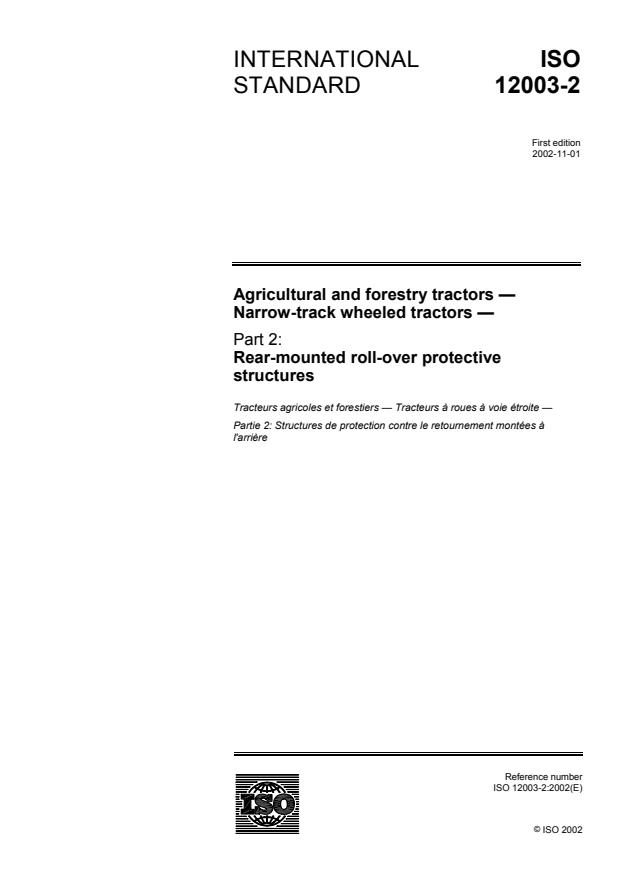
(Main)Agricultural and forestry tractors — Narrow-track wheeled tractors — Part 2: Rear-mounted roll-over protective structures
Agricultural and forestry tractors — Narrow-track wheeled tractors — Part 2: Rear-mounted roll-over protective structures
ISO 12003-2 specifies procedures for both the static and dynamic testing of roll-over protective structures (ROPS) rear-mounted on narrow-track wheeled agriculture and forestry tractors. It defines the clearance zone and acceptance conditions for rigid or tiltable, rear, two-post rollbar, frame and cab ROPS, and is applicable to such tractors, so equipped, having the following characteristics: a ground clearance of not more than 600 mm beneath the lowest points of the front- and rear-axle housings (not considering lower points on the axle differential); a fixed or adjustable minimum track width of one of the two axles of less than 1 150 mm when fitted with the widest specified tyres, and with the overall width of the other axle being less than that of the first axle; a mass greater than 600 kg but less than 3 000 kg, unladen, including the ROPS and tyres of the largest size recommended by the manufacturer.
Tracteurs agricoles et forestiers — Tracteurs à roues à voie étroite — Partie 2: Structures de protection contre le retournement montées à l'arrière
LISO 12003-2 spécifie des modes opératoires d'essai statique et dynamique des structures de protection contre le retournement (ROPS), montées à l'arrière des tracteurs agricoles et forestiers à roues à voie étroite. Elle définit la zone de dégagement et les conditions d'acceptation des structures de protection contre le retournement à deux montants à l'arrière, rigides ou inclinables, y compris toutes structures arrière associées. Elle est applicable aux tracteurs ainsi équippés et présentant les caractéristiques suivantes: un dégagement au sol inférieur ou égal à 600 mm en dessous des points les plus bas de l'essieu avant et arrière, à l'exception des points inférieurs sur le différentiel de l'essieu ; une largeur de voie minimale fixe ou réglable de l'un des deux essieux inférieure à 1 150 mm, les pneus les plus larges spécifiés étant montés et la largeur globale de l'autre essieu n'étant pas être supérieure à celle du premier essieu; une masse supérieure à 600 kg mais inférieure à 3 000 kg non chargé mais en comptant la structure de protection contre le retournement et la plus grande taille de pneus recommandée par le constructeur.
General Information
- Status
- Withdrawn
- Publication Date
- 21-Oct-2002
- Withdrawal Date
- 21-Oct-2002
- Technical Committee
- ISO/TC 23/SC 2 - Common tests
- Drafting Committee
- ISO/TC 23/SC 2 - Common tests
- Current Stage
- 9599 - Withdrawal of International Standard
- Start Date
- 23-Jul-2008
- Completion Date
- 12-Feb-2026
Relations
- Effective Date
- 15-Apr-2008
ISO 12003-2:2002 - Agricultural and forestry tractors -- Narrow-track wheeled tractors
ISO 12003-2:2002 - Tracteurs agricoles et forestiers -- Tracteurs a roues a voie étroite
Get Certified
Connect with accredited certification bodies for this standard

Control Union Certifications
Global certification for agriculture and sustainability.

ECOCERT
Organic and sustainability certification.

Rainforest Alliance Certification
Sustainable agriculture and forestry certification.
Sponsored listings
Frequently Asked Questions
ISO 12003-2:2002 is a standard published by the International Organization for Standardization (ISO). Its full title is "Agricultural and forestry tractors — Narrow-track wheeled tractors — Part 2: Rear-mounted roll-over protective structures". This standard covers: ISO 12003-2 specifies procedures for both the static and dynamic testing of roll-over protective structures (ROPS) rear-mounted on narrow-track wheeled agriculture and forestry tractors. It defines the clearance zone and acceptance conditions for rigid or tiltable, rear, two-post rollbar, frame and cab ROPS, and is applicable to such tractors, so equipped, having the following characteristics: a ground clearance of not more than 600 mm beneath the lowest points of the front- and rear-axle housings (not considering lower points on the axle differential); a fixed or adjustable minimum track width of one of the two axles of less than 1 150 mm when fitted with the widest specified tyres, and with the overall width of the other axle being less than that of the first axle; a mass greater than 600 kg but less than 3 000 kg, unladen, including the ROPS and tyres of the largest size recommended by the manufacturer.
ISO 12003-2 specifies procedures for both the static and dynamic testing of roll-over protective structures (ROPS) rear-mounted on narrow-track wheeled agriculture and forestry tractors. It defines the clearance zone and acceptance conditions for rigid or tiltable, rear, two-post rollbar, frame and cab ROPS, and is applicable to such tractors, so equipped, having the following characteristics: a ground clearance of not more than 600 mm beneath the lowest points of the front- and rear-axle housings (not considering lower points on the axle differential); a fixed or adjustable minimum track width of one of the two axles of less than 1 150 mm when fitted with the widest specified tyres, and with the overall width of the other axle being less than that of the first axle; a mass greater than 600 kg but less than 3 000 kg, unladen, including the ROPS and tyres of the largest size recommended by the manufacturer.
ISO 12003-2:2002 is classified under the following ICS (International Classification for Standards) categories: 65.060.10 - Agricultural tractors and trailed vehicles. The ICS classification helps identify the subject area and facilitates finding related standards.
ISO 12003-2:2002 has the following relationships with other standards: It is inter standard links to ISO 12003-2:2008. Understanding these relationships helps ensure you are using the most current and applicable version of the standard.
ISO 12003-2:2002 is available in PDF format for immediate download after purchase. The document can be added to your cart and obtained through the secure checkout process. Digital delivery ensures instant access to the complete standard document.
Standards Content (Sample)
INTERNATIONAL ISO
STANDARD 12003-2
First edition
2002-11-01
Agricultural and forestry tractors —
Narrow-track wheeled tractors —
Part 2:
Rear-mounted roll-over protective
structures
Tracteurs agricoles et forestiers — Tracteurs à roues à voie étroite —
Partie 2: Structures de protection contre le retournement montées à
l'arrière
Reference number
©
ISO 2002
PDF disclaimer
This PDF file may contain embedded typefaces. In accordance with Adobe's licensing policy, this file may be printed or viewed but shall not
be edited unless the typefaces which are embedded are licensed to and installed on the computer performing the editing. In downloading this
file, parties accept therein the responsibility of not infringing Adobe's licensing policy. The ISO Central Secretariat accepts no liability in this
area.
Adobe is a trademark of Adobe Systems Incorporated.
Details of the software products used to create this PDF file can be found in the General Info relative to the file; the PDF-creation parameters
were optimized for printing. Every care has been taken to ensure that the file is suitable for use by ISO member bodies. In the unlikely event
that a problem relating to it is found, please inform the Central Secretariat at the address given below.
© ISO 2002
All rights reserved. Unless otherwise specified, no part of this publication may be reproduced or utilized in any form or by any means, electronic
or mechanical, including photocopying and microfilm, without permission in writing from either ISO at the address below or ISO's member body
in the country of the requester.
ISO copyright office
Case postale 56 • CH-1211 Geneva 20
Tel. + 41 22 749 01 11
Fax + 41 22 749 09 47
E-mail copyright@iso.ch
Web www.iso.ch
Printed in Switzerland
ii © ISO 2002 – All rights reserved
Contents Page
Foreword . iv
Introduction. v
1 Scope. 1
2 Normative references. 1
3 Terms, definitions and symbols . 2
4 Conditioning of tractor and ROPS for pilot test. 3
5 Test apparatus and equipment . 4
5.1 Dynamic testing. 4
5.2 Static testing. 5
6 Preparation for strength testing . 6
6.1 Purpose. 6
6.2 Tests. 7
6.3 Rules governing testing . 7
7 Test procedures. 7
7.1 General requirements. 7
7.2 Test sequence. 8
7.3 Dynamic (impact) test procedures . 8
7.4 Static test procedures for rear-mounted ROPS . 13
7.5 Vertical crushing test procedure . 15
7.6 Observations during testing . 15
8 Clearance zone. 16
8.1 General. 16
8.2 Clearance zone boundaries . 16
9 Tolerances. 17
10 Acceptance conditions. 19
10.1 General requirements. 19
10.2 After impact loads. 20
10.3 After static horizontal loads. 20
10.4 Additional crushing tests . 21
11 Extension to other tractor models. 24
12 Labelling. 24
13 Test report. 24
Annex A (normative) Providing resistance to brittle fracture at reduced operating temperatures . 25
Annex B (normative) Specimen test report. 27
Annex C (normative) Rear-mounted ROPS specifications. 28
Annex D (normative) Strength test report. 29
Bibliography. 31
Foreword
ISO (the International Organization for Standardization) is a worldwide federation of national standards bodies (ISO
member bodies). The work of preparing International Standards is normally carried out through ISO technical
committees. Each member body interested in a subject for which a technical committee has been established has
the right to be represented on that committee. International organizations, governmental and non-governmental, in
liaison with ISO, also take part in the work. ISO collaborates closely with the International Electrotechnical
Commission (IEC) on all matters of electrotechnical standardization.
International Standards are drafted in accordance with the rules given in the ISO/IEC Directives, Part 3.
The main task of technical committees is to prepare International Standards. Draft International Standards adopted
by the technical committees are circulated to the member bodies for voting. Publication as an International
Standard requires approval by at least 75 % of the member bodies casting a vote.
Attention is drawn to the possibility that some of the elements of this part of ISO 12003 may be the subject of
patent rights. ISO shall not be held responsible for identifying any or all such patent rights.
ISO 12003-2 was prepared by Technical Committee ISO/TC 23, Tractors and machinery for agriculture and foresty,
Subcommittee SC 3, Safety and comfort of the operator.
ISO 12003 consists of the following parts, under the general title Agricultural and forestry tractors — Narrow-track
wheeled tractors:
Part 1: Front-mounted roll-over protective structures
Part 2: Rear-mounted roll-over protective structures
Annexes A to D form a normative part of this part of ISO 12003.
iv © ISO 2002 – All rights reserved
Introduction
The testing of protective structures on tractors is aimed at minimizing the frequency and severity of driver injury
resulting from accidental overturning during normal operation.
This part of ISO 12003 enables the strength of a tractor's rear-mounted roll-over protective structure (ROPS) to be
tested by the application of dynamic and static loads that simulate the actual loads which can be imposed on the
cab or frame when the tractor overturns either to the rear or side without free fall. Observations can be made on the
strength of the structure, the brackets attaching it to the tractor and those tractor parts that could be affected by the
load imposed on the structure.
This part of ISO 12003 largely conforms with existing test codes. It does adopt, however, the seat index point (SIP)
instead of the seat reference point (SRP). Moreover, for the definition of the minimum required clearance zone for
the driver, the clearance datum point (CDP) is introduced, taking into consideration both the interrelation of the
position of the SIP and SRP, as specified in ISO 3462, and the actual horizontal and vertical adjustment of the seat
installed on the tractor.
INTERNATIONAL STANDARD ISO 12003-2:2002(E)
Agricultural and forestry tractors — Narrow-track wheeled
tractors —
Part 2:
Rear-mounted roll-over protective structures
1 Scope
This part of ISO 12003 specifies procedures for both the static and dynamic testing of roll-over protective structures
(ROPS) rear-mounted on narrow-track wheeled agricultural and forestry tractors. It defines the clearance zone and
acceptance conditions for rigid or tiltable, rear, two-post rollbar, frame and cab ROPS, and is applicable to tractors
so equipped having the following characteristics:
a ground clearance of not more than 600 mm beneath the lowest points of the front- and rear-axle housings
(not considering lower points on the axle differential);
a fixed or adjustable minimum track width of one of the two axles of less than 1 150 mm when fitted with the
widest specified tyres, and with the overall width of the other axle being less than that of the first axle;
a mass greater than 600 kg but less than 3 000 kg, unladen, including the ROPS and tyres of the largest size
recommended by the manufacturer.
2 Normative references
The following normative documents contain provisions which, through reference in this text, constitute provisions of
this part of ISO 12003. For dated references, subsequent amendments to, or revisions of, any of these publications
do not apply. However, parties to agreements based on this part of ISO 12003 are encouraged to investigate the
possibility of applying the most recent editions of the normative documents indicated below. For undated
references, the latest edition of the normative document referred to applies. Members of ISO and IEC maintain
registers of currently valid International Standards.
ISO 148, Steel — Charpy impact test (V-notch)
ISO 2408, Steel wire ropes for general purposes — Characteristics
ISO 3462, Tractors and machinery for agriculture and forestry — Seat reference point — Method of determination
ISO 5353, Earth-moving machinery, and tractors and machinery for agriculture and forestry — Seat index point
ISO 12003-1, Agricultural and forestry tractors — Narrow-track wheeled tractors — Part 1: Front-mounted roll-over
protective structures
3 Terms, definitions and symbols
For the purposes of this part of ISO 12003, the terms and definitions given in ISO 5353, and the following terms,
definitions and symbols apply. The symbols and units given in Table 1 are applicable throughout this part of
ISO 12003.
3.1
roll-over protective structure
ROPS
framework protecting drivers of wheeled agricultural and forestry tractors that minimizes the likelihood of driver
injury resulting from accidental overturning during normal operation
NOTE The ROPS is characterized by the provision of space for a clearance zone, either inside the envelope of the
structure or within a space bounded by a series of straight lines from the outer edges of the structure to any part of the tractor
that might come into contact with flat ground; it is capable of supporting the tractor in the overturned position.
3.1.1
rear-mounted ROPS
two-post, rollbar-type, roll-over protective structure mounted on the tractor rearwards of the driver's seat, or a frame
or cab, having a clearance zone whose upper limit is 900 mm above the CDP
cf. front-mounted ROPS (see ISO 12003-1)
3.2
tractor mass
m
mass of the unladen tractor in working order with tanks and radiator full, rear-mounted ROPS and any equipment
required for normal use
NOTE The operator, optional ballast weights, additional wheel equipment, and special equipment and loads are not
included.
3.3
reference mass
m
t
mass, not less than the tractor mass, selected by the manufacturer for calculation of loading energies and forces to
be applied in the tests
3.4
horizontal loading test
application of a horizontal static or dynamic load to the rear, front and sides of the rear-mounted ROPS
3.5
crushing test procedure
application of a vertical static load through a beam placed laterally across the uppermost members of the
rear-mounted ROPS
3.6
reference plane
vertical plane, longitudinal to the tractor, passing through the seat index point (SIP) and the steering-wheel centre
NOTE Normally, for narrow-track tractors, this coincides with the median plane.
3.7
clearance datum point
CDP
datum point determined from the SIP, necessary for establishing the clearance zone
2 © ISO 2002 – All rights reserved
3.8
wheelbase
horizontal distance between the two vertical planes passing through the rotational centre lines of the wheels, where
one plane is for the front wheels and the other for the rear wheels
Table 1 — Symbols
Symbol Description Unit
a Half the horizontal seat adjustment mm
h
a Half the vertical seat adjustment mm
v
B Minimum overall width of the tractor mm
B Maximum outer width of the rear-mounted ROPS mm
b
D Deflection of the rear-mounted ROPS at the point of, and in line with the load application (static test) mm
D′ Deflection of calculated energy required mm
E Strain energy absorbed. Area under F-D curve J
i
E Energy input to be absorbed during longitudinal loading J
il
E Energy input to be absorbed during side loading J
is
F Static load force N
F' Loading force for the calculated energy required N
F Maximum static load force occurring during loading with the exception of the overload N
max
F Vertical crushing force N
v
h Falling height of the pendulum block mm
I Moment of inertia about rear axle, whatever the mass of the rear wheels may be kg⋅m
L Tractor reference wheelbase mm
m Tractor mass (see 3.2) kg
m Reference mass (see 3.3) kg
t
4 Conditioning of tractor and ROPS for pilot test
The rear-mounted ROPS under test shall be in accordance with production specifications and shall be fitted in its
protective position to the appropriate tractor model chosen in accordance with the manufacturer's declared
attachment method.
The tractor under test shall be fitted with tyres having the greatest diameter indicated by the manufacturer and the
smallest width for tyres of that diameter. The tyres shall not be liquid-ballasted and shall be inflated to the pressure
recommended for field work.
The rear wheels shall be set to the narrowest possible track width, and the front wheels to the same track width. If
two front track width settings could differ equally from the narrowest rear track width setting, then the wider of these
two front track width settings shall be selected.
All the tractor’s tanks shall be filled or replaced by equivalent masses in the corresponding position.
5 Test apparatus and equipment
5.1 Dynamic testing
5.1.1 Pendulum block
A pendulum block shall be suspended by two chains or wire ropes from pivot points not less than 6 m above the
ground. Means shall be provided for adjusting independently the suspended height of the block and the angle
between the block and the supporting chains or wire ropes.
The mass shall be 2 000 kg ± 20 kg, excluding the mass of the chains or wire ropes, which themselves shall not
exceed 100 kg. The length of the sides of the impact face shall be 680 mm ± 20 mm. The block shall be filled such
that the position of its centre of gravity is constant and coincides with the geometrical centre of the parallelepiped.
The parallelepiped shall be connected to the system which pulls it backwards by an instantaneous release
mechanism designed and located so as to enable the pendulum block to be released without causing any
significant oscillation of the parallelepiped.
5.1.2 Pendulum supports
The pendulum pivot points shall be rigidly fixed so that their displacement in any direction does not exceed 1 % of
the height of fall.
5.1.3 Lashings
Anchoring rails with the requisite track width and covering the necessary area for lashing the tractor in all required
tests shall be rigidly attached to a non-yielding base beneath the pendulum.
The tractor shall be lashed to the rails by means of wire rope of round-strand, fibre-core and 6 × 19 construction, in
accordance with ISO 2408, and having a nominal diameter of 13 mm. The metal strands shall have an ultimate
tensile strength of at least 1 770 MPa.
The central pivot of an articulated tractor shall be supported and lashed down as appropriate for all test
procedures. For the side impact test procedure, the pivot shall also be propped from the side opposite the impact.
The front and rear wheels are not required to be in line if this is more convenient for attaching appropriate wire
ropes.
5.1.4 Wheel prop and beam
A softwood beam of 150 mm square shall be used as a prop for the wheels during the impact tests. During the
lateral impact test, a softwood beam shall be clamped to the floor to brace the rim of the wheel opposite the side of
impact.
5.1.5 Props and lashings for articulated tractors
Additional props and lashings shall be used for articulated tractors, the purpose of which is to ensure that the
section of the tractor on which the rear-mounted ROPS is fitted is as rigid as that of a rigid tractor.
5.1.6 Tyre pressures and deflection
The tractor tyres shall not be liquid-ballasted and shall be inflated to the pressures prescribed by the tractor
manufacturer for field work. The lashings shall be tensioned in each particular case such that the tyres undergo a
deflection equal to 12 % of the tyre wall height (distance between the ground and the lowest point of the rim) before
tensioning.
4 © ISO 2002 – All rights reserved
5.1.7 Measuring apparatus
The following measuring apparatus shall be used:
a device for measuring the elastic deflection (the difference between the maximum momentary deflection and
the permanent deflection);
a device for checking that the rear-mounted ROPS has not entered the clearance zone, and that this zone has
remained within the protection given by the ROPS, during testing.
5.2 Static testing
5.2.1 Rig for static testing of rear-mounted ROPS
5.2.1.1 General
This rig shall enable horizontal thrust or loading to be applied to the rear-mounted ROPS. Provision shall be made
for the load to be uniformly distributed normal to the direction of loading and along a beam having a length of one
of the exact multiples of 50 mm between 250 mm and 700 mm. The stiff beam shall have a vertical face dimension
of 150 mm. The edges of the beam in contact with the rear-mounted ROPS shall be curved, with a maximum radius
of 50 mm.
The pad shall be capable of being adjusted to any angle in relation to the load direction, in order that it can follow
the angular variations of the rear-mounted ROPS's load-bearing surface as it deflects.
The direction of the force (deviation from horizontal and from vertical) shall be
at the start of the test, under zero load, ± 2°, and
during testing, under load, 10° above and 20° below the horizontal.
These variations shall be kept to a minimum.
. 1
−
The deflection rate shall be slow (< 5 mm s ) so that the load can at all times be considered “static”.
5.2.1.2 Apparatus for measuring energy absorbed by rear-mounted ROPS
The force vs deflection curve shall be plotted continuously in order to determine the energy absorbed by the rear-
mounted ROPS. Measurement of the force and deflection at the point where the load is applied to the rear-
mounted ROPS is not required; however, force and deflection shall be measured simultaneously and co-Iinearly.
The point of origin of deflection measurements shall be selected so that only the energy absorbed by the
rear-mounted ROPS or the deflection of certain parts of the tractor, or both, are measured. The energy absorbed
by deflection or slipping of the anchoring or both shall not be included.
5.2.1.3 Means of anchoring tractor
Anchoring rails with the requisite track width and covering the necessary area for anchoring the tractor for all
required tests shall be rigidly attached to a non-yielding base near the testing rig.
The tractor or assembly (the rear-mounted ROPS and parts of the tractor to which it is attached) shall be anchored
to the rails by any suitable means (plates, wedges, wire ropes, jacks, etc.) so that it cannot move during the tests.
This requirement shall be checked during the test by means of the usual devices for measuring length. lf the tractor
or assembly moves, the entire test procedure shall be repeated, unless the system for measuring the deflections
used in plotting the force vs deflection curve is connected to the tractor or assembly.
5.2.2 Crushing rig
This rig shall be capable of exerting a downward force on the rear-mounted ROPS through a rigid beam
approximately 250 mm wide, connected to the load-applying mechanism by means of universal joints. Suitable axle
stands shall be provided so that the tractor tyres do not bear the crushing force. See Figure 1.
Key
1 Universal pin joints
2 Hydraulic cylinder
3 Supports
Figure 1 — Crushing rig — Example
5.2.3 Other measuring apparatus
A device for checking that the rear-mounted ROPS has not entered the clearance zone, and that this zone has
remained within the rear-mounted ROPS protection during testing, shall be used.
6 Preparation for strength testing
6.1 Purpose
Strength testing using special rigs has as its object the simulation of such loads as are imposed on a rear-mounted
ROPS when the tractor overturns. These tests enable observations to be made on the strength of the ROPS and
any brackets attaching it to the tractor, as well as on any parts of the tractor transmitting the test load.
6 © ISO 2002 – All rights reserved
6.2 Tests
Either a dynamic or static test procedure, at the discretion of the manufacturer, shall be carried out on the
rear-mounted ROPS, the two methods being considered equivalent.
NOTE A complete tractor is not required for the static strength test procedures. The rear-mounted ROPS and the parts of
the tractor to which it is attached represent the operating installation referred to in this part of ISO 12003 as the “assembly”.
6.3 Rules governing testing
The preparation for testing the rear-mounted ROPS is governed by the following general rules.
a) The rear-mounted ROPS shall conform to the series production specifications. It shall be attached in
accordance with the manufacturer's recommended method to a tractor for which it is designed.
b) The tractor or assembly shall be fitted with all series-production components which could affect the strength of
the rear-mounted ROPS or which might be necessary for the procedure.
c) Components that could create a hazard in the clearance zone shall also be fitted so that they can be examined
to ascertain whether the requirements of the acceptance conditions have been fulfilled.
d) All detachable windows, panels and removable non-structural fittings shall be removed so that they do not
contribute to the strength of the rear-mounted ROPS.
e) Where it is possible to fix doors and windows open or remove them during work, they shall be either removed
or fixed open for the test, so that they do not add the strength of the rear-mounted ROPS. It shall be noted
whether, in this position, they would create a hazard for the driver in the event of overturning.
f) The track width shall be adjusted so that the rear-mounted ROPS will not, in as far as possible, be supported
by the tyres during the strength test procedure. lf such procedures are conducted in accordance with the static
procedure, it shall be possible to remove the wheels.
7 Test procedures
7.1 General requirements
7.1.1 lf, during the test procedure, any part of the tractor restraining equipment breaks or moves, the test
procedure shall be restarted.
7.1.2 No repairs or adjustments of the tractor or rear-mounted ROPS may be carried out during the test
procedure cycles.
7.1.3 The tractor gear box shall be in neutral and the brakes off during testing.
7.1.4 lf the tractor is fitted with a suspension system between the tractor body and the wheels, it shall be blocked
during testing.
7.1.5 The side chosen for application of the first impact from the rear (in the case of dynamic test procedures) or
the first load from the rear (in the case of static test procedures) shall be that which will result in the application of
the series of impacts or loads under the most unfavourable conditions for the rear-mounted ROPS. The lateral and
rear impacts or loads shall be on different sides of the longitudinal median plane of the rear-mounted ROPS. The
front impact or load shall be on the same side of the longitudinal median plane as the side impact or load.
7.2 Test sequence
The sequence of strength testing of the rear-mounted ROPS shall be as follows:
a) impact (dynamic test procedure) or longitudinal loading (static test procedure) applied from the rear;
b) vertical crushing (dynamic and static test procedure);
c) impact (dynamic test procedure) or longitudinal loading (static test procedure) applied from the front;
d) impact (dynamic test procedure) or horizontal loading (static test procedure) applied from the side;
e) vertical crushing (dynamic and static test procedure).
7.3 Dynamic (impact) test procedures
7.3.1 Rear impact test procedure
a) Position the tractor in relation to the pendulum block such that the block will strike the rear-mounted ROPS
when the impact face of the block and the supporting chains or wire ropes are at such an angle that the
vertical plane is equal to m /100 with a 20° maximum, unless, during deflection, the rear-mounted ROPS at the
t
point of contact forms a greater angle to the vertical. In that case, adjust the impact face of the block by means
of an additional support such that it is parallel to the rear-mounted ROPS at the point of impact at the moment
of maximum deflection, the supporting chains or wire ropes remaining at the specified angle.
b) Adjust the suspended height of the pendulum block and take any necessary steps to prevent the block from
turning about the point of impact: that part of the rear-mounted ROPS likely to hit the ground first in a rearward
overturning accident — normally the upper edge.
The position of the centre of gravity of the block shall be one-sixth the width of the top of the rear-mounted
ROPS, inwards from a vertical plane parallel to the median plane of the tractor touching the outside extremity
of the top of the rear-mounted ROPS. lf the rear-mounted ROPS is curved or protruding at this point, add
wedges enabling the impact to be applied to it, but without thereby reinforcing the rear-mounted ROPS.
c) Lash the tractor to the ground by means of four wire ropes, one at each end of both axles, arranged as shown
in Figure 2. The front and rear lashing points shall be located at such a distance that the wire ropes make an
angle of less than 30° with the ground. The rear lashings shall, in addition, be so arranged that the point of
convergence of the two wire ropes is located in the vertical plane in which the centre of gravity of the
pendulum block travels. Tension the wire ropes such that the tyres undergo the deflections given in 5.1.6. With
the wire ropes tensioned, place the wedging beam in front of, and tight against, the rear wheels and then fix it
to the ground.
lf the tractor is of the articulated type, its pivot shall be additionally supported by a wooden block of at least
100 mm square and firmly lashed to the ground.
d) Pull back the pendulum block so that the height of its centre of gravity above that at the moment of impact is
given by one of the following two formulae.
−8 2
h = 2,165 × 10 m × L
t
or
−2
h = 5,73 × 10 m × I
t
8 © ISO 2002 – All rights reserved
For tractors with a reversible seat position, one of the preceding or that which is appropriate of the following
formulae shall be used, whichever gives the greater result.
For tractors with a reference mass of less than 2 000 kg:
h = 25 + 0,07 m
t
For tractors with a reference mass of 2 000 kg to 3 000 kg:
h = 125 + 0,02 m
t
e) Release the pendulum block so that it strikes the rear-mounted ROPS.
m
t
α=°u 20
Key
1 Two lashings
2 Wedging beam
Figure 2 — Lashing for rear impact test — Example
7.3.2 Front impact test procedure
a) Position the tractor in relation to the pendulum block such that the block will strike the rear-mounted ROPS
when the impact face of the block and the supporting chains or wire ropes are at such an angle that the
vertical plane is equal to m /100 with a 20° maximum, unless, during deflection, the rear-mounted ROPS at the
t
point of contact forms a greater angle to the vertical. In that case, adjust the impact face of the block by means
of an additional support such that it is parallel to the rear-mounted ROPS at the point of impact at the moment
of maximum deflection, with the supporting chains or wire ropes remaining at the specified angle.
b) Adjust the suspended height of the pendulum block and take any necessary steps to prevent the block from
turning about the point of impact — that part of the rear-mounted ROPS likely to hit the ground first in a
rearward overturning accident (normally the upper edge).
The position of the centre of gravity of the block shall be one-sixth the width of the top of the rear-mounted
ROPS, inwards from a vertical plane parallel to the median plane of the tractor touching the outside extremity
of the top of the rear-mounted ROPS. lf the rear-mounted ROPS is curved or protruding at this point, add
wedges enabling the impact to be applied to it, but without thereby reinforcing the rear-mounted ROPS.
c) Lash the tractor to the ground by means of four wire ropes, one at each end of both axles, arranged as shown
in Figure 3. The front and rear lashing points shall be located at such a distance that the wire ropes make an
angle of less than 30° with the ground. The rear lashings shall in addition be so arranged that the point of
convergence of the two wire ropes is located in the vertical plane in which the centre of gravity of the
pendulum block travels. Tension the wire ropes such that the tyres undergo the deflections given in 5.1.6. With
the wire ropes tensioned, place the wedging beam firmly behind the rear wheels and then fix it to the ground.
lf the tractor is of the articulated type, its pivot shall be additionally supported by a wooden block of at least
100 mm square and firmly lashed to the ground.
d) Pull back the pendulum block so that the height of its centre of gravity above that at the moment of impact is
given by one of the following two formulae, to be chosen according to the reference mass of the tractor under
test.
For tractors with a reference mass of less than 2 000 kg:
h = 25 + 0,07 m
t
For tractors with a reference mass of 2 000 kg to 3 000 kg:
h = 125 + 0,02 m
t
For tractors with a reversible seat position and a rear, two-post rollbar, the same formulae shall be used, as
appropriate.
For tractors with a reversible seat position and any other type of rear-mounted ROPS, either the preceding or
following formulae shall be used, whichever give the greater results.
−8 2
h = 2,165 × 10 m × L
t
or
−2
h = 5,73 × 10 m × I
t
e) Release the pendulum block so that it strikes the rear-mounted ROPS.
10 © ISO 2002 – All rights reserved
m
t
α=°u 20
Key
1 Two lashings
2 Wedging beam
Figure 3 — Lashing for front impact test — Example
7.3.3 Side impact test procedure
a) Position the tractor in relation to the pendulum block such that the block will strike the rear-mounted ROPS
when the impact face of the block and the supporting chains or wire ropes are vertical, unless, during
deflection, the rear-mounted ROPS at the point of contact forms an angle of less than 20° to the vertical. In
that case, adjust the impact face of the block by means of an additional support such that it is parallel to the
rear-mounted ROPS at the point of impact at the moment of maximum deflection, with the supporting chains or
wire ropes remaining vertical on impact.
b) Adjust the suspended height of the pendulum block and take any necessary steps to prevent the block from
turning about the point of impact — that part of the rear-mounted ROPS likely to hit the ground first in a
sideways overturning accident (normally the upper edge). Unless it is certain that another part of this edge
would hit the ground first, the point of impact shall be in the plane at right angles to the median plane and
passing 200 mm in front of the CDP, with the seat being set at the longitudinal seat adjustment's mid-position.
c) Lash to the ground the tractor wheels on the side which is to receive the impact, by means of wire ropes
passing over the corresponding ends of the front and rear axles. Tension the wire ropes in order to produce
the tyre deflection values given in 5.1.6 on the side which is to receive the impact. With the wire ropes
tensioned, place the wedging beam shall be placed on the ground, pushed tight against the tyres on the side
opposite that which is to receive the impact and then fix it to the ground. (It may be necessary to use two
beams or wedges if the outer sides of the front and rear tyres are not in the same vertical plane.)
d) Place the prop, as shown in Figure 4, against the rim of the wheel opposite to the impact, push it firmly against
the rim and fix it at its base. The length of the prop shall be chosen such that it makes an angle of 30° ± 3° with
the ground when in position against the rim. In addition, its length shall, if possible, be between 20 and
25 times greater than its thickness, and its width between two to three times less than its thickness. The props
shall be shaped at both ends.
lf the tractor is of the articulated type, its pivot shall, in addition, be supported by a wooden block at least
100 mm square, as well as being laterally supported by a block similar to that specified in 7.3.1 for articulated
type tractors against the rear wheel. Lash the point of articulation firmly to the ground.
e) Pull back the pendulum block such that the height of its centre of gravity above that at the point of impact is
given by one of the following two formulae, to be chosen according to the reference mass of the tractor under
test.
For tractors with a reference mass of less than 2 000 kg:
h = 25 + 0,2 m
t
For tractors with a reference mass of 2 000 kg to 3 000 kg:
h = 125 + 0,15 m
t
For tractors with a reversible seat position and rear, two-post rollbar, either the preceding or the following
formulae shall be used accordingly, whichever give the greater results.
For tractors with a reference mass of less than 2 000 kg:
25++0,2mB B
( )( )
tb
h =
2B
For tractors with a reference mass of 2 000 kg to 3 000 kg:
125++0,15mB B
( )( )
tb
h =
2B
For tractors with a reversible seat position and any other type of rear-mounted ROPS, the following formulae
shall be used.
For tractors with a reference mass of less than 2 000 kg:
h = 25 + 0,2 m
t
For tractors with a reference mass of 2 000 kg to 3 000 kg:
h = 125 + 0,15 m
t
The load shall be applied in the vertical plane, at mid-point between the two SIPs.
f) Release the pendulum block so that it strikes the rear-mounted ROPS.
12 © ISO 2002 – All rights reserved
Beams are clamped against the sides of the front and rear wheels and props wedged against the wheel rims after anchoring.
Key
1 Lashing
2 Untensioned cable (optional)
3 Softwood beam (150 mm × 150 mm)
4 Prop
a
Rounded to secure contact against wheel rim.
b
Chamfered.
c
Travel arc of pendulum block centre of gravity to pass through point of contact with ROPS.
Figure 4 — Lashing for side impact test — Example
7.4 Static test procedures for rear-mounted ROPS
7.4.1 Rear loading
Apply the load horizontally, in a vertical plane parallel to the tractor's median plane. The load application point shall
be that part of the rear-mounted ROPS likely to hit the ground first in a rearward overturning accident (normally the
upper edge). The vertical plane in which the load is applied is located at a distance of one-third the external width
of the upper part of the rear-mounted ROPS from the median plane. lf the rear-mounted ROPS is curved or
protruding at this point, add wedges enabling the load to be applied to it, but without thereby reinforcing the rear-
mounted ROPS.
The tractor or assembly shall be lashed to the ground using lashings in accordance with 5.1.3.
The energy absorbed by the rear-mounted ROPS during the test shall be at least
−7 2
E = 2,165 × 10 m × L
il t
or
E = 0,574 × I
il
For tractors with a reversible seat position, either of the preceding formulae, or the following formula, shall be used:
E = 500 + 0,5 m
il t
7.4.2 Front loading
Apply the load horizontally, in a vertical plane parallel to the tractor's reference plane and located at a distance of
one-third the external width of the upper part of the rear-mounted ROPS from the reference plane. The load
application point is that part of the rear-mounted ROPS likely to hit the ground first, were the tractor to overturn in a
sideways direction while travelling forwards (normally the upper corner). lf the rear-mounted ROPS is curved or
protruding at this point, add wedges enabling the load to be applied to it, but without thereby reinforcing the rear-
mounted ROPS.
The tractor or assembly shall be lashed to the ground in accordance with 5.2.1.3.
The energy absorbed by the rear-mounted ROPS during the test shall be at least
E = 500 + 0,5 m
il t
For tractors with a reversible seat position and a rear, two-post rollbar, the same formula shall be used.
For tractors with a reversible seat position and other type of rear-mounted ROPS, either the preceding formula or
one of the following formulae may be used, whichever gives the greater result:
−7 2
E = 2,165 × 10 m × L
il t
or
E = 0,574 × I
il
7.4.3 Side loading
Apply the load horizontally, in a vertical plane perpendicular to the tractor's median plane, passing 200 mm in front
of the CDP, with the seat in the longitudinal seat adjustment mid-position. The load application point is that part of
the rear-mounted ROPS likely to hit the ground first in a sideways overturning accident (normally the upper edge).
The tractor or assembly shall be lashed to the ground in accordance with 5.2.1.3.
The energy absorbed by the rear-mounted ROPS during the test shall be at least
E = 1,75 m
is t
For tractors with a reversible seat position and a rear, two-post rollbar, either the preceding or the following formula
may be used, whichever gives the greater result:
1, 75mB +B
( )
tb
E =
is
2B
14 © ISO 2002 – All rights reserved
For tractors with a reversible seat position and other type of rear-mounted ROPS, the first of these formulae shall
be used.
The load shall be applied in the vertical plane at mid-point between the two SIPs.
7.5 Vertical crushing test procedure
Position the beam across the uppermost structural members of the rear-mounted ROPS, with the resultant of
crushing forces located in the tractor's median plane.
Apply a vertical crushing force, F , of 20 m .
v t
Maintain this force for at least 5 s after the cessation of any visually deflectable movement of the rear-mounted
ROPS. The second crushing test may be at the same point as the first.
Where the rear or front part of the ROPS roof does not sustain the full crushing force, apply the force until the roof
is deflected to coincide with the plane joining the upper part of the ROPS with that part of the tractor rear or front
capable of supporting the vehicle mass when overturned. Then remove the force and position the tractor or loading
force such that the beam is over that point of the ROPS that would then support the tractor rear or front were the
tractor to completely overturn and the full force be applied.
7.6 Observations during testing
7.6.1 Fractures and cracks
After each test, all structural members, joints and fastening systems shall be visually examined for fractures or
cracks, while any small cracks in unimportant parts and any tears caused by the edges of the pendulum weight
shall be ignored.
7.6.2 Clearance zone
During each test, an examination shall be made to ascertain whether any part of the rear-mounted ROPS has
entered the clearance zone (see clause
...
NORME ISO
INTERNATIONALE 12003-2
Première édition
2002-11-01
Tracteurs agricoles et forestiers —
Tracteurs à roues à voie étroite —
Partie 2:
Structures de protection contre le
retournement montées à l'arrière
Agricultural and forestry tractors — Narrow-track wheeled tractors —
Part 2: Rear-mounted roll-over protective structures
Numéro de référence
©
ISO 2002
PDF – Exonération de responsabilité
Le présent fichier PDF peut contenir des polices de caractères intégrées. Conformément aux conditions de licence d'Adobe, ce fichier peut
être imprimé ou visualisé, mais ne doit pas être modifié à moins que l'ordinateur employé à cet effet ne bénéficie d'une licence autorisant
l'utilisation de ces polices et que celles-ci y soient installées. Lors du téléchargement de ce fichier, les parties concernées acceptent de fait la
responsabilité de ne pas enfreindre les conditions de licence d'Adobe. Le Secrétariat central de l'ISO décline toute responsabilité en la
matière.
Adobe est une marque déposée d'Adobe Systems Incorporated.
Les détails relatifs aux produits logiciels utilisés pour la création du présent fichier PDF sont disponibles dans la rubrique General Info du
fichier; les paramètres de création PDF ont été optimisés pour l'impression. Toutes les mesures ont été prises pour garantir l'exploitation de
ce fichier par les comités membres de l'ISO. Dans le cas peu probable où surviendrait un problème d'utilisation, veuillez en informer le
Secrétariat central à l'adresse donnée ci-dessous.
© ISO 2002
Droits de reproduction réservés. Sauf prescription différente, aucune partie de cette publication ne peut être reproduite ni utilisée sous quelque
forme que ce soit et par aucun procédé, électronique ou mécanique, y compris la photocopie et les microfilms, sans l'accord écrit de l’ISO à
l’adresse ci-après ou du comité membre de l’ISO dans le pays du demandeur.
ISO copyright office
Case postale 56 • CH-1211 Geneva 20
Tel. + 41 22 749 01 11
Fax. + 41 22 749 09 47
E-mail copyright@iso.ch
Web www.iso.ch
Imprimé en Suisse
ii © ISO 2002 – Tous droits réservés
Sommaire Page
Avant-propos . iv
Introduction. v
1 Domaine d'application . 1
2 Références normatives. 1
3 Termes, définitions et symboles . 2
4 Conditionnement du tracteur et de la ROPS pour l'essai pilote . 3
5 Appareillage et équipement d'essai . 4
5.1 Essais dynamiques. 4
5.2 Essais statiques . 5
6 Préparation pour les essais de résistance . 6
6.1 Objet . 6
6.2 Essai . 7
6.3 Règles générales pour la conduite des essais . 7
7 Modes opératoire d'essai . 7
7.1 Exigences générales. 7
7.2 Séquence des essais . 8
7.3 Modes opératoires d'essai (de choc) dynamique . 8
7.4 Modes opératoires d'essai statiques pour les ROPS montées à l'arrière. 13
7.5 Mode opératoire d'essai d'écrasement vertical . 15
7.6 Observations pendant les essais . 15
8 Zone de dégagement . 16
8.1 Généralités. 16
8.2 Limites de la zone de dégagement. 16
9 Tolérances . 17
10 Conditions d'acceptation . 19
10.1 Exigences générales. 19
10.2 Après l'application des charges de choc . 20
10.3 Après l'application des charges horizontales statiques. 20
10.4 Essai d'écrasement supplémentaire . 21
11 Extension à d'autres modèles de tracteurs. 24
12 Étiquetage . 24
13 Rapport d'essai. 24
Annexe A (normative) Résistance à la rupture fragile de la ROPS montée à l'arrière à température de
fonctionnement réduite . 25
Annexe B (normative) Rapport d'essai de l'éprouvette. 27
Annexe C (normative) Spécifications de la ROPS montée à l'arrière . 28
Annexe D (normative) Rapport d'essai concernant les essais de résistance. 29
Bibliographie. 31
Avant-propos
L'ISO (Organisation internationale de normalisation) est une fédération mondiale d'organismes nationaux de
normalisation (comités membres de l'ISO). L'élaboration des Normes internationales est en général confiée aux
comités techniques de l'ISO. Chaque comité membre intéressé par une étude a le droit de faire partie du comité
technique créé à cet effet. Les organisations internationales, gouvernementales et non gouvernementales, en
liaison avec l'ISO participent également aux travaux. L'ISO collabore étroitement avec la Commission
électrotechnique internationale (CEI) en ce qui concerne la normalisation électrotechnique.
Les Normes internationales sont rédigées conformément aux règles données dans les Directives ISO/CEI,
Partie 3.
La tâche principale des comités techniques est d'élaborer les Normes internationales. Les projets de Normes
internationales adoptés par les comités techniques sont soumis aux comités membres pour vote. Leur publication
comme Normes internationales requiert l'approbation de 75 % au moins des comités membres votants.
L'attention est appelée sur le fait que certains des éléments de la présente partie de l'ISO 12003 peuvent faire
l'objet de droits de propriété intellectuelle ou de droits analogues. L'ISO ne saurait être tenue pour responsable de
ne pas avoir identifié de tels droits de propriété et averti de leur existence.
L'ISO 12003-2 a été élaborée par le comité technique ISO/TC 23, Tracteurs et matériels agricoles et forestiers,
sous-comité SC 3, Sécurité et confort de l'opérateur.
L'ISO 12003 comprend les parties suivantes, présentées sous le titre général Tracteurs agricoles et forestiers —
Tracteurs à roues à voie étroite:
Partie 1: Structures de protection contre le retournement montées à l'avant
Partie 2: Structures de protection contre le retournement montées à l'arrière
Les annexes A à D constituent des éléments normatifs de la présente partie de l'ISO 12003.
iv © ISO 2002 – Tous droits réservés
Introduction
Les essais des structures de protection des tracteurs visent à réduire la fréquence et la gravité des blessures du
conducteur résultant du retournement accidentel du tracteur en cours de fonctionnement normal.
La présente partie de l'ISO 12003 permet d'effectuer des essais de la résistance d'une structure de protection
contre le retournement montée à l'arrière (ROPS), par l'application de charges dynamiques et statiques simulant
les charges réelles qui peuvent être exercées sur la cabine ou le bâti lorsque le tracteur se retourne, soit vers
l'arrière, soit sur le côté sans chute libre. Des observations peuvent être faites sur la résistance de la structure et
des supports de fixation sur le tracteur, ainsi que sur les éléments du tracteur qui peuvent être affectés par la
charge imposée à la structure.
La présente partie de l'ISO 12003 est tout à fait en conformité avec les codes d'essai existants. Toutefois, le point
repère du siège (SIP) a été adopté à la place du point de référence du siège (SRP). Pour la définition de la zone de
dégagement minimale requise du conducteur, le point de référence du dégagement (CDP) est obtenu en prenant
en compte la relation de la position du SIP et du SRP telle que spécifiée dans l'ISO 3462, ainsi que le réglage
horizontal et vertical réel du siège installé sur le tracteur.
NORME INTERNATIONALE ISO 12003-2:2002(F)
Tracteurs agricoles et forestiers — Tracteurs à roues à voie
étroite —
Partie 2:
Structures de protection contre le retournement montées à
l'arrière
1 Domaine d'application
La présente partie de l'ISO 12003 spécifie des modes opératoires d'essai statique et dynamique des structures de
protection contre le retournement (ROPS), montées à l'arrière des tracteurs agricoles et forestiers à roues à voie
étroite. Elle définit la zone de dégagement et les conditions d'acceptation des bâtis et cabines avant à deux
montants à l'arrière, rigides ou inclinables, des tracteurs agricoles et forestiers à roues à voie étroite. Elle est
applicable aux tracteurs ainsi équipés et présentant les caractéristiques suivantes:
un dégagement au sol inférieur ou égal à 600 mm en dessous des points les plus bas de l'essieu avant et
arrière, à l'exception des points inférieurs sur le différentiel de l'essieu;
une largeur de voie minimale fixe ou réglable de l'un des deux essieux inférieure à 1 150 mm, les pneus les
plus larges spécifiés étant montés et la largeur globale de l'autre essieu étant inférieure à celle du premier
essieu;
une masse supérieure à 600 kg mais inférieure à 3 000 kg non chargé mais en comptant la structure de
protection contre le retournement et la plus grande taille de pneus recommandée par le constructeur.
2 Références normatives
Les documents normatifs suivants contiennent des dispositions qui, par suite de la référence qui y est faite,
constituent des dispositions valables pour la présente partie de l'ISO 12003. Pour les références datées, les
amendements ultérieurs ou les révisions de ces publications ne s'appliquent pas. Toutefois, les parties prenantes
aux accords fondés sur la présente partie de l'ISO 12003 sont invitées à rechercher la possibilité d'appliquer les
éditions les plus récentes des documents normatifs indiqués ci-après. Pour les références non datées, la dernière
édition du document normatif en référence s'applique. Les membres de l'ISO et de la CEI possèdent le registre des
Normes internationales en vigueur.
ISO 148, Acier ― Essai de résilience Charpy (entaille en V)
ISO 2408, Câbles en acier pour usages courants ― Caractéristiques
ISO 3462, Tracteurs et matériels agricoles ― Point de référence du siège ― Méthode de détermination
ISO 5353, Engins de terrassement, et tracteurs et matériels agricoles et forestiers ― Point repère du siège
ISO 12003-1, Tracteurs agricoles et forestiers ― Tracteurs à roues à voie étroite ― Partie 1: Structures de
protection contre le retournement montées à l'avant
3 Termes, définitions et symboles
Pour les besoins de la présente partie de l'ISO 12003, les termes et définitions donnés dans l'ISO 5353 ainsi que
les termes, définitions et symboles suivants s'appliquent. Les symboles et unités donnés dans le Tableau 1 sont
applicables dans toute la présente partie de l'ISO 12003.
3.1
structure de protection contre le retournement
ROPS
bâti pour la protection des conducteurs de tracteurs agricoles ou forestiers à roues, destiné à réduire les risques de
blessure du conducteur résultant d'un retournement accidentel au cours d'un fonctionnement normal
NOTE La ROPS est caractérisée par l'espace prévu pour la zone de dégagement soit à l'intérieur de l'enveloppe de la
structure, soit à l'intérieur d'un espace défini par une série de lignes droites joignant le bord extérieur de la structure à n'importe
quel élément du tracteur susceptible d'entrer en contact avec le sol plat et capable de supporter le tracteur dans cette position,
si le tracteur se retourne.
3.1.1
ROPS montée à l'arrière
structure de protection contre le retournement de type barre de sécurité à deux montants arrière, montée sur le
tracteur à l'arrière du siège du conducteur, ou du bâti, ou de la cabine, caractérisée par une zone de dégagement
dont la limite supérieure est située 900 mm au-dessus du CDP
cf. ROPS montée à l'avant (voir ISO 12003-1)
3.2
masse du tracteur
m
masse du tracteur non chargé, en ordre de marche, réservoirs et circuits de refroidissement pleins, équipé de la
ROPS montée à l'arrière et de tout équipement nécessaire en utilisation normale
NOTE Le conducteur, les masses de lestage en option, les équipements spéciaux pour roues, les équipements particuliers
et les charges sont exclus.
3.3
masse de référence
m
t
masse non inférieure à la masse du tracteur, choisie par le constructeur pour le calcul des énergies de charge et
des forces à mettre en œuvre dans les essais
3.4
essai de charge horizontale
application d'une charge horizontale statique ou dynamique à l'arrière, à l'avant et sur les côtés de la ROPS
montée à l'arrière
3.5
mode opératoire d'essai d'écrasement
application d'une charge verticale statique au moyen d'une poutre placée latéralement en travers des pièces les
plus élevées de la ROPS montée à l'arrière
3.6
plan de référence
plan vertical, longitudinal par rapport au tracteur, passant par le point repère du siège (SIP) et le centre du volant
de direction
NOTE Il correspond généralement au plan médian pour les tracteurs à voie étroite.
2 © ISO 2002 – Tous droits réservés
3.7
point de référence du dégagement
CDP
point de référence, déterminé à partir du SIP et nécessaire pour établir la zone de dégagement
3.8
empattement
distance horizontale entre deux plans verticaux passant par les centres des axes de rotation des roues, un plan
correspondant aux roues avant et un plan pour les roues arrière
Tableau 1 — Symboles
Symbole Description Unité
a Moitié du réglage horizontal du siège mm
h
a Moitié du réglage vertical du siège mm
v
B Largeur hors tout minimale du tracteur mm
B Largeur extérieure maximale de la ROPS montée à l'arrière mm
b
Déformation de la ROPS montée à l'arrière sur le point, et dans l'alignement de l'application de la charge
D mm
(essai statique)
D′ Déformation de l'énergie calculée requise mm
E Énergie de contrainte absorbée (zone en dessous de la courbe F-D) J
i
E Énergie devant être absorbée pendant le chargement longitudinal J
il
E Énergie devant être absorbée pendant le chargement latéral J
is
F Force de charge statique N
F ′ Force de charge pour l'énergie calculée requise N
F Force maximale de charge statique se produisant lors du chargement, à l'exception de la surcharge N
max
F Force verticale d'écrasement N
v
h Hauteur de chute bloc pendule mm
I Moment d'inertie à proximité de l'essieu arrière, quelle que soit la masse de l'essieu arrière kg⋅m
L Empattement de référence du tracteur mm
m Masse du tracteur (voir 3.2) kg
m Masse de référence (voir 3.3) kg
t
4 Conditionnement du tracteur et de la ROPS pour l'essai pilote
La ROPS montée à l'arrière doit être conforme à la spécification de production et doit être montée dans sa position
de protection sur le modèle de tracteur approprié choisi conformément à la méthode de fixation déclarée par le
constructeur.
Les pneus ayant le plus grand diamètre indiqué par le constructeur et la plus petite largeur de pneus pour ce
diamètre doivent être montés sur le tracteur. Les pneus ne doivent pas être lestés avec du liquide mais gonflés à la
pression recommandée pour le travail sur le terrain.
Les roues arrière doivent être réglées à la plus petite largeur de voie possible, les roues avant étant ajustées à une
largeur de voie identique à celle des roues arrière. S'il est possible d'avoir deux réglages pour la largeur de voie à
l'avant, de manière égale par rapport au réglage le plus étroit de la largeur de voie à l'arrière, le plus large de ces
deux réglages de largeur de voie à l'avant doit être choisi.
Tous les réservoirs du tracteur doivent être remplis ou remplacés par des masses équivalentes dans la position
correspondante.
5 Appareillage et équipement d'essai
5.1 Essais dynamiques
5.1.1 Bloc pendule
Un bloc pendule doit être suspendu par deux chaînes ou câbles métalliques à partir de points pivotants situés au
moins 6 m au-dessus du niveau du sol. Des moyens doivent être prévus pour régler indépendamment la hauteur
suspendue du bloc et l'angle entre le bloc et les chaînes ou câbles métalliques de support.
La masse doit être égale à 2 000 kg ± 20 kg sans compter la masse des chaînes ou des câbles métalliques qui ne
doivent pas dépasser 100 kg pour leur part. La longueur des côtés de la surface de frappe doit être égale à
680 mm ± 20 mm. Le bloc doit être rempli de sorte que la position de son centre de gravité soit constante et qu'elle
coïncide avec le centre géométrique du parallélépipède.
Le parallélépipède doit être relié au système qui le tire vers l'arrière par un mécanisme de relâchement instantané
conçu à cet effet et placé de manière à permettre au bloc pendule d'être relâché sans entraîner une quelconque
oscillation du parallélépipède.
5.1.2 Supports du pendule
Les points pivotants du pendule doivent être fixés de façon rigide de sorte que leur déplacement dans une direction
quelconque ne dépasse pas 1 % de la hauteur de chute.
5.1.3 Ancrages
Des rails d'ancrage ayant la largeur de voie requise et couvrant la surface nécessaire pour ancrer le tracteur dans
tous les essais doivent être attachés de façon rigide à une base non souple en dessous du pendule.
Le tracteur doit être ancré aux rails au moyen de câbles métalliques, toronnés avec une âme en textile et de
désignation 6 × 19 conforme à l'ISO 2408 et d'un diamètre nominal de 13 mm. Les brins métalliques doivent avoir
une résistance à la traction ultime d'au moins 1 770 MPa.
Le pivot central d'un tracteur articulé doit être maintenu et ancré de manière appropriée pour tous les modes
opératoires d'essai. Pour le mode opératoire d'essai de résistance au choc latéral, le pivot doit également être
étayé du côté opposé au choc. Les roues avant et arrière n'ont pas besoin d'être alignées si cela facilite la fixation
des câbles métalliques.
5.1.4 Etai de roue et poutre
Une poutre en bois tendre à section carrée de 150 mm de côté doit servir de support pour les roues pendant les
essais de résistance au choc. Pendant l'essai de résistance au choc latéral, une poutre en bois tendre doit être
fixée au sol pour consolider la jante de la roue opposée au côté du choc.
5.1.5 Etais et ancrages des tracteurs articulés
Des étais et des ancrages supplémentaires doivent être utilisés dans le cas des tracteurs articulés. Ils sont
destinés à garantir que la partie du tracteur sur laquelle est montée la ROPS montée à l'arrière est aussi rigide que
sur un tracteur rigide.
5.1.6 Pression des pneus et déformation
Les pneus du tracteur ne doivent pas être lestés avec du liquide mais gonflés à la pression recommandée par le
constructeur pour le travail sur le terrain. Les ancrages doivent être tendus dans chaque cas particulier de sorte
que les pneus subissent une déformation égale à 12 % de la hauteur de paroi du pneu (distance entre le sol et le
point le plus bas de la jante) avant la tension.
4 © ISO 2002 – Tous droits réservés
5.1.7 Appareillage de mesure
L'appareillage de mesure suivant doit être utilisé:
un dispositif permettant de mesurer la déformation élastique (la différence entre la déformation temporaire
maximale et la déformation permanente);
un dispositif permettant de vérifier que la ROPS montée à l'arrière n'a pas pénétré dans la zone de
dégagement et que cette dernière est restée à l'intérieur de la protection assurée par la ROPS pendant l'essai.
5.2 Essais statiques
5.2.1 Structure pour l'essai statique de la ROPS montée à l'arrière
5.2.1.1 Généralités
Cette structure doit permettre l'application d'une poussée horizontale ou d'une charge à la ROPS montée à
l'arrière. Des dispositions doivent être prises pour que la charge soit répartie uniformément dans la direction
normale de chargement et le long d'une poutre d'une longueur qui soit un multiple exact de 50 mm, compris entre
250 mm et 700 mm. Le côté vertical de la poutre rigide doit mesurer 150 mm. Les côtés de la poutre en contact
avec la ROPS montée à l'arrière doivent être arrondis, avec un rayon maximal de 50 mm.
Le patin doit pouvoir être réglé selon tout angle par rapport à la direction de la charge, afin de pouvoir suivre les
variations angulaires de la surface porteuse de la ROPS montée à l'arrière au fur et à mesure que la ROPS se
déforme.
La direction de la force (l'écart par rapport à l'horizontale et à la verticale) doit être:
au début de l'essai, sous une charge nulle, ± 2°, et
pendant l'essai, sous charge, 10° au-dessus et 20° en dessous de l'horizontale.
Ces variations doivent être maintenues au niveau le plus bas possible.
-1
La vitesse de déformation doit être lente (inférieure à 5 mm·s ) de sorte que la charge puisse à tout moment être
considérée comme «statique».
5.2.1.2 Appareillage permettant de mesurer l'énergie absorbée par la ROPS montée à l'arrière
La courbe «force/déformation» doit être tracée en continu afin de déterminer l'énergie absorbée par la ROPS
montée à l'arrière. Il n'y a pas besoin de mesurer la force et la déformation au point d'application de la charge sur
la ROPS montée à l'arrière. Toutefois, la force et la déformation doivent être mesurées simultanément et
colinéairement.
Le point d'origine des mesurages de la déformation doit être choisi de sorte que seule l'énergie absorbée par la
ROPS montée à l'arrière et/ou la déformation de certaines parties du tracteur soit mesurée. L'énergie absorbée par
la déformation et/ou le glissement de l'ancrage ne doivent pas être pris en compte.
5.2.1.3 Moyens d'ancrer le tracteur au sol
Des rails d'ancrage ayant la largeur de voie requise et couvrant la surface nécessaire pour ancrer le tracteur dans
tous les cas de figure illustrés doivent être attachés à une base non souple à proximité de la structure d'essai.
Le tracteur ou l'assemblage doit être ancré aux rails par tout moyen approprié (plaques, cales, câbles métallique,
vérins, etc.) pour qu'il ne puisse pas se déplacer pendant les modes opératoires d'essai. Le respect de cette
prescription doit être vérifié pendant le mode opératoire d'essai au moyen des dispositifs habituels de mesure de la
longueur. Si le tracteur ou l'assemblage se déplace, tout le mode opératoire doit être répété, sauf si le système de
mesure de la déformation utilisé pour tracer la courbe « force/déformation » est relié au tracteur ou à l'assemblage.
5.2.2 Structure d'écrasement
Cette structure doit être capable d'exercer une force vers le bas sur la ROPS montée à l'arrière par l'intermédiaire
d'une poutre rigide d'environ 250 mm de large, reliée au mécanisme d'application de la charge par des joints
universels. Des supports adaptés doivent être fournis pour les essieux de sorte que la force d'écrasement ne soit
pas supportée par les pneus du tracteur (voir Figure 1).
Légende
1 Joints articulés universels
2 Vérin hydraulique
3 Supports
Figure 1 — Exemple de structure d'écrasement
5.2.3 Autres appareils de mesure
Un dispositif permettant de vérifier que la ROPS montée à l'arrière n'a pas empiété sur la zone de dégagement et
que celle-ci est restée à l'intérieur de la protection de la ROPS pendant le mode opératoire d'essai.
6 Préparation pour les essais de résistance
6.1 Objet
Les essais de résistance faisant appel à des structures particulières ont pour objet de simuler les charges
imposées sur une ROPS montée à l'arrière lorsque le tracteur se retourne. Ces essais permettent d'effectuer des
observations sur la résistance de la ROPS et sur toute attache la reliant au tracteur ainsi que sur les supports du
tracteur qui transmettent la charge d'essai.
6 © ISO 2002 – Tous droits réservés
6.2 Essai
Les essai des ROPS montées à l'arrière doivent être réalisés conformément à la méthode dynamique ou à la
méthode statique, selon le choix du constructeur, les deux méthodes étant équivalentes.
NOTE Un tracteur complet n'est pas nécessaire pour le mode opératoire d'essai de résistance statique. Toutefois, la
ROPS montée à l'arrière et les éléments du tracteur à laquelle elle est fixée représentent une installation de fonctionnement,
désignée dans la présente partie de l'ISO 12003 par «assemblage».
6.3 Règles générales pour la conduite des essais
La préparation pour la conduite des essais de la ROPS montée à l'arrière est soumise aux règles générales
suivantes.
a) La ROPS montée à l'arrière doit être conforme aux spécifications de production en série. Elle doit être fixée
conformément à la méthode recommandée par le constructeur à l'un des tracteurs pour lesquels elle est
conçue.
b) Le tracteur ou l'assemblage doit être équipé de tous les composants de production en série susceptibles
d'affecter la résistance de la ROPS montée à l'arrière ou pouvant s'avérer nécessaires pour ce mode
opératoire d'essai de résistance.
c) Les composants susceptibles d'entraîner un risque dans la zone de dégagement doivent également être
montés de manière à pouvoir être examinés afin de vérifier que les prescriptions relatives aux conditions
d'acceptation ont été respectées.
d) Toutes les fenêtres détachables, tous les panneaux et éléments amovibles ne faisant pas partie intégrante de
la structure de la protection doivent être retirés afin qu'ils ne contribuent pas à la résistance de la ROPS
montée à l'arrière.
e) Dans le cas où il est possible de fixer l'ouverture des portes et des fenêtres ou d'enlever celles-ci pendant le
travail, elles doivent être soit enlevées, soit fixées en position ouverte pour l'essai, afin que l'on n'ajoute pas de
résistance à la ROPS montée à l'arrière. Il doit être notifié si, dans cette position, elles peuvent créer un risque
pour le conducteur lors d'un retournement éventuel.
f) La largeur de voie doit être réglée de sorte que la ROPS montée à l'arrière repose le moins possible sur les
pneus pendant le mode opératoire d'essai de résistance. Si ces modes opératoires sont réalisés
conformément au mode opératoire statique, il doit être possible de retirer les roues.
7 Modes opératoire d'essai
7.1 Exigences générales
7.1.1 Si, pendant le mode opératoire d'essai, un élément de l'équipement de maintien du tracteur se casse ou se
déplace, le mode opératoire d'essai doit être recommencé.
7.1.2 Aucune réparation ou réglage du tracteur ou de la ROPS montée à l'arrière ne peut être effectué(e)
pendant les cycles du mode opératoire d'essai.
7.1.3 La boîte de vitesses du tracteur doit être au point mort et les freins desserrés pendant les essais.
7.1.4 Si le tracteur est équipé d'un système de suspension entre le corps du tracteur et les roues, celui-ci doit
être bloqué pendant les essais.
7.1.5 Le côté choisi pour l'application du premier choc à l'arrière sur la ROPS (dans le cas d'essais dynamiques)
ou la première charge à l'arrière de la ROPS (dans le cas d'essais statiques) doit être celui qui résulte de
l'application de la série de chocs ou de charges dans les conditions les plus défavorables pour la ROPS. Le choc
ou la charge latéral(e) et le choc ou la charge à l'arrière doivent être appliqués sur différents côtés du plan médian
longitudinal de la ROPS. Le choc ou la charge frontal(e) doit être appliqué(e) sur le même côté du plan médian
longitudinal que le choc ou la charge latéral(e).
7.2 Séquence des essais
La séquence des essais sur la ROPS montée à l'arrière doit être comme suit.
a) choc (mode opératoire d'essai dynamique) ou chargement longitudinal (mode opératoire d'essai statique)
appliqué à l'arrière;
b) écrasement vertical (mode opératoire d'essai statique et dynamique) appliqué aux parties les plus à l'arrière;
c) choc (mode opératoire d'essai dynamique) ou chargement longitudinal (mode opératoire d'essai statique)
appliqué à l'avant;
d) choc (mode opératoire d'essai dynamique) ou le chargement horizontal (mode opératoire d'essai statique)
appliqué sur le côté;
e) écrasement vertical (mode opératoire d'essai statique et dynamique).
7.3 Modes opératoires d'essai (de choc) dynamique
7.3.1 Mode opératoire d'essai de choc à l'arrière
a) Placer le tracteur dans une certaine position par rapport au bloc pendule permettant au bloc de frapper la
ROPS montée à l'arrière lorsque la face de frappe du bloc et les chaînes ou les câbles métalliques de support
sont placés à un angle de m /100 (20° maximum) avec la verticale, sauf si, pendant la déformation, la ROPS
t
forme, au point de contact, un angle supérieur avec la verticale. Dans ce cas, ajuster la face de frappe du bloc
au moyen d'un support supplémentaire pour être parallèle à la ROPS au point d'impact au moment de la
déformation maximale, les chaînes et les câbles métalliques restant à un angle spécifié.
b) Régler la hauteur du bloc suspendu et prendre des mesures nécessaires pour empêcher le bloc de tourner
autour du point d'impact qui est la partie de la ROPS montée à l'arrière susceptible de frapper le sol en
premier lors d'un accident de retournement sur l'arrière, généralement le bord supérieur.
La position du centre de gravité du bloc doit correspondre à un sixième de la largeur du sommet de la ROPS
vers l'intérieur par rapport à un plan vertical parallèle au plan médian du tracteur touchant l'extrémité
extérieure du sommet de la ROPS. Si la ROPS est courbée ou saillante en ce point, des cales permettant
l'application du choc doivent être ajoutées, sans pour autant renforcer la ROPS montée à l'arrière.
c) Ancrer le tracteur au sol au moyen de quatre câbles métalliques, un à chaque extrémité des deux essieux,
disposé comme indiqué à la Figure 2. Les points d'ancrage avant et arrière doivent être situés à une distance
telle que les câbles métalliques forment un angle inférieur à 30° avec le sol. Les ancrages arrière doivent en
outre être disposés de sorte que le point de convergence des deux câbles métalliques soit placé dans le plan
vertical dans lequel se déplace le centre de gravité du bloc. Tendre les câbles métalliques de sorte que les
pneus subissent la déformation indiquée en 5.1.6. Une fois les câbles métalliques tendus, placer la poutre de
calage contre les roues arrière et la serrer contre elles, puis la fixer au sol.
Si le tracteur est de type articulé, son pivot doit également être maintenu par un bloc en bois de section carrée
d'au moins 100 mm de côté et solidement ancré au sol.
8 © ISO 2002 – Tous droits réservés
d) Tirer le bloc pendule vers l'arrière de sorte que la hauteur de son centre de gravité au-dessus de celle au
moment du choc soit donnée par l'une des deux formules suivantes.
−82
hm=×2,165 10 ×L
t
ou
−2
hm=×5,73 10 ×I
t
Pour les tracteurs ayant une position de siège réversible, la hauteur doit être la plus élevée des valeurs
obtenues avec une des formules précédentes ou une des formules suivantes.
Pour les tracteurs ayant une masse de référence inférieure à 2 000 kg:
h m=+25 0,07
t
Pour les tracteurs ayant une masse de référence entre 2 000 kg et 3 000 kg:
hm=+125 0,02
t
e) Relâcher le bloc pendule de manière qu'il vienne frapper la ROPS montée à l'arrière.
m
t
α=°u 20
Légende
1 Deux ancrages
2 Poutre de calage
Figure 2 — Exemple d'ancrage pour le choc à l'arrière
7.3.2 Mode opératoire d'essai de choc à l'avant
a) Placer le tracteur dans une certaine position par rapport au bloc pendule permettant au bloc de frapper la
ROPS montée à l'arrière lorsque la face de frappe du bloc et les chaînes ou les câbles métalliques de support
sont placés à un angle de m /100 (20° maximum) avec la verticale, sauf si, pendant la déformation, la ROPS
t
forme, au point de contact, un angle supérieur avec la verticale. Dans ce cas, ajuster la face de frappe du bloc
au moyen d'un support supplémentaire pour être parallèle à la ROPS montée à l'arrière au point d'impact au
moment de la déformation maximale, les chaînes et les câbles métalliques restant à l'angle spécifié
b) Régler la hauteur du bloc suspendu et prendre des mesures nécessaires pour empêcher le bloc de tourner
autour du point d'impact qui est la partie de la ROPS montée à l'arrière susceptible de frapper le sol en
premier lors d'un accident de retournement sur l'arrière, généralement le bord supérieur.
La position du centre de gravité du bloc doit correspondre à un sixième de la largeur du sommet de la ROPS
montée à l'arrière vers l'intérieur par rapport à un plan vertical parallèle au plan médian du tracteur touchant
l'extrémité extérieure du sommet de la ROPS. Si la ROPS montée à l'arrière est courbée ou saillante en ce
point, des cales permettant l'application du choc en ce point doivent être ajoutées, sans pour autant renforcer
la ROPS montée à l'arrière.
c) Ancrer le tracteur au sol au moyen de quatre câbles métalliques, un à chaque extrémité des deux essieux,
disposés comme indiqué à la Figure 3. Les points d'ancrage avant et arrière doivent être situés à une distance
telle que les câbles métalliques forment un angle inférieur à 30° avec le sol. Les ancrages arrière doivent en
outre être disposés de sorte que le point de convergence des deux câbles métalliques soit placé dans le plan
vertical dans lequel se déplace le centre de gravité du bloc. Tendre les câbles métalliques de sorte que les
pneus subissent la déformation indiquée en 5.1.6. Une fois les câbles métalliques tendus, placer la poutre de
calage contre les roues arrière et la serrer contre elles, puis la fixer au sol.
Si le tracteur est de type articulé, son pivot doit également être maintenu par un bloc en bois de section carrée
d'au moins 100 mm de côté et fermement ancré au sol.
d) Tirer le bloc pendule vers l'arrière de sorte que la hauteur de son centre de gravité au-dessus de celle au
moment du choc soit donnée par l'une des deux formules suivantes. La formule doit être choisie en fonction de
la masse de référence du tracteur soumis aux essais.
Pour les tracteurs ayant une masse de référence inférieure à 2 000 kg:
h = 25 + 0,07 m
t
Pour les tracteurs ayant une masse de référence entre 2 000 kg et 3 000 kg:
h = 125 + 0,02 m
t
Pour les tracteurs ayant une position de siège réversible, deux montants arrière, les mêmes formules doivent
s'appliquer.
Pour les tracteurs ayant une position de siège réversible et tout autre type de ROPS montée à l'arrière, la
hauteur doit être la plus élevée des valeurs obtenues avec une des formules précédentes ou une des formules
suivantes.
−82
hm=×2,165 10 ×L
t
ou
−2
hm=×5,73 10 ×I
t
e) Relâcher le bloc pendule de manière qu'il vienne frapper la ROPS montée à l'arrière.
10 © ISO 2002 – Tous droits réservés
m
t
α=°u 20
Légende
1 Deux ancrages
2 Poutre de calage
Figure 3 — Exemple de méthode d'ancrage pour le choc à l'avant
7.3.3 Mode opératoire d'essai de choc latéral
a) Placer le tracteur dans une certaine position par rapport au bloc pendule permettant au bloc de frapper la
ROPS montée à l'arrière lorsque la face de frappe du bloc et les chaînes ou les câbles métalliques de support
sont verticaux, sauf si, pendant la déformation, la ROPS forme, au point de contact, un angle inférieur à 20°
avec la verticale. Dans ce cas, ajuster la face de frappe du bloc au moyen d'un support supplémentaire pour
qu'elle soit parallèle à la ROPS montée à l'arrière au point d'impact au moment de la déformation maximale,
les chaînes et les câbles métalliques restant verticaux au moment du choc.
b) Régler la hauteur du bloc suspendu et prendre les mesures nécessaires pour empêcher le bloc de tourner
autour du point d'impact qui est la partie de la ROPS montée à l'arrière susceptible de frapper le sol en
premier lors d'un accident de retournement sur les côtés, normalement sur le bord supérieur. À moins d'être
certain qu'une autre partie du côté vient frapper le sol en premier, le point du choc doit se situer dans le plan
orthogonal au plan médian, passant 200 mm à l'avant du CDP, le siège étant réglé à une position
intermédiaire du réglage longitudinal du siège.
c) Ancrer les roues du tracteur situées du côté devant recevoir le choc au sol au moyen de câbles métalliques
passant par-dessus les extrémités correspondantes des essieux avant et arrière. Tendre les câbles
métalliques pour obtenir les valeurs de déformation des pneus données en 5.1.6 sur le côté devant recevoir le
choc. Une fois les câbles métalliques tendus, placer la poutre de calage sur le sol, serrée contre les pneus sur
le côté opposé à la surface de frappe, puis la fixer au sol. (Il peut s'avérer nécessaire d'utiliser deux poutres ou
cales si les côtés extérieurs des pneus avant et arrière ne sont pas situés dans le même plan vertical.)
d) Placer l'étai comme indiqué à la Figure 4, contre la jante de la roue opposée au choc, le serrer fermement
contre la jante, puis le fixer à sa base. La longueur de l'étai doit être choisie de manière à former un angle de
30° ± 3° avec le sol lorsqu'il est placé contre la jante. Sa longueur doit, si possible, être 20 à 25 fois supérieure
à son épaisseur et sa largeur entre 2 et 3 fois inférieure à son épaisseur. Les étais doivent être modelés aux
deux extrémités.
Si le tracteur est de type articulé, son pivot doit également être supporté par un bloc en bois de section carrée
d'au moins 100 mm de côté et soutenu latéralement par un dispositif similaire à celui prévu en 7.3.1 contre la
roue arrière. Ancrer le point d'articulation fermement au sol.
e) Tirer vers l'arrière le bloc pendule de sorte que la hauteur de son centre de gravité au-dessus de celle au
moment du choc soit donnée par l'une des deux formules suivantes. La formule doit être choisie en fonction de
la masse de référence du tracteur soumis aux essais.
Pour les tracteurs ayant une masse de référence inférieure à 2 000 kg:
h = 25 + 0,2 m
t
Pour les tracteurs ayant une masse de référence comprise entre 2 000 kg et 3 000 kg:
h = 125 + 0,15 m
t
Pour les tracteurs ayant une position de siège réversible et deux montants arrière, la hauteur doit être la plus
élevée des valeurs obtenues avec une des formules précédentes ou une des formules suivantes.
Pour les tracteurs ayant une masse de référence inférieure à 2 000 kg:
25++0,2mB B
( )( )
tb
h =
2B
Pour les tracteurs ayant une masse de référence comprise entre 2 000 kg et 3 000 kg:
125++0,15mB B
( )( )
tb
h =
2B
Pour les tracteurs ayant une position de siège réversible et tout autre type de ROPS, les formules suivantes
doivent être utilisées.
Pour les tracteurs ayant une masse de référence inférieure à 2 000 kg:
h = 25 + 0,2 m
t
Pour les tracteurs ayant une masse de référence comprise entre 2 000 kg et 3 000 kg:
h = 125 + 0,15 m
t
La charge doit être appliquée dans le plan vertical au centre des deux points repères du siège.
f) Relâcher le bloc pendule de manière qu'il vienne frapper la ROPS montée à l'arrière.
12 © ISO 2002 – Tous droits réservés
Les poutres sont fixées sur les côtés des roues avant et arrière, et les étais sont calés contre les jantes de roues après
l'ancrage.
Légende
1 Ancrage
2 Câble non tendu (facultatif)
3 Poutre en bois tendre (150 mm × 150 mm)
4 Etai
a
Arrondi destiné à assurer le contact contre la jante.
b
Chanfrein.
c
Arc de déplacement du centre de gravité du bloc pendule passant par le point de contact avec la ROPS.
Figure 4 — Exemple de méthode d'ancrage pour l'essai de choc latéral
7.4 Modes opératoires d'essai statiques pour les ROPS montées à l'arrière
7.4.1 Charge à l'arrière
Appliquer la charge horizontalement, dans un plan vertical au plan médian du tracteur. Le point d'application de la
charge doit être la partie de la ROPS montée à l'arrière susceptible de frapper le sol en premier lors d'un accident
de retournement sur l'arrière, généralement le bord supérieur. Le plan vertical dans lequel la charge est appliquée
est situé à une distance égale à un tiers de la largeur externe de la partie supérieure de la ROPS par rapport au
plan médian. Si la ROPS montée à l'arrièr
...
Questions, Comments and Discussion
Ask us and Technical Secretary will try to provide an answer. You can facilitate discussion about the standard in here.
Loading comments...